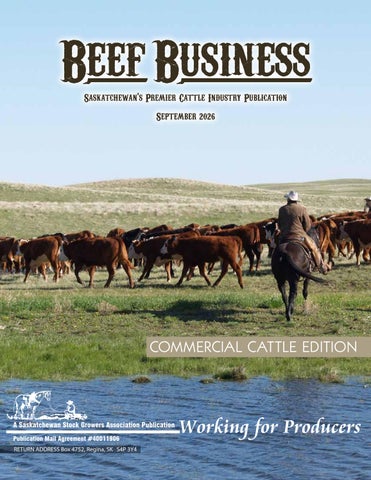
Beef Business ‘
Saskatchewan’s largest circulated industry magazine Saskatchewan`s Premiere Cattlecattle Industry Publication Saskatchewan's Premier Cattle Industry Publication September 2026
COMMERCIAL CATTLE EDITION
A Saskatchewan Stock Growers Association Publication Publication Mail Agreement #40011906 RETURN ADDRESS Box 4752, Regina, SK S4P 3Y4
Working for Producers
ORDER EARLY. SAVE BIG. Now is the best time to secure your new John Deere Hay & Forage equipment with the Brandt Early Order Program. The earlier you book, the more you save.
More Locations
Unmatched Support
Flexible Financing
As Canada’s largest John Deere dealer, Brandt has more inventory, faster access, and local expertise you can count on.
Brandt delivers 24/7/365 support to minimize your downtime and keep you running all season long.
Get the machine you want with flexible financing options tailored to your operation’s needs.
CAN’T WAIT? BRANDT HAS IN-STOCK OPTIONS READY NOW. Scan here to see them all. $460,000
2019 JOHN DEERE 9600 Stk: 1AU19119, 2387 Hours, Kernel Processor, No PRWD, Cutterhead with 56 Angled Corn Knives
$65,000
2008 JOHN DEERE 4895M Stk: 1AU40273, 1260 Hours, 30 Ft Grain Platform, 18.4 x 26 Bar Tires
Visit your local Brandt Ag dealer today to order your new Hay & Forage equipment. Terms and conditions apply.
more.brandt.ca/john-deere
$67,000
2021 JOHN DEERE 560M Stk: 1AU76660, 9524 Hours, MegaWide Pickup, Surface Wrap, 1000 PTO, 5x6 Bales
$535,000
2025 JOHN DEERE 6R 250 Stk: 1AU02368 , 457 Hours, Cab, MFWD with Suspension, IVT, Guidance Ready with Display
Across the working landscapes of Saskatchewan, the wetlands and grasslands needed by wildlife are owned and sustainably managed by ranchers like you. Ducks Unlimited Canada (DUC) offers farmgate conservation programs designed to support your business and stewardship efforts: Looking to buy land? DUC Conservation Easements pay up to 40% of FMV with no restrictions on haying or grazing. Need more forage? Take advantage of financial incentives and expert advice with DUC’s Forage Conversion Program. Or lease land through our annual Hay Tender Program.
1-866-252-DUCK du_regina@ducks.ca ag.ducks.ca
Contents A Saskatchewan Stock Growers Association (SSGA) Publication
INDUSTRY NEWS 6
A Stronger Future for Saskatchewan Beef Starts on the Range
7
Big Win ahead for Canadian Beef in Feed Ban Shift
10
A Late Summer Roundup of Ottawa’s Agriculture News
14
Funding the Frontier: $6.5M Pledged for Prairie Conservation and Sustainable Grazing
16
Dr. Bart Lardner Receives 2026 Canadian Beef Industry Award for Outstanding Research
19
Farm Credit Canada’s Sustainability Incentive Program
MARKETS AND TRADE Weekly Market Charts
21
Retail Meat Price Survey
22
Ralph and Linda Corcoran Win TESA for Spreading Knowledge about Soil Health
FEATURES SCIENCE AND PRODUCTION 24
Understanding and Calculating Price Slide
28
Active Missing Livestock Files
30
The Tip of the Iceberg – Part 2 of 3: Protection Beyond the Sale
32
Retained Ownership: Balancing Risk and Reward in a Small Margin World
ASSOCIATION NEWS AND REPORTS 38
Saskatchewan Feedlot Directory
40
Livestock Marketers of Saskatchewan Directory
42
Saskatchewan Stock Growers Association President's Report
43
Saskatchewan Stock Growers Association Rangeland Scholarship
44
Saskatchewan Stock Growers Association 2026 Annual General Meeting Resolutions
STEWARDSHIP 46
Swift Fox on the Prairies: Dispersal is Underway
48
$6.5 Million Commitment Strengthens Grassland Conservation through Rancher-Focused Programs
BUSINESS Calendar
51
Advertiser Index
52
Business Directory
Managing Editor: Kori Maki-Adair Tel: 403-680-5239 Email: kmaa@shaw.ca Agri-business Advertising Sales: Diane Sawatzky Tel: 306-716-4271 Email: sales@skstockgrowers.com Livestock Advertising Sales: Samantha Chamberlin Tel: 306-528-7658 Email: livestocksales@skstockgrowers.com
20
50
General Manager: Chad MacPherson Box 4752, Regina, SK S4P 2Z6 Tel: 306-757-8523 Email: gm@skstockgrowers.com Website: www.skstockgrowers.com
Subscriptions Box 4752, Regina, SK S4P 2Z6 Tel: 306-757-8523 Email: office@skstockgrowers.com Subscription Rate: One year $26.50 (GST included) Published five times per year Design and Layout: Bumble & Vine Creative | Candace Schwartz Tel: 306-772-0376 Email: candace@bumbleandvine.ca Prairie Conservation Action Plan (PCAP) Manager: Carolyn Gaudet Box 4752, Regina, SK S4P 2Z6 Tel: 306-352-0472 Email: pcap@sasktel.net SSGA reserves the right to refuse advertising and edit manuscripts. Contents of Beef Business may be reproduced with written permission obtained from SSGA's General Manager, and with proper credit given to Saskatchewan Stock Growers Association. Articles submitted may not be the opinion of SSGA. SSGA assumes no responsibility for any actions or decisions taken by any reader from this publication based on any and all information provided. Publications Mail Agreement #40011906 Return undeliverable Canadian addresses (covers only) to: Saskatchewan Stock Growers Association Box 4752, Regina, SK S4P 3Y4
Follow us on:
fb.com/skstockgrowers
@SK_StockGrowers
Cover photo courtesy of Terri Mason, Maple Creek, SK
Contributors
cycle This M a
e
Ple as
Re
zin ga
e
Liz Allen Beef Cattle Research Council Canfax Research Services Carolyn Gaudet Jeff Gaye Brenna Grant Mindy Hockley-Anderson
Chad MacPherson Kori Maki-Adair Kayla Petterson Jason Pollock Leanne Thompson Kelly WIlliamson Rikki Wilson
This magazine is printed on paper that is comprised of 50% recycled paper and 25% post-consumer waste. It is acid-free, elemental chlorine-free and is FSC certified
SEPTEMBER 2026
www.skstockgrowers.com | ©BEEF BUSINESS | 5
INDUSTRY NEWS
A Stronger Future for Saskatchewan Beef Starts on the Range Kori Maki-Adair
Saskatchewan’s cattle industry is entering a period of opportunity, with strong cattle markets and growing international demand for Canadian beef providing an encouraging backdrop for the Saskatchewan Stock Growers Association’s (SSGA) 113th Annual General Meeting (AGM) and Convention. Held June 7–9 in Swift Current under the theme “Celebrating Rangelands and Ranchers,” the convention brought together producers, industry leaders, researchers, government representatives and agricultural partners to discuss the issues shaping the future of Saskatchewan’s livestock sector.
of Saskatchewan’s ranching sector. “The strength of Saskatchewan’s cattle industry comes from producers who are willing to get involved, speak up and work together on the issues that matter to their businesses and communities,” Williamson said. “There is a lot of opportunity in front of us, but there is also important work to do to make sure producers have the tools and flexibility they need to take advantage of it.”
While market conditions offered reason for optimism, discussions also focused on the practical challenges facing producers, including traceability, animal health, risk management, wildlife, succession and regulatory policy.
achievement in fields related to rangeland management. Established in 1995 through member donations matched by Saskatchewan Environment’s Fish and Wildlife Development Fund, the scholarship reflects the SSGA’s longstanding commitment to supporting the next generation of agricultural and rangeland leaders. Producer stewardship was also recognized when Ralph and Linda Corcoran received the 2026 Environmental Stewardship Award (TESA) for their commitment to responsible land management and sustainable ranching practices on their ranch near Langbank, SK.
The SSGA’s annual report highlighted progress on several producer priorities, including the implementation of Saskatchewan’s new Satellite Forage Insurance Program, continued advocacy on Saskatchewan Stock Growers Association Board of Directors 2026-27 traceability and regulatory Back row, left to right: Calvin Gavelin, Larry Flaig, Chris Williamson, The convention marked a change Gord Kozroski, Joe Gilchrist, Vance Allinson issues, support for native prairie Front row, left to right: Chad MacPherson, Jeff Yorga, Chay Anderson, conservation, and collaboration in leadership for the SSGA, with Kelly Williamson, Henry McCarthy, Neil Block delegates electing with provincial and national Kelly Williamson as president. partners on animal health, market access, He will lead an executive that includes Rangeland stewardship was a central trade and industry competitiveness. Henry McCarthy, first vice-president; theme throughout the convention. Chay Anderson, second vice-president; A producer panel recognizing the United The Association also reported continued Neil Block, finance chair; and Nations’ International Year of Rangelands membership growth and increased Jeff Yorga, past president. and Pastoralists highlighted the producer engagement. importance of Saskatchewan’s grasslands The Association also welcomed to food production, biodiversity, wildlife For Saskatchewan ranchers, the message Clint Smith and Paul Buckingham as new habitat, carbon storage and rural from the AGM was one of opportunity Directors at Large. The SSGA expressed communities. balanced with the need for continued its appreciation to outgoing directors advocacy. Strong markets create room for Gerry Delorme, Kelly Lightfoot, The AGM also recognized the people growth, but maintaining a competitive Kurtis Reid and Garner Deobald for helping carry that stewardship into the and sustainable beef sector will require their time, dedication and service to future. Heidi Fradette, an agriculture practical policies, healthy rangelands and Saskatchewan’s livestock industry. student at the University of Saskatchewan investment in the people who will carry from Lake Alma, received the 2026 the industry forward. Williamson succeeds Yorga, whose Rangeland Scholarship at the AGM two-year term included significant banquet. “Ranching has always been about more advocacy on traceability reform, disease than raising cattle,” Williamson said. “It is preparedness, drought resilience, wildlife The $1,000 scholarship recognizes about caring for the land, supporting our management, property rights, forage students demonstrating leadership, neighbours and creating opportunities for insurance and the long-term sustainability community involvement and academic the next generation.”B 6 | ©BEEF BUSINESS | www.skstockgrowers.com
SEPTEMBER 2026
INDUSTRY NEWS
Big Win ahead for Canadian Beef in Feed Ban Shift Kori Maki-Adair
For cattle producers across Canada, proposed changes to Canada’s Enhanced Feed Ban may sound like a technical regulatory matter, but the changes could have implications well beyond the processing plant, helping reduce costs and improve the competitiveness of Canada’s beef industry.
including the brain and spinal cord from cattle 30 months of age or older, would remain prohibited for all uses, and prohibited material could not be fed to ruminants. While the changes would primarily affect slaughter and processing establishments, their impact could extend through the cattle supply chain.
The proposed amendments, published July 11 in Canada Gazette, Part I, would update Canada’s requirements for Under the current system, lower-risk SRM specified risk material (SRM) and bring is subject to requirements for handling, them closer to the approach used in the staining, transportation, tracking and United States. In a disposal. Those joint announcement, requirements add Under the proposal, certain the Canadian Cattle costs and limit lower-risk SRM could be Association (CCA) opportunities to and Canadian Meat recover value from diverted for use in nonCouncil (CMC) cattle by-products. ruminant livestock feed, welcomed the fertilizer and pet food, proposal as a longAllowing eligible sought opportunity material to move rather than being subject to reduce regulatory into non-ruminant to the same restrictions costs and improve feed, fertilizer and and disposal requirements the competitiveness pet-food markets currently applied to all SRM. could reduce those of Canadian beef. costs and create Canada’s Enhanced Feed Ban was additional value for processors and introduced in 2007 as part of measures renderers. A more competitive processing to control bovine spongiform sector, in turn, can support slaughter encephalopathy (BSE). Since then, the BSE capacity and provide more opportunities risk landscape has changed significantly. for packers to bid on cattle. Canada was recognized by the World Organisation for Animal Health (WOAH) as having negligible BSE risk status in 2021, the highest risk designation under WOAH standards. The proposed amendments recognize that reduced risk while maintaining safeguards for animal and human health.
That is particularly relevant in Saskatchewan, where cattle often move outside the province for processing. The strength and competitiveness of processing capacity elsewhere in Canada and across the border can affect the marketing opportunities available to Prairie cattle producers.
Under the proposal, certain lower-risk SRM could be diverted for use in non-ruminant livestock feed, fertilizer and pet food, rather than being subject to the same restrictions and disposal requirements currently applied to all SRM.
“These proposed changes recognize how much Canada’s BSE risk profile has changed while maintaining the safeguards that protect animal and human health. For Saskatchewan cattle producers, a more competitive processing sector means stronger markets and a more efficient value chain. Bringing
SRM would still be prohibited from the human food supply. High-risk material,
SEPTEMBER 2026
Canada’s regulations closer in line with our U.S. trading partners is an important step toward reducing unnecessary costs and ensuring our producers can compete on a more level playing field,” said Kelly Williamson, newly-elected president of Saskatchewan Stock Growers Association’s board of directors. Regulatory alignment with the United States is also important. Canadian cattle producers compete in an integrated North American market, where cattle, beef and related products move across borders. Differences in regulations can create competitive disadvantages even when the underlying animal-health risks are similar. The proposed amendments would bring Canada’s treatment of certain SRM closer to the U.S. approach while continuing to meet WOAH standards. The CCA and CMC have advocated for these changes since Canada received negligible BSE risk status in 2021. Their work with the Canadian Food Inspection Agency and Agriculture and Agri-Food Canada contributed to an industrygovernment working group examining how Canada’s requirements could be modernized. The proposal could also benefit smaller and regional processors, depending on their individual operations and ability to capture value from eligible materials. Across the Prairies, these facilities can provide important alternatives for producers and contribute to local agricultural economies. CCA has emphasized the importance of ensuring smaller establishments can benefit from the proposed regulatory flexibility. A stronger and more diverse processing network would give producers more marketing options and help build a more resilient cattle sector. Importantly, regulatory modernization continued on page 8
www.skstockgrowers.com | ©BEEF BUSINESS | 7
INDUSTRY NEWS Feed Ban Shift cont. from pg. 7 does not mean lower food-safety standards. The proposal would maintain the core protections of Canada’s feed-ban system, including the prohibition of SRM in human food and the restrictions on feeding prohibited material to ruminants. Requirements for segregation, traceability and preventing cross-contamination would also remain in place.
The proposed approach is voluntary, allowing businesses to take advantage of the new flexibility where it makes economic and operational sense. The changes were introduced as proposed regulations, with the consultation period closing on September 9, 2026, at 11:59 p.m. EDT. For Saskatchewan and Prairie cattle producers, the significance of the
proposal comes down to competitiveness. Reducing unnecessary costs, recovering more value from each animal and bringing Canadian requirements closer to those of our largest trading partner can strengthen the processing sector and, ultimately, the cattle industry. For an industry that competes in an integrated North American market, that is a change worth watching.B
November 2026 Beef Business Advertising Deadline October 22 COMMERCIAL ADS Diane at 306-716-4271 LIVESTOCK SALES Sam at 306-528-7658
Forward Flow With More Control
Hi-Hog’s Hydraulic Squeeze Chute with Head Holder
View Hi-Hog’s fully modular S-Alley Handling Systems at www.hi-hog.com
Contact us at salesinfo@hi-hog.com to begin designing your Custom System Curved for Efficiency, Built for Control – The S-Alley Handling System takes advantage of a cow’s natural movement. Call Hi-Hog for Dealer and System information at 1-800-661-7002
8 | ©BEEF BUSINESS | www.skstockgrowers.com
SEPTEMBER 2026
DON'T WAIT... BOOK YOUR DATE FOR 2026!
In the Hub of the Livestock Industry since 1967
SEPTEMBER
SUNDAY
MONDAY
TUESDAY
WEDNESDAY 1 2
THURSDAY
FRIDAY 3
REGULAR CATTLE & SPECIAL YEARLING/CALF SALE - 10 AM
7
9
LETHBRIDGE, AB
14
16
WILKINSON PERFORMANCE HORSES ANNUAL COLT SALE - 1 PM
LETHBRIDGE, AB
20
21
22
23
28
25
26
SEVEN PERSONS MACHINERY & EQUIP. CONSIGNMENT SALE - 10 AM
REGULAR SALE, SELLING CALVES, YEARLINGS, COWS & BULLS - 9 AM STAVELY, AB
30
LETHBRIDGE MACHINERY & EQUIPMENT CONSIGNMENT SALE - 10 AM LETHBRIDGE, AB
National Day for Truth and Reconciliation
RAYMOND, AB
MONDAY
24
LETHBRIDGE, AB
29
SHANE RODENBACK EXCAVATING CONSTRUCTION EQUIPMENT & LAND AUCTION - 10 AM
SUNDAY
19
STAVELY, AB
REGULAR CATTLE & SPECIAL YEARLING/CALF SALE - 10 AM
PONOKA, AB
27
18
CTHS ALBERTA THOROUGHBRED SALE RED DEER - 3 PM REGULAR SALE, SELLING CALVES, YEARLINGS, COWS & BULLS - 9 AM
LETHBRIDGE, AB
2026 ANNUAL AQHRA CANADA QH CUP YEARLING & MIXED SALE - 7 PM
TUESDAY
WEDNESDAY
THURSDAY
FRIDAY 1
SATURDAY
PERLICH BROS FALL HORSE SALE - DAY 1 - 6 PM
2
3
LETHBRIDGE, AB
OCTOBER
REGULAR CATTLE & YEARLING SALE - 10 AM
5
6
12
13
CUDLOBE ANGUS INFLUENCE VIDEO SALE - 11 AM FIRST PRESORT CALF SALE OF 2026 - 11 AM
LETHBRIDGE, AB
PRESORT CALF SALE - 11 AM PLEASE NOTE: ON TUESDAY DUE TO THANKSGIVING
Happy Thanksgiving
18
STAVELY, AB
19
TUESDAY 2 STOCK COW & BRED HEIFER SALE - 1 PM
PRESORT CALF SALE - 11 AM STAVELY, AB
8
3
9
16
LETHBRIDGE, AB
Remembrance Day
FRIDAY
REGULAR CATTLE & YEARLING SALE - 10 AM
LETHBRIDGE, AB
ANGUS X PRESORT CALF SALE - 10 AM LETHBRIDGE, AB
24
12
LETHBRIDGE, AB
29
RANCHER CALF SALE - 10 AM LETHBRIDGE, AB
STOCK COW & BRED HEIFER SALE - 1 PM
7 ANGUS X PRESORT CALF SALE - 10 AM LETHBRIDGE, AB
13
REGULAR SALE, SELLING CALVES, YEARLINGS, COWS & BULLS - 9 AM STAVELY, AB
19
14
STOCK COW & BRED HEIFER SALE - 1 PM
STOCK COW & BRED HEIFER SALE - 1 PM LETHBRIDGE, AB
20
REGULAR SALE, SELLING CALVES, YEARLINGS, COWS & BULLS - 9 AM
STAVELY, AB
STAVELY, AB
26
LETHBRIDGE, AB
SPECIAL BLACK FRIDAY STOCK COW & BRED HEIFER SALE - 1 PM
STOCK COW & BRED HEIFER SALE - 1 PM LETHBRIDGE, AB
27
28
REGULAR SALE, SELLING CALVES, YEARLINGS, COWS & BULLS - 9 AM STAVELY, AB
STOCK COW & BRED HEIFER SALE - 1 PM LETHBRIDGE, AB
30
A family owned business that has been serving the agricultural community for 59 years. We are proud to be a part of the industry and its traditions.
perlich.auction
FOREMAN Jake Daniels
403.635.0309 Cell
Perlich Bros Auction Market Ltd. PHONE: 403-329-3101 TOLL FREE: 1-855-737-5424 EMAIL: auction@perlich.com
21
LETHBRIDGE, AB
BRED SALE - 1:30 PM
REGULAR CATTLE & YEARLING SALE - 10 AM
403.635.0310 Cell 403.331.1830 Cell 403.331.9433 Cell
31
LETHBRIDGE, AB
STOCK COW & BRED HEIFER SALE - 1 PM
Joe Perlich Corey French Justin Perlich
LETHBRIDGE, AB
LETHBRIDGE, AB
REGULAR CATTLE & YEARLING SALE - 10 AM
25
FIELD REPS./AUCTIONEERS
ANGUS X PRESORT CALF SALE - 10 AM
SATURDAY
STAVELY, AB
LETHBRIDGE, AB
RANCHER CALF SALE - 10 AM
Darcy Moorhead 403.635.0308 Cell Ken Lidberg 403.382.8189 Cell Bill Perlich 403.540.1884 Cell Tom Barr 403.627.7400 Cell Lorne Depaoli 403.652.0344 Cell
17
6 REGULAR SALE, SELLING CALVES, YEARLINGS, COWS & BULLS - 9 AM
LETHBRIDGE, AB
LETHBRIDGE, AB
24
LETHBRIDGE, AB
FIELD REPS
LETHBRIDGE, AB
5
18
403.382.7800 403.331.9911 Cell
ANGUS X PRESORT CALF SALE - 10 AM
REGULAR CATTLE & YEARLING SALE - 10 AM
LETHBRIDGE, AB
ANGUS X PRESORT CALF SALE - 10 AM
30
LETHBRIDGE, AB
11
17
23
STAVELY, AB
29
THURSDAY
RANCHER CALF SALE - 10 AM
STOCK COW & BRED HEIFER SALE - 1 PM
22
LETHBRIDGE, AB
10
23 REGULAR SALE, SELLING CALVES, YEARLINGS, COWS & BULLS - 9 AM
WEDNESDAY 4
10
LETHBRIDGE, AB
15
22
REGULAR CATTLE & YEARLING SALE - 10 AM
LETHBRIDGE, AB
STOCK COW & BRED HEIFER SALE - 1 PM
STAVELY, AB
REGULAR CATTLE & YEARLING SALE - 10 AM
LETHBRIDGE, AB
16 REGULAR SALE, SELLING CALVES, YEARLINGS, COWS & BULLS - 9 AM
LETHBRIDGE, AB
ANGUS X CHAR. PRESORT CALF SALE - 10 AM
RANCHER CALF SALE - 10 AM
LETHBRIDGE, AB
STAVELY, AB
15 REGULAR CATTLE & YEARLING SALE - 10 AM
PERLICH BROS FALL HORSE SALE - DAY 2 - 11 AM
9 REGULAR SALE, SELLING CALVES, YEARLINGS, COWS & BULLS - 9 AM
LETHBRIDGE, AB
28
LETHBRIDGE, AB
MONDAY
REGULAR CATTLE & YEARLING SALE - 10 AM
21
27
STAVELY, AB
1
LETHBRIDGE, AB
LETHBRIDGE, AB
26 PRESORT CALF SALE - 11 AM
SUNDAY
ANGUS INFLUENCE RANCHER CALF SALE - 10 AM
ANGUS X PRESORT CALF SALE - 10 AM
STAVELY, AB
8
14
20
PRESORT CALF SALE - 11 AM
STAVELY, AB
7 RANCHER CALF SALE - 10 AM
STAVELY, AB
11
25
NOVEMBER
REGULAR SALE, SELLING CALVES, YEARLINGS, COWS & BULLS - 9 AM
LETHBRIDGE, AB
4
Bob Perlich John Perlich
12
STAVELY, AB
17 REGULAR CATTLE & SPECIAL YEARLING/CALF SALE - 10 AM
STAVELY, AB
11 REGULAR SALE, SELLING CALVES, YEARLINGS, COWS & BULLS - 9 AM
LETHBRIDGE, AB
15
5
STAVELY, AB
10 REGULAR CATTLE & SPECIAL YEARLING/CALF SALE - 10 AM
SHEEP SALE - 1 PM
Labour Day
13
8
4 REGULAR SALE, SELLING CALVES, YEARLINGS, COWS & BULLS - 9 AM
LETHBRIDGE, AB
6
AUCTIONEERS
SATURDAY
Foothills Auctioneers Inc PHONE: 403-549-2120 TOLL FREE: 1-877-549-2121 EMAIL: office@foothillsauctioneers.com
Box 1057, Lethbridge, AB T1J 4A2 3 Miles East of Lethbridge on Highway #3 and 1/4 Mile South on the Broxburn Road
| foothillsauctioneers.com AB. Lic. #0714651
SK. Lic. # 915403
INDUSTRY NEWS
A Late Summer Roundup of Ottawa’s Agriculture News Kori Maki-Adair
Summer on the Prairies has a way of making the days run together. One minute you’re checking your animals, the next you’re trying to beat a storm rolling in, and before you know it, September is underway. Ottawa has been busy, too. Between May 1 and August 31, the federal government announced a series of agriculture-related initiatives touching on everything from clean technology and food security to beef marketing, trade, risk management and the next generation of agricultural policy.
For a cattle producer, “clean technology” may sound like something dreamed up in a boardroom, but the practical question is always the same: Does it make the operation work better?
The government’s argument is straightforward: Canada grows a lot of food, but too much of what is produced is processed elsewhere, while Canadians continue to face high food costs.
Whether that means more efficient equipment, automation, better data or other technologies that reduce costs and improve productivity, the federal government is betting that innovation will have a bigger role to play on Canadian farms and ranches.
For cattle producers, the emphasis on domestic processing and reducing regulatory bottlenecks is worth watching. A stronger Canadian food system ultimately depends on having the infrastructure and processing capacity to turn what is produced on Canadian farms and ranches into products consumers can buy.
Here’s a look back at the summer’s announcements, in chronological order, and what they could mean for producers.
And with that first announcement, the summer’s theme was set: Ottawa was talking about how to make Canadian agriculture more competitive while building resilience for what lies ahead.
May 8: A push for cleaner agricultural technology
June 11: Ottawa puts food security on the table
The sunny season’s first announcement came May 8, when the Government of Canada announced up to $30 million over two years through the Agricultural Clean Technology Program Research and Innovation Stream – Accelerator.
A month later, the focus shifted from technology to the broader food system.
The money will flow through six notfor-profit organizations that will, in turn, distribute funding to eligible projects focused on developing and demonstrating clean technologies for Canadian agriculture. The organizations include Bioenterprise Canada, the Canadian Agri-Food Automation and Intelligence Network, the Canadian Food Innovation Network, MaRS Discovery District, Ontario Genomics and Zone Agtech. The government’s stated goal is to help producers and agri-businesses gain access to technologies that can reduce greenhouse gas emissions while improving competitiveness and resilience. The Agricultural Clean Technology Program is part of Ottawa’s broader effort to encourage the development and adoption of new technologies in agriculture.
On June 11, Prime Minister Mark Carney launched Canada’s first-ever National Food Security Strategy, backed by more than $3 billion in investments over 10 years. The strategy is aimed at increasing domestic food production, strengthening Canada’s food-processing capacity, improving competition and reducing red tape across the agricultural supply chain. There are four main objectives: increasing grocery competition, boosting domestic food production, expanding year-round fruit and vegetable production, and cutting regulatory red tape. For agriculture, some of the more notable pieces include a $1-billion Agri-food Project Finance Fund through Farm Credit Canada, a $150-million Food Security Fund for small and medium-sized businesses, and a $100-million Collaborative Food Innovation Fund. The strategy also calls for modernizing regulations and speeding approvals for seeds, feed, fertilizer and veterinary products.
10 | ©BEEF BUSINESS | www.skstockgrowers.com
In other words, the conversation moved from what’s happening on the farm or ranch to what happens all the way down the food chain. By July, the federal announcements got considerably closer to home for the beef sector. July 8: More than $4 million aimed at growing Canadian beef The first major beef-specific announcement of the summer came July 8 in Calgary. The federal government announced more than $4 million through the AgriMarketing Program for two organizations representing the Canadian beef industry. Canada Beef was allocated up to $3.741 million over two years, while the Canadian Cattle Association (CCA) was allocated up to $300,000 over two years. Canada Beef’s funding is intended to increase awareness and demand for Canadian beef and veal among domestic and international customers. The CCA’s funding is aimed at defending and expanding market access through trade advocacy, international relationships and support for trade rules based on evidence.
SEPTEMBER 2026
INDUSTRY NEWS That is a pretty familiar set of priorities for cattle country: find more markets, protect the markets we have and make sure Canadian beef has a seat at the table when trade rules are being written.
information about weather, forage, crops, moisture and land conditions could eventually help producers make decisions with fewer trips down the road and fewer guesses at the kitchen table.
Canadian Cattle Association President Tyler Fulton said the AgriMarketing funding will allow the association to participate in federal trade missions, investigate potential new export markets and ensure the Canadian cattle producer perspective is represented in global policy discussions.
The technology may be futuristic, but the goal is as old-fashioned as ranching itself: know what you have, know what the conditions are, and make the best decision you can.
For producers who have watched markets, trade negotiations and border policies closely, the announcement is a reminder that the value of a calf doesn’t stop at the auction mart. What happens in international boardrooms can eventually find its way back to the ranch gate.
If there was ever a natural setting for talking agriculture, it was Calgary during Stampede week.
July 9: From the pasture to the satellite The very next day, Ottawa announced another investment; this time, in artificial intelligence, remote sensing and climatesmart agriculture. The government committed up to $1.65 million to Toronto-based A.U.G. Signals Ltd. through the AgriScience Program. The three-year project will combine satellite, drone and field data to develop tools for monitoring crop health, assessing drought conditions, measuring above-ground biomass and forecasting yields. The project will also involve Agriculture and Agri-Food Canada scientists in collecting field data and validating the AI models. The stated objective is to help Canadian agriculture become more productive and resilient in the face of climate change. Now, cattle ranchers may not be losing sleep wondering whether their AI model has accurately predicted crop emergence, but the broader trend is hard to miss. Agriculture is becoming increasingly data-driven, and technologies originally developed for other industries are finding their way onto the farm and ranch. Better
July 13: Calgary Stampede brings the conversation to cattle country
On July 13, Agriculture and Agri-Food Minister Heath MacDonald wrapped up an outreach visit to Alberta that included meetings with producers, ranchers, feeders, processors and industry organizations.
For safe and effective drug delivery, choose
Pneu-Dart For more than 50 years, Pneu-Dart has offered the best remote injection equipment for your drug delivery needs. Our Remote Drug Delivery (RDD) systems are designed to capture or medicate while minimizing stress on animals. Whether you're treating freerange cattle, sedating cervid livestock, or assisting in the translocation of wild animals, Pneu-Dart manufactures the products to handle every target situation. Less stress on the animal
During the visit, the minister announced the same beef-sector investments highlighted on July 8, including the funding for Canada Beef and the Canadian Cattle Association. He also toured farms, ranches, agriculture businesses and processing facilities and met with industry representatives at the Stampede.
No need to confine
High tech darts for ideal delivery
Model 196
Model 389
The discussions covered familiar territory: expanding access to trade markets, reducing trade barriers, strengthening risk-management programs, investing in innovation and resilience, and maintaining communication between government and producers.
Model 178BS
G2 X-Caliber
That last point may be one of the more important takeaways. Government programs are one thing; understanding what is actually happening on the ground is another. For Saskatchewan’s beef producers, there is plenty of common ground with the Alberta conversations. The Prairies may be divided by a provincial boundary, but cattle don’t pay attention to it and neither do many of the challenges facing producers. continued on page 12
Canadian Distributor | Since 2012 INC.
B E C A U S E Y O U C A N ’ T A F F O R D T O M I S S®
Dale Watson 306.861.4618
Austin Watson 306.861.7031
Brody Ward 306.861.7191
targetcattleconcepts@gmail.com targetcattleconcepts.com Follow us on
SEPTEMBER 2026
www.skstockgrowers.com | ©BEEF BUSINESS | 11
INDUSTRY NEWS Late Summer Roundup cont. from pg. 11 By that time in mid-July, the federal message was becoming fairly consistent: grow markets, improve competitiveness, reduce barriers and listen to producers. However, there was one more piece of the summer puzzle to come. July 17: Agriculture ministers look toward 2028 and beyond Just four days later, federal, provincial and territorial agriculture ministers wrapped up their annual meeting in Halifax. The meeting focused heavily on the future of Canadian agricultural policy, including progress under the Sustainable Canadian Agricultural Partnership and development of the Next Policy Framework for 2028-2033. Ministers also issued the Halifax Statement, outlining shared principles around economic growth, competitiveness, market diversification and the future of Canadian agriculture. For producers, one particularly notable discussion involved Business Risk Management programs. Ministers agreed that these programs need to be flexible, responsive to changing risks and accessible to producers. They also agreed in principle to changes to AgriStability related to nonarm’s-length labour and contract work. The proposed changes would recognize compensation paid to family members for work performed on the farm and would make certain contract work, such as laying hay or hauling grain, an eligible expense. That is the kind of detail that may not make for impactful headlines, but it can matter when producers sit down to figure out how a risk-management program fits the realities of a family operation. Dear Readers,
The ministers also returned to the themes raised earlier in the summer: food processing capacity, innovation, regional infrastructure and a more resilient domestic food system. Taken together, the summer’s announcements offer a broad picture of Ottawa’s direction for Canadian agriculture. Not every measure will immediately affect Saskatchewan livestock operations, but the overall direction warrants attention. Competitiveness, market access, risk management, processing capacity, innovation and regulatory efficiency are increasingly interconnected; and, will take more than one summer to put in place. As summer winds down and cattle take on that late-season look, one thing is clear: Ottawa is talking about the future of Canadian agriculture. The real test will be whether that talk delivers better tools, better markets and better returns for producers.B REFERENCES Agriculture and Agri-Food Canada
• May 8, 2026: Government of Canada invests $30M in six NFPs to help accelerate clean tech https://www.canada.ca/ en/agriculture-agri-food/ news/2026/05/government-ofcanada-invests-30-million-in-sixnot-for-profit-organizations-tohelp-accelerate-clean-technologyinnovation-across-canadianagriculture.html
• July 8, 2026: Government of Canada makes investment under the AgriMarketing Program to help grow the Canadian beef sector https://www.canada.ca/ en/agriculture-agri-food/
news/2026/07/government-ofcanada-makes-investment-underthe-agrimarketing-program-tohelp-grow-the-canadian-beefsector.html • July 9, 2026: Government of Canada invests in artificial intelligence and remote sensing for climate-smart agriculture https://www.canada.ca/ en/agriculture-agri-food/ news/2026/07/governmentof-canada-invests-in-artificialintelligence-and-remote-sensingfor-climate-smart-agriculture.html • July 13, 2026: Minister MacDonald concludes successful outreach to Alberta during the Calgary Stampede https://www.canada.ca/ en/agriculture-agri-food/ news/2026/07/ministermacdonald-concludes-successfuloutreach-to-alberta-during-thecalgary-stampede.html • July 17, 2026: Minister MacDonald concludes annual FPT meeting with Ministers of Agriculture https://www.canada.ca/ en/agriculture-agri-food/ news/2026/07/ministermacdonald-concludes-annualfederal-provincial-and-territorialmeeting-with-ministers-ofagriculture.html Prime Minister of Canada June 11, 2026: Prime Minister Carney launches National Food Security Strategy to build a more affordable and resilient food system in Canada https://www.pm.gc.ca/en/news/newsreleases/2026/06/11/prime-ministercarney-launches-national-food-securitystrategy
Are You Moooving?
To ensure you continue to receive Beef Business Magazine without any interruptions, please contact us with your name, old and new mailing address by telephone or email. Telephone: 306-757-8523 Email: office@skstockgrowers.com. 12 | ©BEEF BUSINESS | www.skstockgrowers.com
SEPTEMBER 2026
INDUSTRY NEWS
Funding the Frontier: $6.5M Pledged for Prairie Conservation and Sustainable Grazing Kori Maki-Adair
A $6.5 million commitment from the Weston Family Foundation will give the Saskatchewan Stock Growers Foundation (SSGF) more capacity to expand its voluntary grassland conservation programs across the province. The five-year commitment is part of the Weston Family Foundation’s Prairie Grasslands Initiative and will support conservation, sustainable ranching practices and stewardship of Saskatchewan’s native grasslands. The SSGF has been developing and delivering producer-focused conservation programs since 2020, with much of that work taking place in Southwest Saskatchewan. The new funding will allow the foundation to reach more ranchers, livestock producers and agricultural landowners in other parts of the province.
Native grasslands are an important part of Saskatchewan’s agricultural landscape, but much of the province’s original prairie has been lost to land-use changes. The SSGF estimates that less than 20 per cent of Saskatchewan’s native grasslands remain. For the Saskatchewan Stock Growers Foundation, keeping those remaining grasslands intact also means recognizing the role of the people who manage them. “The Weston Family Foundation’s support over the years has really helped us make a difference for grassland conservation on the ground level,” said SSGF President Kelcy Elford. “This partnership supports not just native grasslands, but also the ranching families and local communities that depend on them.”
Looking to upgrade your watering system? New Vision Agro is proud to stock L-con Industries concrete waterbowl pads and Ritchie waterbowls
232 West Service Rd. Hague, SK For inquiries please call 306 225 2226 www.newvisionagro.com 14 | ©BEEF BUSINESS | www.skstockgrowers.com
The new funding will support several SSGF programs, including the Term Conservation Easement Program. The program gives producers the option of protecting native grasslands for a defined period of time, while maintaining the flexibility to make future land-use decisions. That can be an important consideration for ranching families looking at succession or trying to keep options open for the next generation. The SSGF will also continue its Habitat Management Agreements, which work with ranchers and land managers on infrastructure and stewardship practices that can help maintain and improve native grassland habitat. Another area of work will be the Bird-friendliness Index (BFI) Incentive Program, delivered in partnership with Birds Canada. The program uses the BFI to measure outcomes for grassland birds and provides incentives to land stewards for positive conservation results. “Grassland birds are the fastest declining group of birds in Canada, which is why Birds Canada is proud to partner with SSGF to deliver the Bird-friendliness Index Incentive Program,” said Dr. Kiel Drake, director of the Prairie Region for Birds Canada. The program is intended to complement the other conservation work already taking place on Saskatchewan ranches and farms. A common theme across the programs is flexibility. Rather than taking a one-sizefits-all approach, the SSGF works with producers to find conservation practices that fit the land and the operation. That approach is also reflected in the Weston Family Foundation’s Prairie Grasslands Initiative, which supports work focused on stewardship, economic viability and training. SEPTEMBER 2026
INDUSTRY NEWS “Canada’s prairie grasslands are some of the most ecologically valuable and threatened ecosystems in the world, and we have a responsibility to protect them for future generations,” said Christian Bauta, chair of the Weston Family Foundation.
detailed understanding of how grazing, weather, forage conditions, and other management decisions affect the landscape.
“There’s no singular solution. These are working landscapes and protecting them means supporting a range of long-term solutions that reflect the realities of the people connected to the land; their knowledge, their livelihoods, and their long history of stewardship.” The partnership will also focus on keeping existing ranchers and Indigenous partners on the land, while supporting opportunities for new and emerging producers to enter and stay in the livestock industry. That generational connection is important to the future of Saskatchewan’s grasslands. Ranchers who have worked the same land for decades often have a
The SSGF says the continued demand for its conservation programs shows that producers are interested in conservation opportunities that recognize both the ecological and economic realities of ranching. For Saskatchewan landowners, the expanded programming will provide more options to consider as they make decisions about their land and the future of their operations. The Weston Family Foundation’s Prairie Grasslands Initiative is a 10-year, $70 million commitment to prairie grassland conservation across Canada. The initiative supports communityled projects that bring together land stewards, Indigenous communities and other partners to improve stewardship, address economic pressures affecting
land-use decisions, and provide training and resources. The new five-year commitment builds on an existing relationship between the Weston Family Foundation and SSGF and will allow the foundation to expand its conservation work to more of Saskatchewan. For Elford, the investment is ultimately about supporting the people who are already caring for the province’s native prairie. “With demand for our programs growing year after year, it’s clear SSGF fits with what ranchers and landowners are already working toward, keeping these grasslands healthy and intact for the next generation,” he said. B Learn more at https://ssgf.ca/6-5-millioncommitment-strengthens-grasslandconservation-through-rancher-focusedprograms/
Tag well with Shearwell A World First! MET RFID Tag Order now tags.canadaid.ca or wherever you buy your tags
SEPTEMBER 2026
A revolutionary stainless steel RFID tag for exceptional retention Stainless steel
Built-in HDX RFID chip
Official CCIA tag!
Excellent retention
www.skstockgrowers.com | ©BEEF BUSINESS | 15
INDUSTRY NEWS
Dr. Bart Lardner Receives 2026 Canadian Beef Industry Award for Outstanding Research Beef Cattle Research Council | BeefResearch.ca
On August 19, 2026, a nationally and internationally recognized leader in beef cattle management and forage production was recognized with one of the Canadian beef industry’s top honours. Dr. Bart Lardner is the recipient of the 2026 Canadian Beef Industry Award for Outstanding Research and Innovation.
career conducting applied research to advance the cow-calf and forage sectors. His research on field feeding has led to the practice becoming commonplace in Western Canada, while research on the impacts of water quality from 20 years ago is still being used today to develop decision tools for producers.”
“Dr. Lardner’s research has helped producers reduce costs while maintaining performance and profitability,” said Dean Manning, chair of the Beef Cattle Research Council (BCRC) and a beef producer near Falmouth, Nova Scotia. “Committing to ensure beef producers see value from research investment while supporting the next generation is greatly respected and appreciated.”
Dr. Lardner’s research emphasizes lowering production costs while maintaining profitability, with lasting impacts on grazing systems, forage use and management decisions. His water quality studies showed up to nine per cent higher weight gains, leading to widespread adoption of off-site watering systems now supported by government programs. He introduced forage varieties and validated delayed swathing for winter grazing, increasing yield and adding 30 grazing days. In addition, his work challenged traditional heifer development by showing breeding at 55 per cent of mature weight maintains fertility while saving $60 per head.
Dr. Lardner is a professor and researcher at the University of Saskatchewan’s College of Agriculture and Bioresources and is the current Ministry of Agriculture Strategic Research Program Chair in Cow-Calf and Forage Systems. His work focuses on the management and nutritional requirements of cow-calf, replacement heifers and feeder animals. For more than two decades, Dr. Lardner’s applied research has shaped everyday practices on Western Canadian farms and ranches—from winter grazing and bale feeding to water quality management and heifer development. He is passionate about conducting research to generate recommendations on practices and technologies for cow-calf and forage producers to advance their productivity and profitability while supporting longterm sustainability. With every study he leads, he aims to consider the implications for beef production. “Dr. Lardner’s ability to work across disciplines is impressive,” said Dr. Jeff Schoenau from the University of Saskatchewan. “Bart has spent his
After 20 years as the senior research scientist at the Western Beef Development Centre, Dr. Lardner moved his robust research program to the University of Saskatchewan’s Livestock and Forage Centre of Excellence. “As a researcher, he understands the importance of building the next generation of highly qualified professionals, having supervised over 20 graduate students. He knows the importance of multidisciplinary research and builds collaborations among soil scientists, veterinarians, plant breeders, engineers, economists and producers to ensure research questions are examined from all angles,” says Saskatchewan beef producer Charlotte Ward. “As a cow-calf producer myself, I have seen the positive impact of his research on improving the profitability and sustainability of my operation.”
16 | ©BEEF BUSINESS | www.skstockgrowers.com
University of Saskatchewan Adjunct Professor Dr. Breanna Kelln and BCRC Science and Knowledge Mobilization Specialist Stacey Domolewski presented Dr. Bart Lardner with the 2026 Canadian Beef Industry Award for Outstanding Research and Innovation at the Canadian Beef Industry Conference in Winnipeg.
Beyond his prolific research, Dr. Lardner is highly regarded for teaching and mentoring future researchers. He leads an active graduate program, supervising over 25 graduate and numerous undergraduate students. His students are in high demand, often receiving multiple job offers before graduation— a testament to the quality of his mentorship and industry respect. Dr. Lardner is passionate about beef and forage extension and has delivered more than 400 invited presentations throughout Western Canada and the Northern United States. He has also travelled to similar latitudes around the world—Mongolia, China, the United Kingdom, Ireland, Sweden and Finland— to teach and extend his research on cow-calf nutrition and forage and pasture management. “Bart’s career has focused on conducting applied research to advance the cow-calf continued on page 18 SEPTEMBER 2026
ONE NAME. PICK YOUR FIGHT. A powerful line of cattle vaccines for scours, respiratory, clostridial and reproductive diseases—trusted, proven and now united under a bold look.
One name. Comprehensive portfolio. BOVILIS®. Producers, talk to your veterinarian about using Bovilis ® vaccines in your vaccination protocol. Veterinarians, contact your Merck Animal Health representative for more information, call 1-866-683-7838 or visit www.merck-animal-health.ca. Always read and follow the label instructions to ensure these products are suitable for the animals to be vaccinated. Vaccination may not protect every animal that gets vaccinated. BOVILIS ®, GUARDIAN ®, VISION ® and VISTA ® are registered trademarks of Intervet International B.V. Used under license. COVEXIN ®, NASALGEN ®, ONCE PMH ® and TASVAX® are registered trademarks of Intervet Inc. Used under license. MERCK® is a registered trademark of Merck Sharp & Dohme LLC. Used under license. © 2025 Merck & Co., Inc., Rahway, NJ, USA and its affiliates. All rights reserved. CA-NAL-240900002
SEPTEMBER 2026
www.skstockgrowers.com | ©BEEF BUSINESS | 17
INDUSTRY NEWS 2026 Canadian Beef Industry Award cont. from pg. 16 and forage sectors of the beef industry,” says Jeremy Brown, beef producer and member of the Saskatchewan Forage Council. “His ability to apply scientific rigor to the evaluation of new technologies and practices, while utilizing well-established recommendations to ensure producers can make informed decisions about the adoption of a practice or technology, is just one of the reasons he is such a wellrespected and sought-after guest speaker and industry resource.”
The Canadian Beef Industry Award for Outstanding Research and Innovation is presented by the BCRC on behalf of Canada’s beef industry. The award recognizes scientists and academics who are actively involved in strong research programs aligned with industry priorities, continually engaged with industry stakeholders and demonstrate their passion and long-term commitment through leadership, teamwork and mentorship.
Nominations are accepted by the BCRC from industry stakeholders and must be accompanied by letters of support from industry and scientific colleagues. The recipient is selected by a committee comprised of beef producers, industry experts and retired beef-related researchers located across the country. The award was established in 2015. B
Herd That! Cows can sleep while standing up. However, they must lie down to reach deep rapid eye movement (REM) sleep. 81 per cent of Beef Business readers have made business management changes or decisions based on information in Beef Business?
CELEBRATING WOMEN IN AGRICULTURE Dear Beef Business Readers, We are excited to announce a regular series of feature articles that celebrate the remarkable contributions of women in agriculture. It is an opportunity to recognize and honour the inspiring women who are making a significant impact in Canadian agriculture.
Call for Nominations
We invite you to submit nominations for women who exemplify excellence, innovation, and leadership in agriculture. Whether they are livestock producers, researchers, educators, or advocates, we want to hear their stories! Nomination Guidelines: •
Eligibility: Women who are or have dedicated their time and focus to any aspect of agriculture in Canada or abroad.
•
Submission Details: Please email the nominee's name, contact information, a brief description of their contributions, and why you believe they deserve recognition to gm@skstockgrowers.com
•
Deadline for Nominations: Ongoing
Your nominations will help us shine a spotlight on the incredible work being done by women in agriculture. Let’s celebrate their achievements and inspire future generations! Thank you for your participation. Best regards, The Editor
18 | ©BEEF BUSINESS | www.skstockgrowers.com
SEPTEMBER 2026
INDUSTRY NEWS
Farm Credit Canada’s Sustainability Incentive Program Innovative producers are key to growing a more sustainable future for agriculture, and these changes require research, time and capital. Working with industry partners, Farm Credit Canada (FCC) created a Sustainability Incentive Program in 2025 to recognize and support eligible customers who meet the requirements of participating sustainability programs. Payments are calculated as a portion of your lending with FCC. For each eligible sustainability program, producers could receive one payment per year, up to a maximum of $4,000. Producers can reapply once each program year for the life of the program. For beef producers participating in the Canadian Roundtable for Sustainable Beef (CRSB) certification program, eligibility
requires CRSB certification through a CRSB-approved certification body, as well as being an FCC customer in good standing with an eligible existing FCC loan balance. The application process is designed to be straightforward. Applicants may be asked to provide their contact information, FCC customer number, proof of active certification and the name of the certification body that provided the certification. FCC offers Sustainability Incentive Programs through a number of industry partnerships. Producers who participate in more than one eligible program may be able to qualify for more than one incentive payment.
The program is intended to help offset some of the costs associated with adopting sustainable practices and participating in recognized sustainability programs, while supporting the continued development of a resilient Canadian agriculture sector. For more information about the program, eligible sustainability programs, application dates and how to apply, visit the respective program information provided by FCC. Applications for all programs will close on January 31, 2027. B For more information or to ask questions about this program, please email: SustainabilityPrograms@fcc-fac.ca
aMOOsing facts Canada has 12.1 million cattle and calves spread across more than 71,000 farms and ranches, according to July 2026 data reported by Statistics Canada SEPTEMBER 2026
www.skstockgrowers.com | ©BEEF BUSINESS | 19
MARKETS AND TRADE LEGEND 2026 2025 2024 5-YEAR AVERAGE
Canfax is funded by Memberships, go to www.canfax.ca to subscribe.
SK Weekly Average Price Heifers 500-600 lbs 650.00
775.00 725.00 Price per hundred weight
550.00 500.00 450.00 400.00 350.00
675.00 625.00 575.00 525.00 475.00 425.00 375.00 325.00 275.00
Source: CanFax
Wk 52
Wk 49
Wk 46
Wk 43
Wk 40
Wk 37
Wk 34
Wk 31
Wk 28
Wk 25
Wk 22
Wk 19
Wk 16
Wk 13
Wk 7
Alberta Weekly D1 and D2 Cows 270.00 Price per hundred weight
350.00
Source: CanFax
190.00 170.00 150.00 130.00 Wk 52
Wk 49
Wk 46
Wk 43
Wk 40
Wk 37
Wk 34
Wk 31
Wk 28
Wk 25
Wk 22
Wk 19
Wk 16
Wk 1
Source: CanFax
Weekly Canadian Dollar Weekly Canadian Dollar
0.77
Wk 13
110.00
Wk 52
Wk 49
Wk 46
Wk 43
Wk 40
Wk 37
Wk 34
Wk 31
Wk 28
Wk 25
Wk 22
Wk 19
Wk 16
Wk 13
Wk 10
Wk 7
Wk 4
Wk 1
200.00
210.00
Wk 10
250.00
230.00
Wk 7
300.00
250.00
Lethbridge Barley Price 330.00
0.76
320.00
Price per tonne
0.75 0.74 0.73 0.72 0.71
310.00 300.00 290.00 280.00 270.00 260.00
0.70
Source: Bank of Canada
20 | ©BEEF BUSINESS | www.skstockgrowers.com
Source: CanFax
SEPTEMBER 2026
Wk 52
Wk 49
Wk 46
Wk 43
Wk 40
Wk 37
Wk 34
Wk 31
Wk 28
Wk 25
Wk 22
Wk 19
Wk 16
Wk 13
Wk 10
Wk 7
Wk 1
Wk 52
Wk 49
Wk 46
Wk 43
Wk 40
Wk 37
Wk 34
Wk 31
Wk 28
Wk 25
Wk 22
Wk 19
Wk 16
Wk 13
Wk 10
Wk 7
Wk 4
Wk 1
250.00 Wk 4
Price per hundred weight
Wk 10
Wk 1
Source: CanFax
AB Fed Steer Prices
CDN $ - US terms
Wk 4
225.00
Wk 52
Wk 49
Wk 46
Wk 43
Wk 40
Wk 37
Wk 34
Wk 31
Wk 28
Wk 25
Wk 22
Wk 19
Wk 16
Wk 13
Wk 7
Wk 10
Wk 4
Wk 1
300.00
Wk 4
Price per hundred weight
600.00
0.69
SK Weekly Average Price Steers 500-600 lbs
MARKETS AND TRADE
RETAIL MEAT PRICE SURVEY as of August 25, 2026 ($/lb)
SUPERSTORE
SOBEYS
CO-OP
SAVE-ON-FOODS
$ 9.00
$ 11.01
$ 9.01
$ 9.50
Cross rib roast
*
$ 7.96
$ 14.02
*
Rib roast
*
$ 31.05
$ 21.53
$ 30.01
Outside round roast
$ 15.00
$ 14.52
$ 11.01
$ 17.03
Inside round roast
$ 15.00
$ 14.53
$ 13.02
$ 17.03
Ribeye steak
$ 27.00
$ 20.13
$ 21.49
$ 37.55
Round steak
$ 15.99
$ 14.52
$ 13.52
$ 18.52
Sirloin steak
$ 26.99
$ 30.05
$ 22.03
$ 19.02
T-bone steak
$ 25.99
$ 29.05
$ 25.04
$ 29.01
Tenderloin
$ 41.00
$ 40.07
$ 35.06
$ 55.02
Ground beef - lean
*These items were unavailable at the time of data collection
SEPTEMBER 2026
www.skstockgrowers.com | ©BEEF BUSINESS | 21
FEATURE
Ralph and Linda Corcoran Win TESA for Spreading Knowledge about Soil Health Jeff Gaye
Over their ranching career, Ralph and Linda Corcoran have raised tonnes and tonnes of beef while leaving their land better than they found it. But their legacy as ranchers and environmental stewards isn’t just the beef they produced or the state of their own ranch; it’s the knowledge they gained and shared in the process. Ralph and Linda are this year’s recipients of The Environmental Stewardship Award (TESA) for Saskatchewan. They started ranching as newlyweds in 1976, on rented land with a few cows. By 1985, they were able to buy four quarters near Langbank, and soon purchased an adjoining 4.5 quarters. There they raised cattle and grew crops, finding the land suitable for what they wanted to do. Approximately 450 acres of the land was cultivated, with the rest covered by native and seeded grasses. In 1991, they seeded grasses onto the cultivated land, but by 1999, their pastures and hay land were becoming depleted. The turning point for the operation came in 1999 after the Corcorans’ daughter Haley took a six-day course in Holistic Management (HM). Haley’s first piece of advice was to stop over-grazing, and to adopt high stock density grazing by putting all their animals together. “We thought ‘overgrazing’ meant starting to graze before June 1 and staying after October 1, and also adding one more animal than usual in a pasture for the summer,” Ralph said. “The old adage was if you started grazing before June 1, you would lose four days graze in the fall.” But HM principles teach that overgrazing happens when animals stay in a paddock for too long and nip the new grass off as soon it starts to regrow. The idea is to keep them off of that grass until most of it has fully recovered, which can take anywhere from 60 to 120 days.
A glimpse of the species and habitats on the Corcorans' ranch near Langbank, SK
Ralph says they started to keep all of their stock together and move them every day. It sounds like a lot of work, but the cattle got used to moving and it ended up as a relatively easy chore. “If we move every day, we’re never going to overgraze in that area,” he said. “But then the cows become like milk cows, they’re ready to move.” The daily moves also help at calving time. Calves are born on fresh clean grass and moved the next day. Being able to check the calves when they’re moved helps to keep an eye on how they’re doing. “We’ve have had far fewer losses and trouble as the cows are walking and on clean grass every day,” Ralph said. “Our vet bill also all but disappears when the animals move. You just have to watch the last 10 or so to see any that might need to be treated. Even the flies are not bad, as they stay in the manure back in the last paddock,” he said. Ralph and Linda were impressed with the turnaround they saw—so much so, they took HM training themselves. Over the years, the benefits to the soil, the grass, and the cattle multiplied and the ranch became more profitable. They decided to pursue further training in HM, and by 2009, Linda and Ralph were certified as Holistic Management educators.
22 | ©BEEF BUSINESS | www.skstockgrowers.com
Around 2010, the Corcorans engaged U.S. expert Peter Donovan to conduct a carbon sequestration test at the ranch. That test established a baseline, and Donovan has re-tested the site every three years. In every subsequent test, the results have improved significantly, showing steady improvement in the health of their soil. “I definitely know that if we don’t look after the soil, it doesn’t matter what you have on it—you’re not going to make any money,” Ralph said. “By knowing where we are with the soil getting healthier, and our profits are getting healthier, we know we can put more cows on, and when we can put them on.” Pasture planning is a key to managing the grass and sustaining the soil. A good grazing plan will allow for appropriate recovery time for each paddock, typically 60 or 80 days. It will also provide some flexibility in case the weather is better or worse than expected. Ralph was hired by Canadian Forage and Grasslands Association to teach pasture planning, and he encourages the producers in his courses to look at the advantages of HM planning. “I don’t like to teach pasture plans without introducing them to holistic goal setting, but with the pasture plan they get the seed planted,” he said. “The Pasture Plan is often called Adaptive Grazing Plan. You can make the plan up SEPTEMBER 2026
FEATURE in January or February,” he said. “By grazing time, it may look like there may be a drought, so you may have to change the recovery time. If there is lots of moisture, you might decide to add a few more cows for more profit, or maybe it is an opportune time to add to the ‘biological bank account’ for future generations—you can’t build a biological bank account in a dry year.” That biological bank account has allowed the Corcorans to maintain their herd or even add cows while other producers are looking to move theirs or buy feed. The ranch biology includes more than grass and cattle. In 1959, previous landowners Gordon and Alma Barrett, left two rows of trees uncleared. The 50 to 70-foot-wide rows run the length of the quarter section. Because of the Barrett family's legacy, there is plenty of habitat for all kinds of wildlife; which, not only adds to the enjoyment of rural life, it is a strong indicator of the land's health. The trees provide habitat for saskatoon and chokecherry bushes in addition to many birds, moose, elk, deer, and other wildlife. A big slough provides homes for a variety of waterfowl. Ralph said the thriving wildlife reflects the operation’s overall health and contributes to it. “Those elk and the moose are eating the shrubs and the trees where the cows don’t eat, so they’re utilizing that, and they utilize them at different times of the year,” he said. And he says the wild animals contribute to the advantages of stock density, especially for soil health. Meanwhile, the abundant tall grass keeps the gophers down. “Oh yeah, they don’t thrive in tall grass,” Ralph said. In the earlier years, he and couple of buddies from town could spend a weekend shooting gophers. Now, he might see half a dozen or so, while a nearby property still has a problematic gopher population. SEPTEMBER 2026
HM has a multiplier effect, Ralph says. The more operations that use holistic principles for soil and grass health, the better everybody does. “You could see the benefits if everybody did it,” he said. Many of their neighbours are doing what Ralph and Linda are doing, and it creates a wider area of healthy land. It also creates a supportive ranching community—many TESA recipients Linda and Ralph Corcoran (right) with their grandson having been taught by Ty Nagy, his partner Rory Greenbank, and their son Dallas (left), of Langbank, SK, at SSGA’s 113th AGM and Convention in June 2026. the Corcorans. As Ralph said, “We live in a really good community here, we’re all doing a lot of the same things. Everybody’s benefited from it, for sure.” That community, the local Holistic Management Club, supported each other through the 2003 bovine spongiform encephalopathy (BSE) crisis. “No one knew what happening or what to do but at least we weren’t alone,” Ralph says. The group got together frequently via Zoom calls during COVID-19 restrictions, helping and learning from each other. They have maintained that regular contact ever since. Their grandson Ty and his partner Rory have bought the ranch and operate it in addition to their off-farm work. Ralph says it’s a simple matter for Ty to get into the paddock at 7 a.m., move the 250 cows, and report for work at 8:30 a.m. “He just goes to the next field and he puts a lifter in, and the cows go to the next field, it’s just ‘keep it simple,’” Ralph said. “The custom cows are one herd and his own cows are in one herd; so, that’s why they’re not connected. But if they were all his, they’d be all in one herd, he’d only have to stop at one paddock.
cows, they’re in the nice fresh grass for the day. Then he goes to work, and he doesn’t come back until tomorrow.” Ralph said Ty understands the benefits of holistic management, but he’s not likely to be as amazed by it because he didn’t get to see the “before” picture. “He’s not going to see the awe in it. He can add more for sure, but not like what we did. It was fantastic.” The Corcorans’ TESA nomination was filed with the Saskatchewan Stock Growers Association by the Holistic Management Club. Club members Trevor and Cheryl Branvold, who ranch in nearby Wawota, SK, wrote that the land and the people who have been influenced by Ralph and Linda will show “an ongoing impact for the foreseeable future on conservation, biodiversity, carbon sequestration and improved water cycling, and the cascading effects of these improvements. “Their impact on the viability of ranches and their associated ecosystems will resonate for years to come.”B
“He comes here at 7 a.m., he moves the
www.skstockgrowers.com | ©BEEF BUSINESS | 23
SCIENCE AND PRODUCTION
Understanding and Calculating Price Slide Rikki Wilson
Where 20-slides had been the recent standard, in 2025, it wasn’t uncommon to see a 40-slide and, in some instances, up to an 80-slide; some of the largest price slides seen in history. It is likely, this trend will continue into the 2026 fall-run season given similar market conditions. These slide numbers refer to the number of dollars reduced or added per hundred-weight from the originally-negotiated base price. On a per-pound basis, these numbers become cents. If calves are delivered heavier than the original contracted weight, the price slides down to accommodate the extra pounds. If calves are delivered lighter than the original contracted weight, the price slides up.
Rikki Wilson, Livestock Extension Specialist, Saskatchewan Ministry of Agriculture, Humboldt, SK
As we approach the fall run season in Western Canada, beef cattle producers must think about when it is the right time to sell their calves. They also need to consider different marketing avenues; whether it’s online, an auction mart, or direct from the ranch. On top of these decisions, producers must fully understand key terms to avoid costly mistakes. Typically, cowcalf producers sell calves once a year; therefore, these terms may fall out of memory and should be reviewed. One important term for many producers is “price slide.” A price slide is established when forward contracting calves to a buyer ahead of a specified delivery date of those calves. This enables the buyer to offer a price prior to the actual weighing of the calves. The buyer and seller will negotiate on a delivery date and the expected average base weight of those calves at the time of delivery, as well as negotiating shrink and a base price per pound, or hundred-weight (CWT).
Though, sellers should be aware that this slide margin will still trigger even if the calves aren’t a complete hundred-weight over or under the contracted weight. Instead, the slide is reduced percentagewise to make up for smaller weight differences. The formula used to determine the total price slide is as follows:
The following examples have been provided to illustrate how a price slide may impact the final sale price of forward-contracted calves, in dollars per CWT and dollars per pound, depending on the preferred units. Please note, these examples are based on 2025 price reports and may not reflect average prices or price slides for the 2026 fall-run season.
A price slide is then offered by the buyer and is impacted by several factors. These factors consider expected market trends at the time of delivery, grain markets, and overall fedcattle margins. In some instances, a price slide may be open to negotiation. A large price slide disparity can have a major impact on an operation’s bottom line, as highlighted below. For example, a weak feed-grain market in 2025 created conditions for strong calf prices, and an increased risk for the future fed-cattle market. Thus, the price slide had widened substantially for forward-contracted calves.
24 | ©BEEF BUSINESS | www.skstockgrowers.com
Black-white face steer calves on late fall grass pasture
SEPTEMBER 2026
SCIENCE AND PRODUCTION
Example 1: 40-slide versus 20-slide Terms Option 1
Option 2
Delivery
October
October
Base Weight
625 lb
625 lb
Base Price
$640/CWT
$640/CWT
$6.40/lb
$6.40/lb
Price Slide
$40/CWT
$20/CWT
$0.40/lb
$0.20/lb
Price Slide Effect: Option 1 +40-slide
0
-40-slide
Delivery Weight, lb
525
550
575
600
625
650
675
700
725
Adjusted Slide, $/lb
+0.40
+0.30
+0.20
+0.10
0
-0.10
-0.20
-0.30
-0.40
Adjusted Base Price, $/lb
$6.80
$6.70
$6.60
$6.50
$6.40
$6.30
$6.20
$6.10
$6
Delivery Weight, CWT
5.25
5.50
7.75
6.00
6.25
6.50
6.75
7.00
7.25
Adjusted Slide, CWT
+40
+30
+20
+10
0
-10
-20
-30
-40
Adjusted Base Price, CWT
$680
$670
$660
$650
$640
$630
$620
$610
$600
Adjusted Final Price, $/calf (No Shrink)
$3,570
$3,685
$3,795
$3,900
$4,000
$4,095
$4,185
$4,270
$4,350
Price Difference, $/calf
-$430
-$315
-$205
-$100
0
+$95
$185
+$270
+350
Price Slide Effect: Option 2 +20-slide
0
-20-slide
Delivery Weight, lb
525
550
575
600
625
650
675
700
725
Adjusted Slide, $/lb
+0.20
+0.15
+0.10
+0.05
0
-0.05
-0.10
-0.15
-0.20
Adjusted Base Price, $/lb
$6.60
$6.55
$6.50
$6.45
$6.40
$6.35
$6.30
$6.25
$6
Delivery Weight, CWT
5.25
5.50
7.75
6.00
6.25
6.35
6.75
7.00
7.25
Adjusted Slide, CWT
+20
+15
+10
+5
0
-5
-10
-15
-20
Adjusted Base Price, CWT
$660
$655
$650
$645
$640
$635
$630
$625
$620
$3,465
$3,602.50
$3,737.50
$3,870
$4,000
$4,127.50
$4,252.50
$4,375
$4,495
-$535
-$397.50
-$262.50
-$130
0
+$127.50
+$252.50
+$375
+$495
Adjusted Final Price, $/calf (No Shrink)
Price Difference, $/calf
continued on page 26
SEPTEMBER 2026
www.skstockgrowers.com | ©BEEF BUSINESS | 25
SCIENCE AND PRODUCTION Price Slide cont. from pg. 25 Example 2: 80-slide versus 40-slide Terms Delivery
Option 1
Option 2
November
November
Base Weight
750 lb
750 lb
Base Price
$558/CWT
$558/CWT
$5.58/lb
$5.58/lb
$80/CWT
$40/CWT
$0.80/lb
$0.40/lb
Price Slide
Price Slide Effect: Option 1 +80-slide
0
-80-slide
Delivery Weight, lb
650
675
700
725
750
775
800
825
850
Adjusted Slide, $/lb
+0.80
+0.60
+0.40
+0.20
0
-0.20
-0.40
-0.60
-0.80
Adjust Base Price, $/lb
$6.38
$6.18
$5.98
$5.78
$5.58
$5.38
$5.18
$4.98
$6.78
Delivery Weight, CWT
6.50
6.75
7
7.25
7.50
7.75
8
8.25
8.25
Adjusted Slide, CWT
+80
+60
+40
+20
0
-20
-40
-60
-80
Adjusted Base Price, CWT
$638
$618
$598
$578
$558
$538
$518
$498
$678
Adjusted Final Price, $/calf
$4,147
$4,171.50
$4,186
$4,190.50
$4,185
$4,169
$4,144
$4,108.50
$4,063.00
Price Difference, $/calf
-$38
-$13.50
+$1
+$5.50
0
-$16
-$41
-$76.50
-$122
(No Shrink)
Price Slide Effect: Option 2 +40-slide
0
-40-slide
Delivery Weight, lb
650
675
700
725
750
775
800
825
850
Adjusted Slide, $/lb
+0.40
+0.30
+0.20
+0.10
0
-0.10
-0.20
-0.30
-0.40
Adjust Base Price, $/lb
$5.98
$5.88
$5.78
$5.68
$5.58
$5.48
$5.38
$5.28
$5.18
Delivery Weight, CWT
6.50
6.75
7
7.25
7.50
7.75
8
8.25
8.25
Adjusted Slide, CWT
+40
+30
+20
+10
0
-10
-20
-30
-40
Adjusted Base Price, CWT
$598
$588
$578
$568
$558
$548
$538
$528
$518
Adjusted Final Price, $/calf
$3,887
$3,969
$4,046
$4,118
$4,185
$4,247
$4,304
$4,356
$4,403
Price Difference, $/calf
-$298
-$216
-$139
-$67
0
+$62
+$119
+$171
+$218
(No Shrink)
The above examples highlight the importance of understanding key sale terms and why producers should not focus solely on the contracted base price when evaluating a forward contract. The base weight and price slide are also important; understanding how they impact the final sale price can help producers make better informed decisions in the timing of their calf crop sales, and avoid unexpected price reductions. B For more information on price slide, contact the Agriculture Knowledge Centre at 1-866-457-2377. 26 | ©BEEF BUSINESS | www.skstockgrowers.com
SEPTEMBER 2026
Approved CCIA Tags tags.canadaid.ca
Allflex Destron Shearwell Leader Y-Tex Z-Tags Approved indicators (tags) are available through your local dealer. Looking for a specific brand? Order online or ask your dealer to stock your preferred option! You can order direct anytime at tags.canadaid.ca, or contact CCIA at 1-877-909-2333 or info@canadaid.ca.
SCIENCE AND PRODUCTION
ACTIVE MISSING LIVESTOCK FILES
April 29, 2026 to August 12, 2026
NOTE: If you have any information related to these or any missing livestock file, please contact Livestock Services of Saskatchewan or RCMP Livestock Investigator Cpl. Owen Third at 306-537-9448. Area Missing From
# of Head
Animal Type
Brand Description and Position
LSS Contact
Date Reported
RM# 130
1
Bull
No visible brand
Moose Jaw (306) 694-3709
April 29, 2026
RM# 124
3
Cows
No visible brand
Moosomin (306) 435-4582
May 19, 2026
20
Heifers Right Hip
Swift Current (306) 778-8312
June 9, 2026
Saskatoon (306) 933-7660
June 13, 2026
Moosomin (306) 435-4582
June 13, 2026
RM# 79
RM# 347
RM# 153
20
Cows
1
Heifer
Left Hip
1
Calf
No visible brand
1
Steer
Left Hip
RM # 3
1
Heifer
No visible brand
Moosomin (306) 435-4582
June 15, 2026
RM # 157/ #247
1
Cow
Left Rib
Moose Jaw (306) 694-3709
June 21, 2026
RM # 316
1
Cow
Right Rib
Saskatoon (306) 933-7660
June 26, 2026
RM # 344
2
Bull
Right Rib
Saskatoon (306) 933-7660
July 6, 2026
RM # 344
1
Bull
No visible brand
Saskatoon (306) 933-7660
July 8, 2026
1
Bull
No visible brand Saskatoon (306) 933-7660
July 9, 2026
Swift Current (306) 778-8312
July 11, 2026
RM # 226
RM # 137
19
Cows/calves
1
Bull
Left Shoulder
No visible brand
28 | ©BEEF BUSINESS | www.skstockgrowers.com
SEPTEMBER 2026
FIRST THING I’VE GOT TO DO IS SQUIRREL. AND THEN I’VE GOTTA SQUIRREL. AND AFTER SQUIRREL, I NEED TO SQUIRREL. 866.572.8240
Ground squirrels distracting you from your daily to-dos? Minimize the squirrel moments with Rozol RTU.*
NEW BAG!
WE HAVE YOUR BACKS, BARNS AND BOTTOM LINES. * Commercial Product Only: Only to be used by certified pest control operators, farmers and persons authorized in government pest control programs.
LEGENDARY
SINCE 1973 ROZOL RTU NEW BAG!
SEPTEMBER 2026
866.572.8240
Build your legacy with the legendary Rozol® RTU. Brought to you by Liphatech Ag, your Most Valuable Partner for effective rodent control.
WE HAVE YOUR BACKS, BARNS AND BOTTOM LINES.
Commercial Product Only: Only to be used by certified pest control operators, farmers and persons authorized in government pest control programs.
www.skstockgrowers.com | ©BEEF BUSINESS | 29
SCIENCE AND PRODUCTION
The Tip of the Iceberg – Part 2 of 3 Protection Beyond the Sale Jason Pollock
liquidation, lower cow numbers and changing marketing patterns have reduced the number of animals moving through the system. Current year inspections support this trend. There may be fewer cattle moving through the system, but there is not less at stake.
Chief Executive Officer Jason Pollock Livestock Services of Saskatchewan
In the first two articles of The Tip of the Iceberg, we looked at what happens during an inspection and what happens after the cattle have been physically inspected. We also looked at how inspectors verify ownership and why sale proceeds are sometimes withheld or redirected when brands, invoices, finance interests and payment instructions do not line up. In this article, I want to use five years of numbers to put the impact of inspection into perspective. Much of the value provided by livestock inspection happens beyond the physical inspection. The records we create help find missing livestock, support investigations, resolve stray livestock situations and protect sale proceeds while ownership questions are answered. More than eight million head In fiscal years 2021 through 2025, Livestock Services of Saskatchewan (LSS) inspected approximately 8.27 million head of cattle and horses, or about 1.65 million head per year. Annual volume ranged from 1.82 million head in 2021 to 1.54 million in 2025. Drought, herd
The estimated average livestock value used in our annual analysis increased from about $1,400 per head in 2021 to $3,650 in 2025. At that valuation, the livestock inspected in 2025 represented more than $5.6 billion in estimated livestock value associated with commercial trade, access to credit and movement outside Saskatchewan. When livestock go missing Missing livestock provide a good example of why the information collected through inspection matters. When livestock are reported missing, our internal processes are used to alert inspectors across the province as well as coordinate with the RCMP communication systems, immediately. Manifests, inspection records, and downstream transactions may then provide a trail showing where animals are or have been moved. Not every missing livestock report turns out to involve theft. Cattle can defy even the best fences and escape; especially, during breeding season when bulls can obliterate 100 yards of fence in about 10 seconds. Herds get mixed. Animals are found by neighbours. At times, cases develop into criminal investigations involving the RCMP. Over the past five fiscal years, approximately 2,780 head were reported missing or stolen, representing about $6.7 million in estimated livestock value.
30 | ©BEEF BUSINESS | www.skstockgrowers.com
An unbranded animal can be extremely difficult to connect to its owner once it leaves the ranch. Progress in missing livestock files often depends on brand information recorded in prior and/or subsequent transactions. A registered brand gives an inspector a permanent point of reference. Protecting the proceeds of sale A large part of the hidden iceberg is the money inspectors temporarily prevent from moving. As discussed in Part 2, in the May 2026 edition of this magazine, a withhold does not necessarily mean somebody has done something wrong. It means there is a question that needs to be answered before the money leaves the transaction. Over the last five fiscal years, approximately 37,600 head had sale proceeds withheld while additional ownership clearance was completed. The high point was 2023, when proceeds associated with 11,618 head worth approximately $26.7 million were withheld while ownership issues were cleared. Across the five years, approximately $81.3 million in sale proceeds received this additional scrutiny before being released. Importantly, proceeds were also redirected to someone other than who originally consigned the animal for sale on more than 12,100 head after ownership or creditor interests were established. The purpose is not to slow a sale. The purpose is to make sure the proceeds go where they are supposed to go. Sometimes the dollars are much smaller Stray livestock do not normally involve millions of dollars, but the same principles apply.
SEPTEMBER 2026
SCIENCE AND PRODUCTION Over five years, LSS inspected and identified 659 stray animals. Often, the greatest value is avoiding what happens after strays are located. Establishing ownership allows animals to be removed before a disagreement grows over damaged fences, feed, capture costs, transportation or responsibility for the cattle. What five years tell us Looking at five years rather than a single incident provides perspective. Of the 8.27 million head inspected, more than 50,000 head were involved in either a settlement withhold or redirection. Thousands more were part of missing, stolen or stray livestock files. These are not unusual cases that appear once every few years. They are a regular part of the work we do inside the rest of the iceberg. The time required to resolve each irregularity can vary dramatically, and the work continues until the matter is resolved. It also creates something of a sharedcost effect across the system. The many help pay for the relatively few cases that require significant additional work, but those cases can represent significant value returned to, or protected for, the rightful owners. For the vast majority of cattle, there is nothing more to do beyond completing the normal inspection process. For the relatively small percentage where something does not line up, the layers of protection kick in. These layers can range
from a simple phone call or lookup of information on past sales to a full-blown criminal case involving the RCMP that can eat up significant amounts of time for all involved. When that small percentage is applied across more than eight million head, it becomes a significant amount of work. More importantly, it provides a different perspective on what happens beyond the physical inspection, which is about all that most livestock owners ever see. Those are only the protections we can confidently measure and report.
The Dollars Behind the Headcount Five years of protection: 2021-22 to 2025-26 Headcount shows how often the inspection system was called upon. Dollar value provides another perspective on what was at risk. $81.3 million Sale proceeds withheld while ownership or other interests were cleared.
There is one significant part of the inspection benefit package these numbers do not capture. It happens below the surface, without much thought or notice across Saskatchewan ranches, feedlots, and financial institutions. It can influence whether capital is available to purchase cattle, feed them and/or operate a livestock business. It is probably one of the least understood things LSS provides and there is no reliable way to measure its full economic value.
$25.2 million Sale proceeds redirected after ownership or creditor interests were established.
So, while this was originally intended to be the final article in The Tip of the Iceberg series, there is one more piece below the surface that deserves its own discussion. It may, according to some, be the largest of them all.
Cattle values changed considerably over the five-year period. Headcount is therefore the better measure of inspection activity. Dollar value shows the financial significance of the protection being provided.
$6.7 million Estimated value of livestock reported missing or stolen. $1.28 million Estimated value of stray livestock inspected and identified.
In the final article, we will look at livestock inspection, financial assurance, and the role independent cattle verification plays in supporting access to credit. B
Enter to win
a Cowtown gift card by taking our reader survey!
READER SURVEY
It's quick and easy - only 5 minutes! Scan the code with your phone-cam OR visit https://www.surveymonkey.com/r/HKMTKMG SEPTEMBER 2026
www.skstockgrowers.com | ©BEEF BUSINESS | 31
SCIENCE AND PRODUCTION
Retained Ownership: Balancing Risk and Reward in a Small Margin World Canfax Research Services
The reasons for retaining ownership of calves after weaning can vary. Some producers always retain ownership, while others decide each fall based on feed availability and market prices.
(43.9 per cent), dehorning and castration before weaning (41.8 per cent), booster vaccines two weeks before weaning (34.3 per cent) and introducing calves to water bowls (24 per cent).
Is it a good fit for your operation? When is taking the risk of the market moving against you worth it? And what are the “difference makers” that can make it profitable? Regardless of your why, anyone who retains ownership knows they must balance risk and reward because they are entering a small-margin world.
Ten per cent of respondents selected “Other” practices such as deworming, treating lice, weighing at weaning, creep feed, and keeping heifers with cows longer to enhance epigenetic selection and improve grazing behaviour. Almost 60 per cent of the CCCS respondents who retained ownership did so for more than 120 days.
The 2022-23 Canadian Cow-Calf Survey (CCCS) reported that 40 per cent of respondents retained ownership. Reasons for retaining ownership were to sell into a different time period (54.4 per cent) and to secure a higher price (48.9 per cent). Other notable motivations include improving calf health (28.5 per cent) and meeting buyer requirements (22.6 per cent).
There are several different retained ownership strategies. Weaned calves can be: 1.
2.
A third of respondents selected “Other” motivations related to marketing strategies such as direct sale to consumers, grass-finish and sell into niche markets, breeding stock sales; genetic performance such as collecting data to observe and improve genetics; and operational practices such as increasing herd size and utilizing pasture and manure. Among those who retained ownership, introducing feedstuffs was practiced by 63.2 per cent of respondents nationally, followed by low-stress weaning (58.2 per cent), vaccination after weaning (57.3 per cent), bunk breaking calves Total
Range
3. 4.
Dry lotted or fed on pasture at a moderate rate of gain (2 pounds per day) for a short period of time (<100 days), which shifts income into the next year, avoiding the fall run; Dry lotted for a medium term (100-140 days) with a relatively low rate of gain (1.8 pounds per day) targeting the grasser market in the spring; Dry lotted for a full six-months aiming to sell to a finishing feedlot in the spring; and Retaining ownership with the intent of going to grass as yearlings, then selling, targeting the September market.
Within the COP Network, half of the benchmark farms retained ownership to some degree. This is slightly higher than the national average.
Average
Top-third
Top-third vs. Avg
# head retained
19-711
165
257
56%
Days on feed
45-295
123
154
+25%
Days on pasture
0-145
24
49
+104%
Placement weight
445-638
536
526
-2%
Sale weight
615-1196
777
844
+9%
Pounds gained
82-627
241
317
+32%
Average daily gain
0.37-3.37
2.02
2.18
+8%
32 | ©BEEF BUSINESS | www.skstockgrowers.com
What is the COP Network? The Canadian Cow-calf Cost of Production Network (COP Network) uses standardized data collection, which allows for comparison both within and between provinces, and internationally. Since launching in 2021, the COP Network has collected data from more than 235 producers contributing to 64 cow-calf benchmark farms that represent various production systems. Each benchmark is based on data from three to seven producers. Data collection occurs every five years with annual indexing of input and output prices, as well as crop and forage yields, in subsequent years. Individual benchmark farm summaries, can be found at: https://canfax.ca/ resources/cost-ofproduction/copresults.html
The COP Network data had four distinct groups: 50 to 99 days (13 farms), 100 to 140 days (nine farms), 180 to 208 days (four farms) and yearling grassers (six farms), corresponding to each of the four strategies outlined above. Price risk One of the goals for producers retaining ownership was to sell into a different time period, ideally when prices were higher. However, it must be remembered that retaining ownership has both market risk and performance risk associated with it. The objective is to have enough of a price rally overall and more pounds to sell offsetting the price slide that comes with heavier weights. Spreading overhead costs to another enterprise OR marketing feed Revenue was six per cent higher for the top-third performing operations versus the average. This was driven primarily from a heavier sale weight, with the top-third averaging $3.29 per pound at 844 pounds compared to the average at $3.33 per pound at 777 pounds (based on continued on page 34 SEPTEMBER 2026
RELEARN | RESTORE | REGENERATE | RENEW We s t e r n C a n a d a C o n f e r e n c e o n
Soil Health & Grazing DECEMBER 8 - 10, 2026 D O U B L E T R E E B Y H I LT O N W E S T EDMONTON
g n i ric 1 p 3 d r r i e b y ob by $50 l t r c Ea til O ases ine un e incre deadl
Guest Speakers Include
r c Pri afte
Michael Thompson Jill Clapperton Cynthia Kallenbach And many more.....
REGISTRATION FEES PRODUCER.................................. $ 500.00 FA R M U N I T . . . . . . . . . . . . . . . . . . . . . . . . . . . . . . . . . $ 9 5 0 . 0 0 O N E D AY R E G I S T R A T I O N . . . . . . . . . . . . . . . . $ 3 0 0 . 0 0 STUDENT ................................... $ 400.00 S T U D E N T ( O N E D AY ) . . . . . . . . . . . . . . . . . . . . . . $ 2 0 0 . 0 0 BANQUET TICKET.......................... $ 85.00 B A N Q U E T T I C K E T S M U S T B E P U R C H A S E D S E P A R A T E LY
R E G IST E R AT W W W. A BS O I L G R A Z I N G .C O M SEPTEMBER 2026
www.skstockgrowers.com | ©BEEF BUSINESS | 33
SCIENCE AND PRODUCTION Retained Ownership cont. from pg. 32 2024 data, prices have moved significantly since then). Animal performance was the main driver. Performance is the difference maker It is not surprising that the top-third most profitable benchmarks had more head, more days on feed or pasture, more pounds gained, and a higher average daily gain. All these animal performance metrics were statistically different (i.e., significant at one per cent level), between the top-third and bottom two-third groups. All of the yearling grasser and three of the four long-day backgrounding operations were in the top-third. Some producers retain ownership because they are trying to utilize existing overheads on the operation to generate additional revenue. This allows them to spread their overhead costs across more pounds sold. Another common goal is to market feed through cattle and this can be successfully achieved. However, it’s important to note that you cannot outrun a high-cost structure by retaining ownership. To remain competitive when adding more pounds, there needs to be a competitive cost structure from the outset. The topthird operations had lower costs in every aspect with cash costs 10 per cent lower than average, depreciation 13 per cent lower and opportunity costs 20 per cent lower than the average.
Metric ($/head sold)
Range
Market returns
4000
$/head
Statistical Significance
$2,271
$2,147
-5.5%
Cash Costs
$639-$721
$609
$548
-10%
Depreciation
$24-$713
$250
$217
-13%
Opportunity Costs
$117-$768
$336
$269
-20%
Total Costs
$2,759-$4,649
$3,466
$3,181
-8%
Revenue
$1,769-$3,191
$2,591
$2,738
+6%
Profit
Range
Average
Top-third
Top-third vs. Avg
Short-Term
-1,343 to +499
-285
+44
+15%
***
Medium-Term
-1,671 to +85
-536
-173
+32%
***
Long-Term
-1,945 to -213
-872
-443
+51%
***
**
*
*Significant at 10% level; ** Significant at 5% level, *** Significant at 1% level
When evaluating an enterprise like retained ownership, it is important to put a value on the animals transferred from the cow-calf enterprise to the retained ownership enterprise at the time of weaning. This allows producers to assess if they are achieving their objective. Profitability required both controlling costs and revenue gains When the benchmark farms are divided into three equally-sized groups based on medium-term profit, total costs dropped 15 per cent from the low- to mediumprofit group and by another five per cent from the medium- to high-profit. Meanwhile, the total revenue increased four per cent and seven per cent between groups, contributing to an increase in medium-term profit. Medium-term profit, which accounts for cash and depreciation
Total costs
MT-Profit
5% decrease 7% increase
4% increase
costs, is used because these are the costs needed to continue operating When looking at just cash costs, only the top-third group is profitable showing there is both price and performance risk associated with retained ownership. Overall, it was the difference in cash costs that drove the total cost advantage with the top-third growing their cash cost advantage compared to the bottom two-thirds from two per cent in 2021 to a 10 per cent difference in 2024. Feed and interest costs, which vary during the feeding period, can impact margins. Margins and leverage It should be remembered that retained ownership is a margin business. The cattle cycle acts like an accordion, with leverage shifting up and down the supply chain at different phases. There are times when the cow-calf producer has leverage, when the calf crop is relatively small compared to demand. This increases calf values and squeezes margins for later stages such as continued on page 36
Remember that benchmarks are NOT based on who is the most productive. Benchmarks ARE based on who is the most profitable.
1000 0 -1000 -2000
Top-third vs. Avg
$1,619-$2,874
3000 2000
Top-third
Animal Transfers
2024 Retained Ownership Cost vs. Revenue 5000
Average
Low Profit
Medium Profit
High Profit
34 | ©BEEF BUSINESS | www.skstockgrowers.com
Therefore, benchmarks come from the top-third performing farms (based on medium-term profit), not the average. SEPTEMBER 2026
SIMPLY The Best OLS TUBS
BUILT FOR YOUR HERD Keeping your herd performing from pasture to weaning. OLS tubs deliver chelated trace minerals, concentrated vitamins and proven gut health technology, with low consumption guaranteed! IMPROVE DIGESTIBILITY MINIMIZE ANIMAL STRESS BETTER CONCEPTION RATES HIGHER WEANING WEIGHTS
CONTACT TODAY
VISIT A DEALER NEAR YOU
SEE WHY MORE PRODUCERS ARE SWITCHING TO OLS TUBS WWW.OLSTUBS.COM
SEPTEMBER 2026
www.skstockgrowers.com | ©BEEF BUSINESS | 35
SCIENCE AND PRODUCTION Retained Ownership cont. from pg. 34 backgrounding and feedlots. When supplies are more plentiful, or more evenly matched with demand, the incentive for retained ownership is driven by where there is cheaper cost of gain - backgrounding, yearling grassers or in the feedlot. Dillon Feuz and John Wagner observe that “Profits can be made, or losses incurred, in both relatively high-price and relatively low-price years with retained ownership, depending on the price differentials.” Of course, if these price differentials were known in advance there would be no price risk. The feeder futures and projected prices provide insights. But it should be remembered that the purpose of forecasting is not to tell the future, but rather to plan for it. B
Key Takeaways: •
You cannot outrun a high-cost structure by retaining ownership. To be competitive when adding more pounds there needs to be a competitive cost structure to begin with.
•
Top-third, based on medium-term profit, had more days on feed, more pounds gained and slightly heavier ADG. Performance is key in making retained ownership profitable.
•
Top-third, based on medium-term profit, had lower costs in every category (cash, depreciation and opportunity costs) and higher revenues.
•
The cattle cycle shifts leverage up and down the supply chain. At times there are large margins in retaining ownership and other times are slim. Price risk associated with retaining ownership needs to be understood to avoid being caught off guard
Canfax is funded by Memberships, go to www.canfax.ca to subscribe.
Disclaimer / Copyright Notice: Canfax Research Services (CRS) tries to provide quality information, but we make no claims, promises, or guarantees about the accuracy, completeness, or adequacy of the information. CRS does not guarantee and accepts no legal liability arising from or connected to, the accuracy, reliability, or completeness of any material contained in our publications. Reproduction and/or electronic transmission of this publication, in whole or in part, is strictly forbidden without written consent from CRS.
SPECIALIZING IN SOLAR LIVESTOCK WATERING • Portable Trough Units • Pasture Pipeline Systems • Deep Well Pumps • Dugout/Pond Pumps • Fixed Location Systems • More Great Products • We ship direct to your ranch
SOLAR FENCING FOR LIVESTOCK
• Speedrite 6000I energizer • up to 200 pigtail posts • up to 4 - 1/2 mile reels of reflective braid • push button rewind • on board solar panel and battery info@sunstreamsolar.ca www.sunstreamso
SPECIALIZING IN SOLAR info@sunstreamsolar.ca LIVESTOCK WATERING www.sunstreamsolar.ca 1-204-905-9361 ortable Trough Units • Pasture Pipeline Systems • Deep Well Pumps 36 | ©BEEF BUSINESS | www.skstockgrowers.com
gout/Pond Pumps • Remote Trough Monitors • Fixed Location Systems
1-204-905-9361 SEPTEMBER 2026
SEPTEMBER 2026
www.skstockgrowers.com | ©BEEF BUSINESS | 37
Alphabetical BY LOCATION
SASKATCHEWAN FEEDLOT DIRECTORY BURNTOUT CREEK RANCH Lot Capacity 4,000 Contact: Jordan Kowal Box 36 CROOKED RIVER SK S0E 0R0 Ph: 306-873-0129 jordanfkowal@gmail.com
DIETRICH FARMS LTD. Lot Capacity 2,200 Contact: Jim Dietrich Box 68 MENDHAM SK S0N 1P0 Ph: 306-628-4249 | Cell: 306-628-7170 jdietrich@sasktel.net
P CROSS RANCH Contact: Garrett Poletz Box 1834 BIGGAR SK S0L 2M0 Ph: 306-948-8057 pcrossranch@outlook.com
L-7 FEEDERS Lot Capacity 2,500 Contact: Chad and Crystal Ross Box 1087 ESTEVAN SK S4A 2H7 Ph: 306-421-6346 chadross@xplornet.ca
SMITH RANCH Lot Capacity 1,500 Contact: Terry Smith Box 64 MENDHAM SK S0N 1P0 Ph: 306-628-7742 terrysmith7742@gmail.com
FLOTRE FEEDERS Lot Capacity 1,000 Contact: George Flotre Box 21 BULYEA SK S0G 0L0 Ph: 306-725-4510 | Cell: 306-725-8292 gjflotre@gmail.com
RED COAT CATTLE FEEDERS INC. Lot Capacity 18,500 Contact: Kevin Antworth Box 86 HAZENMORE SK S0N 1C0 Ph: 306-264-3844 info@rccf.ca
20/20 RANCHING Contact: Ryan Vandenhurk Box 300 MIDALE SK Ph: 306-421-0825 2020ranching@gmail.com
BAR JB RANCH LTD. Lot Capacity 6,000 Contact: Eric Buyer Box 40 CARNDUFF SK S0C 0S0 Ph: 306-717-8905 www.barjbranchltd.com
TEE TWO LAND & CATTLE CO. Lot Capacity 2,500 Contact: Duane Thompson Box 285 KELLIHER SK S0A 1V0 Ph: 306-795-7277 teetwo@xplornet.com
CEYLON GAP FEEDERS INC. Lot Capacity 20,000 Contact: Luis Medina Cortez Box 128 CEYLON SK S0C 0T0 Ph: 306-454-2250 luis@ceylongapfeeders.com Facebook: Ceylon Gap Feeders
POUND-MAKER AGVENTURES LTD. Lot Capacity 28,500 Contact: Brad Welter Box 519 LANIGAN SK S0N 1C0 Ph: 306-365-4281 pma@pound-maker.ca www.pound-maker.ca
LIVING SKY BEEF Lot Capacity 1,500 Contact: Ryan Thompson Box 263 CEYLON SK S0C 0T0 Ph: 306-815-7401
SUNNY SLOPE CATTLE LTD. Lot Capacity 2,500 Contact: Don Bowyer Box 1744 MAPLE CREEK SK S0N 1N0 Ph: 306-662-2901 | Cell: 306-741-4375 don@sunnyslopecattle.com sunnyslopecattle.com
SHUR-LIVESTOCK EXPORTING & TRUCKING Lot Capacity 800 Contact: Norm Shurygalo Box 308 BIENFAIT SK S0C 0M0 Ph: 306-388-2329 | Cell: 306-421-3482 shur01@sasktel.net
DUCKWORTH RANCHES INC. Lot Capacity 2,500 Contact: Gerry Duckworth Box 37 COURVAL SK S0H 1A0 Ph: 306-630-8760
HI-LITE CUSTOM FEEDLOT Lot Capacity 5,000 Contact: Dan and Jeff Stevenson 6-4, R.R. 1 MELFORT SK S0E 1A0 Ph: 306-752-3665 danny.hi.lite@yourlink.ca
38 | ©BEEF BUSINESS | www.skstockgrowers.com
BUFFALO PLAINS CATTLE CO. Lot Capacity 25,000 Contact: Phil Lynn Box 674 MOOSE JAW SK S6H 4P4 Ph: 306-624-2381 M & T FEEDLOT Lot Capacity 3,500 Contact: Greg Thompson Box 336 MOOSE JAW SK S6H 4N9 Ph: (306) 694-5314 | Cell: 306-631-7413 TOP GUN FEEDERS Lot Capacity 10,000 Contact: Derek Lawton MOOSE JAW SK Ph: 780-712-0763 derek@titanlivestock.com EXCELLERATOR GENETICS Lot Capacity 4,000 Contact: Ron Dietrich Box 116 MOOSOMIN SK S0G 3N0 Ph: 306-435-9381 excellerator@sasktel.net www.excelleratorgenetics.com
SEPTEMBER 2026
WESTWOOD LAND & CATTLE CO. Lot Capacity 10,000 Contact: Kevin Woods Box 6 MOOSOMIN SK S0G 3N0 Ph: 306-435-2102 Cell: 306-435-7313 or 306-435-3711 BLUESTONE STOCK FARMS Lot Capacity 500 Contact: Jason and Karla Hicks Box 265 MORTLACH SK S0H 3E0 Ph: 306-355-2265 | Cell: 306-630-7466 bluestone@sasktel.net www.bluestonestockfarms.com SCHLAMP CATTLE Contact: Kyle Schlamp Box 123 MOSSBANK SK S0H 3G0 Ph: 306-354-7278 Schlampcattle@yahoo.com NAMAKA FARMS Lot Capacity 10,000 Contact: Stuart Thiessen Box 2409, Strathmore AB T1P 1K3 OUTLOOK SK S0L 2N0 Ph: (403) 934-6122 Fax: (403) 934-6133 Email: nfi@namakafarms.com NBI FEEDYARDS INC Lot Capacity 10,000 Contact: Kees Kokke Box 9 PEEBLES SK S0G 3V0 Ph: 306-697-1510 7L FEEDERS LTD Lot Capacity 10,000 Contact: Kelly Friesen, Danny Reimer and Brandon Reimer Box 790 PORCUPINE PLAIN SK S0E 1H0 Cell: 306-813-7033 Email: 7LFeeders@gmail.com BEZAN LAND & LIVESTOCK LTD Custom Grazing & Feeding Lot Capacity 1,200 Contact: Layton Bezan Box 1726 REGINA SK S4P 3C6 Ph: 306-775-0412 | Cell: 306-537-8898 Fax: 306-775-0444 SEPTEMBER 2026
PRIMROSE LIVESTOCK LTD Lot Capacity 17,000 Contact: Steve Primrose Box 2117 SWIFT CURRENT SK S9H 4V1 Cell: 403-382-9998
JDC AG Lot Capacity 3,000 Contact: Jeremy Dennis Box 447 YORKTON SK S3N 2W4 Ph: 306-786-2888 | Cell: 306-641-5110
HAGERTY LIVESTOCK Contact: Larry Hagerty Box 11 STONY BEACH SK Ph: 306-345-2523 lhagerty@yourlink.ca
D&D CATTLE COMPANY Contact: Mike Deneiko Box 86 YOUNG SK S0K 4Y0 Ph: 306-259-2296 ldeneiko@xplornet.com
TD3L HULL RANCH Lot Capacity 2,000 Contact: Terry and Debbie Hull, Levi Hull Box 160 WILLOWBROOK SK S0A 4P0 Ph/Fax: 306-782-7295 | Cell: 306-641-6270 td.hull@yourlink.ca
offering our best.
• GRASSFED: “True North Foods is partnered with A&W Canada to supply Canadian grassfed beef for A&W’s grassfed burger program.
• SERVICES: Whether you are a specialty producer looking to get your
product to a specific market or distributor, or if you are producing commodity livestock for sale, we can partner with you. From our multi-species capabilities to our ability to handle smaller volumes, we offer excellent capabilities for producers in the Canadian Prairies to maximize their profitability.
• FACILITY: We have a state-of-the-art facility to allow us to reach
markets across Canada, the USA, and beyond. We understand producer’s needs, their care for their animals, and their honest, straightforward nature. Call us to hear how we can work together to get your product to market.
www.truenorthfoods.ca
For general inquiries call 204-745-3068
www.skstockgrowers.com | ©BEEF BUSINESS | 39
LIVESTOCK MARKETERS OF SASKATCHEWAN
306-933-4404 | office@agribiz.ca | livestockmarketers.ca Alphabetical BY LOCATION MILLER LIVESTOCK PARTNERSHIP Contact: Alan Jackson Box 27 GRANDORA SK S0K 1V0 admin@millerlivestock.ca 306-382-3277 | 306-961-5682 C millerlivestock.ca EATON LIVESTOCK Contact: Shannon Eaton Box 10336 LLOYDMINSTER AB T9V 3A5 shannonwob@sasktel.net 780-875-8322 | 780-872-9375 eatonlivestock.com NORTHERN LIVESTOCK SALES LLOYDMINSTER Contact: Brody Brooks, Brent Brooks Box 930. Hwy #1 East LLOYDMINISTER SK S9V 1C4 office@northernlivestocksales.ca 306-240-5340 | 306-825-8831 northernlivestocksales.ca MANKOTA STOCKMEN’S WEIGH CO. LTD. Contact: Chris Williamson Box 248 MANKOTA SK S0H 2W0 mankotastockmens@sasktel.net 306-478-2229 mankotastockmens.com S.A.L.E. O/A COWTOWN LIVESTOCK EXCHANGE INC. (SOUTHERN ALBERTA LIVESTOCK EXCHANGE) Contact: Tyler Cronkhite Box 730 MAPLE CREEK SK S0N 1N0 tyler@livestock.ab.ca 306-662-2648 cowtownlivestockexchange. homesteadcloud.com
MEADOW LAKE LIVESTOCK SALES Contact: Blair Brooks, Brent Brooks Box 130 MEADOW LAKE SK S9X 1Y1 mlstockyards@sasktel.net 306-236-3411 northernlivestocksales.ca JGL LIVESTOCK SALES Contact: Rick Oakes Box 40, RR 280 HWY #1 West MOOSE JAW SK S6H 4N7 rick.oakes@jgl.ca 306-692-4911 jgllivestock.com JOHNSTONE AUCTION MART LTD. Contact: Scott Johnstone Box 818 MOOSE JAW SK S6H 4P5 info@johnstoneauction.ca scott@johnstoneauction.ca 306-693-4715 johnstoneauction.ca TITAN LIVESTOCK - MOOSE JAW Contact: Chad Eaton Box 1384 MOOSE JAW SK S6H 4R3 info@titanlivestock.com 306-692-9668 titanlivestock.com PRAIRIE LIVESTOCK Contact: Dion Huel Box 964 MOOSOMIN SK S0G 3N0 office@prairielivestock.ca dion@prairielivestock.ca 306-435-3327 northernlivestock.ca
NORTHERN LIVESTOCK SALES - PRINCE ALBERT Contact: Brent Brooks Box 186 South Elevator Rd. PRINCE ALBERT SK S6V 5R5 brent.mlstockyards@sasktel.net 306-763-8463 northernlivestocksales.ca SASKATOON LIVESTOCK SALES Contact: Pat Tellier Box 60 SASKATOON SK S7K 3K1 ptellier@nbinc.com 306-382-8088 | 306-291-2720 saskatoonlivestocksales.com HEARTLAND LIVESTOCK SERVICES Contact: David Nilsson #100, 101 Riel Dr. ST. ALBERT AB T8N 3X4 dnilsson@hls.ca 780-453-8674 hls.ca HOLDSTOCK LIVESTOCK Contact: Roger Holdstock Box 564 WEYBURN SK S4H 2K7 jholdstock@sasktel.net 306-842-3144 WEYBURN LIVESTOCK EXCHANGE Contact: Roy Rutledge Box 1504 WEYBURN SK S4H 3N8 sdeg@weyburnlivestock.com 306-842-4574 weyburnlivestock.com WHITEWOOD LIVESTOCK SALES Contact: Rhett Parks Box 68 WHITEWOOD SK S0G 5C0 rhett@whitewoodlivestock.ca office@whitewoodlivestock.ca 306-735-2822 whitewoodlivestock.ca
Liz Allen | Bay 6A 3602 Taylor St E | Saskatoon SK S7H 5H9 40 | ©BEEF BUSINESS | www.skstockgrowers.com
SEPTEMBER 2026
ASSOCIATES CALGARY STOCKYARDS LTD. (TEAM) Contact: Jason Danard #200, 5925 - 12 St., S.E. CALGARY AB T2H 2M3 jasondanard@hotmail.com 403-234-7429 | 403-519-8916 teamauctionsales.com SOUTHERN ALBERTA LIVESTOCK EXCHANGE Contact: Allan Lively Box 1330 FORT MACLEOD AB T0L 0Z0 7slash7ranch@gmail.com 403-553-3315 livestock.ab.ca CANADIAN CATTLE BUYERS CREDIT/JGL Contact: Tim Adams, Rick Oakes Box 40, RR 280 HWY #1 West MOOSE JAW SK S6H 4N7 timadams@ccbccattle.com rickoakes@jgl.ca 306-692-4911 ccbccattle.com JGL COMMODITIES Contact: Shea Jameson Box 40 RR 280 HWY #1 West MOOSE JAW SK S6H 4N7 sheajameson@jglcattle.com 306-642-2378 jglcommodities.com ROBERGE TRANSPORT Contact: Eugene Roberge 1750 Stadacona Street, West MOOSE JAW SK S6H 4P4 roberge4@sasktel.net 800-667-5190 robergeinc.com
SEPTEMBER 2026
PARADISE HILL RANCH & WESTERN WEAR Contact: Corrie Van Metre Box 490 301, Highway 3 PARADISE HILL SK S0M 2G0 corrie@phillranch.ca 403-553-3315 306-344-2188 paradisehillranchandwesternwear.com
SASKATCHEWAN STOCK GROWERS ASSOCIATION Contact: Chad MacPherson Box 4752 REGINA SK S4P 3Y4 gm@skstockgrowers.com 306-757-8523 skstockgrowers.com THE HARTFORD Contact: Christine Loeppky #102 2103 Airport Dr. SASKATOON SK S7L 7E1 Christine.loeppky@thehartford.com 860-547-5000 thehartford.com
FARM CREDIT CANADA Contact: Christy Winquist 1800 Hamilton Street REGINA SK S4P 4L3 christy.winquist@fcc-fac.ca 306-780-7532 fcc.ca
PROVIDING A FULL RANGE OF
VETERINARY DIAGNOSTIC SERVICES Bacteriology/Mycology
Necropsy
Clinical Pathology
NIR Feed and Forages
Dermatopathology
Parasitology
Endocrinology
PCR
Genomics
Serology
Histopathology
Surgical Pathology
Immunohistochemistry
Toxicolology
Immunology
Virology
PD S
PRAIRIE DIAGNOSTIC SERVICES INC
(306) 966-7316 | www.pdsinc.ca Accredited by American Association of Veterinarian Laboratory Diagnosticians (AAVLD); Standards Council of Canada, and CFIA for specific tests.
www.skstockgrowers.com | ©BEEF BUSINESS | 41
ASSOCIATION NEWS, REPORTS AND EVENTS
A REPORT FROM KELLY WILLIAMSON PRESIDENT, SASKATCHEWAN STOCK GROWERS ASSOCIATION around predation and wildlife damage. These are issues that have a very real impact on livestock producers and their operations. Predation can result in significant livestock losses, while wildlife damage can affect pasture, forage, crops, infrastructure, and the overall productivity of an operation. Producers need effective and practical tools to manage these challenges.
President Kelly Williamson Saskatchewan Stock Growers Association
It is an honour to serve as President of the Saskatchewan Stock Growers Association (SSGA), having been elected at the 113th Annual General Meeting (AGM) in Swift Current. I would like to thank the membership for the confidence placed in me and for the opportunity to represent Saskatchewan’s livestock producers. I am a livestock producer myself, operating a cow-calf operation near Pambrun, SK, with my wife, Jamie, and our two children, Oasis and Beck.. Being involved in the day-to-day realities of raising livestock gives me a strong appreciation for the importance of having a strong, united voice for producers and a livestock association that is engaged on the issues that matter to our industry. Direction from Our Membership Coming out of the 113th AGM, our members provided the SSGA Board with clear direction through a number of resolutions. These resolutions help set the priorities for the Association and provide a roadmap for the work we undertake on behalf of our membership. Several of the resolutions dealt with wildlife and hunting-related issues, particularly the growing concerns
The Association will continue to work with government, wildlife organizations, and other industry partners to ensure that the concerns of livestock producers are heard. We need management approaches that recognize the realities of agricultural operations and provide producers with effective options when wildlife populations and predation become a problem. A Busy Summer for the Association The summer months have been a busy time for the Association. In addition to the regular work of representing our membership, the Association has had to navigate the relocation of our office following the sale of the REAL District in Regina. This has required considerable time and effort, but the transition is well underway and our focus remains on continuing to provide effective representation and service to our members. The Association has also been involved in numerous meetings and consultations on a wide range of issues affecting livestock producers. One of the areas of discussion has been interprovincial trade of provincially-inspected meat. Improving opportunities for producers and processors to access markets beyond provincial borders is an important issue for the livestock sector. We will continue to participate in discussions aimed at finding practical solutions that can benefit both producers and consumers.
42 | ©BEEF BUSINESS | www.skstockgrowers.com
Renewable energy development and siting guidelines have also been an important topic of discussion. As Saskatchewan continues to see growth in renewable energy projects, it is important that agricultural land, livestock operations, and the interests of producers are properly considered in the planning and siting process. Traceability remains another important issue for the livestock industry. Effective traceability systems are important for maintaining consumer confidence, protecting animal health, and responding to disease concerns. At the same time, any system needs to be practical and workable for producers. The Association continues to participate in discussions to ensure the producer perspective is represented. The ongoing U.S. tariff situation and its potential impact on Canadian agriculture have also been a significant concern. Our livestock industry is closely connected to international markets, and changes to trade relationships can have a direct impact on producers. We will continue to monitor developments and advocate for policies that support a competitive and sustainable livestock sector. Representing Producers The number of issues facing livestock producers continues to grow, and many of them are becoming increasingly complex. This makes the role of the Association more important than ever. Our job is to make sure the voice of producers is heard at the meetings and tables where decisions are being made. The resolutions passed at our AGM provide us with direction, but the ongoing conversations with producers are what help us understand how these issues are affecting operations across the province. I encourage members to continue bringing forward concerns, ideas, and
SEPTEMBER 2026
ASSOCIATION NEWS, REPORTS AND EVENTS practical solutions. The Association can only effectively represent producers when we know what is happening on the ground. Looking Ahead As we move into the fall, there will be no shortage of work ahead. We will continue to follow through on the direction provided by our membership while working with government and industry partners on the issues affecting our sector. Our focus will remain on practical solutions that allow livestock producers to operate successfully and sustainably. Whether the issue is wildlife damage,
market access, trade, regulation, traceability, or land use, our Association needs to remain engaged and ensure the producer perspective is part of the conversation.
Directors for their time, commitment, and willingness to represent our industry. I also want to recognize our staff for their work through what has been a particularly busy summer, including the office relocation.
I believe Saskatchewan’s livestock industry has a strong future. Our producers are resilient, innovative, and committed to their farms, ranches, families, and communities. As an Association, we need to build on those strengths and make sure producers have a strong voice in the decisions that affect their livelihoods.
Finally, thank you to our members for your continued support and for providing the direction that guides our Association. It is a privilege to represent you, and I look forward to working with the Board and membership as we continue to advocate for a strong and sustainable livestock industry.
Thank You
Respectfully submitted,
I would like to thank the Board of
Kelly
Saskatchewan Stock Growers Association Rangeland Scholarship Congratulations to Heidi Fradette, an agriculture student at the University of Saskatchewan from Lake Alma, SK, and recipient of the 2026 Rangeland Scholarship. The scholarship recognizes Heidi’s dedication to agriculture, leadership and community, and was presented by the Saskatchewan Stock Growers Association (SSGA) during its 113th Annual General Meeting banquet in Swift Current, SK. The Rangeland Scholarship is an annual $1,000 award established in 1995 through member donations, matched by Saskatchewan Environment’s Fish and Wildlife Development Fund. It recognizes students who demonstrate leadership skills, community involvement, and academic achievement in fields related to rangeland management. Who’s Eligible? • Saskatchewan residents • SSGA members or immediate family of members • Enrolled in a post-secondary program related to range management (Preference given to third-year students) Application Deadline: May 1 Award Presentation: Saskatchewan Stock Growers Association Annual General Meeting in June How to Apply: Download the form and instructions at skstockgrowers.com, then submit your application to Saskatchewan Stock Growers Association, Box 4752, Regina, Saskatchewan, S4P 3Y4.
SEPTEMBER 2026
Saskatchewan Stock Growers Association Past President Jeff Yorga presents the 2026 Rangeland Scholarship to Heidi Fradette of Lake Alma, SK, in June 2026.
www.skstockgrowers.com | ©BEEF BUSINESS | 43
ASSOCIATION NEWS, REPORTS AND EVENTS
Saskatchewan Stock Growers Association 2026 Annual General Meeting Resolutions June 9, 2026
Resolution #1
Resolution #5
producers, and their families.
WHEREAS the Advanced Payment Program (APP) cash advance borrowing limit was increased to $500,000 interest free for canola growers; and WHEREAS not treating all agriculture commodities equally, creates an unlevel playing field; BE IT RESOLVED that Saskatchewan Stock Growers Association (SSGA) lobby the federal government to offer all agricultural commodities the same level of borrowing.
WHEREAS the Government of Canada is actively negotiating a trade agreement with Mercosur; and WHEREAS the proposed trade agreement is not mutually beneficial to both parties; BE IT RESOLVED that SSGA lobby the Government of Canada to have beef removed from the Mercosur trade negotiations.
Resolution #9
Resolution #2 WHEREAS wolf populations have increased on private land, resulting in increased livestock losses; and WHEREAS these predators are continuing to move out of provincial and national parks in search of food sources; BE IT RESOLVED that SSGA lobby provincial and federal governments to control wolf populations in provincial and national parks.
WHEREAS livestock predation due to wolves is a growing problem for livestock producers; and WHEREAS current wolf population management tools are not keeping pace with wolf reproduction rates; BE IT RESOLVED that SSGA lobby the Saskatchewan Ministry of Environment to start selling wolf tags province-wide for Saskatchewan resident hunters and non-resident hunters through licensed outfitters.
Resolution #3
Resolution #7
WHEREAS predator problems in Saskatchewan continue to grow, causing significant losses for producers; and WHEREAS there is no incentive for trappers to contribute to controlling the population as fur prices are low; BE IT RESOLVED that SSGA lobby Saskatchewan Association of Rural Municipalities (SARM) and the provincial government to release a bounty on problem animals of at least $50 per head.
WHEREAS producers that have their herds depopulated in animal health investigations will suffer significant financial losses due to lost production and cleaning and disinfection costs; and WHEREAS a producer currently receives no compensation for cleanup and loss of income; BE IT RESOLVED that producers be paid 10 per cent of the valuation to compensate for loss of income whilst clean-up and re-stocking is completed.
Resolution #4 WHEREAS strychnine is only allowed in designated rural municipalities (RMs); and WHEREAS Richardson’s ground squirrels cause crop damage across the entire province; BE IT RESOLVED that SSGA lobby the federal government to make strychnine available to all RMs in the province.
Resolution #6
Resolution #8 WHEREAS animal health disease investigations and quarantines cause significant mental and financial stress for impacted producers; BE IT RESOLVED that Canadian Food Inspection Agency (CFIA) staff who interact with producers are better trained in understanding the livestock industry,
44 | ©BEEF BUSINESS | www.skstockgrowers.com
WHEREAS it is important for the ongoing modernization of the Farm Land Security Board and its protection of Saskatchewan farm land; and WHEREAS it is also important for the ongoing strengthening of the Saskatchewan Farm Land Security Act; and WHEREAS to help facilitate the information collection of Statuary Declaration forms; legal firms and lawyers will need to collect said information as required by the Act; BE IT RESOLVED that SSGA lobby the provincial government to find a mechanism to make mandatory or at least insure the timely and proper information of the Statutory Declaration is collected by the legal firms involved with the transaction. Resolution #10 WHEREAS Occupational Health and Safety (OHS) has limited staff with agricultural knowledge and experience; and WHEREAS the way reports are written by OHS in farm/ranch incidents dictates the next steps (e.g., fines, investigations, charges, etc.); BE IT RESOLVED that SSGA lobby the Government of Saskatchewan to follow the Alberta policy exempting animal agriculture from the Occupational Health and Safety Regulations for family farms and unpaid help (neighbours). BE IT FURTHER RESOLVED that SSGA investigate what the minimum standards are in Saskatchewan for waged employees. Resolution #11 WHEREAS Agriculture and Agri-Food Canada (AAFC) recently announced the closure of three AAFC research and development centres and four satellite research farms; and SEPTEMBER 2026
ASSOCIATION NEWS, REPORTS AND EVENTS WHEREAS the former AAFC research and development centres and satellite research farms are critical infrastructure to the Canadian livestock and forage research capacity; BE IT RESOLVED that SSGA lobby the Government of Canada to have the former AAFC research and development centres stay under the management of the provincial agriculture sector. Resolution #12 WHEREAS it is important to have and maintain unbiased research across all sectors and soil zones of Saskatchewan to ensure quality research for all Saskatchewan producers; and WHEREAS the losses of the AAFC research stations and the potential loss of Termeunde Research Farm contribute to the loss of this research; BE IT RESOLVED that SSGA work with the federal and provincial government and academic institutions to find solutions to maintain existing research infrastructure, information and data. Resolution #13 WHEREAS the University of Saskatchewan is planning to sell the Termuende Research Farm; and WHEREAS this facility still has the ability to provide value to applied science for the beef and forage industry; BE IT RESOLVED that SSGA oppose the sale of Termuende Research Farm.
Resolution #14
Resolution #17
WHEREAS the Canadian Cattle Association (CCA) is in the process of creating a traceability task force; and WHEREAS it is important for primary producers and industry to understand how their national representation is responding to the traceability regulation issues; BE IT RESOLVED that SSGA request that CCA commit to a transparent process and timely communication with producers.
WHEREAS landowners are struggling with predation and wildlife overpopulation issues; and WHEREAS there is an opportunity to create additional hunting and economic opportunities; BE IT RESOLVED that SSGA lobby the Ministry of Environment to strike a working group to develop innovative hunting and outfitting initiatives.
Resolution #15 WHEREAS the Code of Practice for the Care and Handling of Beef Cattle is currently open for consultation; and WHEREAS the draft document is proposing to change pain mitigation from a recommendation to a requirement for painful procedures; BE IT RESOLVED that SSGA lobby to maintain pain mitigation as a recommendation for painful procedures. Resolution #16 WHEREAS the Saskatchewan Cattle Association (SCA) is currently conducting an internal review of their structure, staffing and governance; BE IT Resolved that SSGA lobby the SCA for the process to be transparent and provide producers opportunities to give input into the review.
Resolution #18 WHEREAS natural gas is a more efficient and economical method of heating relative to the current alternatives in rural Saskatchewan; BE IT RESOLVED that SSGA lobby the Government of Saskatchewan for a program to make access to natural gas more affordable to producers. Resolution #19 WHEREAS the Ministry of Energy and Resources is currently reviewing the Surface Rights Acquisition and Compensation Act; and WHEREAS the Saskatchewan Surface Rights Association (SSRA) represents landowners affected by oil and gas activity; BE IT RESOLVED that SSGA support SSRA’s efforts to ensure a more balanced relationship between oil and gas operators and landowners. B
Livestock transportation is regulated provincially through The Animal Production Act and The Animal Production Regulations.
Travel Documentation Required for Livestock Where inspection is not required, livestock manifests are required for most livestock transportation situations in Saskatchewan. Scan the QR code or call Livestock Services of Saskatchewan at 306-546-5086 to learn more about livestock transportation document requirements or to get a livestock manifest. lssc.ca SEPTEMBER 2026
www.skstockgrowers.com | ©BEEF BUSINESS | 45
STEWARDSHIP
Swift Fox on the Prairies: Dispersal is Underway Carolyn Gaudet, SK Prairie Conservation Action Plan
The last swift fox was seen in Saskatchewan in 1928, but they were not officially designated as extirpated until 1978. A reintroduction program was initiated in 1983, which was a collaborative effort involving the federal and provincial governments, the University of Calgary, several zoos and conservation organizations. This collaborative program reintroduced wild born and captive-raised swift foxes from the United States to Southeastern Alberta and Southern Saskatchewan. The Canadian swift fox population currently appears stable, although at very low numbers. Following the reintroduction program, the official status of swift fox population in Canada was changed from Extirpated to Endangered, and then to Threatened, in 2009. The swift fox is a member of the canid family and is related to wolves, coyotes, dogs, and other foxes. The swift fox is about the size of a domestic cat, about 68 to 88 centimetres (26 to 35 inches) long and 30 to 32 centimetres (11 to 13 inches) tall at the shoulder. They weigh three to six pounds, where the males are slightly larger than the females. The fur on the swift fox’s back is a dark buffy grey; the sides, legs and under the tail are an orange-tan; the undersides are beige to pure white; and the tail is fluffy and tipped in black. The key differentiating factors between a swift fox and other foxes is their small size, the black spots on each side of its nose, and its black-tipped tail. That being said, the
swift fox is elusive and hard to find in the wild as they are primarily nocturnal; especially, in the summer. As their name implies, the swift fox can reach speeds up to 60 kilometres per hour.
habitat can limit access to food, shelter, and denning sites.
In addition to habitat-related threats, mortality from causes have significant impacts on swift fox populations. Coyotes Swift foxes are considered opportunistic are important predators, while golden foragers, as they eat small mammals, eagles and great horned owls may also birds, insect, plants, and carrion. Their prey on the swift fox. Vehicle collisions diet can vary are another contributing seasonally, based source of mortality. Swift on the diversity foxes may use dens within and abundance one to two kilometres of of prey species. roads, increasing their In the summer, exposure to traffic. This grounds squirrels is particularly true of and grasshoppers juvenile foxes that are can be an dispersing from their natal important food home ranges, as they may The swift fox is primarily nocturnal but can be spotted during the day source, while in travel farther and may the winter, their © Ryan Moehring/USFWS experience roads more diet may be frequently. primarily mice, voles, and hares. Swift foxes are also vulnerable to other They are highly dependent on human-caused mortality due to their underground dens year-round. They curious nature. They can be susceptible commonly modify burrows created by to trapping, poisoning, and attacks by badgers and ground squirrels and can domestic dogs. Historically, poisoning dig their own dens; although, frequency campaigns targeting wolves, prairie of this behaviour in Canada is unknown. dogs, and coyotes are thought to have Burrows vary in depth and complexity contributed to the decline of swift fox depending on their function. Natal dens populations. These historical pressures, are used to give birth and raise their combined with ongoing habitat loss pups, while shelter dens protect against and other sources of mortality, have extreme climate conditions or predators. contributed to the species’ vulnerability Swift foxes in Canada have used up to across the Canadian prairies. eight dens in a single season. They require relatively large home ranges, averaging How Can You Help? 30 to 40 square kilometres, compared to • Maintain existing grasslands. their American counterparts, likely due to • Avoid insecticides or toxicants in lower burrow density and reduced rodent native rangelands. abundance. • Avoid trapping and snaring to The swift fox is considered a prairie control coyotes, red foxes, etc. specialist and prefers open habitat • Slow down on gravel roads to in short or mixed-grass prairie where less than 80 kilometres per hour; vegetation is 30 centimetres or less, especially, in grassland areas from sparse, and characterized by limited dusk until dawn. B elevation changes or topographic features like steep hills or coulees. These foxes For more information see: COSEWIC. 2021. avoid tall vegetation, cropland, trees COSEWIC assessment and status report and dense shrubs. Consequently, habitat on the Swift Fox Vulpes velox in Canada. loss, degradation and fragmentation are Committee on the Status of Endangered considered primary threats to swift fox Wildlife in Canada. Ottawa. xii + 61 pp. populations, as reductions in suitable
46 | ©BEEF BUSINESS | www.skstockgrowers.com
SEPTEMBER 2026
Background Photo: Swift foxes prefer open, short-grass prairie with vegetation less than 30 centimetres. © SKPCAP
Fall is upon us, and as kids head back to school and seem to grow up before our eyes, swift fox pups are also taking steps toward independence. At this time of year, the pups leave their natal territories to travel 10 to 15 kilometres to establish home ranges of their own—a natural transition that carries special significance for a species that has come a long way. There was a time when the swift fox was extirpated from Canada; today, its status on the Canadian Prairies is considered a conservation success story.
Saskatchewan Stock Growers Association Box 4752, Regina, SK S4P 3Y4 P: 306.757.8523 E: office@skstockgrowers.com
D E T
N A W S S G A
VolunSTEERS
Security knowing that the SSGA is watching out for your business.
Supporting primary producers for over 100 years. Guiding the livestock industry in the past, present and future.
Advocating for an economically viable and independent cattle industry.
What’s a VolunSteer?
An SSGA member who contributes to our new fundraising campaign by donating the proceeds of the sale of an animal.
Why become a VolunSteer?
To help the SSGA increase our financial resources to better serve our members as an advocate to protect, promote and educate on behalf of our industry. Participating in the SSGA’s VolunSteer program is a hassle-free way to invest in the future of the beef industry - the SSGA is inexpensive insurance for your business.
What’s in it for you?
Help the SSGA increase our financial resources to better serve our members as an advocate for your industry. • Receive a tax receipt for your donation. • Free three-year SSGA membership ($393.75 value).* • VolunSteers will also be recognized in Beef Business magazine and at the SSGA Annual Meeting.* *Contribution must be at least $1500 value to receive these benefits.
Help the SSGA fight for your industry! SEPTEMBER 2026
For more information call: (306) 757 - 8523
www.skstockgrowers.com | ©BEEF BUSINESS | 47
STEWARDSHIP
$6.5 Million Commitment Strengthens Grassland Conservation through Rancher-Focused Programs Mindy Hockley-Anderson
A strong future for Saskatchewan’s native grasslands starts with supporting the ranchers who manage them. The Saskatchewan Stock Growers Foundation (SSGF) is excited to continue its work with the province’s producers through an extended partnership with the Weston Family Foundation and their $6.5 million commitment to SSGF programming over the next five years. The funding through the Weston Family Foundation’s Prairie Grasslands Initiative supports diverse approaches to stewardship, economic viability, and training—recognizing that different strategies contribute to long-term biodiversity outcomes and, together, sustain landscape health over time. The SSGF is proud of its producer-focused programs that are part of this initiative. These programs support working ranches and ranching viability while advancing native grassland conservation and helping retain young ranchers in the livestock industry. The partnership will continue to drive multiple SSGF programs, including the highly sought-after Term Conservation Easement program. Term Conservation Easements give producers the opportunity to conserve their native grasslands for a defined period of time while continuing to ranch and make the day-to-day management decisions on their land. Unlike permanent conservation options, a Term Conservation Easement is only registered to the land title for a set term length. The flexibility of this program creates an opportunity to work with multiple generations of landowners and demonstrate the value of conservation approaches that respect the long-term needs of working ranches.
With only three restrictions of no break, no drain and no development, they still allow the landowner to graze, hay, and ultimately, manage their land while receiving a financial incentive for their voluntary conservation efforts.
receive annual per-acre payments based on positive conservation outcomes. Birds Canada conducts bird surveys on participating ranches, and the results are compared to expected bird populations within the surrounding landscape.
Another program supported through this funding is SSGF’s Habitat Management Agreements. These agreements provide technical guidance and infrastructure funding for practical, on-the-ground projects that work to improve grassland health and habitat while still supporting the day-to-day needs of ranches.
When bird numbers exceed regional expectations, producers can earn a payment based on their BFI score. The program provides another opportunity for ranchers to demonstrate the conservation value of their working lands while receiving financial recognition for the habitat they are providing.
Through these agreements, producers can identify management priorities on their land, such as invasive species control, wildlife-friendly fencing, water development, grazing management plans, or other improvements. SSGF then works alongside landowners to identify solutions and develop a plan tailored to their operation, including determining the most effective way to support the project through available funding.
For ranchers, conservation programming can seem daunting, but the reality is that it doesn’t mean taking land out of production. Healthy native grasslands are already a valuable part of a working ranch, providing forage for livestock, supporting healthy soils and water systems, and providing habitat for wildlife.
By investing in targeted improvements, Habitat Management Agreements help producers address challenges on the landscape while maintaining productive grazing operations and strengthening the long-term health of Saskatchewan’s native grasslands. Good grazing management doesn’t just support livestock; it also creates valuable habitat for grassland birds and other wildlife. Through the Weston Family Foundation’s Prairie Grasslands Initiative, SSGF will implement the Birdfriendliness Index (BFI) Incentive Program in partnership with Birds Canada. The program recognizes producers for the role their management practices play in supporting grassland bird populations, with participating ranchers eligible to
48 | ©BEEF BUSINESS | www.skstockgrowers.com
SSGF recognizes the important role producers play in maintaining these landscapes and provides compensation for voluntarily protecting the grasslands they are already stewarding. Thanks to the continued support of the Weston Family Foundation, SSGF can advance its work to conserve Saskatchewan’s native grasslands by supporting sustainable ranching practices, empowering local communities, and expanding producer-led conservation programming across the province. This investment will help SSGF continue delivering practical programs that work within the realities of Saskatchewan’s working ranches. Together, these programs demonstrate that conservation and ranching can go hand in hand. For more information on SSGF programming, visit: www.ssgf.ca. B
SEPTEMBER 2026
CONSERVATION LED BY PRODUCERS. BUILT FOR THE PRAIRIE. As Saskatchewan’s landscape changes, the Saskatchewan Stock Growers Foundation is working alongside ranchers to preserve native grasslands and keep working lands working, today and for generations to come. Funding for Practical Support: Cross fencing for improved grazing management Invasive weed control measures Livestock water system development Native grass seeding Wildlife friendly fencing Term Conservation Easements Perpetual Conservation Easements Contact Us www.ssgf.ca communications@ssgf.ca 1-306-861-2688 THANK YOU TO OUR PROGRAM FUNDERS
CALENDAR SEP 2026 22-23
Animal Health Canada Forum 2026
Ottawa, ON
21-22
2026 Transboundary Grasslands Partnership Workshop
Cypress Hills, SK
22
Beef Business Magazine September 2026 Advertising Booking Deadline Diane/Commercial Sales at 306-716-4271 | Sam/Livestock Sales at 306-528-7658
Contact Us
9-10
Manitoba Forage Grassland Association Regenerative Ag Conference
Brandon, MB
9-12
2026 Annual Conference – Canadian Forage Systems | Designing for Durability – Canadian Forage and Grassland Association in partnership with the Agriculture Research and Extension Council of Alberta
Calgary, AB
23-28
Canadian Western Agribition
Regina, SK
8-10
Western Canadian Grazing Conference & Western Canada Soil Health Conference
Edmonton, AB
15-16
Living Labs – Prairies Conference
Saskatoon, SK
Saskatchewan Livestock Expo
Swift Current, SK
Saskatchewan Beef Expo
Saskatoon, SK
Regional Beef Show and Sale
Prince Albert, SK
OCT 2026
NOV 2026
DEC 2026
FEB 2027 18 APR 2027 9-11 JUN 2027 13-14
Enter to win a Cowtown gift card by participating in our photo contest! How to enter:
Phone graphic courtesy of: freepik.com
•
Email your photos to gm@skstockgrowers.com with the subject line: Photo Contest
•
Include your name, mailing address and the location the image was taken
•
Please insure the photo is high resolution and clear quality for full page printing (300 dpi)
Set your camera to HIGH QUALITY and start tapping!
Winning photos will be used in Beef Business Magazine and SSGA Communications and will be credited in the masthead and elsewhere as appropriate 50 | ©BEEF BUSINESS | www.skstockgrowers.com
SEPTEMBER 2026
ADVERTISER INDEX Austin's Saddlery
52
Johnstone Auction Mart
53
BeefSmart Consulting Inc.
53
Kramer Trailer Sales
53
Brandt Industries Ltd.
2
Linthicum Ranch Ltd.
54
BS Genetics
53
Liphatech Rozol RTU
29
Bannerlane Horned Herefords
53
Livestock Services of Saskatchewan
45
Canadian Cattle Identification Agency
27
MP Jeremy Patzer
51
Cows in Control Inc.
52
Manitou Maine-Anjou Bulls
54
Cowtown Livestock Exchange Inc.
53
Man/Sask Gelbvieh Association
53
D&R Prairie Supplies
52
Masterfeeds
53
Diamond Z Livestock Private Treaty Bull Sale
52
Merck Animal Health - BOVILIS
17
Ducks Unlimited Canada
4
Millborn Renovo Seed
52
Edward Jones - Tyler Knibbs, Financial Advisor
52
Milligan Bio
53
N.M. McMahon CPA
54
Foothills Auctioneers Inc.
9
New Vision Agro
14
Frostfree Nosepumps Ltd.
52
Norheim Equipment Co.
56
Great Plains Realty - Mike Janostin and Shelly Pobran-Janostin, Realtors
54
OLS Tubs
35 52
Head for the Hills Shorthorn
53
Panko & Associates Farm and Ranch Real Estate
Hi-Hog Farm & Ranch Equipment
8
Perlich Bros. Auction Market Ltd.
9
Insole by the Roll Boots/Shoes/Sports
53
Prairie Diagnostic Services Inc.
41
SEPTEMBER 2026
Quick Look Back Camera Systems for Farm & Ranch
53
Ranchland Livestock Supplies
52
Road Boss Grader - Myles Clayton
52
SK Livestock Finance Co-operative Ltd.
3
Saskatchewan Angus Association
13,52
Saskatchewan Charolais Association
37
Saskatchewan Stock Growers Foundation
49
SASKTIP Inc.
21
Shearwell Data Livestock Systems
15
Sliding Hills Media - Dale Weinbender
52
SunStream Solar
36
Target Cattle Concepts
11
True North Foods
39
Western Canada Conference on Soil Health
33
Western Canada Grazing Conference
33
Western Litho Printers Ltd.
53
Willow Mills Ltd.
52
Young's Equipment
55
www.skstockgrowers.com | ©BEEF BUSINESS | 51
D&R Prairie Supplies For fast & easy portable, temporary fencing
ROAD BOSS GRADER
Qualifies for Carbon Action Programs
Myles Clayton
Roger Meyers 1-306-221-1558 rogermbtr@gmail.com
Box 663, Rosetown, SK S0L 2V0 Cell (306) 831-9043 mylesclayton@sasktel.net www.roadbossgrader.ca
DIAMOND Z LIVESTOCK PRIVATE TREATY BULL SALE
2-YEAR-OLD AND YEARLING BLACK GELBVIEH & BALANCER BULLS RYAN ZALINK0 306-536-6057 GRANT ZALINKO 306-551-0621 ROULEAU, SK
Z
?
MANAGE RISK We’ll help you get the best return for your livestock.
Phone 403-775-7534 www.cowsincontrol.com
TEST YOUR MEMORY Read the magazine, then set it aside. Challenge yourself to recall as many ads as possible. - Less than 3: Keep trying! - 4 to 7: Getting better! - 8 to 11: Excellent! - 12 or more: GENIUS
SASKATCHEWAN
ASSOCIATION
306-537-1518
office @saskatchewanangus.com cdnangus.ca/saskatchewan-angus-association
GROWING WITH YOU
Rations, supplements & minerals Call Bruce at 306-229-0302 Locally sourced grains & commodities Call Wes at 306-229-5206
Dale Weinbender | (306) 571-9146 dale.weinbender98@gmail.com FB @ SlidingHillsMedia
www.willowmills.com www.edwardjones.com
SIMPLE & RELIABLE YEAR-ROUND LIVESTOCK WATERING Know your goals so you can choose your investments. Custom Fabricating & Manufacturing
Specializing in solar powered water troughs Custom Chutes | Hay & Bunk Feeders | Custom Livestock Equipment
Maple Creek, SK
Tyler Knibbs
Financial Advisor .
461 King Street Unit 3 Estevan, SK S4A 1K6 306-634-4870 www.edwardjones.com
for large herds
• Saves money • Saves time • 100% sustainable
Frostfree Nosepumps Ltd.
Call John @ (306) 662-8098 Member – Canadian Investor Protection Fund
52 | ©BEEF BUSINESS | www.skstockgrowers.com
• No power! • Multiple pumps
866-843-6744 | frostfreenosepumps.com SEPTEMBER 2026
CT
Cowtown Livestock Exchange Inc. Maple Creek, SK
Regular Sales every Tuesday @ 10:00 a.m. Locally Owned & Operated Call for info on Presort & Other Sales Phone 306-662-2648 Toll Free: 1-800-239-5933
www.cowtownlivestock.com
Your AD could be here! Call now! 306-757-8523 ADVANCED CUSHION CONTROL
All types of commercial and purebred livestock auctions and farm sales. Wash rack facilities for livestock
Scott Johnstone Box 818, Moose Jaw, SK 306-693-4715 (Bus) Fax 306-691-6650
www.johnstoneauction.ca
JOHN SMORODEN
(250) 417-5412 info@quicklookback.com 1075 - 26th Ave. South Cranbrook, B.C. V1C 6Y7 www.quicklookback.com
CAMERA SYSTEMS FOR FARM & RANCH
BeefSmart C O N S U LT I N G I N C .
• Forage & Feed Analysis • Ration Formulation • Mineral & Supplement Formulation
• Forage and Pasture Systems • Herd Trace Mineral Status Assessments
Increasing efficiencies and improving profitability of cow-calf, backgrounding, feedlot, bison and sheep producers through nutrition consulting in the prairies. Connect with us today.
Balanced by BeefSmart
BOOTS / SHOES / SPORTS
Do your feet ache?
"Let us cushion your feet and reduce fatigue at the same time." WWW.INSOLEBYTHEROLL.COM ** FREE SHIPPING within CANADA **
Stock Growers Special Offer! online Discount Code for 20% off
insole20
$80 CAN GET YOUR AD
HERE
We have your hauling needs covered. Check out our website to see what we have in stock or call 1-306-445-5000 and we can discuss your trailer needs. Custom orders available!
Financing & Leasing aVaiLaBLe
LIVESTOCK , CAR HAULERS AND FLAT DECKS
GOOSENECK, BUMPER PULLS 15’, 20', 25' LENGTHS 80”, 90”, 96” WIDTHS
kramertrailersales.com
Maximize the investment
in your herd with nutrition for consistent performance. For beef nutrition technical support in Saskatchewan:
Alyssa Boles (SW SK) 306-790-5576 Pam Heller (SE SK) 306-375-7892 Les Penner (Central SK) 306-260-5750 Karen Scott (Central SK) 306-384-2144 Kurtis Reid (SK) 306-220-2226
(306) 757-8523
Unit 108 4002 Arthur Rose Ave, Saskatoon beefsmart.ca • 306-229-0675 • info@beefsmart.ca
Dollars and Sense
HEAD FOR THE HILLS
SHORTHORNS
Annual February Sale Two year old bulls & bred heifers
Cattle and Internationally Qualified Semen and Embryos for Sale Type to enter text
Dr. Christine Ewert Hill | Dr. Clarke Hill christine.ewert@gmail.com (306) 452-7867 (C) • (306) 452-3803 (H) Redvers, SK S0C 2H0
SEPTEMBER 2026
Contact: Man Sask Gelbvieh President Ian Thackeray @ 306-861-7687
Rob & Joanne Bannerman, Livelong, SK Home: 306 845 7725 Cell: 306 845 7790 bannerman1964@icloud.com
www.skstockgrowers.com | ©BEEF BUSINESS | 53
$80 CAN GET YOUR AD
HERE
Linthicum Ranch Ltd.
Maine-Anjou Bulls (since 1970)
Open replacement and bred heifers for sale. Black/black baldy heifers.
We raise the real Maine-Anjou cattle!
garysandygraham@gmail.com Marsden, SK | 306.830.0883
Call Us You’ll be Glad You Did!
Murray & Jan Linthicum (306) 266-4377
(306) 757-8523
Glentworth, SK
Serving Farmers & Ranchers Across Saskatchewan!
Mike Janostin, Owner/Broker
Manitou
• AgriInvest and AgriStability • Financial Statement and Tax Preparation • Bookkeeping and Payroll • Tax Planning and Consulting • CRA Assistance • Estate and Trust
Shelly Pobran-Janostin, Associate Broker
Connect With Us to Learn More About Buying or Selling! #3-3815 Thatcher Ave, Saskatoon, SK | 306-481-5574 info@greatplainsrealty.ca | greatplainsrealty.ca
604 Government Road South, Weyburn SK S4H 2B4 PH: 306.842.5344 | FX: 306.842.5345 McMahon@McMahonCPA.ca
manitoumaineanjou.ca
$80 CAN GET YOUR AD
HERE
(306) 757-8523
SSGA BOARD OF DIRECTORS THE EXECUTIVE
DIRECTORS AT LARGE
Kelly Williamson President Pambrun, SK
Phone: 306-582-7774
Henry McCarthy 1st Vice President Wawota, SK
Phone: 306-577-8091
Chay Anderson 2nd Vice President Fir Mountain, SK
Phone: 306-640-7087
Neil Block, Abbey, SK Paul Buckingham, Tyvan, SK Calvin Gavelin, McCord, SK Joe Gilchrist, Maple Creek, SK Adrienne Hanson, Langbank, SK Lance Hockley, Yellowgrass, SK Gord Kozroski, Gull Lake, SK Clint Smith, Mankota, SK Brooks Whitney, Maple Creek, SK Chris Williamson, Mankota, SK Kelly Williamson, Pambrun, SK
Jeff Yorga Past President Flintoft, SK
Phone: 306-531-5717
Neil Block Finance Chair Abbey, SK
Phone: 306-587-7806
AFFILIATE DIRECTORS 306-587-7806 306-741-8437 306-478-7748 306-662-3986 306-421-8538 306-891-8189 306-672-7463 306-478-7470 306-662-7777 306-478-7036 306-582-7774
ZONE CHAIR DIRECTORS
Find email contact for the Executive Directors at skstockgrowers.com
Zone 1 - Henry McCarthy, Wawota, SK 306-739-2205 Zone 2 - Karen McKim, Milestone, SK 306-436-4616 Zone 3 - Larry Flaig, Assiniboia, SK 306-266-2070 Zone 4 - Brad Howe, Leader, SK 306-661-0409 Zone 5 - Aaron Huber, Lipton, SK 306-331-0097 Zone 6 - Dave McKenzie, Delisle, SK 306-493-8127 Zone 7 - Vance Allinson, Beechy, SK 306-859-7624 Zone 11 - Amanda Muirhead, Shellbrook,SK 306-222-3926 Zone 12 - Chay Anderson, Fir Mountain, SK 306-640-7087
54 | ©BEEF BUSINESS | www.skstockgrowers.com
Gord Ell - SaskMilk Affiliate Kyron Manske - SK Simmental Affiliate Marlene Monvoisin - SK Angus Affiliate Rob O’Connor - SK Hereford Affiliate Ray Rintoul - SK Shorthorn Affiliate Levi Shiels - SK Charolais Affiliate Jeff Yorga - SK Limousin Affiliate
306-535-1922 306-267-7530 306-648-8200 306-550-4890 306-917-7805 306-746-7590 306-531-5717
APPOINTED DIRECTOR Dr. Andy Acton - Veterinary Advisor, Ogema, SK
306-459-2422
SASKATCHEWAN CCA DIRECTORS Ryan Beierbach, Whitewood, SK Garner Deobald, Hodgeville, SK Lynn Grant, Val Marie, SK Karla Hicks, Mortlach, SK Philip Lynn, Marquis, SK
306-532-4809 306-677-7777 306-298-2268 306-355-2265 306-361-9299
SEPTEMBER 2026
Between now and December 31st, 2026 active Members of the SSGA will receive a $1,250 Young’s Equipment Gift Card for Parts and/ or Service at any Young’s Equipment location with the purchase of any of the following new units: - Case IH MFD Loader Tractor (60-185 HP) - Case IH Balers - NDE Vertical Mixer - Highline Feed Systems In addition to that, we will donate $250 per unit sold to the Saskatchewan Stock Growers Association to support their formidable cause.
Tough Built In
NORHEIMEQUIPMENT.COM
Saskatoon
Lloydminster
Moose Jaw
306-955-1350
306-825-1340
306-692-1350