Carefully crafted stock blends or your own custom mix. TALK
Find your perfect forage seed for a happy, healthy herd.
Take a long-term approach to improving the productivity of your land with Rejuvra® herbicide powered by RangeView®. With up to four years of control of downy brome from a single application, Rejuvra gives native vegetation the time it needs to recover — resulting in stronger forage stands, improved cattle gains and more consistent returns.
See how one treatment can increase forage availability and reduce grazing pressure at ca.envu.com/vegetation-management
A Saskatchewan Stock Growers Association (SSGA) Publication
Box 4752, REAL District, Regina, SK S4P 2Z6 Tel: 306-352-0472 Email: pcap@sasktel.net
SSGA reserves the right to refuse advertising and edit manuscripts. Contents of Beef Business may be reproduced with written permission obtained from SSGA's General Manager, and with proper credit given to Saskatchewan Stock Growers Association. Articles submitted may not be the opinion of SSGA. SSGA assumes no responsibility for any actions or decisions taken by any reader from this publication based on any and all information provided.
Publications Mail Agreement #40011906
Return undeliverable Canadian addresses (covers only) to:
Saskatchewan Stock Growers Association Box 4752, Evraz Place, Regina, SK S4P 3Y4
Jason Pollock
Shelby
Jeff Yorga
Spring Runoff Delivers Mixed Relief for Drought-Weary Producers
After years of drought pressure across much of Saskatchewan, the latest spring runoff update offers a cautiously mixed outlook for livestock producers, bringing some optimism in key regions, but continued concern in others.
According to the Water Security Agency (WSA), most of the province can expect near to below normal runoff in 2026, with notable regional variability driven by late-season snow accumulation and uneven melt conditions.
For producers in central and eastcentral Saskatchewan, the news is more encouraging. Additional snowfall through March has boosted runoff expectations to above normal levels, with well above normal runoff forecast in areas around Hudson Bay and north of Yorkton and Wynyard.
The Quill Lakes Basin is also expected to see above normal runoff, which is welcome news for producers in a region that has experienced both drought and excess moisture extremes in recent years.
In contrast, much of Southern Saskatchewan, where many cattle operations have faced prolonged dry conditions, is expected to see near to below normal runoff, offering limited short-term recovery for pastures, dugouts, and surface water supplies.
For Saskatchewan’s livestock sector, runoff conditions directly influence pasture
by Kori Maki-Adair
growth and grazing capacity, dugout and surface water availability, as well as feed production prospects heading into winter.
While central regions may see improved moisture conditions heading into the grazing season, producers in the south may need to remain cautious, particularly if spring rains fail to materialize.
WSA reports that most major reservoirs in Southern Saskatchewan are at or above normal levels, providing some stability despite lower runoff expectations. However, localized deficits remain, with certain reservoirs still below average.
Lake Diefenbaker, a critical water source for irrigation and downstream users, is currently above median levels and expected to benefit further from well above normal mountain snowpack , which will drive flows through May and June.
Looking ahead, long-range forecasts call for normal precipitation and warmer-than-normal temperatures across Southern Saskatchewan from May through July.
For drought-affected livestock producers, that forecast underscores a familiar reality: rain will be the difference-maker.
Without timely moisture, even stable reservoirs may not fully offset pasture and forage challenges, particularly for
The 2026 runoff outlook reflects a province still navigating uneven recovery from extended dry conditions. While some regions are positioned for improvement, others remain vulnerable.
For livestock producers, the message is clear: conditions may be improving but planning for variability remains essential.
As the Water Security Agency continues to monitor conditions, producers are encouraged to stay informed and be prepared to adapt grazing, water management, and feed strategies as the season unfolds. Find regional runoff updates for your area at wsask.ca/ recreation-environment/spring-runoff/
REFERENCE
Saskatchewan Ministry of Agriculture
Water Security Agency Issues April Update to 2026 Spring Runoff Outlook April 17, 2026
Spring Runoff Updates wsask.ca/recreation-environment/springrunoff/
Beef Cattle Code of Practice Comment Period
Open until June 12
by Kori Maki-Adair
Beef producers in Saskatchewan and across Canada have an important opportunity right now to help shape the future of on-farm animal care standards, as Canada’s updated Code of Practice for the Care and Handling of Beef Cattle entered a 60-day public comment period on April 13, 2026.
Led by the National Farm Animal Care Council (NFACC), the revision marks the first full update to the beef cattle Code since its release in 2013. The process is designed to ensure that the Code reflects current science, evolving production practices, and regulatory changes, while remaining practical for beef producers to implement.
While the Code is not legislation, it plays a critical role in shaping industry expectations and forms the foundation of animal care assessment programs across Canada. It also underpins public trust in beef production.
Visit the NFACC website at www.nfacc.ca/codes-ofpractice/beef-cattle to review the full document and submit comments through
According to Canadian Cattle Association online, the update process is intended to balance scientific rigor with practical application. That balance depends heavily on input from beef producers who understand the realities of raising cattle in diverse environments, from extensive rangeland operations to mixed farming systems.
To provide feedback during the consultation window, beef producers can
visit the NFACC website at www.nfacc.ca/ codes-of-practice/beef-cattle to review the full document and submit comments through the online platform until June 12, 2026.
For beef producers, this consultation represents more than a routine update. It is a direct opportunity to influence the standards that guide animal care, market assurance programs, and consumer confidence in Canadian beef.
With evolving expectations around animal welfare and increasing scrutiny from both regulators and the public, ensuring the Code remains grounded in real-world production is essential. This consultation period provides a clear avenue for producers to make their voices heard and help shape a Code that works for both cattle and the people who raise them.
The revised Code focuses on several key areas that will directly impact day-to-day beef operations, including:
• Animal Health and Welfare: Updated expectations around feed, water, and shelter aim to reflect advancements in research and improved management practices.
• Transportation: align with federal livestock transport regulations introduced in 2019, reinforcing requirements for animal fitness, duration, and handling during transport.
• On-Farm Practices: to common procedures such as castration and dehorning include greater emphasis on pain mitigation.
• Accountability: Strengthened connections between the Code and on-farm assessment programs will further integrate animal care standards into verification systems already used by many producers.
Ottawa Boosts Interest-Free Cash Advances to $250,000
by Kori Maki-Adair
Saskatchewan livestock producers heading into a high-cost production season will see meaningful relief to their cash flow, following a federal decision to increase the interest-free portion of the Advance Payments Program (APP).
Announced April 1 in Ottawa, the Honourable Heath MacDonald, Minister of Agriculture and Agri-Food, confirmed that for the 2026 program year, the interest-free limit will be set at $250,000 for all non-canola advances, which is a significant increase from the typical $100,000 threshold.
Spring is a capital-intensive period for livestock operations. Whether it’s calving, purchasing feed, repairing infrastructure, or preparing for pasture turnout, upfront costs can strain liquidity.
The increased interest-free limit gives producers greater flexibility to manage early-season expenses, reduced reliance on higher-interest operating credit, and improved ability to time livestock sales strategically.
"By increasing the interestfree portion of the Advance Payments Program, we're helping farmers manage costs, while giving them more flexibility to market their products on their terms."
The Honourable Heath MacDonald, Minister of Agriculture and Agri-Food
For livestock producers, feedlot operators, and mixed farms across Saskatchewan, the change translates directly into lower borrowing costs and improved access to operating capital.
The APP allows producers to access up to $1 million in advances based on the expected value of their agricultural products, including livestock. With the federal government covering interest on the first $250,000, producers can now carry more operating capital without incurring financing costs.
At a time when input expenses, from feed and fuel to pasture management, remain elevated, that shift can make a measurable difference.
That last point is especially critical in volatile markets. The APP allows producers to avoid selling into unfavourable conditions simply to meet short-term cash needs, which can offer more control over marketing decisions.
The federal government estimates the change will deliver approximately $37.4 million in additional interest savings to more than 8,600 producers in 2026, averaging roughly $4,300 per operation.
For many Saskatchewan livestock producers, that level of savings can offset a meaningful portion of annual financing costs or be reinvested directly into the operation.
According to Agriculture and Agri-Food's announcement, the Advance Payments Program remains one of the most widely used financial tools in Canadian agriculture, delivered through industry associations and available on more than 500 commodities, including livestock.
It also complements other Business Risk Management programs such as AgriStability, AgriInvest, and AgriInsurance, the current array of programs designed to help producers navigate production risks, market volatility, and income fluctuations.
Minister MacDonald noted the increase is intended to give producers greater flexibility and stability as they navigate ongoing economic pressures.
For Saskatchewan’s livestock sector, where margins are often tight and conditions can shift quickly, the expanded interestfree limit offers a practical, immediate benefit: more working capital, lower costs, and greater control over when and how products are brought to market.
As the 2026 production season ramps up, this adjustment to the APP provides a timely financial cushion, one that producers can leverage to manage risk, maintain flexibility, and keep their operations moving ahead.
REFERENCES
Agriculture and Agri-Food Canada
Minister MacDonald announces interestfree limit under the Advance Payments Program will be set at $250,000 for 2026 for all non-canola advances April 1, 2026 www.canada.ca/en/agricultureagri-food/news/2026/04/ministermacdonald-announces-interest-freelimit-under-the-advance-paymentsprogram-will-be-set-at-250000-for-2026for-all-non-canola-advances.html
That!
Did you know that cows have a field of vision of almost 360 degrees? That's almost twice the range that humans have! Or that 81 per cent of Beef Business readers have made business management changes or decisions based on information in Beef Business?
Chelated Minerals
Controlled Consumption
Better Conception Rates
Improved Digestibility
Minimize Animal Stress
Federal Tax Relief Extended to 2030 for TB-Affected Producers
by Kori Maki-Adair
Saskatchewan beef producers impacted by recent bovine tuberculosis (bTB) events could see meaningful tax relief, as the federal government moves to extend the timeline for reporting compensation income tied to forced herd depopulation—an announcement that arrived just before the April 30, 2026, tax filing deadline.
On March 27, the Honourable Heath MacDonald, Minister of Agriculture and Agri-Food, confirmed the Government of Canada intends to amend the Income Tax Act to allow a multi-year deferral of compensation received following the 2024 and 2025 bovine tuberculosis outbreaks.
With the 2025 tax return deadline now behind them, some affected producers may have already filed returns that include compensation income from animals ordered destroyed. While details will depend on how the proposed amendments are implemented, the announcement signals potential flexibility ahead, particularly for those still in the process of financial recovery or working with advisors on amended filings.
For others who received compensation in 2026, the proposed changes may provide more immediate planning advantages.
Under the Health of Animals Act, compensation is provided to producers whose animals are ordered destroyed to control disease. However, existing tax rules typically require that income to be reported within a short timeframe, despite the fact that rebuilding a herd can take years.
The proposed amendments aim to align taxation with the realities of herd recovery.
How does it work? Producers receiving compensation in 2025 or 2026 for livestock destroyed due to the 2024–2025 bovine tuberculosis outbreaks may defer reporting this income. Under the Health of Animals Act, payments can be spread out as follows:
• 2027 Tax Year: Up to 100 per cent deferred, with a minimum of 83 per cent included.
• 2028 Tax Year: Up to 17 per cent deferred, with a minimum of nine per cent included.
• 2029 Tax Year: Up to eight per cent deferred, with a minimum of four per cent included.
• 2030 Tax Year: Up to four per cent deferred, with the final four per cent included.
This approach allows producers to manage tax obligations alongside the gradual reinvestment required to rebuild breeding herds.
"Canada’s producers are the backbone of our rural communities and are essential to our agri-food success story. This extended tax deferral period would address the unique realities faced by producers as they rebuild their herds after animal health events. The Government of Canada remains committed to giving producers the support and stability they need to keep the sector strong and resilient."
The Honourable Heath MacDonald, Minister of Agriculture and Agri-Food
Bovine TB events are among the most disruptive challenges facing cattle producers. Beyond immediate livestock losses, operations must contend with limited availability and high cost of replacement breeding stock; multi-year timelines to restore herd size and genetics; and ongoing operational expenses without full production capacity.
By extending the deferral period, the federal government is easing pressure on cash flow, which allows compensation dollars to be reinvested where they’re
needed most.
The measure was developed in consultation with industry, including the Canadian Cattle Association, reflecting the realities of herd rebuilding in Western Canada.
The compensation itself, delivered by the Canadian Food Inspection Agency, is designed to offset extraordinary losses from federally reportable diseases. The proposed tax changes build on that support by improving how and when those funds are taxed.
They also complement existing tools such as the Livestock Tax Deferral Provision, which supports producers facing herd reductions due to drought or other weather-related pressures.
While legislative changes are still required, the direction is clear: more flexibility is needed to support producers through long-term recovery following animal health events.
For Saskatchewan beef producers affected by bTB, the proposed deferral offers a practical advantage: time.
Time to revisit tax planning, if needed.
Time to rebuild herds.
And time to restore operations without the immediate burden of taxation on compensation tied to extraordinary loss.
REFERENCES
Agriculture and Agri-Food Government of Canada announces extended tax deferral period for livestock producers affected by 2024 and 2025 bovine tuberculosis events March 27, 2026 www.canada.ca/en/agriculture-agrifood/news/2026/03/government-ofcanada-announces-extended-taxdeferral-period-for-livestock-producersaffected-by-2024-and-2025-bovinetuberculosis-events.html
Shaping Canada’s Soil Strategy: Prairie Producers Urged to Have Their Say
by Kori Maki-Adair
Saskatchewan livestock producers will soon have an opportunity to help shape a new national approach to soil stewardship, as the federal government advances development of Canada’s first National Agricultural Soil Health Strategy.
Announced March 26 in Ottawa, the initiative will see Agriculture and AgriFood Canada (AAFC) collaborate with the Soil Conservation Council of Canada (SCCC) to build a coordinated, long-term strategy focused on protecting and enhancing soil health across the country.
While often associated with crop production, soil health is equally critical to Saskatchewan’s livestock sector, particularly for forage production, pasture productivity, water retention, and drought resilience.
For ranchers and mixed operations across the Prairies, healthy soils underpin forage yield and quality; grazing system sustainability; water infiltration and retention during dry periods; as well as carbon sequestration and environmental performance.
As weather variability and input costs continue to challenge producers, maintaining soil function is increasingly tied to both profitability and long-term resilience.
In the announcement, the Honourable Heath MacDonald, Minister of Agriculture and Agri-Food, emphasized that the strategy will be built in collaboration with producers, provinces, and industry stakeholders, recognizing soil as a national asset fundamental to food security and farm viability.
Engagement is expected to begin this spring, with input sought from producer organizations, provincial and territorial governments, Indigenous agricultural groups, researchers, and industry partners.
For Saskatchewan producers, this represents a key opportunity to ensure the strategy reflects Prairie realities, including extensive grazing systems, variable moisture conditions, and region-specific soil challenges.
This initiative builds on momentum from the Senate’s 2024 report on soil health and subsequent legislation, including Bill S-230. The Honourable Robert Black, Senator for Ontario and a strong advocate for soil stewardship, noted that the strategy is a critical step toward long-term sustainability in Canadian agriculture.
“The Soil Conservation Council of Canada very much appreciates the commitment that the Government of Canada is making to address agricultural soil health challenges in Canada. Our collective goal through this industry-government collaboration is to support farmers and ranchers who are the stewards of this valuable natural resource."
Alan Kruzel, farmer Director, Soil Conservation Council of Canada B
The strategy will be guided by advisory committees and working groups, with a focus on advancing soil health research, improving data collection and benchmarking, strengthening extension and knowledge transfer, and exploring incentives to support adoption of beneficial practices.
For livestock producers, the eventual outcomes of the strategy could influence future programming, including costshared funding, environmental incentives, and best management practice frameworks tied to grazing and forage systems.
There is also potential alignment with broader sustainability expectations from supply chains and consumers, which would make early engagement especially valuable.
According to the SCCC, and as we all
know, farmers and ranchers are the primary stewards of Canada’s soil resources. Ensuring their perspectives are reflected in the strategy will be essential to its success.
For Saskatchewan livestock producers, this is more than a policy discussion; it’s an opportunity to shape how soil health is supported, measured, and incentivized in the years ahead, with direct implications for the productivity and resilience of Prairie operations.
REFERENCES
Agriculture and Agri-Food Canada Minister MacDonald announces Agriculture and Agri-Food Canada collaborating with the Soil Conservation Council of Canada to develop the groundbreaking National Agricultural Soil Health Strategy
March 26, 2026 www.canada.ca/en/agricultureagri-food/news/2026/03/ministermacdonald-announces-agriculture-andagri-food-canada-collaborating-withthe-soil-conservation-council-of-canadato-develop-the-groundbreak.html
Parliament of Canada
BILL S-230: An Act respecting the development of a national strategy for soil health protection, conservation and enhancement www.parl.ca/DocumentViewer/en/45-1/ bill/S-230/first-reading
INDUSTRY NEWS
Next Gen Mentorship Program Welcomes Cohort Seven, Strengthening Saskatchewan’s Livestock Leadership Pipeline
by Kori Maki-Adair
Saskatchewan’s livestock sector will benefit from a new wave of emerging leaders as the Next Gen Agriculture Mentorship Program recently announced its seventh cohort.
Unveiled April 7 in Regina, the program, delivered in partnership with Agriculture and Agri-Food Canada and the Government of Saskatchewan, pairs upand-coming industry participants with experienced mentors for an 18-month leadership development experience.
For livestock producers, the program represents more than professional development It is a direct investment in the future leadership of Saskatchewan agriculture, building leadership from the ground up.
strong ties to the livestock industry:
• Alexa Berezowski with Cody McNernie
• Cheyenne Quam with Krystal Tendler
• Holly Sparrow with Nicole Jones
• Jessica Davey with Alan Jackson
• Kaitlyn Kochanowski with Blake MacMillan
• Mark McMurphy with Todd Andries
• Kennedy MacNeil with Tom Harrison
• Cassidy Ross with Kelly Cruise
"The Next Gen Agriculture Mentorship Program has been influential in developing the next generation of agriculture leadership in our province, Thanks to the dedication of our mentors, participants gain the knowledge and confidence to lead the industry forward."
The Honourable David Marit, Saskatchewan Minister of Agriculture
In this program, participants gain handson exposure to agricultural boards and governance; industry advocacy and policy engagement; business and financial management; media and communications; and strategic networking across the sector.
This kind of training is increasingly important as producers face complex challenges ranging from market volatility to evolving public expectations around animal care and sustainability.
This year’s mentor-mentee pairings reflect a diverse cross-section of Saskatchewan agriculture, including individuals with
Mentees are selected by the Canadian Western Agribition Advisory Committee based on demonstrated leadership potential, clear career goals, and a commitment to advancing the agriculture sector. Preference is given to applicants who may not otherwise have access to formal leadership development opportunities.
Programs like this play a critical role in preparing the next generation to step into leadership roles within producer organizations, commodity groups, and industry boards. For Saskatchewan livestock producers, that translates into stronger representation at decisionmaking tables, whether related to animal care standards, market access, or regulatory policy. Mentorship also helps ensure that practical, on-farm perspectives continue to shape the direction of the industry.
As Heath MacDonald noted, connecting young people with experienced mentors
builds both confidence and capability, strengthening the sector as a whole. Saskatchewan Agriculture Minister David Marit added that the program has already proven influential in developing the province’s next generation of leaders.
The initiative is supported through the Sustainable Canadian Agricultural Partnership, a five-year, $3.5-billion federal-provincial-territorial investment aimed at improving competitiveness, innovation, and resilience across Canada’s agriculture sector.
Delivered with support from Canadian Western Agribition, the mentorship program continues to build a strong pipeline of leaders equipped to guide the future of Saskatchewan agriculture.
For producers across the province, the impact of programs like Next Gen is both immediate and long-term: stronger advocacy, better-informed leadership, and a more resilient livestock sector.
As cohort seven begins its 18-month journey, it brings fresh perspectives and renewed energy, ensuring Saskatchewan’s agriculture industry remains in capable hands for years to come.
B
REFERENCE
Saskatchewan Ministry of Agriculture Next Gen Agriculture Mentorship Program Cohort Seven Announced April 7, 2026 www.saskatchewan.ca/government/ news-and-media/2026/april/07/nextgen-agriculture-mentorship-programcohort-seven-announced
Value-Added Boom Signals Stronger Markets for Saskatchewan Livestock Producers
by Kori Maki-Adair
Saskatchewan’s agriculture sector continues to expand beyond the farm gate, with value-added agriculture reaching a record $8.4 billion in revenue in 2024–25, which is almost double the level seen a decade ago.
Announced April 29, the milestone highlights growing investment and processing capacity across the province, a trend that carries important implications for livestock producers.
a more resilient agri-food system that will benefit livestock producers through improved feed availability, byproduct utilization, and local market access.
In terms of economic impact at home, according to Trade and Export Development
Record $8.4 billion in revenue for March 2024March 2025
Source: Statistics Canada
While much of the growth has been driven by food manufacturing, accounting for nearly 95 per cent of total value-added revenue, the expansion signals stronger domestic processing capacity and market diversification.
For livestock producers, that translates into more stable domestic demand for beef and other animal products; increased opportunities for local processing and value capture; as well as stronger supply chains within the province.
As Saskatchewan Minister of Agriculture David Marit noted in the announcement, recent plant expansions and new investments reflect confidence in Saskatchewan’s agricultural output, both crops and livestock.
Growth is driven by investment and the province is seeing significant momentum in processing infrastructure, including major canola crush expansions such as the Cargill facility in Regina and upgrades by Louis Dreyfus Company in Yorkton.
While crop processing leads the charge, the broader value-added push supports
Minister Warren Kaeding, the sector now includes more than 300 food processors employing over 5,000 people and contributes to food exports reaching more than 160 countries.
Keeping more processing and value creation within Saskatchewan strengthens rural economies and builds long-term opportunities across the supply chain.
Looking ahead, with Saskatchewan targeting $10 billion in value-added agriculture revenue by 2030, continued growth in processing and innovation is expected.
For livestock producers, the message is clear: as value-added capacity expands, so too does the opportunity to capture more value closer to home, reinforcing the role of Saskatchewan as a producer of raw commodities and a leader in feeding global markets.
REFERENCE
Government of Saskatchewan
Saskatchewan Value Added Agriculture Revenue Reaches Record $8.4 Billion April 29, 2026
For more than 50 years, Pneu-Dart has offered the best remote injection equipment for your drug delivery needs.
Our Remote Drug Delivery (RDD) systems are designed to capture or medicate while minimizing stress on animals. Whether you're treating freerange cattle, sedating cervid livestock, or assisting in the translocation of wild animals, Pneu-Dart manufactures the products to handle every target situation.
SaskAgMatters Launches 24/7 Crisis Support, Tailored for Producers
by Kori Maki-Adair
Saskatchewan livestock producers now have expanded access to mental health support, as a new partnership strengthens the province’s long-standing Farm Stress Line.
As of April 1, SaskAgMatters Mental Health Network Inc. has taken over management of the service, introducing a more coordinated system tailored specifically to the realities of farming and ranching. The enhanced program offers 24/7 confidential access to crisis line counsellors trained in agriculture, along with follow-up sessions from Saskatchewan-based, registered mental health professionals who understand the industry.
For livestock operations, stress can come from multiple directions: market volatility, weather, animal health concerns, labour shortages, and the day-to-day demands of managing a farm or ranch. The updated
Farm Stress Line is designed to meet those pressures with support that reflects agricultural life.
Producers, family members, and employees can call 1-800-667-4442 for help with:
• Financial strain and business uncertainty;
• Family and relationship pressures;
• Anxiety, depression, and burnout; and
• Concerns about a colleague or loved one.
The new model combines local knowledge with national resources.
SaskAgMatters Mental Health Network Inc. is
Bacteriology/Mycology
Clinical Pathology
Dermatopathology
Endocrinology
Genomics
Histopathology
Immunohistochemistry
Immunology
Necropsy
NIR Feed and Forages
Parasitology
PCR
Serology
Surgical Pathology
Toxicolology
working alongside the Canadian Centre for Agricultural Wellbeing to connect callers with counsellors who have agricultural training or lived experience.
The initiative is supported by the federal and provincial governments through the Sustainable Canadian Agricultural Partnership, with $200,000 annually over the next two years dedicated to the Farm Stress Line and related counselling services.
For Saskatchewan livestock producer, the enhanced Farm Stress Line is a practical, immediate tool that is now available at any hour, during any season.
Whether facing a difficult calving season, financial pressure, or simply the cumulative stress of the job, producers now have easier access to someone who understands what they’re going through day-to-day.
In an industry where resilience is often expected, this expanded service is a reminder that support is not only available, it’s built with producers in mind.
REFERENCE
Agriculture and Agri-Food Canada
New Farm Stress Line partnership in Saskatchewan delivers enhanced mental health services for the agriculture sector March 31, 2026
Across the working landscapes of Saskatchewan, the wetlands and grasslands needed by wildlife are owned and sustainably managed by ranchers like you. Ducks Unlimited Canada (DUC) offers farmgate conservation programs designed to support your business and stewardship efforts.
Need more hay or pasture?
If you’re looking to buy more land, DUC Conservation Easements pay roughly 35% of FMV with no restrictions on haying or grazing.
Need more forage? Take advantage of financial incentives and expert advice with DUC’s Forage Conversion Program.
Gain access to DUC lands through our annual Hay and Graze Tender Program. We make over 40,000 acres available each year.
MARKETS AND TRADE
RETAIL MEAT PRICE SURVEY
FMD in Focus: How the Virus Works and Why It Spreads So Fast
Dr. Afolakemi Adeniji
Building on the foundation from FMD in Focus: Understanding the Threat and Our Collective Response from our May 2025 edition, this next article takes a closer look inside the disease itself.
Understanding what Foot-and-mouth Disease (FMD) does at the animal level, and how it spreads between species, is critical to strengthening on-farm prevention and response. While the first article focused on preparedness and biosecurity, this follow-up explores the “how” and “why” behind the virus, helping producers better understand risk and recognize where vulnerabilities may exist in their own operations. This time, Dr. Afolakemi Adeniji has penned the article.
Foot-and-mouth disease is one of the most contagious livestock diseases in the world. Understanding how the virus infects animals, and why it spreads so efficiently, is key to protecting Saskatchewan beef operations.
For Saskatchewan beef producers, understanding these dynamics can help identify risk points in everyday practices, from animal movement to equipment use.
How FMD Infects Animals
FMD spreads primarily through inhalation and ingestion of the virus, but how it behaves varies by species.
Cattle (beef and dairy)
Cattle are highly susceptible to FMD, particularly through airborne exposure. The virus enters through the respiratory
FMD is a highly contagious viral disease caused by the FMD virus (FMDV), affecting cloven-hoofed animals including cattle, pigs, sheep, goats, bison, and deer. Horses are not susceptible.
tract, spreads through the bloodstream, and results in fever, drooling, lameness, and blisters on the mouth and feet.
Because cattle can become infected by very low doses, they are often the first to show signs of disease, making them a critical early warning indicator.
In dairy cattle, infection is often detected quickly due to sudden drops in milk production, along with typical clinical signs. Milk can also carry the virus, contributing to spread.
In beef cattle, susceptibility is similar to dairy cattle, but risk is more closely tied to animal movement, commingling, and shared equipment or transport, which can spread the virus between operations. Not all species play the same role in an outbreak.
Swine
While cattle may signal the problem, pigs can accelerate it. Pigs often develop severe disease and are commonly infected through contaminated feed. While less sensitive to airborne infection than cattle, they become extremely infectious once infected. Severe lesions occur on feet and also may be on the snout, udder, hock, and elbow.
Here’s where it gets concerning.
Sheep and goats
These animals often show mild or no signs, allowing the virus to spread undetected in mixed herds. Once the virus enters an animal, its ability to spread becomes the bigger concern.
Why FMD Spreads So Easily
FMD spreads rapidly because infected animals shed virus in saliva, breath, milk, manure, and fluid from blisters. It can move through:
Dr. Afolakemi Adeniji is an internationally trained veterinarian and holds a master’s degree in Population Medicine (Epidemiology with a specialty in applied clinical research). With extensive experience in animal disease management and public health, she brings a passionate, hands-on perspective to emerging animal disease threats such as Foot-and-Mouth Disease and highly pathogenic avian influenza (HPAI). Kemi currently contributes her expertise as the Project Lead within Animal Health Canada’s Canadian Animal Health Surveillance System (CAHSS) Division. Her work reflects a strong commitment to advancing animal health and welfare through a One Health lens.
• Direct contact between animals;
• Airborne transmission;
• Contaminated equipment, clothing, and vehicles; as well as
• Animal products such as meat, milk, and feed.
Animals can spread the virus before showing obvious signs, and infection can move quickly through a herd. This is what makes FMD particularly difficult to control.
Why Swine Pose a Bigger Risk Than Cattle
While cattle are often the first to show signs, pigs play a larger role in driving outbreaks.
• High virus output: Pigs can shed 30 to 100 times more virus than cattle, especially through respiration.
• Aerosol spread: Large numbers of infected pigs can generate airborne virus clouds that may spread to nearby farms under the right conditions.
• Rapid amplification: High-density housing allows the virus to spread quickly within pig populations, increasing the total amount of virus released.
• Feed-related risks: Pigs can become infected by consuming contaminated meat products, making feed pathways an important risk factor.
Cattle are highly susceptible and often the first to show disease. Pigs act as major amplifiers that drive rapid spread. In mixed livestock regions, this creates a high-risk dynamic.
Understanding this difference is critical for protecting beef operations and responding quickly in the event of an outbreak.
Understanding how FMD behaves across species highlights key risk areas for livestock operations:
• Commingling species increases risk of silent spread (especially with sheep and goats);
• Movement of animals, equipment, and people remains a primary pathway; and
• Proximity to high-density livestock operations can elevate airborne risk under the right conditions.
These realities reinforce one key point: biosecurity decisions made every day directly influence disease risk.
REFERENCES
1. WOAH – Foot and Mouth Disease technical disease card.
RECORDKEEPING helps to trace disease pathways, limits exposure during outbreaks, and demonstrates diligence to regulating bodies in the event of an animal investigation:
Animal Identification and Movement
• Individual animal identification (e.g., Canadian Cattle Identification Agencyapproved radio frequency identification indicators/ear tags)
• Animal birth dates and farm of origin
• Dates of entry and exit (sales, purchases, deaths)
• Movement logs between pastures, pens, or other farms
• Transport details (truck identification, driver name, routes, loading date and time)
People and Visitor Logs
• Names and contact info of visitors, service providers, and employees
• Purpose of visit
• Date and time of arrival and departure
• Biosecurity protocols followed (e.g., clothing disinfection, boot changes)
Equipment and Vehicle Logs
• Equipment used for multiple livestock groups (with cleaning schedule)
5. Food and Agriculture Organization Foot-and-mouth disease (Good global source for burden, food security, trade impacts and control strategies) www.fao.org/animal-health/animaldiseases/foot-and-mouth-disease/
6. MSD Veterinary Manual – Foot-andmouth disease in animals. Clinical findings of Foot-and-mouth disease
7. Brown et al., 2022, Viruses: “Airborne Transmission of Foot-and-Mouth Disease Virus: A Review of Past and Present Perspectives.” Best modern review on airborne transmission, aerosol survival, modelling and pig-emission/ cattle-recipient dynamics.
8. Donaldson & Alexandersen, 2002, Predicting the spread of foot and mouth disease by airborne virus. Rev Sci Tech. 2002 Dec;21(3):569-75. doi: 10.20506/rst.21.3.1362. PMID: 12523697.
9. Donaldson et al., 1969, Journal of Hygiene: “Airborne excretion of foot-
FEATURE
and-mouth disease virus.” Classic experimental paper quantifying aerosol excretion by pigs, cattle and sheep.
10. Grubman & Baxt, 2004, Clinical Microbiology Reviews: “Foot-andMouth Disease.” Foundational review of FMDV biology, pathogenesis, vaccines and control.
11. Stenfeldt et al., 2019, PLOS ONE: sheep pathogenesis study. Useful for explaining why small ruminants may be clinically subtle but epidemiologically important.
12. Stenfeldt et al., 2025, Veterinary Research: “The pathogenesis of footand-mouth disease virus: current understandings and knowledge gaps.” Recent review of species differences in FMDV pathogenesis and host-virus interactions.
EDUCATIONAL RESOURCES
Beef Cattle Research Council offers various resources to enhance awareness and help producers prepare for and respond to FMD on a dedicated webpage, including:
• Fact sheets
• Research summaries
• Training programs on biosecurity and risk management
• Guidance on disinfecting clothing and equipment
• Templates for outbreak investigation and timeline tracking
Eight Key Grazing Management Facts to Consider as You Plan for the Upcoming Season
Beef Cattle Research Council | BeefResearch.ca
Effective grazing management is one of the most powerful tools beef producers can use to enhance cattle performance, improve pasture productivity and support the long-term sustainability of your pastures and your operation. Whether you are refining an existing grazing plan or building one from the ground up, these grazing management facts can help you get the most out of every acre.
1. Balance Forage Supply and Demand
Matching animal numbers to forage availability prevents overgrazing and maintains pasture longevity. A commonly used guideline is the “take half, leave half” principle, suggesting that roughly 50 per cent of total forage biomass should remain after grazing. This helps maintain stand vigour and ensures there is enough leaf left for plants to regrow. However, this may not apply to all regions.
2. Provide Rest During the Growing Season
Plants need time to recover, especially after grazing events. Rest allows root systems to rebuild and strengthens plants so they can withstand grazing pressure throughout the season. Without sufficient recovery time, productivity declines, even if grazing seems moderate in the short term. Rotational grazing systems support this principle by dividing land into multiple paddocks and rotating cattle through, allowing plants time to regrow between grazing cycles.
3. Defer Grazing During Sensitive Periods
Certain periods in the plant growth cycle are more sensitive than others. Grazing too early in the spring, or at key reproductive stages, can significantly reduce vigour. Delaying grazing during these critical phases ensures plants build energy reserves and maintain long-term resilience.
4. Manage for Uniform Livestock Distribution
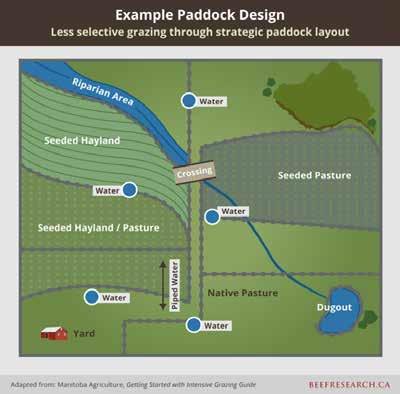
Cattle naturally tend to overuse areas close to water or shade unless encouraged to spread out. Uniform grazing helps maintain consistent forage health across a paddock and reduces patch overuse. It is recommended to place salt and mineral blocks away from water sources, which encourages cattle to graze less used areas and improves distribution. Ideally, water sources should be available within 600–800 feet of all areas of a paddock to support uniform grazing patterns.
5. Choose the Grazing System That Fits Your Operation
Grazing systems commonly used in Canada include continuous grazing and rotational grazing. Selecting the right system depends on your resources, goals and the specific landscapes you manage.
continued on page 22
FEATURE
Eight Key Facts cont. from pg. 21
Continuous Grazing
• Cattle graze one paddock all season
• Minimal cost and management
• Reduced pasture productivity due to lack of rest and recovery
Rotational
Grazing
• Two or more paddocks grazed in sequence
• Supports plant recovery and boosts productivity
• Can lengthen the grazing season
• Requires more planning, fencing and water distribution efforts
6. Monitor Water Quality and Supply
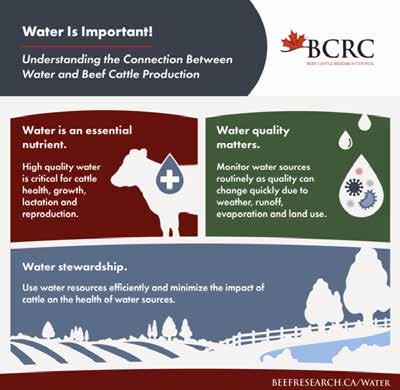
Clean, reliable water is essential. Poor water quality can lead to severe health challenges or even mortality. Research has shown that calves with access to pumped water may gain 16 to 18 pounds more during the grazing season compared to calves drinking directly from a dugout.1 Regular water testing is important as quality can shift significantly during the summer months.
2026 LFCE SUMMER FIELD DAY
Join us for the Livestock and Forage Centre of Excellence (LFCE) Summer Field Day! This free event takes place from 8 a.m.–4 p.m., Tuesday, June 16, at the LFCE Clavet location.
FEATURE
7. Consider Grazing Legumes
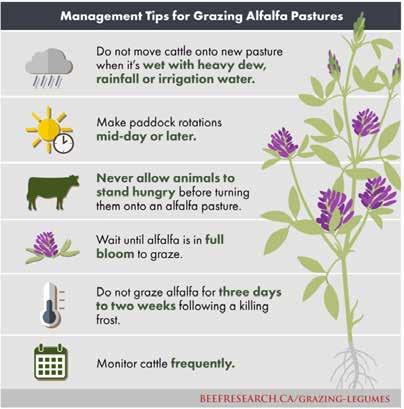
Legumes such as alfalfa and clover can significantly boost forage quality, but some bring a risk of bloat. Newer varieties of bloat safe legumes, such as sainfoin, have improved in persistence and yield. When 15 per cent or more sainfoin is included in a stand with alfalfa, bloat risk is reduced while maintaining nutritional benefits.
8. Evaluate Carrying Capacity Regularly
Carrying capacity, also known as grazing capacity, is the amount of forage available for grazing animals in a specific pasture or field. The BCRC’s Carrying Capacity Calculator at www.beefresearch.ca/tools/carrying-capacity-calculatormethod-1/ allows you to determine the carrying capacity of pastures based on two methods: 1) estimates based on provincial guides, and 2) field-based sampling.
What This Means for Your Grazing Plan
Grazing management is both an art and a science. While the fundamentals remain consistent, each operation is unique based on climate, soil type, forage species, herd size and production goals. By understanding and applying these core management facts, you can increase pasture resilience, improve herd performance and build a more sustainable grazing system for the long term.
REFERENCE
1. Willms, W.D., Kenzie, O., McAllister, T., Colwell, D., Veira, D., Wilmshurst, J., Entz, T. and Olson., M. (2002). Effects of water quality on cattle performance. Journal of Range Management, 55:452-460.
Did you know that cattle can detect odours up to eight kilometres away? Or that 73 per cent of Beef Business readers share their copy with two or more people?
Key Facts for Canadian Beef Producers Grazing Management
A general guideline for forage stand management is the “take half, leave half” rule or 50% utilization by weight (biomass) of the key available forage species in a stand. This may not be applicable to Eastern Canada or areas under irrigation.
Carrying capacity is the average number of animals that a pasture can support for a grazing season. Scan the QR code and enter your numbers to calculate a pasture's carrying capacity.
Salt and mineral should be placed away from water and used to distribute animals more uniformly.
It is recommended that pasture systems be designed to provide water sources within 600 to 800 feet of all areas of a paddock for optimum grazing uniformity.
Varieties of bloat-safe legumes like sainfoin have improved in yield and persistence. When a minimum of 15% sainfoin is included in a stand with alfalfa, bloat risk is reduced.
Test stock water quality regularly as the grazing season progresses. Hot and dry weather, or heavy rainfall or runoff events, can affect water quality and cause herd health problems or even death.
Calves with access to pumped water have the potential to gain 16-18 lbs more during the grazing season than calves watering directly from a dugout. Scan the QR code to evaluate potential costs and benefits of a stock water system.
Who Owns Your Cattle Data and What Is It Worth?
Paul Laronde
A set of calves leaves your yard; vaccinated, managed, and documented. By the time they reach the next owner, most of that information is gone. The value you created stays with the animal but not necessarily with you.
We live in a world that increasingly values data, even the data we assume has little worth. When we receive products or services for free, the reality is that our data is often part of the transaction. Internet search engines are a familiar example: they provide useful information at no direct cost, but “free” isn’t entirely accurate. There is an exchange taking place, whether we recognize it or not.
What we search for has value, whether it is products, services, preferences; especially, when aggregated and sold. Each of us decides whether that exchange is worthwhile. Entire business models are built on collecting, organizing, and monetizing data. Occasionally, companies acknowledge this value and offer compensation; but more often, they collect it for free and use or sell it for profit.
Data is already part of your operation.
Ranches produce data every day, whether they realize it or not. Regardless of the type of operation, information is constantly being generated and recorded.
Breeding operations track sires, dams, breeding dates, and birth weights. Feedlots monitor individual animal weights and gains. When this information is connected to management practices (e.g., feeding regimes, treatments, and health protocols), its usefulness and value increase significantly.
Some of this data also has value further down the production chain.
Have you ever asked yourself: “Who owns the data, who can use it, and
why can’t I access the data on animals I just purchased if it exists in a national database?”
The simple answer is privacy
Producers supported the development of national identification systems with the understanding that they would retain ownership and control of their data: full stop. That’s not entirely absolute. Within the national livestock identification system, certain data is regulated data, and so it is required to be reported and accessible to the Canadian Food Inspection Agency (CFIA) for industry benefit, particularly for animal health, disease tracking and response – including:
• Premises identification (PID)
• Approved animal indicator numbers (i.e., tag numbers)
• Producer contact and location information
• Animal movement data
However, other information such as birthdates, sex, breed, and vaccination records, is not regulatory data and is producer-voluntary data.
Downstream operators (feedlots, backgrounders, processors), see clear value in information such as vaccination history, treatments, drug withdrawal periods, and growth promotant use. Many would also value knowing the source and age (or birthdate) of calves, particularly when purchased through intermediaries.
This type of information is called valueadded data, and it refers to attributes linked to an animal’s record that have economic or management value for others in the supply chain.
In some cases, sharing this data could:
• enhance product value;
• reduce costs; and
• decision-making.
Example: Vaccination Data
Some producers vaccinate calves as part of a herd health program; however, when those calves are sold, that information is not always passed along, often due to lack of simple tools to record or transfer it.
For buyers, this creates risk. They want vaccinated calves but if they cannot verify vaccination status, they may revaccinate anyway, adding unnecessary cost in both time and money. If vaccination data could move with the animal, there is clear potential for shared value between buyer and seller.
Example: Treatment History
Treatments provide another strong case. Modern animal health treatments can be expensive, and knowing whether a treatment has already been administered, or whether it was effective, can directly impact management decisions. If an animal has already received a costly treatment that failed, that knowledge could prevent repeated expense and improve outcomes for the next owner.
What is that data worth?
All of this information could be tied to the animal’s unique identification number. That creates opportunities across the value chain:
• Producers could benefit from carcass data feedback to improve genetics and management;
• Feedlots could refine performance strategies; and
• Processors could better link production practices to final product quality.
In my decades of experience, I have found that many producers are already interested in receiving carcass data but the larger question remains: what is that information worth, and how is that value shared?
continued on page 26
Cattle Data cont. from pg. 25
If participants across the chain can agree on value and have a mechanism to exchange data, there is potential to improve outcomes for everyone involved.
There are a few barriers: time, technology, and trust.
Identification numbers are tied to the producer who owns the tags, and each producer ultimately decides if data is shared, when it is shared, and what it is worth.
Despite the opportunity, adoption faces
real barriers. For many operations, adding and managing data is time-consuming and frustrating. Adding animals to inventory, recording events, and maintaining accurate records can feel like a burden rather than a benefit.
What I wonder is what the future could look like? What if the system worked differently? What if tags automatically reported to a producer’s account? What if animal movements were recorded automatically: leaving the yard, arriving at auction, entering a feedlot? What if producers only needed to focus on adding key value-added information, rather than managing the mechanics of reporting?
For many producers, the technical side of data management is a major source of frustration. The preference is clear: focus on producing cattle, not managing data systems.
Technically, these scenarios are possible. Advances in technology and the right leadership could move the industry in this direction.
The data already exists. The opportunity already exists. The real question is not whether this can be done but whether producers will choose to capture the value of their data, or continue to give it away. B
The Canadian Cattle Identification Agency (CCIA) is a not-forprofit, industry-initiated and led organization committed to serving the species groups we represent. CCIA is led by a Board of Directors representing livestock organizations across Canada, including livestock producers, auction markets, livestock dealers, feedlots, veterinarians and processors. We are your Service Provider CCIA is a Responsible Administrator (R.A.) for beef cattle, bison and sheep; with goats and cervids as potential new species. Responsible Administrator
CCIA owns, manages and maintains the Canadian Livestock Tracking System (CLTS), a national database that allows our clients to record animal identification.
CCIA manages and distributes approved and pre-approved k i dicators (tags) and applicators, for the regulated atus. Sells and Distributes Approved Tags provides access to the CLTS and educates on its use to ort clients. For assistance call
A Second Glance When Growing Polycrops for Livestock
Shelby Robinson
Shelby Robinson, M.Sc., AAg Livestock and Feed Extension Specialist Saskatchewan Ministry of Agriculture Moose Jaw, SK
Annual polycrop forage blends may help extend the grazing season by relieving pasture pressure or increasing winter feed inventory, depending on the goals and use of the forage. Polycrops typically consist of species representing four functional groups: warm season plants, cool season plants, annual legumes and a brassica all growing together to provide forage for livestock.
While interest in polycrops is increasing due to their forage diversity benefits, producers should carefully assess the associated risks to ensure they align with the operation’s risk tolerance.
Choosing the right blend and field site
Before selecting a polycrop blend, first determine the main use for the forage. For grazing systems, access to good quality water for livestock is a major consideration. If the polycrop will be used for baled or silage feed, distance and time required for transporting feed needs to be factored into cost considerations.
Using knowledge of previous years can help to ensure a successful polycrop this
growing season. Considering average yearly cumulative precipitation and average soil moisture may influence blend selection and the success of seed germination.
Recent studies completed at University of Saskatchewan have found that in times of limited soil moisture, some plant species in the blend had reduced germination resulting in overall reduced forage yield.
If you are in an area of low precipitation, choosing a blend that will still yield well in drought conditions may be in your best interest. A few drought tolerant species typically found in polycrop blends are barley, millet, pea, forage rape, sorghumsudan grass, and triticale.
Understanding the field’s previous crop and weed pressure is also important. Once the polycrop starts to emerge, there are no in-crop herbicides that can be used to target weeds without affecting some of the species in the polycrop.
Applying an effective herbicide before seeding can reduce weed pressure by giving the polycrop a chance to establish before the weeds start growing again.
When it comes to number of species in a polycrop blend, more is not always better. Simple mixes often preform as well, or better than, complex mixes in terms of forage yield and nutritional quality. Some examples of simple polycrop mixes are:
Polycrop blends often include a variety of species both familiar and unfamiliar. To maximize forage biomass production, ensure most species in the blend are well
adapted to your area.
Starting small with just a few acres and a simple two or four species blend allows you to evaluate establishment, weed pressure and forage production. If the blend performs well and all the species are present, acreage can be expanded for the next planting season.
Risks associated with polycrops
Depending on the plant species and growing conditions, polycrops may pose different anti-nutritional risks that require careful management. Some are triggered by weather putting stress on the plant such as drought, frost, or hail causing barley to accumulate nitrates. While others are part of the plant’s nature such as sulfur levels in brassicas.
Nitrates
• Accumulate in cereals, oilseeds and weeds when plant growth is stressed by factors such as frost, drought, hail, heavy fertilizer, manure application, or other conditions that limit the plant’s ability to process nitrates.
• When cattle consume high amounts of nitrate, the conversion of nitrate to nitrite surpasses the conversion of nitrite to ammonia. The excess nitrite can then be absorbed into the blood stream where it reduces the oxygen carrying capacity of the red blood cells.
• Symptoms may include, but are not limited to, rapid or difficulty breathing, rapid pulse, excessive salivation, bloat and death.
Forage
Forage Brassica
Forage Brassica
Hairy Vetch
Forage Pea
Forage Brassica
Note: Forage brassica may include radish, turnip, rape, or kale.
SCIENCE AND PRODUCTION
Sulphur
• Brassicas such as turnip, radish, mustard, and canola can accumulate sulphur.
• Sulphur binds to copper and other trace minerals which can cause mineral deficiency resulting in poor conception rates, polioencephalomalacia, and in severe cases, death.
• Symptoms may include, but are not limited to, blindness, diarrhea, head pressing, and reduced feed intake.
Prussic acid
• Accumulation in plants such as flax, sorghum, and sorghum-sudan grass may occur after a recent harvest, high-nitrogen fertilizer application, or an event such herbicide application, frost, hail, or drought. When cattle consume plants containing prussic acid, it is broken down, freeing cyanide in the rumen. Cyanide can then be absorbed into the blood stream, where it binds with the red blood cells and eliminates the oxygen carrying capacity.
• Symptoms may include rapid or difficulty breathing, similar to nitrate poisoning, and in severe cases, death.
Potassium and Sodium
• Plants such as brassicas can contain higher sodium levels compared to other forages. When total dietary sodium levels approach 0.6 per cent of the ration, cattle can become dehydrated and reduce mineral intake if salt-based mineral is used.
• During times of drought, cooler growing temperatures, and high levels of fertilization, cereal crops can accumulate high levels of potassium. Excessive potassium levels in the diet can impair calcium and magnesium absorption causing grass tetany in cattle.
Risk Mitigation
To mitigate risks associated with polycrops, it is recommended to feed test and have a backup plan if antinutritional factors are present. A good backup plan may consist of being flexible, adaptable, and having an alternative feed source. A good backup plan may consist of being flexible, adaptable, and having an alternative feed source. Practical approaches to managing these risks include:
• Blending poor-quality feed with a higher-quality feed can dilute the anti-nutritional concentration in the diet. The amount of blending or dilution necessary will depend on the amount of anti-nutritional factors present according to the feed test. Blending can be done using a mix wagon, shedder, or rolling out bales. Baling polycrops provides more flexibility for blending feed sources compared to swath grazing.
• Adaptation periods are beneficial
when transitioning cattle to a new ration. In grazing systems, limited initial access or starting with low levels of anti-nutritional compounds in mixed rations, can help manage dietary risks. This approach will lower the risk of some anti-nutritional factors but also will help manage any potential for digestive upset.
Polycrops may help extend the grazing season by relieving pasture pressure or increasing winter-feed inventory, depending on forage use and management goals. However, producers should carefully evaluate the risks associated with polycrop blends and how they align with the operation’s risk tolerance.
For more information on selecting and grazing polycrop blends or about managing anti-quality factors in forages, please contact the Agriculture Knowledge Centre at 1-866-457-2377
• GRASSFED: “True North Foods is partnered with A&W Canada to supply Canadian grassfed beef for A&W’s grassfed burger program.
• SERVICES: Whether you are a specialty producer looking to get your product to a specific market or distributor, or if you are producing commodity livestock for sale, we can partner with you. From our multi-species capabilities to our ability to handle smaller volumes, we offer excellent capabilities for producers in the Canadian Prairies to maximize their profitability.
• FACILITY: We have a state-of-the-art facility to allow us to reach markets across Canada, the USA, and beyond. We understand producer’s needs, their care for their animals, and their honest, straightforward nature. Call us to hear how we can work together to get your product to market.
Rotational Grazing: Extending the Grazing Season, Water Systems and Funding Opportunities
Rotational grazing offers more than just dividing pastures into smaller parcels. It can extend the grazing season, reduce winter feeding days, and make better use of forage resources available on the farm. For producers, this approach may mean lower feed costs, improved pasture productivity, and in some cases, additional hay to sell.
Rotational grazing is a widely adopted practice across Canadian beef operations. According to the 2021 Canada-wide Farm Environmental Management Survey, 74 per cent of beef producers utilize some form of rotational grazing, highlighting its role as a common forage management strategy.
Similarly, the Alberta AgriSystem Living Lab: 2022 Baseline Adoption Rates Survey found that of 208 respondents, 69.2 per cent implemented rotational grazing during the 2022 season, managing 57.1 per cent of total reported pastureland under this system. While adoption is relatively high, this indicates that rotational grazing is often applied to only a portion of available pasture acres.
Patterns of use varied among producers. Most rotational grazing began in May (44.7 per cent) or June (35.0 per cent), with October (51.2 per cent) being the most common endpoint.
The grazing period ranged from 48 to 244 days, averaging 145.3 days, which was not statistically different from the average of 135.6 days reported for continuous grazing. Approximately half of producers (49.0 per cent)
Canfax Research Services
reported resting paddocks for 30–60 days between grazing events, and cattle movement was managed either on a time-based schedule (49.7 per cent) or according to forage availability (47.6 per cent).
Of those following a set schedule, the most common frequencies included moving cattle once per week (17.9 per cent) or once every two weeks (11.7 per cent). Triggers for moving herds most often included 50 per cent forage utilization (37.2 per cent) or 80 per cent utilization (35.9 per cent).
Measuring progress is often like watching grass grow. While it’s difficult to detect movement on a daily basis, it’s simple to see growth over time.
Frank Sonnenberg
Despite the widespread adoption of rotational grazing, several barriers limit its expansion. Nearly half of producers (48.4 per cent) identified water access as the primary challenge, while others cited up-front investment costs (10.9 per cent) and reluctance to use electric or portable fencing (9.4 per cent). These findings suggest that while rotational grazing is common, it is often constrained by resource availability and infrastructure limitations.
What is the COP Network?
The Canadian Cow-calf Cost of Production Network (COP Network) uses standardized data collection which allows for comparison both within and between provinces, and internationally. Since launching in 2021, the COP Network has collected data from over 235 producers contributing to 64 cowcalf benchmark farms that represent various production systems. Each benchmark is based on data from 3-7 producers. Data collection occurs every 5 years with annual indexing of input and output prices, as well as crop and forage yields, in subsequent years. Individual benchmark farm summaries, can be found at: https://canfax.ca/resources/cost-ofproduction/cop-results.html
Part 1: Do Productivity Gains Pay for the Infrastructure?
To evaluate rotational grazing, the COP Network developed scenarios for 11 benchmark farms using 2022 data. The analysis assumed that producers invested in a portable electric fencing system
Change in Profit from Extended Grazing Season (5-yr projection)
*Blue bars represent the change in profit per cow for years 1 through 5. The negative value in year 1 reflects the impact of the initial investment. Figure 1. Change in Profit from Extended Grazing Season
in the first year to divide pastures into multiple paddocks, while continuing to use existing water systems. The cost of fencing was considered similar across herd sizes, meaning that the per-cow cost was lower for larger operations.
SCIENCE AND PRODUCTION
Larger herds were able to spread the cost of fencing across more cows, reducing the average investment per animal. Farms with higher feed costs— measured in dollars per head per day—saw more savings by reducing the number of winterfeeding days.
The best way to control cow and sheep is to give them a big grazing field.
Stocking rates were expected to improve by 10 per cent under rotational grazing. However, producer experience and research suggest that the actual range is much wider—from as little as five percent to more than 60 percent depending on forage species, stand age, soil type, fertility, and moisture.
Shunryu Suzaki
For example, savings were most significant for farms relying on purchased feed, where every day of extended grazing lowered costs. Some operations also captured additional income from selling hay no longer needed for feeding, while others improved their resilience by carrying forage over to the following season.
see better results. The analysis reinforces that knowing your own costs, both feed and infrastructure, is key to deciding whether rotational grazing makes sense for your operation.
Key Takeaways
• Portable fencing is the largest upfront investment, with total costs similar across herd sizes. Larger herds reduce the cost per cow.
• Stocking rates were assumed to increase by 10 per cent, but actual results reported by producers range from five to more than 60 per cent.
The primary benefit of rotational grazing was assumed to be fewer winter-feeding days due to increased pasture productivity which allowed for an extended grazing season. For some operations, this also meant more hay was available. If hay was sold in the baseline year, that surplus was treated as additional revenue; if not, it was carried forward into the next year as extra feed inventory.
What Producers Experienced
As shown in Figure 1, across the 11 benchmark farms, only about half were able to pay off the fencing investment within the five-year analysis (orange lines above zero). Those that succeeded had three main advantages: larger herds, higher baseline feed costs, or additional revenue from hay sales.
Notes for Chart:
Smaller operations faced more challenges in paying off the investment within the five-year period. However, if their feed costs were high or if they could generate revenue from surplus hay, rotational grazing still offered a meaningful return.
What it Means on Your Farm
You can make money two ways—make more or spend less.
John Hope Bryant
• Only about half of the 11 benchmark farms were able to pay off their fencing investment within five years.
• Farms with higher feed costs per head per day, especially those relying on purchased feed, saw the greatest cost savings.
• BC1: Additional revenue from selling hay, despite small herd
• BC2: Small herd, low baseline feed cost
• AB3: Larger herd, additional revenue from forage sale
• AB4: Small herd
• AB5: Large herd
• SK3: Larger herd, but low feed cost
The results underline that rotational grazing is not a one-size-fits-all solution. Large herds can recover costs faster because the fencing expense per cow is lower, and farms with higher feed costs see greater benefit from every additional grazing day. Smaller herds may face challenges with payback, but if they have high feed costs or can generate revenue from selling surplus hay, rotational grazing may still be worthwhile.
• SK5: Medium herd, low baseline feed cost, additional revenue from forage sale
• ON2: Cost saving on purchased feed
• QC1: Medium herd, low baseline feed cost
• QC3: Cost saving on purchased feed
• QC4: Small herd
Flexibility can also make a difference. Producers who opt for lower-cost fencing systems or creative pasture layouts may
• Operations that sold hay in the baseline year could capture additional revenue from surplus forage, while other operations built carryover reserves.
• Soil type, fertility, forage species, and age of the pasture stand all impact results.
Part 2: Water That Works Harder
Adding a water system to a rotational grazing system isn’t just about convenience, it can influence calf performance and the initial investment can be partially offset by funding opportunities. How does portable fencing, water systems, and cost-share programs stack up in terms of costs and benefits? The results show both the challenges and the potential for profit.
The Setup: Fences, Pumps, and Pipelines
The 2022 analysis looked at six benchmark farms: AB-8, AB-11, MB-3a, MB-3b, QC-6,
continued on page 32
SCIENCE AND PRODUCTION
Rotational Grazing cont. from pg. 31
and QC-7. Each farm added portable electric fencing, a solar-powered water pump, and a shallow-buried pipeline system to support rotational grazing.
Key assumptions included:
• Longer grazing season achieved through improved management.
• Calves gaining an extra 0.09 pounds per day with the water system, compared to direct dugout access.
• Farm-specific funding assumptions through the On-Farm Climate Action Fund (OFCAF), with 70 to 85 per cent reimbursement of eligible costs.
The Bottom Line: Gains and Losses
Without funding, the net benefits were generally negative over five years due to the high upfront cost of water systems. This was most challenging for farms with large pasture areas needing long pipelines, or smaller herds where costs per cow were higher.
One exception was QC-7, where savings on purchased feed and fewer winterfeeding days resulted in a positive net benefit even without funding.
Estimated Average Net Economic Benefit, 5-yr average
Rotational Grazing Only With OFCAF With OFCAF and Heavier WW
Source: Canfax Research Services, COP Network
Notes:
• AB-8: In Alberta, with 161 cows, 1,465 acres of grassland
• AB-11: In Alberta, with 133 cows, 1,863 acres of grassland
• MB-3a: In Manitoba, with 270 cows, 1,040 acres of grassland
• MB-3b: In Manitoba, with 270 cows, 1,107 acres of grassland
• QC-6: In Quebec, with 150 cows, 156 acres of grassland
• QC-7: In Quebec, with 225 cows, 156 acres of grassland
Rotational Grazing
Estimated Break-even Budget for a 5-year Pay-off Period by
Key Takeaways
• Water systems combined with rotational grazing can improve calf weights by 0.09 pounds per day and reduce number of winterfeeding days.
• High upfront costs make the system challenging without additional funding sources.
• The stacked benefits of funding, feed savings, and heavier calves made the scenario profitable for most farms.
• Herd size and per-cow savings determine how much investment is realistic – e.g., $20,000 over five years for 200 cows saving $20 per cow.
Source: Canfax Research Services, COP Network
Figure 2. Estimated Average Net Economic Benefit over Five Years
When OFCAF funding was applied, the economics changed. Four of the six farms were able to make the scenario feasible with the reduced upfront cost.
Adding in the stacked benefit of heavier calves made the scenario profitable for most farms, though AB-11 saw a reduced price per pound because heavier calves shifted into a lower-priced weight category.
The feasibility of rotational grazing with water systems depends on four things:
SCIENCE AND PRODUCTION
upfront investment, herd size, savings from fewer winter-feeding days, and potential revenue gains from heavier calves. For example, a 200-cow operation saving $20/cow on feed could justify an upfront investment of $20,000 and still expect a five-year payoff.
Farms without an existing water system stand to benefit the most, since installing one can boost calf performance in addition to grazing savings. Programs like OFCAF reduce the financial risk and help producers move ahead with
grazing infrastructure, but details vary by province. Contacting the local delivery agent at https://agriculture.canada.ca/en/ programs/agricultural-climate-solutionsfarm-climate-action-fund is essential for understanding coverage, requirements, and application steps.
Don’t wait for the right opportunity: create it.
George Bernard Shaw
Disclaimer / Copyright Notice: Canfax Research Services (CRS) tries to provide quality information, but we make no claims, promises, or guarantees about the accuracy, completeness, or adequacy of the information. CRS does not guarantee and accepts no legal liability arising from or connected to, the accuracy, reliability, or completeness of any material contained in our publications. Reproduction and/or electronic transmission of this publication, in whole or in part, is strictly forbidden without written consent from CRS.
Chief Executive Officer Jason Pollock Livestock Services of Saskatchewan
Ownership Verification, Finance Brands, and Why Funds Get Withheld
Previously in this series
In Part 1 of The Tip of the Iceberg, we looked at what happens during a livestock inspection and what begins afterward. The inspection itself captures facts at the chute. Much of the verification work starts later, when manifests are entered into the inspection record system and ownership and payment direction are confirmed.
Fun Facts
This article explains what happens when brands, invoices, estates, or finance interests require additional verification before settlement can be released.
The Tip of the Iceberg –Part 2 of 3
Jason Pollock
Inspectors regularly encounter cattle carrying multiple brands. They see cattle that were recently purchased, leased, custom fed, or involved in estate situations. In these cases, ownership must be verified beyond the hide before settlement can move forward.
Most producers only see this process when a transaction slows down. From the inspection side, it is routine work that protects everyone involved in the sale.
Ownership verification in practice
Ownership verification often sounds technical when it is described in policy terms. In practice it usually begins with something simple. The brands recorded during inspection do not match the consignor’s registered brand.
A producer consigns a mixed group of cows at a regular sale. Some of the cattle carry the ranch brand. A few others were purchased privately earlier in the year and still carry the seller’s brand. The manifest is completed and the cattle are inspected without issue upon arrival.
• LSS inspectors enter roughly 100,000 manifests each year.
• LSS inspectors inspect in excess of 1.5M head each year.
• Over 4800 head of livestock offered for sale required either a redirect or withhold in 2025/26
Ownership is not always simple
A brand is the primary proof of livestock ownership in Saskatchewan. In many cases, that is enough. In others, it is only the starting point.
Later, when the manifest is entered into the system, the additional brands recorded during inspection need to be cleared before settlement can be finalized. The inspector contacts the consignor and asks for invoices confirming the earlier purchases. The producer knows the paperwork exists but needs time to locate it. Because ownership of those branded cattle cannot be confirmed immediately, settlement is temporarily withheld.
In many cases this step is resolved quickly
Key Terms
• Manifest: Legal document used to indicate ownership details, payment direction, load details, transporter information, and inspection verification details.
• Inspection Certificate: Legal document used to indicate ownership of livestock post inspection where ownership has changed or movement will take place. Keep this document to “clear” your purchases with LSS in the future.
• Withhold: An LSS directed temporary freeze on payment after sale to verify ownership details and direction of proceeds.
• Redirect: The action of an LSS Inspector to redirect proceeds of sale based on corrected ownership details.
once invoices are provided. Sometimes the inspector is able to confirm the transfer by checking previous inspection records or contacting the registered brand holder directly. Once ownership is confirmed, the proceeds are released and the transaction continues normally.
Situations like this are common. They are also one of the reasons invoices and records of payment matter when cattle are purchased privately and later resold.
When brands and payment direction do not align
A similar situation can occur within family operations. Cattle may be marketed together even though the registered brand holder is a different individual than the person listed on the “Pay To” line. When the manifest is entered into the inspection system, that difference must
SCIENCE AND PRODUCTION
be confirmed. The inspector contacts the consignor first to determine whether proof of purchase is available. If not, the registered brand holder may be contacted to confirm consent for the proceeds to be directed as indicated.
Most of these situations are resolved quickly with a phone call, but the confirmation still has to occur to meet legislated requirements that LSS must uphold. This step protects the registered brand holder. It also protects the consignor and the buyer by ensuring proceeds are directed correctly the first time.
Estates and joint ownership
Estate situations create another version of the same issue. A jointly registered brand does not automatically transfer to the surviving owner when one partner passes away. The brand forms part of the estate until legal authority is confirmed. Inspectors must verify that the executor or administrator has authority to direct the sale. Until that authority is clear, settlement may be withheld. This protects families from disputes and prevents proceeds from being issued before ownership direction is legally established.
Finance brands and secured interests
Finance brands represent the best indication of a lender’s security interest in livestock. When cattle carry a finance brand, inspectors must confirm that settlement is handled according to that agreement. If a release is presented, settlement usually proceeds without delay. If no release is available, the inspector contacts the lender when the manifest is processed.
The lender confirms whether the security interest remains active. If the interest remains in place, proceeds may be redirected. If a release is provided, funds can be issued to the consignor. If it is not, the funds may be redirected as the brand is the ultimate proof of ownership and Livestock Services of Saskatchewan (LSS) will redirect to the brand owner listed on the registry.
These situations are usually resolved quickly once documentation is located. They are also one of the reasons lenders continue to support livestock-based operating credit across the industry. Most withholds are temporary. They exist so ownership details can catch up with the transaction before money changes hands.
These steps protect more than one transaction
Each of these examples shows how inspection protects individual transactions at the point of sale. The same verification system also supports investigations, recovery of missing livestock, and confidence across the marketplace.
Part 3 widens the lens further by looking at how inspection supports brand alerts, stray livestock resolution, theft investigations, and the measurable value this system provides across the industry. B
To keep settlement moving without delay
Producers can help avoid most settlement delays by:
• Completing manifests fully before inspection;
• Presenting prior inspection records or invoices for purchased cattle;
• Ensuring brand registrations are current;
• Providing finance releases when cattle carry a finance brand; and
• Confirming that the “Pay To” line reflects the registered brand holder or includes consent.
Most withholds are resolved quickly once documentation is available. Preparing ahead of inspection helps keep commerce moving at the pace producers expect.
We're Hiring!
Livestock Services of Saskatchewan is hiring Livestock Inspectors to help safeguard producer interests and uphold confidence in the buying and selling of livestock across the province.
Now hiring in:
Market Locations - Swift Current • Yorkton • Moose Jaw • Prince Albert Country Locations (within 50 km) - Foam Lake • Canora • Moosomin • Indian Head • Kipling
The Role: Work directly with cattle and horse producers to verify ownership, inspect livestock, and ensure compliance with provincial legislation. Review manifests and sale documents, support enforcement activities, and collaborate with industry and law enforcement partners.
You Bring: Practical livestock handling experience; strong communication and decision-making skills; working knowledge of the livestock industry; as well as professionalism and sound judgment.
What to Expect: Flexible, on-call work across auction marts, feedlots, farms, and ranches. Some weekend and overtime work required.
ASSOCIATION NEWS, REPORTS AND EVENTS
A REPORT FROM JEFF YORGA PRESIDENT, SASKATCHEWAN STOCK GROWERS ASSOCIATION
Welcome to the Convention issue of the Beef Business!
What a time to be a cattle producer! I hope that by the time this reaches you, the rain has returned and the prairie grasses are jumping. In our part of the world, subsoil moisture continues to be scarce, so the rain dance continues.
Given the variability of moisture, it looks like it will take some time to rebuild the North American cow herd. Let’s make sure that strong prices equal strong balance sheets. For the last 20 years, we have looked over the fence and watched other commodity groups prosper, and then after one downturn in pricing, see their business erode significantly. Let’s not make that same mistake.
The same people and organizations that have been able to extract rents from the grain industry are now refocusing on the cattle business. Be wary of giving up a percentage of what you earned to someone else for advice. Question dealing with firms that bill based on your ability to pay instead of billing the work being done. In times of plenty, it is easy to shrug off added expenses. You have worked too hard and for too long to give it all away. Let’s make our balance sheets great again.
Since our last issue, we had a successful semi-annual meeting at Dakota Dunes. While the business meeting sets the direction for the board moving forward, we also were able to celebrate three worthy recipients of the Honour Scroll awards. I would like to congratulate again: Dale and Shelly Easton of Wawota, Murray and Selena MacGillivray formerly of Radville, and Dr. Grant Royan of Regina; and thank the presenters and attendees for making it a great night. This event is something we are proud to be a part of, and we look forward to continuing the tradition in 2027. If you have not attended yet, I look forward to seeing you in February 2027.
Your board has been hard at work on your behalf on several policy fronts with clear direction coming out of the semiannual meeting The resolutions, printed on page 58 of the March 2026 issue of this magazine, demonstrate the debate was encouraging; and in true Saskatchewan Stock Growers Association (SSGA) form, show that even if we don’t agree on policy, we still enjoy fellowship with the people! It was refreshing to hear that Canadian Cattle Association, Manitoba Beef Producers, Alberta Beef Producers and Saskatchewan Cattle Association have gotten behind SSGA and our friends at the Western Stock Growers Association (WSGA) in opposing the Canadian Food Inspection Agency’s (CFIA) enhanced traceability regulations.
We have not heard an update from the CFIA on their position; so, we will continue to apply pressure until the “pause” becomes a “stop.” Time has a way of eroding folks’ motivations. It’s important to remember that while producer boards change, bureaucracies seldom do. The current state of play is not good enough, and we need to make sure this type of policy doesn’t make it this close to regulation again.
We have clear resolutions about moving the CFIA out from under Health Canada, and back to the Ministry of Agriculture.
On a recent call with Health Canada, we suggested moving everything that happens to an animal (until it is processed), back to the Ministry of Agriculture. And, once it is processed, that portion of CFIA oversight could continue to be under the Ministry of Health.
We were surprised to learn this concept has never been pitched to them. I was encouraged by their receptiveness and feedback. Understanding that moving policy takes a significant amount of time, this is the closest we have come to real change in a long time. During the call, we were told that significant changes to the CFIA are upcoming, so we will continue to push to make sure it comes to fruition, as this file—the CFIA—is the largest barrier to growth and risk to producers in Canada.
The file that represents the second largest barrier to growth for the Saskatchewan livestock industry has to do with the relationship between the Intensive Livestock Operation (ILO) permitting process and rural municipalities’ (RM) discretionary use powers. Today, firms must make the ILO application, alleviate any of their concerns, get provincial approval, and then apply to the RM which has final say on whether they can move forward with construction.
This level of cost and red tape has stopped the flow of capital to our province and our industry. Given that Saskatchewan Association of Rural Municipalities (SARM) and the RMs are reluctant to give up any “power,” it falls to industry to come up with a workable solution. Something as simple as conditional approvals or making the approval process the same across all RMs would be easy first steps. For a variety of reasons, we have not had success on this file, even though it has been on the table for years. All parties acknowledge that change must happen, but the how remains elusive. I welcome your feedback on potential paths forward.
Other more positive developments on the policy front include the upcoming
President Jeff Yorga Saskatchewan Stock Growers Association
ASSOCIATION NEWS, REPORTS AND EVENTS
occupational health and safety regulatory review. This will be our opportunity to align animal agriculture with Alberta, and exempt animal-specific, work-related injuries. While we acknowledge there is a duty of care that must be maintained at every worksite, there is always going to be risk when working with and around livestock. If we want an industry to grow, we must ensure that folks are free from litigation in the event something goes wrong. A lot of work needs to be done to make sure our industry is putting its best foot forward by developing standards and codes of practice to improve worker safety.
Another win for landowners is the Ministry of Environment moving to landowner depopulation tags for big game animals. The recent open elk season to address high elk populations and damage to agricultural crops has garnered mixed reviews. The SSGA Board of Directors has advocated for it since I started coming to meetings! We all know that the folks on the ground have the best read on populations, and now with a new tool to manage them, this is a win-win. We have already been approached by the food bank to partner on a program, making this a win-win-win.
Our June annual general meeting is fast approaching. I look forward to seeing everyone in Swift Current from June 7 to 9th. The agenda is full and should speak to the issues of the day, while making time for fellowship among friends. Please make your plans to join us. This industry is better when we all participate.
As this is my last Beef Business article as your president, it is tempting to spill the beans and reveal some of the inside baseball around how boards work—like how Shane Jahnke never wrote any of his own columns, or that Kelcy Elford is the only president to charge a per diem in the last 25 years ($19.94 for Kung Pow Chicken, no tip)); but, I think it is probably best not to… instead, I’ll just say thank you.
Thank you to the board for their support and effort over the last two years. Thank
you to Chad and the staff for their hard work and dedication to keeping the SSGA rolling. Thank you to Ag Minister David Marit, and previous Minister Daryl Harrison, for their friendship and council.
This has been a lot of fun for me, and something that will be hard to walk away from. While the board is not completely done with me yet as I move to the role of past president, I would like to acknowledge our current Past President Garner Deobald who will get cycled to greener pastures. Thank you for your dedication to the organization, Garner, and best wishes on your future endeavors.
Lastly, I would like to thank my family. They take on the burden when we are away working for the industry, and it’s time to take that burden back. So, thank
you to Kelly and Norma for doing the work at home. Thank you to Kristen, Jennings, and Jagger for reminding me how important it is to get back home. And if you have read this far, I look forward to continuing the conversation in the hospitality room. See you at the Convention!
Until then,
How to enter:
• Email your photos to ssgacommunications@ sasktel.net with the subject line: Photo Contest
• Include your name, mailing address and the location the image was taken
• Please insure the photo is high resolution and clear quality for full page printing
Winning photos will be used in Beef Business Magazine and SSGA Communications and will be credited in the masthead and elsewhere as appropriate
CELEBRATINGRangelands and Ranchers
SSGA 113th AGM & CONVENTION
AGENDA
SUNDAY, JUNE 7
6:00 p.m. President’s Reception
Address from Conservative Party of Canada – John Barlow, Agriculture Critic
MONDAY, JUNE 8 - CONVENTION
CENTRE
8:00 a.m. Registration and Trade Show
9:00 a.m Greetings and Welcome – Jeff Yorga – President, SK Stock Growers Association
Address from City of Swift Current – Al Bridal, Mayor of Swift Current
9:15 a.m. Enabling the Next Generation of Canadian Ag and Food
Colin Brisebois – Vice President of Products and Market Strategies, Farm Credit Canada
10:00 a.m. Networking Break and Trade Show
10:30 a.m. Address from Saskatchewan Agriculture - Honourable David Marit, Minister of Agriculture
10:35 a.m. Canadian Cattle Association Update
Tyler Fulton – President, Canadian Cattle Association
11:20 a.m. Update on Whole Farm Revenue Insurance
Scott Surgenor – Senior Program Officer, Agriculture and Agri-Food Canada
11:50 a.m. VBP Awards Presentation
12:00 p.m. Lunch and Trade Show
1:00 p.m Beef Cattle Market Outlook
Brian Perrilat – AgriBusiness Specialist, Bullseye Feeds
1:45 p.m. Ministry of Agriculture Update
Brady Pollock – Assistant Deputy Minister, Sask Ministry of Agriculture
2:30 p.m. Networking Break and Trade Show
2:45 p.m. International Year of Rangelands & Pastoralists Producer Panel
3:30 p.m. Multimin 90 – Taking Control of Trace Minerals
Jack Fisher – Consultant, Axiota
4:00 p.m. Wildlife Revenue Diversification
Sal Roseland – Owner, R&R Pheasant Hunting
5:00 p.m. Closing remarks
6:00 p.m. Cocktails
7:00 p.m. Banquet and Entertainment: TESA Award
Rangeland Scholarship Silent & Live Auction
TUESDAY, JUNE 9
9:00 a.m.
9:30 a.m.
10:00 a.m.
10:30 a.m.
11:00 a.m.
11:30 a.m.
12:00 p.m.
1:00 p.m.
1:30 p.m.
1:45 p.m.
2:15 p.m.
2:45 p.m
Registration and Trade Show
Call to Order, Welcome and Introductions
Approval of the Agenda
Minutes from the 2025 Annual General Meeting
President’s Report
2nd Call for Nominations
2nd Call for Resolutions
Canadian Beef Codes Update: What Producers Need to Know
Dr. Karen Schwartzkopf Genswein – Research Scientist, Agriculture and Agri-Food Canada
Networking Break and Trade Show
Financial Report
Zone Chair Ratifications
Final Call for Resolutions
Saskatchewan Stock Growers Foundation AGM
Lunch and Trade Show
SSGF Update
Brant Kirychuk – General Manager, Saskatchewan Stock Growers Foundation
SCA Update
Chad Ross – President, Saskatchewan Cattle Association
Networking Break and Trade Show
Canada Beef Update
Eric Bienvenue– President, Canada Beef
Voting Procedures/Results & Resolutions
Other Business
Final call for Nominations and Elections
Closing remarks
Adjournment
Registration fees do not include a ccommodation. We have a block of rooms reserved at the Home Inn & Suites- 1411 Battleford Trail E , Swift Current, SK
To reserve a room call (306) 778-7788
Room Rate: $119 for Queen Classic and $124 for King
Block Name: Saskatchewan Stock Growers Association
Deadline for booking this room rate is May 24, 2026.
Thank You to Our Sponsors
Heritage Ori Cattle
Real Agriculture
Saskatchewan Ministry of Agriculture
Platinum
Bullseye Feeds
Ducks Unlimited Canada
Saskatchewan Stock Growers Foundation
Western Litho Printers
Gold
Beef Smart Consulting
Canadian Cattle Identification Agency
Vetoquinol
Young’s Equipment
Zoetis
SILVER
Prosperity Credit Union
Real Estate Centre - Gord Kozroski
Bronze
Elanco Animal Health
Innovation Federal Credit Union
Mankota Stockmen’s Weigh Co. Ltd
Saskatchewan Charolais Association
Saskatchewan Hereford Association
Titan Livestock
VIDO
Weyburn Livestock Exchange
Trade Show
Beef Smart Consulting
Canadian Cattle Identification Agency
Ducks Unlimited Canada
D&R Prairie Sales
PMT Inc.
Merck Animal Health
Norheim Ranching
Ori Cattle
Rangen
Saskatchewan Angus Association
Saskatchewan Crop Insurance Corporation
Saskatchewan Ministry of Agriculture
Saskatchewan Stock Growers Foundation
Saskatchewan Verified Beef
STOCKBOSS Energyfree Livestock Waterers
Young’s Equipment
Sponsors confirmed as of May 7th
REGISTRATION (includes GST)
As of April 28, 2017 Early Bird Regular (before May 31) (after May 31)
Full Conference $300.00 $325.00
Spousal Full Conference* $250.00 $275.00
Young Producer (under 40) $250.00
Total registration and ticket fees: ___________
*Include additional name(s) on this form for name tag(s)
PERSONAL INFORMATION
Name:
Organization/Ranch Name:
Mailing Address:
City:
Province: Postal Code:
Phone: Fax:
Email:
PAYMENT
Total Registration Fees Enclosed:
Payment must accompany registration. Registration form must be received on or before May 31, 2026 to qualify for early-bird rates. Cancellations received prior to May 31 will be refunded less a $50 administration fee. Cancellations received on May 31 or later will not be refunded. Make cheques payable to “Saskatchewan Stock Growers Association” and send to PO Box 4752, Regina, SK S4P 3Y4.
Registrations with credit card payment may be emailed to ssga@sasktel.net or call (306) 757-8523. Pay with etransfer to office@skstockgrowers.com
Method of Payment (check one): Cheque (enclosed) Visa
Card Holder Name:
Signature:
Card Number: __ __
Expiry Date: __ __ / __
Mastercard
Earlier this year, I was asked to visit a class of eleventh-grade students to talk with them about agricultural sustainability and cattle ranching. I was thrilled at the opportunity to speak about Saskatchewan Prairie Conservation Action Plan’s (SK PCAP) central focus on the ecological importance of grazers in our native prairies and the way herds of 60 million
Bison on the Plains
Shirley Bartz
bison shaped the grasslands in North America’s Great Plains across millennia.
The students’ surprise at the grisly details of the way bison were removed from the Plains made me wonder about people’s knowledge of this history and motivated me to write this brief account of bison in our prairies and the Great Plains.
Map of bison herds from 1720 through 1889 (based on information from Hornaday 1889).
Note that the 4-digit numbers in italics are “dates of local extinction,” and do not represent herd numbers in that location. Bolded numbers do represent remaining bison estimates in 1889.
Infobase Publishing
The origins of the bison lie in the deep geologic history of North America and its periodic linkages to Eurasia and Africa, where ancestors of all bovine species arose. The ancestors of the modern bison are thought to have arrived in North America between 195,000 and 200,000 years ago when glacial activity dropped sea levels sufficiently to open the Berring Land Bridge (Lewis 2021).
Our current Holocene epoch began 11,700 years ago and is marked by the retreat of the Wisconsin ice about 8,000 years ago, and a warming period that brought widespread drought and fires to North America. This change in climate altered vegetation communities, leading the ancient bison species to branch into plains bison (Bison bison bison) and wood bison (Bison bison athabasca).
By the early 1500s, as the Conquistadors were invading the Americas, the plains bison population was estimated at 30 to 60 million animals. Early Spanish expeditions, along with later explorers and fur traders, all described being amazed by how many bison covered the Plains.
If these observations of huge bison herds were awe inspiring, it is even more incredible to think of how bison and prairie plants and animals evolved together across millennia. Bison are recognized as keystone species because they affect grassland species richness and vegetation structure by wallowing, churning soil and vegetation with their hooves, grazing and redistributing seeds and nutrients in their dung (McMillan et al., 2019).
One of the beneficiaries of bison in North America were Indigenous peoples of the Plains. For thousands of years, bison supplied them with food, homes, clothing, fuel, tools and toys. Bison organized Plains Peoples’ economies, spiritual, political, and social lives. With the arrival of the
Bison on the landscape at Glacier National Park Photo courtesy of: Caitlin Mroz-Sailer, SK PCAP
horse in the mid-1700s, the lifestyle and hunting strategies of the Plains people changed significantly. Although some commentators criticized First Nations people as wasteful, bison was central to their existence and were treated with deep respect.
With the arrival of European fur trade economies, the traditional relationship between bison and Plains Peoples began to unravel. Bison became a commodity providing beaver trappers the calories in fat and protein needed to expand across the boreal forest (Colpitts 2014). Historians, such as Hornaday (1889), Roe (1934), and Smits (1994) later used firsthand sources to show that deliberate U.S. military actions and private profiteers were directly linked to the rapid destruction of the bison herds.
Between 1870 and 1885, the U.S. military led efforts by hide hunters and “sportsmen” to destroy “the commissary” of the Plains People and force them onto reservations (Smits 1994). By the late 1870s, their efforts had decimated southern bison herds. When seasonal migration of herds in northern Alberta and Saskatchewan brought these remaining bison south, they were slaughtered in North Dakota and Montana (Roe 1934, Smits 1994). By the close of the 1800s, the numbers of bison were estimated at fewer than 1,000 (Hornaday 1889). [MAP]
The destruction of the bison and the conversion of the prairies are both part of the colonization of the Great Plains. Many remaining native grasslands are carefully managed by cattle ranchers and land managers who are aware of the evolution and history of grazers on these lands. These stewards are working to maintain ecosystem health through rotational
STEWARDSHIP
grazing, regenerative agriculture and other strategies that work with livestock grazing as a key factor in restoring and maintaining the health of prairie landscapes.
There are several important differences between bison and cattle grazing behaviour. Bison prefer to feed on grasses and sedges where cattle are known to eat a wider variety of forages, including more forbs. Bison spend less time grazing than cattle but with greater intensity over shorter durations. Bison will roam farther from and drink less water than cattle, but their tendency to congregate makes larger water sources necessary. Bison are strongly attracted to open landscapes during the growing season (Steuter and Hidinger 1999).
Although the history of bison on the Great Plains of North America is both grand and tragic, the outlook is hopeful. Today, more than 500,000 bison live in parks, on reserves and under private ownership in North America—their highest numbers in 150 years— supporting both Indigenous and settler communities.
Sharing this information can inspire discussions and promote healthy paths forward in our prairie grasslands. I close with deep appreciation for those stewarding today’s herds and the native prairie beneath their feet.
REFERENCES
Colpitts, George. 2014. Pemmican Empire: Food, Trade and the Last Buffalo Hunts in North American Plains 1780-1882. Cambridge University Press. P. 318.
Hornaday, William T. 1889. “The Extermination of the American Bison, with a Sketch of its Discovery and Life History”, Smithsonian Report, 1887 (Washington, DC, 1889), 403.
Lewis, C.W. 2021. The History and Prehistory of the North American Buffalo. Heritage Calgary. https://www. heritagecalgary.ca/heritage-calgary-blog/ northamericanbuffalo
McMillan,N. A.,Kunkel, K. E.,Hagan,D. L., and Jachowski,D. S. (2019). Plant community responses to bison reintroduction on the Northern Great Plains, United States: a test of the keystone species concept. Restoration Ecology 27, 379–388. doi: 10.1111/rec.12856
Roe, Frank G. 1934. The Extermination of the Buffalo in Western Canada. Canadian Historical Review 15 (1), 1-23.
Smits, David D. 1994. The Frontier Army and the Destruction of the Buffalo: 18651883. The Western Historical Quarterly, Vol. 25, No. 3., pp. 312-338. www. buffalofieldcampaign. org/images/get-involved/studentsresource-about-bison/bison-conservationpapers/Smits-The-Frontier-Army-and-theDestruction-of-the-Buffalo-1865-1883Autumn-1994.pdf
Steuter, Allen and Hidinger, Lori 1999. Comparative Ecology of Bison and Cattle on Mixed-Grass Prairie. Great Plains Research: A Journal of Natural and Social Sciences 9 (Fall). 467.
Dear Readers,
Are You Moooving?
To ensure you continue to receive Beef Business Magazine without any interruptions, please contact us with your name, old and new mailing address by telephone or email.
Telephone: 306-757-8523
Email: office@skstockgrowers.com.
Reading the Range: What Your Pastures Are Telling You This Spring
Mindy Hockley-Anderson
Spring is finally creeping across the prairie with grasses greening up, blooming crocus on the hillsides, and cattle itching to head out to pasture. In all the excitement of the new season, it’s important to slow down and read your pastures to understand what they’re really telling you about grazing readiness.
Healthy native rangelands in April and May don’t always look lush or perfectly green; in fact, uniformity in these landscapes can be a warning sign of decreased biodiversity and resiliency. Instead, they will showcase a variety of grasses that green up earlier in the year and others that are still dormant.
Cool-season grasses will emerge earlier in the growing season when the weather is a mixture of warm and cool days while warm-season grasses wait until Mother Nature turns the heat on in June and July. Examples of cool-season species are Western Wheatgrass, Northern Wheatgrass and Green Needle Grass, and common warm-season species are Blue Grama, Sand Dropseed or Little Bluestem.
When it comes to managing native grasslands, a general rule of thumb is to delay turnout as long as possible to allow
the vegetation time to grow and establish without grazing pressure. In the early stages of growing, native grasses rely on carbohydrates stored in their roots and crowns to fuel their initial growth. When the leaves are grazed before they have a chance to photosynthesize, the plant must draw upon limited, stored resources. This weakens the overall health of the plant and can have long term consequences on range health across that whole pasture.
Litter levels are one of the indicators that ranchers can easily assess on their own to get a better picture of pasture health. Litter, which is the dead or decaying plant material from previous growing seasons, works as armor to protect the soil by covering any bare ground, reducing erosion from wind or heavy rain events and provides habitat for birds and insects that contribute to the overall ecosystem.
Litter levels are a great gauge of how well the range is able to cycle nutrients and retain moisture. The expected, or healthy, amount of litter will vary from site to site. Factors such as the soil type, ecosite, and ecoregion all impact the potential of the site to produce vegetation and maintaining healthy litter cover with little to no bare soil is the goal. Some ecosites
such as sand or badlands are expected to have increased naturally occurring bare soil. If bare soil is found, it’s important to determine if it is management caused or naturally occurring.
Moisture is often the first thing ranchers think about in spring, but it’s not just about how wet the ground is after the snow melts, it’s about the land’s ability to retain and use that moisture. A well-functioning rangeland takes a combination of appropriate ground cover, healthy litter levels, dense and diverse root systems and soil structure that allows for infiltration to hold moisture longer and use it more efficiently. If you are missing one of these elements, you will lose moisture through evaporation and runoff. Managing pastures with conservative stocking rates and allowing plants to grow with minimal grazing pressure helps the land better capture and make use of available moisture.
Reading your range in the spring can set the tone for the rest of the grazing season. If you are finding concerns regarding your rangeland health, there are a few different approaches you can take. The first is to delay turnout to allow for more recovery
continued on page 44
Photo courtesy of Mindy Hockley-Anderson
As Saskatchewan’s landscape changes, the Saskatchewan Stock Growers Foundation is working alongside ranchers to preserve native grasslands and keep working lands working, today and for generations to come.
Funding for Practical Support:
Cross fencing for improved grazing management
Invasive weed control measures
Livestock water system development
Native grass seeding
Wildlife friendly fencing
Term Conservation Easements
Perpetual Conservation Easements
Whether you're planning for the future or looking to enhance your land today, SSGF offers flexible, voluntary conservation options that work with your operation, not against it.
Contact Us
www.ssgf.ca communications@ssgf.ca 1-306-530-1385
Reading the Range cont. from pg. 42
time and consider using tame grass resources or investing in rejuvenating tame grass stands for future early season use. Adjusting the stocking rates to decrease pressure on rangelands that have been grazed heavier or look like they need more recovery time is one of the best ways to improve future range health.
In order to properly rest a pasture, it needs rest during the active growing season. This allows the roots to replenish nutrient stores and recover from previous grazing events. When determining future pasture use or turnout timing, make sure you’re getting a full picture by assessing
the land on foot rather than relying on calendar dates alone. Range conditions can change quickly, and taking the time to evaluate native grasslands early in the season can have lasting impacts on overall pasture health and productivity.
The true challenge landowners face is turning observation into a clearer understanding of what it will mean across an entire operation. This is where information from a structured rangeland health assessment can bring context to what you’re seeing on the ground. It’s not about replacing the on-the-ground knowledge, it’s about adding clarity to it.
Spring offers one of the best opportunities
to understand how your land is functioning from the previous season and gives insight to how the upcoming grazing season may unfold. Before any grazing begins, the landscape is already showing you where it’s strong, where it’s stressed, and where it’s recovering well. Reading those signals early can lead to better decisions all season long. Because on native grasslands, the pasture is always talking, the skill is learning how to listen.
If you are interested in learning more about your rangelands or having an assessment completed, check out our website for more resources and program information at www.ssgf.ca.
September 2026 Beef Business Advertising Deadline
RIDING FOR THE BRAND FUNDRAISING AUCTION
Assiniboia Veterinary Clinic
Austin’s Saddlery
Barber Motors
Bayer Crop Science Canada
Berglund Ranch Supply
Bio Agri Mix
Brett Young Seeds
BS Genetics
Bunge
Canada Beef
Cattle Creek Livestock
Management Soltutions Ltd.
Cedarlea Farms
Ceva Animal Health
CJWW Saskatoon Media Group
Covers & Co.
D & R Prairie Supplies
Delorme Ranch
Diamond V
Dudley & Co
Gateway Vet Clinic
Grain Millers Canada
Great Western Brewing
Highline Manufacturing
Hi-Tec Profiles
Imperial Seed
Kakeyow Cowboys Rodeo Association
Kane Veterinary Supplies
Leader Products
Legend Livestock Carriers
Linthicum Ranch
Maple Creek Vet Services
McKenzie Ranch
Merck Animal Health
More Than Just FeedBullseye Feeds
Nelson Motors
Numzaan Safaris
Nutrien
Performance Seed
Pick Seed
Ponderosa Ag Sales LTD
Range Ward Canada
Saskatchewan Rush
Saskatchewan Stock Growers
Foundation
Saskatchewan VBP+
Select Sires
Solvet
South Country Equipment
Springer Farms
T4 Jean
The Hat Doctor
Western Litho Printers
Wild Prairie Cattle Company
Windy Willows
Young’s Equipment
Zoetis
ADVERTISER INDEX
(250)
Linthicum Ranch Ltd.
Murray & Jan Linthicum (306) 266-4377 Open replacement and bred heifers for sale. Black/black baldy heifers.
Glentworth, SK
THE EXECUTIVE
Jeff Yorga
President Flintoft, SK Phone: 306-531-5717
Kelly Williamson
1st Vice President
Pambrun, SK Phone: 306-582-7774
Henry McCarthy
2nd Vice President
Wawota, SK Phone: 306-577-8091
Garner Deobald
Past President Hodgeville, SK Phone: 306- 677-7777
Chay Anderson
Finance Chair
Fir Mountain, SK Phone: 306-640-7087
Find email contact for the Executive Directors at skstockgrowers.com
SSGA BOARD OF DIRECTORS
DIRECTORS AT LARGE
Neil Block, Abbey, SK 306-587-7806
Gerry Delorme, Assiniboia, SK 306-640-7493
Calvin Gavelin, McCord, SK 306-478-7748
Joe Gilchrist, Maple Creek, SK 306-662-3986
Adrienne Hanson, Langbank, SK 306-421-8538
Lance Hockley, Yellowgrass, SK 306-891-8189
Gord Kozroski, Gull Lake, SK 306-672-7463
Kelly Lightfoot, Assiniboia, SK 306-642-8977
Kurtis Reid, Martensville, SK 306-220-2226
Brooks Whitney, Maple Creek, SK 306-662-7777
Chris Williamson, Mankota, SK 306-478-7036
Kelly Williamson, Pambrun, SK 306-582-7774
ZONE CHAIR DIRECTORS
Zone 1 - Henry McCarthy, Wawota, SK 306-739-2205
Zone 2 - Karen McKim, Milestone, SK 306-436-4616
Zone 3 - Larry Flaig, Assiniboia, SK 306-266-2070
Zone 4 - Brad Howe, Empress, AB 306-661-0409
Zone 5 - Aaron Huber, Lipton, SK 306-331-0097
Zone 6 - Dave McKenzie, Delisle, SK 306-493-8127
Zone 7 - Vance Allinson, Beechy, SK 306-859-7624
Zone 12 - Chay Anderson, Fir Mountain, SK 306-640-7087
AFFILIATE DIRECTORS
Gord Ell - SaskMilk Affiliate 306-535-1922
Kyron Manske - SK Simmental Affiliate 306-267-7530
Marlene Monvoisin - SK Angus Affiliate 306-648-8200
Rob O’Connor - SK Hereford Affiliate 306-550-4890
Ray Rintoul - SK Shorthorn Affiliate 306-917-7805
Levi Shiels - SK Charolais Affiliate 306-746-7590
Trenton Vanderpost - SK Goat Breeders Affiliate
Jeff Yorga - SK Limousin Affiliate 306-531-5717
APPOINTED DIRECTOR
Dr. Andy Acton - Veterinary Advisor, Ogema, SK 306-459-2422
Ryan
Garner Deobald, Hodgeville, SK 306-677-7777
Lynn Grant, Val Marie, SK 306-298-2268
Philip Lynn, Marquis, SK 306-361-9299
Karla Hicks, Mortlach, SK 306-355-2265
Between now and December 31st, 2026 active Members of the SSGA will receive a $1,250 Young’s Equipment Gift Card for Parts and/ or Service at any Young’s Equipment location with the purchase of any of the following new units:
- Case IH MFD Loader Tractor (60-185 HP)
- Case IH Balers
- NDE Vertical Mixer
- Highline Feed Systems
In addition to that, we will donate $250 per unit sold to the Saskatchewan Stock Growers Association to support their formidable cause.