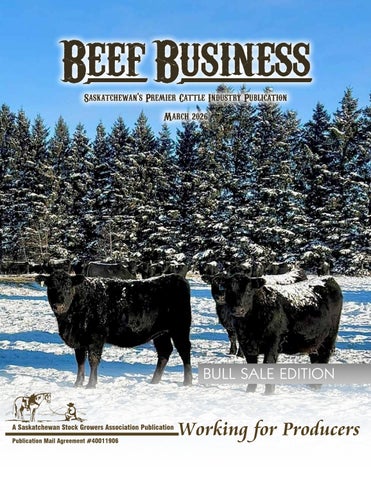
Beef Business March 2026

Page 1


Beef Business

Carefully crafted stock blends or your own custom mix. TALK

Find your perfect forage seed for a happy, healthy herd.

A Saskatchewan Stock Growers Association (SSGA) Publication

General Manager: Chad MacPherson

Box 4752, Evraz Place, Regina, SK S4P 3Y4

Tel: 306-757-8523

Email: gm@skstockgrowers.com Website: www.skstockgrowers.com

Managing Editor: Kori Maki-Adair Tel: 403-680-5239 Email: kmaa@shaw.ca

Agri-business Advertising Sales: Diane Sawatzky Tel: 306-716-4271 Email: sales@skstockgrowers.com

Livestock Advertising Sales: Samantha Chamberlin Tel: 306-528-7658 Email: livestocksales@skstockgrowers.com

Subscriptions

Box 4752, Evraz Place, Regina, SK S4P 3Y4

Tel: 306-757-8523 Email: office@skstockgrowers.com

Subscription Rate: One year $26.50 (GST included) Published five times per year

Design and Layout: Bumble & Vine Creative | Candace Schwartz Tel: 306-772-0376 Email: candace@bumbleandvine.ca

Prairie Conservation Action Plan (PCAP)

Manager: Carolyn Gaudet

Box 4752, Evraz Place, Regina, SK S4P 3Y4 Tel: 306-352-0472 Email: pcap@sasktel.net

SSGA reserves the right to refuse advertising and edit manuscripts. Contents of Beef Business may be reproduced with written permission obtained from SSGA's General Manager, and with proper credit given to Saskatchewan Stock Growers Association. Articles submitted may not be the opinion of SSGA. SSGA assumes no responsibility for any actions or decisions taken by any reader from this publication based on any and all information provided.

Publications Mail Agreement #40011906

Return undeliverable Canadian addresses (covers only) to: Saskatchewan Stock Growers Association Box 4752, Evraz Place, Regina, SK S4P 3Y4

Carolyn Gaudet

Jeff Gaye

Dr. Murray Gillies

Jean Hewson

Ashton Hewson

Mindy Hockley-Anderson

Ryan Kehrig

Tessa Krofchek

Kim Little

Chad MacPherson

Kori Maki-Adair

Carolyn McCormack

Kaitlyn McMurphy

Jason

Gordon Schroeder

Heather Sehn

Elizabeth Shirley

Jordan Sies

Dr. Diego Steinaker

Ian Thackeray

University

University

Belinda Wagner

Dale Weinbender

Garth Woods

Anna Wright

Jeff Yorga

Anna Rintoul

Producers Invited to Help Shape Canada’s Next Ag Policy Framework

Canada’s livestock producers will have an opportunity to help shape the policy and funding landscape that will guide the sector into the next decade, following the launch of national consultations on the Next Agricultural Policy Framework.

On January 20 in Ottawa, the Honourable Heath MacDonald, Minister of Agriculture and Agri-Food, hosted an in-person roundtable with industry stakeholders to begin consultations on the Next Policy Framework (NPF).

The NPF will succeed the current Sustainable Canadian Agricultural Partnership (Sustainable CAP) as the primary federal–provincial–territorial agreement supporting Canada’s agriculture and agri-food sector. The new five-year framework will run from 2028 to 2033, with Sustainable CAP set to conclude on March 31, 2028.

What This Means for Producers

For cow-calf operators, backgrounders, feedlot owners and processors, the NPF will help determine how governments invest in:

• Business risk management programming,

• Environmental and climate initiatives,

• Innovation and research,

• Market development and trade, and

• Competitiveness and productivity supports.

During the Ottawa roundtable, Minister MacDonald met with representatives from across the agriculture and agri-food sector to discuss both ongoing pressures and emerging opportunities. While discussions spanned the broader industry, issues such as input costs, climate resilience, labour availability, trade access and supply chain stability are expected to feature prominently in consultations affecting the beef sector.

“Canada’s agriculture and agri-food sector is a cornerstone of our economy and our food security,” Minister MacDonald said. “Meaningful engagement is essential in developing policy, and these consultations will help ensure the Next Policy Framework is grounded in the experiences and perspectives of those who know the sector best.”

The Long-Term Impact of a Five-Year Framework

The NPF will be the next five-year agreement between federal, provincial and territorial governments guiding agricultural programming and funding across the country. As with previous frameworks, cost-shared and federallydelivered programs will play a key role in shaping on-farm support.

For livestock producers, early engagement is critical. Policy decisions made under the 2028–2033 framework could influence everything from environmental costshare programs and on-farm technology

adoption to risk management tools that help stabilize incomes during market volatility or weather-related losses.

How to Participate

Following the initial roundtable in Ottawa, Minister MacDonald will host additional in-person sessions across Canada to hear directly from regional associations, producers and processors.

Agriculture and Agri-Food Canada will also lead national online consultations through the NPF webpage, inviting input from farmers, processors, Indigenous communities, women, youth and industry associations.

For producers, these consultations represent a key opportunity to ensure that the next policy framework reflects the realities of livestock production.

As governments begin shaping the post2028 landscape, producer input will help determine whether the next framework strengthens the competitiveness, resilience and long-term sustainability of Canada’s livestock sector.

Watch for further details in the coming months.

Learn more at https://www.canada. ca/en/agriculture-agri-food/ news/2026/01/minister-macdonaldlaunches-consultations-for-the-nextagricultural-policy-framework.html

Jared & Heather McTavish

306-435-4925 Home | 306-435-9842 Cell

Moosomin, Saskatchewan

mctavishfarmsltd@gmail.com

PLEASANTDAWN
MCTAVISH ONE EYED JACK 813L SON
BBMT 40N
BBMT 64N
BBMT 20N

Ottawa Expands AgriStability to Cover Pasture Feed Costs for 2026

On February 25, 2026, Agriculture and Agri-Food Canada (AAFC) announced an important update to the AgriStability program that will directly benefit livestock producers who rely on rented pastureland.

In the AAFC news release, Heath MacDonald confirmed that beginning with the 2026 program year, pasturerelated feed costs will be recognized as an allowable expense under AgriStability.

The change means livestock producers who graze animals on land they do not own will be able to include those grazing expenses when calculating eligible program costs. It’s a move aimed at improving fairness within the national business risk management framework.

“Canadian livestock producers deserve risk management programs that reflect the realities of their operations,” MacDonald said. “Adding pasture-related feed costs as an allowable expense ensures fairer support for those who rely on rented pastureland.”

AgriStability is designed to protect producers against significant income declines caused by production losses, rising input costs, or market volatility. Until now, pasture rental and grazing expenses were not fully aligned with other feed costs within the program’s allowable expense calculations.

The amendment is expected to particularly benefit cow/calf, sheep and goat operations; many of which, depend heavily on leased or rented pasture, especially in regions where land ownership is limited or expansion through purchase is cost-prohibitive.

By recognizing pasture-related feed costs, governments aim to ensure more equitable treatment between producers

who own feed resources and those who secure grazing access through rental agreements.

This update is aimed at fulfilling a commitment made by federal, provincial and territorial agriculture ministers at their July 2025 meeting to strengthen business risk management programming.

Rising land rental rates and ongoing input cost pressures have been key concerns for grazing operations in recent years. Industry stakeholders have argued that excluding pasture expenses from allowable costs understated the financial realities of pasture-based livestock production.

The change takes effect for the 2026 program year. Producers are encouraged to maintain clear documentation of pasture rental agreements and grazing expenses to ensure accurate reporting under AgriStability.

The amendment does not create a new program but adjusts the existing framework to reflect modern livestock production models better.

The inclusion of pasture-related feed costs could improve reference margin calculations and enhance support in years of income decline, reinforcing AgriStability’s role as a core tool in Canada’s agricultural risk management system.

This is good news for many grazing operations.

For more than 50 years, Pneu-Dart has offered the best remote injection equipment for your drug delivery needs.

Our Remote Drug Delivery (RDD) systems are designed to capture or medicate while minimizing stress on animals. Whether you're treating freerange cattle, sedating cervid livestock, or assisting in the translocation of wild animals, Pneu-Dart manufactures the products to handle every target situation.

Strengthened Support for Livestock Producers: AgriStability, Livestock Price Insurance and Satellite Forage Insurance

At Saskatchewan Crop Insurance Corporation (SCIC), relevancy means delivering programs that reflect the realities of Saskatchewan producers. For 2026, our suite of programs continues to offer support for livestock operations. Program enhancements strengthen protection, ensuring producers have the coverage they need, when they need it most.

Starting in the 2026 Program Year, AgriStability made adjustments to the feed inventory pricing. This permanent change ensures the Program accurately accounts for feed inventory used on farm and not sold. Program calculations properly reflect farm realities, especially in years of dry conditions.

In addition, feed from rented pasture is

now an allowable expense. This means if you rent pastures, AgriStability will capture the value of the feed consumed by livestock and include it as an allowable expense. Federal and provincial officials continue to review the potential for additional allowable expenses for the 2026 Program Year.

Alongside the AgriStability enhancements, you are reminded of the continued value offered through Livestock Price Insurance (LPI). LPI is a reliable way to help manage market risk in an industry where factors outside your control create market volatility—rising interest rates, tariffs and ongoing trade uncertainty.

This program allows you to establish a floor price for your cattle; if prices drop, you are covered. If prices rise, you benefit

from the higher market. Coverage options are flexible, offering a range of policies that fit your needs. LPI helps safeguard your operation against market instability, making it an option for livestock producers looking to manage risk in today’s unpredictable markets.

New for 2026, Satellite Forage Insurance is available under the Crop Insurance Program. Satellite Forage Insurance uses cutting-edge technology to provide accurate, responsive coverage for hay and pasture acres when there is a shortage of soil moisture.

Satellite Forage Insurance is replacing the Forage Rainfall Insurance Program (FRIP). All existing FRIP customers are automatically enrolled in Satellite Forage Insurance. This change is based on producer and industry feedback calling for more local, accurate and responsive coverage backed by data.

In 2025, SCIC conducted a pilot program. The pilot ran parallel with FRIP. Pilot participants confirmed the technology reflected real on-farm conditions and preferred the program over FRIP.

Simplified coverage options and accurate data make Satellite Forage Insurance a more responsive program for Saskatchewan producers. Satellite Forage Insurance uses more than 20 years of data and real-time satellite soil moisture technology to deliver townshiplevel insurance. This ensures claims and premiums reflect conditions where forage is grown. High, medium or low coverage levels are available and vary by soil zone. Additionally, you can customize your protection with two monthly weighting

SCIC is here to help protect your farm and ranch operations. You know your farm. We understand risk protection. Together, our programs can set you up for a steady season. For more information or to enrol, contact your local SCIC office.

SATELLITE FORAGE INSURANCE

For 2026, Satellite Forage Insurance is replacing the Forage Rainfall Insurance Program (FRIP). FRIP is no longer available and all existing FRIP customers will be automatically enrolled in Satellite Forage Insurance.

Responding to Producer and Industry Needs

In 2022, the Federal-Provincial Industry-Government Forage Insurance Task Team was established to improve forage insurance. The team explored new potential products tailored specifically for forage crops to provide better coverage options for producers.

The goals for improved insurance:

- reflective representation (proxy) for forage production shortfalls

- captures local conditions

- near real-time data

- long-term data reliability

The Saskatchewan Crop Insurance Corporation (SCIC) lead and took a deliberate approach to improve the way they insure forage for Saskatchewan producers.

2025 Shadow Pilot Results

In 2025, SCIC conducted a shadow pilot. The pilot ran parallel with the Forage Rainfall Insurance Program (FRIP). The goal was to incorporate sufficient data, validate technology and design a solution that serves as a trustworthy proxy for forage production shortfalls. This pilot used satellite-based technologies to measure soil moisture. The shadow pilot was strictly informational (no premiums charged and no claims paid). Producer participant feedback helped finalize program development.

Below is a summary of the shadow pilot results:

Localized Saskatchewan has approximately 3,700 townships, compared to the existing network of 224 weather stations. Coverage was available at the township level (10km-by-10km), varying by soil zone.

Simplified

Options

The shadow pilot implemented a default weighting option. Based on participant feedback, two different monthly weighting options were developed into the program design. SCIC recognizes the importance of early moisture and its affects on forage growth, however, at this time, April measurements are unreliable due to snow cover and frozen soil. April precipitation is reflected in early May soil moisture measurements.

Reliable Long-Term Data

Using over 20 years of data from tame hay yields, SCIC developed accurate correlations for soil moisture and forage yields. Satellite technology allowed SCIC to build a responsive program when there is a shortage of soil moisture.

Real-Time Data

Producer participants accessed an online soil moisture monitoring application to explore real-time data. They noted viewing this allowed them to validate their own on-farm observations of soil moisture on their land. Overall feedback noted the appreciation of accessing transparent and timely data to support informed decision-making.

Participant Sentiment

Overall, participants noted the shadow pilot was an improvement over FRIP. The pilot confirmed soil moisture data is a reliable indication of forage production (including SCIC’s data comparison to 2025 forage yields).

Contact Us: 1-888-935-0000 | customer.service@scic.ca | SCIC.ca

Saskatchewan Animal Enforcement Agency to Assume Provincial Animal Welfare Role April 1

Livestock producers across Saskatchewan will see a new organization overseeing animal welfare enforcement this spring.

Agriculture Minister David Marit announced January 19 that the Saskatchewan Animal Enforcement Agency (SAEA) will become Saskatchewan’s official animal welfare enforcement provider effective April 1, 2026.

The transition follows the decision by Animal Protection Services of Saskatchewan to discontinue operations as of March 31, 2026. After a public competition launched by the Ministry of Agriculture, SAEA was selected based

on its long-term operational plan and its ability to meet provincial expectations for enforcement under The Animal Protection Act.

Under the new arrangement, SAEA will provide enforcement services across Saskatchewan, with the exception of Regina, where the Regina Humane Society will continue to deliver services.

For livestock operators, the change signals continuity in enforcement, under new leadership. Government officials say the partnership is intended to ensure effective, professional, and compassionate enforcement throughout the province.

The transition also aligns with updates introduced through The Animal Protection Amendment Act, 2025. Amendments include the creation of a new animal welfare inspector position, a formal code of conduct for animal protection officers, and additional enforcement enhancements.

Producers are encouraged to familiarize themselves with the new agency ahead of the April 1 transition, as SAEA assumes responsibility for responding to animal welfare complaints and inspections across Saskatchewan. Find full details at saskatchewan.ca.

Agriculture is your life

You deserve an advisor who gets what’s on the line.

Our local practitioners specializing in the livestock industry can help minimize your taxes, maximize results, and optimize your operations.

Tax Planning for the Long-Term: Making the Right Decisions for Your Farm

The past few years have seen a welcome increase in the overall profitability of the cattle sector in Canada.  While this is obviously great for the overall financial health of the industry, increasing incomes mean producers may face significantly higher income tax obligations. This often results in producers looking for options to reduce these incomes and obligations through a variety of means, including the prepayment of eligible expenses, managing the timing of sales, and the purchase of new machinery to access additional tax deductions. While each of these options can achieve the desired result, whether they make financial sense in the long term will depend largely on the particular circumstances of the farm.

Pre-buying and cashflow considerations

Canadian farm operations are able to use the cash basis method when calculating their net income for income tax purposes. Generally, this allows producers to make eligible purchases (fertilizer, inputs, cattle, etc.) and fully expense the purchase cost in the year of purchase, so long as the cost has been settled.  Typically, this requires cash payment or the purchase being charged to an operating or financing credit account.

While this strategy may achieve the intended tax result, it may not make sense for every operation. First, consider the strain on the operation’s cashflow and the impact that can have. If the purchase is being financed on credit, ensure that the benefit from the tax deferral exceeds the additional financing costs. Second, consider whether it makes business

sense to purchase the expense based on price, storage considerations, market risk, and other factors. Depending on the nature of the purchase and future price expectations, it may not be a prudent business decision to purchase now versus at a future date solely for the income tax deferral.

Purchasing new equipment and recent tax change announcements

Does your farm operation really need the equipment in question? Purchasing equipment solely to reduce income tax isn’t a strategy we recommend. Each year, look at what you require to run your operation most profitably, and then choose the right tools. Consider purchasing new equipment if:

• Repair costs are getting out of hand;

• You’re unable to get field work done in time and opportunities are lost;

• Your growth plans mean having more acres or a larger herd; or

• When you benchmark your operation against similar operations, it shows you don’t have enough equipment for your farm size.

Once you’ve determined that you need more equipment and the farm’s cashflow projections can support such a purchase, then it’s time to consider the income tax considerations. Recent income tax changes announced in 2024 and 2025 propose to reinstate the full Accelerated Investment Incentive (AII) measures, which allow for three times the normal tax

deduction in the year of acquisition for qualifying purchases.

For example, if you acquire a tractor with a $500,000 purchase price, up to 45 per cent ($225,000) is allowable as a deduction in the year of purchase. This compares to 30 per cent ($150,000) under current rules, which were scheduled to phase down to 15 per cent in 2028 prior to the recent announcements. It’s important to note that the tax deductions in future years will be lower due to the accelerated deduction in the year of purchase. This can potentially cause income issues in future years when the equipment is sold or if the farm’s profitability levels continue in future years.

Key takeaways

Increased profitability for cattle farmers is improving the financial health of the industry while also creating the potential for unanticipated income tax obligations. While there are many options to manage taxable income in a farm operation, income tax considerations shouldn’t be the primary factor when making capital asset purchases or day to day business decisions. Having a well-developed plan with your business and tax advisors will help your operation make well-informed decisions aligned with its long-term goals in mind.

Ryan Kehrig, CPA, CA, is National Leader, Agriculture Tax at MNP, where he works closely with producers and agri-businesses across Canada to support strong, sustainable farm operations.

Take a 15-Minute Canadian Ranchers

Conservation Survey for a $100 Gift Card

University of Alberta

Study Title: Canadian rancher perspectives about conservation activities

Investigators:

John Pattison-Williams, PhD, PAg President, Pattison Resource Consulting jk.pattisonwilliams@gmail.com 780-878-5175

Luke Beattie, Researcher

Invitation to participate: You are being asked to participate in a research project. The research focuses on the views and perspectives of ranchers and farmers, and how you engage with Canadian conservation activities and organizations in Canada’s prairies. The goal of the study is to gather insight from the agricultural community to inform government policies and management practices that relate to grassland / rangeland use.

Study Procedures: The study involves completing a survey on the computer to identify your opinions. The entire survey will take approximately 15 minutes to complete. To thank you for your time, if you complete the survey, you will be entered into a draw where you will have a chance of winning a $100 gift card to Cabela’s. The actual odds of winning will

depend on the number of people who participate in the survey.

Benefits: The data of this survey will be shared with various levels of government to help guide informed decisionmaking on agricultural policy and land management in the prairie region. By participating, you contribute to research that can help ensure that the views and needs of the ranching and farming community are represented in future planning. We will also use the survey data to conduct statistical analyses and develop recommendations for policy improvement.

Risks: We do not anticipate any risks to you associated with participation.

Confidentiality: Your responses will be kept strictly confidential. Completing the survey online means that your answers will be securely stored in a database only the research team has access to. Your individual responses will not be shared with anyone outside the research team. Any reports, publications, or presentations that result from this study will include only summarized data, such as averages or general trends — no individual or farm will be identified.

Withdrawal from the Study: Participation is completely voluntary. You may refuse to answer any questions you do not wish to answer. You may also choose to stop the survey at any time by closing your browser; any partial responses will be saved. Because your survey is anonymous, once you submit your responses, it will not be possible to withdraw them from the study.

Use of your Information: The information gathered will be used in public reports and academic papers. This study is funded by Environment and Climate Change Canada (ECCC). Findings will be made publicly available and may be used by governments, organizations, or interested individuals to help inform decisions and policies related to agriculture, grasslands, and land use in the prairie region.

Questions?

If you have any questions or require more information about the study, you may contact the investigator at (780) 878-5175.

Survey Link:

https://ualbertauw.qualtrics.com/jfe/ form/SV_bIyNEmakfQPofTo

14th Prairie Conservation and Endangered Species Conference

Diversity: Key to Resilience

The 14th Prairie Conservation and Endangered Species Conference is a forum to discuss the latest issues, information, research and trends in the conservation of prairie landscapes, species, and species at risk. It will be held May 5-7, 2026, at TCU Place in Saskatoon, SK.

Find more information at  prairiecesc.ca.

Registration is open.

National Survey Targets Farmer and Rancher Mental Health

University of Guelph and Canadian Centre for Agricultural Wellbeing

Canadian producers are being invited to participate in the Third National Survey of Farmer and Rancher Mental Health, a confidential study hosted by University of Guelph that’s aimed at better understanding stress, resilience and overall well-being within the agricultural sector.

The survey will examine how stress affects farmers and ranchers and identify factors that support resilience in farm and ranch operations. Researchers say the

findings will provide valuable insight to industry leaders, support organizations and policymakers working to strengthen mental health resources tailored to agriculture.

Organizers expect the results will help inform future programs and services designed to better reflect the unique pressures facing producers.

Participation is voluntary and fully confidential. No identifying information will be collected, and respondents may skip any questions they prefer not to answer.

Producer input is considered critical to ensuring the research accurately captures the realities of life in Canadian agriculture and contributes to improved mental health supports across the sector.

The University of Guelph invites farmers and ranchers to take the survey here:

MARKETS AND TRADE

MARKETS AND TRADE

RETAIL MEAT PRICE SURVEY

Road to Bull Sale Season: Seven Key Stops to Buying the Right Bull Beef Cattle Research Council

Purchasing the right bull can quickly move your beef herd toward your production goals. However, buying the right bull doesn’t start on sale day; it begins months in advance.

Here are seven essential stops along the road to purchasing your next herd sire:

#1: Establish Short- and Long-Term Breeding Goals

Before looking at bulls, identify what you want your herd to achieve in the short and long-term. Your breeding program should align with your operation’s resources, management style and future plans.

For example, knowing the traits that you want your calves to have (e.g., lighter birth weight, better growth, carcass quality, maternal traits), will better prepare you to match those goals with the genetic potential offered by available bulls.

#2: Determine the Traits to Focus On

Based on your goals, determine which traits to select for. As an example, if you are breeding first calf heifers, selecting bulls with higher calving ease is essential. In contrast, if you are not retaining replacement females and sell all calves after backgrounding, consider focusing on weaning weight (WW) and yearling weight (YW), with moderate emphasis on carcass and feed efficiency traits.

Use expected progeny differences (EPDs) to predict how a bull’s offspring will perform, on average, compared to offspring from another bull. Emphasis on specific EPDs can help accelerate genetic improvements but remember to avoid single trait selection. Consider prioritizing economically relevant traits (ERTs) and using selection indexes to combine multiple traits into one value.

#3: Identify Potential Seedstock Suppliers

Not all bulls or breeders are created equally. Build relationships with seedstock providers who can explain the genetics behind their bulls, provide performance records and bull breeding soundness exams (BBSEs). These relationships also allow you to evaluate management practices implemented on the farm as differences in production systems can impact performance and how traits are expressed.

A high-priced bull may be more cost effective in the long run if he sires better calves or lasts for more breeding seasons.

Trustworthy breeders will help you match the bull’s genetics to

your operational goals. Some may offer post-sale support or health guarantees.

#4: Evaluate Bulls

Now it’s time to dig into the details. Compare bulls based on your selected EPDs and physical characteristics (e.g., structure, feet, temperament).

Confirm each bull has passed a BBSE and is up to date on vaccinations. Benefits of a bull breeding soundness evaluation include higher pregnancy rates, tighter calving season, early detection of problems and reduced disease risk.

FEATURE

Visually inspect the bulls to assess structural soundness and conformation, which are moderately heritable traits. This impacts a bull’s longevity, breeding efficiency, injury risk and genetic influence on the herd. Bulls with correct leg, foot and joint structure can travel farther, mount more successfully, and avoid lameness or injury.

#5: Rank Bulls

Rank the bulls according to how closely they meet your breeding goals and selection criteria. It may be helpful to use a spreadsheet or note system to keep track of rankings and make comparisons across key traits. Using selection indexes can streamline ranking further at this step.

#6: Establish a Bull Buying Budget

Having a budget is key. Bull prices can range from $2,000 to upwards of $20,000 depending on genetics, pedigree and reputation.

Use the BCRC Bull Valuation Calculator at www.beefresearch.ca/ tools/bull-valuation-calculator to estimate the break-even price of a bull based on your operation’s size, feed costs, weaning rates and current market prices.

#7: Sale Day

Whether buying through an auction or private treaty, the same rule applies—stick to the plan. Focus only on bulls that have been pre-evaluated. Avoid impulse buys or being pressured into a purchase that doesn’t fit your goals or budget. If the right bull isn’t available at the right price, be prepared to wait or reassess rankings.

Final Thoughts on Bull Selection

Bull buying is more than flipping through a catalogue. It’s a multi-step process that starts with good records, clear goals and knowing what traits will move your operation forward. By planning and sticking to a disciplined approach, you can ensure your next herd sire is a sound investment.

Acknowledgements

Thanks to the following individuals for contributing their time and expertise to review this article and related resources:

• Karin Schmid, Beef Production and Extension Lead, Alberta Beef Producers

• Chelsey Siemens, Livestock and Forage Extension Specialist, Saskatchewan Ministry of Agriculture

• Macy Liebreich, Chief Executive Officer, Canadian Beef Breeds Council

• Stephanie Lam, Director of Research, Livestock Research Innovation Corporation

The BCRC is funded by a portion of the Canadian Beef Cattle Check-Off. B

By clearly defining your goals, you’ll be able to make informed, data-driven selection decisions that improve herd genetics, profitability and sustainability.

SDC to Open Processing Plant near Perdue

SDC Farms is set to open Sunnydale Meats, a new federally-inspected slaughter and packing facility near Perdue this summer.

According to Ednali Fertuck-Zehavi, chief commercialization officer for SDC Farms, the goal is to help Saskatchewan producers build their brand with a fully traceable, high-quality product.

“As the only federally-inspected facility in the province for beef, sheep, and bison, we are creating a path that allows us to capture the full value of our livestock right here at home,” she said. “By providing a local, federal alternative, we remove the hurdles of long-distance transport and give these family-run farms a platform to compete on quality.”

The plant will be able to process 100 head of cattle, 200 hogs or sheep, or 50 bison in a day. As well, the facility has advanced segregation capabilities that allow them to handle organic and certifiedsustainable ranchers to process their herds while fully preserving their certifications.

Fertuck-Zehavi says a local plant offers producers—and the province— advantages over dealing with the huge processing facilities in Alberta like JBS in Brooks or Cargill in High River.

“While the industry has trended toward massive consolidation, we offer a vital alternative,” she said. “We are a high-tech, federally-inspected facility that is nimble enough to serve the unique needs of smaller and mid-sized producers. We are proving that you don’t have to be a giant to be a global player. It’s the quality that counts.”

Removing the hurdle of long-distance transportation allows those small to midsize producers an opportunity to compete on quality.

“We compete by focusing on what Saskatchewan does best, which is premium quality,” Fertuck-Zehavi said. “International markets in Asia and Europe are hungry for the high-welfare, grainfinished beef that our province produces. “Our facility is designed to execute the strict protocols these markets require. This allows us to bypass the commodity race and position Saskatchewan beef as a luxury product on the global stage.”

Part of the overall approach will be to build relationships based on ranchers’ needs, and aimed at providing producers with top return for their animals’ value. Fertuck-Zehavi says a collaborative relationship, as opposed to a strictly transactional one, will allow market data help producers direct their efforts toward generating greater value.

“Our goal is to create a model where high quality is consistently rewarded. We are committed to building long-term, transparent partnerships where producers can choose the model that best fits their business,” she said. “That might be a competitive spot price for one farmer, or

a value-based grid for another who wants premiums for superior grading.

“Because we use advanced individual rail scales, we can provide precise data back to the farmer about their animal’s yield and quality. This transparency helps them make better decisions for their herd’s genetics and feed,” Fertuck-Zehavi said.

“We are here to ensure that when a Saskatchewan family farm invests in quality, they see that return directly in their pocket.”

The plant will use a unidirectional flow intended to ensure high standards of safety and efficiency “from the moment an animal arrives to the moment the product is packaged,” Fertuck-Zehavi said. Smart technology is used throughout the building.

The unidirectional linear flow through the plant prevents backtracking and ensures hygiene at every stage. Specialized equipment captures by-products for other industries, maximizing the utility of every animal and significantly reduces the environmental footprint.

“It is a model of efficiency that respects the animal and the environment,” FertuckZehavi said.

Traceability is an important factor for building and maintaining relationships, not just between Sunnydale Meats and its suppliers, but between the Saskatchewan beef industry and its customers. According to Fertuck-Zehavi, it’s “our greatest opportunity to tell the Saskatchewan story to the world.”

To achieve this, she says, Sunnydale has built a smart facility with integrated data systems throughout. Advanced rail bifurcation and static scales create a digital checkpoint for every single animal, continued on page 28

FEATURE

Processing Plant near Perdue cont. from pg. 26

ensuring that specific data like grade, weight, and origin stays physically linked to that carcass.

This allows Sunnydale to share a verified story with the consumer. As FertuckZehavi says, “we give them the confidence to know exactly where their food comes from and celebrate the sustainability and care of our local ranchers. It transforms a simple product into a relationship built on trust.”

Technology like AI-driven rail bifurcation systems maintain individual identity for every single animal, allowing Sunnydale to guarantee lot integrity “from the farm gate right to the dinner plate,” she said. “For the consumer, it builds unshakeable trust. For the producer, it preserves the premium value of their hard work by proving that their beef is safe, sustainable, and top-tier.”

It’s clear there are economic advantages to slaughtering and butchering beef cattle close to home. The challenge is to create and sustain value that outweighs the big processors’ economies of scale. Fertuck-Zehavi argues that by keeping the value-added benefits of processing within the province, Saskatchewan will retain millions of dollars that would otherwise flow elsewhere. This investment will strengthen the entire local supply chain from feed growers to transport companies, proving that “rural Saskatchewan is the ideal place to build world-class agricultural infrastructure.”

Sunnydale expects to create more than 50 permanent, full-time jobs to the community—and not just general labour positions. “We are focused on reviving the skilled craft of the meat cutter and the professional butcher,” Fertuck-Zehavi said.

“We are providing training in the precise art of harvesting and breakdown, as well as strict CFIA food safety protocols and animal welfare standards. We want to elevate the perception of this work,” she said.

“By offering stable, long-term careers in a modern, safety-focused facility, we are giving people the opportunity to master a specialized trade that is the backbone of our food supply.”

The labour aspect isn’t just a desire to be a good employer. It’s a critical component to a successful operation, and one of the biggest challenges in the meat processing sector.

Meat processing is tough work, FertuckZehavi says, and the industry has historically struggled with high turnover. Navigating this is a matter of changing the culture.

“We’ve designed a modern facility that prioritizes worker safety and ergonomics above all else. We believe that if you treat people with dignity and give them the right tools and training to work safely, they build a career with you,” she said.

But of course, the other big challenge, especially when competing with the

sector’s giants, is maintaining profitable margins in fluctuating markets.

Sunnydale’s strategy is total carcass utilization. “We don’t just process meat; we capture value from the entire animal, turning by-products that others might see as waste into revenue streams for other industries. This efficiency is what makes our business model sustainable for the long term,” Fertuck-Zehavi said.

She sees Sunnydale’s growth as directly tied to producers’ growth. If the plant is able to serve the Saskatchewan beef sector’s interests and create new demand specifically for Saskatchewan beef, ranchers will have more confidence they can grow their herds.

“We want to be the reliable partner that encourages the next generation of farmers to invest in their business because they know they have a world-class facility right next door, ready to market their product,” she said.

“By processing our livestock within our own borders, we keep the economic benefits and the expertise right here in our communities,” Fertuck-Zehavi continued. This strengthens Canada’s food security and positions our province as a global leader in premium protein production. We are building an ecosystem where local quality meets global demand, ensuring that Saskatchewan beef is recognized everywhere as a top-tier product.”

Sunnydale Meats is under development. Photos courtesy of Pete M. Gross

It should come as no surprise to many of you that ticks are becoming an increasing problem in Canada and this is likely to get worse with the spread of a different species of tick, the “Asian Longhorned Tick (ALHT)” across the United States. This tick can infest both dairy and beef cattle and is the primary vector of a disease called “Theileriosis” which is caused by the blood parasite “Theileria Ikeda Orientalis.”

This disease is very new to Canada, having been detected in two dairy cows in Ontario, one that was imported from the United States. Theileria is unlike other diseases we commonly see in our cows in Canada.

Currently, the risk of our cows becoming infected with Theileria is low; however, the risk of the Asian Longhorned Tick establishing itself in parts of Canada is high and has increased due to recent detections of the tick in Maine, Michigan and Iowa, as well as detections on cattle crossing the Canadian border.

SCIENCE AND PRODUCTION

Ticks and Cows

along the back line, on the inside of the legs, on the flanks of the udder as well as around the rectum.

Producers are encouraged to discuss tick control with their herd veterinarian to go over which products are available to treat the cows as well as other potential tick control methods. If producers do detect ticks on their animals, we would appreciate if they could submit a picture of the tick to https://etick.ca/ or via the ETick app, our citizen science surveillance tool.

The ETick app can be downloaded for free and has instructions on how to remove ticks, how to take a good picture, how to submit that picture and what to do with the tick afterwards. You can also use this service to submit ticks found on other animals like dogs, horses, or even people.

“ Importing cows should be avoided where possible and any imported cows should be thoroughly checked for ticks . . . in the ears . . . back line . . . legs . . . udder . . . around the rectum. ”

ALHTs thrive in cool, wet climates and avoid cold weather. Consequently, winter should limit the spread of ALHTs until early spring. We are hoping to use this time to increase awareness and to prepare for its arrival. Cattle producers will play a key role in surveillance and control of this tick.

We are asking producers to keep a close eye on their cows for the presence of ticks. This is especially important for cows coming off “bushy” pasture or cows being imported from the United States. Importing cows should be avoided where possible and any imported cows should be thoroughly checked for ticks. They tend to be found in the ears, on the neck,

Finally, if you do start to see an increase in ticks on your cows and some of them begin to get sick, consider the possibility of Theileria. This infection has no treatment and most commonly causes anemia (blood loss) and jaundice (yellowing of the gums) as well as abortions. Your vet can help with diagnosis and supportive care of any affected cattle.

Thank you for your vigilance and for your dedication in caring for your animals. Remember to download ETick and remember that producers can stay informed and participate in surveillance discussions by joining our national, cross sector surveillance network, the Canadian Animal Health Surveillance System, at www.cahss.ca or through their industry groups.

Here’s hoping for tick free cows in 2026!

B

Dr. Murray Gillies is a veterinarian based in New Brunswick, where he was raised on and now practices on his family-owned dairy farm. In addition to his clinical work, he serves as Interim Division Director of the Canadian Animal Health Surveillance System (CAHSS), a division of Animal Health Canada. In this role, he supports coordinated, data-driven approaches to animal health monitoring and disease surveillance across Canada.

Quick Reference

• New types of ticks, such as the Asian Longhorn Tick (ALHT), are likely to expand into Canada in the near future.

• The ALHT carries a disease called Theileriosis that is common in the US but new to Canada. It has only recently been discovered in Canada.

• Theileriosis is a mild disease in cattle and does not spread from cow to cow but can spread through transmission of blood (i.e. shared needles).

• The best opportunity to control Theileriosis is by limiting the importation of the tick from cattle and other animals coming from the US, knowing where ALHT are present in Canada and implementing tick control.

• Cattle producers are an excellent source of surveillance information regarding ticks and should participate in reporting as much as possible.

Protect Your Herd from the Asian Longhorned Tick

An emerging tick and disease threat to Canadian cattle

Why It Matters to Farmers

The Asian longhorned tick feeds on livestock, wildlife, pets, and even people. Heavy infestations can cause stress, weight loss, lower milk yield, and in severe cases, death.

The tick can also carry a parasite that affects red and white blood cells in cattle, causing a disease called bovine theileriosis.

U S herds with infections have reported death losses of 5–20% during outbreaks. Early veterinary care can help animals recover, but once infected, cattle remain carriers for life, and a potential source of infection for other cattle.

What You Can Do

Discuss tick control and prevention with your veterinarian.

Check the ears, neck, udder, and legs for ticks, especially for imported cattle

Use good biosecurity practices: isolate and monitor newly purchased or imported cattle before introducing them to the herd.

Watch for pale or yellow gums (anemia or jaundice), weakness, fever, abortions, or a sudden drop in milk yield.

Call your veterinarian if cows seem weak or pale.

Submit photos to eTick.ca for free!

Found a Tick? Scan to Report It

The Asian longhorned tick is a small, reddish-brown tick that has spread across many U.S. states since 2017 The tick has not been found in Canada as of November 2025 In October 2025, an imported dairy cow tested positive for bovine theileriosis, a disease caused by the parasite Theileria orientalis Ikeda, which can be spread by the Asian longhorned tick. Female ticks reproduce without mating, so one tick can start a new population. Theileriosis is an immediately notifiable disease in Canada.

North American Distribution

The Asian longhorned tick is present in many U.S. states bordering Canada, including Maine, New York, Michigan, and North Dakota, increasing the

Stay Informed Scan or click for Updates

Tick App, Texas search (Nov 2025)

Foot-and-Mouth Disease Planning Needs to Account for Wildlife

Drs. Jamie Rothenburger and Emma Gardner

The home range of a deer can reach over 100 kilometres, which means a deer infected by a virus could move vast distances quickly. This is the crux of the issue when it comes to understanding the role of wildlife if Foot-and-Mouth Disease (FMD) is introduced to Canada.

FMD is among the most economically significant agricultural diseases. Thankfully, Canada’s last outbreak was in the 1950s in Saskatchewan and the disease did not establish itself in livestock or wild animals. Our country’s classification as FMD-free by the World Organization for Animal Health has significant and important implications for accessing foreign markets. However, the risk of introduction remains real.

Many countries have endemic disease, meaning it is common and circulates in animals, causing disease. These countries

include Africa, Asia, the Middle East and parts of South America. Travellers from any of these areas could be a source of virus for places like Canada where we don’t have it.

FMD causes illness in cloven-hooved domestic animals including pigs, cattle, sheep and goats. The virus easily spreads between animals through a variety of means including contact with secretions and through the air. Painful sores develop on the hooves, within the mouth, and teats. These sores can get secondary bacterial infections. They are also production-limiting, with infected animals eating less, growing slower and producing less milk.

As a federally-reportable disease, suspected cases must be reported to the Canadian Food Inspection Agency. Producers should contact their veterinarian immediately if they see sores on the mouth or hooves of their cattle.

• GRASSFED: “True North Foods is partnered with A&W Canada to supply Canadian grassfed beef for A&W’s grassfed burger program.

• SERVICES: Whether you are a specialty producer looking to get your product to a specific market or distributor, or if you are producing commodity livestock for sale, we can partner with you. From our multi-species capabilities to our ability to handle smaller volumes, we offer excellent capabilities for producers in the Canadian Prairies to maximize their profitability.

• FACILITY: We have a state-of-the-art facility to allow us to reach markets across Canada, the USA, and beyond. We understand producer’s needs, their care for their animals, and their honest, straightforward nature. Call us to hear how we can work together to get your product to market.

into free-ranging species. The FMD virus is known to infect more than 70 mammalian species worldwide, with most significant disease occurring in cloven-hooved animals such as deer, pigs and bovine species.

In Canada, we have 10 wild animal species that are known or suspected to be susceptible to this disease, including: deer, elk, moose, pronghorn (antelope), caribou, bison and several species of wild goats and sheep. Elsewhere in the world, bears in captivity have also acquired infection, making it highly likely that our native black and grizzly bear populations are potentially susceptible. But perhaps the biggest free-ranging animal of concern is the introduced European boar (sometimes referred to as wild pigs).

While the consequences of introduction to domestic animals would be severe, there are also important implications for wildlife populations to consider. Containing the disease to one or a few infected farms would be a challenge but is achievable. This is especially true if the disease is recognized and diagnosed early before substantial spread can occur.

What would make eradication difficult is if the virus spreads

If the virus were to be introduced to Canada, free-ranging pigs have the potential to become important transmission vectors. Pigs are known as virus amplifiers, creating very high loads of virus during infection compared to species like cattle. They develop severe lesions, shed high amounts of virus, travel long distances, and can potentially spread the disease between farms.

Efforts to eradicate wild pigs from Canada have proven expensive and difficult. Also critical is their widespread range across important areas of livestock production in Alberta, Saskatchewan and Manitoba. These animals are notoriously difficult to control, and this feature wouldn’t change in the face of a disease outbreak.

FMD in any wildlife species would be problematic for re-establishing Canada’s disease-free status. And how the disease will behave in Canadian wildlife is difficult to predict. It is also challenging to know wild animal population size and distribution and their overlap with domestic species.

Efforts to control the disease in wildlife elsewhere in the world have included

limiting the interactions between wildlife and livestock through fencing and culling. Vaccinating wildlife for this disease poses a number of challenges and even if deemed acceptable from a regulatory perspective (highly unlikely), there are very few examples of successful deployment of vaccines in free-ranging wild animals.

Canada must do everything possible to keep this disease out. That includes preventing the illegal and high-risk importation of animal products through strict, well-enforced border controls. It also means never feeding meat or meat byproducts to pigs, and maintaining strong on-farm biosecurity practices such as limiting visitors and screening them for risk factors.

For example, are you asking visitors whether they have travelled overseas recently—and if so, ensuring they have changed their footwear before entering your farm?

If FMD were to occur in Canadian livestock, there would be a massive response to contain the outbreak and limit the damage. To prevent spread to wildlife, producers would have a critical role to play. Importantly, they would need to increase efforts to reduce contact between infected herds and wildlife such as deer by improving biosecurity at the livestock-wildlife interface, including fencing feed and water sources.

It would be imperative to follow veterinary recommendations or orders because they are there to minimize the virus spread, helping to eliminate the disease as quickly as possible and protect our agricultural industries and livelihoods.

In January of 2025, Germany experienced a contained outbreak on a single farm, resulting in an estimated $1.6 billion CAD economic impact. While the bovine spongiform encephalopathy (BSE) and tuberculosis challenges of the past two decades were significant for the Canadian beef industry, these would pale in comparison to an unchecked FMD outbreak, particularly if it established in wildlife or freeranging pig populations.

Dr. Emma Gardner is a veterinarian and epidemiologist with a DVM and PhD in Epidemiology from University of Guelph and a master degree in Conservation Medicine from Tufts University. Dr. Gardner serves as program coordinator for the Canadian Animal Health Surveillance System at Animal Health Canada and previously held veterinary epidemiology and emergency management roles with the Food and Agriculture Organization of the United Nations following clinical practice in Ontario. She is currently based in Rome, Italy. B

Dr. Jamie Rothenburger is an assistant professor at University of Calgary’s Faculty of Veterinary Medicine, an anatomic veterinary pathologist and wildlife disease researcher, a WCVM graduate with a PhD in Pathobiology from Ontario Veterinary College and Diplomate of the American College of Veterinary Pathologists, who studies infectious diseases at the wildlife–livestock–human interface and writes for The Western Producer.

ACTIVE MISSING LIVESTOCK FILES

December 20, 2025, to February 15, 2026

NOTE: If you have any information related to these or any missing livestock file, please contact Livestock Services of Saskatchewan or RCMP Livestock Investigator Cpl. Owen Third at 306-537-9448.

Livestock inspection is often experienced as a brief interaction at the chute gate or auction mart, yet the work behind that moment is far more extensive. In this threepart series, The Tip of the Iceberg, we look beyond the visible inspection to explain what happens before and after cattle are presented for sale. The series explores how ownership is verified, why sale proceeds are sometimes withheld or redirected, how finance interests and missing livestock are handled, and the value these processes deliver to the livestock industry. Together, the articles provide producers with a clearer understanding of the inspection system and the role it plays in protecting ownership, commerce, and confidence in the marketplace.

The Tip of the Iceberg – Part 1 of 3

What Happens at Inspection and What Starts Right After

Most producers experience livestock inspection as a quick, practical exchange. You drop off cattle at the auction mart or call for an on-site inspection. The inspector checks the manifest, looks at the cattle, and records what is needed so the sale can proceed. When it goes well, it

The Tip of the Iceberg –Part 1

of 3

feels smooth. When it does not, the delay can feel unnecessary.

This series is about what sits beneath those few moments. The inspection is the part you see. The real system includes the work that happens before and after the inspection. It is built into Saskatchewan’s Animal Production Act and Regulations, updated and in force as of July 1, 2024. It exists to protect ownership, support secure payment, and keep commerce moving at the pace the industry expects.

The visible part of inspection

A smooth inspection begins with the basics. The inspector greets the producer and ensures the livestock manifest is complete. That matters because a signed manifest is a legal document and forms the backbone of the transaction record. The information recorded during inspection becomes the data set relied upon later for oversight, verification, and enforcement as necessary.

Fun Facts:

One detail is frequently misunderstood. The inspector generally cannot confirm that the “Pay To” line matches the registered brand owner during the physical inspection itself. That verification typically happens later, when the manifest is entered into the Livestock Services of Saskatchewan (LSS) inspection records database.

If the “Pay To” does not match the registered brand holder, the inspector must complete due diligence. That usually includes contacting the consigner first to allow them to provide proof of purchase. If this is not available, they may then contact the brand holder for confirmation and/or consent. In some cases, a release or written authorization is required to allow sale proceeds to be directed as indicated on the manifest.

• LSS inspectors enter roughly 100,000 manifests each year.

• LSS inspectors inspect in excess of 1.5M head each year.

• More than 8,500 head of livestock offered for sale required either a redirect or withhold in 2024/25

The cattle are then inspected and counted. Brands are observed and recorded. The inspector completes their portion of the manifest. At this stage, the focus is on accuracy. The facts captured here drive every step that follows.

When this part goes well, the interaction is quick and predictable.

What often surprises producers

This protects the brand holder. It also protects the seller, the buyer, and the dealer. It prevents proceeds from being paid incorrectly and having to be recovered after the fact.

A common example

A producer consigns cattle and lists a family farming company on the “Pay To” line. The brand is registered personally in a parent’s name. At the chute, everything appears normal. The cattle are inspected and recorded. The sale proceeds.

Later that day, when the manifest is entered into the system, the mismatch becomes clear. The inspector contacts the consignor to provide proof of ownership/ purchase and then, potentially, the brand holder. If proof of purchase is provided or consent is given promptly, funds are

released without delay. If confirmation cannot be obtained quickly, the manifest may move into a withhold status until direction is clear.

This is not red tape. It is the system ensuring ownership authority is respected.

The work after the inspection

Once the cattle leave the ring, the visible inspection ends, but the inspector’s work continues. Brands observed are recorded on daily brand sheets. Manifests are entered into the system. Brand alerts issued for missing or stolen livestock automatically prompt the inspector to investigate further any time animals are offered for sale with those brands. Producer files are updated if necessary. Duplicate records are marked “DO NOT USE” to prevent future errors.

SCIENCE AND PRODUCTION

Any withholds or redirections require an irregularity record for internal use. These records explain what occurred and why. They provide communication, history, transparency and accountability.

The scale of this work is significant. In the 2024–2025 fiscal year, proceeds for thousands of head of livestock were subject to extra scrutiny before release, protecting millions of dollars in sale value while ownership was confirmed.

This is the essence of the iceberg. The inspection you see is small. The effort and protection beneath it are large.

The May 2026 edition of Beef Business Magazine will bring Part 2, which looks at why inspectors sometimes have to slow down at a transaction and what is required to prove ownership when brands, invoices, or finance interests are involved.

Key Terms:

• Manifest: Legal document used to indicate ownership details, payment direction, load details, transporter information, and inspection verification details.

• Withhold: An LSS-directed temporary freeze on payment after sale to verify ownership details and direction of proceeds.

• Redirect: The action of an LSS Inspector to redirect proceeds of sale based on corrected ownership details.

ASSOCIATION NEWS, REPORTS AND EVENTS

A REPORT FROM JEFF YORGA PRESIDENT, SASKATCHEWAN STOCK GROWERS ASSOCIATION

Welcome to the bull sale edition of the Beef Business. I hope winter has treated you well, the feed stack is full and the cows are fat. Early bull sales have been following right along with the red-hot feeder market. I have heard it said that three steers buy a herd bull, and so far, bull sale prices are reflecting that trend. The calves that new herd sire produces will be marketed in the fall of ‘27; whether your goal is to make replacement heifers or a top pen of steers, there has never been more opportunity. It’s a fun time to be in the cattle business!

Over the last few months, we have seen a surge in membership activity. If this is your first time reading the magazine, welcome! Thank you for standing with us and making your voice heard. The Saskatchewan Stock Growers Association (SSGA) relies on memberships to do our work. We understand that there is a cost to participate, so thank you for placing your trust in us.

That said, trust is not given, it's earned. Our values must be lived everyday and reflected in our policy decisions. When we say that we respect all primary producers and that everyone has a right to express their opinions, we mean it. The SSGA wants to hear from you so that together we can formulate policy. There is no one

on this board that wants to tell you what to think. When resolutions are brought forward, they are discussed, voted on, and if carried, become the direction of the board. We do not take things under advisement or change resolutions once they are passed.

We value individuality and the freedom to be enterprising. These values often run us up against government legislation that seeks additional regulation and stifles our businesses, whether intentionally or not. It has been through our work with government that the new satellite-based forage rainfall insurance was initiated. I am confident that, in time, the program will be granular enough to insure your land specifically—giving you a tool that is actionable and responsive to what is actually happening on the ground. Our advocacy efforts around fence lines, nonnavigable waterways, and discretionary use continues.

We value animal husbandry and environmental stewardship. For most of us, these go hand in hand. It has been through the efforts of this organization and its members that this reality is being recognized by funders and nongovernmental organizations (NGOs). The foresight to launch a foundation with the goal of offering term conservation easements—with a focus on keeping the landowner the landowner—has changed the landscape. Our foundation has a waiting list of applicants.

We value honesty, integrity, and transparency—which brings me to the ongoing traceability discussion. The SSGA has opposed the enhanced measures introduced by the Canadian Food Inspection Agency (CFIA) from day-one. It is also important to recognize and thank Mark Elford and Pat Hayes for their leadership and the work they undertook early on in opposing these proposed regulations.

It is very difficult to negotiate when there is a gun to your head, and the number of hours they put in on our behalf should be

applauded and recognized when ever we get the opportunity. What they started, we have an opportunity to finish. When these discussions began, there were two men that stood against the CFIA, now there is an entire industry of primary producers, united in saying stop

In January, we had a call with the CFIA to express our concerns. They restated several times that the primary producer’s responsibility is to buy the tag and put it in, and that’s it. We had to remind them of cow/calf economics, and if there is cost added to the value chain, it gets passed down to us and we have no where to pass it; so, 100 per cent of the cost of enhanced traceability falls to the primary producer.

We also heard repeatedly from the CFIA that there is a need for movement reporting. We reminded them that we already have a robust manifest system that is moving to digital, and we asked if they had attempted to incorporate it into their system. Their answer was no; they hadn’t. We also suggested that if they want to implement these enhanced rules, they should do so in a jurisdiction without movement reporting and find out if it can be successful.

Will small producers invest in electronic identification (EID) readers? Will adoption exceed 50 per cent? Will the system actually be useful during a disease investigation? If there were clear answers to these questions, it would be more realistic to consider the current proposal.

This leads to a final major point: the technology itself, its usability, and how these rules would function in practice. We do not believe the tools or platforms are ready for this type of rollout. Producers need tags that stay in place and can be reliably read in an alleyway. They need computer interfaces that function without cell service and are straightforward and cost-effective to use.

In short, if the proposed regulations were implemented, producers would bear the burden of complying with requirements

President Jeff Yorga Saskatchewan Stock Growers Association

ASSOCIATION NEWS, REPORTS AND EVENTS

they do not support and lack the tools to meet. For these reasons, we continue to oppose the proposed changes.

At the time of writing, we are heading into our semiannual meeting, where I expect several strongly worded resolutions directed at the Canadian Food Inspection Agency. Coming out of the meeting, we will be asking for your support to turn up the temperature on this issue and not let it get slow played.

Please take the time to contact your local MLA and MP, the check-off agencies, the CFIA, and the federal minister of agriculture to register your concerns. Your voice matters, and we will continue working to ensure it is heard.

We value teamwork. The board and staff of SSGA are here to serve our members, and we encourage you to reach out if there is any way we can support you. Recent town halls, zone meetings, and the semi-annual meeting have shown that we are strongest when we work together. When producers speak with a unified voice, people listen.

Until then, Jeff

Man/Sask Gelbvieh Annual Update

Ian Thackeray

Man/Sask Gelbvieh Association 2026 Board of Directors: Ian Thackeray, President/

Man/Sask Gelbvieh Association Board of Directors:

• President/ Treasurer: Ian Thackeray

• Vice President: Braylen Blake

• Secretary: Kimberly Little

• Other Man/Sask Gelbvieh Association Board members are Eileen Davidson and Maureen Tubman.

(the Zalinko family) for donating the heifer won by McKenzie Perras and Twin Springs Farm Ltd. A total of $11,460 was raised for the Man/Sask Gebvieh Association.

If anyone is interested in sponsoring or helping at an event, please let us know. You can follow us on Facebook.

Wishing everyone a great year, smooth calving, a great bull sale season, and a great spring and summer show season. B

Satellite Forage Insurance

Satellite Forage Insurance offers relevant, responsive insurance when there is a shortage of soil moisture.

Coverage

$

High, medium and low coverage levels available, varying by soil zone. Premiums are now localized to where the insured hay or pasture is located within a township. Includes fire insurance.

Weighting options

Two monthly weighting options are available to tailor coverage:

Claims

Claims begin when moisture levels fall below 93% of the long-term average. Claims are automatically calculated based on satellite data.

The deadline to apply, reinstate, cancel or make changes to a Crop Insurance contract is March 31, 2026.

Scan to book a call!

With 2025 in the rear-view mirror, it is very pleasing to look back and reflect on what a great year it was with outstanding beef prices, exceptional production and female sales, and an overwhelming number of entries and attendance at all the shows and sales across Saskatchewan and Canada.

The Masterpiece sale was held at Gold-Bar Livestock in conjunction with our annual general meeting (AGM). The sale facility was packed with consigners and buyers. It was truly gratifying to see a great turn out and a very good set of cattle on offer. Hosting the AGM and Masterpiece together has been very well received and attended.

Our board of directors remains the same for the coming year; I know we have a great team of people that are willing to contribute. I strongly encourage our membership to reach out to me or any of the other board members if you have any questions, concerns, or ideas.

Saskatchewan Angus Association Annual Update

Canadian Western Agribition (CWA) was another great success and was host to the 2025 National Angus Show. The Black and Red Angus Shows were very deep in quality and well attended with the stands full again. The Commercial Cattle Show and Sale as well as the Bull Pen Alley Show was also very successful. The added food and refreshments, cash draws and enhanced awards for the National were all very well received by those in attendance. Thank you to the volunteers and sponsors that made this event fantastic, once again.

that evening was the Canadian Junior Angus donation heifer from Murray Ranches. Thank you to the Murray family for your generous donation and to all that participated to generate a substantial amount of money for our juniors.

The All-Star Angus Sale was held on Friday night during CWA with an excellent set of cattle traded that evening. Congratulations to all the consigners in the sale. Another highlight

Our next board meeting is scheduled for April 19, 2025, in Moose Jaw, SK. In conjunction with the meeting, we are planning another breeder session. Over the past years, these breeder sessions have been very well received. If you haven’t attended one, this would be a great opportunity to do so. You don’t have to be an Angus breeder to participate, the sessions are open to everyone. The Member Engagement Committee is looking to focus on the on-going bovine tuberculosis testing in Saskatchewan. More details will be available closer to the event. Please watch our social media channels to stay up to date.

Another item to put into your calendar for the summer of 2026 is the Saskatchewan Angus Tour. It is scheduled to take place July 29 and 30 th in the Moose Jaw area. The hosts of this year’s tour are in the early planning stages of this highly popular event and more information will be released later in the spring. Please also keep in mind that, as in previous years, other breeders are welcome to display their cattle at one of our tour stops. It’s a great opportunity to showcase your herd.

Calving is well underway and bull sale season is soon upon us. I wish you all the best in the coming months.

Photo courtesy of Artesian Angus Farms, White Fox, SK

Everyone knows the story of the bison – going from millions across the North American to a few thousand by the late 1800s. Ranchers, conservationists, and national parks saved the species, and now Saskatchewan plays a significant role in the North American bison industry.

Did you know that Saskatchewan is home to about one-third of all the bison in Canada and about 10 per cent of all the bison in North America? Did you know that Saskatchewan has some of the best bison genetics in the world?

The Saskatchewan Bison Association’s (SBA) mandate is to promote the industry by helping to educate its producers and members, educate the consumer and promote bison products, celebrate the animals, and generally drive the industry forward. During this past period, we have made significant process in this area. One of the highlights took place a little

Saskatchewan Bison Association Annual Update

beautiful shoulder mount now watches over and listens to all the major decisions made for the province.

The mount was a gift from the SBA to the people of Saskatchewan on behalf of all ranchers, First Nations, parks, universities, and conservation organizations who raise bison in the province. The National Circle for Indigenous Agriculture and Food (NCIAF) played a supporting role in the donation.

The 16-year-old bull was harvested at Wigness Bison ranch in December 2023. Elders from the Nekaneet First Nation came out to the ranch to do a pipe ceremony and smudge the rifle on the day of the harvest. The day of the unveiling, another pipe ceremony was led by the Nekaneet tribe. The Honourable Scott Moe, Premier of Saskatchewan, spoke on behalf of the government. Merek Wigness spoke on behalf of the SBA and said “Bison are an environmental keystone, the cultural bedrock of the First Nations and an economic driver in Saskatchewan. These are only a few reasons it is symbolically significant to have this bison in the Legislative Building.”

over a year ago, when members of the SBA, the provincial government, Indigenous peoples, and the media met in the Saskatchewan Legislature in Regina. On that day, they unveiled a bison bull shoulder mount high on the wall of the Caucus Meeting Room, which is a busy room where the Premier meets his caucus on a daily basis. It makes sense that this

Recognizing the importance of the next generation of bison ranchers, the SBA recently launched the Sask Bison Virtual 4-H club. Many of you would be familiar with a typical beef club, where a 4-H member raises a bovine calf, documents and maintains the animal, halter breaks it and eventually leads it into a sales ring to be sold. Much of this isn’t possible with a bison; so, in this club, the kids will pick the animal and keep track of it as part of a larger herd, monitor the pastures and feed its on, document any treatments or vaccinations, its overall health, and progress.

At the various virtual meetings, the 4-H member will update the other kids on

their animal’s progress and participate in various other fun activities. There will be a few face-to-face meetings at summer field days, conventions and sales. The animal will be sold during a portion of the annal show and sale held by the SBA in early spring. This is Saskatchewan 4-H’s first virtual club, so kids from across the province can join. Check it out!

Just a few weeks ago, the SBA joined forces with the Manitoba Bison Association to hold the No Borders Convention, Show and Sale in Yorkton, SK. Speakers from across the Prairies and Northern United States gave updates in their area of expertise. Approximately 200 producers enjoyed the presentations, entertainment, food, and networking. Over 60 animals were part of the show and sale, which is a recent record. Quality was premium. Prices reflected the quality of the animals and the overall state of the industry.

This is a great time to celebrate the industry. We’ve learned a lot in the last 50 years since bison made their way back onto the Saskatchewan Prairie. Regenerative and sustainable agriculture are hot topics now, and bison have always been that. Also, consumers are learning something that the First Nations people have known for centuries: bison are good to eat and are good for you.

Thanks to some amazing work done by marketers and farm gate sellers, bison meat has never been more available. Unfortunately, there has been a recent decline in production animals due to drought, feed shortages, and retirements. These factors combined create a low supply/high demand scenario that has led to record prices. It’s a good time to be a bison producer.

If you are interested in knowing more about bison ranching, check out our website at www.saskbison.ca.

B

Wigness Bison herd in Southwest Saskatchewan

On behalf of the Saskatchewan Charolais Association (SCA) Board of Directors, I am pleased to provide a yearly update for the SCA and welcome you to this year’s annual general meeting (AGM). Our board continues to work together to come up with new innovative ways to support and promote the Charolais breed in Saskatchewan.

The SCA Board is made up of nine members from across the province, including Dale Weinbender, President; Justin Cay, 1st Vice; Scott Sunderland, 2nd Vice; Levi Shiels; Duncan Spenst; Nigel Oram; Wacey McCaw; Emily Schick and Sarah Hordos as our Secretary and Treasurer.

The SCA board remains focused on supporting our youth members. In 2025, we sent out 127 Dairy Queen gift cards to 4-H members who exhibited Charolais influenced calves. With that, there were six Charolais-influenced calves that we selected as grand or reserve champion at various 4-H regional shows across the province. These winners were once again acknowledged at Canadian Western Agribition (CWA) and will receive hoodies from the SCA. Congratulations to these 4-H members!

In addition to the gift cards for 4-H members, SCA always sponsors numerous youths shows including Muck Boots and Mittens, Young Ranchman’s All Breeds Livestock Show, Kennedy Jackpot, CCYA 2025 Conference & Show, CWA Junior Beef Extreme, and Claybanks Bricks and Beef Junior Show & Bull Calf Jackpot Along with the youth shows, SCA also sponsors industry events such as Livestock Forage Centre of Excellence Field Day, Edam Fall Fair, Lloyd Ex Fair, and Saskatchewan Stock Growers Association Annual General Meeting & Convention.

Saskatchewan Charolais Association Annual Update

This past summer, we hosted the SCA AGM & Sask Royal Sale at the Dakota Dunes Resort in Whitecap, SK, on June 13. The event was successful at bringing breeders together to take part in a morning of golf, the SCA AGM and Sask Royal Sale. This year, the SCA is moving the SCA AGM & Sask Royal Sale to the Willows Golf Course in Saskatoon. It will take place on June 11. The SCA Board looks forward to seeing breeders come together to talk all things Charolais and take part in the golf tournament, AGM, and of course, the Sask Royal Sale.

Canadian Western Agribition was once again a great success seeing breeders and spectators from across the world get together to see a high-end set of cattle and to take in the CWA Charolais Show & Sale. The SCA Board hosted the 50K Players Club Jackpot with the National Show, and we would like to congratulate Blanchette Ranches on winning with BRL Nobleman 504N PLD ET—a bull selected by a panel of 60 judges.

The Agribition champion female selected was Six Mile Empress 813L exhibited by Six Mile Ranch and Steacy Farms. The champion bull was KAY-R Tremor 7015L exhibited by KAY-R Land and Cattle and KFC Farms ltd. Later that week, the Charolais breed saw more excitement with KAY-R Tremor 7015L selected as the CN Beef Supreme Champion Bull, congratulations to all involved!

During the halftime break in the Charolais Show at Agribition, the SCA Board made the following award presentations:

• Saskatchewan Charolais Association Breeder of the Year: CK Sparrow Farms, Cam and Kerrie Sparrow, Vanscoy, SK

• Commercial Breeder of the Year:

Patzer Ranch, Darcy and Rachelle Patzer, Waldeck, SK

• SCA Honour Scroll: Murray and Nicole Blake, Wood River Charolais, McCord, SK

• $1,000 SCA Scholarship winner: Morgan Debenham

Once again, congratulations to all our 2025 award recipients! The SCA Board also held our $2,000 Bull Buyers Credit draw for the 2026 bull sale season. All commercial producers who purchased a Charolais bull in Saskatchewan in 2025 are eligible. This year, the winner of the SCA Bull Buyers Credit was Dustin Hardy of Edam, SK.

If you are interested in keeping up with SCA, like or follow our Facebook page and keep track of our website at skcharolais.ca for updates on events, programs, 4-H winners and more! You can also view the latest issue of the Saskatchewan Charolais Breeder Directory on our website.

I would like to thank the SCA Board of Directors for continuously working hard to promote the Charolais breed in Saskatchewan. We hope everyone can stay after the AGM for supper and take in the Royal Sale on June 11. It is sure to be an exciting evening.

Sincerely,

The Saskatchewan Goat Breeders Association (SGBA) is excited to continue our work in 2026 alongside goat producers across Saskatchewan and neighbouring provinces. We remain committed to being a reliable source of information, representation, networking, and education for producers across all sectors of the goat industry. As demand for goat continues to rise, imported goat meat remains a challenge for our local market, and we strive to support producers in strengthening local and national marketing of goats and goat products.

Saskatchewan Goat Breeders Association Annual Update

We thank those that have supported us and continue to support us! If you’d like to volunteer or join the board, either in a specific role or as part of a committee, please contact saskgoatbreedersassoc@ outlook.com. If you would like to become a member, reach out or visit our website to complete a membership form at www.saskgoatbreeders.com

We began the year with several educational events, including Goat Biosecurity and Animal Welfare Training on January 4-5, and a cost of production and recordkeeping webinar with agricultural economist Kathy Larson on January 14. Kathy’s session was recorded and is available upon request, as well as other past recordings (fees may apply).

We are also preparing for a full year of shows, education, marketing initiatives, and work surrounding upcoming regulatory changes. As federal livestock identification and traceability regulations evolve, our goal is to provide producers with clear, accessible information as we help producers through the challenges of inevitable changes in a growing industry.

Our 2026 annual general meeting was held on February 28 in a hybrid format, welcoming attendees online and in-person in Saskatoon, SK. This event provided networking

opportunities and featured education sessions on abortion diseases with Dr. Madison Ricard, dystocia and kidding management with Dr. Dinesh Dadarwal, and a discussion and question-and-answer session on anticipated changes to goat identification and traceability regulations. We also brought our membership and fellow goat producers up to speed on the happenings within the SGBA during our annual general meeting.

More educational opportunities are in the works for 2026, and our next Goat Biosecurity and Animal Welfare Training is tentatively scheduled for the evenings of March 12-13 via Zoom. Completion of this training is required to apply for Sustainable Canadian Agricultural Partnership (Sustainable CAP) funding for purchases to improve on-farm biosecurity and animal welfare. It will be the final offering of that training this spring, with additional sessions planned for the summer. For any questions and to sign up, please contact us!

We are also pleased to announce that SGBA will host the 2026 West National Dairy Goat Show in Lloydminster, SK from July 17-19. The event will feature a youth showmanship show, the National Show, and a two-ring open show. The schedule is as follows:

• Youth Showmanship – July 17 –Judge: Alex Cripps

• West National Dairy Goat Show – July 18 – American Dairy Goat Association Judge: Julie Matthys

• TwoRing Open Show – July 19 –Judges: Linda Carlson and Jonathan Dugdale

Sponsorship for the 2026 West National Show is now open. We invite individuals and businesses to support the event and its exhibitors. For details, please contact skgoatshow.sgba@gmail.com.

Wishing

and successful kidding season from all of us at SGBA!

JEFF: 204-242-4448

KEEGAN: 204-384-6913

C2CHAROLAISJEFF@GMAIL.COM WWW.C2CHAROLAIS.COM

C2 NITRO 5N
C2 NASHVILLE 6N

The Saskatchewan Hereford Association (SHA) was first formed in 1919, making it one of the oldest breed associations in the province, yet our board remains modern and goal orientated. Our vision is to increase Hereford influence in the beef industry by supporting our membership in producing efficient, high-quality cattle. The SHA amplifies the Canadian Hereford Association’s (CHA) “Better your Beef” strategy which promotes the use of Hereford genetics to improve docility, fertility, feed efficiency and longevity.

An ongoing goal of the association is to support youth through several initiatives such as sponsorship of 4-H and jackpot shows, providing recognition for commitment to the Hereford breed. We also award two scholarships to young Hereford enthusiasts that are pursuing further education and have demonstrated dedication to supporting the future of the Saskatchewan Hereford breed.

In pursuit of encouraging a sense of

Saskatchewan Hereford Association Annual Update

Kaitlyn McMurphy

community amongst breeders and exhibitors, we hosted our third annual Red Coat Reception at the Atlas Hotel during Canadian Westerrn Agribition (CWA), and it continues to be one of our major fundraising events of the year. It is also an opportunity for us to recognize many of the successes and accomplishments of fellow breeders. You may also have seen our board members out and about this summer at Ag in Motion or visited our booth at CWA for what was known as “the best coffee in the barns.”

Once again, this past summer, the Southeast Hereford Zone hosted a field day with more than 110 head of cattle on display. The Calcutta-style judging competition is engaging for the audience and is always a source of good entertainment and friendly competition.

The Canadian Hereford Association is participating in the Heifer Select Program which is a genomic testing tool that assists commercial producers with choosing

replacement heifers. The tool gathers DNA and performance data such as growth traits, maternal production traits, and carcass quality traits from heifers sired by either registered Hereford, Charolais, or Angus bulls. Forty percent of the sires represented in the program are registered Hereford bulls. To participate, commercial producers are welcome to contact the team at genomics@heiferselect.ca.

Members enrolled in the Total Hereford Evaluation program are eligible to have all females in their herd tested for the CHA Standard Test at 30 per cent of the regular cost through the Hereford Inventory Genotyping program. The program opened in January 2026 and runs until December 31, 2026.

In today’s market, the return of utilizing Hereford genetics to maximize hybrid vigor is higher than ever. You can find a list of upcoming sales on our website at saskhereford.com as well as in the latest issue of our publication Cattle Call

Stray Livestock - Understanding Your Role

Livestock owners are required to take immediate action to recapture their livestock as soon as they know they are stray, and pay any applicable fees as outlined in the legislation for the capture and restraint of their stray.

Greetings from the Saskatchewan Limousin Association (SLA) and its members. Our breed has remained committed to promoting and recognizing our breed, and last August in Swift Current, SK, the SLA held the Canadian Junior Limousin Show, which included 65 juniors from across Canada. The threeday event included workshops, cooking competitions, fitting and grooming, confirmation, and showmanship classes. The week was a great success and a positive experience for the young Limousin enthusiastic juniors in attendance. A generous donation heifer from Double B Cattle Co. raised more than $15,000, which was split between the Do More Agriculture Foundation and the Canadian Limousin Association Youth Development Fund.

Once again, the SLA hosted the Canadian Western Agribition Limousin Show on November 27, 2025, and where the numbers were down slightly; though, the quality certainly was not. Congratulations to all the exhibitors on a top-notch showcase of Limousin cattle. The CWA Parade of Champions Beef Supreme Show was very well represented with outstanding Limousin cattle. We would also like to thank our show sponsors.

• Eden Meadows Farm

• Plains Limousin

• B Bar Cattle

Saskatchewan Limousin Association Annual Update

• Gone West Media

• Hale Stock Farm

• Short Grass Limousin

• Steffes Auction

• Hi Way Limousin

• Greenwood Cattle

• Hewson Land & Cattle Company

• Marten Livestock

• High Cattle Co.

• Pinnacle View Livestock

• MC Marketing

• Qually T Limousin

• E M Tedford & Sons

• Payne Livestock

• Double B Cattle Co.

• Lazy A Limousin

• Bar 3 R Limousin

• Highland Stock Farm

• BoviGen

• J. Yorga Farms Ltd.

It’s bull sale season once again! The Canadian Limousin Association has partnered with Team Auction the last two years to host an online Limousininfluenced feeder calf sale and has become evident that these Limousin-cross calves are bringing a premium by cattle feeders across the country. Proof is in the pudding here folks, these Limousin feeder calves are highly marketable with efficiency and yields that bring forth a commercial profitability—our numberone goal as producers! A full bull sale schedule can be viewed at  www.limousin.com.

The SLA Board of Directors:

Ashton Hewson, President

Kyle Payne, Vice President

Janet Hale, Treasurer

Jean Hewson, Secretary

Terry Hepper

Wyatt Dyck

Jeff Yorga

Carey Hirschfelt

SLA President Ashton Hewson making the cheque presentation to Merle Massie, Do More Ag Foundation representative, at Canadian Western Agribition 2025

Saskatchewan Sheep Development Board Annual Update

In 2025, the Saskatchewan Sheep Development Board (SSDB) realized a small decrease in the number of sheep producers in the province; however, our production has remained consistent due to an increase in flock size of producers in the industry. We are also realizing an increase in the number of lambs marketed per ewe. This is due to management practices, flock health, the introduction of more prolific breeds, and the accelerated lamb production model.

Lamb production in the province is comprised of natural accelerated lambing, synchronized accelerated lambing, semiconfinement lambing, and range grassbased lambing, with production spread throughout the province.  As of December 31, 2025, there were 669 producers registered with the Saskatchewan Sheep Development Board, representing a breeding flock of approximately 60,000 head. We are seeing younger producers entering the industry and increased flock sizes.

The lamb industry is unique in that it has multiple revenue streams: meat production, wool production, and targeted grazing contracts. In 2025, we experienced an increase in targeted grazing activities. In 2025, sheep were

being used for targeted grazing in parks, cities, solar farms, community pastures, and army bases, to name a few. Sheep provide an environmentally-friendly opportunity to control noxious weeds, brush, grass residues reducing the fuel for fires, and grazing management services.

The interest and demand for these services are expanding; our challenge is we have more opportunities than shepherds to do the work. Training opportunities for targeted grazing management are being made available to producer.

The sheep industry is experiencing good demand and strong lamb prices. Currently, demand is outstripping supply resulting in record-high prices for our producers. There is plenty of optimism in the sheep industry. With the lower capital investment required to enter or expand lamb production, we are expecting to see growth in the industry.

We are also seeing increased activities in the value-added wool sector, which is great. Finding alternative uses for the wool will increase the value and improve margins for producers. The SSDB, in partnership with Campaign for Wool Canada and with funding

from the Saskatchewan Agriculture Awareness Initiative Program, produced a promotional film titled “Wool Keepers of Saskatchewan.”

Research and development continue to be important to the organization; we are very grateful for the industry partners and producers who work with us on these initiatives. Projects in 2025 included:

• Breeding Soundness Examination Ram Project – research lead by Dr. Dinesh Dadarwal

• Water Quality and the Impact on Sheep Production Project –research lead by Dr. Greg Penner

• Vaccination Timing Project –research lead by Dr. Fabienne Uehlinger

• SK Livestock Finance Cooperative Pilot

• Electronic Record Keeping Systems Predation Compensation Pilot

• New in 2026 Cache Valley Virus vaccine development lead by VIDO

All indications are that 2026 should be a good year for sheep producers.

Sheep targeted grazing

Saskatchewan Shorthorn Association Annual Update

Here we are amidst another Saskatchewan winter. I hope everyone is keeping well and warm, and that chores and calving are going smoothly.

Things continue to tick along as usual with the Saskatchewan Association— our annual general meeting was held in January 2026 and saw no changes to our board of directors. Promotion is, of course, one of our biggest discussion items, and our board continues to work on various projects in this regard. A reminder that we’ve developed a directory for Saskatchewan breeders, which is a very interactive, user-friendly map and a great asset for those who are looking to advertise. In addition to this, we’ve begun updating our website! We are excited to get this up and running and look forward to showing everyone.

It’s a really exciting time to be in the cattle

CallforNominations

Ce

business, and of course, the Shorthorn breed. We saw an incredible set of cattle shown from our Saskatchewan Shorthorn breeders this past fall, and Canadian Western Agribition saw cattle from across Canada exhibiting again. It was another great week and the show was well attended! Congratulations to our champions and to all who exhibited—it was such a great representation of our breed.

On the note of Canadian Western Agribition (CWA), we would also like to extend another thank you to our show personnel, and all volunteers and sponsors. CWA would not be possible without you! Our fall fundraisers were well received too: Noah’s Arc Welding, Noah and Joceline Rempel, donated a tack box which raised over $8,500 for the Association. In addition to this, we brought the silent auction back as part of

le br at i n g Wo m e n i n Agr i cu lture

Dear Beef Business Readers,

We invite you to submit nominations for women who exemplify excellence, innovation, and leadership in agriculture. Whether they are livestock producers, researchers, educators, or advocates, we want to hear their stories!

Nomination Guidelines:

Eligibility: Women who are or have dedicated their time and focus to any aspect of agriculture in Canada or abroad.

Submission Details: Please email the nominee's name, contact information, a brief description of their contributions, and why you believe they deserve recognition to gm@skstockgrowers.com

Deadline for Nominations: Ongoing

Thank you for your participation.

Best regards, The Editor

our booth and annual banquet. This was sponsored by a variety of breeders and businesses, and it raised more than $1,000. Thank you to our sponsors and all who participated in these fundraisers!

Our 2025 award recipients were Gerry and Betty Wyatt, who received the Honour of the Breed Award, and Eugene Desroches, who was recognized as Commercial Breeder of the Year. Congratulations again to our award recipients! More information, nomination forms, and lists of past recipients will be posted on our new website.

A reminder to keep an eye on our Facebook page for updates on Canadian Western Agribition 2026 and the Association in general. Additionally, if you have any photos you’d like to submit for promotions, Facebook, or our website, please send us an email—we are always looking!

Best wishes for 2026!

Between now and December 31st, 2026 active Members of the SSGA will receive a $1,250 Young’s Equipment Gift Card for Parts and/ or Service at any Young’s Equipment location with the purchase of any of the following new units:

- Case IH MFD Loader Tractor (60-185 HP)

- Case IH Balers

- NDE Vertical Mixer

- Highline Feed Systems

In addition to that, we will donate $250 per unit sold to the Saskatchewan Stock Growers Association to support their formidable cause.

The year 2025 has been another tremendous year for the Simmental breed. Simmental bull sales continue to remain strong, and demand for Simmental influenced calves has never been stronger! We are fortunate to have had enthusiastic and dedicated representatives of our breed throughout the years to contribute to these goals and advancements from the provincial and national levels. Volunteers are the backbone of a any successful organization and this association is no different.

The 2025-2026 Saskatchewan Simmental Association (SSA) Board of Directors consist of the following members: Kyron Manske, President; Dean Sentes, Vice President; Riley Lafrentz; Hayley Labatte; Tiffany Peters; Mark Beutler; Jared Girodat; Travis Rathgeber; and Cory Bloder.

The SSA was proud to host the Canadian Simmental Association National Convention and National Junior Classic in Weyburn July 24-27, 2025. The SSA also held their AGM during the convention. We welcomed Corey Bloder to the SSA Board of Directors. We would like to extend our sincere appreciation to retiring board member and Past President Blaine Barnett for his dedicated service to the SSA Board of Directors.

Saskatchewan Simmental Association’s largest annual promotional event takes place at Canadian Western Agribition. In 2025, we hosted more than 200 head of purebred Simmental cattle from across Canada.

We also host a fun event, the Simmental Breeder’s Sweepstakes, which takes place following the Simmental Show. This event continues to be popular with Simmental breeders as well as breeders from other breeds. The Grand Prize of a $10,000 sale credit that can be used at any of the nominated farms and ranches was won by Porter Simmentals of Kinistino, SK.

Saskatchewan Simmental Association Annual Update

The SSA Scholarship Fund Annual fundraiser was also held at Agribition with a little twist this year. A semen tank with donated semen & embryos, was sold by Dutch Auction. The winner of the Semen tank was Flying TL Simmentals of Earl Grey, SK. Thank you to our generous semen & embryo donators – Kuntz Simmental Farm, Labatte Simmentals/ Circle 7, Crossroad Farms, Sunny Valley Simmentals, Pheasantdale Cattle Company, Double Bar D Farms, Wheatland Cattle Co, McMillen Ranching Ltd, Scissor’s Creek Cattle Co, Triangle 33 Simmentals and Millington Ranch. Thank you also to BoviGen for storing and handling the tank and Alta Genetics for shipping semen stored at their facility!

Simmental have always had a strong presence in the Commercial barn, where most of the cattle are predominantly Simmental-influenced. Both the Champion and Reserve Champion Pens of Open Replacement Heifers and Bred Heifers were Simmental-influenced. Additionally, the Supreme Champion Pen of Bulls came from the Simmental Division, shown by McIntosh Livestock.

Purebred and Commercial Breeder Farm Signs were also presented during the Simmental Show at Canadian Western Agribition. The 2025 SSA Purebred Breeder of the Year honours went to City View Simmentals of Moose Jaw, SK. It is owned and operated by Blaine & Tina Barnett with their children Brody and Addison.

The 2025 SSA Commercial Breeder of the Year was awarded to Stolson Farms of Hodgeville, SK.

The 2025-2026 Scholarship Recipients are Sadie Robb, Lance McMillen, Jory Labatte, Darby McCormack, Porter Wolkowski, and Sydney McCormack.

The 2025 $2,000 Bull Sale Credit Winner was Dahl Farms, Calvin Dahl of Consul,

SK. His name was selected from a buyers' draw of more than 1,250 Simmental bulls sold in Saskatchewan in 2025 by SSA active members.

SSA continues to focus promotional efforts on many different levels across the province including:

• Exhibitor awards for 4-H Members and Regional Winners

• Coffee, donuts and promotional materials at industry events

• Sponsorship of various shows and events throughout the province

We look forward to another great year of promoting Simmental cattle and invite you to attend a bull sale near you. Complete sales listing can be found at www.sasksimmental.com. Find out how you can be entered into a draw to win a $2,000 bull sale credit!

City View Simmentals, 2025 SSA Purebred Breeder of the Year – SSA President Kyron Manske presenting farm sign to City View Simmentals (left to right: Brody, Addison, Tina and Blaine Barnett)
Stolson Farms, 2025 SSA Commercial Breeder of the Year – SSA President Kyron Manske presents the farm sign to the Stolson Farms family. (left to right: Brett and Kayla with children Bowen and Sutton; Roger and Susan; Ryan and Angele with children Charlie, Willa and Wren). B

Resolution #1

Saskatchewan Stock Growers Association

2026 Semi-AGM Resolutions

WHEREAS Canadian Food Inspection Agency (CFIA) has proposed enhanced traceability regulations, this may increase the workload for primary producers, auction markets, and feedlots; and

WHEREAS any costs incurred by auction markets or feedlots can be passed back down to the primary producer; and

WHEREAS the current level of traceability functions;

BE IT RESOLVED that the Saskatchewan Stock Growers Association (SSGA) lobby the CFIA and Canadian Cattle Identification Agency (CCIA) to put a hard stop to any increase in traceability requirements.

Resolution #2

WHEREAS current values for livestock culled in a disease outbreak are consistently lower than market prices; and WHEREAS a producer will suffer significant financial losses where payments are delayed; and

WHEREAS a producer currently receives no compensation for cleanup and loss of income; and

WHEREAS CFIA staff often show a lack of compassion when dealing with livestock producers;

BE IT RESOLVED that a producer affected by a disease cull order be allowed to engage a private valuer (e.g., auction mart or purebred marketer) to determine values and further that there be no maximum amount for purebred breeding stock. Also, that no livestock should leave the farm until compensation is agreed with the CFIA.

Resolution #3

WHEREAS Alberta and Saskatchewan have created Livestock Identification Services (LIS) and Livestock Services of Saskatchewan (LSS) to manage brand inspection services; and WHEREAS these two organizations have created databases, based on animal livestock ownership and movement; and WHEREAS the CFIA has had access to these data bases and used the information collected to aid and expedite recent disease trace out exercises; and WHEREAS creating redundancies is

essentially punishing Alberta and Saskatchewan for the good work they have done;

BE IT RESOLVED that the federal government and the CFIA recognizes the strides that Alberta and Saskatchewan have made in improving our national traceability and use the tools that are already in place.

Resolution #4

WHEREAS the CFIA is proposing individual animal movement reporting; and WHEREAS Western Canada currently has a lot load movement system through permits and manifests;

BE IT RESOLVED that SSGA lobby the CFIA and Agriculture and Agri-Food Canada (AAFC) to explore options to use the existing animal inspection system for animal traceability.

Resolution #5

WHEREAS the CFIA is currently governed by the Minister of Health; and WHEREAS the significant portion of their mandate is agriculture related; and WHEREAS it is much easier for agriculture groups to meet with the Minister of Agriculture;

BE IT RESOLVED that the entire CFIA be moved back under the Minister of Agriculture’s portfolio.

Resolution #6

WHEREAS the CFIA has outsourced data management to non-Canadian entities (e.g., Equine Infectious Anemia/EIA exports and surveillance testing to Global Vet Link); and WHEREAS this is private medical information managed by a foreign corporation; BE IT RESOLVED the CFIA only uses Canadian entities to manage Canadian medical information.

Resolution #7

WHEREAS the Pest Management Regulatory Agency (PMRA) is currently a branch of Health Canada; and WHEREAS PMRA does not consider economic impact in their regulatory approach; and WHEREAS PMRA does not prioritize

agriculture issues when making decisions; BE IT RESOLVED that PMRA be moved under the authority of AAFC.

Resolution #8

WHEREAS the CFIA has proposed amendments to Part XV of the Health of Animals Regulations (Identification and Traceability) to expand species coverage, movement reporting, premises identification, and digitized record keeping; and WHEREAS cattle are currently required to maintain radio frequency identification (RFID) tags at points of sale, and proposed amendments expand requirements to include tracking of lost tags and mandatory updating of replacement tags within the Canadian Livestock Tracking System (CLTS); and

WHEREAS breeding stock and bulls frequently require replacement tags throughout their lifecycle, making the proposed requirements potentially inefficient and cost prohibitive;

BE IT RESOLVED that an independent, comprehensive five-year study be conducted to evaluate RFID tag retention rates, frequency of replacement, administrative burden, operational efficiency, and total producer cost; and

BE IT FURTHER RESOLVED that the results of this study be submitted to CFIA and made publicly available to producers prior to full implementation of the proposed amendments.

Resolution #10

WHEREAS Agriculture and Agri-Food Canada recently announced the closure of three AAFC research and development centres and four satellite research farms; and WHEREAS investment in research is critical to maintaining competitive advantages as an exporting nation;

BE IT RESOLVED that SSGA lobby the Government of Canada to reverse their decision to close the three AAFC research and development centres and four satellite research farms.

ASSOCIATION NEWS, REPORTS AND EVENTS

Resolution #11

WHEREAS growing populations of elk, deer, coyotes, and other wildlife are causing major feed losses, grazing disruption, and pasture decline, and landowners who provide essential habitat lack effective tools to manage overpopulation;

BE IT RESOLVED that the SSGA urge the Ministry of Environment to expand practical tools for managing excess wildlife, including permits that give landowners ability to regulate and outfit hunter access and address local overpopulation;

BE IT FURTHER RESOLVED that SSGA advocate for policy and programs that recognize landowner habitat stewardship and support integrated strategies that protect rangelands, wildlife health, and producer livelihoods.

Resolution #12

WHEREAS many Saskatchewan acres are unsuitable for annual cropping but wellsuited to perennial or shortterm forage; and WHEREAS forage production can improve soil function, reduce weed pressure, and create economic opportunities for both livestock and grain producers while supporting provincial goals for soil

conservation and sustainability;

BE IT RESOLVED that SSGA promote collaboration among livestock and grain producers and urge the Government of Saskatchewan to maintain and develop policies, incentives, and extension programs that encourage converting marginal cropland to forage or foragebased management that improves soil health, limits herbicideresistant weeds, and strengthens longterm agricultural sustainability.

Resolution #14

WHEREAS Richardson ground squirrels and coyotes have abundant populations in many areas of Saskatchewan; and WHEREAS there is a revenue opportunity for the province by offering licensed outfitting for Richardson ground squirrels and coyotes; BE IT RESOLVED that Government of Saskatchewan license outfitting in Southern Saskatchewan for Richardson ground squirrels and coyotes.

Resolution #15

WHEREAS the Saskatchewan cattle industry has voiced opposition to the increased traceability standards; and WHEREAS industry has identified the need

for CFIA reform;

BE IT RESOLVED that SSGA lobby for an industry working group with government to be created to ensure a path forward that halts increased traceability standards and ensures reform takes place.

Resolution #16

WHEREAS the Saskatchewan Cattle Association (SCA) has been discussing the discontinuation of their fall district meetings due to poor attendance;

BE IT RESOLVED that SSGA lobby the SCA to continue to engage cattle producers by holding annual district meetings and consider holding the meetings at a better time of year for cattle producers.

Resolution #17

WHEREAS the transition to e-manifests is slow to take shape and be implemented; and WHEREAS manifests are an important part of our internal provincial traceability without CFIA involvement;

BE IT RESOLVED that SSGA lobby SCA, LSS and the Government of Saskatchewan to expedite this process without extra cost to producers as this benefits the whole industry. B

Saskatchewan Livestock Producers Leading on Carbon Performance

Saskatchewan livestock producers have long understood that good stewardship is good business and a responsibility the industry carries with pride. Caring for the land, livestock, and communities that sustain the industry is not a new concept here; it is a way of life passed from one generation to the next.

Today, new life cycle assessment research from the Global Institute for Food Security (GIFS) reinforces what many in our industry have always believed: Western Canada has the lowest carbon footprint for beef production of all regions studied.

That finding is grounded in rigorous, ISO-compliant life cycle assessment (LCA) methodologies (ISO 14044 and 14067), drawing on validated national datasets from Statistics Canada and the Canadian Roundtable for Sustainable Beef. The research evaluates the full

beef production cycle, from cow/calf to backgrounding and finishing, and measures emissions per kilogram of carcass weight, the most meaningful way to compare regional performance. In other words, it reflects the real work happening on real ranches across our province.

One of the key reasons Western Canada performs so well is productivity built on care and continuous improvement. Canadian beef producers have steadily advanced genetics, feed efficiency, animal health, and management practices. These gains reduce greenhouse gas (GHG) intensity per unit of beef produced, meaning the industry raises more high-quality protein with fewer emissions per kilogram. It is a quiet but powerful example of how innovation and stewardship go hand in hand.

Collaborative efforts, including the partnership between GIFS and the Canadian Beef Improvement Network (CBIN), continue to support genetic progress and practical, on-farm innovation. Behind every data point are producers who are adapting, learning, and investing in the future of their operations and their families.

Saskatchewan’s native prairie grasslands are at the heart of this story. They are more than pasture; they are living ecosystems that store carbon, nurture biodiversity, improve soil structure and water retention, and provide wildlife habitat. When soil carbon sequestration is included in the analysis, Saskatchewan and Canada demonstrate even stronger performance relative to other regions because our soils achieve net carbon sequestration while many competing

continued on page 62

jurisdictions show net carbon emissions. Maintaining healthy grasslands is both an environmental commitment and an economic foundation for livestock producers and a legacy worth protecting.

STEWARDSHIP

distances before reaching the same carbon footprint as crops grown in competing regions. This integrated crop–livestock advantage reflects the strength of our broader agricultural system and the interconnected nature of stewardship on the Prairies.

Carbon Performance cont. from pg. 60 B

Carbon footprint comparisons must always consider regional production systems. Differences in feed intake, finishing weights, climate, and land use all influence results, which is why emissions are best assessed per kilogram of carcass weight rather than per animal. When measured appropriately, Western Canada’s beef sector stands out globally through decades of thoughtful management and resilience.

Life cycle analyses of Saskatchewan field crops, including canola, wheat, pulses, barley, and oats, show similarly strong performance, with among the lowest GHG emissions globally. In some cases, Canadian crops could travel significant

For Saskatchewan’s livestock industry, stewardship is not a slogan; it is a shared value and a competitive advantage rooted in continuous productivity improvement, responsible land management, sciencebased innovation, and evidence-driven benchmarking. It is reflected in early mornings, careful herd management, and the long view producers take when planning for the next generation.

The work led by GIFS demonstrates that Canadian agriculture is not only reducing emissions intensity but is well positioned to be part of the global climate solution. As markets increasingly value verified sustainability performance,

Saskatchewan producers can take wellearned confidence in the fact that our beef production systems are among the most carbon-efficient in the world.

Stewardship is paying dividends for the environment, producers and their families, and for the long-term strength and resilience of Saskatchewan’s livestock industry.

Go to gifs.ca to explore the research and partnerships shaping sustainable agriculture, connect with the Global Institute for Food Security (GIFS) at the University of Saskatchewan.

EASTONDALE BLACK MASS 27’25 B BAR BLACK MASS 8973 X ENDURANCE

SNIPER 54’25 HF PROSTAR 21L X ENDURANCE

EASTONDALE PATRIOT 80’25 MUSGRAVE GRONK 483 X RITO 7175
EASTONDALE

Grass-Bank Projects: Collaborative Conservation in Southwest Saskatchewan

Grass banking is a conservation tool that supports ranchers in adopting habitat-friendly management practices on their own lands in exchange for grazing access elsewhere. Operated through partnerships among conservation organizations, public land managers and producers, grass banks promote community-based stewardship that strengthens both ranching operations and ecological integrity.

Over the past several years, the South of the Divide Conservation Action Program Inc. (SODCAP Inc.), working with conservation partners and local land managers, has implemented Grass-bank

projects impacting more than 64,500 acres of native prairie in Southwest Saskatchewan. These lands provide essential habitat for multiple species at risk and contribute to the long-term conservation of prairie ecosystems.

Supporting Ranchers and Species at Risk

In Southwest Saskatchewan, Grass-bank projects brought together local ranchers, Dixon Community Pasture, and Grasslands National Park under a coordinated, landscape-scale management framework. Working across ownership boundaries demonstrated that conservation outcomes are stronger when implemented collaboratively rather than through isolated efforts.

Participating ranchers adopted adaptive grazing strategies such as strategic rest, adjusted stocking rates, and habitattargeted grazing to meet objectives for species at risk on private and community pasture lands. In return, producers received grazing fee rebates for livestock grazed within Grasslands National Park under the Park’s grazing exchange framework.

Central to the program was a multispecies management plan supported by annual monitoring and review of forage conditions, habitat responses, and ranch priorities. This adaptive management approach helped balance ecological goals with ranch resilience, particularly under the highly variable climate conditions typical of prairie systems.

A Multi-Species Conservation Approach

Grassland conservation is complex because species rely on different vegetation structures and habitat conditions, sometimes with competing needs. Addressing this complexity requires looking beyond single-species management and instead planning at the community and ecosystem level.

SODCAP’s Grass-bank projects implemented management plans

Grass Banks Link Ranchers and Conservation. Left: SODCAP workshops bring producers together to share knowledge and strengthen conservation grazing practices. Right: Pasture managers at Dixon Community Pasture implement grazing plans and adaptive strategies to achieve habitat targets for multiple species at risk.

LESS WASTE. MORE RESULTS.

OLS Tubs contains the highest concentration of vitamins, Amaferm, Lacto-Mos, BioMos, Intellibond and B-Traxim chelates; working together to help your livestock reach their full genetic potential.

Improve fiber digestion and increase energy extraction from low-quality winter forage. Help cows hold condition in the cold.

Aids in binding and flushing harmful pathogens, to support rumen health, and strengthen immunity especially valuable in weaned calves and stressed cows

Costing roughly $0.26-$0.45 per head per day. Compare us to any other TUB on the market, and you will see why we are the Simply the Best!

Grass-Bank Projects cont. from pg. 64

informed by the habitat requirements of multiple species at risk, applied across both landscape and ecosite scales. This framework was developed collaboratively by land conservationists, ecologists, and wildlife experts through the Saskatchewan Prairie Conservation Action Plan (SK PCAP).

Rather than prioritizing one focal species, the program emphasized ecosystem processes—promoting structural heterogeneity, varied grazing intensities, and habitat mosaics. Strategic grazing treatments created complementary conditions across the landscape, enhancing biodiversity while maintaining productive, resilient rangelands.

Conservation on Working Lands

A key outcome of the Grass-bank initiative is the demonstration that native prairie conservation does not require removing land from production. Instead, success depends on partnership, trust, shared learning, and practical tools that align ecological science with producer realities.

By linking habitat stewardship with economic sustainability, SODCAP and its partners have shown that strong grasslands and strong ranches are mutually reinforcing. Programs grounded in collaboration, science-based planning, and producer engagement can deliver meaningful conservation outcomes at scale.

We gratefully acknowledge the support of the U.S. National Fish and Wildlife Foundation, whose contribution was instrumental to the success of this program.

SODCAP: Providing Habitat on a Working Landscape

The South of the Divide Conservation Action Program Inc. works with ranchers in Southwest Saskatchewan to keep native prairie healthy and productive. Through partnerships with producers, governments, industry, and conservation organizations, we deliver practical, science-based solutions that benefit both ranching operations and species at risk.

We believe strong grasslands support strong ranches. By aligning habitat stewardship with economic sustainability, SODCAP helps secure the future of prairie landscapes for generations to come.

Learn more at www.sodcap.com and follow @SODCAPInc on social media.

Next Generation Forage Seed

Forage planning plays a crucial role in livestock farming as it involves making informed decisions about forage crops to maximize the efficiency of feed resources. DSV Northstar can optimize your plan with extensive forage expertise, high-quality products and a vast local dealer network. High performance varieties • Year-round custom blends • Full lineup of stock blends For additional information or to place an order please contact: DSV Northstar Ltd. Manitoba / Eastern Saskatchewan • Toll Free: 1-800-430-5955 Alberta / Western Saskatchewan • Toll Free: 1-800-805-0765

www.dsv-northstar.com

The Butcherbird of the Prairies

Carolyn Gaudet | Saskatchewan Prairie Conservation Action Plan (SK PCAP)

The Loggerhead Shrike may look like a small, harmless songbird, but it is actually a fierce and skilled hunter.

Songbird or Bird of Prey

Shrikes behave much like birds of prey. They often perch high in trees, on fence posts or wires, scanning for movement before swooping down on prey. They may also hunt from the ground, flashing their wings to startle the prey out of hiding.

Shrikes also have adaptations like a hooked bill with a pair of sharp notches along the upper cutting edge (called tomial teeth), similar to those of falcons and raptors, which they use to grasp prey by the neck, to either sever the spinal cord or vigorously shake their prey to break its neck. Shrikes can kill and carry prey their own size, carrying larger prey in their feet and smaller prey in their beak.

Despite their raptor-like habits and adaptations, shrikes are actually songbirds with relatively delicate feet, adapted for perching. Lacking the powerful talons of hawks or falcons, shrikes will secure their catch by impaling their prey on sharp objects such as thorns, barbed wire, or the forks of branches. This allows them to hold their prey in place while they feed and has earned them the nickname “butcherbird.”

In addition to being a mechanical solution, a cache of impaled prey items can provide food stores during the breeding season

when more energy is needed. They can also be used to attract a mate, showing that the bird is a capable and resourceful provider.

Shrikes are valuable for pest control; feeding on insects, amphibians, reptiles, small mammals and birds—most often grasshoppers, beetles and rodents. Primarily, they eat insects during the breeding season and more lizards, snakes, frogs, birds, and small mammals when wintering in Southern United States and Mexico.

Spotting a Shrike

old orchards, riparian areas including river floodplains, desert scrublands, sand plains and dunes, savannas, prairies, golf courses, and cemeteries. They are often seen along mowed roadsides, using fence lines and utility poles as perches. This shrike has adapted to the conversion of grassland to farmland by using active and abandoned farmyards and shelterbelts.

Shrike Conservation

The name loggerhead comes from its unusually large head in relation to its body. It also has a distinctive black facial mask with a hooked bill. Male and female are similar with a grey head and back; white belly; black wings with white wing patches; and black tail with white outer tail feathers. Juveniles, leaving the nest in mid-July, have light greyish-brown bars on the breast and sides, and they have a less prominent facial mask.

The Loggerhead Shrike is not to be confused with the Northern Shrike, which is a separate species that breeds in the far north, in the shrubby, semi-open taiga in Alaska and across Northern Canada. Northern shrikes will winter in the Prairies, including Saskatchewan and the Northern United States, when the Loggerhead Shrikes have migrated south.

The Shrike’s Habitat

Loggerhead Shrikes live in open country with short vegetation and scattered shrubs or low trees, particularly those with spines or thorns, like buffaloberry, hawthorn, chokecherry, and willow, for nesting and perching. They are commonly found in agricultural fields,

Loggerhead Shrikes in Saskatchewan are considered Threatened due to the population declines since the 1960s, with up to 80 per cent of the population lost across their range. The most common threats to their population include the cultivation of habitat in wintering areas and breeding areas, over use of pesticides, and collisions with vehicles.

How You Can Help:

1. Maintain grassland pastures at least a quarter section in size, preferably near other grasslands.

2. Moderate grazing intensities, durations, and frequencies between May and October to create a mosaic of shorter and taller grasses within a pasture.

3. Plant trees and shrubs in areas where they already exist such as upgrading shelterbelts or in abandoned farmsteads.

Nature Saskatchewan has a voluntary, non-binding program called “Shrubs for Shrikes,” that encourages landowners and land managers to conserve habitat for Loggerhead Shrikes. More information on Shrubs for Shrikes can be found at www.naturesask.ca/stewards-of-sask/ shrubs-for-shrikes

An adult Loggerhead Shrike perches on a fence post. Photo courtesy of © Ashley Vass, Nature Saskatchewan
A caterpillar impaled on a barbed wire fence. Photo courtesy of © Emily Putz, Nature Saskatchewan

Why Your Membership MAKES CE NT $

• Receive gift cards with the purchase Case IH MFD Loader Tractor (60-185 hp) or RB565 Round Baler from Young’s Equipment.................................$1,250

• Receive gift cards with the purchase NDE Vertical Mixers or Highline CFR Bale Processor from Young’s Equipment......................................................$1,250

• Receive exclusive fleet vehicle discounts on Dodge Ram trucks up to...........................................$14,000

• Receive 10% on all Mark’s Work Warehouse purchases plus access to exclusive preferred customer sales

• Receive SSGA communications including a Beef Business Subscription.......................................$50+

• Lobbying on your behalf.............................PRICELESS

$1,500 is the average cost for a producer for airfare, hotels, meals, taxi and other travel costs to lobby for 3 days in Ottawa?

HAVE YOUR VOICE HEARD. ENJOY THE BENEFITS.

Engage with like -minded producers, industry partners and government on policy, industry issues, animal health and environment.

Participate in grassroots democracy with leadingedge professional development. Attend educational, social and networking events.

Receive timely communications through social media, weekly newsletters and our Beef Business magazine.

Conservation Through Collaboration: Advancing Grassland Resilience in the Cypress Hills

In the fescue hills of Southwest Saskatchewan, Saskatchewan Stock Growers Foundation (SSGF) is helping to support a legacy that began more than a century ago. Guided by a belief that conservation and ranching can thrive side by side, SSGF works with producers and partners to keep native grasslands intact, healthy and productive. The Cypress Hills Water Project is a reflection of that vision: A collaborative effort that blends tradition with projects that strengthen the longterm rangeland management in one of Saskatchewan’s most storied landscapes.

When the first cattle herds arrived in the Cypress Hills region early in the 1880s, the area quickly earned a reputation as the “birthplace of the Western ranching industry.” As the settlers’ cattle herds grew and ranching operations expanded, the concept of open-range grazing began to face challenges around resource management for long-term sustainability. The concerns around overgrazing and land degradation brought together a group of ranchers, and on December 16, 1918, the Cypress Hills Stockmen’s Association (CHSA) officially formed.

The Cypress Hills Stockmen’s Association plays a key role in maintaining the native grasslands in the West Block of the Cypress Hills by partnering with the Cypress Hills Interprovincial Park to ensure responsible grazing practices are carried out to sustain the health of these grasslands in the park boundaries. This partnership ensures the grasslands will continue to be resilient and healthy, but grazing such a rugged landscape does come with its challenges.

Historically, the main source of water for the cattle is down on Battle Creek. This bottleneck has resulted in uneven distribution of cattle, especially in the later portion of the grazing season. Over time, this concentration of cattle around the creek has caused some degradation of the riparian area and the surrounding habitat. Meanwhile, large areas of desirable

vegetation on the bench away from the creek remain largely untouched. Leaving this large area ungrazed creates a host of problems from the loss of biodiversity, degradation of the grassland habitat, risk of invasive species establishment, and increased fire load.

Currently the CHSA grazes around 1,900 head of cattle on approximately 28,000 acres of rangelands found in the West Block of the Cypress Hills Interprovincial Park. Their commitment, to ensuring these rangelands are maintained, is evident in their continuous work to look for ways to improve their grazing management and create partnerships grounded in the goals of sustainable rangeland management.

For over 20 years, stakeholders in the Cypress Hills area have discussed constructing a pipeline to carry water from Battle Creek up to the bench, where grazing is limited by lack of water. The project is a major undertaking. The vertical lift from Battle Creek to the bench exceeds 700 feet. Because of this significant elevation gain, a high-density pipe would be required to withstand the pressure generated at the pump station to move the water up to the bench. Once the water reaches the bench and the pressure requirements decrease, a smaller pipe could then be used.

Until now, there was insufficient funding or dedication from partner organizations for this project to move forward. Now, after all these years, the project is finally coming to life. Joint efforts and collaboration among Saskatchewan Stock Growers Foundation, Cypress Hills Stockmen’s Association, Cypress Hills Interprovincial Park, and the South of the Divide Conservation Action Program (SODCAP Inc.) means that these grasslands will be resilient for years to come.

The construction of this water pipeline will ensure that riparian vegetation around Battle Creek will have time to rest and recover from grazing pressure,

and support the overall hydrological and ecological stability of the creek. Coaxing the cattle up onto the bench— where there is access to clean, fresh water and the opportunity to graze the rich vegetation—will improve the plant communities, encourage nutrient cycling, and create habitat for species at risk. The rich fescue grasslands in the Cypress Hills are known for their incredible nutritional value for both livestock and wildlife; however, these grasslands need disturbance from grazing to continue as a functional ecosystem.

Construction on this pipeline and water system officially broke ground in 2025, marking a significant step for CHSA and the Cypress Hills Interprovincial Park towards better management of this sensitive landscape. Where possible, the pipeline is placed in the ditch along the road to the ranger station, which reduces the need to disrupt untouched native grasslands and showcases that every step and decision along the way in this project prioritizes the protection of the landscape.

“This a real feel-good project that has longlasting benefits for the Cypress Hills ecosystem and helps to ensure the viability of cattle grazing on the native grasslands. I am happy I was able to play a small part in the outcome of the project, seeing it gain momentum from a conversation with members of the CHSA, SSGF, and SODCAP behind the old barn at the ranger station, to witnessing the flow of water up, way up, through the pipeline to the top of the bench in fall 2025. With three troughs strategically placed, we can encourage rotational grazing across the bench by using one, two or all three as needed."

Melody Nagel-Hisey, West Block Supervisor at Cypress Hills Interprovincial Park

The water system allocates the same amount of water for the cattle as before and doesn’t impact the number of animals allowed to graze in the West Block. It continued on page 72

Grassland Reilience cont. from pg. 70

simply protects the riparian area while enhancing the biodiversity and overall sustainability of the grasslands in this unique region of the province.

On behalf of the Cypress Hills Stockmen’s Association, I would like to say how happy and excited we are to have finally broken ground on this project. As ranchers, we have always tried to find ways to conserve and protect our grassland and riparian grass. This will

Dear Readers,

provide us with another tool to more evenly distribute the cattle that have always been grazed in the West Block. We are proud to have been a part of the collaborative effort it took to make this all happen and would like to thank everyone who had a hand in it.

Corbett Faulkner, President of the Cypress Hills Stockmen’s Association

This project is proof that meaningful conservation work happens through collaboration. By working together, these organizations are protecting sensitive

Are You Moooving?

To ensure you continue to receive Beef Business Magazine without any interruptions, please contact us with your name, old and new mailing address by telephone or email.

Telephone: 306-757-8523

Email: office@skstockgrowers.com.

landscapes, supporting the ranchers who steward them, and ensuring the resilience of the Cypress Hills for generations to come. Saskatchewan Stock Growers Foundation is proud to stand behind this effort, investing in the people and practices that keep our native grasslands thriving.

ALL BLACK BULL SALE

LAND,

As Saskatchewan’s landscape changes, the Saskatchewan Stock Growers Foundation is working alongside ranchers to preserve native grasslands and keep working lands working, today and for generations to come.

Funding for Practical Support:

Cross fencing for improved grazing management

Invasive weed control measures

Livestock water system development

Native grass seeding

Wildlife friendly fencing

Term Conservation Easements

Perpetual Conservation Easements

Contact Us

www.ssgf.ca communications@ssgf.ca 1-306-530-1385

Whether you're planning for the future or looking to enhance your land today, SSGF offers flexible, voluntary conservation options that work with your operation, not against it. THANK

ADVERTISER INDEX

Linthicum Ranch Ltd.

Open replacement and bred heifers for sale. Black/black baldy heifers.

Murray & Jan Linthicum (306) 266-4377

Glentworth, SK

THE EXECUTIVE

Jeff Yorga

President Flintoft, SK Phone: 306-531-5717

Kelly Williamson

1st Vice President

Pambrun, SK Phone: 306-582-7774

Henry McCarthy

2nd Vice President Wawota, SK Phone: 306-577-8091

Garner Deobald

Past President

Hodgeville, SK Phone: 306- 677-7777

Chay Anderson

Finance Chair

Fir Mountain, SK Phone: 306-640-7087

Find email contact for the Executive Directors at skstockgrowers.com

SSGA BOARD OF DIRECTORS

DIRECTORS AT LARGE

Neil Block, Abbey, SK 306-587-7806

Gerry Delorme, Assiniboia, SK 306-640-7493

Calvin Gavelin, McCord, SK 306-478-7748

Joe Gilchrist, Maple Creek, SK 306-662-3986

Adrienne Hanson, Langbank, SK 306-421-8538

Lance Hockley, Yellowgrass, SK 306-891-8189

Gord Kozroski, Gull Lake, SK 306-672-7463

Kelly Lightfoot, Assiniboia, SK 306-642-8977

Kurtis Reid, Martensville, SK 306-220-2226

Brooks Whitney, Maple Creek, SK 306-662-7777

Chris Williamson, Mankota, SK 306-478-7036

Kelly Williamson, Pambrun, SK 306-582-7774

ZONE CHAIR DIRECTORS

Zone 1 - Henry McCarthy, Wawota, SK 306-739-2205

Zone 2 - Karen McKim, Milestone, SK 306-436-4616

Zone 3 - Larry Flaig, Assiniboia, SK 306-266-2070

Zone 4 - Brad Howe, Empress, AB 306-661-0409

Zone 5 - Aaron Huber, Lipton, SK 306-331-0097

Zone 6 - Dave McKenzie, Delisle, SK 306-493-8127

AFFILIATE DIRECTORS

Garner Deobald - SK Charolais Affiliate 306-677-2589

Gord Ell - SaskMilk Affiliate 306-535-1922

Kyron Manske - SK Simmental Affiliate 306-267-7530

Marlene Monvoisin - SK Angus Affiliate 306-648-8200

Rob O’Connor - SK Hereford Affiliate 306-550-4890

Ray Rintoul - SK Shorthorn Affiliate 306-917-7805

Gord Schroeder - SK Sheep Affiliate 306-933-5582

Trenton Vanderpost - SK Goat Breeders Affiliate

Jeff Yorga - SK Limousin Affiliate 306-531-5717

Dr. Andy Acton - Veterinary Advisor, Ogema, SK 306-459-2422

Ryan Beierbach, Whitewood, SK 306-532-4809

Garner Deobald, Hodgeville, SK 306-677-7777

Lynn Grant, Val Marie, SK 306-298-2268

Philip Lynn, Marquis, SK 306-361-9299 Karla Hicks, Mortlach, SK 306-355-2265 • AgriInvest and

Zone 7 - Darcy Moen, Kyle, SK 306-962-3944

Zone 12 - Chay Anderson, Fir Mountain, SK 306-640-7087

BEEF BELONGS.

Across the working landscapes of Saskatchewan, the wetlands and grasslands needed by wildlife are owned and sustainably managed by ranchers like you. Ducks Unlimited Canada (DUC) offers farmgate conservation programs designed to support your business and stewardship efforts.

Need more hay or pasture?

If you’re looking to buy more land, DUC Conservation Easements pay roughly 35% of FMV with no restrictions on haying or grazing.

Need more forage? Take advantage of financial incentives and expert advice with DUC’s Forage Conversion Program.

Gain access to DUC lands through our annual Hay and Graze Tender Program. We make over 40,000 acres available each year.

Turn static files into dynamic content formats.

Create a flipbook