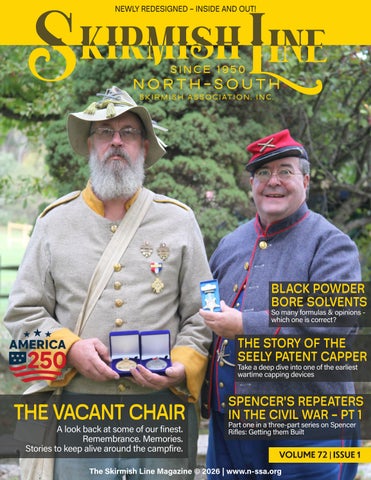

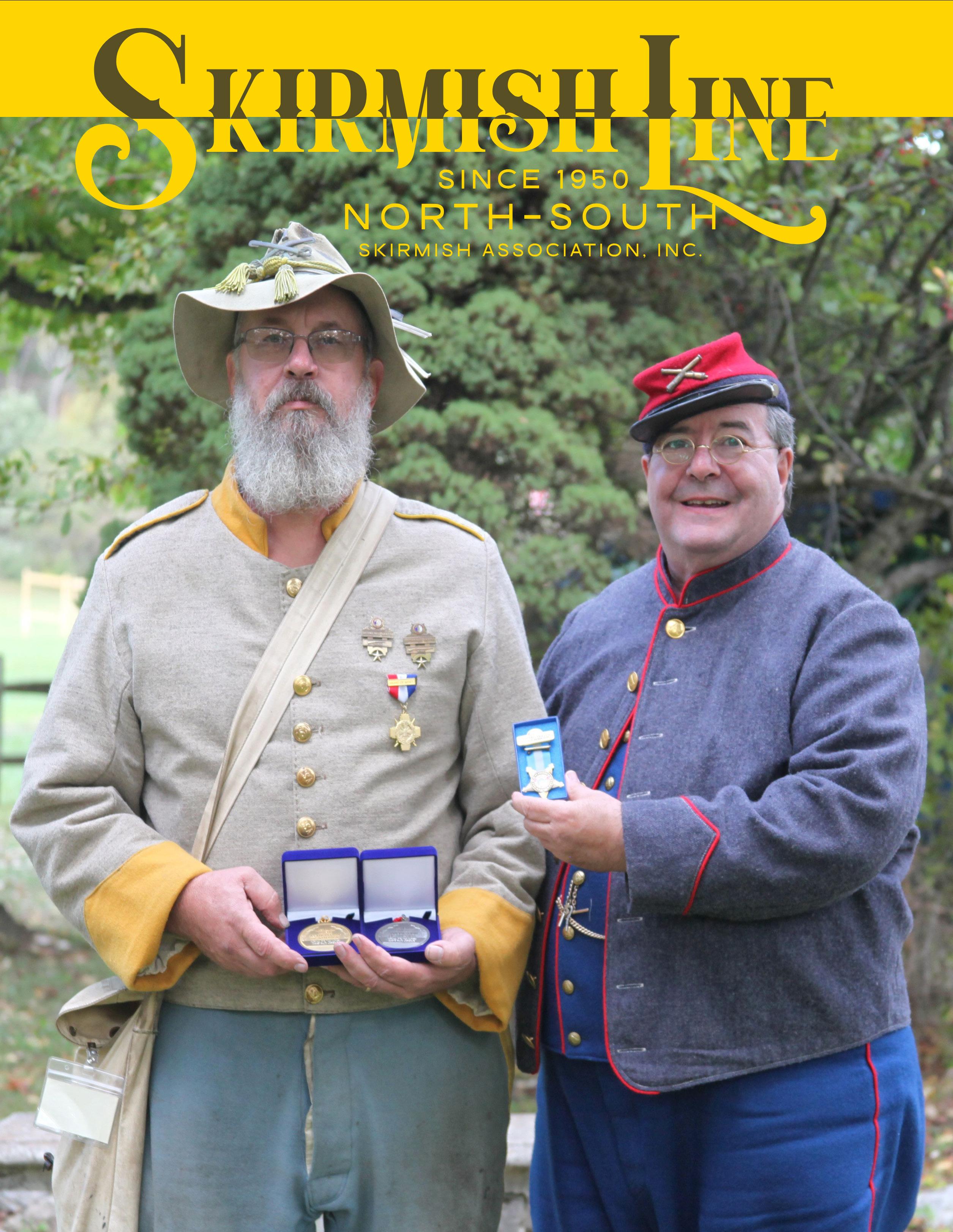
THE VACANT CHAIR
A look back at some of our finest. Remembrance. Memories. Stories to keep alive around the campfire.
BLACK POWDER BORE SOLVENTS
So many formulas & opinionswhich one is correct?
THE STORY OF THE SEELY PATENT CAPPER
Take a deep dive into one of the earliest wartime capping devices
SPENCER'S REPEATERS IN THE CIVIL WAR - PT 1
Part one in a three-part series on Spencer Rifles: Getting them Built
The Skirmish LineTM is the quarterly publication of The NorthSouth Skirmish Association, Inc.
Non-member annual subscriptions are available for $24 per year (U.S. Funds)
Interim Editor & Publisher: Allissa N. Weber | skirmish.line.editor@gmail.com
National Photography Officer | Lis Cole
Contributing Photographers |Niki Bethke, Walt ‘JR’ Zdon, Brittany Cole, Allissa Weber
Visit our website at: www.n-ssa.org
The N-SSA Corporate Seal and the magazine title, The Skirmish LineTM, are registered trademarks of the NorthSouth Skirmish Association, Inc. Reproduction in any form or manner without the expressed written consent of the N-SSA Board of Directors is strictly prohibited. All pages are copyrighted by the North-South Skirmish Association, Inc. and The Skirmish LineTM magazine. Text and images in this publication are the property of the original owners (Authors). Text and images may not be published separately, in hard copy or electronically, without the expressed written permission of their owner(s). The authors and advertisers are responsible to secure the proper permissions and right to publish articles, photos, and illustrations not created by them. The NorthSouth Skirmish Association, Inc., The Skirmish LineTM, and its staff are not responsible for copyright infringement. Please contact the Editor for questions relating to any matter, including but not limited to permission to copy materials herein.
Disclaimer: The North-South Skirmish Association does not guarantee, warrant, or endorse any product or service advertised in this publication. The publisher also does not guarantee the safety or effectiveness of any product or service illustrated, mentioned, offered, or advertised herein. The publisher does not assume responsibility as to whether or not products or services advertised in this publication comply with all state or local laws which may be applicable in regard to the purchase or usage of such products or services.
Warning: The author(s), The Skirmish LineTM and its staff, and the North-South Skirmish Association, Inc. cannot accept any responsibility for accidents or differing results obtained using techniques, products, and combinations thereof that will make results vary. Firearms should be checked before firing and periodically thereafter by a competent gunsmith and all manufacturer’s instructions and warnings must be followed.
FROM THE EDITOR
A New Look and Style

Just in case you hadn’t noticed, this edition looks different!
First and foremost, I want to say “Thank You” to Eddie R. Davenport Jr., our previous editor, for all of his work on the Skirmish Line.
You’re going to notice some significant changes in styling and typography. I’m leaning into a fresh visual direction, focusing on clean layouts and high-fidelity imagery.
These updates are designed to make our content more accessible and engaging. We are currently looking for Skirmishers or other association members who have a desire to write an article or two (or ten) for the magazine.
Please reach out to me at: skirmish.line.editor@gmail. com I welcome feedback from the membership - Good or Bad!
From the Office of The
N-SSA National Commander
By: Dave Cole
Another skirmish season has begun, and I am sure none too soon for all of us. While all want to get out and send lead downrange at various paper and breakable things, the business of the Association still rolls on. We had a very productive Board meeting in January, and while the weather kept some of the Board Members from attending in person, the hybrid work-around was sufficient to get the work done.
I am hoping that your Regional Commanders, as your representatives on the Board, have kept you apprised of the results. This form of communication is essential to keep the membership informed. If that information is not flowing down, ping on your Unit Commanders to make sure that the word gets out
Other vital parts of our Association that are gaining momentum are the Recruitment visits to various shows and the Recruiting Skirmishes. These events have been very positive in reaching out and attracting new members. While we have a great National Recruiting Officer and most Regions have a very active recruiting staff, the grass roots approach to recruiting is essential. “Talk up” the N-SSA to anyone who seems even remotely interested. Invite them to see a skirmish, no matter what region. If they have young children, and your regional skirmishes have BB gun matches, invite them to come out and have the kids shoot in those matches and be part of what we do. Be helpful and use your knowledge to educate the public about our matches. This helps the Association by improving its 501(c)3 status and also shows the willingness of our members to invite and have others participate.
I am looking forward to a great year of skirmishing and to seeing all of you again. Shoot well!!!!
Dave
Dave Cole N-SSA National Commander
12th Pennsylvania Vol. Infantry
From the Office of The N-SSA National Deputy Commander
By: Rick Clements
Greetings to all! Finally, the thermometer has started to climb northward again causing the recent snow accumulation to fade into memory! We’re once again gearing up for a new skirmish season and I’m looking forward to seeing familiar faces & making new friends at the fort.
As worn-out adages go, time waits for no one; and the only constant in this world is change. By now I’m hopeful every member has had an opportunity to learn of decisions/actions made during the January Board meeting that will impact team medal distribution, budgetary restraints, financial investment plans, planned property improvements, and staffing changes. Be sure to review the minutes of the Board meeting.
During the January Board meeting, the selected Financial Advisor was in attendance and provided an overview of the various funds that were created and how we are moving forward. Our Advisor spoke positively of the approved multi-prong Investment plan the Board provided to Diamond Investments. As of this writing, the investment monies have shown steady,
encouraging growth. A well-deserved “tip of the hat” must be given to the members of the Finance Committee for their tireless effort on behalf of the Association.
A comprehensive Budget report revealed the Association is currently on good footing, but it also showed how dependent we have been on financial donations made by the membership beyond the yearly dues payments. Much credit must be given to Wayne Jordan’s diligent undertaking to increase voluntary donations. Your donations have truly helped offset increasing costs as well as the growth of the Association’s endowment fund.
continued on next page....
The responsibility of prioritizing projects and how they shall be funded, either through donations and/or other budgetary allotments, remains with the Board and the Property Management Committee.
The Property Management Committee has begun putting together a list of various projects that currently need funding and/ or require additional monies being set aside. These projects include: the Main Range vehicle bridge repair/re-build efforts; tractor replacement; window replacements at the History Center; Sutler Row roof repairs; bathroom improvements; enhanced lighting efforts; and on-going road repairs.
Additionally, in case you might have missed seeing other improvements underway on the property, Anna Schneeman and her crew of volunteers have made great strides in rebuilding/refurbishing the children’s playground area that took a beating during the flood last year. During her initial survey of the playground, several components were determined to no longer meet code requirements and funds for the replacement effort were obtained through donations. There’s still some more work to be done but thank you Anna!
Until we meet again at Fort Shenandoah in 2026, I wish everyone good health & I look forward to seeing everyone again soon.
Rick
Rick Clements N-SSA National Deputy Commander 49th Virginia Infantry
The Town Where the War Began and Ended (Sort Of)
The First Battle of Bull Run (Manassas) began on the McLean farm where a Union shell actually crashed through the kitchen.
Wanting to escape the violence, McLean moved his family 120 miles south to the quiet village of Appomattox Court House. Four years later, in 1865, Robert E. Lee needed a place to surrender to Ulysses S. Grant. A messenger knocked on a door in the village to ask for a suitable locationand it happened to be Wilmer McLean’s new house.
"The war began in my front yard and ended in my parlor."
—
Wilmer McLean (attributed)
The Story of the Seely Patent Capper
Gunner Fred Gaede, Hardaway’s Alabama Battery, 236-CH
One of the earliest documented wartime capping devices was the Seely capper, invented by Edgar D. Seely of Brookline, Massachusetts.
from this second patent, in both musket and pistol size, are shown in Fig. 2 (top two pieces), along with their Patent Office tag. Both are engraved on one side “E.D. Seely”
Patent models for musket and pistol size cappers supporting the 1863 patent. The pistolsize was never manufactured and this is the only known example. The third from top example is an unexcavated production capper from those made in 1864. The bottom example is also from those made in 1864, and one issued to the 116 th New York Infantry for trial. Author’s collection and photograph.
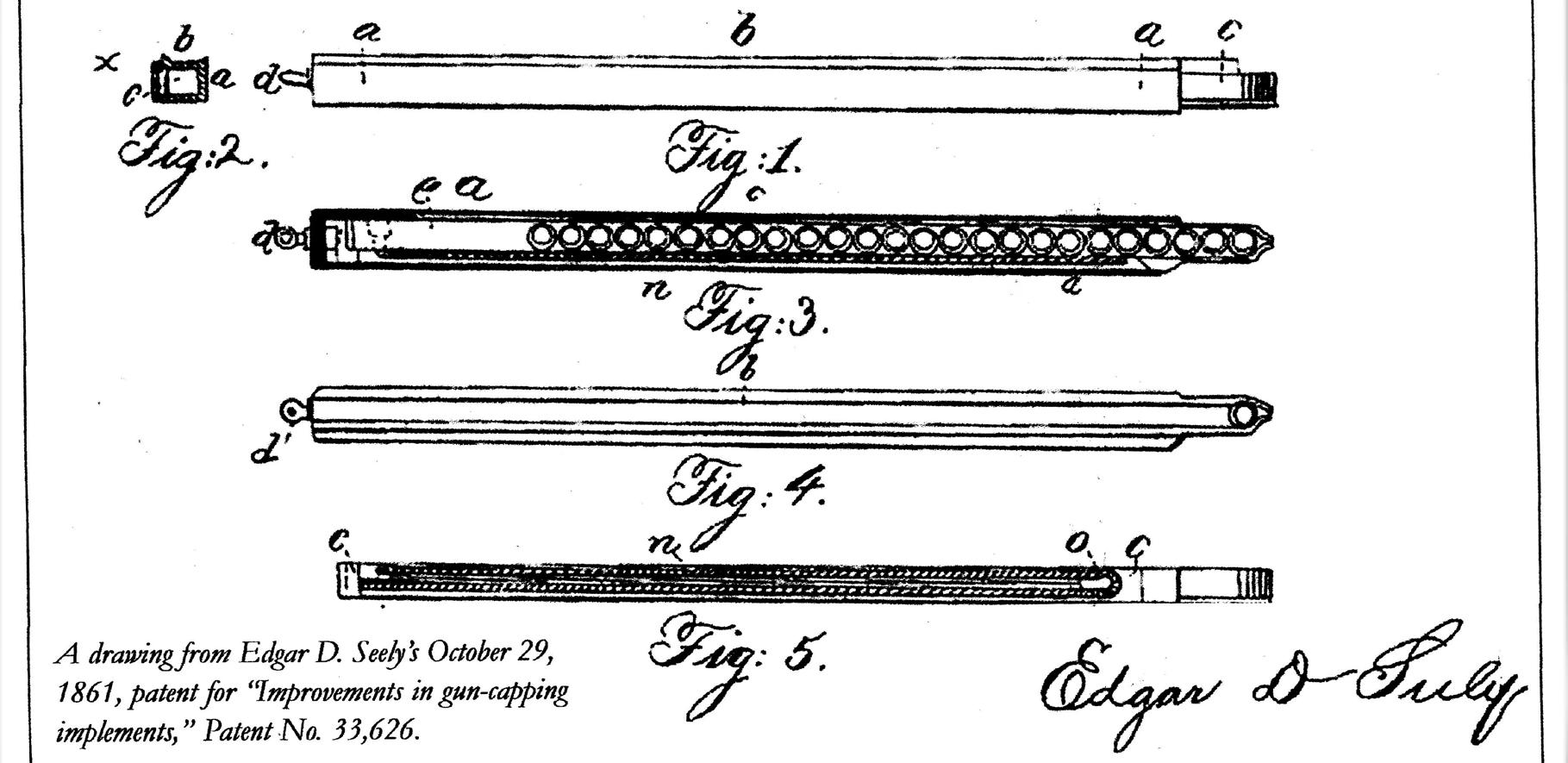
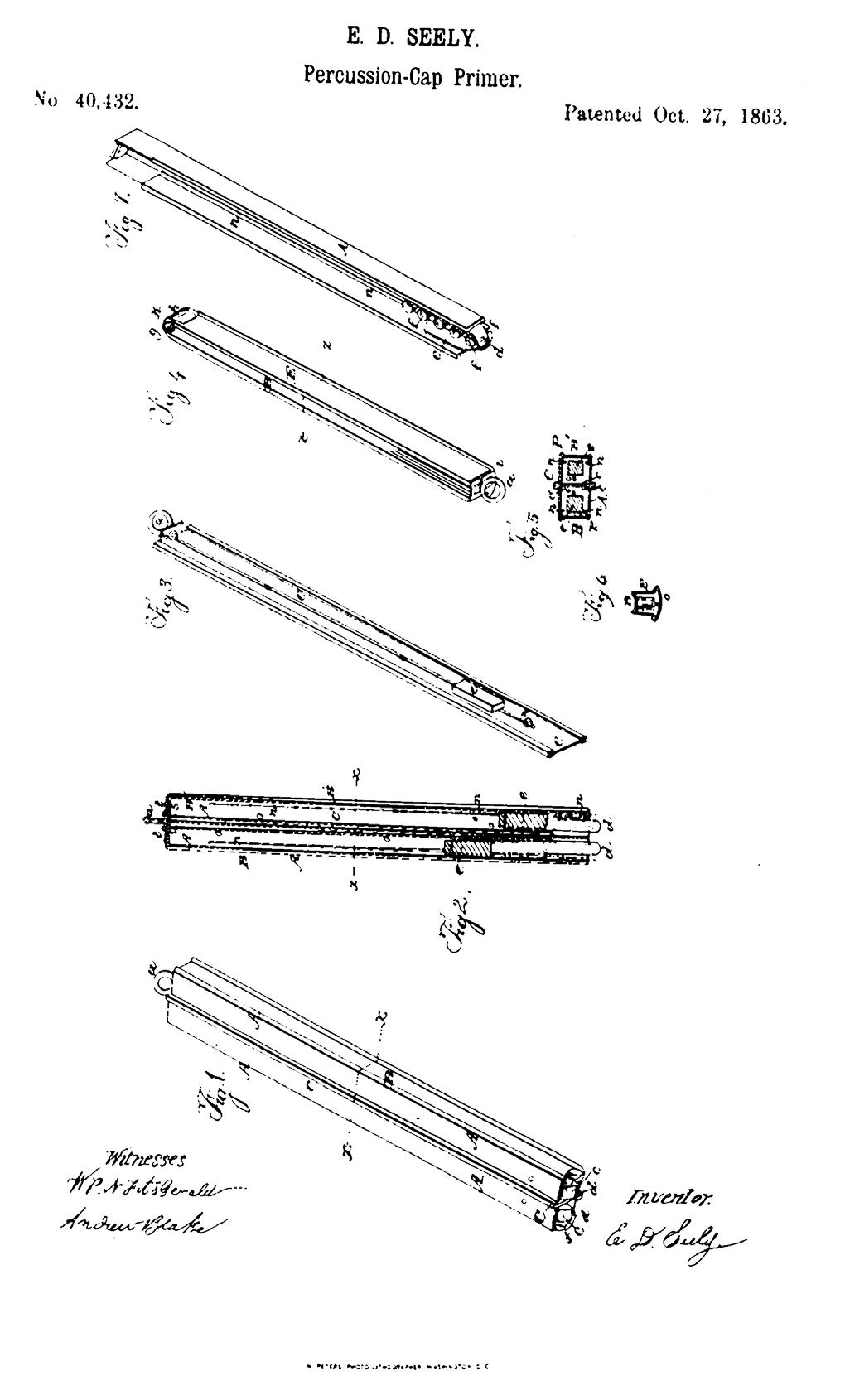
The patent date stamped into the brass of the capper is given as October 29, 1861, reflecting the original patent letter for his “Improvement in Percussion-Cap Primers” (No. 33,626). He was issued a second patent on October 27, 1863 (No. 40,432; Fig. 1), also termed an improvement as it has double the capacity of the original. The patent models
in a script font (Fig. 3) and do not have the patent information seen on production examples.
Relatively rare now, the unexcavated musket capper shown in Fig. 2 (third from top) is about 7 inches long, ¾ inch tall and ½ inch wide. It carries two rows of top hat caps, about 25 caps per row, superimposed on one another. In simple terms, it utilized elastic cords to power ‘followers,’ that in turn pushed caps along the inside of the case, where they were held in position for capping the weapon by a pair of ‘nippers.’ After one row was used the capper was turned over and the process repeated with the other row. A ring was provided at the other end of the case from the nippers to suspend the capper from the uniform or a belt.
Although Seely approached the secretary of war early in 1862, it would take nearly three years to get any functional cappers produced and into field trials. Utilizing a common practice for the early part of the War, Seely tried political pressure to get his invention adopted by the Army. He had gone to his Congressional representative, The Honorable F. Blair, Jr., who in turn contacted the secretary of war, who then directed the chief of ordnance to ‘investigate the merits’ of the invention. Chief of Ordnance General James W. Ripley promptly reported to Secretary of War Edwin Stanton in February 1862 that:
Mr. Seely’s ‘gun capper’ has been submitted to this office, and after a careful examination of it, I am of the opinion that it will not answer for the Military service for the following reasons, viz:
It is delicate and complicated in its construction and therefore, liable to get out of order in the hands of the troops.
It costs sixty cents more than the present cap pocket [$1.00 vs. 40¢] which is found convenient and serviceable.
An apparatus, closely resembling this in principle and structure, was put into the hands of the troops some years since to be used in the field. It did not answer the purpose for which it was intended and was abandonned. [sic]
The magazine of the ‘capper’ cannot, I think, be conveniently filled in the excitement of action.
In addition to the above, I think very little time would be saved in priming, for the same number of motions is required with the ‘capper’ as with the fingers.
These arguments were straightforward and might have deterred other men from pursuing their ambition. But not Seely! He then tried getting letters of recommendation from officers in command, and succeeded in getting, “about one year ago, certain certificates from Genls. Lane, Rosecrans, Porter, and other officers of the Army
relating to my ‘Patent Cap-Primer.’” In January, 1863 he asked Ripley: “I would like to have the Certificates or copies of them given to W.P.N. FitzGerald [sic], Esq. if it is consistent with your rules. I think Capt. Benton took charge of them, there are about twenty different pieces of paper, some containing several names others with single names. I shall consider it a favor if you will enclose them to Mr. FitzGerald.” They were duly returned on the 16th of January, 1863, and on the 17th of January Seely wrote another letter to the secretary of war, proposing “to furnish the United States for the use of the Army, One Hundred Thousand—or more—of [my] ‘Seely Patent Gun Capper,’ as soon as practicable, at one dollar each, to be inspected and delivered in New York or in Washington as the Gov’t may elect. I enclose papers showing the opinion of distinguished officers of the Army as to the utility of this article for service in the field.”
Interestingly, it was one H. Dwight who wrote to the Assistant Secretary of War,
The Hon. P.H. Watson, on April 9, 1863, proposing to furnish Seely’s Patent Capper or Primer at eighty dollars per hundred, or only eighty cents each. He indicated General Silas Casey requested three regiments (one in each of his three brigades) be equipped with the cappers. Dwight offered to “furnish three thousand of the same for these Regts within
Thirty days after an order to that effect shall be made by the Department and will afterwards furnish any larger number, at the rate of at least Ten Thousand monthly.” Chief of Ordnance Ripley replied on April 11th with essentially the same arguments he had made a year earlier (in February 1862) as to the unsuitability of the capper. Mr. Fitzgerald, Dwight’s attorney, continued the pressure with another letter to Assistant Secretary of War Watson in May, requesting “an order for ‘Seeleys [sic] Cappers’ to fill the request of Genl Casey....”
The perseverance finally paid off (Seely or Dwight must have been well connected!) with an order for 1,000 of the ‘improved’ cappers in November 1863. On November 24, 1863 the new Chief of Ordnance General George D. Ramsay wrote Mr. Fitzgerald that:
By authority of the Secretary of War I offer you an order for one thousand (1000) Seeley’s [sic] Gun Cappers, to be of such form and proportions as you may determine and deem best for the purpose intended.
These one thousand gun cappers are to be delivered to the Commanding Officer of the New York Arsenal on Governor’s Island, N.Y. and will be paid for on usual Certificates of Inspection and Receipt at the rate of not over eighty cents each; the price to be less if you can afford to make them cheaper.
Please signify your acceptance or non
acceptance of this order. If you accept be pleased to state when you will be able to deliver them; and also furnish one as a standard pattern by which they shall be inspected.
The contract was subsequently modified to reflect the correct contractor, Mr. Dwight (Mr. Fitzgerald merely having acted on behalf of Mr. Dwight, as his attorney), and that the delivery place would be the Washington Arsenal rather than the New York Arsenal. Clearly the chief was not impressed with the item, but merely bowed to political pressure. He even let the contractor determine the best design to achieve the purpose intended! All Ramsay wanted was a sample to guide the perfunctory inspection process that would be given the cappers.
This contract was annulled for lack of delivery on February 6, 1864. However, another was issued the same day “by authority of the Secretary of War...,” with language virtually identical to that of the first contract. This contract was accepted by Dwight, with delivery predicted to be on or about the first of March 1864. Ramsay wrote Major Benton at the Washington Arsenal to anticipate the delivery of the Seely’s Gun Cappers, and provide for their inspection.
Nine months later, on November 17, 1864, Dwight finally wrote the new Chief of
Ordnance General Alexander B. Dyer about the non-delivery of the cappers:
Sir, I rec’d an order from your Dept. dated Feby 16th ,[sic] 1864, for 1,000 ‘Seely’s Gun Cappers’ ‘to be of such form & proportions as you [i.e., I] may deem best for the purpose intended’ which cappers I was to deliver on or about the 1st of last March. After manufacturing them according to the light I then possessed I found there was a defect in the mode of manufacture which produced a latent imperfection in the instrument impairing its strength and durability.
To furnish these under the order given me by the Department with so liberal margin of discretion to me in the mode of construction I felt would be unjust to the Department and to myself, so that instead of furnishing those I had made I immediately set about obviating the defect. In this I have met with the most gratifying success and am now able to furnish you with an instrument with which I am perfectly satisfied and which will I think meet with your entire approbation. This however has required time, care and labor, and I have but recently succeeded.
The object of this application is to pray you to extend the time for furnishing the cappers embraced in the said order until the latter part of December proximo for the reasons above stated. I am waiting here for an answer and a prompt reply will be greatly [sic] oblige me.
Likely none had been made in the intervening year that were ‘defective’ and the delay was actually due to the device
being more complicated to manufacture than expected. However, knowing the secretary of war was the direct initiator of the contract, the chief accepted the excuse for the delay in delivery. This time Dwight was true to his word, notifying Dyer on December 30, 1864 “I ship this day per Adams Express Co. Two Boxes containing in all 1,000 say one thousand ‘Seely’s Gun Cappers’ of the most approved construction, addressed to the ‘Comd’g Officer of the Washington Arsenal: Mr. Fitzgerald expects to call on you on Tuesday Morn next on my behalf.”
Chief of Ordnance
Source:
Patents
Dyer then directed Major Benton at Washington Arsenal to send 300 cappers to Mr. D.J. Young at Harpers Ferry, now in West Virginia, and another 300 to Lt. Joseph P. Farley at City Point, Virginia. Both of the latter were
instructed that “These cappers are intended to be issued to troops for service in the field, and you will be pleased to issue them to such officers, as you deem best suited to report upon their merits. You will request such officers to make report[s], as soon as practicable; and, will transmit such reports to this office.”
The 116th New York Infantry, “the best in the Nineteenth Army Corps” according to General Philip Sheridan, was selected to receive a portion of those sent to Harpers Ferry. Colonel George M. Love, commander of the 116th, needed very little time “to report that I consider them worthless and have this day [February 7, 1865] collected them from my men, to be turned into the O.[rdnance] O.[fficer] at Harpers Ferry, of whom I received them.” Colonel
Edgar Seely’s second, 1863 patent for an improvement in percussion cap-primers, issued October 27, 1863.
U.S. Patent No 40432A / USPTO via Google
Love objected to the small capacity of 50 caps, their liability to get out of repair and the fact that “a soldier can prime his piece as quickly from the cap pouch as with this ‘capper’” General Sheridan endorsed the colonel’s letter by noting “the colonel states that the men do not want these gun cappers, as they consider them worthless. I forward the report of this efficient officer with no further comment than that his opinions are endorsed by me fully.” Not only was the War coming to a conclusion, the unfavorable field trials doomed any further consideration of the Seely capper. Six hundred had been issued for testing and some were returned. What became of them--or the unissued 400 cappers--remains unknown.
Actually, we do know what became of one of the cappers. The relic Seely Patent Gun Capper shown in Fig. 1 (bottom) was recovered from the vicinity of Harpers Ferry, West Virginia, a number of years ago. Undoubtedly it was one of those issued to the 116th New York Infantry, and ‘lost’ or discarded before it could be recalled by Colonel Love, making it in any case a rare relic of the War. Both it and the unexcavated example above it are marked identically in five lines on one side: E.D. Seely / Pat’d Oct. 29, 1861 / Made by / S.E. and J.N. Root / Bristol, Ct.
As already noted, the1861 date reflects the
original patent date, which was for a single level capper; his second patent coming in 1863 for a similar device having two “magazines,” as he termed them. The 1863 design is what Dwight actually manufactured. It might be noted, a Seely capper is shown in the original volume of Lord’s Encyclopedia. Although not identified as such, another Seely capper is shown in Lord’s third encyclopedic volume on page 139. Despite the number actually made, and with 400 unissued at the end of the War, Seely cappers today are rarely seen on the collector’s market.
The Richmond Bread Riot
April 1863 - Richmond, VA:
Armed with bowie knives and revolvers - angry women marched on the governor's home - demanding relief from out of control inflation.
Some reports say the governor ignored the ladies. So they took matters into their own hands and started looting bakeries and stores.
"We celebrate our right to live! We are starving! Bread or blood!"
The Skirmish Line Article and Photo Submission Guidelines
By: Allissa N. Weber, Interim Editor
Here are some basic guidelines for submissions to The Skirmish Line . Please don’t hesitate to reach out if you have any questions or need clarification on anything.
Clean Copy
◆ Send text files. Do not send PDF files. Do not spend a lot of time formatting your document. Chances are I’m going to strip that formatting out for placement.
Word Origins:
Did you know that the term "shoddy" originally referred to a cheap. reclaimed wool product that was made from scraps and rags?
During the war, corrupt contractors used that product to produce Federal uniforms. Since the material was inferior, after a rain - these uniforms would quite literally, fall apart while still on the soldiers back.
The Civil War turned this phrase into a household term, an insult, referring to poor quailty or worksmanship.
◆ Acceptable use of formatting is Headings and body text. This allows me to map them to the layout software styles.
◆ Single spaces after periods; single-spaced lines.
◆ If you must use a special character (in the print world they’re called glyphs) please highlight it in a bright color so that I can double check that it comes in as it should. These could include, but are not limited to: mathematical operators or umlauts.
◆ Do not use “Word Art” or “Smart Art” in Word documents.
Images & Graphics
◆ Images and graphics must be sent at a minimum of 300 DPI or higher at 100% scale.
◆ Lossless formats (TIFF, PSD, HighResolution JPEG) are preferred.
◆ Do not embed images into a document and expect me to be able to extract those images. This results in low-quality images that aren’t suitable for print.
◆ Send a separate file (or include at the end of your submission) captions for all included images.
◆ Please name the image files something that makes sense and refer to that image file by name. Don’t make me guess which image you’re talking about.
◆ Never, ever, ever send HEIC files. I cannot convert them properly. (This is Apple’s default file format for iPhones.) You’ll need to convert them to JPEG before sending them over.
◆ If they’re your photos, then please tell me that. If they’re your wife's, or husband's, please tell me that too. If they’re NOT, and you don’t own the copyright, then I cannot use them.
◆ Any Open Source files must be properly cited. Include hyperlinks to where you found them so that I can verify that they are cited appropriately.
Tables and Data
◆ Tab-delimited (csv) or Excel formats.
◆ No screenshots of data.
◆ If you need to use a table: keep it concise and clean. It should fit in the margins provided.
◆ Make sure that all columns are labeled as appropriate. Avoid blank cells whenever you can.
Legal Permissions (if required)
◆ If you send an image of a person(s) OUTSIDE of an N-SSA Event, then you need to get permission for us to use their photo in
the magazine.
◆ Note any AI-generated images as such.
I realize this list is somewhat longer than most people want to see, but these are just a basic set of guidelines for anyone printing something these days.
In the future I also plan to have a “Style Guide” for common mistakes that Skirmishers may make when writing an article about our sport.
Again, don’t hesitate to reach out if you have any questions, comments, improvements, or even general rants.
Where Am I?

Antietam Battlefield, Burnside's Bridge
Black Powder Bore Solvents –
What’s
Best?
Chris DeFrancisci
So, you want to clean your Musket, or Carbine, or Revolver, or
Smoothbore? What do you use?
Talk to five people and you’ll get five different answers. None of which may be wrong, just different. There are many bore solvent formulas out there, some better than others. And, there’s old tried and true hot soapy water which also works great.
I’ve spent years trying out different solvent formulas to see what cuts black powder fouling the best. Some work great but rust the bore if left in too long. Others are passable but take a lot of solvent and elbow grease to get the fouling out. So, here are some of my observations on black powder cleaning, with acknowledgment to the Bevel Brothers of the NMLRA for some of their research.
A lot of old-timers have used Blacksolv for years and swear by it. I’ve never used it but have heard that it does a good job of cutting fouling. Sold as a concentrate you mix it up and use the mix to clean your black powder firearm.
Hornady used to sell a great black powder cleaner called One Shot Muzzleloader
Cleaner, but it appears to have been discontinued. Great stuff and if you can find some, get it. Won’t mar a stock finish and will dissolve carbon fouling very well. Won’t hurt the bore either. I used it for years, but can’t find it any longer.
Birchwood Casey and Hoppes also make black powder cleaners. Which work OK, but I have found no advantage over some homemade solvents. Thompson Center also makes a very good black powder solvent, such as the T17 or the original #13. Butch’s Bore Shine Black Powder solvent is also a decent commercial product. All commercial products tend to be a bit pricey however, if you are going to do a lot of shooting and cleaning.
Homemade solvents are a lot less expensive and work great. One of the tried and true solvents (which often gets a bad rap) is the third/third/third mixture. One third Murphy’s Oil Soap, 1/3 Alcohol, and 1/3 Hydrogen Peroxide. It cuts black powder
fouling really well. However, it will rust the bore if left in for any length of time. Use it to clean the bore, then dry it well and oil up the bore using Ballistol or something similar. I used it for years. Some people have said the peroxide will etch the bore, but the Bevel Brothers did some tests and found no evidence of it*.1
If you are worried about the peroxide, substitute Simple Green, still works well.
“Talk to five people and you’ll get five different answers. None of which may be wrong, just different.”
There is also the well-known Moose Milk, various recipes exist, one from the Bevel Brothers which works well is one part Machinists Water Soluble Cutting Oil (natural kind, not synthetic), two parts Pinesol, and 20 parts water*2.
Some people also use Simple Green, either straight or cut with water. Others use 50/50 Ballistol and water. Still others use Windex and vinegar (I don’t like the Windex with ammonia however).
Now, to my major solvent find. After years of using various combinations of solvents, both commercial and homemade I was directed to a great solvent that cuts black powder well, doesn’t rust the gun, and is cheap. I’ve used it for several years now and have passed it on to quite a few people all of whom have continued to use it because it works so well. You can get it at the Dollar Store or Dollar General (although it’s more than a dollar now). Comes in spray bottles or gallons. LA Awesome is just that. Inexpensive, works great, and has other uses as well.
I use it as a bore cleaner, soak the nipples from my Musket, Smoothbore, and Carbine in it. And scrub the cylinders and nipples of my revolver with it. I use Q-tips soaked with LA Awesome to clean around the nipple area and to swab out the threads. They are also great for getting into smaller areas and cleaning.
Whatever you finally decide is the solvent for you, always make sure to use a moisture displacing oil after cleaning. Ballistol is my favorite.
1 Muzzle Blasts, November 2021, p.22-24
2 Muzzle Blasts, November 2021, p.22-24
Spencer’s Repeaters in the Civil War
Part 1: Getting Them Built
A.M. Beck, Palmetto Guards
Spencer rifles and carbines were one of only two types of repeaters to see widespread service in the War for Southern Independence, the other being the Henry. In spite of the fact that the mechanism was patented just before the war, the first general issue of these weapons was not until early 1863. The new company had many hurdles to clear before production could begin.
Christopher Spencer was employed in 1847 as a machinist at the age of 14. Showing unusual aptitude, at 15 he had already built a steam engine. He found work at several industries in New England in the years before the war, both in and out of the arms industry. He began work on his repeating rifle ideas around 1857, while employed at the Cheney Brothers silk mill in Hartford. During his employment at Cheneys he had obtained his first patent, for a machine to automatically label silk spools.
By 1859 Spencer had built working models of his repeating rifle and received patent
27,393 on March 6th, 1859. With financial backing from his grandfather and the Cheneys, Spencer partnered with gunsmith Luke Wheelock to refine his ideas into a rifle that could be mass produced. This led to an association with the Sharps company, and friendship with Richard Lawrence, Sharps master armorer. The Sharps company became the source for many parts used in Spencer’s first rifles, including barrels and most of the lock parts. As the War between the States got going, Spencer had a working repeating rifle, and the Cheney Brothers were ready to build a manufactory to produce it.
In 1861 and ‘62 both the Army and Navy ordinance departments tested the repeaters. The results were very favorable. However, by the time prototype Spencers were being circulated within the military, the War Department already had outstanding orders for 15 or 20 different patent breechloading arms, many of which had been equally favorably tested.
Within both federal and state ordinance departments there was no shortage of partisans for the various patent weapons. However, most of the companies that presented them had little or nothing in the way of production facilities and were in no position to fulfill a large government contract. The War Department had an awful time trying to figure out which weapons were indeed fit for service, and who was in a position to deliver on a very big order for high precision, interchangeable parts guns.
Faced with such a daunting task, the War Department pretty much threw up its collective hands and declared that no new patent weapons would be ordered. Given such a climate, it is not very hard to understand why Spencer met so much resistance to the purchase of his new repeaters.
A large part of the problem was that the people in the War Department were essentially bean counters. They had never seen such a weapon and didn’t have a clue as to its tactical implications. They did however understand that it was very heavy, over 10 pounds loaded, and it used special, expensive ammunition not available through regular ordinance channels, and lots of it. What was worse was the price. When first quality muskets could be had from any one
of a dozen contractors for $18, the price for Spencer’s repeaters was $40, $43 for the Navy version with saber bayonet.
The Spencer company’s first federal contract made an end run around this problem. It was directly from the Department of the Navy. This order was obtained not so much because of the obvious superiority of the Spencer system, but rather the fact that one of the directors of the new company, Charles Cheney, was the Boston neighbor and friend of Gideon Wells, the Secretary of the Navy. Received in June of 1861, this contract was for only 700 rifles.
When this order was received, the company existed mainly on paper. The guns that were being circulated through the military were hand made tool room specials, constructed by Spencer and Wheelock. Their armory was the machine shop of the Cheney brother’s silk mill in Hartford.
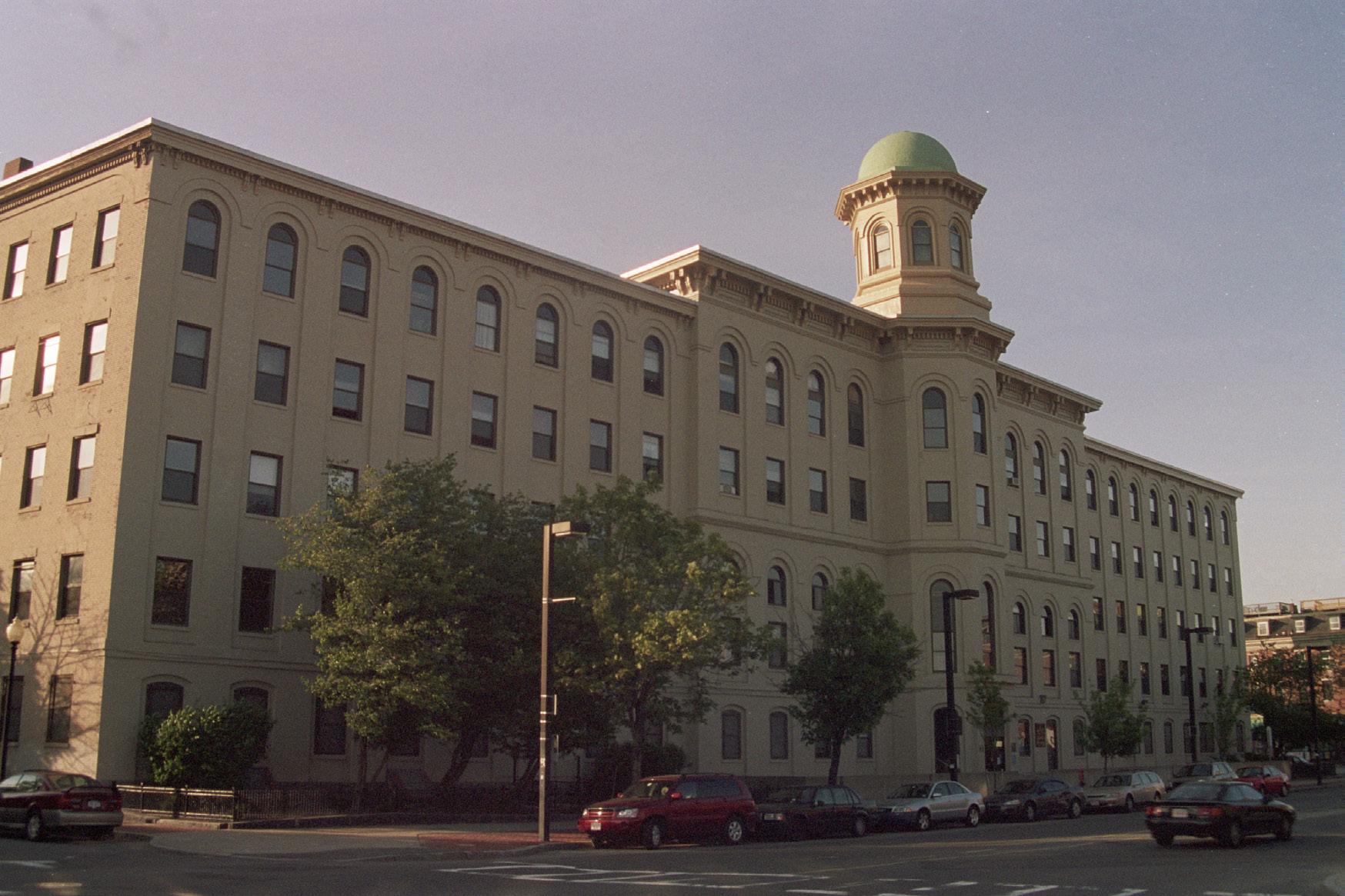
Now that they had an order, the company desperately needed a real armory. Seven hundred guns was not enough to start such a business, but it was decided to go ahead anyway. Just getting the enterprise up and running was turning into a very big risk. Hoping for more, and more substantial, orders, the Cheney brothers rented the second floor of the Chickering Pianoforte building in Boston.
While a premises had been secured, machinery was another matter entirely. Ames, Pratt & Whitney and every other precision machine tool manufacturer, was flooded with orders. Even the English firm of Greenwood & Batley, the only large precision machinery manufacturer outside New England, was backlogged for months, possibly years. With the war in full swing, it was impossible to obtain speedy delivery on any sort of device that could be used to produce war material. Just to make matters worse, skilled gunsmiths were at least as difficult to find as machinery.
Lincoln’s first Secretary of War, had quickly obtained government contracts. They all needed equipment and operators, desperately. The penalties for default on these contracts were severe.
In December of 1861, Spencer’s first big contract came in. Based on tests ordered by General George McClellen the previous November, the army ordered 10,000 Spencer rifles. The first delivery of 500 was to be in three months, an impossibly short time.
Everyone that was at all politically connected, especially the cronies of Simon Cameron,
Meanwhile, one potentially large sale was lost. Spencer well understood that certain officers held great influence in Washington. One officer that he wanted particularly to
The Chickering Pianoforte building on Tremont Street, in Boston, Massachusetts. Spencer's Armory occupied the entire second floor. Photo by author.
impress was Hiram Berdan, then organizing the First and Second US Sharpshooters. As the Army order was being placed in December, Berdan received a sample rifle. Things started off well, but while Berdan was firing the repeater, a cartridge rim burst, blowing hot gas in the famous marksman’s face. Luckily, no permanent damage was done, but Berdan ordered Sharps rifles instead.
Less than a month after receipt of the Army order, the contract situation took a turn for the worse. Due to the sorry state of affairs at the War Department, Lincoln replaced Cameron with a no nonsense lawyer, Edwin Stanton. One of the new secretary’s first moves was to start cleaning house and investigate his predecessor’s shady contracts.
The Spencer Repeating Rifle Company was not in a good state. There was no denying that the first deliveries would be several months late. Army contracts had been written with a clause that the War Department could cancel the whole lot if deliveries were late. The newly formed Spencer Repeating Rifle Company was facing the very real threat of default and collapse.
Spencer’s situation was examined in May of 1862. Since the company was at that point 2500 rifles behind, the total deliveries for March, April and May, the contract quantity
was reduced to 7500 and the Army order was allowed to stand. This was about the best that could be hoped for.
Shortly afterward, their contract was renegotiated to reflect the reduced number. The initial delivery date was moved back to even further, to July. Luckily, the Navy contract was not affected by the upheaval at the War Department. It was however, just as late.
The newly formed Spencer Repeating Rifle Company was facing the
very
real threat of default and collapse.
Christopher Spencer excused himself from the business problems. He held no financial interest in the company that bore his name and did not take an active part in its day to day operation. In fact, he sold his patent rights to the Cheney brothers for a royalty of $1.00 per gun delivered. This is not to say that he did not work hard to make the enterprise a success. There were plenty of technical considerations to keep him busy at the new armory. He designed most of the specialized machinery to make his guns, and
then supervised its construction.
Things proceeded slowly in the Chickering building on Tremont street. The machinery began to take shape and skilled workmen were hired. By late summer of 1862 gun parts were being produced. The Navy rifles were first to be built. Some key equipment had still not been delivered so Spencer called on his friend R. S. Lawrence, at the Sharps company. The Sharps company ahd supplied parts for Spencer’s prototypes and they again appeared in the early Navy rifles. Sharps barrels and lock parts sped up production.
The Navy’s repeaters were submitted for inspection on December 4th of 1862 and the first 600 were received at the Charlestown (Boston) Navy Yard in February of 1863. Just before that delivery, the first 500 Army rifles were shipped to Michigan on the last day of 1862, six months late. These were destined for Col. Copeland’s 5th and 6th Michigan Cavalry, then being organized in the state.
Copeland was extremely well connected politically. During the summer of 1862 he had managed to get a reluctant War Department to allocate 1200 Spencers from the 10,000 rifle order. Unfortunately, as their Spencers were being shipped, the 5th and 6th boarded the cars and departed for
Washington city. Their rifles were finally delivered in January, having taken the scenic route to the Capital. Copeland soon
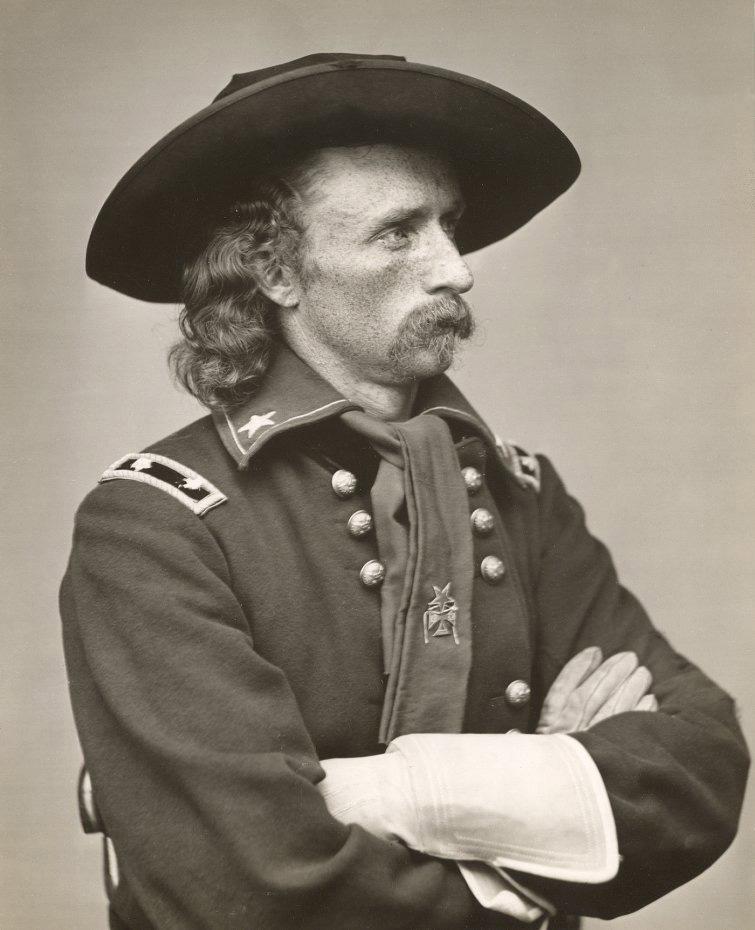
left command due to poor health, and the Michiganders rode to fame commanded by a fresh West Pointer who had barely managed to graduate, last in his class, George Custer.
By March of 1863 things were coming under control in Boston. With deliveries catching up and no new orders, Spencer set off to tour the Mississippi flotilla and the federal armies in the west, where he demonstrated his repeater to any and all who might place
Major General George A. Custer, US Army. Photo by George L. Andrews. Courtesy of the National Archives and Records Administration (NAID 558719)
an order or pull strings back at the War Department. This trip made a very favorable impression within the armies, but its direct result was only one order. That came from Col. John T. Wilder’s brigade of mounted infantry, for 1400 rifles. This order presented a serious problem. It did not come through the Ordinance Department. The men of the brigade pledged their government pay and Wilder, a very successful businessman himself, cosigned the note. This meant that the guns would not be paid for by the government, but rather through Wilder’s personal bank in Greensburg, Indiana. This presented a formidable risk. Spencer crossed his fingers and took the order. This order was later transferred to the Ordinance Department and The Lightning Brigade got their guns through regular issue.
About the same time as Wilder’s order, the state of Massachusetts was having trouble with federal supply of its state troops. The Bay State decided to solve this problem itself and convened a board to select arms for the state militia to be provided by the state. This board found the Spencer repeater the best of the 25 arms submitted. It didn’t hurt that the company was located in Boston. In May of 1863, the state ordered 2000 rifles.
Undoubtedly the most famous sales call made by Christopher Spencer was the one to President Lincoln in August of 1863. Mr. Lincoln had previously tried two different Spencer rifles supplied by the Navy. The first could not be loaded because the magazine tube was stuck fast. In firing the second, the president experienced a jam which required several minutes to clear. These
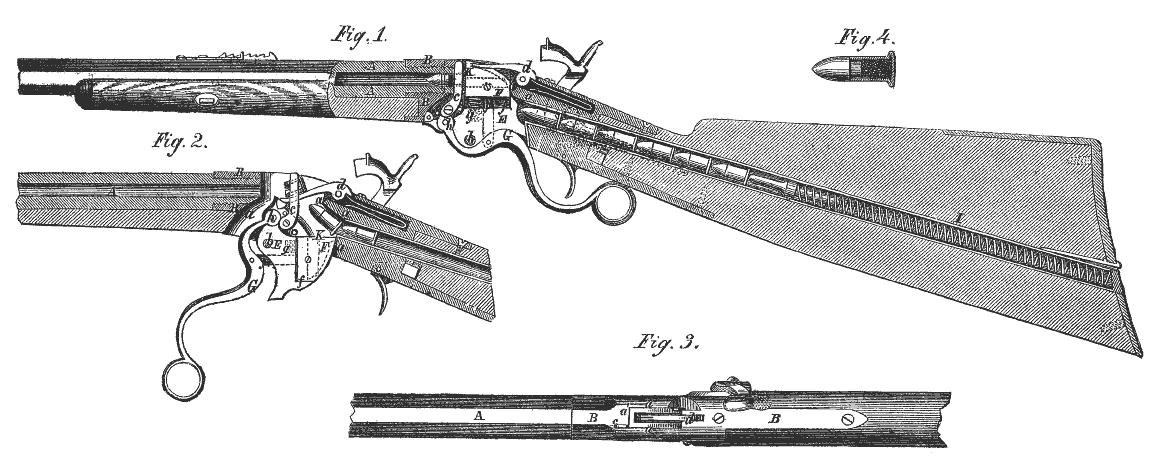
Diagram of the Spncer Rifle. Illustration from Scientific American, January 25, 1862. Courtesy of the Cornell University Library Digital Collections.
are both common problems with Spencer’s repeaters. The magazine tube will rust and quickly become stuck if the arm is cleaned improperly and stray water is left in the magazine. Jams can result when the lever is worked incorrectly. Due to these problems, Lincoln had personally stopped the issue of Spencer rifles.
It was this turn of events that inspired Mr. Spencer’s visit. The meeting apparently went well. Spencer was able to explain the causes and their solutions satisfactorily. The pair then adjourned, meeting the next evening near the Washington monument, where an hour was spent firing the rifle Spencer had brought. The President seemed quite pleased with the gun. He never again stopped its issue, although he also did not personally intervene to increase orders.
Up to July of 1863, only rifles had been built. Most of these were issued to cavalry and mounted infantry in the West. As popular as they were, there was an almost immediate call for carbines. The rifles were inconvenient for mounted service. Reloading the magazine with the rifle across your lap, while at the same time controlling a skittish horse, is not a simple task. Also, not being equipped with a sling ring, there was a very great danger of loosing the weapon while on horseback.
Spencer had set up to build rifles because
the Army refused to call up state cavalry regiments early in the war. The belief in Washington was that the conflict would be over in less than the two years required to train an effective cavalry regiment. Sure enough, the war was still in full swing two years later, and Federal volunteer cavalry was just becoming effective. The need for first class carbines was great.
With the order for 7500 rifles almost complete, the Spencer company approached the War Department with a proposal to deliver carbines. Spencer’s rifles had proved their value in combat and this offer was quickly accepted. A new contract for 11,000 short guns was placed. Initial delivery was to begin in August and be complete before the end of the year. The price was set at $25.
As usual, deliveries were late, but much less late than previous contracts. While the company was setting up to make carbines, they received an order for 2000 more rifles on September 28th, which was delivered less than 3 weeks later. The first carbines were accepted on October 3rd, 1863. Seven thousand were turned over to the Army by year’s end. This time the order was not reduced for late deliveries. The worth of the repeaters was finally being appreciated. Before the contract was completed, the quantity had been increased to 34,500.
As early as November of 1863 Springfield was investigating ways to improve carbine cartridges. One attempt was a 56-56 cartridge loaded with an increased powder charge and lighter bullet. While initially promising, the improvement was not worth retooling production. Another was a 44 caliber round based roughly on a necked down 56-56, the 56-46. This cartridge didn’t make the cut at the Ordnance Department, but did become the primary cartridge for Spencer’s post-war sporting rifles. The most promising was a 50 caliber round with a lengthened case and inside lubricated bullet, the 56-50.
By mid-1864 it was apparent that the 56-50 was the superior choice. As the new cartridge was being developed, Spencer began work on a new carbine to go with it. The frame was lightened and the barrel shortened to 20 inches. With a few other minor changes this became the Model 1865. About half of the new carbines also had Stabler’s magazine cutoff installed.
As Springfield and Spencer worked to finalize the new model, the Burnside company was recruited to switch production from their single shot carbine to Spencer repeaters. As they tooled up, their contract was modified to switch production from the old 52 caliber model to the new 50 calibers.
Deliveries were contracted for January of 1865, but as usual they were delayed as both companies worked out details of the new models. Burnside’s first six sample carbines were delivered at the end of March, however these initial Burnsides required rework on the receiver to get the magazine to feed properly, which delayed the initial production delivery to April 15th. The first Spencer made 50 caliber carbines were shipped on April 3rd of 1865 in a mixed lot of old and new models.
In all, during the War for Southern Independence, the Spencer company delivered 11,471 rifles on Federal contracts, an additional 1003 for the Navy, and 2000 rifles ordered by Massachusetts. The number of M1860 carbines eventually totaled 45,785. Deliveries of 18,959 M1865 improved carbines began in April of 1865, along with another 30,502 made by the Burnside Rifle Company. Few, if any M-1865s were actually in the hands of troops before the Army of Northern Virginia surrendered.
There were a few thousand civilian sales in addition to government deliveries, mostly guns built from parts that Federal inspectors had rejected.
The company could not compete with its own surplus once hostilities had ceased. Arms of all descriptions were being sold off by
the government for pennies on the dollar. Spencer introduced improved models, but the improvements were subtle and did not address the design’s fundamental problem. Spencer’s cartridges were underpowered for the greater ranges and larger game of the West, and the action could not be made to feed longer cartridges through the magazine. Just two years after the conclusion of the war, the Army began retiring their Spencers in favor of Sharps single shot carbines converted to take the new and much more powerful 50-70 central fire cartridge.
Small civilian, state and foreign orders would not sustain the company, neither would refinishing and spare parts work. Finally, in 1869, the armory was bought by the Fogerty Rifle Company, who in turn were purchased by Winchester, in a move to lessen competition.
Christopher Spencer went on to acquired 42 patents, including for the first automatic screw manufacturing machine. This made possible the production of millions of identical threaded fasteners, making modern standardized hardware practical. He helped start several companies, the most successful being Billings and Spencer, which pioneered safe boiler designs and mass produced hand tools. Sportsmen the world over owe Christopher Spencer a debt of gratitude as
the inventor of the pump action shotgun. Before his death in 1922 at the age of 89, he even took flying lessons.
Look for the 2nd article in this series on Spencer
Rifles
in the next issue of The Skirmish Line!
Board of Directors Meeting
Saturday, January 31, 2026
North-South Skirmish Association, Inc. Hyatt Place Dulles South, Chantilly, VA
Approved by an electronic vote of the Board of Directors held between February 21 and March 3, 2026
Commander Cole called the meeting to order at 8:00 a.m.
After the invocation led by Dave Booz, Adjutant Erick Shaw called the roll and reported as present the following members of the Board of Directors:
David Cole, National Commander
Richard Clements, National Deputy Commander
Erick Shaw, National Adjutant
John Defilippi, Inspector General
Bette Shepherd, National Paymaster
Sharon Myers, Executive Secretary
Douglas Walter, Allegheny Region Commander
Tom Wareham, Carolina Region Commander via Zoom
Robert Hicks II, Central Virginia Region Commander
David Booz, Chesapeake Region Commander
Steve Sheldon, Deep South Region Commander
Joseph Plakis III, Middle Atlantic Region Commander
Eric Schuessler, Midwest Region Commander
Lou Ruggiero, New England Region Commander via Zoom
Mark Killeen, Northeast Region Commander
Edward Walters, Northwest Region Commander
Walter Zdon, Jr., Potomac Region Commander
E.R. Mike Davenport, Tidewater Region
Commander via Zoom
John Mark, Western Region Commander via Zoom
Absent was Past Commander Chuck Kindle.
Commander’s Comments
Dave Cole welcomed the two new members
of the board – Robert Hicks II of the Central Virginia Region and Steve Sheldon of the Deep South.
Tim Scanlan has resigned as National Logistics Officer and Dave nominated Glenn Wissinger of the 12th PA Reserves to replace him. Motion made to approve the appointment as submitted was made by Joe Plakis and carried.
Maryanne Faeth-Greketis has stepped down as Costume Committee Chair and has been replaced by Peggy Edwards-Shaw.
Acting Finance Committee Chair Lance Walter has been nominated to fully assume the position. According to the Finance Committee Charter approved in August of 2025, this committee appointment must be approved by the board. Motion to accept Lance as Chair was made by Erick Shaw and carried.
Eddie Davenport has resigned as Skirmish Line Editor. Discussion on hiring an interim editor will take place in Executive Session. A committee has been appointed to conduct the search for a permanent editor consisting of Dave Booz, Chris DeFrancisci, and Gary Crawford. They will finalize a job description and other expectations then put out a call for applicants.
A new committee, the Youth Activity Committee, has been formed with Anna Schneeman as chair. This will permit her to continue the work she began last year rehabilitating the Happyland Playground and develop other activities for the kids.
2026 is a national office election year and Joe Plakis has volunteered to chair this year’s Election Committee.
Dave Cole reported that the recruiting skirmishes are beginning to pay off with increased interest and new members. The various social media presences and working of gun shows is expanding our presence.
He stated that about 12 years ago, Tim Scanlan and Wade Huffman went behind the backstop and found quite a few spent rounds in and near Isaac Creek. In mid-January, Dave Cole and Tim went back behind the backstop and, while they found a few rounds, it was not the number from 12 years ago. The region commanders were asked to remind their teams to empty their firearms at the end of the event into the backstop.
Dave informed the board that John Gaskill and Ernie Wood have been working on a registration system using QR codes and hand-held scanners to streamline registration operations at national skirmishes and the plan is to roll it out for
the 2027 skirmish year.
Deputy Commander
Rick Clements addressed the board by stating that there are serious business decisions to be made today to do with finances and how we move forward.
Paymaster, Finance Committee, Accounting Firm, and Diamond Wealth Advisors
Bette Shepherd began her report by saying that we ended 2025 in a positive manner. Expenses came in under estimates, while income was over estimate. We are still relying on donations to meet our budgeted expenses. The A.C. Baird Memorial Fund was distributed as directed and the Anne Dana Memorial Fund was moved to the Endowment. There are still other Third Party Restricted Funds to be dispersed.
We currently have 12 months of unrestricted cash on hand after Third Party and Board Restricted funds. The plan to move our investments into Diamond Wealth Advisors management did not happen until January 2026 as it took some time to verify account numbers and begin transferring the money. while
Scott Faust from Diamond Wealth Advisors introduced himself and explained that our investments are on the conservative/
moderate side, with the recent deposits we are making above market rates. We are one of the few nonprofits to have a clear investment policy statement.
Erin Clark from SEK CPAs and Advisors, our accounting firm, spoke to the 2025 audit. The only thing mentioned was the recording of journal entries and ensuring oversight of such through the Finance Committee, which is standard procedure and not specific to our organization. She also went over the audit process versus review. The review process is not as invasive nor as expensive as an audit, and if we do not have a third party instructing us to audit, then we could do a review.
Erin explained that if the Association decides to change our fiscal year end from December 31 to November 30, we would just need to do a short period 990 and nothing else. Rick Clements commented that by changing the fiscal year it would give the Paymaster an additional month to assemble the financial report and next year’s budget. Lance Walter stated that moving the fiscal year would probably be the best course. No action was taken at this time.
Lance Walter, Finance Committee Chair, reviewed the committee report. Actions need to be taken today on the national medals and forming an Insurance Committee to review
our coverages and obtain competitive pricing.
Bette then continued her report. Assuming that the budget will not be approved until the end of the day, she pointed out that the Personnel Review was based on a 3% increase, the Charitable Giving request was reduced to $5,000 from $7,200, the Recruitment budget was reduced from $10,000 to $7,500, and we will realize a savings of approximately $7,600 if we do a financial review rather than an audit. The $3,500 range development request would come out of a fund specific to that purpose, which would have no effect on the bottom line.
Motion was made by Rick Clements to perform a financial review instead of an audit in 2026 and the motion carried. Joe Plakis made a motion to move any interest earned from the Third Party Restricted funds to the General Operating Fund and the motion carried.
Dave Cole stated that he went to all parties who requested budgetary funds and asked for a Basis of Estimate. Rick Clements will work with Lance Walter to craft a policy for presentation in August.
the Finance Committee. Motion made to do this was made by Doug Walter and carried. With the committee’s dissolution, Chris DeFrancisci was appointed as a member-atlarge to the Finance Committee, as was Phil Spaugy. As Doc’s Place was placed under the management of the Finance Committee, Rick Intravia was also appointed as a member-atlarge.
A motion was made by Doug Walter ‘to hold committees accountable to the Finance Committee to pre-approve budget requests and be held accountable to the Finance Committee Charter.’ Motion carried.
The Finance Committee recommended that we look at our insurance policies to see if we can possibly save some money. Dave Cole created an ad hoc insurance search committee consisting of Rick Clements as chair, and members Jason Rexrode, Chris DeFrancisci, and Lance Walter to review, obtain quotes, and report back to the board.
Inspector General
John Defilippi reported that we had only a 2% failure rate at the 152nd National.
297 firearms were officially inspected with another 47 courtesy inspections.
Also in the Finance Committee report was the recommendation to dissolve the Endowment Committee and absorb it into
He reminded everyone that all sighted smoothbore muskets must be approved and
issued a card by the Small Arms Committee.
Program Officer
George McDowell stated that skirmish directors and staffs have been assigned through the 158th National, and he will submit the staffs and skirmish director recommendations for the 159th and 160th Nationals in August. Information is continuing to be compiled on individual participation. Motion to approve the 153rd National Program was made by Joe Plakis and carried pending the Rules report.
Executive Secretary
Sherry Myers began her report by saying we ended 2025 with 2,744 members, and increase of 13 over 2024. We had 161 new members join during 2025, with 50 joining after September 1, and 33 joining as a result of recruit skirmishes.
Four teams ceased operations at the end of 2025. Most of the members of Wythe Rifles (019), the 19th Indiana Infantry (084), 1st Maine Heavy Artillery (151), and Harlan’s Light Cavalry (223) merged into existing teams, minimizing overall membership loss.
Motion to not take action against teams not meeting participation was made by Erick Shaw and carried.
for N-SSA probationary membership in the Carolina Region. Motion to accept made by Lou Ruggiero and carried. Their probationary number will be 902-CR.
The 1st Wisconsin, Madison Guards has applied for N-SSA probationary membership in the Deep South Region. Motion to accept made by Steve Sheldon and carried. Their probationary number will be 903-DS. Both teams will stand inspection at the 153rd National.
The 15th Connecticut Volunteer Infantry is requesting to transfer from the New England Region to the Central Virginia. Both region commanders are amendable to the move. Motion made to permit the transfer was made by Lou Ruggiero and carried.
A new range near Attica, Ohio was inspected by Eric Schuessler and Chuck Kindle and they found it to be adequate for skirmishing using hand and shoulder arms. Motion to approve adding the Attica range to the approved range list was made by Eric Schuessler and carried.
Two electronic votes were taken in December 2025.
The Wilmington Horse Artillery has applied
Mike Santarelli stepped down as skirmish director of the 155th National. Mark Fleet of the 5th VA Volunteer Infantry was
nominated to replace him. Motion to approve the nomination was made by Rick Clements and approved.
13 yes votes, 0 no votes, and 4 did not vote.
Mark Hartman of James River Armory requested permission to use the N-SSA Corporate logo in his booth at the January 2026 SHOT Show. Motion to approve the logo use was made by Rick Clements and the motion was approved.
11 yes votes, 0 no votes, and 6 did not vote.
The complete 2026 Skirmish Calendar as listed below was approved after motion by John Defilippi.
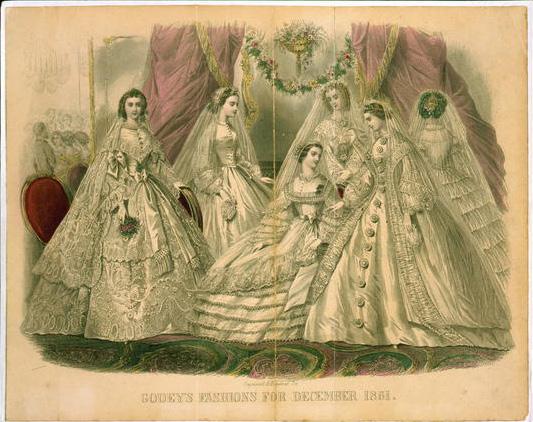
Godey's fashions for December/ Capewell & Kimmel, SC. , 1861. December. Photograph. https://www.loc.gov/item/97511046/
Long-time editor Sarah Hale spent 40 years working on the magazine, increasing circulation from 10,000 copies annually to around 150,000 by 1860.
There was no talk of war or politics on these
The Camel Corps?
Jefferson Davis, as Secretary of War (prior to the conflict) started importing camels from the Middle East to be used in the Southwest.
Some of these camels ended up in Confederate hands after the war broke out. One camel named "Old Douglas" served with the 43rd Mississippi Infantry. Old Douglas was killed by a Union sharpshooter during the Siege of Vicksburg.
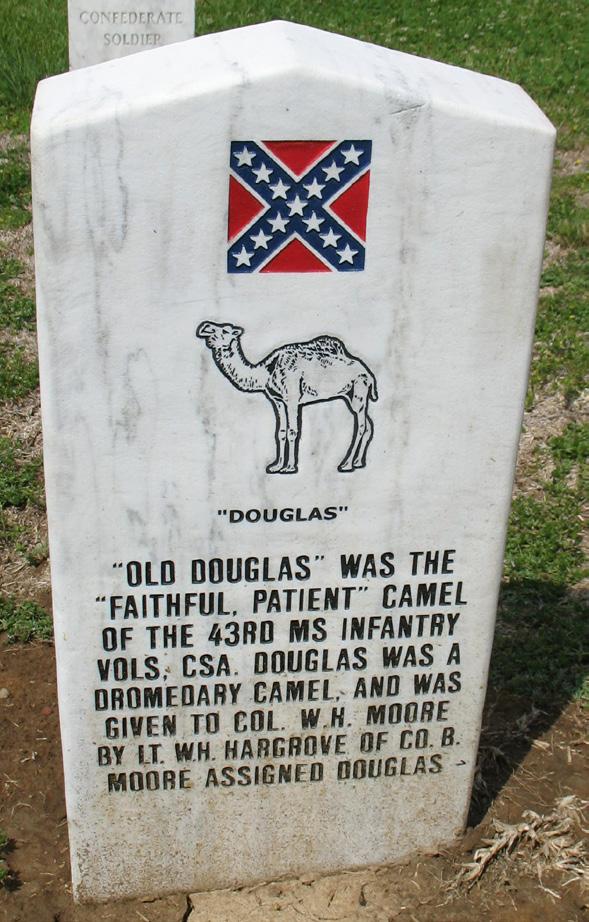
Old Douglas' Headstone. Natalie Maynor, CC BY 2.0, via Wikimedia Commons
Godey's
Lady Book
Founded in 1830, in Philadelphia, by Louis Godey, this magazine was a staple for women of the day.
pages. Sarah would not allow such topics to breed division on her pages.
Godey's was the "Vogue" of its time. Providing a space for all the fashion of the day, as well as many published articles by women.
2026 Skirmish Calendar
January 16-18
Snowball PT ForT Shenandoah
January 31 winTer bod
February 27-March 1 4Th louiSiana dS brierField, al
March 13-15 diSMal SwaMP rangerS T w caPron, Va
March 27-29 early bird al ForT Shenandoah
March 27-29 carolina regional cr STaTeSVille, nc
March 27-29 20Th georgia/PalMe TTo guard dS brierField, al
March 27-29 SouThaMPTon greyS T w caPron, Va
aPril 10-12
aPril 17-19
aPril 17-19
aPril 18
cheSaPeake regional ch ForT Shenandoah
SPring PoToMac PT ForT Shenandoah
Tucker’S naVal brigade T w caPron, Va
Ma region recruiT SkirMiSh #1 Ma ForT roSS, Pa
aPril 25 cV region recruiT SkirMiSh cV ForT Shenandoah
aPril 24-26 carolina regional cr STaTeSVille, nc
aPril 24-26 14Th MiSSiSSiPPi dS brierField, al
aPril 24-26 co. b, 1ST Pa caValry Ma SPringTown, Pa
aPril 24-26 1ST rockbridge Mw PleaSanT hill, oh
aPril 25-26 10Th MaSS baTTery en hoPkinTon, Ma
aPril 25-26 114Th illinoiS wr loaMi, il
May 1-3 cV regional cV ForT Shenandoah
May 1-3 63rd nyVi ne danSVille, ny
May 1-3 TidewaTer SPring regional T w caPron, Va
May 13-17 SPring naTionalS n-SSa ForT Shenandoah
June 5-7 cockade riFleS SkirMiSh cV ForT Shenandoah
June 5-7 durell’S indePendenT baTTery Ma SPringTown, Pa
June 5-7 SherMan’S bodyguard Mw aTTica, oh
June 5-7 8Th ny heaVy arTillery ne FranklinVille, ny
June 6-7 29Th wiSconSin wr aPPle Ton, wi
June 13-14 14Th Virginia caValry en SaraToga, ny
June 19-21 ne inViTaTional ne danSVille, ny
June 19-21 norThweST regional nw laingSburg, Mi
June 20 work SkirMiSh n-SSa ForT Shenandoah
June 26-28 MaSon/dixon SkirMiSh ch ForT Shenandoah
June 26-28 4Th TenneSSee dS brierField, al
June 26-28 leS FlinT cancer SkirMiSh Ma ForT roSS, Pa
June 26-28 110Th ohio Vol. inF Mw PleaSanT hill, oh
June 27-28 120Th new york en SaraToga, ny
June 27-28 1ST illinoiS wr STreaTor, il
July 10-12 Mcneill’S rangerS ch ForT Shenandoah
July 10-12 111Th ohio nw auglaizeVillage, oh
July 17-19 Ve Teran’S SkirMiSh n-SSa ForT Shenandoah
July 18-19 1ST cT VolunTeerS en glaSTonbury, cT
July 24-26 lancaSTer FencibleS Ma ForT roSS, Pa
July 24-26 MidweST regional Mw PleaSanT hill, oh
July 24-26 1ST uS arTillery ne FranklinVille, ny
July 24-26 nw regional nw laingSburg, Mi
July 25-26 uSSS co. g wr beloiT, wi
auguST 1 SuMMer bod gaineSboro, Va
auguST 7-9 allegheny regional al ForT Shenandoah
auguST 7-9 9Th new york caV ne erie, Pa
auguST 9 Ma region recruiT SkirMiSh #2 Ma SPringTown, Pa
auguST 13-15 wainwrighT arTillery SkirMiSh n-SSa ForT Shenandoah
auguST 14-16 nw regional nw richMond, Mi
auguST 15-16 cranky yankee en hoPkinTon, Ma
auguST 21-23 gaTor SkirMiSh cV ForT Shenandoah
auguST 22-23 46Th illinoiS wr beloiT, wi
auguST 28-30 3rd georgia/44Th georgia dS brierField, al
auguST 28-30 union guardS Mw PleaSanT hill, oh
SePTeMber 4-6 TidewaTer direcTorS SkirMiSh T w caPron, Va
SePTeMber 5-6 67Th ny/73rd ny en SaraToga, ny
SePTeMber 11-13 baTTery c nw auglaize Village, oh
SePTeMber 11-13 Fall PoToMac PT ForT Shenandoah
SePTeMber 11-13 carolina regional cr STaTeSVille, nc
SePTeMber 11-13 69Th ny VolunTeerS Ma SPringTown, Pa
SePTeMber 11-13 149Th new york ne danSVille, ny
SePTeMber 18-20 11Th indiana Mw PleaSanT hill, oh
SePTeMber 18-20 T w Fall regional T w caPron, Va
SePTeMber 19 caMP oF inSTrucTion dS brierField, al
SePTeMber 19 PT region recruiT SkirMiSh PT ForT Shenandoah
SePTeMber 19-20 29Th wiSconSin wr briSTol, wi
SePTeMber 30-ocTober 4 154Th naTional n-SSa ForT Shenandoah
ocTober 17-18 coMManderS ShooT en SaraToga, ny
ocTober 17-18 TidewaTer recruiT dayS T w caPron, Va
ocTober 23-25 halloween ShooT PT ForT Shenandoah
The patch design for the 153rd National was approved after motion by Joe Plakis. The patch design for the 154th National was approved after motion by Mark Killeen.
Bivouac
Motion to permit 056-AL, 1st PA Rifles (Bucktails) to expand into Area 4, Site 24 was made by Mike Davenport and carried.
Motion to permit 273-CV, 30th VA
Sharpshooters to relocate into Area 5, Site 41 vacated by the disbanding of Harlan’s Light Cavalry was made by Erick Shaw and carried.
Motion to permit 025-PT, 1st MD Infantry to expand into the Area 2, Site 11 vacated by the disbanding of Wythe Rifles was made by Mike Davenport and carried.
Motion to permit 258-TW, Rowan Artillery to move to the Area 3, Site 29 vacated by the disbanding of 1st ME Heavy Artillery was made by Mike Davenport and carried.
Marketing
Chris DeFrancisci requested that we continue advertising in Civil War News as it gets our presence out to a wider audience through their Facebook page, and this will be discussed further during the budget debate. Chris is stepping down as Marketing Committee Chair and is recommending that Bruce Miller take over. Dave Cole appointed
Bruce Miller to the position.
Property Management
Mark Fleet stated that in his report the capital improvements for 2026 include expenses for roof replacement of the Main Range Tower and the Revolver Range left tower. The plan is to use metal roofing, but if cost prohibitive cedar shakes will be used.
Recruiting
Chris Krecidlo is requesting that the Recruiting Committee be able to set up a tent or booth at one of two places during nationals, either at Registration/Bill Black, in a sutler’s booth, or use the staff building. Dave will talk to Chris K. to see where he would prefer space.
If your region does not have a recruiting officer, please appoint one. The network that Chris K. is building among the recruiting personnel is very active and willing to help. We are also looking at a booth for the February 2027 Great American Outdoor Show in Harrisburg.
Safety Officer
Doug Walter played a video for discussion, looking for guidance on whether or not we should change our procedures for clearing fouled firearms and if we have a printed Ordnance Manual. One will need to be created and an ad hoc committee consisting
of John Defilippi, Doug Walter, Jackie Venskoske, Chris DeFrancisci, and Tim Scanlan will draft one for all disciplines.
History Center
Gary Crawford is trying out new things for displays and is again asking the regions to assign someone to handle their region’s displays in the History Center. He is asking that the Scott Harris Memorial Trophy consist of the highest score of the aggregate consisting of smoothbore musket and smoothbore pistol. Motion to approve made by Mark Killeen and approved pending communication with IT.
Broke for lunch at 11:50 a.m., convened in Executive Session at 1:30 p.m., and reconvened in open session at 1:47 p.m.
Motion to approve the actions taken during Executive Session was made by John Defilippi and carried.
Motion to hire Allissa Weber as Interim Skirmish Line Editor was made by Eric Schuessler and carried.
Rules
Amendment of Rule 3.1.2.2
Current rule states that all Revolver Company Match distances at National Skirmishes are fired at 12.5 yards. The proposal is to return this match to 25 yards
for all events.
Motion was made by Joe Plakis and failed. 1 yes vote to 18 no votes.
Amendment of Rule 29.5.1.b
Current rule: “Protests for all completed company matches, including mortar, shall close Saturday at 3:00 p.m.”
Proposed rule: “Protest periods for all completed company matches, including mortar, shall close 30 minutes after final results of each match are posted.”
Motion was made by Joe Plakis and carried that the rule shall read as follows: “Protests for all completed company matches, including mortar, shall close Saturday at 9:00 a.m.”
Amendment of Rules 13.8 and subsets/14.9, 14.9.1
The current rules read that the Statistics Office Manager (National Statistics Officer) administers and maintains all team and individual classifications. This is now handled by the IT/Database Administrator/ Data Manager. Since this involves moving responsibility from one staff officer to another, it is the opinion of the Rules Officer that the Board should approve the changes.
Motion to approve the change made by Joe Plakis and carried.
For Discussion and Possible Action
There are potential members who have “shied” away from the N-SSA due to the “not politically correct” basis for our history and existence. These men and women are marksmen and target shooters who are interested in shooting and competing with our weapons but have restrictions placed upon them due to the nature of their work. Police, firemen, city municipal workers, government and healthcare employees all fall into this category.
If we had the option for them to compete in the historically in accurate “Dickies and period shirt” they would be more apt to participate. Knowing that our organization has many pillars of ways to participate- but the main driver are the shooting sports. By allowing a more relaxed “code of dress” that could be adopted by any team- (and already in place with many teams) we could remove one of the barriers that keep new people from joining the N-SSA.
Motion made by Mike Davenport and tabled to May after consulting the Uniform Committee.
Amendment to Rules 3.1.2.3.1 and 3.1.2.4.2
Current Rule 3.1.2.3.1: “32 clay pigeons on a backer, 50 yards”
Proposed: “24 clay pigeons on a backer, 50 yards”
Current Rule 3.1.2.4.2: “16 clay pigeons on a backer, 50 yards”
Proposed: “12 clay pigeons on a backer, 50 yards”
Motion to approve the proposed change made by John Defilippi and was approved by a roll call vote of 11-5.
Deputy Commander yes
Adjutant no
Inspector General yes
Allegheny no
Carolina yes
Central Virginia yes
Chesapeake no
Deep South yes
Middle Atlantic yes
Midwest yes
New England yes
Northeast yes
Northwest yes
Potomac yes
Tidewater no
Western no
Amending the number of Company Match medals awarded at national skirmishes
Joe Plakis made a motion to adopt the number of places awarded for team competition at national skirmishes, beginning with the 155th National (Spring 2027). Motion carried with 3 no votes. aMending coMPany MaTch Medal counTS
Musket A-1 A-2 A-3 B-1 B-2 C
Sutler Officer
Paul Stoneburner began his report by informing the board that due to deaths and ill health, we now have 10 unrented sutler booths. In his report he spelled out the issues with lighting and roof leaks, both of which Property Management is aware of and repairs are scheduled.
Carbine A-1 A-2 A-3 B-1 B-2 C
6 4 8 2 2 1 Revolver A-1 A-2 A-3 B C
6 3 4 4 1
3 2 5 3 1
BL/C2 A-1 A-2 A-3 B C
Current 5 4 5 6 3
2 1 2 1 1
Single Shot-Breechloader (Unclassified)
Current 4
Approved 3
Sm Bore A-1 A-2 A-3 B C Current 5 4 5 6 3
5 4 6 7 1 SS Pistol A B C
4 1 1
Last fall, a member supplied a Starlink receiver and permitted Doc’s Place and Sutler’s its use, which worked out well. WiFi service and Starlink equipment is in the proposed budget.
Paul proposed that sutlers who pay for the whole year receive a 10% discount on their fees. Motion to approve was made by Erick Shaw and carried.
Mike Davenport stated that we need to look at the fees charged to our sutlers. Dave Cole tasked Mike with crafting a proposal and bringing it back in August.
Webmaster
Steve Sheldon would like to return to the practice of individuals being able to register themselves for the bulletin board. This would reduce barriers to access, but will require more moderation.
He also stated that we need to revisit which of the forums would be made available to
the nonmember public. Of the almost 11,000 registered users, 9,900 of those have not logged in to the site in at least 3 years. For those who wish to sell items, in order to combat fraud we should require handwritten evidence the item is for sale by the person posting it. He will speak to MackMedia about the costs associated with upgrading.
Budget
On the proposed budget, the following amendments were made by earlier board action:
Proposed Salaries $100,020
Approved Salaries
$ 92,762 (reduction of $7,258)
Financial Audit
$ 21,450
Approved Review $ 13,850 (reduction of $7,600)
Joe Plakis moved to reduce the Northeast Region’s Range Development Request from $3,500 to $3,000. Motion approved.
Joe Plakis moved to eliminate advertising in the Civil War News at a savings of $1,470. The motion was approved with a roll call vote of 11-5.
Deputy Commander yes to defund
Adjutant yes
Inspector General no
Allegheny yes
Carolina yes
Central Virginia yes
Chesapeake no
Deep South no
Middle Atlantic yes
Midwest yes
New England yes
Northeast yes
Northwest yes
Potomac no
Tidewater no
Western yes
Joe Plakis moved to reduce the Charitable Giving request from $7,200 to $5,500. Motion approved.
With these changes, the estimate of revenues is $337,573, the estimate of expenditures is $319,489. After depreciation, we have $5,351 revenue in excess of expenditures. Motion to approve the budget after amendments was made by Joe Plakis and approved.
Walt Zdon, Jr. made a motion to adjourn, which was carried and the meeting ended at 5:00 p.m.
Marching Towards 250 Years
America's Semiquincentennial Celebration
By: Allissa Weber, Interim Editor
As we march towards the 250th anniversary of the United States of America, naturally a lot of the focus on the American Revolution. There is, however, a room for more than one period of America in this celebration and this milestone offers a unique opportunity to examine how any of the unfinished business of 1776 led into the conflict of 1861.
America 250 is the official body that is overseeing the celebration; the White House also has an initiative, which you can find at Freedom 250.
These websites offer a glimpse into the pride and sense of purpose that stems from American initiatives and purpose. Offering a calendar with events, focusing on state-wide celebrations, contests, National exhibits, reenactments, education events, and more. You can search the calendar at America 250 by month, state, or event type.
While July 4th, 2026 is the 'primary' date of the celebration, there are many ongoing events, lectures, and webinars that N-SSA members may find interesting.
Constitutional Chats: Live Podcast (via Zoom webinar) - 14:00 to 15:00 every Tuesday
Meet the Founders with Kevin Walker - Virtual presentation Mondays Feb 2 thru April 6
Tom Paine's War - Author Jack Kelly explores the life and work of Thomas Paine. Event is in conjunction with the Fraunces Tavern Museum, and will be available virtually
Rebels & Redcoats: A Southern Maryland Revolutionary War Family Event - April 11 & 12, 2026 at the Piney Point Lighthouse Museum and Historic Park
250th Anniversary of Fifth Virginia Convention: Virginia's Independence Day - May 15, 2026 - Colonial Williamsburg
Photographic Memory: 50 Years of Photography at the National Portrait GallerySmithsonian National Portrait Gallery - May 15, 2026 thru February 28, 2027
American Frontier Celebration and Broadcast Special - July 1 - Theodore Roosevelt Presidential Library - check their site for additional details for events July 1-4, 2026
As you can see from just this smattering of events, there is something for everyone. Art in the Park, Reenactments, Lecture Series, Music Festivals, Food Festivals, Aerial Drone Shows, and much more.
The Freedom 250 initiative originates out of the White House, and they have partnered with Hillsdale College to produce some short but profound videos in a series called "The Story of America." Below are a couple of the playlists on YouTube, that are from the White House.
The Founders MuseuM - The signers
The Founders MuseuM - The road To LiberT y
aMerica 250
January 2026 Paymaster Summary Report
Submitted by: Bette Shepherd, N-SSA Paymaster
Jennie Wade's Tragic Death
Mary Virginia "Jennie" Wade was kneading bread in her sister's kitchen when an errant bullet flew through two closed doors, struck Jennie in the shoulder then lodged in her heart. She died instantly.
The dough she was kneading was made into bread by her mother, and soldiers assisted the women in wrapping and burying Jennie's body.
Jennie was the only civilian casualty at Gettysburg. The house still stands and can be visited today.
2026 Approved Budget
Submitted by: Bette Shepherd, N-SSA Paymaster

Campfire Echoes Remembering our Vacant Chairs
Forward by Allissa Weber, Tributes by Terri Townsend & Colin Scanlan
Joshua L. Chamberlain, in his October 1889 dedication speech at Gettysburg, spoke of the invisible weight left behind by great people:
"In great deeds, something abides. On great fields, something stays. Forms change and pass; bodies disappear; but spirits linger, to consecrate ground for the vision-place of souls. And reverent men and women from afar, and generations that know us not and that we know not of, heartdrawn to see where and by whom great things were suffered and done for them, shall come to this deathless field, to ponder and dream; and lo! the shadow of a mighty presence shall wrap them in its bosom, and the power of the vision pass into their souls."1
Chamberlain was speaking of a battlefield, but his words ring just as true in the quiet corners of Fort Shenandoah. When we gather around the fire or walk down the line we have shared for decades, we are not just in a physical space; we are in a place made sacred by those who came before us.
In the last few years - or perhaps the last decade, the Association has seen too many forms "change and pass." We’ve lost founders, leaders, friends, good people, and dedicated members who did "great things" for this organization, often without fanfare. Yet, as the smoke from the campfire drifts upward and conversations ebb and flow, we all sense that their spirits linger. They have consecrated our ground, our gatherings, and have turned our shared hobby into a "vision-place" for the next generation.
Chamberlain noted that future generations - those "that know us not" - would be drawn back to see where great things were

done. That place is the N-SSA. It is Fort Shenandoah. It is the burgeoning bonds of camaraderie that we have fostered for years.
Last year we lost several individuals who would be considered ‘giants’ in this organization and the world of black powder history and sport. I invited a few folks to write some words of remembrance about a few of those names. Whether you knew these two men personally or not, I would encourage you to read these tales. Remember their legacy. Share stories of their “great deeds,” and photos or videos. This is how we honor them and keep their memories alive, until we meet again on the Great Skirmish Line in the sky.
As we share these memories and stories, it becomes a balm to the living, and the “power of the vision,” passes into the souls of those who are left behind as well as those who are just joining our sport.
Philip Schreier’s name may not ring a bell with you, but he was certainly a giant in the world of black powder and history. Terri Townsend shares an excellent “Remembrance” article about Phil, who was the NRA Liaison, and presented the NRASponsored Young Skirmisher and Senior Skirmisher Awards, in addition to the annual fall presentation of the NRA Championship awards.
Scott Harris, of the 1st Florida Cavalry, CSA was known by many, spending years helping out at Fort Shenandoah, and became an almost constant presence. Colin Scanlan shares a tribute to Scott.
I extend a deep and sincere “Thank You” to both Terri and Colin for these tributes to individuals who should be remembered. If you would like to write a tribute article for anyone, please do not hesitate to reach out to the editor.
Finally, we have a specific place for “In Memoriam” photos and videos. The album is called “The Vacant Chair” and you can find these albums on the N-SSA Photo Site. All sales from this site are donated back to the N-SSA. If you wish to contribute photos or videos, please reach out.
"It is a duty we owe to the living as well as the dead... to rescue from oblivion the names of our fallen heroes... Let us not permit the graves of those who died for us to be leveled by the plowshare or hidden by the weeds of neglect."2
1 Chamberlain, Joshua Lawrence. "Address of Gen. Joshua L. Chamberlain at the Dedication of the Maine Monuments on the Battlefield of Gettysburg, October 3, 1889." In Maine at Gettysburg: Report of Maine Commissioners, 245–271. Portland: The Lakeside Press, 1898. Digital edition courtesy of University of Maine Digital Commons. Link
2 Ladies’ Memorial Association of Montgomery, Alabama, "Appeal to the Ladies of Montgomery," April 1866, quoted in Marielou Armstrong Cory, The Ladies' Memorial Association of Montgomery, Alabama: Its Origin and Organization, 1866-1902 (Montgomery: Alabama Printing Co., 1902), 12.
Remembering Philip Schreier, 1962-2025
By: Terri Townsend
A few weeks ago, the world lost one of the greatest minds that I ever met. Philip Schreier was an Eagle Scout, a historian, a reenactor, a collector, a museum director, and a good friend to everyone. Firearms and history weren’t just his job; they were his greatest passions. Whether it was a Civil War battlefield, a rifle in the National Firearms Museum, or any item in his personal eclectic collection, he knew the back story on each of them and was happy to share it with you. Anyone who has participated in the N-SSA matches in Winchester, VA, will remember his presence in the NRA Museums booth, and it you were lucky, you could share a Diet Pepsi and a cigar with a good story.
Phil was also a friend of the National Muzzle Loading Rifle Association. He shared firearm displays with the NMLRA Museum for several years. One year, he was not sure what he was bringing. The NMLRA Museum Chair told him to bring some of the movie guns that were in various parts of the National Firearms Museum. It was so popular, it is now the “Guns
of Hollywood” permanent exhibit. In addition, Phil was always willing to give the NMLRA advice on their acquisitions.
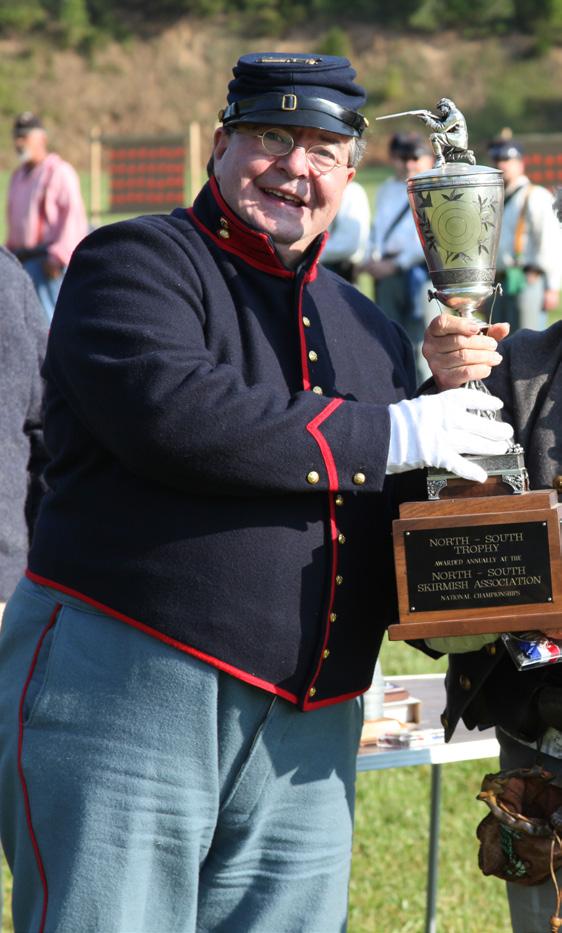
He was an avid reenactor and loved to portray soldiers from different eras. His collection of military and other antique hats was quite extensive. He was known to wear different hats while watching one of his many classic movies and would change hats to align with different characters. His home was decorated with the things he loved: gun-related items, books, movie items, and the New York Yankees. One of his favorite places was his back porch, where he liked to watch movies, enjoy a good cigar, and entertain friends. Phil also loved good seafood, especially with a generous coating of one of the 18 varieties of Old Bay Seasoning. He was the only person I knew that kept a container of Old Bay in his car, in case he happened upon a seafood restaurant.
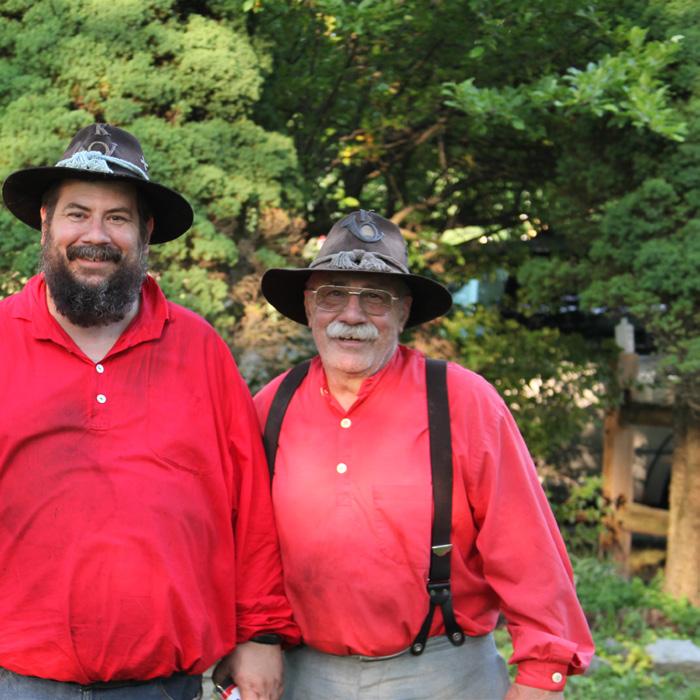
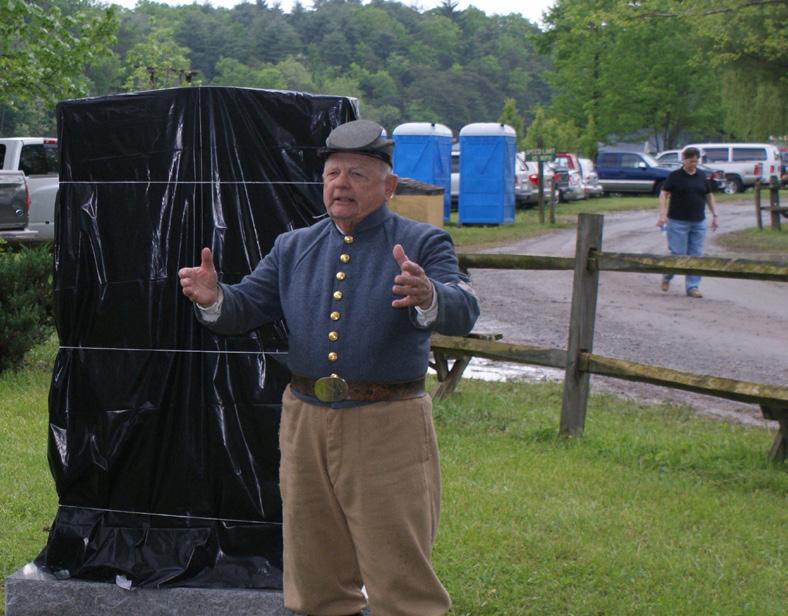
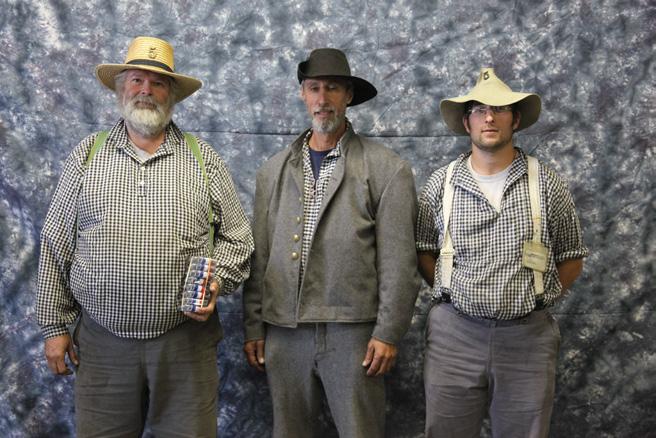
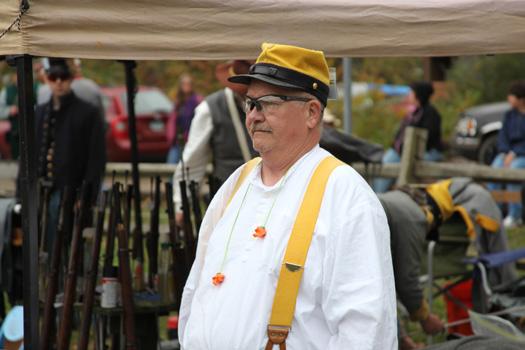
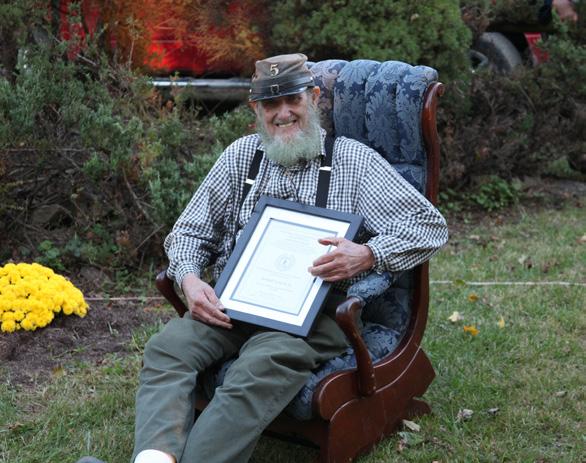
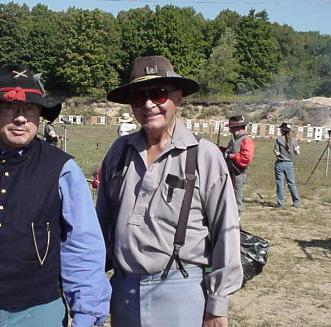
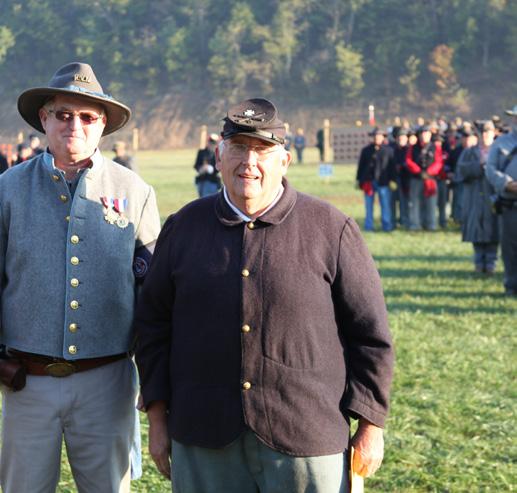
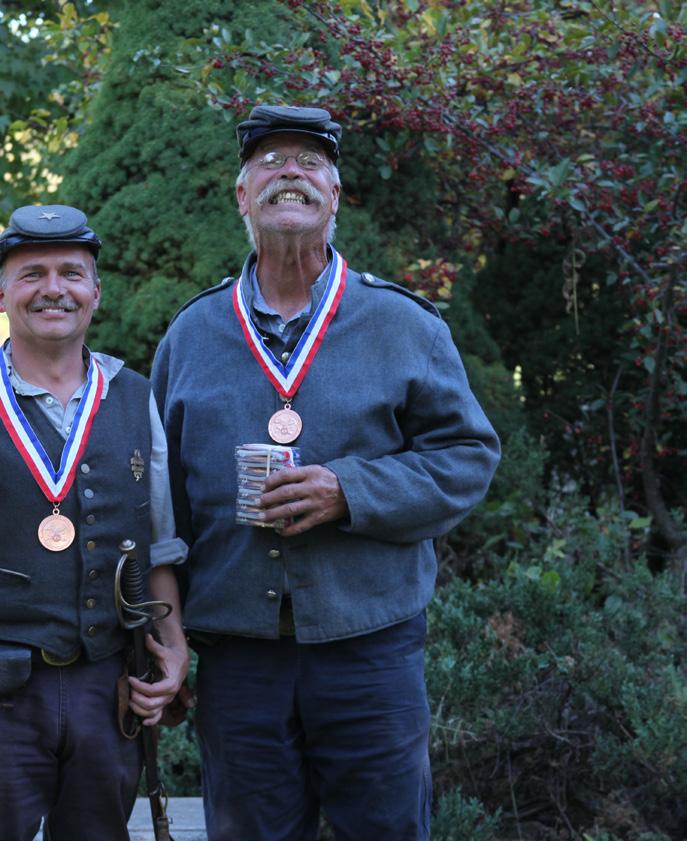
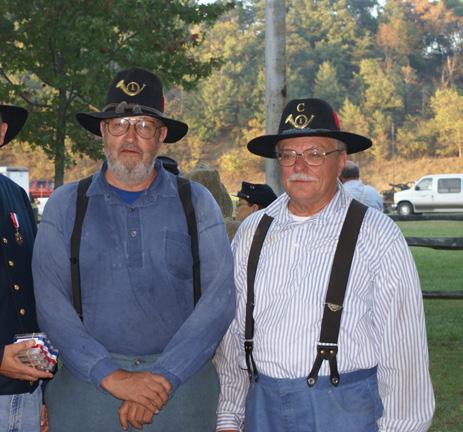
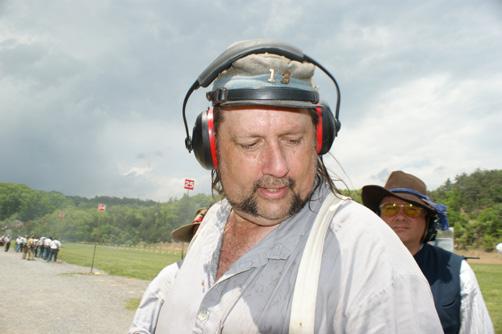
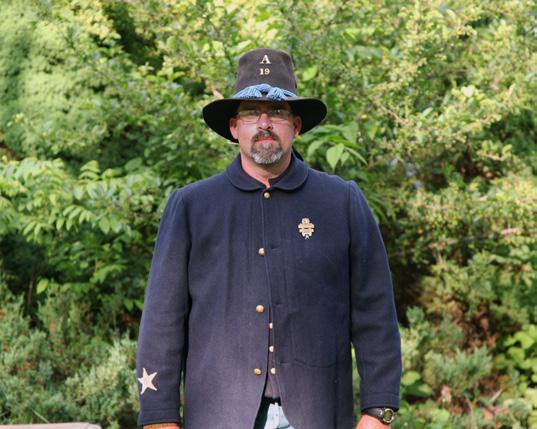
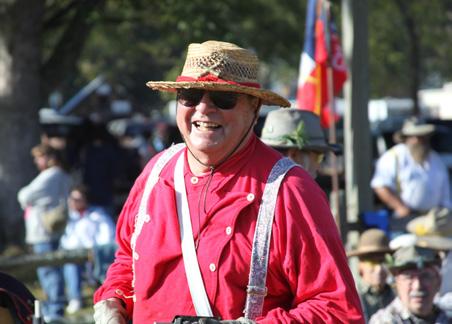

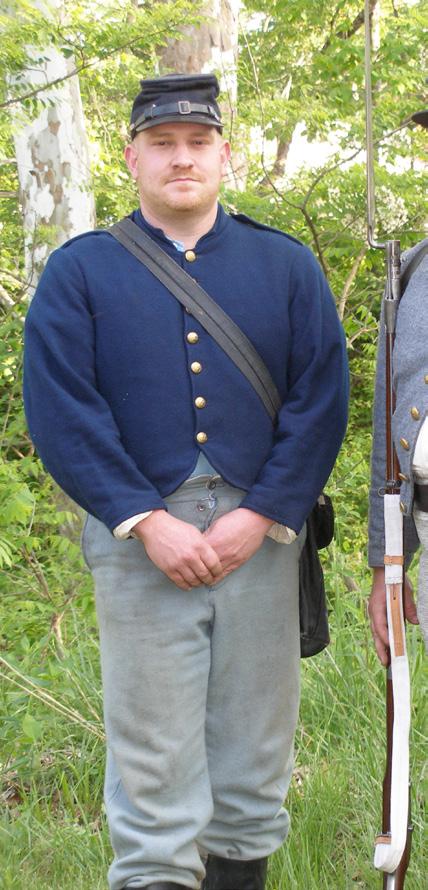
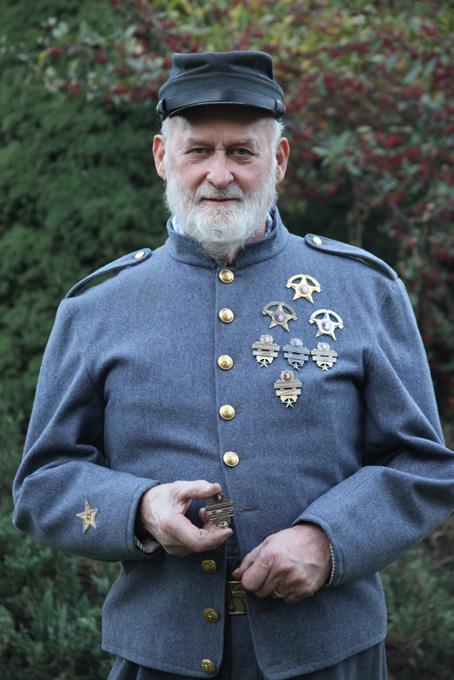
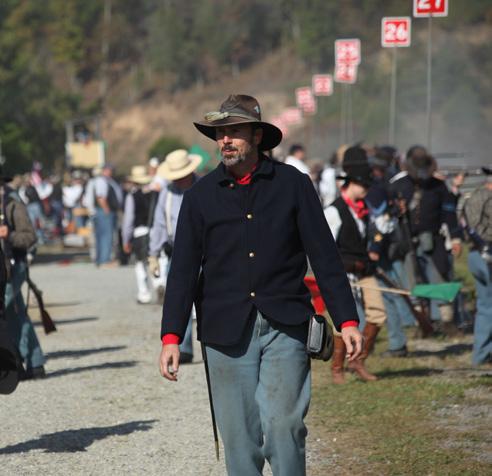
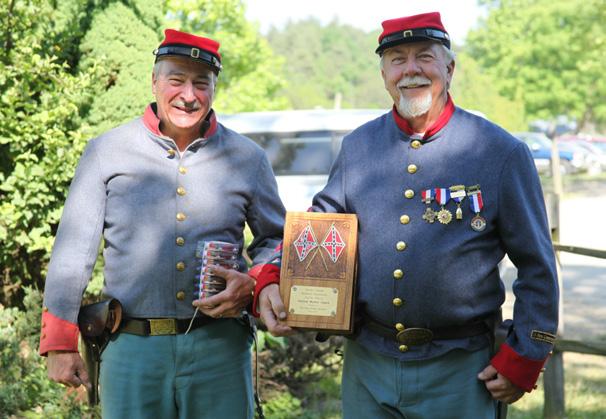
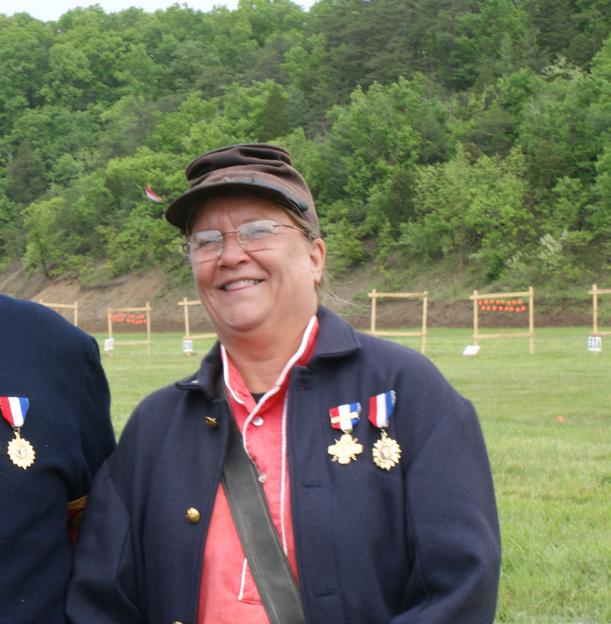
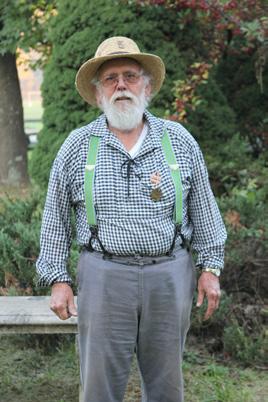
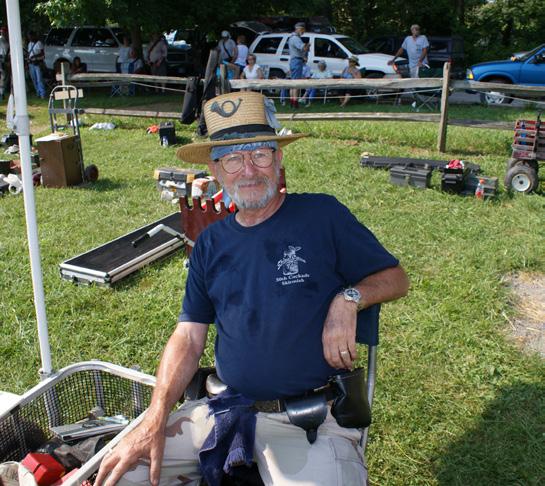
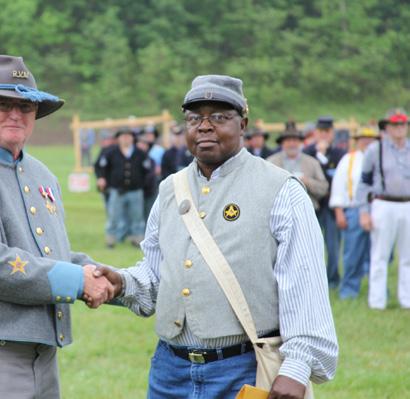
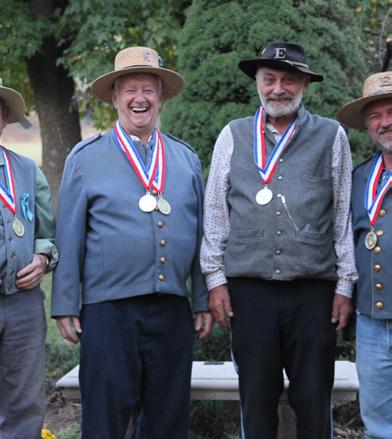
Phil had an extensive collection of museum-quality firearms, each with a story. One of his duties with the NRA was being the Secretary of the Gun Collectors Committee. He also was in charge of “Collectors’ Row” at the NRA Annual Meetings and judged the exhibits. He turned the display area into one of the best “bragging rights” competitions ever known.
Phil maintained the attitude that working with the things he loved was the best job. Even in his later years, his face would light up like a boy on Christmas morning when someone brought him an old gun to examine. He had a multitude of resources at his fingertips to answer any questions that a person might have.
Phil Schreier left the world too soon, but he touched thousands and thousands of lives. He introduced generations of shooters to the sport and others to the love of history. We will miss him greatly, but he will never be forgotten.
Remembering Scott Harris
By Colin Scanlan
Scott
Harris.
A name and face known widely throughout the N-SSA. Scott always ended up in pictures during skirmishes, though he never wanted to be. Scott was at the range for every event, whether the event be competitive, fun, or volunteer work. Scott dedicated his blood, sweat, and tears to his shooting abilities, his friends, and the N-SSA as a whole.
Growing up around Scott was an experience. The stories, advice, and jokes he should not have told me at such a young age. I clung to every word. He was a true friend and acted in my life as another father. If I messed up or did something wrong, he would not snitch on me to my parents, however he would give me advice and the whole "I'm not mad, just disappointed" speech. Though there was the time I was on his tailgate and he hurled me off when he hit a speed bump too quick... Scott was always there for his friends: whether it be injury, attitude, or just bad luck.
As Scott said about his daughter Hayley, "I know time heals, but it just moves so slow." Scott's passing has left a great, empty hole in the N-SSA and in my life. There are so many stories and memories, however, this
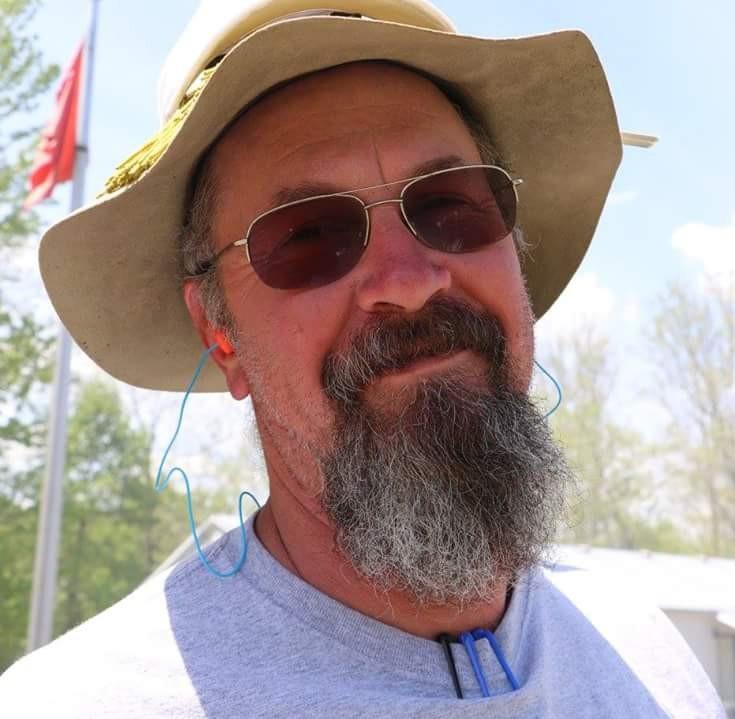
article is only so big. Scott has left us a legacy of great times, triumph, hard work, and great friendship/ camaraderie. I will always strive to be even a fraction of the man he was, and to leave a positive impact on the lives of others as he did with mine.
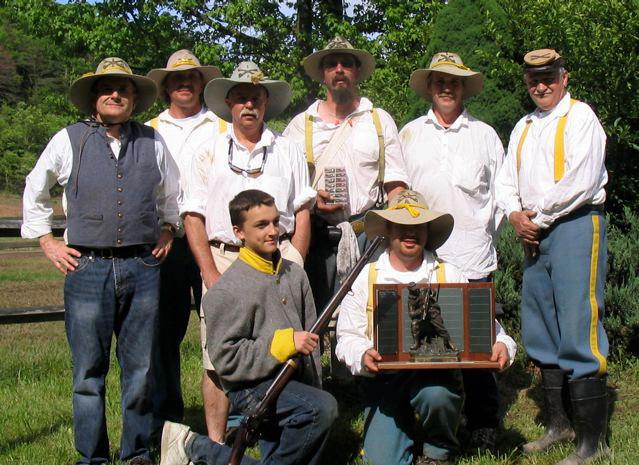
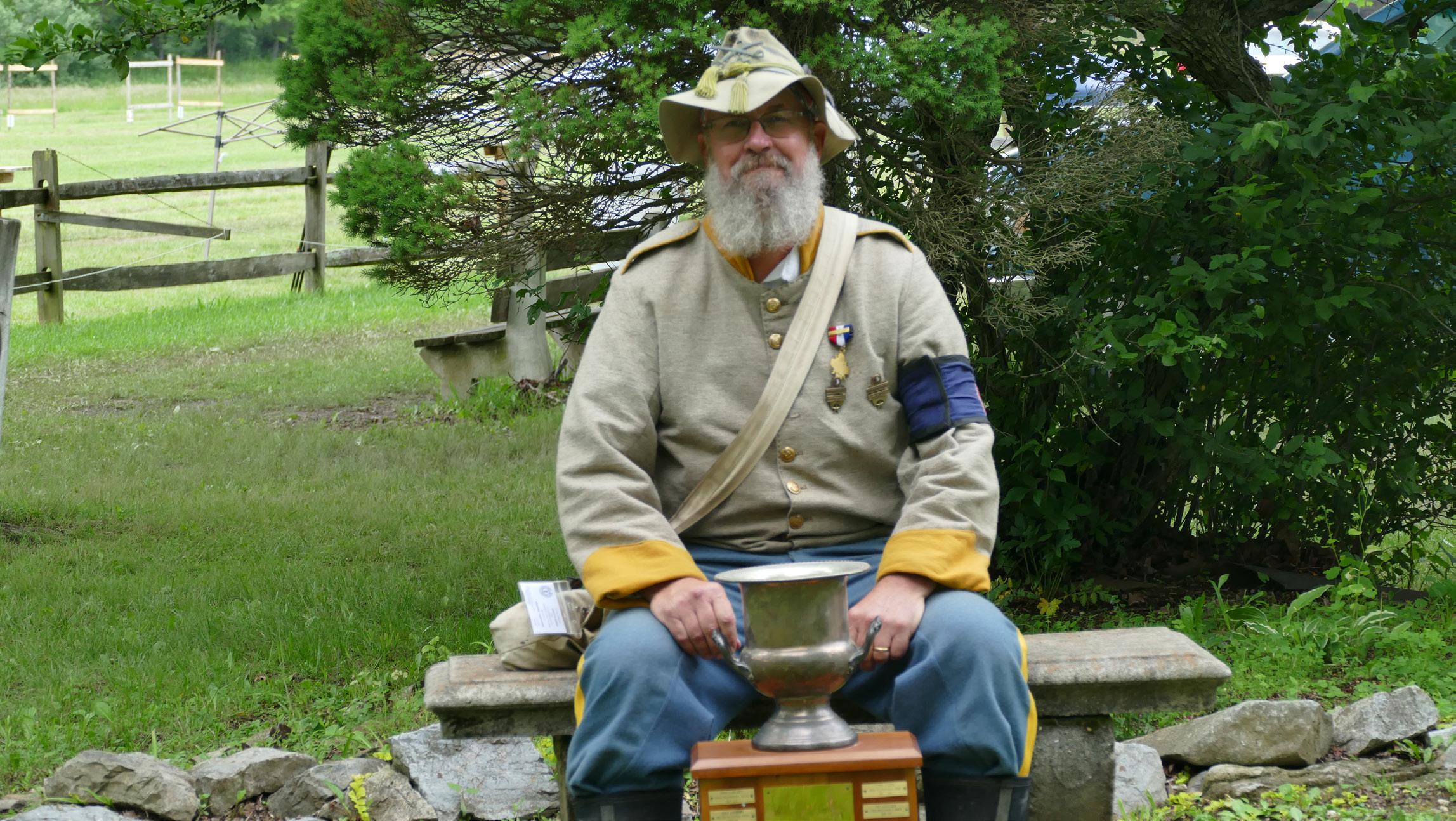
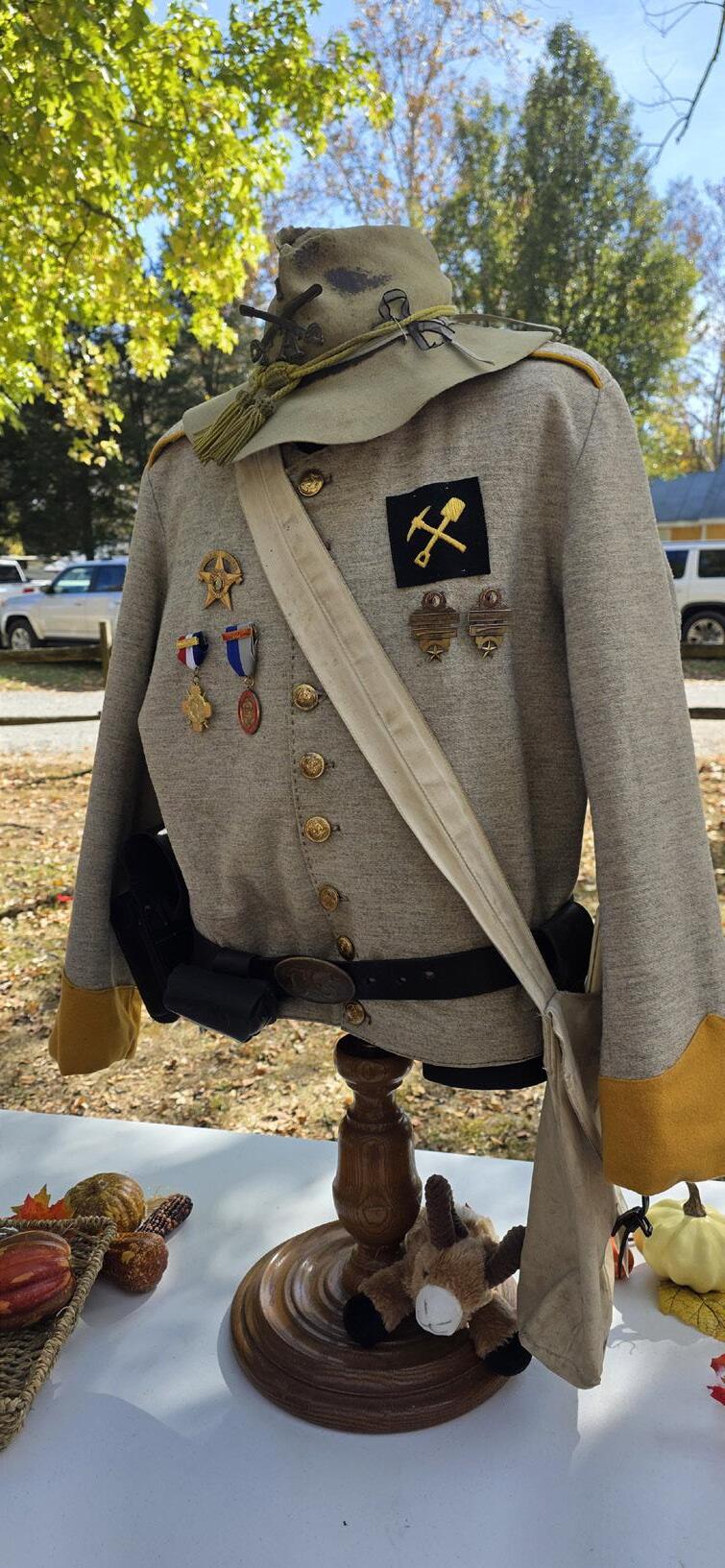
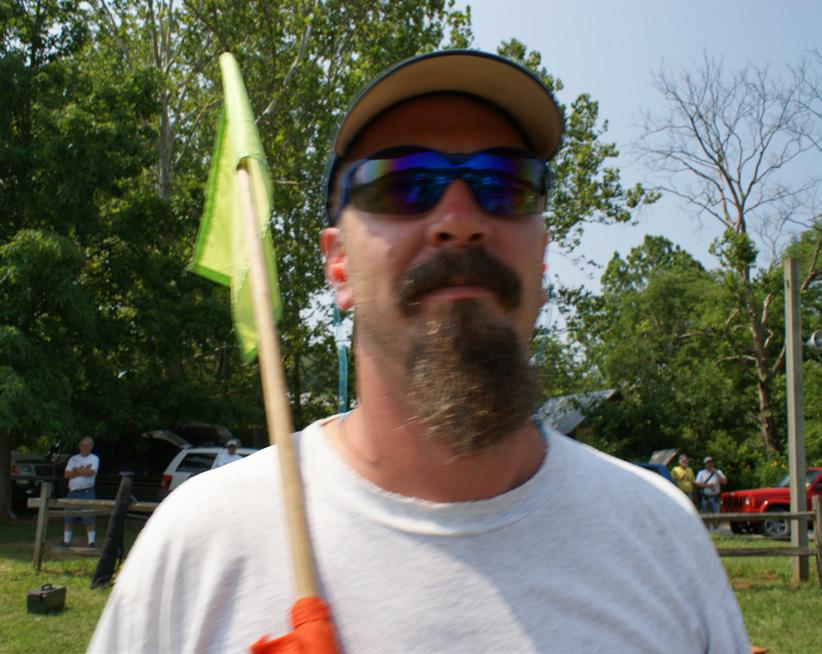
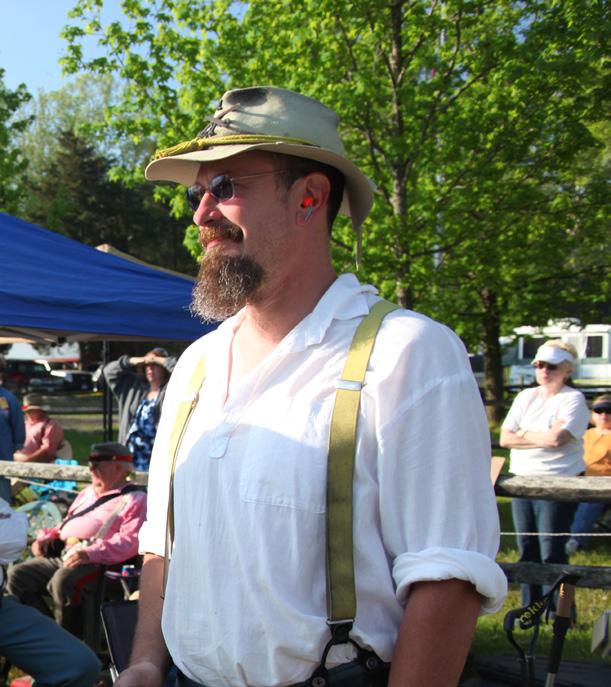
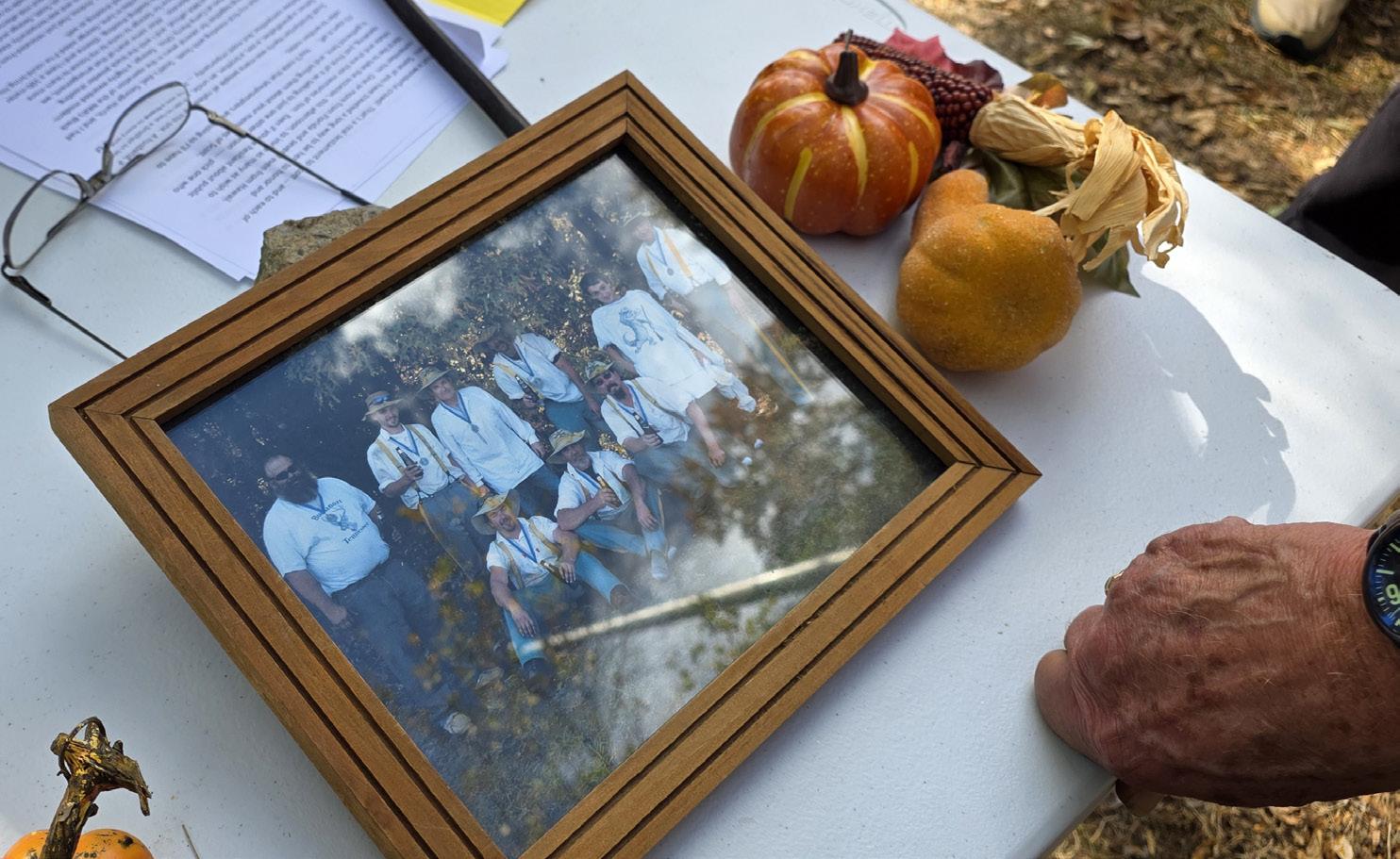
Taps

Michael Benson Delaware Blues
Paul Burchette Lenoir Braves
Dave Comer 9th VA Cavalry
Jim Cox 110th Ohio Volunteer Infantry
Tom Crone Laurel Brigade, ANV
James Hiler, Sr. 1st Stuart Horse Artillery
Sean MacLellan 67th NY Volunteer Infantry
Dave Martinez 1st Tennessee Vol. Inf.
Laverne (Bud) Marvin
Cindy Mattis
Teddy Occhi
149th NY Volunteer Infantry
37th Georgia
15th CT Volunteer Infantry
Winston Parker Dismal Swamp Rangers
Robert Reisch
Thomas Schick
17th VA Infantry
13th NJ Volunteers
Phil Schreier 1st TN Volunteers/NRA Museums Director
Steve Smith Chiswell’s Exiles
Paul Vosburgh, Jr. 1st Maine Heavy Artillery

Society of Color Bearers and Advance Guard
Proud Donors to the N-SSA
Wayne Jordan, Charitable Giving Committee
New Tax Deduction for Charitable Donations
Starting in 2026 the new OBBB tax act grants all taxpayers a new, simple way to deduct the value of donations made to 501(c)(3) organizations like the N-SSA. In the past you needed to itemize deductions on your tax return in order to utilize charitable donations to reduce taxes. But, now, you can deduct up to $2000 on a joint return ($1000 on a single return) without itemizing. This will be simple to do at tax time. Let the government subsidize your donation to the N-SSA.
Have You Taken Your IRA Required Minimum Distribution For 2026?
If you are 70 1/2 years old you can use funds from your IRA account to donate to 501(c)(3) Charitable organizations like the N-SSA. If you’ve reached the age of mandatory withdrawals (73 years old), you can avoid the tax hit that accompanies withdrawals by donating the money directly from your IRA to a charity. This may also save you from IRMAA penalties on your Medicare premiums, too.
DONATE DIGITALLY BY USING OUR QR CODE
Scan the QR code and it will take you to the N-SSA.org webpage. Scroll down to the Donate button. You may donate by credit card or PayPal. Be sure to include your name, mailing address, and email address.
OR SEND IN A CHECK USING THE FORM BELOW . Please send your donation to: N-SSA , c/o Wayne Jordan, Charitable Donations Committee, 8606 Eagle Glen Terrace, Fairfax Station, Va 22039. Any questions can be directed to me at wvjordan@aol.com or 703-407-2445
Name
General Fund or Specific Purpose?
All Checks should be made out to the N-SSA. All donors will receive a letter of receipt by mail or email. The N-SSA is a 501(c)(3) organization and donations are eligible for tax deductions.
Download the 2026 National Officer Nomination Form
NORTH-SOUTH SKIRMISH ASSOCIATION
2026 National Officer Nomination Form
The Chairman of the Nominating Committee must receive this completed nomination form no later than May 1, 2026, for your candidate to be listed on the slate presented to the Membership at the May 2026 meeting. All forms must be mailed and emailed to:
Joseph Plakis III 1123 Beechwood Ave Lansdale, PA 19446
The members of (Unit Name)
Unit Seniority Number
Nominate (Candidate Name)
Candidate’s Comp. #
For the office of:
Signature of Team Officer:
Commander
Deputy Commander Adjutant
Inspector General
nssaelectionchair2026@gmail.com
Comp #: Unit #
I accept the nomination. (Candidate Signature)
Please Provide a typed response to the following questions, please email a word doc as well:
- Candidate’s Qualifications
- Prior Service to the N-SSA - Personal Background Information
- Candidates Statement
Use additional sheets, if necessary, electronic versions will help facilitate getting this online and in the Skirmish Line Please include a recent photograph of the candidate with this nomination. A complete slate of candidates for office will appear in the summer issue of The Skirmish Line and will be posted on the N-SSA Bulletin Board.
To use this form digitally - Nominators: Download it. Open in Acrobat (do not fill it out in your web browser); Fill it out and sign. Save it again. Email it to the Candidate. Candidate signs and saves it again. Return the digitally signed form to the email above
Clear Form
2026 Officers List
Role
NATIONAL COMMANDER DAVID COLE
NATIONAL DEPUTY COMMANDER RICHARD H CLEMENTS
NATIONAL ADJUTANT ERICK SHAW
EXECUTIVE SECRETARY SHARON A MYERS EXSECNSSA@GMAIL.COM
NATIONAL INSPECTOR GENERAL JOHN DEFILIPPI
NATIONAL PAYMASTER BETTE ANN SHEPHERD
PAST NATIONAL COMMANDER CHARLES L KINDLE JR
Commanders
Regional
AL REGION COMMANDER DOUGLAS K WALTER
CH REGION COMMANDER DAVID T BOOZ
CR REGION COMMANDER THOMAS E WAREHAM
CV REGION COMMANDER ROBERT PAUL HICKS II
DS REGION COMMANDER STEVEN SHELDON
EN REGION COMMANDER LOUIS RUGGIERO
MA REGION COMMANDER JOSEPH PLAKIS III
MW REGION COMMANDER ERIC S SCHUESSLER
NE REGION COMMANDER MARK R KILLEEN
NW REGION COMMANDER EDWARD WALTERS
PT REGION COMMANDER WALTER J ZDON JR
TW REGION COMMANDER E.R. MIKE DAVENPORT
WR REGION COMMANDER JOHN P MARK I
2026 Officer's List
Role Name / Email
AL REGION DEPUTY COMMANDER GEORGE F MCDOWELL
CH REGION DEPUTY COMMANDER KENNETH J SPENCE JR
CR REGION DEPUTY COMMANDER REX COCKERHAM
Regional Deputy Commanders
CV REGION DEPUTY COMMANDER BRIAN R LAKATOS
DS REGION DEPUTY COMMANDER JAMES F KOCH
EN REGION DEPUTY COMMANDER PETER C HUGHES
MA REGION DEPUTY COMMANDER JOHN A WESTENBERGER III
MW REGION DEPUTY COMMANDER JAY R FULTON
NE REGION DEPUTY COMMANDER PAUL D. SANDERS
NW REGION DEPUTY COMMANDER JOHN K SNYDER
PT REGION DEPUTY COMMANDER TIMOTHY D SCANLAN
TW REGION DEPUTY COMMANDER LINWOOD L McMAHON
WR REGION DEPUTY COMMANDER KEVIN HERRICK
AL REGION INSPECTOR GORDON DOUGLAS CAMPBELL
Regional Inspectors
CH REGION INSPECTOR MICHAEL L LINTON
CR REGION INSPECTOR DAVE JACKSON
CV REGION INSPECTOR JONATHAN M DOBLIX
DS REGION INSPECTOR EDDYE H LAWLEY
EN REGION INSPECTOR RICHARD M INTRAVIA
MA REGION INSPECTOR TERRANCE MIKLOS
MW REGION INSPECTOR MICHAEL BUNETTA
NE REGION INSPECTOR BENJAMIN P NEVLEZER
NW REGION INSPECTOR PAUL Z LIPKA
PT REGION INSPECTOR JOHN DEFILIPPI
TW REGION INSPECTOR MICHAEL S STONEBURNER
WR REGION INSPECTOR JOHN T THATCHER
2026 Officer's List
Role Name / Email
ARTILLERY OFFICER
ROBERT T WEST
ASST SMALL ARMS OFFICER MICHAEL J SANTARELLI
BIVOUAC OFFICER ROBERT E GORSKY
CORPORATE RELATIONS OFFICER WALTER M KREITLER
HISTORY CENTER OFFICER GARY J CRAWFORD
INSURANCE OFFICER JASON M REXRODE
DATA MANAGER LINWOOD L McMAHON
DOC'S PLACE RETAIL MANAGER CHRISTINE M INTRAVIA
DOC'S PLACE RETAIL MANAGER RICHARD M INTRAVIA
IT/DATABASE ADMINISTRATOR RICHARD E WOOD
JUDGE ADVOCATE/SOLICITOR LARS E ANDERSON
LOGISTICS OFFICER GLENN E WISSINGER JR
MEDICAL LIAISON OFFICER JOHN VENSKOSKE SR
Officers
Staff
NRA LIAISON OFFICER CRAIG STANLEY
ORDNANCE OFFICER JOHN VENSKOSKE SR
PHOTOGRAPHY OFFICER LISBETH A COLE
PROGRAM OFFICER GEORGE F MCDOWELL
PROPERTY MANAGEMENT MARK A FLEET
PROPERTY MANAGER TIMOTHY D SCANLAN
PROTOCOL OFFICER BRANDON S BOWSER
PROVOST MARSHAL BRUCE A ALLEN
PUBLIC INFORMATION OFFICER BRUCE W MILLER
RANGE OFFICER JEFFREY R COX
RECRUITING COORDINATOR CHRISTOPHER D KRECIDLO
REGISTRATION OFFICER JOHN L GASKILL
REVOLVER RANGE OFFICER CHRIS M DEFRANCISCI
RULES OFFICER SHARON A MYERS
SAFETY OFFICER DOUGLAS K WALTER
SIGNAL OFFICER DAVID COLE
SKIRMISH LINE EDITOR - INTERIM ALLISSA N WEBER
SMALL ARMS OFFICER JOHN D HOLLAND JR
STATISTICS OFFICER JEFFREY R KNAUSS
SUTLER OFFICER PAUL D STONEBURNER
2026 Officer's List
Role Name / Email
AWARDS COMMITTEE CHAIR NANCY C CROCKETT
CHARITABLE GIVING COMMITTEE
CHAIR WAYNE V JORDAN
Committee Chairpersons
COMMUNITY RELATIONS COMMITTEE CHAIR GARY J CRAWFORD
COSTUME COMMITTEE CHAIR PEGGY A EDWARDS-SHAW
ELECTION COMMITTEE JOSEPH PLAKIS III
FINANCE COMMITTEE CHAIR LANCE P WALTER
HISTORY & EDUCATION COMMITTEE CHAIR JOHN P ZEBELEAN III
INT'L MUZZLELOADING COMMITTEE CHAIR EDWARD W SCHNEEMAN
LONG RANGE PLANNING COMMITTEE CHAIR EDWIN THOMPSON
MARKETING COMMITTEE CHAIR BRUCE W MILLER
PERSONNEL REVIEW COMMITTEE
CHAIR CARLTON LAYNE
UNIFORM COMMITTEE CHAIR MARK E LATHAM
VETERANS COMMITTEE CHAIR ROB 'HOLLYWOOD' BETHKE
YOUTH ACTIVITY CHAIR ANNA L SCHNEEMAN
YOUTH COMMITTEE CHAIR CASEY C KEENER
YOUTH COMMITTEE CHAIR TRAVIS J KEENER
Classification by Team
Classification by Team
Classification by Team
Classification by Team
Classification by Team
*Team Classifications are recalculated after every National Skirmish
Have Feedback?
Letters to the Editor? Suggestions?
Send it over to us!
Notes from: Allissa Weber, Interim Editor
We'd love to hear what you think as we move forward with changees to the magazine. Love it? Hate it? Feeling sort of "meh" about it? Let me know.
This is, after all, YOUR MAGAZINE!
With that in mind - we need contributing writers for the Skirmish Line , if you want content other than National Skirmish Results and Board Meeting minutes!
What do you - the membership - want to see in this publication? If we get zero feedback - then perhaps the Board has a larger decision to make.
You can reach me at: skirmish.line.editor@gmail.com
Potential Article Ideas/Columns:
• Historical Articles on Arms/ Acoutremants/History
• Interviews
• Meet the Staff Officer(s)
• The Unsung Skirmisher
• Interviews with New Skirmishers
• Interviews with Old(er) Skirmishers (the "OG")
• Gunsmithing/repairs
• Costuming
See you all on the line in May!