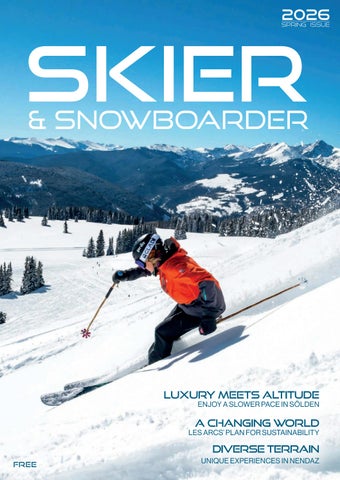
Skier & Snowboarder
Front Cover Photo: Photo by Glade Optics on Unsplash
News Top tips for booking winter 2026/27
In their latest survey, Iglu found that 31% of respondents said they book early to secure exactly what they wanted – and this was the most popular answer when compared to ‘leaving it late’ and ‘waiting for an offer’ among other options.
The importance of getting ahead and securing the best possible ski holidays is vital to many skiers in the UK, so Iglu Ski has come up with its top five tips for booking winter 26/27. Groups of more than six should be booking now for next winter, to secure sole occupancy of a chalet,
preferred flight departure points and the accommodation of choice. Families should certainly be booking February half-term now , the most popular booking date at Iglu Ski at present. It’s such a key week in the ski season, and savvy families are committing now for the best childcare options and the most family-friendly resorts.
Keep an eye out for early booking offers, and act fast! Occasionally, early booking offers are on Iglu’s site, but they can be short-lived, so if you see an additional benefit, like a
lift-pass offer or cash discount, it’s a good time to confirm. There is more choice than ever, but use a comparison site to find it. Agents like Iglu have millions of holidays on site, including low-cost packages from the main operators and flexible holidays that could be short breaks, unusual arrangements, or a particular hotel not commonly available on the UK market.
Try somewhere new, you might get a great price. When new resorts are launched in the UK market, prices can be low. Given the new capacity in Norway, prices have been really competitive this winter, and this continues for early bookings for next year. Jump into Norway for a different experience. You might be surprised at what good value it is, and how open and fun the slopes are.
Phil Wright, Iglu’s Head of Sales and Service, said: “We’re already taking many bookings for next season, especially at peak holiday dates, for groups and for those taking over a whole chalet. It’s a question of paying a low deposit now to guarantee your booking, to have peace of mind for your next ski holiday. Combined, we have many years of ski experience, and can advise on any resort in the world.” Igluski.com
Double Gold in British Travel Awards
For the 12th consecutive year, Neilson won gold at the prestigious British Travel Awards in the category of Best Travel Company for Activity/Sports Holidays.
The Brighton-based brand also celebrated a standout win with another gold for Best Travel Company for Ski/Winter Sports Holidays.
With an unmatched run of 12 straight Gold awards – which are all voted for by the British public –Neilson says its winning streak is a testament to its unique approach –one that uniquely enables guests to try new things, challenge themselves, find balance and enrich their lives in ways that they can’t on other holidays.

International Ski Patrol day celebrated Acquisition set to drive growth
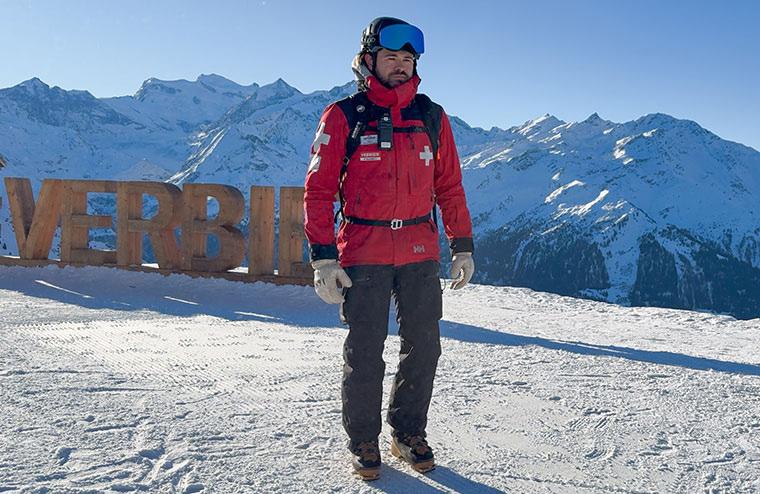
On 10 February, leading global ski brand Helly Hansen celebrated the fifth annual International Ski Patrol Day (ISPD). Established to recognise the incredible work of ski patrollers globally, ISPD encourages communities worldwide to show their thanks on and off the mountain. Ensuring the slopes are open, safe and fun for everyone, ski patrollers are the unsung heroes of the mountains. They work tirelessly to maintain and enhance the ski resort experience from dawn until dusk, throughout the season. On ISPD, all mountaingoers were invited to show their appreciation and support through social media thank you messages and in-resort activations.
Verbier Ski Patroller Théo Besse (pictured) comments: “Being a ski patroller allows me to enjoy the mountains every day throughout the winter whilst contributing to the safety
of others. It combines my passions for the sport, for keeping the mountains safe and working together as a team.”
Marcus Caston, professional skier and Helly Hansen ambassador, adds: “It’s nice to know ski patrollers are always there and have our back – whether it’s getting the mountain open, making sure it’s safe for us to go skiing, or when there’s a problem, pulling us out and getting us home safe.”
Since its inception in 2022, Helly Hansen has partnered with nearly 50 ski resorts across Europe and North America to celebrate ISPD, contributing to a variety of patrol and snow safety organisations. The financial support from the brand has been used to provide workshops, peer to peer support and educational resources across a range of topics, including avalanche safety, mental health and injury management and response. hellyhansen.com/ski-patrol
first tracks scheme for kids
Austria Tourism and Snowsport Scotland have launched “First Tracks”, a new partnership aimed at primary school-age children across Scotland. 150 pupils will have the chance to try skiing and snowboarding for the first time at artificial snow centres across the country. The fully subsidised introductory lessons are accompanied by themed events and competitions, introducing the young participants to the culture, lifestyle, food and music of Austria.
“Austria is renowned globally for its passion for snowsports, from its legendary resorts to its world-leading ski schools. By collaborating with Snowsport, we are investing in the future of the sport.
“We can’t wait to see children progress from the artificial slopes of Scotland to carving their turns on the pristine pistes of the Austrian Alps,” says Martina Jamnig, Director of Austria Tourism London.
Flight Centre Travel Group (FCTG) has acquired Iglu, the leading online travel agency, comprising three brands, Iglu Cruise, Planet Cruise and Iglu Ski.
David Gooch, Iglu CEO, will continue to lead the business, which will form part of Flight Centre’s global leisure division under James Kavanagh. The business will operate from its Wimbledon and Portsmouth offices as it does now.
In addition to targeting further growth in the UK, FCTG intends to leverage Iglu’s scalable platform to drive expansion in the fast-moving global cruise sector.
David Gooch, Iglu’s CEO, said: “We are thrilled to become part of the Flight Centre Travel Group. This partnership opens up significant future growth opportunities, allowing us to scale our operations while maintaining the unique identity that has made us successful.
“By leveraging Iglu’s world-leading ecommerce platform alongside Flight Centre’s global experience, we are perfectly positioned to capture new market share. Most importantly, the strong cultural fit between our businesses gives me great confidence that we will continue to deliver exceptional value to our customers, suppliers and people.”
Outgoing Iglu Founder and NonExecutive Chairman Richard Downs reflected on the incredible success of the last 27 years. He said: “It’s been a remarkable journey of resilience, creativity and technical innovation, since I started Iglu in a small office in Baker Street with a dedicated team. I’m delighted to see Iglu, now the dominant European online retailer of cruise and ski holidays, become a hugely valued part of one of the largest travel companies in the world.”
Maiden victory on home slopes
Swiss ski racer Malorie Blanc reveals to MYRA BUTTERWORTH what it is like to win the women’s Super-G race at Crans-Montana
Winning a race is a special moment for any athlete and their supporters, but doing it on their home slopes transcends such an achievement to the next level.
This is exactly what happened with the unexpected win at the women’s Super-G race at Crans-Montana.
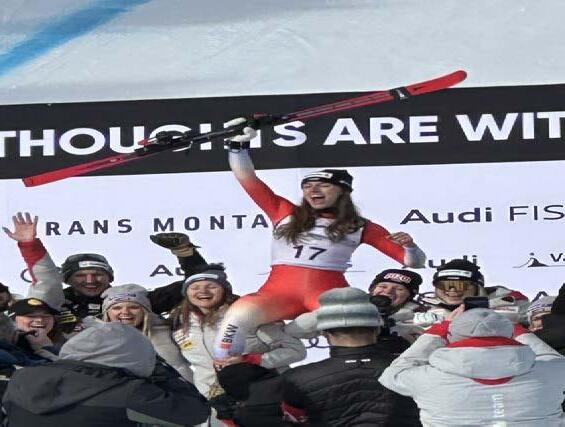
Blanc grew up just moments away from Crans-Montana in Anzère and is a member of the Swiss Ski team. She revealed to Skier & Snowboarder what it meant to claim a maiden Audi FIS Ski World Cup victory on her home slopes.
“Winning a race is always special, but winning at home is something truly unique,” she said. “Crossing the Super-G finish line first in CransMontana, feeling the support of the crowd and seeing so many familiar faces, filled me with emotion. It’s a moment of joy and pride that I will carry with me for a long time.”
The win on 31 January sent the Swiss crowd wild, releasing a huge wave of

red and white flags into the air. It also brought some hugely positive vibes to a ski resort that has been in mourning following the tragic fire on New Year’s Eve in Crans-Montana.
The race respectfully marked the tragedy with a moment’s silence at the start, along with the words ‘our thoughts are with you’ at locations throughout the race, including the finishing line.
The race weekend marked a step forward for the ski resort as it returns to doing what it does best: Competitive sports in the heart of the Alps.
As well as noticing the clean mountain air as soon as you arrive in the resort, there are glorious views that stretch along a chain of summits – from the Matterhorn (the shape of the mountain used as the basis of Toblerone) to Mont Blanc.
And yet, at the same time, it is easy to manoeuvre from the town itself to the highest ski areas in a simple ride in a cable car and gondola – in total, there are 24 ski lifts at the resort. It has 140 kilometres of ski slopes, with the elevation across the ski area ranging from 1,500 to 3,000 metres. But the resort isn’t just for the winter months, as there are golf courses and bike trails to enjoy during the summer.
And once you’ve worked up an appetite, there is a plethora of restaurants waiting for you. For the best raclettes, try L’Ardoise Valaisanne or La Plage for its Toblerone mousse.
Pierre-Henri Mainetti, sales and marketing manager of Crans-Montana Tourism, said: “We are very proud to host these incredible World Cup ski races here in Crans-Montana, a town that sits high above the Rhone Valley with some of the best views in the Alps from Mont Blanc to the Matterhorn.
“Our ski slopes offer something for every level of course, there’s over 140 kilometres of them, but to see both the men and women fly down at speeds of over 130km/h is something special and then to have two Swiss winners on the same weekend is a dream come true for us.”
The other Swiss racer to win during the weekend was Franjo von Allmen, who took the top position on the podium in the Men’s Downhill, which also took place in Crans-Montana. Mainetti added: “Next year we will host the 2027 Alpine Skiing World Championships over 10 days of ski racing – the world’s eyes will be on us as we showcase this top event on the slopes above our town. Let’s hope we have another Swiss gold, or maybe even a British one.”
“Winning a race is always special, but winning at home is something truly unique.”
Ski awards success
Ski In Luxury was awarded the “World’s Best Ski Travel Agent for France 2025” by the prestigious World Ski Awards.
The accolade, which coincides with the company’s 20th anniversary, recognises their dedication and expert commitment to providing highly personalised service and curating the finest luxury chalets in the French Alps – one of many destinations offered.
The World Ski Awards are decided by votes from ski tourism professionals and high-end consumers globally, making the award a significant, independent marker of quality of service to their clients.
Ski In Luxury manages premium properties in leading luxury ski resorts like Courchevel and Val d’Isère, whilst also offering emerging destinations offering value for luxury such as Serre Chevalier and La Clusaz.
“It is an absolute honour to win the World’s Best Ski Travel Agent to France
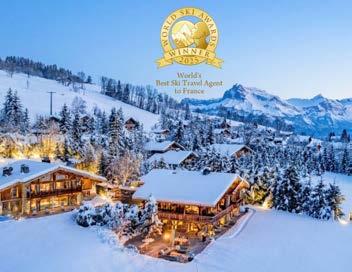
2025,” said Andy Castle, Co-Director of Ski In Luxury. “It’s a testament to the dedication of our entire team and the trust our clients place in us. We sell more than just luxury ski chalets. We go for service gold, so our clients experience extraordinary mountain memories in France, where every detail matters. Whilst we also celebrate our 20th anniversary, we’re excited for another successful chapter of new faces, new properties and new possibilities.”
Best Alpine Wellness Hotels, a prestigious collection of leading Alpine wellness hotels, will be represented by Purpose Comms as it moves into the UK market.
Best Alpine Wellness Hotels is a carefully curated cooperation of luxury, independent, familyrun hotels located across the Alpine regions, united by a shared philosophy of holistic wellbeing, Alpine nature and genuine hospitality.
Each member hotel is rooted in its local landscape, offering guests restorative experiences that combine nature, movement, spa culture and mindful living. Purpose Comms will raise awareness of the collection as a destination for meaningful Alpine wellbeing travel. wellnesshotel.com/en
Adapting to a changing world
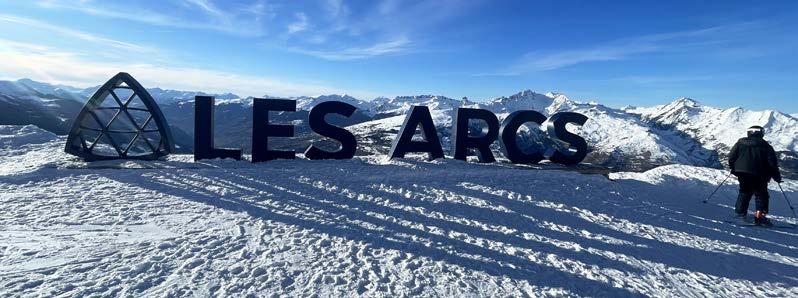
On a trip to Les Arcs KATY DARTFORD found out all about the resort’s ongoing commitment to sustainability and how it is shaping the future of sustainable tourism
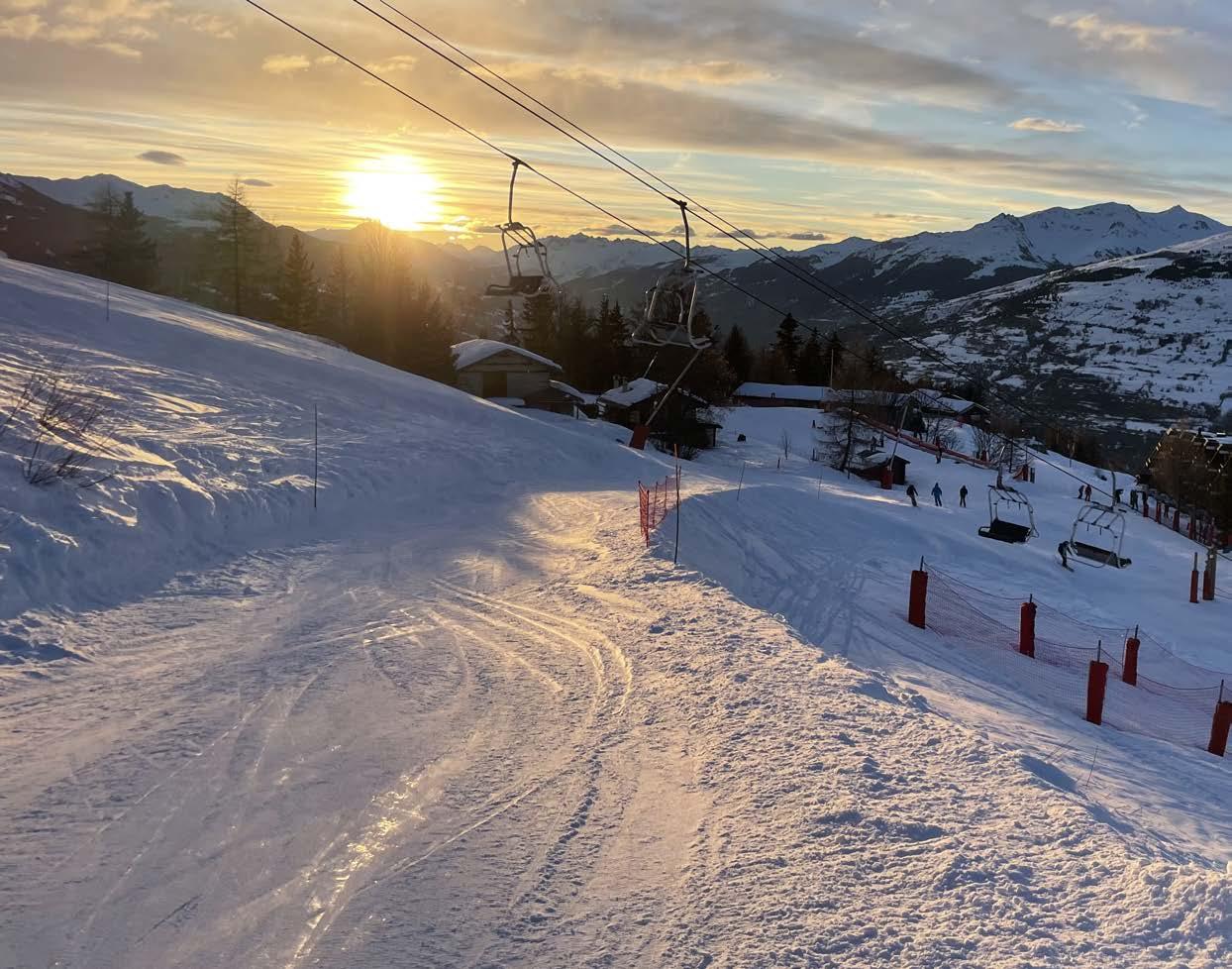
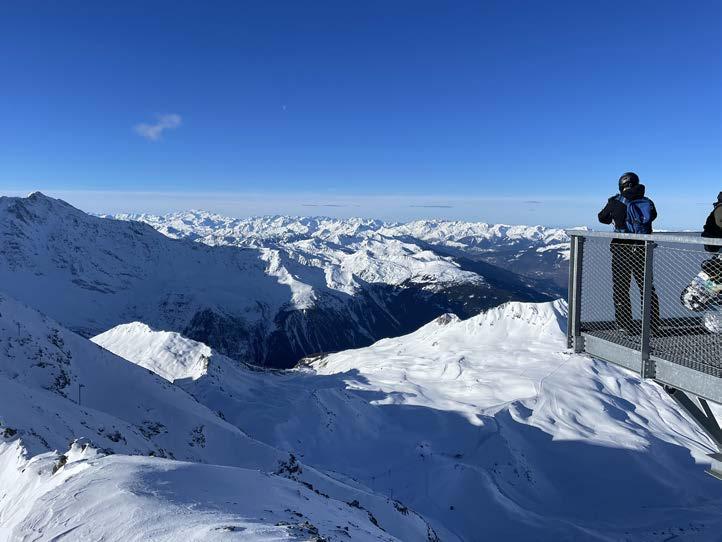
The sun barely crested the ridgeline as I clicked into my skis at the top of the Aiguille Rouge. At 3,226 metres, it’s the highest point in Les Arcs, and on a clear day, the view stretches beyond Mont Blanc and deep into Italy.
But I wasn’t just here for the panorama. I was about to follow Brice Lamon, a Les Arcs local, ski guide and Freeride World Tour judge, down a route he’d traced with a pink line on the map earlier that morning – a descent that would take us through deep gullies, past natural rock corridors, and into one of the resort’s most protected areas.
Brice and I had reached the top of the Aiguille Rouge lift, where we stopped
to observe the route ahead. “You see this ridge? That’s Rocher de Genepi,” he said. “It looks intimidating, but once you’re over the lip, it’s actually pretty smooth skiing.” My nerves weren’t entirely convinced, but as I followed him, I soon discovered that, as promised, the gradient eased after the initial drop.
“Les Arcs is also home to carefully preserved natural areas.”
We started by traversing on skis for a few kilometres, before reaching the Rocher de Genepi ridge, where we had to boot pack over rock and snow for a few minutes before clicking back into our skis. “From here, we drop 2,000m down to Villaroger,” he told me. The descent was exciting – long, wild, with still good conditions, despite a lack of recent snowfall. But it wasn’t just the skiing that made an impression.
Les Arcs isn’t just about big vertical drops and sweeping pistes; it’s also home to carefully preserved natural areas where human impact is strictly controlled. Brice explained as we set off that certain zones above 2,200 metres are off-limits to protect wildlife – especially the endangered
black grouse. “If you ski in these areas without authorisation, you can be fined 135 euros,” he told me. The gardes forestiers, a kind of environmental patrol, keep a close eye on the terrain to ensure these agreements with nature are respected.
Further down, we passed what was once the Olympic piste, a relic of a bygone era when skiing took priority over reforestation. “You used to be able to ski all the way to Bourg-Saint-Maurice from here,”
“A quarter of our visitors arrive by train, compared to a national average of just 10%.”
Brice said, gesturing at the trees now reclaiming the old run. “But they’re not allowed to cut the forest anymore, so it’s overgrown.” Instead, we took a pinball black run, a fast, winding descent through a natural gully with playful drops and tight turns to reach Villaroger.
Skiing at Les Arcs means immersing yourself in a resort that’s actively working towards carbon neutrality. With a B Corp certification – making it the first mountain destination in Europe to achieve this status – Les Arcs has reduced its carbon footprint from 10,000 tonnes to 3,000 tonnes over the past five years. The ski
lifts are powered by hydroelectric energy, while snow groomers run on HVO (hydrotreated vegetable oil) fuel, significantly cutting emissions. The resort’s new hydroelectric project even repurposes summer snowmaking infrastructure to generate clean energy.
I later met with Laura Cumin ADS’ (Les Arcs Domaine Skiable) about the resort’s sustainability strategy, who explained how Les Arcs promotes train travel over flying. “A quarter of our visitors arrive by train, compared to a national average of just 10%,” she told me. “We offer free funicular tickets for anyone arriving by rail, so there’s really no need for a car.”
Les Arcs also focuses on working with operators like Inghams Ski who are actively encouraging customers to take trains rather than planes, and now offer train travel to a third of their ski resorts, including Les Arcs.
This commitment to sustainability extends beyond transportation. At my hotel, La Cachette, the management has taken significant steps to reduce waste and energy consumption.
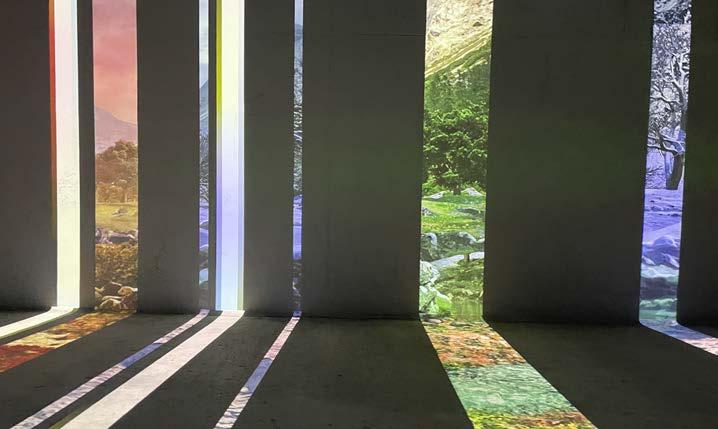
“A new mineral gallery and a light show showcase the Aiguille Rouge’s geology.”
General manager, Yann Margetyal explained over Apres ski drinks that they removed minibars from rooms to cut unnecessary energy use, replacing them with a shared fridge in the lobby. “It saves power and lets guests store their food without waste,” he said.
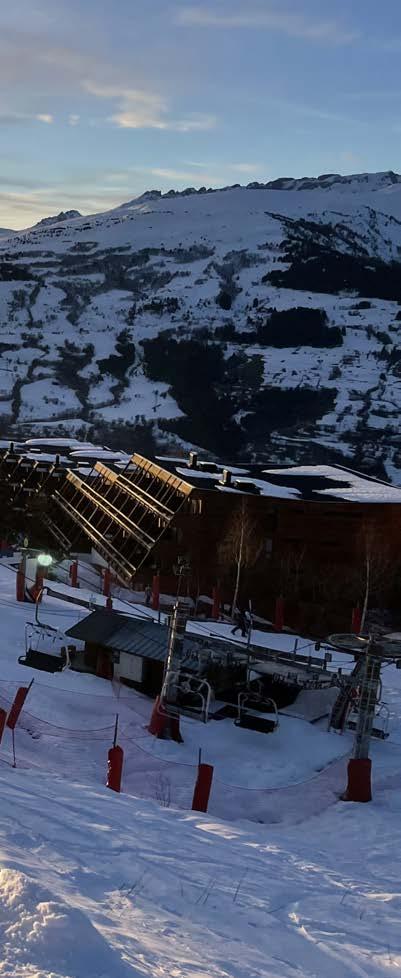
Les Arcs isn’t just progressive in its environmental strategy – it’s also one of the most architecturally significant ski resorts in the world.
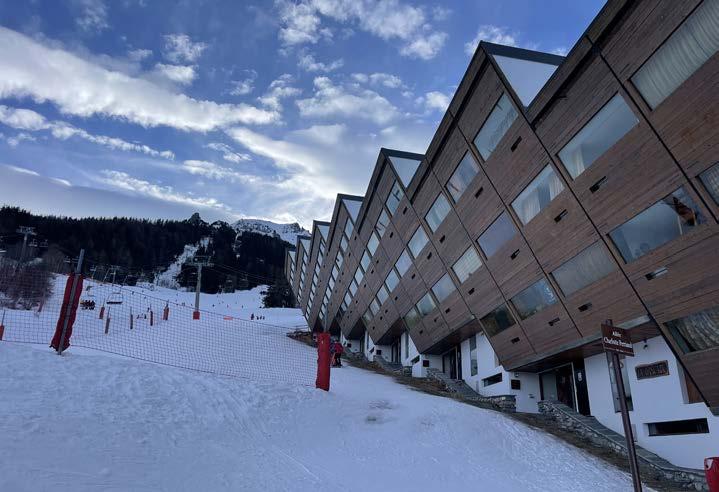
The resort was designed in the 1960s by a collective of visionary architects, including Charlotte Perriand, a trailblazing modernist who reshaped
ski resort design. At Arc 1600 and Arc 1800 she introduced prefabricated buildings, designed apartments to maximise sunlight, and even incorporated open-plan kitchens long before they became mainstream.
“She tilted the buildings at 30 degrees to ensure every balcony got sun,” explained our architecture guide, Jean-Marie Chevronnt. “That kind of thinking was revolutionary at the time.”
Skiing past these structures, I noticed how seamlessly they blended into the mountains. Unlike the
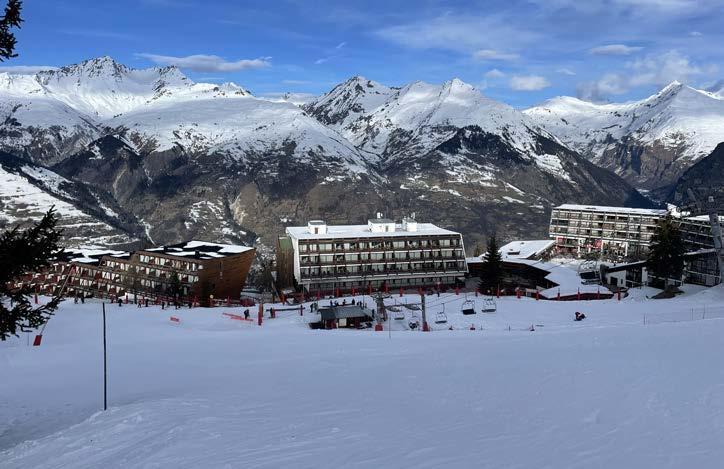
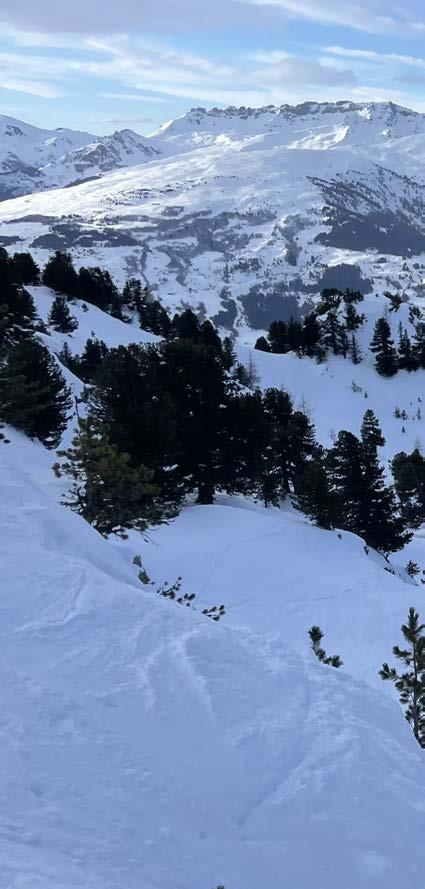
faux-Alpine chalets of many modern resorts, Les Arcs’ buildings were designed to work with the landscape, not against it. The original architects even planted trees at higher altitudes to reforest pastures, a practice that continues today as part of the resort’s sustainability efforts.
Over the past decade, Les Arcs has been evolving from a traditional ski resort into a year-round mountain destination. Climate change is forcing many ski areas to rethink their reliance on winter tourism, and Les Arcs is ahead of the curve. The resort’s summer revenue has grown from €300,000 to €1.7 million in ten years, thanks to activities like hiking, cycling, and educational nature trails.
One initiative that took place in March was the “Agir pour les Glaciers” festival, which raised awareness about the Varet Glacier, expected to disappear within a decade. The event tied in with 2025 being declared the International Year of the Glacier, with the 21 March becoming World Glacier Day.
A new mineral gallery and a light

show at the Varet gondola showcase the Aiguille Rouge’s geology, while educational trails and information panels highlight the impact of climate change on the mountain. Meanwhile, conservationists are working to protect the fragile ecosystems emerging as the ice retreats.
By my final day of skiing, as I carved
down the last run, I’d realised that Les Arcs offers more than just great skiing; it’s a resort that’s actively shaping the future of sustainable tourism. From pioneering eco-friendly technology to preserving biodiversity, it’s proving that ski resorts can adapt to a changing world without sacrificing the thrill of the sport.
“it’s proving ski resorts can adapt to a changing world without sacrificing the thrill of the sport.”
TRAVEL FACTS
For more information about Les Arcs, visit lesarcs.com
BOOKING
Inghams offer 7 nights half board at La Cachette, Les Arcs. Departing 4 April 2026 from London St Pancras from £1,839 per person. Based on 2 adults sharing. All trains and transfers included. inghams.co.uk
one Scot’s vision led to creation of renowned resort
MARK
NICHOLLS
visits Meribel and skis with David Lindsay, son of the founder of the famous French resort
If you ski down the Piste de Rhodos, you may easily miss a discreet rock plinth at the side of the slope. At the height of the season it could well be covered in snow but there it sits, a memorial to the early days of Meribel and a Scot who laid the foundations of a resort in Les 3 Vallees which remains hugely popular with UK skiers.
The engraving honours Peter Lindsay, an army officer who fought in the latter months of WWI as a teenager and then with the Irish
Guards in WWII. Between the wars, he discovered Meribel and then returned to France under more peaceful circumstances to develop the resort into the ski terrain we see today, sitting at the heart of Les 3 Vallees, the world’s largest ski area with its famous neighbours of Courchevel, Val Thorens and Les Menuires.
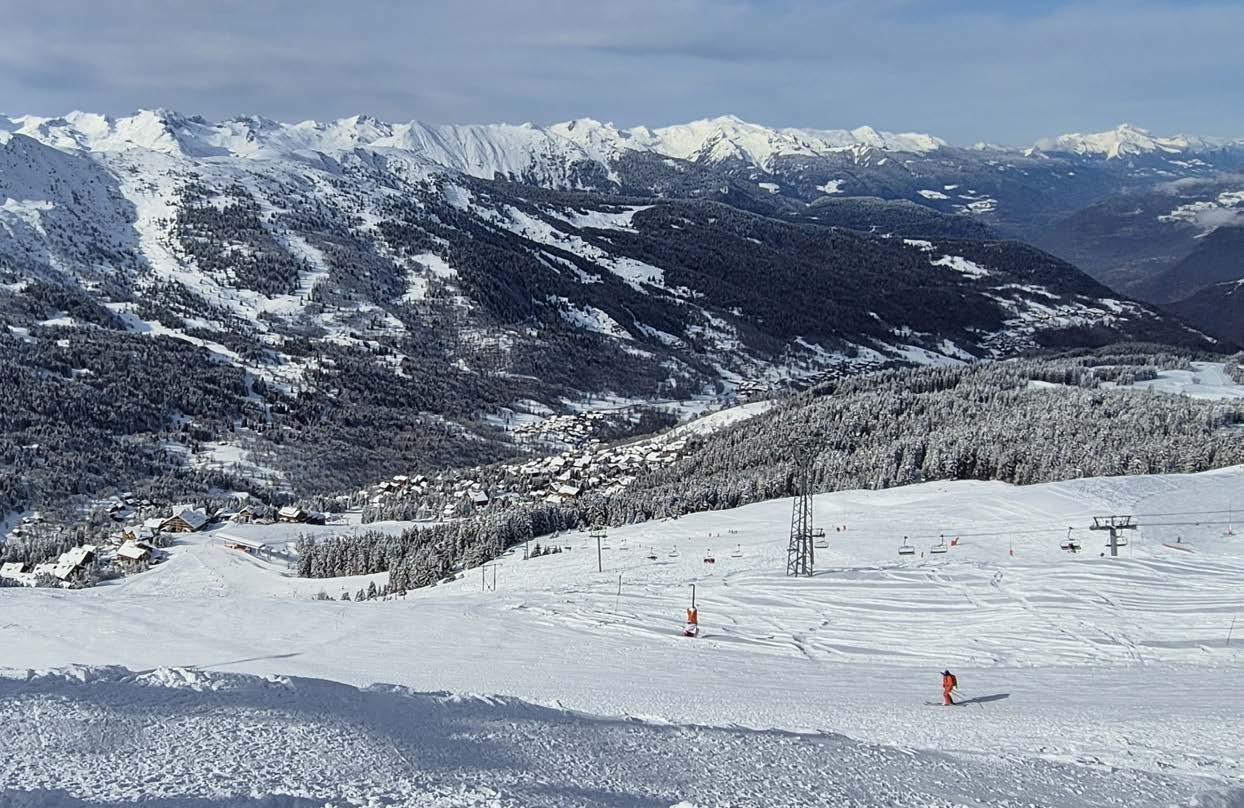
His son, David, now 68, retains an umbilical link with the resort and on a snowy morning in late January last year acted as my guide around the slopes, pointing out landmarks and favourite runs.
“The legacy of my father is well anchored in the history of Meribel,” David tells me, as we pause for coffee. He worked as a ski instructor for 14 seasons in Meribel before qualifying as an accountant and pursuing a career in finance, but retains a life-long link with the
“The legacy of my father is well anchored in the history of Meribel.”
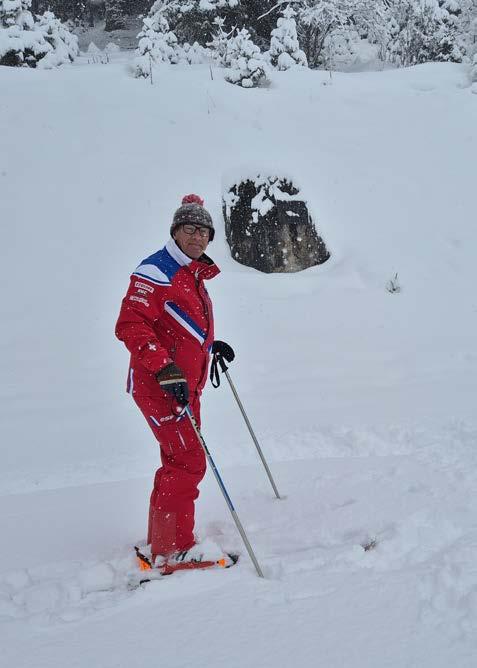
resort, keeping the Lindsay family connection alive.
He now returns every winter for eight weeks’ ski teaching via the ESF and while he concedes his financial involvement in the resort is now limited, he adds: “There is still a very strong connection emotionally from a family perspective. The Lindsay name is still very well known in Meribel.”
That connection, which is well documented, unravelled as we skied various runs, taking in one his favourites on Dent du Burgin.
“I remember skiing that as a boy,
“There are so many good runs here to enjoy.”
and it is also where my father’s ashes were scattered,” he says.
Peter Lindsay (1900-1971) was born into the Lindsay clan, educated at Eton and when he was 18 fought in WWI. A keen skier, he travelled to Meribel and purchased much of the land that is now Meribel town, but his plans for a resort were curtailed with the outbreak of WWII, when he enlisted in the Irish Guards. Returning to Meribel in 1946, with the rank of Colonel, he worked to develop the resort until his death in 1971.
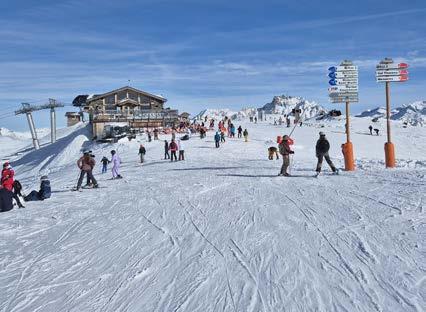
As we continue along the red of Mauduit (named after French Olympic skier Georges Mauduit), David explains: “There are so many good runs here to enjoy. Meribel and Les 3 Vallees very much see themselves as a family resort but it is an area that suits all levels and with an infinite amount of off-piste skiing.
David Lindsay and the memorial to his father Peter on Piste de Rhodos
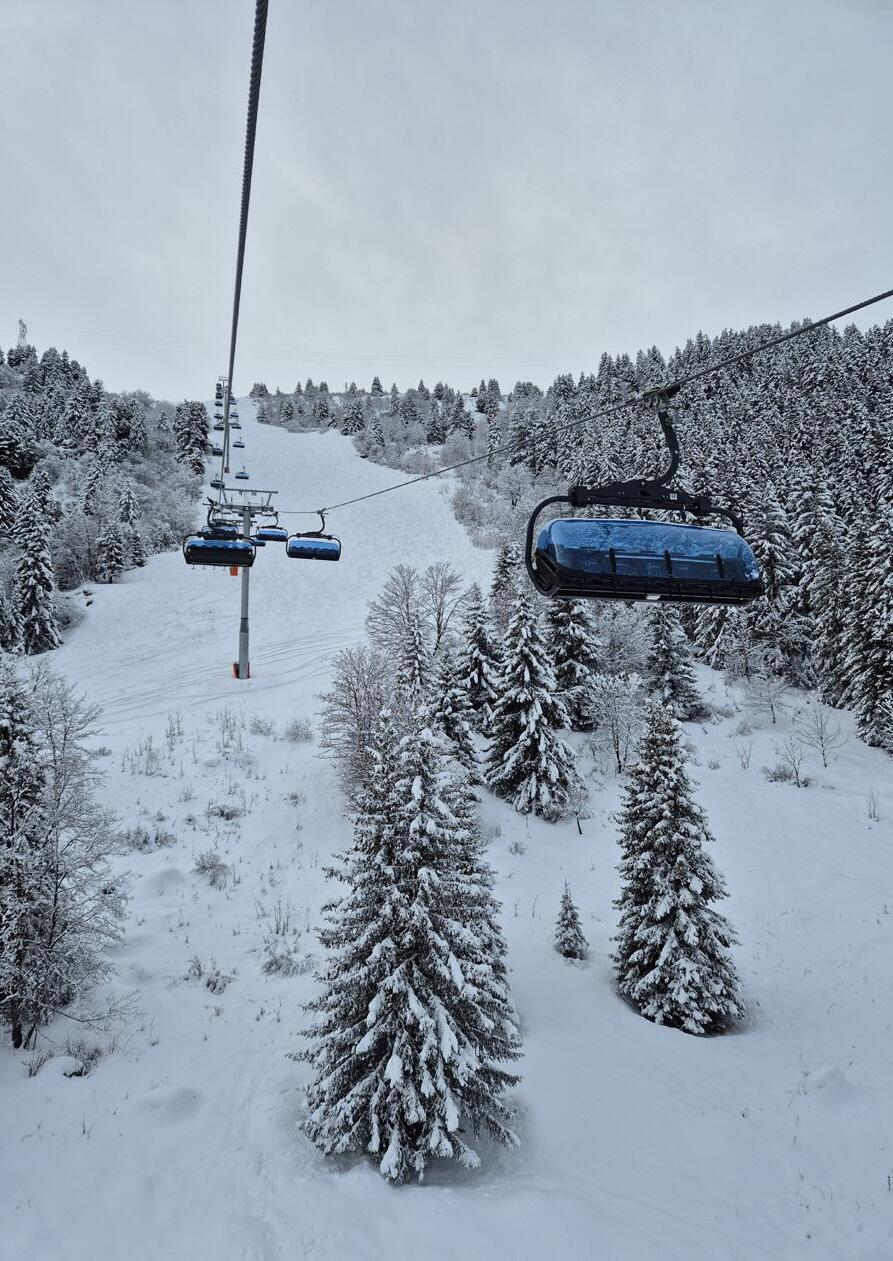
“The single biggest appeal of Meribel is that the skiing is outstanding; with great runs and lift systems, this is world-class skiing at the biggest ski area in the world.”
Meribel – with the three villages of Meribel Centre, Meribel Village and Meribel Mottaret – is at the heart of Les 3 Vallees with an extensive and diverse terrain, reaching from the heights of Val Thorens, to the glitz of Courchevel and the homeliness of Les Menuires, all accessible via an extensive lift system.
The 1992 Winter Olympics came to the region and Meribel hosted
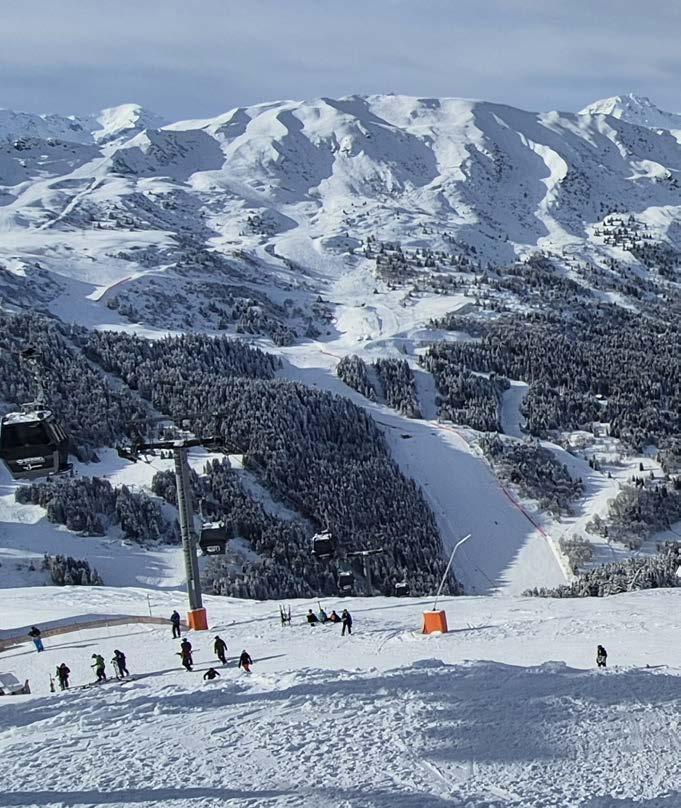
“The biggest appeal of Meribel is that the skiing is outstanding; with great runs & lift systems.”
the women’s downhill and ice hockey and aims to be a venue for the 2030 games.
Meribel remains popular with the Brits. With the five star hotels of Le Coucou ( lecoucoumeribel.com ) and Le Kaila ( lekaila.com/fr/hotel-luxemeribel-savoie ) in Meribel Centre and lovely chalets, Mottaret has a different ambience with ski-in-ski-
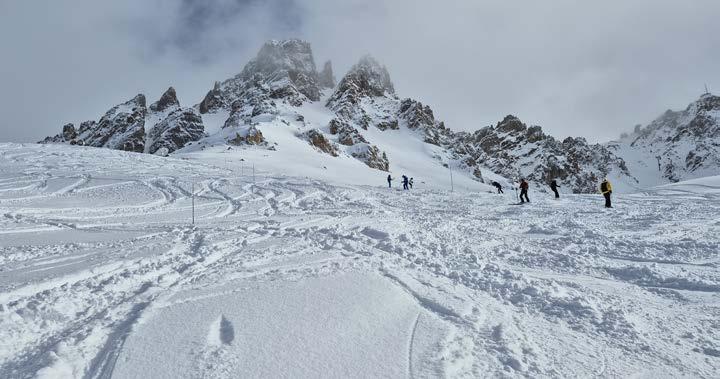
out access for a season that runs from early December to April.
I stayed at the three-star Hotel Le Mottaret ( hotellemottaret.com/en ) with its comfortable rooms, friendly bar (where a bottle of local wine is €25) and restaurant and spa, indoor pool and sauna. There’s also an outdoor hot-tub to relax in at the end of a ski day.
Eating is a delight in and around Meribel and the range is vast – from the meaty feasts of Le Clos Bernard ( closbernard.com/en ) in the woods, to the rustic comfort of La Brizolee in Mottaret (cheeseburger is €25, pork ribs €29 and a bowl of onion soup is €15), or the dining spectacle of La Folie Douce ( lafoliedouce.com/ fr/meribel-courchevel ) where lunch goes on for most of the afternoon with cabaret as you eat. Restaurants at Le Kaila or Le Coucou (which has a fabulous menu) are open to nonresidents where I thoroughly enjoyed
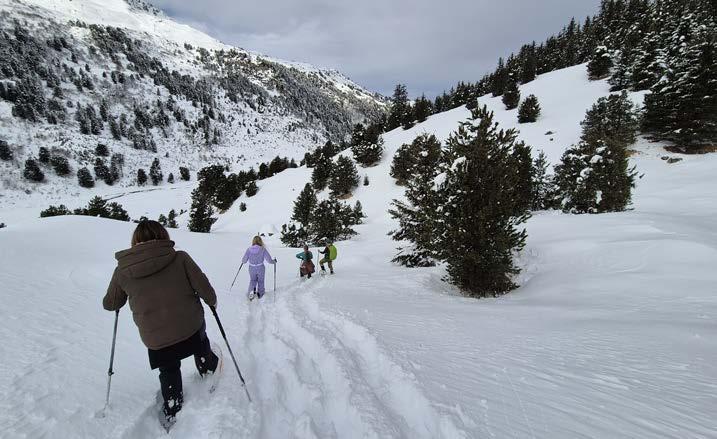
the grilled Sole with meuniere sauce, but it’ll set you back €89. There’s much more to do in Meribel beside skiing. For a little escapism, take a snow-shoe hike above Lake Tueda through trees and kneedeep snow with guide Laurent Vincourt from Raquette Evasion ( raquettevasion.com ). The route climbs for 150m and follows paths before veering into deep fresh snow, descending and walking further beside the frozen lake, finishing with lunch of a delicious Beaufort
pie with leeks at La Buvette du Lac ( meribel.net/en/apidae/tuedas-bar ). There’s also cross country ski and winter hiking, and a whole gamut of festivals such as the hilarious Franglish Comedy Festival which sees English and French comics, such as Mark Steel and Tatty McCleod, entertain.
With so much to offer, however, it’s also worth pausing to ‘doff’ your ski helmet to Peter Lindsay, one of the founding fathers who helped make Meribel what it is today.
TRAVEL FACTS
Transport & Accommodation
Mark Nicholls flew from London Gatwick to Geneva with easyJet, with a two-hour transfer to Meribel and stayed at Hotel Le Mottaret hotellemottaret.com/en
Ski pass
An adult seven day pass is €472, and a one-day pass costs €81.80.
For more information
Visit meribel.net/en
VIP Ski team up with Chemmy Alcott
Guests are invited to an exclusive experience in partnership with Chemmy Alcott, offering rare opportunity to ski and train alongside a true Olympic athlete in Arc 1950.
One of the UK’s most successful downhill ski racers, Chemmy Alcott competed in four Winter Olympic Games and claimed the British Championship title seven times. Since retiring from international competition in 2014, she has become a leading figure in snow sports broadcasting and is now in her fifth year as colead presenter of BBC’s Ski Sunday, with highlights including the World Ski Championships in Saalbach in February 2025.
A seven-night stay at Bear Lodge from 12 April 2026 costs from £1,299pp, based on two sharing, including return group transfers from Geneva Airport, seven-night accommodation at Bear Lodge, daily breakfast and afternoon tea, welcome drinks reception, three-course evening meals on six nights, an exclusive presentation with Chemmy Alcott, the opportunity to ski with Chemmy Alcott, optional yoga and fitness classes hosted by Chemmy and an end of week celebration with prizes. Flights extra. vip-chalets.com/chemmy-alcott
Under-5s stay free
Skiing with small children just got easier, and more affordable. For the rest of the winter season, under-fives stay free in selected AliKats catered family chalets in Morzine, helping to ease both the cost and logistics of a first ski holiday with little ones.
Designed with families firmly in mind, AliKats’ catered chalets blend familyfriendly skiing with cosy off-slope comforts, including relaxed mealtimes, child-friendly menus and welcoming communal spaces, ideal for warming up and winding down after snowy adventures. alikats.eu
premier ski festival
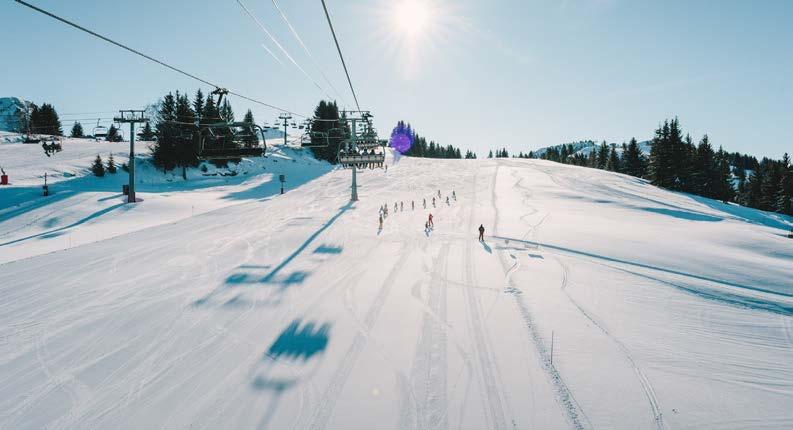
SkiWeekends, the specialist short break and flexible ski tour operator, has re-scheduled its normal programme for one week in March to allow guests the chance to book the new Premier Ski Festival in Les Gets –an event dedicated purely for first-time skiers and snowboarders.
From 21 to 28 March, Les Gets will host an all-inclusive week with lessons and activities, all in a festival atmosphere. The destination is one of the most accessible ski resorts from
Save the date for 28 and 29 March as Volcom Spot to Spot returns to Avoriaz for its explosive 6th edition, bringing two days of all-terrain challenges, good vibes, riding and partying to one of the resort’s most iconic playgrounds.
Open to everyone, the event features modules and challenges spread across Avoriaz’s terrain and welcomes men, women, kids aged 15 and under, amateurs and professionals alike, whether they are riding or simply enjoying the show.
With €8,000 in prize money up for grabs for the pros and plenty of prizes from Volcom, Capita, Union Bindings and Sunbum for top amateurs, the event also rewards all participants with free BBQ and refreshments, ensuring everyone is a winner.
Geneva Airport with a reputation for some of the best beginners’ slopes in the French Alps.
The new festival has responded to a growing number of beginners looking for a shared experience on the slopes with newcomers to the sport. Participants will enjoy ski and snowboard lessons, discover a range of mountain activities and immerse themselves in a relaxed festival atmosphere, all set in the scenic alpine village of Les Gets.
For couples or groups with mixed ability levels, the festival offers a solution: beginners can join lessons and activities while more experienced skiers enjoy the mountain independently, regrouping later for après-ski drinks and evening dinners. Solo first-time skiers will get the chance to meet others that are
The full programme, including spots, challenges and live bands at the legendary Après, will be revealed closer to the event, so stay tuned. Registration opens on 2 March and while entry is free, places are limited.
A four night stay at Maeva Home
Le Cedrat, arriving 27 March 2026 is priced from £484 total based on four sharing a studio apartment on a self-catered basis, flights and transfers extra.
avoriaz.com
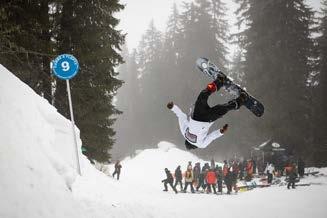
PHOTO: © @ Sophie Rodriguez
starting their skiing journey.
The SkiWeekends accommodation is centred around Chalet Marjorie, offering a 7 or 8 night stay that includes chalet-board accommodation (cooked breakfast, afternoon tea, 3 course evening meals with wine), steam room and a heated outdoor hot tub. Packages start from £1,141pp for 7 nights with return shared Geneva Airport transfers. The all-inclusive festival pack, priced at €399pp, covers lift passes, equipment hire, lessons,
entertainment and additional mountain activities, making it a straightforward, stress-free option for new skiers.
Highlighting the festival’s appeal, SkiWeekends has adapted its usual booking schedule for this event, allowing guests to reserve stays from Saturday to Saturday – a departure from its standard configuration –giving participants a full week to enjoy the festival in a fully-catered chalet. Visit lesgets.com/en/1er-skifestival-en & skiweekends.com
Glisse en coeur event returns
With 16 events under its belt, Glisse en Coeur – which will this year take place on 21-23 March in Le Grand-Bornand – has made its mark as the French mountain’s biggest charity event, raising over five million Euros for 31 children’s and public interest charities. Its success is based on a concept uniting solidarity and non-stop relay skiing in teams for 24 hours from 2pm on Saturday to 2pm on Sunday, in a buzzing atmosphere with live music.
Teams have to race down the namesake piste and participants ski the equivalent of a round-the-world trip over the course of one weekend. One of the charities this year’s event is supporting is Ma Chance Moi Aussi, a charity supporting deprived children from families with learning difficulties. legrandbornand.com/quoi-faire/ evenements-et-animation/ temps-forts/glisse-en-coeur
Ski with henry druce in Val d’Isere
Following the success of its inaugural early-season trip, VIP SKI has confirmed that renowned ski journalist Henry Druce will return to Val d’Isère in December 2026, with bookings now open.
For more than 20 years, Druce served as ski editor for the Daily Mail and The Telegraph, hosting reader trips across Europe, North America and Japan. Known for his deep mountain knowledge and sociable hosting style, his guided weeks combine great skiing with lively après-ski camaraderie.
Guests will enjoy four days of complimentary on-piste guiding with Oxygène Ski School, with the option to book discounted off-piste adventures. The week also includes organised après-ski outings, a charity auction, quiz night and an end-of-week prizegiving celebration.

Accommodation is at No. 3 CLUB Bellevarde, VIP SKI’s largest chalet in Val d’Isère. Sleeping up to 24 guests across 12 en suite bedrooms, the ski-
in/ski-out property sits on the edge of the Santons piste with direct access to the Olympic lift area. Facilities include a spacious open-plan living area with open fire, sun terrace with two hot tubs, indoor pool and spa complex, plus VIP SKI’s elevated CLUB chalet service with canapé receptions and flexible dining.
A seven-night stay at No. 3 CLUB Bellevarde from 29 November 2026 costs £999pp, based on two sharing, including return group transfers from Geneva Airport, seven-night accommodation at No. 3 CLUB Bellevarde, welcome drinks reception, six-day lift pass, four-day ski guiding, a charity quiz night and fundraising auction for Snow Camp, and an end of week celebration with prizes. Flights extra. vip-chalets.com
Could relaxing in front of a cosy fire in your ski chalet be under threat?
FRANK ‘SCOOP’ BALDWIN looks at how new laws and existing regulation are making the use of open fireplaces a hot topic this season
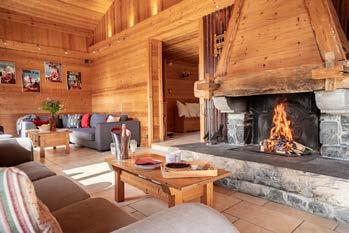
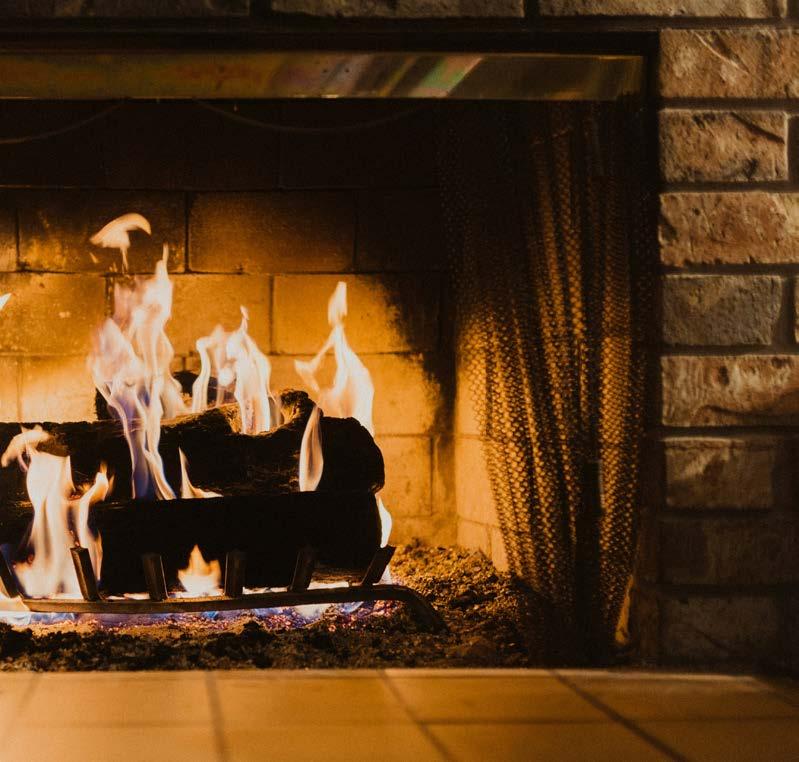
There is something very appealing about relaxing over a drink with friends, or having a romantic evening with your partner, in front of a roaring log fire in your ski chalet after a day on the slopes. However, this scene could be under threat in France because of new laws and existing legislation.
In the past few years, a growing number of French regions –particularly Alpine valleys where cold air traps pollution – have introduced restrictions on open fireplaces and older wood-burning stoves. The reason? It is the fight back against particulates – fine pollution that hangs in the winter air, aggravating lungs, hearts and tempers. Wood smoke, say the experts, is less ‘rustic Alpine charm’ and more ‘microscopic menace’.
For ski chalets, this presents a dilemma. The open fireplace, long cherished for its combination of warmth and mesmerising flames that create a homely atmosphere, is increasingly viewed by authorities as an environmental faux pas.
In some areas, these fireplaces are now officially relegated to the status of ‘decorative object’. The message is you may still be able to enjoy the flames created by an open fire for a certain
amount of time, but it cannot be the main source of heating.
Older closed wood burners fare only slightly better. Those installed before modern efficiency standards are being phased out in some communes, their smoky innocence no longer tolerated. The law does not care that the stove has warmed generations of skiers and snowboarders. If it emits too many particles, it must go.
This is where the seriousness creeps in. Alpine valleys suffer some of France’s worst winter air quality. When everyone lights their fire – chalets, apartments, hotels – the smoke being emitted has nowhere to go. What feels cosy indoors becomes a health problem outdoors. For residents who live there year-round, not just during ski season, cleaner air is not an abstract concept but a daily necessity. However, the emotional impact on the ski chalet should not be underestimated. Estate agents and ski chalet companies have long used the phrase ‘open fireplace’ as a positive attraction. Guests expect it. Rental listings photographs often feature a roaring fire to summon up the cosy atmosphere of ski accommodation. Remove it, and one risks awkward conversations along the lines of: “Yes, the fire is there, but no, you mustn’t
“This is a topic that’s certainly creating some discussion in the Alps this season.”
actually use it in the way fire was traditionally used.”
The good news – because there is some – is that this is not a war on wood itself. Modern, high-performance stoves that meet current environmental standards are still widely permitted, even encouraged. These appliances, while producing heat, burn cleaner, hotter and more efficiently.
They are, however, less theatrical than an open fire. You cannot gaze into them while swirling a glass of wine unless you enjoy staring at sealed glass.
For chalet owners, adaptation is now part of the Alpine experience. Some will upgrade to compliant stoves.
Others will pivot to alternative heating and keep the fireplace as a purely aesthetic relic – an altar to winters past. A few will grumble loudly while secretly acknowledging that breathing is, on balance, preferable.
Laura Hazell, from the ski chalet specialist Ski Beat, said: “Working with our Alpine neighbours and ski resort authorities to co-exist in harmony and minimise our, and our guests’, impact on the environment, has long been a priority for Ski Beat.
“We continue to achieve that balance by embracing energy conservation, employing responsible waste
“A few will grumble loudly while secretly acknowledging that breathing is, on balance, preferable.”
management initiatives and using more sustainable methods of heating to ensure Ski Beat’s chalets are always warm and cosy.
“Log fires are not a primary source of heating for Ski Beat, they are used for short periods of time, usually at the start of the holiday, to enhance the Alpine experience for guests. It would be a shame to lose the log burners totally, they add atmosphere and tradition, but, managing them responsibly is already minimising impact.”
Ceri Tinley, Managing Director of Consensio, the luxury ski chalet company, said: “This is a topic that’s certainly creating some discussion in the Alps this season.
“From our perspective at Consensio, while it’s true that open fireplaces have long been part of the classic chalet experience, we only have a couple where these are still in place. The majority are now closed with glass surrounds or fire stoves. The industry has always evolved with changing regulations, environmental expectations and chalet design.
“Although it’s a shame to see traditional open fires becoming more restricted, our focus is always on maintaining the sense of comfort and ambient luxury that people associate with a chalet holiday. This can be achieved by other means by our teams.
“Ultimately, the charm of a ski chalet goes far beyond the type of fireplace it has, and we’ll continue to ensure our guests enjoy the same inviting, relaxing environment after a day on the slopes.”
France’s fireplace rules are unlikely to extinguish the ski chalet’s soul. They will, however, change its cosy soundtrack – fewer crackles, more quiet efficiency.
The mountains will still be majestic, and skiers and snowboarders will still gather with a beer, a glass of wine or a vin chaud after a day on the slopes to share on and off-piste experiences and to complain about their aching legs.
However, in the future it is more likely they will be doing this in front of a fire that has been carefully approved by the local prefecture.
Completely la masse is back
The 4th edition of Completely La Masse is taking place on 21 March, where competitors of all disciplines will take to the slopes from La Pointe de la Masse (2,804 metres) in Les Menuires for a descent of more than 5km, encountering all sorts of obstacles and surprise entertainment along the way.
Choose from two courses: The ‘Barjo’ run: for the daring, a solo descent (entries – born in 2011 or earlier) or The ‘Mollo’ run: a more gentle descent in teams of three (entries – born in 2017 or earlier).
The village of La Croisette will burst into life in the morning as competitors and spectators flock to the foot of the slopes in Les Menuires with crazy costumes, pop up food stalls and a prize giving ceremony to award 6,000 euros prize money; holidays to Les Menuires, winter sports equipment plus awards for the best costume and lots of giveaways. lesmenuires.com/en/madnessmasse
Backcountry event in Megeve
From the 20 to 22 March, Back to Back Invitational, Megève’s premier backcountry event, combining sport, music and culture, is returning for its sixth edition. This free festival is an inclusive festival for everyone, from riders to spectators.
Expect to see elite athletes showcasing their skills in a medley of mogul, speed riding, ski base jumping and backcountry skiing events. This festival invites everyone to enjoy live coverage at the pedestrian-friendly Côte 2000, and dance to the live music at Palais concert hall in the evenings.
A three night stay at Coeur de Megève, arriving 20 March 2026 is priced from £578pp based on two sharing a double room with breakfast included. Flights and transfers extra. megeve-tourisme.fr/en
Photo by Hayden Scott on Unsplash
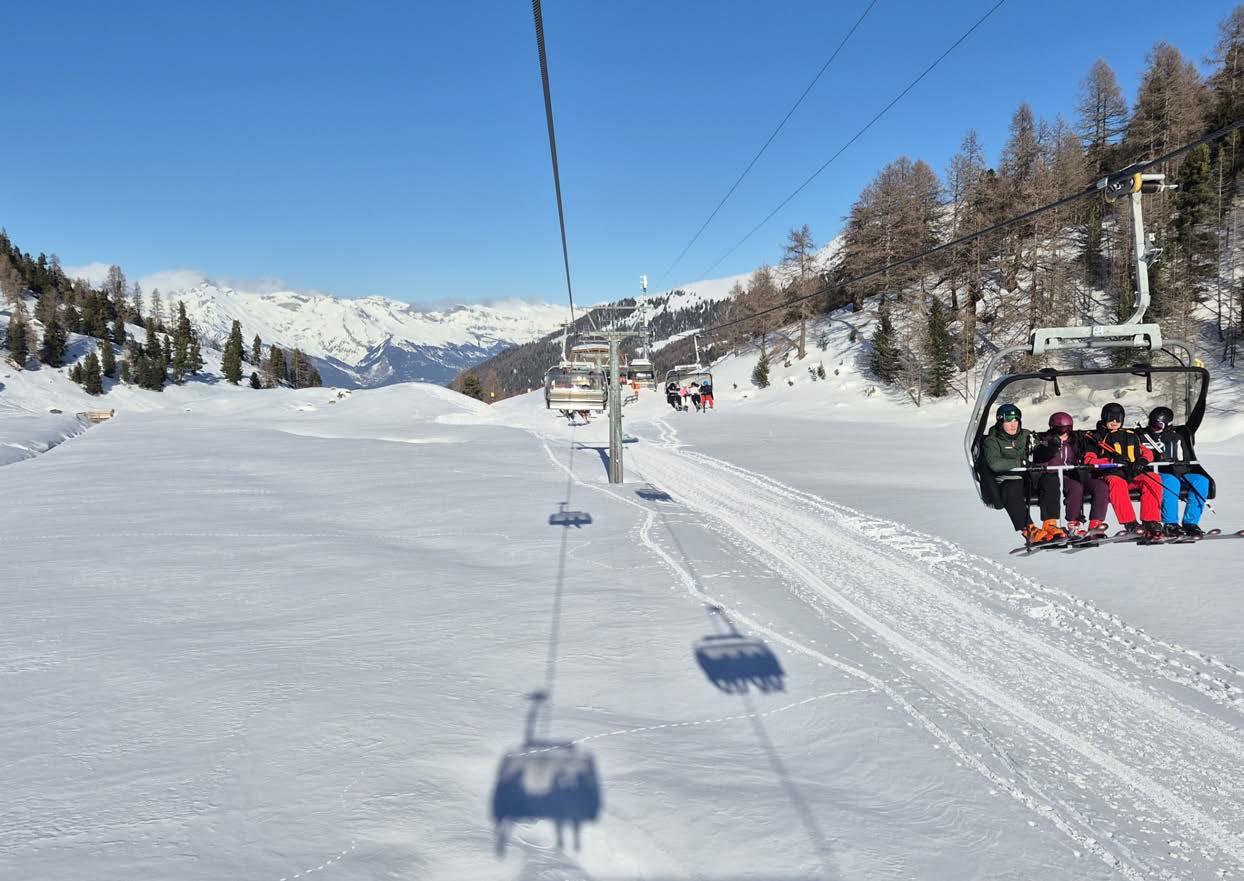
diverse terrain & unique experiences
MARK NICHOLLS takes to the slopes in Nendaz at the ‘more affordable’ end of the 4 Vallees in Switzerland
Unravel the ski map for the slopes above the Swiss resort of Nendaz and you will discover a wide snow-sure arena of challenging pistes.
More than half of the runs ‘glow’ deep red, matching the aura the setting sun creates on the surrounding peaks.
Sitting in the 4 Vallees ski area of 410km of slopes, with 53% of them designated red runs, the terrain is one of the appeals of Nendaz.
But as ski instructor Paul Bourban is quick to add: “Alongside those
many red runs, there are also areas for family skiing as well as black runs and off-piste. Plus, it is a huge ski area, and one that is never as busy as Verbier.”
The nod to its glitzier neighbour is also a veiled way of highlighting that Nendaz – which incorporates Veysonnaz and Thyon – is also more affordable.
Bourban points to an extensive and uncrowded terrain full of surprises and altitude, with several of the surrounding peaks (Grand Combin, Rosablanche, La Ruinette and Mont-
Fort) in the 3300m-4300m range.
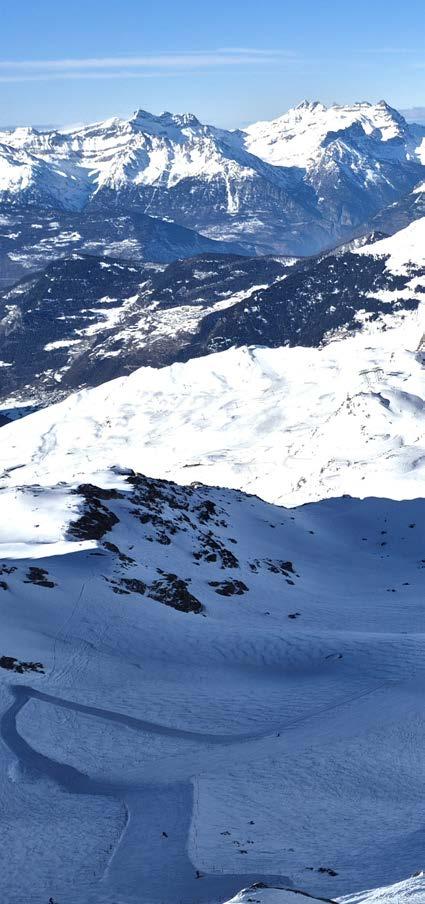
“Go up to the height of Mont-Fort for wonderful panoramas,” he advises.
This is the thrilling end of the resort where the season lasts from November until April.
Once you leave Siviez, a busy interchange of gondolas and chairlifts, you reach Tortin, the gateway to Mont-Fort at 3330m above sea level, with the cable car from Col des Gentianes (2894m) bridging the final stretch to the summit.
From here, it’s a case of skiing down
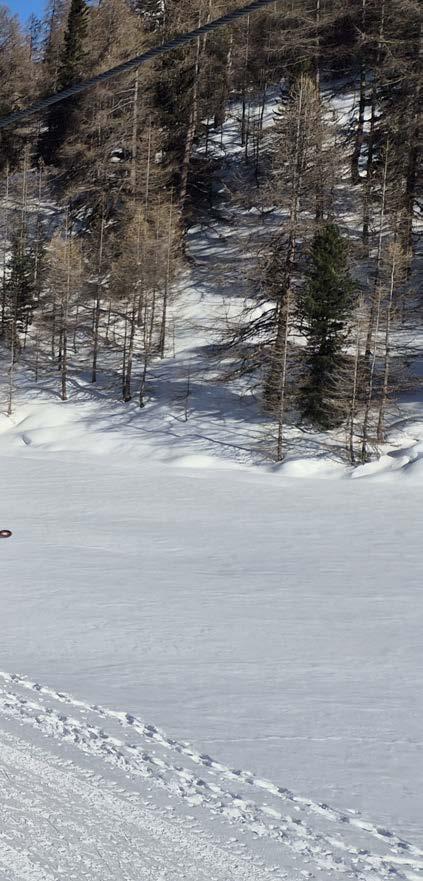
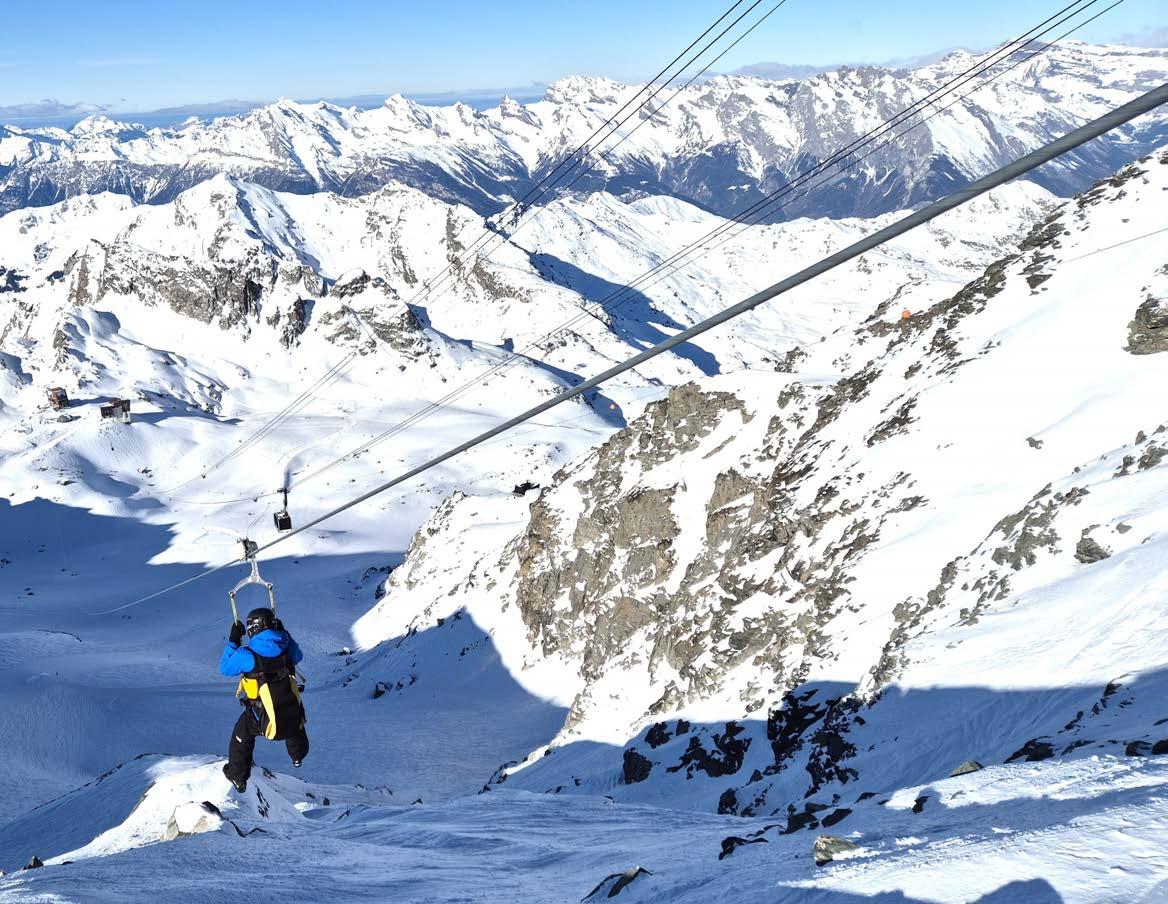
through challenging blacks and the mogul field on some of the steepest terrain in the Alps – or take the ‘quick’ route on the fabulous zip wire. I opted for the zip line. Strapped into a harness with an uninterrupted view of the valley and the Tortin Glacier below, I soon reached speeds of 100 kilometres per hour across the 1.4km to Les Gentianes and an altitude difference of 383m.
While there are new lifts, including the Prarion-Tracouet eight-seater, you’ll also come across more traditional modes of mountain ascent.
Expect button lifts and T-bars as you head across the slopes, but don’t let that put you off because the gamut of reds, blues and blacks offer exhilarating descents for all ages. For me, the appeal of Nendaz is this diversity of terrain. There’s always a black to step up to from reds for an adrenaline hit, or a blue to ease up a little.
And they’re spread over a large area around Siviez (1730m) to
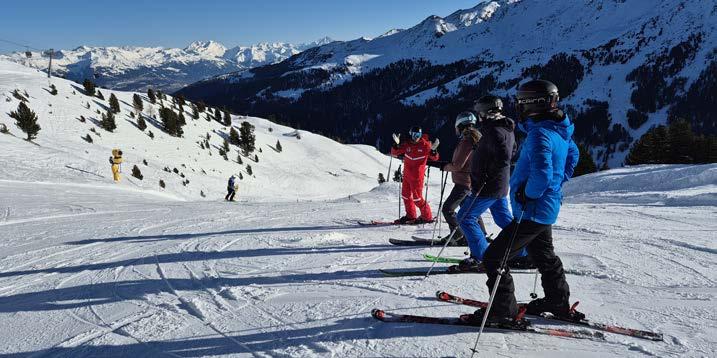
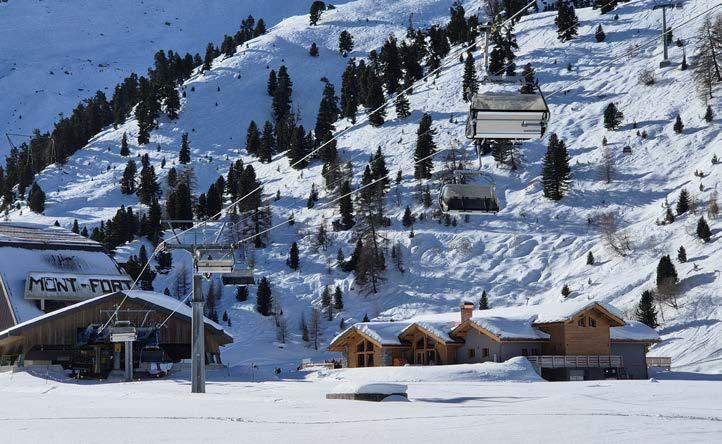
Combatseline (2238m) or Tracouet (2200m) with plenty of mountain huts, such as the cosy Bob’s Bar, to stop off for an ‘apres’ on the final run into Haute-Nendaz.
Mid-January conditions were perfect with blue skies, bright sunshine and uncrowded pistes. An additional appeal is the array of non-ski activities from tubing, snow touring, snow-shoe walks or winter hiking.
My day away from skiing was to take a winter walk with a difference via the Rando’Miam concept; a prebooked self-guided tour that stops at
“For me, the appeal of Nendaz is this diversity of terrain.”
different mountainside eateries for a starter, main and dessert to add a gourmet dimension to hiking.
Rando’Miam (from CHF45) is among 100km of marked hiking routes that meander alongside ski slopes, dive into the forest or follow a bisse, the historic waterways dug between the early 15th and late 19th centuries that irrigate this dryish area of Switzerland. There are snow shoe routes too.
Our route from Siviez rose a manageable 300m and covered about five miles in total there and back.
First stop was La Tetine, a rustic hut alongside a blue slope where we sat outside to enjoy our starter: a platter of cheese and meat, or thick pumpkin soup and coffee and then onto the longest stretch up to Le Hameau de Tortin at 2050m near the Mont-Fort cable car for a main course.
Le Hameau de Tortin restaurant at the foot of Mont-Fort Cable Car
“Mid-January conditions were perfect with blue skies, bright sunshine & uncrowded pistes.”
The choice included spaghetti bolognese, fish and chips, soups and grilled chicken with vegetables and chips served buffet style.
The third and final leg saw us retrace our path toward Siviez for waffles at Bar Le Tipi, an atmospheric mountain hut centred around an Indian tipi and chuck waggon.
There’s an array of accommodation across the Nendaz area but a stay with a difference is offered at the MAD Retreat.
Set outside the main lift hub, yoga, meditation and breathing therapies are prime attractions, with a spa, steam room and pool, in mini chaletstyle accommodation and vegetarian cuisine on the menu.
Here, you’re likely to tuck into beetroot cream soup with winter veg, stuffed zucchini and Jerusalem artichoke, daal and mini naans; or wild rice and romanesco cabbage. Breakfast is bread, eggs, cheese, nuts, fruit, juices and cereals.
The chalets are based on mazots, the small farmhouses traditionally
used by alpine farmers with cattle tethered on a lower floor and family accommodation above.
Skiing is still an option, but Wellness Manager Nino Briot emphasises that most guests arrive for relaxation, rejuvenation and to participate in classes.
“We have a passion about putting an ecological tone to the hotel,” she adds, “and that is seen with the vegetarian food and the ingredients we use.”
It is a place to find ‘me’ time: take a yoga or meditation course, relax in the spa, go for a solitary walk in woodlands and spend time indulging your senses.
“The idea is to create a luxury environment with a relaxing ambience,” says Nina. “We find that people understand and adore what we are trying to do.
“Some people also come to ski and spa, but when guests stay for a week we see a massive transformation in them and they seem to leave very relaxed.”
TRAVEL FACTS
FLIGHTS/TRAIN
Mark Nicholls flew from London Heathrow to Geneva with Swiss International Airlines (swiss.com), got a train from Geneva Airport to Sion using the Swiss Travel Pass (myswitzerland.com) and then took the bus up to Nendaz in the canton of Valais.
ACCOMMODATION: MAD Retreat, starting from CHF299/£268pp a night including full board & courses (madretreat.ch).
Ski pass: A six-day adult ski pass for the 4 Vallees ski area (incl. Verbier) is CHF409.
Mont Fort Zip Line (nendaz.ch/montfort)
visit: nendaz.ch/en & visitvalais.ch
Rando’Miam: nendaz.ch/randomiamhiver
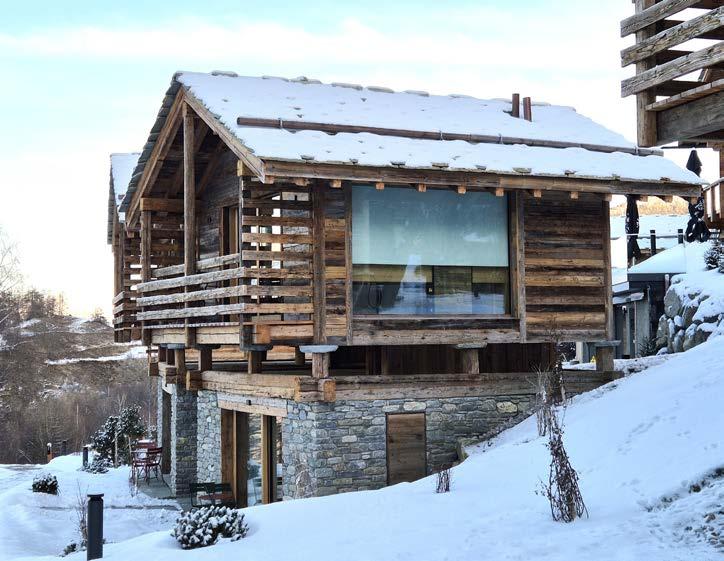
MAD Retreat chalet
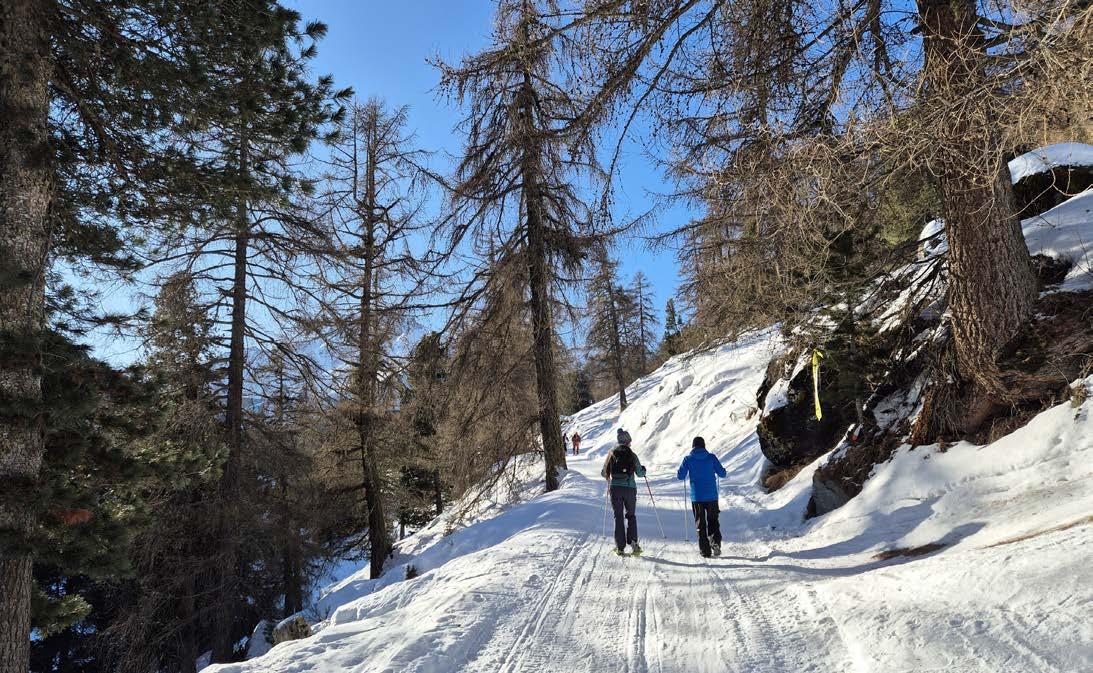
Hiking trail from Siviez
Spring skiing in Verbier comes with an added dose of spectacle this April, as the resort celebrates the end of the winter season with a lively programme of events on and off the slopes.
From 10–12 April the Verbier Air Show returns with aerial displays staged high above the resort, including at Les Attelas. Later in the month, Snow Glow (23-25 April, formerly Snow Pride) brings colour to the mountains, with drag performances, après-ski parties, on-mountain activities, talks and exhibitions creating an inclusive atmosphere across the resort.
The season draws to a close on 25 April 2026 with E.N.D. (Energy Never Dies), a free openair concert in Place Centrale, featuring French electronic favourites Ofenbach and Kavinsky, promising a high-energy finale to the winter in Verbier. verbier.ch

Looking to get away for a ski break in Switzerland? Mountains Beds have a stunning large five-bedroom, split-level chalet apartment in Verbier for 7-10 people which is perfect for either a group or families. They have limited dates available in March where you pay for 5 nights & get the 6th free or they have Easter week for £6500 total (not including flights). For more information, call Mountain Beds on 0044 1502 471960 or email info@mountainbeds.com to book.
Celebrate the end of season at the Ultime Session
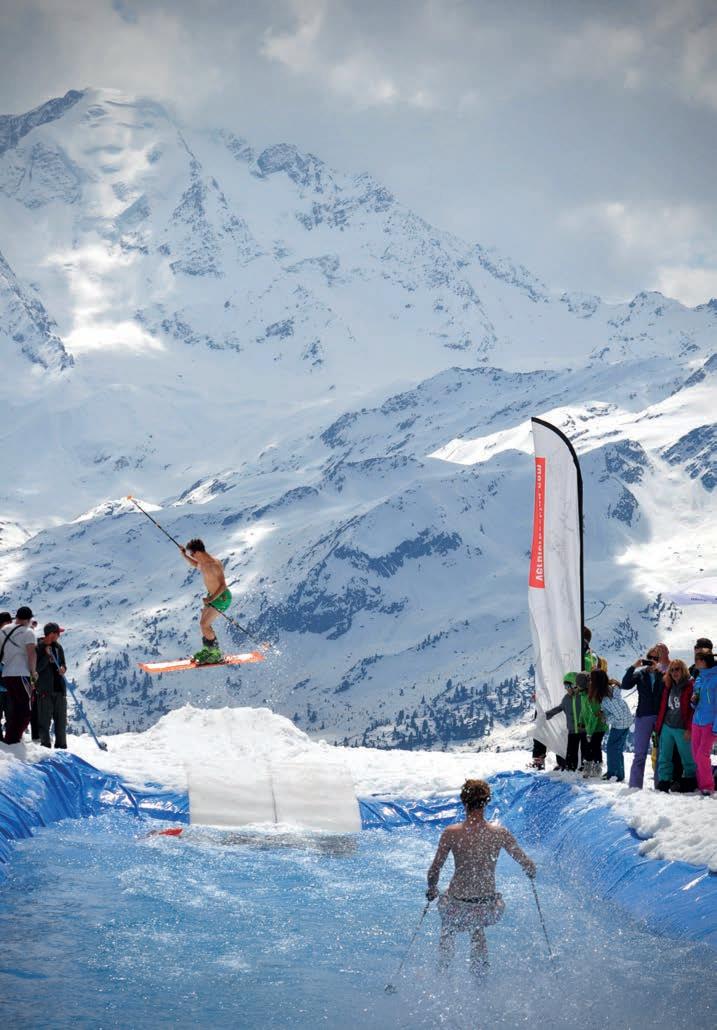
Verbier’s ski season will come to a close in style with the Ultime Session, an end-of-season tradition that this year extends over two days for the first time.
Taking place on 25 and 26 April, at the Snowpark de la Chaux, the Ultime Session brings together high-energy snow sports, live entertainment and a festival-style atmosphere on the mountain. The day features a packed programme of fun, including big air displays, a water slide contest, banked slalom, equipment testing and fancy-dress skiing, alongside food and drink stalls, DJs and live music throughout the day.
It’s a lively celebration that attracts skiers, boarders and spectators alike, all keen to squeeze the most out of the final days of the season.
Back down in resort, the celebrations continue with live music and entertainment in bars. An après-ski DJ set at the Médran Café provides the perfect place to keep the party going as the lifts close and the sun sets on another winter in Verbier.
A four-night stay at Shed Hotel arriving 23 April 2026 is priced at £1,474 total based on two sharing a classic double room with breakfast included. Flights and transfers extra. verbier.ch
PHOTO: © Verbier 4Vallées
Where Luxury Meets Altitude
SAM WILCOX discovers refined luxury and how to unwind and enjoy the Alps at a slower pace on a trip to Das Central in Sölden
At first glance, Sölden hums with energy, music spilling from bars, lifts gliding toward the glacier, it’s fast and adrenaline fuelled. But step through the doors of Das Central and everything changes. It’s calm, refined and effortlessly elegant, the kind of place that reminds you the Alps aren’t just for moving fast, but for slowing down.
Tucked quietly in the centre of Sölden, Das Central feels like a secret, five-star retreat. My husband, daughter and I stayed in a twobedroom suite, and it was a revelation: two generous double rooms, a spacious living area and a bathroom that felt more spa than standard. Where so many Alpine family rooms feel crammed, like an after thought, this didn’t. It was calm, newly renovated and genuinely comfortable for three people, with space to spare.
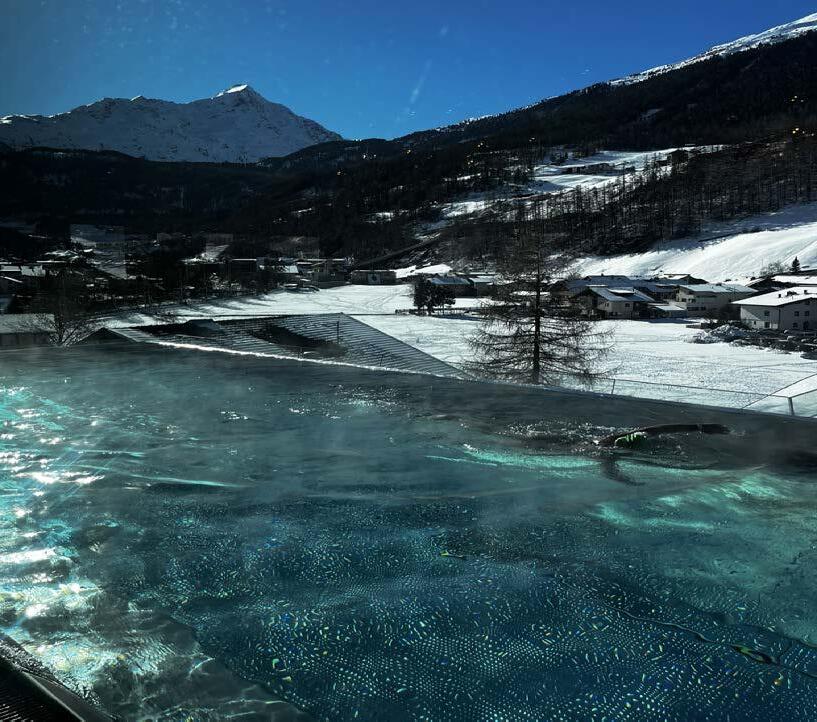
At the top of the Das Central, the Summit Spa steals the show. Spread across two floors and 2,000 square metres, it’s a place that redefines unwinding. The new glass infinity pool juts 17 metres above the rooftops, the view stretching across to the Ötztal peaks.
Inside, luxurious double sunbeds look out onto the mountains, saunas hum quietly, the brine steam bath glows softly and the Bistro Bar serves light dishes to guests in robes. Every element is tuned to one purpose, slowing down.
Breakfast at Das Central is also an event in itself. There’s a juice bar to make your own blends, baskets of
“Every element is tuned to one purpose, slowing down.”

still-warm breads and pastries and a spread of alpine cheeses, local honey and smoked salmon. Hot options are cooked to perfection, with eggs made just as you like them. It’s relaxed and polished, the kind of breakfast that quietly reminds you you’re somewhere exceptional.
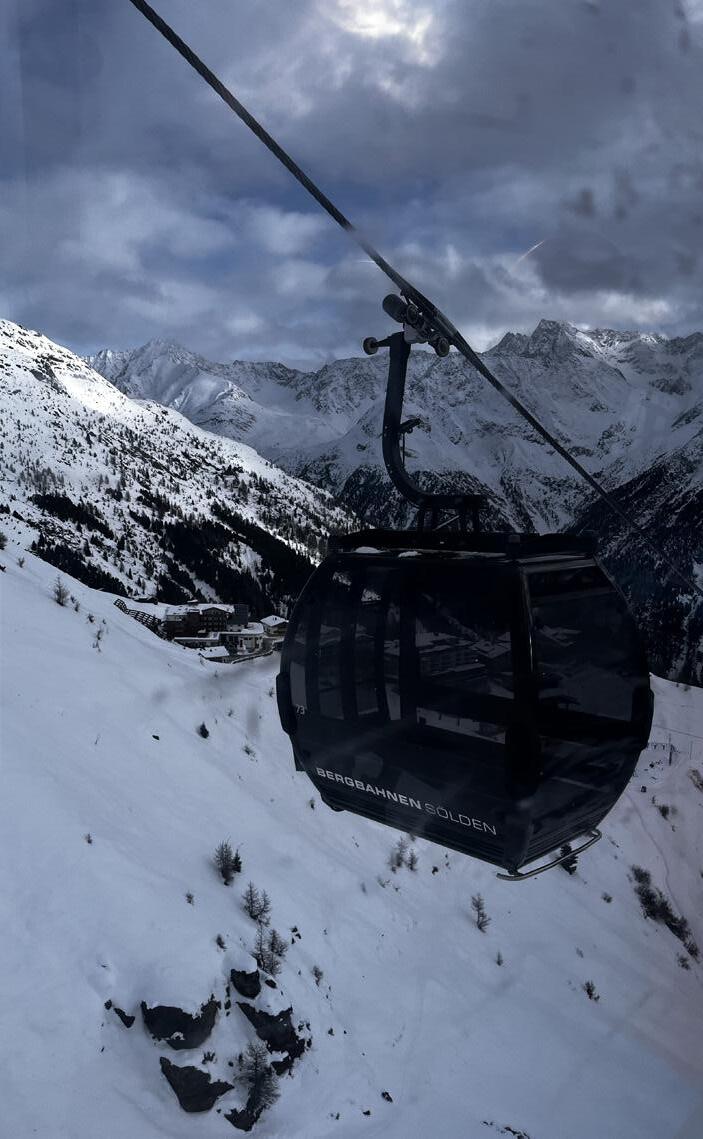
Most mornings, my husband and I joined the early risers heading for the Rettenbach and Tiefenbach glaciers. The hotel’s private shuttle dropped us at the gondola while our daughter, ski boots in hand, bounded off to ski school. By mid-morning, we’d be carving through perfect corduroy at 3,000 metres, the kind of snow that never disappoints, before heading back down later to find her rosycheeked and grinning.
Lunch, even on the mountain, carries the hotel’s unmistakable imprint. Das Central owns ice Q, the glass-and-steel restaurant perched at 3,048 metres on the Gaislachkogel summit, a place as striking for its architecture as for what’s on the plate. It’s refined without fuss: alpine produce served against a backdrop of snowfields and sky. Known to
PHOTOS: Sam Wilcox
“After dark is when the Das Central truly comes into its own.”
Bond fans as the Hoffler Klinik from Spectre, it’s one of those rare spots where the food matches the view, and both are impossible to forget.
After dark is when the Das Central truly comes into its own. The hotel’s
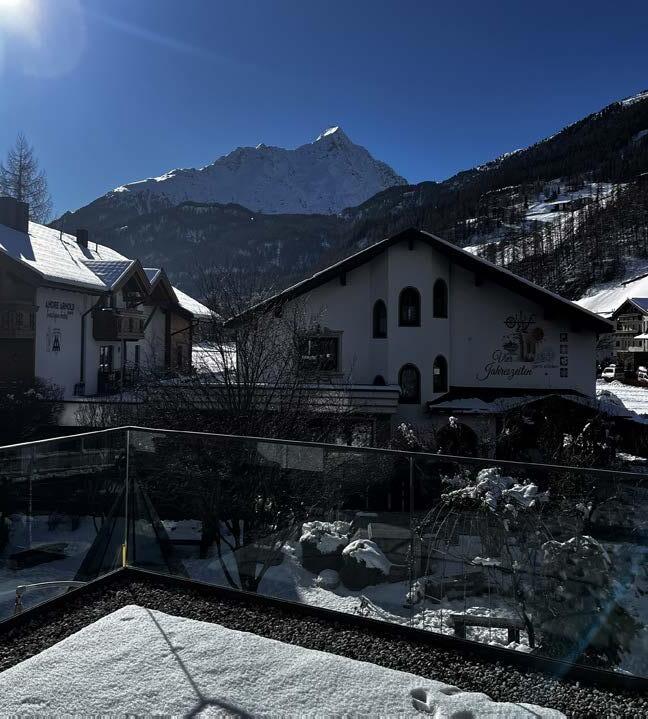
culinary reputation is well earned, its kitchens hold multiple Gault & Millau toques. Dinner is an elegant, unhurried affair: six or seven courses that might move from venison carpaccio with juniper and spruce to glacier trout with wild herbs, or Tyrolean beef lifted by truffle foam and mountain mushrooms.
A harpist plays softly in the background, the notes weaving through the low murmur of conversation, adding a touch of theatre.
The wine cellar is equally impressive, home to more than 30,000 bottles curated by the hotel’s sommelier team. Austrian labels feature prominently, with bold Blaufränkisch and crisp Grüner Veltliner sitting alongside French and Italian classics. The service is warm and intuitive, from staff who remember your glass from the night before.
After dinner, guests drift towards the firelit lounge, where the atmosphere is calm but never contrived. It’s the kind of place where families and quiet luxury coexist easily, with a kids club that operates into the evening. Staff appear just when you need them,
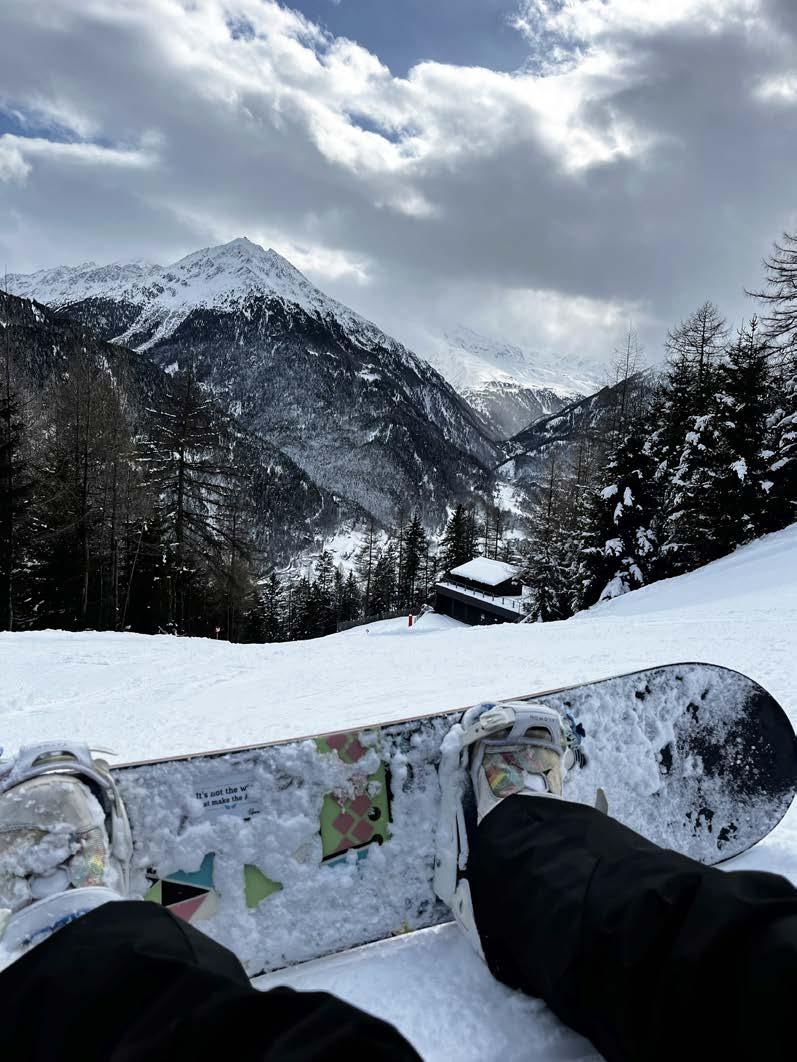
“it’s one of those rare spots where the food matches the view – both impossible to forget.”
never hovering, always a step ahead. There’s a warmth here that feels genuine, threaded through every detail. While Sölden dazzles with its glaciers, Bond legacy and vibrant après-ski scene, Das Central offers something different. For us, travelling with a seven-year-old, that balance mattered. Days began with hot chocolate moustaches
at breakfast and ended with her slipping into bed shattered from a days skiing and the kids’ club. When we left, we were handed a small jar of locally-made marmalade. It felt like a fitting gesture, something simple, genuine and quietly memorable, because Das Central doesn’t try to outshine the Alps, it simply lets you feel at home in them.
TRAVEL FACTS
FLIGHTS
Innsbruck Airport is the nearest gateway (approx. 90 minutes). Transfers to Sölden are frequent and hotel pick-ups can be arranged.
ACCOMMODATION
The Falkner family, who built Das Central in the 1960s, still run it today, their daughter Angelika overseeing much of its design and atmosphere. The Das Central hotel’s new Summit Spa is powered entirely by renewable hydroelectric energy from the Ötztal valley below. central-soelden.com
SKI LIFT
Sölden’s Gaislachkoglbahn lift ascends over 1,700 metres in under 12 minutes, one of the largest vertical rises of any gondola in the world.
GLACIERS
With two glaciers reaching 3,340m, Sölden is one of only two Austrian resorts offering guaranteed skiing from October to May.
BOND LINKS
The futuristic ice Q restaurant, owned by Das Central, doubled as the Hoffler Klinik in Spectre. Beneath it lies the real-life 007 Elements exhibition, hidden inside the mountain itself.
PHOTOS: Sam Wilcox
where old And new combine
SAM WILCOX finds gourmet flavours, timeless trails and a fresh take on tradition in Hochkönig
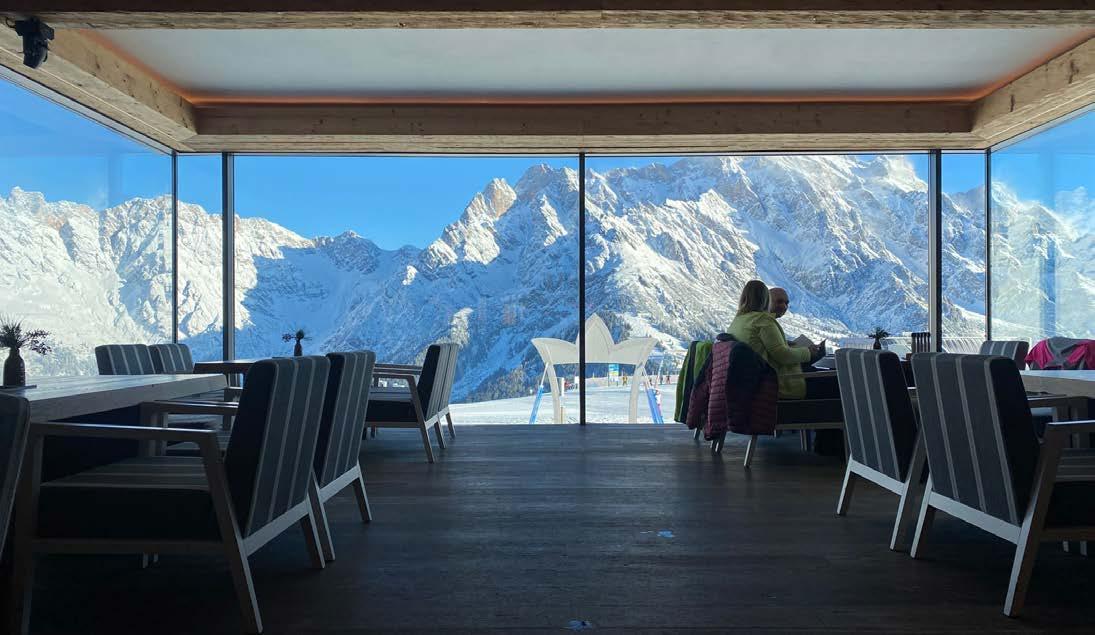
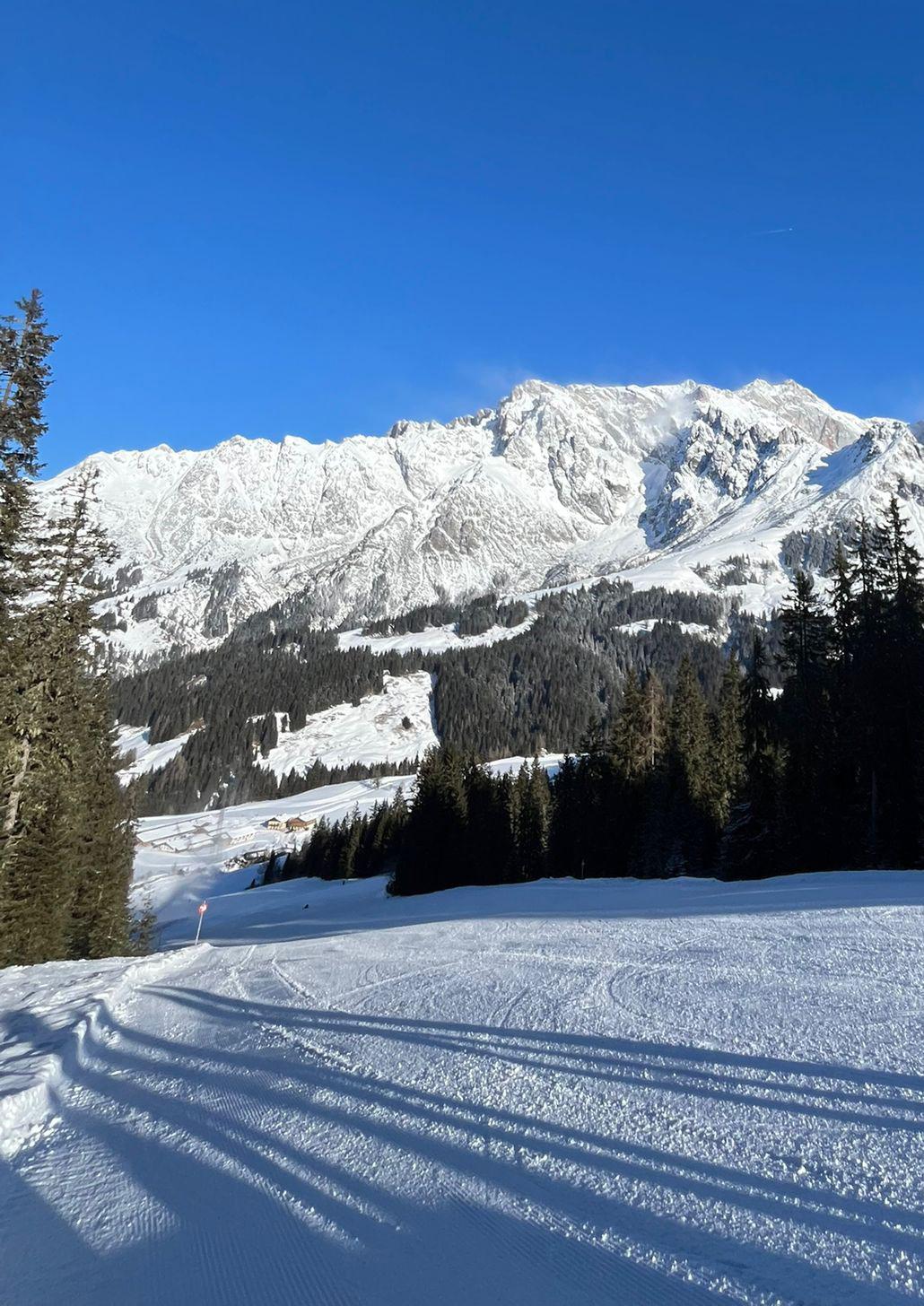
Hochkönig is where old world alpine character collides beautifully with modern vision, rustic huts dish up near Michelin level cuisine, and time worn trails cut through landscapes as striking as any in Austria.
Part of the expansive Ski amadé alliance, Hochkönig sits within one of the largest ski networks in Europe, boasting 760km of interconnected pistes, 270 lifts, and a frankly outrageous 260 mountain huts. Yet this area feels refreshingly unrushed, a place where skiing is less of a sport and more of a rhythm.
We arrived via Salzburg, a compact and scenic 90-minute transfer, and checked into the Hotel Almhof in Hinterthal.
Hotel Almhof is a beautifully restored alpine retreat with a rich family history spanning generations. Think traditional Austrian charm with refined, modern touches, its spacious rooms feature natural wood, soft textiles and sweeping mountain views. The hotel’s wellness area includes a sauna, steam room and relaxation zone, perfect after a day on the slopes. Its welcoming atmosphere, gourmet
“Hochkönig isn’t flashy. It doesn’t shout. But it doesn’t need to.”
kitchen and prime location near the lifts made it the perfect home base for three days of skiing, spa sessions and some of the finest alpine food I’ve encountered in Austria.
Hochkönig stretches between the lift-linked villages of Maria Alm, Dienten and Mühlbach, offering a
total of 120km of runs served by 34 modern lifts. The terrain is a joy for intermediates, think wide, winding reds, reliable snow cover and panoramic views of the Hochkönig massif. What really sets Hochkönig apart, though, is the “Culinary Königstour”, a gastronomic ski safari
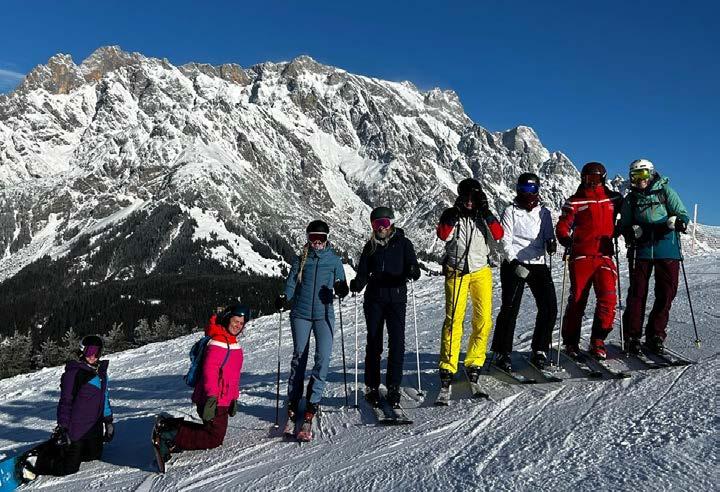
“this area feels refreshingly unrushed, a place where skiing is less of a sport and more of a rhythm.”
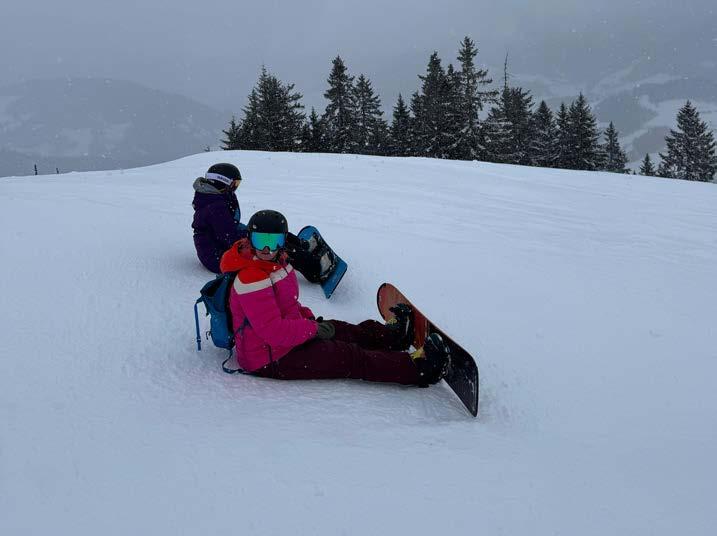
that lets you glide from hut to hut, fork in hand. Each stop serves its own signature dishes, turning lunch into a cultural expedition. Forget limp paninis or overcooked chips, here, menus are made with mountain pride.
A new generation of Austrians is quietly reshaping the mountain experience. Across Hochkönig, family-run ski huts and hotels are
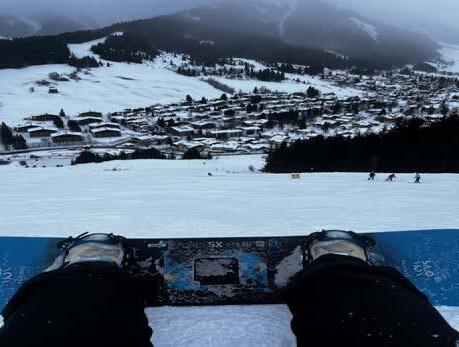
being handed down, but not without transformation. The children of traditional innkeepers have returned with hospitality degrees, global design influences and a sharp eye for detail.
The result is a fresh alpine aesthetic: less chocolate-box charm, more mountain-modern, where weathered timber meets vast glass panes framing snow-draped peaks, modern fireplaces flicker beneath sculptural lighting, and striking art installations hang from centuries-old beams. The soul of tradition remains, but it now comes with a signature cocktail and faultless plating.
We feasted on Käseknödel in rich beef broth, wild game ragout with cranberry sauce, and a particularly perfect Kaiserschmarrn, shredded pancake caramelised in butter and dusted with icing sugar, served straight from a cast-iron pan.
A highlight of the trip was the Grünegg Alm, reached after a short snowy walk above Dienten. A rustic, wood-panelled hut with its own distillery, it offered a generous
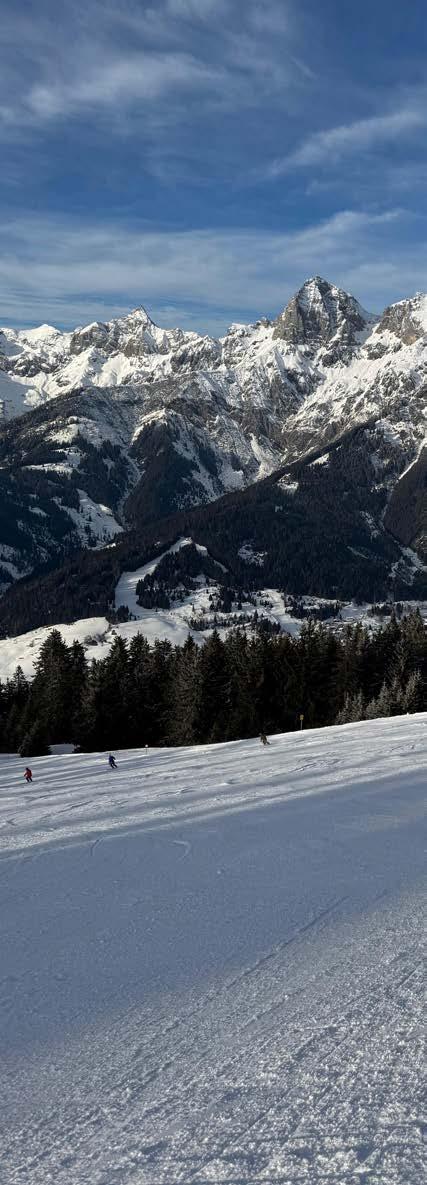
spread of traditional fare followed by schnapps tasting. Then came the descent: not via skis, but by toboggan, under moonlight, through the forest. Fast, slightly chaotic and utterly unforgettable.
Back on skis, we crisscrossed between villages via a lift network that runs like clockwork. Hochkönig’s terrain is perfect for long, lazy loops with minimal queues. And the scenery?
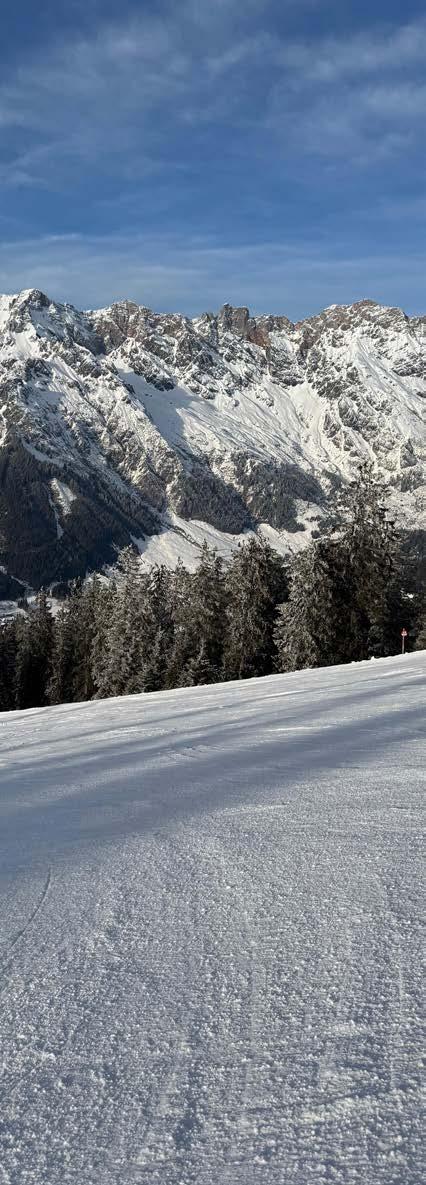
Endless white framed by dark pine, steep cliff faces and that towering Hochkönig peak, the “High King”, watching over it all.
That evening, we were treated to a fine dining experience at Die Hochkönigin in Maria Alm, an architecturally stunning hotel with an equally refined menu. Here, pumpkin soup came with pumpkin seed oil foam, alpine trout was served with

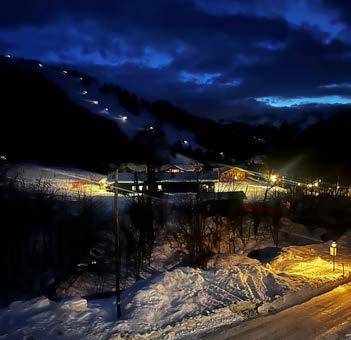
horseradish potato mash, and dessert featured a reimagined Mozartkugel. Hochkönig isn’t flashy. It doesn’t shout. But it doesn’t need to. What it offers is quiet luxury, from spa hotels and gourmet huts, to crowd-free lifts and sweeping runs. It’s the kind of resort where you don’t just ski, you settle in. You breathe deeper. You eat better. And you leave feeling lighter than when you arrived.
TRAVEL FACTS
Hochkönig (hochkoenig.at/en) is part of the Ski amadé network. skiamade.com/en FLIGHTS
Salzburg (90 minutes); return via Munich is also possible.
Accommodation
Hotel Almhof, Hinterthal – family-run 4* hotel with spa. almhof.co.at
Ski area
120km of runs, 34 lifts, snow parks and toboggan routes.
Lift pass
Covers 760km of piste across the wider Ski Amadé region.
Dining highlights
Culinary Königstour and Die Hochkönigin (hochkoenigin.com) Don’t miss
Tobogganing by moonlight and schnapps tasting at the Grünegg Alm
A Giant in the Shadows
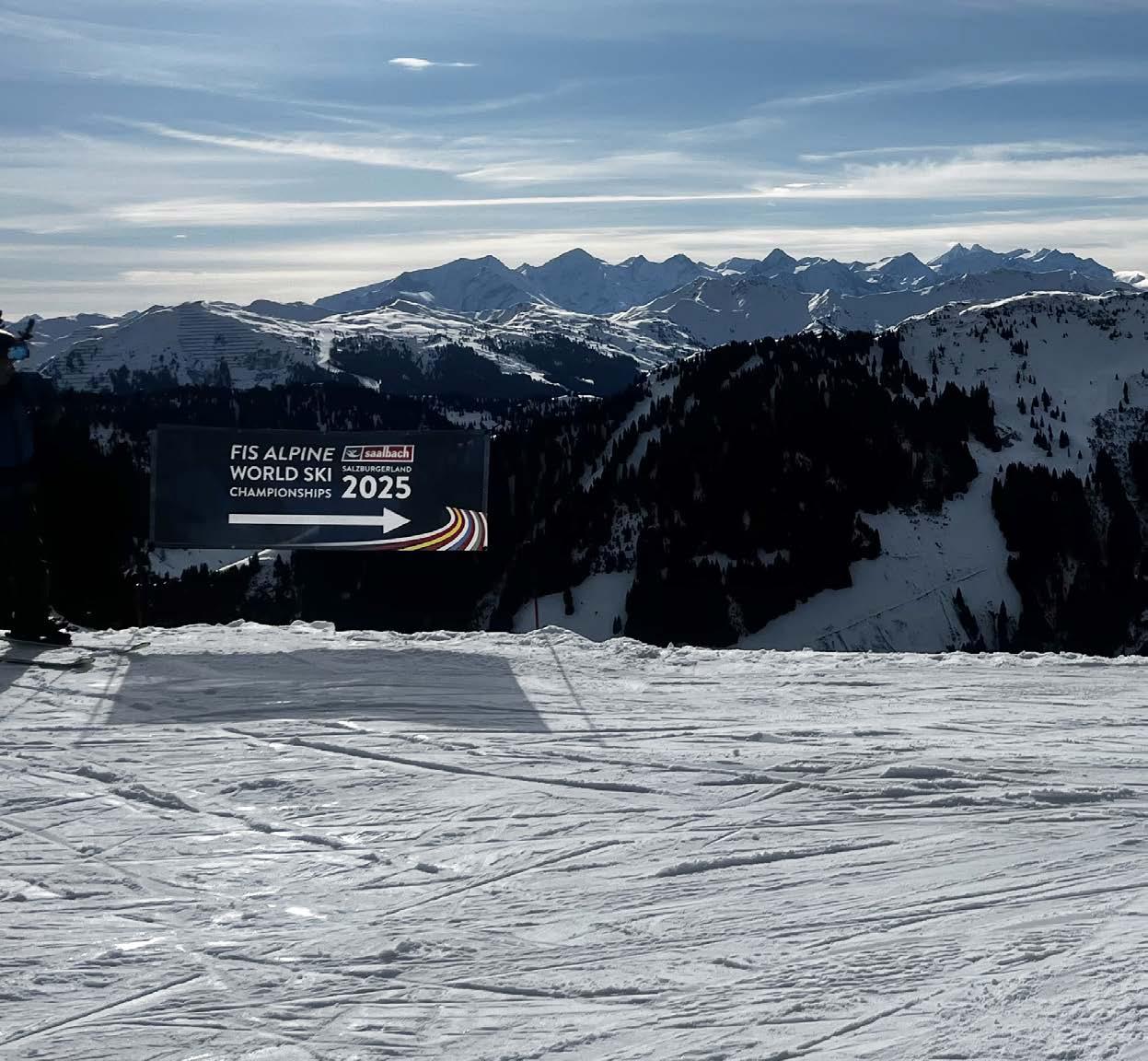
As the region geared up for the 2025 FIS Alpine World Ski Championships, SAM WILCOX discovered the beauty of Skicircus
Hidden among Austria’s rolling peaks, Skicircus, made up of the linked resorts of Saalbach, Hinterglemm, Leogang and Fieberbrunn, forms one of the largest connected ski areas in the Alps.
A giant that hides in plain sight, it doesn’t rely on hype or headline names, just hundreds of kilometres of immaculate pistes, charming villages and a quiet confidence that rewards those who make the trip.
In the days leading up to the 2025 FIS Alpine World Ski Championships,
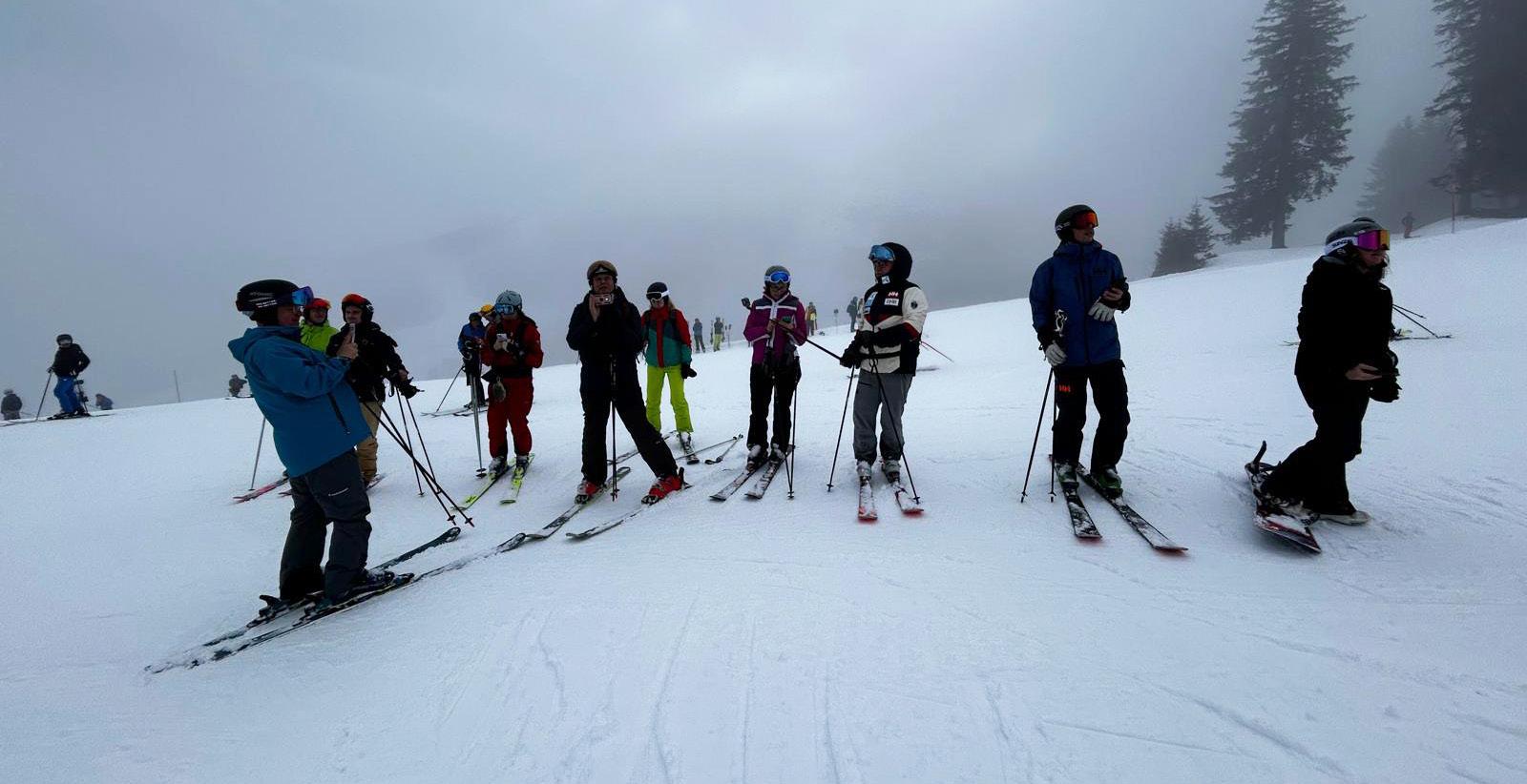
I found myself in Saalbach, the mountain air thick with anticipation. Over three unforgettable days, we discovered just how expansive and diverse this corner of the Alps really is: riding piste bashers to hidden huts for dinner, watching fireworks bloom above ski shows and carving early bird tracks on corduroy slopes.
We were based in Fieberbrunn, a traditional Tyrolean village at the quieter end of the PillerseeTal. Fieberbrunn has kept its authenticity, wooden chalets, onion-domed
churches and a certain unhurried rhythm prevail, but beneath it lies one of Austria’s most dynamic freeride scenes.
Our base was the Hotel Alte Post (alte-post-fieberbrunn.at/en), a fourstar in the centre of Fieberbrunn that gets the Austrian balance just right, polished but unpretentious, with excellent food, spotless rooms and a breakfast buffet that could power you through to après.
The Skicircus covers 270km of groomed pistes, but its real strength
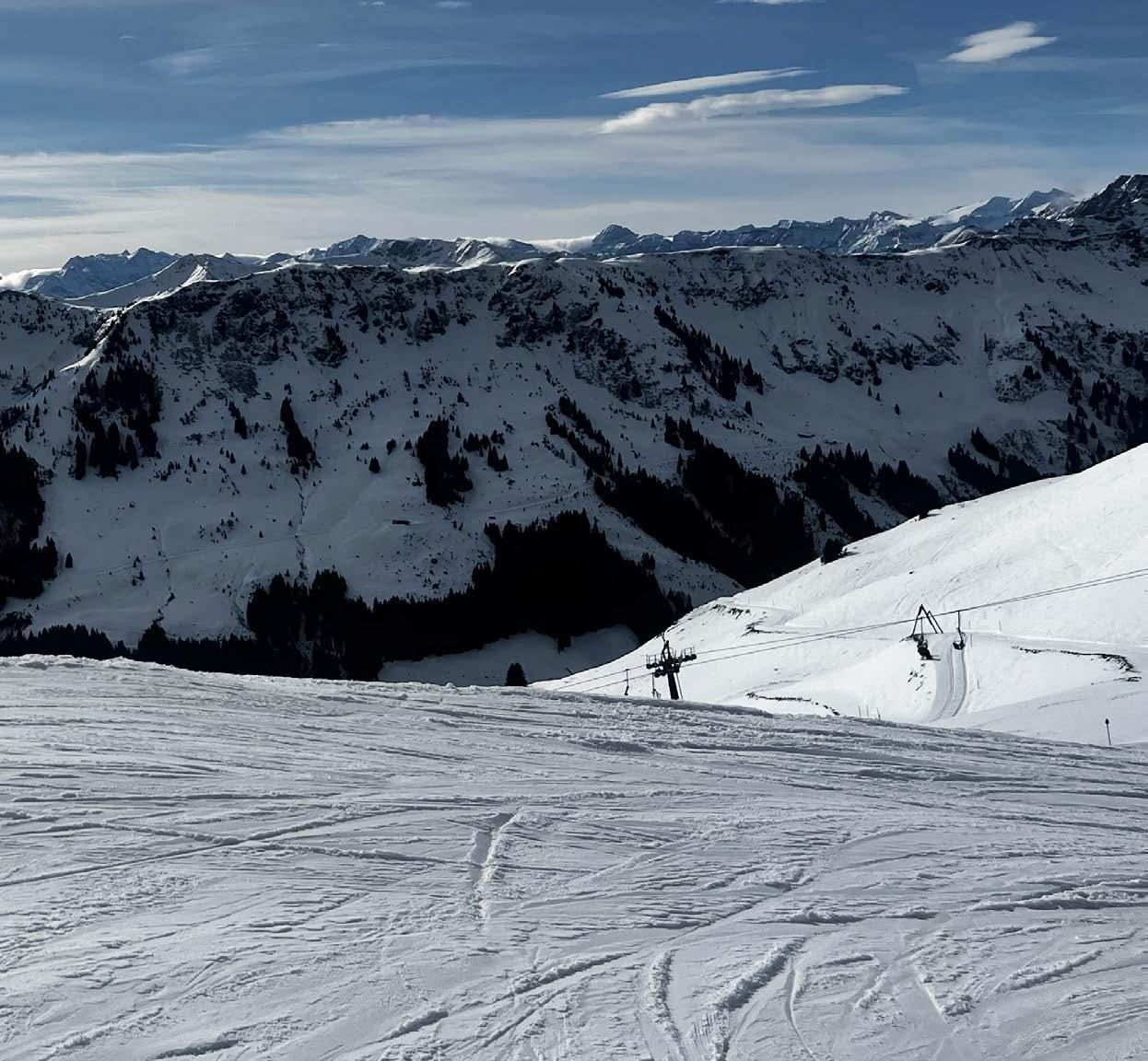
“Fieberbrunn has kept its authenticity.”
lies in how seamlessly it’s linked. You can ski from Leogang in the east to Hinterglemm in the west without unclipping once, a rare feat even by Alpine standards. Modern lifts, clear signage and intuitive route planning make it ideal for high-mileage skiers.
Fieberbrunn itself is at the northeastern edge of the circuit and is widely known as the freeride capital of the Tirol. It regularly hosts Freeride World Tour events, and you can see why, off the back of the Lärchfilzkogel
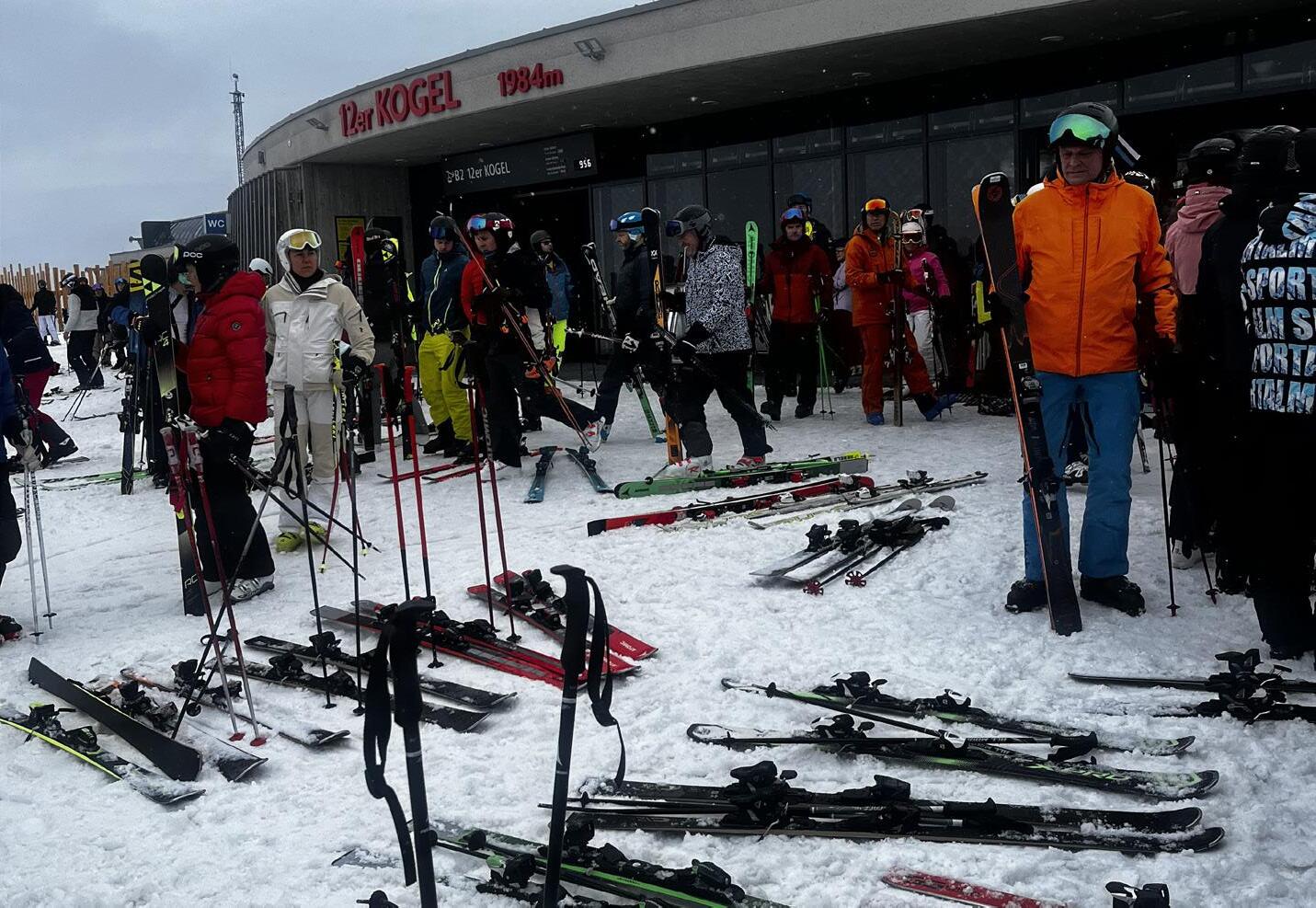
PHOTOS: Sam Wilcox
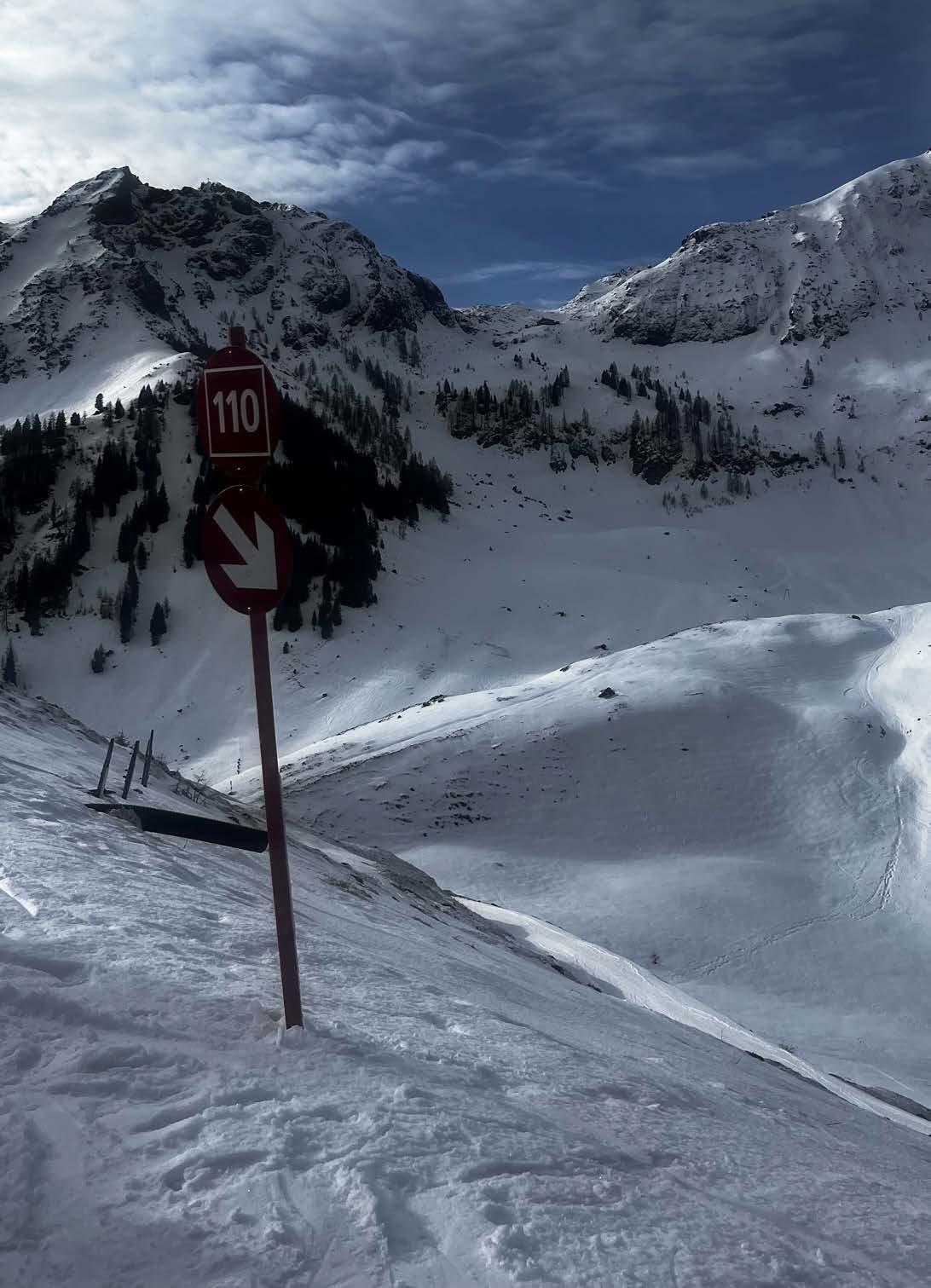
“Locals call the Skicircus ‘The Home of Lässig’ roughly translated as ‘The Home of Cool’ a nod to its laid-back character.”
“The Skicircus covers 270km of groomed pistes, but its real strength lies in how seamlessly it’s linked.”
or Hochhörndl, the terrain turns steep, deep and often gloriously untouched. This is one of the few Austrian resorts where the off-piste is as legitimised and celebrated as the slopes.
The freeride terrain is where Fieberbrunn sets itself apart. Unlike many Austrian resorts where you’re confined to the piste unless you’re with a local, the lines here are welldocumented and accessible (with the right gear and guidance). There’s avalanche signage, backcountry gates and even a local guiding culture that embraces exploration.
For the piste-focused skier, Saalbach and Hinterglemm offer high-speed playgrounds of motorway-wide blues and reds. The Zwölferkogel sector was a standout, fast, consistent gradients with excellent grooming and not a mogul in sight.
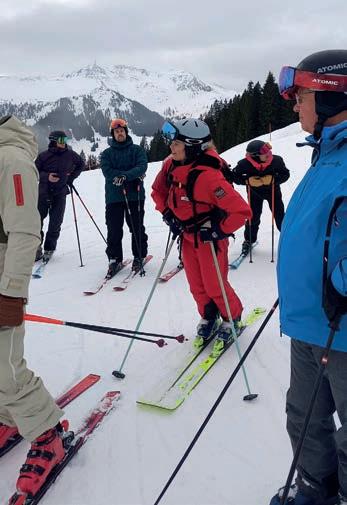
On our first full day, we skied with a guide who helped us thread our way from Fieberbrunn through Saalbach and Hinterglemm, racking up vertical and dipping into light powder stashes hidden beside the marked routes.
The skiing is fantastically varied, with playful tree runs, long carving pistes,
natural rollers and the odd steep red to keep you honest. What it lacks in extreme altitude (summits hover around 2,000m), it makes up for with smart grooming, efficient lifts and a whole lot of soul.
One of the trip’s more unusual highlights was the Ski Symphony show at the Streubödenbahn base station in Fieberbrunn. A choreographed night show involving LED-suited skiers, music and fireworks, a fun and surprisingly elegant performance, particularly when watched with a hot Glühwein in hand. This was followed by an even more memorable dinner where we were driven up to the Alpengasthof Ferchlstadl in a piste basher, which rumbled up through fresh snow to the mountain hut at 1,000m.
Inside, candlelight flickered, schnapps flowed, an Austrian brass band played and hearty Tirolean cuisine came steaming out of the kitchen. This is Austria at its best, understated, authentic and deeply satisfying.
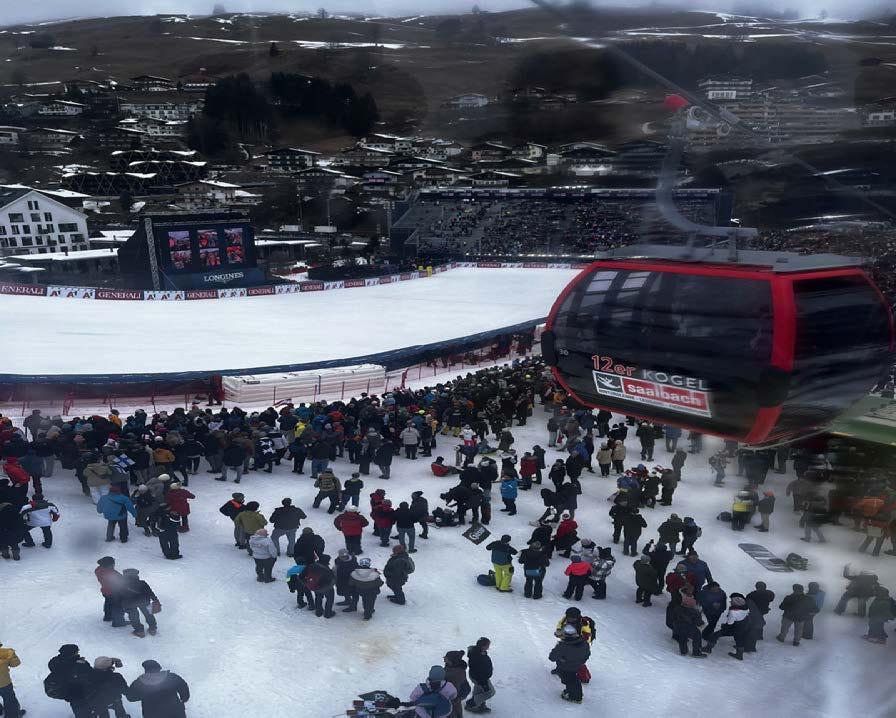
Watching the World Cup in Austria is as much a social event as a sporting one. Crowds lined the finish area in Saalbach, flags draped across barriers,
“Fieberbrunn is widely known as the freeride capital of the Tirol.”
PHOTOS: Sam Wilcox
Austria
the air thick with wood smoke and the smell of Glühwein. Classic crowd pleasers blared out of giant speakers between runs, and every clean descent brought a fresh roar from the crowd, beer sloshing from plastic cups.
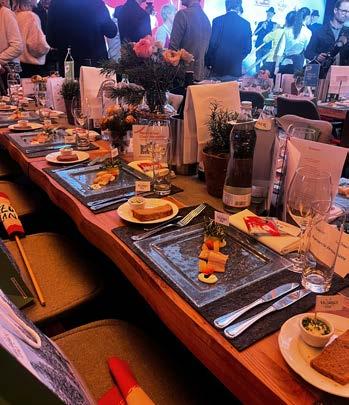
That evening we traded ski boots for something more refined at The Home of Snow, a special dinner held as part of the celebrations ahead of the 2025 FIS Alpine World Ski Championships. Inside, the atmosphere was equal parts excitement and reverence; a gathering of locals, journalists and athletes who have shaped the sport’s history.
Between courses of regional specialities and rich Austrian wine, stories flowed as easily as laughter, each one a reminder that Saalbach’s
TRAVEL FACTS
Getting There
Salzburg is the closest airport (approx. 90 mins). Transfers are straightforward, especially if you’re staying in Fieberbrunn.
Lift Pass
The Alpin Card gives access to the full Skicircus, plus Zell am See-Kaprun, over 400km total.
strength lies not just in its pistes, but in its people, united by a lifelong love of snow.
You won’t find glaciers or champagnefuelled après here. What you will find is something rarer: a vast, beautifully connected ski area with space to breathe, snow you can trust and an atmosphere that’s refreshingly unforced, Austria, quietly at its best.
Snow Reliability
Strong early season snow thanks to the Fieberbrunn microclimate. Extensive snowmaking covers over 90% of pistes.
Guiding
Highly recommended for freeride days. Local companies like S4 Snowsport offer gear hire and certified guides.
Sustainability
The region is fully powered by
renewable hydroelectric energy, part of its drive toward carbon-neutral operations by 2030.
SUMMER SEASON
Saalbach’s slopes double as a mountain bike mecca in summer, with more than 80km of downhill trails.
For more information
saalbach.com pillerseetal.at
PHOTOS: Sam Wilcox
Where tradition & modern alpine lifestyle meet
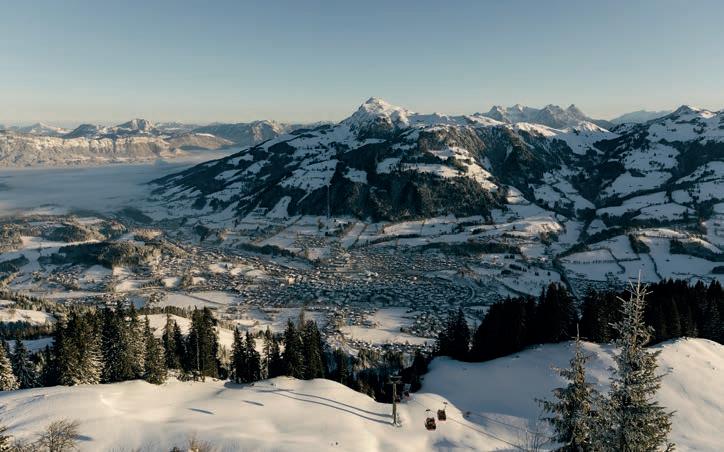
Long known for its legendary ski races and storybook feel, Kitzbühel continues to prove that it’s much more than a traditional ski resort. Recently named Austria’s Best Ski Resort for the 13th consecutive year, the Tyrolean town offers a winter experience that combines world-class skiing, sporting events and a lively cultural calendar.
With 233 kilometres of pistes, 58 lifts and more than 60 mountain huts and restaurants, Kitzbühel caters to skiers of all levels, while also appealing to non-skiers and slower-paced travellers.
Beyond downhill skiing, visitors can enjoy 70 kilometres of cross-country trails, weekly guided winter walks, snowshoeing and scenic dining in traditional Alpine huts.
Kitzbühel offers a wide range of winter activities away from skiing. Guided winter walks and snowshoe hikes run throughout the season, while cross-country skiers can explore trails through snow-covered meadows and mountain landscapes. The floodlit sports trail at Schwarzsee-Reith allows skiing until 9pm, while the Kitzbühel Sports Park offers ice skating, curling and live ice hockey. For some nostalgia, the Gaisberg toboggan run is a firm
favourite with visitors of all ages.
Rising high above the town, the Kitzbüheler Horn offers early-morning skiing on quiet slopes, with views stretching across up to 70 Alpine peaks on clear days. The cable car provides easy access to panoramic viewpoints and mountain restaurants such as the Alpenhaus, making it a popular choice for both skiers and sightseers.
Winter in Kitzbühel isn’t only about sport. In 2026, the Electronic Boutique Festival Sound | Escape will take place for the first time at the Kitzbüheler Horn, running from 20-22 March. Set high above the town, the threeday festival promises unforgettable moments, with CLAPTONE confirmed as the headline act. Admission is free, combining electronic music, mountain scenery and late season skiing into a unique alpine experience.
A seven-night stay at Q Hotel Maria Teresia in Kitzbühel, on a half board basis, arriving 21 March 2026 is priced from £999pp based on two sharing. Includes return flights from London Gatwick to Salzburg and transfers. inghams.co.uk
For more information on Kitzbühel, visit kitzbuehel.com/en
Go on a digital adventure
In the Tiroler Zugspitz Arena in Ehrwald, digital adventure trails invite visitors to explore the region in both summer and winter.
Three of the six routes – Cora, Finn and Mia – are accessible all year round. Each is around four to five kilometres long and takes one to two hours to complete. Adventurers of all ages can explore the routes interactively, with highlights including educational audio guides, videos, mini-games and puzzles.
A seven night stay at Gästehaus Haag in Ehrwald, arriving 14 March 2026, is priced from £436pp based on two sharing a double room with breakfast included. Flights and transfers extra. tyrol.com
Freeride world tour stop dates
The legendary Freeride World Tour stop in Fieberbrunn, Tirol, continues to stand out as one of the most important events on the tour calendar, with the FWT Fieberbrunn Pro once again delivering spectacular freeride action on the iconic Wildseeloder in 2025, where athletes in the Ski Women, Snowboard Women and Snowboard Men categories impressed with creative lines and powerful performances despite challenging conditions.
Looking ahead, the 2026 Freeride World Tour stop is officially confirmed, with the international freeride elite set to return to Fieberbrunn as the Event Village runs from 6-8 March, reaffirming the destination’s status as a cornerstone of the global freeride scene.
A seven night stay at ADEA Lifestyle Suites Fieberbrunn, arriving 1 March 2026 is priced from £1,216pp based on two sharing a Junior suite with breakfast included, flights and transfers extra. tyrol.com
PHOTO: © Kitzbühel Tourismus

A Luxurious panoramic setting for relaxation
DAVID HOBDEN headed to Alpin Juwel, right at the heart of the SaalbachHinterglemm ski area, to experience what this jewel in the Austrian Alps has to offer
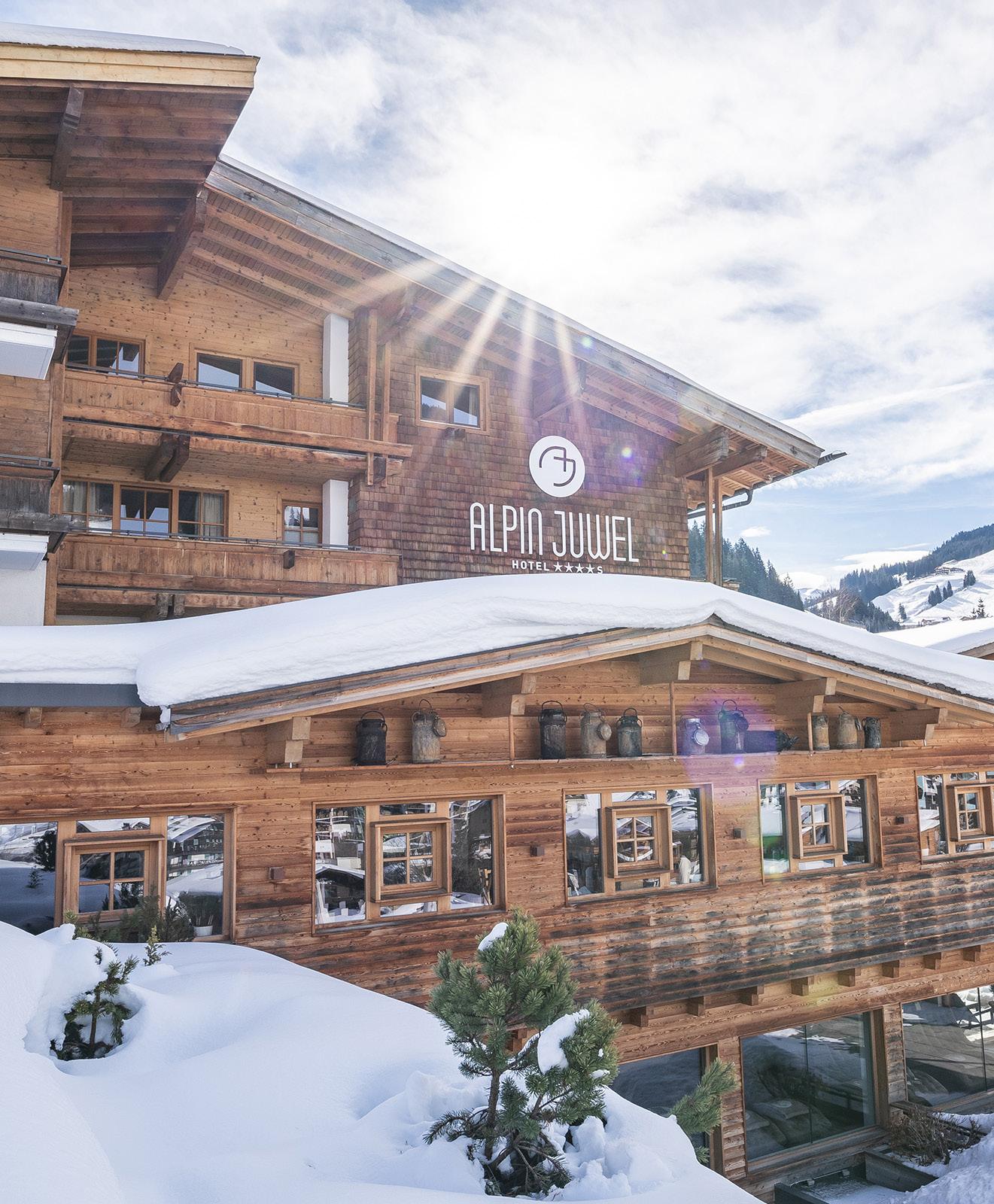
Nestled in a breathtaking panoramic setting, Alpin Juwel Hotel is the epitome of relaxation, adventure and sustainability.
Located in Hinterglemm, a charming mountain village in Austria’s Salzburg region, Alpin Juwel is right at the heart of the Saalbach-Hinterglemm ski area. Just 60 miles from Salzburg, it’s an idyllic destination for skiing, hiking and year-round adventure.
This luxurious retreat seamlessly blends traditional Alpine charm with contemporary elegance, offering beautifully-designed rooms, crafted from wood and glass, with stunning mountain views. Guests can unwind in two pools, a lavish spa and a stylish games room, while the great outdoors beckons just beyond the doorstep with endless activities.
At the heart of this 4-star superior retreat is a commitment to quality and comfort, creating a space where privacy and unforgettable experiences go hand in hand. Whether you’re seeking an active getaway, a culinary journey or pure relaxation, Alpin Juwel invites you to escape the everyday
and embrace the moment. With crisp mountain air, the scent of fresh wood and a seamless mix of home-like comfort and holiday indulgence, it’s an experience to savour.
The hotel’s elegantly-designed rooms and suites showcase natural materials and stylish interiors, creating a warm yet sophisticated retreat.
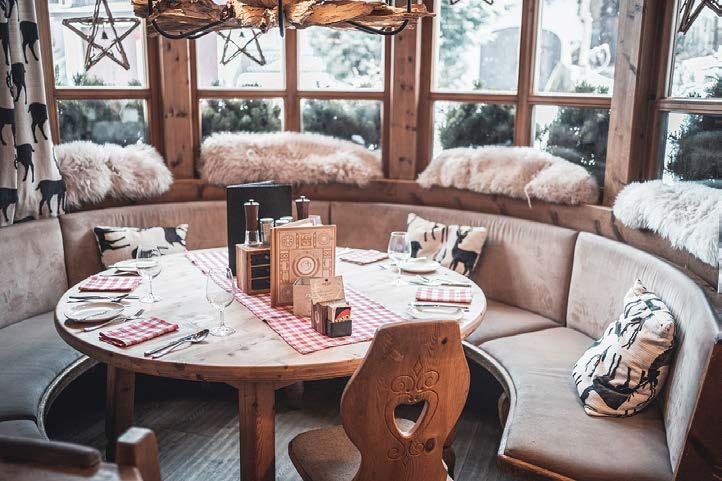
Floor-to-ceiling windows frame the breathtaking mountain scenery, while plush furnishings and modern touches ensure every stay is as comfortable as it is luxurious.
Travel connections from the UK are excellent, with Salzburg Airport offering the most direct route, while Munich Airport provides additional options. The drive from Salzburg takes around 90 minutes, following a scenic route through the Austrian countryside, while a train journey – via Zell am See – takes approximately twoand-a-half hours.
Hinterglemm is a fantastic ski destination for skiers of all levels, offering a vibrant après-ski scene, modern lift systems and extensive terrain. It’s known for being slightly quieter and more family-friendly
Austria
than Saalbach but still provides plenty of action for party-goers and advanced skiers.
It offers 270km of well-maintained slopes, ranging from gentle blues to challenging blacks, and is excellent for intermediate skiers, with plenty of wide, cruising red runs. There are also off-piste opportunities for advanced skiers around Fieberbrunn, which is known for freeriding, and night skiing is available in Hinterglemm, which adds a fun twist to your trip.
Hinterglemm has reliable snow coverage, with modern snowmaking facilities ensuring a long season. Higher-altitude runs tend to have better snow, especially in late season. It has the benefit of modern and efficient lifts, with minimal queues even during busy periods – plus heated chairlifts and gondolas add to the comfort.
Hinterglemm has several nursery slopes and gentle runs, making it great for beginners and kids. The Ski Schools are highly rated, with English-speaking instructors. There are also dedicated children’s areas and activities off the slopes, such as sledding and winter hiking.
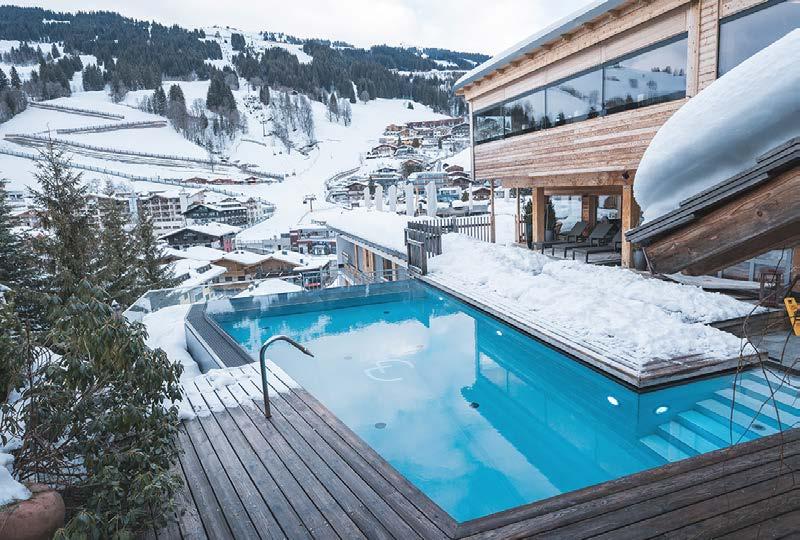
At the heart of Alpin Juwel is its luxurious spa, a true haven of tranquility. Guests can take a dip in the rooftop infinity pool, unwind in the indoor wellness area, or indulge in bespoke treatments using organic
Alpine ingredients. Saunas, steam baths and peaceful relaxation zones complete the experience, offering the perfect way to unwind after a day on the slopes or hiking trails.
Food-lovers will appreciate Alpin Juwel’s farm-to-table approach, with a strong focus on organic, locally-sourced ingredients. The hotel’s restaurants serve up gourmet Austrian cuisine with a creative twist, complemented by an extensive selection of fine wines. For an extra-special experience, the panoramic terrace offers al fresco dining with breathtaking views of the surrounding peaks.
“It has 270km of wellmaintained slopes, ranging from gentle blues to challenging blacks.”
With its seamless blend of luxury, adventure, and sustainability, Alpin Juwel is more than just a hotel – it’s an escape to the extraordinary.
Alpin Juwel takes its environmental responsibility seriously, seamlessly integrating sustainability into every aspect of the guest experience. The hotel prioritises eco-friendly practices without compromising on luxury – from energy-efficient lighting and steam-cleaning methods that eliminate harsh chemicals to the use of natural fibre textiles and locally-sourced materials. Every detail reflects a deep commitment to reducing environmental impact while maintaining the highest standards of comfort and quality. By embracing sustainable sourcing, responsible energy use and chemical-free cleaning,
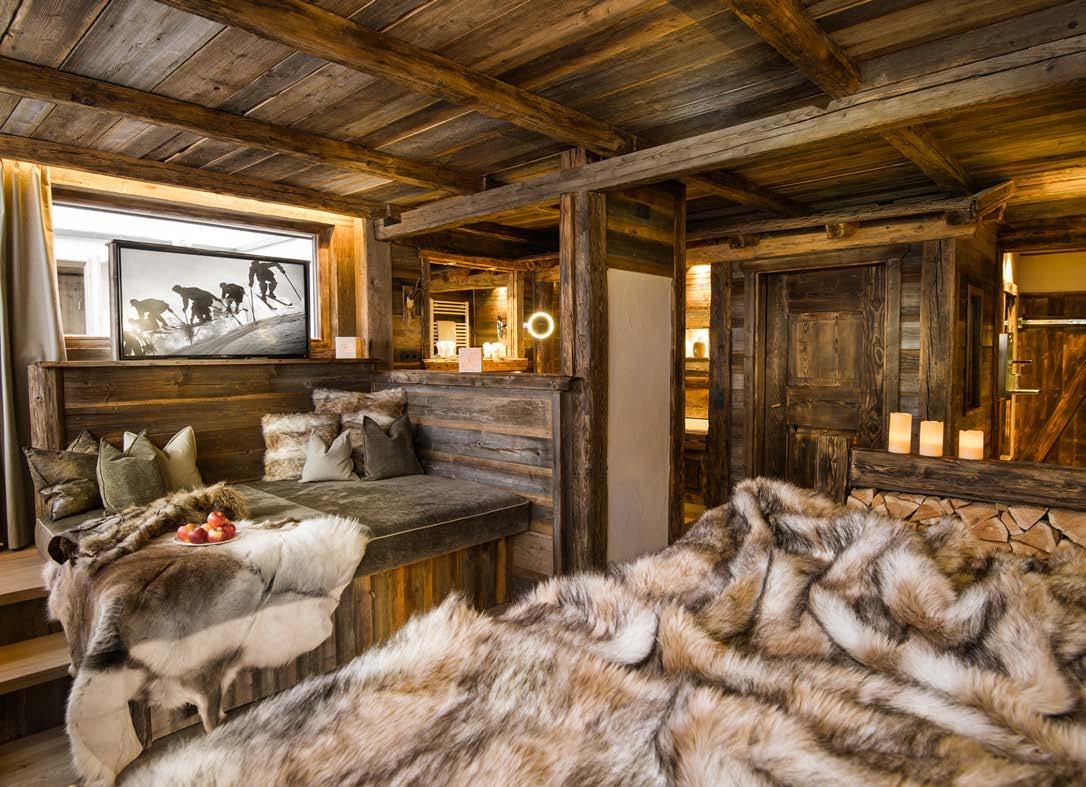
“Floor-to-ceiling windows frame the breathtaking mountain scenery.”
Alpin Juwel offers a truly eco-conscious retreat, where guests can indulge in nature’s beauty while helping to preserve it.
In the summer months, Hinterglemm transforms into a vibrant hub of outdoor activities. Whether you’re seeking adventure, relaxation or family-friendly fun, Hinterglemm offers a diverse array of experiences to make your summer holiday unforgettable. With over 400km of well-marked hiking trails, Hinterglemm is a paradise for nature enthusiasts. Trails range from leisurely walks to challenging alpine hikes, catering to all skill levels. Along the way, you’ll encounter breathtaking vistas, alpine meadows and traditional mountain huts offering local delicacies.
Recognised as Austria’s largest bike region, Saalbach Hinterglemm boasts more than 90km of lines and trails, along with over 400km of mountain bike routes. Whether you’re a downhill enthusiast or prefer cross-country rides, the region provides diverse terrains to suit your preferences. Numerous bike shops and schools are available to equip you with gear and guidance.
Families will find a plethora of attractions designed to entertain and engage children of all ages including Montelino’s Adventure Path. There’s also Teufelswasser (Devil’s Water), a water-themed park featuring Kneipp pools, play areas and mystical cave paths, offering a refreshing experience for the whole family.
Or head for the High Rope Park – as Europe’s largest high ropes course, this park presents over eight kilometres of courses with varying difficulty levels, ensuring an adrenaline-pumping adventure.
For thrill-seekers, Hinterglemm offers activities that promise to get your heart racing, including paragliding, where you will soar above the Glemm Valley with experienced pilots, taking in panoramic alpine views; canyoning, offering the chance to navigate through gorges, waterfalls and natural slides, experiencing the raw beauty of the region up close; plus Mega Flying Fox, where you will experience the exhilaration of flying at high speeds over the landscape on one of the world’s longest zip lines. With its perfect balance of luxury, wellness and adventure, Alpin Juwel is more than just a hotel – it’s an experience that captures the essence of the Alps in every detail. alpinjuwel.at
PHOTO: ©
Foto
Atelier Wolkersdorfer
Sweden & Norway
A winter wonderland for family holidays
There’s lots to enjoy both on and off the slopes for families thinking of heading to Sälen, in Sweden and Trysil, in Norway
With the Milano Cortina Winter Games drawing to a close, Olympic fever has been enjoyed in Sweden and Norway, and with good reason. Both nations are consistently among the most successful at the Winter Olympics, thanks to long winters, reliable snow and outstanding places to train.
These same foundations are what make SkiStar’s resorts in Sälen, Sweden, and Trysil, Norway, attractive winter wonderland destinations for family ski holidays.
British skiers and families can take advantage of the direct flights from London and Manchester to
Scandinavian Mountain Airport, operating throughout the winter season until April. Getting in and out of the efficient airport is a breeze, and with transfers to both Sälen and Trysil among some of the shortest in the business (20 to 45 minutes), it means more time on the slopes and less time travelling – a treat for ski holidays and a huge bonus when travelling with children.
With Easter falling early this year, skiers can expect the ideal combination of longer, brighter days and stable snow, just perfect for classic spring-winter skiing.
The snow and cold weather have also
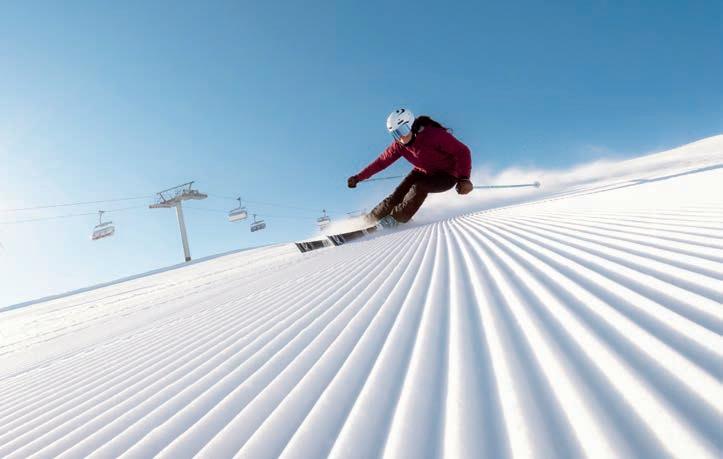
transformed the region into a true winter wonderland and it is just as magical off the slopes. Beyond skiing, take advantage of winter adventures such as cross-country skiing, snow-shoeing and sledging on snow racers. To top it off, on clear nights there is even the chance to spot the northern lights.
SkiStar continues to invest heavily in both Sälen and Trysil, with several new developments launched earlier this winter with highlights including Trysil’s new gondola which opened in time for the opening of the season, and skiers are already reaping the benefits with much better access from the valley station. It carries up to 3,000 people per hour.
A lift pass of four days or more in Sälen also includes the opportunity to ski for two days in Trysil, allowing visitors to experience two countries in one trip.
SkiStar’s resorts are designed with families firmly in mind, offering
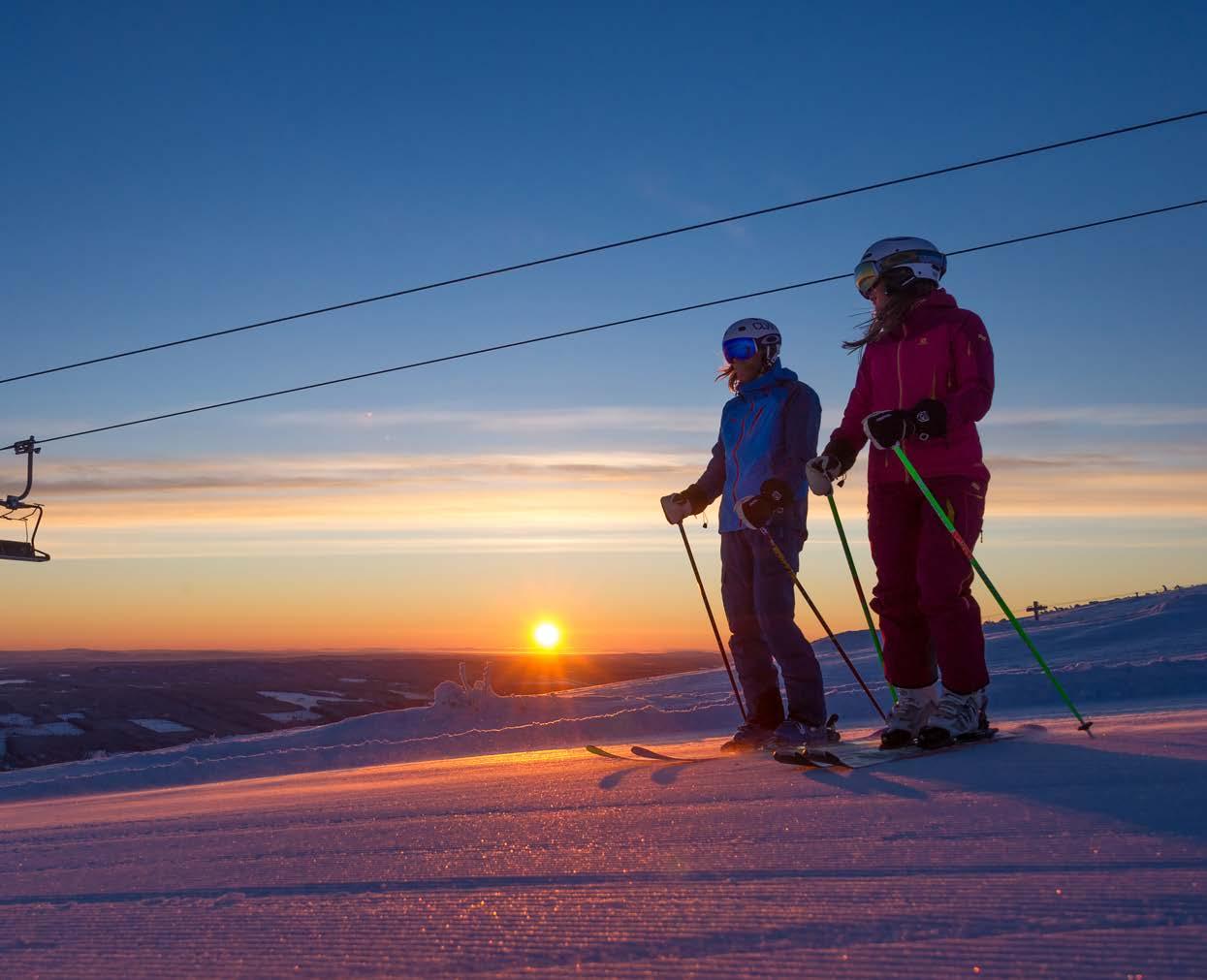
accommodation close to the slopes including ski-in/ski-out, excellent ski schools with instructors tuned in to children’s needs and a sense of fun in learning, charming children’s ski areas and dedicated runs through forests including pit-stops for freshly made warm waffles.
The weeks between 1 and 29 March form part of the shoulder season, offering significantly more affordable prices while still benefiting from excellent snow conditions and quieter slopes – perfect for those looking for a romantic getaway or a ski break with friends.
Late-season skiing and the Easter holidays are particularly appealing for families seeking reliable snow without the crowds. “For me, the period between the sports holidays and Easter is a personal favourite – with well-groomed slopes, great snow availability and a wide range
“skiers can expect the ideal combination of longer, brighter days and stable snow.”
of activities both on and off the mountain,” says Gudrun Sanaker Lohne, Destination Manager at SkiStar Trysil.
Add in cosy lodges, tucked-away cabins and overall Scandinavian cosiness and you have all the ingredients for a truly special lateseason ski break. Half board or selfcatering is available, along with a wide selection of restaurants.
Aside from booking a holiday directly with SkiStar other UK operators offering package holidays to Sälen and Trysil include skiScandinavia, Crystal Ski, Ski Safari, Ski Solutions, Absolute Snow, Iglu and Heidi. skistar.com/en
PHOTO: © Ola Matsson
Alta Badia to see season out with a host of events
In March and April, the days grow longer and weather conditions become particularly favourable for skiing. It is the ideal time to enjoy the mountains and the slopes of Alta Badia, in the heart of the Dolomites, a UNESCO World Heritage site, where excellent snow quality and meticulously groomed slopes ensure a high-level experience even at the end of the season.
In recent years, Alta Badia has strengthened its position as a leading destination for alpine skiing, thanks to an offer that combines efficient infrastructure, high-quality services and an internationally recognised food and wine scene. As tradition dictates, the ski season in Alta Badia draws to a close with a series of unmissable events.
The Sommelier on the slopes event aims to promote and further showcase the finest wines of South Tyrol. The final dates of the season are scheduled for 3, 10 and 31 March. The initiative combines unforgettable skiing on the slopes of Alta Badia with the tasting of some of South Tyrol’s most prestigious wines at two mountain huts. Participants will be accompanied by a ski instructor as well as a South Tyrolean sommelier. It is the people who live in a place who make it truly authentic, rich in culture and traditions passed down from generation to generation. The Nos Ladins – We Ladins project was created with the aim of bringing visitors closer to local life and traditions through meetings with local residents held during the winter months. After all, no one can tell the story of a place better than those who were born there and live there

every day. On 4 March, participants will discover the behind-the-scenes operations of a lift system together with Luigi; on 11 March, Moritz will share anecdotes about tourism in Alta Badia, the evolution of hospitality and his personal experiences as the founder of a renowned mountain hut, which still welcomes skiers and hikers from all over the world today; while on 18 March, together with Hannes, participants will learn the secrets of local pastry-making.
The final Bun de Gran Risa event takes place on 5 March. This exclusive experience offers participants the chance to be the first to ski down the legendary Gran Risa slope, the venue of Alpine Ski World Cup races. The Piz La Ila lift opens at dawn, allowing skiers to witness the sunrise at 2,000 metres and enjoy a perfectly groomed slope prepared overnight.
Participants, in groups of up to 15 people, will be accompanied by
two instructors from the La Villa Ski & Snowboard School, who will explain skiing techniques as well as the preparation and setting of a race course. The experience also includes a simulated start from the starting gate, a short final slalom and the presentation of a diploma and souvenir photos.
The Roda dles Saus returns this winter as well. The week from 15 to 22 March will be dedicated to Ladin cuisine and culture in the La Crusc ski area. Skiing from hut to hut, visitors can savour dishes that originate in the heart of the Dolomites, paired with the finest wines from South Tyrol. Ladin cuisine, simple yet authentic, takes centre stage in the mountain huts within the La Crusc ski area. Each hut specialises in preparing a traditional Ladin dish, cooked step by step according to grandmother’s recipe. This year, Corvara will host the start of the 32nd edition of the Sellaronda
PHOTO: Alta Badia –© freddy planinschek
The Ski Carousel Vintage Party
Skimarathon, scheduled for 20 March at 6pm. The eagerly awaited nighttime ski mountaineering race will see hundreds of athletes compete along the route around the Sella massif, crossing some of the most iconic landscapes of the Dolomites. The event has by now become an international benchmark for ski mountaineering, combining top-level sport with the promotion of the region and attracting athletes, enthusiasts and fans from all over Europe. Visit sellaronda.it
On 22 March, Alta Badia brings the best South Tyrolean wines up to altitude for an exclusive tasting event, taking place from 10am to 3.30pm at the mountain huts Piz Arlara, Ütia de Bioch, I Tablà and Pralongià. The aim is to bring the winter season, dedicated to food and wine, to a stylish close.
In December, the Gran Risa celebrated the 40th anniversary of its first race, held in 1985. To mark this important milestone, a
“Participants are asked to wear retro ski clothing and equipment to create an authentic ‘vintage’ atmosphere.”
photographic exhibition has been set up in the ski area, telling the story of the Gran Risa through images that capture speed, determination and legend. It is a tribute to all those who have contributed to making this slope great, as well as to Freddy Planinschek, the official photographer of the event since the very first edition. The exhibition consists of 20 images positioned along the most scenic slopes of Alta Badia, offering enthusiasts a unique journey through sport, memory, and beauty.
On 24 March, from 1.30pm to 4.30pm, visitors can participate in a guided ski tour with Roberto Erlacher, a local athlete who stood on the podium at the first World Cup giant slalom held on the Gran Risa. That year, the winner was Ingemar Stenmark.
To close the winter season in a festive mood, Alta Badia has planned an original retro-style event. On Monday 6 April, both the valley and the ski slopes will be transformed to recreate the atmosphere of a ski resort from several decades ago. Skiers can take part in a vintage ski race on the La Para slope, where one of the last drag lifts with hooks is still in operation. Anyone can participate in the obstacle race, provided that classic skis are used instead of modern carving skis. Participants are asked to wear retro ski clothing and equipment to create an authentic “vintage” atmosphere throughout the ski area. The event is organised in collaboration between Alta Badia Brand and the Skicarosello Consortium. altabadia.org
an entirely new experience
HILS EVERITT heads to Bulgaria, where she finds a resort offering value for money, ideal for a relaxed break or those new to skiing
I’ve skied extensively all over the European Alps and a little in North America and so when offered a trip to a country entirely new for a few days of piste fun I grab it with both hands. That new was Bulgaria. The resort in question was Bansko – the largest in this particular Balkan country. When anybody mentions Bulgaria for holidays, the most commonly-used adjective is ‘cheap’ generally. When mentioned for winter ski holidays the adjective this time is ‘small’. Neither adjective entirely accurately describes
Bansko. I would prefer to use a phrase ‘value for money’ and ‘limited’ but that only applies to good intermediate skiers upwards who want plenty of variation and a good high kilometrerate of runs.
As I said, Bansko is the biggest of the Bulgarian resorts and sits in the Purin mountains. It is a big town, which really does deserve a larger ski area. One mountain is quite a squeeze at full capacity, which also inevitably means that you have to queue to get up the mountain as there is only the one
gondola up – the Bansko – and one run down at the end of the day. Both are incredibly busy, but keep your wits about you and tone down the speed, then all will be well.
The town sits at 936m so you aren’t going to get a lot of snow, even in the height of the ski season, but the good news is that it soars to 2600m at the highest point at the top of the Plato and Banderitza 2 chairlifts. The snow here was great on this trip and I had lovely time cruising down the friendly and fun blues numbered 3 and 11,
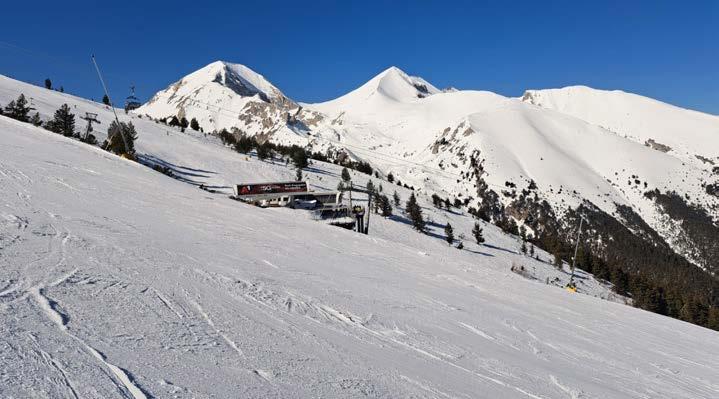
plus the slightly more speedy reds named 2 and 4.
For the snowboarders among you and skiers who like a bit of fun, the Funpark is located at the top here, so you are guaranteed some good cover and plenty of entertainment.
Yes, Bansko is unusual in that none of the slopes have names, they are numbered instead. That is a bit of a shame as it takes some character out
of the equation. There is, however, plenty of character in the old part of town with lots of historical buildings boasting interesting histories if you are that way inclined.
One other thing to observe about Bansko, and probably Bulgarian skiing particularly, is that if you are used to Alpine classification of the runs, then you need to get into another mindset. The reds are more like Alpine blues
“I had lovely time cruising down the friendly and fun blues.”
“There is plenty of character in the old part of town.”
in general. It is a great place for those who have a couple of weeks skiing under their belt and love tackling the same runs numerous times to practice and perfect technique.
For the real beginners it’s ideal, although the nursery slopes are at the top of the first cable car, the Bansko, and the wait can be long, so get there early. You can always enjoy a coffee at one of the attractive bars slopeside before your lesson.
The resort has been billed as a good place for intermediates. But if you’re one of those who likes to travel, then you will be disappointed with the one mountain.
There is some entertaining back
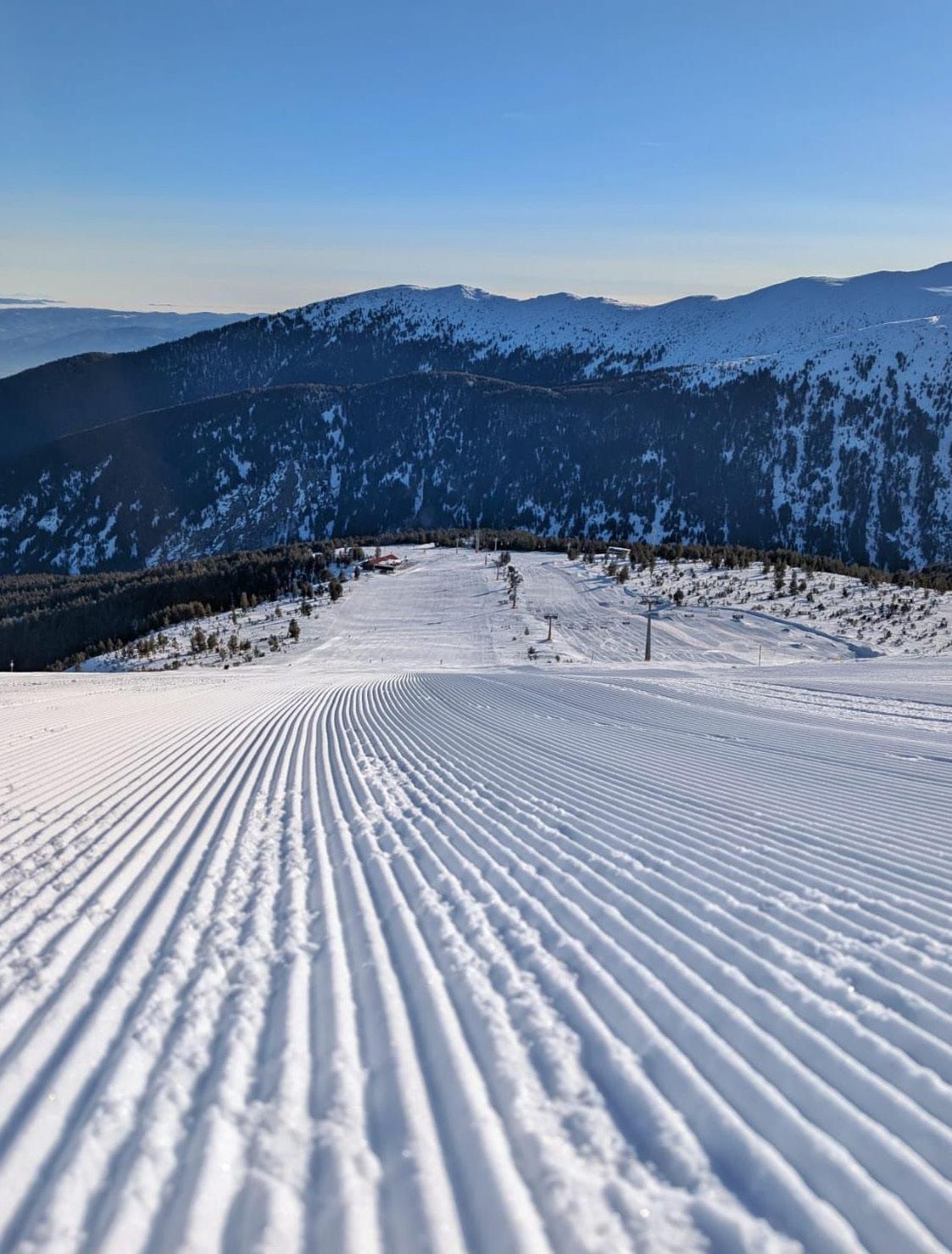
country skiing I am told when the conditions are good, for those who need more than the standard runs on the official piste map. From our viewpoint on the slope it did look highly enticing and I would love to have a go one day when time, plus conditions, allows venturing off piste. I would recommend Bansko for a long weekend for anyone who is a good skier as there is enough here, and, of course, value for money and the après ski is fun. It’s perfect for a cheeky, short mates’ trip where the emphasis on long, hard skiing days isn’t, shall we say, the main object of the exercise…
The Happy End bar at the bottom of the Bansko lift is the biggest après bar and perfect spot for loud music, great atmosphere and a beer or cocktail or whatever beverage you fancy. And if you are dining out in the evening, make sure you book one of the traditional Bulgarian eateries – known as Meyhanes – in the old, characterful, historic part of town. They are enormous fun, often with live traditional music – the salads and traditional dishes are fantastic and, again, value for money – you will have

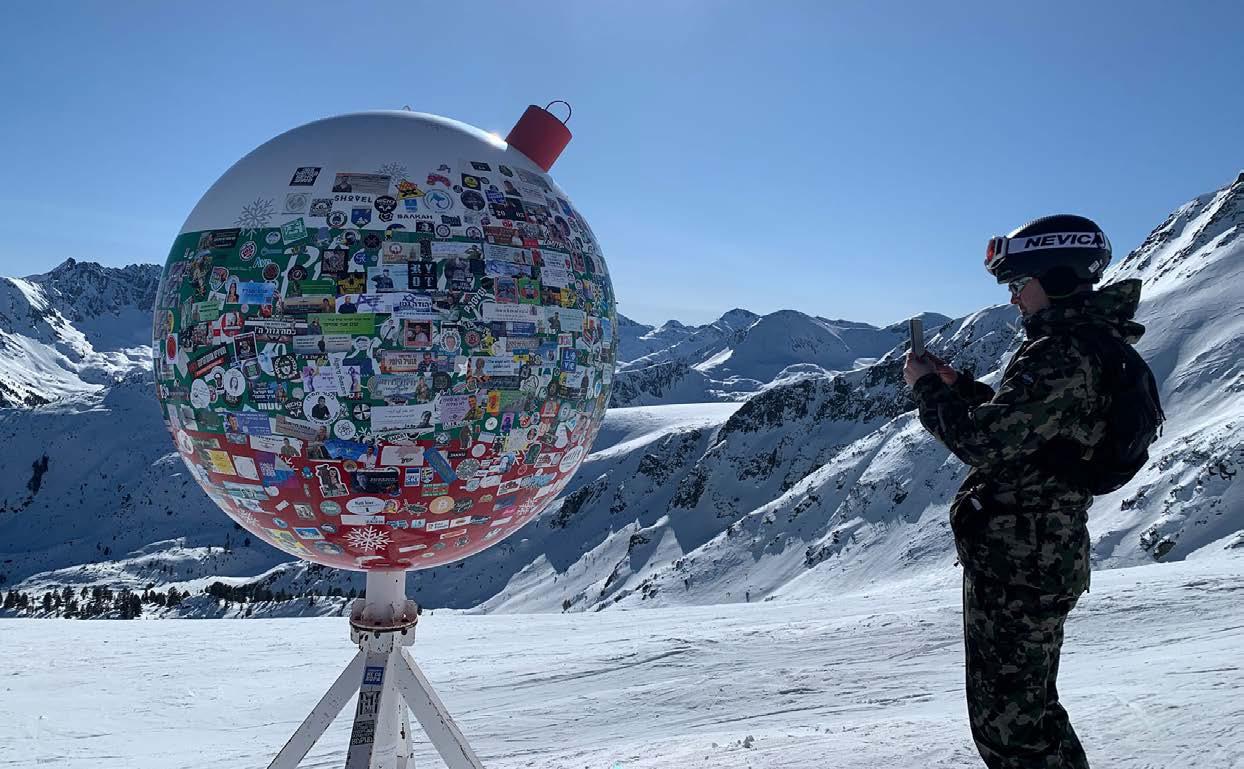
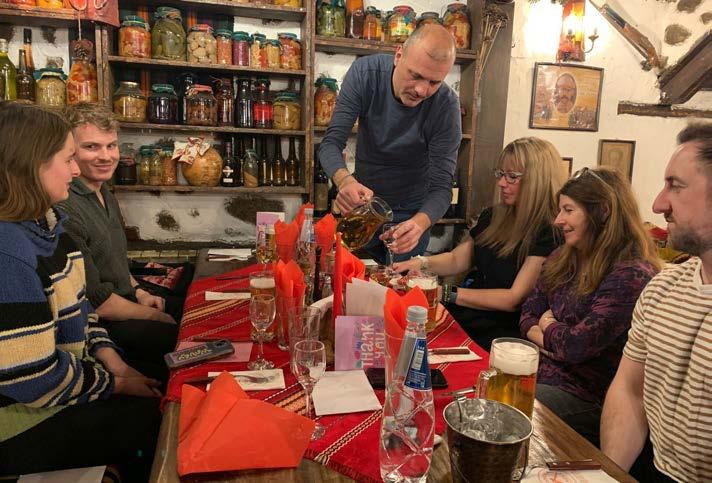
a top time. I also recommend the local Kamenitza draft beer.
Like many European ski resorts, Bansko boasts its own skiing celebrities. In this case, they are Albert Popov, an Olympic medalist who has trained here and lives in the capital Sofia. He, no doubt, used the two black runs to perfect his technique that led to his success –the black no 9 is also now a World Cup run. The other local celebrity is Olympic bronze medal biathlete and Olympic cross country skier Irina
Nikulchina. Another famous name to have graced the resort is the great Alberto Tomba who opened the new main gondola in 2003.
Bansko is very Anglified in that the shops and restaurants all sport signs in English and it obviously feels very different to the Alpine resorts. It offers lots of the internationally standard fast food you would expect and the usual imported beers, but do savour the local offerings – they are lovely. And, once again, better value for money.
“Like many European ski resorts, Bansko boasts its own skiing celebrities.”
TRAVEL FACTS
FLIGHTS
Hils flew to Sofia from Gatwick with Jet2 (transfer to Bansko 2.5 hours).
Accommodation
She stayed at the excellent 4* Four Points by Sheraton mariott.com
BOOKING
Iglu Ski offers 7 nights from £833 per person B&B, based on two sharing at the Four Points By Sheraton, Bansko, Bulgaria, departing from London Gatwick or Birmingham on 27 February 2027 with transfers – Manchester +£3 per person. Igluski.com
Colorado Spring Skiing: six late-season hits for that ‘one last trip’…
Colorado doesn’t really do “end of season” – it does an encore. With high altitude on its side, the state keeps winter rolling long after plenty of places have packed it in, serving up dependable late-season snow and those crisp, cloudless bluebird days that practically demand a victory lap (and a long lunch in the sun).
No other state in the US keeps so many ski areas open into late April and right through May, which is why Colorado has quietly become spring skiing’s spiritual home. And with 2026 set to mark Colorado’s 150th birthday, there’s a little extra sparkle to the whole thing – soft turns, sunny decks and that golden, feel-good finale to a classic Colorado winter.
There are over 30 resorts in the Centennial State, but if you’re chasing prime spring conditions, these six are especially well set up for late-season fun.
Winter Park (Mary Jane included)
When spring hits Winter Park, it hits properly – the resort often keeps lifts
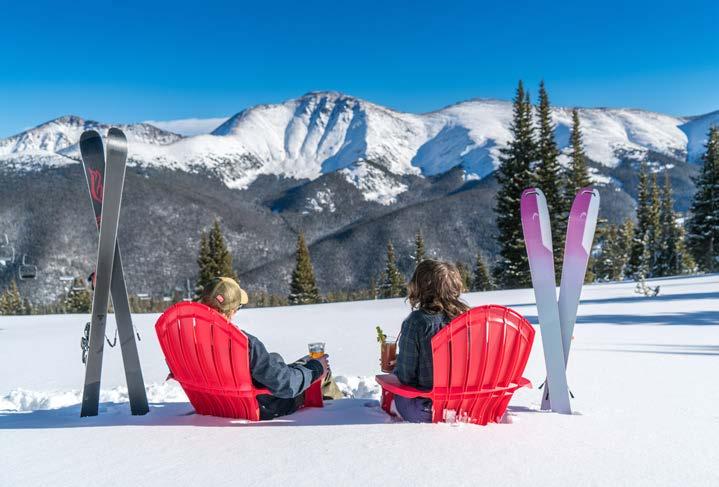
turning into May, and this year has an extra reason to visit: Mary Jane is celebrating its 50th season. Expect a nod to five decades of iconic moguls, tree laps and that relaxed local flavour that’s made “The Jane” a legend.
It’s easy to reach via US-40, there are full services at the base, and it’s tailor-made for hunting soft bumps

and sneaky stashes as the season winds down. Want to ditch the hire car? Jump on the Winter Park Express from Denver – a scenic train ride straight into the Rockies, running to 29 March this year.
Breckenridge
Breckenridge earns its spring reputation the straightforward way: altitude. With some of the highest liftserved terrain in the United States, it typically keeps the season going well into May, and that elevation helps the snow stay in good nick late on.
As spring settles in, Breck’s famously laid-back town energy turns into something more like a festival atmosphere – longer days, sunnier patios and plenty of excuses for “one more lap”. From high-alpine bowls down to easy cruisers, it’s a reliable, upbeat finish to winter.
Aspen Snowmass
Aspen Snowmass in spring is a fourmountain playground: high-elevation
PHOTO: Winter Park Ski Resort
PHOTO: Jack Affleck / Vail Resorts
Winter Park
Vail
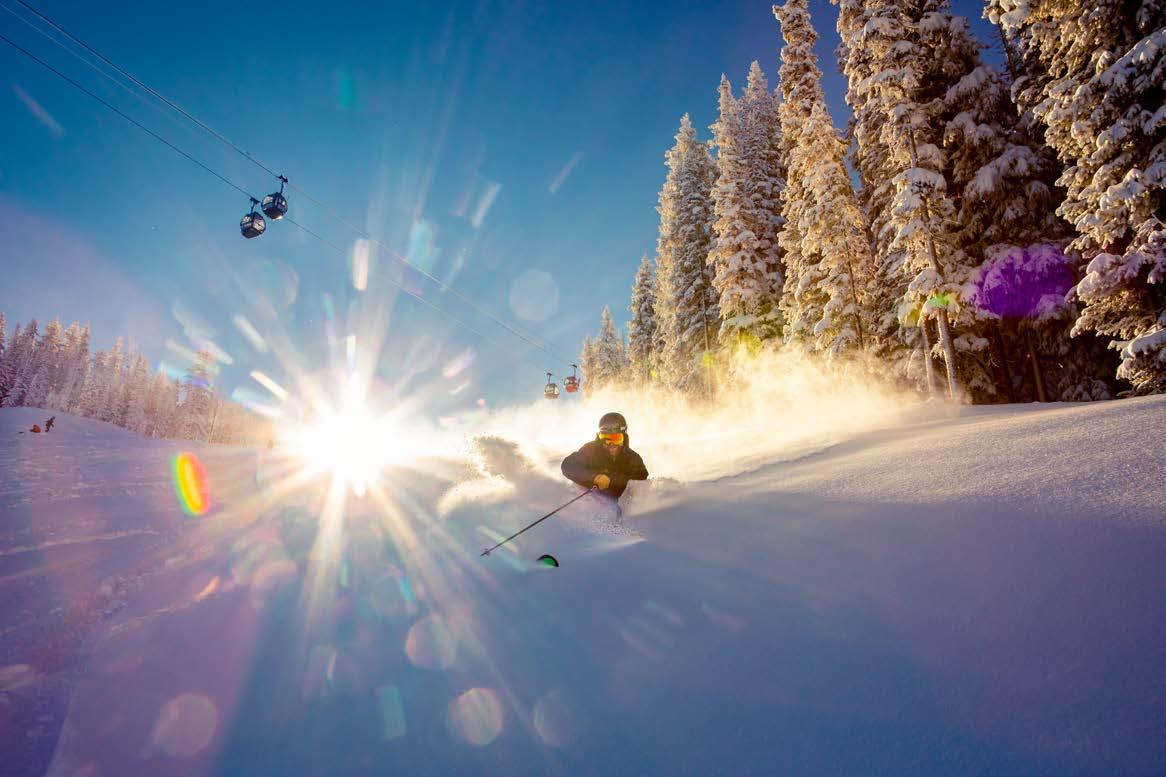
snow, longer sunny days, and a chilled, celebratory vibe that spreads across the whole valley. The calendar helps too, with events like Bacon Appreciation Day and the closing day party at the resort’s Buttermilk mountain.
On the on-snow side, this winter marks a big step forward at Snowmass with two new lifts arriving for the first time in nearly two decades. The highspeed Elk Camp Six-Pack is designed to cut queues and improve uphill flow, while the upgraded Cirque T-Bar doubles capacity and opens up access to expert terrain – smoother, quicker and more dynamic for spring skiing.
Vail
If your idea of spring skiing is big days with maximum variety, Vail fits the brief. Its high-elevation terrain holds snow deep into April, and the size of the place means you can follow the sun (and the softening snow) all day – from morning corn to mellow afternoon
cruisers – across the Back Bowls and Blue Sky Basin.
Off the hill, the village scene comes alive as patios fill and the season signs off in classic Colorado style.
Arapahoe Basin
Arapahoe Basin is the state’s lateseason specialist – a proper springskiing powerhouse. It has some of the highest lift-served terrain in North America, and one of the continent’s longest seasons, reliably stretching from October right through into June.
The elevation keeps things colder and more consistent long after other mountains have wrapped up, and when the weather is on, the steeps, chutes and the sun-soaked Beach bring a lively, end-of-season buzz.
Book your 2026/27 Epic or Ikon Pass in spring for the best deal
If you’re already thinking about next winter, spring is also when the value
play happens. Epic and Ikon both release their lowest prices well before winter demand pushes rates up, so buying early is the way to lock in the full set of perks – and guarantee access to every included resort.
In Colorado, Epic covers Vail, Beaver Creek, Breckenridge, Keystone and Crested Butte. Ikon spans Winter Park, Arapahoe Basin and Steamboat, with limited access to Aspen Snowmass and Copper Mountain.
Beyond Colorado, both passes also open the door to many of North America and the world’s great resorts – and buying in spring gives you the strongest value, widest choice and maximum flexibility for the season ahead.
Find out more at colorado.com/ international-visitors-winter-season

PHOTO:
Aspen Mountain
Familyfriendly fun on offer at Whistler
Family Day was held on 16 February in Canada – a holiday established to encourage families to spend time together. Throughout the winter season, Whistler is a family-friendly destination offering a wide range of outdoor activities, cultural experiences and a walkable Village designed to support family travel.
Whistler Blackcomb ski resort features varied ski and snowboard terrain suited to all ability levels, making it accessible for families with mixed experience. Dedicated family and beginner zones, along with lesson programs, support younger and beginner skiers and riders. Onmountain features such as the Magic Castle on Blackcomb and the Tree Fort on Whistler provide opportunities for play and exploration on the slopes.
For families looking to spend time on the mountain without skiing or snowboarding, the Whistler Blackcomb bubly™ Tube Park offers a lift-accessed tubing experience designed for all ages.
Whistler’s winter appeal extends beyond alpine activities, making it well suited to families that include non-skiers or those looking to balance active days with alternative experiences. Throughout the winter, families
“It features varied ski and snowboard terrain suited to all ability levels.”
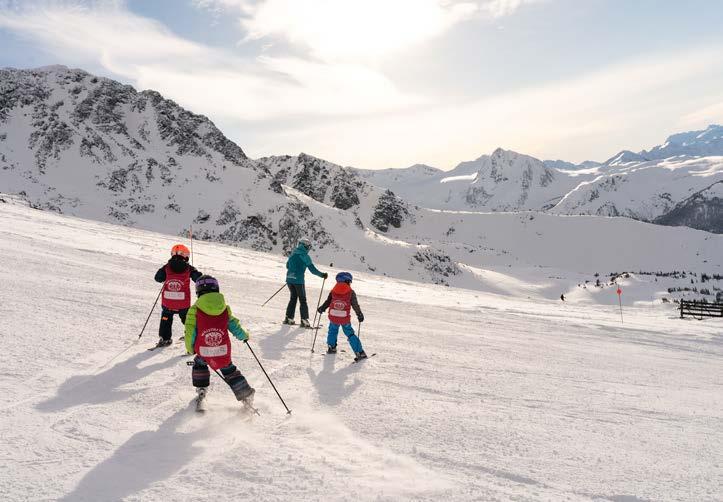
can enjoy a range of outdoor winter activities, including snowshoeing and Nordic skiing on maintained trail networks, as well as guided snowmobile tours. Immersive experiences such as Vallea Lumina, a self-guided evening walk through a multimedia-lit forest, and Ziptrek Ecotours’ guided zipline tours through old-growth forest offer additional options for shared family experiences.
In the Village, Whistler Olympic Plaza provides additional opportunities for families to spend time outdoors, with winter ice skating, a treehouse-style playground that is accessible for a range of abilities and a seasonal family snow zone.
In addition to outdoor recreation, Whistler offers family-friendly cultural and educational experiences. The Squamish Lil’wat Cultural Centre welcomes families year-round with interactive programming led by Squamish Nation and Lil’wat Nation Cultural Ambassadors, including storytelling and hands-on activities that introduce visitors to the cultures of the region’s First Peoples.
The Whistler Museum also offers family-oriented exhibits and programming that explore the community’s history in accessible and engaging ways, providing opportunities for families to learn together while spending time in the Village.
Whistler offers families a wide range of experiences within a compact, pedestrian-friendly resort, making it well suited to family travel. Families can easily move between accommodation, dining, outdoor activities and Villagebased experiences without the need for a vehicle, making it easier to spend time together and move at a pace that suits everyone.
This flexibility allows families to shape a winter visit around their interests and energy levels, combining mountain time with off-slope activities and shared downtime. The destination’s variety also makes it well suited to multi-generational families and groups with mixed interests.
Families planning a winter visit to Whistler are encouraged to travel midweek and, where possible, extend the length of their stay to enjoy a quieter pace and greater availability across the resort. Building itineraries that mix ski days with off-mountain and Village-based activities can help create a more balanced and enjoyable experience for all ages.
Shuttle services connect Whistler with Vancouver and Vancouver International Airport, and once in the resort, the walkable Village and local transit options make it easy to explore.
For more family-focused trip planning resources and winter inspiration, visit whistler.com/family
PHOTO: Tourism Whistler/Vince Emond, ©
Easter getaways
With spring fast approaching, high-altitude resorts across Europe and North America offer reliable snow, longer days and sunshine-filled slopes for an Easter getaway.
Ski Solutions has rounded up a selection of top destinations for an unforgettable spring escape.
Tignes, France
Known for its high altitude and reliable snow conditions, Tignes, alongside Val d’Isère, forms part of one of France’s most snow-sure ski areas. Reaching up to 3,456m at the Grande Motte glacier, the linked Tignes-Val d’Isère ski area is made up of varied terrain from wide, confidence-building pistes to more challenging glacier skiing for experienced skiers. With natural links between resorts and a long season running until early May, it’s a dependable choice for a relaxed Easter ski holiday.
Hotel VoulezVous offers a luxury ski getaway in a striking, modern setting. Located just steps from the slopes, it’s the perfect base for exceptional skiing and with a wide choice of rooms and suites. Ski Solutions offers a seven-night stay from 28 March at Hotel VoulezVous, Tignes on a half board basis, priced from £2,645pp including accommodation, flights and private transfers.
Cervinia, Italy
Linked with neighbouring Zermatt in Switzerland, Cervinia offers a fantastic base. With skiing reaching an impressive 3,500m and more than 360km of slopes across the region, Cervinia promises big-mountain variety. The area is particularly well suited to intermediate skiers, while advanced visitors can enjoy exciting off-piste opportunities.
Located on the southern side of the Matterhorn on the Italian-Swiss border, Cervinia is one of the world’s highest ski resorts – making it ideal for a snow sure trip.
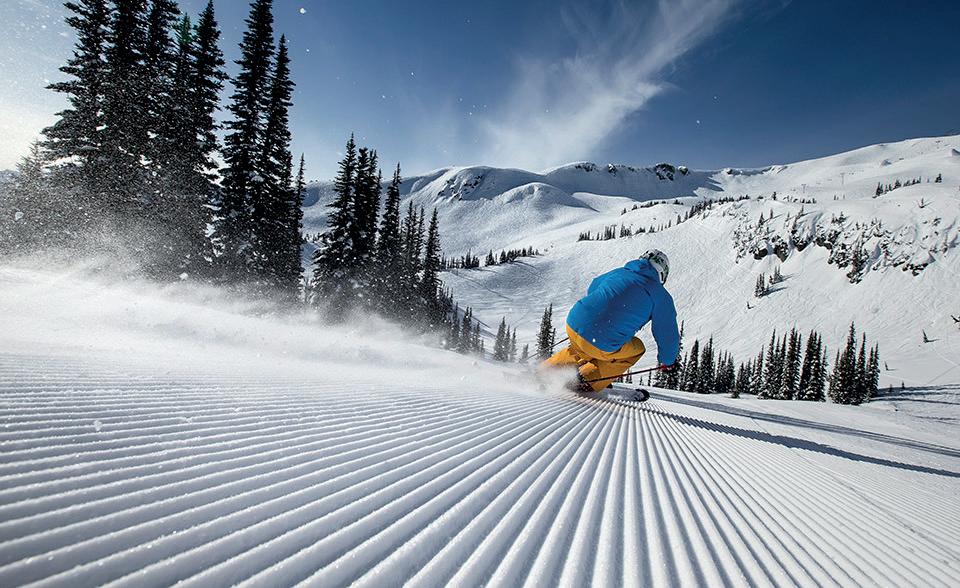
The Relais & Châteaux-listed Hermitage Hotel offers elegant Alpine rooms with Matterhorn views, warm wood interiors and a reputation for excellent service. Known for its serene ambience, the Hermitage Hotel is a wonderful retreat for relaxation. Ski Solutions offers a seven-night stay from 4 April at Hermitage Hotel & Spa on a half board basis, priced from £5,845pp including accommodation, flights and private transfers.
Geilo, Norway
One of Norway’s oldest ski resorts, Geilo offers a wonderfully peaceful choice for a spring getaway. It’s especially good for families and beginners, with quiet slopes and plenty of gentle terrain. Off the slopes, families can enjoy husky-sled adventures or spot reindeer at Langedrag Nature Park.
Vestlia Resort blends contemporary comfort with traditional Alpine style. Its standout spa includes two saunas, a steam room, indoor hot tub, plunge pool, swimming pool and a peaceful relaxation area. The resort offers ski-in, ski-out access and sits just 50 metres from the ski school and childcare centre. Ski Solutions offers a sevennight stay from 5 April at Vestlia Resort, Geilo on a half board basis priced from
£1,595pp including accommodation, flights and rail transfers.
Whistler, Canada
The mountains in Whistler are a skier’s dream destination, offering the ultimate big mountain experience. Skiers and boarders have access to over 8,000 acres of varied terrain thanks to the Peak 2 Peak Gondola. The village itself is filled with everything from lively music venues to cosy snugs for visitors to enjoy.
Delta Whistler Village Suites offers self-catering apartment-style suites with all the conveniences of a full-service hotel. Located in the heart of Whistler Village, it’s steps from shops and restaurants and a short walk, or complimentary shuttle ride, to the main ski lifts. Guests can enjoy concierge and room service, as well as the on-site Brick Works Public House for all-day dining. Wellness facilities include an outdoor pool, hot tubs and a sauna, with well-equipped suites for those who prefer to cook in.
Ski Solutions offers a seven-night stay from 4 April at Delta Whistler Village Suites, Whistler on a room only basis priced from £1,895pp including accommodation, flights and shared transfers.
skisolutions.com
Whistler
Yogiski, France
From 10-16 April, Yogiski returns for its 10th year in Les Menuires and Saint-Martin-de-Belleville combining relaxation, yoga and connection with nature. A wide range of wellbeing activities are on offer throughout the week, including a first track with yoga session at 2,800 metres, Tai Chi, Ayurveda and plantar reflexology workshops, as well as sound baths and candle-lit yin yoga sessions.
One of the highlights of Yogiski is the yoga hike to the Lac du Lou mountain refuge. After an ascent on snowshoes at sunset, a session of relaxing and energising hatha yoga welcomes guests, before enjoying a vegetarian, local meal at the mountain refuge. The evening ends with a descent under a starry sky. Two expert ambassadors guide guests through a range of workshops designed to revitalise body and mind. Caroline Perrineau, an influential Parisian yogist and an expert in Vinyasa yoga, offers an experience enriched by her knowledge of movement neurology, prenatal and postnatal yoga and mental health and Mathilde Guibert, founder of Solstice 108, offers an inclusive practice accessible to all, whatever age or level.
Classes are open to all and free of charge by signing up at the Tourist Office (T&Cs apply). lesmenuires.com/en/yogiski
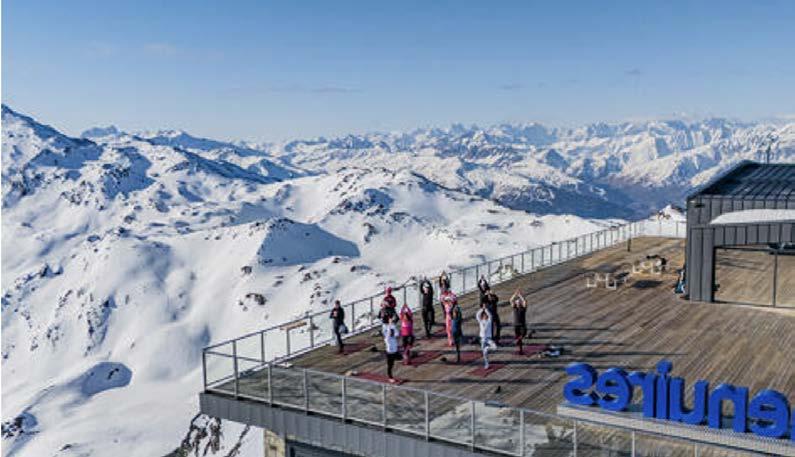
Morzine, France
With excellent snow conditions across Avoriaz and longer, brighter days on the horizon, March is a great time to enjoy a late-season ski escape with AliKats. Tucked away beside the river in Montriond and surrounded by pine trees, Chalet Rivière offers a peaceful, design-led base just minutes from the Ardent ski lift. Sleeping up to 13 guests, the chalet is ideal for families and groups, featuring four en-suite bedrooms, a mezzanine snug, a spacious open-plan living area with double-height ceilings, a modern kitchen, and a brand-new outdoor hot tub with beautiful mountain
Head to Cortina in winter 26/27
Here are Iglu Ski’s top choices for those wanting to head to Cortina in Winter 26/27.
Iglu Ski propose the 3* Sport Hotel Barisetti, Cortina, Italy, from £1,436 per person, based on two sharing, half board, departing London Gatwick on 16 January 2027 with overseas transfers. +£10 Manchester; +£80 Edinburgh; +£60 Birmingham.
The Sport Hotel Barisetti has been a favourite with guests for many years and is located in a prime position, close to one of the main cable cars. The Barisetti family take pride in making their guests feel part
of the family, ensuring that everyone enjoys their stay.
Iglu Ski offer 7 nights at the 3* Panda Hotel, Cortina, Italy, from £1,073, was £1,115 per person, based on two sharing a twin room with balcony, B&B, departing Birmingham on 30 January 2027 with transfers. +£66 Edinburgh; +£5 London Gatwick; +£3 Manchester; +£3 Bristol; +£4 Newcastle.
The Hotel Panda is in a handy location, just a five-minute walk from Cortina’s main, pedestrianised Corso Italia and about 10 minutes on foot from the Faloria ski lifts. igluski.com
views. Guests also benefit from a dedicated ski and boot room, plus a complimentary slope-run service to make getting to the lifts effortless.
A week’s stay at Chalet Rivière, departing 22 March 2026, costs £4,128 total on a self-catered basis, with slope runs included. Flights and transfers extra. alikats.eu
Morzine, France
Morzine’s new unmissable restaurant in the heart of its village has opened its doors. Run by the same team as the infamous Le Crépu restaurant, a village favourite for over 25 years, Comptoir des Halles (formerly the Haka) brings a
Yogiski
new energy to Morzine with its vibrant street-food style menu. Perfect for any time of day, guests can savour its delicious food while soaking in the midday sun or taking in the alpine sunsets from its large terrace just a few steps away from Le Crépu.
A seven night stay at Hotel Les Bruyères, arriving 14 March 2026 is priced from £601pp based on two sharing a twin room on a B&B basis. Flights and transfers extra. morzine-avoriaz.com
Verbier, Switzerland
Le Chaman, a new high-end eatery, promises to bring exciting flavours and lively evenings to Verbier. Located on the site of the former Chez Martin in the centre of Verbier and having undergone a complete facelift, this bistronomic restaurant will deliver refined cuisine in a relaxed atmosphere. On the agenda: local seasonal produce, a constantly evolving menu, après-ski cocktails, elegant dinners and year-round events. An extra-large, sun-baked terrace will offer breathtaking views of the Alps.
A seven-night stay at Hotel Mirabeau, arriving 21 March 2026, is priced from £1,219pp based on two sharing a double room with breakfast included. Flights and transfers extra. verbier.ch
Kitzbühel, Austria
At Berggericht, a four-toque restaurant in the heart of Kitzbühel, Austrian Tirol, fine dining reaches new heights. As Austria’s highestranked newcomer, the restaurant is led by Chef de Cuisine Marco Gatterer, whose cuisine is defined by precision, seasonality and exceptional produce. Drawing on the best regional ingredients alongside refined specialities from France and Japan, he creates dishes that are both elegant and memorable. The experience is further elevated by Patrick Fuchs, a qualified sommelier who curates an extensive, high-quality wine list to complement the menu.
A seven-night stay at Pension Rainhof, arriving 7 March 2026, is priced from £549pp based on two sharing a double room with breakfast included. Flights and transfers extra. kitzbuehel.com
Jackson Hole, USA
The Rendezvous Music Festival will return to Jackson Hole on 28 March, bringing a standout line-up of artists to one of North America’s most iconic mountain settings. The 2026 edition will be headlined by Grammy Awardwinning The Flaming Lips, alongside the acclaimed jam-band Umphrey’s McGee and a high-energy opening
set from DJ Blake Horseman. The weekend’s celebrations begin a day earlier on Friday, 27 March, when skiers and music fans alike can ski directly to a free Souls of Mischief concert beneath the Jackson Hole Tram. The performance marks the finale of the resort’s Road to Rendezvous music series, setting the stage for the main event. General Admission tickets are priced from £30/$41pp.
A three-night stay at Parkway Inn of Jackson Hole departing 26 March 2026 costs from £481 total for four people sharing a superior double queen room.
jacksonhole.com
Jackson Hole, USA
There is a new tempting prospect for international visitors who are eligible for Kids 12 and under ski free with a purchase of an adult life pass (3+ days) plus specially discounted lift passes at Jackson Hole. A new 10-day adult pass costs from £700, 20-day adult pass from £923 and 30 days adult lift pass from £1,145.
A seven-night stay at Gravity Haus Jackson Hole arriving 21 March 2026 is priced from £876pp based on two sharing a King Room. Flights, transfers and lift passes extra. jacksonhole.com

Aprentices’ incredible Morzine trip
National snowsports youth charity Snow Camp is celebrating after taking 15 of its apprentices to Morzine in the French Alps, for an immersive careersfocused experience week designed to build confidence, skills and real-world industry insight in real mountain terrain. The week, just one of many fantastic opportunities offered by Snow Camp, was powered by the Salomon Foundation with a generous donation of €18,000 to fund the experience.

The Morzine Experience Week formed part of Snow Camp’s awardwinning apprenticeship programme, combining on-snow training, mountain safety education and behind-thescenes access to businesses operating at the heart of resort life.
Across the Morzine Experience Week, all apprentices advanced their ski and snowboard skills with specialist instructors, alongside specialist avalanche awareness training and career conversations with industry professionals to help them better understand the range of roles available across snowsports, hospitality and the wider mountain economy.
The group was hosted by Atlas Ski Co who provided a supportive space for apprentices to rest, reflect and recharge after full days of learning, helping create the conditions for young people to get the most out of their week in resort.
Apprentices spent time taking part
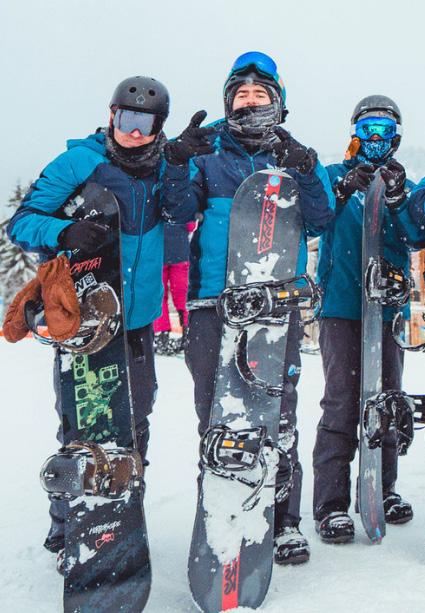
in avalanche safety training delivered by Pulse Snowsports. The session covered key skills used by mountain professionals, including assessing avalanche risk, using transceivers, probes and shovels, and applying search techniques in simulated buried scenarios, all important knowledge that links directly to the apprentices’ BASI Level 1 pathway.
The week also included opportunities to explore commercial careers in snowsports, including a full-day insight experience at the Salomon Design Centre in Annecy, plus introductions to multiple businesses across the resorts of Morzine, Les Get and Avoriaz.
Apprentices were hosted by Summit
New Indoor centre opens
A new indoor snowsport training centre is now open in the grounds of the Luton Hoo Estate on the Bedfordshire/Hertfordshire border.
InPiste offers year-round training for skiers and snowboarders of all abilities, combining the Infinity Piste rolling slope with SkyTech Sport precision carving simulators – the most advanced technology of its kind in the UK. With personalised lessons, instant feedback and data-driven performance analysis, InPiste is designed to support everyone; from families preparing for their first ski
holiday, to experienced athletes maintaining peak performance outside the winter season. In addition to building skills, InPiste will provide a unique environment for maintaining fitness and ski and snowboard specific conditioning all year, as well as supporting injury rehabilitation through controlled, adjustable training sessions.
But the centre’s ambition doesn’t stop there. InPiste has a bold vision to help develop the next generation of UK snowsport talent, creating a pathway for young athletes who aspire
to compete on the world stage.
InPiste will provide all equipment needed, but visitors are welcome to bring their own ski or snowboarding boots for a familiar feel. The centre has free parking and the ‘Après Zone’, a dedicated lounge area offering a space to recover, review training feedback, or connect with coaches off the piste. For parents and supporters, a viewing area provides the chance to watch sessions up close.
All sessions can be booked online for convenience with discounts for multilesson bookings. inpiste.co.uk

Special at their flagship property Chalet Blythe on their day of arrival, who are long-time supporters of Snow Camp, where the group heard first-hand what a season in the Alps involves and what it takes to build a career in resort. The visit was a full-circle moment for the charity, with two former Snow Camp Apprentices now working at Summit Special and inspiring the next cohort of apprentices.
On the snow, apprentices progressed their skills with support from Real Snowboarding and Pulse Snowsports; progressing their BASI training and confidence to deliver snowsport training in a real mountain environment.
The careers focus continued with a behind-the-scenes visit to Le Tremplin,
one of Morzine’s best-known venues, where apprentices gained insight into the reality of hospitality and the skills required to run a high-energy bar, hotel and restaurant in a busy ski resort. Morv Bett, Head of Snow Camp Futures, said: “The apprentices have had an incredible week and have returned with so much insight and drive to advance their snowsports careers. We are so grateful to all partners involved in making the Morzine Experience Week possible, and to those who continue to support Snow Camp’s mission of creating life-changing opportunities for young people from inner city communities through snowsports.” snow-camp.org.uk
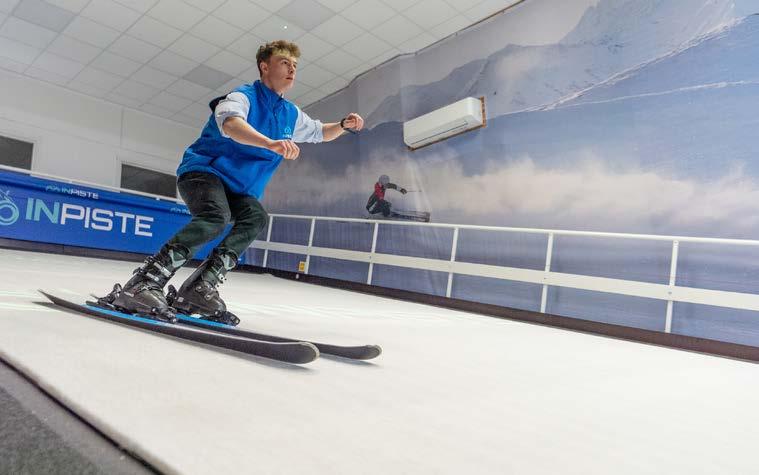
Peta urges resort to go vegan
Following reports that the UK’s largest indoor ski resort has received planning permission to open in Merthyr Tydfil, PETA has sent a letter to Rhydycar West CEO Ali Tyebkhan, urging him to open the resort with fully vegan menus to combat the climate crisis and support local plant farmers.
If Tyebkhan agrees to the plant-powered proposal, PETA will provide free vegan cheese fondue for all skiers on the resort’s opening day.
Valleys resident and PETA Senior Corporate Projects Manager Dr Carys Bennett said: “PETA is urging the ski resort to be a beacon of renewal and hope for Merthyr, Wales and the world, by opening with fully vegan menus.”
Research shows that each person who goes vegan lowers their food-related carbon footprint by up to 75% – making it conceivably the biggest way to reduce one’s negative impact on the planet.
For more information, visit PETA.org.uk

PHOTO: © Richard Washbrooke/Richard Washbrooke Photography
Directory
Anything
Technical Ltd
Sand Aire House, New Road, Kendal, Cumbria, LA9 4AY
Tel: 01539 734701
Email:
info@skiequipmentuk.co.uk
Web:
www.skiequipmentuk.co.uk
Ski boot fitting and ski/ board servicing experts. Ski boot spare parts specialists. Technician training courses.
ESSEX
Alpine Room
71-73 Main Road, Danbury, Essex, CM3 4DJ
Tel: 01245 223563
Web: www.alpineroomshop.co.uk
Alpine Room is a snowsports shop trading since 1970. Every year we put together a stunning collection of snow wear for the whole family, for all abilities and budgets. On site are specialist ski boot fitters who customise boots and mould footbeds, plus a workshop to service skis and snowboards. We cater for everyone and pride ourselves on our specialist status!

Skee
Tex
The Old Mill, Battlebridge, Essex, SS11 8TR
Tel: 01268 768282
Email:
info@skee-tex.co.uk Web: www.skee-tex.co.uk
Specialist snowsports shop, established over 70 years. Experienced boot fitters, full service workshop. Main dealers for K2, Lange, Goldbergh, CMP, Dahu, Salomon, Head, Picture, Hestra, Scott, Olang, Spyder, Henri Duvillard and Protest to name a few.
HAMPSHIRE

Snowtogs
429/431 Millbrook Road, Southampton, SO15 0HX
Tel: 02380 773925
Email:
info@snowtogs.co.uk Web: www.skishops.co.uk
Snowtogs Southampton. One of the oldest family run ski shops in the country, established in 1969. Well known for our custom ski boot fitting with boots from the worlds best brands. We have a full ski workshop on site providing servicing and binding fitting. We also stock a massive range of helmets and goggles and loads of other essential accessories. We now have an onsite booking system for custom boot fitting appointments. Please see our website for more details.

Captains Cabin
Sevenoaks
113/115 St Johns Hill, Sevenoaks, Kent, TN13 3PE
Tel: 01732 464463
Email: sales@theski-shop.co.uk
Web: www.theski-shop.co.uk
Fantastic choice of ski clothing and equipment. All major brands stocked. Professional boot fitting service, hire and workshop repair.
LANCASHIRE
Rivington Alpine
The Old Methodist Church, Market Street, Adlington, Chorley, Lancashire, PR7 4HE
Tel: 01257 483999
Email:
sales@rivingtonalpine.co.uk Web: www.rivingtonalpine.co.uk
Specialist ski boot fitting, modification and footbed manufacture. All major brands stocked and all levels of skier welcome. Free parking outside. Call for an appointment.

Love & Piste
Alberts Barn, 33 Costock Road, East Leake, Loughborough, LE12 6LY
Tel: 01509 853944
Email: sales@loveandpiste.co.uk
Web: www.loveandpiste.co.uk
Established 25 years ago, we are independent skiwear specialists with a store in East Leake (between Leicester & Nottingham) including an inhouse coffee shop & large free parking area, as well as an established website. We cater for the whole family providing clothing, helmets, goggles, sunglasses & luggage. Brands include; Bigbobble Hats, BUFF, Coolcasc, CMP, CRAFT, Helly Hansen, Hestra, Killtec, Manbi, Maier Sports, Oakley, Protest, Reusch, Rossignol, Salice, Snokart, SPY, Stenier, UVEX. Follow us on Instagram and Facebook @loveandpiste.
LINCOLNSHIRE

Tallington Lakes Pro Shop
Barholm Road, Tallington, Stamford, Lincolnshire, PE9 4RJ
Tel:
01778 347000
Email: sales@tallingtonlakesproshop. com
Web:
www.tallingtonlakesproshop.com
Est 1975. An independent ski and snowboard retailer, with years of experience, including custom ski boot fitting service. Large selection of quality clothing and hardware from quality brands. On-site dry ski slope and equipment servicing workshop. Free delivery with online orders over £100.
Profeet Ski Boot Lab
867-869 Fulham Road, London, SW6 5HP
Tel:
020 7736 0046
Email:
info@profeet.co.uk
Web: www.profeet.co.uk/skiing
Profeet are ski boot specialists – extensive selection for all foot shapes and skiing abilities. The latest, alpine, freeride and touring models. By appointment custom fitting with custom ski insoles, custom liners and boot heaters. Comprehensive comfort guarantee.
SCOTLAND
SUFFOLK LONDON LONDON
Finches Emporium
25-27 Perry Vale, Forest Hill, London, SE23 2NE
Tel:
0208 699 6768
Web: www.finchesemporium.com
Finches Emporium is a family run business established since 1947. Our main departments are ski, snowboard, cycle and skateboard with everything you might need for your sport as well as experienced workshops in each discipline.
Snowfit
Unit C & D, Yarefield Park, Old Hall Road, Norwich, NR4 6FF
Tel: 01603 716655
Email: info@snowfit.co.uk
Web: www.snowfit.co.uk
Since 1998 Snowfit has been offering expert advice for equipment & clothing, specialist boot fitting & servicing. We stock equipment, clothing & accessories from all the brands you would expect to find in a proper winter sports specialist. Visit instore or online.

Banks of Perth 29 St John Street, Perth, PH1 5SH
Tel: 01738 624928
Email: enquiries@banksofperth.co.uk
Web: www.banksofperth.co.uk
Large range of equipment plus junior and adult ski clothing. Specialists in boot fitting and custom insoles.
SCOTLAND

Craigdon Mountain Sports Edinburgh 44 Biggar Road, Edinburgh, EH10 7BJ
Tel: 0131 374 2238
Email: shop@cms-edinburgh.com
Web: www.craigdon-edinburgh.com
Improve your mental wellbeing, sack off work... go skiing! Ski/snowboard servicing, coffee & cake, expert boot fitting. Independent Scottish Outdoor Retailer of the Year 2025.

Active Snowsports
Suffolk Ski Centre, Bourne Hill, Ipswich, Suffolk, IP2 8NQ
Tel: 01473 487474
Email: info@activesnowsports.com
Web: www.activesnowsports.com
Custom boot fitting, service and repair, skis, snowboards, boots, clothing and much more.
WEST SUSSEX
The Skiers Lounge
The Ski Barn, Worthing Road (A24 Northbound), Nr Horsham, West Sussex, RH13 8LG
Tel: 01403 915655
Email: support@theskierslounge.co.uk
Web: www.theskierslounge.co.uk
Experienced ski boot fitters carrying a range of boots for all feet from first time buyers to seasonnaires. Our FREE by appointment fitting in our specialist showroom ensures the best possible ski boot fit whether you require comfort and/or performance. Our advanced workshop repairs and services skis and is a training centre for technicians across the globe.
the ski boot revolution
CHRIS EXALL discovers two companies that have thrown the ski boot design playbook out of the window, plus checks out the launch of some unisex goggles and lightweight jackets
For decades, ski boot design has followed a predictable template: a lower shell connected to an upper cuff at pivot points positioned just above the ankle or a 3 piece cabrio shell with a hinged external tongue. Two companies have thrown that playbook out the window. Salomon with their flagship 2026-2027 S/Pro Alpha C BOA 130 and China’s SUN ski boots introducing the most radical rethinking of alpine boot architecture we’ve seen in years.
Salomon S/Pro
Alpha C BOA 130
The ski boot industry has been locked in a “BOA arms race”, with brands scrambling to slap dials on the lower shell to replace traditional forefoot buckles. But for the 2026-2027 season, Salomon has flipped the script –and the boot – upside down.
The all-new S/ Pro Alpha C BOA 130 isn’t just an iteration of the beloved Alpha line; it is a fundamental re-imagining of how a highperformance alpine
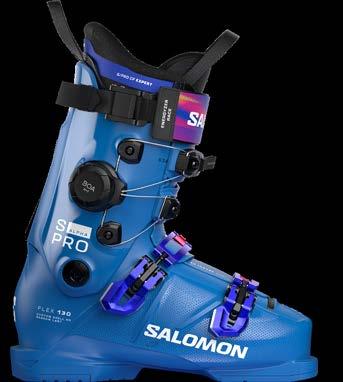
boot should flex, wrap and drive.
The first thing you notice when holding the Alpha C is what’s missing. Look at the medial (inside) ankle, and you’ll see a clean, unbroken wall of mono-injected plastic. Salomon has officially killed the internal cuff hinge.
This new ExoDrive construction uses a single lateral pivot on the outside and a reinforced Powerlink metallic plate on the inside. By removing the traditional hinge on the medial side, Salomon has eliminated the “hinge lag” that occurs when you initiate a turn. The result? A boot that feels like a solid extension of your lower leg, offering a level of lateral power transmission that feels closer to a World Cup plug boot than a resortfriendly 98mm last.
As Archimedes said ‘Give me a lever long enough and a fulcrum on which to place it, and I shall move the world’. The longer cuff is that lever.
“This is the most direct, progressive and smooth alpine boot Salomon has ever designed. The evolution of the S/ PRO Alpha C BOA is all about giving aggressive skiers more power and control without sacrificing comfort. We reworked this boot from the inside out to deliver a high-performance design that responds instinctively on snow thanks to the new ExoDrive and better heel hold, enhanced energy transmission and a fit that can be dialed in with absolute precision,” said Lauren Samuels, Salomon’s North American Alpine Category Manager.
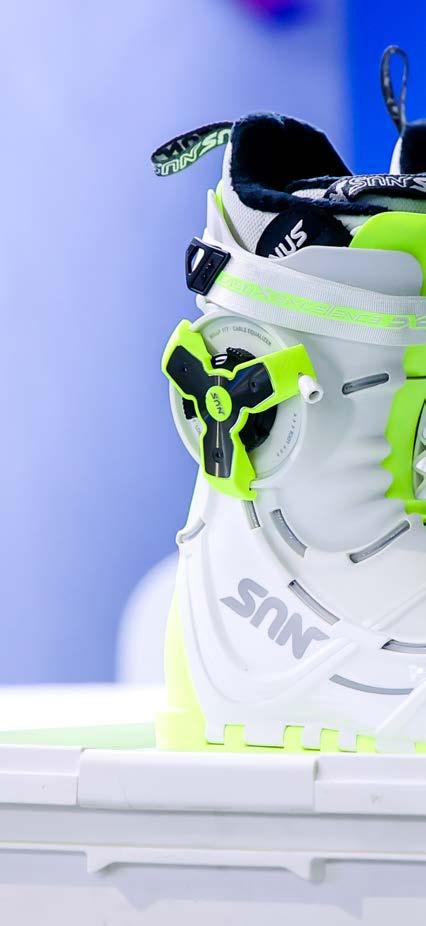
After extensive testing across varied terrain, I can report that Salomon’s gamble has largely paid off. The S/Pro Alpha C BOA 130 represents a genuine leap forward in boot performance, even if it asks skiers to embrace some unconventional design choices.
This asymmetric design fundamentally changes how force transfers from your leg to your ski. By lowering and extending the connection points, Salomon claims the boot provides better leverage and more direct power transmission. Additionally, the medial instep buckle now attaches to the cuff rather than the lower shell, which the company says improves ankle wrap and eliminates unwanted foot compression.
On paper, it sounds like marketing speak. On snow, it’s immediately apparent.
The power transmission through this boot is exceptional. Edge engagement feels instantaneous and
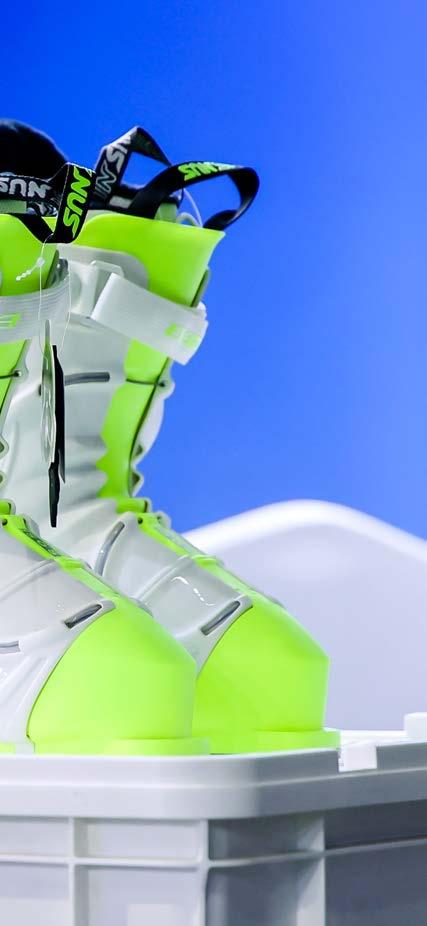
authoritative, with minimal slop or lag between input and response. It’s particularly noticeable when driving hard into carved turns or making rapid directional changes – the boot transfers your intentions to the ski with power, clarity and precision.
The 130 flex rating is pretty accurate, though the boot exhibits an intriguingly progressive character. Initial flex feels smoother than expected –almost approachable –before ramming into firm, supportive resistance deeper in the range. The rebound sits somewhere in the medium-fast category, neither snappy nor sluggish. This progressive flex characteristic allows the boot to feel softer at first contact, then quickly firm up to
“SUN has probably the most unique ski boot design seen in the last 20 years.”
130-level stiffness as you drive into the travel, making it surprisingly versatile across different skiing styles and conditions.
Where the boot truly excels is heel retention. The combination of the ExoDrive shell geometry and the extended cuff wrap creates exceptional heel lock without excessive pressure or discomfort. For skiers who’ve struggled with heel lift in other “low-volume” boots, this design addresses that issue more effectively than any amount of custom work on a conventional shell could achieve.
Salomon markets this as a 98mm last boot targeting low-volume feet, and that designation holds true – with some important caveats. The heel pocket runs genuinely snug without being punishingly tight, ideal for those with narrow heels who’ve found other “LV” boots disappointingly roomy. The boot features a cuff-mounted BOA dial working in conjunction with two traditional lower buckles. This hybrid approach aims to combine independent lower-shell adjustment with the consistent, even cuff closure that BOA systems provide.
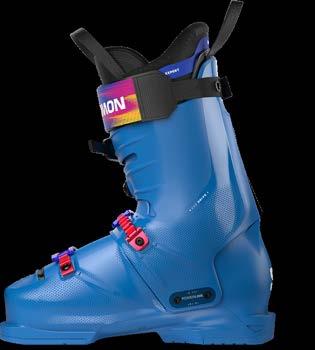
It works – the BOA allows micro-adjustable cuff tightening that distributes pressure more evenly than conventional buckles, while the traditional lower buckles give bootfitters familiar adjustment points and skiers the ability to fine-tune forefoot retention independently.
The shell can be heat molded via Salomon’s Custom Shell HD process, and the S/Pro CF Expert liner also offers full heat moldability along with an adjustable, “edgeless” tongue design. The combination
provides substantial customisation potential without requiring aggressive shell work.
The Salomon S/Pro Alpha C BOA 130 succeeds at what matters most: making skiers better. The ExoDrive shell geometry delivers measurably improved power transfer and edge control, while the heel retention surpasses virtually anything in the narrow-last category. The fit works beautifully for those with narrow heels and higher insteps, though it won’t suit every foot shape.
This boot represents genuine innovation rather than incremental refinement. Salomon took real risks with this design, and those risks have produced real rewards. For advanced to expert skiers seeking maximum performance from a narrow-last boot, the S/Pro Alpha C BOA 130 sets a new benchmark.
Sun Ski Boots
It’s not too many years ago that Top Gear ran specials looking at ‘funny’ Chinese built cars, mocking their derivative designs. Now, to the annoyance of western car manufacturers, Chinese car companies have taken over the electric car market with vehicles which are frequently cheaper and better than their competitors. Companies like BYD and Jaecoo are taking on western competitors and winning.
Within snowsports, it’s only a couple of years since the product manager of a well known ski company told me that ‘no one could make ski boots in China, they don’t have the machines or the technology’. Well they do and they can.
SUN has probably the most unique ski boot design seen in the last 20 years. It’s literally like no other ski boot on the market. It shares a notional resemblance to Dahu and Apex, themselves derived from the 1980s Dynafit DX-2; designs with an exoskeleton shell which wraps
“for the recreational skier who values a walkable liner & convenience over race level performance, it’s a legitimate contender..”
a liner you can walk, dance or possibly drive in. However the resemblance is only skin deep.
The first thing you notice? There are no buckles. None! SUN has opted for a proprietary, high-tension cableand-dial system that looks like a BOA closure which has hit the gym and started weight training.
In 2012, while skiing in Chongli, the company founder, Mr. Su identified a fundamental industry problem: traditional ski boots struggle to balance comfort and control, are difficult to put on and take off, and cannot be quickly removed in emergency situations, compromising both user experience and safety.
He witnessed friends repeatedly adjusting their boots, disrupting their skiing rhythm, suffering from foot discomfort and struggling with the cumbersome entry and exit of traditional boots. In accident scenarios, conventional boots can cause secondary injuries due to delayed removal. These experiences inspired him to rethink ski boot design from the ground up.
Instead of the traditional “cabrio” or “overlap” design, the SUN uses an anatomical wrap that distributes pressure evenly across the instep. The SUN ski boot uses a four-panel shell
structure for optimal balance between support and flexibility. When the boot is open the sides of the shell can swing outwards, and the tongue upwards, opening like a flower to allow the warm, walkable inner boot into the shell. To fasten the boot snugly a large rotary dial on the side of the boot secures two cables which tighten the shell panels around the foot and the leg.
Away from the slopes the inner liner features a reinforced rubber outsole. You can pop liner out of the shell and walk to the lodge or the lifts like a normal human being, rather than a clanking penguin. At the end of the day you simply exit the shell and drive home.
SUN also realised that removing a ski boot from an injured skier can feel as traumatic as the fall itself. Built into the lacing system is a SOS emergency quick-release, designed to prevent secondary injury.
SUN has invested millions of dollars in R&D, with strict control over materials, testing and talent recruitment to ensure the product performs reliably in demanding alpine environments. The boots have passed stringent alpine environment and performance tests, with cold resistance down to –25°C and impact resistance of 500 newtons (well above industry standards).
The company’s research showed that 86% of skiers experienced a 30% reduction in foot fatigue and 92% reported improved edge control on hard snow.
The SUN boot is a testament to how far Chinese manufacturing has moved forward. This is a specialised, wellengineered piece of kit. It’s not a race boot and it’s not quite a freeride charger, but for the recreational skier who values a walkable liner and convenience over race level performance, it’s a legitimate contender.
SUN is actively seeking distribution in the UK and Europe. They say that “SUN Ski Boots is committed to bringing premium Chinese-designed snow sports equipment to the global market”. Imagine a novice skier fighting with their ski boots – anyone who’s taught beginners or worked in ski rental knows the challenges of issuing rental boots. “Point your toes more, now pull up the sides, the tongue goes there, let me help you with the buckles, I’m sure they’re not too small” [when they’re already 2 sizes too big because the skier can’t get their foot in the right size shell]... and so on.
Putting the SUN boot on is completely intuitive – “put your foot in the bootee, tighten the laces, put your foot into this clamshell, toes down, turn the dial til it feels tight. On you go....” It might be the perfect rental boot.
Final Thought... just be prepared to explain the cable dials to everyone in the lift queue.
sleek new looks on the market
VALLON, the sports eyewear company known for classic style, maximum performance eyewear, introduces Crossroads – unisex goggles designed for alpine performance, fusing design notes from classic mountaineering aesthetics with advanced optical and material technology.
Drawing inspiration from traditional climbing rope for their headstrap, they integrate next-generation lenses and high-tensile frame composites to deliver uncompromising clarity, durability and style for modern backcountry, highalpine and powder pursuits.
Commenting on the new launch, Richard and Marcus, co-founders of VALLON said: “When creating the Crossroads™, we strived to design goggles that fuse classic alpine heritage with maximum performance that can withstand extreme environments and challenges. Built for those who carve their own line, this is technical sports eyewear with a whole lotta soul.”
For the Crossroads, VALLON worked in partnership with leading optics manufacturer, Carl ZEISS, to design a new dual-layered Toric lens – the perfect crossover between a Spherical and Cylindrical lens. Toric lenses sit at the nexus of these two optic shapes, merging
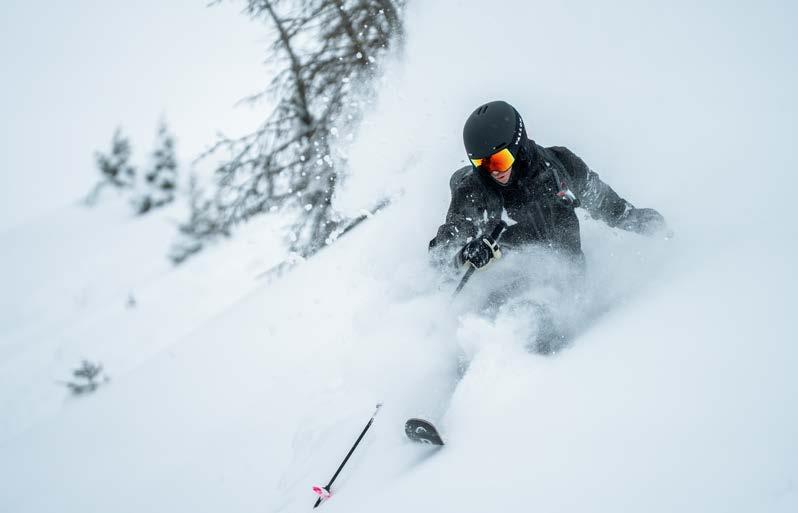
the peripheral vision of spherical lenses with the distortion control of cylindrical lenses.
A magnet-based quick release system provides optimal eye protection and assurance that your lenses will stay firmly in place. Crossroads lenses have dual-layered technology composed of ZEISS outer lens made of 1.6mm shatterproof polycarbonate, and an inner anti-fog lens from leading lens manufacturer, Mazuchelli.
inspired by traditional climbing rope. The headstrap has a silicone lining to keep your goggles secure in all conditions.
The frame is made of durable, temperature-resistant and scratchresistant TPU with a matte coating that gives the Crossroads a modern, sleek finish. Maximised ventilation across the top and bottom of the frame ensures that, paired with the lens antifog inner coating, your goggles won’t fog up.
The Crossroads complements a core brown-tinted lens, with a second interchangeable, high-contrast violet lens included in the purchase. Violet lenses help filter out green and blue light that cause distracting reflections on surfaces like snow. The result of using a violet lens is that the snow’s surface and varying textures appear clearer and skiers experience greater contrast in low-light conditions. Something that a mono-tint photochromic lens cannot provide in the same way. There’s also an upgraded headstrap on the Crossroads to feature a wider 50mm nylon strap in a distinctive design,
Jack Wolfskin’s Alpspitze 3L Jacket is lightweight yet durable, this shell is ideal for skiers who prioritise mobility without sacrificing protection. For years, the “waterproof vs. breathable” debate has been the compromise every skier has had to make. The Alpspitze Air 3L (pictured below left) effectively ends the argument.
The Look: It’s not just tech; it’s a vibe, the men’s “Lime” colourway is a highvisibility nod to 90s alpinism, while the women’s “Midnight Plum” offers a sophisticated, earthy tone that looks as good at the après bar as it does on the summit. At just under 300g, it vanishes in your pack. The “Kimono Cut” eliminates shoulder seams, preventing that annoying chafing when you’re hauling a heavy pack on a multi-day hut trip.
Built with Pertex Shield Air fabric, this shell is an engineering marvel. It is fully waterproof, yet its air-permeable nanofiber membrane allows sweat to escape instantly – meaning you don’t have to play the “zip up, zip down” game every time the pitch changes.
Vallon’s Crossroads (also pictured below)
Some ‘Innovative’ ski gear from the Past
CHRIS EXALL takes a ski down memory lane
Nostalgia is a powerful drug, but if you actually spent the 1970s and 80s sliding down a mountain on some of the “innovations” of the era, you probably have the scars to prove it. From boots that opened like fridges to bindings that functioned like hightension yo-yos, here is some of the craziest ski equipment invented.
1. The Bindings
The Burt Retractable Binding Imagine falling at 30mph, releasing from your skis, and then having those same 200cm planks snap back at your face like a giant, sharp rubber band. That was the Burt Retractable Binding. Instead of a clean release, the ski remained attached to the boot by spring-loaded steel cables. The idea was to avoid “runaway skis”, but in practice, it just turned your equipment into a pair of medieval flails with cheesecutter wire. The binding was as heavy as an anvil and removed any snowfeel leaving you to guess which postcode your skis might be in.
The Spademan Binding
In the 1970s, orthopedic surgeon Richard Spademan decided that those inconvenient toe and heel pieces impaired binding release. His solution? A butterfly-shaped bronze plate screwed directly into the centre of your boot sole. This plate clamped into a single, central mechanism on the ski.
As an upside it offered the most advanced multi-directional release of
its time, perhaps ever, measuring loads from under the leg rather than to toe and heel. However, walking on a flat metal plate made smooth shoes on an ice rink feel stable. Plus, if snow froze onto the plate, you weren’t clicking in until April when the sun came out.
2. The Boots
Rosemount “Refrigerator” Boots
The Rosemount was the first major all-fibreglass boot. Its “innovation” was a side-opening design that swung open like a tiny fridge door. While they were easy to get into, the metal hinges were notorious for leaking, freezing shut, or simply snapping. They were also famously heavy – skiing in them felt like you had strapped two breeze blocks to your feet.
The Knee-High Disaster
In the early ‘80s, brands experimented with boots that reached nearly to the knee. The theory was “added leverage”, but the reality was that without reengineering the entire design you had a stiff, shin-bang-inducing nightmare. Wrongly, many skiers also believed that they could cause knee injuries. They disappeared faster than a neon one-piece in the 90s.
3. The “Soft” Revolution: Nava Bindings
The Nava System was perhaps the most expensive mistake in
“Walking on a flat metal plate made smooth shoes on an ice rink feel stable.”
skiing history. It consisted of a soft, snowmobile style boot that offered zero control, paired with a massive metal exoskeleton rear strut that connected the ski to the back of your leg. Nava offered a unique cocktail of virtually no lateral support, meaning you couldn’t hold the ski on edge to save your life, or dignity. Additionally the system cost a fortune, ensuring that the only people who bought them were wealthy enough to afford the subsequent rescue sledge ride.
An Honourable Mention
The Hexcel Blue Ice tried to solve the lightweight brand’s lack of grip on ice by doubling down, why have one edge per side when you can have two? The stacked edges made the ski grip like velcro, but the added stiffness gave them the agility of an oil-tanker so that grip sent you straight off the edge of the piste.
Every one of these inventions, however, taught the industry a lesson. We wouldn’t have the incredibly safe, high-performance gear we have in 2026 if some brave souls in the 70s hadn’t first tried to ski down a mountain in refrigeratordoor boots.