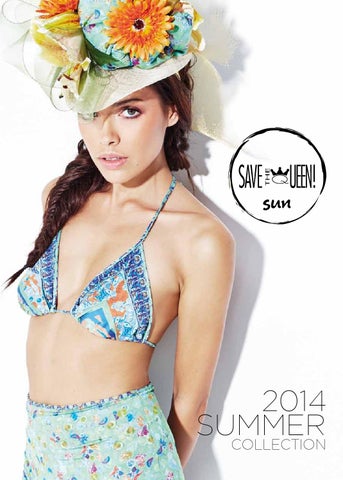
2014 SUMMER COLLECTION
Five icons of the past open the curtain on the new Save The Queen! Sun Summer 2014 collection. Five feminine figures who, with their strength, determination, and vitality, wrote pages in the history of music and show business, at times transforming their notes into fashion; gorgeous leading ladies of novels, inspirations for enchanting paintings. The creative path of the new Save The Queen! Sun collection interprets the charisma of these five “Muses� and translates it into the prints, nuances, and embroidery that cadences all the new beachwear proposals, drawing on five principal themes reflecting their personalities.
2014 SUMMER COLLECTION
ANGELICA from The Leopard The curtain comes down on the new proposals for the Save The Queen! Sun beachwear universe for Summer 2014 with a tribute to the land of Sicily, to the strength and vigour of its colours and its scents, to its proud women. Representing them all, the beautiful Angelica described by Giuseppe Tomasi di Lampedusa in his novel The Leopard. The colours blend harmoniously in the chromatic composition of this last pattern, dominated by yellows, oranges, and blues.
BIKINI QY30 BAG Q942 SHOES Q935 EARRINGS Q943 4
5
BIKINI QX31 SHOES Q941 6
7
BIKINI QY32 BRACELET Q933 8
9
BIKINI Q133 PAREO Q731 EARRINGS Q943 SHOES Q936 10
11
BIKINI Q134 BRACELET Q933 SHOES Q936 12
13
BIKINI Q136 BAG Q938 SHOES Q941 14
15
BIKINI Q137 BAG Q939 SHOES Q937 16
17
BIKINI Q138 18
19
BIKINI Q139 20
21
ONEPIECE Q230 HAT Q934 SHOES Q936 22
23
ONEPIECE Q231 NECKLACE Q931 SHOES Q935 24
BIKINI Q137 BAND Q730 25
DRESS Q430 HAT Q934 26
DRESS Q431 SHOES Q936 NECKLACE Q932 27
TOP Q630 LEGGINGS Q530 28
T-SHIRT Q631 SHORTS Q531 29
TUNIC Q632 NECKLACE Q930 SHOES Q935 30
31
MIRIAM MAKEBA Yellow
Miriam Makeba, also known as “Mama Afrika,” was a South African jazz and world music singer. She is also remembered for her political commitment against apartheid and for having served as a delegate to the United Nations. In 1966, Miriam Makeba was awarded a Grammy for the best folk recording for her album An Evening with Belafonte/Makeba, recorded together with Harry Belafonte. To her, to her extraordinary voice, and to her beautiful turbans, Save The Queen! Sun dedicates a print that lights up with yellow and sky blue – and a variant that matches purple and fuchsia.
BIKINI PY30 34
35
BIKINI PX31 SHOES P936 36
37
BIKINI PY32 SHOES P936 38
39
BIKINI P133 40
41
BIKINI P134 BRACELET P933 BAG P938 42
43
BIKINI P135 BAG P939 SHOES P936 44
45
BIKINI P136 SHOES P936 BRACELET P 933 46
47
ONEPIECE P230 48
ONEPIECE P231 HAT P940 SHOES P936 49
ONEPIECE P232 NECKLACE P931 SHOES P937 50
BIKINI PY32 BAND P730 51
DRESS P430 NECKLACE P930 SHOES P936 52
DRESS P431 BRACELET P933 53
TOP P630 54
BIKINI P133 SHORTS P531 55
T_SHIRT P631 SHORT P532 HAT P934 56
T_SHIRT P631 HAT P934 57
TOP p633 SKIRT P732 shoes P937 58
dress p632 NECKLACE P931 shoes P935 59
TEHA’AMANA “Vahiné” by Paul GauguIn Turquoise
Gauguin’s stay in Tahiti in 1893 coincided with the artist’s achievement of his maximum expressive power. The avahiné, the women of Tahiti, such as TEHA’AMANA, play a significant role in the artist’s canvases as celebrants of the fleeting moment. Gauguin was enchanted by their ingenuous naturalness and an enthusiast of their warm, rich skin tones. He experimented to achieve his magnificent renderings of just the right tones, dark on light, and the calm, no longer exasperated harmony of the colours. The brownish-yellow of the flesh, the blackblue of the hair, and the violet-blue of the clothes (with a few small interruptions in white-pink) stand our against the light backgrounds, orange above and red below, laced with green leaves. Save The Queen! Sun takes over Gauguin’s colour palette with a print dedicated to the avahiné and proposed in nuances of greens and turquoises and in a red-and-blue variant.
BIKINI MY30 62
63
BIKINI MX31 SHOES M936 64
65
BIKINI MY32 EARRINGS M932 66
67
BIKINI M133 SHOES M936 68
69
BIKINI M134 SHOES M936 70
71
BIKINI M135 BRACELET M933 SHOES M936 72
73
BIKINI M136 BAG M938 SHOES M937 74
75
BIKINI M230 HAT M935 76
BIKINI M231 BRACELET M933 SHOES M936 77
ONEPIECE M230 SHOES M936 78
DRESS M430 HAT M934 BRACELET M933 79
DRESS M431 SHOES M936 80
DRESS M432 NECKLACE M931 SHOES M937 81
TOP M630 SLIP MX1 SHOES M936 82
T-SHIRT M631 83
TUNIC M632 84
TUNIC M633 SHOES M936 85
TOP M634 SHORTS M531 SHOES M936 86
TOP M635 SHORTS M532 87
BIKINI MX31 BAND M730 88
BIKINI M134 PAREO M731 NECKLACE M930 89
MIRIAM MAKEBA
fuchsia
Miriam Makeba, also known as “Mama Afrika,” was a South African jazz and world music singer. She is also remembered for her political commitment against apartheid and for having served as a delegate to the United Nations. In 1966, Miriam Makeba was awarded a Grammy for the best folk recording for her album An Evening with Belafonte/Makeba, recorded together with Harry Belafonte. To her, to her extraordinary voice, and to her beautiful turbans, Save The Queen! Sun dedicates a print that lights up with yellow and sky blue – and a variant that matches purple and fuchsia.
BIKINI EY3O SHOES E936 92
93
BIKINI EX31 SHOES E936 94
95
BIKINI EY32 EARRINGS E932 SHOES E936 96
97
BIKINI E133 BAG E938 SHOES E936 98
99
BIKINI E134 BAG E939 SHOES E936 100
101
BIKINI E135 SHOES E936 102
103
BIKINI E137 SHOES E936 104
105
BIKINI E138 106
107
BIKINI E136 BRACELET E933 108
109
BIKINI 136 BRACELET E933 110
ONEPIECE E230 SHOES E936 111
ONEPIECE E231 HAT E941 SHOES E936 112
ONEPIECE E232 113
DRESS E430 SHOES E936 114
BIKINI EY3O PAREO E731 115
BIKINI E137 BAND E730 116
DRESS E431 117
DRESS E432 118
TUNIC E632 NECKLACE E930 119
TUNIC E633 120
T-SHIRT E634 LEGGINGS E532 NECKLACE E931 121
TOP E630 LEGGINGS E530 EARRINGS E 932 122
123
JUMPSUIT E831 124
JUMPSUIT E832 HAT E934 BRACELET E933 SHOES E936 125
FLEECE E830 SHORTS E531 SHOES E940 126
HAT E941 127
JOSEPHINE BAKER Of mixed Afro-American origins, Josephine is often considered the world’s first Black star and was one of Paris’ most applauded vedettes. She obtained French citizenship in 1937; during World War II she played an important role in French counterespionage, assisting the French Resistance. She later put her great popularity into play in the fight against racism and to emancipate the Black people. She was a stanch supporter of the U.S. civil rights movement championed by Martin Luther King. At the Théâtre des Champs-Elysées, where Josephine became prima ballerina, her sheer beauty and her prowess as an artist drove Paris mad, so much so that the theatre was continually sold out. In her shows and her songs, she united the racy, recherché taste of French vaudeville with African music and folklore. Josephine, dressed only in a skirt of bananas, dancing her wild version of the Charleston (a music and dance at the time unknown in Europe), incarnates one of the typical images of the Twenties: a costume invented for her by an Austrian costumer. To her passionate performances and her sincere interest in popular art, Save The Queen! Sun dedicates a print in which light blue caresses black and red.
BIKINI JY30 SHOES J935 130
131
BIKINI JX31 SHOES J935 132
133
BIKINI JX32 NECKLACE J930 SHOES J936 134
135
BIKINI J133 BAG J941 SHOES J935 136
137
BIKINI J134 EARRINGS J932 SHOES J935 138
139
BIKINI J135 SHOES J935 140
141
ONEPIECE J230 BAG J938 142
ONEPIECE J231 EARRINGS J932 143
DRESS J430 BAG J939 SHOES J935 144
DRESS J431 BRACELET J933 SHOES J936 145
DRESS J432 HAT J940 SHOES J936 146
TUNIC J630 147
T-SHIRT J631 BAND J730 HAT J934 148
T-SHIRT J632 LEGGINGS J53O NECKLACE J931 SHOES J936 149
BIKINI J134 EARRINGS J932 PAREO J731 SHOES J935 150
fleece J830 shorts J531 151
CARMEN MIRANDA After getting her start as a singer and samba dancer at local festivals, Carmen was offered the opportunity to work in radio. She won a share of fame and was invited to work on Broadway in New York City, where she contributed to popularising Brazilian music in the United States. Although fifty tears have passed since the height of her stardom, singer and dancer Carmen Miranda has never been forgotten, thanks to the magnetism of her iconic tropical allure. She is probably best known, now, for her tutti-frutti fruit-bedecked turban – and in fact, she herself designed the costumes she wore on the Broadway stages and in the Hollywood musicals of the Forties and Fifties. But then, at just sixteen she was already designing clothes and hats for a shop in Rio de Janeiro. For Save The Queen! Sun, Carmen is the incarnation of the vivacious colours of Brazil, translated into one of the collection’s protagonist prints, in four colour variants, a theme that runs through the bikinis, one-piece bathing suits, and double-face dresses.
BRA D131 KNICKERS D331 BAG J938 154
155
BRA D132 KNICKERS D332 156
157
BRA D133 KNICKERS D330 158
159
BRA D134 KNICKERS D333 SHOES D936 160
161
BRA D135 KNICKERS D332 162
163
ONEPIECE D230 164
ONEPIECE D231 BAG D938 165
BRA D130 PAREO D730 BAG J938 SHOES D936 166
BRA D131 SKIRT D732 167
TUNIC D630 HEADBAND D900 168
ONEPIECE D231 PONCHO D633 HEADBAND D900 SHOES D936 169
DRESS D430 SHOES D936 170
DRESS D431 171
TUNIC D631 BAG D938 SHOES D936 172
T-SHIRT D632 173
DRESS D432 SHOES D936 174
TOP D634 175
TEHA’AMANA “Vahiné” di Paul GauguIn RED
Gauguin’s stay in Tahiti in 1893 coincided with the artist’s achievement of his maximum expressive power. The avahiné, the women of Tahiti, such as TEHA’AMANA, play a significant role in the artist’s canvases as celebrants of the fleeting moment. Gauguin was enchanted by their ingenuous naturalness and an enthusiast of their warm, rich skin tones. He experimented to achieve his magnificent renderings of just the right tones, dark on light, and the calm, no longer exasperated harmony of the colours. The brownish-yellow of the flesh, the blackblue of the hair, and the violet-blue of the clothes (with a few small interruptions in white-pink) stand our against the light backgrounds, orange above and red below, laced with green leaves. Save The Queen! Sun takes over Gauguin’s colour palette with a print dedicated to the avahiné and proposed in nuances of greens and turquoises and in a red-and-blue variant.
BIKINI Y30 178
179
BIKINI X31 180
181
BIKINI VY32 EARRINGS V932 SHOES V937 182
183
BIKINI V133 SHOES V936 184
185
BIKINI V134 SHOES V936 186
187
BIKINI V135 188
189
BIKINI V136 SHOES V936 190
191
ONEPIECE V230 NECKLACE V930 192
ONEPIECE V231 SHOES V936 193
ONEPIECE V232 BAG V938 194
BIKINI VY32 EARRING V932 SKIRT V732 195
BIKINI V136 PAREO V731 196
DRESS V433 SHOES V936 197
DRESS V431 HAT V935 SHOES V936 198
DRESS V432 199
JUMPSUIT V832 SHOES V937 200
201
TOP V630 BAND V730 202
T-SHIRT V631 SHORTS V531 SHOES V936 203
TUNIC V632 HAT V934 204
205
TUNIC V633 SHOES V936 206
JUMPSUIT V831 207
COLLEZIONE ESTATE 2014
Cinque icone del passato aprono il sipario della nuova collezione Estate 2014 di Save The Queen! Sun. Cinque figure femminili che con la loro forza, determinazione e vitalità hanno scritto pagine di storia della musica e dello spettacolo trasformando talvolta le loro note in moda; bellissime protagoniste di romanzi, ispiratrici di quadri incantevoli. Il nuovo percorso creativo della collezione Save The Queen! Sun interpreta e traduce in stampe, nuance e ricami il carisma di queste cinque “Muse” cadenzando tutte le nuove proposte beachwear in cinque temi principali a loro dedicati.
MIRIAM MAKEBA
Miriam Makeba anche nota come Mama Afrika è stata una cantante sudafricana di jazz e world music. È nota anche per il suo impegno politico contro il regime dell’apartheid e per essere stata delegata alle Nazioni Unite. Nel 1966 Miriam Makeba ricevette il Grammy per la migliore incisione folk per l’album An Evening with Belafonte/Makeba, inciso insieme a Belafonte. A lei, alla sua voce straordinaria ed ai suoi bellissimi turbanti Save The Queen! Sun dedica una stampa che si accende di giallo e celeste proposta anche in una seconda variante che abbina il viola ed fuxia.
TEHA’AMANA, ANGELICA de “Il Gattopardo”
Le nuove proposte dell’universo beachwear di Save The Queen! Sun per l’Estate 2014 si completano con una proposta che vuol essere un omaggio alla terra di Sicilia, alla forza e vigore dei suoi colori, dei suoi profumi e alla fierezza delle sue donne, una per tutte la bella Angelica descritta da Giuseppe Tomasi di Lampedusa nel romanzo “Il Gattopardo”. Le cromie che si miscelano armoniosamente nella composizione cromatica di questo ultimo disegno proposto sono i gialli, gli aranci e gli azzurri.
“vahiné” di Paul Gauguin
Il soggiorno di Gauguin a Tahiti nel 1893 coincide con il raggiungimento del suo massimo vigore espressivo. Le “vahiné”, donne tahitiane, come TEHA’AMANA, hanno un ruolo determinate sulla tela dell’artista: divengono la celebrazione del momento fuggente. Prova simpatia ed empatia per la loro ingenua naturalità; è entusiasta dei toni caldi e ricchi del loro carnato. Sperimenta magnificamente la giustezza del tono, scuro su chiaro, e l’armonia calma non più esasperata dei colori. Il giallo bruno delle carni, l’azzurro nero dei capelli e l’azzurro viola della veste (appena interrotti da qualche zona bianco-rosa) risaltano sul fondo
chiaro, arancione in alto e rosso in basso, sparso di foglie verdi. Save The Queen! Sun fa propria questa palette di colori con un disegno dedicato alle “vahiné” proposto nelle nuance dei verdi e dei turchesi ed in una variante che prende vita dalla combinazione del rosso e del blu.
JOSEPHINE BAKER
Di origine meticcia afroamericana, è sovente considerata come la prima star di colore e tra le più acclamate vedette di Parigi. Ottenne la nazionalità francese nel 1937, e nel corso della Seconda guerra mondiale giocò un ruolo importante nel controspionaggio francese della Francia Libera. Ella utilizzò in seguito la sua grande popolarità nella lotta contro il razzismo e a favore dell’emancipazione delle persone di colore, in particolare sostenendo la lotta per i diritti civili di Martin Luther King. Al teatro degli Champs-Elysées, dove Josephine divenne la prima ballerina, la sua bellezza di donna e la sua bravura di artista mandarono Parigi in delirio tanto che il teatro registrò costantemente il tutto esaurito. Nei suoi spettacoli e nelle sue canzoni unì il gusto piccante e ricercato del varietà francese al folklore della musica africana. Josephine vestita solo di un gonnellino di banane, scatenata nel più pazzo charleston (una musica allora ancora sconosciuta in Europa) incarna una delle 209
immagini tipiche degli anni venti: un costume inventato per lei da un costumista austriaco. Alla passionalità delle sue interpretazioni ed al suo sincero interesse per l’arte popolare Save The Queen! Sun dedica una stampa che miscela l’azzurro al nero ed al rosso.
Collection Été 2014
CARMEN MIRANDA
210
Iniziò come cantante e ballerina di samba nelle feste paesane, fino a quando ebbe l’opportunità di lavorare per la radio. Ottenuta una certa fama, venne invitata a esibirsi nei teatri di Broadway, a New York, contribuendo così alla diffusione della musica brasiliana negli Stati Uniti. Sebbene siano passati cinquant’anni dal periodo di suo massimo splendore, la cantante e ballerina Carmen Miranda sopravvive nel tempo grazie al fascino esercitato dalla sua iconicità tropicale. Conosciuta per il suo turbante a tutti-frutti, produceva i costumi con cui appariva sui palchi di Broadway e nei musical di Hollywood negli anni Quaranta e Cinquanta ma già all’età di sedici anni creava abiti e cappelli in un negozio di Rio de Janeiro. Carmen è per Save The Queen! Sun l’incarnazione della vivacità dei colori del Brasile che vengono tradotti in una delle stampe protagoniste di collezione proposta in ben quattro varianti colore. Appartiene a questo tema la proposta di bikini, costumi interi e abiti double face.
Le rideau de la nouvelle collection Été 2014 de Save The Queen! Sun s’ouvre sur cinq icônes du passé. Cinq figures féminines qui, avec leur force, détermination et vitalité, ont écrit les pages de l’histoire de la musique et du spectacle, et qui ont parfois transformé leurs notes en mode ; de très belles protagonistes de romans, inspiratrices de cadres enchanteurs. Le nouveau parcours créatif de la collection Save The Queen! Sun interprète et traduit en impressions, nuances et broderies le charisme de ces cinq “Muses” en déclinant toutes les nouvelles propositions beachwear en cinq thèmes principaux qui leur sont dédiés.
MIRIAM MAKEBA
Miriam Makeba, également connue sous le nom de Mama Afrika, a été une chanteuse sudafricaine de jazz et de world music. Elle est aussi connue pour son engagement politique contre le régime de l’apartheid et pour avoir été déléguée aux Nations Unies. En 1966, Miriam Makeba reçut le Grammy Award pour le meilleur enregistrement folk pour l’album An Evening with Belafonte/ Makeba, réalisé avec Belafonte. C’est à elle, à sa voix extraordinaire et à ses très beaux turbans que Save The Queen! Sun dédie une impression qui s’illumine de jaune et bleu clair, proposée également dans une seconde variante qui associe le violet et le fuchsia.
TEHA’AMANA, ANGELICA du “Guépard”
Les nouvelles propositions de l’univers - beachwear de Save The Queen! Sun pour l’Été 2014 sont complétées par une proposition qui veut être un hommage à la terre de Sicile, à la force et à la vigueur de ses couleurs, de ses parfums et à la fierté de ses femmes, qui sont représentées par la belle Angelica décrite par Giuseppe Tomasi di Lampedusa dans le roman “Le Guépard”. Les chromies qui se mélangent harmonieusement dans la composition chromatique de ce dernier dessin proposé sont les jaunes, les oranges et les bleus.
“vahiné” de Paul Gauguin
Le séjour de Gauguin à Tahiti en 1893 coïncide avec le moment où il atteignit le maximum de sa vigueur expressive. Les “vahinés”, ces femmes tahitiennes, comme TEHA’AMANA, jouent un rôle déterminant sur la toile de l’artiste et deviennent la célébration du moment furtif. Une toile qui éprouve de la sympathie et de l’empathie pour leur naturel ingénu ; elle est enthousiaste des tons chauds et riches de leur carnation. Elle expérimente magnifiquement la justesse du ton, obscur sur clair, et l’harmonie calme non plus exaspérée des couleurs. Le jaune brun des carnations, le bleu noir des cheveux et le bleu violet des
vêtements (à peine interrompus par quelques zones blanc-rose) ressortent sur le fond clair, orange en haut et rouge en bas, parsemés de feuilles vertes. Save The Queen! Sun adopte cette palette de couleurs avec un dessin dédié aux “vahinés” proposé dans les nuances de vert et de turquoise et dans une variante qui prend vie grâce à la combinaison du rouge et du bleu.
JOSEPHINE BAKER
D’origine métisse afro-américaine, elle est souvent considérée comme la première star de couleur et comme l’une des vedettes les plus acclamées de Paris. Elle obtint la nationalité française en 1937, et au cours de la Seconde guerre mondiale, elle joua un rôle important dans le contreespionnage français de la France libre. Par la suite, elle utilisa sa grande popularité dans la lutte contre le racisme et en faveur de l’émancipation des personnes de couleur, en particulier, en soutenant la lutte pour les droits civils de Martin Luther King. Au théâtre des Champs-Elysées, où Joséphine devint la première danseuse, sa beauté de femme et son talent d’artiste provoquèrent le délire des Parisiens, au point que le théâtre afficha constamment complet. Dans ses spectacles et ses chansons, elle unit le goût piquant et recherché de la variété française au folklore de la musique africaine. 211
Joséphine portait seulement une petite jupe de bananes, déchaînée dans le charleston le plus effréné (une musique inconnue en Europe à cette époque), elle incarne l’une des images typiques des années Vingt : un costume inventé pour elle par un costumier autrichien. C’est à la passion de ses interprétations et à son intérêt sincère pour l’art populaire que Save The Queen! Sun dédie une impression qui mêle le bleu au noir et au rouge.
CARMEN MIRANDA
212
Elle fit ses débuts en tant que chanteuse et danseuse de samba dans les fêtes locales, jusqu’au moment où elle eut l’opportunité de travailler pour la radio. Une fois qu’elle obtint une certaine renommée, elle fut invitée à se produire dans les théâtres de Broadway, à New York, contribuant ainsi à la diffusion de la musique brésilienne aux États-Unis. Bien que cinquante ans soient passés depuis son moment de splendeur, la chanteuse et danseuse Carmen Miranda défie le temps grâce à la fascination qu’exerce son iconicité tropicale. Connue pour son turban tuttifrutti, elle produisait les costumes avec lesquels elle apparaissait sur les scènes de Broadway et dans les comédies musicales de Hollywood dans les années Quarante et Cinquante, mais elle créait déjà à l’âge de seize ans des vêtements et des chapeaux dans une boutique de Rio de Janeiro.
Carmen est pour Save The Queen! Sun l’incarnation de la vivacité des couleurs du Brésil qui sont traduites dans l’une des impressions protagonistes de la collection, proposée dans quatre couleurs différentes. On trouve dans ce thème la proposition de bikinis, maillots une pièce et vêtements double face.
PRODUCED AND DISTRIBUITED BY MARCO FANTINI SRL VIA DEL PARADISO, 118/E 50013 CAMPI BISENZIO, FLORENCE ITALY T. +39 055 8958201 info@marcofantini.com savethequeen.com