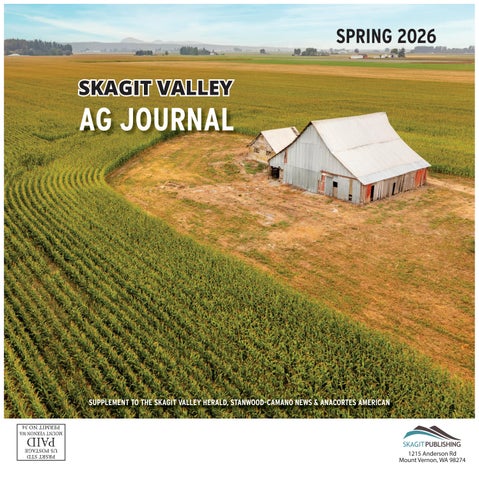
SKAGIT VALLEY AG JOURNAL


Coming years could be good for county seed industry

Washington State University Skagit County Extension Director Don McMoran said growth in the vegetable seed industry will likely be a trend in 2026.
“Another exciting area is the vegetable seed industry. In Europe they’ve had several devastating years in a row and so were seeing some of those crops that left Skagit County coming back in a major way,” McMoran said. “Spinach is the driver, followed by beets and cabbage seed. We’re going to be seeing more of that in the next few years.”
He also highlighted grass seed and cattle as being two industries experiencing success in the county.
Early on in his career people would ask McMoran what crops they should grow, and his answer was blueberries.
“You can get 10,000 pounds of fruit off an acre, and
it’s a plant that can grow on the same land for up to 90 years,” he said. “Then we got a new insect called spotted wing drosophila. That made it much more difficult to grow blueberries.”
In part because of this McMoran is hesitant to make predictions as to what crops will be most profitable.
“I don’t have a crystal ball,” he said. “I don’t make those predictions anymore.”
Another trend McMoran mentioned is fewer mid-sized fams in the county.
“I’m very concerned for the middle-sized farmers in Skagit County,” McMoran said. “What we’ve seen is large farms have bought out small and medium-sized growers, so those medium-sized growers are leaving the landscape and that’s going to change our culture in the future.
“We have larger farms and we also have a lot more small, organic, sustainable farms, and there’s an emptying
out of the middle. I think that continues as we go forward,” he said.
McMoran emphasized the importance of voting for proagriculture legislation in the county and state.
“Farmers are only 1% of the population. We really need good voters to make sure we’re enacting good laws that keep our producers on the landscape.”
McMoran also highlighted the strain high costs are putting on farmers, and emphasized that the industry is increasingly difficult and stressful.
“The future of agriculture is hanging in the balance right now and I encourage your readers to make sure they’re supporting local farms, that they know who their local farmer is,” he said.
The Skagit County Extension runs a farm stress and suicide prevention program that McMoran recommends for those in the agriculture industry dealing with crisis.
LIAM WALSH
Skagit Valley Herald
Washington State University Skagit County Extension Director Don McMoran speaks on June 20, 2025, with Schuh Farms owner Jennifer Schuh during the Strawberry Fields Forever tour.
WSU Breadlab has focus on tasty, nutritional bread
CAMERON MARTINEZ
Skagit Valley Herald
About 72% of Americans bought bread in 2024, according to data from Innova Market Insights.
But about 90% of these purchases contained refined grains, which can negatively impact health, according to the National Library of Medicine.
The Washington State University Breadlab aims to address these health concerns by breeding and baking breads that are both more nutritious and appealing than conventional options.
The Breadlab opened in 2010 in the same building as the Washington State University Skagit County Extension west of Burlington. It was started by Stephen Jones, a former WSU Mount Vernon Northwestern Washington Research and Extension Center director and wheat breeder from Pullman.
“(The Breadlab) started as a way to develop varieties that would be grown in Western Washington,” said Breadlab Research Associate Robin Morgan. “Over time, the focus of the Breadlab evolved to specifically narrow down and focus on whole grain, nutrition and flavor.”
Though bread is central to the diets of Americans,


most bread-making methods leave nutritional gaps, according to the U.S. Department of Agriculture.
Most breads use refined flour. Milling removes bran and germ, stripping away fiber and nutrients, and leaving mostly starch and gluten.
According to 2020 USDA data:
98% of Americans do not meet their daily recommended intake of whole grains
74% of Americans exceed recommended intake limits for refined grains — primarily through white flour
94% of Americans do not meet their daily recommended intake of fiber
The Lancet, a peer-reviewed journal, reports that not eating enough whole grains is the second-largest dietary risk factor for illness and death in the United States.
Fiber is crucial for promoting healthy digestion, regulating blood sugar and supporting heart health, according to the Mayo Clinic.
“The idea is developing varieties that can be used as a whole grain to address relevant nutritional deficiencies that are common in North America,” Morgan said.
For the Breadlab, the process begins by growing and


breeding grains in the fields at the WSU Mount Vernon NWREC.
The center grows varieties of wheat, barley, buckwheat, quinoa, spelt and perennial wheat. A particular focus in on perennial wheat.
Perennial wheats look and work like regular wheat but regrow after harvest. They need less labor, still produce grain, and reduce soil disturbance from tillage, which is the mechanical turning over of soil used to prepare fields for planting.
The Breadlab’s seed has grains labeled by location and year produced. Some seeds are more than 100 years old.
There’s also varieties stored at the NREC.
“They might be something that worked really, really well during a really wet year or a really dry year,” WSU Breadlab volunteer Stephanie Swane said while pointing to a jar from 1907.
Swane continued, “We want to make sure that we have a collection of it so that it doesn’t go away.”
Along with breeding work, the Breadlab creates tasty bread options for the public. After hosting pop-up


events for years, the new Toast Bar has added to the Breadlab’s outreach.
The Toast Bar is a monthly event where members of the public can try the Breadlab’s bread, with toppings included.
The all-you-can-eat experience costs $10, and children 12 and under eat for free.
“It’s helped us understand more that people do, in fact, want to eat whole-grain bread,” Breadlab Outreach & Engagement Manager Janine Sanguine said.
Using feedback, the Breadlab developed a 100% buckwheat sandwich loaf and starter. The loaf is glutenfree and popular among Toast Bar visitors.
The Toast Bar helps the Breadlab become a community space in Skagit County. Still, Sanguine said more awareness is needed locally.
“I get people from South Africa, from Austria, from the UK, from Australia, from France, saying, ‘Ooh, the Breadlab.’ But a lot of times, people don’t know what’s in your backyard. So we encourage our community to come to the events that we have,” Sanguine said.
In terms of the Breadlab’s future, it was recently awarded a BioInnovation grant from the Washington Research Foundation.
“The funding brings together organizations from across the state and will allow WSU researchers to continue developing new crop varieties for farmers,” Sanguine said. “It will fuel efforts to bring more whole grains to the public, including into school lunchrooms. It will expand Washington state’s commercial infrastructure for storing, transporting, milling and marketing whole grains.”
In addition, the Breadlab has launched a Community School to expand its outreach and education program to reach more members in the community.
For more information about the WSU Breadlab, visit breadlab.wsu.edu.


ABOVE: A table full of Toast Bar visitors eat their toast and chat with each other on March 6. Ava Ronning / Skagit Valley Herald
BELOW: The Breadlab’s Stephanie Swane shows off a loaf of bread and the grains that created it during the March 6 Toast Bar event. Cameron Martinez / Skagit Valley Herald


Stephanie Swane (right) tells a WSU Breadlab visitor
Increased fuel, fertilizer costs affect county farmers

CAMERON MARTINEZ
Skagit Valley Herald
As spring planting begins, Skagit County farmers face soaring fuel and fertilizer prices because of the war with Iran.
Jason Vander Kooy, a Skagit-based dairy farmer and vice president of Save Family Farming, said in a statement from the organization that, “The conflict in Iran is affecting farmers here in Washington, as fuel and fertilizer prices spike. As farms are already grappling with the state’s worsening farming profitability crisis, these additional costs are pushing them even closer to the edge of closure.”
The war has caused a slowdown in shipping through the Strait of Hormuz, which handles about 20% of the world’s oil and natural gas.
According to the American Farm Bureau Federation, about 15% of the country’s fertilizer imports come from the Middle East. Key fertilizer ingredients, such as urea and ammonia, are often sourced from the region.
Since last month, the state’s average gasoline price has risen from $4.08 a gallon to $5.21, according to AAA Fuel Prices. These higher fuel prices directly increase transportation and production costs for farms, further narrowing already narrow profit margins, especially given the state’s geographic disadvantage as a corner state.
Additionally, the average North American fertilizer price per ton has increased from $753 in late February to $923 on March 20, according to Green Markets.
For farmers, this translates to significantly higher input costs, adding financial pressure to their already tight budgets.
The amount of fertilizer needed per acre depends on the nitrogen source, resulting in a range of 8.4 to 18.3 acres per ton, according to The Ohio State University.
In 2022, the average farm size in the county was 113 acres, based on U.S. Department of Agriculture Census of Agriculture data.
With current fertilizer prices, these costs now account
for a significant portion of farm budgets, reducing profitability and leaving less money for other critical expenses. For an average farmer, fertilizing their land can now cost between about $5,700 to $12,400.
Prices rose in 2021 as well, but at that time crop prices increased enough to offset higher expenses. Today, however, farm incomes are not keeping up with rising costs, resulting in reduced profitability for farmers.
“Since then, our crop prices have fallen back to preCOVID levels, but the fertilizer prices have remained high,” said Michael Hughes, a worker at Hughes Farm west of Burlington. “It’s tightened the margins over the last five years now, and then just seeing them go higher now is going to be it’s just going to even make those margins even tighter.”
These rising prices have worsened the financial outlook for farmers in the state, pushing more farms toward unprofitability.
In 2024, farmers in the state were about $4 million in the red, according to the USDA Economic Research
A farmer plows a field along Memorial Highway in 2018. As of March 2026, fuel and fertilizer prices are rising due to the ongoing war in Iran. Skagit Valley Herald file photo
Service, illustrating the severity of the economic pressure.
“While we cannot control a global conflict like what’s happened with Iran, our leaders in Olympia can prevent the collapse of farming here by addressing the out-of-control costs they’ve placed on people simply working to grow food,” Vander Kooy said. “Unfortunately, lawmakers ended the legislative session without delivering real relief for Washington farms struggling to survive under the burden of state government-imposed costs.”
Compared to other states, Washington’s farmers face a clear policy disadvantage, according to the Washington Policy Center.
A 2025 policy brief from the center attributes much of this to the state’s “price taker vs. price maker” economic tension in agriculture, which has been largely ignored in legislative cycles.
This means many producers must sell at prevailing market rates, while only specialized growers can set their prices.
This tension worsens as consumers demand fair wages for farmworkers, while international producers often pay workers much less.
The policy brief states, “When consumers pay more for better labor practices or better environmental stewardship, they are paying grocery stores, shippers, and packers, not the farmers and ranchers who bear the burden of implementing those desires.”
Despite high prices, Hughes remains optimistic about the future.
“I do feel hopeful for the future,” Hughes said. “Agriculture goes through ups and downs ... There’ll be another up someday, and hopefully the farms in the area can hang on to get to it.”
Cairnspring Mills flour mill earns Climate Label certification
MILO WHITMAN
Skagit Valley Herald
Cairnspring Mills, a flour mill west of Burlington, has become the first flour company in the world to earn The Climate Label certification.
The certification was granted this winter by The Change Climate Project, a nonprofit that works to eliminate greenhouse gas emissions by creating a global climate standard for companies. The organization has certified 195 total brands.
The certification requires companies to measure greenhouse gas emissions, develop a plan to reduce emissions, and fund climate projects.
Cairnspring Mills’ certification highlights its commitment to climate action.
“Cairnspring Mills has woven climate action and accountability into the fabric of their company, not as an afterthought,” The Change Climate Project CEO Austin Whitman said in a news release.
Since Cairnspring Mills was founded in 2016, it has operated with the climate in mind by sourcing its grain from farmers who use climate-friendly methods such as crop rotation, animal integration and no-till farming.
“They are among a unique group of climate leaders that choose to factor the costs of climate change into their business and, in doing so, earn The Climate Label certification. Every certified company has its own climate story to tell, and we are proud to welcome Cairnspring as pioneers in their industry,” Whitman said.

You don’t have to figure it all out on your own.
At Washington State University Skagit County Extension, we bring real research, real tools, and real support straight to you—right here in Skagit County.
• Learn what makes healthy soil
• Begin by growing your own garden
• Build youth confidence, skills, by enrolling in 4-H
• Make smart choices about food, land, and your future.
GROW YOUR KNOWLEDGE.
This is your moment to take action—and we’re here to help. Our programs are built to strengthen agriculture, empower youth, and create resilient communities. Don’t wait. Get involved. Learn something new.
WSU Skagit Extension staff visiting a local tulip field in April 2026


Cairnspring Mills co-founder and CEO Kevin Morse said the certification reflects the values of the company.
“Adding value and good stewardship are founding principles of Cairnspring. It starts with farmers who are rebuilding their soil and trying to step off the commodity treadmill. We pay premiums that help make that possible, and then we mill in a way that keeps the whole grain intact and connected to the people baking with it,” Morse said in a press release.
The Climate Label certification comes as Cairnspring Mills grows the company by opening another mill in Pendleton, Oregon.

Nestled in the foothills of the North Cascades is our 480-acre cattle ranch, fully equipped log cabins, guesthouses and farm store. We offer AAA approved lodging and Harvest Host sites.
Our ranch produces high quality, all-natural grass finished beef by the package and grain finished quarters, halves and wholes. We sell Maine-Anjou and Angus, steers, heifers, cows and bulls. The farm store at the ranch sells beef, homemade breads, berry crumbles, cookies, jam bars, jam and jelly and local honey.
Our new location, North 40 Farm Store in Sedro-Woolley on F&S Grade and Union road sells all-natural grass finished beef, sourdough bread, local pork, jam and honey, organic apple cider, etc.
46276 Concrete Sauk Valley Road, Concrete W-F 11-5, weekends 10-3 www.doubleoranchllc.com


Cairnspring Mills expects the new mill to be operational by this fall. The company expects the new mill will generate about $22 million annually for regenerative farmers in the region.
Though The Climate Label certification standardizes its approach to its climate efforts, Cairnspring Mills will continue operating with the same principles it had when it began in 2016: Build a company that values the land, its farmers and the community.
“When you build the system that way, what’s better for farmers and their land is also better for the climate,” Morse said.
Proud to support the neighborhood
Being a good neighbor means being there for my community. As your local State Farm® agent, I'm ready to help whenever you need me. Give me a call, or scan the QR code to get in touch.


LEFT: The exterior of Cairnspring Mills’s granary expansion in November. Skagit Valley Herald file photo
RIGHT: Specialized wheat at Cairnspring Mills. Skagit Valley Herald file photo.
Co-Op, Community Action team up on program


MILO WHITMAN
Skagit Valley Herald
In partnership with the Skagit Valley Food Co-op, Community Action of Skagit County will distribute $100,000 this May to farmers in Skagit County through the Farm to Food Bank program.
Community Action will loan up to $10,000 per farm, allowing the farm to purchase infrastructure.
The farms will then repay the loans by donating fresh produce to Community Action’s Skagit Food Distribution Center. The farms will have five years to repay the loans.
Community Action Community Engagement Director Elizabeth Jennings described the program as a “triple win for the community” — the Skagit Valley Food Co-op and Com-


munity Action invest in farmers, who supply the Co-op and the Distribution Center with fresh produce, which ultimately benefits the consumers.
By investing in infrastructure and encouraging fresh, locallygrown produce to stay within the community, the Farm to Food Bank program will address the need for food in Skagit County, Jennings said.
She cited a 2021 Community Health Assessment by Population Health Trust, which identified food insecurity, especially among children, as an emerging issue following the COVID-19 pandemic.
To address food insecurity, the study called for a more developed food distribution system in the county.
Five years later, food insecurity is still an issue in Skagit


The Food Distribution Center in Sedro-Woolley in 2020. Skagit Valley Herald file photo
County, Jennings said, but programs such as Farm to Food Bank are helping to address it by providing consumers with nutritious food straight from local farms.
“Community Action’s vision is a community where everyone works together to end poverty in Skagit County, and this is a creative, beautiful way to do that,” Jennings said.
Madeline McGonagle, Community Action’s farm liaison, emphasized that the Farm to Food Bank program will allow the Distribution Center to get nutritious foods to food banks and food pantries.
She said a lot of food shipments the Distribution Center receives have a lot of shelfstable canned foods, which are valuable, but are often high in sodium and sugar. Fresh meat and produce are needed, but can be harder to come by. The Farm to Food Bank pro-
gram will increase the amount of fresh food at the Distribution Center, meaning consumers will benefit from living in such a strong agriculture community, she said.
“It’s amazing that we live in a place where there’s such a large diversity of products produced right here, and so it feels really special to capitalize on that and procure what we can around us and distribute it to the food pantries,” McGonagle said.
She said that about 10 years ago Community Action had a program similar to the Farm to Food Bank program that used federal funds to provide loans to farmers.
McGonagle, who also works as a farmer, said that the loans through the Farm to Food Bank program won’t be as large as that prior loan program, but $10,000 can still go a long way. In the past program, Community Action was able to loan up to

$40,000 to each farm.
“This round is a little bit smaller, but we’re still hoping that farmers can utilize the money for something that will leverage them to either scale up their business, or make it more efficient,” she said.
The previous program led to several long-standing relationships between Community Action and farmers, McGonagle said. The Food Distribution Center still purchases food directly from some of the farms who took part in the earlier program.
“(The previous program) proved to be really beneficial for a lot of farms in the area,” McGonagle said. “It also really leveraged our ability to create long-lasting relationships with farmers in the area. So we’re hoping to do that again.”
For Community Action, partnerships with local farmers and organizations are vital to addressing the issue of food

insecurity in the county, Jennings said.
The Farm to Food Bank program continues a history of partnerships between the Skagit Valley Food Co-op and Community Action.
Jennings, who has worked at Community Action for about 14 years, said the two organizations have partnered on several grants and donation programs.
Most recently in September, the co-op began its Feeding Change register donation program, which allows customers to make a donation when they check out, with the money going to Community Action’s Distribution Center to purchase food.
Since the Feeding Change program began, customers have donated about $100,000 to the Distribution Center.
Skagit Valley Food Co-op Marketing Outreach Director Nicole Noteboom said that
partnerships with Community Action encourage sustainable solutions to food insecurity.
Noteboom said that the produce that farms donate to repay their Farm to Food Bank loans will have a lower carbon footprint than the typical shipments the Distribution Center receives.
Even when food is sourced locally, larger shipments have transportation costs that impact the environment.
Jennings agreed. Though she called the Farm to Food Bank program a “triple win,” she said there are more than just three ways in which the community wins.
“In terms of t-he efficiency, and the quality, and all of those types of things, these relationships are better for everybody,” Jennings said. “Including the climate and our environment.”


2026 Skagit Ag Summit at WSU NWREC

The 2026 Skagit Ag Summit at WSU NWREC was very well received, with 100 registered participants and approximately 150 in attendance throughout the day emphasizing strong networking, high satisfaction with content and logistics, and a clear desire to continue and deepen the event in future years.
Breakout table topics and key themes
In addition to plenary sessions and panels, the Summit featured facilitated breakout table conversations that surfaced concrete ideas, needs, and opportunities across several priority themes. These table topics generated practical suggestions for future programming, partnerships, and policy discussions.
Artificial Intelligence and Rural AI
Participants explored current and emerging applications of artificial intelligence in agriculture and rural communities, emphasizing both opportunities and risks. Discussion points included:
• Practical tools and examples: Crop Wizard; tree fruit applications; iNaturalist and Seek apps for pest and insect identification; integrating simple tools like insect nets with app-based diagnostics; FFA student projects such as John Krebs’ Ag Innovation project; and the Farm-AI initiative.
• Rural AI “Venn diagram” thinking at the intersection of environment, health, agriculture, and technology, with an emphasis on how AI tools can support decisionmaking rather than replace human judgment.
• Education and workforce preparation: recognition that high school CTE science requirements now include AI and large language models, and the need to connect these requirements with real agricultural use cases.
• Risk and resilience topics: questions about AI’s role in understanding and managing wildfire smoke impacts on crops, and broader concern about how automation and AI may affect rural jobs and community well-being.
Overall, participants saw strong potential for AI to support scouting, diagnostics, planning, and education, while underscoring the importance of thoughtful adoption that centers farmers and workers.
Labor, housing, and workforce
The labor, housing, and workforce table highlighted the complexity of meeting Skagit’s year-round labor needs and supporting workers in a changing regulatory and immigration environment. Key themes included:
• Persistent demand and uncertainty: high demand for year-round labor and the ways uncertainty around immigration enforcement and deportations constrains workforce planning and creates fear for workers and employers.
• Partnerships and navigation:
• Opportunities for stronger collaboration among farmers, agencies, and programs such as Labor & Industries (L&I), WorkSource, Skagit Legal Aid, and community-based organizations.
• A desire for more formalized relationships for worker allocation under H2A beyond word-ofmouth connections.
• The need for resources that help employers and employees understand their rights and obligations.
• Language and communication:
• Need for translators in multiple languages, not only Spanish.
• Interest in conversational language instruction resources (e.g., vouchers for language software, Goodwill ESL, SCF.org offerings).
• Education, outreach, and future workforce pipelines:
• Ideas for panels on agriculture for youth through FFA, 4H, and similar programs.
• A potential job fair with collaborative outreach to STEM and vocational education programs to help students discover agricultural careers.
• The role of organizations such as OIC of Washington in career guidance, industry specialization, and tuition assistance through programs like West and FW Jobs.
Participants emphasized that improving labor conditions, regulatory clarity, and communication will require ongoing, coordinated effort across agencies, employers, and community partners.
Next generation and succession planning
Two related table topics—Next Gen/Succession Planning and Farm Business & Succession—focused on engag-
ing young people, supporting new farmers, and ensuring smooth transfer of farms and knowledge.
Next Gen – succession and youth engagement
• School-based agricultural experiences:
• Skagit Farm Circle visits connecting elementary school students to farms.
• Expanding 4H integration into schools, including after-school and summer programs with multiple access points on campus.
• Classroom resources such as Ag in the Classroom and the “Biggest Little Farm” curriculum.
• Girls and underrepresented youth in STEM: recognition of programs such as Girls in STEM at WSU Everett and the need to connect them more explicitly to agriculture and food systems.
• Community events and incentives:
• Ideas for free farm events featuring local farm produce, shared meals, and film screenings to engage families.
• Incentive-based engagement that uses food and shared experiences to build relationships with agriculture over time.
Farm Business & Succession – resources and capital
• Succession planning resources:
• Promotion of upcoming succession workshops (e.g., February 18 sessions).
• Cascade workshops with expert resource providers, offering 1:1 technical assistance in legal, financial, and business planning.
• Succession workbooks available at the Summit for attendees to take home.
• Capital access and funding programs:
• Discussion of capital “access” as a central barrier, especially for new and transitioning farmers.
• Awareness of specific programs:
• TOPP (mentorship and technical assistance).
• USDA Value-Added Producer Grants (VAPG) for working capital (up to 250,000, due in spring) and planning grants (50,000).
• Healthy Food Financing Initiative (HFFI) for planning and loans.
• WSDA Local Food System Infrastructure (LFSI) grants (up to 75,000).
• Tides Foundation grants and other sustainability funding.
• Electric vehicle initiatives such as WSU’s WAzzip program.
These conversations underscored that sustaining Skagit agriculture requires both early youth engagement and concrete technical and financial tools for existing producers planning transitions.
Farm business, community, and stress
At the Farm Business – Community and Stress table, participants focused on the health of farm businesses and the human side of farming. Themes included:
• Vision and business viability: the need to “think bigger,” increase profitability, and reinvest more into the local community, supported by more business education and thoughtful design and marketing.
• Attracting and retaining people: making farming “cool” for young people and new entrants, including ideas like a farmer exchange program (Farm Link), more automated land-matching platforms, and better visibility of opportunities.
• Practical needs and support structures:
• Water and infrastructure needs as ongoing constraints.
• Peer-to-peer networks and in-person meetings as essential for sharing knowledge and reducing isolation.
• Balancing human relationships with emerging AI tools (“Human and A.I.”) rather than seeing them as mutually exclusive.
• The importance of food and shared meals in building community and resilience.
Participants connected farm business viability directly to farmer well-being, stress, and community health, reinforcing the value of integrating mental health and stress assistance resources into business and technical programming.
Land, water, and code
Two table topics on land, water, and code dug into infrastructure, permitting, drainage, and flood management, as well as the intersections with agritourism and land-use regulations. Key points included:
• Water storage and infrastructure:
• Interest in diverse approaches to water storage, including new storage facilities, manure lagoon conversions, and surface water retention projects.
• Questions about how best to balance water control with the realities of “controlling Mother Nature.”
• Code and permitting:
• Concerns about impervious surfaces (e.g., I5) and
their impacts on hydrology.
• Critical areas regulations, required permits, and activities that are restricted or disallowed.
• The cost and time associated with permitting and startup, including requirements such as three years of business history.
• Agritourism and farmland preservation:
• Ongoing debate about agritourism along I5 as a “hot topic” in Skagit County.
• Questions about whether farmland preservation programs (FPP) and agritourism can coexist, and under what conditions.
• Considerations of buffers, including farm labor buffers, on-farm buffers, and existing landscape features.
• How Voluntary Stewardship Program (VSP) fits into these conversations.
• Drainage, diking, and flood dynamics:
• Discussion of levee width and depth and how they affect water velocity.
• Tidal influences, especially from Lions Park to the river mouth.
• Calls for more education on the management and operation of dike and drainage districts, including how water moves through the system.
• The importance of keeping drainages, gauges, and sloughs free of debris and improving understanding of flood predictions and models.
These table sessions revealed a strong appetite for more technical education on drainage and flood management, as well as for collaborative problem-solving on regulations and agritourism that protect both farm viability and environmental health.
Event overview
The 2026 Skagit Ag Summit was held February 6, 2026 at WSU NWREC in Mount Vernon, Washington, bringing together farmers, agency staff, elected officials, and agricultural advocates to discuss priority issues for Skagit agriculture, including water, succession, innovation, farm-

land preservation, and community resilience. Although approximately 150 people attended the event only total of 32–34 evaluation forms were returned (variation across questions suggests a few partial responses), providing a solid snapshot of participant experience and priorities.
Overall satisfaction
• 23 respondents reported being “Very satisfied,” 7 “Satisfied,” 1 “Somewhat satisfied,” and 1 “Not at all satisfied” with the Summit.
• 26 “Strongly agreed” and 4 “Agreed” with “Let’s do this again,” with only 1 “Unsure,” indicating very strong support for continuing the Summit.
• The conference location was rated highly (25 “Strongly agree,” 5 “Agree”), and food received similarly strong ratings (22 “Strongly agree,” 6 “Agree”).
These scores indicate that the Summit successfully met or exceeded expectations for almost all attendees and continues to be viewed as a valuable annual gathering for the Skagit agricultural community.

Participant outcomes
Hope, preparedness, and confidence
Responses to “Because of this conference today…” show important but differentiated impacts:
• Hope and confidence:
• “I am hopeful”: 16 “Agree/Strongly agree,” 14 “Unsure,” 2 “Disagree.”
• “I feel confident about Skagit agriculture”: 17 “Agree/Strongly agree,” 9 “Unsure,” 3 “Disagree/ Strongly disagree,” 4 “N/A.”
These results suggest the event generally reinforced optimism about Skagit agriculture, while also revealing ongoing uncertainty and concern.
• Preparedness for the coming season:
• “I feel that I am better prepared for farming this year”: 10 “Agree/Strongly agree,” 7 “Unsure,” 3 “Disagree,” 15 “N/A.”
Many attendees were not currently farming (high N/A), and among farmers the conference moderately increased perceived readiness, suggesting room

Engagement with WSU Extension and networking
• “I am more aware of networking opportunities”: 28 “Agree/Strongly agree,” only 1 “Disagree,” confirming that networking was a central strength.
• “I am now part of a larger team that will search out solutions to issues in my community”: 23 “Agree/ Strongly agree,” 6 “Unsure,” 2 “Disagree,” 2 “N/A,” indicating the Summit successfully built a sense of collective effort.
• “I am interested in working with WSU Extension/ NWREC”: 23 “Agree/Strongly agree,” 9 “N/A,” and no


disagreement recorded, emphasizing that the Summit effectively connected participants to WSU Extension resources.
• “I am more aware of solutions and challenging issues in agriculture”: 31 “Agree/Strongly agree,” 2 “Unsure,” demonstrating strong learning and awareness outcomes.
Open-ended responses reinforce these quantitative findings. Participants frequently named connections, networking, and a better understanding of community priorities as the most important accomplishments of the day (e.g., “Networking & new connections,” “Meeting others, networking, learning more about Ag Community needs & priorities”). Networking across farmers, agencies, and policymakers, including new WSU colleagues, was repeatedly highlighted as a core benefit.
Priority topics and information needs
Participants were asked how important it is to receive more/better information on a set of topics. The highest “Very important” responses were:
• Water-related issues: 27 “Very important,” 3 “Important,” 1 “Not important.”
• Climate change: 22 “Very important,” 3 “Important,” 3 “Somewhat important,” 2 “Not important.”
• Regulation: 19 “Very important,” 10 “Important,” 2 “Somewhat important.”
• Irrigation: 17 “Very important,” 11 “Important.”
• Labor issues: 17 “Very important,” 4 “Important.”
Waterrelated issues, irrigation, water bank
Climate change
Regulation and policy
Labor issues
Economics/ costs of production
New technology and ag tech
Pest, disease, weed, and food safety
Marketing and agritourism
Water rights, storage, water banking, status of water issues, FERC settlement, water succession planning
Desire for more on climate crisis and mitigation, resilience focus
Regulatory concerns, policy interpretation, moving politicians, DOE, water law
Farm labor, L&I engagement, workforce challenges
Profitability, cost pressures, business viability
Ag tech, automation, AI, keeping tabs on Skagit thinking about Ag Tech
Weed, insect, disease management, food safety/human pathogens
Marketing, success stories, agritourism, connecting to non-farm audiences
Other topics with strong demand included economics/costs of production, new technology, disease management, weed and insect management, food safety/human
Hayton Farms
Our 5th generation family farm was established in 1876. We specialize in growing many different varieties of • Strawberries • Raspberries • Blueberries • Blackberries

We also grow specialty varieties of orange, yellow and black raspberries, tayberries, loganberries and hardy kiwi.
Hayton Farms raises grass-fed Black Angus beef. You can purchase our beef at the farm stand on Fir Island.
Find a list of the farmers markets we attend on our website.
Farms Berries – Fir Island farm stand: 16670 Fir Island Road, Mount Vernon, WA Berries, grass-fed beef & lamb, ice cream & gourmet foods!
pathogens, and marketing.
From open-ended questions, water and farmland preservation emerged as dominant themes:
• Multiple comments cited the “water scene,” water rights, water banking, and water storage, as well as succession planning and access to water.
• Participants described gaining “broader awareness of priorities for the agricultural community and water resource concerns” to guide resilience work.
• Farmland preservation, farm succession, future generations of farmers, and agritourism or farm-based outreach (e.g., Ag outreach to kids, pathways to protect non-NRL lands, Regional food system, Ag Basics connecting community to agriculture) also featured prominently.
These responses confirm that future Summits should continue to place strong emphasis on water, climate resilience, regulation, and succession/farmland preservation, while integrating applied information on economics and farm-level technology and management.
Title example: priority topics table
Key sessions, speakers, and content
Participants were asked which panel or person was most important to them. Responses clustered around several key individuals and panels:
• Water and regulation:
• Jenna Friebel (Skagit County Dike and Drainage Consortium) – 26 selections.
• Kellie Gillingham (WA Department of Ecology) – 18 selections.
• Erin Ericson (Snoqualmie Valley WID) – 13 selections.


Open-ended comments singled out these speakers for clear explanations of policy and law, practical relevance, and making complex water issues understandable.
• Farmland preservation and succession:
• Laura Claus (Skagitonians to Preserve Farmland) – 20 selections.
• Sarah Stoner (Skagit County Farmland Legacy) – 15 selections.
• Elizabeth Bragg (American Farmland Trust) – 10 selections. Participants praised content on succession, farmland preservation, creative marketing, and advocacy of Skagit agriculture to non-ag audiences.
• Elected officials and leadership:
• Skagit County Commissioners (Ron Wesen, Peter Browning, Joe Burns) and Congressman Rick Larsen collectively received numerous mentions, with appreciation for their presence, support, and discussion of policy priorities.
• Innovation, technology, and farm business examples:
• David Wallace (Farm HQ), Andrew Tuttle and Mary Marshall (Edge Perma), Michael Frazier and Francisco Farias (Viva Farms), and Dr. Kevin Murphy (WSU Bread Lab) were all identified as important, particularly for innovation, succession, and practical business examples.
Participants also repeatedly commented on the value of:
• Hearing a wide range of backgrounds and perspectives.
• Table topics/round tables as a way to deepen discussion.
• The presence of young farmers, new farmers, and advocates integrating into the Skagit agricultural community.
Awareness of Farm and Ranch Stress Assistance Network
Prior awareness of the Farm and Ranch Stress Assistance Network (FRSAN) was relatively high:
• 17 learned of it at prior workshops/Extension events.
• 5 via website/internet.
• 2 via newsletters.
• 5 via “Other” channels, including Conservation District, word of mouth, mailings, Pizza for Producers, and media.

Strengths of the 2026 Summit
Across closed- and open-ended responses, the most frequently cited strengths were:
• Networking and community connection
• Multiple respondents listed networking, meeting new people, talking with other farmers, and “feeling of becoming more connected with my community” as the most important outcomes and the most enjoyable aspects of the day.
• The event served as an integration point for new community members and new farmers.
• Content relevance and breadth
• Participants appreciated the range of topics and speakers, including water, succession, innovation, farmland preservation, regulation, and youth outreach.
• Several mentioned that the Summit provided broader context for agriculture, elevated the needs of local farmers, and clarified priorities and hot topics.
• Logistics and food
• Strong ratings for location and food, with numerous comments praising the pizza and the overall organization and facilitation of the conference.
• Engagement of officials and partners
• Participants valued seeing elected officials and agency leaders present and engaged, reinforcing that agricultural issues are visible and supported at multiple levels.
Areas for improvement
While overall satisfaction was very high, respondents offered several constructive suggestions:
• Session structure and timing
• Make the day slightly shorter.
Comments indicate participants appreciated hearing more about stress assistance resources and suggested continued emphasis on disaster recovery and resilience.

• Allow more time for questions and discussion.
• Shorten panels and include more focused 10–15 minute presentations, including Skagit stats, marketing, and success stories.
• Facilitating discussion and audibility
• Reconfigure table topics as more clearly structured small-group discussions and consider using additional rooms to reduce noise.
• Ensure all speakers and participants use microphones and are elevated (stage/platform) so they can be seen and heard, especially for older participants.
• Participant mix and inclusion
• Bring more farmers into the room, particularly organic producers and others not yet represented.
• Provide dietary options to accommodate restrictions (at least one participant reported no available food).
• Consider a dedicated Spanish-language Ag Summit (e.g., at Viva Farms), and ensure respect during bilingual sessions (one comment noted side conversations during Spanish responses).
• Content additions
• More on organic farming models and voices from that segment.
• Deeper discussions on AI/tech/automation and their human and economic repercussions.
• Sessions to introduce new farmers and use the Summit to build tangible collaborative initiatives (e.g., networks to get local food into schools, ag education, climate and disaster resilience).
Recommendations for future Summits
Drawing directly from survey findings and comments, the following recommendations are suggested for upcoming Skagit Ag Summits:
• Maintain and expand water, climate, and regulation content
• Continue the highly rated water sessions and consider extended or breakout formats to meet demand.
• Integrate climate change, resilience, and regulatory navigation across panels.
• Strengthen farmer-centered and practical content
• Add more production-focused and economics sessions that directly support farmlevel decision-making (costs of production, marketing, farm business planning).
• Increase representation of organic and diversified farm systems and highlight concrete success stories.
• Enhance networking and small-group engagement
• Retain the round-table/table topics format but redesign for better audibility and facilitation, including smaller rooms and clear discussion prompts.
• Include structured introductions or “new farmer” sessions to help build relationships and collaborative projects.
• Improve accessibility and inclusion
• Provide dietary options, acoustical support (consistent microphone use, raised stage), and clear bilingual etiquette expectations.
• Explore a separate or complementary Spanish-language summit and additional outreach to bring more farmers into the room.
• Continue strong logistical support and food quality
• Maintain the current location and hospitality elements that received high marks, including the popular pizza and adequate break times.
Conclusion
The 2026 Skagit Ag Summit successfully advanced its goals of connecting the agricultural community, elevating priority issues, and strengthening relationships among farmers, service providers, and policymakers in Skagit County. Participants reported high satisfaction, strong networking outcomes, and greater awareness of critical topics such as water, climate change, succession, and farmland preservation, while also providing clear guidance for enhancing inclusivity, discussion depth, and practical, farmer-centered content in future Summits.

Agriculture Lives Here State of farming discussed at Skagit Ag Summit
CAMERON MARTINEZ
Skagit Valley Herald
Farmers, educators and researchers, industry and conservation leaders, and local and federal officials met up Friday, Feb. 6, for the Skagit Ag Summit at Washington State University’s Mount Vernon Northwestern Washington Research Center.
“We have a very cooperative group of people who live here,” Skagit County Commissioner Ron Wesen said. “We have agriculture people that work together with different industries trying to do things better ... We still have large portions of agriculture, and that’s not the same as other places in the state.”
The daylong event consisted of five seminars on infrastructure supporting agriculture, farm succession, introducing new agency representatives to the county’s agricultural community, innovation through business and technology, and water issues in the county.
Attendees used the summit as an opportunity to speak among themselves and with local leaders and officials. Some of the most lively discussions were

Genuine Skagit Valley
By celebrating our distinct farm-raised flavors, rich culture, and deep-rooted heritage, we’re working to sustain agriculture in the Skagit Valley for generations to come.
Farming in the Skagit Valley has a long and remarkable history. In 1853, the first commercial potato crop was planted on March Point. By around 1870, locally grown oats were being shipped to markets in Seattle. By 1908, the Skagit Delta led the nation in oat and hay production per acre. For more than 150 years, Skagit farmers have helped feed the region, the state, and beyond with an extraordinary diversity of crops.
Today, Genuine Skagit Valley connects people directly to foods grown and crafted right here. Each summer, the signature Farmstand Fresh campaign invites visitors to experience Skagit’s iconic roadside stands - where freshness isn’t a slogan, it’s a way of life.
From tote to table, visitors can explore stands overflowing with locally grown produce and discover the incredible variety of over 80 commercial crops grown in the valley. Meet the farmers, hear their stories, and experience a thriving agricultural community firsthand.
about the recent flooding of the Skagit River.
U.S. Rep. Rick Larsen encouraged attendees to document damage caused by the recent floods so they may be eligible for federal recovery resources.
One audience member, who identified themselves as an organic farmer living in the floodplain, asked the county commissioners how they plan to address agricultural land within the floodplain.
Crops that have come into contact with floodwater cannot be legally sold because of contaminants in the water, resulting in financial losses for producers in

the floodplain.
Wesen said he would continue to support restricting building on agricultural land, both to keep prices down for farmers and to prevent possible floodrelated damage to buildings.
County Commissioner Joe Burns agreed with preserving farmland, but also said other solutions could include raising houses and adopting different farming methods to prevent contamination from floodwater.
In addition to addressing industry issues, producers in county were commended for the role they play.
“The work you do is essential to our economy, our community and our future,” Burns said to the audience.
“You feed families, you sustain communities, and you make everything else possible. For that, you have my respect and my thanks.”
For more information about upcoming events at the the Washington State University Skagit County Extension, visit extension. wsu.edu/skagit/events/.
From sun-ripened berries and vibrant vegetables to farmstead cheeses, coldpressed juices, fresh eggs, pastured meats, and artisan-made treats—everything is harvested at peak freshness. With minimal travel time, these foods often stay fresh for days, even weeks longer.
Find your farmstand and discover recipes that celebrate fresh, local ingredients at: www.genuineskagitvalley.com


Kellie Gillingham (right) with the state Department of the Ecology speaks Friday, Feb. 6, during a Q&A session at the Skagit Ag Summit. Beside Gillingham is WSU Skagit County Extension Director Don McMoran.
Professor finds watching grass grow ‘endlessly fascinating’
By Scott Weybright Washington State University - College of Agricultural, Human, and Natural Resource Sciences
MOUNT VERNON — Roughly 80% of Kentucky bluegrass seed is produced in Washington, so it’s logical for the turfgrass seed industry to work closely with the state’s leading scientists. Furthering that relationship, Washington State University recently named Michael Neff as the Washington Turfgrass Seed Commission Professor, a position endowed by the industry.
“Dr. Neff has a passion for turfgrass, which can be seen in the results of his work,” said Travis Meacham, a seed grower, former chairman of the commission, and current chair of the industry-advocating Washington Turfgrass Seed Association. “It’s important to have our land-grant university support growers. The future looks brighter when we have someone on the academic side who can help us.”
Industry partnership is vital to Neff’s research.
“Their support allows my team to work on projects that aren’t ready for federal or other large grants,” said Neff, a professor in WSU’s Department of Crop and Soil Sciences. “We need preliminary data,

and this endowment allows us to work on research that is high-risk and high-reward. If the projects work at a small scale, we can apply for additional support to keep advancing.
”Industry backing has led to the Grass Breeding and Ecology Farm on WSU’s Pullman campus, plus a new turfgrass farm at WSU’s Northwestern Washington Research and Extension Center in Mount Vernon.
The goal in Mount Vernon is to develop varieties that grow well in western Washington, which has traditionally been a challenge due to climate.
“We’re collecting grasses from around the west side of the state that we think will grow well,” Neff said. “We’re screening them at the Mount Vernon farm to pick out the best varieties and traits. It’s still early, but we’re hopeful we can improve lawns around the area with grasses that don’t require as many inputs to grow well.
”Inputs for turfgrass include irrigation, fertilizers, and pesticides.
For most of his career, Neff was primarily a molecular geneticist. Becoming WSU’s grass breeder about a decade ago, he has since enjoyed increased applied science opportunities while still relying on his extensive research background on how plants grow.
“Turfgrass has so many uses with wildly different requirements; it is endlessly fascinating,” he said. “You’re going from low-input areas like highway medians to high-maintenance areas like golf putting greens, often using the same species. The varieties must have unique qualities. When we’re breeding, we have to think about who will use each variety and what it will be used for.”
Orlin Reinbold, a member of the turfgrass seed industry for more than 40 years, helped Neff establish the research farm in Pullman and has worked closely with him for over a dozen years.
“This endowed position is great for Michael and his program,” said Reinbold, an entrepreneur who has donated to WSU’s turfgrass program for many years. “He’s

put together a great team that is helping the university while also benefiting our industry. I’m excited to see what they do in the coming years.”
One of Neff’s biggest projects involves breeding for the impact of a changing climate. Kentucky bluegrass requires freezing temperatures for the plant to produce seed the following spring, a process called vernalization. Warming temperatures have limited the number of days below freez-
ing, meaning reduced seed production.
Neff is working to breed varieties that undergo vernalization at higher temperatures.
“The industry tells us what challenges they’re facing, and we look at ways to address them,” Neff said. “We’re building a foundation of results and infrastructure to make sure we help the industry for years to come.”