• A Publication of the Skagit Valley Food Co-op • Open Daily to Everyone • Downtown Mount Vernon •
January – March 2026
The Natural Enquirer
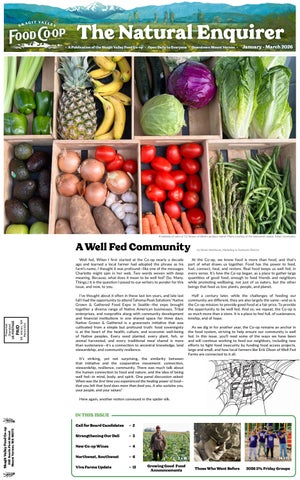
A rainbow of color at 13 Moons at Work’s produce stand. Photo courtesy of the Swinomish Indian Tribal Community.
16 Burlington Parks & Recreation
ECRWSS POSTAL CUSTOMER
PAID
Mt. Vernon, WA Permit #34
Presorted Standard US POSTAGE
A Well Fed Community
by Nicole Noteboom, Marketing & Outreach Director
Well fed. When I first started at the Co-op nearly a decade ago and learned a local farmer had adopted the phrase as his farm’s name, I thought it was profound—like one of the messages Charlotte might spin in her web. Two words woven with deep meaning. Because, what does it mean to be well fed? (So. Many. Things.) It is the question I posed to our writers to ponder for this issue, and now, to you.
At the Co-op, we know food is more than food, and that’s part of what draws us together. Food has the power to feed, fuel, connect, heal, and restore. Real food keeps us well fed, in every sense. It’s how the Co-op began, as a place to gather large quantities of good food, enough to feed friends and neighbors while promoting wellbeing, not just of us eaters, but the other beings that feed us too: plants, people, and planet.
I’ve thought about it often in these last ten years, and late last fall I had the opportunity to attend Tahoma Peak Solutions’ Native Grown & Gathered Food Expo in Seattle—the expo brought together a diverse range of Native American businesses, Tribal enterprises, and nonprofits along with community development and financial institutions in one shared space for three days. Native Grown & Gathered is a grassroots initiative that was cultivated from a simple but profound truth: food sovereignty is at the heart of the health, culture, and economic well-being of Native peoples. Every seed planted, every plant, fish, or animal harvested, and every traditional meal shared is more than sustenance—it’s a connection to ancestral knowledge, land stewardship, and community resilience.
Half a century later, while the challenges of feeding our community are different, they are also largely the same—and so is the Co-op mission: to provide good food at a fair price. To provide the opportunity to be well fed. And so, we repeat, the Co-op is so much more than a store. It is a place to feel full, of sustenance, kinship, and of hope.
It's striking, yet not surprising, the similarity between that initiative and the cooperative movement: connection, stewardship, resilience, community. There was much talk about the human connection to food and nature, and the idea of being well fed—in mind, body, and spirit. One panel discussion asked: When was the first time you experienced the healing power of food— that you felt that food does more than feed you, it also sustains you, your people, and your values?
As we dig in for another year, the Co-op remains an anchor in the food system, striving to help ensure our community is well fed. In this issue, you’ll read some of the ways we have been and will continue working to feed our neighbors, including new efforts to fight food insecurity by funding food access projects, large and small, and how local farmers like Erik Olson of Well Fed Farms are connected to it all.
Here again, another notion conveyed in the spider silk.
202 South First Street Mount Vernon, WA 98273
Skagit Valley Food Co-op
IN THIS ISSUE Call for Board Candidates
• 2
Strengthening Our Deli
• 3
New Co-op Wines
• 4
Northwest, Southwest
• 6
2 & 16
Viva Farms Update
• 13
Growing Good Fund Announcements
7 Those Who Went Before
14 & 15 2026 5% Friday Groups
FROM THE BOARD
Call For Board Candidates! Applications Due Feb 6
Growing Good Fund Announcement It is with great pleasure that the Skagit Valley Food Co-op Board of Trustees announces its decision to award $100,000 to Community Action's Skagit Food Distribution Center from our Growing Good Fund for 2026.
The 2025 Skagit Valley Food Co-op Board of Trustees.
The Board of Trustees of the Skagit Valley Food Co-op has always been fortunate to have a good group of qualified, involved member-owners who were willing to volunteer their time and varied expertise in serving on the Co-op Board. This has provided the governance necessary to allow the Co-op to broaden our offerings of high quality, healthy food, support our environment, support our community with relevant education, and support local farmers, international fair trade, and other co-ops. We have been able to manage our finances appropriately to provide a base for growth and a cushion for harder times while still providing support to members of our community in need.
The Skagit Food Distribution Center is the main hub for all of our area’s food banks. This donation is intended to restart the Distribution Center’s “Farm-to-Food-Bank” initiative that was grantfunded through 2024. This program will provide infrastructure loans to small, local farms that are meant to be repaid with fresh produce to fill that need for the Distribution Center and our local food banks. Additionally, the Board of Trustees is pleased to deepen its partnership with Viva Farms, to whom we’ve donated $300,000 through the Growing Good Fund since 2023. For 2026, we elected to provide $25,000 to Viva Farms as a matching donation to boost fundraising efforts for the purchase of a new refrigerated truck. Founded in 2009, Viva Farms is a local nonprofit farm business training program and incubator farm focused on growing the next generation of farmers by providing bilingual (Spanish-English) training in holistic organic farming practices, as well as access to land, infrastructure, equipment, marketing, capital, and community.
Each year, two positions are open for candidates from the community. (The dedicated Staff Board Position is elected every third year.) The election runs through the Annual Meeting in May and we hope for a good turnout. We are especially interested in bringing in member-owners with skill sets that will enhance our role. As the Co-op is a business, finance, business and leadership skills are always welcome. We work collegially and are looking for people who understand working within a group towards consensus while bringing their own experience and viewpoint to the table. The Board is hoping to increase its representation of the diversity of our community, and we encourage member-owners of all backgrounds and lived experiences to run for office, especially those from underrepresented groups. We ask that interested member-owners also attend at least one board meeting and meet with current Board members to go over what the Board does and what you could expect if you joined.
In 2026, the Board’s Community Giving Committee worked to further refine the process for giving through the Growing Good Fund. The process is intended to ensure alignment with the Co-op’s mission of strengthening community giving while maintaining focus on food-related initiatives in Skagit County. The committee evaluated several local community groups based on the criteria established for the Growing Good Fund. Key factors in the committee’s evaluation included an organization’s ability to demonstrate local impact as well as the potential to create positive systemic change in our local food system. During this evaluation process, the Community Giving Committee also designated Community Action’s Skagit Food Distribution Center to remain the recipient of the Co-op’s new Feeding Change register donation program for 2026. The Board approved the committee’s recommendations at the December Board meeting.
The deadline for the next Board election is fast approaching. If you are interested in being on the ballot, you’ll need to submit paperwork by February 6 and complete the meetings prior to February 12 in order to have your name and info included in the Notice of Election in the Natural Enquirer and online. If you are interested in being considered for Board vacancies that might arise between elections, the timing isn’t quite as urgent, although it would still be valuable to get the process started. If you are interested in being on the Board, we ask that you fill out the Notice of Intent (available on the Co-op website) and submit it to: board@skagitfoodcoop.com Note to Spanish-speaking member-owners: Si usted desea ser candidato para la Junta Directiva de Skagit Valley Food Co-op, por favor visite: skagitfoodcoop.com/our-board
Skagit Valley Food Co-op is a not-for-profit organization whose purpose is to provide good food at a fair price. As stated in the Co-op by-laws: “The Co-op shall promote member welfare by utilizing their united effort for the purchase and distribution of commodities in accordance with the following criteria… A. Maintain the not-for-profit status of the Co-op B. Offer high quality products that contribute to good nutrition C. Support a low-impact, non-harmful approach to the environment D. Support local suppliers and producers E. A commitment to building a cooperative economy and supporting others who share that commitment F. A commitment to educational programs relevant to members and non-members in the community."
AND, with over 75,000 submissions and 1.2 million votes, we won Gold for Best Grocery Store and Silver for Best Health Food Store in Bellingham Alive’s Best of the Northwest!
/Vegan Best Vegetarian ods & Gluten-Free Fo
LAYOUT & DESIGN
STAFF CONTRIBUTORS
Brad Claypool, Kristen Ekstran, Tom Theisen, Casey Schoenberger, Rob Smith & Zach Armstrong
Our Downtown is a great place to work, play, and shop, and we’re happy to be part of the mix. Thanks to you all for your votes, and more importantly, your support of local businesses like ours.
SVFC BOARD OF TRUSTEES
The Natural Enquirer is a quarterly publication of the Skagit Valley Food Co-op. Opinions expressed are those of the writers and may not reflect Co-op policy. No articles are meant to be used for diagnosis or treatment of illness. The Co-op does not endorse the products or services of advertisers. Copyright 2026. Reprints with permission.
|
The Natural Enquirer
|
January – March 2026
Best Green Bus iness
BEST
BEST
NORTH
NORTH
of the
WEST GOLD Best Grocery Store
of the
2025
Beyond that, several of our neighbors in Downtown Mount Vernon were also voted the very best: La Catrina Tacos and Tequila, Rachawadee Thai Café, Calico Cupboard, Martini Brunch, Il Granaio, and Temperate Habits Brewing Company, to name a few.
Megan Young
Skagit Valley Food Co-op
Best Gif t Sho p
All of those votes came through without selfpromotion or paid advertising. It is an honor to be held in such high regard by people throughout the region!
Leah Scates, Justin DeMeyere, Ben Goe, nancylee bouscher
2
re Best Grocery Sto
2025
CONTRIBUTING EDITOR
A Note of Transparency: Board Member Rob Smith is the Director of Programs and Operations at Viva Farms. While Rob has been involved in strategic Board discussions regarding community investments, he is not a Community Giving Committee member, and when it came time to vote on the selection of Viva Farms as a GGF recipient, he appropriately recused himself.
We are especially proud that, not only were we voted Best Grocery Store in Skagit Publishing’s Best of the Best competition, we were also voted Best Gift Shop, Best Vegetarian/Vegan/Gluten-Free Foods, and Best Green Business.
Skagit Valley Food Co-op Mission Statement
EDITOR
Activity within our investment accounts does not impact the day-to-day operations of the Co-op. Growing Good Fund grants and investment gains do not affect pricing or operating profit and are certainly not included when computing patronage dividends or staff profit sharing. We are, however, increasing our strategic reserve, while addressing some real needs in our local community—including food security—in accordance with our Ends Policies.
Every year, our local publications put it out to the people, asking the community to vote for their favorite businesses, from salons and accountants to tea rooms and grocery stores. The Co-op has won plenty of awards over the years, and the streak continues!
7am–8pm
Leigha Staffenhagen
The Co-op has always been managed in a fiscally conservative manner. We own our buildings, have no debt, and have, over the years, built up a strong reserve earmarked for the mitigation of hard times or for new endeavors driven by a strategic plan. We had previously kept these funds in liquid accounts, usually earning very low interest. Several years ago, the Board decided to put some of this money to work. We do still maintain an easily accessible cash reserve—at a level slightly higher than industry average. The remainder is now invested in a diversified portfolio of investments that follow ESG (Environmental, Social and Governance) guidelines. The gains from half of this (not the principal) are used for our Growing Good Fund. The gains from the other half are reinvested.
Voted Skagit’s Best Grocery Store and Gift Shop—Again!
Co-op Winter Hours
Nicole Noteboom
We are often asked where the money for the Growing Good Fund comes from.
WEST SILVER Best Health Food Store
FROM THE GENERAL MANAGER
Happy New Year and cheers to you, Co-op members, shoppers, and staff! The Co-op is here for another year of service to our community, and I couldn’t be more thankful to be a part of it. Last spring, in the Natural Enquirer, I wrote to introduce myself as your Operations Director. This time, I write to re-introduce myself as your Interim General Manager.
Leah slicing up samples at our Apple Tasting event in November.
In our reacquainting with one another, I’d like you to know that I consider myself to be a “co-op nerd.” A couple sentences to help define this attribute: any time I am traveling near or far, I always make a point to stop at the nearest co-op and “ooh” and “aah” over their unique spaces, local delights, and amazing (and sometimes curious) smells. When someone isn’t sure what it means to be a co-op, I am ready and eager to explain the business model, hoping that it means I’ll make a new cooperator and another steward of cooperative values. Now knowing a bit more about my heart, I have to tell you what a remarkable co-op we have here in Skagit Valley. The rich agricultural presence in the Valley is enough alone to make the Co-op a special place, but what has been incredibly humbling for me to be a part of is the people who care for it. The staff are passionate about the products and services we provide, the Board is extremely intentional in giving back to our community, our shoppers are loyal, and our local farmers and producers are proud to be included in our store.
In reflecting on my time here thus far, I would be remiss not to recognize the General Managers who came before me. Todd Wood created such an exceptional foundation for our Co-op from 1978 to 2020. His creativity made this one of the most special co-ops many “co-op nerds” have ever seen. Tony White retired in December after his six-year tenure. Our strong foundation, along with Tony’s leadership, helped the Board to achieve its dream of giving back to the community with programs like the Growing Good Fund and Feeding Change. As those who have come before me, it is now my turn to think of the year ahead and anticipate what is next. Since my start here in March, I have listened to the many voices of our care holders, and what I know is this: in the new year, I look forward to elevating our Co-op’s existing services by investing time in creating efficiencies and developing a culture of positivity. You won’t see many big changes this upcoming year, but I hope that what you feel is a new lightness and joy while shopping here at the Co-op.
Leah Scates
Interim General Manager
FROM THE CO-OP MAKERY
Strengthening Our Deli Through Locally Sourced Produce
by Justin DeMeyere, Food Production Manager
I often feel incredibly lucky to live in the Pacific Northwest, especially in Skagit Valley. As a young man, I transplanted from Eastern Washington to Bellingham in the summer of 2008. On my way north, I buzzed right past Mount Vernon. Fool that I was, I glanced at the redbrick façade of the Co-op and thought, “That seems like a boring city.” Coming from a farming community without Co-ops, I had no awareness of the cooperative spirit or its value. Looking back, my ignorance isn’t surprising. Food co-ops represent only a small fraction of national grocery stores, and most are far smaller than the average supermarket. As “small fish in a big pond,” co-ops face challenges the conventional giants rarely worry about: pricing perceptions, limited buying power, communicating core values, and reaching everyday shoppers. We don’t have skyscrapers full of accountants crunching numbers for us or marketing executives pouring over consumer data trends. Instead, we’re a diverse network of minimally connected stores, each with its own scale and focus. Some lean toward conventional supermarket offerings, others specialize in baked goods or grab-and-go salads, and none rival the modern supermarket in scale and ubiquitous coverage. Many are no bigger than your backyard or living room. We are tasked with understanding our consumers at the grassroots level, a challenge that is both difficult and infinitely rewarding. As a local business, we are aware of one important fact which often escapes the notice of the supermarket giants: in Skagit County, our local economy draws its vitality from the hard work of family-owned farms. When I moved to Mount Vernon in the fall of 2020, I had no idea I was making a fortunate and life-enriching choice. The very city I once overlooked revealed itself as a vibrant hub of local and hyperlocal (meaning from Skagit County) food. A stroll through our produce section mirrors the bounty of any local farmer’s market or roadside stand. Skagit is blessed with a multitude of family owned farms, and our Co-op benefits immensely from this abundance. In the Deli, one of our goals is to expand our local and organic offerings. Our kitchen leadership team is working closely with the produce department to incorporate even more regional ingredients into our dishes.
Current highlights include: Leeks
Red Cabbage
RALPH’S GREENHOUSE MOUNT VERNON
CARPANITO BROTHERS FARM KENT
Yukon Gold & Red Potatoes
RIVERLAND FAMILY FARM
Red Beets
BASIN GOLD CO-OP
FIRST CUT FARM MOUNT VERNON
WELL FED FARM BOW
Green Peppers CORVALLIS, OR
Red Onions
A COLLECTIVE OF GROWERS AND DISTRIBUTORS IN WA + OR
Kale
GRIFFIN CREEK FARM CARNATION
Seasonal offerings like hyperlocal organic romaine, green leaf lettuce and organic zucchini join the lineup in late spring, summer, and early fall. In colder months, we supplement with produce from California family farms—still far closer than the sources many conventional grocers rely on. This commitment not only supports local agriculture but also strengthens our pride in scratch-made recipes and fosters collaboration between the deli and produce teams. None of it would be possible without the tireless efforts of our produce crew, who champion the Deli as a place to showcase local harvests. When we keep it local, we cut down on carbon emissions from transport and production, and we often save on ingredient costs, making us more affordable while returning money to the local economy that sustains us. As a homeowner in Skagit County—and a transplant from a very different farming community—I take special pride in offering something unique to Valley shoppers: Deli items crafted with local and hyperlocal ingredients yearround. And we’re not stopping there! By working with partners like The Food Hub, Dairy Valley, and Organically Grown Company, we’re finding new ways to bring even more of the Pacific Northwest’s bounty to your table. I’d love if you’d try our locally inspired offerings and share your thoughts. I hope every bite, in its own unique way, helps you celebrate this extraordinary place we call home.
OUR NEXT COMMUNITY MEAL:
Friday, February 27 5-7pm • Co-op Deli
We’re hosting another $5 meal and donating all proceeds to local community groups. Bring a friend or your family to give back just by enjoying good food with good people.
skagitfoodcoop.com/5-friday Skagit Valley Food Co-op
|
The Natural Enquirer
|
January – March 2026
3
Coming Soon! Co-op Wines, A Toast to Home by Nicole Noteboom, Marketing & Outreach Director
When I think about preserving farmland, I think about the view off my back porch—a potato field currently in rotation with some sort of brassica. I think of my drive into the Co-op, waving at farmers biking into Viva, other farmers hand-picking their harvest in the rain, passing slow-going tractors, rolling my windows down to marvel at the rows of daffs or tulips, depending on the year. I think of Skagitonians to Preserve Farmland and all the work they have done, along with countless others, to protect this place we call home. Spuds, buds, Brussels, and a pace of living I don’t think I can ever give up. What doesn’t come to mind are the bottles of wine atop my fridge. And yet, Washington is home to some of the best vineyards in the world—not in my back yard, but still in our neck of the woods. I am sure there is some controversy about growing grapes instead of food, like growing lawns instead of gardens, but it’s safe to surmise, that across the Cascades life is not so different, and there are people passionate about preserving their own slice of heaven—land well-suited for vineyards, a robust wine economy, and local businesses.
Megan, Rob, Deborah and Elise, the Barnard Griffin family team.
Second-Generation Winemaker, Megan Hughes.
We’re excited to bring you two new signature wines with gorgeous label art designed by Co-op Graphic Designer Megan Young, and named for our place, the Skagit River Valley: Riverbend Red and Valley Rosé. These wines will be arriving in February, just in time to gift or glug in the name of love! In the meantime, we asked Barnard Griffin’s Megan Hughes to share about her wine creations:
Riverbend Red (2023) is a six-vineyard red blend. Her goal here was to make a style that sits beautifully between everyday drinkability and thoughtful craftsmanship. Its medium-bodied, fruit-forward style makes it approachable and crowdpleasing. Grapes are sourced from all over the Columbia Valley, using sources they are deeply familiar with. The blend leads with Cabernet with some Merlot, Malbec and Syrah blended in to add layers and complexity.
So, when our friends at Barnard Griffin presented us with the opportunity to partner on an exclusive wine selection, it was an easy decision. Founded by Rob Griffin and his wife Deborah Barnard in 1983, Barnard Griffin is one of the oldest and largest family-owned and operated wineries in Washington. In fact, in 2016 Rob celebrated his 40th harvest in Washington and became the longest tenured winemaker in state history. The two share a dream of making world-class wines that speak to the Columbia Valley and a desire to uphold Washington wineries. Barnard Griffin relies heavily on several vineyards throughout the Columbia Valley to craft their wines. Rob likes to think of the partner vineyards as a winemaker’s spice cabinet and says, “Blending lots from different sites always seemed the best course of action to me; like having an entire spice rack in your arsenal rather than one consisting of solely cumin and cinnamon. This line of thought has worked well for Barnard Griffin—allowing our wines to have a sense of place—distinctly Washington, while leaving room for us to blend consistent, awardwinning wine, year after year.” Rob and Deborah’s daughter, Megan Hughes is carrying on the family tradition as a second-generation winemaker at Barnard Griffin. Washington woman-winemaker—a wonderful whoosh of words, perhaps only surpassed by an actual splash in the glass of the wine itself, or the percussive pop of uncorking that bottle you’ve been saving for something special. And these wines are special.
Tasting notes: ripe plum and cherry flavors with subtle spice, gentle tannins, and balanced acidity.
Valley Rosé (2024) is a Sangiovese rosé made by pressing the red Sangiovese grape immediately after harvest. The grapes come from Balcom and Moe vineyard with a Geneva double curtain growing technique. This way of farming gives a healthy amount of shade to the grape, allowing Barnard Griffin to maximize acidity without affecting color. Barnard Griffin and Balcom and Moe have worked together for around four decades. The rosé pairs with almost any food imaginable and is also great by itself. Megan reaches for this rosé when she’s a guest because she knows it’s going to complement a wide array of foods, seafood and veggies especially. Tasting notes: strawberry, watermelon rind, refreshing acid.
Two new wines that speak to the places we love, crafted with care. Now, when I sit on my back porch soaking in the scenery with a healthy pour in hand, I’ll think of the land and livelihoods we’re all working to preserve and raise my glass with a simple toast: to home.
VENDOR SPOTLIGHT
Here For the Tea: Introducing One-of-a Kind Wild Orchard Tea! There was once an article contributed to the Enquirer titled “The Tea That Can Be Bought Is Not the Tea.” I was left a bit confuddled with that title, mostly because if there is any place to find a massive selection of tea—much of it local and very good—it is indeed the Co-op. That said, the title is very catchy, and the article was also about tea, figuratively. I am at least that clever. In its literal sense, the article centered on the belief that the very best tea is a blend you make yourself, by pairing a variety of herbs into an elegant tea infuser, heating your water to the perfect temperature, and steeping for the exact minute of recommendation. Frankly, I myself do not have the time, nor the patience, for such a ritual. Don’t get me wrong—I have the utmost respect for those who find a meditation in the practice (I wish that was me), but when you boil it down, if I want tea, its vessel will be a tea bag or sachet. Or, maybe a homemade matcha. And yes, you can find top-quality tea in a sachet. So, while the best tea might be the one you make yourself, if you’re like me and simply want a warm cup on the go when you’re too sleepy for a leafy tea setup, I’d argue that the tea from our newest tea maker is indeed, thee tea. Meet Wild Orchard Tea Company!
Founded in 1999, Wild Orchard was originally an experimental farm on Jeju Island in South Korea, where barren earth eventually softened into fertile ground as the first organic tea seeds were planted. Fast forward eight years, and that fertile farmland is South Korea’s first USDA Organic certified tea estate. Only in 2020 did Wild Orchard expand to the U.S., eventually earning its Regenerative Organic Certification— one of the highest, and most difficult sustainability standards to reach as a farm. Their dedication to regenerative farming represents their commitment to soil health, via crop rotation, minimal soil disturbance (often no-till), cover crops, and the use of compost without any synthetic fertilizers or pesticides, ever. While the certification is new-to-us, Wild Orchard has proudly practiced regenerative methods as long as they have been in operation—over 25 years! Now, let’s talk the tea itself. We are the very first place to carry Wild Orchard tea in all of Washington! Choose from Wild Orchard’s Everyday Green Tea, Everyday Black Tea, Sunday Brunch, and Sweet Sorbet—each a flavorful expression of the variety, with Sweet Sorbet taking a tropical twist on green tea, with its notes of peach, raspberry, and pineapple.
Beekeeping on Wild Orchard’s Regenerative Organic Certified farm.
4
by Leigha Staffenhagen
Skagit Valley Food Co-op
Wildflowers and Cedars on Wild Orchard’s tea farm.
|
The Natural Enquirer
|
All of their teas are tucked in plastic-free pyramid sachets, which allow the organic tea leaves to easily unfurl and release those brilliant botanical, herby flavors (and nutrients) into your favorite cup. The inner pouch holding the tea bags is made of wholly compostable wood pulp, and the box is 100% recyclable, too. Wild Orchard’s mindfulness of sustainable packaging clearly reflects their caring approach and the drinker’s desire to live and sip lightly. If you’re in more of a matcha mood, Wild Orchard offers some sensational options. All Wild Orchard organic matcha is made with tea leaves grown in unshaded, full sun, without removing any of the stems or veins prior to being ground into a fine, silky powder. What you already know of matcha may not apply—Wild Orchard has a unique take, offering a black tea matcha, too! Robust and excellent as a latte, black tea matcha has an earthy, roasty, chocolatey, coffee-like flavor that might just be the thing you need to cut down your coffee intake in the new year. Wild Orchard’s green matcha boasts a more traditional flavor: intense and earthy, with that bright green color we all love. Both matcha offerings are packed in a recyclable tin with a compostable inner pouch. While you might be inclined to spill the tea with your friends, this tea you won’t want to spill—it is, after all, the tea you can buy that IS the tea.
January – March 2026
NEW + NOTABLE
Hydration, Protein & Snacks Worth Packing
Well, hey, 2026! New year, new items, same wonderful Co-op! If you’re looking for a fresh start with healthy-er habits, check out our mix of new do-more drinks, snappy snacks, and protein-packed picks to feel full and energized along the way.
Hydration Station
Cold, winter weather can make it hard to stay hydrated, but these new super sips are sure to help you hit your New Year's goals. From electrolyte teas and sophisticated spring water to immune-boosting fruit juice, here are a few drinks to fill your cup and brighten up the dark days ahead.
Protein-Powered
Trying to pump up your protein intake in the new year? Along with a balanced diet of fiber and carbs, try these easy-peasy protein boosts to keep you going throughout the day.
Electrolyte Teas
High-Protein Greek Yogurt
CORPSE REVIVER
CHOBANI
Part tea, part electrolyte drink, Corpse Reviver keeps you hydrated with no added sugar and just 10 calories. A multi-functional beverage featuring potassium, magnesium, L-theanine, and zinc, these carefully selected components work in harmony to provide a holistic replenishment experience, and as the name implies, may even bring you back from the dead. Female-founded, vegan, and gluten-free, choose from Prickly Pear, Botanical, and Guava Rose.
If you’re on a mission to hit a specific protein goal this new year, you’ve got to start with the most important meal of the day. While most Greek yogurts boast around 11g of protein and up to 15g of sugar, new highprotein yogurts from Chobani have an incredible 20g of protein per cup and no added sugar. Plus, with nearly 70% of your daily recommended amount of vitamin B12 in one serving, this yogurt will keep you fuller longer and help sustain your energy all day long. Talk about a good way to start the day! Choose from vanilla, mango, cherry, raspberry lemon and strawberry kiwi.
Plant-Based Yogurt
Still + Sparkling Waters
FORAGER PROJECT
Protein-packed yogurt, hold the dairy! Made from coconut and cashew milk, Forager Project Greek yogurt has 10g of protein per serving and is USDA-Certified Organic. Thick and creamy, Forager Project yogurts are free of added sugar, oils, and starches, making for a real-ingredient, plant-based, protein-packed snack any time you need it. Choose from plain or vanilla.
SARATOGA® SPRING WATER
Water has never looked so swanky. But beyond the gloss and glam is something truly refreshing—a spring water sourced sustainably and with deep care. Saratoga’s signature cobalt blue glass bottle is 100% recyclable, and the production facility operates at an impressive 98% waste diversion rate, meaning 98% of all scrap materials are recycled rather than sent to landfills. Their team also includes Natural Resources Managers dedicated to overseeing land conservation efforts and to monitoring the long-term sustainability of their springs in the Adirondacks. All to say, you can sip your Dry January blues away in style at your next special occasion—choose from sparkling or still water in the sapphire bottle. Pinkies up!
Assorted Packaged Nuts FIELD DAY
Protein-packed nuts for a fraction of the price, at your convenience! New from our value brand, Field Day, are pre-packaged almonds, walnuts, pistachios, and cashews for a quick on-the-go protein fix! As always, if you want to go plastic-free, we have a wide selection of nuts (and trail mix) in our Bulk Department.
Snack Attack
Even in the midst of hitting hydration and protein goals, there’s always a need for some snackies. Here are some new crunchy, salty, and gooey sweet treats that hit the spot when your cravings call.
Superfruit Punch UNCLE MATT’S
Olive Oil Tortas
New from Uncle Matt’s is a fruit juice that packs a powerful immunity punch! Featuring dark cherries, blueberries, elderberries, and pineapple juice, this fruit punch is sweetened with just a dash of stevia leaf. It comes in at just 45 calories per serving, and with 100% of the daily recommended amount of vitamin C, it’s meant to keep the bad bugs away. Made with only simple, organic ingredients, this giant jug is perfect for sharing with the whole family every morning!
INES ROSALES
A traditional snack throughout Spain, tortas are thin, crispy, olive-oil crackers baked with anise seeds. While the savory ones are great with cheese and salty meats, the sweet tortas are the perfect complement to your morning coffee—the traditional way to enjoy them! Find sweet orange or savory rosemary thyme in the Co-op now!
Honey Caramels BEE GRATEFUL FARM
When you’re craving just a little something sweet, snag a Bee Grateful Farms honey caramel as you’re checking out your groceries! They’re 100% honey-sweetened and made in Colorado through partnerships with local beekeepers. Owners Hethir and Jason like to think that with every caramel they share, they’re passing on a piece of their appreciation for pollinators, fostering a connection between you and the natural world that supports us all. Choose from Ginger, Espresso, and Sea Salt, and make sure to toss the wrapper in the compost bin when you’re done!
Guava and Mango Nectar Juices SUN TROPICS
A Jamaican vacation might be just what Jimmy Buffett ordered, but if it’s 3 o’clock where you are and you can’t just sail away, a sweet sip of paradise will have to suffice. New from Sun Tropics are guava nectar and mango nectar juices! Made from a blend of exotic fruits, you can pour yourself something tall and tropical in no time at all— enjoyable morning, noon, or night, and in a mock-arita, too.
Game Day Crunchies FIELD DAY
Game day, or any day, find new crunchy snacks from Field Day, the Co-op’s value brand! Pita chips to pair with our famous Jalapeño Artichoke Dip, veggie straws to add some healthy-ish snacks to the game day spread, and corn chip dippers for your famous Sunday chili—all at a budget-friendly price. Find them with our other chips and crackers!
january
february
march
Co-op Juice Granola Wellness Shots Parfait Cups
New Pizzas! Wake Up ‘n’ Go Smoothies Raspberry Chocolate Heartcakes Deli Roasted Chickens
Pretzel Pastrami Melts Guinness Stout Cakes Dublin Coddle Quiche
Cheers to another year of healthy, hearty, amazing food! Seize the day with our fresh-squeezed juices or a wellness shot, follow your heart to the center of a cupcake, and get ready for new sandwiches, pizzas, and smoothies, too! Here’s some of the mood-boosting, taste bud-tickling food you can look forward to in your Co-op this season! Skagit Valley Food Co-op
|
The Natural Enquirer
|
January – March 2026
5
FROM WELLNESS
Northwest, Southwest
by nancylee bouscher, Wellness Manager
The sand is packed into road as solid as cement in between the two-story adobe houses of the Jemez Pueblo village, but as we walk up toward more modern houses, the sand shows hundreds of footprints from people walking with bellies and hearts full on the bounty of San Diego Feast Day. Junior is looking for footprints he left moments earlier when we walked toward the village. His six-year-old feet leave wide prints from dusty Crocs. I start to sing the rhythmic notes of the “Mission Impossible” theme song, and my husband, Junior’s great uncle, picks up the tune. Junior has never seen the show, but he likes the added drama to his own personal mission, so he quickly joins in. He has a large stick that he grabbed from a pile next to his front door, and he’s using that to point out different tracks that might be his. Look! There’s a Croc print, but it’s too large. I tease him that maybe it’s the track of his future self. He whips his face toward mine—his large glasses magnifying his doubt— and I’m struck with the similarities in his face to my own boys, now grown, who also had a pile of favorite sticks. Do all parents feel that pang when we see a shadow of our child’s past that we can never fully recapture? Junior turns back to his mission, quickly finds his tracks and follows them back to his home. Inside, his Grandma has a table, at least twelve feet long, crowded with bowl after bowl of food ready to serve each guest as they come to feast. There is ground pork with green chile and stewed beef with red chile alongside a large basket of thick slices of pueblo oven bread. In the kitchen, there are staggering amounts of food on the stove to refill the bowls for hours to come. She encourages us to sit down and tells me, in English, to “Go ahead. Eat good.”, I do. As a kid, the meals I associate with my home were fried egg sandwiches on white bread with yellow mustard at my dad’s and chipped beef at my mom’s. I had two homes from the time I was two, and I still have two homes—one in Skagit Valley and one in Isleta Pueblo. Both areas are so rich with history and beauty, both homes to vastly different landscapes and flora. Here we eat salmon and berries, while Horsetail and Devil’s Club stretch in the canopy of Cedar. In the Southwest, there’s Yerba Mansa in the shade of Cottonwood, a powerhouse plant used as medicine for centuries. Translated to “Calming Herb”, Yerba Mansa is traditionally used for respiratory, immunity, and calming inflammation. She is a low-growing perennial that loves marshy soil and blooms delicate white flowers in the spring. When a wild plant becomes sought after as an ingredient needed to create a product, there can be negative consequences if the wild harvesting of large amounts for big companies is not done ethically. Due to habitat loss, Yerba Mansa is now on the watch list of the United Plant Savers, so responsible companies are making efforts now to protect her. Of course, beyond what Yerba Mansa does for us as plant medicine, she plays an essential role in the ecosystem by aiding in soil regeneration in compacted areas.
Just as there are guidelines around what it means for a cultivated crop to be grown regeneratively or to ensure that people are paid fairly for their labor, there is also an organization with established guidelines for ethical wild harvesting, FairWild Foundation. They operate globally to help protect the ecosystem and the harvesters alike from Kenya to Kazakhstan, and now in New Mexico, to ensure the responsible stewardship of Yerba Mansa. Many of our Wellness brands use FairWild-certified material in their products: Gaia Herbs, Herb Pharm, Mountain Rose Herbs, Traditional Medicinals, and WishGarden Herbs. Yerba Mansa root is used in many of Wish Garden’s herbal extracts, including Kick-Ass Allergy and Get Over It, two of our bestselling remedies by WishGarden. WishGarden’s products offer ease of use with their pumps and formulas that include glycerin and alcohol as extractives. This means the flavor of the herbs are often a bit muted by the natural sweetness of the glycerin, making their children’s products very popular. Colds, colic, and calmness are just a few issues they address for your medicine mama cabinet. We are also stocking some of their delightful diapering products. WishGarden has long provided staples for mamas-to-be with their pregnancy and nursing-specific products, like After Ease and Milk Rich. If you have really good eyesight or a magnifying glass, you will notice that each herb listed in their ingredients tells you if it’s grown organically or wild harvested. In November, the Yerba Mansa under the Cottonwoods along the Bosque are dried to reddish brown. Underfoot, they are as crisp as the winter air, and when I reach down to touch the dried cone left on a brittle stalk, it breaks off. The scent of it is earthy and sweet with a subtle smokiness, almost like cinnamon. I realize I have never seen this patch in bloom, and I make plans in my head to visit this spot the next time I’m in the south valley of Albuquerque in spring. While tempting, I know I won’t harvest any of her, though. For one, I honestly don’t know when or how to harvest her ethically. It’s irresponsible to just start yanking up wild plants, folks. Also, I already have plenty of Yerba Mansa in my cupboard to see me through several seasons of coughs, and if I did need to purchase some, I know where to find some real good stuff. But I will feel that temptation—I always do. There’s this part of me, some primal yearning to reenact a way of life my ancestors may have experienced in a hope that it will connect me with them.
Wishgarden and Yerba Mansa
Possibly you have been to a Powwow or watched videos of them. Feast day dances are very different. The lines of dancers are diverse in their ages and some mild variances in their regalia, but there is cohesiveness as each dancer wears either bells or strings of shells. As they dance in unison their rhythm adds to the drum beats and voices surrounding us. The cacophony of sound is allencompassing, and I close my eyes to keep my tears in. It feels like the earth is pulsing with this heartbeat created by their unified footsteps, and again this primal yearning surges somewhere inside of me. I have tried to explain this feeling to others, and I have chased ways to feed my need for community and connection. Sometimes, it’s just me shaking my head at a hunger that I cannot satiate or explain. But now and then, I get a fleeting feeling of what somewhere way back in my DNA it was like to have a song, know a dance, have a meal, and be surrounded by people who know the words, feel that pulse, and know the true blessing of what it means to “eat good.”
This same feeling hit my core with fierceness as I watched the hundreds of dancers at Jemez Pueblo on their feast day. Junior’s older sister led us to a spot to put our folding chairs to watch, but I decided to stand. For many, the images that come to mind when we think of Native dancers might be ones from Powwows.
MERCANTILE + WELLNESS FEATURE
40 Blinks Eye Mask | BUCKY
Trying to reinvent yourself in the dead of winter? Oof, okay… instead, how about a gentle start to the day and simply celebrating the little wins along the way?
The first step to a good day, is a good night’s sleep—the more winks the better, and this eye mask keeps light out and the Zzzs in. It’s lightweight with adjustable straps too, so you can drift away with ease.
Here, a few items that invite you to spend just a little time curating wellness that is uniquely yours—to feel more rested, relaxed, and restored.
CUPPA Color | ORE’ ORIGINALS
A dash of color and a splash of something soothing is the perfect way to brighten a gray PNW day—check out our fun and uplifting selection of mugs, then fill it with your go-to tea. Speaking of…
Metabolism Blend | MOONTIME TEA
Need a new go-to? This blend is made for women by women to boost your energy and optimize your metabolism while connecting with the natural cycles of the moon, earth, and your body.
Citrus Scented Candles | GOODLIGHT CANDLES
‘Tis the season for sun-sational citrus, whose flavor AND aroma are an instant pick-me-up. Squeeze the day or brighten the mood with one of these fresh scents: eucalyptus citrus, fig grapefruit, lemon verbena.
Cookbooks | IN OUR UPSTAIRS MERCANTILE
Eating breakfast, packing a lunch, cooking dinner—those are little wins we can get behind. Bonus points if they’re protein packed and nutrient-dense. You’ll find an array of enticing cookbooks in the Co-op, full of recipes for every diet and lifestyle.
Get Over It! Immune Recovery | WISHGARDEN HERBS
What Nancylee said—this herbal remedy is a best seller for a reason. Kick your lingering winter cold to the curb with this part immune support, part lung support, part lymphatic system promoter AND part biotic. You’ll be back to upright in no time.
6
Skagit Valley Food Co-op
|
The Natural Enquirer
|
January – March 2026
Those Who Went Before, and the Community They Helped to Build
Years later, she could tell you their stories—who they were, where they lived, who their children were, who their partners were.”
Last summer, two Co-op community icons died, Sherry Broome and Emilie Cunningham. Between them, they had worked at the Co-op for about 80 years. (I feel like I just need to sit with that for a minute.) One had a calm presence, a love of healing, and the ability to smoothly navigate the Co-op’s financial and technical realms. The other kept us on our toes, kept the shelves steadily stocked for decades, loved to visit with customers, and made the best tea cakes ever. I just saw the quiet, elegiac movie Train Dreams, shot in Washington and set in the early 1900s. In one scene, the main character travels by train over the old wooden bridge he had helped to build when young—a bridge that had transformed both him and his part of the world. Silently, he gazes downstream at another bridge, a new bridge of concrete and steel, flowing with cars. It was my husband who pointed out both the metaphor and the reality of that scene: how we are surrounded and supported by the work of those who have gone before us, and how that history so often gets swallowed by the busy, self-preoccupied present.
Sherry Sherry Broome was the bookkeeper and then financial manager of the Co-op, but her influence stretched into every Co-op corner. She started in 1979, when she filled in as part of a paid staff of three for a bookkeeper visiting Europe. As former Manager Todd Wood puts it, “Her style, competent but kind, was a good fit, and in a mild coup, she kept the job after the old bookkeeper came back.” Sherry’s tenure saw the Co-op move from the small, shaky building on Pine Street to the current location, and then through all the remodels, expansions, and purchasing of the new site that ensued. As financial manager, she was in the thick of it, key to making it happen from an accounting perspective. But like so many jobs in the Co-op community, and even more dramatically in the early days, her efforts spilled beyond her job description. Sherry was just there, carrying what needed to be carried. Her soft North Carolina accent belied the fact that she could also tenaciously hold onto what she felt needed to be held onto. At her memorial service, a nephew mentioned that he’d never heard Sherry utter an unkind word to anyone. I immediately thought, you never asked Sherry for a replacement stapler. She was the maven and gatekeeper of the supply closet for many years. Misplacing a stapler was not acceptable behavior. She might not be unkind, but she could be steely, and I remember when every stapler, and every pair of scissors, on every desk, had a name taped on it for easy tracking. Before computers, she also had to manually track the financial records, all on paper. Her office was a marvel. As Todd says, “Sherry was the savant in piles. It didn’t matter what it was that you needed. You’d go to the office and look around and think, this is hopeless, and you would ask for this particular piece of something, and she’d extract what you needed. I have no idea how she’d do that, but it was her superpower. I knew I could count on her to pull order out of chaos without too much difficulty.” Storing all those papers became its own project, and I recall her carrying her preferred cardboard produce boxes (apple) up to the third floor, and the towers of those boxes, each packed with files. Even after computers, the boxes accumulated and remained, at first because computer storage was non-existent or dicey, eventually just because... you never know. But focusing just on Sherry’s office work leaves out her other worlds, and the way they influenced the Co-op, too. Sherry was a healer who studied acupressure and worked with tuning forks. I know I’m not the only person who sometimes went to Sherry’s office in pain and came away feeling better. She held onto the magic of crystals and of the rocks she and her husband David collected and polished. For Halloween, she often dressed as a fairy—tulle, sparkles, wings, and a wand.
The finance office in those years was home to plants and fish and birds. She was one of two people at the Co-op who could be counted on to scoop up a stray someone found, and give it a home. Sherry specialized in cats, who would join the passel she and David cared for at home. (The other person, who still works at the Co-op, will remain anonymous for her own protection against entreaty.) Babies were welcome in the office as well. Former Co-op staffer Jenny Sandbo started at the Co-op in 1990 as a grocery stocker, “In 1995, my son was born. Sherry and her mother-in-law, Anne, visited my hospital room, laughing and cooing over the tiny bundle of my baby boy. Her visit made me feel like I was part of a special community. After that, Sherry invited me to join her as a part-time assistant on the administrative team, and surprisingly, I was welcome to bring the baby. When I had my daughter in 1999, she joined us in the office as well. Both of my babies spent their first six months of life sleeping, eating, and being changed in that office. Sherry would work on her spreadsheets (remember Lotus 1-2-3?) with a baby drooling in her lap. It was a unique situation, one for which I am forever grateful. The Co-op was a community supporting a young mother who was making a living while caring for her family. Sherry was a driving force behind that culture of care.” Sherry retired in 2020, after 40 plus years at the Co-op.
Emilie Cunningham never dressed as a fairy for Halloween. Her preference was simple: a pointed black witch’s hat. With a short black cape if she was feeling really festive. Emilie started at the Co-op earlier than the rest of us can remember, and she stayed at the Co-op until 2013. She was one of the many volunteers in the early days who kept everything going. When I arrived in 1980, she stocked the grocery shelves and the produce cooler—or at least the nine or so square feet of the cooler that made up the entire produce section. Todd remembers, “The delivery truck would come up from Seattle, and products would be waiting for stocking, spread out all over the place. I remember once when the refrigerated stuff was outside the wooden cooler, all those little flavored yogurts sitting on the floor. And Emilie suddenly got up and said ‘Time for my martini’ and left, leaving the cold products just stranded there on the floor. I was flabbergasted—you just don’t do that. But that was Emilie—she wasn’t going to get caught up in other people’s priorities. She just exuded a flamboyance.” She was a single mom with two daughters, and Todd says that when he began in 1978, both their names were written, in a childish hand, on the walls of the kids’ play space in the center of the old store. Ora Mae, one of those daughters, remembers two things about the early days of helping her mom at the Co-op: eating yogurt push-ups, and sitting on the floor, putting price stickers on rice cakes. Ora also remembers that their family struggled financially, and Emilie’s work at the Co-op made a difference, “We lived in a trailer down by Ship’s Harbor and then in a tiny one-room cottage in Anacortes. My mom was on welfare. But we were able to eat goodquality food. Most of the other kids at school were not eating fried tofu with soy sauce.” Says Ora, “The Co-op helped my mom connect with a wider group of people than she might have otherwise. She met good people with whom she maintained long friendships. As the Co-op grew and became fancier, it was harder for Emilie, an over-the-top eccentric hippie, to fit into the Co-op’s evolving ethos. I’m deeply, deeply grateful to the Co-op for allowing someone as eccentric as she was to have a public-facing job.” As the Human Resources person at that time, I can safely say that holding your ground with Emilie could be like standing up to a hurricane. Yet, one of my earliest memories of her was a cold December day in 1980, when I drove down in my old VW van—no heat, no radio—from my home in Concrete. When I arrived, Emilie was already there, and, with tears in her eyes, told me that John Lennon had been shot. It wrecked her that day, such an act of violence, such an end of an era. Says Ora, “She was painfully empathetic. A lot of other things were a way to distract from that.”
Sherry sitting at her desk in the Finance office, 2002.
As the paid staff grew, Emilie moved into both the grocery department and cashiering. She ordered the magazines and handled the bulk orders. She was a constant presence on the floor, always happy to talk with customers. Her close friend Fran Farnham, former Co-op cashier says, “She knew everybody. She always remembered everyone.
Skagit Valley Food Co-op
|
The Natural Enquirer
|
Emilie was also an artist—she majored in art in college, and then took a job as a technical illustrator at Boeing. She was a painter, yet Ora says she really excelled as a cartoonist, sketching “really brilliant off-the-cuff illustrations that are funny and charming.” Her granddaughter has inherited that talent. Adds Ora, “She raised us to appreciate beauty and nature. I realize now how extraordinary that was. For me it was fabric of life, including a love of fine things. She was a poor hippie, but with incredible taste. She should have had a trust fund.”
The work of the present is crucial. At the Co-op, that includes the people upstairs at their desks; the people downstairs stocking, cashiering, cleaning, serving up food; the people behind the scenes packaging, cooking, and baking; the people helping customers on the phone and on the floor. All of them keep the Co-op running. Yet, holding the Co-op up are the tracks laid and the bridges raised by the thousands who have gone before. In turn, the Co-op has shaped lives and forged community— with good food, good jobs, a chance to create connection and support, a chance to be oneself and not squeeze into a specific mold. Says Todd of Sherry and Emilie, “Both of them had big hearts.” And really, what could be more important when building a Co-op, or a community?
mimi’s tea cakes Every winter, Emilie made the lightest, most delicious powdered sugar cookies, the recipe of her grandmother Mimi.
fO ra Ma e.
by Beverly Faxon
rte Em cou ilie, c irca 1968. Photo
o sy
If you got a batch, or even a bite, you felt pretty lucky. Thank you to Emilie's daughter, Ora Mae for sharing this recipe, a closely guarded secret for many years.
Ingredients · · · · · · ·
1 cup butter 4 Tbsp sugar 2 tsp vanilla 2 cups flour 2 cups pecans or walnuts, chopped fine Powdered sugar, lots! Plus, some gallon Ziplock bags
Directions A food processor works very well to chop the nuts. Stop when they are fine—before they become nut butter. Beat sugar and butter till fluffy and pastel yellow; blend in vanilla; add flour and beat until just combined; fold in chopped nuts. Roll into 1-1.25” balls (bigger balls result in a less ideal ratio of cookie to powdered sugar). To duplicate Emilie’s technique in full, this step is best done while stoned and watching Judge Judy. And/or with a friend who likes to gossip. It may be optimal to chill before baking, but Em didn’t chill them because there was never enough space in the fridge. Preheat oven to 325°. Bake 40 mins or more, check for golden-brown bottoms. This is the key! If you’re impatient, you’ll miss the whole point, which is crisp, light, melt-in-your-mouth cookies. Cool until warm, but no longer hot. If they cool to room temp, the powdered sugar won’t adhere properly. Add a cup or more of powdered sugar to a gallon ziplock. Add 10-12 warm cookies and very gently toss to coat them evenly. Set aside and begin a new bag, repeating until all cookies are coated. They won’t look pretty yet—this is the base layer only. Before serving, add fresh powdered sugar to the bags and carefully toss again to coat with new “snow.” Emilie gave them to people in the powdered sugar ziplock. Feel free to be fancier if you like. Do not wear dark colors if you’re trying to sneak a cookie! Everyone will see the evidence on your clothes.
January – March 2026
7
Good Food For a Good Cause
Co-ops Build Better Food Systems
$6,187
13
Amount Meals Raised in 2025
Community Groups Supported
2024 marked the 20th year of the Co-op’s 4% Friday Shopping Day, so again with a focus of increasing our community giving, the Board decided to increase 4% to 5% in 2025. Now, when you shop on 5% Fridays, the Co-op donates 5% of the day’s sale to a local community group—we’ve announced all 2026 groups on pages 14 and 15. Our largest 5% Friday donation in 2025 came in December: $4,964 to support the Mount Vernon Police Department's unique and highly-regarded Integrated Outreach Services program for our area's homeless population. In addition to the percentage increase from 4% to 5%, we started hosting one $5 Community Meal every quarter, with all meal proceeds also going to our 5% Friday groups. Each of the twelve groups received up to $500 in extra funds for their work in our community! Then, in December, we hosted an impromptu donation-based community meal in response to the historic floods. All of those meal donations went directly to Community Action's Skagit Food Distribution Center to help feed families across Skagit County, including some that had never had to ask for help until the floods. The dinner was a wonderful show of community support, and we raised $1,000 to help feed hungry Skagitonians.
For the second year in a row, your Co-op joined co-ops across the country to lower prices on all Field Day items in the month of November in conjunction with a giving campaign to support North American Traditional Food Systems (NĀTIFS), a nonprofit dedicated to revitalizing Indigenous food systems and promoting cultural preservation within Native American communities. The pledge was five cents for every Field Day product purchased.
wealth and cultural identity to Indigenous populations. The organization’s commitment to promoting Indigenous foodways education, facilitating food access and revitalizing ancestral knowledge underscores its mission to create positive social impact and support underserved communities. You can find Chef Sherman’s book Turtle Island: Foods and Traditions of the Indigenous Peoples of North America in our Mercantile.
In 2024, co-op shoppers everywhere put approximately 280,000 Field Day items in their carts, for a donation total of $140,000. While NCG is still crunching national numbers for 2025, we anticipate similar success.
The Swinomish Indian Tribal Community’s Environmental Health Program’s work involves evaluating Indigenous health, a difficult task given the many intangible aspects of health. The strategy is to focus on a paradigm of health in lieu of disease, and to think about less tangible aspects of health via the proxy of first foods (also called traditional foods or “Swinomish foods”). The Swinomish apply the Indigenous Health Indicators concepts to its climate change work, as well as to food sovereignty and informal learning. Other program work includes increasing access to fresh, local produce through their community garden and the Swinomish preschool’s mini 13 Moons garden. Fruits and vegetables from the garden are freely shared in the community via produce carts, at Elder lunches, and in the main kitchen.
At our Co-op: 17,019 Field Day items for a Skagit Valley Food Co-op contribution of over $850. And for the second year in a row, your Co-op also pledged to match our contribution to the NĀTIFS campaign with a donation to the Swinomish Indian Tribal Community’s Environmental Health Program, to help provide food for children and elders. NĀTIFS was founded by Lakota Chef Sean Sherman (James Beard Winner known as the Sioux Chef). Through initiatives like the Indigenous Food Lab, NĀTIFS offers training programs, educational workshops and support for Indigenous entrepreneurs to empower individuals and foster economic development. By addressing economic disparities, food insecurity and the loss of Indigenous food knowledge, NĀTIFS aims to restore health,
Field Day is the Co-op’s value brand that offers better access to organic, nutrient-dense foods (including canned organic produce) along with household products at a competitive price, for everyone.
Out & About With the Co-op: Winter 2026
Hello to a brand new year of community! Thanks to everyone who visited us at the many events we participated in last year. Since, ahem, 2020, we’ve been working to build our presence at community events as part of our commitment to the cooperative principle of Concern for Community, and we nearly doubled the number of events we either hosted or attended as a Co-op in 2025 from 2024! And the good news is, there are even more events on the horizon this year. While winter is a time to reset and go slow, there are still a few upcoming events we’d love to see you at!
Leigha with Marie of MV HOPE Coalition.
Ryan serving customers at a Community Meal.
5-7pm • The Co-op Deli
Illuminight Winter Walk
Friday, January 30 | 5pm | Mount Vernon Riverwalk
Join us for our first Community Meal of the year! Skagit Valley Food Co-op
Saturday, January 17 | 9am–12pm | Deception Pass State Park
In honor of Martin Luther King Jr. Day of Service, we’re teaming up with Skagit Fisheries Enhancement Group to help restore the riparian zone in a tributary to Pass Lake. We’ll be planting trees in the fields along the shoreline of Pass Lake in Deception Pass State Park, starting at 9am. Grab a cup of coffee at the trail and join us for a fun afternoon—rain or shine. Space is limited! RSVP at skagitfisheries.org
Friday, Feb 27
8
Pass Lake Tree Planting Event with Skagit Fisheries Enhancement Group
The Illuminight Winter Walk celebrates art, light, health, community, and the Skagit River ecosystem! Head Downtown for this free community event featuring live music, art, and a luminary-lit procession. We’ll be serving free coffee courtesy of our friends at Equal Exchange. In the meantime, keep an eye out for opportunities to make your own luminaries around town. |
The Natural Enquirer
|
January – March 2026
High Five Recipes: Go You!
Eating for immunity, cutting down on alcohol, trying a vegan diet—January is the time for something new! As always, our High Five recipes are made with around five main ingredients, so you can spend more time tackling those New Year’s resolutions and less time in the kitchen.
Curried Chicken Salad RECIPE COURTESY OF CO+OP
A quick and easy lunch to enjoy at home or on the go, this curried chicken salad features sweet grapes and dates to complement the aromatic curry flavors. Pick apart a Co-op Roasted Chicken for this and meals for the rest of the week!
Veganuary Goddess Bowl RECIPE COURTESY OF CO+OP
Trying Veganuary this year? This bowl is packed with veggies and whole grains and finished with a sriracha tahini dressing, the perfect addition to your weeknight dinner rotation. Ingredients · 1 cup dry quinoa or bulgur · 1 bunch Tuscan kale, thinly sliced · 2 large carrots, shredded · 2 medium avocados, halved and pitted · 1/2 cup raw unsalted pumpkin seeds
Dressing Ingredients · 1/4 cup tahini · 1 Tbsp cider vinegar · 1 Tbsp Sriracha sauce · 1 Tbsp plus 1 tsp tamari sauce, divided · 1 Tbsp honey
Ingredients · 4 cups shredded Co-op Roasted Chicken · 1 cup chopped pitted dates · 1 cup sliced green onions · 2 cups quartered grapes · 1 bag prewashed salad greens Pantry ingredients: 1/4 cup mayo, 1/2 cup Greek yogurt, 1 1/2 Tbsp curry powder, 1 tsp salt, 1/2 cup sliced almonds. Directions 1. Mix together mayo, yogurt, curry powder, and sea salt. Toss with the chicken, dates, onions, and grapes.
Directions
2. Place a scoop of salad on a bed of greens on each serving plate, and top with sliced almonds.
1. In a small pot, bring 1 1/2 cups water to a boil, then add your grain of choice. 2. Return to a boil, and if using quinoa, reduce the heat to low and cook for 14 minutes, covered. For bulgur, bring to a boil for 1 minute, then cover and let stand for 15 minutes. 3. While the grain cooks, place the tahini, cider vinegar, and one Tbsp each tamari, honey, Sriracha sauce and water in a small bowl. Stir with a fork until smooth. Add a bit more water if the dressing is too thick. 4. Place the pumpkin seeds in a small saute pan and swirl over medium-high heat. 5. When they begin to pop and become fragrant, stir in the tamari. The tamari will coat the seeds and the pan will be dry. Transfer to a bowl to cool. 6. Place a quarter of the cooked grains in each of four low, wide bowls. Arrange the raw kale and carrots on top of the grains. 7. Slice the avocado halves in the skin and carefully scoop them out with a spoon. 8. Fan half an avocado over each bowl. Top with dressing and pumpkin seeds.
Snow Globe Spritz
RECIPE ADAPTED FROM WILDERTON APERTIVO CO.
NA has never looked (and tasted) so good! If you’re trying the Dry January thing, the Co-op has a huge selection of NA beer, wine, cider, and spirits! This recipe from Wilderton Aperitivo Co. features their classic Bittersweet Aperitivo, available in the beer aisle. Ingredients · 1.5 oz Wilderton Bittersweet Aperitivo · 2.5 oz ginger beer · .75 oz orange juice · .75 oz simple syrup Garnish: fresh mint, powdered sugar
Honey Roasted Citrus RECIPE COURTESY OF CO+OP
Directions
It’s time to celebrate citrus season! Grab a few of your favorite varieties and slice them up for this elegant, but simple, fresh fruit dessert.
1. Add all ingredients to a shaker, except the ginger beer. 2. Add ice and shake for 10 seconds. 3. Open the shaker and add ginger beer.
Ingredients · 2 red grapefruits · 2 large navel oranges · 2 large blood oranges · 2 Tbsp extra virgin olive oil · 2 Tbsp honey · 1 tsp vanilla · 2 sprigs fresh rosemary, chopped (optional)
4. Strain into a short glass over crushed ice. 5. Garnish with fresh mint and a dash of powdered sugar.
Immunity Boosting Smoothie RECIPE ADAPTED FROM JOY & OLIVER
Whether you have some food and health-related goals on your New Year’s Resolutions list this year or not, eating for immunity is worth adding! This immunity-boosting smoothie is an easy way to fill up while getting your vitamin C every morning.
Directions 1. Line two sheet pans with parchment paper. Preheat oven to 400°F. 2. Cut away the peel and pith from all the citrus, then slice the flesh into ½-inch-thick rounds.
Ingredients · 2 whole oranges, peeled · 2 whole bananas, peeled · 1 cup frozen mango chunks · 1 tsp fresh ginger, peeled and chopped · 1 Tbsp lemon juice Pantry ingredients: 1 Tbsp honey, 1 cup milk or alternative
3. In a cup, stir the olive oil, honey, and vanilla. Add rosemary, if using. 4. Use a pastry brush to baste each slice before placing, basted side down, on the pans. When all the slices are on the pans, baste the tops with remaining oil mixture.
Directions
5. Bake for 15 minutes, then use a spatula to turn the slices, then bake for 10 minutes longer. Let cool before serving.
1. In a blender, blend all ingredients until smooth. 2. Add to a glass, and sprinkle with hemp hearts for extra nutrition and protein! Skagit Valley Food Co-op
|
The Natural Enquirer
|
January – March 2026
9
REIKI BLESSINGS You are invited to a weekly meditation for World Peace for Inner Peace for You & Personal healings with Valerie Rose
yourgoldenrosehealing.com
Contact the Enquirer NicoleN@skagitfoodcoop.com 360.336.5087 x136 Nicole Noteboom, editor
Advertising We offer discounts for prepayment. All first-time ads must be prepaid. The ad deadline for the next issue (March 2026) is Friday, Feb 20. skagitfoodcoop.com /coop-newsletter
Are you interested in running for the Co-op Board of Trustees?
Join us at any Board Meeting or email the Board directly: board@skagitfoodcoop.com Board Meetings take place on the Co-op's third flood on the 2nd Thursday of every month at 7:45 am. Candidate letters of intent for the 2026 Annual Election are due Friday, February 6. Scan to learn more about our Board
10
Skagit Valley Food Co-op
|
The Natural Enquirer
|
January – March 2026
STAFF FEATURE
Lealia Ulavale Front End Manager
Co-op Employee Since August 2025
Background Previously, I worked for Starbucks in the greater Seattle area for nearly 20 years, where I started as a barista and left as a store manager trainer. During my time there, I learned, then later taught others about compassionate servant leadership, operational excellence, and cultivating environments that foster warmth and belonging. I left Starbucks in January of 2025 to pursue more meaningful work that I felt aligned with, which has landed me here at the Co-op. I am beyond proud to be able to learn from and serve this community!
Favorite customer moment: It's difficult for me to narrow it down to just one favorite moment here. Since coming here, I have been met with so much kindness and authenticity from customers and coworkers alike. I have been blown away by the pride that both members and employees take in being a part of the Co-op. Thank you for the very warm welcome these past few months.
Favorite items at the Co-op:
New treasures, handcrafted fresh herbal creations, and curated meaningful goods to delight and support your self-care rituals.
VERA WELLNESSMount CENTER 303 Vera Street Vernon, WA Acupuncture Barbara Paul-Mayer, MAc. LAC 360-336-6809 Core Synchronism Julie Kongs 360-630-6742 Colon Therapy Jayne De Felice, I-ACT Certified 360-336-5220 Reiki & Theta Healing® Valerie Jean Rose, Reiki Master 360-840-1723 Massage Therapy Spencer Kelliher, LMT 425-231-7605 Rolfing Structural Integration® Nils Larsen 360-293-5866 Clinical Massage & Lymph Drainage GuruBani Whitney, LMT, CLT, CPHt, RH www.alchemy-wellness.co
From reusable and sustainable lifestyle items to intentionally selected crystals, candles, and tools for wellness rituals, do much to explore. We’re proud to feature creations from local makers, including our partner Scents of Wellbeing, and showcase a growing collection of artisan goods. Looking for a bit of sass with your self-care? We’ve got you covered with sarcastic towels, stickers, signs, and other perfectly cheeky finds - because wellness should be fun, too. Stop in and take a peek—you don’t have to buy a thing… but, honestly, you’ll probably leave with something you never knew you needed. WILDVALLEYAPOTHECARY.COM @WILDVALLEYAPOTHECARY 320 E. FAIRHAVEN AVE - BURLINGTON
Live a More Vibrant, Balanced, Vital & Healthy Life!
My go-to items are the hot and ready chicken potpies and the Bacon-y Cubano— both are made in-house!
Favorite meal to make with ingredients from the Co-op: Admittedly, I am not the most diligent cook, thank goodness for our amazing prepared foods department who does most of the work for me! My favorite quick Co-op meal to make has been a grilled chicken linguini alfredo made with Co-op grilled chicken, our fresh pasta, Rao’s Alfredo sauce, and broccoli from our amazing produce department. Pair that with our Rustic Garlic Sourdough, and you are set in 15 minutes!
How I spend time outside of work: I am a huge advocate for self-care, and some things that fill my cup outside of work are taking a scenic drive or walk with friends, getting silly at karaoke, or having a cozy day with my partner. I also love playing almost any game—board games, video games, card games, yard games, sports—you name it, and I will play it!
Co-op Members Save 20% on Wellness Faves in March! One Shop, All Items Come stock up on wellness essentials and your go-to items.
Not a member yet? Join today at any register! Skagit Valley Food Co-op
|
The Natural Enquirer
|
January – March 2026
11
FROM PRODUCE
Grapefruit & the Gelatin Recipe You Didn’t Know You Needed
by Ben Goe, Produce Manager
Two wonders of winter, grapefruit and Brussels sprouts, have something in common: they are both misunderstood and unfairly maligned. People remember them as bitter and unpleasant, and that’s just not the case with modern varieties. I’m here to share a few ways to enjoy grapefruit, and I’d encourage you to read on even if you’re one of the people who think you don’t like them. Brussels sprouts gained prominence in the 16th century in the Belgian capital of, yes, Brussels. Grapefruits originated by chance in Barbados in the 18th century, a cross between sweet orange and pummelo. There are dozens of varieties now, with Star Ruby being the most common. (An aside about pummelo—I strongly recommend the African Shaddock variety. It has a firm, meaty texture, with a note of pine. We can give advice on how to peel one if you need it.) Grapefruit is the official state fruit of Texas, where the Rio Star variety was developed. Another commonality—Rio Star grapefruit and the Hulk are both the product of radiation! In 1984, Dr. Richard Hensz at Texas A&M began treating grapefruit bud sticks with thermal neutrons to induce mutation, and the Rio Star was born. One of the finest varieties, grown only in Texas, it is very sweet, has a deep red color, and is much less bitter than many other grapefruits. The other variety I want to shout out is the Honeygold. It has a very short season, so get them while you can. Honeygolds have low acidity and are very sweet. The skin darkens to a golden color when fully ripe, and the flesh is a pale white-yellow. It’s easy to peel, nearly seedless, and segments easily, making it a great choice for adding to winter salads. Rio Stars and Honeygolds will be stacked high in Produce with other in-season citrus, and as soon as we have fruit small enough to process in our juicer, we will be offering juice from both. In addition to a quick splash of vitamin C to start your day, I recommend using our fresh grapefruit juice for mixed drinks— good gin and good grapefruit juice are a match made in heaven!
One other use I want to mention is gelatin. Hear me out: I think gelatin molds are due for a comeback, though maybe without as much tuna and mayonnaise as in the past. To make an easy, fresh grapefruit gelatin mold, use unflavored gelatin, available in our bulk department. (You can also use agar for a vegetarian option, though the proportions and method are different.) You’ll also need simple syrup: Bring 1 part water and 1 part sugar to a boil to fully dissolve the sugar, then chill. You’ll need equal parts simple syrup and grapefruit juice. For every 2 cups of liquid, use one tablespoon of gelatin. Put the gelatin in a mixing bowl and bring a quarter of the liquid to a boil in a saucepan. Mix the hot liquid into the gelatin to dissolve, then mix in the cold liquid. Have a lightly oiled mold pan or bowl of the appropriate size ready, and pour the mixture in as soon as it’s fully combined. You can also add segments of the fruit after pouring it into the mold. Chill for several hours, and invert onto a serving tray. Voila, it's the seventies! And Bon Appétit.
Local In-Season Produce CASCADIA MUSHROOMS
· Shiitake, Oyster, Lion’s Mane mushrooms · mixed Mushroom packs and growing kits · dried Reishi, Oyster + Shiitakes
SAUK FARM
THE CROWS FARM
· assorted radicchio + Winter squash HEDLIN FAMILY FARMS
· green, Savoy + January King cabbage RALPH’S GREENHOUSE
· Honeycrisp apple cider
· leeks, parsnips, cabbage + carrots
CEDARDALE ORCHARDS (not certified organic)
· apple cider gallons, 1/2 gallons and pints
DAHLIA DEPOT (not certified organic)
· pea shoots, spicy mix + mild microgreens · red kohlrabi, radish and pea shoot micro greens
BOLDLY GROWN FARM
· assorted beets, radicchio + Winter squash · Daikon radish, kohlrabi, shallots purple, green + Savoy cabbage
BROWNFIELD ORCHARDS
· Gala, Fuji, Pink Lady, Granny Smith Honeycrisp, Evercrisp, + Cosmic Crisp apples WELL FED FARMS
· beets, purple cabbage, assorted Winter squash MOONDANCE FARM
· sunflower sprouts, celery root, · french grey shallots, assorted Winter squash GRIFFIN FAMILY FARMS
· Not local, but still fresh and direct! Medjool Dates from a third generation certified organic family farm in Somerton, AZ.
FIRST CUT FARM
· assorted potatoes + onions
Citrus & Arugula Salad RECIPE COURTESY OF CO+OP
If gelatin isn’t your thing, you can’t go wrong with a bright and flavorful winter salad. Featuring grapefruit, Cara Cara, and Blood oranges and accented with a simple balsamic vinaigrette and crunchy walnuts or salty feta, this salad will appeal to everyone at the table. Dressing Ingredients · 3 Tbsp extra virgin olive oil · 2 Tbsp balsamic vinegar · 1 clove garlic, pressed · 1 pinch dried oregano · 1/2 tsp salt Directions
Salad Ingredients · 1 large red grapefruit · 1 large Cara Cara or navel orange · 2 large blood oranges · 1 small shallot, thinly sliced · 4 oz arugula · 1/2 cup chopped walnuts · 4 oz crumbled feta, optional
1. First, make the dressing. In a jar or small bowl, combine the olive oil, balsamic vinegar, garlic, oregano and salt and shake or whisk to mix. Reserve. 2. Using a sharp knife, cut off both ends of the grapefruit and each orange to expose the flesh and make a flat surface. Place on the flat, cut side and use your knife to pare away the peel and pith, leaving just the flesh of the citrus exposed. 3. Place each trimmed fruit on its side and slice thinly. Remove any seeds and reserve. 4. Spread the arugula on a large platter or place in individual bowls. 5. Arrange the citrus rounds on top of the arugula, with the blood oranges on top. 6. Sprinkle with shallots and drizzle with dressing. Add walnuts or feta, if desired. Serve immediately.
12
Skagit Valley Food Co-op
|
The Natural Enquirer
|
January – March 2026
Every time you bring in a reusable shopping bag, we honor your commitment to reducing waste with a token worth 8¢ that you can give back to a local community group.
Meet our 1st Quarter Groups! January 1 - March 31
Upper Skagit Library Freedge
Become a Farmer with Viva Farms’ Practicum in Sustainable Agriculture from Viva Farms
Who keeps you, your family, your neighborhood well fed? Could it be you? Lucky for us, in Skagit County, we know who does: farmworkers, agronomists, tractor mechanics, seed scientists, grocery buyers, farmers market staff, the bees… Living in an agricultural area of the Magic Skagit, we naturally witness our food system more than most people in the U.S. do. As cities grow in population, the gap in our understanding of food widens. As you consider who, not what, keeps you well fed, how does that sit with you? At Viva Farms, a local nonprofit farm business training program and incubator farm, operating near the Port of Skagit and in Woodinville (King County), it’s unsettling. We are focused on growing the next generation of farmers because we believe in a just and resilient food system where farming is a financially viable livelihood. Many farmers describe the occupation of farming as more than a job—more like a lifestyle, a livelihood, a calling, a serious responsibility and an honor.
Does the soil call to you? In many ways, Viva Farms is in the business of keeping Skagit (and beyond) well fed. Our mission is to empower aspiring and limited-resource farmers by providing bilingual (Spanish-English) training in holistic organic farming practices, as well as access to land, infrastructure, equipment, marketing, capital—and community. Right now, applications are open to join our program via an 8-month, land-based course where participants apply knowledge and practice techniques of sustainable agricultural production on a certified organic parcel.
The Practicum in Sustainable Agriculture, the course that starts in April, trains students to launch a farm business. Are you interested in feeding your community? If so, we encourage you to learn more and apply. From there, you might just launch your farm, join the incubator full of 30+ other farms, harvest your first crops, and sell them into our community-supported agriculture box or to the Skagit Valley Food Co-op. Or, you might identify that some in your community are in need and sell to Skagit Gleaners like Mizpa Farm and Josh Farms did last summer, or volunteer to cook as Mejia Romero Farm did at Tri-Parish Food Bank this fall, or create no-questions-asked, free-to-all extra veggie boxes like Dear Table Farm offered at the farmers market during the SNAP benefits disruption. We are working at Viva Farms to make the dream of farm ownership—growing food, maintaining the soil, living with the land, creating homes for the bees—available to all. Happy New Year to all! Tours of Viva Farms will begin again come June! We look forward to seeing you.
The Upper Skagit Library empowers the community by creating opportunities, fostering connections, and providing resources, while committing to the highest standards of librarianship. The Freedge, an extension of the Food Recovery Program, allows Concrete restaurants, corner stores, grocers, schools, and more to put their extra food to good use by feeding neighbors in need of food assistance instead of composting or trashing leftovers and close-dated food items. upperskagitlibrary.org/community-freedge
Communities in Schools The mission of Communities in Schools (CIS) is to surround students with a community of support, empowering them to stay in school and achieve in life. CIS mentors students through academic, behavioral, and social challenges that come with being a kid in today’s world. CIS lowers barriers between students and life-enriching opportunities, giving them the best chance of becoming productive members of society. whatcomskagit.ciswa.org
Ready to feed your Skagit neighbors organic, nutritious fruits and vegetables? Come try your hand at farming by applying to the Practicum in Sustainable Agriculture course. Learn more at vivafarms.org or call 360.969.7191 x 804
The Friendship House Café As the only no-cost daily meal service in Skagit County, Friendship House provides a critical service to our community. The Café is committed to serving at least one nutritious, hot meal per day, 365 days per year, to anyone who is hungry. Proper nutrition and full stomachs are essential to being healthy, active, and productive, and Friendship House strives to ensure that every person who enters the Café is fed not only food but also compassion, respect, joy, and acceptance. skagitfriendshiphouse.org
Viva Farms students running a pop up at Pike Place Market, Downtown Seattle.
Adela and braided garlic.
La Conner Sunrise Food Bank The mission of the La Conner Sunrise Food Bank is to address the food needs of our community by offering supplemental food to individuals and families facing challenging circumstances. The food bank operates a weekly food distribution service as well as a home delivery service to those who are elderly, disabled, or living without transportation within the La Conner School District. Viva's new truck!
Skagit Valley Food Co-op
|
The Natural Enquirer
|
January – March 2026
laconnerfoodbank.com
13
One of our most exciting ways to support the community is through 5% Friday! One Friday each month, you shop and together we give 5% of Co-op sales to a local community group. Just think—each of these organizations is, itself, supporting the community.
Mark your calendars to support these groups in 2026! JAN 23
APR 24
Skagit County Meals on Wheels
Skagit Valley Farmers Market Coalition
For almost 50 years, Skagit County Meals on Wheels has been dedicated to ensuring that no senior goes hungry or isolated in Skagit County. The delivery of hot, healthy meals and regular wellness checks helps seniors remain in their homes, promoting independence and dignity and preventing malnutrition. With budget cuts and hot food in jeopardy, 5% Friday funds will be used to purchase nutritious food for the Meals on Wheels program. Your support will help ensure that every senior in need receives a healthy meal, keeping our community strong and well-fed.
The Mission of the Skagit Valley Farmers Market Coalition is to celebrate and grow our unique Skagit culture around food and community by strengthening our resilient farmers’ markets. The coalition includes the Sedro-Woolley Farmers Market, Mount Vernon Farmers Market, and the Anacortes Farmers Market. 5% Friday funds will support the coalition’s EBT Market Match program, which feeds people who need it most and puts money in the pockets of local farmers. All matched dollars are used for fresh fruits and vegetables grown by local farmers.
marchformeals.org
facebook.com/SkagitValleyFarmersMarketCoalition
FEB 27
MAY 22
Help Me Grow Skagit
Skagit Land Trust
Family Resource Center
Kulshan Creek Neighborhood Youth Program
The Help Me Grow Skagit (HMGS) Family Resource Center provides critically needed diapers, wipes, formula, and other basic needs, including personal hygiene and cleaning products. The HMGS Family Resource Navigators further assist families by connecting them to other services they may need, including healthcare, developmental screenings, and prenatal care. Two car seat safety technicians continue to provide car seats and installation. Funds from 5% Friday will be used to purchase and distribute these essentials to families in need.
Skagit Land Trust conserves wildlife habitat, agricultural and forest lands, scenic open space, wetlands, and shorelines for the benefit of our community and as a legacy for future generations of people and wildlife. Funds from 5% Friday will directly support the Kulshan Creek Neighborhood Youth Program, coordinated by Skagit Land Trust, providing primarily migrant youth and their families with meaningful opportunities to engage with the natural environment through monthly field trips throughout Skagit County. Funds will support meals, transportation, program materials, and staff time.
helpmegrowskagit.com/resource-center
skagitlandtrust.org
MAR 27
JUN 26
Sedro-Woolley Farm to School
Skagit Gleaners
Sedro-Woolley Farm to School serves students, families, and community members who live within the Sedro-Woolley School District (SWSD) boundaries. 5% Friday donations will be used to further Farm to School (F2S) efforts in the SWSD, supporting staff time, supplies, and materials as the program continues to develop the new Cascade Middle School food production garden. This new garden will significantly expand the F2S initiative in SWSD by integrating food systems education at the middle school level.
Skagit Gleaners’ mission is to address food waste and its environmental impacts while building an equitable food system. They do this by rescuing surplus food and products from local businesses, farms, and community members, keeping these items out of overflowing landfills. The Gleaners will utilize 5% Friday funds to support the Hand-Harvest Gleaning program to purchase tools and supplies. In 2025 alone, the program saved 15,000 pounds of food that would have otherwise gone to waste.
unitedgeneral.org/farm-to-school
skagitgleaners.org
14
Skagit Valley Food Co-op
|
The Natural Enquirer
|
January – March 2026
$600,00+
$50,837
All Time Donation Total
2025 5% Friday Donation Total
JUL 24
OCT 23
Children of the Valley
SVC Foundation - Cardinal Food Pantry
Children of the Valley (COV) provides a safe, positive, and enriching after-school program for under-resourced, low-income children in the Mount Vernon, Conway, Sedro-Woolley, and Burlington School Districts. COV now supports up to 200 students in grades K-8 who attend each of their district’s elementary and middle schools. Funds from 5% Friday will support COV’s Teen Volunteer Mentorship Program, which engages, supports, and empowers local middle and high school students who choose to volunteer at Children of the Valley.
The Cardinal Food Pantry at Skagit Valley College is an essential campus resource that helps address food insecurity among SVC students. The pantry serves hundreds of students each year who face economic hardships that threaten their ability to stay enrolled and succeed academically. Funds from 5% Friday will be used to purchase high-demand food staples, including rice, beans, pasta, canned proteins, and fresh produce. Special attention is given to sourcing culturally relevant foods that reflect the diverse backgrounds of the student population.
childrenofthevalleymv.org
skagit.edu/student-resources/student-basic-needs-resources.html
NOV 20
AUG 28
Food To Go - Anacortes
O.U.R. Journey Skagit
Food to Go is a weekend food program serving children in the Anacortes School District. The program provides two breakfasts, two lunches, two dinners, healthy snacks, and fresh fruit every Friday to children who are experiencing weekend food insecurity. Most recipients receive free and reduced breakfast and lunch during the week from the Anacortes School District. All donations to Food to Go are used to purchase food for children. For the 2024-2025 school year, 250 students were enrolled in Food to Go’s program.
O.U.R. Journey Skagit empowers Latinx, immigrant, and BIPOC youth and families affected by trauma, gang involvement, and systemic barriers. Through culturally rooted mentorship and community healing practices, O.U.R. Journey helps youth build resilience, reclaim identity, and strengthen family bonds. 5% Friday funds will support youth mentorship and healing programs, buy supplies for their trauma-informed youth and parent workshops, snacks for after-school groups, and transportation costs for youth to attend cultural activities and field trips.
foodtogoanacortes.org
ourjourneyskagit.org
DEC 18
SEP 25
MVHS L.U.C.H.A. Club
Immigrant Resources & Immediate Support
L.U.C.H.A . (Latinx Unidos Con Honor y Amistad—Latinx United with Honor and Friendship) is a Mount Vernon High School Club with the goals of raising awareness of culturally sensitive issues at MVHS and in our community, developing leadership skills, and advocating for others through volunteer work and mentoring. Funds from 5% Friday will support club members’ attendance at leadership conferences across the state and the purchase of healthy snacks for weekly after-school meetings.
The mission of IRIS is twofold: to connect immigrants with existing community resources and to provide immediate assistance to those experiencing a temporary crisis. IRIS serves immigrant families in Skagit and Whatcom counties, with a focus on increasing access to services in rural areas and serving single mothers and farmworker communities. IRIS will use funds from 5% Friday to help keep immigrant families together by covering the costs of legal consultations and fees. irisnw.org
Skagit Valley Food Co-op
|
The Natural Enquirer
|
January – March 2026
15
Co-op Donates $100,000 to Community Action’s Skagit Food Distribution Center’s Farm-to-Food Bank Initiative A New Chapter of Growing Good In 2023, the Co-op kicked off its 50th Anniversary year by donating $100,000 to Viva Farms to support local, organic farming in Skagit Valley through the then newlyestablished Growing Good Fund—a monumental moment for a monumental year. The Co-op has since donated $200,000 more to Viva Farms through the Growing Good Fund to help solidify healthy, long-term food systems and food security in Skagit. Since its inception, the Growing Good Fund has been focused on feeding people for generations to come— which we will continue to do, always. With the evergrowing needs of our community, we are now shifting our focus towards feeding people in the here and now. In 2026, we are delighted to announce that we’re donating $100,000 to Community Action’s Skagit Food Distribution Center! Still supporting a healthy, longterm, local food system, this year’s donation will revive a Community Action initiative that helps farmers, food banks, and the families who need food the most. About Community Action’s Skagit Food Distribution Center Located in Sedro-Woolley, Community Action’s Skagit Food Distribution Center addresses the problem of food insecurity that affects Skagit County’s most underresourced individuals and families, and people who never had to ask for help until disasters like the recent floods. With a warehouse and industrial-sized refrigerator and freezer, the Food Distribution Center is the regional hub with the capacity to receive large food shipments and redistribute them to our area’s independent food banks and meal programs. While Community Action also serves San Juan and Island Counties, its programs have their deepest, most sustained impact within Skagit County. A cornerstone of the county’s food security network, the Food Distribution Center strengthens regional food systems, fosters collaboration, and provides food assistance to thousands of Skagit residents each month. In 2024 alone, the SFDC distributed 3,316,789 pounds of food accessed by 43,962 households, ensuring reliable access to fresh, nutritious food for families in both more populated communities like Mount Vernon and Anacortes, as well as rural areas such as Concrete and Marblemount. In 2025, those numbers were reached before the year was over.
by Skagit Valley Food Co-op & Community Action
Funding the Farm-to-Food Bank Initiative Every year, the Food Distribution Center contracts to purchase nutritious local produce from 30+ farmers. In addition to getting great Skagit produce on the tables of food bank customers, Community Action volunteers deliver 260 monthly food boxes with shelfstable food and fruits and veggies to home-bound seniors; the fresh, local produce is one reason they sign up. Community Action piloted a smallfarm infrastructure effort more than a decade ago that enabled growers to acquire essential equipment and repay investments through produce contributions to emergency food programs. While limited in duration, the project demonstrated the powerful potential of linking farm sustainability with community food access. The initiative was funded again from 20222024 by Food Lifeline, and now the Growing Good Fund will re-launch, help sustain, and eventually multiply the impact of this work that already has a successful track record with local farmers and food banks alike. “Hardworking families are at the kitchen table looking at their budgets and deciding between paying for rent, childcare, or groceries,” says Patricia Hochreiter, Food Access Manager at Community Action. “At the same time, we see cuts in nutrition programs at the federal and state levels. The need for nutritious food has never been greater.” Purchasing and getting donations from local farms is a win-win for hungry families, and for farmers, Hochreiter says. Erik Olson, owner and founder of Well Fed Farms, agrees. “Our goal has always been to grow and provide real, quality food for as many people as possible,” says Olson, who’s been farming for 15 years. “By partnering with the Food Distribution Center, we’re able to reach an even wider range of people than we could on our own.”
Erik Olson, owner and founder of Well Fed Farms.
A decade ago, Well Fed Farms was one of the farms that partnered with Community Action to secure funding for a critical piece of infrastructure: a walk-in cooler and freezer that allowed Olson to scale up production and expand into wholesale markets. “As a first-generation farmer, making that investment on my own would have required a large operating loan,” Olson explains. “Community Action helped make it possible.” With grants from the USDA and the State of Washington, the Skagit Food Distribution Center invested in farm infrastructure across the region, from tractors to seeds and processing equipment. Community Action has also served as a fiduciary for other programs, so local food banks could purchase equipment they couldn’t afford on their own. Today, even with the equipment loan paid off, Olson gives back to the same organization that helped him grow, donating fresh produce to the Food Distribution Center to ensure high-quality organic food reaches every corner of the community. The Co-op is glad to now be part of the collaboration, and we are excited to watch the partnership grow, so we can bring amazing Skagit-grown produce from more farms to food banks, and ultimately to the family table.
Lilia Ortiz, Director of the Tri-Parish Food Bank, picks up a load from the Food Distribution Center to assist with increased demands after the 2025 Skagit floods. (Photo: Rosemary DeLucco Alpert)
Volunteers in the Food Distribution Center.
The Co-op’s Register Donation Program In September 2025, we introduced our newest community giving program, Feeding Change! A register donation program, Feeding Change allows shoppers to donate $1, $3, or $5 to a community group during checkout. When we kicked off the program in September, we selected Community Action’s Skagit Food Distribution Center as the first donation group so your dollars could literally feed people and create systemic change. As usual, you showed up—donating over $55,000 in 2025! Thank you. Because of the SNAP funding suspension, the Board decided to match the October donation total: $12,500 times two is $25,000! And since then, the Board’s Community Giving designated the Distribution Center as the recipient group for all of 2026 in an effort to help feed Skagitonians in uncertain times.
The Growing Good Fund is an investment in food for the future, helping support local farmers, who will then provide fresh produce to food banks via the Distribution Center in the future. Feeding Change helps us all support one of the Co-op’s Ends Statements: “A better community for all through direct support, leadership, and involvement in initiatives and organizations aligned with our values and mission.” Again, it’s important to note that giving is always optional, and there is no pressure to do so—the checkout process also allows you to pay without an additional donation. Thank you all for your generosity.
The difference between Feeding Change donations and the Growing Good Fund is that your register donations go directly toward the Distribution Center purchasing food for food banks, which is greatly needed in this moment—the Co-op writes a check every month, providing Community Action sustainability to plan ahead and flexibly meet quickly-changing community needs, such as during recent flooding.
16
Skagit Valley Food Co-op
You can donate to the Skagit Food Distribution Center at any register!
|
The Natural Enquirer
|
January – March 2026