As students move into Key Stage 4, we offer them the chance to re-focus their learning and select subjects to study whilst maintaining a broad and balanced core curriculum. Students will follow a core of six GCSE subjects, plus three additional option subjects. It is very important for students to select subjects carefully, making use of all the sources of information available to them and pick subjects where they will experience success and enjoyment in their studies, whilst also taking account of any possible future career plans or higher education requirements.
This booklet outlines the demands of all the different courses we offer. Staff will be more than happy to answer any questions you may have.
Core (compulsory subjects):
● English Language
● English Literature
● Mathematics
● Theology
● Combined Science
● PE (non-examined)
● PSHCEE/RSE (non-examined)
Option subjects (three subjects from):
● Art, Craft and Design
● Design Technology
● Business Studies
● Computer Science
● French
● Spanish
● Geography
● Information Technology (Cambridge National)
● Music (BTEC) ● Psychology ● Single Sciences
Sociology ● Sport (BTEC)
● History
Please use the options evening event to gain all the information necessary to make fully informed choices. It is unlikely that students will be able to change options once the courses have started; therefore, it is imperative that options are considered carefully at this stage. We ask you to make nine choices (three from each pool in order of preference). We will try to allocate your first preference, but this is not always possible in which case the second preference will be used. In rare situations, the third preference might be required. Where a subject is under-subscribed, the subject may not take place, and the second preference will be allocated. The option pools are listed below.
Pool 1
Pool 2
Pool 3
Business Studies Art Geography
Computer Science Design Technology Psychology
French History Music (BTEC)
Information Technology Spanish Sport (BTEC)
Sociology Single Sciences
The Core Curriculum
Subject title: English Language
Exam board and syllabus: Assessment and Qualifications
Alliance (AQA)
Structure of assessment to include length and number of exams and exam break down:
● Paper 1 (50%) – Explorations in Creative Reading and Writing (1 hour, 45 minutes)
● Paper 2 (50%) – Writers’ Viewpoints and Perspectives (1 hour, 45 minutes)
● Non-endorsement assessment – Spoken Language (quality of verbal communication)
(English Language will be assessed on the 9-1 GCSE scale)
Summary of content/modules covered:
● Two clear and distinct identities: Explorations in Creative Reading and Writing and Writers’ Viewpoints and Perspectives.
● Reading tasks draw on a wide range of poetry, prose, drama and nonfiction texts. These will include sources from the 19th, 20th and 21st centuries, with some being whole texts. Students will be required to consider how established, modern and emerging writers use narrative and descriptive techniques to capture the interest of readers. They will also be expected to link sources from different time periods together in order to consider how each presents a perspective or viewpoint to influence the
reader.
● Writing tasks will use a written and visual prompt to encourage students to write either a narrative or descriptive piece. Students are also expected to be able to produce written texts for specific audiences, purposes and forms in which they have to give their own perspectives. Marks are available for content and organisation as well as technical accuracy (SPaG). Students are taught to produce crafter writing that is both sculpted and highly ambitious.
Course aims:
● An accessible and enabling qualification for all learning abilities, providing an assessment journey that supports students through each examination paper whilst making it a positive and engaging experience.
● ‘The AQA specification for English Language is innovative, combining reading and writing in each of the two papers. This is effective as the reading texts serve a double purpose: as the basis for comprehension questions and as supporting text for the writing tasks.’ (National Foundation for Education Research, 2014).
What can this course lead to in the future?
GCSE English Language is the ideal platform from which to branch out into other academic disciplines and further education specialist subjects, from Linguistics and Journalism to Media and Broadcasting.
For further information, contact Head of English- Miss H Dinkha
Email: dinkhh@stmo.sjscat.co.uk
Recommended Resources:
Oxford University Press: AQA GCSE English Language – Developing the skills for learning and assessment (Student Book)
Subject title:
English Literature
Exam board and syllabus: Assessment and Qualifications Alliance (AQA)
Structure of assessment to include length and number of exams and exam break down:
Paper 1 (40%) – Shakespeare and the 19th Century novel (1 hour, 45 minutes)
Paper 2 (60%) – Modern texts and poetry (2 hours, 15 minutes)
(English Literature will be assessed on the 9-1 GCSE scale)
Summary of content/modules covered:
● Shakespeare as a literary text with assessments of character, theme, imagery, language and structure. Students will be expected to focus on extracts and whole plays and to recognise the power and scope of dramatic works and their ability to move and entertain modern audiences.
● The 19th Century novella is seen as a real opportunity to extend students’ experiences of reading as they have some of the strongest storylines and narrative structures of any novel and contain themes and concepts that are just as relevant today as when they were originally written. Students will be expected to focus on extracts and whole texts, responding to characters, themes and the writers’ use of language and structure and a powerful tool for meaning.
● Modern prose or drama provides students with the opportunity to engage with contemporary texts that will inspire and speak to today’s young readers. Students will be expected to respond in extended essay format so that they can demonstrate their full engagement with, and perspective of, the text under study.
● Poetry Anthology and Unseen Poetry - students will study the Power and Conflict cluster of themed poems. The examination task will be to compare two of these poems. The unseen poetry examination question will see students presented with two unfamiliar poems. Students will have to explore how the poet presents a particular idea in the first poem and then, looking at both poems, compare the poets’ methods.
Course aims:
Literature is an accessible and enabling subject for every student so that all are able to draw upon the wealth of culture, knowledge and exploration that exists within its pages. This qualification is for all abilities of the learner, providing an assessment journey that supports students through each examination paper whilst making it a positive and engaging experience for all. It also makes use of a range of assessment strategies so that the ‘closed book’ and un-tiered aspects of the national demands are not barriers to learning.
What can this course lead to in the future?
● The design of this curriculum is aligned with the sort of assessment required at A Level, where literature is seen as a distinctly ‘high-order’ discipline.
● GCSE English Literature is also the ideal platform from which to branch out into other academic disciplines and further education specialist subjects, from Social Studies and History to Politics and Psychology.
For further information, contact Head of English- Miss H Dinkha
Email: dinkhh@stmo.sjscat.co.uk
Recommended Resources:
● Oxford University Press: AQA GCSE English Literature – Developing the skills for learning and assessment (Student Book)
Texts to be studied are:
● Shakespeare: Macbeth
● 19th Century Novel: A Christmas Carol (Charles Dickens)
● Modern drama: An Inspector Calls (J.B. Priestley)
● Poetry Anthology: Power and Conflict
Subject title: Mathematics
Exam board and syllabus: Edexcel Course Code 1MA1
Structure of assessment to include length and number of exams and exam/CA break down:
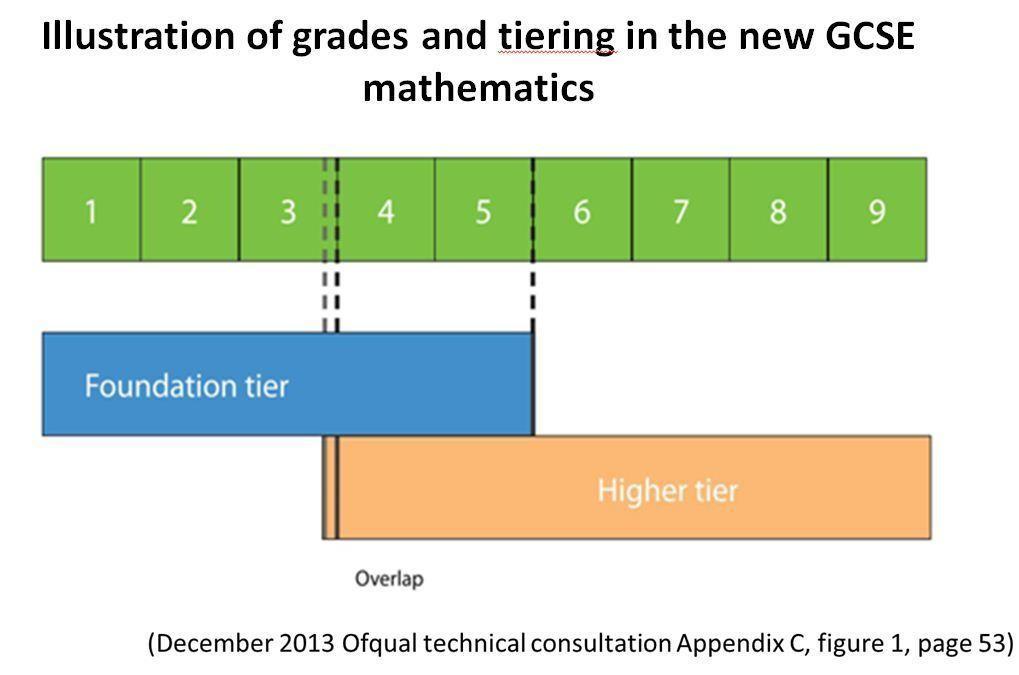
The course is taken at either higher or foundation tier. The grading system for maths will be from Grade 9 to 1.
The foundation course covers Grades 1 to 5 whilst the higher covers 4 to 9.
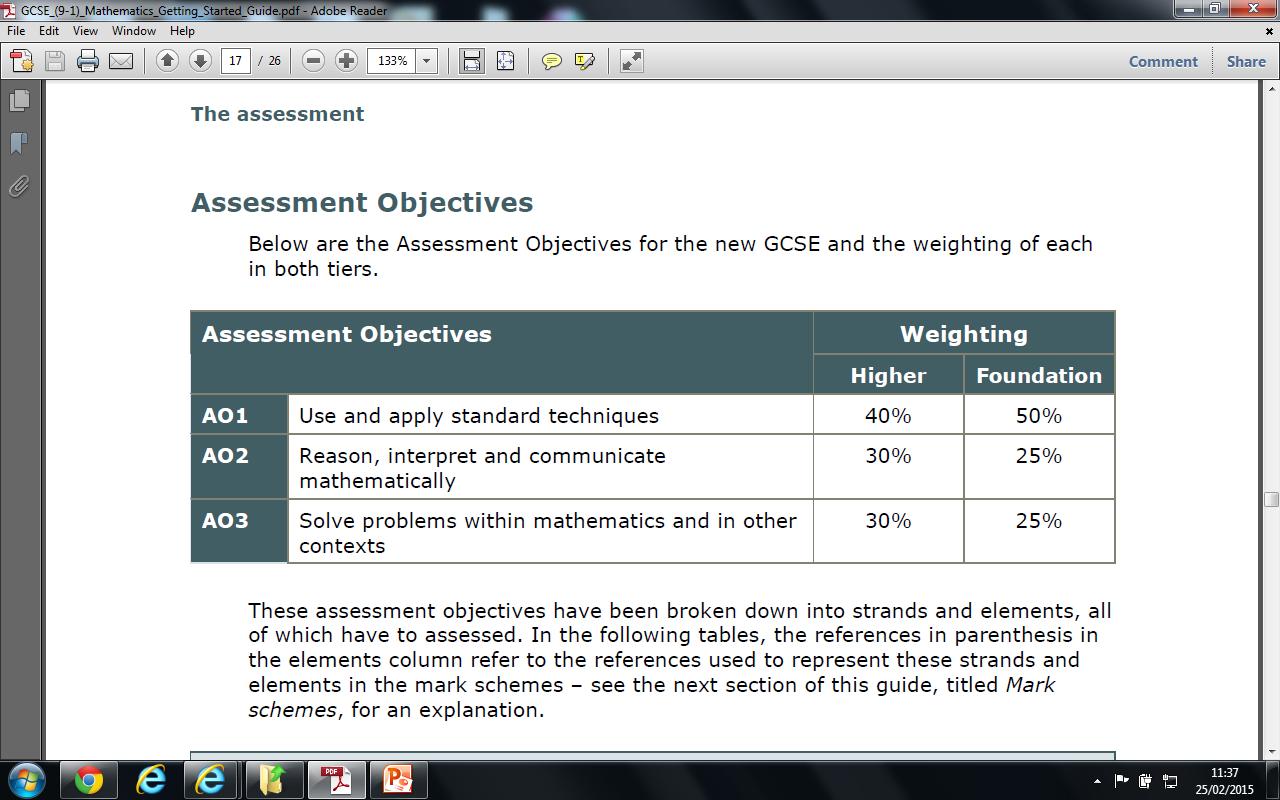
Illustration of grades and tiering in the new GCSE mathematics
In addition, students in the top two sets will have the chance to study Further Maths which affords excellent preparation for A level maths.
Overview of assessment
The students are assessed in three examinations in the May / June of Year 11. There is not a controlled assessment element to the assessment. There will be three examinations each lasting 1 hour and 30 minutes. The breakdown of how the maths is assessed is detailed below:
Summary of content/modules covered
The mathematics GCSE course has been revised for this GCSE. Overall there is more content in the course compared to previous years and the examinations will include a higher proportion of questions at the higher grades within each tier. The content covers number, algebra, ratio, proportion & rates of change, geometry & measures, statistics and probability.
● Success will come from hard work in lessons and especially independently at home.
● Mathematics equips pupils with a uniquely powerful set of tools to understand and change the world. These tools include logical reasoning, problem-solving skills, and the ability to think in abstract ways. Mathematics is important in everyday life, many forms of employment, science and technology, medicine, the economy, the environment and development and in public decision-making. Different cultures have contributed to the development and application of mathematics. Today, the subject transcends cultural boundaries and its importance is universally recognised. Mathematics is a creative discipline. It can stimulate moments of pleasure and wonder when a pupil solves a
problem for the first time, discovers a more elegant solution to that problem, or suddenly sees hidden connections.
Course aims:
● To enrich and develop students’ understanding and application of mathematics in their lives. What can do this course lead to in the future?
Course progression
● A Level Core Mathematics (NEW)
● A Level Further Maths
● A Level Biology/Chemistry/Physics
● A Level Computer Science
A minimum Grade 4 or above is needed for entry to numerous schools and colleges. Many subjects will expect a minimum grade 5, whilst subjects such as Physics and Computer Science may require a Grade 7.
Career opportunities
● Plumber
● Electrician
● Accountant
● Engineer
● Software consultant
● Architect
These are just a few examples of careers that require maths. A number of employers will insist on a qualification in maths for any job. For example to be a teacher of any subject now requires Grade 5 or above in maths
For further information, contact Head of Mathematics-Mr M Blinkhorn
Email: blinkm@stmo.sjscat.co.uk
Recommended Resources:
● We strongly recommend purchasing Maths-buster to help reinforce maths independently. This online resource from CGP is available for the current GCSE from the school for £5 and will boost your confidence through Year 10. In Year 11 it will tailor a revision programme for you. Other support material such as revision books and workbooks will be available for sale via the school.
Subject title:
Combined Science
Exam board and syllabus: AQA Trilogy 8464
Structure of assessment to include length and number of exams: This qualification is linear. Linear means that students will sit all their exams at the end of the course.
Overview of assessment:
There are six papers: two biology, two chemistry and two physics. Each of the papers will assess knowledge and understanding from distinct topic areas. Each written exam is 1 hour 15 minutes long.
Summary of content/modules covered:
The programme of study includes: Biology
1. Cell biology
2. Organisation
3. Infection and response
4. Bioenergetics
5.Homeostasis and response
6. Inheritance, variation and evolution
7. Ecology.
Chemistry
8. Atomic structure and the periodic table
9. Bonding, structure, and the properties of matter
10. Quantitative chemistry
11. Chemical changes
12. Energy changes
13.The rate and extent of chemical change
14. Organic chemistry
15.Chemical analysis
16.Chemistry of the atmosphere
17. Using resources
Physics
18. Forces
19. Energy
20. Waves
21. Electricity
22.Magnetism and electromagnetism
23. Particle model of matter
24. Atomic structure.
Course aims:
Courses based on this specification should encourage students to:
• develop scientific knowledge and conceptual understanding of science
• develop understanding of the nature, processes and methods of science
• develop and learn to apply observational, practical, modelling, enquiry and problem-solving skills, both in the laboratory, in the field and in other learning environments
• develop their ability to evaluate claims based on science through critical 10
analysis of the methodology, evidence and conclusions, both qualitatively and quantitatively.
What can do this course lead to in the future?
● Studying Science A-levels
● Pharmaceutical Science
● Pathology
● Forensic Science
● Engineering
● Environmental Science
● Research Science
For further information, contact Head of Science- Ms R Khan
Email: khanr@stmo.sjscat.co.uk
Recommended Resources
Free access to the Kerboodle digital textbook and resources are available to all students.
AQA 9-1GCSE Combined Science Award revision guides and workbooks.
Subject title:
GCSE Theology
Exam board and syllabus: WJEC EDUQAS RE GCSE 9-1
Catholic Christianity & Judaism ROUTE B
Structure of assessment to include length and number of exams and exam break down:
We are studying the Eduqas Catholic Christianity & Judaism Route B Religious Studies Specification.
In Year 11 students will have TWO one-and-a-half-hour exams and ONE one-hour exam.
Component 1: Foundational Catholic Theology
Written examination: 1 hour 30 minutes 37.5% of qualification, 90 marks
Students will study the following two themes. All questions are compulsory.
● Theme 1: Origins and Meaning
● Theme 2: Good and Evil
This component will be assessed by compulsory questions focusing on knowledge, understanding and evaluation of the identified themes.
Component 2: Applied Catholic Theology
Written examination: 1 hour 30 minutes 37.5% of qualification, 90 marks
Students will study the following two themes. All questions are compulsory.
● Theme 1: Life and Death
● Theme 2: Sin and Forgiveness
This component will be assessed by compulsory questions focusing on knowledge, understanding and evaluation of the identified themes.
Component 3: Judaism
Written examination: 1 hour 25% of qualification, 60 marks
Students will study the beliefs, teachings and practices of Judaism.
This component will be assessed by compulsory questions focusing on knowledge, understanding and evaluation of the subject content.
Controlled Assessment: N/A
Summary of content/modules covered:
Paper 1: Foundational Catholic Theology
Theme 1: Origins and Meaning
● Origins and Meaning – Creation ex nihilo and Imago Dei.
● Beliefs about Creation – Genesis.
● Sources: The Bible –the nature of revelation and inspiration.
● Forms: Painting –Michelangelo’s Creation of Adam in the Sistine Chapel.
● Practices-Loving and serving communities in Britain and elsewhere: the influence of the concept of Imago Dei on Catholic Social Teaching about justice, peace and reconciliation.
Theme 2: Good and Evil
● Good, Evil and Suffering –Original Sin and St Augustine.
● Beliefs- The nature of the Trinity.
● Beliefs- Incarnation.
● Sources: Jesus and Moral authority.
● Forms: Sculpture and Statutory –Michelangelo’s Pieta.
● Practices: popular devotion as practised in catholic communities in Britain and elsewhere.
Paper 2: Applied Catholic Theology
Theme 1: Life and Death
● Death and the Afterlife.
● Beliefs –Eschatology.
● Sources- The Magisterium.
● Forms –Artefacts, music and the funeral rite.
● Practices – Prayer within Catholic communities in Britain and elsewhere.
Theme 2: Sin and Forgiveness
● Crime and Punishment.
● Beliefs –Redemption.
● Sources- The Church.
● Forms –Buildings.
● Practices – Sacraments and the mission and evangelisation in Britain and elsewhere.
Paper 3: Judaism Beliefs and Teachings
● The nature of God.
● Messiah – Mashiach.
● Covenant.
● Life on Earth.
● The afterlife.
● Practices
● Worship: practices in Britain and elsewhere.
● The Synagogue.
● Rituals.
● Daily Life.
● Festivals: practices in Britain and elsewhere.
Course aims:
Students will be expected to demonstrate an understanding of the influence of religion on individuals, communities and societies. Students will be expected to support their responses using appropriate knowledge and understanding of key sources of wisdom and sacred texts. These texts might include, for example: the Bible; extracts from the documents of Vatican II or other ecumenical councils, extracts from Papal encyclicals and exhortations, extracts from the work of key theologians and thinkers such as St Augustine of Hippo as well as the views of past and current philosophers (including ethical philosophers). Students must be aware how varied interpretations of sources and/or teachings may give rise to diversity within traditions or textual studies on religious, philosophical and ethical studies in the modern world. What can this course lead to in the future?
❖ AS/A Level Theology.
❖ AS/A Level Religious Studies.
❖ AS/A Level Philosophy and Ethics.
❖ AS/A Level Sociology/Psychology
Through studying Theology, students can:
❖ Absorb and retain complex information and identify key issues.
❖ Sift, select relevant information and think logically.
❖ Express ideas clearly through written tasks and discussion.
❖ Use imagination and creativity.
❖ Develop a critical approach to contemporary issues.
❖ Develop a disciplined approach to problem solving.
❖ Develop investigative, analytical and critical evaluation skills.
❖ Understand and take a sensitive approach to different cultures and beliefs.
❖ Show a real curiosity in people and world cultures.
For further information, contact the Head of Theology - Fr A Homer
Email: homera@stmo.sjscat.co.uk
Recommended resources and reading
❖ http://resources.eduqas.co.uk
❖ Eduqas Route B GCSE Religious Studies textbook published by Hodder.
❖ Eduqas Route B GCSE Religious Studies REVISION GUIDE published by Hodder.
❖ The Catechism of the Catholic Church.
❖ Papal Encyclicals – as advised by Teachers and outlined in the Specification – usually published on the Vatican Website.
❖ The Bible.
The Option Subjects
Subject title: Art, Craft and Design
Exam board and syllabus: Edexcel
Structure of assessment to include length and number of exams and exam/CA break down:
● Coursework projects are assessed at the end of each term. ‘Coursework’ is all classwork and homework tasks undertaken throughout the course. Candidates submit their project for assessment in the last week of each term.
● Record observations, experiences and ideas that are appropriate to intentions.
● Analyse and evaluate images, objects and artefacts showing understanding of context.
● Develop and explore ideas using media, processes and resources, reviewing, modifying and refining work as it progresses.
● Present a personal response, realising intentions and making informed connections with the work of others.
Overview of assessment:
The overall GCSE grade is based on the following elements:
● Two coursework projects, Cubism & Sculpture - 60% of the final grade.
● 10 hour timed exam submitted with all preparation work - 40% of the final grade.
● Final exhibition of all work undertaken on the course (assessed by external examiner).
Summary of content/modules covered:
1. Candidates will develop ongoing observational drawing, developing their ability to record from direct experience. This will mainly be studio based and will include self- portraiture, still life work, perspective, and figure drawing. Candidates will extend their knowledge of the basic element of art - line, tone, form, structure, and texture. This work will mainly be monochromatic, but colour may be used.
2. There will be two main coursework projects based on Art and Design Movements from the past and present. Candidates will develop an understanding of Western and Non-Western Art, and evolve a personal response to the work of other artists and movements based on a range of subject matter whilst developing skills, methods and techniques.
Course aims:
1. To develop creative and imaginative powers for communicating and expressing ideas, feelings and meanings in art, craft and design.
2. To develop ability to investigate and analyse their own and others work.
3. To develop understanding of codes and conventions of art, craft and design, past and present in a range of cultures.
4. To develop ability to use and make decisions about techniques and processes in relation to pupils own work.
What can do this course lead to in the future?
● Graphic, Fashion or Web Design
● Art therapy
● A Level Art
● BTEC Foundation in Art & Design
For further information, contact the Head of Art- Ms A Mahmood Email: mahmoa@stmo.sjscat.co.uk
Recommended Resources: BBC Bitesize
Subject title: Business Studies
Exam board and syllabus: Pearson (Edexcel)
Structure of assessment:
● Theme 1: Investigating Small Business (50%) – 90 minutes – Written examination paper. Mixture of multiple choice, data response, short and extended answer questions.
● Theme 2: Building a Business (50%) – 90 minutes – Written examination paper. Mixture of multiple choice, data response, short and extended answer questions.
● There will be a minimum assessment for quantitative skills and the assessment of these skills will comprise 10% of the subject marks.
Summary of content/modules covered:
Theme 1: Investigating Small Business (50%)
Theme 1 concentrates on the key business concepts, issues and skills involved in starting and running a small business. It provides a framework for students to explore core concepts through the lens of an entrepreneur setting up a business.
Topic 1.1 Enterprise and entrepreneurship:
You will be introduced to the dynamic nature of business in relation to how and why business ideas come about. You will also explore the impact of risk and reward on business activity and the role of entrepreneurship.
Topic 1.2 Spotting a business opportunity:
Students will explore how new and small businesses identify opportunities through understanding customer needs and conducting market research. They will also focus on understanding competition.
Topic 1.3 Putting a business idea into practice:
This topic focuses on making a business idea happen through identifying aims and objectives and concentrating on the financial aspects of a business.
Topic 1.4 Making the business effective:
Students will explore a range of factors that impact on the success of the business, including location, the marketing mix and the business plan.
Topic 1.5 Understanding external influences on business:
Students are introduced to a range of factors, many of which are outside of the immediate control of the business, such as stakeholders, technology, legislation and the economy. Students will explore how businesses respond to these influences.
Theme 2: Building a business (50%)
Theme 2 examines how a business develops beyond the start-up phase. It focuses on the key business concepts, issues and decisions used to grow a business, with an emphasis on aspects of marketing, operations, finance and human resources. It also considers the impact of the wider world on the decisions a business makes as it grows.
Topic 2.1 Growing the business:
Students are introduced to methods of growth and how and why business aims and objectives change as businesses evolve. The impact of globalisation and the ethical and environmental questions facing businesses are explored.
Topic 2.2 Making marketing decisions:
Students will explore how each element of the marketing mix is managed and used to inform and make business decisions in a competitive marketplace.
Topic 2.3 Making operational decisions:
This topic focuses on meeting customer needs through the design, supply, quality and sales decisions a business makes.
Topic 2.4 Making financial decisions:
Students will explore the tools a business has to support financial decision making, including ratio analysis and the use and limitation of a range of financial information.
Topic 2.5 Making human resource decisions:
Growing a business means that decisions relating to organisational structure, recruitment, training and motivation need to be made to influence business activity.
Course aims:
GCSE qualifications in business subjects enable students to:
● Actively engage in the study of business and economics to develop as effective and independent students and as critical and reflective thinkers with enquiring minds.
● Use an enquiring, critical approach to distinguish facts and opinions, to build arguments and make informed judgements.
● Develop and apply their knowledge, understanding and skills to contemporary issues in a range of local, national and global contexts.
● Appreciate the range of perspectives of different stakeholders in relation to business and economic activities.
● Consider the extent to which business and economic activity can be ethical and sustainable.
What can do this course lead to in the future?
A business course can help you prepare for college and university. It can prepare you for Level 3 courses in different subject areas. You will become skilled in making decisions, being creative, solving problems, understanding finance, dealing with data, communicating and working as part of a team. It will give you an understanding of business and the world work
For further information, contact- Ms E Pape
Email papee@stmo.sjscat.co.uk
Recommended Resources:
An interest in the following TV programmes:
● The Apprentice 19
● Dragons Den
● Sky News or BBC News app on your mobile phone
Subject title:
Computer
Exam board and syllabus: AQA 8525
Computer technology continues to advance rapidly. The growth in the use of mobile devices and web-related technologies has exploded, resulting in new challenges for employers and employees. Computing is of enormous importance to the economy, and the role of Computer Science as a discipline itself and as an ‘underpinning’ subject across science and engineering is growing at an exponential rate.
The qualification gives pupils an understanding of key computing concepts and the fundamentals of programming. The course also contains some advanced mathematical concepts including an understanding of the use of number bases, e.g. binary and hexadecimal notation. Students will need to be able to understand the concepts behind binary arithmetic and base number conversions, and to manipulate and link various programming concepts such as flowcharts, data types, variable manipulation, program flow control, functions, procedures and error handling.
Assessment summary:
Paper 1: Computational thinking, problem solving, code tracing and applied computing as well as theoretical knowledge of:
1. Fundamentals of algorithms
2. Programming
Written exam: 2 hours
90 marks
50% of GCSE
Paper 2: Theoretical knowledge of:
3. Fundamentals of data representation
4. Computer systems
5. Fundamentals of computer networks
6. Fundamentals of cyber security
7. Relational databases and structured query language (SQL)
8. Ethical, legal and environmental impacts of digital technology on wider society, including issues of privacy
Written exam: 1 hour 45 minutes
90 marks 50% of GCSE
Students must be assessed as ‘green’ in Assessment and Monitoring Cycle 3 (Summer 2026) for progress towards a Level 6 target in Mathematics in order to be eligible for Computer Science, due to the subject’s high demand for advanced mathematical skills. Summer mathematics assessment results will also be taken into account when determining suitability.
For further information, contact- Dr P Lanigan Email lanigp@stmo.sjscat.co.uk
Subject title: Design and Technology
Exam board and syllabus: Edexcel GCSE (9-11)
Content and assessment overview
The Pearson Edexcel Level 1/Level 2 GCSE (9–1) in Design and Technology consists of one externally-examined paper and one non-examined assessment component. Students must complete all assessment in May/June in any single year.
Written examination: 1 hour and 45 minutes 50% of the qualification
100 marks
Content overview
1 – Core content and any one from the following material categories:
2 – Metals
3 – Papers and boards
4 – Polymers
5 – Systems
6 – Textiles
7 – Timbers
Assessment overview
The paper consists of two sections. Section A is assessed on the core content and Section B is assessed on the material category students have chosen.
1DT0/1A – Metals
1DT0/1B – Papers and boards
1DT0/1C – Polymers
1DT0/1D – Systems
1DT0/1E – Textiles
1DT0/1F – Timbers
Section A: Core
This section is 40 marks and contains a mixture of different question styles, including open-response, graphical, calculation and extended-open-response questions. There will be 10 marks of calculation questions in Section A.
Section B: Material categories
This section is 60 marks and contains a mixture of different question styles, including open-response, graphical, calculation and extended-open-response questions. There will be 5 marks of calculation questions in Section B. Calculators may be used in the examination.
Component 2 (Paper code: 1DT0/02)
Non-examined assessment 50% of the qualification 100 marks
Content overview
There are four parts to the assessment:
1 – Investigate
This includes investigation of needs and research and a product specification.
2 – Design
This includes producing different design ideas, review of initial ideas, development of design ideas into a chosen design, communication of design ideas and review of the chosen design.
3 – Make
This includes manufacture and quality and accuracy.
4 – Evaluate
This includes testing and evaluation.
Assessment overview
Students will undertake a project based on a contextual challenge released by us a year before certification.
This will be released on 1 June and will be available on our website.
The project will test students’ skills in investigating, designing, making and evaluating a prototype of a product.
Task will be internally assessed and externally moderated.
The marks are awarded for each part as follows.
o 1 – Investigate (16 marks)
o 2 – Design (42 marks)
o 3 – Make (36 marks)
o 4 – Evaluate (6 marks)
For further information, contact Mr L Morrissey- Head of Computing, Design Technology & Food Technology Email: morril@stmo.sjscat.co.uk
Subject title:
Geography
Exam board and syllabus: AQA GCSE Geography (8035)
Summary of content/modules covered :
Paper One – Living with the Physical Environment
This unit of work is content driven. The topics covered are:
● Section A: The challenge of Natural Hazards
o Natural Hazards
o Tectonic Hazards
o Weather Hazards
o Climate Change
● Section B: The living world
o Ecosystems
o Tropical Rainforests
o Either Hot deserts or Cold environments
● Section C: Physical Landscapes in the UK
o UK physical landscapes
o Two from: Coastal landscapes in the UK, River landscapes in the UK and Glacial landscapes in the UK
Paper Three – Geographical Applications
This is a synoptic unit of work based on key themes from Papers one and two, a pre-release examination booklet and fieldwork.
● Section A: Issue Evaluation
o This section is a critical thinking and problem-solving element. The issue will come from any element of Papers 1 or 2 but may extend beyond it. Students will be issued with a booklet approximately 12
Paper Two – Challenges in the Human Environment
This unit of work is content driven. The topics covered are:
● Section A: Urban issues and challenges
o Urban population change
o Opportunities and challenges in the Urban world
o Urban sustainability
● Section B: The changing Economic World
o Global variations in development
o Global development gap
o Employment patterns and regional growth in the UK
● Section C: The challenge of Resource Management
o Resources Management
o One from: Food, water or Energy
Geographical skills can be assessed in any of the three papers these include
o Cartographic skills
o Graphical skills
o Numerical and Statistical skills
weeks before the examination to analyse. They will answer a series of questions leading to a more extended piece of writing in the examination.
● Section B: Fieldwork
o Students need to answer questions based on fieldwork techniques from an o unfamiliar situation
Students need to answer questions based on their individual enquiry work
Course aims: This exciting course is based on a balanced framework of physical and human geography. It allows students to investigate the link between the two themes, and approach and examine the battles between the man-made and natural worlds. Geography aims to improve skills and confidence in using and interpreting numerical data, statistics, maps and written text. The geography course studied uses geographical concepts to try and explain the key issues facing the world today. It aims to provide a broad basis of knowledge for further study, as well as being a stimulating course for those students who finish their geographical studies at the end of Key Stage four.
Fieldwork element
Students need to undertake two geographical enquiries, each of which must include the use of primary data, collected as part of the fieldwork exercise. Fieldwork must take place outside of the classroom and school grounds on at least two occasions. The students will be expected to apply knowledge and understanding to interpret analyses and evaluate information and issues relating to geographical enquiry. They will also be expected to select, adapt and use a variety of skills and techniques to investigate questions and issues and communicate findings in relation to geographical enquiry.
What can this course lead to in the future?
After studying GCSE Geography you can consider:
Further education courses
AS/ A Level Geography
AS/ A Level Geology
AS/ A Level Environmental Studies
AS/ A Level Travel and Tourism
Leisure and Tourism BTEC/ Diploma Courses
Employability Skills
Data handling skills
Investigation skills
Project management
Problem solving skills
Writing to varying audiences
Resource Interpretation
Concept application skills
Recommended resources and reading lists
Geography, Widdowson et al. Hodder Education
GCSE AQA Geography for the Grade 9-1 Course: The Revision Guide, CGP
GCSE AQA Geography for the Grade 9-1 Course: Exam Practice workbook, CGP
GCSE AQA Geography for the Grade 9-1 Course: Complete revision & Practice
For further information, contact- Mr J Page Email pagej@stmo.sjscat.co.uk
Subject title:
History
Exam board and syllabus: AQA GCSE History (8145)
Structure of assessment to include length and number of exams and exam:
Why study history?
We live in important historical times. Changes in politics, culture, migration and the physical environment are the product of powerful beliefs, habits and traditions, some of them recent, others developing over centuries. To make sense of this world, we need to understand its context. History can help provide that context.
The skills you develop can be used in a range of fields. You will be encouraged to:
● Ask relevant questions, investigate issues critically, and develop your own opinion based on a range of interpretations and sources.
● Learn to research with a critical eye, identifying bias and examining historical context for sources and interpretations
● Organise and communicate knowledge and reach substantiated conclusions
● Critically analyse and compare a range of sources and historical interpretations
● Build your knowledge of significant events, individuals and groups that shaped our world
AQA’s GCSE (9–1) History
This programme encourages students to understand the making of the modern world, considering long, medium and short-term factors that contributed to the making of the modern world.
Apart from studying a wide range of exciting historic periods, you’ll learn a range of handy skills that will help you with A-levels and future work. These include:
● excellent communication and writing skills
● how to construct an argument research and problem skills
● investigation and problem-solving skills
● analytical and interpretation skills
Learners will be required to study four different topics split over two exams
Students studying AQA’s GCSE (9–1) History will sit two examination papers:
Paper 1: Understanding the modern world
Section A: Period study - America, 1920–1973: Opportunity and inequality
This period study focuses on the development of the USA during a turbulent half century of change. It was a period of opportunity and inequality – when some Americans lived the 'American Dream' whilst others grappled with the nightmare of poverty, discrimination and prejudice. Students will study the political, economic, social and cultural aspects of these two developments and the role ideas played in bringing about change. They will also look at the role of key individuals and groups in shaping change and the impact the developments had on them.
Section B: Wider world depth study - Conflict and tension between East and West, 1945–1972
This wider world depth study enables students to understand the complex and diverse interests of different states and individuals and the ideologies they represented. It considers revolutionary movements during this time. It focuses on the causes and events of the Cold War and seeks to show how and why conflict occurred and why it proved difficult to resolve the tensions which arose during the Cold War. This study also considers the role of key individuals and groups in shaping change and how they were affected by and influenced international relations.
1 hour 45 minute written paper 50% of total GCSE This exam consists of short answer questions and longer, essay type questions.
Paper 2: Shaping the Nation
Section A: A Thematic Study - Britain: migration, empires and the people, c790–present
This thematic study will help students to gain an understanding of how the identity of the people of Britain has been shaped by their interaction with the wider world. It will consider the people who invaded and conquered Britain, the country’s relationship with Europe and the wider world. It will consider the ebb and flow of people into and out of Britain and evaluate their motives and achievements. It considers the causes, impact and legacy of empire upon the ruled and the ruling in the context of Britain’s acquisition and retreat from empire.
Section B: British depth studies including the historic environmentElizabethan England, c1568–1603
This option allows students to study in depth the last 35 years of Queen Elizabeth I’s reign. It will focus on major events of her reign, such as the extent to which it was a ‘Golden Age’, considered from economic, religious, political, social and cultural standpoints.
1 hour 45 minute written paper 50% of total GCSE
This exam consists of short answer questions and longer, essay type questions.
For further information, contact Mr J Page Email pagej@stmo.sjscat.co.uk
Subject Title: OCR Cambridge Nationals in IT
Exam board and syllabus: Cambridge National (J836)
Why should you choose this subject?
You may be interested in this if you want an engaging qualification where you will use your learning in practical, real-life situations, such as:
● using different applications and tools to design, create and evaluate IT solutions and products
● creating a data manipulation solution
● creating an Augmented Reality prototype.
This will help you to develop independence and confidence in using skills that would be relevant to the IT sector. The qualification will also help you to develop learning and skills that can be used in other life and work situations, such as:
● planning and designing IT solutions and products for a given purpose
● selecting the best tools and techniques to solve a problem
● solving problems by exploring different software application tools and
techniques
● creating IT solutions and digital products
● use of planning techniques to complete tasks in an organised and timely way
● finding imaginative ways to solve IT problems.
Course overview
R050: IT in the digital world
In this unit you will learn about design and testing concepts for creating an IT solution or product, and the uses of IT in the digital world. Topics include:
● Design Tools
● Human Computer Interface (HCI) in everyday life
● Data and testing
● Cyber-security and legislation
● Digital Communications
● Internet of Everything (IoE).
R060: Data manipulation using spreadsheets
In this unit you will learn how to plan, design, create, test and evaluate a data manipulation spreadsheet solution to meet client’s requirements. You will be able to evaluate your solution based on the user requirements. Topics include:
● Planning and designing the spreadsheet solution
● Creating the spreadsheet solution
● Testing the spreadsheet solution
● Evaluating the spreadsheet solution.
R070: Using Augmented Reality to present information
In this unit you will learn how to design, create, test and review an Augmented Reality model prototype to meet a client’s requirements. Topics include:
● Augmented Reality (AR)
● Designing an Augmented Reality (AR) model prototype
● Creating an Augmented Reality (AR) model prototype
● Testing and reviewing.
Assessment: Students will need to complete 3 units
R050: IT in the digital world
[Written exam worth 40% of the total qualification]
R060: Data manipulation using spreadsheets [Coursework worth 30% of the total qualification]
R070: Using Augmented Reality to [Coursework worth 30% of the total
present information qualification]
All results are awarded on the following scale:
Level 2 – Distinction* (*2), Distinction (D2), Merit (M2), Pass (P2) [P2 is equivalent to a GCSE Grade 4]
● Industry recognised Google certification for students invested in data analysis
● Creating spreadsheets to manage aspects of daily life (budgeting, prediction modelling, tracking)
Find out more: Full course specification is at: https://www.ocr.org.uk/qualifications/cambridge-nationals/it-level-1-2-j836/
For further information, contact Mr L Morrissey- Head of Computing, Design Technology & Food Technology Email: morril@stmo.sjscat.co.uk
Subject title:
GCSE French
Exam board and syllabus: AQA (8658)
Students may opt to study French in addition to the language they chose at the end of year 7.
Assessment: The course is weighted as follows:
Paper 1: 25% Listening: Terminal examination in Year 11
Paper 2: 25% Speaking: Terminal examination in Year 11
Paper 3: 25% Reading: Terminal examination in Year 11
Paper 4: 25% Writing: Terminal examination in Year 11. (All terminal examinations are tiered: Foundation and Higher).
Course Content:
The course covers three themes:
Theme 1: Popular Culture
Theme 2: Communication and the World around us
Theme 3: People and Lifestyle
Course Aims:
● To develop the ability to use French effectively for purposes of practical
communication in a range of different contexts.
● To form a sound base of the skills, language, grammar and attitude required for further study, work and leisure.
● To offer insights into the culture and civilisation of French-speaking countries.
What can this course lead to in the future?
The GCSE course in French can lead to study at A level and subsequently, at degree level, or other vocational qualifications in languages. This could then lead to careers in:
● Interpreting
● International Business
● Teaching
● Travel & Tourism
● Diplomatic Service & Foreign Office (including MI5 and MI6)
● Hospitality
● Media
● International Law
● Human Rights
For further information, contact Ms C Elsted -Head of Modern Foreign Languages Email - elstec@stmo.sjscat.co.uk
Recommended Resources:
Active hub (Pearson Online), Studio for GCSE, Pearson Revise AQA GCSE French Revision Guide & Workbook, French-English dictionary, OUP AQA GCSE French Foundation or Higher Grammar, Vocabulary and Translation Workbook, Languages Online website, Fun with Languages website, Doddle.
Subject title: Spanish
Exam board and syllabus: AQA (8698)
Assessment: The course is weighted as follows:
Paper 1: 25% Listening: Terminal examination in Year 11
Paper 2: 25% Speaking: Terminal examination in Year 11
Paper 3: 25% Reading: Terminal examination in Year 11
Paper 4: 25% Writing: Terminal examination in Year 11.
(All terminal examinations are tiered: Foundation and Higher).
Course Content:
The course covers three themes:
Theme 1: Popular Culture
Theme 2: Communication and the World around us
Theme 3: People and Lifestyle
Course Aims:
● To develop the ability to use Spanish effectively for purposes of practical communication in a range of different contexts.
● To form a sound base of the skills, language, grammar and attitude required for further study, work and leisure.
● To offer insights into the culture and civilisation of Spanish-speaking countries.
What can this course lead to in the future?
The GCSE course in Spanish can lead to study at A level and subsequently, at degree level, or other vocational qualifications in languages. This could then lead to careers in:
● Interpreting
● International Business
● Teaching
● Travel & Tourism
● Diplomatic Service & Foreign Office (including MI5 and MI6)
● Hospitality
● Media
● International Law
● Human Rights
For further information, contact Ms C Elsted -Head of Modern Foreign Languages
Spanish Foundation or Higher Grammar, Vocabulary and Translation Workbook
(£5.00 - available from the MFL department), Spanish-English dictionary, Languages Active hub (Pearson Online), Online website, Fun with Languages website, Doddle, Duolingo, MEMRISE.
Subject title: Music
Exam board and syllabus: Pearson BTEC Level 1/Level 2 First Award in Music
Structure of assessment to include length and number of exams and exam/CA break down:
The course is structured into four units spread over 120 guided-learning hours. Two units are mandatory and two are optional. The two mandatory units required for the music sector are
● The Music Industry
● Managing a music product
Pupils will explore two sub-sectors of the music industry, by choosing a further two units
● Introducing music composition
● Introducing music performance
Three out of the four units are internally assessed and one unit is externally assessed through a one hour written exam. 75% of the work is coursework based.
Overview of assessment:
See above.
Course aims:
● This course allows you to engage with the music industry and develop a range of relevant practical and technical skills. You will explore music product development and events management, and apply your knowledge in new and practical industry-related contexts.
● You will become aware of more styles of music and understand what music of different styles is expressing; this will lead to a wider and richer selection of music that you like to listen to
● You will be more informed about how to perform and compose music to bring out the full effect of a piece or song What can this course lead to in the future?
A level music technology, BTEC music and technology and degrees in music. Careers in music include; song writing, performing, music education, recording and producing, music business and touring, music health and advertising.
For further information, contact Mr E Gaudencio-Head of Music
Email: gaudee@stmo.sjscat.co.uk
Subject title: Psychology
Summary of content/modules covered:
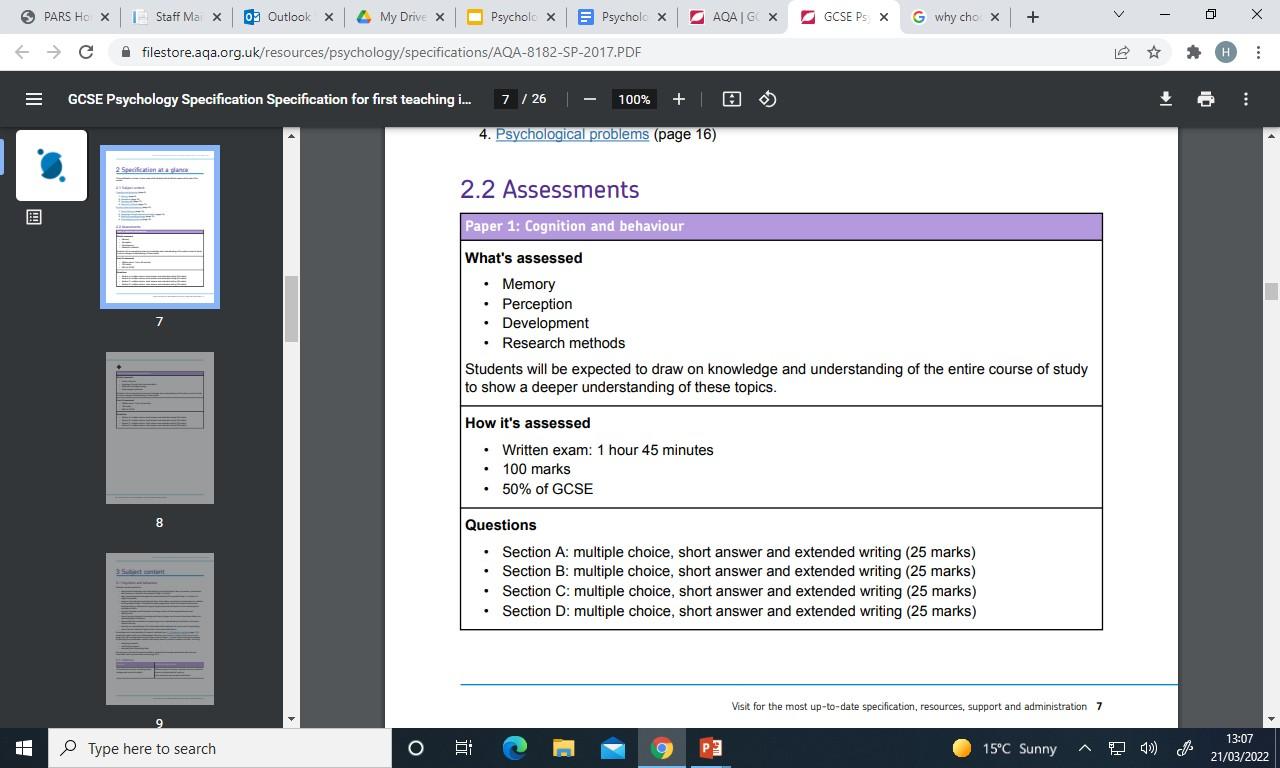
Paper 1: Cognitive and behaviour
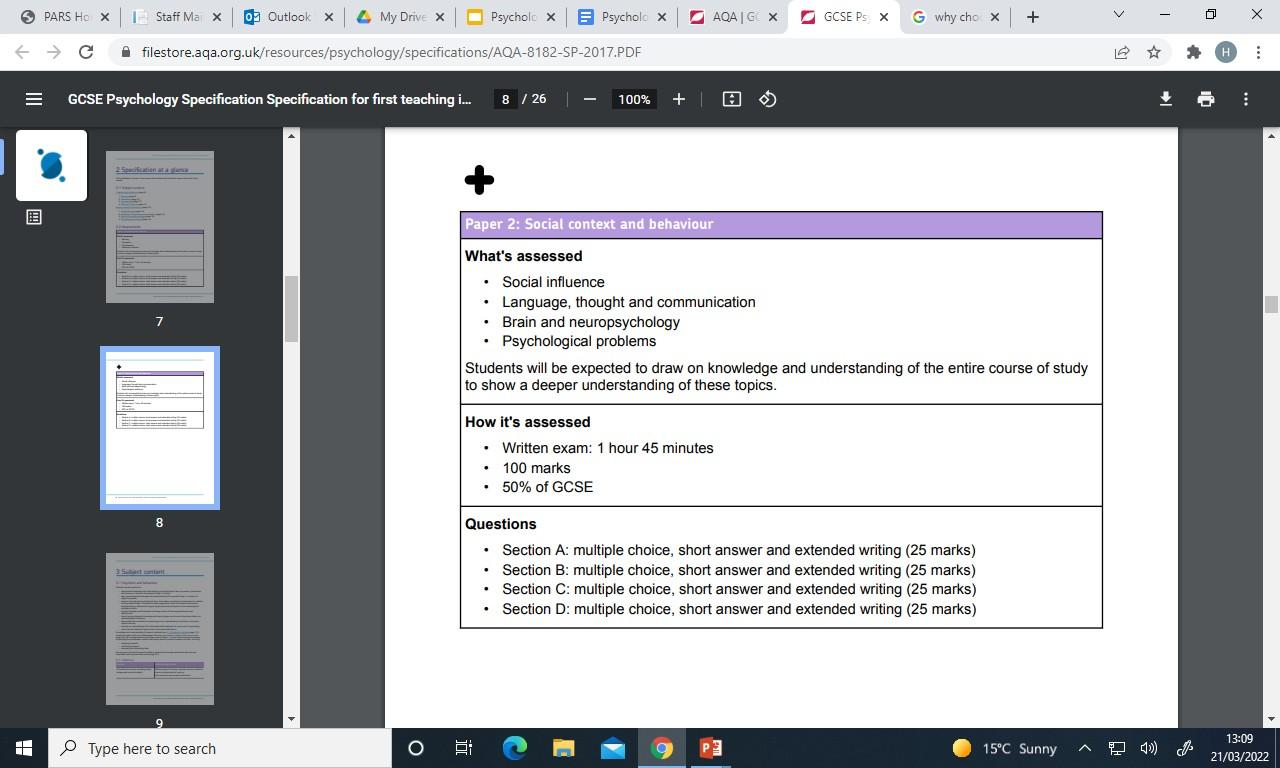
Paper 2: Social context and behaviour
Section A- Memory
• Processes of memory
• Structures of memory
Section A- Social Influence
• Conformity
• Obedience
• Memory as an active process
Section B- Perception
• Sensation and perception
• Visual cues and constancies
• Theories of perception
• Visual illusions
• Factors affecting perception
Section C- Development
• Early brain development
• Development of intelligence
• Effects of learning on development
Section D- Research Methods
• Ways to conduct research practically and ethically
• Data handling
• Prosocial behaviour
• Crowd/collective behaviour
Section B- Language, thought and communication
• Relationship between language and thought
• Effect of language/thought on views of the world
• Animal and human communication
• Non-verbal communication
• Explanations of non-verbal communication
Section C- Brain and neuropsychology
• Structure/function of the nervous system
• Neuron structure and function
• Structure and function of the brain
• An introduction to neuropsychology
Section D- Psychological problems
• Introduction to mental health
• How mental health changes over time
• Effects of mental health
• Clinical depression
• Theories and interventions for depression
• Addiction
• Theories and interventions for addiction
Course aims:
GCSE qualifications in Psychology enable students to:
• use specialist vocabulary, psychological concepts, terminology and convention to engage in the process of psychological enquiry
• acquire knowledge and understanding of psychology, developing an
understanding of self and others, and how psychological understanding can help to explain everyday social phenomena
• understand how psychological research is conducted, including the role of scientific method and data analysis
• present information, develop arguments and draw conclusions through a critical approach to psychological evidence, developing as reflective thinkers
• develop an understanding of the relationship between psychology and personal, moral, social and cultural issues, and develop an understanding of ethical issues in psychology
• develop an understanding of psychological issues, the contribution of psychology to individual, social and cultural diversity, and how psychology contributes to society.
What can do this course lead to in the future?
A psychology course can help you prepare for college and university. It can prepare you for studying A-level psychology and psychology at degree level . You will become skilled in designing investigations, being a critical thinker, strong evaluation skills, understanding how the brain works and why we do certain things, dealing with data, communicating and working as part of a team. It will give you an understanding of us as thinking, emotional human beings which is an essential skill in all aspects of life.
For further information, contact Miss H Winfield- Head of Psychology
Email: winfih@stmo.sjscat.co.uk
Recommended Resources:
● AQA GCSE Psychology textbook and revision guide
● Learn DOJO
● Kerboodle
● BBC Bitesize
● Miss Winfield’s further reading list
Subject title:
Separate Science
Exam board and syllabus: AQA Biology, Chemistry and Physics
Structure of assessment to include length and number of exams. This qualification is linear. Linear means that students will sit all their exams at the end of the course. (GCSE exams June 2018 onwards)
Overview of assessment:
There are six papers in total: two biology, two chemistry and two physics. Each of the papers will assess knowledge and understanding from distinct topic areas. Each written exam is 1 hour 45 minutes long.
Summary of content/modules covered:
The programme of study includes:
Biology
1. Cell biology
2. Organisation
3. Infection and response
4. Bioenergetics
5. Homeostasis and response (
6. Inheritance, variation and evolution
7. Ecology.
Chemistry
8. Atomic structure and the periodic table
9. Bonding, structure, and the properties of matter
10. Quantitative chemistry
11. Chemical changes
12. Energy changes
13. The rate and extent of chemical change
14. Organic chemistry
15.Chemicalanalysis
16.Chemistry of the atmosphere
17. Using resources .
Physics
18. Forces
19. Energy
20. Waves
21. Electricity
22.Magnetism and electromagnetism
23. Particle model of matter
24. Atomic structure.
Course aims:
Courses based on this specification should encourage students to:
• develop scientific knowledge and conceptual understanding of science
• develop understanding of the nature, processes and methods of science
• develop and learn to apply observational, practical, modelling, enquiry and problem-solving skills, both in the laboratory, in the field and in other learning environments
• develop their ability to evaluate claims based on science through critical analysis of the methodology, evidence and conclusions, both qualitatively and quantitatively.
What can do this course lead to in the future?
● Studying Science A-levels
● Pharmaceutical Science
● Pathology
● Forensic Science
● Engineering
● Environmental Science
● Research Science
For further information, contact Head of Science- Ms R Khan
Email: khanr@stmo.sjscat.co.uk
The science department will also consider the suitability of those selecting this option based on their summer examination results.
Recommended Resources
Free access to the Kerboodle digital textbooks and resources are available to all students.
AQA 9-1GCSE Biology, Chemistry and Physics revision guides and workbooks.
Subject title: BTEC Level 1/Level 2 Tech Award in Sport
Exam board and syllabus: Pearson
Structure of assessment to include length and number of exams and exam/CA break down:
The BTEC Level 1/Level 2 Tech Award in Sport gives the learner the skills and confidence needed to progress to a fulfilling, exciting career in the sport and fitness industry. The course gives a real-life feel of the multidisciplinary nature of the subject area as learners constantly apply their learning to both themselves, elite performers, coaches and practical situations. The course allows students to gain coaching, technical and physical skills whilst ensuring they have the right qualifications for University or employment, whether this be within the sporting sector or transferable skills to other industries
The course is structured into Three Components
Component 1: Preparing Participants to take part in Sport and Physical activity
Component 2: Taking part and improving other participants sporting performance
Component 3: Developing Fitness to improve other participants' performance in sport and physical activity
Components 1 & 2 are non-exam internal assessments through the use of written tasks as well as practical performance tasks, giving students the opportunity to build upon their Sports Leaders Award and practical ability to support their achievement.
Component 3 is a written examination using the knowledge acquired throughout the course.
These Components are split across two years giving students the opportunity to gradually develop their knowledge and understanding.
Summary of content/modules covered:
This style of assessment promotes deep learning through ensuring the connection between knowledge and practice.
Component 1 focuses on the different types of physical activity and providers; the needs of participants; barriers to participation and ways to overcome these barriers; as well as equipment and technology required to take part in sport. Learners will also develop an applied understanding of physiology and anatomy as they learn how to plan and deliver a warm-up to prepare participants to take part in sport and physical activity
Component 2 covers components of fitness and how they are used in different types of sport; practical participation in sport and the rules and regulations in sport and ways to improve other participants’ sporting performance through planning and delivery of sports drills and conditioned practices.
Component 3 explores how athletes’ reach optimal levels of performance. Working closely with their teacher, each student will gain an appreciation and understanding of the different fitness components, fitness tests, training methods and training principles that can be incorporated into their training regime to further enhance and improve their sports performance. Training programmes are tailored to their specific training needs and their sport. A performer’s training cycle can incorporate lots of different fitness training methods, such as circuits for muscular strength and endurance. Incorporating different fitness training methods keeps training interesting, which helps to keep motivation levels high.
What can do this course lead to in the future?
The BTEC First in Sport provides the opportunity to develop a good understanding of whether the sport industry is for you, and if so, which part of it you might want to study further. This course is the same size and level as a GCSE, allowing learners to progress to a Level 3 programme, such as A Levels, a T Level or a BTEC National, either on its own or in combination with A levels including Sport and Exercise Sciences.
This course is different from studying GCSEs, as it covers vocational theoretical content and requires participation in applied learning to develop transferable and technical skills that are needed in the sport industry, it gives you the opportunity to apply your knowledge, skills and the techniques you learn in practical ways.
Developing key transferable skills including interpersonal skills, leadership, organisation and confidence. These are essential in the sport industry as this will provide a platform for entry into this ever growing sector. There has never been a better time to study sport!
For further information contact, Mr D Muir- Head of PE
Email: muird@stmo.sjscat.co.uk
Recommended Resources:
● To support learners we have invested in Everlearner - an interactive online platform which consolidates learning, providing additional revision / assessment tools.
Textbook provided - Pearson BTEC Tech Award Level 1/Level 2 (2022) Sport
Subject title:
GCSE Sociology
Exam board and syllabus: AQA
Paper 1: The sociology of families and education
What's assessed:
● The sociology of families
● The sociology of education
● Relevant areas of social theory and methodology
● Students will be expected to draw on knowledge and understanding of the entire course of study to show a deeper understanding of these topics. How it's assessed:
● Written exam: 1 hour 45 minutes
● 100 marks
● 50% of GCSE Questions
● Section A has two multiple choice questions followed by a range of short and extended responses.
● Section B has two multiple choice questions followed by a range of short and extended responses.
Paper 2: The sociology of crime and deviance and social stratification
What's assessed
● The sociology of crime and deviance
● The sociology of social stratification
● Relevant areas of social theory and methodology
● Students will be expected to draw on knowledge and understanding of the entire course of study to show a deeper understanding of these topics.
How it's assessed
● Written exam: 1 hour 45 minutes
● 100 marks
● 50% of GCSE
Questions
● Section A has two multiple choice questions followed by a range of short and extended responses.
● Section B has two multiple choice questions followed by a range of short and extended responses.
Course aims:
GCSE qualifications in Sociology enable students to:
● apply their sociological knowledge, understanding and skills to develop an understanding of relationships and tension between social structures and individual agency within a UK and global context.
● critically analyse information and use evidence to make informed arguments, reach substantiated judgements and draw conclusions.
● use and apply their knowledge and understanding of how social structures and processes influence social control, power and inequality.
● use sociological theories to understand social issues, debates, social changes and continuities over time.
● understand and evaluate sociological methodology and a range of research methods.
● use sociological terminology appropriately and make connections between the key areas of subject content.
What
can doing this course lead to
in the future?
A qualification in sociology will provide you with many key skills, including logical thinking, planning, research and negotiation – all of which can be used in a variety of careers. There are many careers where a qualification in sociology is useful. For example, many sociologists go into:
social work – community projects,
charity work,
welfare advisors and other areas of social services.
civil service,
prison officers, journalists,
police
teaching.
For further information contact, Mr A Ghebre
Email: ghebra@stmo.sjscat.co.uk
FAQs
How are the options allocated?
Once all submissions have been received, they are collated and checked to ensure they have been completed correctly, for example that a different subject has been selected in each pool. The combinations of subjects chosen by students are also reviewed to ensure they are suitable, along with the appropriateness of certain options.
The numbers for each option are then reviewed to identify any subjects that are over- or undersubscribed. If an option is oversubscribed, students’ second choices will be considered and allocated where possible, depending on the numbers in those subjects. If an option is still oversubscribed after this process, third preferences will then be used.
A student’s favourite subject is French – can this be guaranteed?
No. There is no way of guaranteeing any option.
A student does not like any of the other subjects in a pool. How should they choose a second option?
Students should think very carefully about what they choose as a second option, even if it feels like choosing the “least-worst” option. It is 42
impossible to predict how the numbers will work out and, if a student is affected by this process, it is important that both the second and third choices have been carefully considered.
What happens if a student does not want to do an option they are given?
They will have to take the allocated option, which is why second and third preferences are so important.
Is it first-come, first-served?
No. Options cannot be allocated until all students’ choices have been received, so there is no advantage in submitting them earlier.
Does it matter what class a student is in?
No. It makes no difference at all. Options are allocated based on numbers, unless the subject has specific entry requirements.
Once options have been submitted, can they be changed? Once submitted, options cannot usually be changed unless there are exceptional circumstances. In this case, please contact lanigp@cvms.stmo.co.uk.
When will students find out which options they have been allocated?
This is usually confirmed at the end of the summer term.