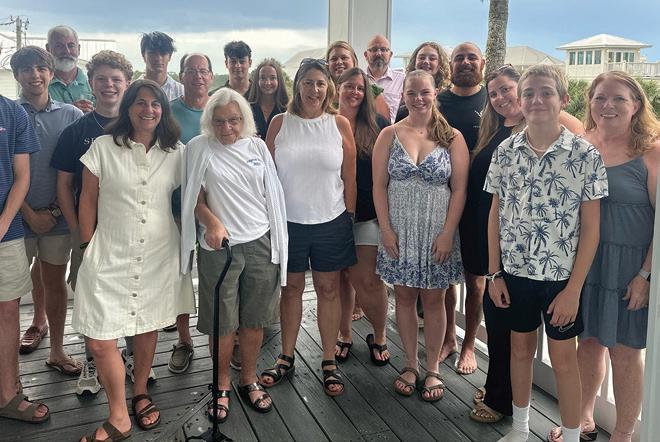
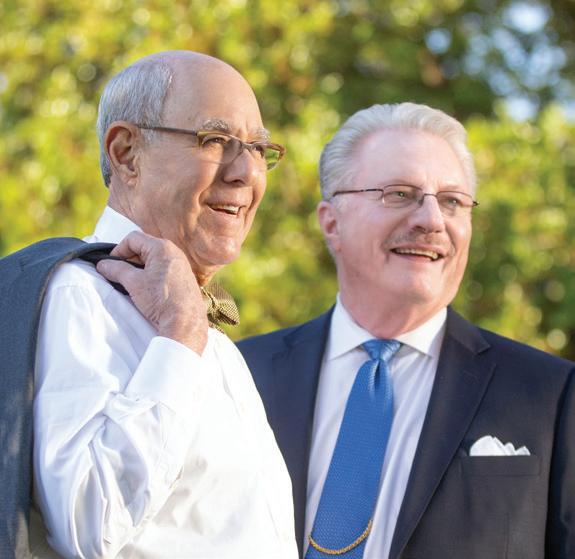
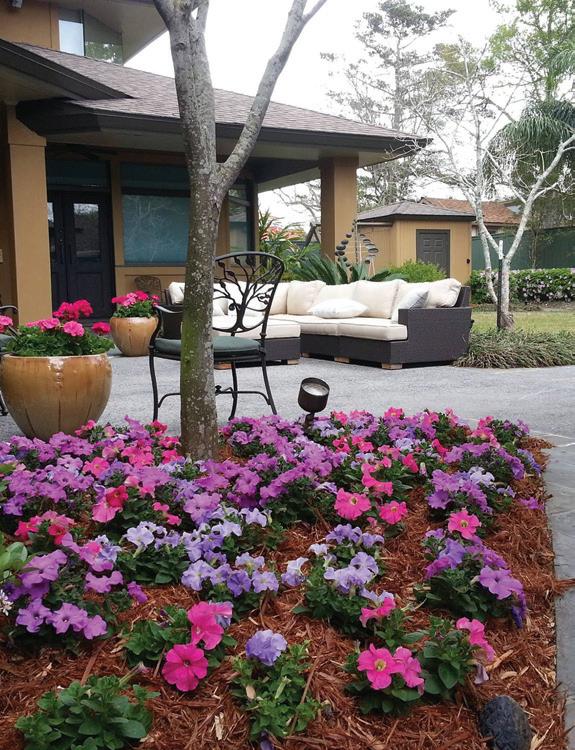
Porch balcony at the new Program Center at Ramah Darom
Have you stopped beating your wife?
It’s the classic no-win question. If you say no, you are cruel and twisted. If you say yes, you admit that you had been doing it. That is the no-win scenario the Jewish community is facing from anti-Israel activists.
One of the most bewildering and infuriating aspects of anti-Israel agitation, and the sharp rise in antisemitism, is that so much of it is based on absolute falsehoods — activists are irate over things that never happened and do not happen, and we are expected to answer and atone for things that are fictional. We are vilified for things that are not happening.
One of the biggest problems is that so many are inclined to believe even the most outrageous charges, bolstered by a mainstream press that pulls for who they designate as the underdog. The classic notion of journalism is that if your grandmother says she loves you, find at least two corroborating sources before you believe it. But when it comes to Israel, all pretense of skepticism and curiosity go out the window (Hello, Nicholas Kristof and the former journalistic entity called the New York Times), and if it makes Israel look bad, lead with it. But don’t run things that would make Hamas look bad — in fact, if you can, don’t even mention them. So people get a very skewed idea of what is happening, and are outraged by things that aren’t true, and don’t even know about the true outrages on the other side.
Even today, so many people believe Israel killed 500 people in a hospital bombing early in the Gaza war, despite it being proven long ago that it was an Islamic Jihad missile that misfired and hit the parking lot, and there were never 500 casualties. But Hamas set out the scenario, journalists reported it unquestioningly (because, of course, this is the sort of thing they believed Israel would do), and there were riots worldwide because of the inflammatory lie.
Remember how 14,000 babies in Gaza were on the brink of starving to death within 48 hours if something didn’t happen? Of course, starvation doesn’t work that way, but nobody stopped to consider how absurd the charge was — the charged-language accusation was enough.
And of course, there was Kristof’s recent charge that Israel trains dogs to rape Palestinian prisoners, something that is impossible to do. But some Hamas people told him that happens, so that was good enough for him. Though these are the same people who state Israel floods
The QR code to our new Substack site. Subscribe today!
Southern Jewish Life is an independent Jewish periodical. Articles and columns do not necessarily reflect the views of any Jewish institutions, agencies or congregations in our region.
subscribe, email subscribe@sjlmag.com
Close to Everything
Studio, 1 and 2
Bedroom Apartments
Specialized Activity Program
Weekly Housekeeping
Basic Utilities Included Beautiful Manicured Grounds
Covered Parking
Historic Neighborhood, Walk to Parks
Laundry Room on each floor
Gaza by opening dams that don’t exist, or trains attack dolphins, or puts hormones in chewing gum exported to Gaza or Egypt to degrade the morality of Muslim teens.
The actual rapes of Israelis on October 7, with video evidence filmed by the Gazans themselves? Ehhh, we need more evidence before we’ll believe an Israeli account.
Israel has been accused of killing as many as 600,000 in Gaza, and people making that accusation are still easy to find online. But after activists said hundreds of thousands of bodies would be found in the rubble, and that clearly has not happened, what does one do? Surely they weren’t wrong! Simply accuse Israel of having some new weapon that completely vaporizes a human body, making it vanish into thin air. In many anti-Israel circles, that is accepted as established fact.
How does one argue with anyone who believes such things?
The biggest charge is genocide against Gazans — including the idea that “the victims of the Holocaust are now the perpetrators,” which certainly sounds like “legitimate criticism of Israeli policy” and not antisemitic Holocaust minimization and inversion, doesn’t it?
To put a lie to the charge that Israel has genocided “mostly women and children” in Gaza — in early 2024, Save The Children noted that schools for 625,000 students in Gaza had been closed for six months. Then UNRWA more recently claimed that 660,000 Gaza children had been out of school for over two years.
In a genocide, aren’t population figures supposed to go down?
Furthermore, if one accepts the questionable “Gaza Ministry of Health” (a.k.a. Hamas) figures, over 70,000 were killed in Gaza, and the phrase “mainly women and children” almost always follows it in the mainstream press, unquestioned. But Hamas recently announced stipends to over 50,000 martyrs’ widows. They figure, correctly, that most people won’t do the math and will continue to believe the civilian women-and-children party line.
Now that Gaza is no longer under constant scrutiny, as Hamas tries to rebuild itself and assert control over Gazans, the focus has shifted to what is described as Israel’s war against Lebanon — and of course, the obligatory ridiculous accusations of Israeli genocide against the Lebanese.
continued on page 22
letters
Editorial on conspiracies also veered into conspiracy territory
I read and re-read your commentary in the May 2026 issue. I wanted to make sure of what I was reading and understanding. What stood out to me was the irony, maybe hypocrisy, of claiming a conspiracy when you yourself was fomenting that very same thing.
Certainly, Iran is bad for Jews and terribly bad for Israel. It is a pariah in the world. Putting aside for a moment the decision and rationale (did Trump have one?) for the war as made by Trump, the world would be a better place without Iran’s push to exterminate Jews and Israel. No one wants Iran to have a nuclear weapon, and Israel is most definitely hostile to this happening. And deservedly so. Trump has spoken out numerous times about the dangers of Iran. He bombed them last summer. Of course, so has Netanyahu. Constantly.
So why is it far fetched to believe that Netanyahu was pushing Trump to attack Iran? Trump already did attack Iran last summer. Trump did not need any prodding from Netanyahu. Trump and Netanyahu are close allies, talk frequently with each other, so don’t you think it is quite plausible that Netanyahu was urging on Trump to attack Iran… again? And if you believe that you’re antisemitic?
But here’s where your commentary veers into conspiracy muck. You admit that it is farfetched to believe in a conspiracy that Israel controls Trump. I agree. Yet you push an unfounded
conspiracy that there is antisemitism when people suggest that Israel pushed Trump to attack Iran. So when Kamala Harris (whose husband is Jewish and they celebrate Passover) speaks to that, she is somehow part of a vast antisemitic conspiracy, when she says, as you quoted, that America was “pulled into a war that American people do not want”? I agree that Netanyahu does not have to be a great salesman; Trump was quite willing to repeat what he did last summer. And you also misrepresent the NYT’s interview that it “stipulated as a fact” as to Israeli manipulation of Trump. Evidence?
This is what bothered me. We bemoan our President and his cronies for creating conspiracies without any evidence, and now here you are, doing the same, i.e. citing “conspiracy theories” when someone comments on something that you interpret as anti-Israel. I’m sure you are aware that one can be pro-Israel (I am) but against Netanyahu (as I am also). I feel that your commentary is stirring up so-called “conspiracy theories” where there are none. Pizza Gate? Stolen election? And now talking about Israel’s desires to seek help in their battle against Iran makes one… an antisemite? Please.
Isn’t there plenty of real horrible and violent antisemitism out there that dwarfs this saga?
I enjoy your magazine, but this time, disagree with the opinion.
Nahum Laventhal New Orleans
Southern Jewish Life Staff
Publisher/Editor
Lawrence Brook editor@sjlmag.com
Associate Publisher/Advertising
Lee Green lee@sjlmag.com
Creative Director
Ginger Brook ginger@sjlmag.com
Social/Web
Emily Baldwein connect@sjlmag.com
Photography
Cheryl Dorchinsky, James Henry Brook
Contributing Writers
Rivka Epstein, Belle Freitag, E. Walter Katz
Columnist
Doug Brook brookwrite.com
Birmingham office: P.O. Box 130052, Birmingham, AL 35213
New Orleans office: 3747 West Esplanade Ave., 3rd Floor, Metairie, LA 70002 (205) 870-7889 • (504) 249-6875 (888) 613-YALL (9255)
ADVERTISING: Contact Lee Green, (205) 870-7889, lee@sjlmag.com
SUBSCRIPTIONS: Subscriptions for the print edition are $30 for one year, $48 for two years. Paid subscribers to our Substack site also receive the print edition.
Copyright 2026. All rights reserved. No part of this publication may be reproduced in whole or part without written permission from the publisher. Views expressed in SJL are those of the respective contributors and are not necessarily shared by the magazine or its staff. SJL makes no claims as to the Kashrut of its advertisers, and retains the right to refuse any advertisement.
Documenting this community, a community we are members of and active within, is our passion. We love what we do, and who we do it for.
agenda
interesting bits & can’t miss events
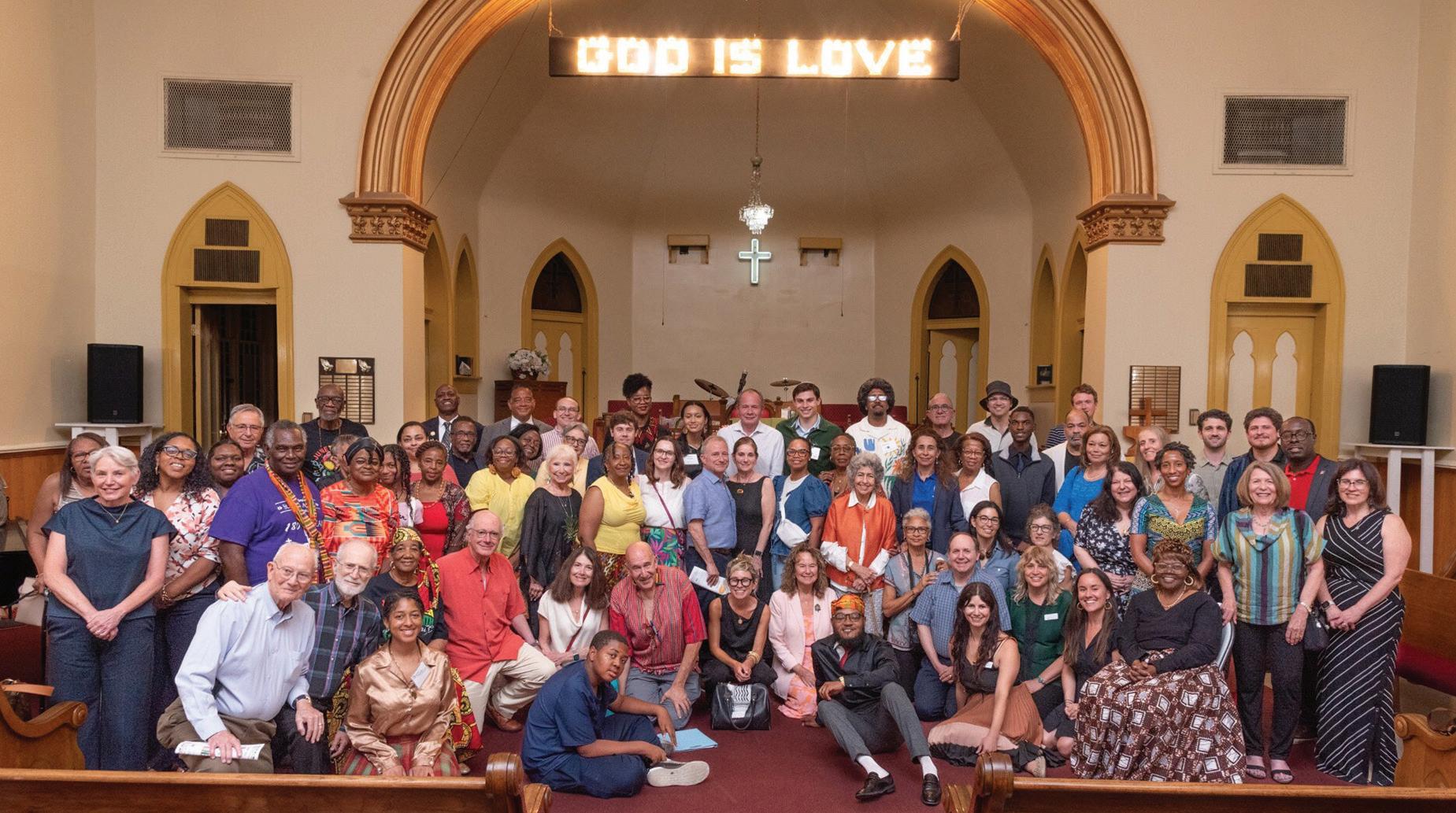
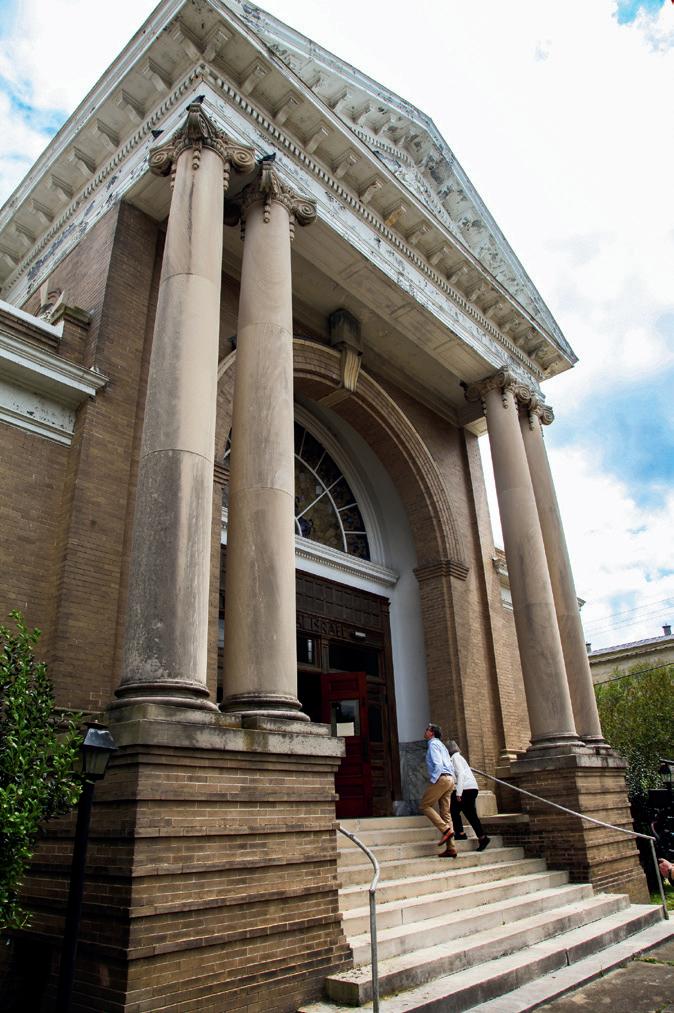
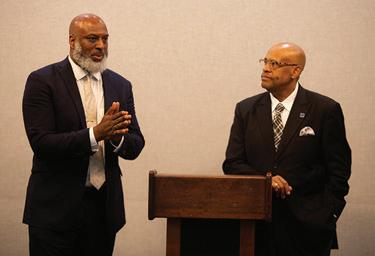
On June 18, the third annual Juneteenth Seder was held at the historic St. James AME Church in New Orleans. The seder was led by Rabbi Katie Bauman and Reverend Wendell Shelby-Wallace, with shared themes of liberation, resilience, and hope that connect the communities. The Seder was coordinated by the Jewish Federation of Greater New Orleans’ Behar Center for JewishMulticultural Affairs, with Xavier University of Louisiana, the XULA Exponential Honors Program, Tulane Hillel, St. James AME Church, Rekindle, ADL South Central, Dillard University, NAACP New Orleans, and the Jewish Endowment Foundation of Louisiana.
Louisiana’s JEF establishes fund for “unexpected” security costs
While Jewish institutions are tasked with large security costs during the current rise in antisemitism, there are times when unexpected additional security needs arise.
The board of the Jewish Endowment Foundation of Louisiana has established a Louisiana Jewish Security Fund to help Jewish organizations respond to “unanticipated, incremental security needs,” especially expanding the presence of security personnel.
The fund is launching with $50,000. Additional donations are welcome, and additional allocations may be made in the future.
All Jewish nonprofits in Louisiana are eligible. Covered expenses are those that go beyond what is in an annual budget, whether due to changing circumstances or in response to the need for heightened security in the immediate aftermath of a national or local incident — for example, the need for heightened vigilance nationally after the attack at Bondi Beach in Australia during a Chanukah celebration. An organization might decide to have an additional officer on site in the immediate aftermath of such an event.
The reimbursement grants are for eligible expenses dating back to the time of the Bondi attack last December 14, and continuing into the future.
The fund does not cover expenses that were already planned and budgeted, or “hardening” infrastructure such as cameras or attack-prevention devices.
To receive the grant, an organization must incur the expense, and then submit reimbursement documentation, including the annual budget or event budget, receipts and an explanation of the added need. Applications will be reviewed by a Joint Security Grant Review committee from JEF and the Jewish Federation of Greater New Orleans, and reimbursements will be made quarterly.
Funding decisions may be full or partial, depending on community demand, and some eligible expenses might not be fully funded. Once
overall community needs are better understood, JEF may seek to expand the funding and reconsider unfunded or partially-funded requests.
As the program develops, guidelines may be revised according to community need, changing security conditions and the types of requests.
Reimbursement request forms are available from the JEF office.
JFNA CEO visiting Birmingham Federation’s campaign kickoff
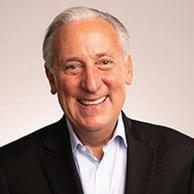
The Birmingham Jewish Federation will welcome Eric Fingerhut, president and CEO of the Jewish Federations of North America, to its 2027 Annual Campaign kickoff.
Before joining JFNA, Fingerhut served as the president and CEO of Hillel International from 2013 to 19. At Hillel, he led the organization’s Drive to Excellence, which resulted in doubling the number of students engaged by Hillel each year to over 130,000, and the total funds raised each year to nearly $200 million. His emphasis on recruiting, training and retaining top talent for the system, and on building a data and performance driven organization, have become models for the non-profit sector.
Before joining Jewish professional life, he worked in public service and higher education. He served as chancellor of the Ohio Board of Regents from early 2007 to 2011, leading Ohio’s system of public universities and colleges; as Ohio state senator from 1997 to 2006; and represented Ohio’s 19th congressional district in the U.S. Congress from 1993 to 1994. In 2004, he was the Democratic Party’s candidate for U.S. Senate.
The event will be on Aug. 23 at 3 p.m. Location is provided upon registration, and tickets are $36. Reservations are requested by Aug. 16.
The Jewish roots of America 250
New series in Birmingham and Baton Rouge explores the Jewish ethics that informed the Founding Fathers
With the celebration of America 250, the Rohr Jewish Learning Institute developed “Sinai and Civics: The Jewish Ethics that Shaped America’s Founding,” showing how many of America’s values come from the Torah.
In Baton Rouge, the course will be held on four Mondays, from Aug. 10 to 31, with in-person sessions at 11 a.m. at the Main Library at Goodwood, and at 6 p.m. on Zoom. Registration is $98, with a 10 percent discount for couples or returning students.
In Birmingham, Chabad of Alabama will be holding the course at the Levite Jewish Community Center on Thursdays at 12:30 p.m., starting Aug. 20. After skipping Aug. 27, it will resume the following week and go through Sept. 17. Registration is $59 on the LJCC website.
The course was offered by Chabad in New Orleans in June.
The first session, “The Foundations of the Covenant,” explores how America’s founders were inspired by the Hebrew Bible, on a sense of covenant, and how that made America the most welcoming nation for the Jews throughout the diaspora.
The second session explores the story of the foundational American and Jewish notion of how all people are created equal, something that hasn’t been “self-evident” to many throughout history. The third session, “In G-d We Trust,” is about how the American Dream of equal opportunity and mass prosperity is a Biblical concept.
The final session, “The Separation of Powers,” shows how the American system parallels the Torah’s ancient division of powers, and the role morality plays in the public square.
Continuing education credits are available for lawyers and legal professionals.
Anonymous Nola gift helps Rosh Ha’Ayin upgrade safety of its shelters
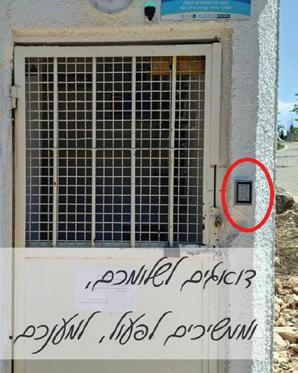
The Jewish Federation of Greater New Orleans announced that an anonymous donor responded to a request from Rosh Ha’Ayin Mayor Raz Sagi for assistance in equipping the city’s 42 public shelters with remote-access opening systems, to save critical seconds during red alerts. The donor provided $50,000 for the systems.
The remote access systems will enable the city to have the shelters locked during times of calm, but immediately open them remotely in the case of a notification from the Home Command. The shelters have also been upgraded with air conditioning and WiFi.
In a letter to the New Orleans community that Sagi sent to the Federation, he said “it is hard to describe how much your support contributes to the security of the residents of Rosh Ha’Ayin,” who recently endured a 41day stretch of running to the shelters, sometimes several times in one day.
In a statement, the Federation said “we are extremely thankful to the donor and humbled that we can assist our Rosh Ha’ayin family in their time of need.”
Rosh Ha’Ayin municipality via Facebook
From skinhead to the Jewish community
Frank Meeink to tell his story, panel at Hadassah Southern’s fall gathering in Birmingham
Hadassah Birmingham will be hosting the Southern Region’s fall meeting on Aug. 16. An open program will be held at 10 a.m., featuring Frank Meeink, one of the best-known skinhead leaders on the East Coast, who completely changed and became Jewish, and now fights white supremacy.
There will be a panel discussion with Temple Beth-El Rabbi Steven Henkin, Alabama Holocaust Education Center Executive Director Lisa Bachman, moderated by Kathy Hershfield, a Hadassah advocacy leader and former national vice president.
Registration for the event is $36, or $72 if staying for lunch afterward. Registrations are due by Aug. 5. The central Birmingham venue will be given upon registration.
Reimer takes historic Manhattan pulpit
Temple Israel, one of Manhattan’s oldest Reform congregations, announced that Rabbi Matthew Reimer will succeed Rabbi David Gelfand, who led the synagogue for 20 years and retired at the end of June.
Reimer previously worked at the Union for Reform Judaism as associate director of transition and crisis support, and as the senior rabbi at Temple Sinai in New Orleans. He succeeded Rabbi Edward Paul Cohn in 2016, then left New Orleans in 2019.
Reimer will be only the sixth senior rabbi in the history of Temple Israel, which was founded in Harlem and has about 620 member families. Like Temple Sinai, Temple Israel was founded in 1870.
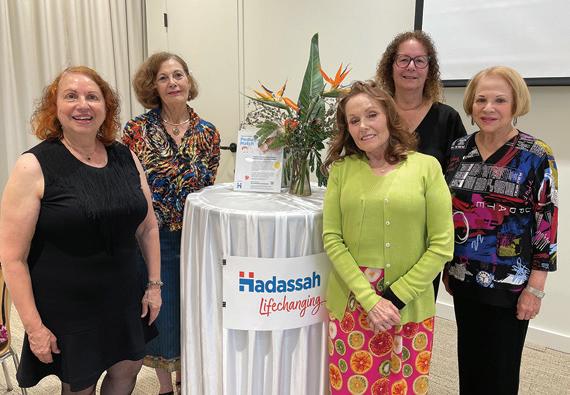
Hadassah Baton Rouge held a cocktail party fundraiser for the pediatrics departments at the Hadassah Hospitals in Jerusalem on May 28. “Delivering Hope and Healing to the Children of Israel” featured Gwen Cooper-Simon of Opelika, one of the Area vice presidents and a retired OB-GYN, who spoke about the grondbreaking innovations in pediatrics at Hadassah, and how their success benefits the rest of the world. The event was held at the Unified Jewish Congregation of Baton Rouge. Pictured are: (front) event chair Ellen Bander, committee members Judy Feder, Elizabeth Clubb Rayner and Susan Lipsey. In the back, Gwen Cooper-Simon.
The New Orleans Jewish Community Center was named Best Athletic Club in the Where Y’At Best of the Big Easy reader’s choice awards.
The Birmingham Jewish Federation’s Young Leadership Program is accepting applications for its new cohort. The group will meet from October 2026 to May 2027, and includes a free Israel trip, non-profit leadership training and a deep dive into local agencies. Information and an application are on the Federation website, applications close on Aug. 7.
The Jewish Federation of Huntsville and North Alabama will have its annual meeting on July 26 at 2 p.m. at Etz Chayim. Ariel Liberman, assistant professor of law and legal studies at Auburn University, will speak about Tisha B’Av and today’s civic challenges. Registration is required.
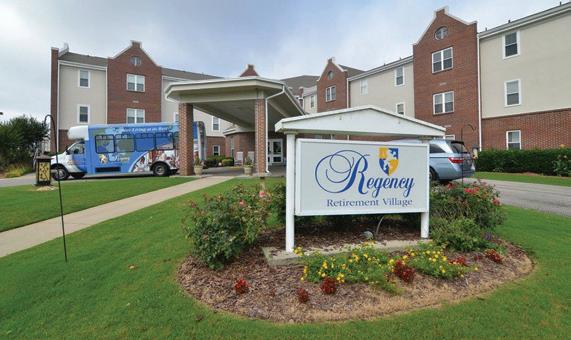
Nestled in the scenic foothills of Shades Mountain in West Homewood, Regency Retirement Village provides the warmth of home combined with the reassurance of community living.
Independent Living • Assisted Living Pathways Specialized Programs • Short-Term Stays
Call us to schedule a tour! 385 West Oxmoor Road, Birmingham (205) 942-3355 regencybirmingham.com Come see what makes us different.
Voted Best Restaurant, Best Chef, and the recipient of AAA Four Diamond Award for the past twelve years Fresh seafood in an exciting and contemporary atmosphere We’d love to host your simcha in our three event spaces
1218 20th St S Birmingham / (205) 933-0999 Just down the street from Temple Emanu-El and Temple Beth-El oceanbirmingham.com
Bodega at the J Cafe is now open for the summer at the Uptown Jewish Community Center in New Orleans. The kosher-style menu includes breakfast, snacks, lunch, dinner, frozen drinks, and sweet treats. Hours are 11 a.m. to 7 p.m. Monday to Thursday, 11 a.m. to 3 p.m. Fridays, 9:30 a.m. to 6 p.m. Saturday and Sunday.
It may be mid-summer, but in one spot, thoughts are turning to Chanukah. Sea Shul on 30A Sisterhood will present Chanukah House in Rosemary Beach, an evening to celebrate Chanukah, as part of the Rosemary Beach Foundation Holiday Home Tour. The event will be Dec. 5, time to be determined. Location will be shared five days in advance to those who register.
The Uptown Jewish Community Center in New Orleans is hosting a three-part series, “Aging Well, Living Fully” with Beverly Gianna, MA, MAG, community gerontologist and long-term ombudsman. The conversations will center on what every older adult should understand about long-term care, resident rights, and how to advocate effectively. Bring a lunch. Sessions are free and open to the community. The final session is Aug. 13, “Advocacy, Rights and Staying Empowered.” Reserve at least two days in advance.
The Mike Slive Foundation, which fights prostate cancer, will have its 10th anniversary celebration Blue Shoes Gala on Sept. 3 at the Regions Field Ballroom in Birmingham. Tickets went on sale on June 23.
With Camp Chai in the books, the North Louisiana Jewish Federation has two more events. On Aug. 2 there will be a summer pool party in Shreveport, address sent upon registration. On Aug. 3, there will be an end of summer fun day at B’nai Zion.
Temple Emanu-El and Temple Beth-El will have Shul by the Pool on July 31 at the Levite Jewish Community Center’s indoor pool at 6 p.m. Services will be led by Rabbis Steven Henkin and David Young, Cantor Robby Wittner and Robin Berger. A pasta bar dinner will be available, dinner reservations are $10. On Aug. 1, there will be a tot morning service at 10 a.m. at the outdoor pool, with Wittner and Berger.
At the Shreveport Regional Arts Council’s Critical Mass 14, where over 100 artists in the nine-parish area of northwest Louisiana compete, Ellen Soffer won the visual arts category. She will produce her own solo show for Critical Mass 15 next year. This year’s show is on display at artspace in Shreveport through Aug. 7.
The Temple Sinai Sisterhood in New Orleans will have its annual Sisterhood Attic Sale on Aug. 9. Sale items are being accepted on weekdays, 9 a.m. to 4 p.m.
Chabad of Pensacola will have its Camp Gan Israel from Aug. 3 to 7, for ages 5 to 12.
Nola Federation takes top spot in GiveNOLA Day
Shatters previous best in 24-hour online fundraiser
Thirteen was indeed a lucky number as the Jewish Federation of Greater New Orleans took top honors for most money raised on GiveNOLA Day. The 13th annual fundraiser, coordinated by the Greater New Orleans Foundation, was held on May 5, with over 1,000 participating nonprofits taking part in the 24 hours of online giving, which set its own record with $8,221,698 raised from 49,736 donations, according to preliminary figures.
The previous high was $8.15 million in 2021, but that came from 67,990 donations. This year’s record result breaks a string of four consecutive declines since 2021; last year’s GiveNOLA Day raised $6.911 million.
The Federation raised $324,351 from 145 donors, far outpacing its previous record of $222,000 in 2021. This year there was a renewed emphasis on GiveNOLA Day after two less active years. Last year the Federation raised $43,030 from 87 donors. From 2015 to 2019, the Federation had placed first among small organizations, until the classifications were reorganized.
The online fundraiser is open to nonprofits in a 13-parish region. In addition to online gifts, there is a Lagniappe Fund from the Greater New Orleans Foundation, sponsors and donors. That fund is then divided proportionately among the nonprofits based on how much they raised.
The nonprofits are divided into three categories, with large ones having annual budgets of over $750,000, small ones under $100,000, and medium between those figures. The top five in terms of money raised and in number of unique donors receive a bonus. The Federation will receive a $7,500 bonus as the highest earner among large organizations. Hadassah New Orleans earned a $1,000 bonus for coming in fourth among small organizations, raising $20,881. In all, 19 Jewish organizations participated.
While the Federation shattered its own record, it actually was a bit short of its stated goal of $360,000. Charissa Brim, chief advancement and communications officer for the Federation, said this is an ambitious year.
Last year, the Federation’s Annual Campaign brought in a little over $2.8 million. This year, Campaign Chairs Jackie Stern and Jon Schlackman “wanted to be audacious in their goal” and set it for $3.6 million, to represent double-chai. Brim said it is a stretch, “but we’re all for aiming for the moon and landing among the stars.”
After Super Sunday on March 22 brought in $183,091, some donors thought there was a chance to approach $360,000, a double-chai that would be 10 percent of the campaign, on GiveNOLA Day. “We ultimately didn’t make it, but we were pleased to get so close,” Brim said.
Only three times has any organization hit $360,000 in GiveNOLA — all by the Ogden Museum, which battles with the Louise McGehee School for the top overall spot each year. The high mark was $406,260 in 2020.
This year, the Ogden placed second, just behind the Federation, with $321,837.
Many of the other Jewish organizations participating far outpaced last year, none more dramatically than Hadassah, which had raised $3,135 last year; Avodah, which went from $3,372 last year to $28,371 this year; the National Council of Jewish Women’s New Orleans Section, which zoomed from $5433 last year to $25,011 this year, placing 13th in the medium category; and the Jewish Community Center, which surpassed its $25,000 goal with $26,085, up from $11,709 last year.
The Museum of the Southern Jewish Experience raised $36,856. Jewish Community Day School brought in $13,538, the Anti-Defamation League
MACHINE & CUTTING TOOLS
attracted $7,604, Jewish Children’s Regional Service raised $5,619, and Jewish Family Service brought in $5,387.
Tulane Hillel brought in $4,905, despite GiveNOLA being in the middle of a week-long national online campaign, Hillel Global Giving Week, where as of May 8, they had raised over $170,000 toward a $200,000 goal.
Slater Torah Academy raised $799, and the Louisiana Community Mikvah brought in $753.
Among the congregations, Temple Sinai once again led with $8,692, up from $4,921 last year. Gates of Prayer attracted $6,443 for the Manheim School, Touro Synagogue raised $2,760, Shir Chadash took in $632. Northshore Jewish Congregation, which set a goal to replace ceiling tiles in the building, raised $831, up from $64 last year. Beth Israel in Metairie raised $688.
None of the Jewish organizations came close to the top in the number of unique donors, with the Federation placing 45th among large organizations. MSJE placed 54th with 123.
“At the Greater New Orleans Foundation, we acknowledge how fortunate we are to live in one of the most generous regions in this country. GiveNOLA Day proves this to us each year,” said Alex Gershanik, board chair of the Greater New Orleans Foundation. “Over the past 13 years, the people of this region have raised more than $79.5 million for the local nonprofits serving our community, with 100% of contributions and sponsorship dollars going to the participating nonprofits. I want to thank all of the generous sponsors and donors who contributed to making GiveNOLA Day 2026 such a success.”
In a somewhat bizarre statistic, none of the Jewish agencies received a Rock Around the Clock bonus, for the seventh consecutive year. Each hour, all organizations that had received a donation during the previous hour are eligible for a $500 bonus, with a bonus given in each size category. The winning organizations are selected randomly, and are ineligible for additional bonuses later in the day.
With 24 hours and three categories, 72 agencies are selected during the day. Despite having anywhere from 16 to 19 Jewish organizations participating in a pool that generally ranges from 900 to 1000 organizations overall, none of the Jewish organizations have received one since 2019, when Jewish Children’s Regional Service and the Anti-Defamation League each received one.
MSJE’s “Sit a Spell” series of virtual summer programs return
The Museum of the Southern Jewish Experience in New Orleans is bringing back its Sit-a-Spell series of virtual lectures on Southern Jewish history.
The first session is “Southern Jews and Comedy” on July 23 at 6 p.m. Jennifer Caplan, associate professor and The Jewish Foundation of Cincinnati Chair in Judaic Studies at University of Cincinnati, will lecture on Southern Jewish comedians, past and present, who gain comedic inspiration and material from their cultural background.
On July 30 at noon, there will be a talk with the filmmaker of “Xueta Island.” Dani Rotstein will discuss his experience in Mallorca, where a small community of Catholics grapple with — and face discrimination as a result of — their Jewish names and suspected Jewish ancestry. Museum members can register to receive a passcode to view the film online between July 28 and Aug. 3.
The series concludes on Aug. 6 at 6 p.m. with “Southern Jewish Mayors.” Jacob Morrow-Spitzer, a scholar of modern Jewish-American history, will lecture on the surprisingly high number of Jewish mayors in the Reconstruction-era South. He will focus particularly on Isaac Lowenburg, an immigrant, businessman and mayor of Natchez in the 1880s.
Registration for the free online programs is available at msje.org.
Network of Jewish Human Service Agencies names Nola JFS’ Roselle Ungar new board chair
Roselle Ungar, chief executive officer of Jewish Family Service of Greater New Orleans, is the new board chair for the Network of Jewish Human Service Agencies. The annual meeting was held on May 6 as part of the Network’s PowerNET conference, held in Toronto.
The Network was formed in May 2017 with the merger of the Association of Jewish Family and Children’s Agencies, and the International Association of Jewish Vocational Services. It represents more than 170 nonprofit human service organizations across the United States and Canada, providing collaboration, professional leadership, innovation, and shared best practices across the human services sector.
Ungar has been involved with the organization since it was formed, and has been on the board for five years. She has chaired the advocacy committee and the development committee, and was co-chair of the PowerNET 2024 conference. “We are the voice of the Jewish human service sector,” she said.
The 2024 conference had been the Network’s largest, but this year’s in Toronto “beat us out,” Ungar said, with about 600 delegates from 114 agencies. At a time when Canada’s large Jewish communities have been under increasing attack, “we were happy to be in Toronto to support the Jewish community.”
“We are excited to welcome Roselle as board chair,” said Reuben Rotman, president and CEO of the Network. “She brings deep experience, strong leadership and a longstanding devotion to both the Network and the communities our member agencies serve.”
Ungar noted that she is the first person from a mid-size to smaller community to be asked to serve as board chair, and “I’m really honored that I am given this opportunity,” and to be a voice for the smaller agencies. “Many of our challenges are the same,” she said. “We operate with smaller staffs and smaller budgets.”
Ungar has led JFS in New Orleans since 2015.
ONE STOP KOSHER FOOD SHOPPING
Dine In — Take Out — Catering Mon-Thu 10am-7pm • Fri & Sun 10am-3pm (Closed Saturday) 3519 Severn, Metairie (504) 888-2010
www.koshercajun.com
Outside the New Orleans area? We will ship your order to you!
Shop for your favorite dancer at Applause
1629 Oxmoor Road • Homewood, AL (205) 871-7837 • applausedancewear.net
Dancewear, Gymnastics and Fitness Family Owned and Operated since 1981
community
Before that, she was director of community and philanthropic affairs at Crescent Bank and Trust, and from 1997 to 2006 she was assistant executive director of the Jewish Federation of Greater New Orleans, becoming interim executive director during the early days of the post-Katrina recovery.
She has also worked with the Greater New Orleans Sports Foundation, and supervised thousands of volunteers during Super Bowl XXXI.
A Certified Fundraising Executive, she was president of the New Orleans chapter of the Association of Fundraising Professionals, and is a former national vice president of Hadassah, where she currently serves on the National Assembly as an advisor to the Philanthropy Division, and co-chaired the 2014 national convention in Las Vegas. She also served as president of Beth Israel in Metairie.
In early June, the Network held an advocacy fly-in to Washington, with 40 professional and lay leaders representing 23 member agencies across 17 states for two days of advocacy, education, and relationship-building. Over 100 meetings were held with Congressional offices, and Ungar said she spent an entire day “discussing critical issues impacting our community, including SNAP benefits and Medicaid,” as Medicaid allocations to the states have been dropping dramatically.
The non-profit security act is also important, she said, but their primary focus is providing support for the agencies’ clients. As benefits are reduced, the more clients “reach out to all of us for financial assistance, food and security.”
Since a lot of the agencies work with seniors, another priority is “adequate support for them to age in place. That is critical.”
Each year, she said, the Network is “becoming a bigger voice and being invited to sit at new tables, Jewish and non-Jewish.”
Member agencies generally serve the entire community, not just the Jewish community. “Our doors are open for everyone,” Ungar said. In New Orleans, she said, 75 percent of their clients are not Jewish. “For a very large percentage of agencies across North America, that is the same,” especially in larger communities. “The bigger the agency, the more the net is expanded.”
The Network supports individual agencies through seminars and training sessions, “relevant to each of the different departments in all of our agencies,” Ungar said. Online groups meet regularly, and “we do a lot of training for staff, and we provide grants.”
Their emphasis is to “get it down as close to that client as we humanly can.”
Huntsville’s B’nai Sholom plans year of sesquicentennial events
Huntsville’s Temple B’nai Sholom will hold a yearlong celebration of its 150th anniversary with a series of events, including a concert by the Huntsville Symphony and the writing of a new Torah.
Details about the writing of a new Torah, including participation by congregants, will be announced later this summer. The Torah will be dedicated at Rosh Hashanah services on Oct. 2, 2027.
While a Jewish presence in Huntsville dates back to 1829, it wasn’t until the 1870s that there were enough Jews to start organizing a community. A B’nai B’rith lodge was formed in 1875, followed by B’nai Sholom in 1876, with 32 founders who met in the Masonic Hall. They immediately adopted Reform traditions.
Despite financial struggles and a small community, there was a push to establish a building for B’nai Sholom in 1898, and land was purchased at the corner of Lincoln and Clinton. The B’nai Sholom building is the oldest synagogue building in the state that is still in continuous use as a synagogue; Anniston’s Beth El was dedicated in 1892 but currently has services only on the High Holy Days.
L’dor V’dor, from generation to generation, will kick off on July 24 at 6:30 p.m. with a Shabbat L’dor V’dor, weaving traditional the Shabbat liturgy with special moments in the congregation’s history. Several guests from the community and the congregation’s past are expected.
Shalomfest, on July 25 from 10 a.m. to 3 p.m., will be a street festival open to the entire Huntsville community. It will celebrate Jewish traditions and culture, with Jewish comfort foods, live entertainment, music
from the Nashville Klezmorim, events, and a visual and oral history of the congregation and its effect on Huntsville since 1876.
Admission is $18 for adults, free for children under 13. Admission covers food, entertainment and educational activities.
There will be six Shabbat services throughout the year that are designated Kol Shalom: Voices of our Community. Members from across generations will share their stories about B’nai Sholom and Jewish life in Huntsville. Those will be on Aug. 14, Oct. 23, Nov. 13, Feb. 12, March 12 and April 9, at 7 p.m.
On Sept. 18, Shabbat Shuvah will be a Legacy Shabbat, with music and liturgy inspired by sermons and writings from the past.
The “Faith and Remembrance” Huntsville Symphony concert will be on April 24 at 7:30 p.m., featuring “3 poemes juifs,” three Jewish poems, by composer Ernest Bloch. A cocktail reception will follow.
On May 15 at 10:30 a.m. there will be a Shabbat service celebrating adults who never had the opportunity for a Bar or Bat Mitzvah, or are returning to Jewish learning.
The following weekend will be L’dor V’dor Shabbat, a culmination of the year’s events. The 6:30 p.m. service on May 21 will celebrate the enduring story of B’nai Sholom. A community-wide Jewbilee from 10 a.m. to 3 p.m. on May 22 will include music, song, poetry, stories and shared memories.
The celebration committee is chaired by Rachel Cabot and Allison Murray.
Man convicted in 2017 rash of bomb threats extradited from Norway to Florida
Michael Kadar apparently behind four JCC incidents in Birmingham and one in New Orleans
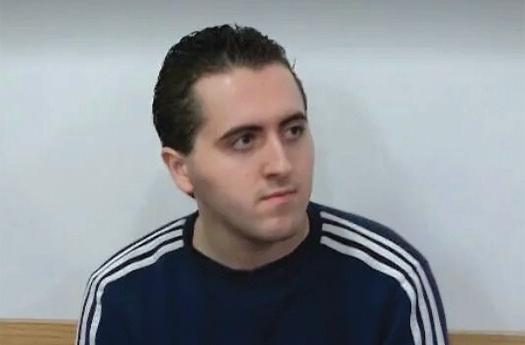
The individual who was behind a rash of hoax bomb threats called in to Jewish institutions around the United States from December 2016 to March 2017 was arraigned in Orlando on June 22 after being extradited from Norway. Birmingham’s Levite Jewish Community Center and N.E. Miles Jewish Day School received four bomb threats during that time, while the New Orleans Jewish Community Center received one.
Michael Ron David Kadar, 27, is a dual citizen of the United States and Israel. He was living in Ashkelon when he made 2,000 fake bomb threats to hospitals, airlines, schools and Jewish institutions. He used an online service to disguise his voice and enabled him to be anonymous.
In addition to targeting pretty much every JCC in America over several weeks, Kadar’s threats often led to emergency flight landings, even the scrambling of fighter jets. He also tried to extort a state senator in Delaware.
Online, he had a “School Email Bomb Threat Service,” charging $30 to send a customized threat to a school, and charging extra to pin the threat on someone else.
After his arrest and during his trial, his identity was kept under wraps in Israel, though he was identified in three 2018 indictments, in Washington, Georgia and Florida. In August 2025, the gag order in Israel was lifted.
In June 2018, an Israeli court convicted him on hundreds of counts of extortion, computer offenses, money laundering and spreading false information to cause panic. He was sentenced to 10 years in prison, but was released in 2024.
During the trial, Kadar’s attorney said he was autistic and suffered from a brain tumor, caus-
ing cognitive issues. After his arrest, he reportedly told investigators that he thought the bomb threats were a “game” that were “causing fun” for people.
After he was released in Israel, he went to Norway to seek refugee status. Norway was going to send him back to Israel, but that was stopped when the U.S. requested his extradition to face charges. Since October 2024 he was in custody at a psychiatric institution in Norway.
In November 2025, Norway rejected the extradition request, but that was overturned, and the Norway Supreme Court declined to intervene. After that decision was made, Kadar’s father told the Jerusalem Post that his son’s human rights were being violated because he “is in a severe psychotic state” and forcibly medicated. “The psychiatrists say he is at risk of suicide… an Israeli court has already ruled that he tried a significant number of times to end his life.”
Gabi Kadar said his son was “not criminally responsible because of the psychosis.”
In Orlando, Kadar faces charges of hate crimes and obstruction of the free exercise of religion for the threats against JCCs and Jewish schools. He also made bomb threats to a middle school and the Orlando International Airport.
“The alleged crimes stand out for their cruelty and for the harm they caused to the Jewish community,” said Assistant Attorney General A. Tysen Duva of the Justice Department’s Criminal Division. “When technology is exploited to terrorize houses of worship and community centers, it is an attack on religious liberty and public safety. We will never lose sight of the families, staff, and first responders who were
forced to live with these threats.”
According to the Justice Department, “Many of the calls resulted in the temporary closure and evacuation or lockdown of the targeted facilities and required law enforcement and emergency personnel to respond to and clear the area, although no actual explosives were found.”
In Washington, Kadar faces charges from threats made in March 2017 against the Anti-Defamation League office and the Israeli Embassy.
The Middle District of Georgia is charging him in a January 2017 incident where he allegedly called a police department with false information about an alleged hostage situation in progress at a private residence in Athens, which included a threat to kill responding police officers. Police and emergency personnel responded to the scene, only to learn that there was no emergency.
Hate crime charges carry a maximum of 20 years in prison. Bomb threats each carry a maximum of 10 years. The interstate threats, hoax and cyberstalking charges carry five years.
Michael Kadar being sentenced in Tel Aviv in November 2018.
A Life of Giving: Remembering Jacksonville Philanthropist
Elaine S. Furman
By Talia Green
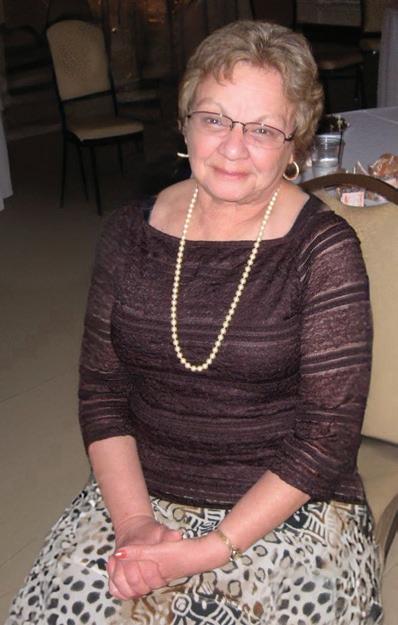
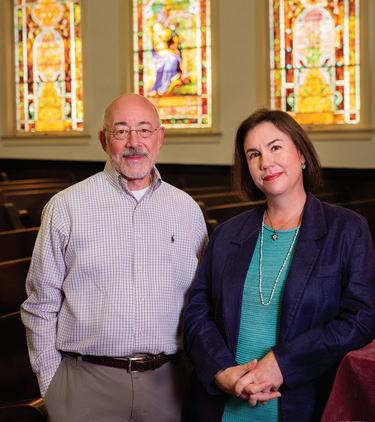
When Deb Miller, Naomi Kipp, and David Furman think of their mother, Elaine S. Furman (z’’l), they remember a woman whose life was guided by Jewish ethics, kindness, and a deep sense of responsibility to others.
“It was at the core of everything she did,” Deb said.
For the longtime Jacksonville philanthropist, generosity was a way of life. Whether volunteering to help adults learn to read, serving in her synagogue’s library, supporting local food banks, or knitting blankets for people who were homeless, Elaine was constantly looking for ways to help others.
“She was very giving and very aware — aware of the environment, of Judaism, of other people,” Naomi said. “Everything from turning off lights so we didn’t waste resources to thinking about how our actions impact others.”
“It was just part of who she was,” David agreed.
Elaine was born in Newark, New Jersey, before eventually settling in Jacksonville in 1984. A trailblazer in her profession, she worked as a pharmacist at a time when relatively few women entered the field, bringing her signature determination and intellectual curiosity into every aspect of her life.
Central to that life was helping secure the future of the Jewish homeland. “Our mother was a fierce advocate for Israel,” Deb said. “She supported many Israeli organizations, but she felt that Jewish National Fund was especially important.”
Elaine visited Israel frequently throughout her life. Through Jewish National Fund, she planted trees during her visits, and tree planting became one of her favorite ways to honor and remember loved ones.
In 2023, Elaine attended a Jewish National Fund Legacy Luncheon in Jacksonville, where she learned about tax-efficient opportunities to support Israel while receiving fixed payments for life. The following year, she established a charitable gift annuity through the organization, creating a meaningful legacy while continuing to contribute to a cause she loved.
“Over time, she started thinking about how to make a greater impact with larger gifts,” Deb recalled. “Israel was a top priority for her.”
From supporting the Jewish homeland to building a loving, Jewish home, Elaine’s legacy extends far beyond any single gift.
Her children and grandchildren remember joyful Passover seders filled with singing, learning, and extra guests around the table. They remember her quoting Jewish texts from memory, breaking into Broadway show tunes, and sharing the lessons she learned from her parents and grandparents.
Most of all, they remember a woman whose values informed every aspect of her life. “Jewish ethics permeated everything,” Naomi reflected.
Today, those values live on through her family, her community, and the causes she championed throughout her life. Through her legacy gift to Jewish National Fund, Elaine ensured that her commitment to the land and people of Israel will continue to make an impact for generations to come.
Photos courtesy Jewish National Fund Elaine S. Furman (z’’l)
Elaine and her family
New Website!
www.thaiesaneal.com
Online Ordering Available
See us for your Thai cravings!
Featuring our Drunken Noodles, Pad Thai and Panaeng Curry
New Asian-Inspired Salads
Ask about our Catering Options
Pizitz Food Hall, 1821 2nd Ave. No.
Open Mon-Sat, 11am-8pm Order Online for Pickup through Google on Toast Delivery via UberEats, DoorDash, GrubHub www.thaiesaneal.com
A new chapter for Mishkan Israel
Selma congregation hires Stephanie Butler to lead expanded community initiative
The effort to preserve Selma’s Mishkan Israel as a place for education and dialogue took a significant step forward with the recent hiring of Stephanie Butler as director of community programs.
Butler was previously the director of programming and engagement at Temple Beth-El in Birmingham, which included coordinating the Beth-El Civil Rights Experience, an interactive program that has attracted groups from around the country to explore the Jewish community’s role in and reactions to the civil rights movement. Prior to that, she headed the Blumberg Family Jewish Community Services in Dothan, which worked to attract new Jewish families to the area.
As director, Butler will guide the development of new initiatives aligned with the Selma Temple’s mission to “merge the congregation’s past with the present needs of its home city.” These include expanded educational programming, public events, partnerships with community and cultural institutions, and increased national visibility.
“Selma is a place where history lives, but it is also a place where people live and learn and work,” Butler said. “The Selma Temple initiative is about more than preservation. It’s about creating opportunities for people to engage with history in ways that are relevant and accessible. It also ensures that Mishkan Israel serves the community today as much as it honors the past.”
“Stephanie brings a combination of creativity, discipline, and deep commitment to community,” said Michael J. Siegel, Temple Mishkan Israel’s Board Chair.
Ronnie Leet, Selma resident and long-time Temple president, added, “She understands how to build something that is both rooted and relevant. As we enter our next chapter, her leadership will help ensure that Temple Mishkan Israel is preserved as a historic site and also as a living resource for Selma and beyond.”
For years, Leet, now one of two Jews left in Selma, has worked to preserve the congregation’s building and facilitate visits for groups that have wanted to tour the historic space.
Mishkan Israel was founded in 1870, and the building was dedicated in 1900. Jewish residents played a prominent role in Selma’s commercial, civic and philanthropic life, with three Jewish mayors between 1887 and 1920. Jewish-owned businesses were fixtures of downtown Selma, and members of the congregation contributed to the economic and social development of the city. It was said that in the early 20th century, on Rosh Hashanah one could roll a bowling ball down Broad Street and not hit anyone, because of how many stores were Jewish-owned.
For a brief time, there was also an Orthodox congregation, and the old Harmony Club building steps from the famed Edmund Pettus Bridge has been renovated.
Ronnie Leet and Stephanie Butler inside Mishkan Israel
At its peak around 1940, Mishkan Israel had more than 100 member households. In 1980 there were still around 200 Jews in Selma, but the community shrank significantly since then, as younger generations moved to larger metropolitan areas.
There were Selma “extended family” reunions in 1997 and 1999. In recent years, Mishkan Israel has been more of a civil rights history stop. Major events were held there for the 50th and 60th anniversaries of Bloody Sunday, the civil rights battle at the bridge in 1965. About a decade ago, an Orthodox congregation in the Washington area held a Shabbaton over King Weekend, putting a first-ever mechitza in Mishkan Israel, and managing to have a Shabbat-observant and kosher experience.
The Selma Temple Initiative was established to preserve the historic Mishkan Israel building, share the story of Jewish life in Selma and the Deep South, and merge the congregation’s past with the present needs of Selma.
The vision is for a restored Temple Mishkan Israel to be a place where people can gather to learn, reflect, celebrate and connect, while preserving its role as a sacred Jewish space through occasional worship services, life-cycle celebrations, and programs.
They also hope to strengthen local resources and provide opportunities for lifelong learning. Through partnerships with community organizations, schools and cultural institutions, they look to support broader efforts to improve quality of life in Selma and Dallas County.
Last November, Mishkan Israel hosted “Rise Up Together: A Musical Celebration,” featuring Rabbi Micah Lapidus, composer-in-residence at The Temple in Atlanta, and Melvin Myles, a celebrated soloist formerly of The Historic Ebenezer Baptist Church and now at The National Cathedral in Washington.
Mayor Johnny “Skip” Moss III said Mishkan Israel was “absolutely packed” for that concert. “Selma’s story has always been one of people coming together across lines of faith, culture, and background,” he said, and the concert “was a beautiful reminder of that.”
Strengthening the city’s cultural landscape and working on expanding heritage tourism, especially focusing on civil rights history, is also a priority.
“This initiative is about people,” Butler added. “It’s about creating spaces where individuals feel welcomed, challenged and inspired. It is also a catalyst for where history is not just remembered, but is used as a way to connect, learn and grow.”
CJFS CARES Respite Is Growing!
To learn about volunteering at CARES, email lise@cjfsbham.org or call 205.879.3438
JewBelong billboards seek allies in the Bible Belt against antisemitism
Christian Allies Collective joins the fight
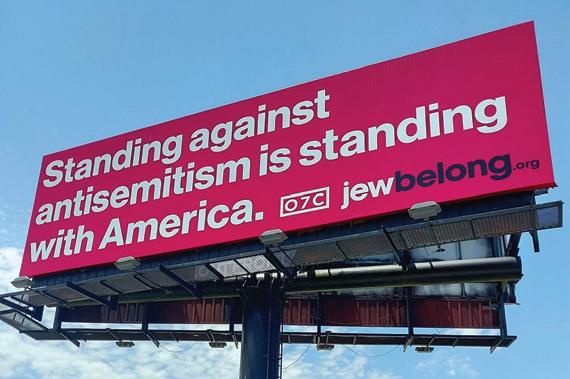
JewBelong, known for its pink billboards with thought-provoking messages, generally about fighting antisemitism, is expanding its presence where there are fewer Jews, but a lot of potential allies.
As part of the effort, they established a Christian Allies Collective, a network of churches, ministries and Christian leaders to stand with the Jewish community in the fight against hate.
As part of the effort, JewBelong and the Christian Allies Collective recently placed two billboards in Birmingham, with the messages “An attack on one of us is an attack on all of us” and “You don’t have to be a Jew to protect Jews.” The two billboards, on Interstate 65 near First Avenue North, and south of the Warrior exit, will remain up through next April, speaking directly to Christian audiences.
Billboards have already been placed in Memphis, Myrtle Beach, Little Rock and Bentonville. Planned locations in the coming months include Jackson, Savannah, Tallahassee, Nashville, Daytona Beach and Lynchburg, Va.
At the end of last summer, there was a campaign to place billboards in Southern college towns, including Tuscaloosa, Oxford, Baton Rouge, Tallahassee and Gainesville. A few months earlier, a billboard that had been placed in New Orleans was vandalized with a Palestinian message. Archie Gottesman, co-founder of JewBelong, said the billboards in the Bible Belt are mainly tailored to a non-Jewish audience, knowing that in the Bible Belt there are a lot of people who simply don’t know any Jews. The billboards operate on a simple premise. “Many, if not most, people in the country do not dislike Jewish people. Most just don’t know about the issue” of antisemitism. “We want to take people who are neutral and make them positives” toward the Jewish community.
It is a challenge, she said, because “the pro-Hamas crew are doing a great job” at messaging and pushing the neutrals into their corner. “The other side has been so good at getting sympathy and spreading falsehoods about the issues, the Jews need to tell the story better. We just don’t necessarily do that — that’s one of the reasons why JewBelong needs to be out there.”
The group is a non-profit, with all of its overhead covered, she said, so “when people donate, it goes right to billboards.”
She knows that there is a certain percentage of people who have a negative view of Jews, and a billboard isn’t going to change that, which is why the focus is on the “neutrals.”
Gottesman said they get a lot of feedback from people who see a billboard, wonder about the message and are “really surprised” to learn about the extent of antisemitism. The billboards then spark conversations at home and elsewhere.
In 2025, JewBelong did an impact study in Kansas City after billboards had been up for three months, showing a “significant shift” in attitudes. Two-thirds of non-Jews surveyed said they had a negative emotional impact upon learning about antisemitic violence, including sadness, shock or anger. Over half believe antisemitism is rising, and there was a 26 percent increase in those who actively speak up about antisemitism.
The Collective membership includes Christian Broadcasting Network, Generation Zion, the October 7 Coalition, the Philos Project, Larry Huch and New Beginnings Church in Dallas, Johnson Ferry Baptist Church in Marietta, Ga., and Colorado Christian University and Regent University. Some allies have co-branded billboards in their areas.
“We are deeply grateful to the Christian leaders and organizations who are stepping up and standing with us,” Gottesman said. “Christian voices reach places Jewish voices don’t, and their solidarity makes it clear that
this fight isn’t just a Jewish issue: it’s an American one.”
She said the allies play an active role in sharing messaging, engaging their communities, and elevating awareness of antisemitism through both grassroots and national platforms.
At the Christians United for Israel summit in Washington in early July, JewBelong has planned two mobile billboard trucks to thank CUFI members for their allyship. Messages include “You make ‘Love thy neighbor’ look less like a suggestion and more like a lifestyle,” “We’d like to thank you individually, but that’s a lot of Christians,” and “Not all heroes wear capes. Some wear CUFI lanyards.”
When JewBelong was formed, the pink billboards focused on outreach to people who were Jewish but did not feel like they had a place in the organized Jewish community. Gottesman said it was for “people who feel they never got the secret handshake, they didn’t attend religious school, have a Bar Mitzvah, their mom wasn’t Jewish but their dad was… so many people who feel “you’re a better Jew than me.”
It’s a feeling she could identify with, as her sisters all went to Jewish day schools, but she did not. “I felt like the least Jewish member of my family,” she said. “I had a feel for what that felt like, to not know as much.”
After she got married, her husband converted to Judaism, and “it was helpful to me to look at Judaism through the eyes of a rookie.” Lack of knowledge, such as a lack of understanding Hebrew, can be a barrier. “We live in a world where people can choose to be Jewish,” and Judaism “is important, it gives people sustenance.”
JewBelong provides simple, straightforward explanations without judgment. They have free explanatory booklets about the holidays, and
Passover is their busy season. They have recently been developing booklets about the Jewish lifecycle. “That’s what our focus was until October 2021,” she said. Online, Zionism became a bad word, and antisemitism continued to get worse. “October 7 made it much worse, and that brings us to where we are right now.”
One of these days, she said, “I want to go back to the happy stuff, the joyous Judaism. Hope springs eternal.”
Gemiluth Chassodim in Alexandria will have a Shabbat service welcoming four new members of the Jewish community, July 31 at 6 p.m.
The New Orleans Jewish Community Center announced that its annual Center Celebration will be on Nov. 7, “Mod About the J: Celebrating 60 Years.” The party will have a 1960s “Mad Men” inspired theme.
The Beth-El Civil Rights Experience in Birmingham will have a community tour on Aug, 7 at 3:30 p.m. Registration for the dynamic tour, with video, audio and hands-on activities, is $7 for local students, $12 for Beth-El members and $15 for non-members. Participants are invited to the musical Shabbat Shel Shirah featuring Civil Rights Experience docent Dalia Abrams at 5:45 p.m.
The next Honor Our Parents Shabbat coordinated by Collat Jewish Family Services in Birmingham will be on Aug. 14 at 11 a.m. at the Levite Jewish Community Center.
The Uptown Jewish Community Center in New Orleans will host Mindfulness in Wellness and Illness, a weekly series led by Dr. Jayashree Rao, a retired pediatric endocrinologist. Through guided meditation and simple exercises based on the Mindfulness-Based
Stress Reduction program, participants will learn practical techniques to stay present, reduce stress, and improve focus in everyday life. The series begins on August 5 and meets on Wednesdays at 12:30 p.m. through Sept. 30. It is free and open to the community, registration is requested.
Rabbi Judy Caplan-Ginsburgh will be teaching her annual Introduction to Judaism class on Aug, 22 from 1 to 4 p.m. at Gemiluth Chassodim in Alexandria. The class is free and open to the community. It consists of a brief overview of beliefs, holidays, the Jewish calendar, customs, worship and holidays, along with a tour of the Temple, a question and answer session, and sampling some Jewish foods.
Birmingham’s Levite Jewish Community Center will have a Honey and Handbags sale to benefit the Birmingham Jewish Federation’s Israel World Jewry Bureau. On Aug. 11 from 3 to 6 p.m., Bee Good Alabama’s raw local honey will be available, along with unique handmade Zippy Bags.
Pensacola’s Temple Beth El will host its annual Jews Who Cook fundraiser, on Aug. 15. at 5 p.m. Chefs will compete in three categories — appetizers, main courses and desserts. Aspiring chefs should reserve their spot as soon as possible.
John Ambrose has a ‘passion’ for building great kitchens and baths
John Ambrose is a Birmingham cabinet expert with years of experience in top-quality remodels and new construction. In this Q&A, John discusses what sets Ambrose Kitchen & Bath apart.
Why do you focus on kitchens and baths? Having worked on ground-up construction and full home remodels, I realized that kitchens and bathrooms are my passion. These are the most used and most challenging design features of the home—and as the youngest of four brothers, I like nothing more than to win a challenge! Getting the lighting, plumbing, tile, countertops, cabinets, hardware, appliances and paint to work together is like conducting a symphony. Every element has to be in harmony to achieve our clients’ vision.
Do you have a showroom to visit? Absolutely. In our showroom clients can get a handson look at working kitchens showcasing two of our top cabinet brands, Kith Kitchens and Mouser Custom Cabinetry. We also have lots of other samples to show. We see clients by appointment only because we believe that each client deserves our undivided attention.
What sets Ambrose Kitchen & Bath apart? We are committed to listening and collaborating with our clients to build spaces that work for them. Most customers come to us to solve problems in their existing space. We listen and create designs that ensure their new kitchen or bath will work for the way they live. We’re also a tight team of highly skilled professionals who have a passion for design and an eye toward the tiniest detail. We think through every aspect of our clients’ space and plan each component in advance.
Can you accommodate my busy schedule? Of course! Whether you’re a busy working parent, constantly on the road or retired and living your best life, we can work with you. We understand that not everyone can get to the design table during retail hours. In fact, we schedule most of our appointments after 4 p.m. on weekdays or on weekends.
What if I’ve never remodeled before and I’m feeling overwhelmed? Don’t worry. We’ll walk you through your entire project hand-in-hand. Before we ever started focusing solely on kitchens and baths, we did full remodels and built homes from the ground up. We understand every stage of the remodeling process and how to staff it, so we can guide you and answer all your questions. We’ll help make sure your project goes smoothly from rough-in to fluff-out.
I have no idea what a kitchen costs these days. What if my budget and dreams don’t align? We get it. We can break down costs in an easy-to-understand way and work with you to design the ideal kitchen or bath for your budget. We’ve hand-picked beautiful cabinet lines at every price point. Come take a look!
For more information, call us at 205-510-6961 or visit AmbroseKitchenandBath.com.
Many historical ties at this year’s ADL Botnick Torch of Liberty event
Special recognition of Jackson’s Beth Israel
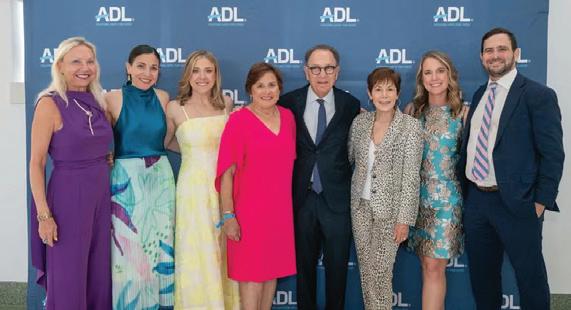
The Anti-Defamation League’s South Central region held its annual A.I. “B” Botnick Torch of Liberty Awards, May 14 at The Josephine in New Orleans, honoring Cathy and Charlie Glaser, and Jones Walker LLP. There was also a special recognition of Jackson’s Beth Israel Congregation, which was attacked by an arsonist on Jan. 10.
The event raised over $375,000, “at a time when antisemitism remains at an all-time high and our work is as important as ever,” according to the regional office, which covers Mississippi, Louisiana and Arkansas.
There are historical ties between the ADL South Central office and Beth Israel. After the bombing of Beth Israel and Rabbi Perry Nussbaum’s house in 1967, the ADL office, under the leadership of Botnick, coordinated a quiet effort to raise funds that were given to law enforcement to entice informants inside the Klan and find who was behind the bombings.
After the bombing of Meridian’s Beth Israel, working with the informants, a trap was arranged as the bomber, Tommy Tarrants, targeted the home of Meyer Davidson. Law enforcement was waiting, and Tarrants was captured following a shootout, and his partner, elementary school teacher Kathy Ainsworth, was killed.
Beth Israel Student Rabbi Ben Russell noted the Klan-style hatred of “an earlier era,” saying that today antisemitism “emerges in new forms, amplified by fear, division, and a culture increasingly comfortable with dehumanization. One act of hatred can fracture a community. But it can also reveal the strength of the people determined to resist it together.”
After the Glasers moved from Memphis to New Orleans, Charlie’s home town, in 1974. Cathy started community work at the New Orleans Jewish Community Center, serving as liaison for the New Americans Holocaust Remembrance Committee for 50 years.
After law school, she practiced at Stone Pigman before becoming law clerk to Judge Walter Marcus Jr., until 1999, when she became the regional director of the ADL South Central office. During her 14 years as director, she launched the National Youth Leadership Mission to Washington, the Interfaith Passover Seder with Loyola and Tulane Hillel, No Place for Hate programs, and Echoes and Reflections Holocaust education training
To the Families of New Orleans
Our decision to join the professionals at Lake Lawn Metairie allows us to continue our mission to provide families the highest caliber of care in the most beautiful of surroundings. Lake Lawn Metairie proudly serves all congregations and all local cemeteries. Whether planning in advance or at the time of need, we’re dedicated to serving families with professionalism, compassion and attention to detail that is second to none.
Sincerely,
Stephen Sontheimer & Billy Henry
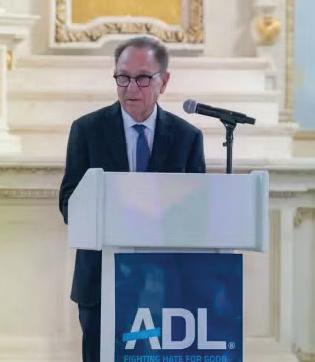
Charlie Glaser addresses the event
While the ADL’s annual Audit on Antisemitic Incidents showed fewer events, as college campuses cooled down somewhat, the reported incidents became more violent. Both the Southeast and South Central regions showed dramatic declines, with many harassment incidents coming from antisemitic slogans chanted at anti-Israel rallies.
Even in Alabama, opposition to AIPAC became an issue in the U.S. Senate race, as Democrat Dakarai Larriett stated he would refuse any contributions linked to the pro-Israel group. In the Republican primary, a candidate attacked one of the front-runners over contributions from a Jewish New Yorker, with AIPAC also being mentioned in a negative way.
Black pro-Israel leaders, including Bishop Reginald Gibson and Dr. Brandy Gibson of Birmingham, formed the new Black Christian Leadership Council for Israel Relations, and one of the first programs is taking hundreds of Black pastors to Israel on “Unfinished Business,” a trip that was originally envisioned by Martin Luther King Jr., in 1967, but was postponed by the Six Day War, and he was never able to lead that trip.
The U.S. Department of Education has initiated a Title VI investigation of the Bay County school district in Florida over allegations of antisemitic discrimination in the Panama City-area district. An 11th-grade student withdrew from the school after classmates made antisemitic presentations in class, with the teachers not making any effort to intervene.
Skip Bertman, a legend of Louisiana State University athletics, will be inducted into the Jewish Sports Heritage Association.
Yaacov Agam, whose work includes large art installations in Birmingham and New Orleans, died at 98.
The owner of a couple dozen for-profit Jewish summer camps, including Blue Star in North Carolina, filed for bankruptcy after a questionable bond issue in Israel. Southern Poverty Law Center grilled over lack of Islamist groups on its Hate Map.
And more! Subscribe to our Substack today!
in partnership with the National World War II Museum.
Charlie began in optometry at Ochsner Clinic before establishing St. Charles Vision in 1976. He has served on numerous boards, including the executive committee at Touro Synagogue, where he also co-chaired the very first Jazz Fest Shabbat. He also served on the ADL South Central board, and two of their children are on ADL boards where they live — Rachel chairs ADL Austin, and Maggie is on the board of ADL Mountain States. Son Alex is a partner at Jones Walker, which partners with the New Orleans Jewish community on numerous initiatives, including a 2022 trade mission to Israel, and hosting an “Innovation Embassy” the following year.
In a social media post, the local Jones Walker office said “We are proud to be recognized for our longstanding partnership with ADL, our support of the Corporate Partners Against Hate initiative, and our broader commitment to the Jewish community and the Greater New Orleans area.”
>> Editor continued from page 4
Israel isn’t fighting Lebanon — it is fighting in coordination with Lebanon against Hezbollah, which has been occupying Lebanon and running a parallel government for the benefit of Iran. Whatever happened to being anti-occupation?
After the first couple months of the war, Lebanon reported 2,294 dead. Of those, 80 percent were adult men — Hezbollah fighters. That only 20 percent are women and children is astonishingly low for any war, and shows what a lie the genocide charge is.
The news will simply report “four killed” in an Israeli strike in Lebanon, not mentioning that the four were likely Hezbollah fighters. When Hezbollah praises its martyrs, they admit that those deaths are fighters, not civilians, such as a recent report of “29 killed in Lebanon” that turned out to be 29 Hezbollah fighters, and no civilians.
If Israel were evil genociders… a Hezbollah operative was visiting relatives in February when he got a call from Israel — he was in their sights, and they gave him the option of leaving the building so his relatives would not get taken out as well. He did leave the building and was killed in his car, by himself. For that, he was praised for his heroism; that “genocidal” Israel gave him that choice was glossed over.
But Israel is said to be indiscriminately bombing Lebanon and causing a genocide there, and we’re all going to get really mad about it and harass Jews — er, Zionists!
When it comes to antizionism, nuance has left the building, as so many in the movement are shedding the pretense and veering into overt antisemitism.
During Covid, there were no mass demonstrations outside Chinese restaurants. Russian
establishments bear no brunt of concern over Ukraine. But synagogues? Jewish restaurants? They’re seen as fair game.
This is another example of how lies are spread to manufacture outrage, and to make harassment of Jews acceptable and noble. Anti-Israel activists say synagogues, especially in the New York area, are legitimate targets because they have events where “stolen land” is being sold. Their publicity, to gin up the number of outraged protestors, basically insinuates that Israel goes through the territories, confiscating Palestinian properties and evicting the residents, then turning around and selling those homes to American Jews. Of course, that is blatantly false, those real estate events are for those considering moving to Israel and are for legally acquired properties.
One thing those demonstrations do accomplish is showing exactly why the Jewish world needs an Israel, just in case.
The prevalence of such lies also is why it is so disappointing to see so many within the Jewish community, relying on the skewed reporting of the mainstream press, parrot those lies — accusing Israel of using starvation as a weapon in Gaza, or agreeing with the genocide libel. Now that those seem to have run their course, the cause du jour to foment anti-Israel sentiment seems to be settler violence against Palestinians.
Now, settler violence does exist, and one incident is one too many. It would take a whole ‘nother column to do the issue justice, but suffice it to say that it is incredibly overblown. Yes, all instances need to be dealt with, quickly and decisively. We are better than that. However, not only is the number of settler violence incidents a small fraction of the incidents of often-deadly Palestinian violence toward Israelis in the territories, even the far smaller figure for settler violence is highly inflated.
Analysis of an incident list shows that roughly 16 percent of the “violent” incidents are Jewish visits to the Temple Mount (which are legal, though highly regulated, under longstanding agreements), instances of self-defense against Arab attacks, or Palestinian clashes with Israeli security forces, traffic accidents, even benign “trespassing” by tourists or hikers. In other words, over 90 percent aren’t what people envision when they hear the loaded term “settler violence.”
Activist groups also routinely stage provocations against Israeli civilians and soldiers, with cameras rolling, in hopes of getting a reaction, so they can get (edited) footage to show the world how cruel and depraved Israel is. Ro Khanna, anyone?
And with all this, a coalition of American Jewish groups, including the Reform and Conserva-
tive movements, recently decided to self-flagellate about how terrible “the settlers” are.
Since March, a crackdown including arrests and restrictions has resulted in a 25 percent decrease in “settler violence” and authorities say roughly 370 people are the problem. That’s 370 too many, but a drop in the bucket compared to the “settler” population of 500,000.
We have to go beyond the headlines and the inflammatory accusations, because so often, the accusations are spurious. Rather than apologize, we have to push back against the false claims. It’s difficult, and frustrating, to be forced to defend against things that simply aren’t happening.
As it is said, the antisemite doesn’t accuse the Jew because he thinks he is a thief, it is for the perverse pleasure in humiliating the Jew to turn his pockets out to prove his innocence.
Have you stopped poisoning the town’s wells?
Have you stopped murdering Christian children for ritual use?
Have you stopped starving Gazans?
Have you stopped perpetrating genocide?
Have you stopped beating your wife?
Lawrence Brook, Publisher/Editor
Chabad of Alabama establishes endowment
Chabad of Alabama in Birmingham announced that it has established the Chabad of Alabama Endowment Fund.
Rabbi Yossi Posner said that this year “has been filled with tremendous growth, outreach, and impact” made possible by the generosity of the community. Having an endowment “represents the next step: ensuring that the Chabad community in Alabama continues to thrive not only today, but for generations to come.”
In addition to an organization’s annual fundraising, endowments are seen as a “savings account,” with interest and other earnings being available to the institution each year. Growth comes from earnings beyond what is spun off to the institution, and from new contributions.
For some institutions, their foundations provide a substantial portion of the annual budget.
The Chabad endowment was launched with $2 million, “thanks to the foresight of previous investments from a gift from Jo Ann Hess Morrison and her husband David Morrison.” Once the foundation hits $5 million in assets, Chabad will begin to use the interest to support their programs.
David Lichtenstein will be managing the fund’s investments. In addition to him, the foundation’s board includes Posner, Steven Brickman, Eli Posner, James Abroms, Alan Engel and Miriam Friedman.
Chabad in Birmingham was established in 1982, the Posners arrived in 1987. Their building was dedicated in 1998.
Birmingham’s Camp Gan Israel named for the Abroms family
fresh with premium ingredients and customizable spice levels. Kosher-style and Vegan selections.
Chabad of Alabama announced that in recognition of a major gift, its Camp Gan Israel summer day camp is being named for the Abroms family.
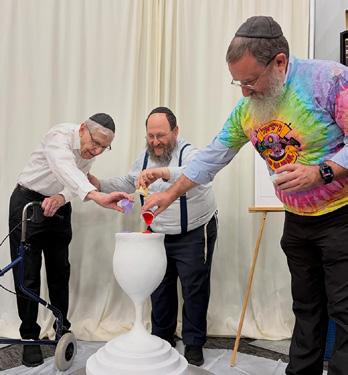
A dedication ceremony for Abroms Camp Gan Israel was held on June 30, “in honor of the incredible leadership and partnership of Mr. Hal and Judy ob”m Abroms.”
At the dedication, campers took small cups of paint and drizzled them over a “Cup of Overflowing Blessing,” “with prayers from overflowing blessings for the Abroms Family, Abroms Camp Gan Israel, our Birmingham Jewish community, all the people of Israel, and our world.”
At the June 30 dedication, Hal Abroms is joined by Chabad of Alabama Rabbis Yossi Posner and Yossi Friedman to start the decoration of the Cup of Overflowing Blessing, which would then be painted by this year’s campers.
Chabad has held the day camp in Birmingham for over 30 years. This summer, the sessions lasted four weeks from June 22 to July 17, and drew 101 campers. According to Chabad, “Through this gift, Birmingham’s children will continue to experience the warmth, joy, and inspiration that have made Camp Gan Israel such an integral part of Birmingham’s Jewish community.”
In the announcement of the naming, Chabad said “We are profoundly grateful to the Abroms family for their friendship, vision, and unwavering commitment to Jewish continuity and education.”
On the wings of (War) Eagles: New Chabad opening at Auburn
The expansion of Jewish life at Auburn will get a boost as classes begin this fall, with the establishment of Chabad at Auburn.
Chana and Rabbi Aryeh Wells will be establishing the new center, under the direction of Rabbi Yossi Posner of Chabad of Alabama, in Birmingham.
Aryeh Wells is a native of Boynton Beach, Fla. At Columbia University, where he received a degree in philosophy, he was active with Chabad on Campus, becoming more involved, and pursuing yeshiva studies in Jerusalem and Brooklyn.
The former Chana Laber grew up at the Chabad in Rensselaer, N.Y., that her parents ran, along with a girls’ summer camp. She is a self-taught artist who has led painting workshops around the world. They married in 2024 and have a son, Yisroel.
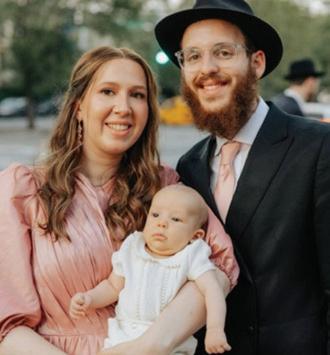
Chana and Rabbi Aryeh Wells, and Yisroel
The Auburn Chabad will serve the university, along with the Auburn and Opelika areas, with Shabbat and holiday meals, Torah classes, educational programs, community events and other Jewish experiences throughout the year.
The state also has Chabads in Mobile and Huntsville, and at the University of Alabama, where they “Roll Tide with Jewish Pride.”
Historically, “The Loveliest Village on the Plain” has had a small Jewish
population at Auburn University was under 100. In recent years, that number has increased, and some reports now have the Jewish student population at 300 and growing. Auburn also has a Hillel, which does not yet have its own building.
The presence of Coach Bruce Pearl leading the basketball program boosted the university’s visibility in the Jewish world, as he is outspokenly Jewish, took the basketball team to Israel in 2022 for three summer games, and has hosted basketball tournaments in Auburn for Jewish high schools from around the country. Pearl has promoted the new Chabad’s fundraiser online, as the goal is $100,000.
In the past couple of years, Rabbi Sholom Posner has taken Chabad on Wheels to Auburn as part of an effort to bring Judaism to smaller communities throughout the state. During his visits to Auburn, he saw a growing need for a permanent presence.
Pearl said he is “so excited about having a rabbi in Auburn,” and was “so pleased to be involved in the process.” He said it will be “AUsome for our Jewish students and families to learn and grow in our faith and connection to God and family.”
Chabad of Alabama thanked the Marcus Family for their support of Chabad at Auburn, Pearl for championing the vision, Shalom Posner for laying the groundwork, and Rabbi Avi Weinstein of Chabad on Campus International for his guidance and partnership throughout the process.
LET’S HANG OUT
Black pro-Israel leaders unite for “Unfinished Business”
pastors’ trip to Israel
New Black Christian organization seeks to support the Jewish community and fight antisemitism; November mission will realize Dr. King’s unfulfilled plan to bring thousands of pastors to Israel in 1967
With the Jewish community looking for allies in the face of surging antisemitism and anti-Israel activism, a group of Black pastors with long track records in Israel advocacy and Black-Jewish relations has joined forces to establish the Black Christian Leaders Council on Israel Relations.
A major part of the announcement on June 25 at the National Press Club in Washington focused on a planned Israel trip in November involving 500 Black pastors and Christian leaders, “Unfinished Business,” for which recruitment is now underway. In 1966, Martin Luther King Jr. was working with former Israeli Prime Minister David Ben Gurion to bring several thousand Black pastors to Israel in November 1967. The Six Day War led to a postponement to 1968, but with King’s assassination in April 1968, the trip never happened.
It was another trip to Israel by a group of pastors that led to the formation of this new organization. Pastor Michael Stevens explained that he and Pastor Dumisani Washington, founder of the Institute for Black Solidarity with Israel, were part of last December’s delegation of 1100 pastors organized by Friends of Zion founder Mike Ev-
ans. Stevens said that trip was “beautiful, it’s historic,” but only 40 of the 1100 pastors were Black.
Back home, Stevens and Washington coordinated with Pastors Roger Cheeks, senior director of outreach at the International Fellowship of Christians and Jews; Valerie Washington of IBSI; and Pastors Reginald and Brandy Gibson of Birmingham, to establish the Council “to help ensure that the essential Black American voice defending Israel and the Jewish people is clearly heard.”
Washington felt that “There needs to be a more concerted effort in the black community, and we decide to take on that mantle,” and this is their “hineni moment” to say “here I am.”
Stevens said “we’re not new to this, we’re true to this,” averaging 25 years of experience in Black-Jewish relations.
Stevens said the goal is to be “a firewall” and “a very visible friend” to the Jewish community. He has a rapid response initiative, Shoulder to Shoulder, that is part of the new organization. Its goal is to have a network of Black pastors who can be “boots on the ground” whenever there is an antisemitic incident, being “in that Jewish
At a June 25 press conference at the
Press Club in Washington, Pastor Dumisani Washington and Pastor Michael Stevens announce the Black Christian Leadership Council for Israel Relations, and the upcoming “Unfinished Business” pastors’ trip to Israel.
community, standing with that rabbi, standing with that Jewish Federation” not just to offer prayers, but “what tangibly, what materialistically can we do to stand in a minute of crisis?”
Stevens was the first African American Out-
Photo by James Henry Brook
National
community
reach Director for Christians United for Israel, and Washington was his successor. While Stevens said he loves the leaders of the Christian Zionist movement and owes “a debt of gratitude” to CUFI founder Pastor John Hagee, over the past eight or so years among white evangelicals, the movement has seemed increasingly polarized and been identified with a more patriotic and nationalistic tone. “We love our country, we love Israel, we love the Lord,” he said. But the tone doesn’t resonate with the typical Black pastor, and the Council is a place that they can identify with and express their support for Israel in their own way.
One of the best ways to bolster that support is by visiting Israel, but there is more to it than just going on a trip. Stevens said that he and Washington have probably brought 600 to 700 Black pastors to Israel over the years, and they have a “phenomenal time,” especially with rabbis they encounter, “and they said, wow, I want this back home,” but there were no relationships with the Jewish community to build upon. He said there is already interest from about 75 rabbis who want to join the November trip, so that by the time they get back to the U.S., relationships are already being built.
The Council is working with the Israeli Embassy in Washington and the Jewish Federations of North America, especially Rabbi Joshua Stanton, associate vice president for Interfaith and Intergroup Initiatives at JFNA.
Washington asked “how would history possibly been different, had thousands of Black Americans been making a pilgrimage to Israel in the late 1960s? There was no such thing as mass pilgrimages to Israel, especially from the United States. The black community was getting ready to start something that no one else was doing.”
Another bit of “unfinished business” they plan to address involves a group of Ethiopian pastors on the trip. Sigd, a major festival for Ethiopian Jews, falls during the trip, so an event is in the works for the pastors to apologize to the Ethiopian Jewish community for their mistreatment over the centuries.
Israeli Embassy Minister of Public Diplomacy Sawsan Hassan said when the Council leaders first met with Israeli Ambassador Yechiel Leiter to discuss the trip, “he called me after that to his office, and he said this is history… we need to do everything to support their initiative.”
Hassan said “the friendship between the Black American community and the Jewish people is not new… It’s old. It’s deep. And it was forged in some of the hardest chapters both our peoples have known.”
In November, “you will not come as strangers, you will come as family. Israel welcomes you with open hands and arms.”
Chara McMichael, JFNA senior director of
community
political affairs and government relations, “has been very instrumental in hoping give us a kosher understanding of how we might serve the Jewish community in a very real and meaningful way,” Stevens said.
McMichael said “this partnership is an extraordinary opportunity, and this initiative presents an opportunity to strengthen bonds between the Black and Jewish communities” and continue King’s vision of building together.
“The future of black Jewish relations will not be defined by our differences, but by what we can achieve,” McMichael said. “And the beauty of this partnership is that it’s not just about going to Israel. It’s about joining forces with the Jews that stand here in America and supporting one another as we move forward. Together we will stand shoulder to shoulder in the fight against racism and antisemitism.”
Black-Jewish Relations for 3,000 years
Washington said the first Africa-Israel summit “was when the Queen of Sheba traveled from Ethiopia to Jerusalem, 3,000 years ago, stood in Jerusalem and told the world God loves Israel forever.”
He added, “No other region can boast of a 3,000-year relationship with Israel, other than Africa,” and Black Americans and Africans are reclaiming their heritage of standing with Israel and the Jewish people.
The Council will also have a strong presence in Africa, Washington said. After October 7, they were among the founders of the African Jewish Alliance, established with Jewish friends including Charles Jacobs. The group was a way for Christians in places like Nigeria and Sudan to express support for Israel, because “Israelis and Africans have this real time issue that’s going on in terms of security” against radical Islam.
Washington said that when members in Nigeria saw the videos of the October 7 attacks, their reaction was “that happens to us every week, too,” saying “Hamas is Boko Haram, is Al-Shabbab, is al-Qaeda. They have different jerseys, but the same league” in terms of killing Christians, Jews, Druze and even other Muslims.
He said some will argue that the massacres of Christians in Nigeria is not a genocide because Muslims are also being killed. But Washington pointed out it is Muslims killing fellow Muslims who are “standing with their Christian brothers and sisters… imams who were hiding Christians in their mosques, who got killed because the extremists wanted them dead.”
The Council also cites “over a century of partnership” between the Black and Jewish communities, including heavy Jewish involvement in the founding of the NAACP, the joint effort of Booker T. Washington and Julius Rosenwald to build 5,300 Black schools throughout the South from 1912 to the 1930s, and partnerships in the civil rights movement, such as the close friendship between King and Rabbi Abraham Joshua Heschel.
The council’s launch was a few days after the anniversary of the 1964 murder of three civil rights workers in Mississippi. Stevens said “I grew up thinking it was two white guys and a black guy. No one ever told me it was two Jewish guys who came from the North, down to be with James Cheney, and they were murdered.”
In 1975, Bayard Rustin and A. Philip Randolph, “two lions of the civil rights movement,” formed the Black Americans to Support Israel Committee (BASIC). Washington reminded that this was the year the United Nations passed the Soviet-backed initiative to label Zionism as a form of racism. “When almost all other voices were silent in the West, it was the Black community that stood out, formed, and organized” in opposition to the resolution, Washington said.
Despite that, Stevens said, the relationship between the Black and Jewish communities “lost traction” in the 1970s and 1980s. “Somewhere, we lost communication… and don’t have a plan.”
Stevens said “the Al Sharptons, the Jesse Jacksons and the Louis Farrakhans, that’s what the last 60 years was. The Crown Heights Riots. That’s
where the conversation was when it came to Blacks and Jews.”
Washington noted that the outsized attention given to “the negative mouthpieces in the black community are like someone telling my Jewish friends Jewish Voice for Peace speaks for you.”
He noted that in his book, “Zionism and the Black Church,” not only did he quote King’s Israel advocacy, but the “vast majority of the civil right movement” leaders, who were also pro-Israel.
In recent years, “the anti-Israel narrative, particularly the one that has been fueling of the pro-Palestinian narrative, has always exploited the black community… There was always the goal for those people to use our community as a bludgeon against Israel,” such as equating Ferguson or George Floyd with Palestinian liberation.
Stevens said, “There is a black Zionism, Christian Zionism, that is a mountain and the base of a movement that’s untapped right now,” and their goal is to give it a voice.
Stevens added, “if anyone gets the Jewish conversation, it’s Black folk. If anybody understands slavery, if anyone understands oppression, if anyone understands being outcast from their own country, and the things that were experienced with the Holocaust and the slave trade, if anyone understands civil rights.”
>> Rear Pew Mirror
continued from page 30 with a special Mahjong Eve service which, among other things, contains the recitation of the foundational affirmation of Judaism that comes straight out of the Torah: The Shemahjong.
Not all Jews play Mahjong. It’s not as though all b’nai mitzvah are given their own Mahjong set along with their kiddush cup. (Though per haps they should be.) Nonetheless, a sizable percentage of the Jewish community plays Mah jong. Some games get quite intense. Most games remain civilized, but some players become so frenzied that they’re described by a Yiddish term created especially for this unique crazed state: Mahjongena.
Much like Jewish traditions and rules, there are many variations and interpretations of how to play Mahjong. Regardless of those differences, anyone who made it to the end of this literary litany deserves congratulations in the idiom that the Jews of old would offer to whoever won the latest game: Mahjong tov.
Doug Brook believes that if the Mahjong players didn’t want to see these things written on the white board each week, they wouldn’t play in the room where he teaches. To acquire both Rear Pew Mirror books, read other past columns, or listen to the Rear Pew Mirror podcast, visit http://rearpewmirror.com/.
Her heart is in good hands
Here, everything we do comes from the heart. Every child is surrounded by our team of compassionate caregivers who treat them as if they were their own. From the smallest patients with the biggest spirits to the families who stand beside them, we’re inspired by their strength and courage. Helping kids heal, grow and live their best lives possible, it’s at the heart of everything we do. ChildrensAL.org/heart
Problem Yards Our Specialty
Tile as Old as Time
Chinese food is as Jewish as apple brei. But is there any more Asian influence in Judaism than this christmatic culinary custom?
Of course, there is. What’s more, like its consumable cousin, today’s topic can be so addictive that just an hour later you’ll be hungry for it again.
It’s commonly known that 10 Jews are required in order to hold a service. However, in another room of the synagogue, a different activity gathers groups of four to engage with the same focused intensity as the most manic shuckler at services.
This activity is, of course, mahjong — a Chinese tiles game that’s every bit as Jewish as an eggroll. A game so Jewish that it has as many variant spellings as Chanukah.
A game whose prevalence in Jewish culture — and even in Jewish ritual — became so pervasive that its presence was radically reduced throughout the Jewish world such that nothing remained but the game itself. Until now.
Mahjong has brought Jews together as a people for generations. This is reflected in the original version of a popular Hebrew song, currently known as “Hinei Mah Tov.” People today know its words as “Hinei mah tov umanayim shevet achim gam yachad” — “How good and pleasant for brothers to dwell together.”
But the original lyric was “Hinei Mahjong Umanayim” — literally “How Mahjong is pleasant…” bringing people together.
This particular porcelain pastime was once prominent in Jewish holidays. For example it’s central to one of the most famous Chanukah songs, originally titled “Mahjong Tzur.” Its opening words were once “Mahjong tzur yeshuati” — literally, “Mahjong, rock of my salvation.”
What’s more, it’s well documented in numerous lost records that the dreidel was not, in fact, the original Chanukah toy. Thanks to savvy marketing, this four-sided top overtook the holiday’s entertainment from the four-sided Mahjong table.
A Mahjority of readers approve of this column…
Lest we think that it’s limited to the less religious holidays, look no further than Passover. As is known, the Passover seder table is typically not square and is usually occupied by far more than four people. This leads the youngest person at the seder to traditionally ask “Mah Nishtana haMahjong Hazeh Mikol haLeilot” — meaning “why is this Mahjong different from all other nights?”
As nearly several people realize, most of the seder prior to the meal is attempting to answer that question by, among other things, retelling the Passover story. As the aroma of the meal draws near, there’s an eloquent explanation of three main symbols of Passover: Pesach, Matzah, uMahjong.
Mahjong lurks in plain sight throughout Jewish history. One of Judaism’s greatest historic symbols of resistance is a particular mountaintop stronghold that came to a tragic end. Before the thousand Jewish rebels made their final stand against the Romans there in 70 C.E., Herod had built it as a luxurious gaming palace overlooking the Dead Sea, high atop Mount Mahjonga.
When modern synagogues host Mahjong tournaments, they hold a special service on the night before. The usual Ma’ariv service is replaced