SELECT SCIENTIFIC DISCOVERIES
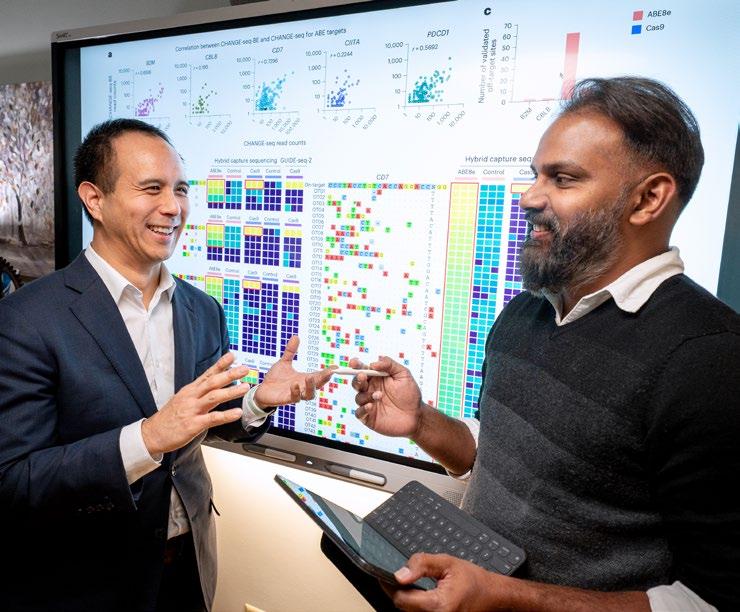
CHANGE-seq-BE finds off-target changes in the genome from base editors
Shengdar Tsai, PhD
Nature Biotechnology
• Base editing offers precise genome correction, but existing tools often fail to detect subtle off-target effects, limiting safety and clinical application.
• St. Jude scientists developed CHANGE-seq-BE, a sensitive, genome-wide method that efficiently identifies offtarget activity from base editors, including sites missed by other techniques.
• CHANGE-seq-BE has already supported an FDA emergency therapeutic use application and provides a critical resource for ensuring the safety and effectiveness of future genome editing research.
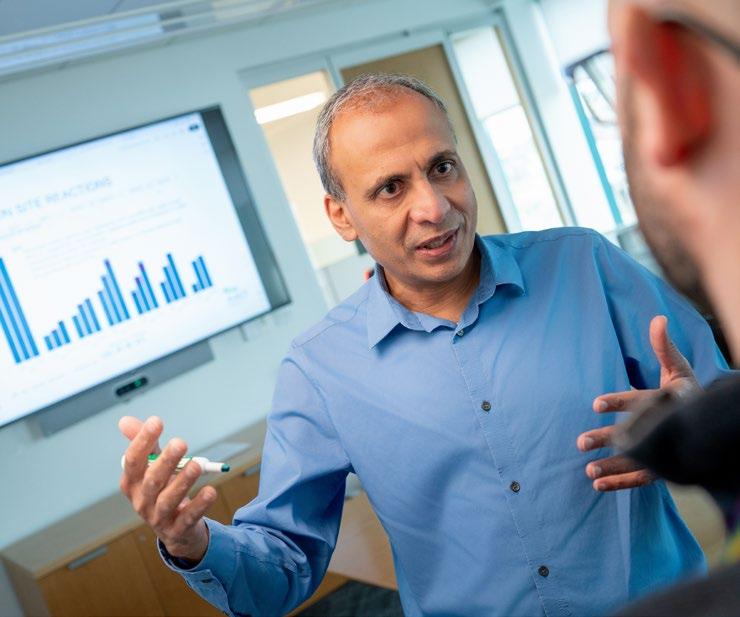
Studies show that less frequent, allinjectable treatment for HIV is safe and preferred by adolescents
Aditya Gaur, MD
The Lancet HIV
• Many adolescents with HIV struggle to consistently take daily oral medications, highlighting the need for alternative treatment options.
• The IMPAACT Network tested a long-acting, all-injectable HIV regimen—cabotegravir and rilpivirine—administered once every two months in adolescents across 18 centers in five countries.
• Over 48 weeks, the injectable regimen maintained viral suppression with no major safety concerns, and all participants preferred it to daily oral therapy, offering a promising new option that improves adherence and quality of life.
Learn more: Visit the St. Jude Newsroom to read the full press release.
Learn more: Visit the St. Jude Newsroom to read the full press release.
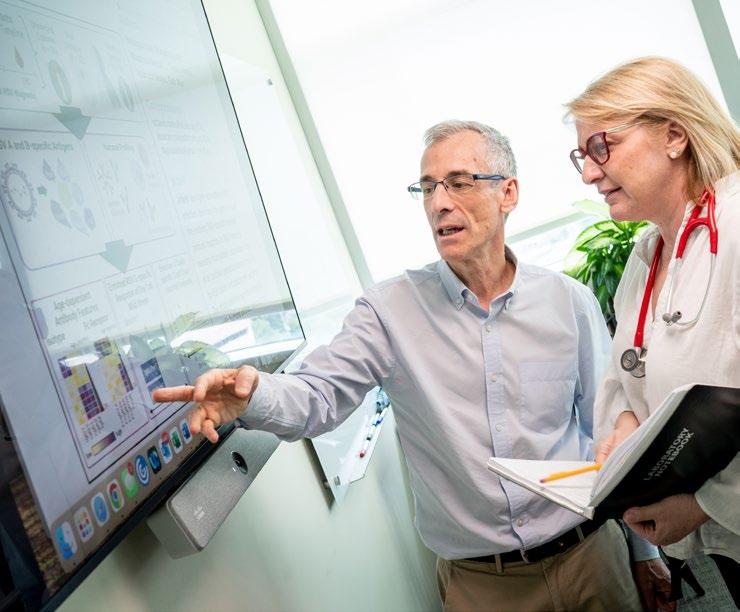
Hearing loss contributes to cognitive decline after childhood cancer treatment
Heather Conklin, PhD
Neuro-Oncology
• Radiation therapy for childhood brain tumors can cause hearing loss, which contributes to more pronounced cognitive decline in areas such as reasoning, learning, and communication.
• St. Jude researchers analyzed children treated for ependymoma to measure the specific effects of radiation-induced hearing loss on cognitive outcomes.
• The findings highlight the importance of early interventions, such as hearing aids, and support treatment planning that reduces hearing loss to protect children’s cognitive development.
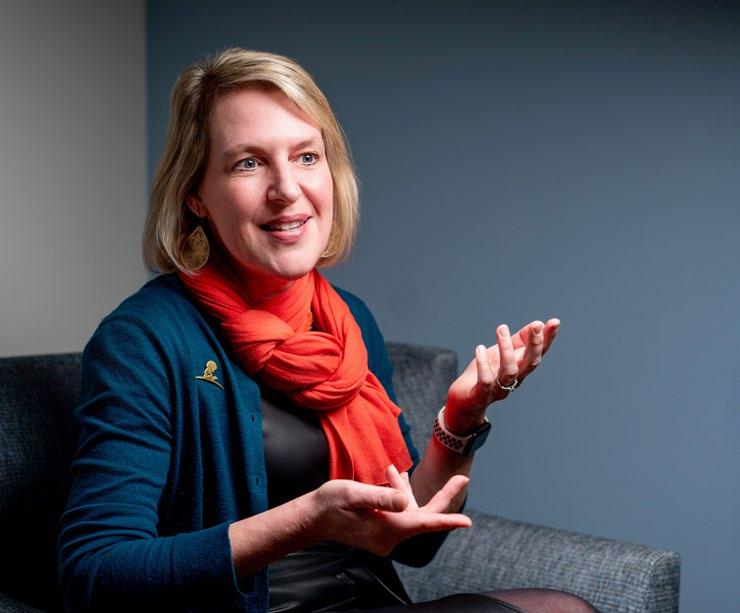
Differing
immune response in infants may explain increased severity of RSV over SARS-CoV-2
Octavio Ramilo, MD | Asunción Mejías, MD, PhD, MsCS
Science
Translational Medicine
• Infants hospitalized with RSV often experience more severe illness than those with SARS-CoV-2, but the reasons for this difference were unclear.
• St. Jude and The Jackson Laboratory for Genomic Medicine analyzed immune responses at single-cell and gene-activity levels, comparing infants with RSV or SARSCoV-2 infections to identify immune patterns linked to disease severity.
• The study shows that RSV severity is linked to suppressed natural killer cell activity, informs careful use of treatments like steroids, and provides a framework for understanding and protecting infant immune development.
Learn more: Visit the St. Jude Newsroom to read the full press release.
Learn more: Visit the St. Jude Newsroom to read the full press release.
Shared origins illuminate potential dependency across brain tumor types
Paul Northcott, PhD
Cancer Cell
• Pineoblastoma is a rare and aggressive pediatric brain tumor, making it difficult to study and develop effective treatments.
• St. Jude and global collaborators analyzed the largest cohort of pineoblastoma samples using single-cell gene profiling to identify the tumor’s cell of origin and key genetic features.
• Researchers discovered that a subset of lightsensing genes is essential for tumor survival—not only in pineoblastoma but also in medulloblastoma and retinoblastoma—highlighting a potential shared vulnerability for new therapies across multiple cancers of the central nervous system.
Study shows breath test can confirm bacterial infection
Kiel Neumann, PhD
ACS Central Science
• Bacterial infections can be hard to distinguish from viral infections or inflammation, often leading to unnecessary antibiotic use and contributing to drug resistance.
• St. Jude researchers developed a breath test using a bacterial-specific molecule, mannitol synthesized with carbon-13, which produces a detectable signal when metabolized by infecting bacteria.
• Preliminary results suggest this rapid, noninvasive test could confirm bacterial infections in a wide range of clinical settings, helping guide appropriate antibiotic use and combat drug resistance.
Learn more: Visit the St. Jude Newsroom to read the full press release.
Learn more: Visit the St. Jude Newsroom to read the full press release.
Carsten Bönnemann, MD, joins St. Jude to expand research on pediatric catastrophic neurological disorders
St. Jude Children’s Research Hospital recruited Carsten Bönnemann, MD, a world-renowned expert in neuromuscular and neurogenetic diseases, to lead its new Department of Genomic and Translational Neuroscience. Under Bönnemann’s leadership, the department will focus on the most devastating childhood neurological diseases, uncover genetic and molecular roots of these diseases, and push toward precision therapies. This institutional effort underscores St. Jude’s continued dedication to tackling rare, complex disorders with few available treatment options.
Learn more: Visit the St. Jude Newsroom to read the full press release.
James R. Downing, MD, to step down as president and CEO of St. Jude Children’s Research Hospital in late 2026
St. Jude Children’s Research Hospital announced that James R. Downing, MD, will step down as president and CEO in late 2026. Downing will transition into a faculty role in the Department of Global Pediatric Medicine, which he helped establish to advance St. Jude’s global mission. Downing’s tenure includes over a decade of growth and strategic expansion in research, clinical care, and global impact.
“Nothing worth doing can be achieved in a single lifetime, nor can it be achieved alone. I’m merely a caretaker of St. Jude, and I look forward to helping the next leader fulfill our founder’s dream that no child should die in the dawn of life.”
– James R. Downing, MD
Learn more: Visit the St. Jude Newsroom to read the full press release.
Liquid Biopsy: Transforming Pediatric Care
St. Jude researchers are advancing new models of care by using cell-free DNA to detect and characterize disease from fluid samples—often before symptoms appear and without invasive procedures. These approaches enable earlier intervention, reduce risk for patients, and improve diagnostic precision, signaling a broader shift toward proactive, data-driven pediatric medicine.
Cell-free DNA offers early warning for bloodstream infections in kids with leukemia
Joshua Wolf, PhD, MBBS
The Lancet Microbe
St. Jude researchers are using cell-free DNA in the blood to detect infections in children with leukemia before symptoms appear. This method provides an early indication of potentially life-threatening infections, enabling clinicians to act quickly and reduce complications.
Learn more: Visit the St.
to read the full press release.
Classifying pediatric brain tumors by liquid biopsy using artificial intelligence
Paul Northcott, PhD
Nature Cancer
St. Jude researchers developed an AI-based liquid biopsy that uses DNA from cerebrospinal fluid to classify pediatric brain tumors without surgery. The approach shows strong potential to improve diagnostic precision and reduce risk for patients, supporting more personalized treatment in the future.
Learn more: Visit the St. Jude Newsroom to read the full press release.
Jude Newsroom
Retrotransposon drives cancer by altering 3D genome structure
Jian Xu, PhD Cancer Discovery
Many pediatric cancers lack clear genetic drivers.
St. Jude researchers found that mobile DNA pieces, called LINE-1 elements, can “jump” throughout the genome, promoting cancer by reshaping the genome’s three-dimensional structure and activating oncogenes.
This work expands cancer biology beyond mutations to include genome architecture.
Mapping 3D-super-enhancers with machine learning to pinpoint regulators of cell identity
Brian Abraham, PhD
Nucleic Acids Research
Traditional methods are often not sensitive enough to capture how genes are regulated in three dimensions.
St. Jude scientists developed a machine learning approach to map super-enhancers in 3D and identify key regulators of gene expression. The work enables more precise targeting of disease-driving regulatory networks.
Learn more: Visit the St. Jude Newsroom to read the full press release.
Learn more: Visit the St. Jude Newsroom to read the full press release.
Learn more: Visit the St. Jude Newsroom to read the full press release.
First-of-its-kind analysis reveals the structural variant landscape driving pediatric cancer development
Jinghui Zhang, PhD Cancer Cell
Structural variants have been historically underrecognized drivers of pediatric cancer. St. Jude researchers showed these large-scale DNA changes account for about 60% of cancer-driving events across tumor types. The findings highlight genome structure as a central factor in cancer development and treatment.
ST. JUDE
Erica Kaye, MD
Greg Armstrong, MD
Sharing stories of impact and discovery across the St. Jude research enterprise.
Scientific advances make the mission of St. Jude Children’s Research Hospital possible every day.
St. Jude Progress tells the stories of those advances from the investigators, laboratory researchers and clinical scientists who are making them.
Scan the QR code to learn more about St. Jude Progress
The pioneering expertise of St. Jude is being showcased through featured content on Nature platforms, sharing stories of research and discovery with a global audience.
This quarter, our Nature partnership spotlighted how St. Jude is advancing data-driven science— from revealing hidden biological signals in single-cell sequencing, to building continuously updated protein knowledge bases, to using machine learning to rapidly identify more effective drug combinations. We also shared stories of impact in Nature Briefing focused on artificial intelligence and robotics in biomedical research.
Mining sequencing data to uncover hidden drivers
Jiyang Yu, PhD
How to tame an ever-growing proteome
M. Madan Babu, PhD, FRSC
Drug combination model expertly ‘fills the gaps’
Paul Geeleher, PhD