Research Poster Winners & Entries 2026

Page 1


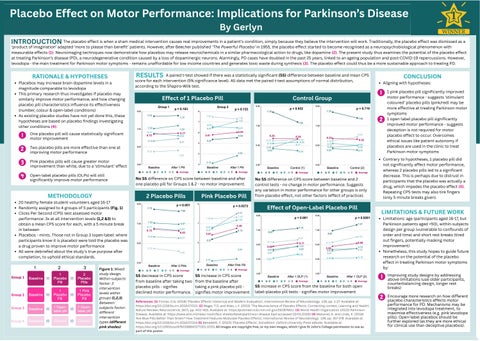
Placebo Effect on Motor Performance: Implications for Parkinson’s Disease

The placebo effect is when a sham medical intervention causes real improvements in a patient’s condition, simply because they believe the intervention will work. Traditionally, the placebo effect was dismissed as a ‘product of imagination’ adapted ‘more to please than benefit’ patients. However, after Beecher published ‘The Powerful Placebo’ in 1955, the placebo effect started to become recognised as a neuropsychobiological phenomenon with measurable effects (1). Neuroimaging techniques now demonstrate how placebos may release neurochemicals in a similar pharmacological action to drugs, like dopamine (2) The present study thus examines the potential of the placebo effect at treating Parkinson’s disease (PD), a neurodegenerative condition caused by a loss of dopaminergic neurons. Alarmingly, PD cases have doubled in the past 25 years, linked to an ageing population and post-COVID-19 repercussions. However, levodopa - the main treatment for Parkinson motor symptoms - remains unaffordable for low income countries and generates toxic waste during synthesis (3). The placebo effect could thus be a more sustainable approach to treating PD.

RATIONALE & HYPOTHESES

Placebos may increase brain dopamine levels in a magnitude comparable to levodopa

This primary research thus investigates if placebo may similarly improve motor performance, and how changing placebo pill characteristics influence its effectiveness (number, colour & open-label conditions)

As existing placebo studies have not yet done this, these hypotheses are based on placebo findings investigating other conditions (4):

One placebo pill will cause statistically significant motor improvement

Two placebo pills are more effective than one at improving motor performance

Pink placebo pills will cause greater motor improvement than white, due to a ‘stimulant’ effect

Open-label placebo pills (OLPs) will still significantly improve motor performance

METHODOLOGY

20 healthy female student volunteers aged 16-17 Randomly assigned to 4 groups of 5 participants (Fig. 1) Clicks Per Second (CPS) test assessed motor performance: 3x at all intervention levels (1,2 &3) to obtain a mean CPS score for each, with a 5 minute break in between

Placebos - mints. Those not in Group 3 (open-label: where participants know it is placebo) were told the placebo was a drug proven to improve motor performance All were debriefed about the study’s true purpose after completion, to uphold ethical standards.

Figure 1: Mixed study design. Within-subjects factor: 3 intervention levels within groups (1,2,3) Betweensubjects factor: different intervention types (different pink shades)

A paired t-test showed if there was a statistically significant (SS) difference between baseline and mean CPS score for each intervention (5% significance level). All data met the paired t-test assumptions of normal distribution, according to the Shapiro-Wilk test.

Control Group

No SS difference on CPS score between baseline and after one placebo pill for Groups 1 & 2 - no motor improvement.

SS decrease in CPS score from baseline after taking two placebo pills - signfies declined motor performance.

SS increase in CPS score from the baseline after taking a pink placebo pillsignifies motor improvement

No SS difference on CPS score between baseline and 2 control tests - no change in motor performance. Suggests any variation in motor performance for other groups is only from placebo effect, not other factors (effect of practice).

Effect of Open-Label Placebo Pill

SS increase in CPS score from the baseline for both open label-placebo pill tests - signifies motor improvement

References: (1) Finniss, D.G. (2018) ‘Placebo Effects: Historical and Modern Evaluation’, International Review of Neurobiology. 139, pp. 1–27. Available at: https://doi.org/10.1016/bs.irn.2018.07.010. (2) Wager, T.D. and Atlas, L.Y. (2015) ‘The Neuroscience of Placebo Effects: Connecting context, Learning and Health’, Nature Reviews Neuroscience, 16(7), pp. 403–418. Available at: https://pubmed.ncbi.nlm.nih.gov/26087681/. (3) World Health Organization (2023) Parkinson Disease. Available at: https://www.who.int/news-room/fact-sheets/detail/parkinson-disease (last accessed 02/01/2026) (4) Meissner, K. and Linde, K. (2018) ‘Are Blue Pills Better Than Green? How Treatment Features Modulate Placebo Effects’, International Review of Neurobiology 139, pp. 357-378. Available at: https://doi.org/10.1016/bs.irn.2018.07.014 (5) Benedetti, F. (2020) ‘Placebo Effects’. 3rd edition. Oxford University Press eBooks Available at: https://doi.org/10.1093/oso/9780198843177.001.0001 All images are copyright free, or my own images, which I give St John’s College permission to use as part of this poster

CONCLUSION

Aligning with hypotheses:

1 pink placebo pill significantly improved motor performance - suggests ‘stimulant coloured’ placebo pills (pink/red) may be more effective at treating Parkinson motor symptoms

1 open-label placebo pill significantly improved motor performance - suggests deception is not required for motor placebo effect to occur. Overcomes ethical issues like patient autonomy if placebos are used in the clinic to treat Parkinson motor symptoms

Contrary to hypotheses, 1 placebo pill did not significantly affect motor performance, whereas 2 placebo pills led to a significant decrease. This is perhaps due to distrust in participants that the placebo was actually a drug, which impedes the placebo effect (5) Repeating CPS tests may also tire fingers (only 5 minute breaks given).

LIMITATIONS & FUTURE WORK

Limitations: age (participants aged 16-17, but Parkinson patients aged >50), within-subjects design per group (vulnerable to confounds of order and time) and short rest breaks (tired out fingers, potentially masking motor improvement)

Nonetheless, this study hopes to guide future research on the potential of the placebo effect in treating Parkinson motor symptoms by:

Improving study designs by addressing above limitations (use older participants, counterbalancing design, longer rest breaks)

Encourage more research on how different placebo characteristics affects motor performance for PD. Mechanisms may be integrated into levodopa treatment, to maximise effectiveness (e.g. pink levodopa pills). Open-label placebos should be further explored (as they are more ethical for clinical use than deceptive placebos).

Effect of 1 Placebo Pill
2 Placebo Pills
Pink Placebo Pill

Introduction

Melisa, The Sixth Form College, Farnborough, UK.

Exosomes for tissue regeneration

❖ Exosomes discovered 50 years ago are nanoscale extracellular structures (30–150 nm) that mediate intercellular communication by delivering bioactive molecules, including proteins, lipids, DNA, and various RNA species and microRNAs (miRNAs) [1].

❖ Once considered cellular waste, they are now recognized as powerful regulators of cell behaviour and reflect the physiological or pathological state of their cells of origin [2-4]

❖ Found in many body fluids, exosomes have gained significant interest as low-toxicity therapeutic tools and biomarkers, particularly in cancer immunotherapy for early diagnosis. Due to their ability to cross the blood–brain barrier, they gained importance in early indicators for neurodegenerative diseases [6-9]

❖ Exosomes mediate intercellular communication and regulate processes such as proliferation, differentiation, migration, inflammation, fibrosis, and tissue regeneration –Exosomes derived from Mesenchymal stem cells (MSCs) promote tissue repair by transferring regenerative factors and genetic material to recipient cells, reprogramming their behaviour, modulating immune and inflammatory responses, and stimulating resident stem and progenitor cells to enhance endogenous repair (Fig. 1).

❖ Endometrial injuries such as intrauterine adhesions, thin endometrium, and fibrosis are common causes of infertility and poor pregnancy outcomes and low birth rates

Aim of this project

This project aims to compare the effects of MSC-derived exosomes from different sources on endometrial healing and tissue regeneration The RNA profiles carried by these exosomes will be analysed using RNA sequencing and compared with RNA profiles from exosometreated tissues

Results

Size-Exclusion Chromatography (SEC) (IZON Science Ltd, New Zealand) protocol have been preferred over ultracentrifuge to isolate exosomes from biological samples due to its ease of use, functionality and ability to preserve exosomes in their relatively pure and natural state [9] The column pores are composed of polysaccharide resin particles, which separate particles according to their size (Fig 2) It can be performed with low volumes, is fast and simple, and saves time and labour It is compatible with various liquids and achieves high isolation efficiency.

The experimental results demonstrated that the SEC method can separate MSC-exosomes with high resolution. Furthermore, quantitative analyses conducted have shown that the obtained exosomes are in the range of 10⁹ –10¹⁰ particles per mL and are of high purity Characterisation tests have confirmed that the exosomes are 70–150 nm in size (Fig 3) Further experiments will be carried out as schematically shown (Fig. 4.)

Discussion

In a recent study, it was found that exosomes effectively facilitate endometrial recovery in Intrauterine adhesions (IUA) and enhance fertility [10] These exosomes notably enhanced fibrosis and mediated cell proliferation and migration. It pinpointed specific miRNAs delivered by exosomes that exert therapeutic effects on IUA and illuminated their underlying molecular mechanisms The target for miRNA therapy was identified, offering fresh perspectives for the precision therapy [10].

However, in difference to studies reported in literature, this project aims to use exosomes from at least four different sources and evaluate their efficacy. Studies in human and animal models have demonstrated that exosomes are involved in follicular development and embryo formation. They are also known to carry microRNAs (miRNAs) involved in ovulation signalling pathways [11] Research suggests that exosomes offer promising potential in gynaecological disorders by providing new mechanisms for diagnosis, treatment, and disease monitoring [11]. Exosome based studies are expected to make substantial improvements not only in these disorders but also in the early diagnosis and the treatment of cancers and neurodegenerative disorders as they regulate complex intracellular interactions and their ability to modify the activity of specific cells make exosomes a promising option

References

Fig. 3: Size distribution of experimentally obtained exosomes.

Acknowledgements

I would like to thank Prof Naci Cine, Department of Medical Genetics of Kocaeli University, Turkey for welcoming me to his laboratory and for his excellent supervision Miss Cansu Ugurtas of the same department is also gracefully acknowledged

I believe the images are not subject to copyright protection but are used here with disclosure of its AI origin and they are properly acknowledged in captions I therefore believe all images are copyright free or my own images which I give St John’s College permission to use as part of this poster

1-) Sanyal K, Banerjee AG., (2025) Exosomes: A Brief Review of Biology and Medical Applications, EMJ Innov. 2025;9[1]:73-81., https://doi.org/10.33590/emjinnov/ UHTE1027. Accessed on 16th April 2025.

2-) Edgar JR., (2016), Q&A: What are exosomes, exactly?, BMC Biology (2016) 14:46. DOI 10.1186/s12915-016-0268-z. Accessed on 16th April 2025.

3-)https://www.thermofisher.com/uk/en/home/life-science/cell-analysis/exosomes/ exosomes - documentary- episode-1.html. Accessed on 21st April 2025.

4-) Ill-Min Chung H, Rajakumar G, Venkidasamy B., Subramanian U., Thiruvengadam M., (2020), Exosomes: Current use and future applications, Clinica Chimica Acta, Volume 500, Pages 226-232., https://doi.org/10.1016/j.cca.2019.10.022. Accessed on 19th April 2025.

5-) Wei J, Hollabaugh C, Miller J, Geiger PC, Flynn BC, (2021) Molecular Cardioprotection and the Role of Exosomes: The Future Is Not Far, Journal of Cardiothoracic and Vascular Anesthesia, Volume 35, Issue 3, Pages 780-785, https://doi.org/10.1053/j.jvca.2020.05.033. Accessed on 20th April 2025.

6-) Rana B., Kumari B, Kumari J, Ganguly NK, (2019) Glioblastoma diagnostics and prognostic biomarkers: Current status in medicine and exosome derivation, Current Medicine Research and Practice, Volume 9, Issue 2, Pages 65-73. https://doi.org/10.1016/j. cmrp.2019.03.001. Accessed on 20th April 2025.

7-) Liu W, Bai X, Zhang A, Huang J, Xu S and Zhang J., (2019), Role of Exosomes in Central Nervous System Diseases. Front. Mol. Neurosci. 12:240. doi: 10.3389/fnmol.2019.00240. Accessed on 20th April 2025.

8-) Bhat EA, Sajjad N, Thokar FM, (2021), Current advancement of exosomes as biomarkers for cancer diagnosis and forecasting|, Cancer Treatment and Research Communications. 28, 100417. https://doi.org/10.1016/j.ctarc.2021.100417. Accessed on 20th April 2025.

9-) Sidhom K, Obi PO, Saleem A. (2020) A Review of Exosomal Isolation Methods: Is Size Exclusion Chromatography the Best Option?. Int J Mol Sci 21(18):E6466

10-) Liu H, Zhang X, Zhang M, Zhang S, Li J, Zhang Y, Wang Q, Ping Cai J, Cheng K, Wang S, (2024) Mesenchymal Stem Cell Derived Exosomes Repair Uterine Injury by Targeting Transforming Growth Factor-β Signaling, ACS Nano, 18, 4, 3509–3519

11-) Çine N, Savlı H, (2025) The Importance of Exosomes in Gynecological Diseases, Anat J Obstet Gynecol Res 2(1):8-15

Fig. 1: Mesenchymal stem cell differentiation. Image generated using Gemini 3 Flash (Google AI)
Fig. 2: Exosome isolation method.
Fig 4: Experimental workflow for rat endometrium regeneration using exosomes Image generated using Gemini 3 Flash (Google AI)

Introduction:

Echoes of a Soviet Past:

The Great Patriotic War, Collective Memory, and Russia’s Foreign Policy in Ukraine

The collective memory of the Great Patriotic War, in which 14 million Russians alone died, has deeply affected Russian society. Throughout both the Soviet and post-Soviet era, it has moulded and been moulded by the state in a multitude of ways. My research intends to link attitudes to the war amongst both leadership and Russian society at large with the conflict against Ukraine which escalated into full invasion in February 2022.

Soviet Era:

During the Soviet era, commemorating the war was a key part of the state’s mobilizational strategy, displacing the October revolution. However, this depended on a highly specific framing of the war. In the Soviet narrative, the war began in 1941 (to avoid any moral ambiguity about Soviet actions in Poland or inaction against Japan) and was therefore a purely defensive war, fought by the entire Soviet people to both defend their fatherland against Germany and fulfil a messianic mission to liberate the world from fascism. From the Soviet perspective, their own country, led by the CPSU, was responsible for victory in this war of good against evil, whilst the WesternAllies’ role was minimised.

However, that isn’t to say that the narrative was static. The legacy of Stalin was hotly contested, as his cult of personality was promoted during both the Stalin and Brezhnev eras and disavowed during the Khrushchev and Gorbachev governments. However, the biggest fault line lay primarily on the ‘Russian Question’ – the role of the Russian nation in the war. There existed a ‘discursive tension’ that persisted throughout the existence of the USSR between a pan-Soviet interpretation, that attributed victory to the socialist ‘brotherhood of nations’ and the unique multinational nature of the Soviet state, and a Russocentric interpretation that focussed more on the leadership of the Russian nation and their historic martial prowess.

Post-Soviet Era:

In the immediate aftermath of 1991 (under Yeltsin) much of the memorialization of the war became taboo as Soviet crimes had been exposed during glasnost, and people wanted to distance themselves from the Soviet regime.

However, beginning in the early 2000s, and consolidating during the 2010s, the memory of the Great Patriotic war has returned to prominence, albeit with a slightly edited narrative. Under Putin, the role of the CPSU has been erased as has any semblance of the panSoviet narrative. The new narrative describes a Russian victory as part of their spiritual mission to defeat fascism. It is clearly promoting Russian exceptionalism and places it within the greater Russian historical narrative of fighting against those who seek to conquer Europe.

Russia’s Foreign Policy Aims:

Russia historically had a siege mentality, and this combined with a feeling of weakness and victimisation after the fall of the USSR, has caused the government to pursue 3 key goals:

• Exclusive control over the former USSR

• ReducedAmerican influence in Europe

• Shift to diplomacy oriented around great powers – doctrine of ‘limited sovereignty’

Effectively it wants to return to the post-war ‘Yalta order’, which is seen as the apex of Russian power. The superpower identity is key in Russia, as in the absence of a coherent state ideology or domestic economic stability the government seeks to play into historical narratives to build support amongst the populace.

The

Great Patriotic War & Ukraine

Conflict:

Historical memory is both an actual cause and a cynical justification for Russia’s aggression against Ukraine, with the war in Ukraine being largely understood as a continuation of the Great Patriotic War. The war is presented as a crusade against Nazism, with Ukraine described as a Nazi state (this is to do with decommunization, as well as the legacy of Bandera and the Azov Battalion). However, the war is not just seen as against Nazism, but also against the West. Using historic examples like the Munich Conference, Russia has attempted to demonstrate that the Nazis and the West were complicit and therefore moral equivalents.

The legacy of the Molotov-Ribbentrop Pact is also key. It is glorified by the state (with at least 45% of Russians supporting the pact despite knowledge of the secret protocols) and is used to justify the use of force and promote great-powerfocussed geopolitics. Moreover, the narrative surrounding the pact blames the West for forcing the USSR to make a deal with the Nazis – again reinforcing this idea that the West is complicit with Nazism and is hostile to Russia on the world stage.

Conclusion:

The Russo-Ukrainian conflict is primarily an expression of Russia’s desire to both assert control over its ‘imperial sphere’ and its messianic anti-Nazi, anti-Western mission, which it sees as a struggle for survival. Furthermore, collective memory plays both a mobilizational and causational role by creatiof Russian victimisation. It filters aggression through a historical narrative to present it as defensive action.

‘Vpered! Na zapad!’ – English ‘Forwards! To the West!’ – 1942 poster by Viktor Ivanov

What Factors Have Contributed to the United Kingdom’s (UK) Dentistry Crisis?

With the National Health Service (NHS) website bluntly admitting that it is not an exception to be unable to see an NHS dentist, even directing people with emergency teeth problems to pharmacists, Watt et al. (2024) stated that rates of DIY dentistry have increased, due to long waiting lists for dental appointments with the NHS and high costs for treatments from private dental clinics. The purpose of this poster is to investigate what barriers have contributed to the current dental crisis.

Units of Dental Activity (UDAs)

Triggle (2022), from the BBC reported that the current NHS contract is unpopular with dentists, and this unrewarding system has pushed dentists towards the private market. UDAs represents NHS dental work in the UK. Each treatment type has a set UDA value, which determines how treatments are paid, creating a standardised system for measuring workload and allocating funding.

Band 1: basic examinations, diagnosis, advice, check-ups and some preventive measures.

Band 2: everything in Band 1 plus additional treatments such as fillings, root canal work, or extractions.

Band 3: more complex procedures like crowns, dentures, and bridges (British Dental Association, 2025).

The UDA system undervalues complex and urgent care by using fixed bands that ignore time, difficulty, and clinical variation. This misalignment drives dentists to prioritise higher-UDA treatments, to ensure clawback does not occur (the recovery of funds by the NHS from a dental practice that fails to reach a certain number of UDA’s in a year). For example, a simple filling is worth the same number of UDAs as a complex root canal (NHS Business Services Authority, 2025).

COVID-19’s Impact and Aftermath

The General Dental Council (2020) reported that from March 2020 the dental industry and dental care services were severely affected by the COVID-19 pandemic. During the tightest period of lockdown starting from 23rd March 2020, only urgent or emergency dental care was available, mainly through regional hubs and centres. Dental practices began to reopen for face-to-face care from 8th June 2020 in England and 22nd June in Scotland.

The NHS Business Service Authority (2025) found that there was a decrease in adult patients being seen by NHS dentists as well as courses of treatments being given. Firstly, 22 million adults were seen by an NHS dentist in 2019 compared to 18 million adults in 2025. Furthermore, 39.7m courses of treatment were delivered in 2018-19 whereas 35 million courses of treatment were delivered in 2024-25.

Lack of Access to a Dentist in Disadvantaged Areas

The NHS Somerset Integrated Care Board found that only 122,799 adults (26.3%) in that population were able to see a dentist in 2025, compared to 630,295 adult patients (44.1%) in the NHS South East London Care Board that year (NHS Business Services Authority, 2025). This data highlights the differences in access to dental care in rural areas compared to urban areas. No local authority in England has more than one NHS dentist per 1,000 people, and rural areas are more likely to have fewer practices.

Meanwhile, residents in areas with the poorest health outcomes are less likely to have access to an NHS dentist compared with those in areas with better health outcomes, suggesting that demand exceeds supply where dental care is most needed.

For example, Middlesbrough has only 10 NHS dental practices per 100,000 people despite high deprivation levels, while Richmond upon Thames has 28 per 100,000 and low deprivation.

The analysis also found that areas with higher rates of child dental decay do not have more NHS dentists than areas with lower rates, despite a clear need.

Conclusion

Reference:

Long-term factors such as the UDA contract combined with fleeting factors like the COVID pandemic has further weakened the already challenged and limited NHS dental service. The only alternative to securing an appointment with a dentist is to go private, which is not a feasible option for most people. It will take significant policy changes to begin to fix this deep-rooted problem.

British Dental Association (2025) UDA contract changes explained. Retrieved from British Dental Association: https://www.bda.org/representation/priorities/fair-pay-and-contracts/uda-contract-changes-what-youneed-to-know/uda-contract-changes-explained/

General Dental Council (2020) COVID 19 and dentistry:Survey of the UK public. Retrieved from General Dental Council: https://www.gdc-uk.org/docs/default-source/research/covid-19-and-dentistry-survey-of-theuk-public-report0e677a96-bdc1-4447-a20e-1d402b7dbb4b.pdf?sfvrsn=8f04c781 12

Local Government Association (2022) NHS “dental deserts” persist in rural and deprived communities – LGA analysis. Retrieved from Local Government Association:https://www.local.gov.uk/about/news/nhs-dentaldeserts-persist-rural-and-deprived-communities-lga-analysis

NHS Business Services Authority (2025) NHS Dental Statistics for England 2024/25 and 2018/19 Retrieved from NHS Business Services Authority: https://www.nhsbsa.nhs.uk/statistical-collections/dentalengland/dental-statistics-england-202425

Triggle N. (2022) BBC. Retrieved from Full extent of NHS dentistry shortage revealed by far-reaching BBC research: https://www.bbc.co.uk/news/health-62253893

Watta R., Stennetta M., Redicanb C., & Vernazzac C. (2024) Urgent need for transformative change in NHS Dentistry. The Lancet. 1115-1117.

Do digital platforms

make it

harder

to
Do digital platforms make it harder to protect

manga intellectual property rights?

protect manga intellectual property rights?

The global manga industry has been revolutionized by the significant rise of digital distribution platforms, making manga more accessible to international audiences than ever before.

LINE Manga, ComiXology and Crunchyroll Manga are examples of services which have allowed publishers to reach readers directly through online storefronts and subscription products However, as a result of this digital shift, a multitude of complex challenges regarding the enforcement of intellectual property rights has arisen. The spread of manga scans and the global reach of piracy have made it increasingly difficult for manga creators and publishers to protect their works Understanding how digital platforms impact IP enforcement is critical to assessing the legal and commercial future of the manga industry in a globalized, digital economy. Moreover, it highlights the limits of current intellectual property law in this new digital age where media can be duplicated endlessly and may fail to protect individual creators.

References

1. Examining the globalization of manga (2022) Global Manga: “Japanese” Comics without Japan? [date accessed: 27/04/2025] https://www.google.co.uk/books/edition/Global_Manga/UZoTCgAA QBAJ?hl=en&gbpv=1&pg=PA1&printsec=frontcover

2. Research on digitalization (2024) Manga Global Strategic Business Report [date accessed: 27/04/2025] https://www.businesswire.com/news/home/20240816343450/en/Man ga-Global-Strategic-Business-Report-2024-2030Digitalization-Creates-New-Market-Opportunities-ChangingDemographics-and-the-Rising-Popularity-of-Manga-OutsideJapan ResearchAndMarkets.com

3. Manga Rock, a major illegal manga site/app (2019) [date accessed: 16/09/2025] https://www.animenewsnetwork.com/news/2019-09-02/mangapiracy-site-manga-rock-to-shut-down/.150656

4. News article detailing Japan’s move to strengthen copyright protection (2024) Japan to use AI to tackle online manga and anime piracy [date accessed 28/04/2025] https://www.japantimes.co.jp/news/2024/12/04/japan/animepiracy-ai-patrol/

5. Andy Maxwell (2022) Shueisha & VIZ Media Target Massive Manga Piracy Site ‘Manganato’ [date accessed: 11/09/2025] https://torrentfreak.com/shueisha-viz-media-target-massivemanga-piracy-site-manganato-220602/

6. T.Doi (2024) ‘Infringement of Patents and available remedies’ from The Intellectual Property Law of Japan. Brill .pp42-49

Much of the research that has been completed is scattered. The scholar Casey Brienza has studied the international reach of manga - making reference to the challenges of piracy and copyright. International intellectual property specialists have also published papers on copyright challenges in Japan; however, this is mostly focused on domestic copyright (such as the likes of doujinshi culture) and not specifically on digital platform enforcement There has also been wider media research discussed due to the growing popularity of streaming services such as Netflix and Crunchyroll as well as digital comic services such as VIZ although manga-specific enforcement is less detailed in the academic world. Therefore, although research on copyright and digital manga distribution exist separately, there is little to no comprehensive research focused on how digital platforms impact manga intellectual property enforcement

Additionally, there has been controversy regarding the Geo blocking of certain countries by official manga apps due to intellectual property law issues. The fan use of VPNs to bypass these restrictions raises the question of user rights versus copyright enforcement.

In spite of the fact that the topic of intellectual property on manga is not a new idea, the point still stands that its relation to digital distribution platforms is a very new and revolving issue - especially due to the fact that it has exploded in popularity internationally in the past 10 years Furthermore, the problem of difficulty of online piracy simply being hard to measure as a result of anonymous and offshore servers being used.

Manga studies as a whole are also considered to be more of a niche field of academic study; therefore, legal scholars often spend more time on bigger industries such as film or music.

These results demonstrate that digital distribution platforms significantly shape the practical enforcement of manga intellectual property rights While legal policies outline clear responsibilities, enforcement is weakened when platforms operate anonymously or outside the law. Platforms that voluntarily cooperate with rights holders can reduce piracy’s impact however such self-regulation is inconsistent and unenforceable. This highlights a gap between legal expectations and digital realities, suggesting that stronger international cooperation and platform accountability are necessary to improve intellectual property enforcement in the digital manga ecosystem

A case study analysis was conducted looking into specific manga platforms and answering to whether they respond to piracy and what legal actions have been taken around them The case of the piracy site Manganato, taking place between 2021 and 2023, showed that the platform works by hosting unauthorized managed scans while remaining anonymous. Despite the repeated requests from the publishers Shueisha and Kodansha to takedown manga scans, Manganato constantly circumvented the enforcement by changing domains and site mirrors. This demonstrates how digital piracy platforms can exploit judicial gaps and the scale of the internet to resist sustained legal pressure which limits the effectiveness of traditional copyright enforcement mechanisms

In contrast, a second case study focused on Mangadex, a scan-hosting platform that occupies a more ambiguous legal position. Although MangaDex does not officially license manga content, it has implemented internal policies to respond to piracy complaints. These include removing titles once they receive official English licenses and complying with publisher takedown requests. This showcases a form of selfregulation driven by community norms rather than direct legal obligation.

The findings show that digital distribution platforms respond to manga piracy in varied and inconsistent ways Piracy-focused sites such as Manganato demonstrated high resistance to enforcement, continuing operations through domain changes despite repeated takedown efforts In contrast, semi-regulated platforms like MangaDex showed partial compliance by removing licensed titles and responding to publisher requests. Legal frameworks such as notice-and-takedown systems exist, but their effectiveness depends heavily on platform cooperation, technical capabilities, and jurisdiction, resulting in uneven enforcement outcomes across digital manga platforms.

*All images are copyright free, or my own images which I give St Johns College permission to reproduce as

Bobare

Introduction

How effective are international humanitarian laws in protecting belligerents?

International humanitarian law (IHL) is the area of law that seeks to govern and minimise the effects of armed conflict, usually when it comes to protecting civilians. However, the rights of belligerents (those engaged in armed conflict, also known as combatants) shouldn’t be discarded - no one should be beyond rights. Equal protection is a central pillar of the rule of law, and thus IHL should parallel this. Through both books on IHL, and treaties and conventions themselves, I will set out a handful of ways it succeeds, and fails, at ensuring belligerents are protected.

The distinction between combatants and civilians

One of the most fundamental principles of IHL is the distinction of civilians and combatants, with only the latter being open to lawful attack. As this distinction grows murky, not only is citizen protection put at risk, but too the rights and duties of the combatant. difficulty in distinction now arises from a growth in guerrilla warfare and foreign fighting (those who fight in non state armed groups). While engaged in conflict, as ‘unlawful combatants’ these groups remain technically civilians and thus aren’t eligible for combatant privileges (1). Such as:

-combatants may not be criminally prosecuted for violence committed in compliance with IHL (2) -if captured by the enemy, they have the right to be treated as a prisoner of war (POW) (3) -as a POW, they cannot lose POW status until release, so cannot lose status or conventional rights by transfer to another belligerent or neutral state (4)

While unofficial belligerents, as fighters (whether deemed moral or not) potentially the rights of such should apply, not only for their own protection, but to maintain clarity and certainty under IHL. Even if absolute combatant privileges aren’t granted, the binary nature of combatant vs civilian leaves room for a neglect of the rights of those in just as much risk as official belligerents.

conclusion

Overall, IHL does protect belligerent interests, yet mainly reaches its downfall in its lack of scope. Whether this be a neglect of unlawful belligerents, forgetting its own principle of impartial assistance, or not encompassing at rest combatants as hors de combat. To better protect belligerents and their rights, an increase in widespread clarity seems necessary

Balancing belligerent rights and counter-terrorism legislation

Shortly after 9/11, UNSC Res. 1373 (2001) invoked chapter VI of the UN charter, that required member states to employ domestic measures to ‘refrain from providing any form of support, active or passive, to entities or persons involved in terrorist acts’. However, the resolution did not exclude the ordinarily lawful means to protect participants in armed conflict (in this case terrorism). This then jeopardises equal belligerent access to aid. Notably, the long-accepted idea within IHL of impartial medical or humanitarian assistance became insecure. Article 18 of APII (additional protocol II) states that:

‘relief actions for the civilian population which are of an exclusively humanitarian and impartial nature, and which are conducted without any adverse distinction shall be undertaken…’ (5)

While some have tried to safeguard impartial humanitarian pursuits e.g. EU council directive on Combating terrorism, there is still clear potential for domestic and international imbalance between security and IHL. Additionally, difficulty arises regarding humanitarian training (e.g. first aid training) owing to aggressive counter-terrorism laws. For example, while the Australian Criminal Code Act 1995 provides exemptions that allow for association with terrorists for the purpose of ‘providing aid of a humanitarian nature’, no exemption is made in reference to humanitarian training. (6)

This conflict of national vs humanitarian protection exemplifies a weak spot in IHL’s scope when it comes to belligerent rights. Ostensibly, impartial aid and training is imperative in violent conflict, yet a lack of safeguarding implies that the rights of the wounded are precarious at best.

Targeting

Another pillar of IHL is the principle of targeting, as it concerns who a military operation is aimed at. This relates to reducing civilian casualties, ensuring proportionality between the anticipated military advantage and civilian loss, and finally, the obligation to respect IH laws on targeting

Belligerents are not to target:

-civilians (7)

-those who are hors de combat (combatants who are unable to engage in conflict e.g. the injured or detained) (8)

-hospital ships engaged in their normal role (9)

Of course, the obligation not to intentionally target those combatants who are hors de combat is a notable manifestation of their rights under IHL and shouldn’t be dismissed. I would however like to draw attention to the fact that able combatants may be targeted at any time, not just in active combat, but also potentially while resting in the casern (10). While lawful targeting of combatants is logical, the notion that once at war, any belligerent becomes so called ‘fair game’ even when not an active threat, or even asleep appears cruel and unsophisticated. Arguably those at rest without any immediate means of defence should also be deemed hors de combat? Should targeting continue to be a cornerstone of IHL, reform is clearly needed to fairly differentiate those combatants who are active in combat, and those who are vulnerable and unjustly open to target.

How did Ancient Greek architects use mathematical knowledge to create the illusion of perfection in buildings such as the Parthenon?

Introduction

AncientGreekarchitectureisoftenadmiredforits harmonyandbeauty. However,closerinspectionrevealsthatmanyofthese buildingsarenotperfectlystraight.

Ratherthanaimingforstrictgeometricregularity,Greek architectsdeliberatelymanipulatedformtocorrect visualdistortionscausedbyhumanperception. Byapplyingmathematicalknowledge-particularly geometry,proportion,andopticalcorrection-they createdbuildingsthatappearperfecttothehumaneye.

Perfectly Straight With Entasis

Entasis

Subtleoutwardcurvatureincolumns.

Perfectlystraightcolumnscanappearthinnerand weakerinthemiddlewhenviewedfromadistance.

Greekarchitectscounteredthisillusionbyintroducinga straightbulgeatthecolumn’scentre. Thisadjustmentcreatescolumnsthatappearstraight, strong,andbalanced.1

References

VisualtricksoftheParthenon

● Curvedstylobatetocounteractsaggingillusion

● Slightinwardleanofcolumns

● Thickercornercolumnstobalanceperspective

Iftheparthenonwereconstructedusingperfectstraight lines,itwouldappeardistortedtoviewers. TheserefinementsdemonstratethatGreekarchitects prioritisedperfectionoverstrictmathematicalpurity.2

Proportionandharmony

Greekideasofbeautyweredeeplyinfluencedbymathematicsandphilosophy.3

ThinkerssuchaspythagorasandPlatobelievedthatnumericalrelationshipsunderpinnedharmonyin theuniverseandhumancreations.

Architecturebecameaphysicalexpressionofrationalorderandbalance.4

SomescholarsarguethattheGoldenRatio(≈1.618)wasintentionallyusedinGreektemples5,while otherssuggestsimilaritiesarecoincidental.6

Regardless,proportionalrelationshipsclearlyguidedarchitecturaldesign.

Conclusion

AncientGreekarchitectsdidnotpersueperfectionthroughrigidgeometry.Instead,theyusedmathematicsto understandandmanipulateperception.

BuildingsliketheParthenondemonstrateapowerfulfusionofart,scienceandphilosophy.Thisprovesthat perfectionisnotaboutaccuracy,butratherabouthowsomethingisseen.

1.Coulton,J.J.‘EntasisinFourth-CenturyBCDoricBuildingsinthePeloponneseandat Delphi.’TheAnnualoftheBritishSchoolatAthens,Vol.92,1997.

2.Robertson,D.S.AHandbookofgreekandRomanArchitectureCambridgeUniversity Press,1929.

3.Hurwit,JeffreyM.TheAcropolisintheAgeofPericles.CambridgeUniversityPress,2004

4. Plato.TimaeusandCritias.TranslatedbyDesmondLee,revisedby ThomasKjellerJohansen,PenguinClassics,2008.

5.Doczi,György.ThePowerofLimits:ProportionalHarmoniesinNature, ArtandArchitecture.RandomHouse,1981.

6.Livio,Mario.TheGoldenRatio:TheStoryofPhi,theWorld’sMost AstonishingNumber.BroadwayBooks,2002.

Calculationorinstinct?

Scholarsdebatewhethertheserefinementswerebasedon formalcalculationsorintuitivemasterydeveloped throughexperience.

TheconsistencyofthesecorrectionsacrossGreek templessuggestsasharedandsophisticated understandingofgeometryandperception.

ATYPICAL ANOREXIA IS A RESULT

OF

WEIGHT STIGMA IN CARE FOR EATING DISORDERS

Introduction

Eating disorders are complex mental illnesses, affecting around 70 million people worldwide (1), categorized by: a fear of weight gain or ‘fattiness’ which is controlled by restriction of food and/or over-exercise. Individuals who are emaciated or underweight are more likely to be diagnosed with Anorexia Nervosa then those of a ‘normal body weight’ - despite eating disorders being classified as a mental and psychological illness. Because of this, many individuals who did not meet the low weight criteria miss out on receiving treatment; becoming more intense and controlling to ‘prove’ their illness. Individuals with a ‘normal’ body weight may be diagnosed with something called Atypical Anorexia Nervosa, also known as OSFED (Other Specified Feeding and Eating Disorder)

Discussion 2

By using weight criteria, treatment may not be available to individuals, particularly in the United States of America, where healthcare is not free and patients must find insurance which will cover the healthcare needed for their eating disorder. In many cases, years lapsed before patients eating disorder symptoms were identified and treated . (4) Specialist services in the UK currently tend to prioritize work with the most severely unwell, while primarily focusing on inpatient treatment. This can contribute to the perception that those not requiring inpatient treatment do not need or ‘deserve, treatment children and young people, who are in the early stages of developing an eating disorder or are in a larger body, will thus not be eligible for appropriate help until the disorder becomes more severe and perhaps entrenched. (5) This clearly emphasises the idea of weight stigma in eating disorders, how weight loss can be perceived in different ways, it depends on the starting and current weight.You could be of a larger weight and use unhealthy methods to loose weight and it will go unnoticed because of weight stigma and the belief that ‘you can only have Anorexia if you’re underweight and emaciated’.

Discussion 1

By using weight criteria for AN, patients who may be at a ‘healthy’ weight or in a larger body may not be taken as seriously and could not receive adequate care for consequences of their restriction.

Diagnostic criteria doesn’t allow for a diversity of bodies and AAN as a whole is under-researched and more screening and referrals are required as those with AAN are more vulnerable (2). Because of the use of BMI, a picture and stereotype is created around eating disorders, that to have an eating disorder, specifically anorexia, you must be emaciated. It creates the idea that if you are not underweight, you simply cannot have an eating disorder, and if you do, it is bulimia or binge eating disorder.

There is a rudimentary understanding that you simply cannot be anorexic if you are not emaciated to the eye.

There is a clear lack of acknowledgment for the individuals mental health and wellbeing; the key thing driving their eating disorder. This creates a clear impact on individuals care as they will seemingly only receive treatment if they look a certain way, underweight. This stereotype isn’t just a general public consensus though, it spills into medical diagnosis as well, with instances of misdiagnosis.

Patients found that it was more dangerous for them to seek help then to simply go without it or as a “scary place and it’s mistrustful, and you do not want to go there…unless you absolutely have to” (item A) (3)

Item A

Scatter plot of the proportion of inpatients diagnosed with atypical anorexia nervosa relative to the number with atypical anorexia nervosa and anorexia nervosa, by year, along with the regression line of best fit. (6)

Conclusion

Instead, removing the atypical label and just diagnosis all patients with anorexia nervosa, doctors can find other ways to generalize patients, using things such as subtypes, a commonly used practice already, with a restricting subtype and a binge/purging subtype. The weight criteria perpetuate a huge stigma on those who are not emaciated, and by removing or re-evaluating, those with a restrictive eating disorder will are more likely to be taken seriously and receive fair treatment. Yes, atypical anorexia is weight stigmatized anorexia.

1) Osborn KD. Competing for perfection: A scoping review evaluating relationships between competitiveness and eating disorders or disordered eating behaviours. Eur Eat Disord Rev. 2023 Sep;31(5):549-576. doi: 10.1002/erv.2978. Epub 2023 Apr 4. PMID: 37014206. 2) Harrop, E.N. et al. (2021) 'Restrictive eating disorders in higher weight persons: A systematic review of atypical anorexia nervosa prevalence and consecutive admission literature,' International Journal of Eating Disorders, 54(8), pp. 1328–1357. https://doi.org/10.1002/eat.23519

3) “You Don’t Look Anorexic”: Atypical anorexia patient experiences of weight stigma in medical care, Body Image,Volume 46, 2023, Pages 48-61, ISSN 1740-1445, https://doi.org/10.1016/j.bodyim.2023.04.008 4)Kulkarni, S.S. (2012). Patients often find getting coverage for eating disorders is tough. [online] MedCity News. Available at: https://medcitynews.com/2012/10/patients-often-find-getting-coverage-for-eating-disorders-is-tough/ [Accessed 2 Dec. 2025]. 5) NHS England (2015). Access and waiting time standard for children and young people with an eating disorder commissioning guide. [online] Available at: https://www.england.nhs.uk/wp-content/uploads/2015/07/cyp-eating-disorders-access-waiting-timestandard-com-guid.pdf.

1. 6) Predictors of Complications in Anorexia Nervosa and Atypical Anorexia Nervosa: Degree of Underweight or Extent and Recency ofWeight Loss?Whitelaw, Melissa et al. Journal of Adolescent Health,Volume 63, Issue 6, 717 - 723

Introduction

“ Should the insanity defence be reformed in the English Legal System?

Medical vs Legal Definition

The insanity defence plays a crucial role in criminal law by ensuring that individuals who lack mental capacity at the time of an offence are not unfairly punished. However, in English law, the defence remains largely governed by the 1843 M’Naghten Rules, which many argue are outdated and disconnected from modern psychiatric understanding. This raises the key question: should the insanity defence be reformed to reflect contemporary legal, medical, and social realities?

Modern psychiatry recognises mental illness as complex and varied, yet English law continues to rely on rigid legal definitions. Conditions such as schizophrenia or bipolar disorder may significantly impair judgement or self-control but still fail to meet the legal threshold for insanity. This disconnect highlights the difficulty of fitting nuanced medical conditions into outdated legal categories, often resulting in inconsistent or unfair outcomes.

Historical Foundations

The insanity defence has deep historical roots, originating in Roman law and early English common law principles such as Bracton’s writings and the “Wild Beast” Test. These ideas culminated in the M’Naghten Rules, which established a strict cognitive test focused on whether a defendant understood the nature or wrongness of their actions. While this framework brought consistency, it reflects a narrow and inflexible view of mental illness.

Public Perception and Controversy

Media portrayals and high-profile cases have led to widespread misconceptions that the insanity defence is frequently used as a loophole. In reality, it is extremely rare and often results in lengthy hospital orders rather than freedom. Sensationalised reporting fuels stigma around mental illness and undermines public confidence in the justice system.

Conclusion

Although the insanity defence has provided legal certainty for decades, it no longer adequately reflects modern medical knowledge or societal values. Reform is necessary to reduce stigma, address bias, and align the law with contemporary understandings of mental health—while still protecting public safety. A carefully balanced, gradual reform would ensure the defence remains fair, effective, and fit for the future.

Introduction

Throughout the 19th century, courtship and marriage played an important role in the lives of middle and upper class women. From a young age, these women were exposed to the idea that their purpose in life was to get married and run a household. This research will explore how much these expectations actually changed throughout the 1800s.

Regency period

-Women who got married were expected to submit to their husband completely and all their possessions belonged to him.1

-Single women were ostracised and banned from taking part in certain activities considered inappropriate for unmarried women 1

-Education for girls focused on teaching them how to run the house and be a good host.2

-They were expected to take dance lessons as dancing at balls was a way to meet suitors.2

Marrying for money

-The Regency importance of marrying for money is shown in Jane Austen's Mansfield Park when Edmund says "If this man had not twelve thousand a year he would be a very stupid fellow" about Mr Rushworth when his sister is engaged to him 3

-This shows how she is only marrying him for his money.

-This theme is repeated throughout many of Austen's books, like Pride and Prejudice, with Mrs Bennet's desperation for Jane to marry Mr Bingley, as he has "four or five thousand [pounds] a year" 4

Victorian Period

Mid 19th century

-Views on women solely being housewives were changing, as many schools such as Cheltenham Ladies College (1853) were established to let girls study academic subjects rather than just how to run a household. 5

-By 1860, only 40% of women were illiterate, as opposed to 60% in 1840. 5

-Balls were still held in the Victorian period and they were still places where women could meet potential husbands. 6

-Women were expected to dance with men who asked them and still used dance cards, where they filled in who they were going to dance with and in what order. 6

Victorian Period

Late 19th century

-Hildreth's Advice for Marriage provides an insight as to what was expected of married women at the end of the 19th century.

-" Don't marry a man for money...What subtle contempt a man must have for one who simply loves his pocketbook"7

-"Don’t marry a man too poor...it is double suicide" 7

-These points show that there is a difference in the idea of marrying for money, as although she is still suggesting not to marry a poor man, she is also saying not to marry someone solely based on money.

-Some books also gave advice on how women should choose a husband- look at how they spend their time, the conversations they have, their job, their personality (whether they are vain, self-sufficient etc) 8

-This shows that women were given more of a say in who they married

References

Conclusion

Expectations for marriage and courtship for middle and upper class women changed somewhat throughout the 19th century. During the Regency period, there was still a heavy focus on women's sole purpose being to get married and become housewives, which was shown by the type of education they were offered. Additionally, women were encouraged heavily to marry for money and to improve their status. By the end of the Victorian period, there was a shift away from many of these ideas, as women were being encouraged to choose their husbands themselves, and to choose them for love. Furthermore, they were offered a more academic education, showing how marriage was not necessarily seen as their sole purpose anymore. However, women were still discouraged from marrying poorer men, showing money did still play a role in marriage.

1 Thomas, T. (2023) The Rights of Women in Regency TImes. Available at: https://alwaysausten.com/2023/07/04/the-rights-ofwomen-in-regency-times/ (Accessed: 28/08/25)

2 Curzon, C.(Unknown date) Was the Regency era a good time to be a woman? Available at:https://www.historyextra.com/period/georgian/was-the-regency-era-a-good-time-to-be-a-woman-the-truth-not-seen-inbridgerton/ (Accessed: 02/09/25)

3 Austen, J. Mansfield Park. Penguin Classics 1996, (First published 1814)

4 Austen, J. Pride and Prejudice. Cranford Collection 2022 (First published 1813)

5 Oxford Royale Academy (2025) A History of Women's Education in the UK. Available at: https://www.oxfordroyale.com/articles/history-womens-education-uk (Accessed: 03/01/26)

6 Fischer, W. (2022) What a Victorian Ball Was Really Like. Available at: https://www.grunge.com/1079656/what-a-victorianball-was-really-like/ (Accessed:03/01/25)

7 Hildreth's Advice for Marriage. Welbeck 2021 (First published 1891)

8 The Lady's Book of Manners. Edited by J. Hird and J. Barnes. Copper Beech Publishing Ltd. 2006 (Originally created 1890s)

Introduction

DENTISTRY AND DEMENTIA

“To what extent is poor oral health a risk factor for dementia?”

Dementia is a syndrome characterized by progressive loss of memory and cognitive function. In the UK alone, 1 in 11 people over the age of 65 have dementia and cases are rapidly rising (1). Dementia cases are estimated to have reached a staggering 1 million with numbers set to rise to 1.4 million by 2040 ( 2). With an increasing aging population, dementia poses as a significant issue faced by the country.

In recent years, poor oral health has been associated with numerous health conditions such as mouth cancer, diabetes and even cardiovascular disease. However, emerging evidence shows that oral hygiene could be linked to dementia, specifically Alzheimer’s - to what extent is this certain and how can we prevent dementia to the best of our ability?

How can oral hygiene affect cognitive ability?

Poor oral hygiene leads to the buildup of harmful bacteria in the mouth (3), causing a state of oral microbiome dysbiosis (an imbalance in the composition and therefore the functioning of the chemicals in the mouth) (4). Long-term infection of harmful bacteria in the gums can cause the spread of bacteria to the whole body. For example, Porphyromonas gingivalis, a harmful bacteria which causes gum disease, has also been identified in the autopsies of Alzheimer’s patients (5).

P. gingivalis are transported in blood vessels and can enter the brain by crossing the blood-brain barrier (6).Once in the brain, P. gingivalis release enzymes (known as gingipains) which bind to the tau protein in brain nerve cells and causes the tau protein to be released. The tau protein undergoes a conformational change before re-attaching to the nerve cell- leading to the formation of neurofibrillary tangles and the death of nerve cells.

The death of the nerve cell causes the free tau protein to leak into the brain and attach to healthy nerve cells, increasing brain damage (7).

Conclusion

Although multiple peer reviewed evidence suggests it, proving that poor oral hygiene is a direct cause of dementia is not certain due to the multifactorial nature of brain diseases. The population studies conducted can show association between the two, but not necessarily hence, further research in this field is desperately needed.

https://www.nhs.uk/conditions/dementia/ dementia/

References

(5) ScienceAdvances

Porphyromonas gingivalis in Alzheimer’s disease brains: Evidence for disease causation and treatment with smallmolecule inhibitors (2019) https://www.science.org/doi/10.1126/scia dv.aau3333

patient

Scientific evidence regarding this link

In an experiment conducted by the University of South Florida, two cohorts of patients with normal and poor oral health were used. To ensure that each cohort wasn’t entirely subjective, a list of inclusion criteria were used to select patients used in the study.

The findings showed a greater than doubled increase of Alzheimer’s disease in the cohort with poor oral health in opposed to the healthy oral health cohort. Furthermore, the Kaplan- Meier survival analysis of both cohorts showed that the survival probability of those with poor oral health was 0.89% lower than the normal oral health cohort (8).

Figure 2, diagrams of the brain as Alzheimer’s disease progresses

How many people have dementia in the

https://www.alzheimers.org.uk/blog/howuk

(3) PubMedCentral

Oral Microbiome: A Review of Its Impact on Oral and Systemic Health (2024) https://pmc.ncbi.nlm.nih.gov/articles/PM C11434369/ Date accessed: 31/12/25

(4) Belmore Dental Implant and Facial Clinic

Mind Your Mouth: How Poor Oral Health May Be Linked to Alzheimer’s (2025) https://www.belmoredental.co.uk/blog/mi nd-your-mouth-how-poor-oral-healthmay-be-linked-to-alzheimers/

“All images are copyright free, or my own images which I give St. John’s College permission to reproduce as part of this poster.”

Date accessed: 29/12/25

(6) Jessica Irving

The surprising link between brushing your teeth and dementia (2023) https://www.fivelives.health/post/surprisin g-link-between-brushing-teeth-dementia Date accessed: 29/12/25

(7) British Dental Journal

Stronger connections made between oral health and Alzheimer’s disease (2022) https://www.nature.com/articles/s41415022-5136-3

Date accessed: 29/12/25

(8) PubMedCentral- University of Southern California

Poor Oral Health Linked with Higher Risk of Alzheimer’s Disease (2022)

https://pmc.ncbi.nlm.nih.gov/articles/PM C10669972/#sec3-brainsci-13-0155

Date accessed: 29/12/25

“All images are copyright free, or my own images w

Figure 1, diagram of a healthy brain nerve cell and brain nerve cell of an Alzheimer’s
Figure 3, image of tooth being brushed

https://www.parliament.uk/magnacarta/#:~:text=Magna%20Carta%20was%20issued%20in,as%20a%20power%20in%20itself

https://www.bbc.co.uk/bitesize/guides/zysppv4/revision/3

https://www.theguardian.com/law/2020/jun/19/reviewing-the-case-for-trials-without-a-jury https://www.law.cornell.edu/wex/jury_instructions

https://www.apa.org/monitor/2010/02/jn - https://research-management.mq.edu.au/ws/portalfiles/portal/223451208/ Judge_or_Jury_paper_IJCJ_Croucher_and_Hon_Final_revision_1_.pdf

Can the Development of Quantum Computing

Enhance Cyber Security whilst not Imposing any Risks? Stefania

Introduction:

Quantum computing is a topic most people have heard about. It mixes computer science and physics. However, as these computers constantly evolve, how do we know it won’t be a threat to out privacy and personal information especially when it comes to cybersecurity.

What are quantum computers and how they work:

Quantum computers are faster than classical computers at specific tasks. They have two properties, superposition and entanglement.

• Superposition – qubits can exist in multiple states at once(1 or 0). (1)

• Entanglement - allows qubits to become connected ( what happens to one qubit instantly affects another). (1)

Classical computers Quantum computers

• Use bits (1 or 0)

• Process information stepby-step, one state at a time

• Uses classical physics

• Slow for huge, complex calculations

• Very stable as it works at room temperature

• Best for everyday tasks

• Use classical encryption

• Use qubits

• Can have many states simultaneously

• Uses quantum mechanics

• Fast for certain tasks like simulations, cryptography

• Very unstable, needs cold environments to function

• Best for specialised tasks

• Could break classical encryption also allows quantum-safe encryption

Conclusion

:

What is cybersecurity + its history:

• Cybersecurity protects people, organisations and systems from cyberattacks. (2).

• These attacks can lead to identity theft, financial loss and exposure of sensitive information(3).

1940s

WWII where cracking the Enigma showed how important secure communication was. 1970s

• Antivirus software emerged(5)

• Governments create cybercrime laws

• First major hacking cases

• Brain virus, Morrison worm (5) 1980s 1990s

2000s

• Widespread of privacy concerns and the explosion of social media(5)

• Stuxnet – a worm targeting Iran’s nuclear facilities.

• Cybersecurity moving from a technical to a matter of national and global security(5)

• Data breaches, identity theft, espionage became global concerns.(5)

The internet exploded with cyberattacks(4).

• First phishing attacks(5)

• More advanced antivirus software and firewalls(5)

• Intrusion of government systems(5)

2010s and beyond

• Election security concerns (2016)

• Rise of ransomware

• Major data breaches

• Rise of AI in cybersecurity (5)

Quantum computers have the potential to affect cybersecurity in both a negative and positive way. They can break certain types of encryption, but they can also be used to create unbreakable quantum encryption methods. Whether they become a risk or benefit depends on how we prepare for the future.

References:

1. Chen, E.C. (2025) Quantum -Safe Cybersecurity: Defending A Post-quantum World: [1/12/2025]

2. National Cyber Security Centre (2020). What is cyber security? [online] ncsc.gov.uk https://www.ncsc.gov.uk/section/about-ncsc/what-is-cyber-security. [1/12/2025]

3. Lindemulder, G., Kosinski, M. and Jonker, A. (2024). Cybersecurity. [online] IBM. Available at: https://www.ibm.com/think/topics/cybersecurity. [1/12/2025]

4. GeeksforGeeks (2022). History of Cyber Security. [online] GeeksforGeeks. Available at: https://www.geeksforgeeks.org/computer-networks/history-of-cyber-security/ [2/12/2025]

5. Labs, K. (2024). History of Cybersecurity: An Overview. [online] Keepnet Labs. Available at: https://keepnetlabs.com/blog/cybersecurity-breaches-lessons-fromhistory.[2/12/2025]

"All images are copyright free, or my own images, which I give St John's College permission to use as part of this poster

Bob Thomas creates a program Called Creeper ( a worm) that could move across ARPANET’s Network. (4)

Introduction

Are you tired of soaring energy bills, constant talk about the climate crisis, and being told to “Use less power” as the solution? What if the answer wasn’t cutting back, but creating something better, something cleaner, something powerful - a new kind of energy altogether? Nuclear fusion … the same reaction that powers the Sun, promising cheaper, cleaner and virtually infinite energy. However, nuclear fusion is dominated by a centralised, outdated method - magnetic confinement (MCF); despite decades of capital investment in MCF, it fails achieve commercially viable fusion. Although viable fusion sounds like a distant dream, new-generation decentralised fusion promises cleaner, cheaper, and safer energy sooner rather than later, and this project explores whether these decentralised approaches can turn hope into a reality. (1)

BACKGROUND

To make fusion work, scientists need to heat hydrogen (the fuel) to temperatures hotter than the Sun and squeeze it tightly at high enough pressure to achieve fusion and release energy. The problem? Nothing on Earth naturally, handles something that extreme, so specialists have invented different ways to “trap” and control plasma. Here are three of the main approaches are explained using everyday ideas:

Reverse Field Config (Helion)

Instead of holding plasma still, this method spins up 2 rings of plasma and fires them toward each other at high speed. When they collide, they squash and heat enough to trigger fusion in short bursts. Imitating the energy released by smashing 2 steel balls, enough energy to burn paper – Try it? (4)

MCF (ITER)

Simulations

Using an educational simulation model, we compared how these approaches behave under changing operating conditions. ITER, which relies on magnetic confinement fusion, exhibits a slow yet controlled power rise before stabilising at around 10¹⁴ W, highlighting excellent plasma stability but also significant external energy overheads. Helion’s pulsed system produces rhythmic bursts of peak output, reaching 25 MW per pulse, which trades steady-state operation for controllable, highefficiency energy capture.

First Light Fusion’s projectile-based method produces short, intense bursts of power, often peaking around 0.1–0.2 MW at higher impact velocities, before rapidly dropping back between shots, demonstrating the inherently intermittent “pulse-and-capture” nature of inertial fusion. Sim link: https://colab.research.google.com/drive/1JD6ITalbVXky6ubqlSV07XqSqcEBeFE9

Fusion Unbound

Is decentralisation the key to unlocking commercial fusion power?

Author – Veer

Expert opinions

In his book, System Approaches to Nuclear Fusion Reactors, Frederick B. Marcus examines fusion through a “technical” lens, Prioritising functionality and viability of reactors as a power system.

Utilising that view, ITER’s importance lies in the proof that a large, well-controlled fusion reactor can operate, withstand extreme heat and radiation, and be maintained in the real world, thereby exposing the engineering solutions required for fusion to occur.

However, companies like Helion and FLF are promising due to their smaller, faster, and simpler designs. Still, his approach would be judged by: can they achieve stable, repeatable fusion efficiently? Stripping hype away, Marcus presents: ITER as inefficient and outdated, but has. Proven potential. Whereas Helion and FLF are bold and promising, but they still must survive the same. Brutal system-level reality test before they can be taken seriously as true power solutions. (8)

If you tried to hold hot jelly with your hands, It would fall apart instantly. Instead, strong Magnets act like an invisible “magnetic cage,” trapping super-hot plasma inside a doughnutshaped chamber, so that it never touches the walls and is compressed to create fusion. (2)

Projectile Fusion (FLF)

Here, a projectile is fired into the fuel. Think about a water balloon in slow motion collapsing inwards upon impact, where the powerful shockwave compresses, heating the fuel to achieve fusion conditions. (6)

Comparative Analysis

The data clearly illustrate a significant contrast in both scale and cost efficiency across the three fusion projects ITER, FLF, and Helion.

• ITER averages $44M per MW - 360months

• FLF averages $5M per MW – 72 months

• Helion averages $6M per MW – 60 months

While ITER’s “cathedral approach” marks major milestones in fusion research, its cost inefficiencies and lengthy development timeline raise concerns for practicality as a major energy source.

In contrast, the data suggests that FLF and Helion are 8 times as costefficient and rapidly progressing, highlighting the strong potential of becoming a commercially viable fusion system. These approaches are not just cheaper - they are strategically smarter(5,7)

Conclusion

The comparison is clear: while legacy mega-projects like ITER remain scientifically impressive, they are too slow, too expensive, and too complex to power the world realistically anytime soon. In contrast, next-generation fusion approaches such as Helion and First Light Fusion are smaller, faster, dramatically cheaper, and designed from the start for real-world deployment rather than endless experimentation. These technologies represent a decisive shift in fusion thinking: from “build the biggest machine possible” to “build something that actually works, can be repeated, and can reach people’s homes.” Their shorter timelines, lower costs, and practical engineering focus mean they are far better positioned to deliver usable fusion energy within our lifetimes. If fusion is going to transform global energy, it is far more likely to come from agile, innovation-driven systems than from slow, megareactors. The future of fusion won’t belong to the billiondollar projects; it will belong to the smartest ones. (9,10)

Bibliography

[1] International Atomic Energy Agency, Nuclear Fusion, Vienna, Austria.

[2] ITER Organisation: What is ITER?

[3] EURO fusion, Magnetic Confinement Fusion.

[4] Helion Energy, How Our Fusion Works.

[5] MIT Technology Review, “Helion bets on pulsed fusion to reach net energy gain,” 2023.

[6] First Light Fusion, Our Technology.

[7] R. McCrory et al., “Inertial fusion energy: Overview and perspectives,” Nature Physics, vol. 10, no. 3, pp. 221–226, 2014.

[8] F. B. Marcus, System Approaches to Nuclear Fusion Reactors, Springer, 2012.

[9] UK Atomic Energy Authority, Fusion Energy and the Future of Energy Systems.

[10] World Economic Forum, “Can nuclear fusion finally become viable?” 2023.

Introduction:

Bibliography

[1] Clegg, B. (2021). QuantumComputing:theTransformativeTechnologyoftheQubitRevolution . Icon Books

[2] Al-Khalili, J. (2012).Quantum:aGuideforthePerplexed . London: Weidenfeld & Nicolson.

[3] Susskind, L. and Friedman, A. (2015). QuantumMechanics:theTheoreticalMinimum . London Penguin Books.

[4] Asma Al-Qasimi and F. V. James, D. (2025). QuantumInformation . Cambridge University Press.

[5] Rawal, B. and Braga, D.M. (2024). Harnessing AI and Quantum Computing: Revolutionizing Drug Discovery and Approval Processes Using Collagen as an Example (Preprint).JMIRBioinformaticsandBiotechnology

Author - Yajat

Background:

Modern society relies on computers to solve problems in healthcare, security, finance, and technology. However, many of the most important challenges today – from climate modelling to developing new medicine – are reaching the limits of classical computing. Quantum technology offers a fundamentally different approach. By usingqubitsthat follow the laws of quantum mechanics, quantum computers can process information in ways that classical machines cannot. This project explores how quantum computing works and why it is increasingly seen as a powerful tool for real-world applications. [1][9]

Classical computers process information using bits that are either 0 or 1, but quantum computers use qubits, which follow the laws of quantum mechanics. Through superposition, a qubit works with probabilities and can exist partly as 0 and partly as 1 at the same time (superposition) - an idea famously illustrated by Schrödinger s thought experiment, where a cat is sealed in a box with a poison mechanism linked to a random radioactive decay, and is considered both alive and dead until observed. We represent a qubit state as a state vector: e.g. in Dirac notation |ψ

, where α, β are complex amplitudes and |0

|1

are basis states. They allow �� entangled qubits to represent up to 2��classical states simultaneously. [1][3]

This probabilistic behaviour can be visualised on the Bloch sphere, which represents a qubit’s spin as a direction in space, a concept first revealed by experiments such as the Stern–Gerlach experiment. By manipulating these probabilities, quantum computers can explore many possible solutions simultaneously, making them far more efficient at solving complex problems such as protein folding. Photons are often used because they travel long distances with minimal interference. [1][2][8][4]

Entanglement – Instant Correlation

Qubits can also become entangled, “spooky action at a distance” as Einstein called it, meaning their states remain instantaneously linked even when separated by large distances. This entanglement is created by carefully engineered physical interactions, such as laser pulses or microwave signals, and enables quantum computers to coordinate information across many qubits at once.

[1][9][8][2]

Quantum Algorithms

Quantum algorithms use sequences of quantum gates to solve problems more efficiently than classical algorithms. By exploiting superposition, entanglement, and interference, they can explore many possible solutions at once. For example, Shor s algorithm can factor large numbers exponentially faster than classical methods, which is crucial for cryptography, and Grover’s algorithm can search unsorted databases in roughly the square root of the time a classical computer would need. [1][4][9]

[6] NIST (2024). NISTReleasesFirst3FinalizedPost-QuantumEncryptionStandards|NIST . [online] NIST.

[7] Kramer, M. (2025).PositioningQuantumTechnologyforFutureInnovation . [online] All Things Innovation. [Accessed 20 Dec. 2025].

[8] NIST (2025).QuantumComputingExplained|NIST . [online] NIST.

[9] Chatgpt (version GPT-5), OpenAI, used from 3rd-4th Dec, Available at: https://chatgpt.com/, Used to “rewrite significant portions of text for better flow of language” and “suggesting an outline”

Conclusion

Quantum technology is moving from theory to real-world impact. Near-term applications like quantum sensing and secure communication (QKD) are already emerging, while quantum computing hardware continues to advance like IBM’s Eagle, Google’s Willow, etc. Governments and industries are investing heavily in research and development, education, and infrastructure to prepare for a post-quantum future. Quantum computers are unlikely to ever be like home computers because they require huge, specialised lab setups but are available to access through cloud services. Over the next decade, quantum advances could tackle critical challenges in health, climate, and technology, simulate complex systems, and protect data with quantum-safe encryption making quantum technology a powerful tool for solving society’s toughest problems. [9][7]

Applications

QUANTUM COMPUTING

• Healthcare: researchers will be able to simulate molecules and proteins at atomic detail and analyse vast medical datasets, enabling earlier, more accurate diagnostics.

A Critical Driver of Tomorrow’s Industry and Society

Quantum Algorithms and Gates – Information processing

Quantum gates work by applying carefully timed electromagnetic pulses that rotate a qubit s state on the Bloch sphere, changing its probabilities rather than simply switching it on or off. Some Gate types include: [4][3]

• Pauli-X (NOT) gate: flips the state |0⟩ <-> |1⟩

• Hadamard (H) gate: creates equal superposition; e.g., H|0⟩=(|0⟩+|1

• CNOT: create entanglement between qubits

• Measurement: Observing a qubit projects it to 0 or 1.

and H|1⟩

Probability amplitudes act like waves: if waves align they reinforce (constructive) and if out of sync they cancel (destructive). Quantum algorithms harness interference to amplify correct answers and cancel wrong ones. This is how quantum algorithms using quantum gates can solve certain problems dramatically faster than classical computers. [1][4][9]

• Cybersecurity: Quantum Computing threatens current encryption systems, as quantum computers could easily break any of today’s classical security. To prevent this, quantum encryption, such as QKD, which uses qubits to create encryption keys that are intrinsically secure is used. Any attempt to observe or intercept the key changes the qubits’ state, instantly alerting the sender and receiver.

• Finance: Quantum algorithms allow faster, more accurate risk analysis and portfolio optimization, helping banks detect fraud and make better strategic decisions.

• Materials Science: Quantum simulations reveal atomic-scale behaviours, guiding the design of new materials, catalysts, and superconductors without costly trial-and-error experiments.

These are just a few examples—quantum computing promises to change many other fields in the years ahead. [5][6][7][9]

Types of Qubits – How We Keep Them Cool

• Superconducting Qubits (IBM, Google): Tiny circuits cooled near absolute zero. Like spinning a top on ice, microwave pulses nudge them to calculate.

• Trapped Ion Qubits (IonQ, Honeywell): Ions float in an invisible cage and are “nudged” by lasers. Think of marbles hovering in mid-air, perfectly controlled.

• Topological Qubits (Microsoft): Exotic particles store information in “braids” that resist errors like twisting rubber bands so the pattern stays intact even when wiggled. [9][5][8]

Bloch Sphere model
Quantum circuit example
Trapped Ion Qubit diagram

Turn static files into dynamic content formats.

Create a flipbook
Research Poster Winners & Entries 2026 by sjcaccess - Issuu