![]()


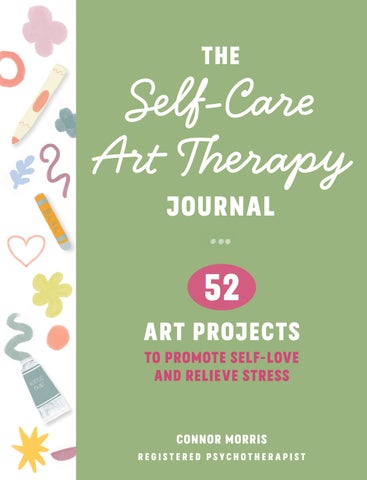
Art Projects to Promote Self-Love and Relieve Stress


Get Creative 6
An imprint of Mixed Media Resources
19 W 21st St, Suite 601
New York, NY 10010
mixedmediaresources.com
Editor
RACHEL CHLEBOWSKI
Art Director
CHRISTINA FREYSS
Editorial/Production Coordinator
JEAN O’DEA
Chief Executive Officer
CAROLINE KILMER
Chairman JAY STEIN


Copyright © 2026 by Connor Morris
All rights reserved. No part of this publication may be reproduced or used in any form or by any means—graphic, electronic, or mechanical, including photocopying, recording, or information storage-andretrieval systems—without permission of the publisher.
The written instructions, photographs, designs, projects, and patterns are intended for the personal, noncommercial use of the retail purchaser and are under federal copyright laws; they are not to be reproduced in any form for commercial use. Permission is granted to photocopy for the personal use of the retail purchaser.
The EEA authorized representative is Authorised Rep Compliance Ltd., Ground Floor, 71 Baggot Street Lower, Dublin, D02 P593, Ireland (www.arccompliance.com).
ISBN: 978-1-68462-107-1
Manufactured in India
1 3 5 7 9 10 8 6 4 2
First Edition


To all the imperfect, messy, creative humans out there doing their best.
Thank you for making life so much more interesting.


Throughout my life, I have struggled with stress, anxiety, understanding myself and my emotions, and a sense of not belonging.
When I was a teen, I discovered how drawing made me feel. I would sit in class with a sketchbook on my lap instead of listening to my lessons. At that time, I was focused on creating something with my hands and the feeling of pride that came with it.
My relationship with art and creativity has not been a linear one. There were long periods of time in which I didn’t pick up a paintbrush. I wondered if this made me
less of a creative person or artist; I wasn’t sure how to carry or honor this part of my identity. However, it was something that I always came back to, particularly when I didn’t have the words to express myself during times of struggle.
Somewhere along the way, I discovered the magical world of art therapy, and something just clicked for me. I learned how the arts can be studied and implemented as therapeutic tools and how truly beneficial they can be.
This approach just made sense to me. It felt intuitive and natural.
So, I began my educational journey to become an art therapist. This path expanded my understanding of art beyond something that could be judged by skill or aesthetics; rather, art can be deeply personal and valuable no matter what it looks like or what the process of making it is like.
We can create just because it feels good.
In 2021, I began my private practice, using art to support people of all ages in navigating various life challenges. As a psychotherapist, I have supported individuals experiencing anxiety, depression, trauma, identity exploration, and more. Eventually, I began posting videos online to share educational and engaging content about art therapy and to express my enthusiasm for the field.
When the opportunity arose for me to
create something a bit more substantial— this book—I was filled with excitement, ideas, and a fair bit of nervousness. Although it has been a deeply vulnerable process to write and create this book, if the art has taught me anything, it’s that it can hold all that I am feeling.
If you’ve heard of art therapy before and still feel a bit confused, you’re not alone—I promise. In the simplest terms, art therapy is where art and psychotherapy meet. An art therapist is a trained mental health practitioner who specializes in arts-based therapy and interventions in order to treat mental health concerns. Art therapists may use a variety of different materials and media, from drawing and painting to clay, collage, and more. They may provide a directive (a directed or guided activity or prompt), or they may ask you to create spontaneously (creating without a prompt). This book is full of prompts, but you are also encouraged to add spontaneous elements. When we talk about art therapy, we are often speaking about the dynamic between a client, an art therapist, and the art. When we remove the art therapist from the situation and discuss the artist and the art, we may use terms such as “art as therapy,” “creative wellness,” or “therapeutic artmaking.” None of these terms are wrong, and, if you choose to use the term “art therapy,” that is also okay! While an art therapist can help you set goals, provide structure, and guide you through the
artmaking process, you can still benefit deeply from making art on your own.
Artmaking offers many benefits. I have listed just a few below:
• It allows for deeper insight into experiences by creating a visual representation of them.
• It creates a sensory experience that can be calming for the nervous system.
• It allows for play and creative exploration of materials, which are relaxing for the nervous system.
• It promotes mindfulness, as your focus is on the art.
• It builds self-esteem and confidence.
• It challenges unhelpful narratives, such as having to be perfect.
• It explores your feelings in a nonverbal way.
• It’s fun!
These are just some of the ways that artmaking can be helpful. You can use this book to simply explore the different activities; even creating once a week can be beneficial. The activities in this book can be repeated as often as

You will get something different out of the prompts depending on how you’re feeling or the phase of life you are in.
So, how do we actually use art and creativity to care for ourselves or as a tool for selfdiscovery? I find that the hardest part for most people is simply getting started. A blank page can feel overwhelming, as we fear making mistakes or “messing it up.” Part of the process in this book will be facing the fear of not being able to create because you think the result won’t be good enough.
To support you through that fear, this book includes gentle, detailed prompts and even some templates to ease you into the creative process as you begin to stretch that creative imagination of yours.
TIP:
IF YOU DON’T KNOW WHERE TO BEGIN, I ALWAYS SUGGEST CHOOSING YOUR FAVORITE COLOR AND MAKING A SINGLE MARK ANYWHERE ON THE PAGE SO THAT THE PAGE IS NO LONGER BLANK.
Now let’s talk about self-care for a moment. Self-care is essentially an act or a practice that maintains or improves your well-being. To benefit from the longer-term aspects of self-care, we will want to create a regular and consistent practice. But to take the pressure off for now, I want to assure that you can build up to this. Whether you create daily or every few months, you are
still a creative person. You can use creativity as self-care in the moment, especially when you need to express something, or you can build it into a consistent practice.
Something really important to know about art therapy is that we are not focused in any way on technical art skills or how the physical art piece is going to look. We are more focused on how the process of creating makes you feel. I say this because I want you to be able to tune in to being in the moment. This will take practice. You might find yourself judging yourself and your art, wondering if it’s beautiful or good enough.
All of what you create is important. It doesn’t have to be beautiful. It can be messy, confusing, and disorganized, because that’s how life is sometimes. And sometimes, through all of that, we may notice that something is beautiful just as it is.
You can absolutely add things to your art that feel beautiful to you or that make it more aesthetically pleasing to your eye—you don’t have to ignore that instinct. What I do want to encourage is to notice when those voices of judgment that prevent you from creating come in . . . and then create anyway. You do not need to have any art experience to make art. You are so welcome to be here in this space, and I honor you for making the room to show up for yourself.

The Self-Care Art Therapy Journal is organized into ten themed chapters and includes 52 exercises, one for each week of the year! Within each theme, you will be given prompts to help you explore the theme more deeply.

Most of the exercises can be done right in the book! There are some exercises that might encourage you to create off the page, but all can be adapted so that all you need is paper and pencil. You can turn the book into a keepsake for your year of learning self-care through art, or you can complete and repeat activities outside the book. In each activity, you will be given a prompt, an estimated time frame, and suggested materials, along with a quick guide of steps for the prompts. You’ll also see Tips and Accommodations throughout with optional modifications, depending on sensory needs or available materials or other ways to recreate or augment the activity.
These exercise prompts are a general guide to help you get started with creating. You can follow them as they appear, but you can also interpret the prompts in any way that makes sense to you. Art therapy isn’t about following directions exactly; it’s about practicing following your own intuition about where the art leads you. If you feel that you are straying far from the original activity, that is okay! There is absolutely no way to mess up your art and no particular way to do an activity. Your art is a part of


you—the more spontaneous your artmaking, the more that it is coming from you. And if you stick right to the guide, that is also okay!
Each activity comes with a reflective journal prompt. This will help you reflect more deeply on your own artmaking and how it relates to your life. You can follow the prompt or feel free to write about whatever is coming up for you in that moment.
One of the goals that I have for this book is that it is as accessible as possible. You do not need to buy expensive or fancy art materials in order to participate. Many of the activities can be created right inside the book. Even if all you have is a pen or a pencil, you can still fully engage with the work.
Some activities may invite you to build or construct something outside the book, but this is only a suggestion. Feel free to adapt any prompt to suit your materials. If it is easier for you to draw instead of construct something, absolutely do it! Not having certain materials will not take away from the experience. Although a variety of materials can provide options and different experiences, you can still benefit from creating with a base level of materials.
Primary Materials
• Drawing tools (pens, pencils, markers, colored pencils, crayons, highlighters, pastels)
• Scissors
• Glue
• Tape
• Paper (printer, construction, cardstock, scrap)
• Paint (any: watercolor, tempera, acrylic)
• Paintbrushes
Other Materials
• Collage images (from magazines, newspapers, old books or photos, or online)
• Plasticine or clay
• Recycled materials (cardboard, tissue or tea boxes, yogurt containers, jars, etc.)
• Fabric or yarn
• Needle and thread
Primary materials are the base level of materials that are suggested for the activities in this book. Other materials will help expand your experience even further via creating art outside the book; however, the activities can still be adapted by drawing or painting instead. Decorative elements are not necessary but can be there for your enjoyment and to give you options; this is not an exhaustive list.
These activities involve reflection, so setting up a supportive environment can help. This might look like finding a quiet area to make art, making a playlist and listening to music, having a favorite drink nearby, wearing comfy clothes that you can get messy in, or arranging soft lighting. Consider your five senses and how you can find some comfort in addressing each one. Move anything out
Decorative Elements
• Stamps
• Stickers
• Glitter
• Buttons
• Pom-poms
• Pipe cleaners

of the way that you don’t want to get messy. Speaking of mess, sometimes the fear of mess or cleanup prevents us from creating. If at all possible, set up your art space in an area where you can give yourself permission to leave a little mess. If this feels hard, try making cleanup part of the creative ritual. Play music while you tidy, and remember that caring for your space is an extension of caring for yourself.
It is so amazing that you are taking this time for yourself to create and explore different parts of yourself. Creating art and accessing the artistic part of ourselves are ways of taking care of ourselves. You are honoring yourself by setting aside time to do this. I hope that these prompts and guides can help you in that journey. Happy creating!
The act of creating provides us with an opportunity to look toward our inner selves. When we make art, we are creating something visual and tangible. This allows us to take what exists in our inner world and view it externally, giving us a new perspective and insight.
This chapter focuses on self-discovery and exploration. Engaging in artmaking for these purposes makes time and space to uncover new aspects of ourselves. The key here is to approach artmaking with curiosity and not judgment. When we create and spend time with ourselves, we can welcome all parts of the self in—because all parts of us are important.
The thing is, we often hesitate to look inward at our experiences, uncertain about what we might discover. This is why we need to cultivate a gentle approach. When I talk about showing up with gentleness or curiosity, I mean paying attention to what you notice in your art and setting aside the judgmental thoughts that will inevitably come up, bringing yourself back to a place of curiosity. This might look like “Oh, interesting, that brought up this emotion,” or “I am noticing I used a lot of scribbles in this art.” You are just noticing things as they are.
We grow, change, and shift throughout our lives: our interests change, the people in our lives change, our values change. In this chapter, you will use art to look at different aspects of your life to see if you can discover anything new about yourself. Enjoy exploring!
MEDIUM: Mixed media Collage
MATERIALS:
• Paper for collaging (magazines, newspapers)
• Scissors
• Glue
TIME COMMITMENT:
45–60 minutes
PLAY AROUND WITH LAYERS, CUTTING IMAGES IN UNIQUE SHAPES OR RIPPING THE PAPER.
Imagery helps us express what words alone can’t capture. In this art activity, we explore imagery using collage, taking fragments of images from magazines or books and creating a new unified picture. Collage is a wonderful medium to work with because it can take the pressure off having to fill a blank page with ideas. The intention of this exercise is to choose images that you feel represent you, that will surround a picture of you. You don’t need a reason to choose an image. Pick what stands out to you, even if you don’t know why; this is something that you can explore during or after the process.
HERE ARE THE STEPS
1. Spend time looking through magazines and cut out any images or words that stand out to you.
2. Either take a photo of yourself or draw a picture of yourself and place it in the center of a blank page.
3. Play around with your collage images, placing them around the picture of yourself.
4. Is there anything around your home that you can add—concert tickets, photographs, or sticky notes that feel relevant? Add any other details you would like.
5. Glue the images to the page.

No access to magazines? Print images from online or even draw them yourself!
A virtual collage on a computer or tablet is another option.
REFLECTIVE JOURNAL PROMPT:
What do you notice about the images and words you’ve surrounded yourself with?
ART PROMPT:
With a picture of yourself at the center, create a collage using images that you feel represent you as a person.

Washi tape is a fun and functional addition to collages.
MEDIUM: Drawing
MATERIALS:
• Drawing tools of choice (pastels, pencils, markers, etc.)
TIME COMMITMENT: 5–10 minutes
Nature is filled with so many wonderful metaphors. Metaphors and symbols help us express ourselves on a deeper level. Maybe the sun reminds you of warmth and joy or a stormy sea represents anxiety. An important thing to remember is that what might mean one thing to me might mean something completely different to you. Maybe the sun doesn’t remind you of warmth and joy, but, rather, of scorching heat. The intention of the activity is to choose an aspect of nature that reminds you of yourself in this moment. What can you discover about how you are feeling?
Here are the steps:
1. Take a moment to notice how you are feeling. It can be helpful to write down any descriptive words that come to mind (“heavy,” “jittery,” “silly”).
2. Decide on a part of nature that you feel best fits how you are feeling.
3. Draw a picture of this part of nature.

REFLECTIVE JOURNAL PROMPT:
Why did you choose this aspect of nature? What tools might you need to be present in it (an umbrella, sunglasses)?
ART PROMPT: What aspect of nature do you feel represents you in this moment?
MEDIUM: Mixed media
MATERIALS:
• Paper
• Drawing supplies
• Scissors
• Glue
TIME COMMITMENT:
20 minutes
What is in your heart? Imagine all the people, things, memories, and goals that make your heart feel full—what might those be? Connect with what is meaningful to you. We show ourselves love by giving our attention to what matters in our lives. Who are the people or pets in your life, or the hobbies that you enjoy? What do you feel passionate about—your values, your favorite shows or music? The things that you love are important. With this activity, we are going to take some time today to fill our hearts.
HERE ARE THE STEPS:
1. Cut out a heart shape from a piece of paper.
2. Glue the heart down onto another piece of paper or into this book.
3. Fill the heart with words and images that represent what is important to you.
4. Surround the heart with your favorite colors.

ART PROMPT:
Finish the sentence “Today I am giving myself the gift of…” with art.


I encourage you to come back to this chapter whenever you need. These activities will look different each time you do them. Your needs change from day to day, and every day is an opportunity to show yourself some form of love and compassion. I want to remind you that acts of self-love and compassion don’t need to be big and momentous. Opportunities may come when we aren’t expecting them. Maybe it’s a moment to say “no” to going out when you are feeling really tired, maybe it’s noticing a self-critical thought and replacing it with a loving one, or maybe it’s setting aside 10 minutes per day to draw.
It can sometimes feel easier to express ourselves through creativity and art. On the days when it is feeling harder to show yourself some care, I encourage you to turn to art, even if it is just for a short amount of time.


Imagine for a moment stepping outside your mind and being aware of your surrounding environment. Take it all in—the sounds, the colors. Imagine bringing that awareness inward and feeling your breath rise and fall. Now imagine having thoughts come into your mind and letting them go without judgment.
Mindfulness is a practice that essentially means being aware of your internal and external surroundings without judgment. This includes being aware of your bodily sensations, thoughts, emotions, and senses. It’s a skill that can be developed through consistent practice. Mindfulness doesn’t mean that your mind doesn’t wander; our brains are made to think. However, cultivating mindfulness can improve the skills of shifting attention and honing awareness, which can have many benefits.
Mindfulness can go hand in hand with the creative process. A benefit of practicing mindfulness is that we can better observe ourselves and our environment and perceive things for what they really are. It’s also a great way to relax our nervous systems, helping us shift the focus from our minds to the here and now. Mindfulness can be practiced during any activity. Engaging in mindfulness while creating art has a mutually beneficial effect, as the act of creating tends to cultivate a naturally mindful state. The following activities are designed to guide you through different practices of mindfulness while allowing you to explore creatively.
MEDIUM: Drawing
MATERIALS:
• Drawing tools of choice (pastels, pencils, markers, etc.)
TIME COMMITMENT: 5–10 minutes
This activity is a practice in shifting focus. Because patterns are predictable, using them can release the stress associated with deciding what to draw on a blank page. Your goal here is to pick one shape or pattern that you can repeat and with which you can completely fill the page. Our brains love predictability and repetition, and both can help bring us into a flow or a mindful state. An important thing to remember is that your mind will wander— and that’s okay. When you notice your mind wandering, allow yourself to take a breath . . . and then bring your attention back to what you are doing.
KEEP A LITTLE NOTEBOOK AND A PEN WITH YOU THROUGHOUT YOUR DAY. WHEN YOU FIND THAT YOU NEED A LITTLE PREDICTABILITY AMONG LIFE’S CHAOS, YOU CAN PULL OUT YOUR DRAWING TOOLS AND REPEAT THIS ACTIVITY.
Here are the steps:
1. Choose any shape or pattern.
2. Using your drawing tools, completely fill the next page by repeatedly drawing your selected pattern.
REFLECTIVE
JOURNAL PROMPT:
What reactions did you notice in your mind or body during this practice?


ART PROMPT:
Create a collage of your values.

MEDIUM: Drawing
MATERIALS:
• Drawing tools of choice (markers, pens, etc.)
TIME COMMITMENT: 15 minutes
There are things or people in our lives that tend to make us feel energized when we are around them; they fill us up. There are other things that feel like they drain us. In this activity, you will define those things or those people that fill you up like a warm cup of tea or a vase full of flowers. You get to choose the container. Outside the container, draw the things or people that you feel are draining. Use the container itself to represent the boundary between you and what’s outside the container.
Here are the steps:
1. Draw a container (a cup, a bowl, a vase).
2. Inside the container, draw anything in your life that makes this container feel full.
3. Outside it, draw anything that drains the container.
REFLECTIVE JOURNAL PROMPT:
What do you notice about what you’ve allowed inside or kept outside your cup?


ART PROMPT:
Draw and fill your container with what is important to you.


Boundaries can feel like a challenging aspect of our lives, as they, in many cases, involve our relationships with others. Developing clarity about what we value and what our limits are can be a great step toward practicing setting boundaries. Remember, this is an individual experience for everyone, and it’s going to look different for you from how it looks for someone else. Creativity is a playful way to explore these difficult topics and bring clarity and insight to ourselves and our needs.
When was the last time you really engaged in play? Play is something that enables our imagination, that we do for fun and out of curiosity and enjoyment, but it doesn’t always come easily to us in adulthood. Playing comes so naturally to children—it’s how they interpret and learn about the world. There is freedom in play, making it a very valuable resource for our adult selves. In adulthood, we may feel so overwhelmed by our everyday responsibilities that play feels like something we don’t get to engage in unless we have done all our chores . . . but engaging in play is so good for our brains and bodies that it should be considered a necessary part of each day—even for just a little bit.
These activities are meant to help you engage in the play process and to reflect on what play used to look like for you as a child and what it might look like for you now. They are also meant to help you step outside the box, stretch your imagination, and practice creating without judgment.
MEDIUM: Painting
MATERIALS:
• Paper
• Paint (tempera or acrylic)
• Paint palette
TIME COMMITMENT: 20 minutes
What would it be like to give yourself permission to make a mess? You may have finger-painted when you were younger; it would have allowed you to really feel the material, get messy, and play. A helpful strategy to engage in play is to think back to our childhoods and participate in activities that we likely would have done. It can help us get into the mindset of play when we think, “How would a child approach this?”
Here are the steps:
1. Set up your paint so that it is easy for you to touch—for example, squeeze it onto a paint palette.
IF YOU DON’T HAVE A PAINT PALETTE HANDY, SQUEEZE THE PAINT ONTO A DISPOSABLE PLATE OR FOIL.
2. Dip your fingers into the paint and place them on the page. Use one or multiple colors.
3. Move your hands instinctively around the page. The goal isn’t to create a particular image, but rather to move the paint around.
REFLECTIVE JOURNAL PROMPT:
Describe how it felt to get messy.
ACCOMMODATIONS:
Feel free to wear gloves for this activity if you have any sensory concerns with these materials.
ART PROMPT:
Draw an imaginary world on the blank map.


Play is something that can be more difficult to access in adulthood than it was in childhood. When we grow up, we get overwhelmed with responsibilities, and our priorities change. But we can learn a lot from the natural inclination to play, explore, and be silly. When we play, we expand our imagination.
Imagination is an important skill to have in life, as it lets us see many different possibilities. When we play, we get to practice existing and experiencing joy without judgment and expectation. Hopefully this chapter has reintroduced you to the joy of play and provided examples of how you can engage in more play in your day-to-day life.

In my practice, stress and anxiety frequently emerge as themes. When we experience daily stress and anxiety, our bodies and minds may begin to wear down. For this reason, it is so important that we take the time to explore our personal experiences with stress and anxiety and learn skills to manage them.
This chapter will use creativity to explore how stress and anxiety are showing up in your life and introduce creative skills that temporarily reduce symptoms of stress and anxiety. Taking time to make art has been shown to reduce stress in the moment, and beginning a daily creative practice can help you reduce stress overall. If you are struggling, it is always recommended that you reach out to a professional practitioner you trust.
MEDIUM: Drawing
MATERIALS:
• Coloring tools of choice (crayons, colored pencils, etc.)
TIME COMMITMENT: 5–10 minutes
We may think that our emotions live only in our head, but our emotions also very much live in our body. Emotions can create a sense of energy that sometimes needs to be moved, and that’s where scribbling can be helpful. Scribbling isn’t just for kids; it’s also a great way to move stagnant energy and emotions. In this activity, you are going to participate in the art of scribbling. There is no wrong way to do this—if you are moving your materials on the page, then you are doing it right.
Here are the steps:
1. In the center of the next page, use your coloring material of choice to start scribbling.
2. Move in any direction, constantly moving from one side to the other.
3. Decide which speed feels good for you. Do you need to move fast or slowly?
4. When you are finished with your first color, pick another.
5. Continue this until the whole page is full.

KEEP A LITTLE JOURNAL AND CRAYONS WITH YOU SO YOU CAN SCRIBBLE ON THE GO.
REFLECTIVE JOURNAL PROMPT:
Do you notice anything different about yourself now compared to when you started this activity?
ART PROMPT:
Create a mask in which one side reflects your outer self and the other side reflects your inner self.

play about, 63, 74
Collage Portrait, 72–73
Finger-Painting, 64–65
Imaginary World, 66–67
Nostalgia Collage, 68–69
Texture Painting, 70–71
A Postcard to Yourself, 134–135
Rrecyclables
Build a Castle, 58–59
Worry Container, 86–87
Repetitive Patterns, 38–39
SSeed Packet, 128–129 self-care, 9–10 self-confidence about, 113, 124
I Am Powerful, 118–119
My Magazine Cover, 116–117
Stumble Care Kit, 120–121
Temporary Art, 122–123
Zooming Out, 114–115 self-discovery and exploration about, 13, 24
Freewriting Poem, 18–19
My Glow, 20–21
Nature Metaphor, 16–17
Parts of Me Collage, 14–15
Stitching a Message to Self, 22–23 self-growth about, 125, 136
A Lesson from Nature, 132–133
Outside My Comfort Zone, 130–131
Pathways, 126–127
A Postcard to Yourself, 134–135
Seed Packet, 128–129 self-love and compassion about, 25, 36
A Gift, 28–29
Kind Words Collage, 30–31
My Inspiration, 34–35
My Soft Space, 32–33
What Is in Your Heart?, 26–27
Sitting with Your Feelings, 98–99
Stitching a Message to Self, 22–23
stress and anxiety relief about, 75, 88
Appreciation Card, 82–83
The Art of the Scribble, 78–79
My Friend Anxiety, 76–77
Paint Your Breath, 80–81
Peaceful Landscape, 84–85
Worry Container, 86–87
Stumble Care Kit, 120–121
TTemporary Art, 122–123 textile
My Soft Space, 32–33
Stitching a Message to Self, 22–23
Texture Painting, 70–71
VValues Collage, 52–53
WWater Metaphor, 90–91
What Do You See?, 46–47
What Is in Your Heart?, 26–27
Worry Container, 86–87 writing
Appreciation Card, 82–83
Freewriting Poem, 18–19
“It’s Okay to Feel” Letter, 96–97
Outside My Comfort Zone, 130–131
A Postcard to Yourself, 134–135
ZZooming Out, 114–115


As I sit down to write these acknowledgments at the end of my book-writing journey, I keep thinking about what an incredibly cool experience this has been. Throughout my career as an art therapist, I’ve always been adamant about the importance of the arts. While I usually work with people one-on-one, it feels amazing to have created something that feels more accessible, a resource that can reach and support many more people. And when I pause to take it in, I keep circling back to a feeling of astonishment: Wow . . . did I actually write a book?
I seriously could not have done this without the support of so many amazing humans. First, a big shout-out to Rachel, my editor at MMR, who has been by my side from the very beginning. Your excitement and encouragement made this project a true joy! Thank you for your thoughtful feedback and dedication in helping bring this vision to life. To Christina, the art director: Thank you for weaving together all of the pieces of this book into something visually amazing. And to the entire MMR team, even those I didn’t get the chance to meet: Thank you for creating something this art therapist can truly be proud of.
Behind every project like this are the people who hold up our everyday lives. To my husband, Andrew, who makes me feel like I can do anything, thank you for your endless optimism and overall goofiness that gets me through each day. To my mom, the most grounded person I know: Thank you for reminding me to get outside, nourish myself, and come back to the basics when I forget (you were right—those things do make me feel better). And to Jessie, my best friend of over a decade, the person I can’t go more than three days without talking to and who helps me navigate the absurdity of adulthood, thank you for always being by my side. And an honorary thank-you to Taylor Swift, as this book was written mostly while listening to her songs.
Finally, I want to acknowledge the many teachers, supervisors, peers, friends, authors, and therapists who have offered me nuggets of wisdom along the way. Each of you has shaped me, and, in turn, this book. Community, creating, and connection are the foundation of it all.


Connor Morris, RCAT, RP, DKATI, is an art therapist and registered psychotherapist who has worked individually with clients and in groups and workshops since 2017. Connor works with people for a variety of reasons but focuses on the areas of anxiety, chronic stress, perfectionism, and identity. Connor’s therapy work and online content show her passionate belief that we all have the ability to create and that it can help us on our wellness journeys. She resides in Huntsville, Ontario, Canada, where she works with adults virtually. She can be found on Instagram and TikTok at @birchwoodarttherapy

Art is for everyone in this unique collection that’s part guided art journal, part art therapy exercise book. With a range of projects and media from drawing and painting to writing, collage, and other crafts, The Self-Care Art Therapy Journal helps you connect with yourself creatively, build confidence, and combat perfectionism through exercises that encourage play and promote mindfulness.

• Simple steps with suggested materials and time commitment
• Thoughtful guidance introducing each exercise
• Journaling prompts and space for self-reflection
• Helpful tips and accommodations for modifying or recreating projects
This insightful collection of activities from registered art therapist Connor Morris, RCAT, RP, DKATI, can be done directly in the journal to create a keepsake for a year of selfdiscovery, or outside the journal, depending on the craft.

WHETHER YOU HAVE EXPERIENCE WITH ART AND THERAPY OR NOT, THIS IS A RESOURCE FOR ANYONE ON A JOURNEY TO SELF-LOVE .