New Benchmarks Prove AI Image Generators Can’t Do Commercial Design
New Benchmarks Prove AI Image Generators
Can’t Do Commercial Design
Commercial design has become one of the most discussed frontiers in artificial intelligence. While image generation models have made remarkable progress in creating artistic visuals, recent research suggests that AI image generator limitations remain significant when it comes to professional commercial design tasks. Two major benchmarks, Microsoft's BizGenEval and LICA's Graphic-Design-Bench, provide some of the strongest evidence yet that AI image generators are still far from replacing true design systems built for business use cases
The Growing Debate Around AI and Design
For the last few years, AI image generators have impressed users with stunning artwork, photorealistic imagery, and creative concepts generated from simple prompts These systems can create fantasy landscapes, product mockups, illustrations, and marketing visuals in seconds.
However, commercial design is fundamentally different from artistic image creation
A business poster, sales presentation, webpage banner, infographic, or social media advertisement is not judged only by visual appeal It must communicate information clearly, maintain hierarchy, follow brand guidelines, place elements accurately, and ensure text remains readable and editable.
This distinction is exactly what recent benchmark studies sought to measure
Rather than asking whether AI can generate attractive images, researchers asked a more practical question:
Can AI image generators create professional commercial designs that satisfy real-world business requirements?
The answer, according to both studies, is largely no
Understanding Microsoft's BizGenEval
BizGenEval was developed by a Microsoft research team specifically to evaluate how AI image generators perform on commercial visual content
Unlike traditional image-generation benchmarks that focus on artistic quality, BizGenEval examines real business-oriented materials such as:
● Webpages
● Presentation slides
● Posters
● Charts
● Scientific figures
The benchmark was designed to reflect actual design tasks that marketers, product teams, educators, and businesses perform every day
Researchers assembled a large collection of professional visual assets and created hundreds of prompts that tested whether AI models could reproduce key design characteristics accurately
The benchmark evaluates performance across four critical dimensions:
1. Text Rendering
Commercial designs rely heavily on text
Headlines, descriptions, labels, CTAs, annotations, and supporting information must all appear correctly
The benchmark tests whether AI systems can:
● Generate readable text
● Preserve spelling accuracy
● Maintain formatting
● Render long passages correctly
2. Layout Control
Design is fundamentally about structure
Layout control measures whether a model can place elements in the correct locations while respecting hierarchy, spacing, alignment, and composition
This includes:
● Element positioning
● Grid adherence
● Visual hierarchy
● Proper spacing
3. Attribute Binding
Attribute binding evaluates whether models can correctly associate properties with specific objects.
Examples include:
● Correct colors
● Accurate quantities
● Proper shapes
● Matching styles
A model may generate visually appealing content while still failing to assign attributes correctly
4. Knowledge-Based Reasoning
Commercial visuals often contain domain-specific information.
This category tests whether AI can integrate accurate knowledge into visual content
What BizGenEval Revealed
The benchmark tested 26 different AI models, including both closed-source and open-source systems
The findings reveal several recurring weaknesses.
Models Approximate Layouts Instead of Enforcing Them
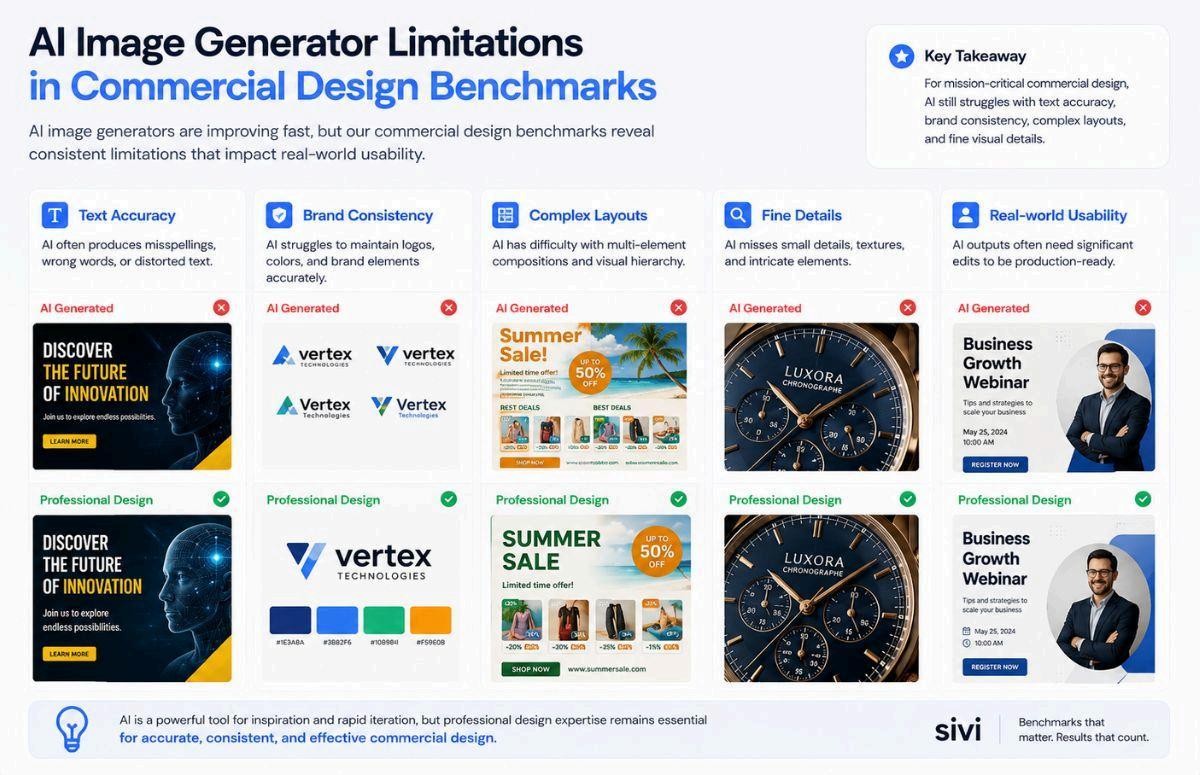
One of the biggest discoveries was that AI image generators can imitate the appearance of commercial designs but struggle to reproduce their exact structure
At first glance, generated outputs may appear convincing
A chart looks like a chart
A poster looks like a poster
A webpage resembles a webpage
However, closer inspection often reveals issues such as:
● Misaligned elements
● Incorrect spacing
● Missing components
● Broken hierarchy
● Wrong object counts
The systems are essentially predicting visual patterns rather than composing layouts intentionally.
Text Rendering Remains a Major Problem
Despite years of progress, text generation inside images continues to be a persistent weakness
Many models still produce:
● Misspelled words
● Garbled characters
● Incomplete sentences
● Inconsistent formatting
This issue becomes increasingly severe as text volume grows.
Commercial design depends heavily on accurate communication Even a small text error can make a design unusable for business purposes.
Attribute Errors Persist
Researchers also observed frequent failures in attribute binding
For example:
● Requested colors may be incorrect
● Object quantities may not match instructions
● Shapes may be altered
● Labels may be assigned improperly
These mistakes might seem minor individually, but they become significant in production environments where accuracy matters
Knowledge Integration Is Inconsistent
Many commercial visuals contain information that must be factually correct
When tasks required domain knowledge, AI models often struggled to maintain consistency and accuracy
This was especially evident in:
● Educational materials
● Scientific figures
● Data visualizations
● Historical content
While BizGenEval focuses on broad commercial content evaluation, Graphic-Design-Bench takes an even deeper look at design-specific capabilities.
Developed by researchers at LICA, the benchmark treats graphic design as a structured discipline rather than a visual style
Instead of evaluating generic images, it breaks design into 49 specialized tasks across several categories
These categories include:
Layout
The benchmark examines whether models understand:
● Grid systems
● Margins
● Layer ordering
● Spatial relationships
Professional design relies heavily on these principles
Even slight violations can reduce clarity and effectiveness.
Typography
Typography is one of the most important aspects of design
Graphic-Design-Bench evaluates:
● Font hierarchy
● Legibility
● Contrast
● Text organization
Many image generators struggle because typography requires precision rather than approximation
Infographics
Creating effective infographics involves more than displaying data
Designers must:
● Prioritize information
● Establish hierarchy
● Guide visual attention
● Simplify complexity
The benchmark tests whether models can perform these tasks successfully
Design Semantics
Commercial designs communicate specific intentions
A corporate presentation should not resemble a concert poster
A healthcare infographic should not look like a gaming advertisement
This category measures whether models understand the purpose behind a design.
Animation and Temporal Structure
The benchmark also explores future-facing design challenges involving animation and sequential visual storytelling
Although still emerging, this area highlights the growing complexity of design evaluation
Why These Results Matter
Many discussions around AI design focus primarily on aesthetics
The benchmark results shift the conversation toward functionality
Businesses do not simply need attractive visuals.
They need designs that are:
● Accurate
● Editable
● Consistent
● Brand-compliant
● Production-ready
A visually appealing output that contains incorrect text, poor hierarchy, or broken layouts creates additional work rather than reducing it.
This distinction explains why commercial design remains difficult for image generation models
The Structural Problem With Pixel Prediction
The benchmark findings point toward a deeper issue
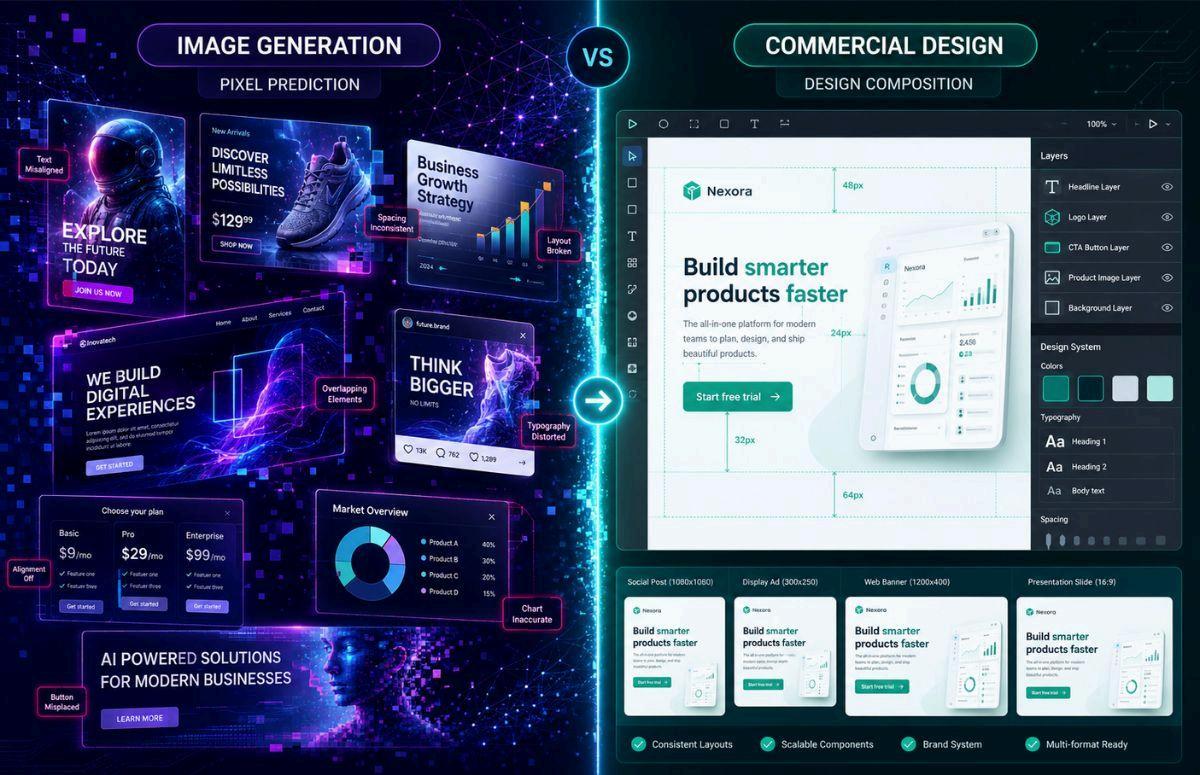
Most image generators operate through pixel prediction
They generate visual content by estimating what pixels should appear next based on patterns learned during training
This approach works remarkably well for artistic imagery because artistic quality is often subjective.
Commercial design operates differently
Design elements are not merely pixels.
They represent structured objects with relationships and constraints
A headline is not just a collection of letters.
It is a content element with:
● Position
● Font
● Weight
● Hierarchy
● Alignment
Similarly, a CTA button is not simply a colored rectangle
It has a functional purpose within the composition
Pixel-based systems often struggle because they treat all elements as image regions rather than structured components.
Professional designers do not create layouts by predicting pixels
They work with components
They intentionally place:
● Text blocks
● Images
● Icons
● Shapes
● Buttons
● Logos
Each component exists independently and serves a specific purpose
Commercial design involves managing relationships between these elements while maintaining consistency and clarity
This compositional approach is fundamentally different from image synthesis.
As benchmark results demonstrate, generating attractive imagery is not the same as generating effective design.
The Future of AI in Commercial Design
The studies do not suggest that AI has failed
Instead, they highlight that current image-generation approaches may not be sufficient for solving commercial design challenges
Future systems will likely need to combine:
● Layout intelligence
● Structured design representations
● Editable components
● Brand-awareness
● Constraint-based generation
The next generation of design AI may resemble design engines more than image generators
Rather than predicting pixels, these systems could assemble designs using structured layers and components while preserving editability and precision.
What Businesses Should Take Away
Organizations evaluating AI for marketing and design should understand the distinction between image generation and commercial design generation.
Current image generators can be useful for:
● Concept exploration
● Creative inspiration
● Visual ideation
● Draft imagery
However, they still struggle with:
● Complex layouts
● Typography accuracy
● Information hierarchy
● Brand consistency
● Production readiness
Businesses should evaluate AI tools based on their ability to solve real design problems rather than their ability to generate visually impressive examples
Conclusion
The results from BizGenEval and Graphic-Design-Bench provide some of the clearest evidence yet that modern AI image generators remain limited in commercial design contexts While these systems excel at creating compelling visuals, they continue to struggle with the structural requirements that define professional design
The benchmarks reveal recurring weaknesses in text rendering, layout control, attribute binding, and knowledge integration More importantly, they expose a fundamental gap between generating pixels and generating designs
Commercial design is not simply an image-generation challenge. It is a composition challenge that requires structure, hierarchy, precision, and intent
As AI continues to evolve, the future of design automation will likely depend less on better pixel prediction and more on systems capable of understanding and constructing designs as editable, structured compositions Until then, the benchmark evidence suggests that AI image generators remain powerful creative tools, but not complete solutions for commercial design.