Large Design Model: The Future of Text-to-Design AI
Artificial intelligence has transformed the way people create images, illustrations, and visual content. However, generating an attractive image is not the same as creating a professional design. A business design needs more than pixels. It needs readable typography, logical hierarchy, balanced spacing, consistent branding, clear composition, and the flexibility to be edited when requirements change. This is where a Large Design Model (LDM) introduces a different approach to generative AI. Sivi describes a Large Design Model as an AI architecture designed specifically for text-to-design. While conventional text-to-image models focus on generating pixels, an LDM focuses on engineering layouts and understanding design principles such as hierarchy, grouping, typography, whitespace, and composition. The objective is to move AI from simply creating a picture to creating an actual design that can be used and modified.
What Is a Large Design Model? A Large Design Model is a generative AI system designed to create structured, layered graphic designs rather than only producing flat raster images. Instead of seeing a design as a grid of pixels, an LDM can understand it as a collection of related components. For example, consider a promotional graphic containing a product image, headline, supporting text, logo, and call-to-action button. A traditional image generator may produce all of these elements as part of one finished image. An LDM approaches the same task as a
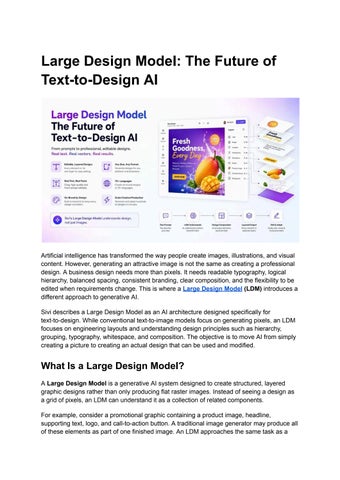
structured composition, understanding the relationship between the different elements and how they should work together. Sivi's Large Design Model generates layered design data and uses a composition process to create editable designs. According to Sivi, its architecture processes content, assets, and brand information into a structured representation before applying styles, preferences, colors, and rendering. The resulting design can then be customized through the design editor. This design-first approach is what separates text-to-design from conventional text-to-image generation.
The Problem With Traditional AI Image Generation Text-to-image AI has become extremely powerful for creating artwork, illustrations, product concepts, backgrounds, and other visual content. Tools such as Midjourney and DALL-E demonstrate how effectively AI can translate natural language into imagery. However, businesses often need something different from an artistic image. They need an advertisement with accurate copy, a social post with editable text, an ecommerce banner with a product and pricing information, or a campaign creative that can be resized and adapted. Flat images can create problems in these situations. Text may be baked into the image rather than existing as editable text. A button may look like a button but cannot actually be selected or modified as a design component. Changing a headline or replacing a product image can require regenerating the entire creative. This creates a gap between image generation and actual design production. A Large Design Model is intended to bridge that gap by treating design as a system of components rather than simply a collection of pixels. Sivi describes this as moving from prompting for a picture toward creating a design.
From Text-to-Image to Text-to-Design The distinction between text-to-image and text-to-design becomes clearer when looking at their outputs. Text-to-image systems generally produce raster images. The visual may look polished, but individual elements are not necessarily available for object-level editing. Text can also become part of the generated image instead of remaining as selectable typography. Text-to-design systems work toward a different output. The goal is to create a structured composition containing elements such as real text, images, vectors, backgrounds, and other components. These elements can be edited individually, making the output more useful for professional design workflows.
Sivi's Large Design Model page describes this difference as the distinction between creating a picture of a design and creating the actual digital design. Its text-to-design workflow supports real, selectable text and layered design components rather than treating the entire creative as one flat image. This shift is important because most commercial design work is iterative. A headline changes. A product gets updated. A campaign needs another language. A brand color changes. An advertisement needs to fit a different placement. A useful AI design system needs to accommodate those changes rather than forcing users to start again every time.
Editable and Layered Designs One of the strongest advantages of a Large Design Model is editability. Sivi's approach generates layered designs in which text, vectors, images, backgrounds, and other elements can exist independently. This allows users to modify individual parts of a design instead of treating the generated output as a finished, unchangeable picture. For marketing teams, this can significantly change the creative workflow. Imagine creating an advertisement and then discovering that the headline needs to be shortened. With a flat AI-generated image, the entire creative may need to be regenerated. With an editable design, the headline can be changed while the rest of the composition remains intact. The same principle applies to product images, promotional messages, calls to action, and other design elements. AI handles the initial composition, while the user retains control over the final result.
Brand Consistency With AI Generating creative content at scale creates another challenge: maintaining brand consistency. Businesses often have specific fonts, colors, logos, imagery, spacing rules, and visual styles. Generic AI image generation can struggle to reproduce these details consistently because the model is generating pixels rather than constructing the design from controlled components. A Large Design Model can approach branding differently. Sivi's LDM workflow incorporates user-provided brand details and can apply brand colors, fonts, assets, and other design preferences to the generated composition. This makes AI-generated design more suitable for businesses that need large volumes of content while maintaining a recognizable visual identity. Instead of creating a different visual style for every prompt, teams can establish brand rules and use those guidelines as part of the generation process.
Design at Any Size Modern marketing rarely relies on one standard image size. A single campaign might require a social media post, display advertisement, website banner, ecommerce graphic, mobile creative, or a custom-sized promotional asset. Traditional image-generation systems can be constrained by predefined aspect ratios. A design-focused model can instead build the composition around the required dimensions. Sivi positions its Large Design Model as capable of generating designs in different sizes, including custom dimensions. This means the design can be composed according to the available space instead of simply cropping an existing image. This flexibility is particularly valuable for marketing teams managing multiple channels.
Large Design Model Use Cases A Large Design Model can support a wide range of creative applications. For display advertising, marketers can generate multiple creative variations for campaign testing. Because the text remains editable, headlines and calls to action can be changed without rebuilding the entire visual. For social media content, businesses can transform written content into visual posts. A blog article, product announcement, or marketing message can become a structured social creative rather than simply an image with randomly generated text. For ecommerce, an LDM can help create promotional graphics featuring products, pricing, benefits, and calls to action. Product-focused campaigns can then be adapted into different sizes and formats. For thumbnails, the model can combine key imagery, headlines, and visual hierarchy into a composition designed to communicate the subject quickly. These use cases reflect a larger opportunity: AI can become part of the production workflow instead of being limited to the image-generation stage.
The Architecture Behind a Large Design Model The architecture of an LDM is an important part of what makes it different. Sivi explains that its LDM uses custom diffusion models and multimodal architectures. The process begins by understanding content, assets, and brand details and converting them into a structured representation. A composer then uses that representation along with styles and preferences to produce layered design data.
The composition is subsequently passed to an SVG rendering engine, where colors and other visual properties can be applied. The resulting layered design can then be customized using the design editor. This architecture demonstrates a fundamental difference in philosophy. Traditional image generation asks, in effect, “What should these pixels look like?” A design model asks, “What components should this design contain, how should they relate to one another, and how should the final composition be structured?” That difference enables AI to participate more directly in professional design workflows.
Sivi's Evolution of the Large Design Model Sivi has developed its Large Design Model through multiple generations. According to the company, Sivi Gen-1 launched in June 2023 and demonstrated that AI could generate layouts from text prompts. Sivi Gen-2 introduced features such as Style Cards and Composition Guides, providing users with greater control over the visual direction. Sivi's Gen-3 represents a further move toward a component-based and agentic Large Design Model. The company describes it as being designed to create editable, on-brand designs while reasoning about the components used in the creative. This evolution reflects how AI design is moving from simple generation toward greater control, structure, and usability.
Why Large Design Models Matter The importance of Large Design Models extends beyond faster image creation. They address a fundamental problem in generative AI: usable output. A visually impressive image is not necessarily a useful marketing asset. Businesses need designs that can be edited, resized, localized, branded, and adapted to changing campaign requirements. That is why the movement from text-to-image to text-to-design is significant. It changes the role of AI from an image generator into a potential design-production system. With layered output, real typography, brand-aware composition, flexible dimensions, and editable components, an LDM can help reduce repetitive production work while keeping humans involved in creative decisions. For businesses, this can mean faster campaign production, easier creative iteration, more consistent branding, and greater scalability across channels. For designers, it can shift AI from being a tool for generating starting points to becoming a collaborative part of the actual design workflow.
The Future of Text-to-Design AI
The future of generative design is likely to be less about producing one perfect image and more about creating flexible visual systems that people can continue to work with. A Large Design Model represents this direction by combining generative AI with the logic of graphic design. Instead of simply painting pixels, it can construct layouts, organize components, respect brand constraints, and produce editable creative assets. Sivi's Large Design Model is built around this concept: AI that creates designs, not just images. As businesses continue to demand more creative content across more channels, languages, formats, and campaigns, the ability to generate structured and editable designs could become increasingly important. The transition from text-to-image to text-to-design is ultimately a shift from visual generation to creative production. And that shift could redefine how businesses, marketers, and designers create digital content at scale.