Shipping has always operated in an imperfect world
—Mikael Skov, the head of Hafnia
2026 is expected to be a year defined by overcapacity in container shipping
—Peter Sand, Xeneta’s chief analyst
A year of implementation
— Arsenio Dominguez, secretary-general of the International Chamber of Shipping
You aren’t just buying a hull anymore; you’re buying a future-proofed power plant
— Josephine Le, managing director at The Hood
The industry is awash with hype, exaggerated claims, and misinformation
— Captain Kuba Szymanski, secretary-general at InterManager
Sentiment will eat careful fundamental research for breakfast any day
— Roar Adland, SSY’s head of research
The site for incisive, exclusive maritime news and views www.splash247.com
EDITORIAL DIRECTOR
Sam Chambers sam@asiashippingmedia.com
CORRESPONDENTS
Adis Adjin adis@asiashippingmedia.com
Bojan Lepic bojan@asiashippingmedia.com
All editorial material should be sent to sam@asiashippingmedia.com
COMMERCIAL DIRECTOR
Grant Rowles grant@asiashippingmedia.com
GENERAL MANAGER
Victor Halder victor@asiashippingmedia.com
Advertising agents are also based in Tokyo, Seoul and Oslo – to contact a local agent please email grant@ asiashippingmedia.com for details.
MEDIA KITS ARE AVAILABLE FOR DOWNLOAD AT WWW.SPLASH247.COM/ADVERTISING
All commercial material should be sent to grant@asiashippingmedia.com or mailed to Asia Shipping Media Pte Ltd, 30 Cecil Street, #19-08 Prudential Tower, Singapore 049712
Although every effort has been made to ensure that the information contained in this review is correct, the publishers accept no liability for any inaccuracies or omissions that may occur. All rights reserved. No part of the publication may be reproduced, stored in retrieval systems or transmitted in any form or by any means without prior written permission of the copyright owner. For reprints of specific articles contact grant@asiashippingmedia.com.
Runners and riders
Welcome to our annual outlook for the shipping markets in the Year of the Fire Horse, a zodiac sign characterised by being forthright, strong in reasoning, alert, impatient, wilful, dynamic, full of energy, and dedication with strong leadership.
Strong reasoning, dynamism and leadership are certainly assets shipping CEOs will require to navigate what looks like a treacherous 12 months from a geopolitical point of view.
Rarely in close to 26 years of covering this industry have I entered a Lunar New Year with so much uncertainty as to where the markets are headed. There’s simply so much up in the air - trade wars, actual wars, the Suez reopening, climate negotiations, to name just a few. We are experiencing a period of prolonged, multi-front instability that requires a different strategic attitude to business than the relatively stable decades that preceded the 2020s.
The industry’s collective takeaway is unambiguous. Geopolitical dislocation has not peaked; instead, it has become a persistent context that is reshaping trade patterns, regulatory regimes and operational playbooks.
In compiling this magazine, we’ve asked some of the smartest people in the business to give us their take on shipping in the year ahead. We’ve covered individual market sectors, regulation, the environment, the maritime tech diaspora, even going so far as to consult a Feng
Shui master on the final page. One thing is clear - as the opening days of the Lunar New Year attest - we are in for one hell of a ride. Stay tuned to Splash throughout the year to give you the incisive, calm big picture of just what is going on in the world of maritime around the world. And for those of you with a tech bent, do check out SplashTech, our new site dedicated to documenting the transformation of our industry.
Sam Chambers Editor Splash
The Sustainable Solution:
Liberia's Green Ship Recycling Program
Aligned with the IMO's Hong Kong Convention
The new permanent state
Shipping grapples with structural dislocation
For decades, the shipping industry has built its business models on the assumption of a rules-based global order. Trade flowed, ports operated, and volatility, while sometimes severe, was viewed as cyclical-a passing storm that would eventually give way to calm. But as we move deeper into 2026, a consensus has crystallised among industry leaders: the storm has not passed; it has become the climate, made all the more clear with the decapitation of the leadership in both Venezuela and Iran this year.
The era of just-in-time and predictable seas is being replaced by a reality defined by persistent geopolitical friction. For many, the initial shock of this shift is giving way to a pragmatic, if sombre, acceptance. As Daniel Bischofberger, CEO of Swiss turbocharging specialist Accelleron, puts it: “Shipping has always operated under uncertainty, and I think those who accept it as a more or less permanent state of affairs are going to benefit.”
This acceptance is not about defeat, but about adaptation. something made ever more trying with the sudden Iranian war. “I believe the question of reshaping global trade will continue as a major theme for many years,” he says. “Rather than worry about it, our job is to try and understand it and adapt to the emerging realities.”
The peak is nowhere in sight
If the goal is adaptation, the first step is recognising that the disruption is not a temporary anomaly. When looking at the horizon, the view from the C-suite is decidedly cautious. Mikael Skov, the head of tanker giant Hafnia and a a veteran of industry cycles, offers this
Disruption has become structural rather than cyclical
assessment: “I don’t believe we have reached peak geopolitical dislocation yet. Fragmentation remains a real risk, particularly if political tensions translate into broader trade restrictions or retaliatory measures that reduce volumes and efficiency in global trade.”
Skov adds that while fragmentation is a significant headwind, it is not an end state. “That said, shipping has always operated in an imperfect world. While prolonged fragmentation is a concern, it can also drive long-term value creation.”
For Hakki Deval, managing partner at Turkish owner Devbulk, the complexity is an inescapable factor. “Geopolitical volatility is another persistent source of risk,” Deval notes. “From disruptions in key waterways to constantly evolving sanctions regimes, trade patterns can shift abruptly. Experienced shipowners can navigate these risks - but it does add complexity and requires disciplined operational management.”
He captures the current mood succinctly: “It is challenging, but it is also becoming part of the normal operating landscape of global shipping.”
Alex Karydis, a director at German owner Hanse Bereederung, emphasises that trade isn’t disappearing, it is merely moving. “Despite uncertainty in the long run, trade flows are reorganising rather than disappearing,” he argues. “This restructuring favours flexible, well-specified tonnage and owners who understand deployment, emissions performance, and charterer needs in detail. In that sense, volatility is creating opportunity for those positioned correctly.”
However, Karydis warns of the “double burden” of geopolitical and regulatory noise. “The main concern is not demand itself, but regulatory and geopolitical unpredictability occurring simultaneously. Owners and charterers are being asked to make long-term decisions on assets, fuels, and compliance frameworks while key elements remain unresolved or subject to political pressure.” This forces a difficult strategic outlook, with Karydis noting that “fragmentation now appears structural rather than cyclical.”
The existential risk
For some, the outlook is more dire. Mark O’Neil, CEO of shipmanager Columbia Group, warns that many operators are fundamentally unequipped for the world that is emerging. “Many vessel operators and clients who have invested considerably on the basis of existing trade routes and markets will see those trade routes and markets evaporate or radically change,” O’Neil warns. “They will struggle to keep up with the pace of change, reshape their business models and redeploy their assets.”
O’Neil sees the current geopolitical environment as a direct threat to the international order. “Unfortunately, I do not believe we are yet at peak geopolitical dislocation. There will be a further breakdown of the international rulesbased order and a steady shift to regional regulation and the predominance of nation state interests.” He believes this will force a consolidation in the industry.
Pradeep Chawla, CEO of training organisation Marine Pals, agrees that the turbulence ahead is significant. “It is my belief that the standoffs between the big powers will continue for the coming years,” he says. “The realignment of the world order has historically never been done in a peaceful or rational manner. The turmoil ultimately does settle down and during the turmoil some industries will win and some will lose.”
The uncertainty tax
The practical result of this era is what Captain Pappu Sastry, CEO of Adhira Shipping & Logistics describes as an “uncertainty tax” on every voyage. “We are in a persistent phase of fragmentation,” Sastry says.
“This means longer and less predictable tradelanes, heavier compliance burdens, and insurance or war-risk swings that can change voyage economics quickly.” For Sastry, fragmentation is manageable but expensive: “It is not a market killer, but it is an uncertainty tax. It rewards operators who invest in documentation discipline,
strong contracts, and conservative leverage.”
Ika Bethari, president directoof Indonesian owner Asian Bulk Logistics, notes the ripple effects. “Geopolitical fragmentation remains a concern.
Disruptions across major trade corridors inevitably lead to delays, higher costs, and operational uncertainty throughout the supply chain, with the impact ultimately felt by end consumers.”
Arun Sharma, executive chairman of the Indian Register of Shipping, highlights the danger to technical standards. “Unclear transition pathways, uneven regulation and geopolitical disruption make long-term investment decisions harder and risk diverting attention from safety and compliance.” He adds, “What is worrying is that division and uncertainty are becoming the new normal. Different rules, trade routes and restrictions are increasing the cost and complexity of running ships.”
Defining the new baseline
Leaders are increasingly classifying this period not as a glitch, but as a reboot of the system. Stuart Ostrow, CEO of ShipMoney, points to a fundamental shift in perception. “What feels different now is that disruption has become structural rather than cyclical,” he says.
Kris Vedat, CEO of SmartSea, suggests that the skills required to win have changed. “In this environment, resilience, visibility and decision-making speed matter far more than marginal efficiency
gains,” he says.
“Shipping has always operated globally; now it must also operate with sustained ambiguity and rapidly shifting constraints.”
Sven Brooks, CEO of ScanReach, sees the interaction of technology and geography as the defining feature. “What makes this period different is that geopolitical complexity now interacts directly with operational, commercial, and compliance considerations. As a result, volatility is no longer episodic - it is becoming a standing condition that the industry must plan around, rather than wait out.”
Matthew Costello, CEO of Voyager Portal, sees the impact in the day-today work of chartering and operations. “One big reason for pessimism is that geopolitical uncertainty has become the norm, and its impact is already showing up. The playbook you used last quarter might not price the voyage correctly today.”
Vikas Trivedi, co-CEO of shipmanagement at Synergy Marine Group, offers the final word on the shift from prediction to preparedness. “The challenge is less about individual events and more about cumulative friction across trade routes, regulations and crew mobility. Shipping has always operated in imperfect conditions, but those with strong governance, diversified experience and measured judgement will be better placed to navigate prolonged uncertainty than those optimised solely for stable environments.”
Trade isn’t disappearing, it is merely moving
Strong start
There’s plenty of reasons for optimism across most cargo segments in dry bulk
The dry bulk market enters the Year of the Horse with momentum that is both broad-based and, in places, strikingly concentrated.
The final quarter of 2025 closed markedly firmer than Q4 2024, with Baltic quarterly averages showing the capesize 5TC up c.58% year-on-year, kamsarmax 5TC +52%, ultramax 11TC +26% and handysize 7TC +22%. The opening weeks of Q1 2026 have extended the run: compared with the same period in 2025, capesize 5TCs are running c.140% higher, kamsarmax +70%, ultramax +44% and handysize +39%. That earnings resilience has translated directly into a sharp rerating of asset values - notably capesize secondhand prices that Xclusiv says are at levels unseen since 2008. Buyers are competing fiercely for prompt eco-vessels and 5-10 year tonnage; sellers are reluctant to part with modern units, tightening available supply.
Iron ore
Ursa Shipbrokers’ vessel-tracking analysis of AXSMarine data shows global iron ore port loadings reached a record 1.73bn tonnes in 2025, up 3% on 2024, with January 2026 at 140.1m tonnesthe strongest January in a decade. Iron
ore accounted for 30% of 2025 dry bulk loadings and 38% of tonne-miles, confirming its outsized contribution to demand and to capesize employment. The pattern in 2025 - weaker H1, strong H2 rebound - highlights how restocking cycles, seasonal flows and Chinese policy/consumption shifts drive the market. In the Year of the Horse, iron ore is the single biggest swing factor: sustained Chinese restocking and steady Brazilian/Australian exports keep capes and VLOCs busy and support tonne-miles, but any meaningful slowdown in Chinese steel output or inventory draws would transmit rapidly to large-ship earnings. For now, Ursa’s data point to near-term support for rates and asset values via iron ore.
Coal
Allied Shipbroking sees coal as caught between market reality and transition policy. Seaborne coal trade softened in 2025 - the IEA’s Coal 2025 report notes a decline in traded volumes - largely because key importers ran higher domestic supplies and adjusted sourcing, not because of an immediate collapse in demand. Allied emphasises that policy debate around coal’s future is growing, but there are no short-term international
measures that will materially cut existing export flows. The freight implication is a slow-burn risk: reduced demand visibility and a decline in spot volatility rather than an abrupt volume shock. Coal will continue to underpin panamax and kamsarmax employment in 2026, but the market should price in a gradually more fragile demand backdrop where policy signals and contract adjustments mute the upside.
Grains
Ursa’s analysis puts seaborne agricultural trade at a record 716.5m tonnes in 2025, up modestly year-on-year, and BIMCO reports bulk grain shipments jumped 15% year-on-year in the first six weeks of 2026. January 2026 agricultural loadings were 57.1m tonnes - up 8% year-on-year - with east coast South America and the US Gulf leading. Brazilian soybean production (forecast 180m tonnes) and bumper crops in Argentina and Australia have driven longer-haul exports, lifting tonne-miles and the Baltic Panamax Index (the panamax index averaged +69% year-on-year in the opening weeks). For 2026 BIMCO expects grain shipments to grow 5-6% - outcomes hinge on Northern Hemisphere harvests and maize yields in Brazil.
CREWING. HANDS-ON. TRANSPARENT. DIGITAL. WORKING GLOBALY.
Based in Hamburg, Danica Crewing Specialists supports shipowners worldwide with professional crewing solutions. We combine a traditional hands-on approach with modern, innovative digital tools – delivering transparency, speed and reliability across the entire crewing process.
With an international network of recruitment offices and deep market insight, we support owners as a first-party crewing partner – independent, flexible and focused on what matters most: people.
Bauxite
Ursa’s analysis shows global primary aluminium output hit 73.8m tonnes in 2025 and that seaborne bauxite loadings reached a record 246.6m tonnes (up 21% year-on-year). China dominates, receiving an estimated 88% of bauxite shipments, while Guinea and Australia accounted for roughly 73% and 18% of loadings respectively. The growth in bauxite is structural: rising aluminium capacity (mostly in China) creates persistent long-haul Guinea-China and Australia-China flows that add significant tonne-miles and favour capes and larger panamax/VLOC employment.
Minor bulks
Braemar’s China analysis highlights a surge in combined imports of chrome, copper, manganese and nickel ores/ concentrates to a record 129m tonnes in 2025 (+11%). The vessel mix has broadened: chrome from Mozambique and South Africa has shifted some volumes into the panamax/capesize space, while supra/ultramax remain central for manganese and many concentrate trades. Copper concentrates (30.4m tonnes in 2025) and nickel flows remain sensitive to mine disruptions and policy shifts (Indonesian export controls precedent). Minor bulks were a key marginal driver
in 2025 and look set to remain so in 2026, supporting supramax, ultramax and panamax earnings and adding diversity to the cargo base beyond iron and coal.
Fleet composition
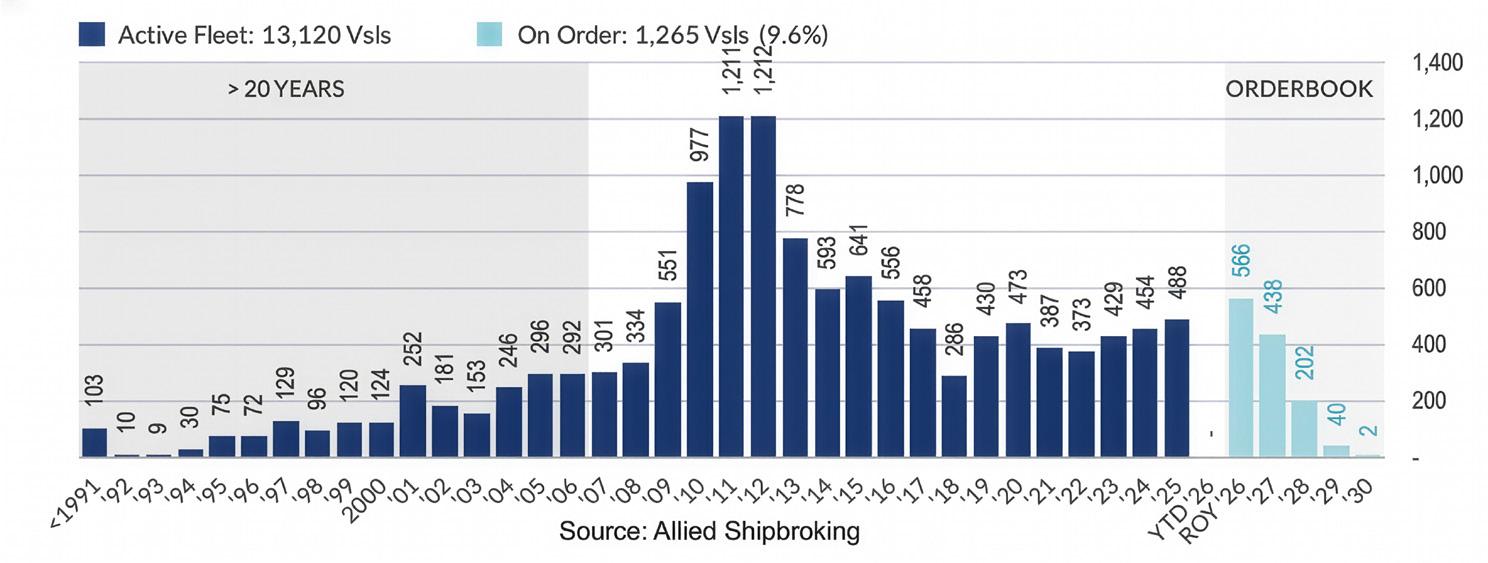
Allied’s late January 2026 dry bulk snapshot shows the active fleet (vessels >20,000 dwt) sits at roughly 13,120 ships — about 1,043m dwt — while the orderbook runs at some 1,265 units (~116.7m dwt), equal to 9.6% of the fleet by count. Delivery flow is heavy and front-loaded: 566 ships arrived in 2025, 438 pencilled for 2026 and 246 for 2027 and beyond. Newbuilds skew decisively mid-size, keeping pressure on the market where those segments compete fiercest.
Xclusiv cites constrained availability of prompt eco tonnage and aggressive secondhand bidding while longer, more costly special surveys for older ships are removing trading days. The resulting effective-supply tightening - lower speeds,
increased idle days, survey-driven offhire - is a structural positive for rates even if headline fleet growth remains positive. Conversely, the sizeable 2026 delivery pipeline leaves the recovery exposed if demand momentum stalls.
Bottom line
The Year of the Horse opens with a credible cyclical upswing: iron ore and bauxite tonne-mile growth, record agribulk crops and rising minor bulk volumes give the market a broad demand base. Xclusiv’s earnings and asset value data show a market that is already repricing higher. Structural supply dynamics - ageing tonnage, expensive special surveys, owner reluctance to sell modern eco units - materially reduce effective capacity and lend durability to the rebound.
If restocking and Southern Hemisphere harvest flows persist, 2026 can be a genuine up-cycle year.
Capital discipline will be needed to avoid repeating the value-destructive boom-and-bust cycles of the past
Sweating on Suez
The unwinding of liner shipping’s greatest boom has been predicted countless times. In 2026, the evidence looks more compelling than ever
The warning signs have been there for months - container shipping’s greatest ever period of earnings looks like it is unwinding. The question is how quick and severe this descent will be.
Early liner results this year have been illustrative that the good times are over, Maersk following Japan’s Ocean Network Express (ONE) in announcing its ocean division had slipped into the red for the final quarter of 2025. The Danish shipping giant also revealed it will lay off 1,000 staff this year as cost discipline rises up the corporate agenda of most global liners faced with a deteriorating freight rate environment.
Vincent Clerc, Maersk’s CEO, conceded 2025 had been a a year where supply chains and global trade continued to be reshaped by what he described as “evolving geopolitics”.
For his part, ONE’s CEO Jeremy Nixon conceded his company faces a “challenging operating environment”.
Structural reset
“Container freight is poised for a downcycle – putting downward pressure on rates
and carrier revenue – as an unprecedented wave of new vessel capacity continues to enter the market,” states a recent report from container booking platform Freightos.
Drewry’s recently published 2026 Financial Health Check for liner shipping has warned that the sector is nearing a “structural reset” as freight rates normalise and pandemic-era windfalls evaporate and a massive newbuilding orderbook delivers.
Drewry has urged liner companies to trade the boom mindset for tighter financial and operational stewardship to navigate a what it sees as an impending tougher, lower-margin cycle.
American consultancy AlixPartners has also called on liners to maintain strict capital discipline this year.
“With freight rates reverting toward pre-Suez crisis lows and shippers pressuring liners to transition back to the Suez Canal, carriers must execute aggressively on cost-saving programs while managing capacity through slowsteaming and vessel idling,” the company advised, adding: “The carriers’ strong balance sheets provide a crucial buffer, but capital discipline will be needed to
avoid repeating the value-destructive boom-and-bust cycles of the past.”
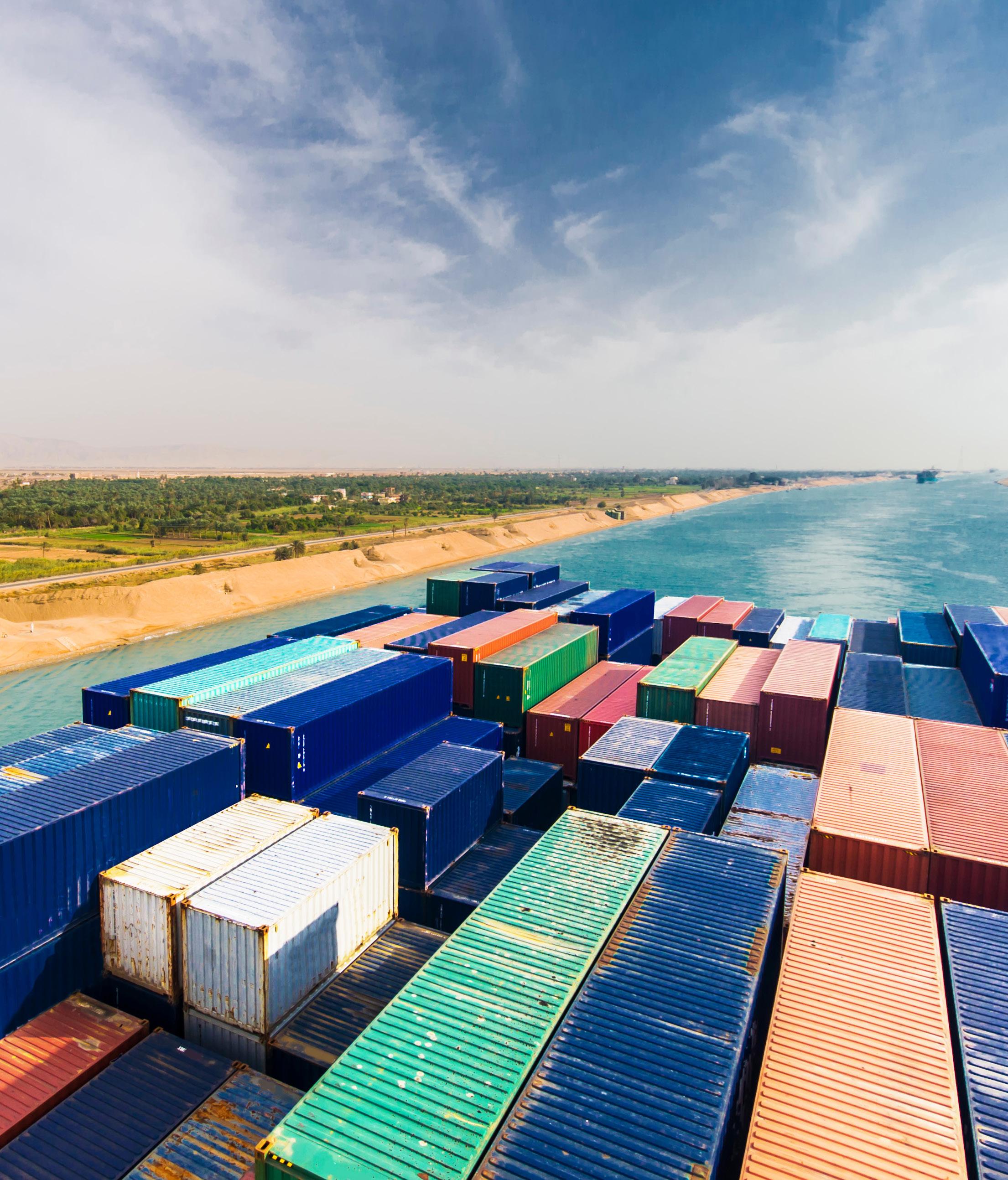
Return to Suez
Much of this year’s liner fortunes will depend on how quickly the industry returns en masse to transiting the Suez Canal, something that has just been clouded once again with the sudden war between Iran and the US and Israel.
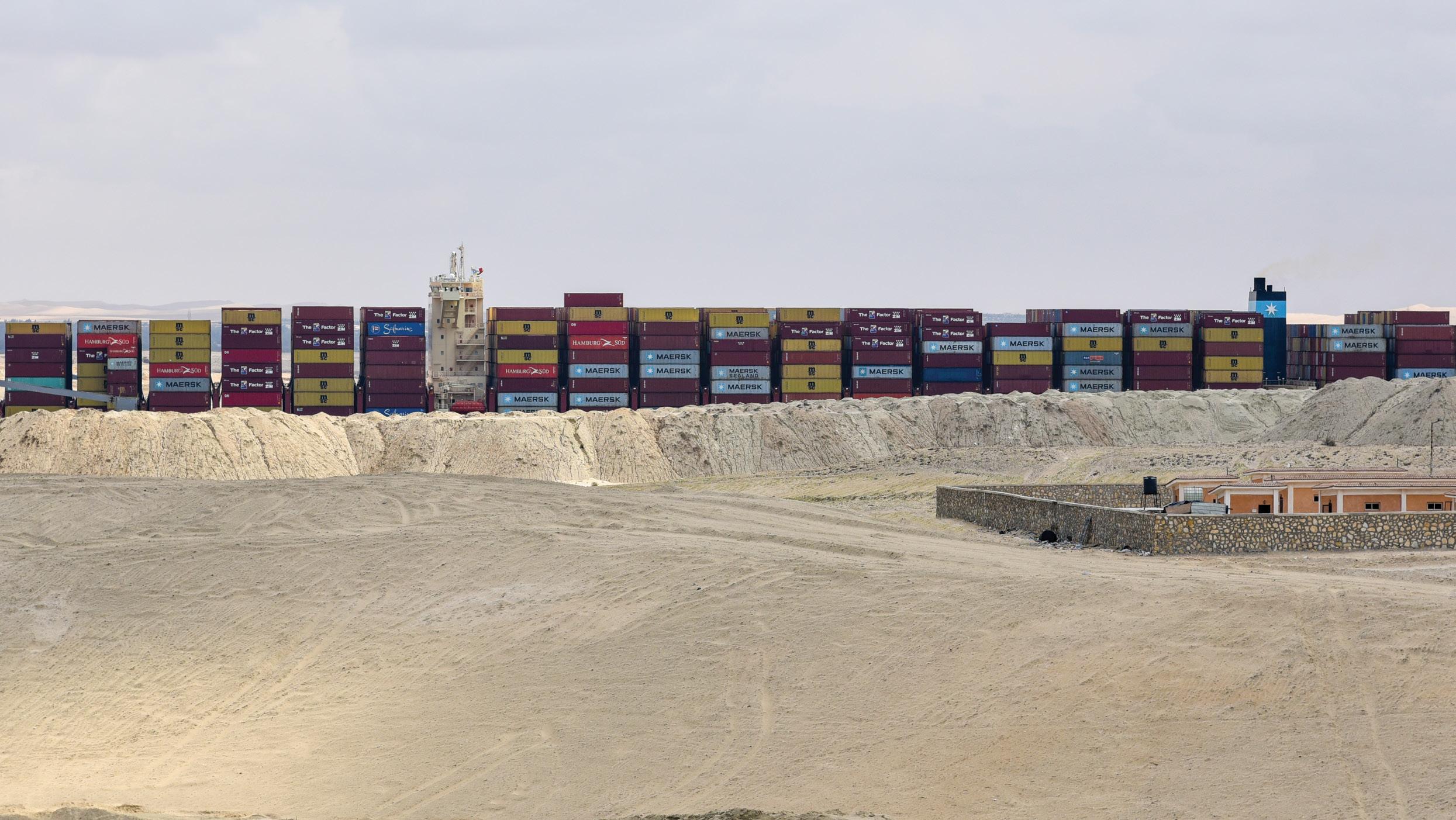
A large-scale return to shorter sailing distances via the Suez Canal would effectively free up 6-8% of global container shipping capacity, according to data from Xeneta, a freight rate platform.
A report from Danish consultancy Sea-Intelligence showed the demand in Q3 of each year on the basis of a Red Sea opening in early 2026, followed by a three to four-month transition period of operational congestion, as well as assuming a general 3% demand growth globally in 2026.
In this case, Sea-Intelligence sees global demand in teu-miles decline by 12% in Q3 this year.
“The return to the Suez Canal route is one of this year’s key influencing factors for capacity, freight rates, transit
MOMENTUM WHERE IT MATTERS
Building from a one-country operation at the Port of Manila in the Philippines, ICTSI has pressed forward across 37 years. On six continents, currently in 20 countries, we continue developing ports that deliver transformative benefits.
All across our operations, we work closely with our business and government partners, with our clients and host communities: to keep building momentum where it matters, in and through ports that keep driving sustainable growth.
ARGENTINA AUSTRALIA
times and fuel consumption,” says Philip Damas, managing director of shipping consultancy Drewry.
The usual pre–Lunar New Year uplift never materialised, and Drewry confirms that peak season has been underwhelming, with rates sliding since early January.
“Container spot rates are falling sharply, which indicates that the market is weak, contrary to the general expectation of rising demand and increasing spot rates before the Chinese New Year. This year, rates peaked earlier than usual, and if the normal seasonal pattern continues, they might decrease further,” Drewry noted on February 19.
“Carriers are reacting swiftly, blanking sailings, cutting capacity and idling vessels where necessary. The freight market feels softer and is becoming increasingly difficult to ignore,” notes Braemar, while adding that there is an ongoing disconnect on the charter side, which remains decidedly firm.
Just how much overcapacity?
“2026 is expected to be a year defined by overcapacity in container shipping, compounded by a large scale return of services to the Red Sea,” says Xeneta’s chief analyst, Peter Sand.
An unprecedented wave of new vessel capacity continues to enter the market
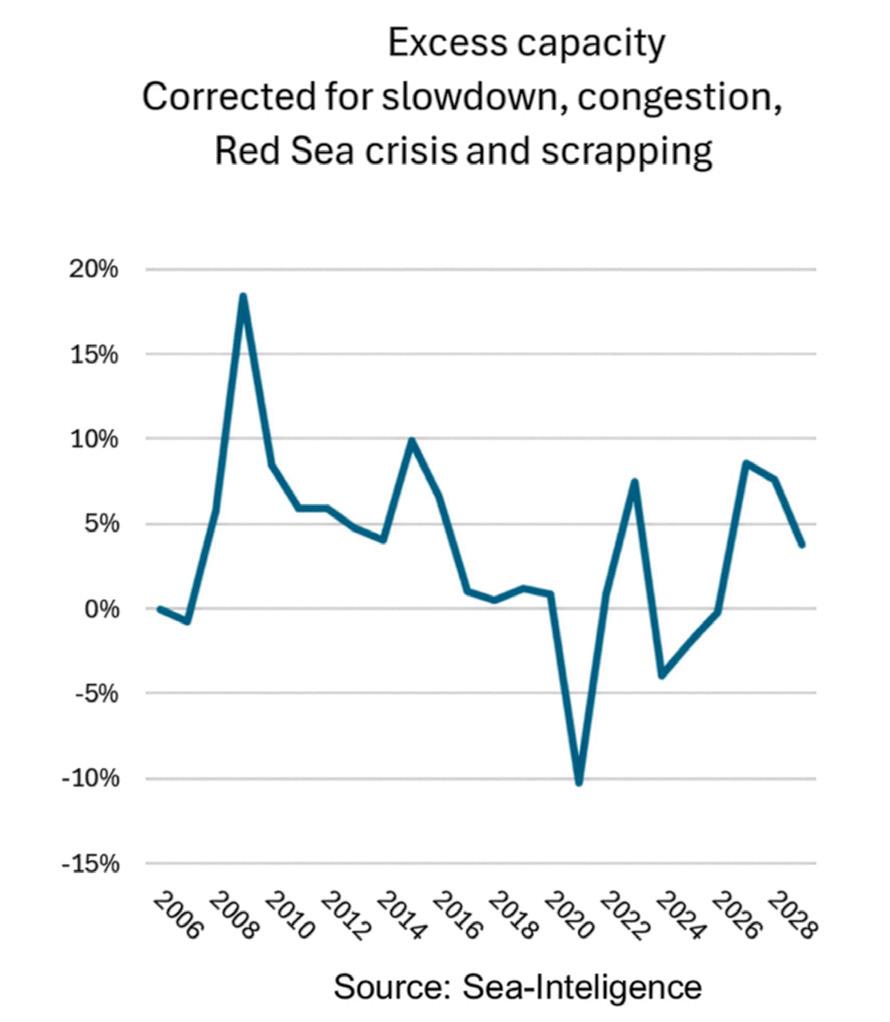
For its part, Sea-Intelligence warns of a likely cyclical downturn in container shipping, peaking in 2027–28, driven by a rapidly expanding orderbook that now exceeds 34% of the fleet. Despite unexpectedly strong demand in 2025 — global container volumes rose about 4.2% year-on-year — confirmed vessel orders through 2029 imply capacity growth that outpaces teu demand, recreating a post-financial-crisis scale of potential oversupply.
Using 2006 as a common index base for supply and demand, Sea-Intelligence has demonstrated an apparent and widening divergence between nominal vessel capacity and cargo volumes. However, it argues a raw comparison is misleading and sequentially adjusts for four capacity-absorbing factors.
First, a long-term structural slowdown in vessel speeds and longer port stays has historically required capacity to grow roughly 2.3 percentage points faster than demand (2006–2019) to preserve effective throughput; this principle is retained in the baseline outlook. Second, congestion and schedule unreliability temporarily absorb capacity; Sea-Intelligence projects
delay-related absorption rising to about 6% in 2026 before normalising from 2027. Third, the Red Sea crisis is modelled to remove roughly 10% of global capacity via rerouting until mid-2026, exacerbating short-term tightness but easing if resolved. Fourth, scrapping dynamics matter: 17% of capacity is 20+ years old, and the report assumes about 65% of that vintage fleet will be scrapped between 2026 and 2029 (2% in 2026, remainder phased through 2027–29), though many older units are small feeders less likely to be entirely withdrawn.
After applying these corrections, the adjusted supply/demand gap (see chart) still reveals substantial overcapacity emerging, peaking in 2027 and remaining elevated in 2028. Sea-Intelligence concludes a cyclical downturn is robustly probable, while noting major uncertainties: a prolonged Red Sea disruption now made more likely in the wake of the war between Iran, the US and Israel, or a deeper US-related trade shock could materially change timing and magnitude.
As has been the case throughout the 2020s for container shipping, buckle up, it’s going to be an interesting ride.
A Comprehensive Maritime Provider Committed to Safety, Quality, Sustainability, and Innovation.
High stakes, high returns, and a thicket of political risk
Propelled by the best quarterly earnings in nearly two decades, tanker owners are cantering towards a vintage year
Tanker markets enter the Year of the Horse in an odd place: the best quarterly earnings in nearly two decades sit alongside a thicket of political risks that can reverse fortunes in a single headline. Read in sequence, the market signals are simple - demand and freight are unusually strong - but the forces behind that strength are anything but. Geopolitics dominates, and where politics goes, tanker markets follow, something compounded this year by the decapitating of the leadership in both Venezuela and Iran.
As broker Gibson notes: “Geopolitical forces are set to remain the dominant driver of tanker markets this year.”
Conflicts unresolved, sanctions evolving and unpredictable trade policy decisions are reshaping freight flows faster than conventional supply and demand mechanics. That has two effects: it creates acute, short-term volatility and it can distort effective capacity by segregating sanctioned tonnage into separate, often inefficient, trading networks.
At the same time, commercial metrics look healthier than many expected. Veson Nautical highlights that “tanker markets
are entering 2026 with historic quarterly earnings levels not seen in nearly two decades.”
Political frictions
OPEC+ production increases, sanctions-induced inefficiencies and floating storage dynamics have tightened apparent supply and buoyed demand.
Where the old tanker business was driven mainly by barrels and voyages, today rates are boosted by political frictions that limit where compliant ships can trade and how shadow fleets operate.
Those frictions are layered on top of medium-term structural trends.
McQuilling’s 2026-2030 outlook describes the next five years as a “forest” of structural forces - macroeconomics, a weakening US dollar, a commodity supercycle, stronger emerging market oil demand, and constrained shipyard capacity - with geopolitical “trees” introducing volatility around that forest. McQuilling is confident the market is in the early stages of a multi-year commodity cycle reminiscent of 2002-
2010. Their forecast sees the front end of the oil curve pressured by incremental supply in 2026, while resilient emerging market demand and dollar weakness should support longer-dated prices. That sets up contango and forward pricing supportive of tanker tonne-miles.
From a vessel type standpoint
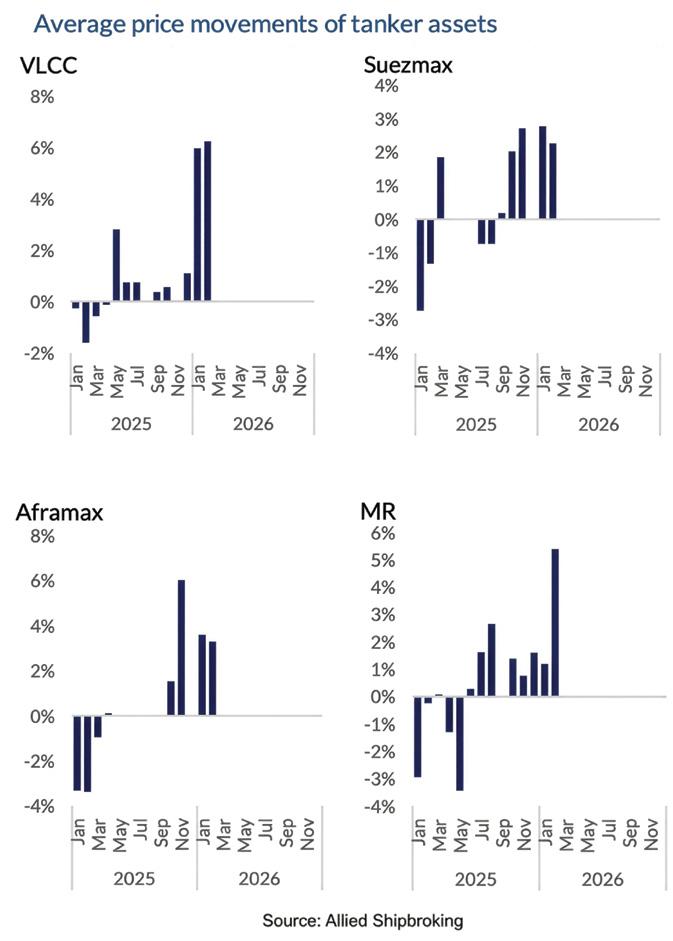
McQuilling expects Middle East exports to underpin VLCC demand. Americas exports will matter too, with new terminals in Argentina and improved logistics in Guyana feeding long-haul trade. They see VLCC fundamentals firm through 202627 and forecast eco VLCC spot earnings averaging about $87,000 a day over that period. Mid-sized tankers - aframaxes and suezmaxes - pick up residual demand as charterers flex vessel size to manage freight per barrel economics; eco aframax earnings could average $54,000 a day in 2026 before easing.
Still, the seasonality of orders and deliveries matters. McQuilling warns of rising newbuilding prices and supply constraints as yards juggle oil tanker orders with LNG, container and dry bulk programmes.
We are in unprecedented times
Northeast Asian yard productivity, ageing workforces and policy uncertainty add to the bottleneck and will lift newbuild cost trajectories.
Those bullish supply/demand signals have attracted capital and risk appetite. Evercore’s traders note the manic nature of the rally: “Trading tanker stocks is not for the faint of heart,” they write, pointing out that regime shifts - the Venezuala and Iran story, sanctions tightening, OPEC adds - have delivered a stunning early-year performance for crude tanker equities. But Evercore also cautions: as soon as a dominant theme is identified, it can reverse, and capacity expansion may outpace tonne-mile demand growth in 2027, undermining the current rally.
Sinokor’s charge
Market structure is changing beyond macro cycles. Fearnleys has documented one of the most striking recent shifts: the rapid consolidation of compliant VLCCs under Sinokor. Their analysis suggests Ga-Hyun Chung-led Sinokor now controls roughly 25% of the compliant VLCC fleet. The consequences are immediate: charterers face a narrower pool of compliant options and owners gain pricing power. HSBC captures the dynamic neatly: “Sinokor’s aggressive fleet expansion has tightened available vessels supply and strengthened owners’ pricing power.” Anecdotes from the market reflect that squeeze - owners now fix one-year deals for $90,000/day and three-year deals north of $60,000/day in some cases.
Frontline’s Lars Barstad described the situation in late January, saying: “We are in unprecedented times.”
In the shadows
Braemar has mapped out scenarios: one in which shadow exports remain siezable and another where sanctioned flows are drawn back into compliant channels. Either scenario yields different winners
and losers. In particular, their “end game” thesis posits sustained pressure on the shadow fleet - more sanctions, more seizures, and a reallocation of volumes to compliant tonnage. If that plays out, VLCCs and compliant large crude tankers pick up the slack as trade routes re-normalise, but aframaxes could see reduced tonne-miles if Russian and Venezuelan flows reroute.
That analysis mirrors Sentosa Shipbrokers’ market read: global crude imports are comfortably supplied, but freight dynamics are now more about positioning and arbitrage than pure volume growth. Reduced west-to-east VLCC arbitrage and a west-of-Suez decline in VLCC positioning have kept long-haul tonnage scarce and rates high. Sentosa highlights how sanctioned fleets and STS operations add complexity, effectively shrinking the mainstream fleet and amplifying volatility. In products, clean tanker fundamentals lag crude because regional refining balances, not seaborne volumes, control flows.
This year’s tanker market is a marriage of political distortion and structural support. That creates opportunities for owners with flexible capital and quality tonnage.
Normalisation of trade flows
Mikael Skov, who heads up Hafnia, the world’s largest operator of product tankers, tells Maritime CEO the greatest reason for hope is normalisation of trade flows. “Any easing of geopolitical tensions - whether through developments in Ukraine or gradual shifts in countries such as Venezuela, and potentially Iran over time - would allow sanctioned volumes to migrate back into compliant, transparent markets,” Skov says.
That would reduce reliance on the dark fleet, improve safety and governance, and shift demand toward well-managed, high-quality tonnage. He also points to advances in data and AI that enhance detection of inefficiencies and better vessel allocation - tools that could
make markets less chaotic and more predictable.
His caution is equally vivid. Prolonged geopolitical uncertainty combined with continued fleet growth would pressure utilisation and earnings. “If cargo demand weakens or remains unpredictable while newbuilding deliveries outpace scrapping, the result is pressure on utilisation and earnings, even for well-run fleets,” he warns.
On asset prices, Skov expects mild softening: “I would expect asset prices to soften modestly over the coming year, both for newbuildings and secondhand tonnage, but without any material correction.” That sits with the broader view that while spot and TC markets can spike, long-term asset values will be capped by visible orderbooks and a wary financing environment.
Technical
Management
Advanced technical support
Consultancy
Tailored solutions for operational excellence
Crew Management & Maritime Training
Crewing expertise & in-house maritime education
Inspection
Ensuring safety, compliance & vessel readiness
New Building Projects
End-to-end new building support
MUMBAI
KOCHI
MANILA
DUBAI
HONG KONG
LNG carrier market to heal slowly toward 2027
Surging US and Qatar exports and Europe’s post‑winter restocking boost cargo volumes, but a record wave of newbuild deliveries will weigh on spot rates through 2026
The LNG shipping market finds itself straddling three divergent stories: a clear, long-term rise in seaborne trade, a near-term glut of vessels, and the fallout from the US-led attack on Iran. Owners and charterers are wrestling with the practical implications - routing, layup, short-haul trades, the timing of a recovery - while export volumes and new liquefaction capacity keep ratcheting up.
Demand dynamics are becoming more pronounced after a bruising winter in Europe. Vortexa notes that Europe is set to exit winter with its lowest gas storage levels since 2018, a situation that creates 10m to 15m tonnes of incremental LNG demand over April-October, concentrated in Northwest Europe.” That post-winter restocking has already reshaped northsouth flows: record-high US/Canada East Coast hub prices during Winter Storm Fern pulled in around 10 import cargoes in January, even while the storm’s direct impact on US exports appears limited to roughly five cargoes at its peak.
European inventories depleted by the cold spell have been a key absorber of the recent surge in exports, underpinning a visible short-term lift in voyage demand.
Supply side
On the supply side, fundamental changes are under way. Clarksons Research records accelerating trade volumesglobal LNG trade reached 435m tonnes in 2025 (up from 360m tonnes in 2020) - and notes a marked uptick at the end of the year, with exports rising to a record 43m tonnes in January 2026, up 13% year-on-year. Much of that growth has been driven by the US, where shipments reached 109m tonnes in 2025, boosted by the rapid ramp-up at Plaquemines and early flows from Corpus Christi Stage 3. Clarksons expects momentum to persist: after a 5% increase in 2025, trade volumes are projected to rise by 7% in 2026 and to accelerate further in 2027 as new project ramp-ups come online.
But the converging wave of new liquefaction - and, crucially for shipowners, a record orderbook for newbuild carriers - is depressing charter markets in the near term. Clarksons flags another 110 ships scheduled for delivery in 2026, marking a fresh influx of tonnage that will exacerbate the oversupply of available ships before
Another
110 ships are scheduled for delivery in 2026
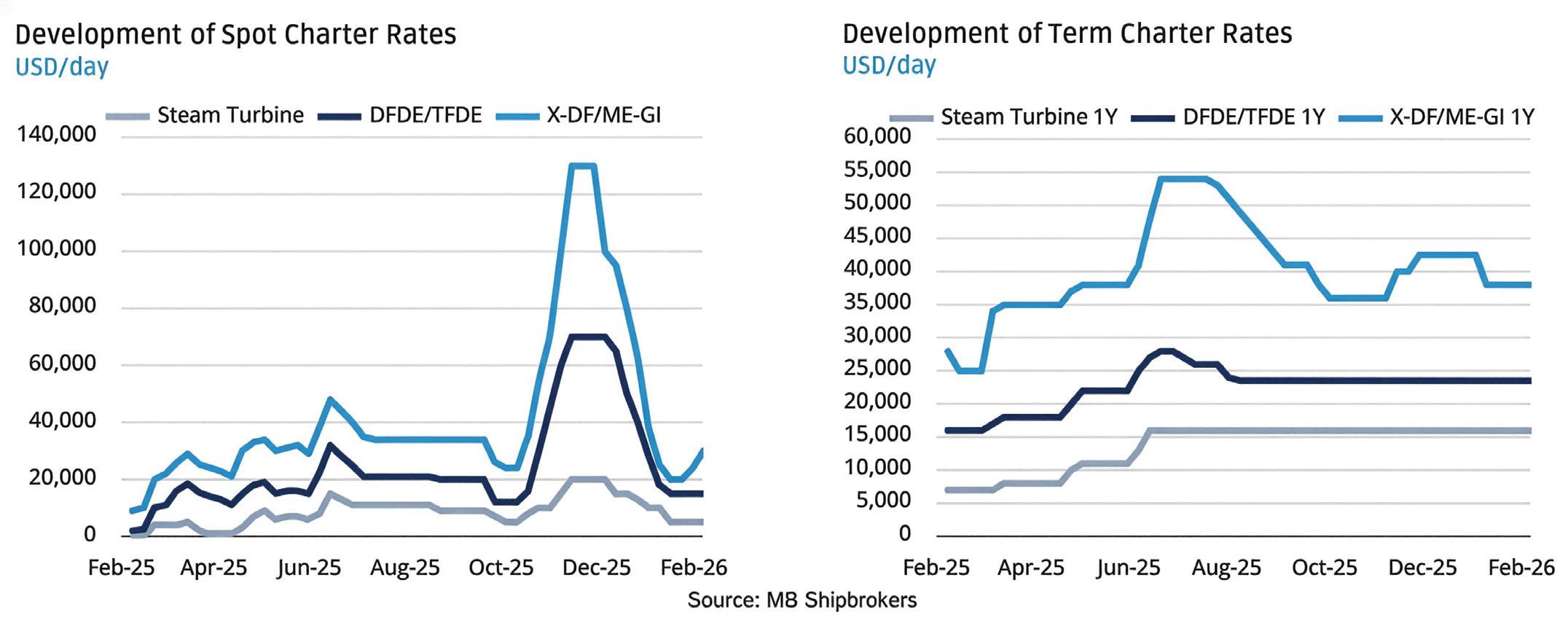
demand growth fully absorbs them. The result: spot markets that remain weak despite the improving cargo picture. Clarksons reports that spot rates for a 174k cu m two-stroke unit have averaged about $35,000 per day so far in 2026up from 2025 lows but still some 50% below recent typical seasonal levels.
Norwegian bank DNB Carnegie has adjusted its own outlook accordingly, slashing estimates for two-stroke sailedin spot rates for 2026 to $37,000 per day from an earlier $79,000 per day. Analyst Jorgen Lian put the near-term dynamic plainly: “We expect a heavy orderbook to continue weighing on [LNG carrier] freight markets near-term, before markets should start to gradually improve from 2027.” That timeline - a trough in the immediate years and a gradual recovery beginning around 2027 - is now a common theme among market watchers.
Markets should start to gradually improve from 2027
additions in 2026; Golden Pass is slated to see its first cargo in March, while the initial train from Qatar’s expansion has been pushed to Q4. These ramp-ups should add meaningful cargo volumes,
slippage - such as the delayed North Field start-up - can change the year-to-year
Nuanced commercial strategy
accelerating trade and record newbuild deliveries implies a nuanced commercial strategy. The immediate squeeze on spot rates incentives a mix of approaches: locking in medium- to long-term charters where possible, using short-haul and repositioning voyages to soak up excess tonnage, and considering slow-steaming or temporary layups for older tonnage. Clarksons also flags how rising short-
flexibility have cushioned some of the pressure, but not enough to offset the sheer volume of new ships entering the
months, the structural case for LNG
shipping remains constructive. Clarksons projects strong momentum through 2030 as around 290m tonnes per annum of export capacity is due online across the remainder of the decade, potentially driving trade north of 700m tonnes. If that trajectory unfolds and vessel supply growth moderates after the current delivery spike, the market could move from oversupply toward a tighter balance - validating the 2027 recovery window that banks such as DNB Carnegie anticipate.
In the Year of the Horse, then, LNG shipping looks set for a bumpy but ultimately upward ride: stronger cargo flows and record new liquefaction capacity point to robust long-term fundamentals, while a heavy 2026 delivery slate and subdued Asian demand will keep freight markets muted in the near term. Much will depend on how protracted the war between the US, Israel and Iran lasts. For shipowners and charterers the challenge is to navigate this transitional stretch - balancing contract strategy, fleet deployment and patience - so they’re positioned to benefit once the next leg of the LNG expansion truly gallops into full stride.
Fit for purpose?
How can the IMO reassert its role as shipping’s global regulator?
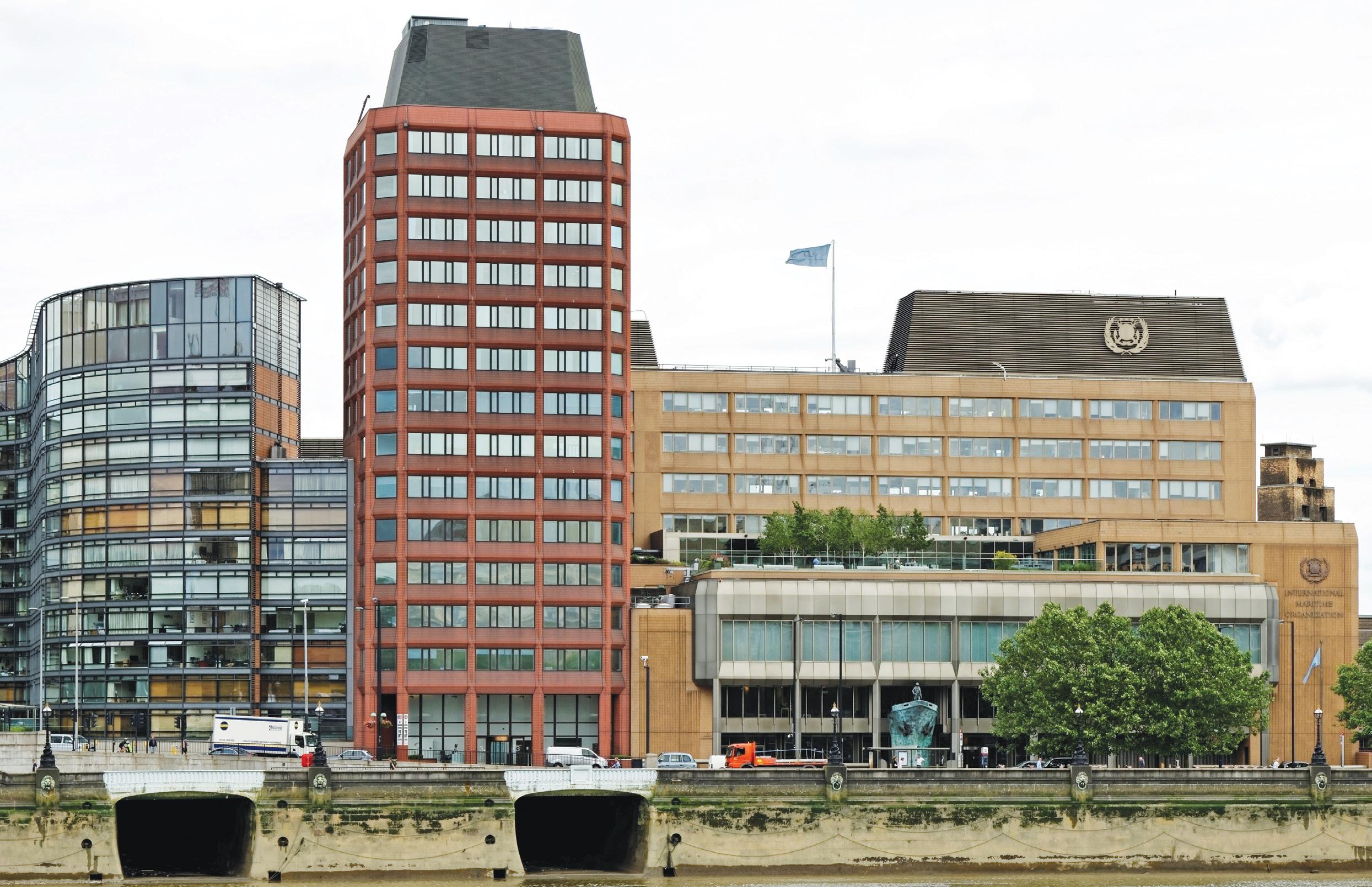
Following last October’s dramatic failure to get the Net-Zero Framework (NZF) over the line, and the current US administration’s disdain for many branches of the United Nations, the International Maritime Organization (IMO) finds itself under red-hot pressure heading into the Year of the Fire Horse, its legitimacy as shipping’s global regulator has arguably faced no greater strain in its 78-year history.
Not for nothing, Arsenio Dominguez, the genial, hard working Panamanian leading the UN body, stressed the importance of “getting things done” in 2026 in his New Year’s message. Dominguez vowed 2026 would be a “year of implementation; moving from plans to concrete actions and measurable
progress”. But just how much can he cajole out of member states in the coming months?
Essential and irreplaceable
Costas Delaportas, president and CEO of Greek owner DryDel Shipping, is adamant that the IMO is still the top global regulator, because it’s the only body that can set truly worldwide rules for international shipping. However, like everyone polled for this report, he concedes the London body is “under pressure”.
“Regional regimes such as EU ETS and FuelEU Maritime are already shaping behaviour, and if IMO implementation is slow or unclear, the industry ends up
with a patchwork of overlapping rules,” he says, arguing that the IMO’s leadership will be judged on speed and realistic execution, not announcements.
Alex Karydis, a director at German shipowner Hanse Bereederung, says the IMO is essential and irreplaceable, albeit under pressure.
“Regional initiatives are filling perceived gaps, sometimes at the expense of global consistency and progress,” he says. “The challenge for the IMO is to reassert relevance through clarity, enforceability, and realistic transition pathways. Fragmentation increases if confidence in global regulation weakens.”
“The IMO provides a platform for collaboration and open discussions for the improvement of the maritime
What matters is how rules translate into operational behaviour
The risk is not irrelevance, but fragmentation around the edges
industry,” maintains Captain John Lloyd, CEO at the Nautical Institute.
Quite so, agrees Peter Hult, CEO at VIKAND, a maritime medical specialist. “Regulations should not only set minimum standards but also encourage operators to invest meaningfully in their people,” he advises.
Arun Sharma, executive chairman of the Indian Register of Shipping, describes the IMO as the “cornerstone” of the global maritime regulatory framework. Its effectiveness, he argues, will increasingly depend on timely rule development, clear implementation guidance, and consistency in application, particularly as new technologies, fuels and operational models are introduced across the industry.
Henrik Jensen, CEO of crewing specialist Danica, sees the IMO as remaining very much “critical” to the industry.
“Shipping is unique in its level of global standardisation, and the IMO has been instrumental in making international trade possible. It is essential that the rest of the world continues to support and strengthen the IMO’s role,” he urges.
Regulator vs lobbyist
Of all those surveyed for this report, the sharpest criticism for the UN body came out of Limassol and the office of Mark O’Neil, the CEO of Columbia Group. The failure to get the NZF voted through, he maintains, stemmed not from its failure as a global regulator but from what O’Neil describes as the IMO’s “misconceived and somewhat naive attempt” to assume the role of global shipping lobbyist for which, he says, it is “woefully” ill-equipped.
“We need to separate out the functions of lobbying/agreement, and the separate function of regulating what has been agreed,” O’Neil urges. Moreover, given
what he sees as the gradual erosion of a global rules-based order, and its replacement with regionality and national interests, O’Neil questions whether structures and organisations such as the IMO have had their time in their present form and require radical overhaul in order to remain relevant.
Vikas Trivedi, co-CEO at rival manager Synergy Marine Group, agrees that consensus-based processes are being tested by the pace of change and by regional initiatives moving ahead independently.
“The risk is not irrelevance, but fragmentation around the edges,” Trivedi says, adding: “The challenge for the organisation is to align ambition with implementability, ensuring regulations remain workable at ship level.”
Mikael Skov, the CEO of product tanker giant Hafnia, is still backing the IMO, as he cannot see any realistic alternative if the industry is to avoid further fragmentation. That said, he admits the recent outcomes have shown how difficult it is to align a highly diverse industry behind complex global frameworks.
“Going into the Year of the Horse, regulation needs to be technically robust, clearly articulated, and supported by workable implementation plans - not left at a high level,” Skov suggests, stressing that the IMO must recognise that shipping is not monolithic. “Legislation that may suit liner trades does not necessarily translate well to tramp or tanker markets,” he points out.
Dr Jens Tülsner, CEO and founder of Marine Medical Solutions (MMS), can see a risk of credibility gaps if targets aren’t matched by practical pathways and consistent implementation.
The aviation model
One suggestion mooted by Captain Kuba Szymanski, secretary-general at
Source: International Maritime Organization
InterManager, is to move the model of the IMO more closer to its aviation counterpart, the International Civil Aviation Organization (ICAO), another UN agency.
“It is striking how two industries with so much in common can be so different in practice—particularly in shipping’s entrenched blame culture, which remains one of the biggest barriers to progress,” Szymanski notes.
Kris Vedat, CEO of SmartSea, a maritime digital transformation specialist, and Rob Mortimer, CEO of fuels provider Fuelre4m, have the final words on the matter.
“Global regulation only works when supported by common standards, consistent data and enforceable mechanisms,” Vedat says, a point of view shared by Mortimer who tells Maritime CEO: “Regulation alone won’t decarbonise shipping. What matters is how rules translate into operational behaviour. If regulation incentivises real efficiency gains rather than box-ticking compliance, it remains relevant. If not, the industry will move faster than the rulebook.”
Delays and uncertainty might be making things messier
Changes in trade flows ought to be constructive for VLCCs
IMO delay turns decarbonisation into discipline
After member states voted a one‑year pause on the Net‑Zero Framework, shipowners and suppliers say decarbonisation has shifted from ambition to pragmatism
October 18 last year saw International Maritime Organization (IMO) member states vote for a one-year delay in the Net-Zero Framework (NZF), throwing shipping’s path towards decarbonisation into considerable doubt. The campaign to down the NZF was led by the US and Saudi Arabia with the past year seeing president Donald Trump reverse many other environmental goals.
Since the October vote, IMO secretarygeneral Arsenio Dominguez has been running a delicate campaign to soften and straighten the NZF’s language, meeting with member states to work out a way to get the legislation through somehow in October this year.
The IMO will focus on “getting things done” in 2026, Dominguez said in his New Year message. Dominguez vowed 2026 would be a “year of implementation; moving from plans to concrete actions and measurable
progress”. To get the NZF over the line would be a remarkable diplomatic feat for the Panamanian IMO head.
The noise out of the White House surrounding all things green has clouded environmental priorities for many in shipping. The word ‘pragmatism’ features prominently in Maritime CEO interviews with leading names in the industry on the environment this year.
Lost relevance?
Emanuele Grimaldi, chairman of the International Chamber of Shipping, says the delayed decision about the NZF has “amplified risks for some players, while providing greater strategic possibilities for others”.
Mark O’Neil, who heads up Columbia Group, reveals to Maritime CEO that he never believed that the NZF was realistic in what he describes as “the Trumpian geopolitical landscape and the global
economic outlook post-covid”.
“I believe the decarbonisation drive will only weaken further as global economies seek energy security and to re-adjust to the new Realpolitik,” O’Neil predicts.
Captain Kuba Szymanski, secretarygeneral at InterManager, the body for shipmanagers, reckons 2025 was was a year of slowing green investment, largely because other economic priorities demanded support.
“That does not mean sustainability has lost relevance—rather, the pace and sequencing of investment are being reassessed,” he explains.
“Over the past year, policy developments and the postponement of key regulatory milestones have reinforced the need for pragmatism, particularly outside Europe,” says Mikael Skov, who heads up Hafnia, the world’s largest product tanker owner. Skov stresses Hafnia will not speculate on technologies or fuels before there is clear
customer demand, regulatory clarity, and supporting infrastructure.
Quite so, concurs Roger Holm, president, Wärtsilä Marine, one of the world’s largest producers of ship engines,
“The key barriers are no longer technologies themselves but fuel availability, infrastructure readiness, cost, and regulatory clarity - all of which differ significantly by trade,” Holm says, adding: “That reality is shaping more cautious, step-by-step investment strategies.”
Holm, like others polled for this report, believes that over the past year, green investment has become “more pragmatic and more disciplined”.
“The industry has moved beyond the idea of a single, universal solution and towards investments that deliver measurable value today while keeping options open for tomorrow,” Holm tells Maritime CEO.
That change in mindset is particularly clear when owners look at mid-life decisions for existing vessels, Holm says.
“Rather than waiting for perfect clarity on fuels or regulation, many are prioritising efficiency as the most immediate and reliable green investment,” Holm says.
Arthur English, CEO of Norway’s G2 Ocean, the world’s largest ship operator within the open hatch segment, says that he is still a firm believer in shipping’s
The year ahead should be about pragmatism
need to decarbonise. However, the timescale for affordable and available green fuels has moved out, he says, making it impossible to predict when G2’s ammonia-methanol ready vessels will actually convert to new fuel types.
Selective and disciplined
Alex Karydis, a director at German shipowner Hanse Bereederung, says his company’s environmental approach has become more selective and more disciplined.
“We are less interested in just green branding and more focused on measurable performance, verifiable data, and commercial impact whenever available,” he says.
Green investments must now demonstrate not only environmental benefit, but also charterer acceptance and what Karydis describes as “balance sheet resilience”.
Hakki Deval, managing partner at Turkish dry bulk operator Devbulk, says that over the past year his company has shifted from viewing green investments as optional enhancements to seeing them as a core strategic component of competitiveness.
“Charterers, banks, and regulators are aligning around clear emissions expectations,” he maintains, saying that Devbulk’s approach remains pragmatic and data-driven.
“We focus on proven fuel-efficiency technologies with realistic payback periods,” Deval says, stressing that decarbonisation must be executed “sensibly and sustainably”.
Fast payback
Rob Mortimer, CEO of Fuelre4m, a fuel treatment technology specialist, echoes many of those interviewed for this report, in saying: “The year ahead should be about pragmatism: low capex, fast payback, scalable solutions. If it doesn’t deliver operational gains quickly, it’s not a serious investment.”
Concluding, Josephine Le, managing director at The Hood, a social media platform for seafarers, says: “Delays and uncertainty might be making things messier but green branding will be the only way to stay in the top-tier chartering pool, if not for the sake of the planet alone.”
All eyes will be on the IMO headquarters in London in October.
Have we hit peak ordering?
Maritime CEO takes a close look at the orderbook
Asia’s testablished yards enter the Lunar New Year in rude health, yet past downturns have taught them that complacency - and over expansioncan hurt for many a year.
With orderbooks stretching into 2029, top yards are focused on increasing productivity, looking to automate to beat demographic constraints. Chinese yards continue to be reactivated pushing national shipbuilding capacity back toward postglobal financial crisis highs. Koreans tentatively are looking at overseas expansion, the Japanese are gearing up, while a host of other Asian nations - most notably India -are making bold shipyard claims.
Japan is aiming for rejuvenation with public and private sectors coming together to try and double output over the coming decade while India, Indonesia, the Philippines and Vietnam all making big plans to boost their own shipbuilding capabilities Meanwhile, in the Western Hemisphere, Donald Trump has made shipyard reactivation a key part of his industrial policies in his second term.
Newbuild prices
Newbuild prices look to have peaked, but
What we are observing today is largely a catch-up renewal cycle
remain considerably above historical averages.
“Prices will remain stubbornly high. Shipyards are booked through 2028, and the cost of dual-fuel ready specifications, combined with high labour and steel costs, provides a solid floor. You aren’t just buying a hull anymore; you’re buying a future-proofed power plant,” says Josephine Le, managing director at The Hood, a shipping social media platform.
“Newbuild pricing remains influenced by yard capacity, environmental regulation and fuel transition bets,” says Soma Sundar, CEO of bigyellowfish, a behavioural risk management platform
Kris Vedat, CEO of SmartSea, a maritime digital transformation platform, argues that asset pricing is becoming less about age and more about adaptability.
“Newbuild prices are likely to remain elevated, in part because they offer optionality — whether in fuel readiness, digital architecture or regulatory compliance — even as uncertainty persists around long-term propulsion pathways,” he says.
Mark O’Neil, head of Columbia Group,
believes that newbuild prices will remain firm, in part thanks to a realisation around the world that fossil fuels have had a reprieve over the past year.
“If the whole decarbonisation debate has achieved anything it has ensured a controlled global fleet renewal programme,” O’Neil tells Maritime CEO.
“Owners have been hesitant to invest where the alternative fuel landscape was so unclear and investment choices have such a long tail. That position is now somewhat clearer where fossil fuels will remain the dominant fuels at least for the next asset life cycle. Fundamentally, therefore, asset prices - both newbuild and secondhand - should remain firm to strong where demand will outstrip supply for the short.”
Orderbook-to-fleet ratios
Orders continue to flood in during the opening months of 2026, notably Greeks chasing VLCC slots.
This is leading to higher orderbookto-fleet ratios. From a sectoral perspective, the crude tanker orderbook-
to-fleet ratio rose steadily in 2025; starting at 11%, rising to 14% by October, but since then has surged to over 18%. This has been driven by VLCCs, rising from 10%, steadily to 13% in October, and jumping to 19% today, according to data from Hartland Shipping. Dry bulk ratios were basically flat through 2025 at 11%, but since October have risen to 13%, with strong ordering in all sizes bar handysizes. Containers saw persistent ordering through 2025, and the ratio is approaching 35%, higher than any stage in the ongoing boom since 2021. Less orders and a rise in deliveries saw product tanker ratios fall in 2025, but even they have risen since October.
Hartland cites mitigating factors to not be too pessimistic about the risk of boom and bust for owners from all this ordering.
“Yards are full, orders are just being stacked onto the back of orderbooks, rather than adding to earlier schedules,” Hartland suggests in a recent report, adding: “Furthermore, across shipping, fleets are ageing and in need of replacement. These fleets will be even older once these orders deliver in 202829.”
Traditionally in shipping, alarm bells tend to ring for investors when the orderbook-to-fleet ratio of a sector
Fossil fuels will remain the dominant fuels at least for the next asset life cycle
goes above 30%. For certain segments today, notably LNG, LPG and megamax containerships, that ratio is at record levels, and yet analysts are generally sanguine about this tonnage overhang.
In some parts of the shipping market, today’s orderbook numbers are back at levels last seen during the shipbuilding boom of the late 2000s and early 2010s, something that then led to a lost decade for shipyards.
“That’s clearly worrying for certain sectors and vessel sizes, but it doesn’t spell trouble across the board,” says Burak Cetinok, who heads up research at broker Arrow.
“The orderbook-to-fleet ratio is a useful, high-level gauge of future supply, but on its own it only tells half the story. To really understand what’s coming, you also need to look at how old the existing fleet is and how much of it is likely to be phased out,” Cetinok explains, going on to highlight just how old the tanker and bulker segments are today.
The area of concern for Cetinok are the large containerships – the vessels capable of carrying 18,000 teu and above. For this niche, Cetinok highlights how the orderbook is now more than four times larger than it was just 18 months ago.
Dimitris Roumeliotis from the research and valuation department at Greece’s
Xclusiv Shipbrokers, maintains the current orderbook-to-fleet ratios are not a structural threat, either at the aggregate level or within specific vessel classes.
“After a decade of historically low ordering activity, what we are observing today is largely a catch-up renewal cycle driven by the need for more efficient and lower-emission vessels, and the reinvestment of the significant cash flows generated over the past few years,” Roumeliotis says.
End of the boom?
The shipbuilding boom this decade has been built on very solid freight earnings. The ClarkSea Index - a weighted barometer measuring the fortunes of the entire commercial shipping fleet - stood at $34,058 a day going into the Year of the Horse, the highest level for over three years, with the average in the year to date up 44% year-on-year and up 53% on the ten-year trend. Shipping cycles rarely last long, something shipyards that has burnt shipyards in the past.
Dr Martin Stopford, the world’s most famous maritime economist, warns: “Be careful what you wish for. Geopolitical events can supercharge tight markets, but if they coincide with a downturn, or damage demand, watch out.”
How 2026 will define the future of shipping technology
Every year, Maritime CEO reaches out to ask the industry for what they see as the big tech developments or breakthroughs we should anticipate. Answers are carried below
As we move through 2026, the maritime industry is entering a critical maturation phase. The initial gold rush of digital adoptionwhere the mere act of installing new software was considered a victory - is being replaced by a more pragmatic, outcomes-based approach. The hype cycle of artificial intelligence and connectivity is giving way to the cold, hard reality of operational efficiency, system integration, and human-centric design. Industry leaders are no longer asking if they should digitise, but rather how to ensure those digital tools deliver genuine, sustainable value.
AI and processing power
For Arthur English, CEO of Norwegian shipowner G2 Ocean, the coming 12 months will serve as a definitive litmus test for maritime organisations. The landscape is splitting into two camps: those who successfully harness technology and those who will be left behind.
“We will start to see the effects of intelligent business processes and how this will separate between companies who are able to utilise AI tools to create
business value and the ones that are lagging behind,” English reckons. This divergence will be driven largely by the raw technical capacity to compute. As English points out, “More powerful processing power capable of running powerful optimisation models and enabling complex datasets to be analysed will enhance decision making. Combined with AI tools this has the potential to really make a difference and think we will start seeing this in 2026.”
Crucially, this digital evolution is supported by a changing landscape in infrastructure. “Due to more competition in the satellite market, we are expecting fleet and shore communication will further advance and take digitalisation in shipping a step forward in 2026,” he adds.
From experimentation to reliability
Building on this momentum, the focus is shifting from AI as a toy to AI as a tool. Kim Sørensen, CEO of StormGeo, observes that the primary shift for the next year is a move toward operational certainty.
”First, AI will become a standard part
of daily voyage decision-making and optimisation. I expect the focus on AI to shift from experimentation to actual operational reliability,” Sørensen explains. He notes that the era of AIdriven rote tasks is here: “For example, AI will increasingly be used to automate time-consuming, repeatable, and routine decisions in weather routing services, while leaving safety-critical situations to human experts.”
Beyond pure AI utility, Sørensen identifies a desperate need for ecosystem consolidation. “Second, shipping companies will increasingly move away from multiple standalone tools toward more integrated platforms that support a broader part of the value chain,” he says. The “fragmentation fatigue” among operators is palpable. “Instead of having several vendors for different functions, such as voyage planning, bunker management, emissions compliance, and more, I foresee companies gradually shifting to vendors that can support a broader part of the value chain.” To ensure this works, he emphasises that, “In an era where access to information and data has never been greater, userfriendliness and visualisation in maritime tech will become more important.”
Operationalising intelligence
Kris Vedat, CEO of SmartSea, echoes the call for deeper integration, arguing that we must move past the idea of AI as an external analysis layer.
“AI will increasingly be built directly into operational workflows - voyage execution, maintenance planning, safety management and commercial decisionmaking - rather than sitting as a separate analytics layer,” Vedat states. This represents a fundamental change in how ship managers interact with software; the AI becomes the system itself, rather than
relevant intelligence driven by agentic AI and Gen AI.” Similar to Sørensen’s vision, Basu sees the market moving toward a centralised model: “Platforms globally will make the move towards consolidation. Instead of working with multiple service or tool providers owners/ operators will prefer to work with digital platforms that allow single platform access and multiple features.”
The human friction factor
check on the “connectivity is solved” narrative. While bandwidth is increasing, dependability remains the challenge.
“More bandwidth at sea accelerates demand rather than solving connectivity challenges,” Morgan explains. He cautions against complacency: “The belief that Starlink-style links remove the need for maritime-native systems confuses raw bandwidth with dependable service: maritime links degrade, switch, and face weather, routing and geopolitical interruptions.”
Vedat also points to the necessary maturation of digital infrastructure, specifically identity. “Digital identity becoming foundational. Secure digital identity for people, systems and devices will underpin cyber security, compliance, and trust across maritime operations, much as it already does in aviation and financial services.” Finally, he reframes the conversation around connectivity: “LEO connectivity will matter less for headline speeds and more for enabling vessels to function as fully connected digital workplaces, supporting continuous operations, updates and collaboration.”
However, as Raal Harris, the vice president of InterManager, reminds the industry, technology is not a vacuum. Digitalisation often arrives with a hidden cost-friction.
“The problem is that digital systems have been added over time, rather than designed to work together from the start,” Harris warns. “Technology providers are often asked to solve specific issues in isolation, which can result in tools that work well individually but create friction when used together.” This disconnect creates a significant burden for the crew.
“Without closer cooperation across the industry, seafarers are left to manage the consequences of systems that do not naturally fit alongside one another. When crews are expected to use multiple applications simply to complete a single task, the industry cannot claim that digitalisation is easing life at sea.”
For Morgan, the next year is about resiliency. “As fleets add more data-hungry apps and reporting, optimisation’s role has shifted from airtime cost-cutting to ensuring continuity, security and data integrity.” He concludes with a directive for the industry: “Effective maritime optimisation therefore requires breakpoint recovery, prioritisation, automation and integrity assurance. Providers that make connectivity behave like a utilitydependable, secure and predictable - will win trust.”
Shaping, not just measuring
Harris calls for a pivot toward humancentric design: “If digitalisation is to succeed, it must be shaped around the people who rely on it every day. Seafarers need tools that reduce friction rather than add to it, and interfaces that reflect the realities of shipboard life, where connectivity is uneven and workload is already high.”
Connectivity as a utility
Paul Morgan, head of engineering at GTMaritime, provides a vital reality
Ultimately, the theme for 2026 is one of action. As Soma Sundar, co-Founder and CEO of Bigyellowfish Technologies, succinctly puts it, the industry is graduating from passive observation to active engagement.
Maritime tech, he argues, will move beyond the metrics of the past: “The next wave of maritime tech will not only measure performance, but actively shape it.”
In the coming 12 months, the companies that thrive will be those that integrate their data, protect their connectivity, and remember the human beings operating at the edge of the network. The tools are ready; the era of implementation has begun.
We’re Preparing to Make Waves September 24, 2026 Fairmont Hotel, Singapore
Register here
The era of the pitch is over. The era of the proven outcome is here
Beyond the hype
With so many technologies on the market, how do you evaluate what is genuinely valuable?
The maritime industry is undergoing a digital journey, but it is a renaissance shadowed by an overwhelming influx of options. From AI-driven voyage optimisation to sensorheavy machinery monitoring, the sheer volume of “transformational” technology can be paralysing. For shipowners and managers, the challenge is no longer finding new technology - it is determining which of those technologies will survive the harsh realities of sea life and which are merely marketing noise.
The cultural litmus test
Shipping has always been a highstakes, conservative industry. As Henrik Hyldahn, group CEO of Marcura, aptly puts it, “Shipping is cautious, and rightly so. High stakes, significant money, real consequences. 90% reliability won’t cut it. Neither will 95%. The bar is higher here than in most industries.”
This high bar is exactly where many entrants fail. “That’s why you see a lot of startups struggling,” Hyldahn observes. “You have to build the market and the product simultaneously. That requires
domain expertise, persistence, and longer runways than most can sustain.” For those evaluating tech, Hyldahn offers a clear benchmark: “If they’re selling intelligence, or AI, are they building on structured maritime data, and do they have the governance in place to keep data secure? Do they understand that shipping has edge cases that technology alone can’t handle? And critically: have they earned trust through years of operational proof?”
This skepticism is a necessary defence mechanism. Captain Kuba Szymanski, secretary-general at InterManager, reinforces the need for this guarded approach. “Trust and intelligence are paramount,” he says. “The industry is awash with hype, exaggerated claims, and misinformation. That makes rigorous evaluation essential and reinforces the importance of supporting strong inhouse people expertise gained through experience when selecting technology partners.”
The evidence-based framework
Once the filter of domain expertise is ap-
plied, the evaluation must turn to the hard data. Alex Karydis, a director at German shipowner Hanse Bereederung, distills the selection process into a rigorous threepart diagnostic test: Verifiability: Can performance be proven?; Operability: Does it work in real trading conditions?Commercial applicability: Does it matter to charterers, financiers, and insurers?
“Technology that fails any one of these tests,” Karydis notes, “rarely delivers lasting value.”
To apply these tests, organisations need a structured process. Arthur English, CEO of G2 Ocean, emphasises a disciplined requirements-gathering phase. “In order to ensure that we select the right technology partner, we first spend time understanding the need we have for any technology or system’s functionality,” English explains. “We agree on the minimal requirements for functionality, data processing, integrations and usability standpoint, and differentiate between must-have and nice to have.” This leads to a trial-by-fire approach: “We prefer to do a proper proof of concept or trial period to prove the value of a system or technology before we commit to it.”
Hakki Deval, managing partner at Turkish owner Devbulk, agrees, advocating for a “data first, practicality second, marketing last” philosophy.
Devbulk’s framework requires: “Verified performance: real fuel savings proven through third-party data; operational simplicity: reliability across global tramp trades, without overcomplexity; financial rationality: conservative, realistic payback periods; and supplier strength: longterm support, warranty quality, and serviceability.”
Niraj Nanda, chief commercial officer at Anglo Eastern, the world’s largest shipmanager, agrees on the importance of the trial phase. “When assessing new technologies, the most important considerations are safety, reliability, and cost-effectiveness,” Nanda says.
“We typically begin with pilot projects, where we work with our clients and tech partners to evaluate and select suitable vessels to roll out, that allow us to validate performance in real operating environments.”
Beyond the sales pitch
When evaluating a partner, the product is only half the equation; the partner is the other. John Rowley, CEO of Wallem Group, stresses the importance of substance.
“Strong and honest data, a track record and client recommendations are most
The industry is awash with hype, exaggerated claims, and misinformation
important for choosing partners,” Rowley notes.
“With things like new fuels, there have to be first movers, which also means that someone has to be willing to take risks. But a good technical partner should be able to show that it can offer the data, testing, training and documentation to support its claims.”
This perspective is shared by Vikrant Gusain, CEO of Dockendale Group. He argues that it is the intangible qualities that define value. “The people behind the product, their industry understanding, support capability, and long-term vision play a critical role in determining true value.”
Roger Holm, president of Wärtsilä Marine, adds the strategic, long-term layer of the total cost of ownership (TCO). “In 2026, the real test of any technology is the value it delivers over the vessel’s entire lifecycle - not the performance claimed on day one,” Holm asserts. He warns against short-term thinking.
“Integration has become a decisive factor. Optimising for a single fuel or regulatory scenario creates long-term risk, especially as regional rules and carbon pricing continue to diverge.”
Captain Pappu Sastry, CEO of
Adhira Shipping & Logistics , provides the ultimate harsh environment test. “Operability and uptime come firsttechnology must work reliably with intermittent connectivity, harsh corrosion, dust, heat, and limited spares availability,” he says. For Sastry, the red flags are clear: “Black-box claims, unclear responsibility splits, and weak spares or training plans are immediate no-go signals.”
The integration imperative
As the industry moves away from fragmented tools, the focus shifts to how these technologies integrate into existing workflows. Kim Sørensen, CEO of StormGeo, advises operators to look inward before looking outward. “If I were a shipowner or operator today, I would ask myself what operational problems I am actually trying to solve, rather than focusing on individual technologies or tools,” he says. The goal is to “fit naturally within day-to-day workflows for onboard crews and onshore teams, reduce complexity rather than adding to it.”
Daniel Bischofberger, CEO of Accelleron, agrees, noting that “value comes from evidence, integration, and long-term relevance.” He highlights the
need for partners who “understand the entire system and can support performance over multiple-decade lifecycles.”
Joy Basu, CEO of Smartship Hub, points to the rise of platforms as the answer to this fragmentation. “The industry is moving toward integrated digital platforms that unify vessel performance, machinery monitoring, cargo updates, voyage optimisation, weather routing, safety camera feeds, and automated noon reporting within a single source of truth,” Basu explains. “These platforms must be easy to adopt, integrate seamlessly with existing ERP systems, and rely increasingly on calibrated sensor data to deliver accurate, automated insights.”
Kris Vedat, CEO of SmartSea, simplifies this priority: “Integration matters more than feature lists, and execution matters more than vision statements.” For Vedat, the best tech is “often the least visible because it works reliably in the background and enables better decisions without adding friction.”
From intent to execution
The final layer of evaluation is the impact on human capability. Soma Sundar, CEO of Bigyellowfish Technologies, argues that technology should “translate intent into consistent execution.” He looks
Data first, practicality second, marketing last
for solutions that “strengthen human capability and confidence, recognising that technology should enable people to perform reliably under real-world conditions.”
Vahit Şimşek, CEO of AVS Global Ship Supply, uses a strict three-point lens: solving a real problem, integrating smoothly, and adopting a partner mindset. “If the benefit is not measurable - time saved, errors reduced, visibility improved, costs stabilised - it is not a priority,” Şimşek states.
Dr Jens Tülsner from Maritime Medical Solutions takes a typical clinical approach to the discussion, evaluating tech as one would a medical intervention. “Proof, not promises,” he demands. He scrutinises the integration burden, human factors like cognitive load, and cyber and data governance.
For Tülsner, success is not just fuel savings, but also safety incidents, fuel/ maintenance deltas, downtime, crew retention, and fatigue and wellbeing indicators.
This shift is enabled by a change in industry architecture. Sven Brooks, CEO of ScanReach, notes, “Connectivity, data acquisition, and onboard digital foundations no longer have to dictate which applications you run, or which sensors you procure.” This openness is
the new prerequisite for longevity.
Substance over storytelling
As Jeremy Daoust, head of market management and insights at OneOcean, reminds readers, “Responding to accelerating change means being digitally ready. This isn’t a single project - it’s a long-term capability.” The winners will be those who install infrastructure today that allows them to adapt tomorrow.
In the final assessment, the message from the industry is consistent: technology is no longer a “purchase”; it is a strategic capability. As Stuart Ostrow, CEO of Ship Money, puts it, “Trust, transparency and long-term partnership matter more than speed to market. In a crowded tech landscape, substance always outperforms storytelling.”
Perhaps the most pragmatic advice comes from Rob Mortimer, CEO of Fuelre4m: “It’s simple: prove it. Show me measured fuel savings on real vessels, over real voyages, with independent data.”
For Mortimer, and indeed for the majority of the industry’s decision-makers, the era of the pitch is over.
The era of the proven outcome is here. If the tech cannot be verified, integrated, and supported for the long haul, it has no place on a modern vessel.
genevadry.com
Session Highlight
IRON ORE
New markets opening up, and the supply/demand statistics for this most important dry bulk trade. Where to look to if China's steel growth has peaked plus a look at the ongoing shift from capes to newcastlemaxes.
Speakers
VP Innovation and Commercial Development,
Peter
Moderator
Lye, Executive Head of MarketingShipping & Safety, Anglo American SwissMarine
Milena Pappas, Commercial Director, Star Bulk and Head, Oceanbulk Maritime
Melinda Moore,
Ivanhoe Atlantic
Lars-Christian Svensen, CEO, 2020 Bulkers and Himalaya Shipping
John Michael Radziwill, Chairman, CTM
Tim Huxley, CEO, Mandarin Shipping
Thinking differently in 2026
Learning how to think disruptively can help us make better decisions, argues Thomas Zaidman, managing director of Sagitta Marine
The Swiss Federal Intelligence Service (FIS) recently published a manual in which this most peaceable of nations laments the growth of cognitive blind spots in understanding where risk exists and where threats might arise.
The FIS identifies six potential weak points in or thinking; how do we translate this emphasis on psychology and what it tells us about our own mental blind spots into a shipping context?
It sounds simple, but how often do we push the button without really thinking through all the potential implications and whether what we think is right or wrong? Beliefs can be firm and strongly held; that doesn’t mean they are always right in a fast-changing, volatile market.
In shipping, this often shows up when we assume a particular trade or cargo flow will always be there. Stress-testing that belief means asking what happens if volumes pause, a port becomes constrained and whether today’s decision still holds up under those scenarios.
We place a lot of emphasis on gut feel, but in truth, that gut only reflects what the data already tells us. If you know where the market is, how it’s trending and what the bigger picture looks like, you can make that decision based on actual insight rather than hope.
Gut feel matters, but over time it is shaped by patterns. Looking at historical rate distributions, seasonal behaviour,
ballaster positioning, and forward supply helps separate probability from hope. A statistically informed decision –such as fixing length versus staying spot – doesn’t eliminate risk, but it ensures the odds are consciously understood rather than guessed.
It’s very easy to assume we know better than colleagues or counterparts, but we can all benefit from modelling uncertainty to reflect knowledge gaps or emerging risks.
We often assume we understand a voyage because we have done it before. But minor variables – draft restrictions, berth productivity, local working practices, weather windows – can materially change outcomes. Acknowledging what is unknown allows uncertainty to be priced in, contingencies to be planned, and surprises to be managed rather than reacted to.
Every day is a school day, they say, but in reality, unless we practice lifelong learning, we tend to rely on accumulated and assumed knowledge rather than fresh ideas. Not knowing something doesn’t mean it can’t be learned, understood and acted upon.
Markets evolve faster than experience alone. Ports modernise, regulations shift, and counterparties adapt. Operators who remain curious, about alternative routes, or changing charterer behaviour, are better positioned than those relying solely on how things used to work. In shipping, learning is not optional; it is
part of risk control.
Deploying creative thinking is the cornerstone of active risk management in shipping. On paper, the business is vanishingly simple. In practice, it’s a Swiss watch of moving parts that need to work together. Doing so efficiently requires creative application of intellect and experience to really see where the opportunity exists and how to exploit it.
Two voyages with identical rates can deliver very different results depending on sequencing, bunkering strategy, or optionality built into the fixture. Creative thinking might mean structuring flexibility into redelivery, combining operational efficiencies, or identifying a triangulation that others overlook. This is where experience and imagination intersect to create real value.
Assumptions are innate to our many unconscious biases so it should be a natural process to perform a mental 180 every now and then. This might be the most theoretical of these exercises; you don’t have to act against your instincts but examining them might be just what is needed.
If the consensus is that rates must rise, ask what would happen if they don’t. If everyone is chasing a trade, ask why. Testing the inverse scenario, without necessarily acting on it—often reveals hidden risks or overlooked opportunities. In shipping, this discipline can prevent crowded positioning and costly confirmation bias.
The new rules of ship connectivity
Starlink didn’t kill the need for maritime specific optimisation programmes. It made them better, argues Paul Morgan, head of engineering at GTMaritime
More bandwidth has a funny effect at sea. It does not reduce demand. It accelerates it.
The idea that improved bandwidth eliminates the need for maritime-native systems is one of the most expensive misunderstandings in the market today. Improved bandwidth is raising expectations, increasing onboard digital dependence, and amplifying cyber exposure.
Over the past few years, ship operators have added more systems, more reporting obligations, more security tooling, and more data-hungry applications to the same floating workplace. At the same time, the maritime workforce has become more digitally confident and far less patient with tools that do not behave like the technology they use ashore.
Against this backdrop, it is tempting to believe a simple story. Starlink arrives, bandwidth improves, and the connectivity problem is considered solved. Some buyers now assume that maritime-native systems are no longer required, because their vessels appear to have land-like connections.
It is an understandable view, but it confuses bandwidth with reliability, and at sea, that distinction matters.
Maritime connectivity does not fail in a single, neat way. It degrades, it
drops, it shifts between links, and it can become unstable due to weather and routing conditions. It also collides with geopolitical constraints and national restrictions in ways that shore-based users rarely experience. Even where bandwidth is strong, continuity of service is not guaranteed.
That is why more bandwidth does not remove the need for optimisation. It changes what optimisation is for.
Today, optimisation is about continuity, security, and assurance.
One of the least discussed costs in maritime IT is the invisible labour of friction. A transfer fails, somebody resends it. A crew member is asked to manage the process manually. A shore team stays up late to monitor a connection. The bandwidth cost is only part of it. The time cost, fatigue cost, and operational distraction are often higher.
In many fleets, those pressures drive a return to physical delivery because it feels dependable. A USB stick is sent by courier. A technician carries data to the vessel. The organisation absorbs the logistics because it is better than watching digital transfers fail.
This is where the bandwidth story becomes dangerous. The more confident buyers become that connectivity has been “solved”, the more likely they are
to adopt systems that assume permanent availability. Those systems might work in an office. At sea, assumptions are liabilities.
We are seeing a clear shift in what buyers prioritise. Cost still matters, but it no longer leads the conversation. Security leads, with reliability sitting directly beside it. Buyers want to know how a solution behaves when a vessel is offline, when links switch, when traffic spikes, and when the unexpected occurs.
Buyers also want to know whether a vendor truly understands the maritime environment. Support has become a differentiator again. When a crew member is struggling mid-voyage, generic helpdesks are not enough. Industryspecific expertise carries real value.
In that context, optimisation is no longer about compression alone. It is about continuity. Breakpoint recovery, prioritisation, automation, and integrity assurance are no longer nice to have. They are foundational.
The winners in this market will be the companies that make connectivity behave like a utility: dependable, secure, and predictable. In maritime IT, reliability is not about excitement, it is about assurance. When systems perform consistently under pressure, risk is reduced and trust is earned.
Have we passed peak chaos?
Roar Adland, SSY’s head of research, gives his Fire Horse shipping market outlook
After six long years of continuous disruption, starting with covid in January 2020, shipping analysts can be forgiven for longing back to the good ol’ days when only supply and demand fundamentals and perhaps a sprinkling of market sentiment actually mattered.
The past year has laid bare that shipping is now, explicitly, a bargaining chip in a geopolitical game of tit-fortat. Not only in terms of tariffs and counter-tariffs, as we saw in the previous US-China trade war, but also regarding ‘special port fees’ and attempts at forcing the fleet of your counterpart to operate elsewhere.
While there is now a one-year truce in the trade conflict, tariffs on US commodities into China remain elevated and, thus, still reduce trade volumes between the two countries. However, for commodities where there are alternative sources of supply and demand, such as grains, coal and to an extent crude oil, such artificial trade barriers have merely redirected flows (e.g. South American soybeans replacing US origin) with limited impact on global shipping demand.
What about the potential for a normalisation of Red Sea/Suez transits? The challenge – in commodity shipping at least – is that there aren’t many incentives to change the status quo. The economic inconvenience of the
Sentiment
will eat careful fundamental research for breakfast any day
alternative Cape of Good Hope routing is not large enough for shippers to push strongly for a change, and owners and operators, as well as their insurers, certainly prefer the safer and longer option. Moreover, the Houthi campaign should be interpreted in a bigger geopolitical context where providing selective access to your allies’ fleets is both cheap to achieve and easy to maintain. Also, such power over one of the world’s major maritime chokepoints is nearly impossible to wrestle away without incurring excessive military or political costs. Hence, while there will be occasional positivity and talk of resumption also in 2026, we lean to the side of no change, a point of view reinforced by the sudden US-led invasion of Iran.
The end of Russian hostilities in Ukraine seemingly falls in a similar category at this moment, with neither party (and their allies) able or willing to give in to the demands of the other. Even if there is a ceasefire under fair terms that all parties agree to, the road towards a complete rolling back of sanctions on Russia, certainly in Europe which is what matters for trade efficiency and shipping markets, would be long and politically fraught. What we can hope for is a much-
needed amnesty on the scrapping of dark fleet tankers which would simultaneously reduce environmental risk and improve the market balance.
Despite the recent geopolitical shocks to the world economy, commodity demand has arguably held up very well. Going into 2026 we remain positive to commodity demand, with Europe and the US potentially seeing an improvement in economic growth and industrial production as interest rates come down. While the Chinese property sector is unlikely to recover any time soon, the resulting headwinds on overall economic growth are now by definition much weaker while advanced manufacturing and exports are firing on all cylinders.
The only concern which is selfinflicted is the observation that supply growth is picking up strongly across all shipping sectors. Some shipping sectors – notably chemical tankers, product tankers and LNG – are increasingly structurally vulnerable on the basis of a simple fundamental balance. Until now, shipping has been saved by continued disruption but at some point we will have hit peak chaos.
Finally, as always, sentiment will eat careful fundamental research for breakfast any day.
What the Year of the Horse has in store for shipping
Maritime CEO tries to go beyond the chaos and uncertainty to find some guidance for shipping from the ancient art of Feng Shui
What does the Year of the Horse hold for the shipping industry?
As usual at this time of year, Maritime CEO paid a visit to our local Feng Shui master and also checked out a few other sources to try and form a view on what lies ahead. Let’s dispense with AI for a moment and turn to the ancient Chinese practice that harmonises individuals with their environment through the flow of energy or qi.
This year is a ‘Double Fire Year’, which only occurs once every 60 years. The Fire Horse symbolises vitality, momentum and transformation, but this once in six decades occurrence is also believed to bring a whirlwind of change, possibly shifting from progress to chaos in the blink of an eye. So are we heading for a year of even greater volatility and chaos than what we have seen in the Year of the Snake, which was supposed to be cautious and introspective but at times proved quite the opposite?
As the year dawns, the picture looks a bit confusing. Our fortune teller bluntly
advised that this will be “a challenging year for shipping”, but conversely, other experts state that the dominance of fire in the year ahead gives a positive outlook. With the fire element being so dominant, ‘water’ industries such as shipping, logistics, and travel are expected to be the most profitable as they ‘cool’ and facilitate the world’s movement. With a frantic January and February in the tanker secondhand and newbuilding market, it would appear that many owners are already opting for the more bullish forecast.
In terms of when is the most fortuitous time to invest or be ready for difficulties, our expert clearly understands that shipping is a long-term game. February and May are considered to be good times for shipowners to make investments, but April and November could prove to be difficult from a cargo point of view. The guidance suggests that investments made earlier in the year may suffer a downturn, but hold on, and perhaps April and November are going
to be a good time to book in a few ships on period charters prior to a pick up in rates.
As regards geographical guidance on where to trade, our soothsayer suggests focusing on the Far East. He is perhaps alluding to trying to avoid the trade wars and possible conflicts emanating from the West, which have so dominated the recent news agenda and could bring the whirlwind of change and chaos the Double Fire Year can bring. A hint that trades out of Africa could be volatile is hopefully not going to see a faltering in exports out of Simandou just as they get going. Let’s also hope for no resumption of disruptions around the Horn of Africa.
Rarely has it been so difficult to make a forecast for the year ahead. Here’s hoping that the energy, passion and speed which define the Horse outweigh other Horse characteristics such as impulsiveness and unpredictability. Whatever the year brings, Maritime CEO wishes you peace, prosperity and health.