The Bliss of Solitude
The Allure of Accounting
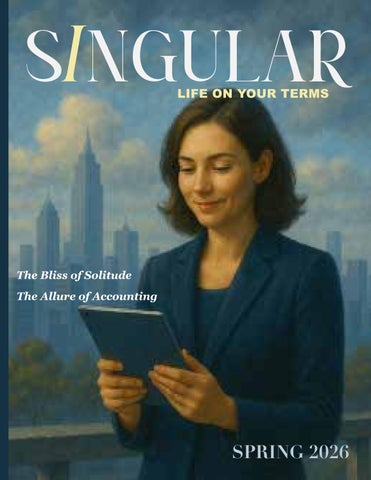
The Bliss of Solitude
The Allure of Accounting
Thank you for reading this first edition of Singular. This publication is a lifestyle magazine for Ayn Rand fans, Objectivists, for those who are ambitiously pursuing values to achieve a life of rational self-interest.
There are many excellent sources of analysis and commentary on current political eventsfrom Yaron Brook’s podcasts to ARI’s New Ideal content, to the Harry Binswanger Letter, and more. And there is a wealth of books and courses that teach the philosophy, most now available online. This magazine is not intended to replace any of those.
It is an antidote to the many jarring lifestyles magazine today, with their praise of “green” practices, of sacrificing for the environment, or of altruism and how you can help the poor and needy.
This magazine will celebrate lives being lived well by Objectivists, excellent books being written by them, art being created, values they are pursuing. I hope it will be provide inspiration for you and be a source for new values to consider pursuing.
Please contact me with any comments or suggested articles, or if you would like to subscribe for future editions.
jerieagan@me.com
A Philosophy For Living On Earth
Follow reason, not whims or faith.
Work hard to achieve a life of purpose & productiveness.
Earn genuine self-esteem.
Pursue your own happiness as your highest moral aim.
Prosper by treating others as individuals, trading value for value.
aynrand.org overview

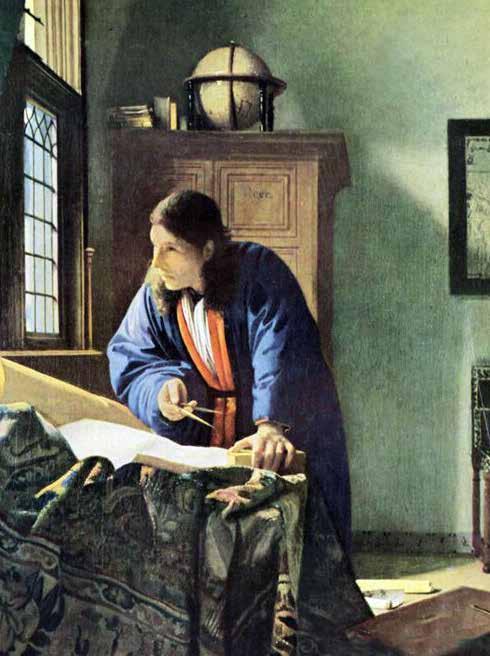
“A man thinks and works alone.” Ayn Rand
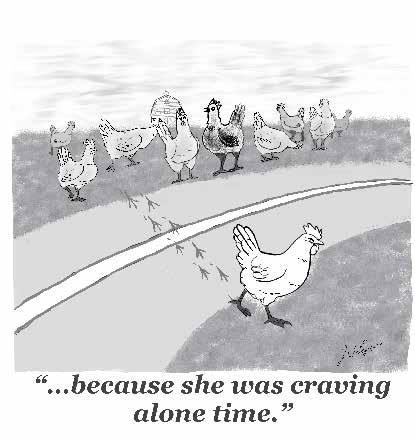
There is a quiet joy in being alone.
As Objectivists, we recognize the importance of independence and autonomy and we know that thinking is a faculty of the individual. We therefore tend to value solitude in a way that many people do not. It is often in solitude that one works, writes, plans, integrates and rests.
This article celebrates the value and benefits of solitude and explores its various forms and the views people have about the topic.
Solitude here is defined as the state of being alone by choice. It does not mean enforced exile, isolation, or withdrawal from the world. Nor is it loneliness, the ache of disconnection. It is not being a hermit or recluse.
The Benefits of Solitude
To begin to concretize the value of solitude, consider its absence. Imagine living in the Middle Ages. You sleep in a shared bed with
your family, inside a small hut where people are always nearby. What little personal hygiene there is, is done in public. Private conversations are virtually impossible. You are never alone. You could consider a walk into the forest, but that would be dangerous, and you have no time for it anyway as your daylight hours are consumed by the struggle to survive.
Ayn Rand dramatizes the horror of this kind of existence without solitude in her novel Anthem. She depicts a world stripped of privacy, where being alone is forbidden.

“As I lazily gazed down at the sea, I would often reflect on the profound truth: ‘There is no one else in the world, and the world was created for me.’” – A.A. Milne
Every waking hour is dictated by the authorities, who understood that eliminating solitude was the surest way to control people.

Thanks to capitalism and the industrial age, we now take privacy for granted and are able to enjoy the benefits of being alone.
Solitude is of value for productiveness. Every invention, idea, or work of art begins in a single mind. For some professions, such as writer, artist, architect, etc, solitude is absolutely necessary. It is the breeding ground of originality and provides a space where thought flows more freely. Imagine Howard Roark trying to design a building surrounded by chatter and being constantly interrupted —impossible.
For those whose jobs require frequent interaction with others, solitude provides a space for clarity and reflection. When I was an executive with a demanding meeting schedule,
I always instructed my assistant to schedule a half-hour open between meetings. That pause was crucial to my productivity as I integrated material from previous engagements and identified essentials. Other periods of planned solitude were crucial to planning and evaluating the business.
For those who seek mastery, solitude can also be important. Deliberate practice requires focus, self-motivation, and self-direction and thrives when one is alone. Even if the goal involves participation with others, such as a team sport or performance, skill development in solitude helps the endeavor.
In addition to the benefits of solitude for productiveness, it also provides psychological values. It is a respite from the constant stimuli of others. Conversations with other people, when you are really listening, engage too much of the mind for you to fully examine your thoughts about the topic. Solitude quiets both external noise and any inner turmoil. The reforming altruist benefits from solitude, for it removes the objects of sacrifice. It provides the time to identify if you are too much concerned with pleasing others. For those suffering from secondhandedness, the tendency to think and feel through others, solitude also provides a place to heal.
Introspecting emotions is another activity best conducted alone. Solitude provides uninterrupted time for analyzing, feeling and deeper self-understanding. It is not easy to identify what you are feeling when you are responding to constant input from others.
Solitude is also restorative. In 2015, the BBC’s Rest Test surveyed 18,000 people from 134 countries. Participants rated “spending time alone” as the most restful activity—above being with friends, eating, drinking, or even sex. Other research confirms that solitude helps regulate emotions, restoring balance and autonomy. As Rand describes Roark on the cliff in The Fountainhead:
“For three years, ever since he had resided in Stanton, he had sought solace here for his sole relaxation— swimming, rest, contemplation, and solitude whenever he could find an hour to spare.”
Despite all of those benefits, solitude is not always seen as a value. And there are individuals who hate the idea of being alone. Authorities have often discouraged it and society has often disparaged it. Those who choose solitude are frequently labeled anti-social, gloomy, or eccentric.
For most of history, solitude was
seen as dangerous or degenerate—except for a few saints, philosophers, or geniuses who found creative or spiritual joy in it. For women especially, solitude carried stigma. Terms like “old maid,” “spinster,” and “crazy cat lady” portray being alone as failure. Even today, anyone dining alone is often viewed with pity. In Japan and Australia, designers have created robotic “dining companions” to simulate a companion.
As mentioned above, capitalism, through prosperity and property rights, has made solitude accessible to virtually everyone. A locked door, a quiet room, a day of thought—these are achievements of the industrial age. But not everyone seeks it. If we seek solitude to reflect, create, or rest, it is a positive experience. If we fear it, it can become boredom or loneliness. Those who live for others may even find solitude intolerable—there’s no one to sacrifice for or to tell you what to think. There is no joy in having to be alone with your thoughts. Alternatively these people may seek alone time as an escape from others rather than as a positive value.
in Daffodils, one can even revisit solitude in memory.
Solitude can occur in different places—from a week in a secluded cabin to a few quiet minutes in a bathroom during a party. You might walk through the woods, read by a window, sketch in a park, write in a cafe, putter in your garden, or simply sit in silence to hear your own thoughts. Solitude can be found in vast landscapes or cozy rooms.
It can be found in hotel rooms or airplanes or your own back yard. As Wordsworth described
I think it is important to have a designated space to routinely pursue solitude. I remember the joy when, at age 15, I first had my very own bedroom. Ah, the peace. This joy was magnified when, at age 20, I had my first apartment without roommates. Having a designated time to spend alone is also a good idea, especially if you live and work with others.
In addition to occurring in different places, solitude can also take different forms and entail different activities. There is perfect solitude, which suggests physical separation from others and quiet. This is where you are alone and not engaged with any one in any way. You may be doing focused work, meditation, reflection, or journaling.
Another version of solitude is
than about Hopper’s subjects.
Solitude and Independence
There is no conflict between enjoying solitude and engaging with others. People enrich our lives through trade, knowledge, love, and inspiration. But after much social engagement, solitude feels like reuniting with an old friend. We need it to integrate experiences and gain clarity.
when you are alone and quiet but engaged with others in some manner. You might be mentally rehashing past conversations or planning future ones. You might be reading, a book, newspaper or online content, absorbing the author’s thoughts. But solitude would seem to stop once you start communicating in emails or through social media.
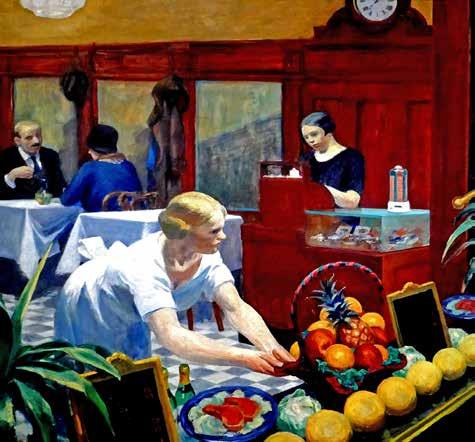
A different type of solitude is when you are around other people but not engaged with them and don’t expect to be interrupted. This abstracted time involves retreating into ones thoughts, reflecting, or becoming absorbed in a task. An example of this is in the Edward Hopper painting, Tables for Ladies - figures that are calm and self-contained, absorbed in thought. Those who value solitude will find inspiration in paintings like this, while those who see sadness reveal more about their own discomfort with solitude
“The independent individual who resides in society learns from others and may choose to collaborate with them, but the essence of his learning and work lies in the process of thought, which he must undertake alone.”
For those who prize reason and individualism, solitude is a value. To live on one’s own terms, one must think, choose, and act on one’s own judgment. Solitude provides the space and time to do this. For many, solitude has been seen as a means to hear the voice of God. In truth, in solitude, one hears one's own voice—and becomes one's own divinity. $
“Whoever delights in solitude is either a wild beast or a god.”
Aristotle
“He who separates himself seeks his own desire; he quarrels against all sound wisdom.”
Proverbs 18:1
“A perfect solitude is, perhaps, the greatest punishment we can suffer. Every pleasure languishes when enjoy’d apart from company, and every pain becomes more cruel and intolerable.”
David Hume, A Treatise of Human Nature (1739–44)
“To be alone is not freedom but despair.”
Gabriel Marcel, Being and Having (1935)
“Solitude is the punishment our modern world inflicts for the failure to connect.”
Erich Fromm, The Art of Loving (1956)
BY WILLIAM WORDSWORTH
“Whether we are in a crowd, on a journey, or even at some festive gathering, our thought should make for itself an inner sanctuary.”
Quintilian, 1st century AD
“In solitude the mind gains strength and learns to lean upon itself.”
Laurence Sterne, 8th-century novelist
“In solitude we find ourselves; in crowds, we lose ourselves again.”
Friedrich Nietzsche (1844-1900)
“The best thinking has been done in solitude. The worst has been done in turmoil.”
Thomas A. Edison (1847-1931)
“The mind is sharper and keener in seclusion and uninterrupted solitude. ..Be alone, that is the secret of invention; be alone, that is when ideas are born.”
Nikola Tesla (1856-1943)

I wandered lonely as a cloud
That floats on high o'er vales and hills, When all at once I saw a crowd, A host, of golden daffodils; Beside the lake, beneath the trees, Fluttering and dancing in the breeze.
Continuous as the stars that shine
And twinkle on the milky way, They stretched in never-ending line
Along the margin of a bay:
Ten thousand saw I at a glance, Tossing their heads in sprightly dance.
The waves beside them danced; but they Out-did the sparkling waves in glee:
A poet could not but be gay, In such a jocund company: I gazed—and gazed—but little thought What wealth the show to me had brought:
For oft, when on my couch I lie
In vacant or in pensive mood, They flash upon that inward eye Which is the bliss of solitude; And then my heart with pleasure fills, And dances with the daffodils.
Iama passionate accountant. And that is not intended as a joke.
To many, accounting is seen as dull—an occupation for dogmatic rule-followers and bean counters, far removed from the excitement of the business world. In fiction, accountants are often cast as the ones who gave up their dreams, who sold out for stability, who only care about cutting costs. This stereotype is as persistent as it is misleading.
And yet accounting is at the heart of running any business. It is a way of thinking, of understanding economic reality through numbers. It is fundamental to capitalism. And it IS exciting. I enjoyed a fabulous career as testament to this.
Accounting is the system of processing and recording financial transactions. These transactions are classified, verified, summarized, and reported in financial statements. The key financial statements depict how the company
“ACCOUNTING IS THE LANGUAGE OF BUSINESS.”
Warren Buffet

has performed for a given period (income statement), what its financial position is at the end of the period (balance sheet) and an analysis of cash flow. The financial statements are then audited and reported to shareholders. This is the essence of financial accounting. In addition to financial accounting, there is management accounting, which focuses on determining and providing the information needed to run the business.
The system of recording for modern financial accounting is based on double-entry bookkeeping, first formalized by a Franciscan friar and mathematician in the 15th century, Luca Pacioli, a colleague of Leonardo da Vinci. Pacioli’s method recognized that every business transaction has two sides: for example, if you buy raw materials, you decrease cash (credit) and increase expenses (credit); if you borrow funds, you increase both cash (debit) and liabilities (credit)
formance and position. Without accurate and consistent financial statements, large scale capitalism itself would not be possible. Who would invest money in large corporations who did not provide reliable financial information?
be expensed when issued since the company is benefiting from the labor, or when they vest and become a firm obligation of the company, or when they are exercised and the exact price is known? If the share price changes, should that be reflected in the current period?
.And so on. This beautifully logical system ensures accuracy, consistency, and accountability. An important benefit of this system is that it provides a built-in error detection tool; if at any moment in time the sum of debits for all accounts does not equal the corresponding sum of credits for all accounts, you know an error has occurred. I recall my joy in learning this elegant structure when taking my first accounting course in college. It was a respite from the confusion of the required liberal arts courses.
I further delighted in learning how the architecture of double-entry accounting provided for investment, transparency, and the kind of complex organizational coordination necessary for the Industrial Revolution and beyond. (See sidebar). The audited financial statements, along with footnotes, are key to an investor understanding the business per-
Today the processing and recording of many routine transactions is automated. An accountant must ensure that the systems for doing this run well. Failure in this area can cause massive harm. If the systems, particularly the implementation of new ones, are done without proper controls, this can lead to unpaid bills, missed revenue, and lost customers. Errors in classification or timing can lead to regulatory fines, lawsuits, reputational damage, or even collapse.
Another example of a new type of transaction is one I encountered in the oil industry. While companies can have full ownership of oil and gas reserves in the ground in the US, this is not so in other countries. Can the company re -
as an exchange of assets. They need to review contracts for the presence of commitments that should be recorded as a liability. A knowledge of the law is a great help in this area and this is why accountants are schooled in business law. They must also determine whether certain values recorded in the past still reflect present reality. This requires an understanding of microeconomics and valuation theories. This is not just bookkeeping—it is analytical and requires an understanding of the economic consequences.
Accounting is not just about counting beans; it’s about making every bean count” - William Reed
But transaction processing is just the beginning for accountants. The further challenges are more concerned with classifying and interpreting the information in a meaningful way. This requires classifying new or unusual transactions to accurately represent their economic reality. There are various standard setters with rules, but they cannot keep up with business innovations in transaction structuring. Working within existing rules to properly reflect the economic reality of a transaction is a creative challenge for accounting.
Consider stock options issued as compensation: Should they
cord the oil in the ground as an asset in Venezuela if the company never owns the barrels but is only allowed a percentage of revenues? What level of legal ownership is necessary to classify as an asset? Conceptual challenges like these ensured that my job was never dull.
Accountants must also review non-cash transactions, such

Beyond the externally issued financial statements, the most important user of accounting information is the company’s own management. The information provided by accounting is vital to running any business. Internal leaders use management accounting to make informed decisions, including pricing, budgeting, cost control, investments, and operational efficiency. It combines financial data with non-financial information such as the volumes of various products produced.
When working as an accountant I learned that accounting is the language of business. Understanding concepts like revenue, expense, profit margins, assets, liabilities, and such provides the evidence for sound decision making. Accounting reflects the economic reality of transactions. Accounting can provide answers to questions such as::
How much profit did we make? Why was it more or less than last year?
Which products or stores are most profitable? Why? Is it related to cost or to sales volume?
Do we have enough cash to survive a downturn—or to expand?
Which costs are fixed, and which vary with production?
Which investments would yield the most return on capital?
The challenge of answering these questions is part of the fascination of the work that accountants do. Accountants must deeply understand the business and its drivers. They must provide not only accurate numbers but also context, insight, and judgment. They also help management determine which information is most relevant to the decisions.
The insight into the business that accounting provides is why many top executives began their careers in accounting. As John D. Rockefeller once said of his first job in bookkeeping,
“The place was delightful to me—all the method and system of the office. My eyes were opened to the business of transportation.”
A good accountant is also crucial to protecting the integrity of an enterprise. They explain, advise, correct, and anticipate. They are often the first to spot problems before they become disasters. When I was a CFO, the CEO of the business called me his “conscience”.
The best accountants are not just number-crunchers; They’re financial storytellers.”
— Jessica Turner
He would turn to me for my studied opinion on the economics of a decision to avoid letting his unconsidered excitement take over.
I was also key to preventing any intentional distortion—known variously as creative accounting, financial engineering, or earnings management. Enron was an expert at this. These methods obscure economic reality: selling and leasing back assets to inflate returns, hiding debt through off-balancesheet arrangements, timing the recording of revenue or expenses to manipulate earnings. Such actions betray the purpose of accounting. They distort truth. They undermine trust. As mentioned above, financial statements tell a story, and it important that it be non-fiction. The “conscience” of the CEO should not let this happen.
In addition to internal and external reporting, and providing guidance in business decisions, accountants play a key role in any merger and acquisition deals. They interpret the financial information from the target company, advising on the valuation and looking for hidden issues.
There are also specializations within accounting. In the area of taxes, accountants' work yields quantifiable value as they find ways to minimize the burden. There is also a specialty of forensic accounting, which is like being a detective for fraud. So much can be detected from an
understanding of the numbers.
Accounting is not dull. It involves critical thinking and creative problem-solving. It is at the core of running a business. It is crucial for evaluating business performance, for business decision making, for interpreting economic impacts of contracts, and for advising investors and management.
My career, which started in accounting, led me to the highest levels of management within an international oil company. At every stage of my career, I learned more about the varied parts of the business. I redesigned complex systems, I provided critical thinking in mergers and acquisitions, I successfully fought against “financial engineering”, and I advised on where we should invest our capital.
My success required constant productivity, honesty, integrity, justice, and independent thought. I loved the structure and method, the focus on reality, and seeing capitalism at work. I cannot imagine having had a more rewarding career. $

During the Industrial Revolution, double-entry bookkeeping was a crucial tool.
Improved financial management: This system allowed companies to accurately track their financial transactions, assess profitability, manage cash flow, and ensure proper record-keeping.
Facilitated investment: By providing transparency to potential investors and lenders, the system made it easier for businesses to secure financing for expansion and investment in new technologies and infrastructure.
Cost accounting and efficiency: The ability to precisely track costs associated with production, labor, and materials became vital in the era of mass manufacturing.
Enabled better decision-making: Having a comprehensive view of a business’s finances allowed entrepreneurs to make more informed decisions about production, pricing, and overall strategy.
In essence, double-entry bookkeeping provided the necessary framework for managing the complexities of growing businesses during the Industrial Revolution.
It is simply impossible to imagine capitalism without double-entry bookkeeping; they are like form and content.”
Jane Gleeson-White
Author of Double Entry: How the Merchants of Venice Created Modern Finance
Thesebooks by Objectivists are highly recommended. Unlike some of the earlier attempts by Objectivists to write fiction, these do a great job of “showing” rather than “telling” the principles of the philosophy. If you enjoy heroes with integrity, you might enjoy these. The non-fiction books included here provide a deeper exploration into how to live life according to Objectivist principles.

S.F. Hayes
Charlie Emerson, media mogul, thrives on control— over his company, his employees, and his life. But his empire is on the brink of collapse and he’s desperate. His solution to drive up ratings and sales: a reality show centered around a fake marriage between a high-powered music mogul—himself— and a struggling artist. All he needs is a bride.
Alexandra “Alex” Weiss is a reclusive coffee vendor and struggling musical prodigy with dreams of producing her Red Concerto. She’s learned that blending in with others’ expectations is the safest way to survive, but when Charlie proposes his deal—a fake marriage in exchange for producing her music—she can’t resist. How hard can it be to fit into his world?
What should be a simple arrangement quickly spirals into something far more complicated. Alex’s music, raw and haunting, shatters Charlie’s tight grip on his carefully curated world, and his obsession with control turns into a dangerous need to uncover Alex’s past. As the show drags them into the ruthless glare of the public eye, old wounds resurface, dangerous betrayals abound, and a real attraction ignites between them. When Charlie’s control slips and Alexandra’s past catches up with her, both are forced to confront their deepest desires—and their darkest fears.
In this taut psychological thriller, two lives collide in a world of manipulation, ambition, and hidden truths. The show may be fake, but the consequences are real.
What a wonderful book! The compelling plot, vivid writing and intriguing characters make it such a delight. It has been a long time since I read a book where I was this invested in the outcome. I was rooting for the heroes to make the right decisions. Highly recommended, especially if you appreciate what the author calls “the prospect of someone completely engrossed in their work”.
JB Phillips
Excellentbook. The abolition of slavery in the United States was an act of justice, but that act was incomplete. Considered subhuman even by many advocates of abolition, African slaves were unprepared for the challenges of freedom. Uneducated and brutalized for generations, they lacked the skills required to make life’s choices. The result was political and social turmoil that contin-
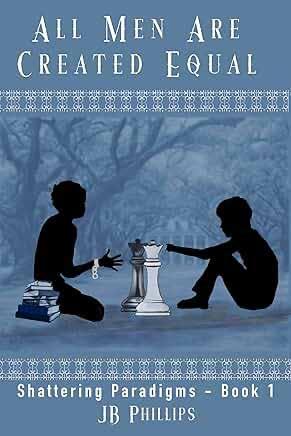
ues to this day. It didn’t have to be that way. All Men are Created Equal dramatizes what could have and should have been done to prepare slaves for freedom. In the novel, Samuel, the son of a slaveholder, befriends Will, a slave boy. Their friendship changes their lives, and ultimately the course of history.
AMAZON
Can one person change the course of history?
The son of a slaveholder, Samuel Dawson abhors slavery. In 1857, Samuel challenges the paradigms of Southern culture by befriending Will, an enslaved boy his father has recently purchased. Samuel’s father demands that Samuel end the friendship but can offer no rational reason for doing so.
When Samuel is put in charge of his father’s plantation, the son begins an audacious experiment. He treats the slaves as human beings. Facing overwhelming criticism and hostility, Samuel must make a lifealtering decision. He can succumb to the pressure to conform, or he can pursue his vision of what is right.
All Men are Created Equal is an inspiring story of courage and independence in the face of monumental challenges.
Tara Smith
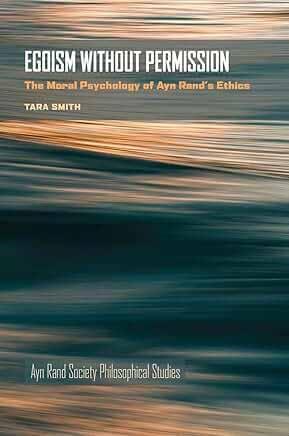
Whenpracticing a radical new theory of morality such as that of Ayn Rand, one can go wrong in numerous ways. Leftovers from previously held philosophies can lurk unseen in the depths of one’s mind, undermining the value to be gained by fully practicing the new rational ethics. Dr. Smith highlights several of these areas and explains in her clear, compelling style how to overcome and avoid these pitfalls. This guidance and her emphasis on the purpose of morality being that of a flourishing life were immensely helpful to me.

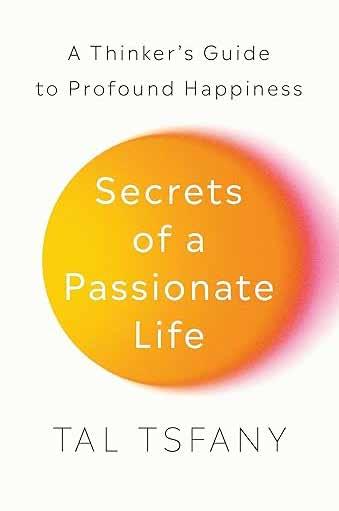
Tal Tsfany
Do you still feel the fire inside you? That energy craving a life of deep meaning, self-expression, and fulfillment?
Most people settle for a “can’t complain” existence—comfortable but uninspired. Secrets of a Passionate Life challenges you to aim higher and craft a life rich with passion, profound happiness, and joy.
Drawing on the revolutionary principles of Ayn Rand’s Objectivism, Tal Tsfany offers a bold, practical guide to reclaiming your passions, overcoming emotional barriers,
and engineering a life of authentic happiness. Through thoughtprovoking insights and real-world strategies, you’ll learn how to:
-Define what happiness truly means—on your own terms
-Uncover and embrace your deepest and authentic values
-Break free from self-doubt and emotional limitations
-Take bold action to transform your dreams into reality
-Derive and extract self-esteem from your pursuits and achievements
This book isn’t for those content with mediocrity—it’s for the dreamers, the doers, the thinkers who refuse to let their fire go out.
(From Amazon description)
Ayn Rand controversially defended rational egoism, the idea that people should regard their own happiness as their highest goal. Given that numerous scholars in philosophy and psychology alike are examining the nature of human flourishing and an ethics of well-being, the time is ripe for a close examination of Rand’s theory. Egoism without Permission illuminates Rand’s thinking about how to practice egoism by exploring some of its crucial psychological dimensions. Tara Smith examines the dynamics among four partially subconscious factors in an individual’s well-being: a person’s foundational motivation for being concerned with morality;
their attitude toward their desires; their independence; and their self-esteem. A clearer grasp of each, Smith argues, sheds light on the others, and a better understanding of the set, in turn, enriches our understanding of self-interest and its sensible pursuit. Smith then traces the implications for a broader understanding of what a person’s self-interest genuinely is, and, correspondingly, of what its pursuit through rational egoism involves. By highlighting these previously under-explored features of Rand’s conceptions of self-interest and egoism, Smith betters our understanding of how vital these psychological levers are to a person’s genuine flourishing.”
University of Pittsburgh Press

In the midst of all of the non-representational blobs and smears of paint known as modern art, there are some shining examples of beautiful paintings being created by members of the Objectivist community. This article highlights some of my favorites. They provide fuel for the soul. If you appreciate the recreation of reality according to these artists’ metaphysical value judgments, I encourage you to further explore them.

I can’t help but smile with I see these sunflowers. They reach towards the glorious sun with such joy. As Jo Marie says on her website:
“A strong composition, a harmonious integration of color, the infusion of light into shadow and the quality of air, are all essential ingredients in my paintings. But, what is most important is the concept I want to convey.”
From her studio in Manhattan, Jo Marie creates beautiful still lifes that capture the light with such emotion.
https://www.jomariediiorio.com
Hanging in the entryway to my home is this sumptuous still life by long term painter, Linda Mann.
It brings me into a quiet world of books and contemplation of art, one where the light is sharp and clear. And in this world, there are little luxuries like the gold brooch and the touchable soft velvet. The glass vials provide a hint of science.
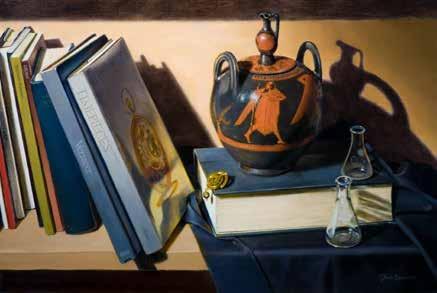
Here is what Linda says on her website: “…Through her selective and heightened focus and dramatic lighting, everyday objects are imbued with weight and meaning. In unstable times, it is valuable to step back and be reminded that despite chaos, the world is still understandable and beautiful.” “Over the years, Linda Mann has chronicled the journey of her artistic technique, opening a window into her process for others to learn from and enjoy”
Linda Mann lives and works in Bellevue, Washington. https://www.lindamann.com

“Arline Mann’s watercolor paintings contemplate light and shadow in personal spaces and on cherished objects. Building on the traditions of Nineteenth-Century Scandinavian painters such as Christen Kobke, Constantin Hansen, and Anders Zorn, her work seeks clarity and calm, and assumes a benevolent world. In Mann's watercolors, exterior light stresses the comfort and shelter of the interior elements -- a distinctive room, familiar objects such as glass, books, soap -always with a sense of human occupation.”
“I paint to recreate for myself a very specific lifelong sense of exaltation, and to offer a viewer that same experience.”
Mann lives and works in New York City and Chattanooga, Tennessee.
Above is her latest work - Open Window in her Personal Spaces category.
To the right is my favorite of Arline's painting, Place of Peace, painted in 2021. What a lovely place for solitude.
https://www.arlinemann.com

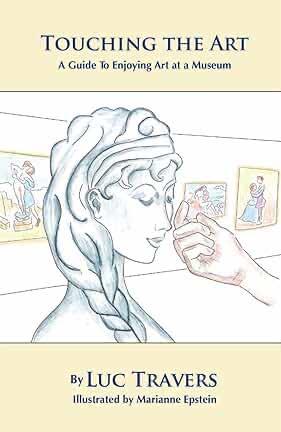
If you would like to appreciate art even more, I suggest you discover Luc Travers. He has written two books that are guaranteed to make you look at art more closely. One is Touching The Art, A Guide to Enjoying Art at a Museum.
As he says: “A visit to an art museum does not have to be a history lesson. Appreciating a painting is not reserved for a cultured few. For many people, a visit to an art museum can feel like a tiring cultural duty. The visual arts, however, have the potential to be as thrilling to experience and as personally moving as your favorite movies. Get ready to experience an innovative yet intuitive approach to enjoying art!
In this book, I will introduce you to five powerful works of art and teach you how to experience them like you would a great movie or novel. You will learn how to “read” an artwork; how to bring static images to life; how to connect your life to the lives of the characters in the art; and how to create for yourself a museum experience that will thrill and inspire you. You will never look at the visual arts the same way.”
Campus SOFT RING notebooks by Kokuko Made in Japan. Available on Amazon

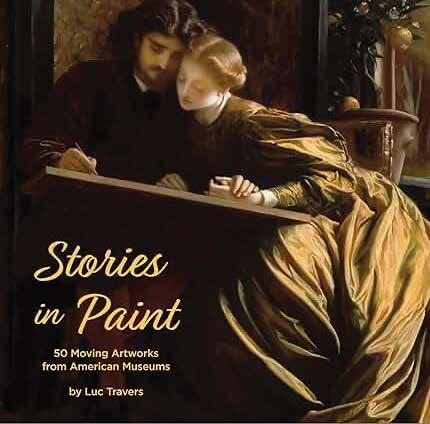
In his second book, Stories in Paint, 50 Moving Artworks from American Museums, “you get 50 beautiful and intriguing artworks, guiding questions to help in your own immersion into the works, and my in-depth “readings” of each painting. It will feel like you’re coming on a museum tour with me.”
Having been on several of those tours, I would highly recommend them. https://www.touchingtheart com

Elegant, thin lines 6mm

Comes in many different sizes and colors

Dr Jart+ BB Premium
If you don’t like spending time applying numerous products to your face in the morning, try this. It provides:
Hydration
Sunscreen - SPF 40
Niacinamide
Medium coverage
Several shades
Dispensing with a pump - no messy sponges needed
Available at Sephora and Amazon

I am not opposed to using fancy facial products, but for my face cleanser I use Cetaphil, available at most drug stores and on Amazon. Why?
It’s clear, non-oily, and has no fragrance
It rinses off easily
Removes all make up, even mascara
Leaves skin soft and moist
Bidet.
The warm seat is so welcoming. And the cleaning features make life easier and you don’t run out of toilet paper as often. Enough said for the pleasure I get from Toto’s bidet. I miss this when I am traveling, except when I am in Tokyo.

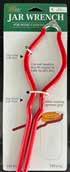
There is no jar that I have not been able to open with this Jar Wrench device. It adjusts to any top and provides a firm rubber grip. The handles provide incredible leverage. This makes a great gift for friends with arthritic hands. Order at My Kitchen Center. https:// www.mykitchencenter.com
Not ready to buy a new car just to get the latest technology, like Car Play? This magnetic holder was the best I found for securing your phone to the dashboard to use its GPS. And it swivels. Available on Amazon.



All ice cream scoopers are not the same. Some are just round. Some are not deep enough. This particular one - OXO SoftWorks Ice Cream Scoop With Nonslip Grip is the best. The flat, rather sharp top cuts right through the ice cream. The ice cream slides out without the need for one of the fiddly levers. Give it a try. Available at https:// www.athome.com
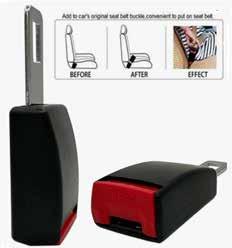
Such joy from such a simple device. The seat belt extender snaps in to the fixed end of your existing seat belt and remains there. The strap snaps in to it.
Benefits include:
Easier to reach
No annoying bells and screeches
Accommodates large torsos and baby seats.
I almost always choose to wear my seat belt, by my choice. Available on Amazon.
For many years my favorite coffee beans were from Starbucks. And my favorite variety was Sumatra, which has a smooth but earthy and full bodied flavor. I recently discovered beans that were even better - from a little specialty shop housed in an historic building on the lakefront in Milwaukee, Wisconsin. https://colectivo.


Coffee has gotten complicated. This guide gives the varying proportions of espresso, milk, cream, and other add -ins. Have you heard of all these names? And these are just for espresso drinks.
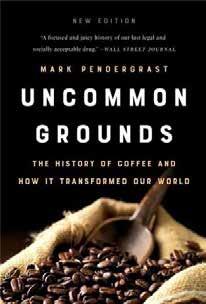
For a delightful history of coffeefrom its discovery in Ethiopia around the 9th century to the creation of the beverage in Yemen in the 15th century to the blossoming of coffee houses in Europe to the Starbucks experience - this book covers it all.
Even with this many options, there is yet a different mix that I prefer. Espresso is too syrupy for me and yet “regular” coffee seems too weak.
So I order what Starbucks calls a Red-Eye - a regular coffee with a shot of espresso. (Two shots is called a Black-Eye.) A splash of half and half and I am in heaven.


JURA GIGA 10
Fully Automatic Espresso Machine
Pour in the beans, fill the water tank, and push a button for the best possible home coffee.


Havingspent several decades in various levels of management at a giant international company and at several small start-ups, here are some of the key things I have learned about managing people: 1. All employees are not alike. Yes, they should all be treated fairly and under consistent policies. But they have different skills and capabilities and experiences. They often have different motivations. So, a manager would do well to treat them differently.
2. Communication is critical. When giving an assignment to staff it can help to give them the full context, to explain why you need a particular piece of work done. Knowing the purpose not only makes the task more meaningful to them, it allows them to work more independently, making relevant decisions on their own.
It is also important to communicate to all staff about the company’s strategy and plans.
3. When assigning new work, be sure to clarify where it fits in the employee’s existing work priorities. Due dates can also help convey the urgency and help with prioritization.
4. Laying off staff can boost morale. Employees know who is not pulling their weight and the injustice of this can be demoralizing. When cost constraints require a reduction in the number of employees, take the time to base the cuts on competence. Never ask for volunteers or you will lose the better staff who are employable elsewhere.
5. As you progress to higher levels in the organization with managers reporting to you, be sure to frequently engage directly with the lower level staff rather than hav-
ing everything filtered by your direct reports. This can be done without undermining your managers.
6. Dig deep when something goes wrong. This is a perfect opportunity to have lower level staff clearly explain what went wrong and how to fix it.
7. Respect the expertise of your staff, especially the ones with deep technical knowledge. But do require them to explain issues in less technical language, translating insider verbiage. $
• Ensure that everyone knows the purpose of the meeting in advance; send out an agenda with time allotted for each item
• Have someone capture action items and decisions and have them read back at the end of the meeting
• Be aware that some people talk more than others. Draw out the quiet ones, who sometimes have the best ideas
• Assume participants have read any materials sent in advance and don’t repeat the information during the meeting
• Using slides during a presentation that depict charts or pictures or relationships can be helpful, but those with just words can be distracting as the audience tries to read and listen at the same time.

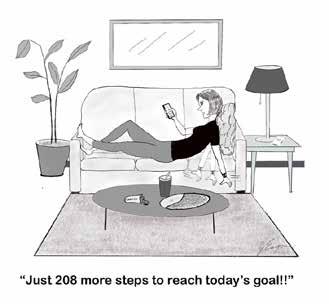
With my background in accounting, I have always loved to measure things. I’ve tinkered with this in the health and fitness area, trying most new products as they come out. Here are some of my favorites:
Oura ring - I find this easier to wear than a watch. In the 6 years I’ve been using it, the newer devices have become thinner and now could easily pass for jewelry. I wear it on my ring finger, even though it is suggested that one wear it on one’s index finger. I found the index finger wear to be intrusive. The battery lasts an average of 4.5 days. It is waterproof so I only take it off for the hour it takes to charge it.
Like several other devices, the ring measures steps. Since it does this by arm motion, it won’t count if you are walking with your arms still, such as when pushing a grocery cart or carrying something. It doesn’t count if you are on a bike, holding on to the handles. I get around this by wearing it on my toe when working out on my stationery bike.
It measure sleep - total sleep as well as REM (dreaming) and deep sleep and time awake. It also measures HRV while sleeping. This is all summarized in a sleep “score”.
From an algorithm using body temperature,
HRV, and movement, it calculates “stress”. I tend to ignore this part of the data - since seeing that I am stressed causes me to feel stress.
It doesn’t measure real time heart rate as well as a heart rate monitor, so when doing aerobics I also wear a heart rate monitor using a chest strap (Morpheus is the best I’ve tried for this).

MyFitnessPal is an app I use to record my daily food consumption. With its massive database and its ability to read bar codes, it is relatively easy to input the information. The output shows calories, protein, fat, sugars, minerals, etc. It totals these for meals and for the day.
One advantage of this is the awareness it provides of how much and what kinds of foods you
are eating. In my annual physical one year the blood test results read that my potassium was too high. I was able to check what I had eaten and tell the doctor that it was not what I was eating that caused the result.
Another advantage I found is that it forces me to face up to reality. When trying to cut calories, this can be important.
“Yes, Jeri, you really ate three of those cookies, not two.” When I know I’m reaching the limit of my goal for the day and realize I will have to record what I eat next, I will often forego that late night snack.
So, these are my favorite daily use measurement apps. What are yours? $
• captures steps, heart rate, stress levels, readiness, oxygen and more
• measure sleep stages and gives a score
• battery lasts 4-5 days and charges within an hour
• waterproof
• thin and comfortable
• comes in different sizes and beautiful colors

Now there’s a new proactive tool to screen for cancer.
The Galleri test can be taken annually as a simple blood test. It screens for a “fingerprint” of many of the deadliest cancers before they become symptomatic, including those with no recommended screening tests today.