A lot of us think that getting healthy means making a big change—starting a new routine or making a New Year’s resolution. But as I read through this issue, I was reminded that wellness is usually about the small things. It’s the everyday choices that help us feel more like ourselves.
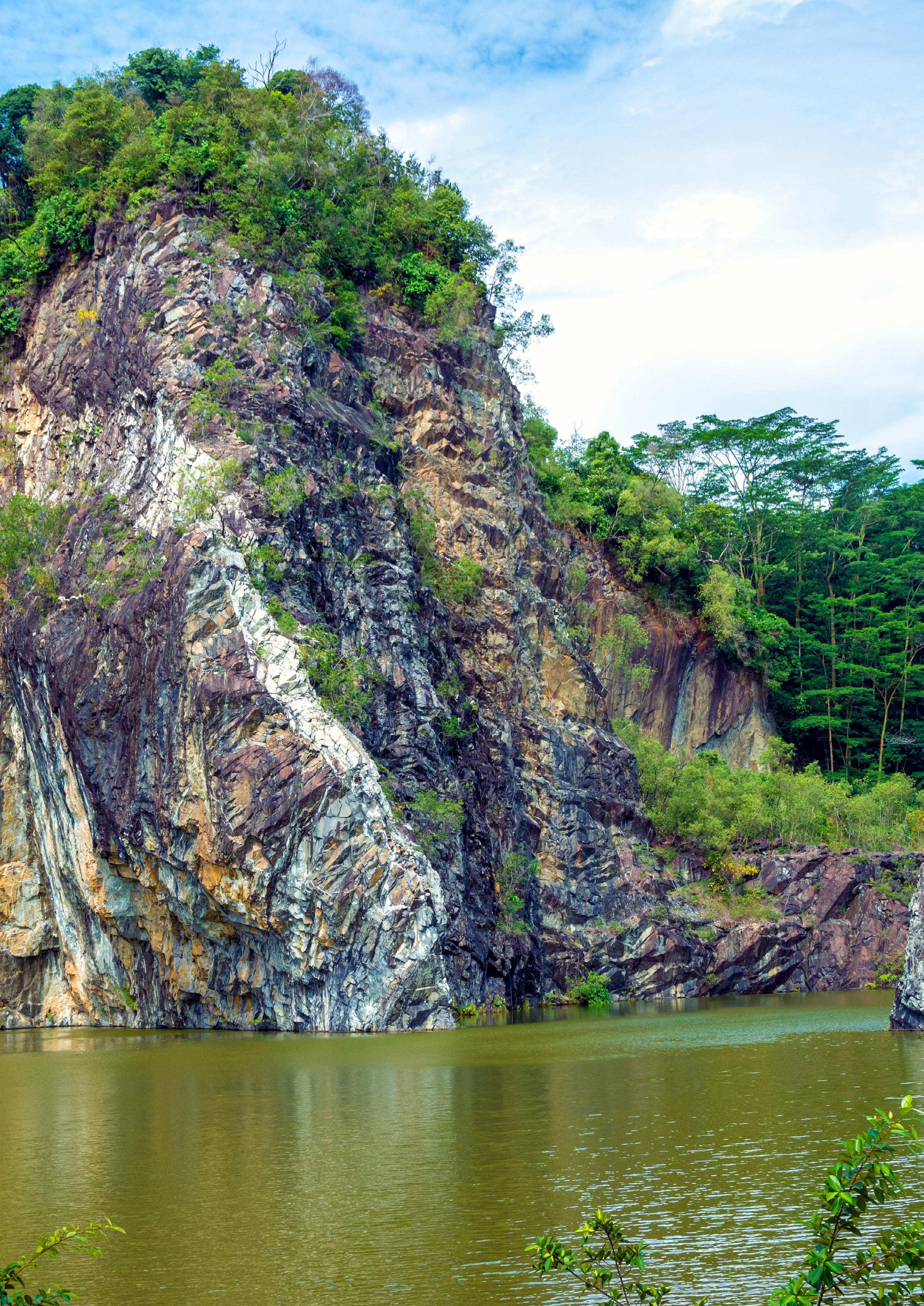
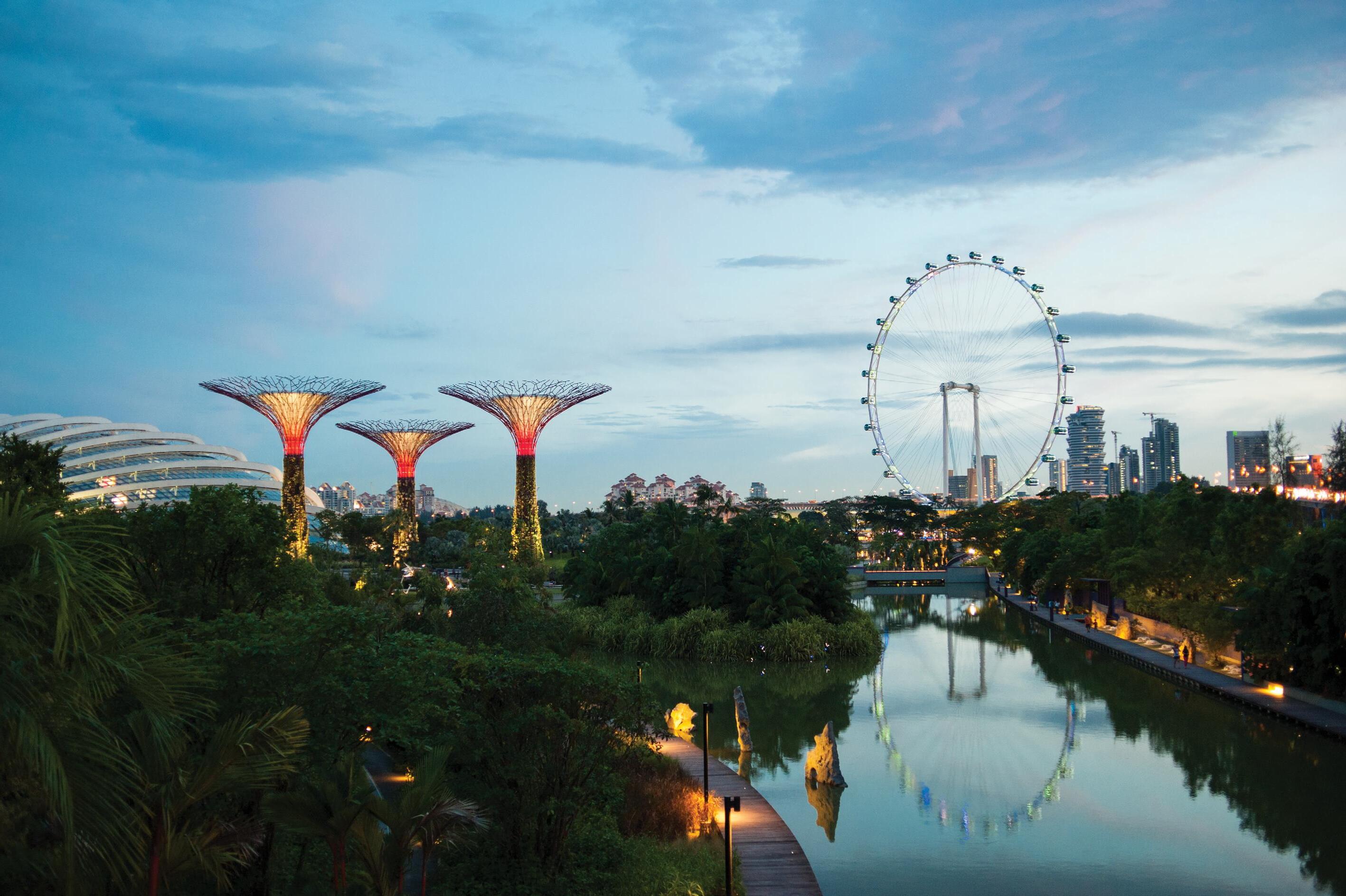
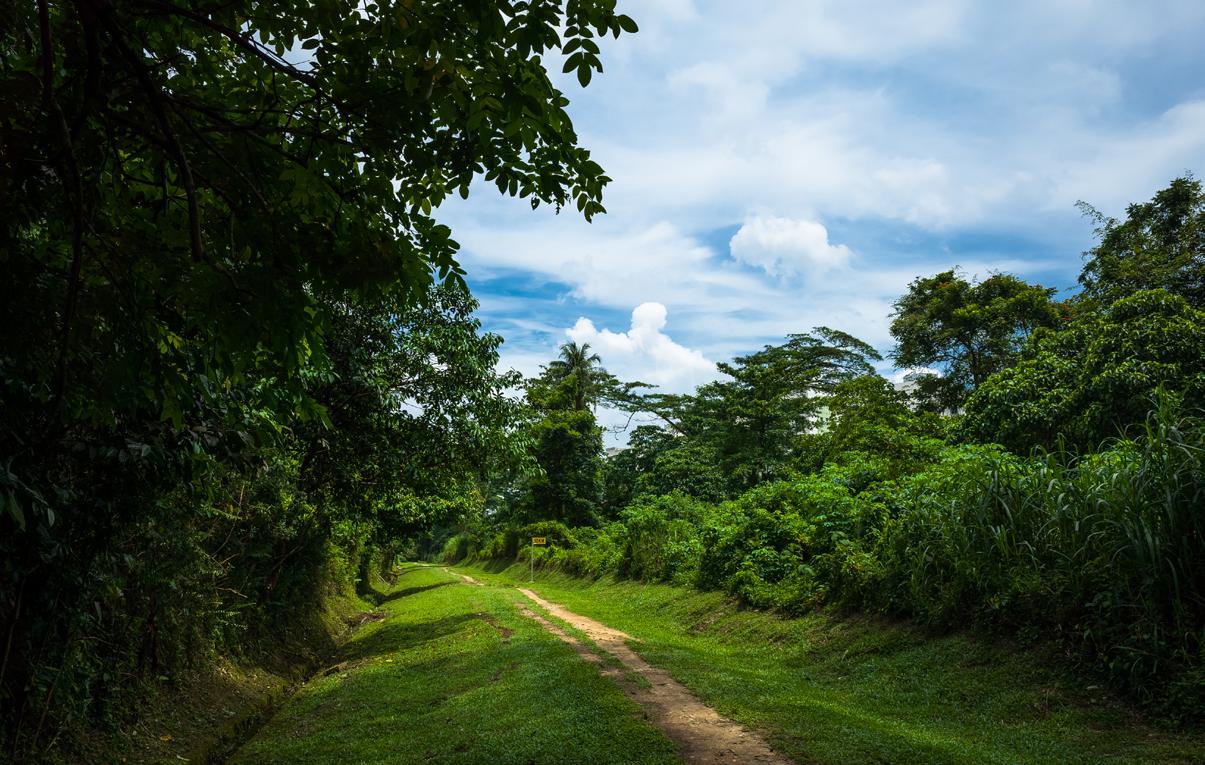
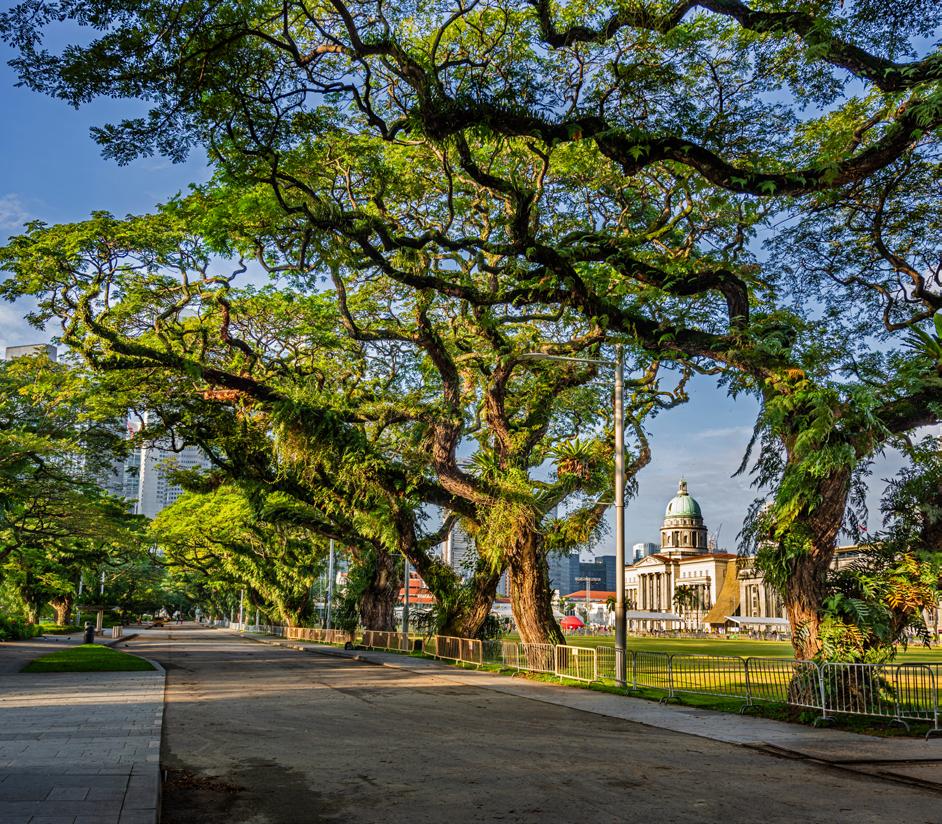
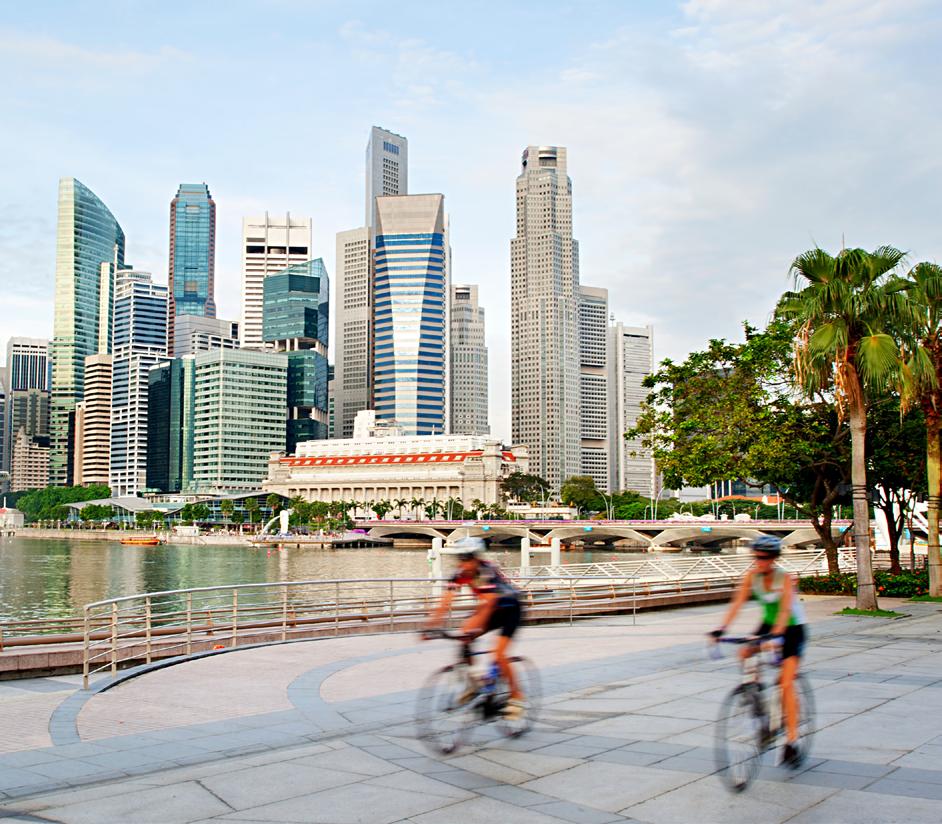
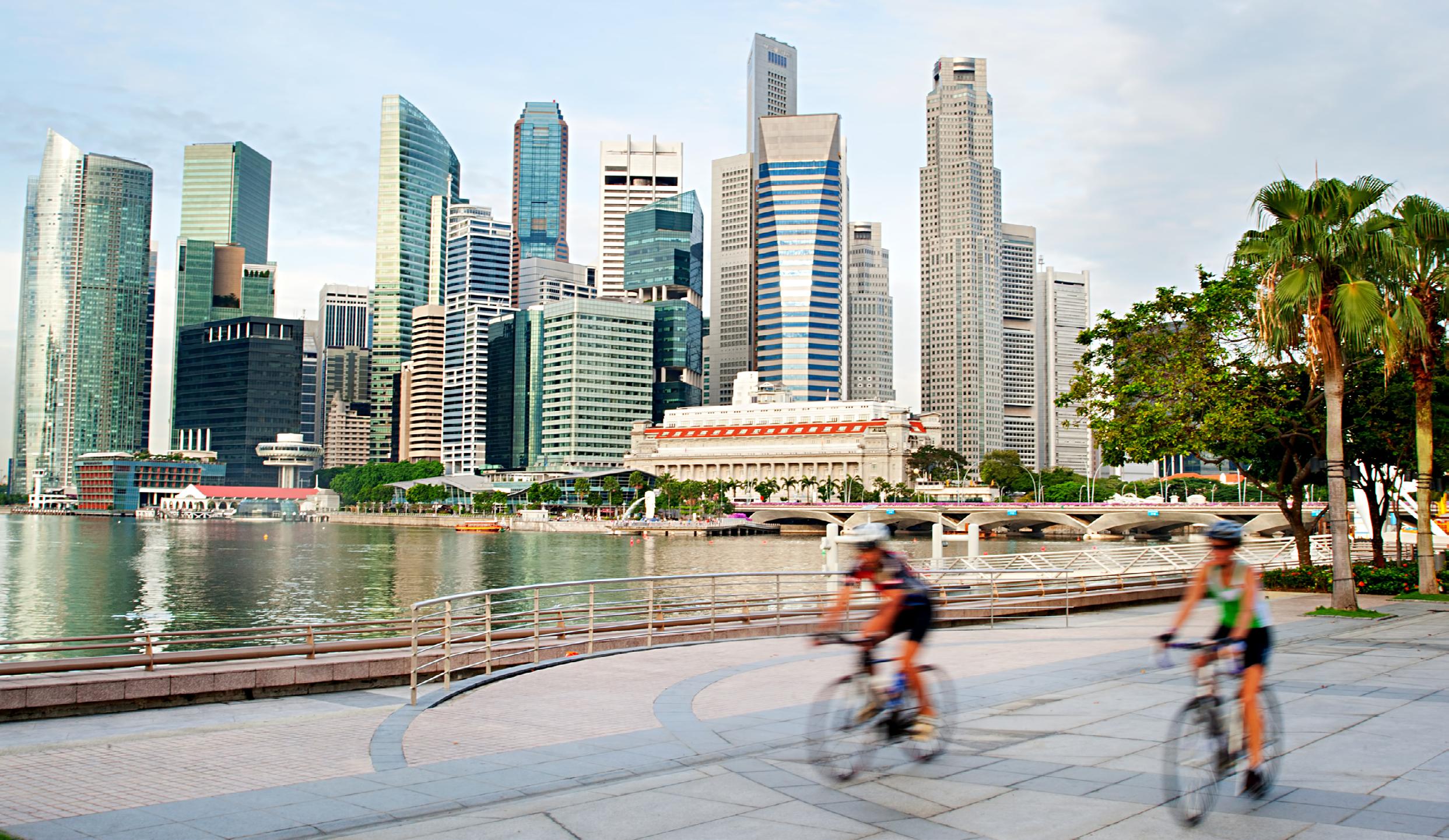
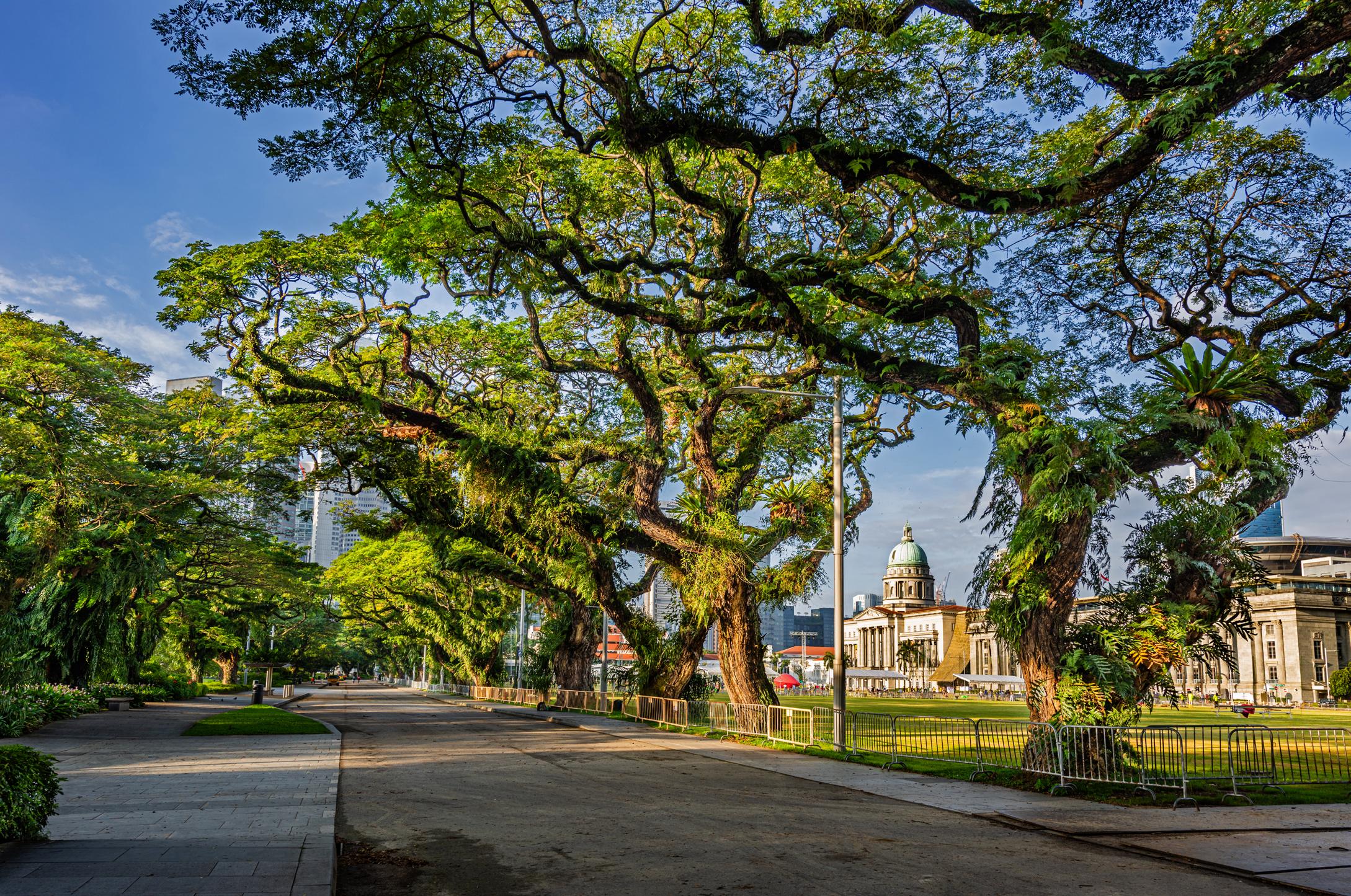
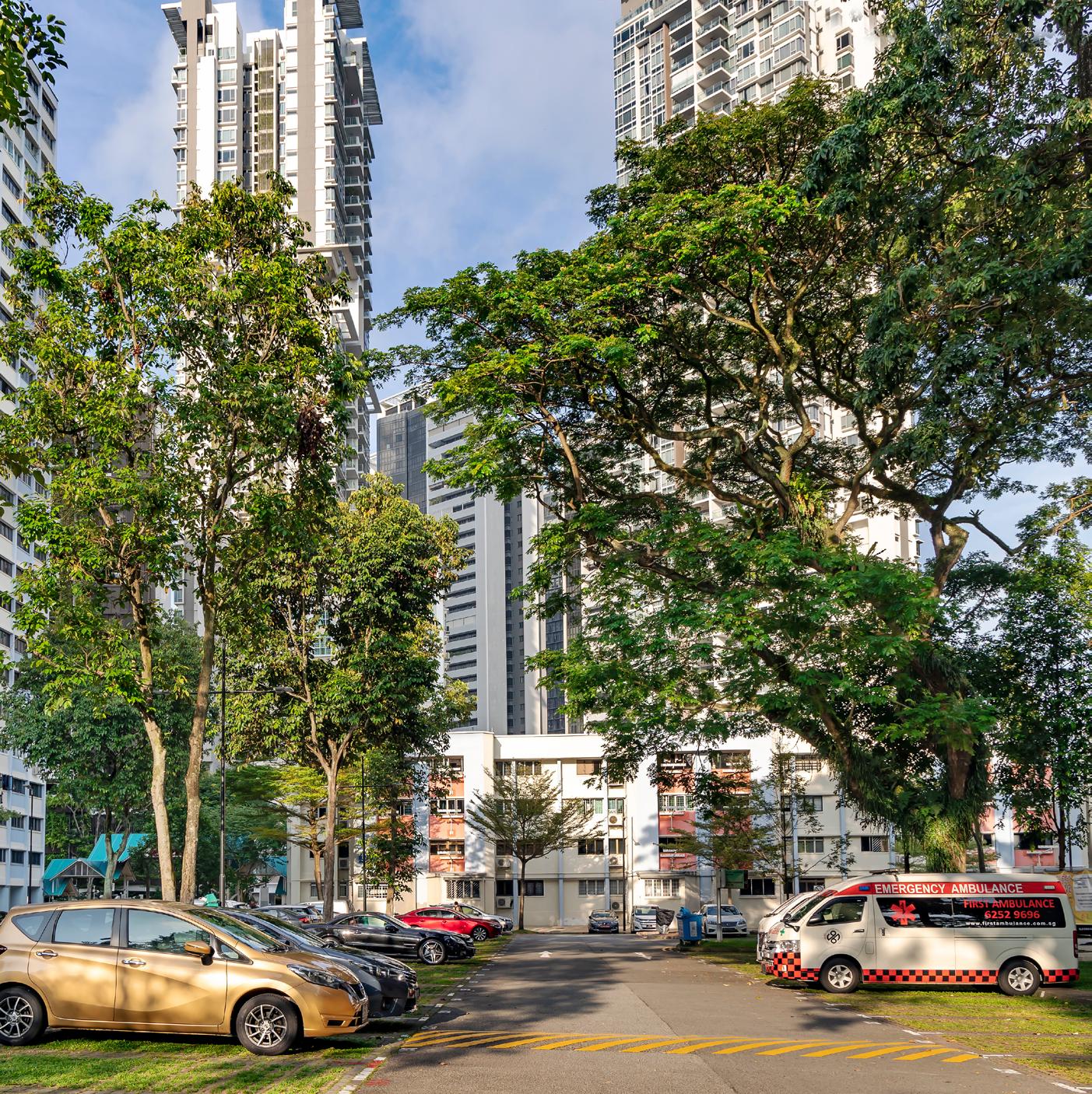
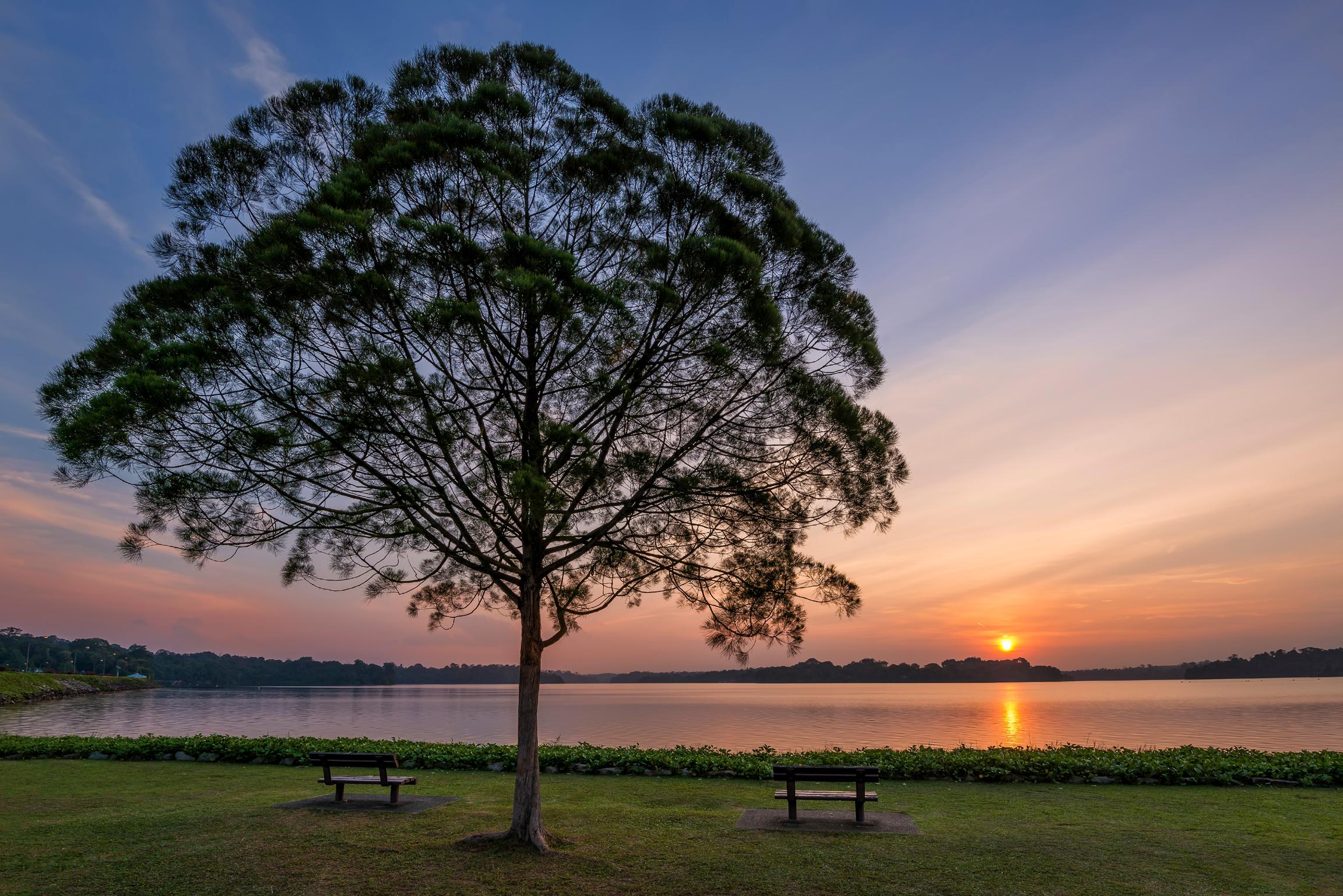
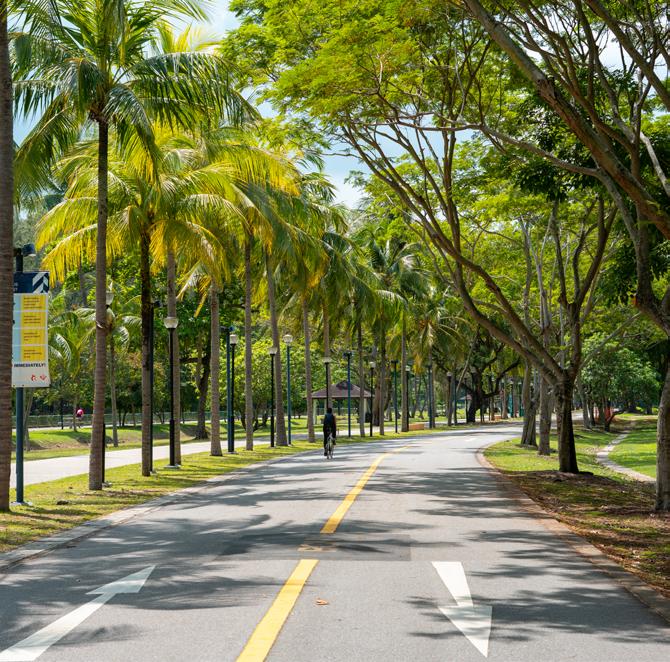
We’re lucky in Singapore to be surrounded by so many green spaces. In this issue, we share some of our favorite ways to enjoy nature nearby—whether it’s a walk along a shady park path or exploring a pocket of rainforest. We also take a closer look at the trees that make our city unique. If you’ve ever stood under a Rain Tree or enjoyed the scent of an Angsana, you’ll know how grounding it can feel. These trees remind us that growing strong takes time, and that real strength is often quiet. We’re also taking time to look inward. Our articles on anxiety and burnout touch on challenges that many of us deal with, especially in a fast-paced place like Singapore. Wellness isn’t just about physical health— it’s about how we feel, how we connect with others, and how we handle change. You’ll find practical tips for everyday health, a spotlight on men’s health (which doesn’t get talked about enough), and some thoughts on how moving or starting over—something many expats know well—can throw us off balance. If there’s one thing that ties these stories together, it’s that health isn’t something you just achieve and forget about. It’s a process—something we work on every day, in our minds, bodies, and the world around break, or just stepping outside for a bit of sunshine. perspective, and maybe even a breath of fresh air.
Here’s to looking after our roots and growing together.
EDITORIAL
WHO WE ARE
Editor-in-Chief: Susan Williams communications@aasingapore.com
Aimee, Aaron Arthur Foeste, Pedrinha Furtado, Tiara Giles, Richard Hartung, Agi Heale, Susan Williams, Kay Yin
AMERICAN ASSOCIATION BOARD MEMBERS
President: Michelle Reeb
Vice President: Christopher Ellis
Treasurer: Brian Rogove
Secretary: Daniel Moss
Directors-at-Large: Heidi Hughes, Olive Ngah, Tianna Nguyen, Colton Payne, Carlos Ruano, Carmen Schwender
AmCham: Dr. Hsien-Hsien Lei
AWA: Paige Jenkinson
SAFL: Stacy Ohrt-Billingslea
SAS: Chris Raymaakers
The American Club: Dan Gewirtz
Non-Voting Members
US Embassy: Lisa Liao
US Navy COMLOG WESTPAC: RDML Todd "Chimi" Cimicata
AAS: Melinda Murphy
PUBLISHER – AMERICAN ASSOCIATION
American Association of Singapore (AAS) is a professional, not-forprofit organization established to enhance the well-being and living experience of Americans residing in Singapore and to promote relationships, both business and social, between Americans and those from different cultures and nationalities.
Living In Singapore magazine will be released five times per year, with the purpose of enhancing the expatriate experience in Singapore.
SUBSCRIPTION
Editor-in-Chief
A subscription to Living in Singapore is complementary with an AAS membership. AAS annual family membership is $150.
To join, visit aasingapore.com and have Living in Singapore magazine delivered to your inbox. Reproduction in any manner, in English or any other language, is prohibited without written permission. Living in Singapore welcomes all contributions of volunteer time or written material. Living in Singapore is printed by NPE Print Communications Pte Ltd, 39 & 41 Kallang Place, 339169. Living in Singapore magazine Print Permit No. MDDI (P) 052/04/2025. FOLLOW US!
CONTENTS
05. COMMUNITY NEWS
Check out what we've been up to and what's coming up
08. 90 ACTS OF CHARITY
See what our community has been doing to give back
12. HEADSPACE
How ice baths can help with mental health
14. LIVING SINGAPORE STORIES
The history of Raffles Hotel
17. AWA IS 90!
How the American Women's Association grew out of AAS
20. EVERYDAY HEALTH
Tips on what you should be taking care of and how often
22. MANAGING ANXIETY
Advice from the author of Generation Panic
25. OVERCOMING BURNOUT
Tips for getting through difficult periods
26. SINGAPORE'S TREE STORY
Learn about how intentional planning has shaped the Garden City
28. NATURE IN SINGAPORE
It's easy to get to if you know where to look
30. MEN'S HEALTH AND WELL-BEING
How are the men in our lives doing, and what do they need to be their best selves
34. COPING WITH TRANSITIONS
How to get through life's changes when you're far from home
MESSAGE FROM THE PRESIDENT
BY MICHELLE REEB
Singapore is a place of constant arrival and transition. Each month, new families land here excited and uncertain, while others prepare for their next chapter elsewhere. What remains steady through all that change is the role our community plays in helping people feel grounded, welcomed, and connected — all essential to overall wellbeing. Strong communities support not just social connection, but also emotional and mental health during times of change.
My family and I experienced this firsthand when we arrived 15 years ago with plenty of questions about what life here would look like. Organizations like AAS helped turn what initially felt like a foreign posting into a true home. That experience continues to shape my commitment to ensuring every newcomer can quickly find support, build friendships, and access the resources they need from day one.
The Living in Singapore Reference Guide remains one of the practical ways we support our community. Whether you are newly arrived or long established, the guide provides reliable, community-driven information that reduces stress and builds confidence. Order your free copy at https://www.aasingapore.com/living-in-singapore-17th.
Our signature events — from the Fourth of July and Thanksgiving to Toys for Tots and the George Washington Ball — do more than celebrate tradition. They create belonging. They connect families, welcome newcomers, and foster multi-generational engagement. Supporting people through different life stages helps build a resilient, healthy community that endures wherever life takes us.
As with many non-profits, funding and sponsorship have become more challenging. That makes member engagement more important than ever. Attend events, maintain your membership, volunteer, and encourage others to get involved. Healthy communities require active participation.
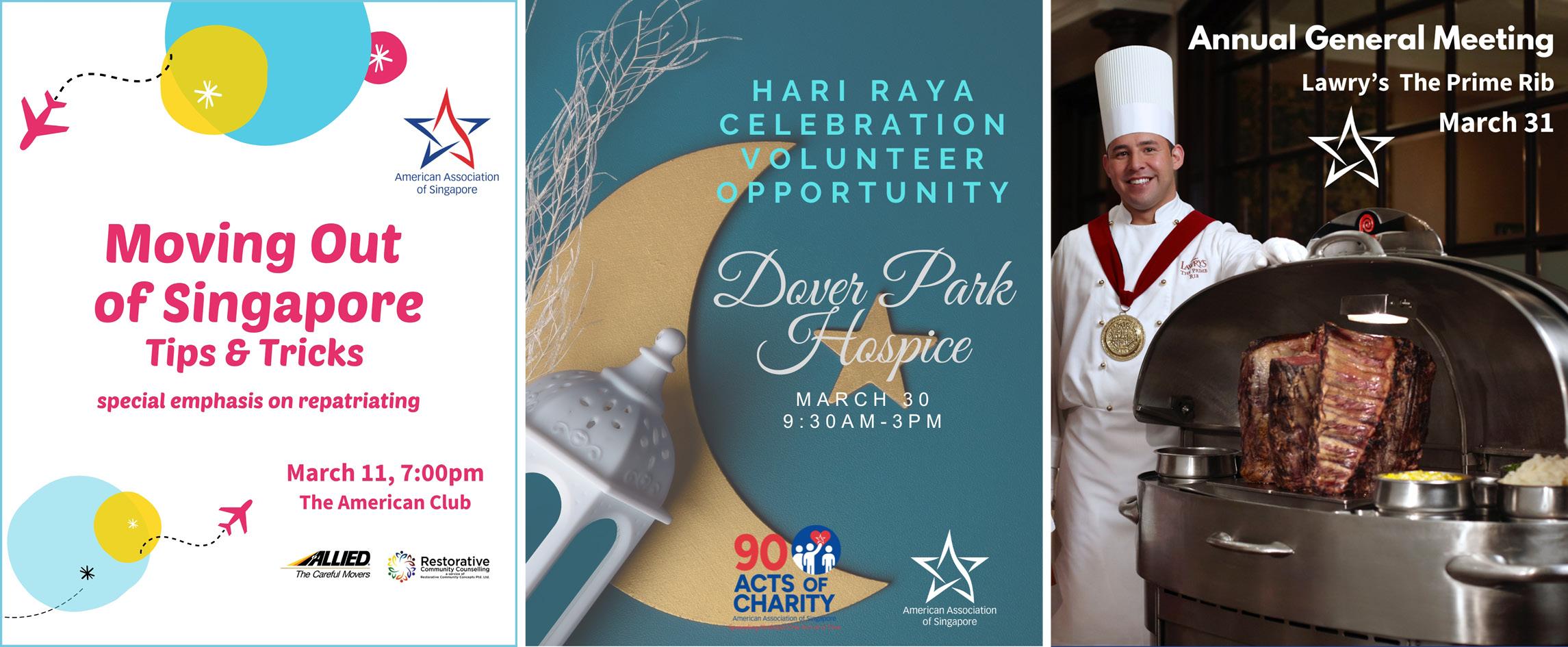
I also encourage you to attend our Annual General Meeting on March 31. Participating in the democratic process is something we should never take for granted. Your voice and involvement help ensure we remain strong, relevant, and responsive to our members.
Serving our community continues to be an honor.
Warm regards,
Michelle González Reeb
President, American Association of Singapore
AAS STRATEGIC PARTNERS
PATRIOT PARTNERS
STARS & STRIPES PARTNER
COMMUNITY PARTNERS
MEMBER BENEFITS
AAS paid members enjoy discounts at a range of local businesses. Check out our website for more details.
AAS members, be sure to log in to receive discount codes on the "Your AAS Membership Card" page.
MEET OUR NEW GENERAL MANAGER!
Marketer, Innovator, and Community Leader
After years of dedicated service, longtime American Association of Singapore General Manager Melinda Murphy will be stepping down at the end of March. We are deeply grateful for her leadership and the lasting impact she has made on the Association, and we wish her every success in her next chapter.
We are pleased to share that Tara Strunk has been appointed to lead AAS into its next era.
We recently caught up with Tara to learn more about her journey and what inspires her work.
Originally from the States, Tara has moved several times over the years, most recently from Shanghai. Singapore has long held a special place in her heart. She spent much of her formative years here, attending the Singapore American School when it was still located at the King’s Road campus.
“The Singapore American School gave me a diverse perspective of the world,” she recalls. "When I was there, the school was much smaller than it is today, and it had such a welcoming feel. It was a special place to grow up.”
She has also been a member and an active volunteer with the American Association of Singapore at different points throughout her time in the country.
“When my family first moved to Singapore, we fell in love with the people, the food, and the culture,” she says. After graduating from SAS, Tara earned an undergraduate degree in Asian Studies from Arizona State University and an MBA from Case Western Reserve University. “I wanted to make sure that I had the right skills to build a career in Asia. Singapore is such an exciting place to work because it’s an incredible launching point for the region. The pace of change across Asia is thrilling. I’m constantly amazed at how quickly things evolve.” Today, she proudly calls herself a Singapore permanent resident.
A seasoned product and strategy expert, Tara is passionate about building communities and creating meaningful impact. She currently serves as a board member of the Rotary Club of Marina City and leads the club’s public relations initiatives. During her time in Shanghai, she founded and led the Rotary Leadership Awards for the Rotary Club of Shanghai.
The annual event recognized outstanding individuals, non-profits, and corporates driving social responsibility in China, and raised over 1.5M RMB to support CSR projects in mainland China.
Tara has lived and worked in more than six countries, bringing a global perspective to her leadership. Her professional experience includes marketing roles at companies such as Sherwin-Williams, PPG Industries, AkzoNobel, Steelcase, and SharkNinja. Across industries, she has combined brand and product expertise with a strong commitment to social impact. She believes design, branding, and community work best when aligned.
When she's not organizing events or shaping brand strategies, Tara dedicates her time to supporting caregivers of the elderly through personal projects. You’ll also find her running along East Coast Park and exploring Singapore through her photography lens.
AAS Running Club @ Fullerton
Mar 1, 9:30 – 11:00 AM
AAS Running Club @ MacRitchie
Mar 8, 9:30 – 11:00 AM
Bowling League at TAC
Mar 10, 7:00 – 9:00 PM
Moving Out of Singapore
Mar 11, 7:00 PM
AAS Running Club @ Fullerton
Mar 15, 9:30 – 11:00 AM
UPCOMING EVENTS
Red Carpet Rise & Shine
Mar 16, 6:30 – 10:30 AM
Freelancers, Entrepreneurs & Small Business Owners Coffee
Mar 19, 10:00 AM – 12:00 PM
AAS Running Club Park Run 5K
Mar 28, 9:30 – 11:00 AM
Hari Raya Celebration @ Dover Park Hospice | 90 Acts of Charity
Mar 30, 9:30 AM – 3:00 PM
AAS Annual General Meeting
Mar 31, 6:00 – 8:00 PM
Project Homeworks | 90 Acts of Charity
Apr 11, 9:00 AM – 1:00 PM
Freelancers, Entrepreneurs & Small Business Owners Coffee
Apr 16, 10:00 AM – 12:00 PM
A JOYFUL EASTER BY THE SEA
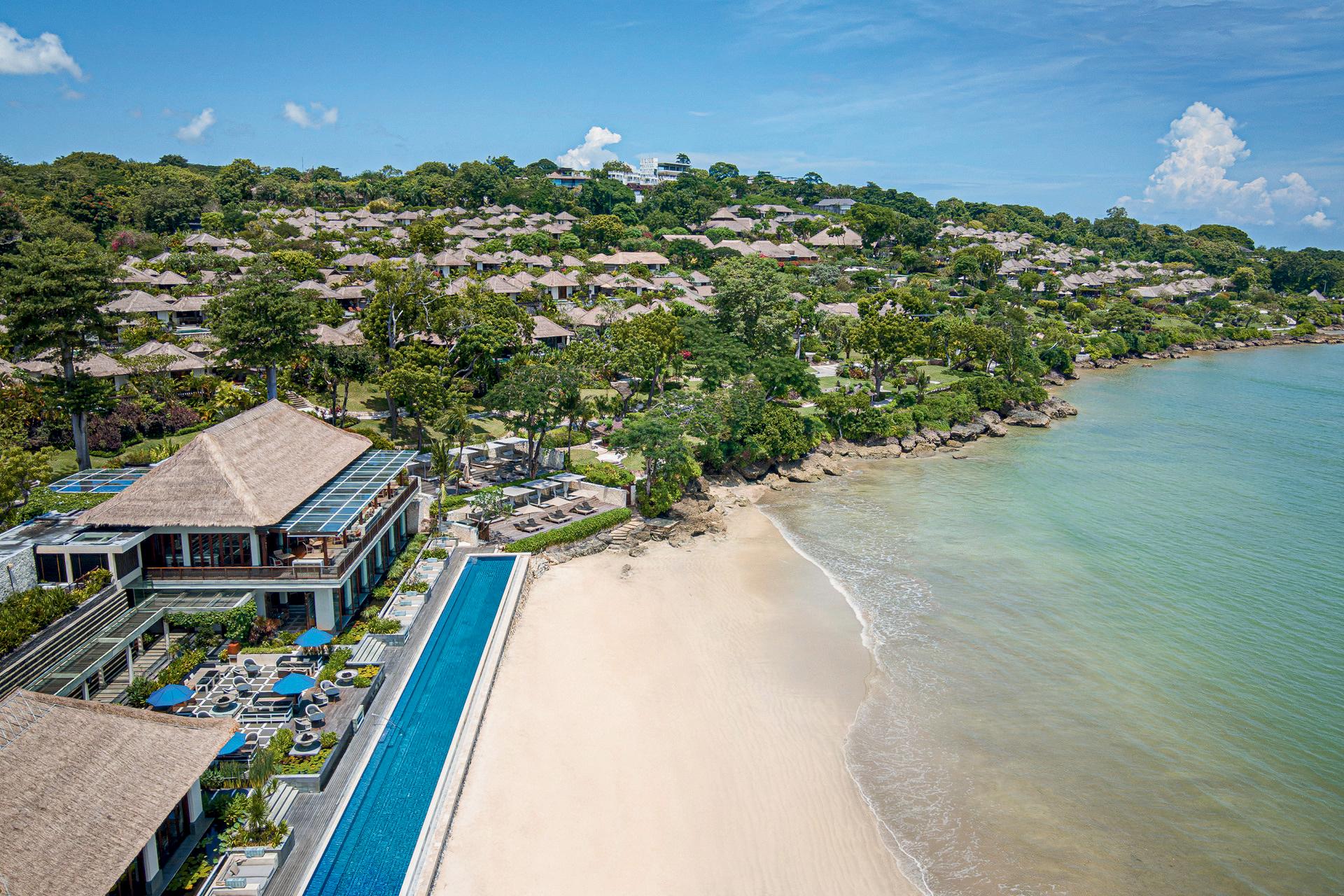
This April, celebrate Easter at Four Seasons Resort Bali at Jimbaran Bay and enjoy our Stay Longer - Fourth Night Free offer - an invitation to linger a little longer in your private villa by the bay.
At Sundara, our beachfront restaurant and beach club, a special edition of the Pink Brunch brings together seasonal pink-hued creations, premium seafood and Whispering Angel Rosé, all set against the gentle rhythm of the ocean.
Young guests can take part in an underwater egg hunt in the iconic 57-metre beachfront pool and enjoy treasure-filled moments at Umah Rare Kids Club - completing a celebration shaped by sun, sea and togetherness.
FOUR SEASONS RESORTS BALI
FOURSEASONS.COM/BALI
@FSBALI | +62 361 2019000
Australia and New Zealand Your next destination after Singapore ?
If you’re weighing your options, whether that’s returning to the U.S. or relocating elsewhere, this session explains what it takes to live, work, and settle long-term in Australia or New Zealand.
For others, it could mean applying for the permanent residence in Australia or New Zealand while the eligibility window is open, and considering moving in the future.
For example, New Zealand permanent residence is for life, with no ongoing residence or renewal requirements, get it now and you can live in New Zealand any time in the future.
ANZ Migrate is a specialist advisory practice dedicated to helping professionals, investors, business owners, families and entrepreneurs secure permanent residency in Australia and New Zealand.
WIth 23 years of experience, and licensed and registered migration agents for Australia and New Zealand, we have the experience to find the right solution for you.
Join Our Exclusive Seminar, Tuesday, April 28, 2026, 7 PM
The Library at The American Club
In collaboration with the American Association of Singapore
www.anzmigrate.com info@anzmigrate.com
+65 6979 7935
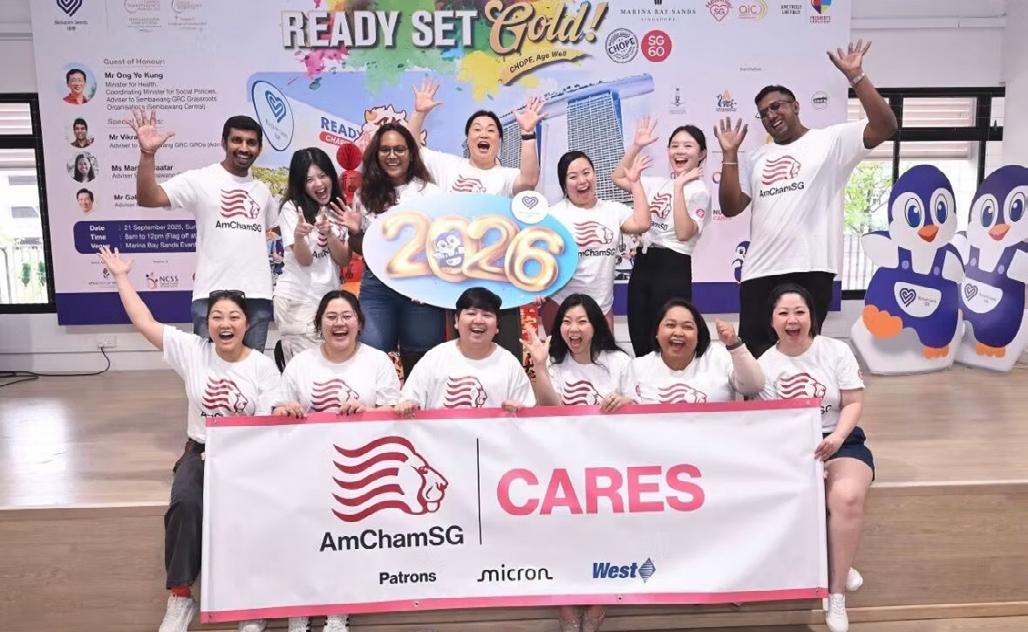
To commemorate Martin Luther King, Jr. (MLK) Day, nearly 100 AmChamSG staff and members came together to visit over 400 senior households in Sembawang to distribute oranges in celebration of the upcoming Lunar New Year. MLK Day serves as a National Day of Service, encouraging Americans to strengthen their communities through volunteerism.
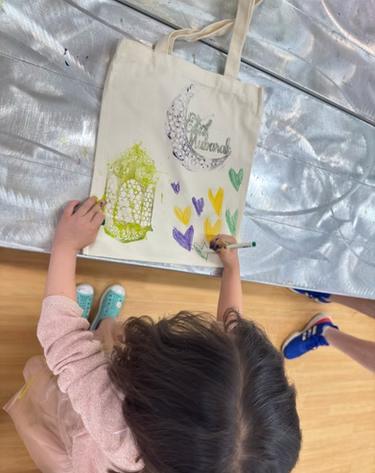
As part of MLK National Day of Service, lots of little kids turned out to paint tote bags for the upcoming Hari Raya event at Dover Park Hospice. We were super impressed that each child wanted to give back to help others. Big thanks to The American Club for supporting the AAS event.
Amy was an elf at the Enabling Village, helping to wrap gifts.
HIGHLIGHTING RECENT ACTS BY OUR COMMUNITY
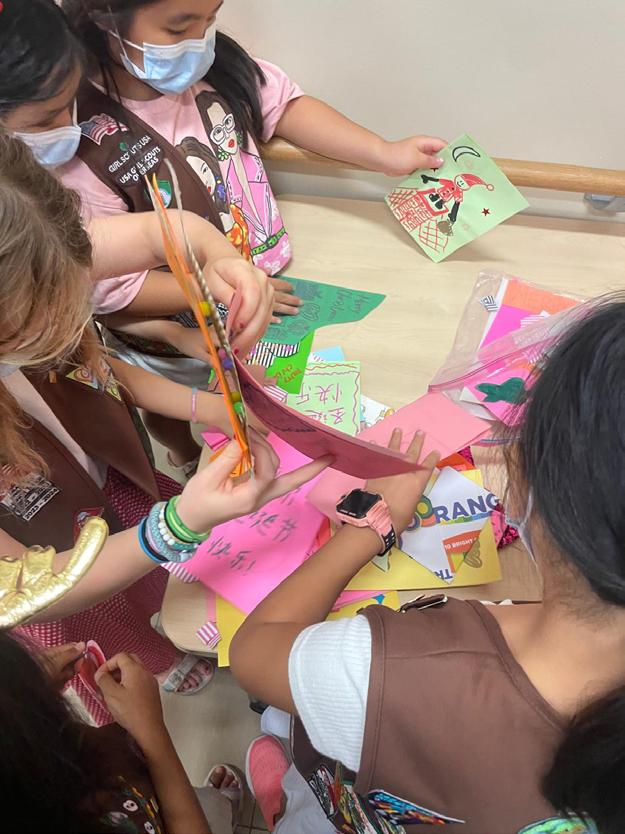
Girl Scouts USA Troop 99 curated a care package for seniors at the Lions Befrienders Center in celebration of Chinese New Year.
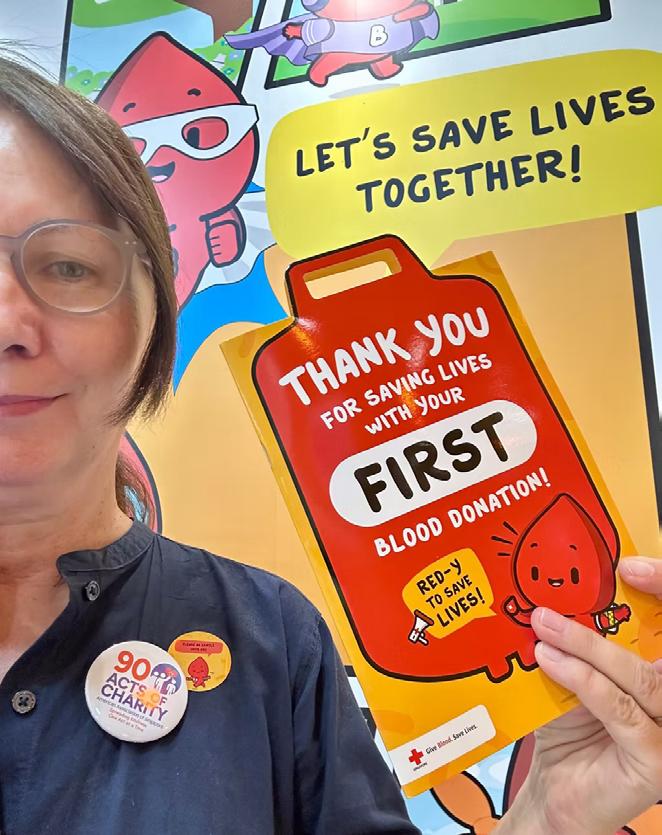
Amy donated blood for the first time. Donating blood is an act of kindness and can save up to 3 lives.
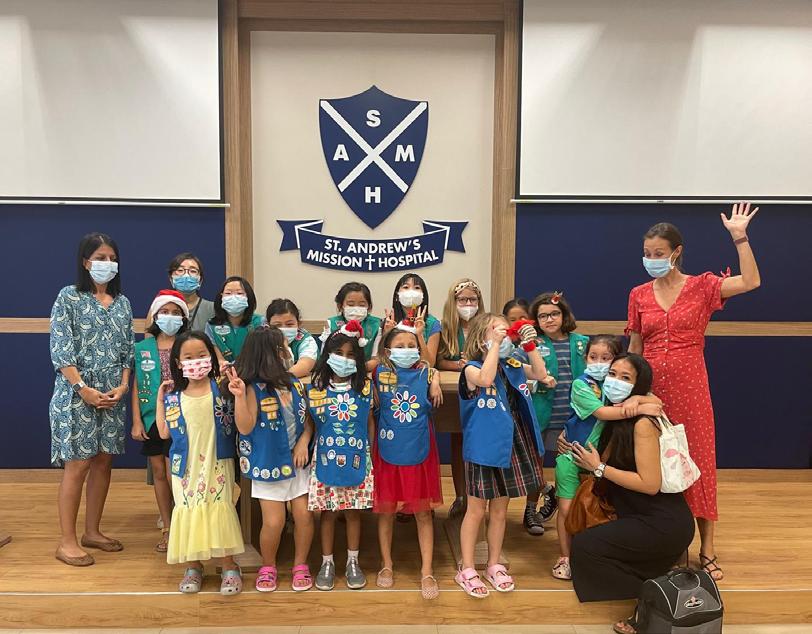
Twenty cheerful Girl Scouts, ages 5 to 15, from several troops, brought lots of Christmas joy to several nursing homes across Singapore, continuing a tradition that began at a local women’s nursing home at St. Andrew’s Mission Hospital. The girls sang carols, played instruments, and delivered hand-crafted cards.
Share your acts of kindness with us at www.aasingapore.com/90-acts
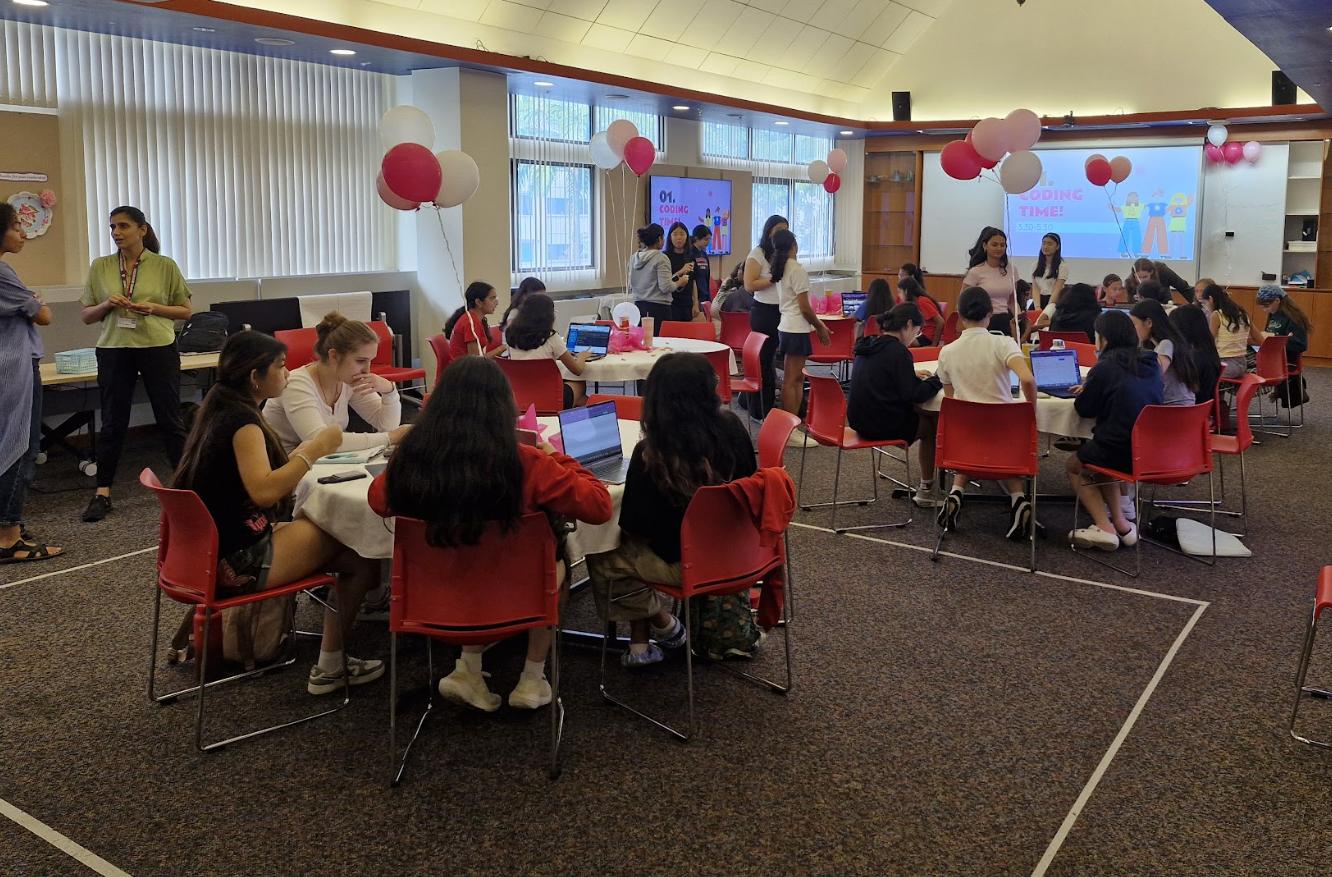
GIRLS AREN’T JUST CODING. THEY’RE REWRITING THE SCRIPT.
By Riya, Eleventh Grade
Riya Kamat, a junior at SAS, blends her passion for technology and powerlifting to explore how strength fuels leadership and resilience. She believes technology should include everyone and be shaped by many different voices.
When alumna Adriana (2025) first entered the robotics lab, she noticed a stark contrast. All the boys were operating the robot’s controller, while all the girls were roaming around with clipboards, only observing and noting. But Adriana refused to be limited by such expectations. Within a year, she created her own version of “Girl Powered” workshops, where girls not only took notes on robot stats but also operated the machines. In the following season, the team went from having zero female drivers to three!
“When you walk into a lab and know you belong, then you fight to stay,” Adriana, says with a smile.
This sense of belongingness sparked a quiet revolution at SAS. For far too long, STEM has been seen as a boys’ playground due to societal stereotypes, gaps in early exposure, and the lack of female representation. At SAS, students and teachers are challenging these outdated notions. One hackathon at a time, we are rewriting the code.
Evelyn is a current junior who fell in love with coding during the pandemic. A friend introduced her to HTML, and what began as a hobby turned into enrolling in coding classes and eventually opting for the AP Computer Science class. She has grown, but the reactions haven’t changed. People still ask “you?” with a puzzled look when they learn she’s in Advanced Placement Computer Science (AP CS). “Are you seriously asking me that?” Evelyn laughs in response. This disbelief acts as her fuel.
“Girls need to know it’s okay to work in a male-dominated field,” exclaimed Evelyn. We only discover what we enjoy after we try it once.
Some alumni, like Jayesha (2025), believed that simply joining a club was not enough. If we had to alter the trend, we would have to create new environments. Thus, she founded SAS’s Girls Who Code (GWC) chapter after observing that all existing coding clubs on campus were led by boys. “We need a space where girls can learn freely, without preconceived notions, judgements, and challenges,” she shared. The GWC club now hosts hackathons
that welcome beginners, students with no coding experience, and highlight how coding is more about creativity than complexity. Although some pushback always remains. Even now, when girls try to speak up in AP CS, they get sidelined.
“Have unwavering faith. Don’t be afraid to stir things up. You belong here just as much as anyone else,” shares Jayesha.
Ms. Khan is the teacher who helps us keep the door to opportunity open. She understands that culture, and not just curriculum, influences who pursues STEM. She reflected, “Boys often dominate CS because they encounter it first. Girls feel like they’re already behind when they arrive.” Now, she plans to encourage young girls to start early, with the help of highlighting female role models in assemblies, programs like Hour of Code at the elementary level, and using the PTA to influence parents, especially mothers, to facilitate greater female participation. “Boys need to realize it’s normal and necessary for girls to be present in all spaces,” Ms. Khan concluded.
While reflecting on these stories, a clear pattern emerges. Adriana hands back the robot controller to the girls; Evelyn breaks the mold by being fully present; Jayesha creates a community where none existed; and Ms. Khan ensures that the next generation doesn’t have to wait until high school to feel they belong. These women demonstrate that STEM at SAS is not only about science and technology, but it’s also about transforming culture.
So, next time someone claims, “But girls don’t code,” a SAS student would easily prove them wrong by writing a line of code, assembling a robot, and winning a hackathon. This is not a place where girls are merely entering STEM classrooms; this is the place where we are rewriting the rules to make them smarter, stronger, and sharper.
Beneath the Surface
By Jasper Zhang Yuchen, Troop 10B
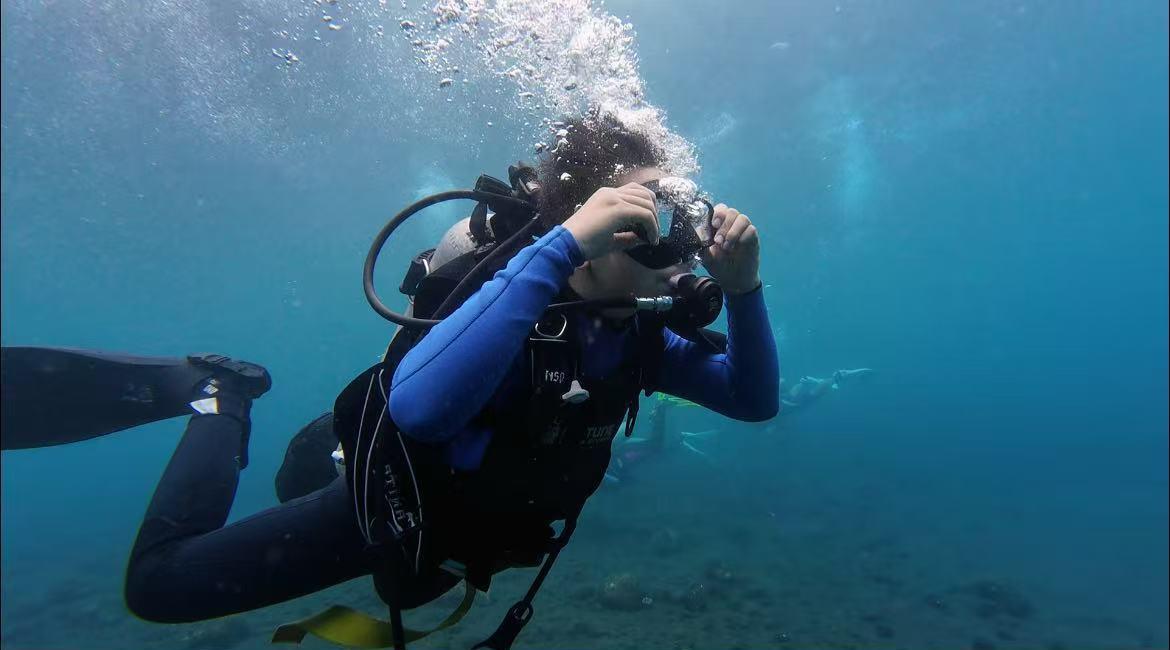
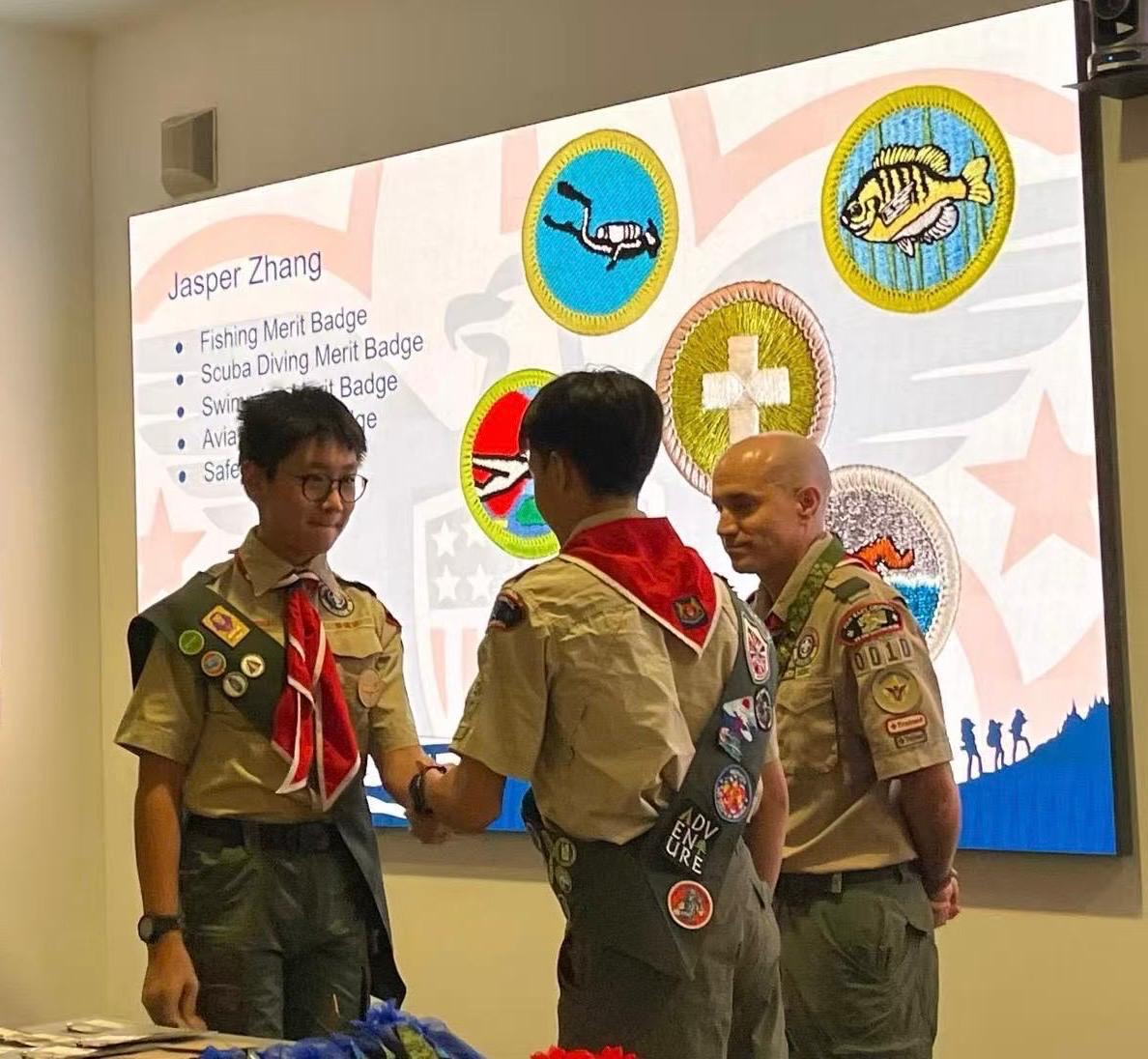
Have you ever tried diving in the cold sea beside a gigantic shipwreck stretching over 50 meters long? That was my experience in Bali. I’m Jasper, a 14-year-old Boy Scout, currently Second Class rank, and scuba diving has become one of the most meaningful experiences of my life.
I wanted to start scuba diving because I had been to the Great Barrier Reef in a submarine, and I wanted to see the underwater world up close. I faced many challenges and thought about quitting, but I kept reminding myself how far I had come and how much I wanted to see the reefs, fish, and shipwrecks. Also, in Scouting and in my social circle, I see many Scouts doing scuba diving and earning the merit badge. And since I had an urge to go into the water myself when I was young, I learned to scuba dive.
I started scuba diving in Grade 7, and I was very nervous when I took my first breath underwater. It felt like nothing I had experienced before. As I descended, my ears hurt badly from the pressure, almost as if someone was pushing earbuds deep inside. My coach taught me how to equalize the pressure, which helped. The hardest skill for me was taking off my mask underwater. When the water rushed in, I panicked and shot back to the surface. After calming me down, my coach told me to keep breathing through my regulator and tilt my head so bubbles wouldn’t go into my eyes. After many tries, I finally succeeded.
The next challenge was open water diving. At first, it looked normal until my coach told me I had to redo all the pool skills in the sea. My heart sank. I really didn’t want to take my mask off again, but I told myself, “I’ve come this far, I won’t quit now.” When I stepped into the water, I thought I would freeze, but it was actually warm like a bath. As we descended, I felt pressure in my ears, but I managed to equalize and finish the dive. On the second day, more challenges came. The water felt different on my face, and I wanted to open my eyes. Then I had to breathe without opening them, but I managed by tilting my head and letting the bubbles move away.
Scuba diving also helped me in Scouting. It let me earn my Scuba Diving Merit Badge more easily because I already had my Open Water Diver certification. More importantly, it taught me persistence. This helps me stay focused when things get boring or frustrating. Diving also improved my breathing, which helps me swim faster and feel less tired on land. I can now sense pressure changes even when diving just a few meters, which helps protect my ears.
I believe scuba diving is not just a sport. It builds courage, persistence, and the bravery to push yourself beyond your limits. You don’t have to dive to grow — every sport teaches these lessons. Sometimes you don’t even notice that you’ve grown, but you have, and that growth will benefit you for a long time, either in your life or if you decide to come and do Scouting!
Photos by Ms. Angela Lin
Bridging Generations, Connecting Hearts at Christmas
By Ali Sanders, Troop 66 Leader
Singapore USA Girl Scouts reach out to the elderly through spirit and song
For four years and counting, the Singapore USA Girl Scouts has made a tradition of visiting a nursing home each holiday season. Girls ages five to 15 arrive in their holiday best, carrying a small speaker, a playlist of Christmas songs they have spent weeks practicing, and loads of handmade cards and crafts. Each year, they are greeted by the joyful faces of the residents at St. Andrew’s Nursing Home in Henderson, who clap along, shake small tambourines and maracas, and graciously receive the crafts made for them. In addition to singing and sharing crafts, the scouts offer snacks and a tea service to residents. It’s an experience that could warm a heart of stone, and often brings adult chaperones to tender tears.
Naomi R., age 10, captured why she loves this tradition: “It’s all about being kind to people around us, making people happy, and making them feel loved.”
The project started in the aftermath of the pandemic, when the elderly had been further isolated from society for their own protection. Troop 66, with girls who were five-year-old Daisies at the time, wanted to engage with the elderly as soon as the world was safe enough, to show them they had not been forgotten and were deeply appreciated.
“The elderly need companions, and they need our time. They just want people to show up for them,” said Heidi S., age nine.
The gift that goes both ways
Many of the girls joined to give back to their community, but they soon realized they received as much as, if not more than, they gave. Connecting the youngest living generation with the oldest is a powerful way to dismantle boundaries and prejudices and to connect people with different experiences and backgrounds. The girls are often touched by the humility and simple appreciation found in the residents.
Sakura T., 10, explained the way she felt after her first visit to the nursing home: “Older generations are important because they can help other people with their history and wisdom.”
Growing beyond one nursing home, growing beyond Christmas
Since its inception, the nursing home effort has started involving more troops each year. In 2025, the Singapore USA Girl Scouts doubled the number of nursing homes reached and hopes to expand to more in the future. In 2026, other Girl Scouts troops have already reached out to nursing homes to visit and bring cheer throughout the year.
“We are helping the elderly who have to stay in the nursing home. They don’t have the option to go out and do whatever they want. They aren’t mobile, so we come to them,” shared Robyn O., 10.
Victoria M., 10, echoed this sentiment, saying, “When I walked along the halls singing to the ladies, it made my heart so happy. I feel bad for them because they are in wheelchairs and don’t go outside much. But the more people who can bring joy to them, the better.”
HEAD SPACE
By Andrea McKenna Brankin
HOW ICING THINGS DOWN CAN IMPROVE MENTAL HEALTH
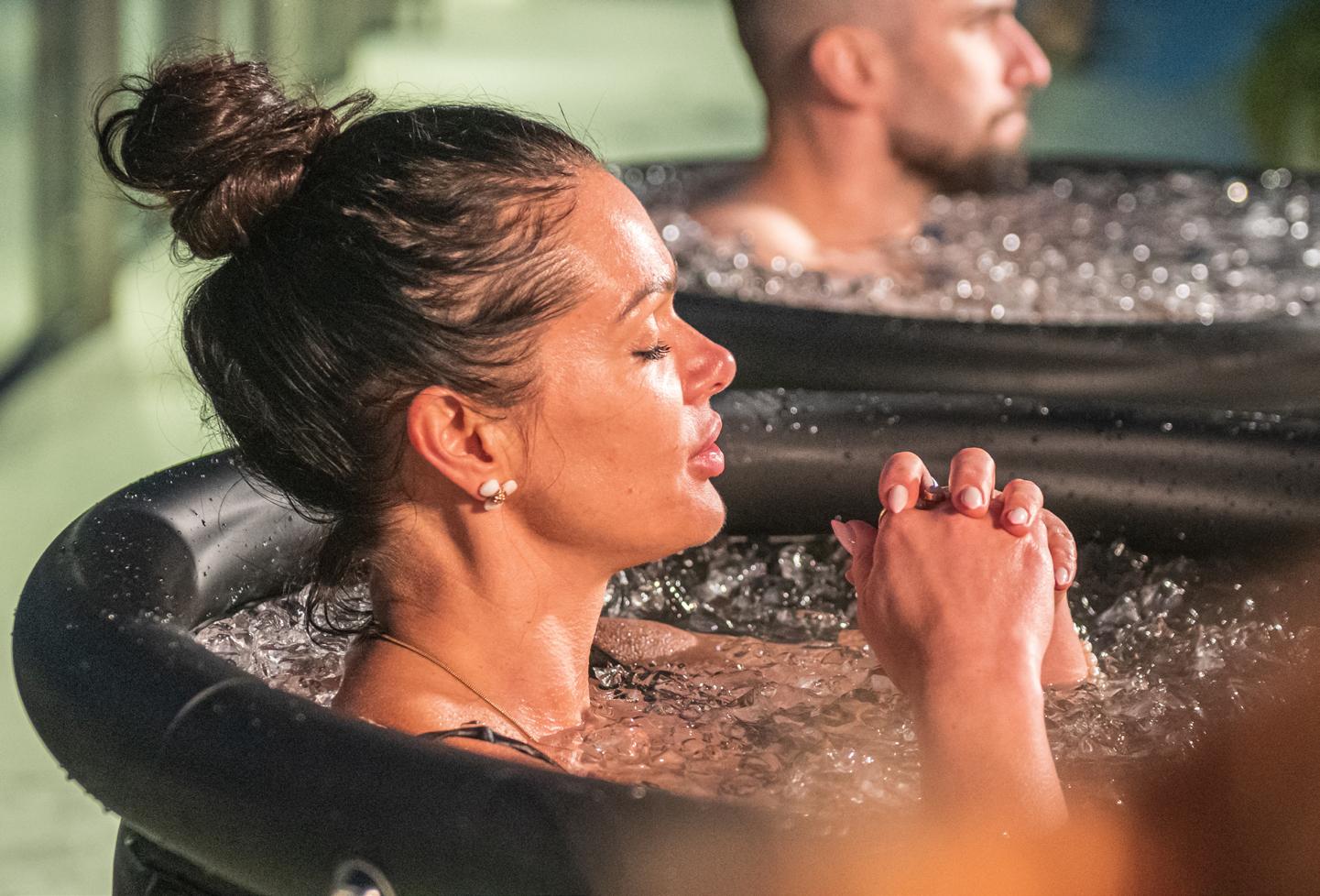
Ice baths used to be something you’d only see elite athletes doing on social media. Now, they’ve gone mainstream — and not just for muscle recovery. More and more people are exploring cold exposure and contrast baths (alternating hot and cold water) as tools to support mental health.
So what’s actually going on here? And how can you use these methods wisely?
HOW ICE BATHS MAY SUPPORT MENTAL HEALTH
When you step into cold water, your body goes into a short, controlled stress response. Your breathing speeds up, your heart rate rises, and your nervous system shifts into high alert. At first glance, that doesn’t sound relaxing. But here’s the key: you’re choosing the stress, and you’re learning to stay calm inside it. That practice builds resilience.
Cold exposure may:
• Trigger the release of endorphins (your body’s natural mood lifters)
• Increase alertness and focus
• Improve circulation
• Train your nervous system to regulate stress more efficiently
Many people report feeling mentally clearer and more energized after an ice bath. It can feel like hitting a reset button. You step out sharper, calmer, and sometimes surprisingly positive.
There’s also a confidence component. Doing something uncomfortable on purpose—and getting through it— strengthens your self-belief. That mindset carries over into everyday challenges.
WHAT ABOUT CONTRAST BATHS?
Contrast bathing alternates between hot and cold water. For example, two to three minutes in warm water, followed by one minute in cold water, repeated for several rounds.
method stimulates circulation by causing blood vessels to dilate (hot) and constrict (cold). From a mental health perspective, it can:
• Promote relaxation after stress
• Improve body awareness
• Help you feel grounded and present
• Support recovery after physical training
The hot phase relaxes you. The cold phase sharpens you. Together, they train your nervous system to shift gears smoothly, a powerful skill for managing anxiety or stress in daily life.
HOW OFTEN SHOULD YOU DO IT?
More is not better here.
For most people:
• Ice baths: Two to three times per week is plenty.
• Contrast baths: One to three times per week, depending on your body's response.
Cold exposure sessions don’t need to be extreme. Even one to three minutes in cold water can be effective. Start gradually — cool showers before full ice immersion — and build tolerance over time.
If you feel exhausted, overly stressed, or dread the session, that’s your cue to pull back. The goal is controlled stress, not punishment.
CONTRAINDICATIONS:
WHEN TO BE CAREFUL
Ice baths are not for everyone.
Avoid or speak to a healthcare professional first if you have:
• Cardiovascular conditions
• High or uncontrolled blood pressure
• Raynaud’s phenomenon
• Respiratory disorders
• A history of fainting
• Pregnancy
Cold shock can place strain on the heart and blood vessels, especially if you jump in suddenly. Always enter gradually and never do it alone if you’re new to it.
This
Also, if you’re already in a heightened state of anxiety or panic, an intense cold session might amplify that feeling. In those moments, gentle tools like slow breathing, walking, or light movement may be more supportive.
BUILDING HEALTHY MENTAL HEALTH HABITS
Ice baths are a tool — not a cure.
Strong mental health comes from daily habits, just as brushing your teeth protects your physical health.
Mental health hygiene includes:
• Consistent sleep
• Regular movement
• Nutritious food
• Time outdoors
• Meaningful connection
• Managing screen time
• Reflective practices like journaling or mindfulness
Cold exposure can complement these habits but cannot replace them.
If you’re chasing the “hardest” protocol but neglecting sleep, relationships, or rest, you’re missing the bigger picture. Living your best life isn’t about stacking extreme habits. It’s about consistency with the fundamentals.
Here’s a grounded way to think about it: use ice baths or contrast therapy as a resilience-building session. It’s practice for staying steady when life feels uncomfortable. But your foundation should always be solid daily habits.
Take care of your nervous system. Train it gently. Challenge it wisely.
Your mental health deserves maintenance, not just crisis management. And when you treat it like something worth protecting every day, everything else in your life performs better — your focus, your relationships, your goals, your energy.
That’s how you truly build a strong mind.
By Susan Williams
We've all been there. You're halfway through prepping dinner when you realize you forgot to get one ingredient. Going back out to the store is a pain. But you need it, so you turn to the usual apps – Deliveroo, FoodPanda, Grab – and delivery times are at least 45 minutes, more often an entire hour! Enter RedMart Now, RedMart's new grocery delivery service that delivers in as little as 30 minutes. It picks up where BeepBeep! left us last-minute shoppers suddenly high and dry.
I am lucky enough to live in one of the postal codes RedMart Now delivers to (those starting with 05-17, 22-30, and 58-59). If you're not in one of these, don't fret – they are progressively expanding service islandwide. In fact, when the service first launched on February 6, my postal code was not among the included areas, but within a week it had expanded to include mine. So I was fortunate that when I needed some groceries at the last minute, yet again, I could try out RedMart.
I don't often shop with RedMart, though I would like to, because I'm not great at planning far enough ahead to wait until the next day for groceries. I know. It's one of those executive functions I got distracted and missed out on mastering. So, between really liking RedMart's products and selection, and being a Last-Minute Lucy, I was really excited to try RedMart Now.
I was impressed by the range of items available for immediate delivery and their pricing. My order ended up about 25% cheaper than comparable orders I've made at a grocery store via FoodPanda. I was able to get everything I needed not only for that night's dinner but also for the following night (how's that for planning ahead?). I tossed in a bottle of rosé, because why not?
And would you believe that it arrived cold?! Color me impressed. I'm sold!
Even more impressive is that my order arrived in 40 minutes flat, in pouring rain, on a public holiday.
Living in Singapore readers who would like to try out RedMart Now can save 20% until March 10 using the code REDMARTNOW (capped at S$10).
LIVING SINGAPORE STORIES Connecting past and present
By Marc Servos
FROM PRE- AND EARLY RAFFLES HOTEL ACCOMMODATIONS TO THE OPENING OF THE MAIN BUILDING: 1830S-1899
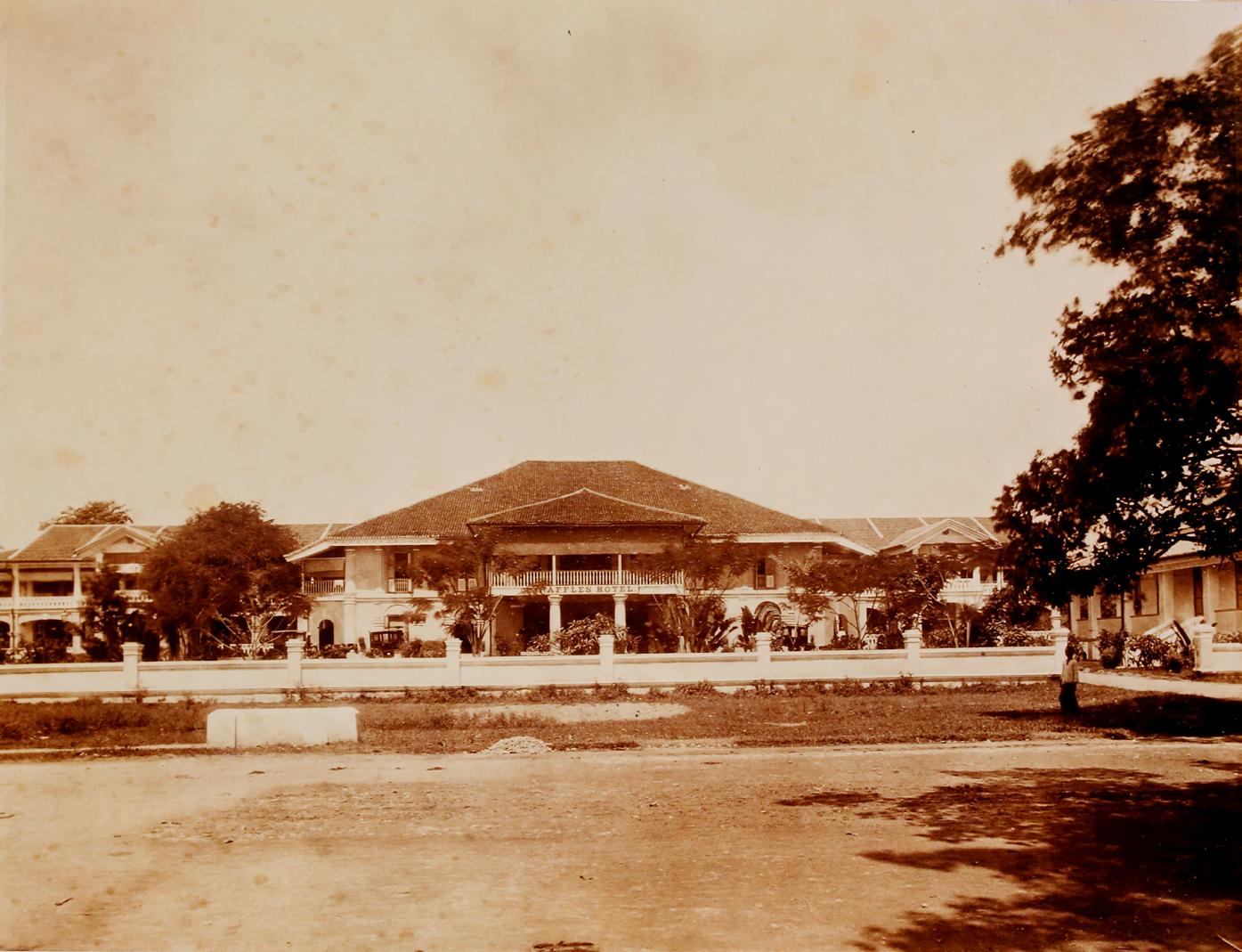
Raffles Hotel, the legendary and historic luxury hotel standing prominently at One Beach Road, is one of Singapore's most recognized and established landmarks. It is renowned for hosting historic and contemporary writers, celebrities, and dignitaries, and for serving as a venue for an array of lavish social events and celebrations, as well as cultural activities. Many people are aware of its establishment in 1887, but the main building now at its Beach Road entrance wasn’t built until twelve years after its founding. The history of the original structure dates back over six decades. Beach Road formerly faced the beach and the open sea, as its name suggests. In the early 1830s, Robert Scott built a bungalow-style beach house at the site of the current hotel’s main building. This private residence was later owned by the Arab merchant and landowner Syed Mohamed Alsagoff, who leased it to other entities in the late 19th century.
In 1878, American-born and British-educated veterinarian and entrepreneur Dr. Charles Emerson leased this charming beach house and converted it to Emerson’s Hotel. He was an established restaurateur and hotelier and, in the late 1860s, had previously established both Emerson’s Tiffin Rooms
restaurant in the Flint’s Building, located next to Cavanaugh Bridge, and the Clarendon Hotel at the intersection of Beach and Middle Roads. Emerson’s Hotel was advertised as Singapore’s most complete hotel, providing outdoor activities such as lawn tennis and quoits (similar to modern-day horseshoe), and the owner himself often showed guests around town.
Dr. Emerson died after a week-long fever in 1883, and Emerson’s Hotel closed that year. The building, still owned by Syed Mohamed Alsagoff, was reopened as a hotel on New Year’s Day 1884 under the name of Hotel Des Indies, which operated briefly until it was taken over later that year as a boarding house by the Raffles Institution, which was located on Beach Road across Bras Basah Road (the present site of Raffles City).
The late Charles Emerson’s lease expired in September 1887, as well as Raffles Institution’s use as a boarding house. It was almost immediately afterwards that the property was leased by the four Sarkies brothers - Martin, Tigran, Aviet, and Arshak - and renamed in honor of Sir Stamford Raffles. The Sarkies were ethnic Armenians who were well known for opening and operating a chain of hotels in Southeast Asia. The new establishment was opened as Raffles Hotel, at the original beach house, on December 1, 1887, and the accommodations consisted of ten rooms.
The Sarkies soon recognized the prime location, its proximity to the beach, and the hotel's high standards of accommodation and service, making it popular with wealthy clientele.
Expansion occurred during the early 1890s; two two-story wings were built in 1890, followed by a billiards room at the junction of Bras Basah and Beach Roads, and the Palm Court Wing, completed in 1894. Raffles Hotel now had 75 rooms.
It was not long after these expansions that plans were set forth to develop the iconic main building, which continues its imposing presence today. This new structure, designed by British architect Regent Alfred John Bidwell of the Swan and Maclaren architectural firm, was
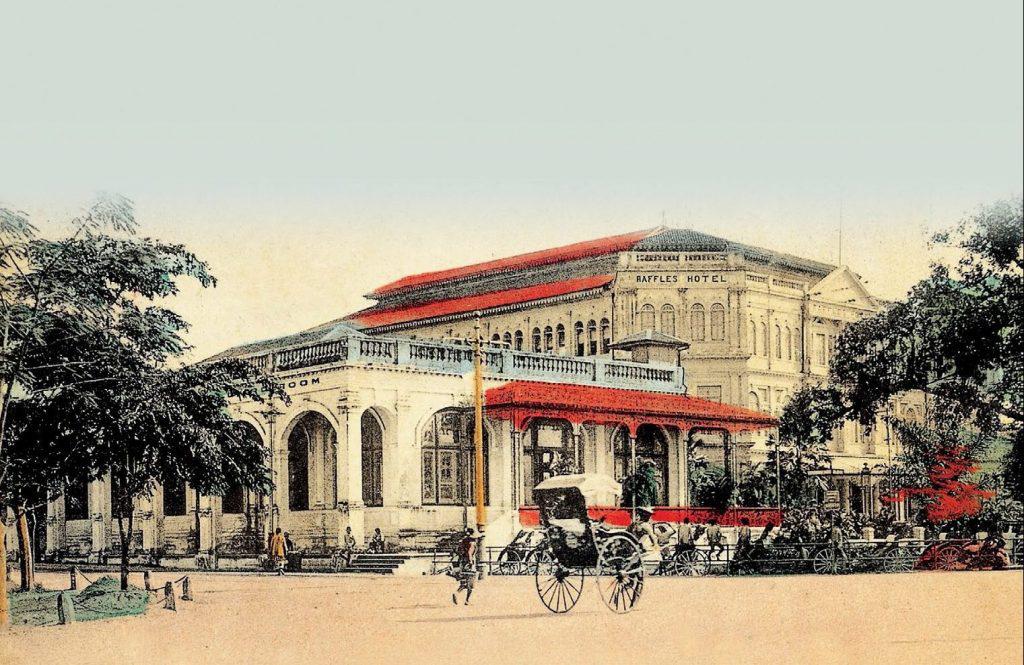
Raffles Hotel, c. 1900. Collection of Children's Museum Singapore; donated by Prof Cheah Jin Seng.
Orthdontic care for the whole family
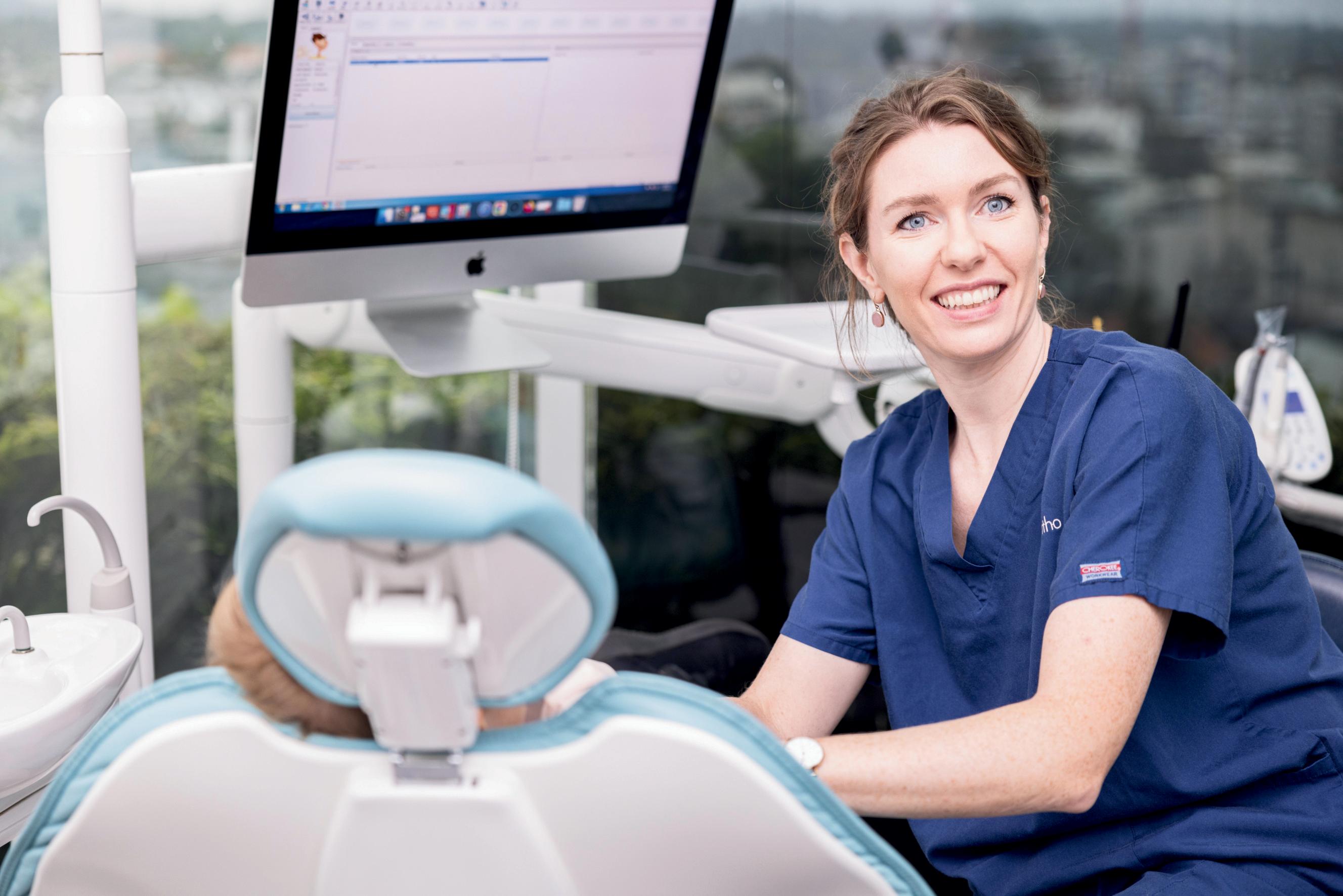
Orthodontics for children, teenagers and adults with Dr Clara Gibson at expatdental®.
Braces and Invisalign®
Early assessment and interceptive treatment
International training and practice experience
Care coordinated within a full-service clinic
Scan to chat with our team about AAS member pricing
completed in 1899 and replaced the original beach house on the same site. Its tropical design featured high ceilings and extensive verandahs, and its stateof-the-art features included electric lights, the first hotel in the region to do so, and powered ceiling fans. The dining room featured pillars, a Carrara marble floor, and a seating capacity of 500.
Raffles Hotel has continued to expand over the years, and numerous stories and legends are associated with it, including the creation of the Singapore Sling cocktail and a roaming tiger in the billiards room. But these are other stories. It is also worth noting that the original Emerson’s Tiffin Rooms continued to be operated by Dr. Emerson’s daughter and subsequently by other owners until its closure in 1906. Another eatery honoring him with the same name opened in 1990 on Neil Road in Tanjong Pagar, featuring memorabilia from Raffles Hotel’s predecessor, but it has since closed.
Original Raffles Hotel - Opened in 1887
WHERE WOMEN LEAD, COMMUNITY GROWS
THE BIRTH OF THE AMERICAN WOMEN'S ASSOCIATION
By Susan Williams
It may not surprise you that when the American Association of Singapore was founded in 1917, then called the American Association of Malaya, only men could become members. The Association was a social and civic anchor for American expats, offering connection and friendship far from home. Still, many of its gatherings and community efforts relied on the quiet, capable support of American women. In honor of International Women's Day, let's take a look back at how the American Women's Association came to be.
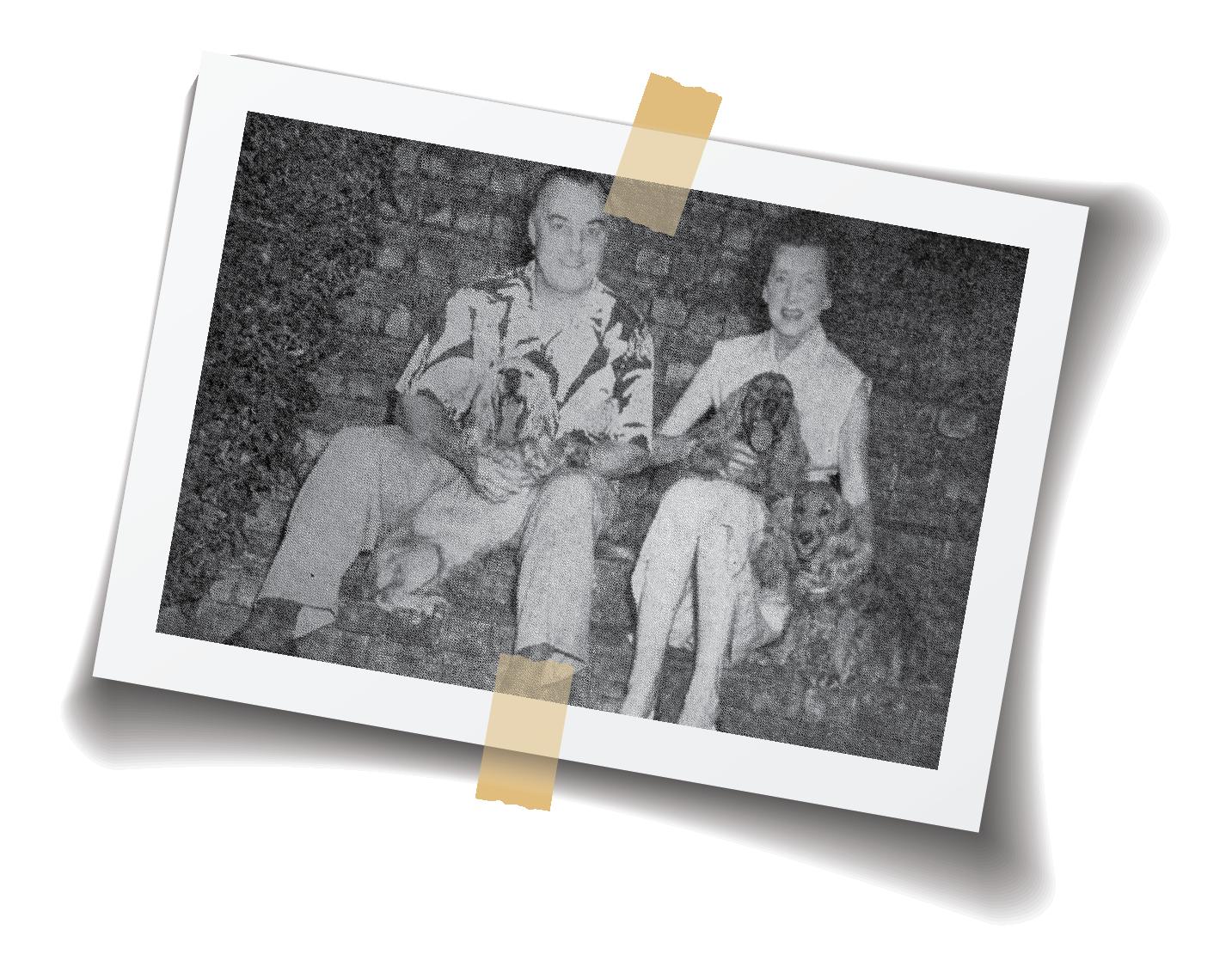
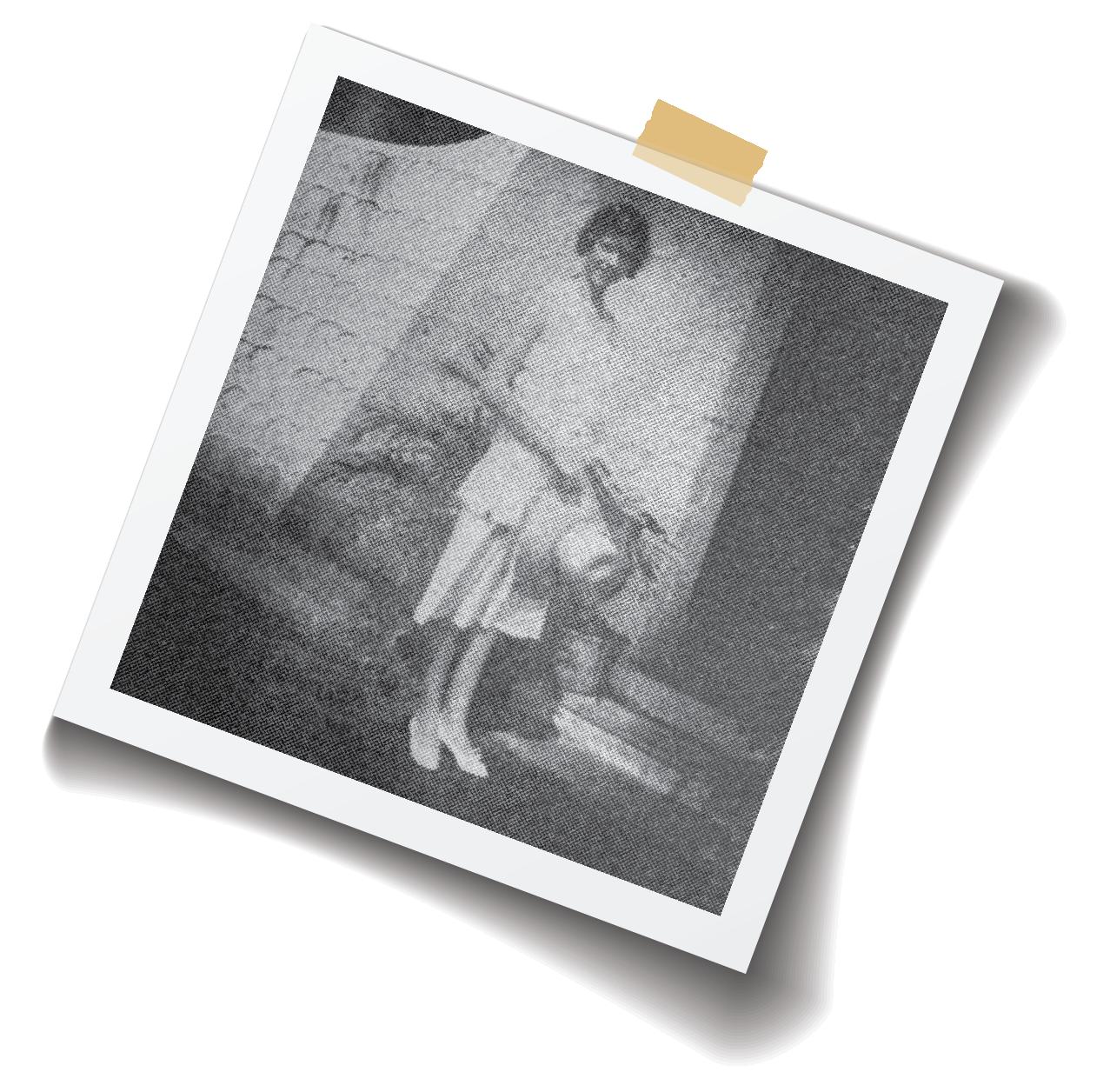
By 1935, it was clear that women were already making important contributions by organizing, volunteering, and strengthening the Association’s social life. Then-president F.D. Harrison believed they deserved an organization of their own. As a result, the Women’s Auxiliary of the American Association of Malaya was formed, growing directly from the
the American Association quickly developed its own identity, fostering friendship, service, and a sense of belonging.
Many of the activities from those early decades are still familiar today. Members welcomed newcomers with coffee gatherings, formed Mahjong and bridge groups, and played sports like golf and tennis. They also supported charitable causes, knitting sweaters for troops and volunteering in
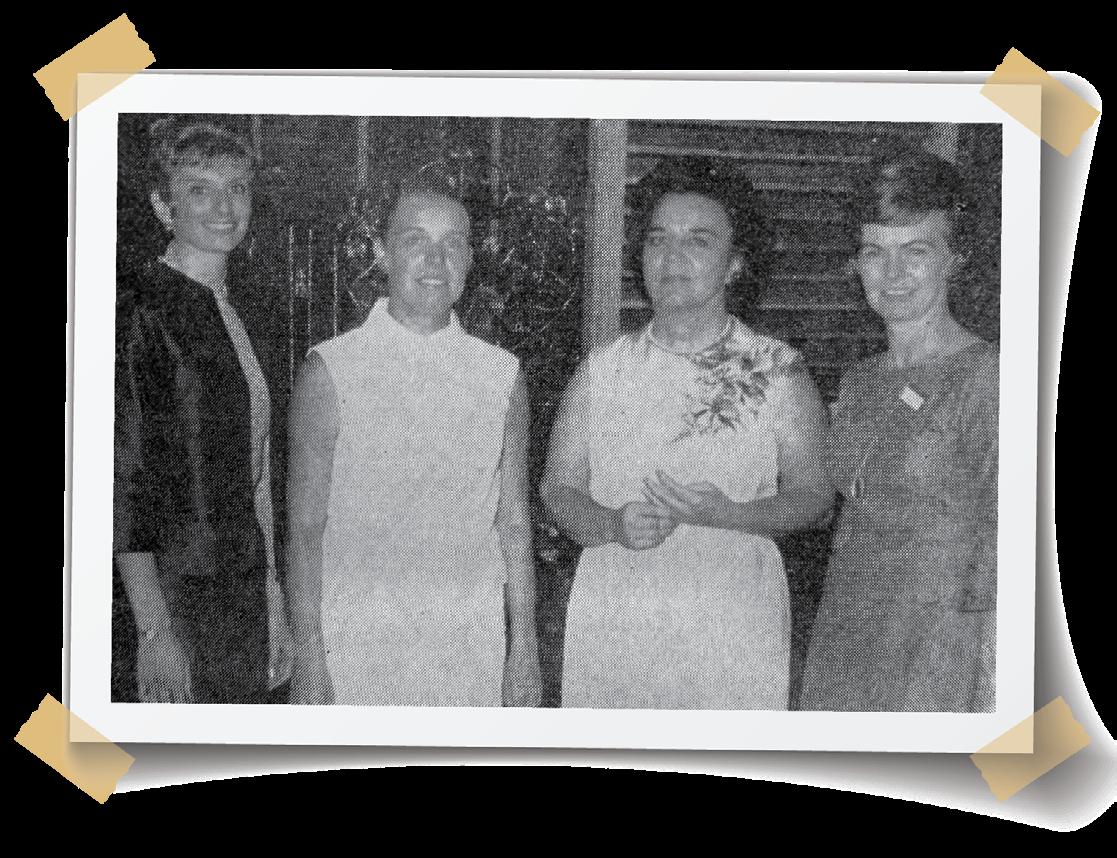
hospitals, while celebrating special occasions. In 1966, they held a holiday luncheon and fashion show, with Martha Galbraith, wife of the first US Ambassador to Singapore, Francis Galbraith, as the guest of honor.
In 1967, AWA made another progressive change by introducing social memberships, allowing more women to join beyond the original criteria. Over time, this became today’s associate membership, which does not require an invitation and is open to women of any nationality.
From its start as an auxiliary within the American Association to its growth into an independent, internationally inclusive group, AWA’s story is one of steady change. It is rooted in community, shaped by service, and driven by women who stepped forward when given the chance. Today, AWA continues to share a strong and meaningful relationship with the American Association of Singapore, holding a seat on the AAS Board and collaborating on events that strengthen the broader American community in Singapore.
Bertye Windle, first AWA President, 1935
From left: Mrs. Wally Sanborn, Vice-president of AWA; Mrs. John Dexter, US Embassy; Mrs. Martha Galbraith; and Mrs. Fred B. Powers, President of AWA, 1966
F.D. (Harry) and Betty Harrison
Belonging.
EVERYDAY HEALTH IN SINGAPORE: A QUIET CHECKLIST FOR
WELL-BEING
By Pedrinha Furtado
Reaching another age milestone this year, I found myself pausing, not dramatically, not anxiously, but with curiosity.
Am I actually taking care of myself the way I think I am?
Not in the obvious ways we so often associate with “being healthy,” but in the quieter, behind-the-scenes ways, like whether my vaccinations were still up to date.
It’s an easy thing to overlook. Vaccinations tend to belong to childhood memories, school consent forms, or pre-travel checklists. For many adults, especially expats balancing careers, families, and life transitions, they quietly fade into the background.
Yet living in Singapore, where healthcare is both world-class and accessible, invites a different approach. Health isn’t just something to fix when it breaks; it’s something to maintain thoughtfully and consistently.
ANNUAL HEALTH SCREENINGS
Singapore makes preventive healthcare remarkably straightforward, yet many adults still delay annual screenings. Often, it’s because we feel fine or because knowing feels harder than not knowing.
But screenings are not about anticipating bad news. They are about understanding your baseline.
Most clinics in Singapore offer comprehensive health screening packages tailored to age and risk profile. These screenings are especially relevant for expats. Changes in climate, diet, stress levels, and work culture can influence long-term health in subtle ways. Knowing what’s happening internally allows us to adjust gently before small shifts become major disruptions.
What to do: Book a comprehensive health screening once a year. Who it’s for: Every adult, especially from age 30 onward, or earlier if you have family history concerns.
ADULT VACCINATIONS
Reviewing my vaccination history raised an unexpected question: When did adult healthcare become so easy to forget?
In Singapore, adult vaccinations are strongly encouraged and widely available through polyclinics and private practices. Recommendations vary based on age, lifestyle, travel habits, and medical history.
Staying current isn’t about fear; it’s about responsibility. To ourselves, to those we love, and to the wider community we live and work in.
What to check: Review your vaccination status with a GP or family doctor.
Common adult vaccinations in Singapore include:
• Influenza (yearly) Especially important for office workers, parents, caregivers, and frequent travelers.
• Tdap booster (every 10 years) Protects against tetanus, diphtheria, and pertussis.
• MMR (Measles, Mumps, Rubella) For those without confirmed immunity.
• Hepatitis A & B Particularly relevant in Asia and for those dining out or traveling frequently.
• Shingles (Herpes Zoster) Typically recommended from age 50 onwards.
• HPV (Human papillomavirus) Recommended for both women and men, up to age 45, depending on medical advice.
• Varicella (Chickenpox) For those who have never had the illness or been vaccinated.
• Pneumococcal Advised for adults over 65 or those with chronic conditions.
• Yellow Fever and Typhoid Recommended for specific travel destinations.
DENTAL CARE
Regular dental check-ups and cleanings help prevent gum disease, tooth decay, and complications that can affect overall health, including cardiovascular conditions.
Dental care in Singapore is efficient and prevention-focused, yet many adults still wait until discomfort appears. Beyond teeth, oral health is closely linked to heart health, diabetes, and even systemic inflammation.
What to do: Schedule dental check-ups and cleanings every six months.
EYE HEALTH
With screen-heavy workdays and airconditioned environments, eye strain is common. Annual eye examinations can detect early signs of glaucoma, retinal changes, and chronic dry eye conditions often before symptoms appear.
Clear vision supports energy, productivity, and overall quality of life more than we often realize.
What to do: Get an eye examination once a year, or more frequently if you wear corrective lenses.
MENTAL HEALTH
Singapore has made significant strides in mental health awareness, offering access to counselors, therapists, and wellness practitioners across both public and private healthcare systems.
Mental health doesn’t require a crisis to deserve attention. Sometimes, it simply requires space for reflection, conversation, and recalibration.
Whether through therapy, mindfulness practices, support groups, or honest conversations, tending to emotional wellbeing is part of staying healthy, especially when “home” exists in more than one place.
What to do: Check in with your mental health proactively.
LIFESTYLE HABITS
Singapore’s heat affects hydration needs, energy levels, and recovery. Regular movement, whether walking, swimming, yoga, or low-impact training, supports mobility and longevity.
Small habits matter: drinking more water than you think you need, resting intentionally, and choosing nourishment over convenience when possible.
What to consider: Movement, sleep, hydration, and nutrition in a tropical environment.
Singapore doesn’t just offer healthcare; it offers structure. Knowing where to turn reduces stress before you ever need help. Chapter 6, Health & Wellness, in the Living in Singapore Reference Guide provides practical insights for navigating the system with clarity and confidence.
My research on this began with a simple question about vaccinations. But it became something more. It reminded me that health isn’t loud. It doesn’t always demand attention. Sometimes, it simply waits for us to notice.
There is something quietly empowering about reviewing your records, booking that screening, and asking your doctor a question you’ve postponed for years. Not because something is wrong, but because you’ve decided to be present in your own life.
Living abroad often means we are strong for everyone else. We adapt, we manage, we build. But consistently and intentionally tending to our own well-being is an act of self-respect.
Mini Checklist
ANNUAL HEALTH SCREENING
Full blood panel (cholesterol, glucose, liver & kidney function)
Blood pressure check
BMI & metabolic assessment
Age-appropriate cancer screenings
Mammograms / Pap smear
Prostate-related
VACCINATIONS REVIEW
Influenza (yearly)
Tdap booster (every 10 years)
Hepatitis A & B (if not immune)
MMR (if immunity unclear)
HPV (based on age eligibility)
Varicella (Chickenpox)
Shingles (50+)
Pneumococcal (65+ or high-risk)
DENTAL HEALTH
Scaling & polishing
Cavity screening
Gum health assessment
Wisdom tooth review (if applicable)
EYE HEALTH
Vision assessment
Glaucoma screening
Retinal scan (especially 40+)
Dry eye evaluation (common in airconditioned environments)
MENTAL & EMOTIONAL HEALTH
Personal stress check-in
Sleep quality review
Burnout assessment
Therapy or counseling consultation (if needed)
Community connection check
Lifestyle Basics in a Tropical Climate
Hydration habits (2–3L water daily in heat)
Weekly movement plan
Sun protection (SPF daily)
Vitamin D check (if mostly indoors)
Insurance coverage review
If you’ve been meaning to book a checkup, review your vaccinations, or simply pause and ask yourself, "How am I really doing?" consider this your gentle nudge. Because everyday health isn’t about reacting when something breaks.
It’s about quietly choosing to care before you have to.
MANAGING ANXIETY
FIVE PRACTICAL TOOLS FROM GENERATION PANIC
By Agi Heale
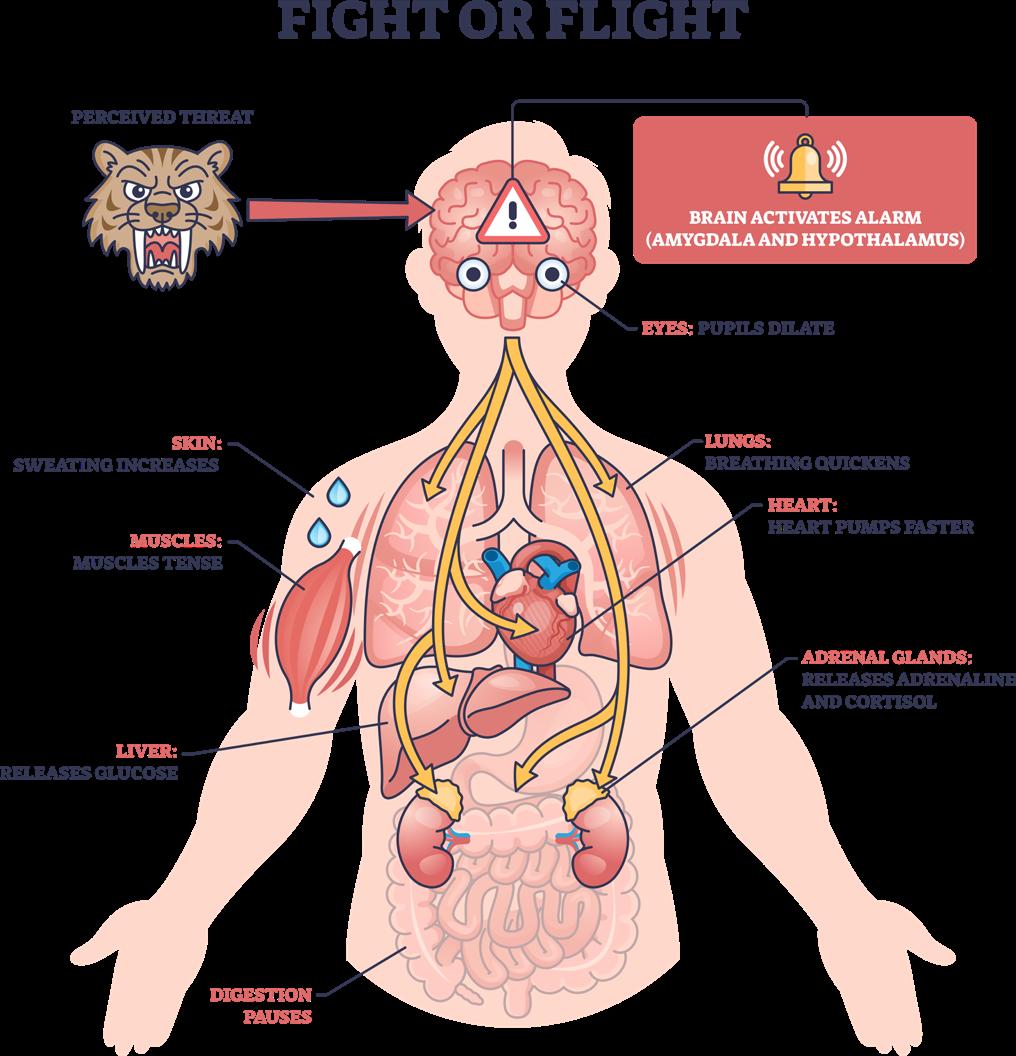
Anxiety is part of modern life. It shows up at work, at home, and in the blank space between events when nothing is technically going wrong, yet the mind and body behave as if something is. Anxiety is a response from our nervous system when there is uncertainty, perceived threat, or overwhelm – we are essentially trying to protect ourselves. Our early ancestors were often faced with genuine dangers, such as saber-toothed tigers, but in today’s world, we need to update our minds to realize that most of the time, there is no immediate threat in front of us, and we can move away from that fight-flight-freeze response.
Generation Panic provides practical tools by introducing a set of simple techniques that work in real time and under everyday conditions. By “mix-and-matching” readers can find what works best for them and apply different approaches depending on what is needed. Here are five ideas to get you started.
1. THE
7–7–7
BREATHING METHOD
Anxiety begins in the body faster than it begins in the mind. The nervous system activates before the brain invents a story about what is wrong. Heart rate increases, breath becomes shallow, muscles tighten, and the body prepares to respond to a threat. Without any conscious intervention, the mind then interprets this physiological state as anxiety. This sequence matters because it explains why trying to “think your way out of anxiety” rarely works. The body must be de-escalated first.
The 7–7–7 breathing method targets the nervous system directly. The structure is simple: inhale for seven seconds, hold for seven seconds, exhale for seven seconds. The long exhale engages the parasympathetic nervous system, the part responsible for slowing the body down. Holding the breath briefly prevents hyperventilation and gives the body time to register the incoming change. After a few cycles, heart rate slows, breath deepens, and muscle tension reduces. This shift alone lowers the intensity of anxious thinking.
The 7–7–7 method works because it gets us out of our head and into our body –our breath is always with us, and when you control your breathing, your mind will follow. It can be used in meetings, at home, on public transport, before bed, after waking, or in moments of uncertainty. It is discreet, fast, and reliable. Once physiological activation is lowered, the rest of anxiety becomes easier to manage because the brain is no longer reacting to a full alert state.
2. BACK TO THE PRESENT
An anxious mind defaults to the future. It imagines negative scenarios, loops through “what if” questions, and simulates problems that have not yet happened. The thinking is rarely irrational; it is simply unbounded. When there are no time limits or practical constraints, the brain can invent endless futures, none of which can be resolved in the present moment. This creates the internal sense of being overwhelmed, trapped, or out of control.
By coming back to the here and now, we can interrupt this pattern. Instead of thinking about the next month, week, or even day, focus only on what can be done in the next 10 minutes. Break down your day, moment by moment, to force your brain back to the present. From here, you can actually move to action and begin to take small steps forward.
This technique is especially useful for work-related anxiety. Work creates open-ended futures: pending deadlines, unknown decisions, expectations, and social evaluation. Coming back to the present converts those abstract pressures into concrete tasks. The brain prefers bounded problems (which it can solve and “fix”) to infinite ones (that feel out of control).
When the brain stops inventing futures, it stops trying to predict outcomes.
The mind becomes quieter, decisions become simpler, and next steps become clearer.
3. ONE TASK AT A TIME
Anxiety scatters attention into many fragments. While the body is activated and the mind is forecasting futures, we move into cognitive overload, where it becomes difficult to concentrate and make decisions. Productivity collapses and anxiety increases because nothing moves forward – the overwhelm ensures we are stuck on a hamster wheel.
Grounding attention in a single task is an efficient way to disrupt that loop. It does not matter which task is chosen. What matters is finishing it
from start to finish. Washing dishes, clearing email, scheduling appointments, folding laundry, drafting a document— anything that moves from incomplete to complete will work. Completion creates closure, and closure reduces anxiety.
It is worth remembering that anxiety thrives in unstructured mental space. Single-task grounding introduces structure without requiring motivation or emotional strength. When one task is completed, the brain experiences momentum, not perfection. Momentum matters because it reestablishes agency, and in doing so, tasks that previously felt overwhelming become manageable again.
The point is not to do more, but to give anxiety fewer places to hide, as the mind cannot catastrophize and execute at the same time.
4. DISCOMFORT VS. DANGER
Anxiety often misclassifies discomfort as danger. A difficult conversation, a deadline, a presentation, or a period of uncertainty feels threatening - even though no real danger exists. When discomfort is treated as such, the nervous system reacts as if its survival is at stake.
Distinguishing between discomfort and danger is central to managing anxiety. When the brain identifies something as dangerous, avoidance becomes logical. Instead, if we can reclassify tasks as merely uncomfortable, we can reduce emotional intensity and keep behavior aligned with reality instead of fear.
Discomfort shows up in hundreds of ordinary situations: expressing opinions in groups, asking for clarification, negotiating, presenting, making decisions, or setting boundaries. None of these situations actually threatens survival, but they still trigger anxiety. Recognizing them as discomfort changes the meaning of the sensation and weakens the anxious response. We can move away from instinctively wanting to flight, fight, or freeze, and instead see that the signal we are receiving is manageable. Once the brain learns that discomfort does not produce disaster, anxiety loses reinforcement.
5. CONTROL THE CONTROLLABLES
Anxiety expands when we try to control variables that cannot be controlled: the reactions of others, the timing of outcomes, future events, perfection, or external evaluation. Trying to manage them wastes our time and energy, as well as increasing our anxiety, because the system never resolves.
Controlling the controllables is a boundary exercise. The key is to identify what is actually within reach. Preparation, effort, communication, pacing, clarification, and followthrough fall into the category of controllable. The rest belongs to chance, timing, and/or other people. When attention is constrained to the controllable category, anxiety decreases because the problem becomes smaller and solvable.
When the controllable box becomes clear, tasks become clearer, decisions become simpler, and the imagination stops filling space with scenarios that cannot be influenced. The nervous system prefers a smaller sandbox.
FINAL INTEGRATION
These five tools (7–7–7 breathing, back to the present, one task at a time, distinguishing between discomfort and danger, and controlling only what is controllable) work because they disrupt the system that anxiety runs on. Hundreds of clients have benefited from coming back to these fundamental principles. Perhaps one of them resonates more deeply, perhaps none of them feel like they work – that is all ok… the most important point is to try out different tools and see what is impactful for you in the moment – different situations will call for different techniques.
Anxiety cannot be eliminated, and elimination should not be the goal. The goal is functional management. When anxiety is managed practically, it stops dictating choices and stops interfering with daily life. Anxiety becomes a signal, not a barrier. That shift alone gives people more freedom and more capacity to operate under pressure.
Agi Heale is a Leadership Coach and Facilitator with over a decade of experience helping leaders and teams thrive. She is a certified CTI coach, PCC, and Master NLP Practitioner, as well as the author of Generation Panic: Simple & Empowering Techniques to Combat Anxiety
OVERCOMING BURNOUT ABROAD
By Tiara Giles
In 2023, I moved to Singapore, all bright-eyed and bushytailed, waiting for my new work visa to go through. I tried to eat everything I could and make as many friends as I could before I started work. I felt lucky to have about two and a half months of free time to truly get to know the country.
But when I started working, I felt burnout seep in after only a short month. My hours felt longer than usual. I felt like I didn’t know how to do my job. I felt like I had no stamina. Maybe I was just being dramatic. Maybe that two-and-a-half-month jobless stint had me feeling a bit too comfortable. I just needed to get over it, right?
The more I tried to mask my burnout, the more tired I became. I felt like I couldn’t understand the people I had been working with. I couldn’t understand their demands. Like, why were we getting penalized for taking a sick day? Why were they begging us not to get sick? Why is this a thing here?
I thought I had finally gotten away from jobs like this.
I felt awful. My body grew ill, I started to hate getting up, and I felt like I was becoming lazy with my work. I felt working was useless if I was meant to do the same job with no progression, too many hours, and very little in the way of benefits. I started to feel trapped, like this was all I could do: wake up, go to work, feel tired, and sleep.
Tips for Managing Burnout
1. Turn to other people
Reach out to those closest to you, such as your partner, family, and friends. Limit your contact with negative people. Connect with a cause or a community group that is personally meaningful to you.
2. Reframe the way you look at work
Try to find some value in your work. Find balance in your life. Take time off.
I eventually expressed all of this to my therapist. I told her how I felt I couldn’t understand the people here. I told her how I really, really struggled to understand the locals when I lived in Korea, too. I struggled with the work and dating culture there, and now I’m still struggling in Singapore. My therapist took one look at me and recommended that I get tested for ADHD and autism.
These diagnoses made my burnout so much worse. I quickly felt like I couldn’t handle it. I felt like I was regressing instead of improving. I needed to figure something out, and fast. I was tired of being tired, and I was tired of being sick and tired. So I decided to let work stay at work, accept only what I had the capacity for, and not put up with misery from work. Work may take up of 70% of my day, but it won’t take over my life.
So my biggest advice to you is to leave work at work if you can. When it’s time to clock out, do so physically AND mentally. The rest of the day belongs to you.
And as for people, I discovered I understood the culture well. I just masked in order to fit in with society. So just be yourself. Your real friends and family love you for who you are.
Focus on you. Leave time for yourself. Do the things that bring you joy.
Work is not your life. It just helps you fund it.
3. Reevaluate your priorities
Set boundaries. Take a daily break from technology. Nourish your creative side. Get plenty of sleep.
4. Make exercise a priority
Aim to exercise for 30 minutes or more per day or break that up into short, 10-minute bursts of activity. A 10-minute walk can improve your mood for two hours.
5. Support your mood and energy levels with a healthy diet
Minimize sugar and refined carbs. Eat more Omega-3 fatty acids to give your mood a boost. Avoid nicotine. Drink alcohol in moderation.
SINGAPORE’S TREE STORY
When I moved to Singapore from the US, I thought I knew wood.
I worked with it every day in the furniture and building industries and was experienced with hands-on carpentry.
I knew wood from cutting it, shaping it, sanding it smooth, turning rough planks into cutting boards, tables, and furniture that would live in people’s homes. Wood, to me, arrived on trucks. I knew it by grain patterns and hardness ratings, not by leaves, bark, or canopy shape.
I was amazed by the urban greenery here. Singapore inspired me to learn about its exotic tropical hardwoods. For the first time, I wanted to know about trees, not just wood. As a novice, I described the wonderful greenery here as “… very green.” This evolved to a nuanced understanding of the trees and their stories. “Green” became “…pinnate compound leaves of the Angsana tree…”
How did Singapore become the world’s greenest city? Surely this could have happened in Jakarta, Manila, Bangkok, and other capitals across Southeast Asia, given the same climate. But it didn’t.
Singapore’s “tree story” is founded on urban planning decades ahead of its time. Shortly after independence in 1965, Prime Minister Lee Kuan Yew launched the “Garden City” vision.
At the time, Singapore was crowded, industrializing fast, and struggling with pollution. Lee believed greenery wasn’t a luxury: it was essential for quality of life, national pride, and long-term survival.
Leaders like Dr. Goh Keng Swee, S. Rajaratnam, and Lim Kim San supported the idea that good urban planning must include nature. Tree planting became policy, and the famous tree-planting campaigns were launched. Roads were designed with verges wide enough for roots. New housing estates included green corridors. Parks weren’t leftovers; they were planned and implemented everywhere.
Institutions followed. The Singapore Botanic Gardens, founded in 1859, became a living classroom for tropical plants. What would later become the National Parks Board (NParks) took on the responsibility of caring for greenery as critical infrastructure, not decoration. This effort led to the world’s-mostbeautiful-drive-from-the-airport that we’re all familiar with, where Rain Trees form a covered arch, shielding the concrete from the sun. The massive Angsana trees that line Orchard and Scotts Roads protect pedestrians while releasing cooling moisture. Studies confirm that tree-lined streets are up to 7ºC (12ºF) cooler than bare streets.
Many aspects of the story are unique and truly impressive.
The authenticity: all of this was done decades before ESG, carbon credits, or any opportunity for marketing or social credit.
The commitment: planting and maintaining this number of urban trees requires tremendous financial, management, and infrastructure resources.
Knowing Singapore is fiscally prudent and not shy about collecting fees when it can, I find it most impressive and refreshing (literally) that there are no billboard advertisements here.
Imagine the long interstate drive back home. How much nicer would it be without advertisements cluttering the landscape? We can opt out of viewing ads online by paying for premium services. Shouldn’t we be able to drive to work without seeing advertisements? Again, LKY was ahead of his time. And this required the commitment to forego the vast amounts of revenue that could be earned renting roadsides for advertising.
Equally impressive is the quality of the trees they planted. I revert back to the wood, not the tree, for this. African Mahogany and Angsana are some of the most prized hardwoods in the furniture
By Aaron Arthur Foeste - Founder of Arthur Zaaro, Specialist in Salvaging Singapore Trees
industry. I’m sure Lee’s vision included the concept of circularity, where a felled tree could be used for something valuable. My business now collects felled hardwoods here and repurposes them into high-quality cutting boards and furniture. All of Singapore’s felled trees are from urban areas, and unlike imported tropical timber, no habitats are destroyed to obtain this wood.
Today, Singapore has over seven million trees that are managed carefully, inspected, pruned, replaced when necessary, and always prioritized. Major developments are required to replace greenery vertically when it’s removed horizontally. The One Million Trees movement aims to plant an additional one million trees by 2030.
Angsana is now my favorite wood. It’s like cutting cold butter with a sharp knife – smooth and clean. It has a perfumelike scent: a wonderful combination of sandalwood, honey, and a touch of dill. Singapore served as an urban timecapsule for Angsana. Planted decades ago, it has simultaneously been driven to the critically endangered list due to overcutting in its natural habitats. But it’s thriving here in our midst.
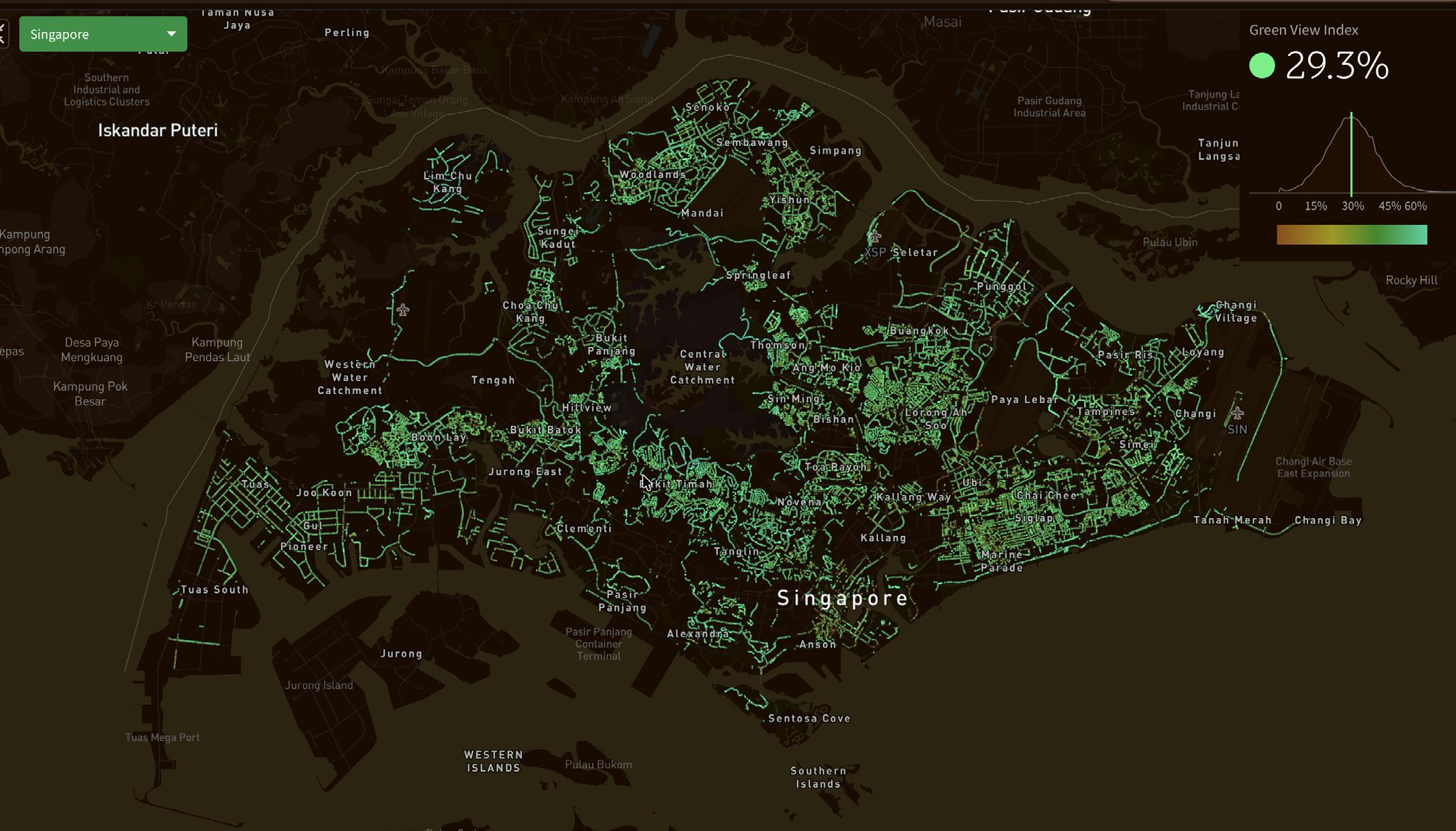
Treepedia measures the canopy cover in cities. Their method analyzes the amount of green perceived while walking down the street. The tree canopy contributes to lower urban temperatures and mitigates air pollution. Treepedia is a project by the MIT (Massachusetts Institute of Technology) Senseable City Lab.
TREEPEDIA GREEN VIEW INDEX IN SINGAPORE
IT’S EASY TO GET INTO NATURE IN URBAN SINGAPORE
By Richard Hartung
Do you want to escape urban Singapore and get out into nature? It’s easier than you might think to head out to nature reserves and parks or even offshore islands that offer a respite from urbanization.
SINGAPORE HAS PLENTY OF NATURE WHEN YOU KNOW WHERE TO LOOK
Even though Singapore touts itself as one of the greenest cities in the world, with National Parks (NParks) citing more than 7,800 hectares of green spaces, most of what we see every day is manmade parks or tiny green patches. They’re very different from the vast national parks and forests in larger countries around the world, including nearby Malaysia and Indonesia. Indeed, it can seem nearly impossible to reach an actual forest.
Yet there actually are places in Singapore where you can get away from the noise and buildings – 24 of them, NParks says, including four nature reserves and twenty parks or nature areas.
The nature reserves – Bukit Timah, Central Catchment (MacRitchie), Labrador, and Sungei Buloh – are the biggest ones.
The largest is the Central Catchment Nature Reserve, which NParks lists as exceeding 2,000 hectares. Twenty kilometers of trails wind through the Reserve, with routes one through six ranging from an easy three-kilometer walk to an 11-kilometer route that circles the entire Reserve and takes several hours to complete.
Bukit Timah Nature Reserve is also a delightful escape, with four trails of varying lengths and difficulty levels that begin at the Visitor Center. Its 163 hectares include Singapore’s tallest hill, Bukit Timah Hill, at 163 meters. It also includes some of Singapore's last remnants of primary forest and has more unpaved dirt trails than some other reserves. You can easily spend a few hours or even half a day wandering through the trails.
Bukit Timah and other reserves are often adjacent to nature parks, which serve as green buffers that protect biodiversity and provide habitat for native plants and wildlife. While not
as rich an opportunity to fully escape into nature, they offer pleasant sojourns amid greenery.
Offshore islands offer a respite, too. Pulau Ubin, for instance, has a variety of wildlife in a relatively rustic setting and offers hikes or short treks as well as camping, kayaking, and cycling. It’s easy to rent a bike that you can use to get around parts of the island, or you can simply follow trails that will take you away from the populated area near the pier where you arrive. It’s easy to spend anywhere from part of a morning to a full day exploring the island.
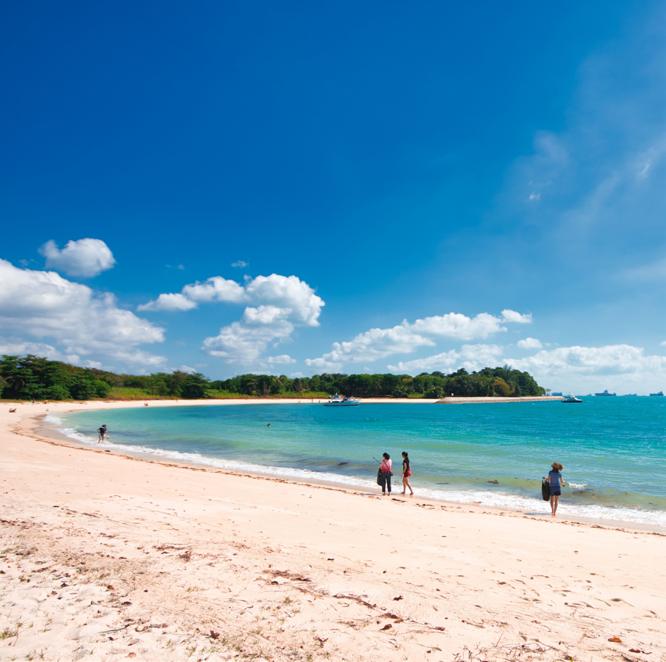
St. John’s Island, accessible via ferry from Marina South Pier, has an easy walking trail that is nearly three kilometers long. And from St. John's Island, it’s about a 15-minute walk via a manmade causeway to a beach on Lazarus Island.
While they don’t offer as much of an escape from the city as nature reserves, there are also longer trails in Singapore that have greenery on both sides, even if you’re often peeking out at buildings.
The Coast-to-Coast Trail, for example, is a 36-kilometer route linking nature areas, parks, and park connectors from Jurong Lake Gardens in the west through the Lornie Nature Corridor to Coney Island in the northeast. You could easily hike for the full day on this one.
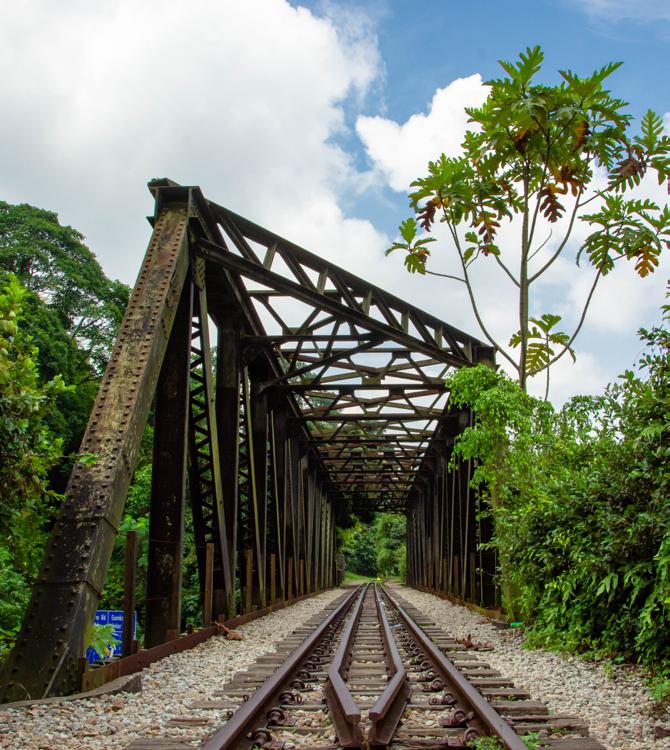
The Rail Corridor, on land formerly used for the railway tracks linking Singapore to Malaysia, is a 24-kilometer stretch from Woodlands to Tanjong Pagar. While houses and malls, as well as office buildings, are visible along the way on this one, too, the trails are bounded on both sides by greenery. It also allows wildlife to move between major green spaces along the route. While part of it is paved, the stretch from Rifle Range Road to Kranji has a trail made from grass and gravel. Walking along the entire trail can easily take half a day or more.
Another popular, though perhaps lesser-known, trail is Mandai T15 in the Central Catchment Nature Reserve. The 7.1-kilometer wooded loop, which starts
on Mandai Lake Road near the entrance to the Singapore Zoo and continues to the Bukit Panjang Hawker Centre, offers a couple of hours amid greenery. Along the way, you’ll see trees and wetlands as well as long-tailed macaques, and if you’re lucky, you may even spot some deer. Linking many of the places is the Park Connector, which has more than 380 kilometers of paved pathways around the island that go through greenery as well as urban areas.
GETTING THERE IS EASY, BY YOURSELF OR WITH A GROUP
Getting out into nature is easy once you figure out where you want to go, and you can head to any of these areas on your own. You can drive, use a taxi or ride-hailing service, or take buses or the MRT to get close to the entrance of many of them. Well-marked paths also connect these nature parks, and the “Park Connector” signs are abundant on walkways throughout Singapore. It can also be enjoyable to go with a group. If you want to learn lots more about the area you’re visiting, the Nature Society Singapore (nss.org.sg) runs regular walks in parks across the island. Expert leaders explain the flora and fauna to participants in the walks, who are almost all nature aficionados. I’ve found an amazing depth of knowledge among the volunteer guides on nature walks I’ve enjoyed.
A fun way for families to get out into nature is to join the Hash House Horrors (hashhousehorrors.com), a children’s running and walking group that follows a trail of flour or chalk through parks and “jungles” all around the island. Our children thoroughly enjoyed their time in nature, even though some of the trails were challenging, and the “runs” all ended with a meal. For adults who want a similar experience, sometimes in the lesser-known areas of Singapore, nine other Hashes (www. hash.org.sg) in Singapore target men, women, bikers, or other segments.
Another option is WWF-Singapore (www.wwf.sg), which organizes Wetland Watchers at Lim Chu Kang Nature Park. The monthly conservation program aims to enhance the connection between people and nature. WWF says participants can gain hands-on experience as a field biologist while contributing to the conservation of Singapore’s ecosystems. WWF also hosts walks at Rifle Range Nature Park, led by experienced guides who help participants learn about Singapore’s natural heritage and who may help you spot species such as the Strawheaded Bulbul or the Malayan Colugo. There are plenty of other nature groups, too. Check out Meetup, for example, to learn about groups such as SG Hikes (www.meetup.com/sg-hikes), or use AI to check out other groups that may interest you.
GETTING INTO NATURE IS WONDERFUL
Wherever you go on your nature excursion, whether it’s heading into a forest or sitting on an uncluttered beach, you’re likely to feel an immediate sense of calm from simply spending time in the natural world. Beyond that peace of mind, spending time in nature offers numerous benefits.
Exposure to green space has been linked to better sleep, lower blood pressure, and reduced risk of chronic disease, according to Harvard professor Heather Eliassen. "We see changes in the body such as a lowering of blood pressure, a change in your heart rate variability, and your heart beats slower,” the BBC similarly observed. “The scent of trees and soil is full of organic compounds released by plants,” and breathing them in can even boost your microbiome. Yes, we’ll most often spend our days in an urban environment of high-rise buildings and busy streets. When we need an escape, though, nature is close by. It’s easy to spend hours amid the trees and streams, which help restore our sense of well-being.
SILENCE, AND THE SOFT SPACES IN BETWEEN: WHAT A MINI SURVEY REVEALS ABOUT
MEN’S WELL-BEING IN SINGAPORE
By Kay Yin (@thisiskaykhy)
People speak more openly about mental health today, and we now understand more clearly how closely the mind and body influence each other. Stress weakens immunity, affects daily functioning, and shapes our overall wellbeing. At the same time, we live in an age of constant information. The steady stream of updates and curated online lives quietly raises our expectations of ourselves.
Without noticing it, many of us end up in a daily race that creates anxiety, restlessness, and a sense of never doing quite enough. It is not surprising that insomnia, anxiety, and depression have become more common.
Women tend to voice their struggles more readily, while many men continue to hold theirs in. Globally, men face a silent but serious crisis. WHO warns that suicide rates among men are far higher than among women, yet men remain less likely to seek professional support. Society still links masculinity with quiet endurance and self-reliance, which leads many to internalize stress. When emotions have nowhere to go, they often surface as anger, burnout, or withdrawal.
On the surface, men may appear steady and composed. However, after speaking with many of them and reviewing the small anonymous survey I conducted, it is clear that their inner experience is more complex. Singapore offers comfort, stability, and opportunity, yet it can also intensify pressure, especially for expat men who are building a life far from home.
In much of Asia, the challenge is even greater. Mental health issues are still seen as a stigma, and seeking help is often viewed as weak, unnecessary, or self-indulgent. This makes it hard for men to reach out, even when they feel overwhelmed. In Singapore, the culture of efficiency adds another layer. People are expected to keep going, stay strong, and perform. For foreigners, the stakes may feel even higher. Showing vulnerability can raise fears about job security, marital stability, or future visa renewal.
This piece is an attempt to acknowledge what many quietly experience in a place where composure is expected, and in no way tries to generalize. The survey I conducted is small (approximately 20 expat respondents) and personal, but it offers insight into the inner lives of expat men living and working in Singapore.
WHO THESE MEN ARE
Most respondents were in their 30s to 50s. They are in the middle of their careers, carrying growing responsibilities, and beginning to reflect on the bigger picture of their lives. Some are approaching retirement and wondering what life might look like beyond work. A few even asked themselves, “How much time do I have left for things other than my job?”
Some came to Singapore for professional opportunities. Others followed their partners. A number arrived seeking a reset. Their backgrounds differ, but they share a common effort: holding everything together while navigating a demanding, fast-paced city.
Many described their emotional state as “mostly calm,” “okay,” or “managing.” It is a practical kind of calm shaped by work, family expectations, and identity. One man summed it up by saying, “Calm, but only because I do not have space not to be.”
WHAT THEY CARRY
Behind that steadiness are pressures they rarely voice.
Work culture in Singapore is fast and competitive. The cost of living is high. Many men feel they must perform well for the sake of their families. Visa cycles, company restructuring, marital struggles, and career uncertainty add further stress.
Loneliness appeared repeatedly. Many men rely almost entirely on their partners for emotional support. Few feel they have close male friends in Singapore. Adult friendships take longer to form, and busy routines make connections more difficult.
WHAT KEEPS THEM STEADY
Most respondents pointed to movement as their strongest anchor. Running, cycling, tennis, and gym sessions help release stress and clear the mind. These activities provide structure to their days.
Partners and spouses also offer grounding. Quiet conversations, shared routines, and simply knowing someone is there create emotional stability.
Men also build steadiness through everyday rituals such as morning coffee, predictable work routines, and weekend sports. These familiar patterns act as anchors in a fastmoving environment.
THE EXTRA LAYER FOR EXPAT MEN
Living abroad adds its own emotional terrain.
Starting over socially in midlife is different from starting over in youth. Many men shared that they have not yet found “their people” in Singapore. Some hesitate to open up because vulnerability feels risky in a new environment.
Grief and major transitions also feel sharper when support systems are far away. Some men turn to long-distance friends or mentors. Others confide only in their partners. A few manage everything quietly because they do not know where to turn.
DO MEN SEEK HELP?
Their willingness varies. Some have tried therapy. Others are open to it. A few believe they do not need help and are not interested. The hesitation often comes from unfamiliarity rather than resistance. Many simply never learned that seeking support can be a form of strength.
WHAT MEN WOULD TELL EACH OTHER
The advice they would give one another was simple and sincere. “Meditation, recognizing our limits”
“Get to the gym and sort out your diet and lifestyle, also things can only get better”
“Don’t be shy to seek help and disclose vulnerability” “Exercise. Be social. Get to know the community” “Sharing isn’t weakness”
Men often carry more than they show. The calm they present can hide responsibility, stress, and private worry. In a fast and efficient city like Singapore, it is easy for these pressures to go unnoticed. What many men need is not perfection, but simple permission to be human and to acknowledge their inner world without judgment.
Small check-ins, steady routines, and reliable connections make a meaningful difference. So does timely support. With more accessible counselling and mental health services available today, both online and in person, seeking help has become more practical and less stigmatized.
One line from the survey expresses it clearly: “If you do not take care of yourself, you cannot take care of others.”
If you have a partner, son, or male family member, you may already sense when he needs more than fulfilling a role or meeting expectations. I hope my own son grows up knowing he can express his feelings freely, that asking for help is acceptable, and that emotional awareness is part of becoming the man he wants to be.
Disclaimer: This piece is not medical advice. If you are experiencing emotional or psychological difficulty, please reach out to a licensed mental health professional or a trusted support resource.
If you or someone you know is having suicidal thoughts, Samaritans of Singapore can be reached anytime at their 24-hour Hotline, 1767, or 24-hour CareText, 9151 1767 (via WhatsApp).
Coping with Transitions
By Aimee @littleluxurylist
One of life’s most beautiful and sometimes tragic aspects is the transitions we will inevitably undergo.
We get our first “real” paychecks.
We move into our first apartments.
We fall in love, break up, and do it all over again.
But one of the biggest transitions that we will ever undergo is our move here to Singapore.
Suddenly, there is this huge physical distance that now separates us from our loved ones and the neighborhoods where we grew up.
We aren’t just building new homes, but new lives. The distance is coupled with the fact that we become different, too. Our preferences for late-night clubbing may evolve into game nights with friends. Or we pick up new hobbies and new friends, slowly and surely growing into a slightly different version of ourselves.
Support through Transitions
As with other periods of transition, one of the biggest factors that helps is the support networks we build here in Singapore. Recently, an acquaintance told me how she was lonely over the new year. Her friends in Singapore were out of town, and she felt like she had no one to call, even to go to a movie. I empathized with her and encouraged her to expand her circle of friends or reconnect with old friends.
Even a small country like Singapore still has almost six million residents. We start making an effort to find friends in all kinds of personal and professional settings. We join industry associations (e.g., tech or finance-based ones to the Chamber of Commerce), school-based associations (e.g., Ivy Network, other alumni associations), and of course, countrybased associations or clubs (i.e., the American Association). Parents may reach out to other parents not just for playdates and advice, but for a little connection for themselves, too.
We keep connecting, but it takes more effort. Adult friendships are hard to make and harder to maintain. They sometimes wilt in the face of our own work dramas, PTA meetings, and time with our partners. We also face the reality that Singapore is a transient place, and we may end up moving, leaving the friends we made an effort to make. Or suddenly, in a year, several of our friends pick up and move, leaving us a little lonelier.
Dealing with Transitions and Grief
Life keeps moving forward, whether we have these tight networks in place or not. Many of us find ourselves in the sandwich generation, dealing with aging parents and the ups and downs of raising kids (please tell me the teenage years get better!). Between remembering to put all the season’s soccer games on the family calendar, we may suddenly be thrust into another shift, somehow managing our parents or other loved ones when they fall ill.
How are we supposed to help family members from thousands of miles away?
I didn’t know how to do this with my father during his illness. His sickness left us debating care for a few months. But his body succumbed sooner than we thought, preventing us from having to get too far with detailing long-term care from abroad. My father never exercised much. But he was only slightly overweight and, at least, seemed to read and socialize more in his golden years (though his mental sharpness was still there). He was always generous, almost to a fault, giving away time and money he didn’t necessarily have. But he was always reserved and didn’t like to trouble people.
One of the troubling things he didn’t want to share with us was his health. It started with an aneurysm, which he only told us about later. But he couldn’t hide his shortness of breath, persistent bruising, and increased difficulty walking. He ended up getting triple bypass surgery to relieve his blocked arteries. This surgery ended up being the beginning of his demise. I was still living half a world away while researching home care options and nursing costs. My mom and uncle managed the best that they could while I grappled with the guilt of not being able to do more. What could I really contribute besides finding a nurse? My father was a shell of himself - living, but just barely. He could barely walk, talk, or eat. Our living room on the first floor became his bedroom and the easiest place for him to simply exist.
Finally, he was hospitalized because he had great difficulty breathing. It was right before Thanksgiving, and my kids were still in school. Amid daily updates on his condition, I decided we should all just go visit him, rather than wait until the term break.
We arrived to find ourselves in the middle of a cold spell on the East Coast, which aptly reflected my dark mood. I walked into an unfamiliar hospital room and struggled to minimize my own shock. Now I was the one who could barely breathe as I gazed upon my now gaunt father, who looked so much more like my grandfather in his later years. My father still couldn’t communicate with us. Yet when I arrived, tears started rolling down his face. He knew that we were there. The family he had created over the last 40 years now surrounded him. We all cried and provided quiet comfort to him and each other.
He took his last breath less than 12 hours later. We held his funeral three days later on my birthday.
My logical, list-loving self could deal with closing accounts and calling customer service from wherever I was. But I couldn’t put away every shirt. I couldn’t go through every file. Most importantly, I couldn’t tell my dad I loved him and appreciated him. I left to go back to my life in Singapore, my grief in tow.
There is a void when you experience the death of a loved one. Suddenly, there is just empty space. Space where someone had smiled. Space where somebody told you the same story they
had told you last month. Space where someone you cared about existed. That emptiness will be present wherever you are.
We only realize how ephemeral life is when we lose someone. The somewhat clichéd saying rings true: we must live our lives in a way that makes our loved ones proud.
Talk it out.
Cry it out.
Grieve.
Grief has no borders.
Grief does not stay in a constant state.
Grieving has no timeline.
But life goes on. Slowly, your feelings won’t consume you. You start to find more joy in the little things. You live your life with the people who are still in it.
After all, life is full of transitions, beautiful and tragic.
If your next big transition is moving out of Singapore, consider attending our talk on repatriating on March 11. The event is free for AAS and The American Club members! Scan here for more info.