Qwen 3 TTS on Simplismart: Production-Ready Voice Synthesis at 90ms TTFB
Text-to-speech technology has become essential for conversational AI, voice assistants, accessibility tools, language-learning platforms, customer support automation, content creation, and interactive applications. However, many teams still face a difficult trade-off when choosing a TTS solution: high-quality speech often comes with higher latency, while fast systems may compromise on naturalness, voice control, or deployment flexibility.
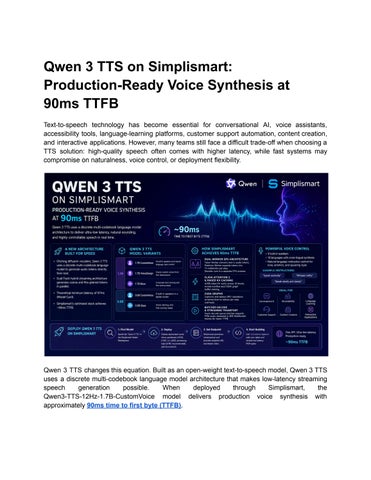
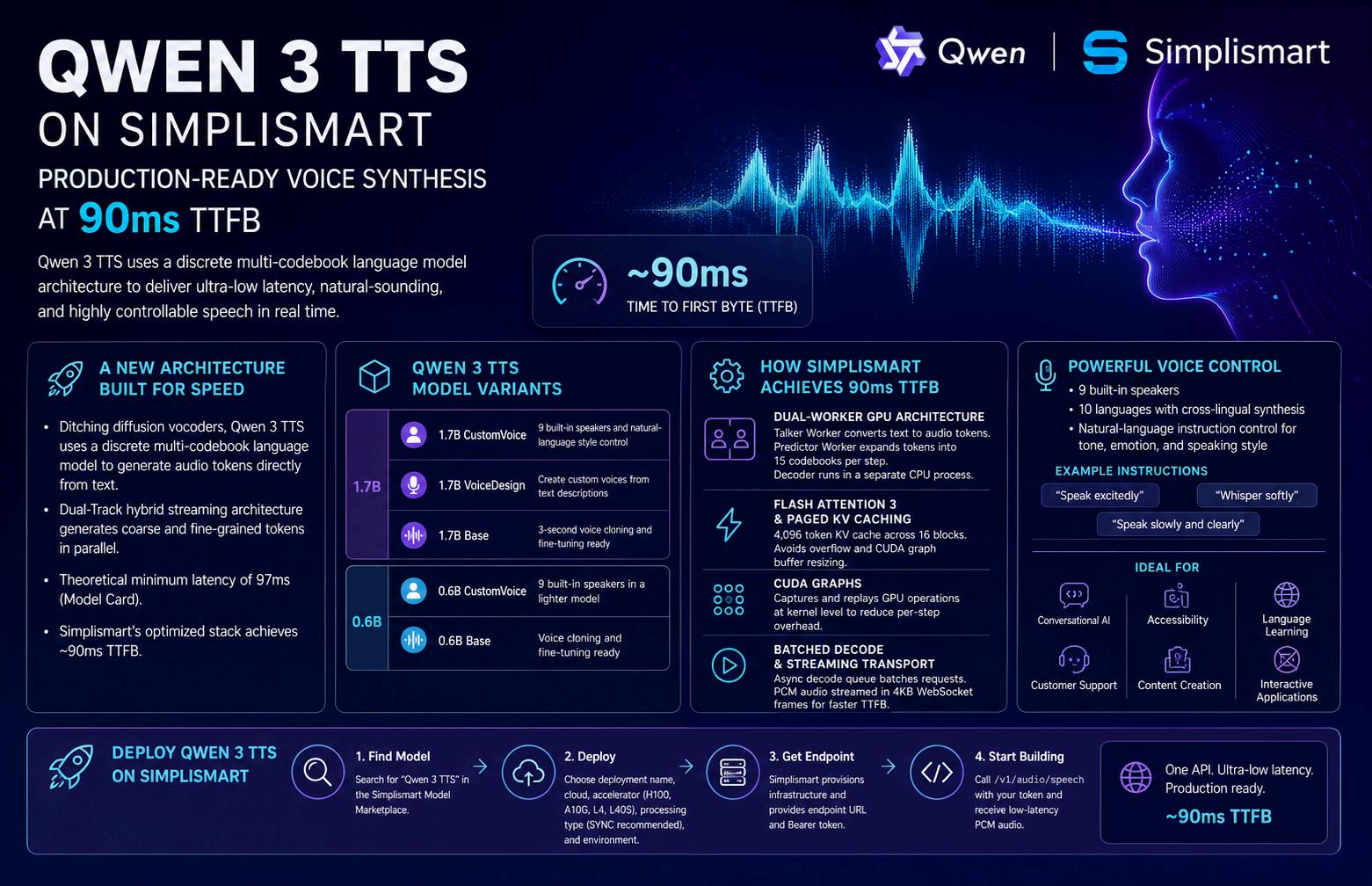
Qwen 3 TTS changes this equation Built as an open-weight text-to-speech model, Qwen 3 TTS uses a discrete multi-codebook language model architecture that makes low-latency streaming speech generation possible. When deployed through Simplismart, the Qwen3-TTS-12Hz-1 7B-CustomVoice model delivers production voice synthesis with approximately 90ms time to first byte (TTFB).
This combination gives developers a practical way to build real-time voice applications without managing complex GPU infrastructure, Docker configurations, Kubernetes clusters, or custom serving pipelines
Why Traditional TTS Pipelines Struggle With Latency
Most traditional text-to-speech systems use a two-stage architecture. First, a language model processes the text and generates phoneme, duration, pitch, or acoustic representations Then, a diffusion-based vocoder converts those representations into audio.
The challenge is that diffusion vocoders are sequential by design They require multiple denoising iterations before producing usable audio Depending on the model and quality settings, this process can involve anywhere from dozens to hundreds of denoising passes.
Every pass adds latency Even if the language model is optimized, the diffusion vocoder can become the main bottleneck in the pipeline. This makes it difficult for conventional TTS systems to consistently achieve low time-to-first-byte performance
Another limitation is error propagation. In traditional pipelines, phoneme duration and pitch predictions are passed from the language model to the vocoder as fixed conditioning inputs If the language model makes an inaccurate prediction, that error can affect the final audio output The vocoder has limited ability to correct such mistakes once the denoising process begins.
As a result, many diffusion-based TTS pipelines remain in the range of 150ms to 300ms latency, even after aggressive optimization and distillation.
How Qwen 3 TTS Uses a Different Architecture
Qwen 3 TTS removes the need for a separate diffusion vocoder Instead, it uses a discrete multi-codebook language model that predicts audio tokens directly from text.
A codebook converts continuous audio signals into discrete tokens, similar to how a language model converts text into tokens These audio tokens represent important speech characteristics such as pronunciation, pitch, prosody, acoustic detail, and vocal timbre.
Because Qwen 3 TTS generates audio tokens end to end, it can begin producing audio after processing very little input text. This supports faster streaming onset and reduces the structural latency associated with traditional vocoder-based pipelines
The model uses what Alibaba describes as a Dual-Track hybrid streaming architecture. One track generates first-layer codebook tokens, which represent the primary acoustic sequence At the same time, a second track predicts the remaining codebook layers that add fine-grained vocal details, timbre, and prosody.
Since both tracks operate in parallel rather than sequentially, Qwen 3 TTS can begin streaming audio earlier. The model card reports a theoretical minimum latency of 97ms, while Simplismart’s optimized production serving stack achieves approximately 90ms TTFB
Qwen 3 TTS Model Variants
The Qwen 3 TTS model family includes five variants across two parameter sizes: 1.7B and 0 6B
The 1.7B CustomVoice model includes nine built-in speakers and natural-language style control. The 1 7B VoiceDesign model enables the creation of custom voices from text descriptions The 1 7B Base model supports three-second voice cloning and is ready for fine-tuning
For lighter deployments, Qwen 3 TTS also provides a 0 6B CustomVoice model with nine speakers and a 0 6B Base model designed for voice cloning and fine-tuning workflows
Simplismart’s shared endpoint serves the Qwen3-TTS-12Hz-1.7B-CustomVoice variant. This model supports nine built-in speakers, ten languages, cross-lingual synthesis, and natural-language instruction control.
How Simplismart Achieves 90ms TTFB
While Qwen 3 TTS is designed for low latency, production performance depends heavily on the serving infrastructure. Simplismart uses an optimized serving stack to reduce bottlenecks and support consistent real-time voice generation
Dual-Worker GPU Architecture
A common TTS serving approach runs the entire workload inside a single Python process. Under concurrent traffic, this can create Global Interpreter Lock contention and reduce responsiveness.
Simplismart separates the workload into dedicated processes:
● Talker Worker: Converts text into audio token representations through the language model
● Predictor Worker: Expands the primary tokens into multi-codebook audio representations, including 15 codebook tokens per step.
● Decoder: Converts audio codes into raw PCM audio in a separate CPU-bound process
This architecture prevents the decoder from blocking the main event loop. The workers communicate through ZMQ zero-copy inter-process messaging, helping reduce serialization overhead and latency
Flash Attention 3 and Paged KV Caching
Simplismart runs the attention mechanism with Flash Attention 3 and paged KV caching Paged attention uses a block-based memory model, similar to virtual memory in an operating system.
This allows the system to process longer sequences without reserving fixed GPU buffers for every request. The KV cache is configured for 4,096 tokens across 16 memory blocks. This helps prevent cache overflow and avoids CUDA graph buffer resizing overhead during longer speech requests
CUDA Graphs also capture and replay GPU operations at the kernel level. This reduces per-step kernel launch overhead and helps keep latency stable under load
Batched Decode and Streaming Transport
Simplismart uses an asynchronous queue for audio decoding Instead of serializing requests through a shared decoder lock, decode requests are submitted to a background worker that can batch multiple operations together.
This improves throughput during concurrent usage without adding unnecessary per-request latency.
For streaming delivery, PCM audio is packaged into fixed-size 4KB WebSocket frames The first audio chunks use smaller decode windows to reduce time to first byte. After streaming begins, the system shifts to larger windows to improve throughput
Built-In Speakers and Natural Language Voice Control
The CustomVoice model includes nine built-in speakers, and each speaker can synthesize all ten supported languages This makes cross-lingual voice generation possible without requiring separate speaker models or language-specific configurations
For example, an English-named speaker can produce fluent Japanese speech with natural prosody
The model also accepts a natural-language instruction field. Developers can guide vocal expression using prompts such as:
● “Speak excitedly”
● “Whisper softly”
● “Speak slowly and clearly”
These instructions influence tone, rhythm, emotional expression, and speaking style at inference time This differs from many traditional TTS APIs that offer only fixed emotion settings or static speaker embeddings.
The flexibility is useful for accessibility applications, language-learning platforms, ambient voice experiences, interactive storytelling, ASMR-style content, customer service tools, and conversational AI products
Deploying Qwen 3 TTS on Simplismart
Deploying Qwen 3 TTS through Simplismart is designed to be simple.
First, open the Simplismart Model Marketplace and search for Qwen 3 TTS The Qwen3-TTS-12Hz-1.7B-CustomVoice model is preconfigured for low-latency serving.
Next, select Deploy Simplismart provisions the GPU infrastructure, configures networking, and prepares the serving stack.
During deployment, users can choose a deployment name, cloud environment, accelerator, processing type, and environment settings Available accelerator options include H100, A10G, L4, and L40S, depending on quota availability.
For real-time voice applications, SYNC processing is recommended ASYNC processing is more suitable for batch workloads. Users can also choose between Production and Testing environments for usage tracking and dashboard organization
Once deployed, Simplismart provides an endpoint URL and Bearer token. Developers can call the /v1/audio/speech endpoint using an authenticated HTTP request and receive PCM audio output
Final Thoughts
Qwen 3 TTS represents an important shift in real-time speech generation. By replacing diffusion-based vocoders with a discrete multi-codebook language model, it reduces the architectural barriers that have traditionally limited streaming TTS latency
Combined with Simplismart’s dual-worker GPU architecture, Flash Attention 3, paged KV caching, CUDA Graphs, batched decoding, and WebSocket streaming, Qwen 3 TTS can deliver production voice synthesis at approximately 90ms TTFB.
For teams building real-time AI voice products, Simplismart provides a faster path from model selection to a live, scalable TTS API.