SOUTH PACIFIC
Suggested reading list

![]()

Pacific: the Ocean of the Future by Simon Winchester, book
Travelling the circumference of the truly gigantic Pacific, Simon Winchester tells the story of the world's largest body of water, and - in matters economic, political and military - the ocean of the future.
Voyagers: The Settlement of the Pacific by Nicholas Thomas, book
Anthropologist Nicholas Thomas charts the course of the seaborne migrations that populated the islands of the Pacific.
The Compass: Ocean Stories, Part 4: The Pacific, podcast
From the coral wonders of Australia’s Gold Coast to the loneliest South Pacific atoll, local people make their living from the beauty of their surroundings. In this BBC podcast, Liz Bonin explores how native traditions and the booming business of tourism co-exist
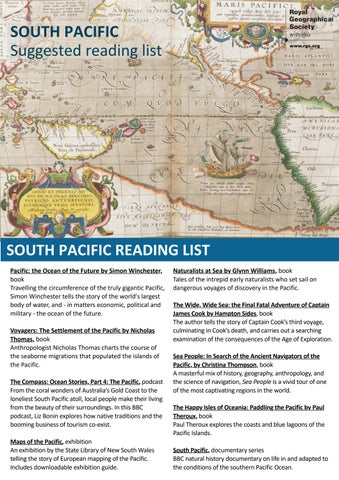
Maps of the Pacific, exhibition
An exhibition by the State Library of New South Wales telling the story of European mapping of the Pacific. Includes downloadable exhibition guide.

Naturalists at Sea by Glynn Williams, book
Tales of the intrepid early naturalists who set sail on dangerous voyages of discovery in the Pacific.
The Wide, Wide Sea: the Final Fatal Adventure of Captain James Cook by Hampton Sides, book
The author tells the story of Captain Cook’s third voyage, culminating in Cook’s death, and carries out a searching examination of the consequences of the Age of Exploration
Sea People: In Search of the Ancient Navigators of the Pacific, by Christina Thompson, book
A masterful mix of history, geography, anthropology, and the science of navigation, Sea People is a vivid tour of one of the most captivating regions in the world
The Happy Isles of Oceania: Paddling the Pacific by Paul Theroux, book
Paul Theroux explores the coasts and blue lagoons of the Pacific Islands
South Pacific, documentary series
BBC natural history documentary on life in and adapted to the conditions of the southern Pacific Ocean.
The Mysterious Islands of the South Pacific, documentary
This BBC Earth documentary explores the sheer scale and majesty of the largest ocean on Earth, the isolation of its islands and the extraordinary journeys wildlife and humans have gone through to reach these specks of land.
Natural History Heroes: Evelyn Cheesman, podcast
In this podcast, Beulah Garner, an entomologist at the Natural History Museum, looks at the beetle collections of Evelyn Cheesman, an entomologist who carried out 8 solo research trips to the Islands of the Pacific South Seas.
Seascapes with Royal Holloway University, podcast
This insightful podcast with Dr. Rachael Squire and Prof. Kim Peters addresses people’s relationships with the ocean. They explore our historic connections, how this can change, and the role aquariums have as a means to help us become more in tune with marine environments.
‘Thunder storms in the Weeping Valley, Kokoda, Papua’ Watercolour
Captain Cook's First Voyage, podcast
Greg Jenner is joined in the 18th century by the Royal Geographical Society’s Cartographic Collections Manager, Dr Katherine Parker, and comedian James Nokise on the maiden voyage across the Pacific ocean with Captain Cook.
Conquering The Pacific: An Unknown Mariner and the Final Great Voyage of the Age of Discovery by Andrés Reséndez, book
The author shares the history of an uncovered voyage as colorful and momentous as any on record for the Age of Discovery—and of the Black mariner whose stunning accomplishment has been until now lost to history
Tales of the South Pacific by James A. Michener, book
Winner of the 1948 Pulitzer Prize for Fiction and the inspiration for the Rodgers and Hammerstein musical South Pacific, the book contains 19 short stories set in the Pacific during World War II.


‘Potoroo White, Male’, from 'Atlas Historique' - 'Voyage autour du monde’ by
Australia with Simon Reeves, documentary series
Renowned adventure journalist Simon Reeve embarks on an epic adventure across Australia.
First Australians, exhibition
The Australia National Museum exhibition explores the shared stories and experiences of First Nations peoples from across the continent.
Endeavour Voyage: the Untold Stories of Cook and the First Australians. Edited by Ian Coates, book
This book brings a new perspective to this chapter of history by expanding the narrative to encompass the perspectives of Indigenous Australians long absent from the telling of these stories. Published to accompany an exhibition at the National Museum of Australia.
HMS Challenger: How a 150-year-old expedition still influences scientific discoveries today, article This year marks 150 years since the voyage of HMS Challenger left on its mission of scientific discovery. Museum researchers explain how the groundbreaking expedition is still important for scientists working today.
The Devil's Mariner: A Life of William Dampier, Pirate and Explorer, 1651-1715 by Anton Gill, book Dampier circumnavigated the world three times. He was also one of the first Englishman to explore parts of Australia
Legacy of the Wandjina: The Kimberley Research Project 1988, documentary
A film narrated by Bill Gill documenting ‘The Kimberley Research Project 1988’, a joint project between the Royal Geographical Society and Linnean Society, in co-operation with the Government of Western Australia.
Histories of Rock Art Research in Western Australia’s Kimberley, 1838–2000 by Joakim Goldhahn, Sam Harper, Peter Veth and Sven Ouzman, article
An article from the Australian National University which frames the history of rock art research in the Kimberley in north-western Australia.
Western Australia Museum, podcasts
A series of podcasts which delve into the depths of Western Australia’s rich history, captivating scientific discoveries and diverse cultural heritage.
Writing Australia, podcast
A podcast series from BBC Sounds, containing five essays from Australia on the theme of place and belonging.
The Mariner’s Mirror podcasts: Australia, podcast
A series of podcasts on the maritime history of Australia, including ‘Aborigines and the sea’ & ‘The Dutch discovery of Australia’.
Matthew Flinders: Australia on the map, exhibition
An online exhibition by the State Library of New South Wales about the English navigator Matthew Flinders, the first known European to circumnavigate and survey the coastline of Australia.
A Voyage to Terra Australis: Account of an Expedition in South Pacific 1801-1810 by Matthew Flinders, book
First published in two volumes in 1814, Matthew Flinders vividly describes his voyages to map the great island continent between 1796 and 1803.
The Welcome to Country Handbook: A Guide to Indigenous Australia by Marcia Langton, book
An accessible introduction to First Nations Peoples, histories and cultures.
Australian National Maritime Museum, Dive Deeper resource, website
Resource hubs (including stories, artefacts, and more) on First Nations, Migration, Maritime Archaeology, Ocean Futures, Australia’s role in the Indo-Pacific, Society and Water
Unsettled, virtual exhibition
The Australian Museum uncovers the untold histories behind the nation’s foundation story. First Nations voices reveal the hidden stories of devastation, survival and the fight for recognition - presented through long hidden historical documents, large-scale artworks, immersive experiences and never-before-seen objects from the Australian Museum collections and beyond.
Guardian of the Kimberley: Albert Wiggan, podcast
Part of Australian Geographic’s ‘Talking Australia’ series, this episode discusses the future of the Kimberley with Albert Wiggan, traditional owner and Bardi-Kija-Nyul Nyul man, indigenous ranger and conservation activist from the Dampier Peninsula of Western Australia.
Natural History Heroes: Alfred Russel Wallace, podcast
Entomologist at the Natural History Museum, George Beccaloni, explains why Alfred Russel Wallace is his natural history hero.
Nathaniel's Nutmeg: How One Man's Courage
Changed the Course of History by Giles Milton, book In 1616, an English adventurer, Nathaniel Courthope, stepped ashore on a remote island in the East Indies on a secret mission: to persuade the islanders of Run to grant a monopoly to England over their nutmeg, a fabulously valuable spice in Europe.
The Spice Trails, documentary series
In this BBC documentary series Kate Humble goes on the trail of some of the world's most valuable spices ealing their his ade, m thology and usag

Indonesia Etc.: Exploring the Improbable Nation by Elizabeth Pisani, book
The author, who first worked in Indonesia 25 years ago as a foreign correspondent, set out in 2011, travelling over 13,000 miles, to rediscover its enduring attraction, and to find the links which bind together this disparate nation.
The Malay Archipelago by Alfred Russel Wallace, book Wallace travelled 14,000 miles around the Malay Archipelago and is said to have visited every ‘important’ island at least once over 70 separate expeditions.
Inside the Crocodile: The Papua New Guinea Journals by Trish Nicholson, book
With a background in anthropology and a successful management career in Europe, five years on a development project in the remote West Sepik province of Papua New Guinea more than fulfils Trish Nicholson's desire for a challenge.
Attenborough’s Paradise Birds, documentary In this film, David Attenborough uncovers the remarkable story of how 'birds from paradise' have captivated explorers, naturalists, artists, film-makers and even royalty.
Looking for Adventure by Steve Backshall, book Steve Backshall describes his lifelong fascination with Papua New Guinea, inspired by an early childhood visit to an exhibition of Papuan arefacts.
Beyond the Coral Sea: Travels in the Old Empires of the South-West Pacific by Michael Moran, book Michael Moran undertakes a captivating journey to the paradise islands of the Coral, Solomon and Bismarck Seas - a region which has been little written about during the past century.
In the Shadow of the Palms: More-Than-Human Becomings in West Papua by Sophie Chao, book Sophie Chao examines the multispecies entanglements of oil palm plantations in West Papua, Indonesia, showing how Indigenous Marind communities understand and navigate the social, political, and environmental demands of the oil palm plant.

Illustration from: 'Histoire Naturelle, Zoologie' from'Voyage autour du monde’ by Louis Isidore Duperrey, 1825-30
Vanuatu: in Search of Female Chiefs, talk Sophie Hollingsworth travelled to the South Pacific archipelago and lived with the Ngowtari (female leaders) to study their unique powers, jurisdiction and ceremonies. She reflects on what we can learn from a matrilineal society
The People of Paradise, documentary series BBC series featuring David Attenborough discussing his journey through the South West Pacific in search of vanishing south sea rituals and customs
Melanesia: Travels in Black Oceania by Hamish McDonald, book By land and sea, Hamish McDonald travels from one end of Melanesia to the other Speaking with locals from all walks of life, he uncovers the histories, values, aspirations and tensions that have shaped their communities.

g y p deliberately risked their lives to show that the ancient Peruvians could have made the 4,300-mile voyage to the Polynesian islands on a similar craft.
Islands Near the Sun: Off the Beaten Track in the Far, Fair Society Islands by Evelyn Cheesman, book British entomologist and traveller, Lucy Evelyn Cheesman, went on eight solo expeditions in the South Pacific between 1924 and 1952, collecting over 70,000 specimens. This is an account of her first expedition.
The Warrior, the Voyager, and the Artist: Three Lives in an Age of Empire by Kate Fullagar, book Features the story of Mai, a Raiatean man who lived in Tahiti and joined Cook’s second expedition.
Protecting Paradise: The Story of Niue, documentary National Geographic’s Pristine Seas documents how the island nation of Niue created a new marine reserve helps safeguard its ocean resources for generations to come.
Aphrodite’s Island: the European Discovery of Tahiti by Anne Salmond, book
An account of the European discovery of Tahiti. Includes insights into Tahitian perceptions of the visitors and the European fascination with Tahiti.
Last Stop in the Remote Pacific, talk RGS microlecture. Leading an expedition to the Marquesas Islands to study a rare parrot, Liv Grant treks uninhabited islands, swims shark-filled waters and joins a festival of feathers.
The Bounty: the True Story of the Mutiny on the Bounty by Caroline Alexander, book
More than two centuries have passed since Fletcher Christian mutinied against Lt. Bligh on a small armed transport vessel called Bounty. Caroline Alexander focusses on the court martial of the ten mutineers captured in Tahiti and brought to justice in Portsmouth.
Mapping Rapa Nui: the Hidden Histories of Exploration, talk
This RGS talk by Dr Sarah L Evans uncovers the hidden histories of the early archaeological expedition to Rapa Nui (Easter Island), led by the Oxford-educated Katherine Routledge on the 1912-1916 Mana expedition.
Relics of History: Travelling Women Pioneers, talk Produced in collaboration between Silversea and the Society, ‘Relics of History’ delves deep into the annals of exploration. Julie Carrington uncovers the fascinating stories behind three outstanding women travellers of yesteryear, including Katherine Routledge.
The Mystery of Easter Island: the Story of an Expedition by Katherine Routledge, book
Katherine Routledge’s account of her anthropological and archeological expedition to Easter Island with her husband, William Scoresby Routledge, in 1914-1915.
Among Stone Giants: the Life of Katherine Routledge and Her Remarkable Expedition to Easter Island by Jo Anne Van Tilburg, book
Many of Katherine's papers were thought to be lost until they were discovered by Jo Anne Van Tilburg, the contemporary world's leading authority on the Easter Island statues. In this compelling biography, Dr. Van Tilburg brings her unique expertise to Katherine Routledge's discoveries and to her turbulent life.
Easter Island: Archaeology, Ecology and Culture by Jo Anne Van Tilburg, book
Making use of new archeological evidence and new concepts of ecology and culture, the author examines the island's prehistory, myth, and folklore, and offers an extended analysis of its famous statues, explaining how they were constructed and transported.
Rapa Nui: The Truth About Easter Island, podcast A Gone Medieval podcast which discusses the fresh techniques and research which have helped to understand the history of the island.

John Linton Palmer's Rapa Nui Album, article
At the heart of the Society’s artwork collection lie ten elephant folio travel albums containing over 500 images by John Linton Palmer (1824-1903), a British naval officer who visited Easter Island in 1868.
Rapa Nui, Easter Island: the Statues at Risk from Rising Sea Levels, exhibition
A Google Arts & Culture online exhibition looking at the statues of Easter Island and the impacts of tourism and climate change.

Seeking Robinson Crusoe by Tim Severin, book Society Fellow and Founder’s Medallist Tim Severin explores the legend behind Daniel Defoe's classic novel and re-examines the claim that Crusoe was based on a real life castaway, Alexander Selkirk. The fictional and the factual are brought together, taking the reader on a voyage of unusual discovery.
Robinson Crusoe: A Classic Adventure Novel of Shipwreck and Survival against Nature by Daniel Defoe, book
Shipwrecked in a storm at sea, Robinson Crusoe is washed up on a remote and desolate island. For 24 years he remains in solitude until he finally comes across another human being. Considered a classic literary masterpiece, and frequently interpreted as a comment on the British Imperialist approach at the time, Defoe's fable was and still is revered as the very first English novel.
Nature: Juan Fernandez Islands, podcast
The Juan Fernandez Islands are the home of many plants and animals found nowhere else in the world. Paul Evans visits the archipelago in search of the endemic Juan Fernandez firecrown hummingbird and discovers that introduced plants and animals, such as cats, goats and even blackberries, are causing severe problems for the uniquely-adapted willdife of the islands.
In Our Time: Robinson Crusoe, podcast
Melvyn Bragg and his guests discuss Daniel Defoe's novel Robinson Crusoe.
Waitt Expedition to Juan Fernández Islands, Chilew/National Geographic's Pristine Seas, documentary
The Waitt Foundation and National Geographic's Pristine Seas team up to survey and document the ocean habitat of Chile's Juan Fernández Islands.
Crusoe's Island: A Rich and Curious History of Pirates, Castaways and Madness by Andrew Lambert, book
Acclaimed historian Andrew Lambert uncovers the fascinating truth about a faraway place that still haunts our imagination and culture: the island of Robinson Crusoe in the South Pacific Ocean.
Chile: Travels in a thin country by Sara Wheeler, book
Squeezed in between a vast ocean and the longest mountain range on earth, Chile is 2,600 miles long and never more than 110 miles wide - not a country which lends itself to maps, as Sara Wheeler found out when she travelled alone with two carpetbags from the top to the bottom, form the driest desert in the world to the sepulchral wastes of Antarctica.
The Cordillera of Dreams, documentary
Director Patricio Guzmán left Chile more than 40 years ago when the military dictatorship took over the government. However, he never stopped thinking about a country, a culture and a place on the map.
The History of Chile by John L Rector, book
This book traces the chronological story of the country, from the indigenous peoples to the democratic transition after the Pinochet dictatorship.
The Future of Exploration, podcast
For guests having completed their cruise, this podcast
Explore: How To Plan An Expedition, focuses on the future of exploration. A panel discuss what it means to be an explorer in the 21st century and talk about the myriad of global challenges facing exploration today, as well as the responsibilities and tasks facing travellers, adventurers and field scientists, and where they overlap or differ.
Stories from our Collections, resource
Learn more about objects in the Royal Geographical Society’s Collections and the geographical themes and histories which underpin them through these online exhibitions and short stories.
Talks on Demand, talks
If you can’t attend events at the Royal Geographical Society, use our free catch-up service to access hundreds of presentations on a variety of topics, from ocean ice to volcanic ash, from Afghanistan to Zimbabwe.
Geography Directions, blog
Keep an eye on geography in the news through the Royal Geographical Society’s current affairs blog.

The Royal Geographical Society (with IBG) is a landmark partnership with Silversea that provides guests with informative and engaging enrichment resources, based on unrivaled access to its two million strong collection of maps, charts, atlases, archives, images, artifacts, and other items that date back to 1482 and chart earlier journeys and explorations. Founded in 1830, the Royal Geographical Society is a respected professional body for geography and geographers and is one of the largest and most innovative geographical societies in the world with one of the largest international geographical holdings to document the history of exploration and geographical understanding of our world, its people and places, past and present.

Please note: views and opinions do not necessarily reflect those of the RGS-IBG Subscriptions may be required to access content Suggested content may be available in other formats Links and information correct on 4 March 2026.
A new and correct map of the world laid down according to the newest and most accurate observations and discoveries made by the Royal Society's of London and Paris', 1790
