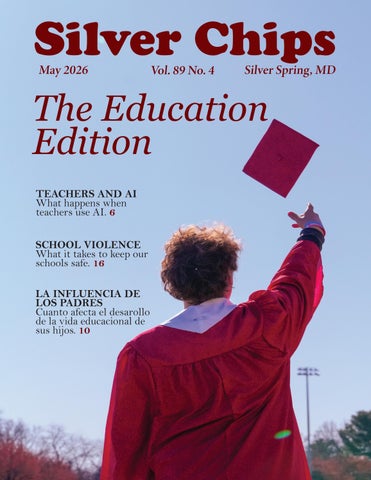
Silver Chips May 2026
Vol. 89 No. 4
Silver Spring, MD
The Education Edition TEACHERS AND AI What happens when teachers use AI. 6 SCHOOL VIOLENCE What it takes to keep our schools safe. 16 LA INFLUENCIA DE LOS PADRES Cuanto afecta el desarollo de la vida educacional de sus hijos. 10
Linda McMahon’s Vision By: TOMAS MONTIICELLI and HANA SOR Since Linda McMahon was appointed Secretary of Education by President Donald Trump, her stated goal has been to empower parents, send education back to the states, and promote school choice for children. Her tenure marks a sharp shift from the Department of Education’s (ED) traditional operations. While past secretaries have held deep education backgrounds, McMahon has previously only taken on executive business roles. According to the Department of Education’s website, the agency was founded in 1979 to “help racial minorities, women, people with disabilities and non-English speaking students gain equal access to education.” For decades, the department has enforced civil rights protections and distributed federal funding to schools across the country. That structure may soon change. The
4 MAY 2026 SILVER CHIPS MAGAZINE
administration has implemented cuts to multiple offices, including the Office for Civil Rights (OCR) in the ED, which enforces disability discrimination protections under Section 504 of the Rehabilitation Act of 1973. Since OCR investigates complaints and ensures schools comply with federal disability law, reductions to the office could limit the federal government’s capacity to enforce protections. Separately, the administration’s move to shift federal oversight under the Individuals with Disabilities Education Act (IDEA) from the ED to the Department of Health and Human Services would transfer responsibility for monitoring special education programs to a different agency, potentially changing how these protections are administered and enforced. Broader changes in fed-
eral civil rights policy could also impact the DE’s mission. Previously, the Trump administration signed executive orders in alignment with McMahon’s reported objectives for the department. In January 2025, Trump signed an executive order titled “End ing Illegal Discrimination and Restoring Merit-Based Opportunity,” which criticized diversity, equity, and inclusion (DEI) policies, claiming that they violate longstanding federal civil rights laws. The administration has also launched civil rights investigations of universities and schools and has frozen federal funding for education research centers. Other employees expressed concern about communication from leadership. Robin, another employee at the OCR, believed that leadership at the ED have not prioritized keeping employees up to date on recent changes. “Given [the] lack of trust, there has been very littletle direct communication from leadership to career staff other than what’s already public or soon to be public,” Robin said Questions have also been raised about McMahon’s qualifications by members of Congress and former ED officials. Unlike former Secretary Miguel Cardona, who served as a teacher, principal, and Connecticut’s education commissioner, McMahon has no background in public education.
What the former WWE CEO envisions for America’s students Instead, the administration has cited her experience leading the Small Business Administration and her experience as CEO of World Wrestling Entertainment as justification for her appointment. Jonathan Butcher, Acting Director of the Center for Education Policy at The Heritage Foundation, argued that McMahon’s role requires a more business-focused perspective. “Operating and closing the Department of Education is a business decision. The Department doesn’t hire teachers or run schools; it facilitates funding and ensures compliance with federal law. Secretary McMahon’s business experience is essential,” Butcher said. The shift in the department’s priorities has been welcomed by some educators and parents. Jan Greenhawk, former teacher and softball coach at Talbot County Public Schools and volunteer for Moms for Liberty, found that the Depart-
‘ We want you to be able to choose the school where your child will attend,’” she said. “We think that’s a really good thing … for parents, for kids, for everybody.”
ART BY LUCA ESSER
McMahon’s
new
role
has
sparked fierce backlash, and educators and parents alike agree that the scope of change is historic. “There have been changes at the department un-
“Operating and closing the Department of Education is a business decision. The Department doesn’t hire teachers or run schools; it facilitates funding and ensures compliance with federal law. Secretary McMahon’s business experience is essential.” ment has historically failed to make tangible progress. “[The department] would give us restrictions all the time, but they never really improved education in the classroom,” Greenhawk said, reflecting on her years of teaching. Greenhawk has grown increasingly hopeful about the Department’s future under McMahon’s leadership. “[The Department is] saying to parents,
McMahon’s new role has sparked fierce backlash, and educators and parents alike agree that the scope of change is historic. “There have been changes at the department under different administrations … but nothing like what’s happening now,” Sam said. “This is unprecedented in the department’s history, [and] we’ll see if the department continues to exist.”
JONATHAN BUTCHER
der different administrations … but nothing like what’s happening now,” Sam said. “This is unprecedented in the department’s history, [and] we’ll see if the department continues to exist.”
SILVER CHIPS MAGAZINE MAY 2026 5
silverchips1
Silver Chips has been a public forum for student expression since 1937.
SC Interested in getting more Silver Chips content? Want to support local student journalism? Scan the QR code to subscribe!
JOSEPHINE BRUNN LAKE
SPANISH WRITERS Alena Ahn Camila Chi Joaquin Contreras-Rushing Murilo Dos Santos Maria Espinal Kenai Fraizer Rayas DESIGN EDITORS Emmy Henriquez Adanna Akamigbo Tokyo Hopkins Senaya Asfaw Santiago Jimenez Lucy Holland Kristen Llerena Kiya Tiruneh Jacqueline Machado Garcia Eric Yang Edwin Medrano MANAGING EDITORS Anyeli Munoz Rodriguez Emanuel Morales Arene Casey Pendergast Jocelyn Nolasco Fernandez Jessica Zhang Livia Rosenberg Elora Derbyshire Candela Rubini Lafuente Yongle Xin Priya Tapia-Pereira Neha Narayan Stella Theisman Priya Tapia-Pereira Nate Viechnicki Senaya Asfaw Lila Grosko ART EDITORS Sahana Parikh Marial Espinal Hernandez Mackenzie Lyons Luca Esser Josephine Brunn Lake ENGLISH WRITERS Sonya Del Pozo ARTISTS Vee Dimyan Tinbite Abie Rae Foster Sophia Benitez Zoe Gorbachev Eva Dammann Lark Jeffers Melanie Fang Elena Kleiner Jessica Hsieh Alice Levings Tane Park Jamie Love Marcela Mason-Rodriguez Michelle Nee Heaven Meskelu Celia Max Victoria M. Regachuelo Gabriella McKenzie Aleydis Romero Justin Rosentover Jason Yu Ada Schwartz Sophia Zhdanova Hana Sor EDITORS-IN-CHIEF Satchel Jelen Doris Wang Thomas Sparshott Kyara Romero Lira
PUZZLE EDITORS Daneel Kutsenko Ruth Wajda-Gotwals
BUSINESS DIRECTORS Sophia Li Eva Schwartz
PHOTO EDITORS Ian Gleason Daneel Kutsenko
BUSINESS STAFF Andie Alison Maryam Elsharif Kendra Gray
PHOTOGRAPHERS Sadiq Abdillahi Raffi Diamond-Berman Kaylee Hopkins Jamie Lozada-McBride Linnea Menge Maz Olson Eleanor Olson
2 MAY 2026 SILVER CHIPS MAGAZINE
ADVISERS Jeremy Stelzner Maria Eugenia Tanos
VICTORIA M. REGACHUELO
Ian Gleason 1 COVER PHOTO Tomas Monticelli & Hana Sorr MCMAHON’S VISION 4 LINDA Former wrestling executive’s plan for education Elora Derbyshire & Zoe Gorbachev DISCLOSURE 6 FULL Moving teacher AI use out of the “gray area” Marcela Mason-Rodriguez & Priya CAUSE Tapia-Pereira 8 ATheLOST end of equitable college admissions Murilo Dos Santos & Kenai MOLDEANDO EL FUTURO 10 Padres o hijos, ¿quién tiene el control? Fraizer Rayas Gabriella McKenzie & Jessica Zhang THAN A SCORE 12 MORE The debate over Maryland’s new standardized tests
THE FUTURE OF PUBLICLY FUNDED Sonya Del Pozo & Ada Greenfield 14 WHAT’S EDUCATION? & Justin Rosentover Private vs. Private vs. Charter schools
NEW NORMAL 16 THE The reality of school violence today PUERTAS 18 ABRIENDO El proceso de solicitud universitaria WITH DAVID STEIN 20 Q&A Chips chats with the head of the MCEA
Vee Dimyan & Lark Jeffers
22
JACK OF TOO MANY TRADES Why the MCPS principal turnover rate is so high
Elena Kleiner & Jamie Love
24
THE STEWARDS OF SPECIAL EDUCATION How the teacher shortage impacts students and families
Alice Levings & Mackenzie Lyons
A NUEVAS EXPERIENCIAS 26 ADAPTÁNDOSE EDUCATIVAS
Candela Rubini Lafuente & Priya Tapia-Pereira Neha Narayan & Yongle Xin
28
OPTING OUT MCPS Communities respond to Mahmoud V. Taylor THE TRUTH ABOUT COLLEGE COSTS Debunking common myths about higher education
30 32 EDUCATION DOESN’T WORK 34 CHIPS CLIPS
Santiago Jimenez & Livia Rosenberg Celia Max & Sahana Parikh
Adanna Akamigbo & Rae Foster Justin Rosentover Daneel Kutsenko & Ruth Wajda-Gotwals SILVER CHIPS MAGAZINE MAY 2026 3
ally needs to be disclosed,” Shindel said. “But I think there’s a lot of uses for AI, even to come up with ideas [for] more active engagement [and] active learning strategies.” Sanah Azad, a senior on Blair SGA’s AI Committee, is not enthusiastic about teachers using these tools for assignment creation. “You do get the AI vibe,” Azad said, referring to AI-generated assignments. “[They’re] just more dense [and] not as creative.”
Full disclosure
Moving teacher AI use out of the “gray area”
By Elora Derbyshire & Zoe Gorbachev
Teacher Training
LUCA ESSER
6 MAY 2026 SILVER CHIPS MAGAZINE
In October, the MCPS Department of Educational Technology released a draft of revisions to its longstanding policy on classroom technology, known as Policy IGS, for public comment. “This is the first time we will have incorporated the use of generative AI within a policy,” Beth McKay, Technology Implementation Specialist, said. The policy gives teachers considerable discretion in their AI use, allowing them to “use generative AI tools to support instruction, personalize learning, and expand access to educational and operational resources.” However, there is one major caveat: teachers are expected to exercise “responsible judgment” regarding the use and disclosure of generated content. Board Member Brenda Wolff explained in an email to Silver Chips that the policy’s vagueness is intended to accommodate tech-
Quality Concerns and Transparency
Teacher AI Use
At Blair, the percentage of teachers using AI appears to match national data. In a spring 2025 SGA poll, 50 out of 75 teachers surveyed reported interacting with an AI chat program for “school-related tasks and responsibilities.” Social studies teacher Kevin Shindel uses AI as a supplement for creating quizzes, background readings, and discussion questions, noting that he edits these materials manually for quality. “Whenever teachers use AI, it re-
DATA COURTESY OF GALLUP | GRAPHIC BY ZOE GORBACHEV
AN G
AI Policy in MCPS
nological changes and advances. “The goal is to make the policy broad enough that it will not need to be adjusted every time technological advancements occur,” Wolff wrote. After the policy’s approval by the Board, MCPS departments will be tasked with developing more specific regulations to implement it in schools. In an email to Silver Chips, MCPS Technology Implementation Specialist Jason Milke explained that the new MSDE guidance will apply to the district without directly affecting the wording of their policy. “[The MSDE material] will provide MCPS with clear guidance for additional regulation and guidelines that are in development,” he wrote. But this is just the first step.
LAN IE F
guidance does not serve as a formal policy or mandate, it outlines content and general suggestions that school districts are expected to consider when creating their own AI policies. As MCPS develops its AI guidance in 2026, the Montgomery County Board of Education must prioritize developing specific regulations to comply with state recommendations.
When testing whether AI-generated ed ucational content supports cultural rep resentation in the classroom, University of Massachusetts researchers Robert Maloy and Torrey Trust found that 90 percent of 300 AI-generated civics lesson plans promoted only a basic level of thinking—often relying on ME
Your homework assignment might have been created by the same chatbot that writes emails and generates pickup lines. And, odds are, nobody has bothered to tell you. The implementation of AI in classrooms has transformed from a hypothetical debate to a daily practice. According to a 2024-2025 Gallup poll, six in 10 American teachers already use AI tools in their work—and the Trump administration aims to expand this practice, pushing for public-private partnerships with tech companies in K-12 education. AI has the potential to save critical time that could be spent interacting with students; teacher users reported an average of 5.9 hours saved per week, adding up to nearly six weeks per year. But as AI’s classroom presence has grown behind the curtain, educational policy has struggled to keep up. Paired with the stigma currently surrounding AI users, the lack of regulation nationwide has led to a transparency crisis. Out of 1,183 teachers, principals, and district leaders polled in a 2024 EdWeek Research Center survey, 80 percent responded that it is “not necessary to tell students or parents” about an AI-created lesson. In March, the Maryland State Department of Education released new guidance on AI in Maryland schools. While this
Understanding the ethical concerns around AI use should not be voluntary. Currently, MCPS does not have any AI training requirements for staff. While the MCPS Department of Educational Technology offers sessions on responsible AI use, attendance is not mandatory. The MSDE guidance outlines training as an expectation for school districts and has released interactive training on AI use cases. None of the training put out so far, though, is mandatory. Blair computer science teacher Vikash Sahu noted that the training must be engaging and comprehensive to help teachers
gain a deeper understanding of the technology and recognize the surrounding ethical concerns. “I would like to see [a training that] actually gives you a technical breakdown of how these systems work so that it kind of demystifies [AI],” Sahu said. MCPS currently approves the use of Google Gemini and Microsoft Copilot. The MSDE guidance establishes an approval pipeline for new tools. The allowed uses for these approved tools, though, are exceedingly broad, with neither grading nor lesson planning mentioned throughout the entire draft. The design of these platforms does not help. Many AI tools on the market rely on what is known as frictionless design—interfaces that make it easy to incorporate AI-generated content without review. While some have fine-print warnings about inaccuracy and bias, such notices are often easy to miss. There is no meaningful pause built into the system that forces teachers to stop and evaluate their interaction with the AI.
outdated, memorization-heavy techniques. Only six percent included multicultural content, and the histories of marginalized groups were largely missing. These results indicate that AI-generated lesson content strays far from the policy’s requirement for all MCPS technology use to “support original, authentic and active learning [and] assess higher-order thinking, as applicable.” While AI tools are often marketed as educational resources, they can reinforce outdated teaching methods and exclude diverse perspectives. When their use is not disclosed or properly balanced with human refinement, student learning suffers. While the MSDE draft mentions the importance of “monitoring biased or harmful outputs” from AI, the logistics of this monitoring are left to districts as they develop their policies.
The Future
In 2026, 134 bills related to AI in education legislation have been introduced across 31 states. Worldwide, only 7 percent of schools have AI guidance, and of those that do, 40 percent have only informal guidance. There is no way to predict how AI will develop in the future, but some institutions are taking important, if small, steps towards protecting integrity in education. “In higher education, the expectation is] to be transparent,” MCPS Technology Implementation Specialist Heather LaDuca said. “[In] Pre-K to 12 [education], we are still in this gray area.” MCPS departments must emphasize transparency through clear, actionable policies that align with those issued by the MSDE and other educational institutions. The MSDE guidelines have set the district on the right path, but suggestions are not enough to create actual change in the state. “Students should be taught how to use [AI tools] responsibly. They should understand how they work,” Sahu said. “The same is true for teachers.” The technology is here. Whether we can effectively regulate it is another question entirely, and it is not one that ChatGPT can answer for us. SILVER CHIPS MAGAZINE MAY 2026 7
A lost cause
JOSEPHINE BRUNN LAKE
The end of equitable college admissions IEH
CA HS
JESSI
BY MARCELA MASON-RODRIGUEZ AND PRIYA TAPIA-PEREIRA Since the Supreme Court overturned the protections of affirmative action in 2023, colleges have been shying away from using race or gender for admissions processes, instead returning to a so-called strictly merit-based approach. Affirmative action, which emerged in the 1960s, is a practice in which institutions such as universities make an effort to increase opportunities for racial and ethnic groups that may have faced systemic inequalities. Under the Trump administration,
8 MAY 2026 SILVER CHIPS MAGAZINE
the federal government has doubled down on eliminating race-based admissions, mandating compliance in the college application process. In February 2025, the Department of Education issued a letter that threatened taking away federal funding from institutions that continued to use race or “diversity, equity, and inclusion” (DEI) frameworks in admissions or financial aid. In March, the General Services Administration proposed a rule that would require all federal funding recipients—including universities—to certify that
they do not have DEI programs. The federal government has placed pressure on colleges to prove that their admissions are purely merit-based. In August 2025, Trump signed a memorandum designed to prevent “hidden racial proxies” from factoring into college admissions in order to dismantle “shameful, dangerous racial hierarchies.” To fulfill Trump’s memorandum, colleges must report data detailing race, sex, GPAs, and standardized test scores. The American Council on Edu-
cation noted that the government is demanding demographic data that colleges previously stopped collecting in compliance with the initial affirmative action ban. Facing federal pressure, colleges are facing difficulties when it comes to boosting equity in their admissions. Emily Morris, a former admissions counselor and current Adjunct professor at American University, noted that after the ban on affirmative action, colleges have fewer tools to work with in admissions. “They can’t ask the questions in the same way to make sure that they’re doing a diligent job of making sure that these diverse perspectives and demographics are represented,” Morris said. “Universities’ goal is to reach high-quality education and to get young people from across the country, across the world into their programs … but this gives them less tools to know that they’re reaching a wide, diverse audience.” To adapt, many colleges are honing in on socioeconomic status as a diversifying factor. Currently, Black students make up five percent and Latino 15 percent of enrolled students at selective universities. At the same time, Black and Latino students are overrepresented among first gen students and Pell Grant recipients in selective universities. Of first-gen students enrolled in selective universities, 44.5 percent are Black and Latino. Black and Latino Students also make up 49.4 percent of Pell-grant eligible students and selective universities. If colleges were to focus on socioeconomic affirmative action, their racial and ethnic diversity could simultaneously increase. Of course, this approach is complex. While socioeconomic affirmative action supports racial diversity, it is important for systems to keep in mind that a class-conscious admissions approach often ignores geographic disparities. More than two-thirds of Black and Latino US residents live in the nation’s largest cities, compared to less than half of white residents—a reality that
would not be captured by household income alone. A family’s tax bracket is certainly not enough to measure the true, everyday educational disparities that exist between different households. To maintain diversity under the administration’s radar while accounting for these challenges, colleges adopted tools like Landscape—a College Board product that provided key indicators (such as crime rates, median family income, and percentage of students receiving free and reduced meals in an area) to identify underrepresented students who performed well relative to surrounding conditions. This initiative proved successful in boosting admission rates for students from disadvantaged neighborhoods the following years after it began. Many institutions also used this tool to make scholarship decisions rather than solely use the data on admissions. However, in September 2025, College Board quietly notified schools that Landscape would be eliminated. The abrupt cancellation comes in light of mounting political pressure from the Trump administration and legal groups. In the months prior, the Department of Education and the Attorney General issued warnings to universities threatening severe federal funding cuts for institutions that used geographic or socioeconomic data as a separate path toward race-conscious admissions. Though Landscape did not collect data on race or ethnicity, the tool most likely still presented a legal liability to the College Board. The fallout lands on students. Without tools like Landscape, the burden of explaining external conditions and circumstances lies entirely with the applicant. The Trump administration has made it clear—in their race to end race-conscious admissions—that they are willing to sacrifice crucial context on individual students in the name of a rigid meritocracy. Yet this hyperfixation on merit conveniently ignores the most
glaring advantage of all. As the administration aggressively targets neighborhood data and demographic data as “unlawful proxies,” it has remained silent on legacy admissions. Although American cultural norms stress individual achievement, a sizable portion of students at top colleges are admitted in part due to lineage. According to a 2023 study from Opportunity Insights, legacy students from families in the top one percent are five times as likely to be admitted as the average applicant with similar standardized scores, ratings from the admissions office, and demographic characteristics. Furthermore, legacy students are accepted at four times the rates of non-legacy applicants with the same test scores. Meanwhile, an analysis spanning 20 years of Harvard admissions done by the National Bureau of Economic Research found that roughly 77 percent of admitted legacy students were white. If our government wants to ensure a rigid definition of a merit-based admissions system, the least they could do is not pick and choose the factors that colleges can consider. Their selective enforcement demonstrates the reality behind the federal crackdown; rather than leveling the playing field, it protects the advantages of those who are already ahead. True meritocracy relies on context, yet our government is selectively obscuring the backgrounds of millions of college applicants—and destroying that possibility.
JOSEPHINE BRUNN LAKE
SILVER CHIPS MAGAZINE MAY 2026 9
Moldeando el futuro Padres o hijos, ¿quién tiene el control? POR MURILO DOS SANTOS Y KENAI FRAIZER RAYAS en términos de participación de los padres en una escuela”, dijo la Sra. Gil. Ella también señala que proviene de nuestro medio de comunicación: los correos electrónicos. Muchas escuelas en América Latina utilizan aplicaciones de mensajería instantánea como WhatsApp en vez de emails. “Si se envía un correo electrónico, probablemente no se leerá. Los mensajes de texto han sido un salvavidas. Muchos de nuestros padres trabajan en varios trabajos, por lo que revisar el correo electrónico no siempre es realista. Pero cuando sale un texto, está ahí mismo en su teléfono…¡Mensaje recibido!”, explica la Sra. Gil. Debora Thompson, madre de un estudiante de Blair, resalta la importancia de obtener una buena educación,
“Nadie te puede quitar tu educación. Te da estabilidad, independencia, y una diversidad de carreras”
explica. Sin embargo, como Belay dijo, “No todos caben en el mismo molde”. Los estudiantes necesitan el apoyo de sus padres y de sus profesores para tener éxito académico e incrementar su aprendizaje. Belay reconoce que, “Con la ayuda y asistencia [de mis padres] para guiarme, me han apoyado mucho como persona y me empujan hacia las cosas que importan en la vida”. Aunque Blair y otras escuelas tienen sus dificultades, la Sra. Gil tiene optimismo de que se pueda mejorar el sistema educativo para ser compatible con todos. Blair tiene los recursos necesarios y el personal hispanohablante para dar ese apoyo a las familias y comunidades que lo necesitan.
L
DEBORA THOMPSON
ESPINA
por su propia iniciativa, dejando a un lado su vida social para enfocarse mayormente en el aspecto académico. A veces, los estudiantes escogen clases difíciles para ser más competitivos para las admisiones a las universidades junto a sus actividades extracurriculares. El estrés puede llevar a que un estudiante falte a clase por el cansancio o a no hacer la tarea para preservar su vida social. Como en la escuela no te enseñan cómo ser padre, las estrategias que cada padre usa son diferentes, cada uno con fortalezas y debilidades. Los maestros pueden formar una gran parte de cómo un estudiante crece y forma su identidad en la escuela como persona y estudiante. Muchas veces se necesita una figura permanente para seguir proveyendo esa infraestructura a largo plazo. Nayab Ali, una investigadora de la Universidad de Malakand con un doctorado en sociología rural, hizo un estudio en 2023 sobre resultados académicos y los efectos que tienen los estilos de crianza. Ali descubrió que los padres con un estilo autoritativo, con altas exigencias y un gran apoyo, obtenían mejores resultados académicos para los estudiantes. Según una encuesta, muchos estudiantes de Blair tienen la libertad de elegir sus propias clases. De los 120 estudiantes que participaron en la encuesta, casi el 90% dijeron que sus padres controlaban poco o nada su selección de sus cursos. Esto les da la libertad de elegir las clases que quieran, cumpliendo con ciertos requisitos de graduación. Esto no significa que los padres no estén involucrados con la educación de sus hijos. Benjamin Rocap comentó que él elige sus propias clases, pero sus padres tienen la confianza de que va a elegir clases que le gustan, pero que también sean difíciles. La profesora de ELD, Jody Gil, con 25 años de experiencia como profesora, aporta este aspecto sobre el sistema educativo, “La participación de los padres es algo que es una especie de segunda naturaleza para las personas que han nacido aquí y han pasado por el sistema. Una de las cosas culturalmente que realmente se hace en otros países es que es mucho más práctico
MARIA
E
tremo, existen los estudiantes que faltan o llegan tarde a las clases, no n la secundaria, los estudiantes entregan tareas, pasan el día sin hacer empiezan a tener más independencia trabajo y parece que no quieren ir a la y control sobre su vida escolar. Eligen escuela. entre una variedad de cursos y particEntre estos extremos, la mayoría ipan en mayor oportunidades, como busca un equilibrio. Gabriel Belay, deportes o actividades extracurricu- un estudiante de onceavo grado en lares. Esto abre puertas a los estudi- Blair, reconoce que necesita ayuda antes para descubrir pasiones, inter- de sus padres aunque no le encanta, eses para una carrera, aprovechar “Sé en mi corazón, no importa cuánto clases divertidas y clubes para pasar me molesta, cuántas veces me gritan el tiempo. Los padres pueden tener o me dicen qué hacer, sé que viene una gran influencia en las decisiones d e un buen lugar”. Aunque que toman los estudiantes, desde parezca control y extener control completo hasta no dar igencia, los padres importancia, todos los padres crean buscan apoyar de la base y forman parte de la vida edula mejor manera cacional de sus hijos. posible. No quieCada padre tiene una manera única ren parecer figuras de educar, especialmente cuando se todopoderosas, trata de la educación. Los dos extremsino crear una relos tradicionales son los padres que ación positiva para empujan a sus niños a ser perfectos y ayudar a sus hilos padres que dejan la responsabiljos. Como los idad solamente a la escuela y a sus estudiantes, hijos, estando menos inlos padres volucrados. quieren enPor un lado, los contrar un estudiantes pueden equilibrio unirse a equipos entre dar deportivos, quea sus hijos darse después de indepenla escuela para dencia y actividades brindarextracurricules apoyo lares, recibir académico. notas perfEl estrés y los ectas y ser el estándares no solestudiante amente vienen de modelo, los padres, sino demostrantambién de otras do cómo personas. Balin sería el Savage, un esalumno tudiante en onideal. ceavo grado en el A l programa Magotro net, explica que ex“La comunidad magnet es súper competitiva. Así que no solo tienes la presión de ti mismo, tienes la presión de tus compañeros”. Los estudiantes toMARIA ESPINAL y MICHELLE NEE man decisiones 10 MAYO 2026 LA ESQUINA LATINA REVISTA
LA ESQUINA LATINA REVISTA MAYO 2026 11
More than a score The debate over Maryland’s new standardized tests
By Gabriella Mackenzie and Jessica Zhang formance levels: Beginning Learn- 2023–24 and 80 percent in 2022–23. T his spring, Maryland public er, Developing Learner, Proficient Still, numbers alone are not enough school students will take the yearly Learner, and Distinguished Learner. to entirely encapsulate actual learnstate and county-mandated exams, including the Maryland Comprehensive Assessment Program (MCAP) and the Maryland Integrated Science Assessment (MISA). As MCPS prepares to adopt a new state assessment for the 2026–2027 school year, staff, students, and community members are voicing concerns about whether these assessments accurately reflect student learning and achievement. MCAP tests are required by the Maryland State Board of Education (MSBE) to be administered in schools across the state. Niki Porter, Chief Academic Officer of the MCPS Division of Teaching and Learning, notes the importance of these tests in demonstrating students’ understanding of academic concepts. “It’s a way of us holding ourselves accountable to make sure that we are actually instructing and helping students to master what we’ve instructed,” Porter says. “The state gives specific standards or skills that they want students to have in certain grade levels or courses.”
Both distinguished and proficient learners are considered proficient,” Duvall-Jones says. In contrast, MAP assessments are not state-mandated but provide district-level insight. Kecia Addison, MCPS Director of Shared Accountability, explains the difference between the state MCAP and the county MAP tests. “[The] MAP assessment, while it isn’t a state-required assessment, is a nationally normed assessment that allows us as a district to see the extent to which students are progressing in literacy and mathematics in alignment with the state assessment,” Addison says. Beyond evaluating each student’s individual performance, standardized testing also contributes to a five-star rating system that evaluates every public school in Maryland. “The state is using student scores on these tests to rate the school and to determine how well they are doing in terms of preparing students for postgraduate life,” Blair staff development teacher Leslie Blaha says. Statewide ratings have improved
ing progress. During the 2024–2025 school year, MCAP scores showed that 57 percent of MCPS students were proficient in English Language Arts and 35.7 percent in math. Although both subjects showed an increase of around two percent from the previous school year, a large percentage of students are still not meeting proficiency. Duvall-Jones notes that students are still recovering from COVID-19 disruptions. “Overall results showed steady gains, a 5.5 percentage point increase since the 2021-22 school year, although ELA student performance has recovered more swiftly than mathematics,” Duvall-Jones says. Thomas Swanson, a calculus teacher at Blair, agrees with Duvall-Jones. “Both before and after [COVID], I’ve seen that the gaps in students’ understanding are significant, but also [it depends] on that big pandemic year where it hit them, how that manifested in each cohort of students since then,” Swanson says. “Because I teach higher-level secondary math without … students having those strong foun-
tive, noting that some students lack sufficient motivation to put their best efforts into testing. “I think a lot of students are indifferent to it … they feel like it’s a chore or something they have to do … [so] they’re putting in very minimal effort to pass these exams,” Tung Pham, a statistics teacher at Blair, says. “Because of that, I don’t think it really reflects … their ability to do math.” Abby Whelan, a Blair junior, agrees that there is no significant incentive to perform well on tests. “Personally, I don’t try as hard when it’s not for a grade,” she says. “It doesn’t feel like it means anything because it’s not counting towards something.” Blair senior Zeyad Jazoulli states that many students view tests as something to complete. “[As stu-
cent reported putting a high level of effort into state-mandated tests that counted toward a grade. Blaha also notes that tests would be more effective if they assessed the same skills that students learn in the classroom. “For example, if you’re in Algebra 1, the expectation is that everybody in Algebra 1 would know how to do these 12 things,” she says. “The test should measure whether or not every student who finished Algebra 1 can do those 12 things, but that’s not actually what happens.” According to Swanson, this gap between curriculum and testing content causes teachers to prioritize exam material over core topics and skills. “What content is covered versus not covered on those tests could definitely skew teachers’ decisions in
ate a new assessment in the 2026– 2027 school year. Swanson explains that there are many areas to consider while creating an assessment that accurately reflects students’ abilities. “There’s so many additional variables beyond just how well students perform on a test that I don’t think [standardized tests are] measuring everything that [they] set out to,” Swanson notes. Blaha explains that previously, when teachers designed their own assessments, the tests better reflected how well students understood topics. “[The previous system] was a much better measure of whether or not the students actually learned what [teachers] taught them,” Blaha says. Countywide tests are an easy way
There’s a strong need for us to come up with a brand new assessment. You want to have the confidence that the assessment that you are administering is aligned to your standards. modis erum fugita sae ne volo.”
CAREY WRIGHT
dents], knowing your score doesn’t matter definitely affects the [overall] scores,” he says. “Most students go into the test with their only goal being to get it over with, causing their performance to be worse. This is especially true for tests that do not have a minimum score and are only requirements for graduation.” In future years, certain exams may begin counting toward course grades. In MCPS, exams such as MISA and National, State, and Local (NSL) government tests will factor into student semester grades. There is also discussion about reintroducing final exams. In a survey of Blair students, 72 per-
what content they focus on in their classroom,” he says. “It kind of creates a situation where the test is more important than the education itself, which is contradictory to the purpose of testing in the first place.” In an August 2025 MSBE meeting, Maryland State Superintendent of Schools Carey Wright emphasized the importance of developing new state assessments. “There’s a strong need for us to come up with a brand new assessment,” Wright said. “You want to have the confidence that the assessment that you are administering is aligned to your standards.” The MSBE states that it’s planning to cre-
for people to collect data, though, allowing the county to analyze student progress through numbers. “At the end of the day, you sit for a test, it goes into a computer, it’s crunched, [and] boom,” Blair English Language Development teacher Joellyn Gil says. Maryland is planning to roll out a new assessment for the 2026-2027 school year. To ensure tests prioritize student motivation and instructional alignment, they must bridge the divide between administrative data needs and the measurement of actual student mastery.
“The state is using student scores on these tests to rate the school and to determine how well they are doing in terms of preparing students for postgraduate life.” LESLIE BLAHA Cherie Duvall-Jones, deputy director of the Office of Communications for the MSDE, explains how performance is measured. “MCAP assessments include four student per12 MAY 2026 SILVER CHIPS MAGAZINE
in recent years: in the 2024–2025 school year, 86 percent of schools earned a star rating of 3 or higher in Maryland, compared to 83 percent in
dational skills, trying to build off of that is tremendously difficult.” Educators are also questioning whether testing policies were effecSILVER CHIPS MAGAZINE MAY 2026 13
What is the future
of K-12 education?
PUBLIC SCHOOLS
BY ADA SCHWARTZ AN OPINION
PRIVATE SCHOOLS
BY SONYA DEL POZO AN OPINION
CHARTER SCHOOLS
BY JUSTIN ROSENTOVER AN OPINION
14 MAY 2026 SILVER CHIPS MAGAZINE
As of 2025, there were over 95,000 public schools in the U.S. serving approximately 49.3 million students. Many of these students graduate every year from public schools in the United States without thinking twice. Public schools have been tried and true since the puritan colonies of Massachusetts in the 1600s, giving every student the opportunity to receive the education that they deserve. However, two-thirds of traditional public schools lost enrollment between 2019 and 2023. This is due to a variety of factors, including declining birth rates and increased private school voucher systems—and it is not good news. While public schools can have packed classrooms, and some odd bathroom smells, it is important that we all remember that public schools have something special. Public schools welcome all students— and that is one of their biggest advantages. Public schools are one of the few plac-
es where people of diverse backgrounds can meet and learn to work together. “Private schools get to choose who walks through their doors,” Blair Principal Damon Monteleone said. “We don’t. You show up here; we teach you.” According to the Pew Research Center, 65 percent of private school students are white, compared to 47 percent in public schools. In addition, public schools are 14 percent Black, 28 percent Hispanic and six percent Asian. Private schools are only nine percent Black, 12 percent Hispanic, and four percent Asian. Diverse schools reflect a diverse world and students who go to diverse schools are more prepared to interact with and understand the diverse people of the world. “For students [who] go to a place like Montgomery Blair, it is natural for them to be able to move in and out
of different circles; to be culturally and socially proficient, [and] empathetic,” Monteleone said. Government policies—such as subsidies for students to attend private schools or undergo homeschooling—encourage movement away from public schools and can weaken this diversity. D.C.’s , Opportunity Scholarship Program (OSP) voucher system—which provides funding for alternative education options—has come under fire for perpetuating racial segregation. Research has attributed this system to the creation of an environment where only 18 percent of public school students are white—compared to 37.4 percent of the D.C. population as a whole. Public schools are also legally required to provide education for all students, including those with disabilities. Under the
Individuals with Disabilities Education Act (IDEA), they must provide resources such as Individualized Education Plan accommodations. At private schools, however, disability-informed support is not a guarantee: private schools are not legally obligated to provide IDEA accommodations unless they take federal funding. “As an attorney, I once had a case where [a] child was attending a Catholic school, and they needed some medical accommodations. They were just having such a hard time,” Board Member Atlarge Rita Montoya said, noting that it was frustrating seeing the student struggle despite the simplicity of the student’s needed accommodations. Public schools also tend to be larger than other systems, allowing for more clubs. “There is such a wealth of opportunities, resources, and clubs
[at public schools],” Blair senior Katie Horvath-Wulf, who attended a private elementary and middle school, said. “I’ve been able to be a part of things here that just don’t exist at private schools because there are just not enough people.” Not only do these clubs make the school experience more enjoyable, but research shows that they can also have a positive impact on test scores, behavior, and attendance. Researchers speculate that these benefits could be caused by increased access to prosocial, community-building peer groups. Not all that glitters is gold. While private and charter schools may have some shiny advantages, public schools are the right choice for America. They are dependable and open to everyone, with options for every student.
In a school of more than 3,000 students, many at Blair are accustomed to large classes and overcrowded hallways. With Blair’s student-to-teacher ratio of about 16-1, staff contend with the large student population packed within the building. This is not unique to Blair. On average, U.S. public schools employ one teacher for every 15.4 students, while private schools only have one teacher for every 9.7 students. This lower teacher-to-student ratio allows for more individualized attention, facilitating stronger academic performances. Blair junior Maddie Highfill, who attended private school throughout her sophomore year, said that smaller class sizes benefited her learning. “One thing that my old school was known for was helping with accommodations: small class sizes, smaller groups, more individual
one-on-one teacher learning,” Highfill explained. In overflowing classes with teachers taking care of higher quantities of students, it is difficult to ensure that every student receives the same level of attention. The personalized attention offered in private schools benefits students with and without accommodations. As a result, students feel more comfortable to speak up and ask questions in a smaller and less pressured environment. In addition to smaller class sizes, private schools also generally have smaller school populations. The average U.S. private school has 152.6 students, and 41 percent of all private schools enroll fewer than 50 students. These schools offer students a better opportunity to build relationships with their teachers and create stronger, more tight-knit student communities. As privately owned entities, they are
not constrained by state-mandated curricula and can therefore integrate different topics into classes—a clear contrast from public schools, which are regulated by state governments. As a result, private school systems allow local communities and institutions to have a greater influence in their students’ education. For example, because private schools are not directly funded by the federal government, they are not bound by the Establishment Clause of the First Amendment—which prohibits the government from establishing a state-sponsored religion—and can therefore serve as religious institutions. 76 percent of private school students attend religiously affiliated schools, allowing families to integrate faith into daily education, providing students another avenue to connect over a shared aspect of their identities. The benefits of going to a large pub-
lic school cannot outweigh the learning and community-building advantages of a smaller student body. Though private schools generally host less diverse populations—the student population of Maryland private schools is 65 percent White, 12 percent Hispanic, and 9 percent Black, while Maryland’s overall population is 31.6 percent Black, 7.3 percent Asian and 13.3 percent Hispanic—financial aid programs like the Broadening Options and Opportunities for Students Today (BOOST) scholarship program in Maryland are making private schools more accessible to a more diverse student body. The BOOST program offers scholarships for eligible students in 178 Maryland private schools, and gives priority to students who are eligible for free and reduced–price meal programs (FARMs). Private schools also offer their own financial aid programs. These pro-
grams aim to ensure that the racial and socioeconomic gaps between public and private schools will close, allowing more students to receive the greater academic opportunities offered by private schools. While no education system is flawless, private school students benefit greatly from individualized attention and curriculum operating largely outside of state mandates. For families seeking strong communities offered by specialized instruction and closer student-teacher relationships, private schools are the best option.
American test scores have reached a 20-year low, and the decline cannot be explained by pandemic learning loss alone. Math and English scores on the National Assessment of Educational Progress, the gold standard of student testing, have been in decline since 2013, with only a small increase in math scores between 2023 and 2024. We need to figure out how to first stop, then reverse, this crisis in education. The way to do that is through experimentation—which is where charter schools come in. Public charter schools are government-funded on a per-student basis—the amount of money they receive depends on the number of students who choose to go there. Just like public schools, they are free to students. “Charter schools are effectively public schools that are operated with some degree of independence or autonomy from the local school district,” Jamison White,
director of data and research for the National Alliance for Public Charter Schools (NAPCS), said. They exist alongside public schools. When there is not enough space for all interested students, charter schools use a lottery system for admissions. This autonomy allows charters to experiment with innovative programs in ways that traditional schools often struggle to do. Montgomery County’s only charter school, the MECCA Business Learning Institute (MBLI), offers students a chance to learn real-life financial skills while they are still in middle school. “As they left [traditional] schools, students weren’t sure how to navigate the real world when it came to their finances: how to pay bills, manage expenses, understanding things like interest or investments or insurance,” MBLI Chief Academic Officer Tracey Cooper said.
Like MBLI, most charters offer some sort of specialized programming, which can include Montessori, STEM opportunities, or language immersion. Parents who want these opportunities for their children can quickly get them for free without imposing their desires on everyone else or wading through bureaucratic red tape. “If you had a school district with 10,000 kids and a small group of them … wanted to do Chinese immersion … the school district is going to struggle to convince 10,000 parents [to support the program],” White said. “[But] a charter school could come in and say we can open up a school [for that].” Parents are voting for charters with their feet. A 2025 survey by NAPCS found that charters welcomed more than 100,000 students nationwide last year while enrollment in traditional public schools decreased by over 220,000. Be-
cause parents can choose to switch their children out of charter schools, poorly performing charters get shut down when they do a bad job. “The charter school sector is the only part of the public education sector that’s continuing to improve,” White said. “It’s a ‘survival of the fittest’ strategy.” In 2022 and 2023, charter schools received an average of around $3,000 less per student per year than traditional public schools, saving taxpayer funds. “If there’s a window that’s broken, I can call a [window] glazer … I don’t have to submit a request in triplicate to the central office and wait for them to send out whoever they have a contract with,” Martia Fleming, an administrator working at a Washington, D.C. charter school for over a decade, said. “I can get competitive bids.” Around half of the county budget and a fifth of Maryland’s budget goes to
schools. Savings of $3,000 per student would free up almost half a billion dollars every year. Our current system clearly isn’t working, but charters let us search for a solution. “Kids are choosing [charter] schools that are more aligned with their interests and are consequently feeling better about school,” White said. “They’re showing up more and that’s all leading to a positive headwind.”
SILVER CHIPS MAGAZINE MAY 2026 15
The new normal
The reality of school violence
“For awhile, loud sounds were scaring me, but I was in ther-
apy for over a year, and I talked a lot about that. At first I didn’t really realize what had happened. I didn’t really realize how I really felt because nobody really talked about it at school for a year after. ” OLE HAGE
By Vee Dimyan & Lark Jeffers
JOSEPHINE BRUNN LAKE
Blair has faced similar events, in- there were 2,501 school shootings— Blair junior Ole Hage ran out of cluding a stabbing in 2021, repeated in which a firearm is discharged or
the Edmund Burke School after the final bell rang on April 22, 2022. His mom had promised him pizza that night for his good grades, but the then-seventh grader did not make it far before chaos erupted. “I heard what I thought was a jackhammer,” Hage recalls. “I thought it was construction, because they were doing construction on [the] apartment building [behind the school], but as I turned around, I saw the glass bridge shatter and I saw people run. So I ran with everybody else.” Hage and his classmates ran to the nearby Levine School of Music as a man, standing on a balcony of the nearby apartment, continued his deadly assault. Schools should be places where students can learn, grow, and socialize safely. However, school violence— specifically bomb threats, shootings, and shooting threats—has become a persistent reality for students in the United States. “I feel like every day, when I wake up, I’m scared if something’s gonna happen here or … at my brother’s school,” Blair sophomore Aiden Holiday says. “I walk around school really anxious all the time.” On Feb. 9, there was a school shooting at Thomas S. Wootton High School. The incident prompted a multi-hour lockdown, during which some students were bused to Robert Frost Middle School for reunification with their guardians.
16 MAY 2026 SILVER CHIPS MAGAZINE
bomb threats in October 2023, and— most recently—another on Feb. 4, which prompted mixed reactions in students. Some took the threat more lightly. “[I]t didn’t feel serious; I feel like everybody took it as a joke because we didn’t know what was going on and they didn’t give us any information,” Xhcia Cherif, a Blair sophomore, says. “It was taken as a joke— especially in the second half after we were outside for so long.” However, others grew concerned as the evacuation continued for over an hour. Upon receiving the threat, students and staff were ordered to evacuate the building and sit in the football stadium while the school was searched by bomb-sniffing dogs and police. “It didn’t feel real,” Blair sophomore Lizabeth Diaz says. “The longer that we were outside, the more anxious I got and the more I realized something might actually happen.” On Feb. 19, Blair entered a lockdown under reports of a gun, which turned out to be unsubstantiated. “The lockdown was really scary, especially because I heard the sirens and everything,” Thomas Walker, another Blair sophomore, says. While threats may not always result in direct physical harm to students, research shows that exposure to school shootings has lasting psychological effects. According to the K-12 School Shooting Database,
brandished on school property—between 2000 and 2025, with an additional 63 in 2026 already. Students who experience threats or acts of violence from guns or bombs often suffer from post-traumatic stress disorder (PTSD) and anxiety, which can lead to further mental health struggles. In some cases, these symptoms can last for years. Blair sophomore Ali Curca experienced a school shooting in California when she was in elementary school, and the effects of the shooting are still present today. “I have minor PTSD from it, and I have phonophobia, which is basically just the fear of loud noises,” Curca says. “I wear a lot of headphones, and it’s just because I don’t want to hear chairs moving … I freeze. I feel like when I look around and I see nobody reacting, it makes me feel crazy.” Hage also used to have similar reactions, though years of therapy have helped him get better. “For a while, loud sounds were scaring me, but I was in therapy for over a year, and I talked a lot about that,” he says. “At first, I didn’t really realize what had happened. I didn’t really realize how I really felt because nobody really talked about it at school for a year after.” The consequences may extend beyond mental effects alone. Studies have found a correlation between
students who survived school shootings and increased youth mortality rates. Robin McKnight and Phillip B. Levine, economics professors at Wellesley College, conducted one such study. “The students who were affected in [Columbine], before the shooting, had lower mortality rates than other students in Colorado,” McKnight says. “Afterwards, their mortality rates from accidental deaths and from suicides were higher, relatively speaking, than other students from their cohort in Colorado.” Academic outcomes for affected students can also suffer. In a study from the Stanford Institute for Economic Policy Research, researchers found that school shootings lead to drops in student enrollment, a decline in average test scores, and increased student absenteeism. Additionally, survivors of school shootings can struggle to socialize or engage with peers for many years after a school shooting. In light of these risks, school safety planning has become increasingly important. In MCPS, emergency responses vary based on the assigned
threat level. In the event of any external emergencies or threats, such as violent activity in the area, schools go into a “secure” mode, meaning that external doors are locked, students and staff are brought inside, and activities continue inside the building. If the threat is in close proximity, the school will enter “lockdown” mode, where classroom doors are locked, lights are turned off, and students and staff remain quiet and out of sight. Schools are required to complete multiple emergency drills by October each year to review emergency procedures with students. Schools also recognize that evacuation is the safest option in some situations. If the teacher or administration deems it safe enough or a student is unable to get behind a locked door, students can flee the building instead of hiding. “I know lots of times it used to be, if there was an active shooter, everyone would run into a classroom,” Blair assistant security officer Brian Leatherwood says. “[Now] if it’s an active shooter and if you are safe to flee, flee the area and flee to safety.” Most perpetrators of school shoot-
ings demonstrate their intent beforehand through what they do or say. A 2021 study from the U.S. Secret Service found that 94 percent of perpetrators shared their plans with others, and 73 percent detailed how they would execute their plans. If other students say something when they hear or see something problematic, innumerable school shootings could be prevented. Students are key sources in dangerous situations. “We try to use our relationships with our students[to make sure] they feel good to come forward and share [information],”Aaron Carter, the MCPS cluster security coordinator, says. “You guys need to have that trusted adult that you feel comfortable going to … You hear something crazy? Share it.” While many safety procedures are in place, some feel that MCPS must further prioritize communication. “I feel like all of our community should know more about what’s going on post-threat,” Liliana Reyes, a Blair senior, says. “We’re really in the dark for these types of things.” Maintaining school safety is a collective responsibility. Students, families, and staff must help keep schools safe by holding individuals accountable and having strong safety measures in place. Meanwhile, schools must do their part by addressing threats seriously to ensure students feel safe. “You never want to prepare for a school shooting, but I think the drills … are beneficial,” Hage says. “Nobody ever wakes up expecting to be part of a school shooting.”
GRAPHIC BY VEE DIMYAN | DATA COURTESY OF THE SCHOOL SHOOTING DATABASE GRAPHIC BY VEE DIMYAN | DATA COURTESY OF THE SCHOOL SHOOTING DATABASE
SILVER CHIPS MAGAZINE MAY 2026 17
Abriendo puertas
El proceso de solicitud universitaria
POR SANTIAGO JÍMÈNEZ Y LIVIA ROSENBERG
E
l pasado otoño, muchos estudiantes aplicaron a la universidad con dudas, ya que no tuvieron información o no sabían cómo completar este proceso. Mucha gente no piensa en lo que va a hacer después de terminar la secundaria. Sin embargo, en un abrir y cerrar de ojos, ya está en medio del proceso de solicitud a las universidades. Si se desconoce cómo es este proceso, es muy importante aprender cómo funciona. ¿Cómo comienza el proceso de aplicación? Antes de que comience la solicitud, es necesario saber el camino correcto para usted. La Señora Barry, consejera de universidades y carreras, dijo, “Cada uno tiene un paso diferente. Es posible que vayas a la uni-
dentro de Maryland es que el costo de la matrícula es significativamente menor al de universidades fuera del estado, lo cual puede ser un factor determinante. Otro aspecto es el ambiente circundante. Se debe decidir entre una ciudad, donde hay mucho que se hacer fuera del campus y mucha diversidad, o la tranquilidad de un campus en una zona rural con una comunidad universitaria más fuerte. La cultura también es un componente esencial. Hay universidades que se enfocan más en los deportes, algunas que valoran la vida griega (fraternidades y hermandades), y otras que se dedican a los estudios académicos. Además, el tamaño depende de la escuela, variando de pocos cientos de estudiantes hasta 75,000. Los dos ofrecen sus propios beneficios: las escuelas grandes tienen más recursos u oportunidades y las escuelas pequeñas presumen de su personalización y comunidad íntima. ¿Qué es Naviance y Common App? Con miles de factores a considerar, el inicio del proceso podría ser estresante, pero hay recursos que pueden ayudar. El Condado de Montgomery (MCPS por sus siglas en in-
LINNETH POZO
versidad, que consigas un trabajo, que fundes tu propio negocio. Entonces necesitas decidir si la universidad es la vía que te queda”. Si decide ir a la universidad, el primer paso es elegir las universidades. Hay muchos factores a considerar, como la distancia desde su hogar. Si quiere vivir cerca, hay opciones como la Universidad de Maryland u otras. Un beneficio de asistir a una escuela 18 MAYO 2026 LA ESQUINA LATINA REVISTA
glés) se asocia con Naviance, una aplicación que muestra las estadísticas de más de 14,000 escuelas. Hay una herramienta que se llama Búsqueda SuperMatch de Universidades (SuperMatch College Search en inglés) en que se puede indicar la ubicación, tamaño, diversidad, y precio, y Naviance le da las universidades que le encajan bien. Otro instrumento bien utilizado es Scattergrams, que expone el promedio de calificaciones (GPA por sus siglas en inglés) y resultados de exámenes de los estudiantes que fueron admitidos y los que fueron rechazados. La mayoría de escuelas usan la Aplicación Común, una plataforma estandarizada, para recibir solicitudes. Después de poner su información necesaria, la plataforma envía la misma información a todas sus universidades.. Algunas instituciones requieren ensayos adicionales o una tarifa para solicitar. Si su universidad preferida no se encuentra en CommonApp, necesita aplicar directamente a la escuela en su página web. En la solicitud, se debe poner la transcripción de notas, los resultados de exámenes (si los va a entregar), los premios que ha ganado, las clases que está tomando en el último año, y sus actividades extracurriculares. Abeku Abercrombie, el coordinador de compromiso para el programa de ingeniería en la Universidad de Maryland, dijo, “Asegúrate que tengas el enfoque en lo académico, pero no solo concentrarte en eso. Manténgase completo con posiciones de liderazgo, intervención en la comunidad o la escuela, cosas así”. ¿Cómo puede pagar para la universidad? El aspecto financiero es un factor esencial para decidir en qué universidad estudiar. Muchos rechazan la oportunidad de estudiar en la universidad de sus sueños por no poder pagarla, lo cual puede resultar frustrante. Pero no se desanime porque hay bastantes ayudas económicas que el gobierno y organizaciones brindan para su educación. La Solicitud Gratuita de Ayuda Federal (FAFSA por sus siglas en inglés), es ayuda financiera del gobierno para residentes y ciudadanos. Usando
declaraciones de impuestos de años anteriores, los cuales son verificados por el Servicio de Impuestos (IRS por sus siglas en inglés), recibes un número reflejando cuanto ayuda financiera puedes recibir basado en cuánto ganan sus padres o guardián legal. Pero no se preocupe si no puede aplicar a FAFSA porque hay otras oportunidades para encontrar ayuda financiera. Otro aspecto financiero que se debe tener en cuenta son las tarifas para solicitar. La mayoría de universidades cuestan entre $40-$80, y el costo total puede ser muy alto dependiendo de la cantidad de escuelas a las que se va a aplicar. Sin embargo, la Señora Barry mencionó que, “algunas escuelas le dan exención de pago de tarifas si te las pone en contacto o asistes algún taller o una jornada de puertas abiertas”. Además, CommonApp se puede dar una exención de tarifas. Estas tarifas serán subsidiadas si pertenece al programa de almuerzo reducido (FARMS por sus siglas en Inglés) pero de igual forma se debe hablar con su consejero para preguntar si el costo de su aplicación puede ser subsidiada. Opciones si no es ciudadano Si no puede aplicar a FAFSA por ser indocumentado pueden aplicar a las becas públicas y privadas que
le pueden ayudar. Una de estas es la ayuda financiera que otorga el gobierno de Maryland, la Solicitud de Ayuda Financiera Estatal de Maryl a n d (MSFA A p o r s u s siglas en inglés), u n a ayuda ofrecida sólo a
los residentes de Maryland. Para recibir los beneficios, necesita crear una c u e n t a en el
KYARA ROM
ERO LIRA
que es residente de Maryland y poder aplicar. También hay otras becas que puede encontrar creando su cuenta. Asimismo, existen becas privadas ofrecidas por organizaciones privadas y que se pueden solicitar de distintas maneras dependiendo de los requisitos. No pierda la oportunidad y busque algunas becas que le interesen porque existen diversas ayudas con requisitos que no necesariamente son por sus notas y rendimiento académico. La escuela provee muchas posibilidades para aplicar a becas en el “Blazer Checklist” que tiene un link donde puede encontrar todas las becas disponibles con la fecha límite, requisitos y la cantidad de ayuda monetaria que ofrece. También hay más becas en las que puede aplicar en su cuenta de Common App en el apartado de “ayuda financiera” en donde muestra la elegibilidad y la fecha límite para aplicar. El proceso de aplicación para la universidad puede ser muy tedioso y largo, pero con una buena organización de tiempo, puede transformar este proceso en algo llevadero. Además hay recursos que ayudan a los estudiantes a conseguir ayuda financiera sin importar su situación legal. Si tiene alguna pregunta, no dude en contactar con la oficina de consejería que le puede apoyar.
Sistema de Procesamiento de Ayuda Universitaria de Maryland (MDCAPS por sus siglas en inglés) para verificar LA ESQUINA LATINA REVISTA MAYO 2026 19
Q&A with David Stein BY CELIA MAX AND SAHANA PARIKH
PHOTOS COURTESY OF THE MCEA PHOTO COURTESY OF THE MCEA
This conversation has been edited for length and clarity. David Stein currently serves as president of the Montgomery County Education Association (MCEA), the largest teachers’ union in MCPS. Stein’s two-year tenure, which will come to an end this June, has been marked by challenges, as well as progress. Before he was elected to lead the MCEA, Stein also worked as a mathematics teacher at Blair for 22 years. Stein spoke with Silver Chips in a wide-ranging conversation about his legacy as MCEA president, the impact of AI in the classroom, and the future of public education in MCPS.
What has been your primary focus as president of MCEA? The primary focus is getting school budgets funded. We are seriously under-resourced and underfunded as a school system. Our per-pupil expenditure has not gotten back to where it was before the recession of 2009. A primary job of mine as president is to work with the superintendent, the school board, the county executive, and the county council to really make some headway into getting the budget back to where we need it to be. We also made a lot of progress last year with the school district in trying to give teachers more autonomy over the time that they have when they’re not teaching, allowing them to plan for their instruction.
What is a common misconception, if any, that you get about MCEA? They think that since we’re the teachers’ union, we only represent teachers, and that’s false. Another misconception that you hear is that we are only interested in salaries. We are interested in salaries because that’s how you recruit and retain the high quality teachers that we need in the district, but it is definitely not our only concern. Our concern is getting the schools to the place where students and families have the resources that they need to be able to succeed. And, since our members are the ones that are actually doing the work in the classrooms, in the buildings, we teachers are really the experts. We’re the ones who know what 20 MAY 2026 SILVER CHIPS MAGAZINE
needs to get done, and MCEA is about lifting up all those voices.
You made a statement against the proposed regional plan model. Could you elaborate on the issues with it and what do you think would be a more effective way to ensure equity in magnet programs? We have a disagreement with the superintendent over this issue. We all acknowledge that there’s unequal and inadequate access to special programs around the county. Depending on where you live, you might have a lot of programs you can apply to, or you might have few programs you can apply to. That is a problem that needs to be addressed. The issue that we have is the way that [the board has] chosen to try to fix it, which is to create—all at once—six regions, each with five specialized programs. So that means building up 30 programs around the county from scratch. You have to staff those programs, you have to figure out what the curriculums are within those programs, you have to figure out what the progression is, and what it means to go from ninth grade to twelfth grade within those programs. Our contention is that, if you try to do it at that scale, that quickly, what will happen is you’ll end up with programs in name only. So you’ll end up with programs that they
say, “Yes, we have a biomedical program at [this] high school, or we have a science and math technology program at this high school” and parents and communities will say, “Great, you’ve done it. You’ve created a program,” but if that program doesn’t have welltrained staff, or doesn’t have a cohesive curriculum framework, or doesn’t have a theory from ninth grade to 12th grade, it’s not really a program. We’re concerned that we’re headed in that direction.
mean that’s gonna stay that way in the future … [but] the philosophy of it is really deeply troubling to me.
What is your perspective on the growing use of AI in education? Where do you see it supporting teachers and where do you see potential risks? I don’t agree with just saying “We’re gonna ban it.” I think back to the early ‘90s, when I started being a math teacher and graphing calculators were first invented and promulgated in schools. A lot of math teachers at the time were saying, “This is going to ruin everything, it’s too much power for the students, and it’s going to keep them from learning.” But it changed the way that we talk, the way we taught math, and the way we thought about functions. Now, if you look back, people would think, “Why were we so upset about it?” Now, AI is way more powerful than graphing calculators. But pretending like it isn’t there or banning it isn’t the right solution. What we need to really do is think about how you can harness it to enhance, rather than substitute, for learning. That will require changing things—just like with the graphing calculators. I think that’s the kind of movement that we have to make to AI. We have to think about changing the way that we teach and the way that we assess. I know a lot of teachers are going back to in-class instead of at-home essay writing. I think it’s a question of harnessing the technology and being very thoughtful about the way that we
are changing our instruction and our assessment based on it.
What do you want your legacy as MCEA president to be? I think I would like people to say that I was president during the most challenging time for public education in this country. And that we got through that time stronger, more together, and more focused on what our mission is, moving our students together and learning. I hope that we look back and say, “Despite all the challenges, we made progress.” If we can say that, then I can retire happily.
How has the dismantling of the Department of Education affected MCPS from your perspective? It’s just starting to affect MCPS because a lot of it has been in litigation. The federal government is not a very high percentage of our budget, but the reality is, it is small, but it is directed towards our most vulnerable students. The money that comes from the federal government is almost exclusively going to students who are experiencing poverty, special education students, and students where English is not their first language. That means that things that we are used to being funded in federal grants, that money now has to come [from] the budget that we’re funding with local and state money, because we’re not going to abandon those students. Either we need to have
our partners in the county and the state figure out where they’re gonna get that money from, or we have to take it from something else. I think that is where we’re starting to see the effects. Besides just the money, my whole lifetime, there has been an understood commitment from the federal government that they are going to be using their funds to help school districts with their most vulnerable students. The fact that that commitment is now gone and the money has either disappeared or is on the verge of disappearing is really tragic. These people will not be in charge forever, and we will build back once they’re gone, but it’s gonna be hard. Once you take away stuff, it’s very hard to try to build that back. I think that they’re making really long-term damage to the way this country thinks about public education.
If MCPS was an ice cream flavor, what do you think it would be and why? Rocky Road because everything we do is a challenge. It’s a challenge budget-wise because we don’t have as much money as we need to do what we need to do. It’s a challenge because our district is so large. We have almost 160,000 students. We have almost 30,000 employees. And so moving a ship that size is really, really hard. Even when everybody agrees that we need to change something, it’s hard to change it. We are making progress, but it is rocky.
What impact has the Mahmoud v. Taylor Court case decision had on teachers and classrooms? I think that was a very unfortunate decision because it sends a message that certain people are not worthy of being heard from and not worthy of being acknowledged. When you say to a community, “Okay, you can opt out of books if they have characters in it that you don’t like or approve of, and your child doesn’t need to be exposed to that,” to me, that’s the antithesis of what public education is supposed to be about. Public education is supposed to be about learning about the society we live in as it is. I was worried about the decision that we were going to have a deluge of opting out, and with so many people trying to opt out of so many books, that there would be an operational issue. We haven’t seen that many cases of opting out yet, but that doesn’t
TEACHERS UNITED MCEA President David Stein speaks at a union rally. Stein has been President of the MCEA for two years. SILVER CHIPS MAGAZINE MAY 2026 21
Jack of all trades
BY ELENA KLEINER AND JAMIE LOVE
The job description for today’s
My husband used to work the grill at football games. We had a date night at the basketball games. We really made Blair our family.
RENAY JOHNSON
high school principals is essentially an exercise in shapeshifting. “Ask any school principal what their responsibilities entail,” Edward Owusu, the Eexecutive Ddirector for of the Montgomery County Association of Administrators and Principals (MCAAP), said in a recent statement, “and you’ll get a list that sounds more like the job of a Fortune 500 CEO, crisis manager, and community liaison rolled into one.,” In the CEO role, a principal’s primary goal is to set a school’s tonetemperature. As Laina Cox, a school ambassador fellow for the ED, explained, a principal’s leadership dictates the culture of an entire schoolentire school’s culture, from how teachers push students to how students feel walking through the door. But unlike what the CEO title implies, a principal cannot lead a school from a desk. The moment the job shifts into crisis management, a physical presence is necessarytheir leadership requires a physical presence. For Bethesda-Chevy Chase High School’s acting principal, Kevin Yates, this presence begins in the hallways. By being constantly visible around the school, Yates not only seeks to support the security team, but also to create a sense of stability that allows him to act as athe job to shift into community liaison. During Renay Johnson’s 13-year tenure as principal of Blair, her role 22 MAY 2026 SILVER CHIPS MAGAZINE
as liaison focused on ensuring that the school served functioned as a resource hub for students’ the mental, social-emotional, and physical health of students. “[You] have to have a strong counseling department, highly qualified teachers in every classroom, and you have to have a strong athletic and after-schoolafter school program with clubs,” Johnson said. Serving as a liaison also meant her workdaywork day rarely ended at five. Because she was a constant presence at local forums and neighborhood events, Johnson said she was dubbed the “Silver Spring mayor.” By the end of her tenure, the distinction between her personal and professional life had all but vanished. “My husband used to work the grill at football games. We had a date night
at the basketball games,” she said. “W[W]e really made Blair a part of our family.” Despite the important role of principals in MCPS, many said they lack support from a variety of stakeholders, including the school’s administration, teachers, and parents. Although it is the principal who oversees much of the staff activity, it is often not part of their job to facilitate the execution of these responsibilities. When a school faces a crisis— whether that be a student altercation, a controversial policy, or a broader school climate issue—Owusu said argued that both the community and Central Office consistently look to the principal as a target rather than a solution. This dynamic , Cox said, creates a double standard. “Anything that goes wrong, you’re blamed for, and anything that goes right, the credit is given to someone else,” Cox said. The effects of this blame-first environment are evident. In MCPS, the principal career path has turned into a revolving door. Over the past five years, nearly 135 MCPS schools have had leadership turnovers—32 of which occurred just last school year. While these changes can be necessary for a struggling school, constant turnover often proves counterproductive. According to Johnson, the success of a principal’s success relies greatly on their connection with staff,
article, education-centered consultant Andy Goodeve outlined the leading arguments for school leadership continuity. At the top of his list: the building of trust and predictability. When students know what to expect, he argued, they feel “safe, secure, and better able to focus on learning.” But beyond students’ the comfort of students, this stability is needed for the technical work in school improvement. As Johnson explained, the ability to receive a directive and then actually execute it is a slow-moving process. “It takes a while to … determine how you’re going to implement new policies and initiatives that are handed down to you from Central Office,” she said. If that process is interrupted by constant turnover, Goodeve added that the impact of those initiatives is significantly diminished, leaving the school in a state where resources are spent but no meaningful change is made, Goodeve said.
TERMINATIONS
RETIREMENTS
Anything that goes wrong, you’re blamed for, and anything that goes right, the credit is given to someone else.
LAINA COX
Why the MCPS principal turnover rate is so high
students, and parentsthe parent community. But when schools are unable to keep principals beyond the short term, there is no time for that connection to form, which eventually hinders the school’s growth. Although Johnson’s experience makes it clear that continuity in leadership is important, the county has increasingly sought short-term replacements in retirees and workers in Central Office workers to fill its vacant spots as short-term replacements. After 30 years in MCPS—including five as the principal of Damascus High School—Yates was prepared to announce his retirement in July 2024. But when the school system failed to find a suitable candidate for Blair’s open principal position, —previously held by Johnson—Yates was asked to step in as the school’s acting principal. “I was perfectly happy with [the request],” Yates said. “I knew Blair was a great school.” While Yates approached the role with enthusiasm, his appointment posed a significant challenge. Per Maryland state policy, a 45-day waiting period is required before retirees canare able to return to work. For Yates, this meant missing crucial preparation before officially beginninghe could officially begin his role in mid-August. At the same time, the temporary nature of his role left the community facing continued uncertainty about long-term leadership. “It’s hard [not knowing] what’s going to happen next year,” Yates said. Yates’ experience aligns with a broader objective among other education experts. In a recent LinkedIn
For Cox, overseeing the transition from planning to execution is the most important aspect of the role. LikeSimilar to Johnson, she maintains that gradual policy work is the best way to ensuremake sure that a school is actually growing and not just staying open. “Taking a plan from ideation to implementation … might take long, but it’s why you do it,” Cox said. With the costs of principal attrition clear, the focus shifts to where the responsibility for retention lies. A 2022 study published by The RAND Corporation suggested that it rests with the school system, arguing that district leaders should actively work to “alleviate educators’ sources of job-related stress.” Researchers suggested expanding tutoring programs, investing in summer school, or providing more adult support in the classroom. Owusu agreed that structural support is needed, but he also insists on a change in perspective. Rather than treating principals as targets of for systemic challenges, he suggested MCPS leaders should move toward collaboration. In other words, the question shouldn’t be who to blame when a crisis occurs, but how principals and their community can work together to find a solution. Ultimately, Owusu stresses that any action byon the part of MCPS is better than none. “If we don’t support our principals, we risk losing them. And if we lose them, we lose the very foundation of our schools,” he said.
PROMOTIONS/ TRANSFERS
18 42 49
53% OF MCPS PRINCIPALS LEFT THEIR SCHOOLS BETWEEN 2019-2023 | DATA COURTESY OF MCPS SILVER CHIPS MAGAZINE MAY 2026 23
The stewards of special education
How the teacher shortage impacts students and families BY ALICE LEVINGS AND MACKENZIE LYONS
MCPS describes their mission as “[ensuring] every student has the academic, creative problem-solving, and social-emotional skills to be successful in college, career, and community, regardless of his or her background.” However, despite an allocation of $46.7 million for MCPS special education programs in the county’s operating budget, the county still struggles to provide students and families with the support and guidance they promise. MCPS special education programs are expected to follow the same federal laws and regulations as any other school district in the country. “The process should be the same, whether you’re in Montgomery County, if you’re in Frederick, or in Texas, because it’s based on federal law,” Thomas Rea, a special education resource teacher at Rockville, explains. Federal laws such as the Individuals with Disabilities Education Act (IDEA) and Section 504 of the Rehabilitation Act of 1973 are intended to standardize student screening procedures. However, student, parent, and teacher experiences inevitably vary, necessitating a broader array of resources. A district’s access to resources, approach to the social and emotional aspects of special education, and students’ home environment all contribute to how a student fares. “These kids need a lot more support and a lot more resources,” clinical director Justine O’Meara says. “It’s not one-size-fits-all.” In order to support these students, Maryland special education
24 MAY 2026 SILVER CHIPS MAGAZINE
teachers generally start by obtaining a bachelor’s degree in education and a state-issued teaching certification. General education teachers typically follow the same path, but becoming a special education teacher requires specialized training that focuses on disabilities, learning differences, and behavior management. Aside from the extra hours of training, one of the most important qualities employers look for when hiring special education teachers is their passion for working with different students and helping them excel. “The number one thing that I look for is a candidate that can connect with students, a candidate that wants to do this because of their passion for education and their desire to help students,” Rea says about the hiring process. “If they don’t have that, then they’re not going to be somebody that I’m going to want.” Sometimes, special education teachers are motivated to teach in the program because of their own personal experiences with learning disabilities. “My oldest son had a 504 plan … I saw what it was like to navigate the [school] system as a parent,” Lisa Moran, an English teacher at Blair, says. “I felt like I could be helpful in schools because I could see both sides.” Despite a lack of resources in MCPS, the number of students enrolled or interested in special education programs has skyrocketed. Rea, who has worked in special education for over 30 years, is seeing far more children and parents with an interest in Rockville’s different special education opportunities. “It seems like, in the past
two years, I’ve been screening kids almost weekly,” Rea says. As MCPS special education enrollment increases drastically, the need for special education teachers has also risen. To meet this need, MCPS began encouraging paraeducators to take on larger special education teaching roles. In 2025, MCPS installed a program that allowed paraeducators to obtain a special education teaching license while continuing to work as paraeducators. “They’re working here as paraeducators and then they’re going to college at the same time, and the training that they’re getting is really on-the-job training,” Rea explains. Still, the push has not been able to offset the number of children who need individualized attention. Many special education teaching positions throughout Montgomery County remain vacant, and students, parents, and school staff struggle as a result. “I’ve heard complaints from parents saying their child is not getting enough attention,” Sophie Huang, a senior at Richard Montgomery and founder of the Special Education Equal Development Society (SEEDS), says. “I’ve also heard their children are not in the program that is best suited for them. [These classes] are not necessarily providing a lot of intellectual stimulation, [resulting in less] personalized support,” Huang says.This phenomenon follows the countywide trend of teacher shortages. “When there’s a shortage of teachers, that means there’s a shortage of teachers who are working with the students,” Sheryl Raskin, a special education teacher in MCPS, says. 504 plans
and IEPs both aim to ensure an equal learning environment for students with disabilities by providing students with the services and support they need, but teacher shortages make it difficult for students to receive that help. While both IEPs and 504 plans provide accommodations for students with learning disabilities, the IEP offers specific daily objectives and more intensive support. “IEPs are usually 30 or 40 pages long [and] have goals,” Sheryl Raskin, a special education teacher, says. Those goals may pertain to reading comprehension or decoding—translating written words into matching letters. According to Raskin, they help students with disabilities set measurable and attainable objectives, preparing them for life beyond high school without the support they are accustomed to in classrooms or at home. Obtaining either document is often a lengthy and complex process. To receive them, students undergo evaluations, including behavioral assessments and classroom observations. Meetings are also organized with teachers and school administrators to discuss whether a student meets the requirements for a 504 plan or an IEP. Staff shortages and high caseloads can delay this process, and many students wait months for approval— or are denied services altogether. “I’ve seen [lengthy wait times], and a lot of people are having a hard time getting officially diagnosed to qualify for these benefits,” Huang says. Beyond these logistical challenges, families of students with disabilities can struggle with feelings of isolation.Their experiences are shaped not only by staffing shortages but also by negative social attitudes around special education. “There’s a lot of stigma around having a disability [and] needing special education,”
Monica Martinez, an advocate for special education, explains. “[Having] a child with a disability or special education needs can be really marginalizing because you don’t share that experience with many other families.” Since special education has to be a personalized experience for every student, many teachers can find the job rewarding but also very challenging. “Special education is two jobs for the price of one,” Moran says. “You are a teacher … but you’re also a case manager, [and] a social worker.”
Right now, MCPS expects special education teachers to meet extreme paperwork demands, help students with intense behavioral challenges, and manage large caseloads of students, all with different needs and disabilities. MCPS board members, school staff, and parents have proposed solutions to special education teacher shortages. In 2022, MCPS offered an exclusive $5,000 bonus to dual-certified special education teachers working in general education. The incentive was intended to encourage dual-certified teachers to transition from their roles in general education to fill open positions in special education. Moran was one of the teachers who turned the bonus down, largely because the benefits did
not apply to special education staff who were already working for MCPS. “[I was like], ‘People who stuck it out and stayed in special education, you’re not going to give them a bonus for sticking? You’re going to just pay me to come back?” Moran says. “These are my colleagues. They worked just as hard as I did.” Additionally, for teachers like Moran, $5,000 dollars simply was not enough. “[After taxes] What am I left with, $2,500? What’s that going to do?” Moran said. “Now, if you wanted to give me a bump in my salary permanently or you want to guarantee me three planning periods and a limit on my caseload, we’ll talk.” Other proposals, including those aimed at making special educators’ workloads manageable, were stymied due to funding constraints and COVID-19-related shutdowns. Many special educators feel they are not compensated fairly for the work they put in. “Teachers tend to be undervalued,” Martinez explains. “They don’t get paid enough [and] in terms of special education, it’s even more challenging because there are federal requirements that special education teachers have to comply with that don’t apply to general education teachers.” As vacancies go unfilled and workloads increase, teachers say appreciation alone does little to ease the strain or prevent burnout. “Special education is a very hard job, and I know most people appreciate that,” Moran says. “But being appreciative … doesn’t solve actual, on-the-ground problems.” MCPS needs to shift its focus from offering encouragement and short-term financial incentives to implementing permanent solutions and guaranteeing that both educators and students receive the comprehensive support promised by the county. SILVER CHIPS MAGAZINE MAY 2026 25
IN AL
ES P
herencia latina. Una historia inspiradora es la de la estudiante Emily Morales Ángel, que llegó de El Salvador a los 8 años, y ha vivido una experiencia en el programa de ELD caracterizada por su crecimiento. Cuando llegó al país, su conocimiento del inglés era muy limitado, por lo que fue colocada en clases ESOL. Con el pasar del tiempo, ha mejorado hasta llegar a estar en clases de inglés de Colocación Avanzada (AP por sus siglas en inglés). “Hacemos una entrevista bien detallada para hacer muchas preguntas de la familia, revisamos los récords escolares que traigan del otro país, es- pecialmente si son estudiantes de secundaria, porque si traen créditos, tenemos que hacer una evaluación para que cuando se matriculen en Blair, por ejemplo, puedan tener todos los créditos que trajeron de sus países y, también hacemos una encuesta de tres preguntas que son requeridas por el Estado, el Home Language Survey, donde hacemos preguntas acerca de su primer idioma”, dice Bohorquez. Sin embargo, el proceso de mudarse varía ligeramente dependiendo del alumno y puede llevar a inconveniencias para el estudiante. Sofia Saz Lorenzo, una estudiante del grado 10 que se ha mudado este año desde España, afirma, “Es verdad que me han puesto en clases que yo en España ya había tomado, solo que pues como por temas administrativos me hicieron repetir, por ejemplo Geometry [...] Intenté hablar con mi counselor para cambiarme, pero me ha dicho que aunque ya la haya hecho la tengo que repetir [...] Como ya estoy haciendo en mates algo que ya he hecho, pues voy más atrasada que mis compañeros en España, por lo tanto a
IA
etrás la enseñanza de cono- (MCPS por sus siglas en inglés), explicimientos básicos sobre cultura, no- ca como es el protocolo que se sigue ciones y habilidades a niños y jóvenes, en el condado cuando llega un alumno cada sistema educativo ha evolu- extranjero a estudiar en MCPS: “Decionado distintamente por las situ- pendiendo de cómo contesten a preaciones socioeconómicas, políticas guntas [acerca de su lengua materna], nosotros les tenemos que hacy culturales de su país y esto er el examen de inglés. Encausa diferencias entre tonces aquí hacemos el cada uno de ellos. English Proficiency, En el condado de el examen de inglés Montgomery, para determinar uno de los más si van a necesitar diversos de los apoyos de DesarEEUU, inmirollo del Inglés (congran miles de ocido como ELD estudiantes de por sus siglas en distintas partes inglés)”. del mundo cada Las clases año. Por lo tande ELD son to, desde 2017 para estudise han matriculaantes emergendo más de 30,000 tes multilingües estudiantes extran(conocido como jeros al sistema eduE M L por sus cativo del condado de siglas en inMontgomery. Al mudarse a otro país, los nuevos estudiantes d e b e n pasar por un proceso para demostrar e n q u é punto AL SPIN están en RIA E A M su educación. Esto incluye los exámenes ESOL, que son exámenes de nivel de inglés que determinan si vas a necesitar clases de refuerzo del idioma. También, los consejeros del alumno necesitan glés), lo una copia de tu expedique se refiere ente académico, para a estudiantes que saber qué clases son competentes en tienes que tomar otros idiomas, como esy qué clases has pañol, y están aprendiencompletado. do inglés. En el Condado de Margarita BoMontgomery hay 28,000 es- tudihorquez, Directora de antes EML lo cual forma el 18% de los Admisiones Internacionaestudiantes. De estos 28,000 estudiles de las Escuelas Públicas antes EML, un 73.7% de ellos son de del Condado de Montgomery 26 MAYO 2026 LA ESQUINA LATINA REVISTA
AR
D
POR CANDELA RUBINI LAFUENTE Y PRIYA TAPIA-PERERIA
M
Adaptándose a nuevas experiencias educativas
la hora de volver me será mucho más difícil recuperar el ritmo y pues entrar a la universidad”. A su vez, varios alumnos extranjeros afirman que el sistema educativo estadounidense tiene una estructura más flexible, que guía a los alumnos dentro de un camino relativamente libre, en vez de obligar a seguir un camino rígido y previamente establecido por un currículo estandarizado. Los estudiantes pueden elegir asignaturas más centradas en lo que quieran hacer en un futuro o incluso entrar en programas como el de Artes de la Comunicación (CAP por sus siglas en inglés) y STEM MAGNET. Asimismo, las habilidades de los alumnos se evalúan de una forma continua, ya que todas las tareas cuentan para la nota final de la asignatura. Por el contrario, en muchos países solo se evalúan exámenes específicos, dejando de lado los ejercicios y la práctica. Esto puede generar presión en los estudiantes, el valor de su nota se concentra en muy pocas notas, sin tener en cuenta el resto de tareas. Sobre esto, Cecilia Navia, una estudiante de décimo grado que se mudo desde España en 2022, afirma “Me parece mejor [la evaluación continua] porque hay menos estrés de tipo, lo tengo que hacer bien en ese examen o suspendo todo el curso”. Otra diferencia significativa es que, mientras en muchos países todavía se prefiere el papel y los libros de texto como forma estándar de entregar ejercicios, ya que se considera que la tecnología puede ser una distracción, aquí el u s o de computadoras e s muy común y gran parte de las tareas se entrega digitalmente, lo cual puede dar acceso a más recur-sos e innovación. En cuanto a la cuestión de si algún sistema es mejor que otro, no hay una respuesta absoluta. Hay muchos factores a tener en cuenta y cada estudi-
LIN
NE
TH
ante tiene experiencias distintas que pueden estar basadas en sus circunstancias o opiniones subjetivas. Sin embargo, apartando la pregunta de quién es mejor o peor, por lo general, a los alumnos extranjeros les gusta el sistema educativo estadounidense, ya que opinan que es un sistema muy abierto que les permite explorar varias opciones y experimentar. Daniela Castillo, una estudiante de undécimo grado que se mudo desde Colombia, dice,
“Siento que hay como que mucha diversidad, como tú puedes hacer, puedes estudiar algo que ya vaya con tu carrera y hay diferentes programas en los cuales puedes estudiar mientras, o sea, por ejemplo, mientras estudias en la high school puedes hacer como un técnico o algo así”
PO ZO
E n definitiva, dadas las diferencias en los sistemas educativos alrededor del mundo, cambiar de uno a otro puede traer inconvenientes al principio y obligarte a salir de tu zona de confort. Ahora bien, no todo es blanco o negro y, una vez adaptado, te puede dar una perspectiv a distinta y más completa y te puede ayudar a percibir el mund o desde un punto de vista que no todo el mundo tiene.
DANIELA CASTILLO
LA ESQUINA LATINA REVISTA MAYO 2026 27
Opting out
MCPS communities respond to Mahmoud v. Taylor BY NEHA NARAYAN AND YONGLE XIN In October 2022, MCPS added a slew of LGBTQ-inclusive storybooks to its English Language Arts program, including titles like “Pride Puppy!,” “Love, Violet, Prince & Night,” “Uncle Bobby’s Wedding,” and “Born Ready: The True Story of a Boy Named Penelope.” What began as a curriculum diversity update quickly became a firestorm in 2023 when the county abruptly ended parent opt-outs for lessons using these books, setting the stage for a Supreme Court battle over who gets a say in the content that students are exposed to in public schools. The Impact of Mahmoud v. Taylor At the heart of the case are MCPS parents Tamer Mahmoud and Enas Barakat, who argued that they should be allowed to opt their son out of classroom instruction using storybooks featuring LGBTQ characters, claiming that those books conflict with their religious beliefs. The lawsuit also names two other couples as petitioners: the Persaks and the Romans, along with the parents-right group Kids First. The case began in the U.S. District Court for Maryland, where the parents’ 2023 request for an injunction was initially denied based on the conclusion that their primary argument was simply “an objection to school ‘indoctrination,’” and they could not find a legal precedent to prove this case was a government-imposed burden on their
religious exercise. The Fourth Circuit Court of Appeals upheld that same decision in 2024, deciding that the record on this case was “too threadbare to demonstrate a burden on religious exercise,” and that the parents failed to make “specific allegations describing how the books are actually being used in classrooms.” Mahmoud and Barakat took this case to the next level and appealed to the Supreme Court, which granted certiorari in January 2025. Oral arguments were heard in April, and in a 6-3 decision on June 27, the Court sided with the parents, citing Wisconsin v. Yoder— which banned compulsory education for Amish children beyond the eighth grade— as precedent. The Court ultimately ruled that the county policy of prohibiting optouts substantially burdens the free exercise of religion. The ruling has immediate implications for Montgomery County and beyond. In the wake of the decision, the school system processed 58 opt-out requests from 43 families. MCPS’ new “Refrigerator Curriculum,” a one-page overview distributed to elementary school families, features key book themes for each marking period and now serves as a tool for families to monitor content and exercise their opt-out rights without disrupting the learning of other students. Effect on the Law
ALL PHOTOS BY ELEANOR OLSON
INCLUSIVE LIT Uncle Bobby’s Wedding by Sarah S. Brannen (above) and Intersection Allies: We Make Room For All by Carolyn Choi and Chelsea Johnson (right) are examples of books parents in MCPS can now opt their children out from reading. 28 MAY 2026 SILVER CHIPS MAGAZINE
Mahmoud v. Taylor hinges on one main question: does a blanket requirement for instruction on gender and sexuality unfairly burden the rights of families to free religious exercise? Daniel Marcus, an Associate Attorney General under Bill Clinton and professor of law at American University’s Washington College of Law, notes that this ruling marks a shift in the precedent the Court previously established regarding general policies. “The Supreme Court has moved [away] from a position reflected in [another] case, Employment Division v. Smith … where they took the view that if a state legislature or school district has a policy that is applicable neutrally to everybody, [then] the fact that there are some incidental effects on religious beliefs doesn’t mean that the law is unconstitutional,” Marcus says. Once the Supreme Court found that MCPS’ policy did restrict free religious exercise, the county had to prove that their policy satisfied the requirements of “strict scrutiny”—a legal doctrine used to review the legality of government regulations that infringe on a constitutional right. Under strict scrutiny, MCPS had to show that it used the “least restrictive means possible” to “advance a substantially important government action.” In other words, it had to prove that the policy’s goal was important and that the process infringed on the petitioners’ rights as little as possible. The Court’s decision states that, by not allowing opt-outs, MCPS failed to use the least restrictive means. “The majority of the Court couldn’t believe that there was such a burden on the schools to allow the individual opt-out [in part, because of] the fact that the school had started out by allowing them,” Marcus says. Marcus details the objections raised in Justice Sonia Sotomayor’s dissenting opinion about extending this ruling to other school content. “The Fundamentalist Bible-reading religions believe that God created the world in seven days and that the world is only 5,000 years old. Does that mean that you have to allow opt-outs [for them]? Are we going to see requests for opt-outs from science courses that teach the theory of evolution?” Marcus asks. “You could argue that’s an even bigger infringement on their rights.” MCPS Responds In MCPS, books are classified into three categories: library books, supplemental instructional materials, and core curriculum materials. Most of the books at issue in the case—books like “Pride Puppy!” and “Born Ready: The True Story of a Boy Named Penelope”—are supplemental instructional materials. They each require two signatures from staff members attesting to their educational value, connection to the curriculum, and their suitability for different grades regarding violence, graphic humor, and sexual content. “High school books have a different threshold than the books for elementary but it’s really about
things that might be flagged in terms of language [or] violence … like a movie rating,” MCPS Supervisor of School Library Media Programs Holly Van Puymbroeck says. Following the Mahmoud v. Taylor ruling, the county is moving to make all curriculum materials more accessible for parents. “What we really need to do is make sure parents understand what materials are being used. We’re not necessarily singling out any one type of material,” Van Puymbroeck says. “That was all on our website already, but now we package it in the Refrigerator Curriculum.” Using that information, parents have the option to opt their children out of certain instruction by submitting Form 281-26: “Request to be Excused From Instructional Material”. Parents are not required to submit a specific reason for their opt-out, but requests to be excused from courses required for graduation will be denied. Families’ Thoughts For many parents, the Mahmoud v. Taylor ruling is less about censorship and more about having a clear process. MCPS parent Kat Walters, whose fifth grader attends Oakland Terrace Elementary School, trusts the school’s judgement on curriculum overall. “The majority of parents are just really too busy to even look that deeply into what their kids are reading or learning in school. We kind of trust the county and the county curriculum in broad strokes,” Walters explains. She understands why some families may want opt-outs, especially for religious reasons, but reinforces the need for limits. “I do think there needs to be a process in place so that it doesn’t get unwieldy … so that it’s not just a few parents creating the curriculum for the masses,” she adds. Fairfax County teacher and MCPS elementary school parent Greg Taft believes that the ruling is unlikely to drastically affect what kids regularly learn. “Some lessons that they won’t get in school, they might have either way because it seems almost impossible to grow up and not encounter some knowledge of LGBTQ issues,” he notes. Taft also points out that accommodations for students who opt out are manageable. “If I’m sending out a student survey on whether or not they feel comfortable learning about a certain topic and they say no, I just send them to the library. The school tells me where to send the student … it never really affects what I teach that much.” Students React Among students, reactions to Mahmoud v. Taylor are far from uniform, and many express concern that opting out of LGBTQ-inclusive content risks limiting understanding rather than protecting belief. Blair sophomore Percy Gray shares his belief that MCPS generally succeeds in presenting material through multiple perspectives rather than a single dominant lens. “We live in a very diverse area, and we’re able to have more people coming from different perspectives … and we can look at events less in just a typical white man’s perspective,” Gray explains. Gray
argues that religious opt-outs become problematic when they prevent students from accessing information tied to identity. “If students are not learning inclusive content and they’re not being told they matter, that is dangerous … just normalizing that could be something that saves a kid’s life.” Other students question why LGBTQ topics are treated differently from other required material, even when the content is uncomfortable. Blair freshman Benicio Sosa shares his confusion on families objecting to learning about LGBTQ identities when students are already expected to engage with challenging topics. “There’s stuff that people learn about in history class that they might not want to learn about, but we still have to,” Sosa says. “Even if you don’t support it, just still learn about it—you might learn something.” At the same time, some students express understanding for parents who seek more control over what younger children are exposed to. Blair Sophomore Ruth Alamu says that while she personally does not mind LGBTQ-related content, she believes opt-outs can function as a compromise for families who feel uncomfortable. “If some people don’t feel like it matches up with their values or religion, then yeah, it should definitely be an option,” Alamu said, noting that it could make some parents happier. Many students argue that opt-outs can affect students of varying ages. Blair Junior Anna Seelke suggests that elementary school students may struggle when school instruction conflicts with messages they receive at home. “Elementary school kids, they don’t really have a choice per se,” Seelke says. “But it might be confusing when your parents have one set of values or think one thing and then the school is teaching you about the complete opposite.” Blair senior Aanya Garg disagrees with the Supreme Court’s decision, rejecting the idea that representation in literature pressures students to adopt certain identities. “I don’t think it’s forcing anything on anyone,” Garg says. “They’re not making kids gay.” She emphasizes that school plays a crucial
role in broadening student’s awareness of the world. “School is a big forum for people to learn about what’s going on in the world, especially because some people don’t always learn those things at home,” she says. Staff Adapt Curriculum decisions are largely made at the county level, leaving minimal jurisdiction to the school. “The county approves texts and gives us a list of approved texts that teachers can teach,” Kati Holmes, Blair’s English department head and resource teacher, says, emphasizing that her role focuses on supporting teachers rather than selecting content. She adds that, so far, MCPS stands by its inclusive texts. “They have not removed any books from our curriculum. We still have inclusive texts available at all grade levels.” Since the decision, Holmes says that Blair has yet to receive any formal religious opt-out requests. Instead, concerns are typically handled directly between students, families, and teachers. “We’ve always let students opt out of texts if they’re uncomfortable with something, as long as they communicate with the teacher ahead of time,” she says. While some teachers initially worried the ruling might lead to self-censorship, those concerns have eased. “There really have not been any opt-outs for religious reasons, and teachers still feel free to teach the texts that work for them,” Holmes says. However, just because Blair is not seeing a disruptive outcome following the Supreme Court decision does not mean that other areas will see similar outcomes. “Not all schools are Blair, and not all counties are MCPS,” Holmes says. “A lot of our teachers who have worked in other states or other counties have a lot more elevated concerns because they’ve seen schools where the county is either censoring what teachers can teach, or they feel a lot more pressure from community groups or parents to limit what they’re teaching.”
SILVER CHIPS MAGAZINE MAY 2026 29
POR MURILO DOS SANTOS y KIRAN DURVASULA
Comó el sistema daña a las minorías
Diciplina que estigmatiza
B
lair se destaca por la diversidad de sus estudiantes, pero esa misma diversidad no siempre se refleja en la forma en que se aplica la disciplina dentro de la escuela. Blair no solo tiene un sistema de disciplina ineficiente, sino uno que afecta desproporcionadamente a algunos grupos étnicos más que a otros. Los datos de suspensiones en Blair han revelado un patrón preocupante: los estudiantes de color son disciplinados con mayor frecuencia que sus compañeros. Esto no es solo un problema de números, sino que también refleja desigualdades en la forma en que las escuelas manejan la disciplina, las expectativas y el apoyo. Los administradores reconocen que los patrones de Blair reflejan las tendencias nacionales. Adriana Burgos-Ojeda, administradora del 11º grado, confirma que Blair no es una excepción, “Estamos en línea con los datos nacionales” que muestran una sobrerrepresentación de estudiantes afroamericanos y latinos en disciplinas como ISI (intervención o suspensión escolar) y detención durante el almuerzo. Burgos explica, “Esto habla del racismo institucionalizado y de la manera en que nuestras escuelas fueron construidas”. También señaló que los estudiantes afroamericanos y latinos, especialmente los niños, son “típicamente sobre-identificados”, en las estadísticas de suspensiones, reflejando inequidades dentro del sistema educativo.
MARIA ESPINAL
30 MAYO 2026 LA ESQUINA LATINA REVISTA
Algunas investigaciones han demostrado que los estudiantes de color reciben más suspensiones que los estudiantes blancos por los mismos comportamientos. Factores como el prejuicio implícito, expectativas inconsistentes, e inequidades estructurales influyen en quién es disciplinado. En diciembre de 2024, el Departamento de Educación publicó un documento con estadísticas de suspensiones y datos demográficos de los estudiantes del año académico 2023-2024. En diciembre de 2025, se publicaron las estadísticas del año académico 2024-2025. Debido a cambios y a la confusión en la clasificación del sistema disciplinario, particularmente entre ISS (suspensión dentro de la escuela) e ISI (intervención dentro de la escuela), Blair reportó solo 8 suspensiones. Esta diferencia hace difícil comparar los datos directamente con otras escuelas. Sin embargo, las estadísticas de 2023 muestran que los estudiantes hispanos representan 16,7% de las suspensiones a nivel estatal, el 40,8% en el condado y el 48,8% en Blair. Esto sugiere que, incluso en comparación con el estado y el condado, los estudiantes hispanos en Blair están sobrerrepresentados en las medidas disciplinarias. Las consecuencias de estas prácticas disciplinarias van más allá del tiempo perdido en clase. Según el Instituto Nacional de Justicia (NIJ), los estudiantes con tasas de suspensión más altas tienen más probabilidades de enfrentar un arresto en el futuro, siendo un predictor más fuerte que otros factores demográficos. El NIJ también confirma que los estudiantes suspendidos tienen mayor probabilidad d e repet i r grados, abandonar la escuela y tener dificultades económicas en el futuro. Si la escuela trata a sus estudiantes como prisioneros en estas prácticas de disciplina, es más probable que enfrenten problemas legales en el futuro. Blair ha intentado imple-
GRAFICO POR KIRAN DURVASULA
mentar alternativas pero estas medidas aún requieren una evaluación crítica. Una de estas ha sido castigar a estudiantes dentro del horario escolar, normalmente durante clases o a la hora del almuerzo. Se llegó a conocer esta forma de disciplina como ‘suspensión dentro de la escuela’. “La comprensión que teníamos antes era que las suspensiones dentro de la escuela eran menos dañinas que las suspensiones fuera de la escuela, y ahora la investigación está tomando una mirada más crítica a eso”, añade Burgos. “Para un estudiante que está sobresaliendo y depende de la instrucción directa, ser removido de ella no es tan útil y podría ser dañino”. Una investigación hecha por la Universidad de Texas A&M muestra que los estudiantes que enfrentan suspensiones durante la escuela tienen un aumento de un 25% de probabilidad de fracaso académico. Aaron Orellana, un estudiante de Montgomery Blair, ofrece una perspectiva que confirma lo que muestran los datos demográficos sobre disciplina escolar. “Hay estudiantes hispanos que quieren triunfar y no se merecen una suspensión solo por llegar tarde…Llegas tarde tres veces y ya te dan suspensión. Eso es un problema del sistema, porque afecta más a ciertos grupos”, dice Aaron.
“El sistema trata a todos como si fueran iguales, pero en realidad no lo son. Y eso crea patrones, especialmente con los hispanos”
AARON ORELLANA
Muchos comportamientos que terminan en suspensión son subjetivos. Infracciones como ‘falta de respeto’ o ‘interrupciones’ dependen de la interpretación del maestro, lo que abre la puerta a prejuicio implícito que afectan a los estudiantes de color. En MCPS, el enfoque restaurativo incluye charlas restaurativas y círculos restaurativos formales. Carrie Vieira, la especialista que lidera la Justicia Restaurativa en MCPS, explica que “Las estrategias restaurativas específicas no son explícitamente necesarias para ninguna situación particular, ya que los enfoques restaurativos representan una filosofía más que un conjunto prescrito de acciones”. Las disparidades disciplinarias en Blair muestran que se generalizan las razones por las que un estudiante llega tarde y se ignora su contexto. Ser una escuela justa significa reconocer que no todos los estudiantes enfrentan las mismas circunstancias. Para reflejar su diversidad, Blair debe revisar cómo aplica la disciplina y asegurar que las consecuencias no amplíen inequidades. Es importante considerar cuán diverso es este condado. Hay problemas en las prácticas de disciplina que exigen hacer un llamado a la reflexión para generar una mejoría. La propia administración quisiera encontrar mejores alternativas.
, dice Burgos. Para abordar las inequidades, Blair y el condado deben examinar sus prácticas disciplinarias, entrenar al personal sobre prejuicios implícitos, e implementar sistemas de apoyo que aborden las causas del comportamiento estudiantil. Si esperamos a que el sistema entero cambie garantiza que nada cambiará. Blair no puede arreglar la política del condado de la noche a la mañana, pero puede reformar sus propias prácticas disciplinarias ahora. Blair está en una posición única para modelar un sistema basado en la rendición de cuentas, el apoyo y el aprendizaje. La diversidad de Blair es una de sus mayores fortalezas. Asegurar que todos los estudiantes sean tratados de manera equitativa es esencial para ser una escuela inclusiva donde cada estudiante tenga la oportunidad de tener éxito.
“Estoy super abierta a todo tipo de alternativas…la idea es la progresión” ADRIANA BURGOS-OJEDA LA ESQUINA LATINA REVISTA MAYO 2026 31
Education doesn’t work A primary goal of education policy since at least Lyndon Johnson’s administration has been to reduce the “achievement gap” in test scores between poor students and wealthy ones. It largely hasn’t worked. The National Assessment of Education Progress (NAEP), the gold standard of education testing in the United States, has shown a constant gap between economically disadvantaged and non-disadvantaged students for over 30 years. The reason for this failure is that education is not effective at reducing inequality. Only 10 percent of educational outcomes are determined by school. This means that despite billions of dollars and barrels of ink in laws, schools can only make so much of a difference. The point of school never should have been to reduce gaps between socioeconomic groups, because education can’t do that. Changes to curriculum bring everyone up, and everyone down, together. The single largest factor in differences in educational outcomes between students other than socioeconomic status is IQ, something that schools cannot do anything about. “The biggest cause of individual differences is genetics … if it were easy to close these gaps, we would have done it by now. We’ve been trying to do it since the 1950s,” Dr. Russell T. Warne, a former educational psychology professor currently at RiotIQ, said. The way we’ve been thinking about education for 60 years is wrong and as a result we haven’t made any progress. “If I pushed [students] through a time machine to 50 years ago… [all else being equal], that would be better for students today, which is really telling about the education landscape as a whole,” Thomas Briggs, the interim Executive Director of the Center for Educational Progress, said. That’s not to say student outcomes aren’t better today than 50 years ago. They are, but we’ve lost a sense of where we are going. School boards seem busier engaging in fights over whether kids can read certain books instead of whether kids can read at all. We need to rethink how we approach student abilities. An arbitrary system based on age to determine the advancement of students is not the way to do that. One of the many reforms recently instituted in Mississippi’s approach to education—which has led to a surge in test scores across demographic groups— is that students who can’t pass a reading exam in third grade don’t move on to fourth. Equivalently, students who are outpacing their classes should be allowed to skip ahead. “If kids are ready for college in fall of their eleventh grade year,
32 MAY 2026 SILVER CHIPS MAGAZINE
that tells us that at some point in the K-12 time, those students could have skipped a grade,” Warne said. That isn’t a small proportion of students either; Warne estimates it as high as a quarter of all high school students. There is also, as Briggs points out, no reason to group students by age level. “The idea of a grade level is totally silly,” Briggs said. “One of the more radical, but still technically feasible and organizationally feasible ways to promote acceleration and decrease inefficiency is just [to] totally ungroup math and reading by age.” School should push every student upwards, encouraging them to do more academically. If we want the best doctors, scientists, and leaders for our country, we need to push our best students to do the most difficult coursework they can. That means offering as advanced courses as possible regardless of inequities in who is taking them. It is true that the most advanced students tend to be the wealthier ones, but that is not a reason to stop offering advanced classes entirely. We need to refocus education around measurable results and achievable goals. The number of students who can read proficiently at a level appropriate for their age is measurable and there are clear techniques to increase it. But MCPS’ mission includes the statement that “WE BELIEVE [their emphasis] that each and every student matters; outcomes should not be predictable by race, ethnicity, or socioeconomic status; equity demands the elimination of all gaps.” This educational idealism is, frankly, impossible. There will always be a gap between students. Every improvement in instruction—by reintroducing phonics for early reading or stricter discipline policies that reduce interruption—will benefit the best-performing students as much as, if not more than, the worst-performing ones. “All we end up doing is raising
the achievement of all groups, which is a good thing … [but] the other thing we end up doing in some states—not all—is widening the gaps. The rich get richer and the poor get slightly less poor,” Warne said. Better reading instruction helps the worst readers become more proficient, but it also causes the best readers to do even better. We need to recalibrate education not around pie-in-the-sky dreams but instead around improving individual students as much as we can. Schools cannot be the great equalizer. In fact, in a perfect world, educational outcomes would be determined solely by students’ backgrounds, since every school district would be pushing every student to their full potential. “If everyone [was] getting good lessons from good teachers in safe schools then what’s left to explain differences? It should be what the kids come in with,” Warne said. Schools have become a wishing well for us to place all our dreams and tax dollars in and hope for success and it is not working. Scores on the NAEP have been flat or declining for a decade in both mathematics and reading. In 2003, the gap between economically disadvantaged and non-economically disadvantaged students in mathematics was 23 points. In 2024, it was 24. The only number that goes up is spending; over that same time period, education funding has increased by over 35 percent (adjusted for inflation). To achieve results, we need to rethink our system from the ground up. We know that spending gaps are not responsible for unequal outcomes, so we need to stop spending ever more money without tangible results. There are solutions to be had, Mississippi and Louisiana are proof that evidence-based reforms to reading education can work, but it requires abandoning impossible goals and focusing on pushing every student up together.
INVESTIGATIVE
SPORTS
DATA & AI
SOCIAL MEDIA
VIDEO PRODUCTION & DOCUMENTARY
TELL STORIES FROM WASHINGTON, ANNAPOLIS, COLLEGE PARK & BEYOND
Economically disadvantaged vs. non-disadvantaged 4th grade scores
LEARN MODERN TOOLS THAT APPLY TO ANY FIELD
NAEP score
BY JUSTIN ROSENTOVER
SMALL COLLEGE, Year
UNIVERSITY
The University of Maryland’s nationally renowned Philip Merrill College of Journalism provides elite training in the skills you need for a successful career in journalism, media and countless other fields. Here, at a small college, you’ll receive personalized attention from a forward-thinking faculty while capitalizing on all the benefits of a Big Ten university that ranks among the nation's best.
PRACTICE REAL-WORLD MEDIA SKILLS FROM DAY ONE LEARN HOW TO BECOME
#MERRILLMADE merrill.umd.edu
@merrillcollege
@MerrillCollegeUMD
Debunking higher education myths with infographics By ADANNA AKAMIGBO and RAE FOSTER
An Educated Approach to Real Estate Each rebus puzzle represents a common word or phrase
Foriegn Language In between jobs
Sponsored By
JOBinJOB
Answers
LANG4UAGE
c: 301.651.5415 | o: 301.652.0643 floyd.gomez.starnes@rlahre.com www.rlahre.com
William Jelen Architect Silver Spring, Maryland
GRAPHIICS BY KIYA TIRUNEH
williamjelenarchitect.com 34 MAY 2026 SILVER CHIPS MAGAZINE
SILVER CHIPS MAGAZINE MAY 2026 35
wordsearch words All Art by Luca Esser & Eva Dammann
Across:
36 May 2026 SILVER CHIPS MAGAZINE
Across cont.
Down:
Down cont.
1. Frost starter 1. Watched a friend’s dog, say 32. Apple messaging 43. ”Medical” prefix 6. last person in a line 2. Natural gas component 44. Current units program 13. ____ Cain, Muscial artisit 45. Glaze of egg white 3. Girl in a Beach Boys song 33. ___churri sauce 14. Perfect world 46. Sneezer’s needs 4. ”___ beaucoup!” 34. Historic law-en15. Village of yore 47. undercover cops 5. Kindergarten lesson forcement family 16. Unauthorized DVD 6. Baby bear 36. Florida citrus city 17. Cervantes sidekick 7. Perched on 38. Mentor 19. First coat of paint 8. Rude dude 39. Suit to ___ 20. Italian, Let’s Go! 9. Science of light 42. Letter before tee 22. Stretchy skin condition 10. Essence of the Tin Man’s plea 23. Coffee alternative 11. ”How We Fight for Our Lives” 24. Fundamentals memoirist Jones 27. CEO of Turning Point 12. Some MIT grads USA 18. Astrologer Sydney 28. Small river 21. Willow 29. Believer’s suffix 25. Hawaiian Isaiah Answer Key 32. Slurpee rival 26. Race for a seat 35. Comeback 28. Has a hunch 37. British expression of 29. Babylonian goddess approval 30. Spatial 40. Charlemagne’s capital 31. Choir section 41. Shaggy 43. ”Medical” prefix SILVER CHIPS MAGAZINE May 2026 37
Happy End of the School Year!
more r o f s Scan er Chip Silv
Sil
ver
Chi
ps