3
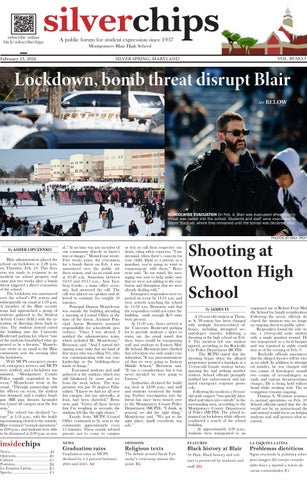
Lockdown, bomb threat disrupt Blair see BELOW
SCHOOLWIDE EVACUATION On Feb. 4, Blair was evacuated after a bomb threat was called into the school. Students and staff were evacuated to Blazer Stadium, where they remained until the school was declared clear PHOTOS BY MAX TROY
By ASHER LIPCZENKO Blair administration placed the school on lockdown at 1:28 p.m. on Thursday, Feb. 19. This decision was made in response to an incident on school property and came just two weeks after a bomb threat triggered a direct evacuation of the school. The lockdown was announced over the school’s PA system and subsequently via email at 1:39 p.m. A member of the Blair security team had approached a group of students gathered in the Student Activity Center (SAC) with the intention of directing them back to class. The students instead exited the building into the University Boulevard parking lot, where “one of the students brandished what appeared to be a firearm,” Monteleone wrote in an email to the Blair community sent the evening after the lockdown. With MCPS emergency protocol, emergency services and MCPS were notified, and a lockdown was initiated. “Montgomery County Police rapidly responded to the scene,” Monteleone wrote in the email. “Through partnership with the officers on scene, the student was detained, and a replica handgun (BB gun; firearm facsimile) was found off campus near the bus stop.” The school was declared “secure” at 1:54 p.m., with the building remaining closed to the outside. Blair resumed “normal operations” at 2:06 p.m., and students were able to be dismissed at 2:30 p.m. as usu-
insidechips News.......................................... A2 Opinions.................................... B1 Culture ...................................... C1 Features..................................... D1 La Esquina Latina.................. E1 Sports........................................ F1
Shooting at Wootton High School
al. “At no time was any member of our community directly in harm’s way or danger,” Monteleone wrote. Two weeks prior, the evacuation for a bomb threat on Feb. 4 was announced over the public address system, and via an email sent at 10:40 a.m. Sometime between 10:10 and 10:15 a.m., Amy Isenberg Cooke, a main office secretary, had answered the call. The call was placed on speaker and allowed to continue for roughly 10 minutes. Principal Damon Monteleone was outside the building attending a meeting at Central Office at the time of the threat. Assistant Principal Aaron Bernstein assumed responsibility for schoolwide procedures. “Once I was alerted, I notified the administrative team, which included Mr. Monteleone,” Bernstein said. “And I started delegating some tasks that are kind of first steps: who was calling 911, who was communicating with our core leadership in the building—these kinds of things.” Evacuated students and staff gathered at the stadium, which was still blanketed by snow and ice from the week before. The temperature was just 36 degrees Fahrenheit. “I knew we had ice all over this campus, but our sidewalks, at least, had been shoveled,” Bernstein said. “Given all these factors that I’m weighing in seconds, the stadium felt like the right choice.” Emails from MCPS’ Central Office continued to be sent to the community approximately every 15 minutes. These emails advised parents not to come to campus
or text or call their respective students, citing safety concerns. “I understand, when there’s concern for your child, [that] as a parent, as a guardian, you’re going to want to communicate with them,” Bernstein said. “In my mind, the messaging was sent to help make sure that we were not adding to the confusion and disruption that we were already dealing with.” Emergency responders were reported on scene by 11:01 a.m. and were actively searching the school by 11:32 a.m. Bernstein said that the responders could not enter the building until enough K-9 units were present. At 11:50 a.m., buses arrived at the University Boulevard parking lot to provide students a space to warm up. An email stated that these buses would be transporting staff and students to Eastern Middle School. Bernstein later clarified that relocation was only under consideration. “It was miscommunicated that we were going to Eastern Middle School,” Bernstein said. “It was a consideration, but it was never decided we were going to Eastern.” Authorities declared the building clear at 12:08 p.m., and staff and students reentered the building. Further investigation into the threat has since been turned over to the Montgomery County Police Department (MCPD). “I think, in general, we did the right thing,” Monteleone said. “We got to the right place, [and] everybody was safe.”
NEWS
OPINIONS
FEATURES
LA ESQUINA LATINA
Graduation rates in MCPS declined by 8.3 percent between 2024 and 2025. A2
The debate around Sarah Fulnecky’s viral essay misses the point. B4
At Blair, Black history and culture is preserved by students and staff. D3
Sigue creciendo la polémica sobre peso imagen del cuerpo creando daño físico y mental a través de varias comunidades. E1
Graduation rates
Religious texts
By JAMES YI A 16-year-old student at Thomas S. Wootton has been charged with multiple firearm-related offenses, including attempted second-degree murder, following a shooting at the high school on Feb. 9. The incident left one student injured, according to the Rockville City Police Department (RCPD). The RCPD stated that the shooting began when the alleged perpetrator pointed a handgun at a 15-year-old female student before opening fire and striking another student. School officials promptly notified law enforcement and initiated emergency response protocols. Following the incident, a 16-yearold male suspect “was quickly identified and taken into custody” in the surrounding area, according to the Montgomery County Department of Police (MCPD). The school remained on lockdown while officers conducted a search of the school building. At approximately 4:30 p.m., students were transported to an
Black history at Blair
organized site at Robert Frost Middle School for family reunification. Following the arrest, officials declared the situation was no longer an ongoing threat to public safety. Responders found the sole victim, a 16-year-old male student with a single gunshot wound. He was transported to a local hospital and was reported in stable condition as of the evening of Feb. 9. Rockville officials announced that the alleged shooter will be tried as an adult. In addition to attempted murder, he was charged with two counts of first-degree assault two counts of second-degree assault, and various firearms-related charges. He is being held without bond while awaiting trial. The investigation remains ongoing. Thomas S. Wootton returned to normal operations on Feb. 10. School officials noted that the day would not be an instructional day and instead would focus on helping students and staff process what occurred.
Problemas dietéticos
silverchips
A2 News February 23, 2026 NEWS BRIEFS Compiled by KIRAN DURVASULA
Montgomery County leaders defend proposal to close sole charter school In a recent board meeting, MCPS officials defended a controversial proposal to revoke the charter of the MECCA Business Learning Institute (MBLI). The school is the county’s only operational public charter school. After MBLI opened in the fall of 2025, Superintendent Thomas Taylor cited a series of serious operational and legal compliance issues, including violations of state and federal education laws. MCPS noted deficiencies in services for students with disabilities and Individualized Education Plans (IEPs), transportation logistics, compliance with federal and state special education laws, and student records and enrollment. In a letter to MBLI leadership, Taylor wrote that MCPS had provided written notice of infractions along with multiple other forms of warning and attempted assistance. Princess Lyles, who handles communications for MBLI, argued that MBLI has regularly communicated with MCPS to clarify and seek guidance on meeting standards. Members of the MCPS Board of Education delayed a vote on whether to revoke the MBLI’s charter to Feb. 5. No new information regarding the decision has been released.
Wes Moore’s approval numbers decline On Jan. 13, a Gonzales Research Poll showed Marylanders’ approval of Democratic Governor Wes Moore had decreased from earlier in his term. The poll was conducted between Dec. 21, 2025, and Jan. 6 by landline and cellphone, with around 800 registered voters participating. According to the poll, 52 percent of people approved of Moore’s actions during his term, which was a decline from 55 percent in March 2025 and 64 percent in September 2024. Voter discontent centered on issues that included affordability, the economy, and taxes. When voters were asked if they would support Moore in the 2026 election, 49.9 percent stated that they would vote for Moore over a Republican or third-party candidate. A spokesperson for Gov. Moore’s campaign questioned the poll results and noted that they have remained steady throughout Moore’s time in office.
Seniors offered opportunity to speak at graduation This year, all seniors will have the opportunity to audition to give a speech at graduation. The idea of a student graduation speech was originally proposed by Attendance Secretary Roxanne Fus, and was reintroduced by Principal Damon Monteleone. Jody Gil, the English Language Development teacher at Blair, is in charge of organizing the audition. The audition will be held in front of a panel of students, four English teachers, and two administrators. After the speaker is selected, they will work with English teachers to refine their speech and practice delivery and pacing. Students interested in auditioning must complete an interest form that was emailed to eligible seniors. Auditions are tentatively scheduled for after school on March 24 in Room 266.
Snow closures extend school year
was going through this ice.” MCDOT remained in conOn Jan. 24-25, a major win- tact with emergency services and ter storm swept through the East schools throughout the week. “We Coast, bringing up to 11.5 inches were in touch with emergency of snow across Montgomery Coun- services the entire time,” DeTitty. As a result, MCPS canceled all ta said. “We [assigned plows] to district operations for the following the fire stations and hospitals to make sure that emergency vehicles week. After snowfall, the Montgomery could get to people, [and] we were County Department of Transpor- in constant communication with tation (MCDOT) is responsible for schools.” According to DeTitta, commuclearing roads. However, according to Emily DeTitta, MCDOT’s nication with MCPS was also chalStrategic Communications Manag- lenging. “For the first week, we got er, this storm was uniquely difficult maybe three different requests [to due to a significant amount of sleet plow], which we handled. And we and ice. “I don’t know that we’ve were asking for a list [of uncleared experienced [this] before where we streets], which we didn’t get until a ABOVE Two pedestrians walk through downtown Silver Spring after just had this ice that wasn’t melting week later,” she said. “One of the snowstorms left the sidewalks and streets covered in snow and ice at all,” she said. “The plows that things that we’re going to be lookwe have are really meant for snow. ing at is just our communications erything that they need and their due to unsafe neighborhood roads. The plowing was slower because it with MCPS [so that] they have ev- operational needs are met earlier “There was an email saying there on.” may be delays because this bus BELOW Silver Spring residents help push a car stuck on an uncleared MCPS has denied claims of can’t go through, [and the bus was] downtown street insufficient communication. In an already probably 15 minutes late,” email to the school board, Chief Clay said. “So I took [my son] to of Staff Essie McGuire wrote that school.” it was not MCPS’ responsibility to In total, MCPS canceled five provide a list of uncleared streets instructional days and had two twoand that the district remained fo- hour delays as a result of the snow cused on clearing school campus- and ice. To meet Maryland’s 180es. day minimum requirement, MCPS Following the canceled week, added four instructional days on MCPS announced that on Feb. 2, June 18, 22, 24, and 25 after the school would be canceled for stu- state denied its waiver request to dents but teachers would return excuse the missed days. June 19 to facilities to make up for a lost and 23 will remain non-instructionprofessional day. However, the al days due to federal holidays and decision was later reversed due to county elections. continued dangerous conditions. State legislators are also working “The messaging was bizarre,” Blair on a bill that would allow MCPS English teacher Adam Clay said. “I to meet either the minimum inhad just sent an email to my ninth- structional hours or days requiregrade team about a meeting on ment rather than both. If passed, Monday, and then 10 minutes lat- MCPS would not need to extend er, they said we’re not coming in.” the school year, as it is already On Feb. 3, MCPS opened with a on track to exceed the minimum two-hour delay, though more than hours without the added days. PHOTOS BY ELEANOR OLSON 50 bus stops could not be serviced By TOMAS MONTICELLI
Graduation rates drop 3 percent By LARK JEFFERS
Where only first names appear, names have been changed to protect the identity of the sources. Blair’s graduation rate dropped 8.3 percent between the graduating classes of 2024 and 2025—a sign of a larger decrease in graduation rates across MCPS; between 2024 and 2025, graduation rates in the county decreased from 91.8 percent to 88.7 percent, according to an annual report by the Maryland State Department of Education (MSDE). This represents a total decline of 3.16 percent in MCPS, compared to a statewide drop of 1.2 percent. The MSDE was unable to identify a specific impetus for the statewide decline. However, Joshua Michael, the president of the Maryland State Board of Education, said that the decline could be caused by fear regarding immigration enforcement. “[T]he State Board [of the MSDE] is deeply concerned about declines among multilingual learners and Hispanic students,” Michael said. “Heightened political tensions and fear around immigration enforcement erode students’ sense of safety and belonging, disrupting learning and pathways to graduation.” According to the same MSDE graduation report, the graduation rate for Hispanic/Latino students— the official MSDE classification for Latinx students—dropped by 6.74 percent between 2024 and 2025. Additionally, the graduation rate for multilingual learners dropped to 66.64 percent—a drop of 6.49 percent. In 2025, there was a rise in Immigration Customs Enforcement (ICE) activity in Maryland, with ICE arrests increasing 290 percent in the past year. At both a local and national level, Hispanic
and Latino individuals have been targeted by ICE. The number of Latino arrests in Maryland by ICE jumped from 584 arrests between February and July of 2024 under the Biden Administration to 1,744 arrests between February and July of 2025 under the Trump Administration. ICE has maintained a presence across Montgomery County and around Blair. “We’ve had over 15 families affected now—either parents or students directly, being deported or put in detention,” Dahlia Badt, the vice president of Blair’s chapter of Students For Asylum and Immigrant Rights, said.
plete courses on time—an issue that many multilingual learners face. MCPS aims to close this gap in graduation among multilingual learners moving forward. “MCPS is implementing strategies designed to restore academic excellence and reinforce core foundations across the district, guided specifically by the Montgomery Board of Education’s Future Ready Strategic Plan,” MCPS said in its press release. The Montgomery Board of Education’s Future Ready Strategic Plan does not outline how it will support the 33,742 EML (Emerging Multilingual Learners)
As noted in the MSDE statement about the 2025 graduation report, many students who feel vulnerable to ICE activity in the area are having their learning and pathways to graduation affected. “I can tell you this year that we have students who have stopped coming or rarely come,” Theresa Hiller, the English Language Department resource teacher at Blair, said. “Often they’re reaching out, and they’re like, ‘What should I do? I’m scared to leave my house.’” Another potential cause for the drop in graduation rates includes student struggles to com-
of MCPS as of the 2023–2024 school year. “Many of our EMLs come and start brand new in ninth grade,” Hiller said. “To drop right into ninth grade and earn credits, you have four years to pass the tests, learn the language, earn the credits, [earn the] SSL hours, [earn the] world language credits … it’s definitely harder.” Another potential factor related to the graduation decline could be a rise in chronic absenteeism. Chronic absenteeism is defined as when students miss 10 percent or more of the school year. In the 2023–2024 school year, 27 per-
cent of students were considered “chronically absent” in Maryland. The MCPS attendance policy is that if a student is absent for 15 or more consecutive full days without explanation, they are withdrawn from the system. If a student has 15 or more non-consecutive absences, however, there are no formal consequences. Additionally, MCPS’ attendance policy notes that after three unexcused absences in one class, students will be referred to the principal or counselor. However, Daniel, a junior at Blair, explained that he did not think he would be punished after skipping class. “I was late to class three times, and I got detention,” Daniel said. “But when I skipped class four times, I didn’t receive any punishment whatsoever.” In a December 2025 attendance report, MCPS finds that its high schools had a chronic absenteeism rate 0.86 percent higher than the same time last school year. The U.S. Department of Education (DOE) found that students who miss more school are more likely to fail their classes. The DOE also noted that it is difficult to disaggregate chronic absenteeism from class and racial disparities; in the 2022–2023 school year, 33 percent of Hispanic/Latino students across the country experienced chronic absenteeism, as compared to white students at 22 percent. Additionally, English learners experienced chronic absenteeism at a rate 5.4 percent higher than non-English learners. MCPS said that it will be implementing strategies to close educational gaps in its statement about the graduation decline, including the Montgomery Board of Education’s Future Ready Strategic Plan.
silverchips
Montgomery County property values increase by 12.2 percent By SONYA DEL POZO and LILA SHAW Montgomery County property values are expected to increase by 12.2 percent in 2026, according to a Dec. 30 report by the Maryland State Department of Assessments and Taxation (SDAT). The projected increase is lower than the 17.7 percent growth recorded in 2025. The 12.2 percent increase applies to “Group 2” properties, which include areas of Baltimore City and Montgomery, Anne Arundel, Baltimore, Howard, and Washington counties. Montgomery County Director of Finance Mike Coveyou explained that the prediction indicated a return to typical values in the county. “Property values … have been sort of flattening over the last few years,” Coveyou said. “They actually sort of piqued a couple [of] years ago, and they’re down roughly 10 percent—from 22 percent growth to 12 percent growth in the last two years. It’s getting back towards what I would consider … normal.” During the pandemic, health-related concerns led residents nationwide to move out of congregate housing and into single-family homes. Melissa McKenna, the executive director of the Affordable Housing Conference of Montgomery County, explained that the residual effects of these moves contributed to higher property values nationwide. “We’ve also seen an increase in the materials and the labor costs to construct new housing. As it gets more expensive to build, it gets more expensive to then live in or to rent,” McKenna said. “Even in the single housing and townhouse market, the cost
has gone up simply because there isn’t as much [housing] available.” In Montgomery County, where demand for housing is high, housing costs have outpaced inflation, making living in the county more difficult for low-income residents. “In Montgomery County, the price of housing has been rising faster than inflation basically for all of the 21st century,” Carrie Kisicki, the
This high cost of living has made it increasingly difficult for low-income residents to secure housing. “Wages are not growing as fast as the cost of living,” Fani-Gonzalez said. “That’s why increasing housing for people of low income is really important.” In 2023, Fani-Gonzalez helped pass County Bill 15-23, Rent Stabilization, which placed limits on rent
GRAPHIC BY LILA SHAW DATA COURTESY OF MD STATE DEPT. OF ASSESSMENTS AND TAXATION
Maryland housing advocacy manager at the Coalition for Smarter Growth, said. “[Rising property values are] reflective of how desirable it is to live [in Montgomery County].” While property values continue to increase, wage growth has not kept pace nationwide. “We have stagnant wages across the nation, not just here,” Montgomery County Councilmember Natali Fani-Gonzalez said. “Yet, the housing costs have increased.”
growth in Montgomery County to support low-income residents. In 2025, the county legislature furthered its support for residents and passed the More Housing New Options for Workers Bill to expand affordable housing opportunities for residents. The bill expedited the process for half-vacant office buildings to be converted into housing, which was required to include affordable residences. “As part of the requirements, you had to have at least 17 percent af-
February 23, 2026 News A3
fordability in that conversion from office to housing,” Fani-Gonzalez said. Fani-Gonzalez explained that these conversions have faced resistance from some community members. “There’s a lot of people who feel that the neighborhoods are the way they are and don’t want to have any changes to it,” Fani-Gonzalez said. “The reality is that we’re evolving as a society, and we have the responsibility to meet the moment … [which] means ensuring that our neighbors have places to live, that our children have places to afford and to live in after they graduate from high school, college, and so on.” Debates over neighborhood change are also closely tied to where housing is built. In a primarily metropolitan area such as Montgomery County, proximity to transportation can significantly alter housing costs. “The places where you don’t necessarily need a car to get around, where you can walk or bike or take transit to meet your daily needs—often those are the places where we haven’t been building enough housing,” Kisicki said. “That means that the housing that already exists there is more expensive, it’s not accessible to everybody.” Kisicki argued that expanding housing near transit hubs could address both affordability and environmental concerns. “We should be putting housing in places where people can live an environmentally friendly life and an affordable life, rather than continuing to build in a way that we know has been destructive for our environment and that can be even more expensive in the long term,” she said.
Ostrander leaves after 16 years By ADA SCHWARTZ Former Magnet Coordinator Peter Ostrander left Blair at the start of the second semester to assume a new position as the supervisor of academic programs for MCPS. Former Assistant Principal Christopher Klein assumed the magnet coordinator role at the start of the second semester. In his new role, Ostrander will oversee the creation of magnet programs under the new regional magnet program system. The system, which was first proposed to the Board of Education in May 2025, will divide the county into six regions, each with their own programs featuring the following five themes: humanities and International Baccalaureate (IB), visual arts, STEM, biomedical science, and leadership. Each of these regional program systems will be exclusively available to students within the allocated region. The board is expected to vote to approve the plan on March 26. Prior to joining Blair in 2010, Ostrander served as a computer science teacher at Takoma Park Middle School, a program supervisor at Roberto Clemente Middle School, and as the Supervisor of Secondary Programs in the Office of Accelerated Instruction for MCPS. When Blair needed a new administrator, Ostrander decided to return to a school. “[Blair] had already gone through a round of interviews and didn’t find a candidate that they were happy with,” he said. “When they reposted it, I decided, ‘Let me step back down into a school.’” As Blair Magnet Coordinator, Ostrander oversaw magnet curriculum, and staff. During his tenure, Ostrander and the Magnet team
also implemented exit interviews for graduating Magnet students. “He was able to then take that feedback and provide it to staff … and we could make adjustments and adapt based on that feedback,” James Schafer, a Magnet physics teacher, said. “I think that really helped shape the direction of the program.” When the MCPS Department of Academic Programs opened
ests.” Ostrander’s new job will involve recreating the magnet programs in new schools. He said he aims to ensure Magnet programs are replicated faithfully across the regions. “Because we do something different—we don’t just teach AP [classes]—part of [my job] is making sure that our curricula are well-written, [and] that we train new teachers and new schools on the differenc-
PHOTO BY IAN WOODWORTH
MOVING ON Former Blair Magnet Coordinator Peter Ostrander speaks with his successor to the position, Christopher Klein the supervisor of academic programs position in October 2025, Ostrander applied to be a part of the new changes coming to the magnet program system. “Part of [why I joined] is making sure that the programs we’ve worked to build are maintained with fidelity in these other [regions],” he said. “Plus, I’m excited [about] these new programs. We [didn’t] have some of these programs before, and it creates a whole [other] outlet for students with different inter-
es,” Ostrander said. Ostrander started in his new role prior to the official approval of the regional program plan, which is set to be voted on by the board in March. He will be transitioning into his position earlier in order to help set Central Office’s proposal into effect. “We knew we wanted the position to start as soon as we [could], and [it] just worked out that it would be at the end of the semester,” Ebony Langford-Brown, the Director of
the Academic Programs in the Division of Teaching and Learning, said. Ostrander will be working under Langford-Brown in the Department of Academic Programs in the Division of Teaching and Learning. The new regional program system would bring significant change to magnet programs across MCPS and to Blair. As more regions are created under the model, Blair’s Magnet applicant pool would shrink from two-thirds of the county to one-sixth of the county. Schafer said he was hesitant about the potential changes but expressed confidence in Ostrander’s involvement. “While I don’t want to see a lot of changes to what’s happening at Blair, I at least know that there’s someone who’s being intentional and thoughtful about those changes,” Schafer said. “[I’d be] at least confident that they were made with the right ideas in mind.” Christopher Klein, the new Blair Magnet Coordinator, explained that he plans to first ensure he has a complete understanding of every facet of the Magnet program, then survey students and staff for new ideas to implement. “I need to listen deeply to find out what’s working well, what should never change … and what are the things that could be better,” Klein said. “Before I make judgments, I need to remain agnostic and just deeply listen.” Reflecting on his time at Blair, Ostrander said he was proud to have been a member of the school community. “Everybody in this building is always operating with students in the forefront of their mind,” he said. “Instead of a legacy, I’m proud I was able to be a part of it.”
INTERNATIONAL NEWS BRIEFS Compiled by MOLLY BREEN
Thousands of civilians killed in Iranian protests
In late December 2025, protests broke out across Iran after the Iranian rial reached record lows, with 1.42 million rials amounting to one U.S. dollar. This inflation can be attributed to chronic fiscal deficits and sanctions on international oil trade, sparking widespread grievances across the country. During the resulting protests, citizens expressed discontent with the Iranian regime because of the economic crisis and rising political tensions. On Jan. 8, the Iranian government blocked internet access and all international phone calls in response to these protests. On Jan. 9, the military carried out mass arrests against protesters, often employing violent and lethal methods. The Iranian government has confirmed approximately 3,000 deaths, but some reports estimate the death toll of these arrests to be over 20,000. Throughout January, the U.S. continued to threaten military intervention in response to the violent force against Iranian protesters. By Jan. 26, the U.S. military had deployed one aircraft and three warships to the Middle East to monitor further escalation. An Iranian diplomat, Gholam Hossein Darzi, claimed the U.S. has “direct involvement in steering unrest in Iran to violence.”
Former South Korean president indicted, faces death penalty
The former president of South Korea, Yoon Suk Yeol, was indicted in eight trials related to his illegal actions as president. On Dec. 3, 2024, Yoon Suk Yeol declared martial law to combat “anti-state forces,” only to repeal the decision hours later. 11 days later, Yoon was impeached by the South Korean National Assembly, primarily for failing to properly implement martial law and for alleged abuse of power. One of these eight trials reached a verdict on Jan. 16, and Yoon was found guilty of obstructing justice and destruction of evidence. He was sentenced to five years in prison. The sentences Yoon now faces in the seven remaining trials include jail time and, in one trial, the death penalty. The verdict in that trial is expected to be reached on Feb. 19.
Olympic truce announced before Winter Olympics
Due to current geopolitical tensions, the United Nations (U.N.) has called for an Olympic truce for the ongoing 2026 Winter Olympics. The tradition of the “Olympic truce” dates back to the 9th century BCE in ancient Greece, when the Greek city-states would make peace during the games to allow for safe participation. On Nov. 19, 2025, the U.N. adopted the Olympic Truce Resolution for the 2026 Milan Olympics. This resolution called for a seven-week truce to all wars. This garnered widespread support from both the U.N. council and the International Olympic Committee (IOC). Despite the support, there has been little action taken to halt any ongoing wars or conflicts. The IOC has the ability to ban countries from participating in the Olympics and has done so in the past when countries have violated their agreement of the Olympic truce. In 2022, the IOC banned Russia from the Winter Olympics and any other preceding games due to its invasion of Ukraine. As of Feb. 14, there have been no bans or sanctions placed on any other countries currently at war.
silverchips
B1
OPINIONS February 23, 2026
AI use is destroying the environment And you’re part of the problem By LEYA FEKADU AN OPINION It’s Tuesday night, and you have ten assignments to complete, but you’re distracted. Low-quality AI-generated reels keep your thumbs active, your mind in a blank trance, and your face unexpressive at their incoherent nonsense. As silly as dancing babies, sob stories told by cats, or human-faced “niche fruits” eating themselves are, the juice isn’t worth the squeeze. Not only are these videos rotting our brains, but they’re also rotting our environment. AI has greatly advanced in recent years and has been making waves in consumer use since the release of generative models like ChatGPT and Gemini in 2022 and 2023, respectively. In 2025, 55 percent of adults reported regular AI use. Google searches are summarized with AI, math homework can be done in minutes with tools like Gauth, and silly images and videos can be generated almost instantaneously. AI has become inescapable—and so has the cost. “There’s a cost to all that … I don’t really think any of us have a really good understanding of what that is,” David Del Pozo, the director of the Latino Health Initiative, said. “And when we finally do … it will
probably be too late.” Creating each of those funny images, for example, uses as much power as charging a phone. And that’s just the start. Training AI models means thousands of processors running continuously for months. About 30 percent of the energy required to train these models comes from coal, a non-renewable energy source, which will constitute 40 percent of greenhouse gas emissions by 2030. Researchers estimated that training GPT-3 emitted roughly 500 metric tons of carbon dioxide. It takes the same amount of emissions to drive from New York to San Francisco about 438 times. Back in the day, people might have actually driven that distance to meet a long-distance partner or to see family. Now, we’re spending the same amount of energy talking to AI chatbots (according to Common Sense Media, 75 percent of American teens have used AI chatbots). Emissions aren’t the only environmental issue. While we’re
watching reels of AI cats crying rivers of tears, real-life rivers and groundwater reserves are being drained. Processors in data centers need water cooling to stop overheating, and large data centers require as much as five million gallons of water per day—the same amount as a city of 50,000 people. “[Data centers] have mass consumption of water … which is concern-
ing considering the fact that almost a quarter of humanity already lacks access to clean water and sanitation,” Blair junior Juliana Fay Thompson, the public relations director for the student-run environmental organization EcoMoCo, said. New data centers also provide communities with little gain. They produce hardly any permanent jobs, their tax cuts take money
from government services, and acres of land that could have been used for farming and economic development are instead being used for warehouses and processors. “[Data centers] make lots of noise, they could create lots of traffic—those are different impacts that will come to bear on people who live in those communities,” Del Pozo said. “Somebody else might say, ‘It’s bringing lots of jobs here.’... [but] are [the employees hired] the people who are in those communities? Probably not.” The unholy sound of Skibidi Toilet might be annoying, but it’s incomparable to the sounds of the HVAC systems in these data centers, which residents of nearby communities compare to the humming of freight trains. The same residents can also expect a myriad of airborne pollutants from contaminated water vapors and other smogs released from these facilities. Data centers’ cooling towers are linked to risks of Legionnaire’s disease, which can cause fatal, pneumonia-like
infections in nearby residents. Perand polyfluoroalkyl substances also lead to kidney cancer or higher risks of diabetes. Maryland’s power grid already struggles in extreme weather—and the soaring energy demand driven by rapid data center expansion threatens to add another layer of strain to the system. On Dec. 16, 2025, state lawmakers passed a bill that ordered a study of the cost of greenhouse gas emissions and the impact of data centers on these costs, and established a new energy planning office for the state. While this bill is one essential step forward, AI’s environmental toll continues to grow at an alarming and unsustainable rate. Before consuming AI content or using it to help with simple tasks, consider whether using AI is really necessary. Do you need it—or do you simply want to use it? “We’ve come a long way, and scientific discoveries are always something that are going to have an impact, good or bad,” Blair freshman Frankie Ramsdell, the founder of the AI committee on Blair’s Student Government Association, said. “We really need to figure out a way through government regulations and scientific studies to make powering AI more efficient to help the environment before it’s too late.”
Why everyone should take physics It’s not as scary as you think
I was 100 percent sure I [was] going to keep doing the humanities for the rest of my life. And then I took [physics], and I was like, ‘Oh, maybe I was wrong.’ ics, classes like chemistry can also satisfy the requirement. This allows students who find
ror stories about it—especially AP Physics.” Most high school students can’t foresee what path they will travel, so it is too soon to say they will never need physics. As a senior in CAP, Riley MacArthur was once sure she would go into the humanities. However, taking physics shifted her interests towards engineering. “I was 100 percent sure I [was] going to keep doing the humanities for the rest of my life. And then I took [physics], and I was like, ‘Oh, maybe I was wrong,’” MacArthur said. Most students do not yet know what they will or will not enjoy. Physics
IEH
HS
often outperforming national averages. In the 2021-2022 academic year, physics majors averaged
credit. While physical science may sound like it refers to phys-
CA SI
Work[ing] backwards to tell what the cause was, or some piece of the cause—[is a] general [skill] that [any student] can use, even if they’re not going to major in a science field.
510.2 out of 528 on the notoriously difficult medical school entrance exam, the MCAT, compared to an overall average of 505.9. On the law school exam, the LSAT, physics majors averaged 163, compared to a national average of 156. Additionally, 73 percent of physics majors who applied to law school were accepted, compared to a national acceptance rate of 68 percent. While this does not prove causation, it does show physics majors are strong in other areas. For high schoolers, physics is an interdisciplinary field with clear relevance to other classes like mathematics, chemistry, and biology. In AP Physics, students work with vectors, graphs, and integrals—topics that are also covered in math classes. Working with these topics in physics provides students with a deeper understanding of what they have already learned. “In calculus, there were some things I could do but … I didn’t have a physical understanding of what [it] meant,” Blair senior Sophia Jones said. “In physics, [when] we were learning to do [calculus] with these real-world things, [like] electrical currents, I got what it actually meant.” Unfortunately, there has been a shift in MCPS schools away from the idea that students should build a foundation in all the sciences. The county requires one biology credit, one physical science credit, and one Earth or space science
ES YJ TB AR
Physics majors are also well prepared for career-related standardized tests,
PETER SHAWHAN
problem-solving, which are skills that 77.1 percent and 88.3 percent of employers say they are looking for, according to a survey by the National Association of College and Employers. Physics also teaches students analytical cause-and-effect reasoning, a useful ability in almost any career. “If-then reasoning—how you can work backwards to tell what the cause was, or some piece of the cause—[is a] general [skill] that [any student] can use, even if they’re not going to major in a science field or they’re not going to pursue a scientific career,” Peter Shawhan, a University of Maryland physics professor, said. In fact, according to the Georgia Institute of Technology, 89 percent of physics majors go into a field other than
physics or astronomy, and 38 percent of physics students receive a graduate degree in a non-physics field. Physics students’ ability to switch into new fields demonstrates the versatility and usefulness of a physics education.
RILEY MACARTHUR
By ADA SCHWARTZ AN OPINION Equations, formulas, a n d graphs are what many people imagine when they think of physics—a class just for nerds and future engineers. But that is not all there is to physics. When a student conducts a group lab, draws a diagram, or calculates the time it takes for an apple to hit Newton’s head, they are learning written communication skills and
physics too challenging or mathheavy to opt out. “I didn’t take physics because it’s science and math together,” Blair junior Lulya Kelit said. “I’m not really good at math, and I heard a lot of hor-
teaches problem solving, analytical reasoning, and a p - plies interdisciplinarily, so students should be required to try out physics and take a chance on it. “Taking a chance, even if it’s hard, even if you end up not liking it, is definitely worth it,” MacArthur said.
silverchips
February 23, 2026 Opinions B2
Should national service be required for teenagers?
YES
NO
Mandatory national service for 18-year-olds would foster national unity, promote personal growth, and equip young adults with valuable skills.
Mandatory service will foster inequity and can only be maintained at an incredible cost to citizens and their government.
By LEYA FEKADU AN OPINION
By ASHER LIPCZENKO AN OPINION
ALL PHOTOS BY SADIQ ABDILLAHI
Though nationalism and patriotism once formed the bedrock of this nation, 250 years later the United States feels anything but united. A year of mandatory national service for 18-year-olds would help bridge these divides and connect Americans across the political spectrum. While military service is the most recognized form of national service, many teenagers find the idea intimidating and do not consider it an option for themselves. However, some Americans are unaware of the many roles and responsibilities military recruits undertake beyond front-line combat. “There [are] hundreds of different jobs in the army and the rest of the military that have nothing to do with holding a rifle,” Bill Hunley, who serves as a captain in the D.C. National Guard, said. “There are a lot of neat things you can do without being part of [combat roles] that can lead you into a career after the military.” Mandatory national service would showcase the diversity of paths within the military and allow young Americans to gain important life skills. Four out of 10 high school students say they are unclear about their career prospects and 49 percent of teens claim that high school has done little to prepare them for adult life. Hands-on experience through national service grants these fresh high school and college graduates the opportunity to experience working with different communities. Lisa Levy, a former volunteer for the Peace Corps in Jordan, felt unsure about the career she wished to pursue after college. Levy’s experience working in healthcare projects as part of the Peace Corps helped her realize her passion for the field. “One of the projects I did was relating to healthcare and that experience was what led me to do various jobs related to health care advocacy,” she said. “It very much helped me reframe and understand what I wanted to do.” Organizations such as the Peace Corps demonstrate how service can shape longterm career trajectories. Marc Grossman, a social studies teacher at Blair, credits his transformative experience volunteering in the Peace Corps with connecting him to educational opportunities, kick-starting his career as a teacher. “I wasn’t sure [what I wanted]. I was speaking to someone who was an investment banker, and I was like, ‘What do you think about investment banking? Should I do that?’ [But] all they wanted to talk about was their Peace Corps experience,” Grossman said. “MCPS used to have a program where if you were a Peace Corps volunteer, they would pay for your grad school. And that’s why I moved here and have been teaching ever since.” In addition to financial aid, Grossman noted that serving in the Peace Corps shaped him into a more empathetic and culturally aware person—traits he applies while teaching a diverse range of students to this day.
Amid declining national pride and rising political polarization, some Americans worry that a commitment to national service might conflict with their values. However, civic engagement is vital to any democracy, and mandatory service encourages young adults to join the national conversation and bring change. “You sign up to defend the Constitution of the United States [and] the people of the United States, no matter who is in office,” Hunley said. “What better way to make a difference in your community than to try to influence it by joining an organization that can do that?”
We’ve all heard the old adage, “high school was the best time of my life.” While that may be an exaggeration, no one can deny that young adulthood is a formative period, where we are just beginning to understand ourselves and who we want to be. That time should not be interrupted by mandatory service, and 57 percent of US adults aged 18-29 agree. It is true that 68 countries—including Brazil, Russia, Turkey, North and South Korea, and Israel—require adults to serve
IN-SCHOOL RECRUITMENT U.S. Marine recruiters speak with a student at an information table in the main hallway Volunteering exposes individuals to different viewpoints and strengthens their sense of civic responsibility. Research from the University of Maryland’s School of Public Policy showed that volunteering for any cause raised voter turnout likelihood by 12 percentage points. “You can’t help but come back to the United States and see the [country] through a more critical lens,” Grossman said. Volunteers are exposed to various governing styles and have the chance to compare the lifestyles and cultures of developing countries, propelling deeper consideration of one’s nation and responsibility. While students may find the idea of national service intimidating, it has proven to be transformative for many young adults. Yimmy Rivera, a Blair alum and student in the Army National Guard noted that his experience provided a valuable lesson on community and partnership. “[National service] brings people from all walks of life. I was … with people from Cameroon, but [we all] trained together,” he said. “You call them brothers and sisters [and] you fight like one, no matter who you are.”
in the military (though gender, age, and duration of service varies from country to country.) It is also true that some countries, like Germany for example, had a mandatory service requirement, but reduced or abolished it. As a nation, the United States was founded on principles of individual liberty and limited government. Countries like Israel or South Korea can understandably mandate service for national security, but the U.S. lacks such concerns, and therefore has no reasonable justification to infringe on the rights of citizens, let alone teenagers. And on top of ideological concerns, mandatory service has serious social and economic effects as well. “You’re basically taking away somebody’s entry into the labor or educational [or] post-educational market by a year,” Sebastian Jilke, an associate professor at Georgetown University’s McCourt School of Public Policy, said. Data from the U.S. Census Bureau shows that, in 2024, the median income for individuals with a
high school diploma, and no college, was $58,410, while those with some college education earned a median income of $76,520. Delaying educational or career opportunities by even one year can have serious financial consequences. Mandatory national service would promote further inequity due to the staggering number of young adults who are ineligible to participate. According to data from the U.S. Army’s Office of Public Affairs, 71 percent of American youth are ineligible to serve in the military due to factors such as obesity, drugs, physical and mental health problems, misconduct, or aptitude. Such high rates of ineligibility undermine the concept of mutual responsibility or a universal requirement by pushing the burden upon a small portion of our population. Even if young adults ineligible for the military were to engage in some alternative activity, like civil service (as was the case in Germany), the distribution of tasks would deteriorate to abject competition. “You can imagine [mandatory service] devolving into a situation where, if everyone has to do this, competition could arise over the particular service position one gets,” John Marvel, an associate professor of public administration at American University, said. “That would almost undermine the service aspect of it.” And even if we excluded ineligible participants, such a program would still incur heavy costs. In late 2025, there was much debate in Germany about reinstituting mandatory military service, which would have cost the country €70 billion (approximately $82 billion). At the same time, calculations from the Naval Institute indicated that if all eligible Americans were to serve, it would cost the U.S. government around $132 billion. At the end of the day, consider what service is really about: choosing to help others and support the community—not fulfilling a requirement or satisfying any other extrinsic motivator. Requiring teenagers to serve would remove the fundamental choice to serve. Service is something that everyone should partake in—but on their own time. Letting individuals choose when, and what, they do to help others will only benefit them more in the long run.
voicebox All photos by SADIQ ABDILLAHI
“I feel like the idea of having sort of adult SSL hours is really necessary in keeping adults educated and helping to raise morals in the population.”
“Prisoners have to do community service. But regular people, I feel like you shouldn’t enforce those rules on them”
“I think I’d be against mandatory military service because, generally, I’m not a fan of the military, but for other types of service, I think that would be a good thing.”
SCARLETT EISENER sophomore
KAKU KITILA junior
GRACE SAURI senior
“I think that it can help with national pride as well as the fact that it can build character, you sort of learn how to more or less like help your community and understand what your community means to you. ”
ADELINE HOGAN junior
B3 Opinions February 23, 2026 silverchips
Montgomery Blair High School 51 University Boulevard East Silver Spring, MD 20901 silver.chips.print@gmail.com 2024 NSPA Pacemaker Finalist, 2024 American Scholastic Press Association Most Outstanding High School Newspaper, the 2024 American Scholastic Press Association First Place with Special Merit, the 2024 National Scholastic Press Association First Class with Three Marks of Distinction, the 2024 Columbia Scholastic Press Association Gold Medal winner, and the National Scholastic Press Association Pacemaker 100.
EDITORS-IN-CHIEF Satchel Jelen Doris Wang DESIGN EDITORS Senaya Asfaw Lucy Holland Kiya Tiruneh Eric Yang NEWS EDITORS Casey Pendergast Jessica Zhang OPINIONS EDITORS Elora Derbyshire Yongle Xin FEATURES EDITORS Neha Narayan Priya Tapia-Pereira CULTURE EDITORS Senaya Asfaw Lila Grosko SPORTS EDITORS Mackenzie Lyons Sahana Parikh OMBUDSMAN Justin Rosentover COLUMNIST Kiya Tiruneh SENIOR WRITERS Adanna Akamigbo Rae Foster Tomas Monticelli Ruth Wajda-Gotwals STAFF WRITERS Molly Breen Sonya Del Pozo Vee Dimyan Hope Dowd Faye Kiran Durvasula Leya Fekadu Dermott Foley Zoe Gorbachev Lark Jeffers Elena Kleiner Alice Levings Asher Lipczenko Jamie Love Marcela Mason-Rodriguez Celia Max Gabriella McKenzie Ada Schwartz Lila Shaw Hana Sor James Yi BUSINESS DIRECTORS Sophia Li Eva Schwartz BUSINESS STAFF Andie Alison Jocelyn Nolasco Maryam Elsharif ART EDITORS Josephine Brunn Lake Luca Esser ARTISTS Tinbite Abie Eva Dammann Melanie Fang Jessica Hsieh Tane Park Victoria Angeli M. Regachuelo Jason Yu Sophia Zhdanova PHOTO EDITORS Ian Gleason Daneel Kutsenko PHOTOGRAPHERS Sadiq Abdillahi Raffi Diamond-Berman Rae Foster Kaylee Hopkins Linnea Menge Eleanor Olson Maz Olson SCPSPORTS EDITOR Daneel Kutsenko PUZZLE EDITOR Daneel Kutsenko OUTREACH COORDINATORS Justin Rosentover COPY EDITORS Elora Derbyshire Lila Grosko Lark Jeffers Neha Narayan Sahana Parikh Casey Pendergast Priya Tapia-Pereira Doris Wang Eric Yang ADVISER Jeremy Stelzner HEADER ART Luca Esser Lucia Wang Jason Yu
For the Post, in memoriam By THE EDITORIAL BOARD AN OPINION Democracy plunged into darkness on Feb. 4, 2026. That day, the Washington Post laid off 30 percent of its staff, including 300 of its 800 journalists. Reporters who were working in the middle of the Ukraine War were fired. All of the paper’s photojournalists were dismissed. This impersonal destruction of the Post’s journalistic team, ostensibly to cut costs, was a disgrace to its once-proud role as a defender of rigorous and compelling journalism. In an era marked by the birth of “alternative truth,” the Washington Post Fact Checker debunked 30,573 false or misleading claims made by the president during his first term. In the words of longtime fact-checker Glenn Kessler—whose column was discontinued after he left the Post last summer—“falsehoods are now winning.” In many ways, the death of the Washington Post was not a surprise, given its shift in recent years from its old anti-administration editorial line. In February 2025— eight years after the Post adopted its slogan “Democracy Dies in Darkness”—Bezos announced that the paper’s opinion pages would publish stories in support of two pillars: “personal liberties and free markets.” Now, the Post’s mass layoffs made Bezos’ impact clear: the paper that broke the Watergate Scandal and published Edward Snowden’s files on the NSA Prism program is no longer. In December 2024, following Bezos’ decision to block the Post’s endorsement of presidential candidate Kamala Harris, the Silver Chips editorial board expressed
hopes that community members would continue engaging with local news sources. While legacy media struggles to survive, the civic action of individuals and news organizations continues to illuminate local stories. The Baltimore Banner, touting its success in Montgomery County, is now expanding into Prince George’s. School newspa-
censorship, and misinformation, we aim to continue representing, defending, and informing our community. For years, Silver Chips staff have looked to the Post—among other legacy news institutions—as a model for quality journalism. Before Carl Bernstein helped the Post uncover Nixon’s illegal
silverchips
effects of artificial intelligence on our communities, and county policies—from redistricting to regional magnet programs. We have shared stories about Blair clubs, recorded administrative changes, and highlighted school traditions. Student time, effort, and energy ensure that the environment that fostered journalists like Bernstein and Lopez JOSEPHINE BRUNN LAKE
Editorial Cartoon pers at our public schools continue to be the first to report on news in otherwise overlooked areas—like the virtual academy and inappropriate teacher-student relationships. In light of the Post’s dismantling, we reaffirm our commitment to truth, free speech, and transparency. While the world of journalism rapidly changes with the continued rise of artificial intelligence,
activities, he helped Silver Chips by working as the circulation and exchange manager. Before Julyssa Lopez began writing cover stories on Madonna, Maluma, and Daddy Yankee as Deputy Music Editor at Rolling Stone, she was reporting on the Hispanic community at Blair. To the students on our staff, Silver Chips is more than a club. We report on the Trump administration’s impact on education, the
remains for the next generation. The Washington Post will never be the same. But Silver Chips and other local news outlets will continue to fearlessly create and share our stories for our peers and community. We will not let the death of the Post be the final nail in the coffin of dependable journalism in America.
Give freedom a chance By JUSTIN ROSENTOVER Ombudsman AN OPINION At the height of the Cold War, “The Father of Venezuelan Democracy,” Romulo Betancourt, made it policy that non-elected governments would not be recognized by Venezuela. Today, Venezuela itself is ruled by a government Betancourt would despise. Its dictators, Nicolás Maduro and his predecessor Hugo Chávez, abandoned Betancourt’s love of democracy and now their government should face the consequences. Last month, after the United States captured Nicolás Maduro to bring him to trial, the outrage was immediate. The New York Times editorial board declared the attack “illegal and unwise,” but dueling gatherings in the aftermath provide
Silver Chips is a public forum for student PHOTO BY IAN GLEASON expression. Student editors make all content decisions. Unsigned editorials represent the views of the editorial board and are not necessarily To contact Justin those of the school or of all Silver Chips members. Signed letters to the editor are encouraged; email him at submit them to silver.chips.print@gmail.com. scombud@gmail.com Letters may be edited for space and clarity.
better insight. One was a combination of groups including the D.C. Alliance Against Racist and Political Repression which sported signs saying “hands off Venezuela.” The other was a gathering of Venezuelan refugees dancing and singing in the street. The Venezuelan refugees recognize what the New York Times and those protestors do not—there is nothing wrong with deposing an evil government. In fact, this has been bipartisan American policy since World War II. In 1947, Harry Truman declared, “I believe that it must be the policy of the United States to support free peoples who are resisting attempted subjugation by armed minorities or by outside pressures.” Kennedy in 1961: “Let every nation know… that we shall pay any price, bear any burden, meet any hardship, support any friend, oppose any foe to assure the survival and the success of liberty.” Reagan in 1984: “Let us look to the future with confidence, both at home and abroad. Let us give freedom a chance.” The Trump Administration has failed to live up to the high-minded American ideals of liberty and equality both in Venezuela and here at home. Marco Rubio, who is “running” the country, is no more of a democratic leader than Maduro was, just a less evil one. But this does not make American intervention in Venezuela unjustified or unnecessary. More than half of Venezuelans live in extreme poverty and are unable to purchase even basic food. In 2024, the people of Venezuela elected opposition leader Edmundo
González in a landslide, but Maduro blatantly cheated, claimed victory, and forced González to flee to Spain. The same protesters that opposed war in Venezuela also called for ICE to leave D.C. But those goals are contradictory. Arbitrary arrest and murder of American citizens is a violation of our liberty, but so is the miserable poverty and oppression put upon the people of Venezuela by their “government.” If we are to fight for freedom at home, we must also fight for it abroad. Almost 250 years ago, America justified its independence by saying that “whenever any Form of Government becomes destructive of these ends, it is the Right of the People to alter or to abolish it, and to institute new Government.” There are billions of people around the world who live under governments that do not secure the rights to “life, liberty, and the pursuit of happiness.” They have as much of a right to overthrow their governments and establish new ones as we do. It is our obligation to help them via whatever means necessary. War is not an appealing option, but it is often the best chance for freedom. Nazi Germany was not defeated through negotiation and compromise—it was only emboldened by it. In a time when we see our freedom being eroded at home and abroad, it is our obligation to fight in its defense. In just the last month we’ve seen the horrors of today’s tyrants in Iran, where as many as 30,000 people were mowed down by their own rulers. The fall of the Iranian gov-
ernment would not bring those people back, but it would save the next 30,000 and end a government which has terrorized people from Yemen to Lebanon with its proxies. Contrary to popular belief, the United States has actually done a pretty good job founding democratic regimes when we bother to try. Japan, Germany, Grenada, and the Philippines all have American-conceived governments. After decades of war and death, the current Iraqi government was elected by its citizens, as was the Afghan government before the U.S. abandoned Afghanis to the horrors of the Taliban. Success in Venezuela is even more likely since Venezuela lacks the ethnic and religious tensions of the Middle East and has a history of stable democracy and economic growth. America is a nation founded on the idea of freedom and rule by the people. Why is it that we continue to deny these rights for people around the world? The freedom of an American should not be worth more to us than the freedom of a Venezuelan or a Georgian or an Iranian. In a world where democracy is under attack from every direction, America must ensure “that government of the people, by the people, for the people, shall not perish from the earth.” Rather than a “Donroe” doctrine of American dominance in the Americas, we should embrace Betancourt’s wisdom and bring the United States’ might to bear on all unfree nations.
silverchips
Who are we to judge?
February 23, 2026 Opinions B4
Why debates about religion often miss the point By ELENA KLEINER AN OPINION In the fall of 2025, Samantha Fulnecky, a student at the University of Oklahoma, received a zero on a psychology essay—an event which sparked national debate across both Christian and academic communities. In her assignment, Fulnecky referred to society’s acceptance of transgender individuals as “demonic,” effectively condoning the harassment of students who do not conform to gender norms. Her sole reference was an ideological construct created within the institution of Christianity, rather than the Bible itself. The teaching assistant (TA) who graded her paper was a transgender woman. After Fulnecky received her score, she filed a complaint with the school administration on the basis of religious discrimination. The professor who upheld the grade was ultimately dismissed from the university. Fulnecky’s essay was a reflective response to a scientific article that presented data showing that children who do not conform to societal gender norms are more likely to face harassment from their peers. Fulnecky argued that the bullying of these children was justified by God’s intentionality in human creation. “I do not necessarily see [teasing] as a problem,” she wrote. “God made male and female and made us differently from each other on purpose and for a purpose.” According to the TA’s feedback, which had been released to the public, she failed the assignment due to a number of factors— including Fulnecky’s blatant rejection of course content, her disregard for psychological terminology, weak cohesion in her claims, and general lack of sophistication. When the situation became publicized, some conservatives jumped to Fulnecky’s defense, claiming that she was a victim of anti-Christian discrimination, targeted due to her choice to cite the Bible. Others argued that religious texts are never valid sources in academic contexts. However, from my perspective as both a progressive and religious person, her use of the Bible as support was not inherently the problem. Instead, the issue lies in how she used it and how her hateful message contradicts the themes of the Bible. I was raised with the idea that we are meant to embrace the acceptance, humility, and
grace expressed in Jesus’ love. It hurts me to see people who identify as Christians condoning actions that hurt one’s neighbor—especially in the name of God. Regardless of whether she deserved a zero on her assignment, Fulnecky’s awareness of the teaching assistant’s gender identity is disappointing; her intention appears not simply to express
approaching the Bible, we need to approach it from a lens of love and justice.” Reverend Trudy Stringer, former theology professor at Vanderbilt University Divinity School, reflected on the role of Jesus in society amid the current social climate. “When I look at the different ways Jesus is used, I think about feeding people and healing people. Then, I look at what’s happening in our country right now, and it makes me wonder, what [do events like this] mean?” she said. Stringer wondered how TINBITE ABIE
belief but to hurt another individual. Yet, a large group of people support her, praising her supposed courage in defending the Bible. “She was so right to stand up for her beliefs and what the Bible says,” one commenter wrote under a Facebook post recapping the situation. “Jesus is smiling down at her and her stand for Christian beliefs,” another commenter added. As a religious person, this baffles me. “Love” is one of the most prominent words in the Bible, and not by coincidence. The Bible is meant to be used to spread love, not to degrade another person based on their identity. Many pastors and religious scholars reflect on the life of Jesus in a loving and accepting light, not as an invitation for exclusion and hate. “Far too often, the Bible is used as a weapon instead of its intended purpose, which is to highlight a God who is love,” Reverend Samantha Gonzalez-Block, my pastor from the Interfaith Families Project of Greater Washington, said. “Anytime we’re
a faith so intentional in the helping of people could cause individuals like Fulnecky to act out of such hate. Her experience of the embracing of Jesus was through healing and helping others, rather than division and fear. According to Pastor Matt Klingler from The Well Community Church in Silver Spring, religious groups have long used their values as an excuse for exclusion and hate—exactly what Jesus stands against. “This is an age-old problem where [a] religious group often ostracizes or judges another group,” Klingler said. “[In the Bible], there’s this group called the Pharisees, [who] were probably the most religious of [Jesus’] time. When Jesus shows up on the scene, they end up hating him because he is so loving and kind and values all people, no matter who they are.” Personally, I disagree with Fulnecky’s view that the acceptance of transgender people is
not permitted by the Bible. Regardless of one’s interpretation of the Bible, though, a hateful message rooted in judgment against another cannot be justified. In the Christian community, a common phrase alluding to the message of Luke 6:37 preaches, “Who am I to judge when I myself walk imperfectly?” Pastor Klingler echoed this idea. “Everyone falls short of God’s standards,” he said. “Therefore, how could we judge or condemn another person for anything?” My faith tells me that God not only knows our actions but also our thoughts and hearts. First Chronicles 28:9 states, “For the Lord searches all hearts and understands every intent of the thoughts.” Fulnecky cannot live out the will of God if she judges or condemns people based on their identity. Ultimately, Fulnecky’s lack of genuine acceptance for others and outright hateful actions contradict one of the most prevalent messages in the teachings of Jesus: to remain humble and to not judge one another. I believe that she has no place to judge another and label another individual as “demonic.” This takes me back to what I believe is the true intention of the Bible in a Christian context: to live and love like Jesus. In my conversation with Reverend Gonzalez-Block, she implored me to become more thoughtful in my perspective if I ever find myself tempted by a message in the Bible to act without love and kindness. “If the Bible is inviting you to treat your neighbor unfairly, it’s an invitation for you to stop and to spend some more time in the text to find where God’s love and justice come alive,” she said. Reverend Stringer emphasized the importance of focusing on Jesus’ loving teachings—regardless of the exclusive narrative established by some Christian institutions. “People of color, women, and queer Christians are reclaiming evangelism—rescuing the Jesus [movement],” she said, referring to the original message of Jesus and his first disciples. The words and actions of Samantha Fulnecky—and the divisive debates that followed—are deeply troubling. To subscribe to Christian values means following the guidance and teachings of Jesus: to spread God’s love through word and action. We must live constantly in the biblical truth that we are meant to love one another.
silverchips
C1
CU L T U R E February 23, 2026
A post-Valentine’s Day date guide 9 ways to celebrate your loved ones in the month of love By KIRAN DURVASULA and RUTH WAJDA-GOTWALS Although Valentine’s Day has come and gone, it’s still important to appreciate and spend time with loved ones—whether they’re your date, your mate, or even if you just want to treat yourself. Our Silver Chips Date Guide will help you keep the season of love going a little longer, with date ideas perfect for every relationship status. DIY Galentine’s Party Though romantic relationships can be an important part of life, close friendships are equally important. To honor these platonic relationships, we recommend hosting a gathering or throwing a party with your gals—aka, Galentine’s! Hang some pink and red streamers, dangle colorful string lights, and hit play on your favorite playlist to set the stage for an amazing vibe. From there, the best part about this plan is that it’s customizable, and you can easily tailor your Galentine’s party to fit the group. To help with brainstorming your itinerary, we highly recommend any of these activities: Personalized pizzas: Set out prem ade dough and toppings at stations so everyone can craft cute individual heart-shaped pies. Paint and sip: Get some painting supplies and non-alcoholic sparkling cider, and unleash your inner artist. For a more humorous night, pair up with a friend and have them sit across from you, so they can’t see your canvas. Then try to paint each other! The reveal at the end will probably have you cracking up. For a bigger group activity, you can find a simple reference photo and have everyone in the group interpret it in their own style. Board night: If you haven’t seen it on TikTok, this trend is very potluck-esque. Ev- eryone in the group brings a board or tray with their contribution of food on it, such as a veggie platter, cheese and crackers, or even just arranging Chick-fil-a on a tray as if it’s the components to a charcuterie board. Extra activity ideas include organizing a slime night (where everyone makes their own slime,) a spa night (where partygoers pamper themselves to the max,) or a game night (where everyone brings their favorite game to play together.) Ice Skating at the National Gallery of Art Sculpture Garden For couples seeking a romantic
winter experience in Washington, D.C., the National Gallery of Art Sculpture Garden ice rink—which sits right outside of the National Gallery of Art—offers an enchanting blend of art, nature, and intimacy. From the rink, you can see the Gallery in the background with trees and small, twinkling lights surrounding the area, creating a cozy atmosphere. Gliding hand-in-hand across the ice outside the National Gallery provides a magical setting unlike a typical skating rink. The rink operates from late November through early-March, Sunday through Thursday from 11 a.m. to 9 p.m., and on extended weekend hours until 11 p.m. Admission is $15 per person, and skate rentals are approximately $7. For the most intimate experience, visit during weekday evenings when the crowds thin out and the sculpture garden’s atmospheric lighting creates a nice ambiance. Weekend afternoons offer a livelier energy, sometimes with live music. After skating, couples can check out the National Gallery of Art—which offers free admission— or warm up at the Pavilion Café with a coffee.
fresh salads, pasta dishes, shareable appetizers, and an extensive drink menu. Entrees average between $15 to $25, while appetizers cost $10 to $15. Lane rentals typically range from $8 to $10, depending on the time and location, while shoe rentals are around $5 per person. Consider visiting during weekday evenings or weekend afternoons for the best availability and atmosphere! U.S. Botanic Gardens The United States Botanic Garden offers a peaceful experience perfect for couples and solo adventurers. Located near Capitol Hill, this conservatory provides a lush escape from winter and offers free admission. Step inside the glass-enclosed conservatory and you’ll find seasonal blooms that create an intimate
Bowling at Pinstripes Gather your squad for an unforgettable celebration at Pinstripes, where bowling meets Italian-inspired dining in a sophisticated yet fun atmosphere. This venue balances entertainment and style, making it ideal for larger groups who want more than a typical party destination. During this month of love, many locations are offering seasonal Valentine’s Day food items
such a s heartshaped pizzas and cute Valentine’s-themed cocktails. The Italian-American cuisine offered at Pinstripes goes far beyond standard bowling alley snacks, featuring wood-fired pizza,
atmosphere, along with picturesque model trains making their way through the garden. Close your eyes, and the warm air and fragrant flowers will transport you to a tropical paradise. For couples, the winding paths offer intimate and quiet moments. For a reflective experience, solo visitors can wander through the Tropics room and discover rare plants, or sit on a bench to observe the surrounding scenery. The garden’s tranquil environment encourages mindfulness and self-reflection, creating space for relaxation, self-care, and self-love. The conservatory is open daily from 10 a.m. to 5 p.m. Weekday mornings offer the quietest experience, while weekend afternoons are busier. Whether you’re celebrating with a partner or by yourself, this free botanical garden delivers natural beauty at no cost. The Board and Brew The Board and Brew offers the perfect combination of food and games for a laid-back Galentine’s gathering or a casual couple’s date. This board game cafe offers an extensive library of over 750
games, ranging from classics like Scrabble to modern strategy games like Catan. With so many options, there’s surely a game to match any mood or skill level, creating a playful atmosphere where friendly competition sparks laughter and connection. The menu features handheld sandwiches, salads, and an assortment of shareable appetizers like soft pretzels and macaroni and cheese. Expect to spend around $12 to $25 per entree, with a small table fee of $5 to access games. Visit during weekday evenings for a quieter experience, and be sure to reserve a table if going with a larger group! Pottery Painting at ‘All Fired Up’ Go with friends or take a date to All Fired Up, a pottery painting place near the National Cathedral in Washington, D.C. Guests can purchase an unpainted piece of pottery—like a mug or figurine—for an average price of $25 to $35 per item. The studio is quaint and sweet. Upon entering, you are surrounded by colorful walls and ceramics, with an abundant supply of every shade of glaze. It feels like a meditative and creative sanctuary— the perfect place for a date! All Fired Up offers an array of glazes, an endless selection of tools and supplies, and experienced staff members to answer questions or demonstrate techniques. After finishing your design, the piece will be taken to the kiln and available for pickup a few days later. Monster Mini-Golf Take a 25-minute drive from Blair up I-495 and I-270 toward Gaithersburg to reach Monster Mini-Golf. With gusts of wind floating through dark rooms lit by neon lights and lanterns depicting monsters, Monster Mini-Golf offers a mysterious atmosphere. The course offers 18 holes for $16 per person. You can also pay an additional $4 to $10 for a laser maze, bowling, an arcade, or virtual reality experiences. Competition brings people together, and the scenery makes for a lively, memorable outing. Hot Yoga at CorePower CorePower Yoga has studios in Chevy Chase and D.C., both around half an hour from Blair. For students, the studio offers a free week of unlimited classes—a
great opportunity to bond with someone while working up a sweat and getting a rewarding workout. CorePower Yoga offers your typical low-intens i t y yoga classes. For more of a challenge, o n e of their heated, intense classes, such as Hot Power Fusion. Instructors will lead you through working with every single muscle, and your cardiovascular endurance will be put to the test. First-time participants can ask for a one-time complimentary mat and towel, but bringing your own afterward avoids future rental fees. CorePower Yoga offers nine classes categorized by functional strength training, flow and cardio conditioning, or mobility and active recovery. Visitors can choose classes based on level of intensity, so make sure to look through the online schedule on their app, and find the perfect time and class for you to take advantage of this deal! try
Big Escape Rooms For a mentally active bonding experience, make sure to check out some escape rooms! In downtown Silver Spring, about ten minutes from Blair, Big Escape Rooms offers four escape rooms of varying difficulty, ranging from $20 to $33 per person. Immerse yourself in the story of the room, and let the pressure build as you solve clues and riddles to escape. This teamwork-filled outing is bound to bring you and your friends or beau closer, as you’re pressured to work together and put your intelligence to the test. For an exceptionally fun and exciting night, Big Escape Rooms will help you channel your inner detective with the people you love.
silverchips
C2 Culture February 23, 2026
2026 is the new 2016—for the moment By VEE DIMYAN and ALICE LEVINGS
I feel like our trends are all just one big loop ... So it’s almost inevitable that we’re just gonna be stealing from the past.
feels meaningless. Students note that much of the 2016 culture outdates them, as they were too young to partake in popular culture a decade ago. “Personally, I was like 5 years old, so I didn’t experience much [of 2016 trends],” Blair freshman Sarah Ouedraogo says. Elise Ansah, another Blair freshman, agrees, “I was 4 years old in 2016. I
didn’t really know what was going on.” As usual, corporations have already begun capitalizing on the “return of 2016” to gain more business and appeal to a wider clientele. “I know corporations are definitely planning on playing into this,” Plaia says. “You can always go into the comment section of a trending video and see some corporation trying to be clever and connect with the kids.” Ironically, as soon as a big brand tries to engage with a trend, it tends to die immediately. In 2025, a creator by the name of Ashton Hall went viral after users noticed he used an expensive brand of water instead of normal tap water to wash his face. Brands like Duolingo and McDonald’s attempted to post content making fun of Hall’s absurd routine, and the moment’s popularity and humor were ruined. Once trends become mainstream enough for large corporations to participate, it can feel like the trend has reached its peak and is no longer niche. So far this year, Hollister, Florence by Mills’ beauty, and Reformation have hopped on the 2016 trend, posting slide-
shows of “2016” photos with iconic 2016 music, including “Lean On” by Major Lazer, in the background. The caption for the Reformation post read, ‘We miss 2016 too.” “Corporations capitalize on literally anything possible, right?” Blair Senior Santa Kana says. “It’s 100 percent—whatever’s trending, they’ll be capitalizing on.” We can’t know until the end of the year whether 2026 is the new 2016, but while there’s still time before every brand under the sun starts posting pictures from a decade ago, don’t be afraid to take part.
The Rio De Janeiro filter and 2016 EDM pop [is] making a comeback, [including] clubbing, lots of rhinestones, bedazzled, neon colors.
CLEMENTINE HIGGINS
K PAR
2016’s resurgence follows a year of weird, meaningless trends and inside jokes, marked by zealous laughter over two consecutive numbers stemming from a song by Skrilla, an obsession over off-brand furbies that nobody could afford, and an adoration of a chocolate bar filled with bright green cream that became so popular it garnered its own Wikipedia page. The “2016 is the new 2026” phenomenon isn’t a surprise; for years, people have been trying to bring back old trends. “I feel like our trends are all just one big loop,” Samya Niemerski, a Blair senior, says. “So it’s almost inevitable that we’re just gonna be stealing from the past.” It is definitely not the first time Gen Z has taken inspiration from past trends. Y2K fashion, bold neon colors, heavy makeup looks, and music that was popularized in the ‘80s, ‘90s, and early 2000s have recently made a comeback among Gen Z teenagers. “Tattooed chokers have made a big comeback, or just chokers in
general. [I’ve seen] longer necklaces and [old] music and aesthetics,” Blair senior Clementine Higgins notes. “The Rio De Janeiro filter and 2016 EDM pop [is] making a comeback, [including] clubbing, lots of rhinestones, bedazzled, neon colors.” The color, whimsy, individuality, and authenticity of 2016 are coming back and replacing the all-black, performative, meaningless vibes of the 2020s. “People are blasting Justin Bieber now. I thought he fell off, but he’s back again for some reason,” Elise Ansah, a Blair freshman, says. “And it’s also the clothing. I’m noticing a lot more colorful clothing like tie dye instead of the all-black Y/N vibe that we’re going for.” However, for some, this trend
SAMYA NIEMERSKI
E TAN
I like all 2010s music, and I love Tumblr ... I wouldn’t be opposed to it coming back.
REINA PALMAIRA
Just when we thought we had finally escaped it, 2016 is making a full-fledged comeback. Resurrected by colorful tights, rainbow frappuccinos, and quirky hobbies, the year has clawed its way back into relevance—armed with Tumblr-era fashion, funky pop music, and side parts. It’s only February, but new trends and viral videos are already gaining traction across social media platforms, one of the most prominent being the revival of 2016. As online communities buzz about “2026 being the new 2016,” students across the country are exhilarated to see 2016 make its comeback. “2016” and “2016 trends” are some of the most searched topics on Instagram and TikTok, with TikTok searches for “2016” surging by 452 percent in January. Many people, including celebrities, are posting photos from ten years ago, and social media pages are filled with dog filters and Zara Larsson songs from ten years ago. “I like all 2010s music, and I love Tumblr, of
course, and stuff from that era,” Reina Palmaira, a Blair junior, says. “I wouldn’t be opposed to it coming back.”
Whether you learn the Lush Life dance trend, use the Rio De Janeiro or dog face filter on your Snapchat photos, or revamp your closet with skinny jeans and pastels, make 2026 a colorful, vivid, exciting year filled with nostalgia and creativity. And however you go about it, make it your own.
C3 Culture February 23, 2026
Pickleball diplomacy comes to Blair
silverchips
Shanghai students pay a visit to celebrate pickleball and friendship By ELENA KLEINER and JAMIE LOVE Tension fills the air. Across the barrier, two adversaries lock eyes, bracing for the grueling battle ahead. The scene has all the hallmarks of an intense international negotiation—but there are no treaties involved, just a competitive game of pickleball. In April 2025, MCPS Athletic Director Jeff Sullivan launched Pickleball Diplomacy, an initiative that sent a delegation of 31 MCPS students on a 12-day visit to Shanghai, Shenzhen, and Beijing. Through competitive pickleball matches against Chinese students in each city, the program sought to achieve a simple goal, explained by Sullivan: “Friendship and building positive relationships that are genuine.” While the pickleball court may seem like an unusual place for international relations, this is not the first time a paddle and ball have served as an icebreaker between these two nations. Following the Chinese revolution of 1949, contact between the U.S. and China was infrequent at best. For more than two decades, diplomatic ties were nonexistent and trade was limited. In 1971, however, an unlikely event sparked a breakthrough in diplo-
macy. Nine players from the U.S. Table Tennis team visited China as the first delegation of Americans invited to the country in decades. The trip, which became known as the beginning of “ping-pong diplomacy,” proved instrumental in the improvement of U.S.-China relations and cultural exchange. More than fifty years later, a modern twist on sports diplomacy began to take shape. At the 30th Asia-Pacific Economic Cooperation Economic Leaders’ Meeting in 2023, Chinese President Xi Jinping announced a “50,000 in five years” plan, which aimed to attract 50,000 Americans to China on exchange or study programs in five years. Concurrently, MCPS made history as the first school district in the U.S. to offer varsity pickleball, piloting the sport at 11 schools. These seemingly uncorrelated developments—a global diplomatic initiative and a local sports movement—merged in 2025, marking the beginning of Pickleball Diplomacy. Despite the language barrier, the program’s initial trip was a great success for both parties. After returning to Maryland, Sullivan wrote to Xi to detail the formative cultural exchange that occurred during the games. Xi responded, emphasizing pickleball’s significance as “a new bond for youth exchanges,” noting
PHOTOS BY RAFFI DIAMOND-BERMAN
DIGGING IN Students from Luwan Senior High School settle in for a traditional American buffet lunch which included a stop at Blair. On Feb. 5, Blair’s Blazer Pride Marching Band greeted the Shanghai delegation outside the main entrance. After a buffet-style lunch— where Blair Principal Damon Monteleone and Luwan Principal He Li signed an agreement to be-
The people here are very enthusiastic. I was very moved when you guys waited for us in the cold outside of the school gate.
LUWAN STUDENT
that the future relationship between the two countries “depends on the youth.” Some U.S. officials, however, were not convinced. By late summer 2025, Chairman of the Select Committee on China John Moolenaar became aware of the initiative. On Aug. 18—only a few weeks after China invited MCPS players to the embassy for a tournament—Moolenaar wrote to Montgomery County Executive Marc Elrich to express his skepticism. In the letter, he explained that the China Education Association for International Exchange (CEAIE), which sponsored the trip, could not be trusted. “[T] he sporting competition CEAIE funded is clearly not just about pickleball; it is a tool used by the CCP to expand its influence over the American public,” Moolenaar wrote. He argued the program should be stopped. But this year, it expanded. Despite Congress’ disapproval, MCPS announced in January that the Pickleball Diplomacy initiative STANDING PROUD From left-to-right: Ms. Fillman, Ms. Boule, Ms. Hill- would continue in 2026. Only a er, Ms. Armstead-Thomas, Mr. Monteleone, Mr. Oldham, and Ms. Bla- month later, the county prepared to host a delegation from Luwan ha pose for a photo during the festivities Senior High School in Shanghai,
come sister schools—the Chinese students spent the afternoon experiencing life as Blazers. They enjoyed performances from the school’s band, poms team, and cheer teams, followed by an exclusive teaser of Blair’s Sankofa production. Some students then practiced English conversation, while others lifted weights and learned about catapult projects. Despite the excitement of the
day, many in the delegation were most grateful for the simple human connection. “The people here are very enthusiastic,” one student said. “I was very moved when you guys waited for us in the cold outside of the school gate.” Another added, “American people are really … warmhearted and welcoming.” This appreciation was not just one-sided. Blair Athletic Director Rita Boule was equally struck by the opportunity to meet the visiting students. “I [got to] learn a little bit about who they are as people and their culture and what they enjoy,” she said. “[It’s] just been such a cool experience to see kids from a completely different country.” Ultimately, this shared sense of connection suggests that Sullivan’s vision is working. Not only has Pickleball Diplomacy, as Sullivan described, “brought friendship and our … people together,” but it has also proven that meaningful relationships do not always arise from formal discussion. Sometimes, they stem from finding common ground in unexpected places.
Februrary 23, 2026 Culture C4
silverchips ER
IC
NG YA
Chips Clips
Contact Puzzle Editors Daneel Kutsenko and Down: Ruth Wajda-Gotwals at 1. 1,000 make a silverchipsclips@gmail.com kilo with the subject “February Chips Clips” with 2. Renegade 3. That is: Lat. questions, comments, concerns, or any other feedback 4. Used by South Asians and their Down Continued: diaspora to describe 43. Hairstyle that themselves Elle Woods knew a 5. Cynthia’s bestie case-deciding detail about 6. Cell centers 45. Glee clubs 7. Kind of exam 46. Kit ___ (candy 8. Dan in “Forrest bar brand) Gump” 47. Bite the bullet 9. ___ Miss 48. Hoodwinked 10. Greyhound 51. “Harry Potter” alternative series garden pest 11. Big Island bash 52. El’s favorite 12. DHL competitor 53. When your homeboy 13. Track event helps you out, say “good 21. Mindy of “The _____!” Facts of Life” 54. “___ See Clearly Now” 22. Madre’s hermano 55. Alaskan city 25. “Gimme a break!” 56. Burgeon 26. Portable bed 57. Exhibit anxiety 27. “Who’s calling my 58. Cooper, youngest actor phone?” Song to win a Grammy 28. “Thar ___ blows!” 59. Norway’s patron 29. “Como ___ saint usted?” 61. Andy Dwyer fell 30. Pasta suffix, in a..? commercially 31. Tchaikovsky’s “___ Lake” 32. Baseball great Ty 33. The second son of ER Adam and Eve ESS CA U L 34. “Who’s the leader here?” 38. Some Halloween decor 39. UK pub fave 40. Fail many times, say “take some ___”
Across: 1. Electrical network 5. What a plan is when it shouldn’t be executed 10. Dorm donor, often 14. Was a passenger on 15. Out in the country 16. Ruminate 17. Gets on in years 18. “See if ___!” 19. “Masking” stuff 20. Nostalgic lip-syncing app 22. Money held for a minor 23. Tennis unit 24. Early afternoon 25. Hush-hush org. 26. “In the backseat of your rover” band 32. “_____ moment”: a defining event that can shape a person’s life 35. “So that’s your game!” 36. Farm female 37. Sentimental news item, briefly 38. Heed the alarm 40. Sicilian mount 41. Jerry’s partner
Across Continued: 42. Yale student 43. Prairie 44. Mannequin challenge song 49. Owns 50. Make public 51. Toothpaste type 54. Eight iron ones make a block in Minecraft 57. Game that had everyone walking 60. Snoop Dogg’s daughter 61. Toyed with, cat-style 62. Trademark 63. Eros, to the Romans 64. Seal the victory 65. Run ___ (go wild) 66. Latest word 67. Fifty minutes after the hour 68. Own (up) Feburary Solutions
LUCA ESSER
silverchips
Center Spread
Crossing into danger Story BY Molly Breen, Zoe Gorbachev, and Yongle Xin | Art BY Josephine Brunn-Lake | Design BY Lucy Holland
The pattern of risk
Montgomery County’s struggle for pedestrian safety
Vision Zero
Montgomery County adopted the Vision Zero initiative in 2016, becoming the first suburban jurisdiction in the country to commit to eliminating traffic deaths and severe injuries. Holland reports that countywide, there has been only a two percent decrease in serious injuries and fatalities compared to pre-COVID numbers. However, on what the county refers to as its “high injury network,” corridors with the highest risk for serious injuries and fatalities, the results are more encouraging. “We’ve had over a nearly 30 percent decrease on those roads compared to the same time frame,” Holland says. “Where we have our focus work, we are seeing that those areas are becoming safer than they were prior to our efforts there.” This suggests that targeted interventions, improvements like adding traffic signals, installing protected crossings, reducing speed limits, and redesigning intersections, work when implemented correctly. The challenge lies in the pace and scale of change required across the county. Montgomery County performs relatively well compared to national averages. According to Holland, the county ranks third or fourth lowest in fatality rates compared to similar areas in Washington, D.C., Maryland, and Virginia. If Montgomery County had the nationwide average fatality rate for a jurisdiction of its size, it would see approximately 120 deaths per year instead of 44. “Our roadways [in Montgomery County] are definitely not as safe as they need to be, but they are much safer than your average U.S. roadway,” Holland notes. However, he acknowledges that fatalities increased across the region following COVID-19 and remain “somewhat elevated” despite recent improvements.
Wade Holland is Montgomery County’s Vision Zero program coordinator, a county initiative with the goal of achieving zero fatalities or serious injuries on county roads by 2030. According to him, student fatalities typically number around one to four per year out of 40 to 50 total fatalities countywide. “It is not zero, but it is smaller than our other cohorts in terms of age groups,” Holland says. Pedestrian incidents tend to cluster along major corridors, designed to move cars quickly rather than accommodate people on foot. High-injury corridors in the Silver Spring area include Connecticut Ave, Georgia Ave, and University Blvd. Eli Glaizer, a transportation planner for Montgomery Planning, explains the characteristics of these roads that contribute to crash severity. “The main factor is just speed. Unfortunately, a lot of the main roads in Montgomery County are designed for cars to drive really quickly,” Glaizer says. “If a car is driving faster, it has more energy, and that energy can do a lot of damage to people.” Visibility also plays an important role. The way intersections are designed, whether or not there is sufficient lighting, and whether drivers can see pedestrians all impact crash likelihood. But perhaps more significantly, many of Montgomery County’s major roads lack dedicated space for pedestrians and cyclists. University Boulevard demonstrates this dangerous design. “[University Boulevard] is generally six lanes with a four or five-foot sidewalk immediately against the street. And the speed is 35 miles an hour,” Grazier says. This narrow sidewalk’s placement directly next to high-speed traffic creates danger and perceived danger that discourages walking.
A major factor when it comes to pedestrian-related accidents is legal liability. Alan Siegel, a personal injury lawyer at Chaikin, Sherman, Cammarata, Siegel P.C, explains the legal side of pedestrian accidents. “In Maryland, in particular, the law is extremely hard on pedestrians,” Siegel says. “In Maryland, they follow a law called contributory negligence. And what that means is that if the person who’s bringing the lawsuit or the case is even one percent negligent or at fault, then they are barred from recovery.” These laws can make it extremely difficult for plaintiffs to recover damages in pedestrian-accident cases. The recovery of damages is important in order to pay for expenses such as medical and funeral bills. “There are instances where a pedestrian can be hurt by a motorist, even a negligent motorist, and still not be able to recover for their injuries,” Siegel says. Contributory negligence is a controversial doctrine that is uncommon in the U.S., with Maryland being one of only four states that practice it. Legal scholars often criticize it, arguing that it can be unfair to the plaintiff. “Maryland should get rid of the law of contributory negligence. [It] is draconian.” Siegel says. Because of this law, Maryland pedestrians often have little recourse after a collision, leading many drivers to go unpunished and become repeat offenders with no incentive to change the behaviors that lead to crashes. Being aware of state laws when it comes to pedestrian rights and responsibilities is a major factor in becoming a safe pedestrian and driver. “[Pedestrians] should never assume that somebody sees them,” Siegel says. “They should wait to make sure that a driver is going to stop and yield to them.”
Our roadways in Montgomery County are definitely not as safe as they need to be, but they are much safer than your average U.S. roadway.
Be a champion for your areas around your school, be a champion for your neighborhood.
Looking ahead The long road to redesign
While Vision Zero has identified where change is needed, actually implementing those changes can be difficult. Progress remains slow because Montgomery County faces the challenge of changing a transportation system built for cars to accommodate all users. Carrie Kisicki is the Maryland Housing Advocacy Manager for the Coalition for Smarter Growth, a new urbanist advocacy group working to combat car-dependent infrastructure. She says that the county’s roads are designed, first and foremost, to move cars quickly. “A lot of our infrastructure is still designed to prioritize cars and make [them] as fast as possible,” she says. “It’s not designed to facilitate people getting around on public transit or to keep people safe if they’re outside of a car, walking or biking.” Changing this requires not just political will but massive physical infrastructure changes that cost time and money. “The investment that it took to get where we live to where it is today was decades and decades and decades of significant investment,” Glaizer says. “It’s always more expensive and time-consuming to retrofit and to fix what you did the first time.” Montgomery County’s University Boulevard Corridor (UBC) Plan aims to expand transit options, adjust zoning rules, and improve pedestrian safety along the corridor. Approved on Dec. 9, 2025, the plan is now in the implementation phase, which involves finalizing the document. The UBC plan not only aims to expand transit options, but make the UBC and other corridors like it more comfortable for pedestrians. “[We plan on] making University Boulevard—and corridors like it—places that are safe and comfortable and accessible for people that live and work along them, not just travel through them,” Glaizer says.
WADE HOLLAND
Liability
Despite clear safety benefits, road redesigns often face significant public pushback. Holland referred to this as the greatest roadblock to implementing Vision Zero. “There can be a lot of resistance to change in anything,” Holland says. “That’s definitely a challenge when you’re trying to change your goals for the roadway network from an idea where we really want to make sure we get people to Washington, D.C. as fast as possible to saying safety has to be our top goal.”
This resistance intensifies when safety improvements involve measures that could slow traffic, such as adding traffic signals, adding bike lanes, or removing travel lanes to control speeds. “That is not a popular thing, especially when we know that there is a pretty high traffic congestion in this region,” Holland says. Glaizer notes that while the department has independence to create long-term visions based on data, actual implementation requires coordination with multiple agencies and often involves navigating community controversy. Aside from public pushback, there are also logistical challenges. “It just takes a lot of time and money to move utilities, to move curbs, to lay new asphalt, [and] to change the signals. There’s a lot of infrastructure,” Glaizer says. “The interplay of all of it becomes much more costly to fix once it’s already installed.”
ELI GLAIZER
The main factor is just speed. Unfortunately, a lot of the main roads in Montgomery County are designed for cars to drive really quickly. If a car is driving faster, it has more energy, and that energy can do a lot of damage to people.
Speed bumps
WADE HOLLAND
The intersection of Bauer Drive and Russet Road in Aspen Hill looks like thousands of others across Montgomery County. Six lanes of traffic, narrow sidewalks, and a school bus making its daily stops. But on Oct. 9, 2025, this intersection became the site of a tragedy when 11-year-old Summer Lim was struck and killed by a turning school bus while riding her bicycle home from Earle B. Wood Middle School in Rockville. Two weeks before this incident, on Sept. 21, 16-year-old Wheaton High School student James Evert Anderson was crossing University Boulevard West near St. Paul Street in Kensington when he was struck by a car. He also died at the scene, at an intersection that his mother, Caty Anderson, had warned officials about five years earlier. In an email to her state delegate, Alfred Carr, she wrote, “There have been numerous car accidents in the last 11 years that we’ve lived here,” and asked about options like traffic lights or speed cameras to solve the issue. Five years later, her son would die at the location. The crashes that caused the deaths of Summer Lim and James Anderson were not isolated incidents, but instead part of a larger trend affecting Montgomery County’s most vulnerable road users. In 2025, Montgomery County reported 44 traffic fatalities, with 18 pedestrian and cyclist deaths, continuing a trend that has persisted since the COVID-19 pandemic. While the county has made progress in certain areas, these recent student deaths demonstrate how far it still has to go to ensure the safety of all commuters.
February 23, 2026 Features D1/D2
The road to zero traffic deaths in Montgomery County remains long and uncertain. While the initial 2030 Vision Zero goal seems unlikely to be met, the plan has driven progress on the county’s highest-risk corridors. Major infrastructure projects, such as the University Boulevard changes and the Flash bus rapid transit, along with ongoing efforts to promote pedestrian safety, are significant steps in the right direction. But beyond statistics and plans, the urgency of this issue is measured in lives, including those of Summer Lim and James Anderson. At a December town hall organized in response to Anderson’s death, Maryland state lawmakers apologized to the community. “We’re sorry. We shouldn’t be here tonight. This is a failure, frankly, at all levels of government, for years, for a variety of different reasons,” Maryland State Delegate Jared Solomon says. At the meeting, the Maryland State Highway Administration announced plans to install a traffic signal by 2027 at University Boulevard West and St. Paul Street, where Anderson died. As Montgomery County continues this effort to redesign its streets, the question is not whether change will happen but whether it will happen fast enough to prevent the next tragedy. For now, that answer remains uncertain, but the commitment to trying offers some reason for hope. Vision Zero is not purely a government initiative—students can also become advocates for safer streets. Following Anderson’s death, student groups at Wheaton High School and across the county have begun organizing, attending town halls, petitioning, and calling attention to dangerous intersections near their schools. Holland urges students to become active advocates for safety improvements in their communities. “Be a champion for your areas around your school, be a champion for your neighborhood,” he urges.
D3
silverchips
FEATURES February 23, 2026
Tango que cantar
Blair Spanish teacher’s singing passion
It was a full house a few times in the Lisner Auditorium. I performed with an entire orchestra-which is 15 to 20 musicians-- [and] that was amazing.
CLAUDIA GARGIULO
Claudia Gargiulo walks to the top of the blue-lit stage. The orchestra blends into the darkness behind her, and she begins to sing. Her voice, passionate and strong, emerges from the speakers of the Lisner Auditorium. She sings in a way that makes the Spanish words of her tango song dance and vibrate. Gargiulo weaves a story with her voice, slowly and melodically enchanting her listeners. She ends the song to thunderous applause and steps out of the shining spotlight. Singing has long been a passion of Gargiulo, who also works as a Spanish teacher and Latinx coordinator at Blair. “My mom told me that as soon as I [could] stand, I was singing and doing stuff with my body like dancing—very histrionic [things]—and that was celebrated in my family,” Gargiulo says. Gargiulo began singing professionally at 18, attending a music conservatory in Argentina and learning from a private voice teacher trained in
the classical opera style. She soon began touring, starring in venues around Argentina and eventually joining groups that toured across Italy. “This was the best job ever,” Gargiulo says. “Performing and [getting to know] a different culture was really good.”
In 2002, Gargiulo made the decision to move to the United States to pursue new opportunities in her singing career. While tango was her speciality, she branched out into other styles and roles. “I came to the United States because I won an audition at the Gala theater,” Gargiulo explains. “[It was] not tango.
It was Portuguese.” The musical “Brazil Calls Us to Samba,” about the history of bossa nova music, played at the GALA Hispanic Theatre, which focuses on promoting Latino art and culture. After the role ended, she stayed in the U.S. with the help of a sponsor and an artist Visa and created her own tango group. “The tango group is a chamber quintet with bandoneon—which is similar to an accordion—violin, double bass, piano, and voice,” Gargiulo explains, noting that her role within the group comes with many responsibilities. “I am the lead of the group, so I need to coordinate rehearsals, [make] the flyers, and [manage] publicity. I have to dedicate a lot of hours after school to my singing activities.” Gargiulo’s group tours around the coast, mainly in southern states like Georgia, North Carolina, and South Carolina, where they perform at festivals over the summer. “But I always think that it’s not enough,” she says. “I tell people, ‘Let’s do it more.’” Gargiulo has been invited to sing at the Kennedy
I try to be appealing to the kids [while teaching], as [I do] as a singer, [trying to] attract the attention, to be a little entertaining.
CLAUDIA GARGIULO
By CELIA MAX
Center Millennium stage as well as at the Lisner Auditorium. “It was a full house a few times in the Lisner Auditorium,” she says. “I performed with an entire orchestra— which is 15 to 20 musicians—[and] that was amazing.” For Gargiulo, singing is special because it involves not just the technique but also storytelling. “There is another aspect that is very interesting for me, which is the narrative,” she says. “As a singer, you have lyrics involved, and the lyrics are narrating a story. So you need to deliver not only the melodical and emotional part of the music, but also the emotional part of the poetry. It’s a great combination, and it creates an atmosphere that is different [from] an instrument.” In 2012, she began teaching Spanish full-time, never leaving her life of singing behind but exploring new interests. “I teach AP Spanish Literature, which I love as well,” Gargiulo says, noting that her interests also lie in literature and culture.
Gargiulo, who moved to teaching at Blair from Northwood last year, finds that there are many similarities between being a teacher and a singer. “The narrative and the communication with the audience are very similar,” she says. “I try to be appealing to the kids [while teaching], as [I do] as a singer, [trying to] attract the attention, to be a little entertaining.” Integrating music into her class is one way Gargiulo aims to be an engaging teacher. She has previously assigned her Spanish 5 students a project in which they could present their topic in the form of a song or rap. “It was a project, but that was super fun to hear the kids creating the song, the lyrics, and the music,” Gargiulo says. According to her students, the addition of music enhances their classroom experiences. “She is very good at making class fun,” junior and Spanish student Ayah Imam says. “Sometimes we listen to music from different time periods or cultures when we’re learning about them.” Singing is not just a pastime for Gargiulo, but is rather something that has remained a positive constant in her life. “I’ve been singing professionally since I was 18. I am over 60 now,” she says. “For me, it’s a way of living, of well-being.”
SINGER OFF-DUTY When she’s not singing in front of full houses at
silverpatrons silver patrons
PHOTOS BY IAN GLEASON the Kennedy Center, Claudia Gargiulo teaches Spanish at Blair
If you would like to support the paper, go to tinyurl.com/subtochips to subscribe to Silver Chips, be featured on the paper, and receive merchandise.
Diamond
Kate Stewart
Platinum
Matt Andelman - The Nicodemus Family
Gold
Xiaodong Yi - J. Andrew Derbyshire & Anjna Kurichh - Anna Mackler - Karyn Stenzler - Maggie Holland
Silver
Timothy Ernst and Grace Manubay - Ann Jelen - Maria B. Velez and Wayne Santoro - Drs. HF & R Nicodemus Erika Callaway Kleiner - Susan B Herbel - Jason Fasteau - Stefanie Weiss - Jack Grosko
Bronze
George Mayo - Chip Somodevilla - Kate Gardoqui - Laurence Weinberger - Danielle DeMooy - Peggy Ellowitz Marina Deane-Gonzalez - Tony & Elizabeth Pegg
BECOME A SILVER PATRON With a donation of 50 dollars or more you can become a silver patron today! Support student journalism, get your name in the paper, and receive free merch! Go to our google form https://forms.gle/oPaJHMNRJUrXJCsB8, mail a letter to 51 Univeristy Blvd, Silver Spring, MD 20901, or email silverchips.business@gmail.com if you’re interested!
silverchips
February 23, 2026 Features D4
Chips chats with Jim Levings A look into the life of a commercial airline pilot By SONYA DEL POZO
When did your interest in D.C. So let’s say we fly up to Burflying start? lington, Vermont, and then we’ll Our family lived in Hawaii from when I was in preschool until I was going into third grade, and it just so happened that we lived right outside of a Marine Corps air base. They had fighter jets that were based there. And because we were so close to the base, we would see them flying all over the place … I always thought they were loud, and they were fast. I was like, ‘That’s what I want to do.’
come back. And then we might go
wait for them to] say we’re cleared for takeoff. Depending on the direction that we are going, you set the throttles to max power and then start accelerating down the runway. A lot of people don’t realize this, but when you are on the ground, you don’t steer with the yoke. You have foot pedals that are actually steering the airplane. So that’s how you keep it in the center of the runway. And usually at about 140 miles per hour or so we will pull back on the yoke, and the plane will start to lift off. In D.C., because … of restricted airspace, you have to be very careful where you fly. You’ll fly up the river, and it’s at that point that the air traffic controller will hand you off
There are some days when you will fly into an airport and it’s super foggy, and you can’t see anything. We have specific instruments in our airplane that tell us exactly where we are, even though we can’t see anything. Sometimes we can go all the way down to 100 feet without seeing anything. And so you’ll be in the fog down to 100 feet, then at 100 feet you’ll break out and you’ll see the runway and you’ll land. And then there are other days where it’s super windy, where the wind is not coming directly at you—it’s kind of off to the left or to the right. That makes it a little bit harder to land. Flying with weather at night, you can’t really see the clouds and the buildup, though
are. There’s just miles and miles
of [open] land—hundreds and hun-
dreds [of miles]. It’s pretty amazing
just how big this country is. Some-
times it’s fun to kind of see the
weather and stuff, as you’re flying over and you’ll see like where it
like all the snow on the ground,
literally a line where it stopped.
I enjoy looking out the window
and just kind of seeing what’s out there.
Do you have a message for high schoolers or kids who want to become a pilot someday?
I think it’s a great profession;
it’s very rewarding. The good
news is that for a lot of young
people out there, [it’s] unlike
[how] it was 20 or 30 years ago, where it was really just white
men that were flying these
planes. [Now,] the airlines real-
ly want to have a diverse cock-
pit, so it’s a much more diverse
workplace. So to any young person who is thinking about it, it’s
a lot of hard work to get there,
but once you get there, it’s defiTAKE FLIGHT Jim Levings sitting in the cockpit of a plane he often flies PHOTO COURTESY OF JIM LEVINGS from there to Dayton, Ohio, and to another controller and you start you can see the lightning. You have from Dayton, Ohio, we might go getting handed off and you just … to use your weather radar to avoid to Dallas, and then we’ll spend the follow their instructions. We will the storms. It’s all very safe, but night, let’s say, in Montgomery, Al- climb up to between 35,000 and those are the days that are kind of abama, or something like that. And 40,000 feet, and we’ll cruise at that long days. Like this weather that we because I’m based out of D.C., I altitude. It’s definitely a lot of fun. just had: [a big snowstorm] would have to finish my trip in D.C. have been kind of challenging for What’s the most challeng- pilots, but that’s kind of what you Can you walk through a ing aspect for you while get paid to do, right? normal takeoff? you’re in the air? With a normal takeoff, they’ll What’s the most exciting Our family lived in push us back from the gate, and part about flying? Hawaii from when then we’ll start the two engines Anytime you’re up in the sky, I was in preschool up. And we’re running through you have a different perspective, ... We would see some checklists to make sure that especially over the United States, [fighter jets] flying everything’s in order, that the enand you realize you’re high above all over the place gine started properly. We will taxi something, you can kind of see … I always thought out to the runway and run some things like how a bird would look they were loud, and more checklists. And then we’ll at it. I’m always amazed at just how they were fast. I was be talking to air traffic control, or big this country is. I’ll be flying over like, ‘That’s what I the tower, and they’ll tell us to taxi Oklahoma, Missouri, or some of want to do.’ into position onto the runway. [We the other states in the Midwest,
nitely worth the payoff. The last
thing I would say is [that] being a
pilot [means] you’re not sitting in
front of a computer all day just
sending emails and generating reports … When you’re a pilot, [they]
There’s just miles and miles of [open] land—hundreds and hundreds [of miles]. It’s pretty amazing just how big this country is.
JIM LEVIINGS
I fly Monday, Tuesday, Wednesday, and Thursday. And you can work as much as you want, but you have to fly a minimum of 65 hours a month, so I’m only flying maybe
I think it’s a great profession; it’s very rewarding. The good news is that for a lot of young people out there ... [Now,] the airlines really want to have a diverse cockpit.
stops snowing and you’ll just see
JIM LEVINGS
Currently, what does a typical day look like for you as a pilot?
how remote some of these cities
snowed and then it kind of just
What was the process, and what were the challenges of becoming a pilot? Well, you can go the military route, or you can go the civilian route. I had some issues with my back, so I was disqualified from going into the military and I went the civilian route. And at the time—this was in 1997—there was a two-year program through a college that you could go through, and you could get all your ratings and certificates. You start with your private pilot’s license, and then you get your instrument, then you get your commercials—these are all just ratings you get from the FAA. I probably flew five days a week. There were a lot of tests, and because they compress everything into basically less than 24 months, and you have all these things that you have to get, there [are] really no breaks. So you get done with one rating, and you go into the next rating. I was fortunate that I always had good hand-eye coordination. So the flying part was not exactly the hardest. I think for me, the hardest part was learning all the rules and regulations.
and it’s amazing sometimes just
JIM LEVINGS
I was fortunate that I always had good hand-eye coordination. So the flying part was not exactly the hardest. I think for me, the hardest part was learning all the rules and regulations.
JIM LEVINGS
Jim Levings, a commercial airline pilot at Ronald Reagan Washington National Airport in downtown D.C., dreamed of flying while growing up in Hawaii. After attending flight school in 1997 and earning his Federal Aviation Administration (FAA) certifications and private pilot’s license, Levings eventually moved to Silver Spring, flying domestic routes out of D.C. Levings sat down with Silver Chips to discuss his career as a pilot and the intricacies of flying.
15 days out of the month. And I like to do morning flights, so I fly out of Ronald Reagan Washington National Airport in downtown
pay you to fly. If you land the plane safely and you get everyone to their
destination, you can walk away and then enjoy your time off.
D5 Features February 23, 2026
100 years of Black History at Blair
silverchips
By GABRIELLA MCKENZIE
PHOTO BY IAN GLEASON
REOBSERVING HISTORY The Acorn Park’s Silver Spring Memory Wall contains murals of the B&O Railroad. Local historian David Rotenstein explained the mural’s depiction of white and Black passengers standing on the platform was historically inaccurate white people in building the community,” Rotenstein says. Acorn Park, the small urban park off East-West Highway, is an example of how Black history has
Local historical societies were producing racially biased histories that either fully excluded the Black experience or minimized it.
DAVID ROTENSTEIN
[The murals told] a very distorted, untrue representation of the community’s history by alleging that Black people could stand on the B&O platform and wait for trains alongside white people.
was teaching me through osmosis about how to deal with anybody
and everybody,” Hernandez remarks. A spotlight for Villani was on Jan. 14, 1981, when Stevie Wonder performed for Blair students and staff. “One of the great memories I have was the day that Stevie Wonder showed up and spent the day at Blair and did a concert for our students to promote his March on Washington the next day to try to get Martin Luther King’s birthday as a national holiday,” Villani says. “He came to Blair because he wanted to promote the idea.” Today, one of Blair’s highlighted events is Sankofa, a student-organized production to celebrate Black History Month. Student playwright Evvaleen Robinson explains how the Sankofa production gives a voice to the Blair community. “Sankofa highlights Black talent, and that’s something we need—especially now as the world becomes less tolerant and less accepting of art. There are so many people at Blair to whom Sankofa is the perfect outlet,” Robinson says. While it is important to discuss the past and the present, persevering and ensuring the future of Black History Month and Black identity in America is equally critical. Nationally, Rotenstein explains how, through administrative orders on museums and political sites, the preservation of history and culture belonging to Black Americans has been challenged. “With the new administration, after Donald Trump returned to office last year, we can actually see physical erasure happening daily. The museum panels at the President’s House in Philadelphia, for example, which told the story of George Washington as an enslaver, were removed at the direction of the new administration,” Rotenstein says. Rotenstein encourages ensur-
ing the future and perseverance of Black history, emphasizing that it is
important to make sure that those
from the culture are the ones de-
livering their stories and experienc-
es. “I can’t stress enough that there
needs to be more people from
marginalized communities teaching
history and engaging with the pub-
lic to tell their own stories,” he says.
At the community level, initia-
tives like Sankofa at Blair reflect
Sankofa highlights Black talent, and that’s something we need—especially now as the world becomes less tolerant and less accepting of art.
EVVALEEN ROBINSON
been represented and contested in the Silver Spring community. In 2017, Rotenstein worked with local advocates to protest the use of historically inaccurate murals. “Part of that park’s history was told in this series of murals painted on a massive wall next to the park. And those murals reflected that historical narrative … privileging the white experience, minimizing and distorting the black experience,” Rotenstein says. One of the murals had a painting of Black and white passengers on the B&O Railroad platform. The depiction misled viewers from the actual history, as segregation at the time prevented Black passengers from waiting alongside white passengers on the platform. “[The murals told] a very distorted, untrue representation of the community’s history by alleging that Black people could stand on the B&O platform and wait for trains alongside white people,” Rotenstein says. The story of Lyttonsville is a display of an essential local narrative. “Black History Month … has repeatedly been criticized because it tends to focus on the same stories that tend to get retold over and over,” Rotenstein says. “What’s
lost in these stories are the very local stories. Stories of people who helped break down racial barriers. People like Roscoe Nix in Silver Spring, who led sit-downs and helped end the grip that segregation had on public spaces.” Just as local communities preserve local Black narratives, Blair has also grown its role in Black History Month—prompted by support from Black alumni and administrators. In the 1980s, Blair had an expanding population going through demographic changes. Joseph Villani, who was Blair’s principal from 1980 to 1984, explains how the student body became more diverse during his tenure. “That was a real period of transition in Montgomery County,” Villani says. “We had a lot of international students coming to Blair and we had students from around the metropolitan area whose families moved into Montgomery County.” Chick Hernandez, who graduated from Blair in 1981, also describes the school’s demographic atmosphere at the time as being extremely diverse, which influenced his experience as a student. “[Blair]
DAVID ROTENSTEIN
Black History Month was established as a national celebration in February 1976 by President Gerald Ford. However, the month’s origins and development transcend a single declaration. Dr. Carter G. Woodson, a renowned author and historian, dedicated his education and life to the recognition of Black history and culture. Woodson is deemed the Father of Black History Month. In 1915, the summer’s weekslong celebration of Black history and culture in Chicago inspired Woodson to create an organization that promoted research into the Black experience in America. He worked to study and highlight the unseen achievements of Black culture and history through founding the Association for the Study of African American Life and History. Woodson also created Negro History Week in 1926 to further recognize the work and achievements made by African Americans. 100 years later, the celebration has expanded beyond a single week into a nationwide month of reflection and recognition of Black culture. Celebrating local Black history is just as important as any national recognition. In Silver Spring, the Lyttonsville community and neighborhood represent one of the many diverse areas with a strong African American history. Samuel Lytton, a free black man in the early 1850s, founded Lyttonsville after establishing a successful farm in the area throughout the 1890s. From the start, this area drew in Black community members, as Lytton sold parcels of land to a growing population of Black residents moving to the area. Through the early 20th century, the community was populated by federal government workers and those who worked in domestic services. As the county moved toward suburbanization of the area in the mid 20th century, these communities continually struggled with displacement. “County leaders targeted the Lyttonsville area as a prime area for redevelopment to possibly bring in new subdivisions and redevelop it,” Rotenstein says. “At the same time, [they would] displace the large number of Black families living there.” These efforts were opposed by community members, and as a result, physical barriers were erected to separate them from white residential suburbs through infrastructure. “Everything from Samuel Lytton’s time in the area up through the late 20th century involves efforts to displace the historically Black community, seize the land, [and] convert it to different uses,” Rotenstein says. “And at the same time, mostly successful efforts by the Lyttonsville residents to resist that and keep their property.” Local Black communities have also faced threats to the preservation of their history through how and what is included in historical records. “Local historical societies were producing racially biased histories that either fully excluded the Black experience or minimized it and played up the roles of wealthy
a commitment to carrying Black
history forward. Organizers hope
to see the production’s influence
grow over time. “Every year we
keep developing—not just the way
that the show works [but also]our
costumes, our dances, our vocals.
Every year, we take what we’ve
learned and we just kind of try to el-
evate,” Siri Laney, the student head director of Sankofa, says.
Black heritage should be rec-
ognized and valued across all as-
pects of society—and Black culture
is here to stay. “Us saying that we need to be heard isn’t radical, it’s the truth,” Robinson says.
silverchips
E1 La Esquina Latina el 23 de febrero de 2026
la
El 23 de febrero de 2026
esquinalatina Representando la comunidad latinx desde el 2003
Volumen 91 Número 3
No es lo que parece
El engaño de las tendencias de dietas Por TOKYO HOPKINS y CANDELA RUBINI LAFUENTE
LISS
ETT
EM
ART
I
e x tendió e n t r e comunidades de la clase media por su bajo costo, y su popularidad en los medios subió, como en películas populares como Pulp Fiction y Trainspotting. Antes del heroin chic, las modelos típicamente tenían una presentación física sana y vibrante,
opini ó n . Meghan Trainor, cantautora de “All About That Bass”, creó una marca personal que destacaba la positividad corporal. Aun así, este último año, Trainor ha hablado abiertamente sobre el uso de Mounjaro, una medicación para la diabetes, junto a otras prácticas para perder peso. Como resultado, la gente en línea ha especulado sobre la autenticidad de su marca. Vivimos en un mundo saturado de medios de comunicación, donde
FOTO PARA ADANNA AKAMIGBO
estamos expuestos a mensajes que influyen en nuestra percepción de las cosas. De acuerdo a Common Sense Media, una organización sin ánimo de lucro que entre otras cosas financia estudios sobre el efecto de los medios entre niños y jóvenes, en un día cualquiera, niños de 8 a 12 años usan algún tipo de dispositivos electrónicos durante 5 horas, mientras que los jóvenes de 13 a 18 años los usan durante aproximadamente 7.5 horas. Así que, aunque no haya un motivo único para el declive de la salud mental de una persona, está implícito que los medios de comunicación influyen en su parte. Un estudio de Frontiers in Psychiatry en una escuela secundaria estadounidense, reveló que los alumnos que afirmaban usar redes sociales durante más de 2 horas al día tenían 1,6 veces más probabilidad de experimentar problemas de imagen corporal que quienes pasaban menos tiempo en redes sociales. Desde girl dinner hasta Ozempic, los jóvenes están en riesgo de desarrollar trastornos alimentarios por su exposición a los dañinos estándares de belleza en línea. Hellner declaró, “El Internet es falso y hay drogas involucradas. Esto va a causar problemas a la salud mental de los jóvenes porque están intentando lograr estándares imposibles”. Corroborando esta idea, la Sra. Kelly Nosoff, una profesora de Salud y Educación Física en Blair, ha notado los efectos de las redes sociales en adolescentes hoy en día, a medida que se vuelven más conscientes de su apariencia.
Es difícil tener una clase sin ver a un estudiante mirándose en su cámara o maquillándose durante la mitad de la clase
KELLY NOSOFF
NO Ozempic para bajar de peso rápidamente en algunas personas famosas. Ozempic es una inyección semanal prescrita a personas con diabetes para ayudar a que sus cuerpos produzcan más insulina. Este medicamento GLP-1 es conocido por inducir la pérdida de peso en
como Cindy Crawford. A mediados de los 90, el estilo de heroin chic pretendía contrastar con el arquetipo estándar de las modelos de principios de los 90. Esto ha llevado al movimiento Y2K que conocemos hoy en día; la ropa comúnmente asociada a la estética, como pantalones de tiro bajo y baby tees, normalmente tenía diseños únicos y llamativos. Este estilo acentuaba facciones delgadas, y los famosos que personificaban esta estética, como Britney Spears y Christina Aguilera, influenciaron a su audiencia en promover estándares de belleza delgada. El estilo Y2K ha creado un sentimiento de nostalgia entre la generación actual de adultos jóvenes, especialmente dados algunos eventos recientes que nos dejan una imagen poco clara del futuro. Como la era Y2K es percibida como libre y despreocupada, dada la autoexpresión y la falta de tecnología, la gente desea retornar a esa estética. Con el resurgimiento reciente de la moda Y2K, la tendencia del heroin chic ha revivido, cambiando una vez más las narrativas de hoy. Durante el principio de la década del 2010, figuras de reloj de arena, BBLs y cuerpos curvados generalmente eran el estándar, contrastando con la de Y2K. Sin embargo, al final de la década, la positividad corporal ganó popularidad. El objetivo de este movimiento es reafirmar la validez de todo tipo de cuerpos, contrastando con los ideales de estrictamente delgadez o curvas. No obstante, algunos de los iconos de este movimiento parec e n haber camb i a do de
Nosoff también mencionó que los adolescentes están dispuestos a seguir tendencias nuevas y sus creadores de contenido, diciendo que comprarán productos promocionados por los creadores incluso si no se benefician de ellos. Dada la influencia de las redes sociales, es inminente promover un espacio más seguro en línea. Adicionalmente, es igual de importante promover la positividad corporal offline. Como dijo la Sra. Nosoff,
Si empezamos por mirarnos a nosotros mismos y no proyectar nuestras inseguridades en nuestros hijos, creo que es un gran punto de partida para las generaciones futuras
KELLY NOSSOF
La delgadez es la nueva moda; millones de personas en las redes sociales han sido expuestas a tendencias recientes que promueven la pérdida de peso extremo. Estos trends están animando a la gente a recurrir a estrategias poco sanas para perder peso, cambiando los estándares de belleza. Una canción viral en 2023 creada por Olivia Maher (@liviemaher), una creadora de contenido de estilo de vida en TikTok, hizo crecer la popularidad de girl dinner, un término que describe cenas que son reemplazadas con aperitivos. Uno de sus videos populares, por ejemplo, consistía en una cena con pan y queso. Los alimentos en estas cenas, emplatados en porciones pequeñas, acomodan al estilo de vida de muchos adultos sin tiempo para cocinar. Aunque los videos muestren una estética romantizada, estas “comidas” no tienen ningún tipo de valor nutricional, y seguir este tipo de dieta puede afectar la salud de una persona negativamente. Además, muchas personas famosas han perdido peso drásticamente. Aida Hellner, una estudiante de Blair en el grado 12, está expuesta a muchas noticias de salud y bienestar en línea. “He visto personas hablando sobre la relación entre Ariana Grande y Cynthia Erivo”, dijo. “Parece que son ‘hermanas anoréxicas’, en que tienes una relación cercana con alguien y le animas a perder más peso, pero eventualmente se vuelve competitivo, porque, ¿quién es más delgada?” S e ha especulado sobre el uso de
sus consumidores. Recientemente, ha habido un aumento en el número de pacientes que han recibido el medicamento sin tener diabetes. El Ozempic no es oficialmente un medicamento para perder peso, así que no seguir sus indicaciones puede llevar a problemas de salud en el futuro. Sin embargo, mucha gente ha ignorado el daño inminente del Ozempic; según un estudio reciente de la Fundación Familia Kaiser, una organización sin ánimo de lucro que publica análisis, encuestas y periodismo sobre temas de atención médica, 1 de cada 8 estadounidenses ha usado drogas GLP-1 durante su vida. Adicionalmente, 2 de cada 5 adultos han usado este tipo de medicaciones con el único propósito de perder peso. El uso extremo de Ozempic y otras medicinas ha introducido el resurgimiento de drogas en el mundo social, específicamente heroína. La heroína es una sustancia sumamente adictiva con propiedades narcóticas, que a largo plazo puede causar desequilibrios físicos difíciles de revertir. En los años 90, heroin chic fue popularizado entre modelos de moda. Modelos como Kate Moss fueron descritos como tener característic a s comúnmente asociadas con el uso de heroína. Estas características incluyen piel pálida, ojeras oscuras y un cuerpo delgado. La popularidad de la heroína s e
El tema de los trastornos alimentarios es delicado; las personas deberían ser más conscientes del comportamiento que fomentan. Los problemas de salud mental pueden tener un gran impacto en los adolescentes, y los estándares de belleza no deben ser definitivos. Cada persona debería sentirse cómoda en su propia piel—especialmente los jóvenes.
silverchips
el 23 de febrero de 2026 La Esquina Latina E2
Latinoamérica domina el frío Por KRISTEN LLERENA En junio 24 de 2019, el Comité Olímpico Internacional decidió que los juegos de invierno en 2026 serían organizados por Italia. Finalmente se han iniciado los juegos este 6 de febrero. Los Juegos Olímpicos de invierno tendrán lugar principalmente en Milán y también en otras ciudades en el noreste de Italia. Habrá 16 deportes, incluyendo un deporte nuevo para los juegos, el esquí de montaña. La ceremonia de apertura fue en el Stadio San Siro, el estadio más grande en Italia. La artista americana, Mariah Carey, se presentó en la ceremonia incluyendo cantantes nativos como Andrea Bocelli y Laura Pansini. Los juegos de invierno de 2026 introducen varios cambios a los juegos tradicionales. Por primera vez, los atletas pueden participar en el deporte de esquí de montaña, también conocido como Skimo. Los deportistas de Skimo escalan montañas usando el equipaje de esquí. Aparte de deportes nuevos, se espera ver más igualdad entre género de los atletas. Por primera vez, se propone tener aproximadamente mitad hombres y mitad mujeres participando en los juegos. También, los atletas van a poder
embarcar los mismos retos. Por ejemplo, en el deporte salto de esquí, tanto hombres como mujeres van a competir usando una colina de la misma altura. Comparado a los juegos olímpicos del verano que incluyen fútbol, boxeo y voleibol, no se ven muchos atletas latinos en los juegos de invierno. La falta de representación se debe mucho al desconocimiento de ambientes fríos en Latinoamérica. Pero en años recientes, el aumento de atletas latinos es notable. Deportistas como Donovan Carillo, Sarah Schleper y el patinador artístico emergente Gabriel Martínez han abogado por más representación latina en los juegos de invierno. El patinador artistico de el equipo ecuatoriano de patinaje, Gabriel Martínez, comentó sobre la disparidad, “Creo que es importante recordar que los latinos y las personas de color tienen un tipo de cultura diferente. Una cultura que va en contra de todo lo que representa el patinaje y la mayoría de los deportes de invierno... La mayoría de estos deportes surgieron en entornos donde la gente tenía dinero”. Durante los años recientes, Gabriel Martínez ha competido con esperanzas de participar en los juegos olímpicos. Desafortunadamente, no calificó
para los juegos de 2026. Sin embargo, planea continuar su carrera atlética. “En cuanto al futuro, realmente espero poder hacer algo más, no solo por Ecuador, sino por todas las comunidades latinas, espero poder aportar un poco más, ¿sabes?, como Donovan (Carillo), en quien pienso constantemente”, dice Martínez, consciente de su habilidad de ser uno de los pocos representantes latinos en deportes de invierno. El trabajo hacía la representación en deportes de invierno viene desde nuestra comunidad también. La patinadora y estudiante de Loiederman Middle School, Miranda Chi ha estado patinando por cinco años y su inspiración para seguir el deporte es admirable. “Lo que realmente me impulsó fue querer romper barreras, no hay muchas personas de color en el patinaje artístico y quería cambiar eso. Pisar el hielo se sentía como reclamar un espacio que a las personas como yo no siempre se les animaba a tomar, y convertirlo en algo poderoso y hermoso”. Miranda tiene una pasión por representar su cultura mexicana en su deporte. Le gusta incorporar música y movimientos representativos de su cultura. Su carrera deportiva continuará creciendo con intención y orgullo de su
identidad. En total, atletas del equipo de Estados Unidos han ganado 330 medallas durante los Juegos Olímpicos de invierno d e s d e 1924 en los juegos de Francia. Se espera que haya aproximadamente 200 atletas representando a Estados Unidos en los juegos este año. “Hay una patinadora artística, Amber Glenn. Ella siempre se pone una bandera del orgullo en todas sus entrevistas. Siento que ella trae mucha diversidad al deporte”. Compartió la estudiante de Blair y patinadora artística Ruya Koknar sobre la patinadora estadounidense. Por primera vez desde 2014, jugadores del NHL, la liga nacional de hockey, van a participar en los Juegos Olímpicos. El equipo de
hockey de los EEUU tendrá 23 jugadores del NHL en su equipo de 25 para las olimpiadas. Se espera ver mucho talento del equipo USA en todos los deportes olímpicos. Los juegos olímpicos de Milán se transmiten en canales como NBC y Peacock hasta su cierre el 22 de febrero.
Ella considera que en su experiencia en la escuela secundaria evidenció que había mucha apropiación cultural y que muchos reclamaban algo como suyo cuando en realidad pertenece a otra cultura. Tras formar una familia con su esposo, originario de la India, en su matrimonio ella sintió que ya era su cultura porque fue invitada y la adoptó tras su matrimonio como las vestimentas y costumbres. En la noche internacional, la celebración anual que Blair hace para todas las culturas en el área, y de los estudiantes y sus familias, ella usó una vestimenta típica de la India, algo que ella considera como su cultura. Para las personas que la conocen, no era extraño, pero algunos pensaban que se estaba apropiando de otra cultura. Este tema delicado causa muchos problemas entre personas para quienes piensan que las culturas no se deben mezclar para que mantengan su pureza. Por otro lado, hay quienes piensan que cada uno es libre e independiente de utilizar símbolos o cosas de otras culturas. Es esencial respetar la tradición y entender el significa-
do de otras culturas, ya que muchas personas se pueden ofender porque lo que es un disfraz o vestimenta para otros es algo sagrado o apreciado que tiene mucha importancia en sus vidas.
RI
MA
AL PIN
S AE
Detrás del disfraz
Compartiendo cultura con respeto Por KENAI FRAIZER RAYAS y SANTIAGO JÍMÈNEZ
FOTO PARA LIVIA ROSENBERG
o tradiciones de otras culturas para reclamarlas como parte de su cultura, lo cual tiene un efecto negativo ya que puede generar conflictos entre dos culturas que reclaman por algo que consideran que es suyo. Por último, otra razón para que las personas no estén de acuerdo con que se utilicen aspectos de su cultura es el mal uso de ellos, lo cual en lo más extremo puede conllevar que se tome como un insulto. Una maestra de Montgomery Blair que enseña la clase de geografía humana tiene una experiencia personal. La Sra. Patel mencionó que,
Si estás usando algo representativo de una cultura con la que no te identificas o no formas parte de, especialmente si es un disfraz o para vestirse, eso no es un disfraz, es una ropa normal de una cultura
MORGAN PATEL
Debido al incremento de la comunicación y conexión entre diferentes comunidades y culturas, muchas costumbres, vestimentas, tradiciones y comida se han expuesto a diferentes partes del mundo; en este contexto se ha generado una controversia muy grande: ¿Otras personas deberían usar elementos tradicionales de otras culturas? Muchas personas están a favor y se enorgullecen de que otras personas den a conocer su cultura. Por otro lado, otras personas creen firmemente que no está bien porque consideran que al no pertenecer a la cultura, la utilizan para apropiársela o para hacer una broma ofensiva. La cultura es algo que heredamos de nuestros padres, familiares y entorno y que formamos durante la niñez. Cuando las personas se mudan a otros países o continentes, llevan su cultura y costumbres consigo mismos. Hay varios maestros en Montgomery Blair que vienen de otros países y culturas y ahora enseñan en la escuela. La Sra. Zoll creció en Japón y ahora enseña la clase de japonés en Montgomery Blair. Una de las cosas más importantes es el lenguaje que “Está conectado y es parte de la cultura”. Para que sus estudiantes aprendan japonés, necesitan saber los modales y la importancia de saber cómo se habla a alguien de acuerdo a la edad y la relación interpersonal. Son partes esenciales que se enseñan a los estudiantes en la clase de japonés. La Sra. Zoll aprecia cuando los estudiantes están abiertos y aprenden cómo ser parte de otra cultura. Es importante que haya un respeto mutuo entre todas las personas que conviven en un lugar donde coexisten varias culturas. Asimismo, llevar algo significativo de una cultura le da visibilidad y da la oportunidad de que otras personas puedan descubrir nuevas tradiciones que no conocen, y ahora tras la popularidad de las redes sociales muchas personas saben de distintos estilos de vida
y muchos se sienten orgullosos de que el mundo conozca sus comunidades y qué gente quiera llevar algo representativo de ellas. En un país como Estados Unidos y especialmente en Montgomery Blair hay una diversidad y apertura a nuevas culturas que es única. Los estudiantes y maestros aprecian que haya estudiantes de todas partes del mundo. Entre las distintas costumbres de cada alumno y perspectivas de otros países, cada aspecto de la educación se eleva con tener representantes y niños de distintas culturas, lo que les da a los estudiantes la oportunidad de aprender en un espacio seguro donde puedan demostrar cada uno su cultura. Algunas personas no están de acuerdo con que se utilice la ropa de su cultura porque a veces se usa para burlarse o para crear estereotipos que no necesariamente se aplican a todas las personas de una cultura. Muchas de estas personas que se burlan de otras culturas se esconden detrás de las pantallas y las publican en las redes sociales. Otras de las razones son la apropiación cultural, que es querer adueñarse de algunas costumbres
E3 La Esquina Latina el 23 de febrero de 2026
Orgullo latino en el escenario global
silverchips
Demostrar un mensaje de amor y unidad durante el Super Bowl Por ANYELI MUÑOZ RODRIGUEZ y LIVIA ROSENBERG
emb r e , algunos han ido en contra de la decisión. Aunque Puerto Rico es un MARIA ESPINAL territorio autónomo de los Estados Unidos, algunas personalidades de la derecha han dicho que él no es suficiente estadounidense, en parte porque su espectáculo era mayormente en español. En sesenta años del Super Bowl, fue el primer espectáculo así y refleja como la demografía e idiosincrasia del país ha cambiado desde 1966. Hay más de 57 millones de hispanohablantes en los Estados Unidos, y millones de es-
Kid Rock fue el artista principal y contó con 6 millones de espectadores. Reese Abramson, estudiante de primer año de Blair, dice que, “Creo que [el Espectáculo Típico Americano] es racista. Yo no lo vi”. A pesar de que este show estaba preparado con la intención de hacer competencia al espectáculo de Bad Bunny, se pudo ver que incluso el Presidente Trump miró el show de Bad Bunny. La Sra. Hiller dice que, “Es sabido que [Trump] veía a Bad Bunny, no su programa alternativo”. Para responder a la negativi-
pectadores lo vieron alrededor del mundo. Otra crítica fue el punto de vista político de Bad Bunny. Él ha criticado abiertamente al presidente y al Servicio de Inmigración y Control de Aduanas (ICE por sus siglas en inglés) por lo que le hacen a la comunidad latina. Por eso, Turning Point USA albergó su propio espectáculo en Youtube, que se llamó el Espectáculo Típico Americano (All-American Halftime Show en inglés).
dad, Bad Bunny puso un claro mensaje durante su espectáculo: La manera de superar al odio es con amor. Para muchos estudiantes de Blair fue una emoción ver a Bad Bunny y muchos de ellos se tomaron el tiempo de darse unos minutos en su trabajo y ver el espectáculo. Este fue el caso de Francisco Lara, estudiante de Blair, quien dijo que, “Estaba en mi trabajo y aun así me tomé el tiempo para ir
a ver el show”. La felicidad que se sentía en ese momento era inexplicable. Para muchos, este fue un momento donde se sintieron orgullosos de sus raíces. Como cuenta Lara, “Fue una oportunidad que nos dieron para estar en el Super Bowl”. Suleyma Duran, estudiante de segundo año de Blair, menciona que le encantó,
cómo él representó a cada cultura de la comunidad latina y nos llevó juntos. Y demuestra que no somos los que presuponen. No somos malvados
SULEYMA DURAN
Entre ritmos Latinos y símbolos culturales, Bad Bunny transformó el espectáculo del medio tiempo del Super Bowl en un momento histórico y sin precedentes. El 8 de febrero del 2026, en el Estadio de Levi en Santa Clara, California, el artista puertorriqueño no solo puso a bailar a más de 128 millones de espectadores, sino que llevó su música, su cultura y un mensaje de unidad a uno de los escenarios más vistos del país. Desde el primer acorde, el estadio se convirtió en una explosion de energía caribeña. La puesta en escena combinó luces vibrantes, coreografías preciosas y una escenografía que evocaba elementos culturales de Puerto Rico. No fue simplemente una presentación musical, sino una narrativa visual y sonora que celebró la identidad latina en uno de los eventos deportivos más importantes del mundo. Para los puertorriqueños este fue un momento de mucha emoción. El Señor Muñiz describe que, “Para mi fue un momento donde sentí un orgullo enorme”. Este momento marcó una fase muy esencial para muchos, esta emoción no solo la sintieron los latinos sino que también muchos estadounidenses. La Sra. Hiller, jefa de departamento del programa ELD, dice “me encantó el show de Bad Bunny y estuve de pie todo el tiempo”. El repertorio incluyó varios de los éxitos que han consolidado a Bad Bunny como una de los artistas más influyentes de la última década. Cada canción fue recibida con entusiasmo tanto por el público presente como por los millones de espectadores en sus hogares. La
mezcla de reguetón, trap latino y ritmos urbanos logró algo que pocos consiguen: unir generaciones y culturas distintas bajo un mismo ritmo. El señor Muñiz dice que su momento favorito fue, “cuando él dice ‘God Bless America’, está hablando del continente y trae a todas las banderas de los países y nombra a cada uno de los países”. La Sra. Hiller cuenta, “Mi parte favorita fue la aparición de Ricky Martin porque él era muy popular cuando yo tenía la edad de muchos estudiantes de Blair”. Desde el momento en que la NFL anunció que Bad Bunny iba a encabezar el espectáculo del medio tiempo e n septi-
El espectáculo se extiende sobre fronteras literales y figurativas, especialmente con su mensaje de que América es no sólo los Estados Unidos, sino también todo Centroamérica, Sudamérica, y el Caribe, y los estadounidenses deben ser más tolerantes y amables. En definitiva, la actuación de Bad Bunny no fue simplemente un espectáculo musical de otro nivel. Fue una declaración cultural, una celebración de identidad y un recordatorio del poder que tiene la música para cruzar fronteras. En apenas 13 minutos, el artista logró convertir el medio tiempo en un evento que será recordado como uno de los más significativos de su era.
Durante un momento de olvido, se puede recordar la historia de Chile Por PRIYA TAPIA-PEREIRA En el 2025 se celebraron tres elecciones en Latinoamérica: En Bolivia, Honduras y Chile, y cada elección se caracterizó por ser un nuevo cambio político hacia la derecha. En Chile, el defensor de la dictadura de Pinochet, Jose Antonio Kast ha ganado la elección presidencial. Como el mapa político de Latinoamérica está marcado por los nuevos cambios y legados de gobiernos de la derecha, la llegada de Kast fomenta aún más esta “ola derechista” convirtiéndo el panorama chileno en ultraderechista y conservador. De todos modos, esta ola derechista tiene complejidad y pasado que se extiende fuera del mapa político. La política global e interna suele ser un tema que votantes de países latinos ven reflejados en los candidatos de derecha. En Chile, la población inmigrante se duplicó en los últimos siete años y alcanzó al 8,8% del total en 2024, el 46.8% de los inmigrantes recientes de Chile emigraron debido a la crisis económica y política en Venezuela. Con el aumento de inmigrantes en Chile, el tema de inmigracion llegó a ser uno de los asuntos más discutidos en la elección. Además, el 63% de los adultos dijieron que la delincuencia violenta era una de sus principales prioridades. Pero lo que aceleró el apoyo por Kast fue su enfoque en correlacionar y echar la culpa a los inmigrantes por el aumento de crimen en Chile. Algo similar a
la campaña de Trump y su ataque hacia los inmigrantes en EEUU. “Kast ha ganado las elecciones precisamente por el temor que se ha creado frente a los inmigrantes”, dijo Carlos Toranzos, quien vive en Cambridge y fue exiliado de Chile durante la dictadura de Pinochet. “Decir ‘los inmigrantes legales o ilegales son un problema, porque son ladrones, son asesinos, son violadores,’ esas acusaciones son constantes. Entonces las políticas que pueden imponer son evidentemente políticas que restrinjan y cierren las fronteras a cualquier tipo de intercambio”. Al implementar estas formas de retórica, se puede ver un país divido donde los que apoyan a Kast se acostumbran a deshumanizar a los inmigrantes. “No es una ideología democrática, es una ideología de dictadura, entonces ellos imponen su voluntad. No permiten los partidos políticos, no permiten sindicatos, el congreso no funciona. Son medidas represivas que suspenden totalmente las libertades democráticas”. Esto es aparente en los primeros cambios que Kast ha hecho desde el inicio de su presidencia en enero. Su gabinete se compone de dos abogados que defendieron el régimen de Pinochet. Uno de ellos es el encargado del ministerio de Justicia y Derechos Humanos. Tener un representante de la dictadura sirviendo como la figura de derechos humanos en Chile no solo causa frustracion entre los que han sido afectados por la dictadura sino además dolor. “Es
una burla total, porque es tener un representante de Pinochet, que ha sido el que ha violado todos los derechos humanos.” dice Toranzos. Además, puede manipular como la gente de Chile recuerda la dictadura. Si tienes alguien que no admite y reconoce la violación de derechos humanos durante la dictadura, no puede reconocer la historia verdadera del pais y no puede cambiar sus maneras. Para Toranzos, el momento de la dictadura fue fuerte, triste y doloroso. El era un exiliado de Bolivia estudiando en Chile en 1971. En tres años, participó en varias actividades y organizaciones sociales como voluntario. Apoyó programas de alfabetización y programas de aperturas. Cuando llegó la dictadura, cuenta Toranzos, “los militares fueron a mi departamento. Entraron en mi departamento… y sacaron todos los libros y los tiraron por la ventana … los tiraron por la ventana y quemaron todos nuestros libros”. Toranzos recuerda que estas manifestaciones violentas eran diarias y llegó al punto donde la gente tenía miedo de salir de la casa. Con Kast como presidente, existe el riesgo de que el gobierno pueda promover el olvido de los eventos y experiencias que sufrieron las personas durante la dictadura. “Es una experiencia muy dolorosa, porque no sólo afectó a Chile, sino que afectó a la América Latina… porque muchos países fueron víctimas de otros golpes de Estado de la misma orientación que Pinochet”.
Aun así, hay maneras de cómo las personas de Chile están recordando su historia. “[Mi escuela] tiene una historia también política, súper relacionada a la dict-
fue la vida durante la dictadura militar y dejar un legado de esperanza para las nuevas generaciones. “Mi colegio influye harto en la creencia política”. dice Rivera, “La gente
GRAFICO POR PRIYA TAPIA-PEREIRA DATOS CORTESÍA DE LA FUENTE MILENIO.COM
adura”. Dice Colomba Rivera, un estudiante en el grado doce en el colegio Latino Cordillera en Santiago, Chile. Durante los años de la dictadura hubo secuestros de estudiantes y profesores enfrente su escuela. Por eso, la escuela hace memoriales para recordar cómo
que está en este colegio están más consciente políticamente, porque nos enseñan, aparte de todo lo que necesitas para la vida, te enseñan a ser un ciudadano consciente políticamente, alguien que esté preparado para la vida de otras formas también”.
silverchips
el 23 de febrero de 2026 La Esquina Latina E4
La Diversidad de Celebraciones Por JACQUELINE MACHADO GARCIA y JOCELYN NOLASCO FERNANDEZ Imagínate que para tu cumpleaños número quince uses un enorme vestido de baile con una corona real; esta es la realidad para muchas quinceañeras que celebran sus quince años. Uno de los elementos más visibles de esta celebración es el vestido, generalmente largo y elegante, que simboliza el cambio de niña a una joven mujer. La tiara que se usa junto al vestido representa su estatus especial y las nuevas responsabilidades que asume al entrar en esta etapa de su vida. El término quinceañera proviene de una tradición latinoamericana que celebra los 15 años de una joven y su transición de niña a mujer. Durante la etapa, la quinceañera asume roles nuevos en su comunidad, como métodos de ayudar más a sus familias. Esta celebración puede remontarse hasta las civilizaciones indígenas de Mesoamérica. Entre los mayas y los aztecas, existían ceremonias similares en las que la pubertad marcaba una etapa importante, donde la niña era reconocida como una mujer. Esta transición era honrada mediante rituales que reconocían su nuevo estatus social. Sin embargo, cuando los misioneros católicos llegaron a las Américas, estas costumbres fueron adaptadas y reformadas de acuerdo con las tradiciones católicas. La influencia de España introdujo nuevos elementos, como la misa de acción de gracias celebrada en la iglesia. Durante la ceremonia, la joven participa activamente, acompañada por su familia, padrinos y miembros de la comunidad. La misa representa un momento de reflexión sobre el crecimiento personal que la quinceañera comienza a asumir. El sacerdote suele ofrecer un mensaje centrado en valores como la fe, el respeto y la responsabilidad. También se realizan ofrendas simbólicas, como la Biblia, el rosario o una vela, que representan la importancia de la fe que llegará a lo largo de su vida. Aunque también existen las quinceañeras sin misa, que se centran principalmente en la celebración social de esta fecha tan importante en la vida de una joven. Un elemento clave es que la quinceañera suele estar acompañada por una corte de honor, compuesta por damas y chambelanes, quienes generalmente son famil-
iares cercanos o amigos íntimos y representan su apoyo durante esta etapa de su vida. Estos chambelanes y damas suelen participar en una coreografía y en un baile especial junto a la quinceañera, presentados al público como parte del espectáculo de la celebración mientras la corte de honor simboliza el apoyo, la amistad y la protección que rodean a la quinceañera en su paso de la niñez a la adultez. Representan la importancia y el
nos explica la Señora Lía Contreras, consejera de Blair, “Creo que es un momento de una conexión, es un momento único…la vida es corta y el futuro incierto, entonces creo que esas son memorias para una muchacha en ese momento de compartir con su padre”. Después del baile, es común que el padre le cambie los zapatos planos por tacones o zapatos elegantes, representando simbólicamente su paso a la vida adulta,
Hay muchas celebraciones que suelen tener elementos similares a los de las quinceañeras, por ejemplo, el Sweet Sixteen. Esta celebración se realiza mayormente en Estados Unidos cuando una persona cumple 16 años. Suele organizarse como un evento social al que asisten familiares y amigos, y puede llevarse a cabo en una vivienda, un salón de fiestas o un espacio alquilado. La celebración incluye nor-
y que la protagonista ya no es una niña y a partir de ese momento comienza su nueva vida. También están los padrinos, quienes ayudan a guiar y apoyar a la joven ya que en muchas comunidades los padrinos son como sus segundos padres y en muchos casos, contribuyen financieramente para hacer el evento posible.
malmente música, comida y decoración acorde a una temática elegida por el festejado. Durante el evento se reserva un momento central para el cumpleañero, en el que se presenta ante los invitados, apaga las 16 velas del pastel y abre los regalos. A muchas personas les emociona la idea de celebrar esta meta especial, y la estudiante
MICHELLE NEE cariño de la comunidad cercana, acompañándola y celebrando este momento especial junto a ella. Otro elemento crucial de la quinceañera es el vals, que tradicionalmente se baila con el padre o otra figura significativa, simbolizando la transición y el fuerte vínculo familiar. Para muchos, esta es una tradición memorable, como
Corrina Spealman nos comparte su opinión, “Yo creo que es divertido celebrar todos los cumpleaños, pero el Sweet Sixteen es súper especial porque por lo menos en este país, tú adquieres privilegios como manejar y votar en algunos lugares, que puede hacerte sentir más como un adulto”. En muchos Sweet Sixteen se incorporan actividades específicas como un vals, bailes grupales o la participación de un familiar cercano en el primer baile. También pueden entregarse objetos simbólicos, como una tiara o una corona, como parte del festejo. En la comunidad judía se celebra el Bar Mitzvah para niños o el Bat Mitzvah para niñas cuando cumplen 12 o 13 años. En ese momento, los jóvenes pasan a ser considerados adultos dentro de su comunidad religiosa. La preparación para el Bar o Bat Mitzvá comienza meses antes. Los jóvenes estudian hebreo y aprenden a leer textos sagrados. El día de la ceremonia, leen un pasaje de la Torá frente a la comunidad en la sinagoga. A partir de entonces, pueden participar en rituales y tomar responsabilidades religiosas que antes no tenían. Después de la ceremonia, suele haber una celebración grande con familiares, amigos y seres queridos. Este evento no solo marca el crecimiento personal del joven, sino que también refuerza su sentido de pertenencia a la comunidad y la importancia de valores transmitidos por sus mayores. El Bar y Bat Mitzvah son vistos como el inicio de una nueva etapa en la vida de los jóvenes judíos, en la que asumen nuevas responsabilidades y forman parte activa de las tradiciones y la vida comunitaria. Estas celebraciones son profundamente significativas para quienes las viven, ya que representan identidad, familia y crecimiento dejándoles ver la nueva etapa de su vida que van a asumir.
El Hielo mantiene a los estudiantes en casa
Estudiantes temen la presencia de agentes federales en Silver Spring En las últimas semanas, las redes sociales han mostrado videos e imágenes de protestas estudiantiles en distintas partes del país, donde miles de jóvenes han salido de sus escuelas para protestar políticas migratorias y expresar solidaridad con comunidades inmigrantes. Sin embargo, ha llamado la atención que en varias de estas manifestaciones la asistencia ha sido menor de lo esperado, con numerosos estudiantes expresando temor de participar públicamente. Como se vio en un comentario de Tik Tok,
nadie vino a la nuestra porque ICE estaba justo afuera
ANÓNIMO
Por NATE VIECHNICKI
Estudiantes de las comunidades de Four Corners y Silver Spring han expresado el creciente temor ante reportes y rumores sobre la presencia de agentes del Servicio de Inmigración y Control de Aduanas (ICE) en áreas cercanas a la escuela secundaria Montgomery Blair, centros comerciales, y paradas de transporte público. La inquietud se ha difundido rápidamente entre estudiantes y familias, generando un ambiente de ansiedad que afecta la
asistencia escolar, la participación en actividades extracurriculares y el bienestar emocional de muchos jóvenes. La escuela secundaria Montgomery Blair tuvo su propia protesta el 20 de enero de este año, llamada “América Libre” por sus organizadores. Sin embargo, algunos estudiantes mencionaron que el miedo causado por ICE influyó directamente en la asistencia a la protesta escolar, dejando a varios organizadores sorprendidos por la cantidad reducida de estudiantes que asistieron. Una estudiante del grado 12, Emme Brown, explicó que, “algunos de mis amigos que estaban interesados en participar decidieron quedarse en clase porque
temían a que agentes federales estuvieran presentes”. Además, otra razón para la baja asistencia a la protesta era un mensaje del director Monteleone compartido con toda la escuela que dijo que “los estudiantes no recibirán una ausencia excusada”. El temor también ha tenido efectos visibles en negocios locales, especialmente en áreas comerciales como Four Corners Shopping Center. Algunos dueños de negocios y empleados han notado una disminución en el número de clientes durante ciertos días, lo que atribuyen a la preocupación dentro de la comunidad. Varios residentes han mencionado que evitan visitar centros comerciales o restaurantes
por miedo a encontrarse con agentes migratorios. Como comentó un residente anónimo en el sitio web comunitario DC Urban Moms, “mis vecinos ya no salen durante el día cuando hay rumores que ICE está en el área”. A medida que continúan circulando reportes sobre actividad migratoria en Silver Spring y Four Corners, estudiantes del área siguen enfrentando una realidad marcada por la preocupación y el deseo de sentirse seguros en sus escuelas y comunidades. Para muchos jóvenes, el tema no solo representa un asunto político, sino una situación personal que influye en su educación y bienestar emocional.
E5 La Esquina Latina el 23 de febrero de 2026
Diferentes métodos para un mismo propósito
silverchips
LA ESQUINA LATINA
Universidades alrededor del mundo Por ANYELI MUÑOZ RODRIGUEZ y LIVIA ROSENBERG Estudiar en un país extranjero es una experiencia que puede abrir oportunidades, pero esto también requiere experiencias nuevas como lo es la estabilidad, adaptabilidad, y creatividad. Para que este proceso sea útil requiere de mucha adaptación ya sea en el mismo país o un país extranjero, y lo más único es la experiencia de una cultura diferente a la que está acostumbrada un estudiante. En algunas universidades de Latinoamérica, el proceso de admisión cambia entre escuelas, ya que algunas universidades privadas requieren exámenes de ingreso. Para las universidades públicas esto cambia, ya que la secundaria y la preparatoria o bachillerato son calificadas por promedio según los criterios de cada profesor con respecto al empeño del estudiante. Karolina, una estudiante de la Universidad Santo Tomás en Colombia, describe que para ser admitida se necesita un examen, conocido como ICFES. Karolina dice que, ”un requisito importante es una entrevista sobre cuáles eran las razones por las cuales había decidido estudiar la carrera y ahí podían ellos decidir si el estudiante era aceptado o no”. Algo importante era el presupuesto de esta uni-
versidad. Karolina describe que a pesar de ser una universidad privada, el costo es muy accesible; le cuesta 8,700,000 millones de pesos colombianos ($2,400 dólares), cada seis meses. Las universidades en el Reino Unido también ofrecen un buen camino para recibir una educación fuerte y tienen un proceso diferente. Allí se utiliza la plataforma de Servicios de Admisión de Universidades y Colegios (UCAS por sus siglas en inglés). Los estudiantes británicos se especializan en algún área específica durante la secundaria, pero los estudiantes fuera del Reino Unido pueden entrar si saben lo que van a estudiar. En Estados Unidos hay muchas universidades, algunas están en el centro de una ciudad, otras son rurales. Puede ser difícil decidir cuál es la opción correcta con tantas posibilidades, pero hay recursos como Naviance y oficinas de consejería. La Aplicación Común (Common Application en inglés) es utilizada por más de mil universidades. Se debe poner una lista de actividades extracurriculares, resultados de exámenes (si los va a entregar), y un ensayo. Algunas escuelas solicitan ensayos adicionales, y la mayoría de universidades requieren una tarifa para solicitar que oscila de $50 hasta $100. Sin embargo, como notó la Señora Barry, consejera de Blair, recibir una exención
demuestra el interés en la escuela. Para ciudadanos, el gobierno federal ofrece ayuda financiera a través de la Solicitud Gratuita de Ayuda Federal para Estudiantes (FAFSA por sus siglas en inglés) que puede cubrir algunos gastos. También existe la Solicitud de Ayuda Financiera Estatal de Maryland (MSFAA por sus siglas en inglés) para estudiantes indocumentados, además de becas privadas y públicas. Rosy Benitez, maestra de Blair que estudió en la Universidad de Maryland, dijo que, “A veces dan becas para latinos, mujeres o gente que está estudiando educación, gente estudiando medicina”. Con todos estos sistemas, puede ser difícil elegir la mejor opción. En Estados Unidos, la vida en campus es más interesante. Algunas escuelas se enfocan en deportes que unen el cuerpo estudiantil y dan vida al campus. La Sra. Benitez mencionó que en la Universidad de Maryland, “Hay bastantes clubs, hermandades, y fraternidades, incluye una hermandad para latinas”. Eso es una ventaja de las escuelas estadounidenses: la mayoría son muy diversas. Más de la mitad de la población estudiantil de la Universidad de Maryland son minorías. La diversidad varía entre cada escuela, pero en general hay una mezcla de perspectivas que enriquecen la experiencia. Aunque hay muchos ben-
CAMPUS DE VOCES ÚNICAS Una mezcla de culturas a través de la educación HARPER GATES
eficios de asistir a una universidad estadounidense, también hay desventajas. La administración de Trump le ha quitado el financiamiento a muchas universidades y programas especializados. Según el Centro de Progreso Americano, la mitad del subsidio federal para la Universidad de Maryland está en peligro de ser removido. Zuri Smith, quien aplicó a siete universidades internacionales, comentó que, “El tipo de ciencia que quiero estudiar, el gobierno lo desfinancia, y por eso no quiero ir a la universidad en este país”. El precio es algo que atrae estudiantes estadounidenses a escuelas extranjeras. En América Latina, el costo puede variar de $50 hasta $10,000 cada semestre, y algunas (como en Argentina, Uruguay, y Venezuela) son gratis para ciudadanos. Para los británicos, el precio de universidad es de $10,000 hasta $15,000 cada año en Reino Unido. Lo más caro, en general, son las escuelas en Estados Unidos. Asistir a la Universidad de Maryland como residente del estado, sin ayuda financiera, cuesta $30,000. Para ir a una escuela privada, se puede totalizar más de $100,000 en solo un año. La Sra. Benitez concluyó con un consejo, “La universidad no es imposible…se puede escuchar como desmoralizante, se puede escuchar como no debo ir, no voy a poder ha-
cerlo. Pero yo creo que es tu esfuerzo. Tienes que tratar también de conectarte”. Las universidades latinoamericanas y estadounidenses representan dos modelos educativos influenciados por sus contextos sociales, culturales y económicos. Sin embargo, ambas comparten un objetivo fundamental: formar estudiantes comprometidos, preparados y capaces de construir un mejor futuro. Cada universidad brinda oportunidades para que los jóvenes desarrollen sus habilidades, descubran su potencial y persigan sus sueños con esfuerzo y dedicación. A través de diferentes técnicas, las universidades buscan crear campus acogedores que fomenten el crecimiento personal y académico, motivando a los estudiantes a superar obstáculos y convertirse en agentes de cambio. Sin importar el país, la educación universitaria sigue siendo una herramienta poderosa para transformar vidas y construir positivamente al desarrollo de la sociedad.
EDITORES-EN-JEFE Kyara Romero Lira Tom Sparshott ESCRITORES Alena Ahn Sara Beltran Camilla Chi Joaquin Contreras-Rushing Murilo Dos Santos Maria Espinal Kenai Fraizer Rayas Emmy Henriquez Tokyo Hopkins Santiago Jímènez Kristen Llerena Jacqueline Machado Garcia Edwin Medrano Anyeli Muñoz Rodriguez Emanuel Morales Arene Jocelyn Nolasco Fernandez Livia Rosenberg Candela Rubini Lafuente Priya Tapia-Pereira Stella Theisman Nate Viechnicki EDITORA DE ARTE Maria Espinal ARTISTAS Sophia Benitez Harper Gates Michelle Nee Lissette Martino Heaven Meskelu Aleydis Romero EDITORA DE DISEÑO Adanna Akamigbo ASESORA Maria Eugenia Tanos
silverchips
Regular para no abusar
el 23 de febrero de 2026 La Esquina Latina E6 (INTERNACIONAL) NOTICIAS BREVES
Una inteligencia que ayuda pero entorpece Por MARIA ESPINAL y STELLA THEISMAN El Chat GPT ha causado un gran efecto en la transformación del sistema educativo. A finales del año 2022, la aplicación más popular entre muchos estadounidenses “Chat GPT”, fue lanzada, dando una primera prueba de inteligencia artificial al público. Desde Exploding Topics, durante abril de 2025, Chat GPT ha tenido 800 millones usuarios cada mes, y durante julio de 2025 hubo 2,5 mil millones de respuestas cada día. Específicamente en las escuelas, el uso de la IA ha aumentado. Según Collegeboard, entre enero y mayo de 2025, el uso de IA en estudiantes ha aumentado entre 71-84% de estudiantes. El enfoque de la en inteligencia artificial, Chat GPT, y otros, sistemas de IA tiene varios efectos en la educación. Los maestros que tienen acceso a IA pueden ser más eficientes y los estudiantes también lo utilizan. A la misma vez, hay un desacuerdo en la ética del uso de la IA para dar notas o crear tareas de parte de los maestros. También para los estudiantes, hay un problema de deshonestidad académica con el uso de IA para completar tareas.
Como todo el uso de IA, más maestros lo han usado en años recientes. James Demma, un maestro de biología en Blair comentó que, “Algo entre yo creo que tiene la posibilidad de ayudar a niños mucho para aprender cosas”, sin embargo, el Sr. Demma añade, “Creo que [la IA] es una barrera para el aprendizaje. Creo que es otro obstáculo”. A pesar de sus pensamientos iniciales, el Sr. Demma reconoce el peligro de IA en las escuelas. Por otro lado, el Sr. Rada, un maestro de inglés en Blair, dijo, “Las personas no se dan cuenta de lo realmente nefasto que es, que está lentamente drenando la creatividad y el pensamiento crítico, y a las personas les gusta porque es conveniente. En total, diría que tiene un efecto negativo en el mundo”. Sin embargo, él sabe que la IA va a continuar siendo popular, especialmente en las aulas. El explicó, “Creo que al fin del día va a estar integrado en el aula de alguna manera. Creo que los maestros tienen que empezar a pensar sobre las apropiadas maneras de utilizar la IA”. A pesar de que el Sr. Rada no está de acuerdo con el uso de la IA en la escuela, es inevitable que
la IA va estar presente en la enseñanza de los estudiantes. Fiel a esta predicción, desde Schools’ Embrace of AI Connected to Increased Risks, un informe de la organización sin ánimo de lucro Center for Democracy and Technology, 86% de estudiantes de sexto a duodécimo curso en los Estados Unidos usaron IA durante el año escolar 2024-2025. Según Education Week, una parte de este crecimiento es que muchas herramientas didácticas populares han incrustado elementos de IA entre ellos.
MARIA ESPINAL
Durante una reunión reciente, El Consejo de la Asociación de Padres y Profesores del Condado de Montgomery (MCCPTA, por sus
siglas en inglés) aprobó una resolución sobre el uso de IA en las escuelas del condado de Montgomery. En esta resolución decidieron que la MCCPTA quiere que MCPS cree directrices estrictas sobre el uso de IA para estudiantes y maestros. Ellos enfatizan la importancia de la preservación del pensamiento crítico cuando los cerebros de los estudiantes se están desarrollando. Según NLM (La Biblioteca Nacional de Medicina), “La aplicación de la IA en el aprendizaje tiene un carácter paradójico porque tiene la capacidad de ser tanto un amplificador cognitivo como un inhibidor”. La IA tiene la capacidad de promover aprendizaje en las escuelas, pero algunos estudiantes de Blair no están de acuerdo. Linnea Menge, un estudiante en duodécimo grado de Blair dice, “Para la escuela, creo que la IA se siente como una especie de pereza, y desalienta a la gente a usar su cerebro, y creo que eso no es bueno, porque creo que la gente debería aprender y superar las cosas difíciles”.
Sin embargo, una gran parte de estudiantes piensan lo contrario del uso de IA en las escuelas. Un estudiante Crisis energética en Cuba en duodécimo grado, Mario Ben-Arias dice, “El IA Desde el 9 de febrero, Cuba ha es una buena herramien- suspendido el suministro de comta para ayudar a clasificar bustible para aviones en sus aeroideas o mejorar la gramática, puertos. El gobierno ha anunpero siento que personas, ciado un racionamiento severo, incluso yo, han aprendido a priorizando sectores esenciales. Después de las 21:00 horas, discrear una dependencia del minuyó el flujo de vehículos y IA porque es la salida fá- las calles han estado semidesiercil”. Aunque los estudiantes tas. En Cuba, el turismo es uno tienen opiniones opuestas de los principales motores en la sobre el uso de la inteligen- economía, con la crisis, la falta de cia artificial en las escuelas, combustible ha provocado una hay un problema mayor, las pérdida en el sector de turismo regulaciones del IA. con el cierre de hoteles y la reuLa IA todavía está me- bicación de turistas. Air Canada, jorando y cambiando. No una aerolínea canadiense, susobstante, está claro que va pendió directamente este lunes a estar en las aulas esco- sus servicios y han reportado lares y que alguien lo usará. que supuestamente en los próxPor esos debe haber regula- imos días, enviará vuelos vacíos ciones claras sobre el uso de para recoger a aproximadamente la IA en las escuelas. Tiene 3.000 clientes y volverlos a casa. que haber un equilibrio en La crisis todavía está muy prela manera que se motiva el sente en Cuba, y sigue con apaaprendizaje en estudiantes, gones, calles vacías y vuelos canusando el servicio de IA. celados. También puede ser beneficioso que los maestros enseñen a los estudiantes los Inversión estadounidense usos responsables de la IA. en Venezuela Por su parte los maestros, deben utilizar la IA de una forma responsable que no El pasado jueves 12 de febrero les quite su rol en el proce- el secretario de energía de los so de aprendizaje y que a su EEUU Chris Wright viajó a Caravez produzca un trabajo im- cas, Venezuela para discutir con pactante y significativo. el nuevo gobierno venezolano acerca de las posibles inversiones petrolíferas en la región. No se mencionó a Maduro más de una vez en la reunión, pues el propósito de la visita era de negocios. Al final serán inyectados más de 100 millones de dólares en capital a la región para la restauración, modernización y expansión del equipo y maquinaria para la extracción petrolífera. de vivienda y el gobierno. El secretario de energía de los Lucas piensa que la Línea EEUU asegura que es seguro duplicar la producción en un año y Morada beneficiará a la co- quintuplicarla en los próximos 5 munidad en general, espe- años. El gobierno local está comprocialmente a las personas que metido a cooperar con los esfuerno tienen carro, y propuso zos de expansión industrial en el agregar más semáforos para país. hacer las calles más seguras. Dado lo grande que es el condado de Montgomery, Carnavales a través de las puede ser difícil abordar los Américas problemas en cada comunidad. A través de la colabo- A través de todo el continente, se ración, familias, estudiantes, están celebrando los más reconocidos carnavales latinoamericanos trabajadores de la construc- de la región. ción y funcionarios pueden El Carnaval se celebra por las raíces y las tradiciones de cada fortalecer un ambiente más región, mezclando sincretismos seguro para todos. religiosos, fiestas de la cosecha y la diversidad cultural en todo el continente, con exponentes como el Carnaval de Oruro en Bolivia, considerada la fiesta más célebre del país. Durante el mes de febrero, se viaja alrededor del país adorando a la virgen del Socavón involucrando baile y culto. El Carnaval de Negros y Blancos, una festividad de Colombia que es Patrimonio Cultural Inmaterial de la Humanidad, ensalza la diversidad en la población y celebra sus diferencias. La gente baila, juega, y se pintan con cosméticos y harina o talco. El Carnaval de Río de Janeiro, uno de los carnavales más populares en el mundo, es una conmemoración y homenaje a la cultura brasileña y una oportunidad de celebrar el placer y la abundancia antes del periodo de abstinencia de la Cuaresma.
La linea morada viene a Silver Spring Por TOKYO HOPKINS La Línea Morada parece hacer más daño que bien; el proceso de construcción ha obstruido muchas áreas del condado de Montgomery. Como resultado, muchas familias minoritarias buscan soluciones para los problemas que han surgido. La Línea Morada, programada para abrir al final de 2027, es un tren ligero que conecta 21 estaciones por los condados de Montgomery y Prince George’s. Esta línea, que se extiende 16 millas desde Bethesda hasta New Carrollton, facilitará el acceso a otras rutas de tren y redes de autobuses locales. La línea también tiene componentes que beneficiarán el medio ambiente, incluyendo el uso de electricidad para bajar niveles de carbono. Los beneficios de este proyecto, sin embargo, quizás no pueden superar las desventajas; retrasos de construcción, congestión de tráfico, y la falta de seguridad en comunidades locales han provocado discursos entre los miembros de la comunidad. Muchas escuelas en el condado de Montgomery han experimentado cambios debido a la construcción. Para la escuela intermedia Silver Spring Internacional, la condición del edificio no es el único problema; la próxima estación Dale Drive frente al campus ha causado preocupaciones de seguridad. En un testimonio
publicado por Maryland. gov, un miembro del consejo del condado describió el ambiente del campus como “muy, muy preocupante”. Empleados de la escuela corroboraron esta declaración por decir que los trabajadores de construcción que rodean el campus dificultan identificar a extraños que puedan ser una amenaza. El edificio también se ha convertido en más inaccesible debido a bloqueos de carriles, calles brutos, y desvíos por el área. Like Silver Spring Internacional, students in neighboring schools have experienced difficulties getting to and from school. Damian Lucas, un estudiante de Blair que vive en la ciudad de Takoma Park, ha enfrentado desafíos para ir a la escuela. “Es más por el pasar de mi casa a la estación de bus”, dijo, “porque siempre tengo que caminar un poco para llegar a la estación de bus y antes solo pasaba recto”. Además, la Línea Morada ha impactado la calidad de la vivienda para residentes del condado de Montgomery. Según una investigación hecha por la Universidad de Maryland, el precio de una unidad de alquiler con dos dormitorios cerca de la Línea Morada subió por $480 cada año desde 2015 hasta 2017. Para unidades con tres y cuatro dormitorios, se subió por $600. Muchas comunidades alrededor de Línea Morada son barrios de mayoría de inmi-
grantes y de bajos ingresos. Según el Caucus Legislativo Latino de Maryland, 32% de las personas en la zona de la Línea Morada son latinos y 26% son negros. De esta moda, la construcción ha hecho peor los desafíos de alojamiento y crecimiento económico. Propietarios de empresas locales han notado los efectos negativos de la gentrificación. Noticias De Los Estados reportó un testimonio de Yolanda Brewster, una inmigrante guatemalteca que dirige el quiosco Xelaju en el centro comercial La Unión. Brewster notó una pérdida de lucro debido a la pandemia de COVID-19 y bloqueos de construcción que cubren el bulevar Uni-
FOTO PARA TOKYO HOPKINS
versity. “Ahora es como un cementerio — ya nadie viene aquí”, dijo Brewster. La Coalición del Corredor de la Línea Morada es una comunidad público-privada que está poniendo soluciones en práctica. El equipo de Acción para Empresas Pequeñas ha desarrollado un plan para preservar las microempresas en barrios vulnerables, como Langley Park y Long Branch. Este plan consiste en apoyo en promoción, investigación, mercadeo, y asistencia de gestión. Además, su Equipo de Acción del Acelerador de Vivienda trabaja para aumentar la accesibilidad de vivienda asequible y promover cooperación entre organizaciones
Compilado por Sara Beltran y Emanuel Morales
La linea morada Nueva parada de la Línea Morada en Langley Park
SPORTS
silverchips
F1
February 23, 2026
How to start your winter arc
Strategies and techniques for staying in shape this winter By HOPE FAYE DOWD and ASHER LIPCZENKO Oh, the weather outside is frightful. And since we’ve no place to go, how about getting plenty of exercise? In the winter, when outdoor activities like jogging and sports may be unavailable, exercise is just as important—and most
ROBERT MCMAHON
Body, mind, and spirit are all connected. If you talk to any mental health professional, the first thing they’re going to recommend is regular exercise.
people don’t get enough. Here are some useful ways to stay fit when ‘tis the season. Why exercise in the winter? In the winter months, it can be challenging to maintain both physical and mental health. Frigid temperatures and inclement weather can make it difficult to get outside. Reduced exposure to sunlight can cause Seasonal Affective Disorder (SAD), a depressive condition that afflicts people in the winter. This is just one example of how deeply physical health can affect your mental state. “Body, mind, and spirit are all connected. If you talk to any mental health professional, the first thing they’re going to recommend is regular exercise,” Blair physical education and health resource teacher Robert McMahon explains. Prolonged inactivity is associated with increased risk for cardiovascular conditions and worsened mental health. On the other hand, exercise is also proven to boost the immune system, combat health conditions, boost energy, and even improve sleep. Getting started
INGRRID SULLIVAN
[The YMCA] has a great selection of ways to stay fit whether it’s lifting, cardio, biking, running or even just playing basketball at their [indoor court].
Setting a goal for yourself can help you find motivation and create a workout schedule. You can set goals related to how often you workout, how long you workout, and benchmarks you would like to meet. For example, you might want to work out three days a week or be able to run a mile in under eight
minutes before the start of track season. It is important to set specific, measurable, and achievable goals so that it’s easy to follow and track your progress. Goals provide a clear sense of direction and enhance motivation. Indoors versus outdoors Even though the cold winter weather can be discouraging, exercising outside is still an option. As always, preparation is everything, so make sure to dress for the weather and know the symptoms of hypothermia. Intense shivering, extreme fatigue, slurred speech, or a loss of coordination should never be ignored. It’s also important to cover the areas on your body that are most susceptible to frostbite—mainly your hands, feet, and ears. You can wear insulated socks, gloves, and hats to keep those areas warm. Once you bundle up, a short walk around your neighborhood can help you stay active while getting some Vitamin D. Though, keep in mind, it is best to limit time spent out in the cold—30 minutes or less, depending on just how cold it is. But doesn’t the average adult need around 75 minutes of vigorous exercise per week? The answer is yes, but intense outdoor exercise in the winter can be tricky. It is crucial to warm up beforehand, which can be as simple as five to 10 minutes of light exercise (such as marching-in-place, heel digs, knee lifts and bends, and shoulder rolls) to get your heart rate up. It’s important to be aware of the weather forecast and conditions. If it’s below 10 degrees Fahrenheit, you should consider moving indoors. Snowy or icy conditions may also make sidewalks and running paths unusable, and it’s important to always prioritize safety. If you prefer to avoid the cold all together, indoor facilities and athome workouts provide numerous opportunities to stay active in the winter. Local gyms are a great option. Many private gyms and public gyms offer personal trainers or fitness programs where you can either work with a group of people or get one-onone training with an experienced professional and some, like the Silver Spring Recreation and Aquatic Center (SSRAC), even offer free memberships! Only a 15 minute drive from Blair (1319 Apple Dr.), the SSRAC offers a variety of workout options, from exercise and weight rooms to dance studios. SSRAC’s gym area has treadmills, free weights, and machines that target specific muscle groups. SSRAC also offers a pool where people can sign up for lessons and free-swim. If you
LOCKING IN Students entering the Silver Spring Recreation & Aquatic Center PHOTO BY KAYLEE HOPKINS are looking to practice sports, the gym offers a variety of options like pickleball and basketball, so make sure to check the schedule for the days in which sport of choice is available. Right down the street from Blair (9800 Hastings Dr.) is
the YMCA, which provides many different types of gym equipment and its own indoor pool. “[The YMCA] has a great selection of ways to stay fit whether it’s lifting, cardio, biking, running or even just playing basketball at their [indoor court],” Blair junior Ingrid Sullivan says. “It creates such a good environment to work out.”
495 Strength and Performance
Winter sports Wait. What if I play a spring sport, and want to use the winter months to prepare for the on-season? Well, believe it or not, many sports don’t require warm weather. Blair offers many winter sports such as basketball, indoor track, poms, cheer, swim and dive, bocce, and wrestling. These sports are a great opportunity to have organized activity and learn how to play a new and interesting sport. If you want to expand on this selection, club sports are another great option. In the DMV leagues like i9 sports, DC Fray, MoCo Rec, or The St. James rec., you’ll learn the basics of a sport without the strict time commitments of school teams or higher level club teams. For more advanced athletes, there are travel teams for winter sports, and many fall sports continue training in the offseament can be son. More niche sports like skiing, fun, it’s not al- snowboarding, and ice skating do ways require specialized terrain, but are equally as fun and often serve as a great
are going to push you … and use the tools to get better,” 495 founder Jonathan Jurewicz says. It can often be intimidating to start going to a gym when you don’t know a lot about working out, but finding a fitness program can help students find a supportive community to learn. Finding a community can be especially helpful at a time when less people are going to gyms or recreation centers. Of course, some people simply prefer working out at home, in which case the internet boasts a variety of guides, routines, and tutorials for different goals and fitness levels. Though fancy, high-tech equip-
ART BY JESSICA HSIEH
Gym, a physical fitness private gym in North Bethesda (5020 Boiling Brook Pkwy.), focuses on helping athletes and non-athletes alike train to reach their athletic goals. “During the winter months, I think it is a great time to join something like this where you can have a community of like-minded teenagers who
necessary. “I discovered all kinds of different ways to work different muscle groups and stuff with just your body weight,” McMahon explains. “Sometimes you have to be creative and use a sheet for a pull-up bar, or have a partner and do some manual resistance, or do some isometrics.”
way to get the heart rate up. Cold weather doesn’t have to stop us from staying healthy and strong. Whether you choose winter sports, indoor gyms, fitness programs, outdoor exercise, or at home workouts, there are plenty of ways to stay fit during the winter. So grab a friend or a family member and get out there!
silverchips
F2 Sports February 23, 2026
Girls’ wrestling competes at the Girls’ Blazer Brawl By HANA SOR
PHOTO BY SADIQ ABDILLAHI
PINNING A WIN First-year wrestler Emily Lee (12) defeats an opponent from Reservoir in a match during Blair’s annual Blazer Brawl
We have [stateranked] girls going out there to wrestle. We are really excited to show some of the highest levels of high school girls wrestling.
and in your matches,” Unger said. For most of the seniors competing, the event will be one of the last tournaments of their high school careers. Unger, who is finishing up her last year with the Blair wrestling team, recalled the emotion that came with having to leave behind her team after this season ends. “It’s a little bittersweet, but it’s also nice to know that when I leave the program, there’ll be a lot more girls than when I joined it,” Unger said. “So it’s nice to think [that] I’m leaving behind this program in very good hands.” Although Unger will not continue to wrestle in college, she expressed gratitude for the experiences that wrestling gave her. “I think Blair, as a whole, has one of the best girls [wrestling] teams,” she said. “I’m sure that will continue … even when I’m not here, because I think that I’ve helped build a really amazing program.” Several of Unger’s family members attended the tournament to show their support, including her cousin, who first in-
troduced her to the sport. Unger’s mother, Jill Clark, felt that she was able to see Unger’s growth through her wrestling journey. “She started wrestling as a sophomore, and she’d never wrestled before,” Clark said. “It’s just been really fun to see her grow into this sport and get better at it.” For the past four years, the annual Blazer Brawl tournament has helped give girls’ wrestling in Montgomery County the attention it deserves. Angie Harmon, a spectator at the event, said she was inspired by watching the determination of the wrestlers. “Young women are taught not to fight. And to see that coming out [of] all of the young women here is really inspiring to me,” Harmon said. “I’m in my 40s … but watching this just makes me want to get on the mats and fight them, too.”
Young women are taught not to fight. And to see that coming out [of] all of the young women here is really inspiring to me.
ANGIE HARMAN
off its annual Girls’ Blazer Brawl Tournament with dozens of eager audience members lining the sidelines and cheers echoing from teammates. With over 100 girls from across Maryland competing, the event was met with anticipation from spectators and wrestlers alike. The tournament was first hosted four years ago in an attempt to promote girls’ wrestling, which has consistently grown in both viewership and participation in the last few decades. Girls’ wrestling has expanded from 804 reported participants nationwide in 1994 to over 74,000 in 2025. Women’s wrestling has also garnered international recognition, with Team USA earning five Olympic gold medals across two Olympic Games. Former regional MCPS wrestling champion and Blair wrestling assistant coach Mervin Mancia found that the tournament allowed more visibility for girls competing in a typically male-dominated sport. “This is another opportunity for our girls to wrestle and grow the sport [at] school, within the county, and hopefully in the state,” Mancia said. Elias Chen, the new head coach of Blair Wrestling, said he first wrestled at the tournament a decade ago. Chen came back to Blair this year as the varsity head
tices lasting about two and a half hours. “Wrestling’s a winter sport. We’re in a huge gym for hours on end, going match after match, so it can be pretty intense, spending a lot of time over tile and under fluorescent lights,” Chen said. Senior captain and third-year wrestler Allegra Unger felt that although the training is rigorous, it yields success on the mat. “You get out what you put in. So if you do put in the work at practice, it’ll show on the mat
ELIAS CHEN
NELSON H. KOBREN MEMORIAL GYMNASIUM, Jan. 23—Blair Wrestling kicked
coach after serving as an assistant coach for one year. Chen said he was excited to see numerous highly ranked wrestlers competing in the same space. “We have [stateranked] girls going out there to wrestle. We are really excited to show some of the highest levels of high school girls wrestling,” he said. “I’m so proud of them for being the central girls’ competition.” During the season, wrestlers train up to six days a week, at prac-
Poms 2nd at Northwest Friday night basketball By DERMOTT FOLEY and MARCELA MASON-RODRIGUEZ ’Tis the night before the Poms competition, when all through the house, not a dancer is stirring, not even a mouse. Too soon, an alarm goes off at 5:30 a.m., signaling the start of an intense day for the Blair Poms team. As each dancer wakes up, they get ready for the Northwest Poms Invitational, one of four meets they have trained for all winter. Junior captain Jaida Cox rolls out of bed and begins preparing her home for the nine other dancers who will soon arrive. At Cox’s house, senior captain Susana Menjivar pulls her hair into a crisp bun and attaches a flamboyant red and white bow. At the same time, Ismael Worrell applies a swoop of red eyeliner across each of his eyes—the Blazers’ signature meet-day glam. “Competition days are a lot of fun, but also very intense,” Jaida Cox says. “Normally, we’ll meet at someone’s house, between 5:30 or 6:30 in the morning, and then we all get ready as a team, we’ll do our makeup, our hair.” This process is essential to their team chemistry—one of the factors that allows them to perform so well. Once uniforms are on and finishing touches are made, Pommies load into several vehicles and hit the road. As the cars make their way to Germantown, the dancers talk through their feelings, alternating between serious and lighthearted conversation. Pressure rises as they edge closer to Northwest, where they will be able to display the culmination of months of hard work.
PHOTO BY SADIQ ABDILLAHI
FINAL HUDDLE Blair Poms team huddles together to reflect on their performance at the County Championships that marked the end of their season
Although the Poms team dances at football games in the fall, the sport is most intense during the winter season. Each invitational gets the team one step closer to the County Championship on Feb. 7, where they show off their carefully curated routines. “The football season is great, and it’s really spirited, but they lock in in the wintertime for competition season,” Jaida Cox’s mother Laina Cox explains. “[Competition season] feels a little more high stakes … it’s much more stringent and kind of a tight regimen.” After warming up, the dancers walk out onto the gymnasium floor, brimming with confidence; at their previous competition, they placed third and won the choreography award. “I just think [the competition] is going to be very rewarding,” Jaida Cox says. “We’ve put so much work into not only stamina, but also making sure our routine is very clean.” Once the music starts, the Blazers ignite the stadium with a fire-themed routine—an exhibit of the hard work they had put in since the fall. They deliver a high-energy performance, moving through songs like “Fireball,” “Set Fire to the Rain,” and “Play with Fire.” Their synchronized dances range from lyrical to hiphop, blending a variety of energetic moves into a five-minute routine. From toe touches to pirouettes, the team does it all—all while keeping smiling, expressive faces for the judges, refusing to reveal an ounce of exertion. As the final song “BURNITUP!” by Janet Jackson hits its final notes, the team waves to the judges before scurrying off the gym floor, leaving only the captains in the spotlight. In a quick goodbye, the three remaining dancers hit one last pose, kick, and spin, blowing a kiss to the judges before trotting off court to meet their teammates. “It’s really a beautiful thing just seeing everything come together so nicely and seeing the final product, because I think they tell a story through their dance every time,” Evvaleen Robinson, a junior on the team, says. Although the hard work is over, the suspense isn’t. After the team catches their breath in the hallways of Northwest’s building, they await their result sitting on the gym floor. When placements are announced, the crowd erupts in cheers. Blazers place second, cementing their position as one of Montgomery County’s top Poms programs. “Our Poms team works so hard, both in the fall, and then when it becomes competition season and you get to see it all come together,” Laina Cox says. “They literally leave everything on the floor.”
By MARCELA MASON-RODRIGUEZ and JAMES YI NELSON H. KOBREN MEMORIAL GYMNASIUM, Jan. 16– The Friday night boys’ basketball game had it all: comebacks, buzzer beaters, and stifling defense against the Quince Orchard Cougars. Although the Blazers were down the first two quarters, they made an exhilarating post-halftime comeback. The energy on and off the court was electric, with the spirited crowd motivating the players to “shoot that ball!” Although the Quince Orchard basketball team has experienced perennial success, this year proved different. The Blazers entered the game with a solid four wins on the season, compared to Quince Orchard’s 0-5 start. Blair forward Muhammad Thiam said that he felt confident walking on the court that night. “We had high expectations going into the game,” Thiam said. “Quince Orchard is a good opponent, but I fe[lt], with our roster, we could beat them.” He explained the preparation that goes into a game, from talking with teammates on the third floor to warming up together and doing dynamic stretching, which helps the team physically and mentally prepare for the game. The game had a rocky start for the Blazers. The Quince Orchard Cougars made the first two shots of the game and quickly took the lead. However, Blair junior and forward Joel Turkson quickly stopped the Cougars’ momentum, making the first shot—a layup— for Blair early in the game. The team continued to play hard through all four quarters. Starting the second quarter four points behind, the Blazers covered an astounding amount of ground, tying up the game 26-26 and ultimately surpassing the red, black, and white-clad Cougars by 15 points at the end of the third quarter. Off the court, Blair students worked overtime to show support for their team. The Blair Indoor Track and Field team came out to show support alongside other passionate spectators, such as Blair junior Ingrid Sullivan. “I believe in the quality of this team and I think they’re going to lead us to victory,” Sullivan said before the match. “I go to basketball games pretty frequently and I think they are a great way to show up and have Blair pride.” As cheers erupted from the bleachers, the team’s chemistry continued to shine. The
PHOTO BY SADIQ ABDILLAHI
BALLING OUT Guard Paul Ransom (11) shoots a two pointer against the Quince Orchard Cougars in the first quarter Blazers were up by 15 points in the fourth quarter. With three minutes remaining, the scoreboard read 61-37. By maintaining a stifling man-to-man defense, the Blazers ensured the Cougars would not catch up. “I feel like we do a great job on capitalizing on defense,” Thiam said. “When we focus on the defensive aspect of a game, I feel like we can beat anybody.” This defensive strategy paid off, and as the clock ticked closer to zero, many shots were made within the last minute, bringing the score to 63-42 with 30 seconds remaining. Right before the buzzer went off, Blair guard Paul Ransom made an astounding layup, securing the win for the Blazers and ending the game at a whopping 65-45—a 20-point Blazer victory. When asked about the game’s outcome, the players were proud of their performance. “I feel like we were able to play well,” Thiam said. “We stuck to what we knew and that’s why we beat them.” The win was equally exciting for the spectators, who were happy to see their team beat Quince Orchard. “It was a good comeback,” Blair junior Abby Whelan said. “I’m glad our team got to win at home.” Overall, the Blazers showed their best moves out on the court, playing hard to earn the victory. Playoffs will begin at the end of February following the team’s last regular season game on Feb. 20.