The Declaration of Independence is a formal document that served as the signatory colonies’ statement that they were now “free and independent States.” It is a vital document in American history.
On July 1, 1776, delegates from the original 13 colonies, making up the Second Continental Congress, met in Philadelphia to vote on Richard Henry Lee’s motion for independence. After some deliberation, ultimately 12 of the 13 delegates voted in favor. In recognition of those 12 delegates, here are 12 facts regarding the Declaration of Independence.
• The drafted document was officially adopted on July 4, 1776, two days after freedom from Britain was approved. However, most delegates signed the document on August 2, 1776, while others signed on a later date. John Dickinson and Robert R. Livingston never signed the Declaration of Independence.
• John Dunlap was the official printer of Congress at the time. He worked all night and into the morning of July 5 to produce the large, single-sided sheet, known as a broadside. About 200 copies of Dunlap’s broadside were made.
• The University of Virginia owns two copies of a rare early printing of the Declaration. It is on display in the Albert and Shirley Small Special Collections Library. It is believed the copy once belonged to George Washington.
• Benjamin Franklin, George Read, Roger Sherman, Robert Morris, George Clymer, and James Wilson signed both the Declaration of Independence and the U.S. Constitution.
• The Declaration of Independence and the Constitution were hidden at Fort Knox during World War II, two weeks after Pearl Harbor was attacked.
• Despite what the movie “National Treasure” will have one believe, the message on the back of the document is visible and reads “Original Declaration of Independence dated 4th July 1776.”
• Richard Stockton, a lawyer from New Jersey, was a signer of the Declaration who later recanted his support of the American revolution. He subsequently swore his allegiance to King George III after being captured by the British.
• In 1989, an original Dunlap Broadside was found hidden behind a picture a Philadelphia man bought at a flea market for $4. It later sold for $8.1 million. Ultimately, 26 copies have been found.
• The United States celebrates Independence Day on July 4th, even though independence was accepted on July 2nd.
• Early on, not everyone in America was supportive of the Declaration of Independence. Partisan politics led to discord. Federalist John Adams was feuding with Republicans and Thomas Jefferson. The anniversary date of the signing was not widely celebrated until the Federalists were no longer involved in politics.
• The one-year anniversary of Independence Day and the celebration of the adoption of the Declaration of Independence slipped the minds of Congress in 1777. When they remembered it was July 3rd, they planned a last-minute celebration on July 4th, and each year thereafter.
• John Trumbull’s painting “Declaration of Independence,” which was made into a lithograph replica by Ralph Trembly, hangs in the Rotunda of the U.S. Capitol. It is a fictional depiction of the five-man drafting committee presenting their draft to Congress, and not the signing. The painting shows 42 of the 56 signees, since Trumbull couldn’t get likeness-
es of all involved. The men featured in the painting were never all in the room at the same time during the Declaration’s debate and signing.
The Declaration of Independence is a key document in American history, and its words are celebrated each Independence Day. (MC)
There Were 56 Signatories
Community Gardens are a Cultivating Connection
By Alicia Doyle Sunday Signal Staff Writer
From shared harvests to hands-in-the-soil connection, community gardens are quietly flourishing across Santa Clarita — offering residents a place to grow more than just food.
At both the longstanding Community Gardens of Santa Clarita and the newer garden at FivePoint Valencia, the act of tending crops has become a vehicle for building relationships, promoting sustainability, and reconnecting with nature in an increasingly fast-paced world.
Rooted in Community
For Mark Hershey, president of the Community Gardens of Santa Clarita, the appeal begins with something simple yet powerful: the opportunity to grow.
“Community gardens provide an opportunity for gardeners to grow
vegetables all year since our climate has two growing seasons, summer and winter,” Hershey said. “Our garden members lovingly tend their plots and the gardens as a whole, growing a variety of vegetables, herbs, fruits and flowers using organic methods.”
But beyond the harvest, Hershey emphasizes the emotional and social benefits.
“Working with the soil and growing crops offers a sense of peace and calm and instills a feeling of community,” he said.
Founded on May 9, 2011, the Community Gardens of Santa Clarita have steadily expanded over the years. Today, the site spans 1.29 acres and includes 131 garden plots, along with an orchard of approximately 50 fruit trees, owl boxes, birdhouses and a flower garden.
“Our mission is to create a community facility where individuals can come together to promote the benefits of locally grown, organic food that is environmentally friendly, sustainable and cost effective,” Hershey said.
That mission has drawn more than 200 residents over the past 15 years, with 88 active gardeners currently cultivating plots ranging from 10-by-10 to 10-by-20 feet.
Growing Together
The gardens are not only a place to plant, but also a hub for year-round community engagement.
“We have four quarterly events every year to involve gardeners,” Hershey said, noting activities such as a pancake breakfast, harvest festival with chili and pie competitions, and a holiday celebration.
Participation does require commitment. Gardeners pay an annual fee — $50 for a 10-by-10 plot or $100 for a larger
plot — and are expected to contribute 12 volunteer hours each year. Plots are assigned on a first-come, first-served basis, and there is currently a short waitlist.
While the rewards are plentiful, Hershey is quick to point out that gardening is not without effort.
“Many people underestimate the time and physical work of preparing, planting, maintaining and harvesting their crops,” he said.
Still, for those willing to invest the time, the payoff extends far beyond the garden bed.
“Gardening and harvesting your crops is a very fulfilling endeavor,” Hershey said. “The flavor of your own grown vegetables is far more delicious than store-bought. The relationships formed are wonderful and last a lifetime.”
A Newer Model in FivePoint
Across town, a different — but equally community-driven — approach is taking root at the Community Garden in FivePoint Valencia.
Located at Confluence Park Garden Home at the corner of Riparian Avenue and Ramblewood Street, the garden operates as a shared space rather than individual plots.
“The Community Garden is much more than a place to grow vegetables and flowers — it’s a vibrant gathering space that reflects FivePoint’s commitment to sustainability, connection and community spirit,” said Gaynor Butler, one of three volunteer committee members alongside Samantha Santana and Sara Voznyak.
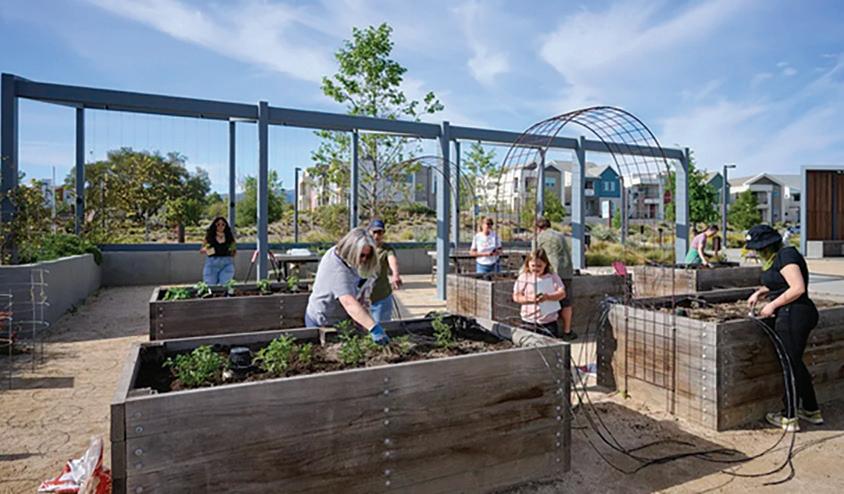
Unlike traditional garden models, FivePoint’s garden emphasizes collaboration. Residents collectively plan seasonal plantings, and all crops are grown and maintained together in five raised beds measuring 4-by-9 feet.
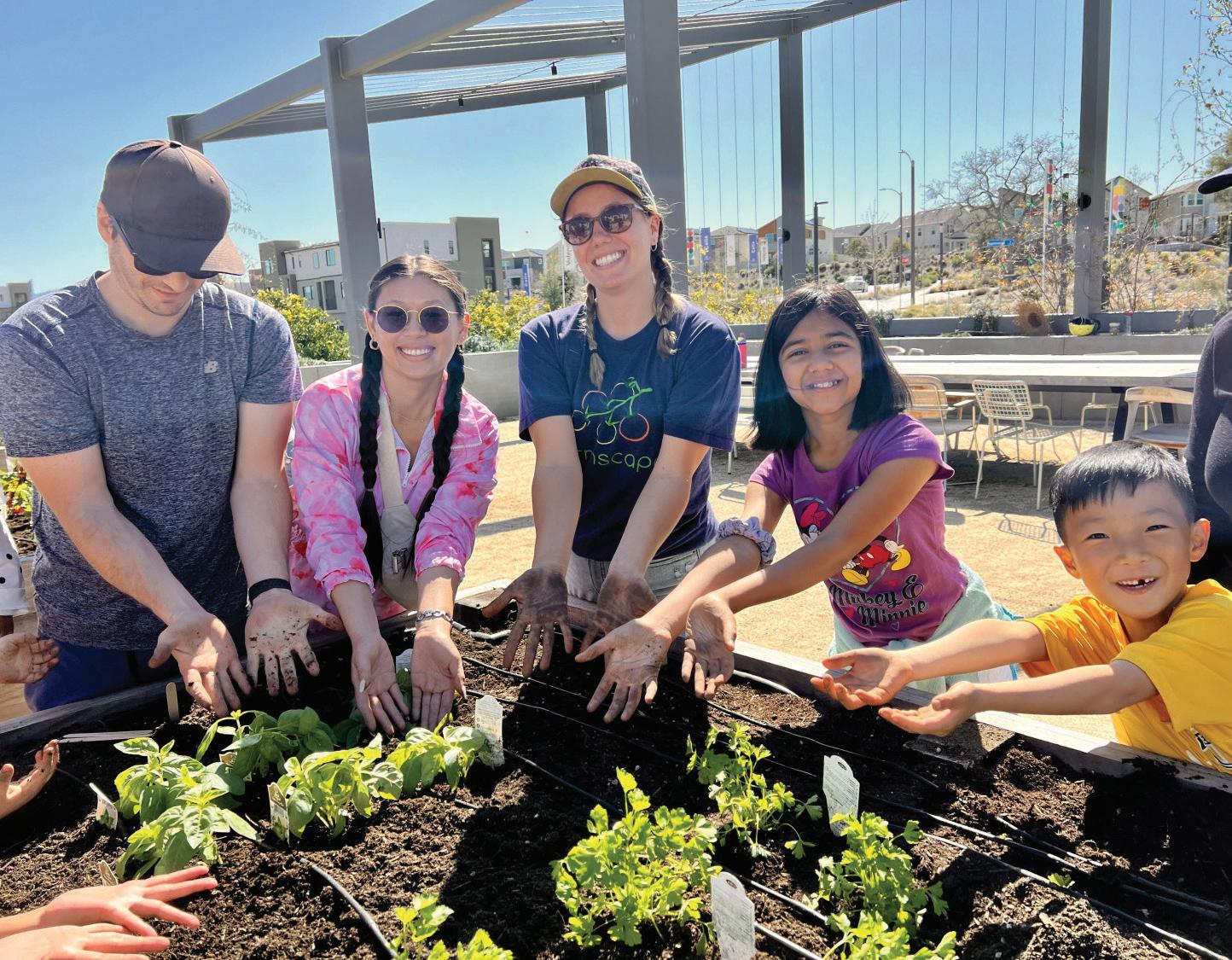
Whether at the Community Garden in FivePoint Valencia (left) or the Community Gardens of Santa Clarita, gardeners can tend plots while growing a sense of community. COURTESY PHOTOS
There
“What makes the garden unique is its welcoming atmosphere,” Butler said. “Whether you’re an experienced gardener or simply curious to learn, everyone is encouraged to participate.”
No Experience Required
Accessibility is a defining feature of the FivePoint garden. There are no fees to participate, thanks to funding from the homeowners association, and no prior gardening experience is required.
“Residents simply need to bring their enthusiasm and willingness to learn,” Butler said. “The garden is a supportive, hands-on environment where members can gain confidence while working alongside neighbors.”
Monthly workdays paired with healthy potlucks have become a cornerstone of the program, blending light gardening tasks with social connection.
“These gatherings help strengthen neighborhood bonds while nurturing a space that benefits everyone,” Butler said.
The garden also hosts a weekly community harvest every Tuesday evening, inviting residents to sample fresh produce while learning proper harvesting techniques from members.
“Signage throughout the garden encourages visitors to harvest during these designated times, helping maximize yields and maintain plant health,” Butler said.
Cultivating Connection
While the two garden models differ — one offering individual plots and the other operating as a shared space — both reflect a growing interest in local, sustainable living and community engagement.
At FivePoint, Butler sees the garden as an extension of neighborhood life.
“At its heart, the Community Garden is about more than gardening — it’s about cultivating community, fostering lifelong learning and experiencing the simple joy of growing something together,” she said.
Children and families are especially encouraged to participate, turning the garden into a living classroom for healthy habits and environmental awareness.
Similarly, at the Community Gardens of Santa Clarita, education and mentorship play a key role. Beginner gardeners are welcomed with orientation sessions and access to instructional videos, ensuring that even those new to gardening can succeed.
For Hershey, that inclusivity is essential.
“Beginner gardeners are welcomed,” he said. “We provide guidance and resources so they can learn and grow.”
Planting Seeds for the Future
As interest in sustainability and local food sources continues to rise, community gardens like these are becoming increasingly relevant.
They offer not only fresh, organic produce, but also a chance to slow down, connect with others and engage in something tangible.
For those considering getting involved, both Hershey and Butler emphasize that the first step is simply showing up.
“Gardening is a very fulfilling endeavor,” Hershey said. “It brings people together in a meaningful way.”
And at FivePoint, the invitation is just as open.
“New members are always welcome, whether they are experienced gardeners or simply interested in getting involved and meeting neighbors,” said Butler, adding that interested residents can stay informed through community publications such as Valencia Lifestyle and the Clubs Weekly Roundup.
In a region known for its sunshine and long growing seasons, these shared spaces are proving that community can take root just as easily as any seed — when given the right conditions to grow.
PHOTOS COURTESY FIVEPOINT VALENCIA
Happy Fourth of July, Santa Clarita!
By Ken Striplin Santa Clarita City Manager
Today, communities across America gather to celebrate our nation’s independence, honor the freedoms we enjoy and reflect on the values that unite us. Here in Santa Clarita, the Fourth of July is more than a holiday. It is a longstanding tradition that brings friends, families and neighbors together to celebrate both our country and community.
One of the best ways to experience that spirit is by attending the Santa Clarita Valley Fourth of July Parade, an iconic hometown tradition that has become a summer highlight for generations of residents. This year’s parade theme, “Celebrating 250 Years of America’s Freedom, its People, Places and History,” commemorates our nation and serves as a reminder of the remarkable journey that has shaped our country. The parade begins this morning at 9:00 a.m. in Old Town Newhall and features communi-
ty groups, local organizations, businesses, classic cars, performers and hometown heroes, all coming together to celebrate what makes Santa Clarita such a special place. Whether you have attended every year or are experiencing it for the first time, I encourage you to grab a lawn chair, bring your family and join your neighbors in celebrating our nation’s birthday. The celebration does not end when the parade concludes. As the sun sets this evening, Santa Clarita’s Independence Day festivities continue with the City’s annual Fourth of July Fireworks Show at the Valencia Town Center. Beginning at approximately 9:15 p.m., an impressive display will light up the night sky, providing a memorable finale to a day filled with patriotism and family fun.
The Fourth of July is also a perfect time to recognize the men and women who have served our country. Throughout Santa Clarita, our Hometown Heroes Banners proudly honor local active-duty military service members. These banners serve as visible reminders of the courage, sacrifice and dedication
demonstrated by members of our community who answered the call to serve. As you travel throughout the City this holiday weekend, I hope you’ll take notice of these banners. Each one tells a story of service and represents a family, a legacy and a commitment to protecting the freedoms we celebrate today.
I also encourage residents to visit the Veterans Historical Plaza (24275 Walnut Street). Designed as a place for reflection and remembrance, the plaza features monuments, military story stations, memorials and hundreds of engraved commemorative bricks honoring veterans who served our nation. Walking through the plaza and reading the names etched into these bricks provides a powerful reminder that the freedoms we celebrate on Independence Day were secured through the service and sacrifice of ordinary Americans who answered an extraordinary call.
From all of us at the City of Santa Clarita, I wish you and your family a safe, festive and memorable Independence Day.
The Latest News on What’s Happening In Hollywood
By Tony Rizzo
Michael Douglas and Oliver Stone joined forces again for the upcoming drama film “White Lies.” Douglas, 81, and Ellen Barkin, 72, will be supporting Josh Hartnett, 47, whose character is the film’s main focal point. Filming wrapped in June.
Forest in “The Death of Robin Hood” (co-starring Jodie Comer and Bill Skarsgard), in which the former “Wolverine,” 57, takes on Robin Hood’s midlife crisis.
ton Heston, Christian Bale and Oliver Reed. Since then, at least 50 film and TV versions have been produced.
My obsession with the 1950 Disney film must have been the reason why I eventually joined the navy!
There’s an apparent fascination with the 11 days when Agatha Christie disappeared in 1926 without a trace.
Sunday-Thursday, July 5-9, 2026
Stone won Best Director Oscars for “Platoon” (1986) and “Born on the Fourth of July” (1990), while Douglas won his second Best Actor Oscar for “Wall Street.” “Wall Street” earned $44 million against a $16.5 million cost, while “Wall Street: Money Never Sleeps” (2010) only made $135 million after a $70 million cost.
Hugh Jackman hits screens as the elderly robber/baron of Sherwood
Jackman then immediately jumped into playing Long John Silver in Ridley Scott’s upcoming reimagining of “Treasure Island.” The book “Treasure Island” by Robert Louis Stevenson has sold more than tens of millions of copies since it was first published in 1883. In 1934, Metro-Goldwyn-Mayer (MGM) made a film version with Wallace Beery and Jackie Cooper. In 1950, Disney produced an exciting version with Robert Newton and Bobby Driscoll, and in 1972, Orson Welles played Long John Silver. In 1990, a TV adaption starred Charl-
In 1979, Vanessa Redgrave starred in “Agatha” with Dustin Hoffman, and in 2018, we saw “Agatha and the Truth of Murder.” Now Ryan McParland (“The Gentlemen”) will star with Felicity Jones and Ben Hardy in “Eleven Missing Days.”
Christie’s most successful play, “The Mousetrap,” which opened on Nov. 25,1952, has a unique contract clause specifying that a movie can’t be produced until the stage production closes for at least six months. The never-ending London production of “The Mousetrap” has been running in the West End for over 73 years without signs of closing!
Josh Hartnett (Upcoming in “White Lies”) Depositphotos
Top Movies
JUNE 29, 2026
1. Toy Story 5 (PG) Tom Hanks, Tim Allen
2. Disclosure Day (PG-13) Emily Blunt, Josh O’Connor
3. Obsession (R) Michael Johnston, Inde Navarrette
4. Backrooms (R) Chiwetel Ejiofor, Renate Reinsve
5. Scary Movie (R) Marlon Wayans, Shawn Wayans
becoming
M I N I O N S & M O N S T E R S B Sun: 10:10 12:50 3:15 5:30 7 45; Mon to Thu 12:50 3:15 5:30 7:45 Il umination expands its oyful animated un verse w th a r otous new chapter.
S U P E RG I R L C Sun: 10:00 1:10 4:10 7 10; Mon to Thu 1:10 4:10 7:10
When an unexpec ted and ruthless adversar y strikes too close to home, Kara Zor-El aka Superg r , reluc tantly joins forces with an unlike y companion on an epic, interste lar ourney of vengeance and justice
J AC K A S S: B E S T A N D L A S T E Sun: 10:00 12:50 3:10 5:30 7:45; Mon to Thu: 12:50 3 10 5:30 7:45 Johnny Knox ville and the gang return for one final fling at the big screen
TOY S TO RY 5 B Sun: 10:10 1:10 4:10 7:10; Mon to Thu: 1:10 4:10 7:10
The toys are back in Disney and Pixar ’s “Toy Stor y 5 ” and this time t’s Toy meets Tech
D I S C LO S U R E DAY C Sun: 9:50 12:50 4:00 7:20; Mon to Thu: 12 50 4:00 7:20
If you found out we weren’t alone, if someone showed you, proved it to you, would that fr ghten you? This summer, the truth belongs to seven b llion people We are coming c ose to - Disclosure Day
P R E S S U R E C Sun: 10:10 1:10; Mon to Thu: 1 10 PM
In the tense 72 hours before D-Day and the fate of the free world hanging in the balance, PRESSURE fo lows General
Zoey Deutch, 31, and Miles Gutierrez-Riley, 27, star in “Gail Daughtry and the Celebrity Sex Pass,” which opens on July 10. It’s about a couple who grants each other a sex pass, and in time, they meet female celebrities like Jennifer Aniston, 57, Elizabeth Banks, 52, and Elizabeth Perkins, 65, for him. They also meet male celebrities like Jon Hamm, 55, Henry Winkler, 80, “Weird Al” Yankovic, 66, and Paul Rudd, 57, for her. You’d think that a young couple would want sex passes with celebrities who are a lot less geriatric!
With women being an integral part of the American workforce, it’s important to bring to light the challenges many working women face as they carry an extraordinary load, and better understand that the stress they experience isn’t imagined. In fact, it’s well-documented that the stress working women experience is widespread and shaped by both structural pressures and day-to-day realities. According to Dr. Ashley Zucker, a psychiatrist with Kaiser Permanente Southern California, there’s a clear, grounded look at the forces behind that stress, along with context from recent research and expert perspectives.
Core Sources of Stress
Dual expectations at work and home
“Many women face demanding workplace responsibilities — tight deadlines, high-stakes projects and performance pressure — while simultaneously managing childcare, household duties and emotional labor at home,” Dr. Zucker says. “This combination leaves many feeling stretched thin.”
The “mental load” and invisible labor “Beyond physical tasks, women often carry the cognitive burden of planning, organizing and anticipating family needs,” Dr. Zucker notes. “This mental load contributes significantly to chronic stress and burnout.”
Societal and cultural expectations
“Women frequently feel pressure to excel in both career and caregiving roles, often without adequate support systems,” Dr. Zucker says. “These expectations can amplify guilt, especially when work obligations cause them to miss family moments.”
How This Stress Shows Up
Burnout and exhaustion Research
shows that a majority of working parents — especially mothers — report significant burnout as they try to manage both domains at home and at work.
Reduced mental and physical health Women are more likely than men to experience stress-related health issues, including anxiety, sleep disruption and chronic conditions.
Guilt and emotional strain Many working mothers describe guilt about not being “present enough” at home or not giving enough at work, creating a constant sense of falling short.
Why this Stress Matters
Impact on children and family dyna mics “When parents are overwhelmed, it affects emotional availability and family relationships,” notes Dr. Zucker. “Conversely, when women achieve a healthier balance, children benefit from increased stability, engagement and emotional well-being.”
Impact on career progression
“Chronic stress can reduce productivity, limit opportunities for advancement and make it harder to pursue long-term professional goals,” Dr. Zucker says.
Impact on overall life satisfaction
“Studies show that parents who shift from seeking a ‘perfect balance’ to more flexible ‘work-life integration’
report higher satisfaction across work, family and personal domains,” notes Dr. Zucker.
Contextual Background: Why this is So Common Today
Modern workplaces blur boundaries Technology makes it harder to “leave work at work,” increasing the sense of being constantly on call.
Child care challenges Reliable, affordable child care remains a major barrier, forcing many women to juggle unpredictable schedules and emergencies.
Shifting family structures Many households rely on dual incomes, meaning women often cannot step back from work even when family demands intensify.
Persistent gender norms Despite progress, women still perform a disproportionate share of domestic labor, even when working full-time.
A Thought-Provoking Insight
A growing body of research suggests that the goal for working women shouldn’t be “perfect balance” — which implies equal attention to everything, Dr. Zucker advises. Rather, intentional integration, where women make choices that support work, family, community and self simultaneously should be the priority.
“This shift can reduce stress and increase fulfillment,” she said.
Kaiser Permanente offers valuable information related to stress management.
GARDENING
Heat-Resistant Veggies for an Easy Summer Garden
By Sandy Lindsey Epoch Times
The selection of plants and seeds can quickly become overwhelming. For example, there are hundreds of tomato varieties alone, and choosing the wrong one can lead to a disappointing growing season despite meticulous care.
The first consideration is to choose plants appropriate for your U.S. Department of Agriculture hardiness zone. Next is the type of seeds or transplants. The open-pollinated nature of heirloom plants allows for seed saving, which can be a significant budget booster and can lead to the natural development of localized strains that do better over time.
On the other hand, hybrids, which are the result of carefully controlled pollination and must be purchased to guarantee true-to-type seedlings, often offer more uniform and vigorous growth, sprout more easily, and provide higher yield. Pest- and disease-resistant hybrids are specifically designed to avoid common problems, reducing the need for meticulous monitoring and the resulting maintenance, and lessening the risk of crop loss.
A Word on Transplants
Check transplants carefully for signs of pests and diseases such as leaf spot and blight. In general, it’s best not to purchase a vegetable plant that is already flowering, as it has moved its focus to producing fruit and seeds. That makes it harder for the plant to establish the crucial new roots that will allow it to survive and thrive in a new environment. But if the price is so low you can’t say no, immediately remove all the flowers and buds to help the plant redirect its focus.
Instant Green
Fast-sprouting and then continuously producing, leaf lettuce is so easy to grow that it’s often used as a starter plant to introduce young children to the magic of gardening. Typically seen as a cool-season plant, it’s beneficial to choose a heat-tolerant varietal. The popular early-harvest Black Seeded Simpson, for example, is ready in less than 45 days. Other slow-to-bolt (i.e., go to seed) hot-climate greens that are resistant to tipburn include New Red Fire, Amish Deer Tongue, Grand Rapids, Green Ice, Lollo
Biondo, Oak Leaf, and Salad Bowl, to name a few. Prefer butterhead or bibb lettuce? Batavia or French crisp, or summer crisp? Or iceberg? There are heat-tolerant options in these categories, too. Germinate seeds indoors to increase the chance of success, and grow them in early morning sun, with midday and afternoon shade. Or protect them with shade cloth.
Love spinach? Even heat-tolerant spinach can struggle in genuine summer heat. For spring or early summer production, plant some Bloomsdale Long Standing or Catalina seeds.
Hearty summer kales include the resilient Blue Ridge and Lacinato (also known as Black Cabbage, Dinosaur Kale, and Nero Di Toscana).
Tomato Suggestions
Although there are heat-tolerant tomatoes — High Heat, Big Beef, Dixie Red, Phoenix, Homestead Heirloom, Arkansas Traveler, Cherokee Purple — that dramatically increase the chance of summer success, gardeners looking for even more of a sure thing may want to opt for cherry, grape, or pear tomatoes. Although these don’t provide the large one-time yields needed to make pasta sauce, they do provide a constant harvest for salads. Plus, they have a shorter time to maturity.
The wild Everglades tomato has been referred to as “indestructible,” while the vibrantly tasty Sun Gold, Super Sweet 100, and unique-looking Yellow Pear also require minimal care, making them excellent choices for laid-back gardeners.
Bounteous Beans and Peas
Generally rated as “beginner-friendly,” there’s a lot more than green and yellow string beans to choose from. Love Mexican refried beans? Grow pinto beans or perhaps black beans, kidney beans, mung beans, or navy beans. Alternatively, one of the many delicious heat-loving yard-long beans — which actually do often grow to 18 to 24 inches — may appeal. Larger spaces can maximize vine or pole beans that can reach more than 10 feet in length and need some support but will provide a continuous harvest all season long.
Although peas are typically a cool-season crop, sugar snap peas can tolerate heat if watered thoroughly and regularly, although they may produce less than in spring or fall.
The Squash Family
Yes, there’s actually a National Sneak Some Zucchini Onto Your Neighbor’s Porch Day. The holiday is Aug. 8, but harvests of zucs and their summer squash relatives (yellow, pattypan, etc.) can continue on well after that because the undemanding, robust growers are that productive.
Be sure to plant winter squash early, as it takes longer to mature — particularly butternut and delicata, which both store well — and let’s not forget a few pumpkins.
Stretches of scorching summer days may leave you and your family feeling like you just can’t quite get (or stay) cool. If you find yourself resigned to cooler rooms or leaving ceiling fans on constantly, it might be time to check your air conditioner.
Extreme heat is no longer rare for many parts of the country. According to recent data from the U.S. Census Bureau, more than 13 million households reported being uncomfortably hot for an extended period.
Not all air conditioning systems perform the same when temperatures spike. While most systems can keep up on typical summer days, prolonged heat can expose performance gaps, leading to uneven cooling and higher energy use. The difference often comes down to how the system is designed.
To better understand whether your HVAC system can stand up to summer, consider this information from the experts at Mitsubishi Electric Trane HVAC US, a world leader in residential air conditioning units with sophisticated, durable systems that deliver quiet operation and energy-efficient performance.
Why Some Homes Stay More Comfortable Than Others
Not every home experiences summer heat the same way. Factors such as home layout, sun exposure, insulation, and HVAC system design can all
influence how effectively a home maintains comfort during prolonged periods of high temperatures.
For example, upstairs bedrooms, rooms with large windows, and spaces exposed to direct afternoon sun often have different cooling demands than other areas of the home. Systems that provide more precise temperature control and flexibility can help address these differences and deliver more consistent comfort throughout the house.
Signs Your System May Be Struggling
As summer temperatures rise, there are often clear signs that an HVAC system may be struggling to keep up with demand. One of the most common indicators is a system that seems to run constantly during the hottest parts of the day, yet fails to deliver the level of comfort homeowners expect.
Homeowners may also notice persistent warm spots in certain rooms, increased indoor humidity, or weaker airflow from vents. In some cases, increased noise from vents or equipment may signal the system is working harder than usual to maintain airflow and cooling performance.
Another warning sign often appears on monthly utility statements. A noticeable increase in energy use during peak summer months can indicate the system is consuming more power to maintain comfort under challenging conditions.
Not every home experiences summer heat the same way. Many different factors can influence how effectively a home maintains comfort during prolonged periods of high temperatures.
What Makes the Difference in Extreme Heat
ther slicing, salad (Marketmore 76, Spacemaster 80, Sweet Slice), pickling (National Pickling, Boston Pickling), or eating fresh off the vine. Plan on providing robust support, particularly as the plant becomes weighed down with fruit. Gigantic Armenian cucumbers are technically a muskmelon with a cucumber taste, but they adore the heat.
Root Vegetables
Radishes range from tiny to foot-long, come in a wide variety of colors, and in heat levels from mild to spicy. Toss some seeds in the ground; the results will astound.
Bugs Bunny’s Fave
Carrots come in a wide variety of colors and nutrition profiles. For example, orange is known for
its high levels of beta-carotene, while purple has more anthocyanin. They make a great choice for container gardens, where a dozen or more can fit into a small space.
Flavor Enhancer
Day-length sensitive sun bunnies, onions adore the long days of Southern summer with their 14 to 16 hours of daylight. Northern short-day varieties still require 10- to 12-hour days. Green onions and scallions can make do with six to eight hours. Keep all well-watered.
Sweet, Sweet Potatoes
Although they may seem similar, sweet potatoes are technically members of the morning glory family. They thrive in high heat and can even be drought-tolerant once established.
Not all HVAC systems are built the same. Modern system design plays a critical role in how well a home stays comfortable during prolonged high temperatures. Zoned Comfort Solutions from Mitsubishi Electric include ducted and ductless options designed to deliver reliable comfort, efficiency, and control in demanding conditions like summer heat surges, along with important features like:
• Cooling performance designed to maintain comfort even during extreme outdoor temperatures
• Precise temperature control that helps deliver more consistent comfort throughout the home
• Quiet, efficient operation that delivers strong performance with less noise and energy use
• Flexible installation options for homes with existing ductwork and homes without ducts, plus room additions, garages, sunrooms, and other hard-to-cool spaces
Evaluating whether your current system is designed to handle sustained high temperatures can help prevent discomfort and avoid rushed decisions during the hottest days of the year. To learn more, visit MitsubishiComfort.com. (Feature Impact)
Daily Steps to Help Your Vehicle Last Longer
Modern cars have longer life expectancies than their predecessors. Consumer Reports indicates it’s not unheard of for modern vehicles to endure for 200,000 miles or more. For many, that equates to 12 to 15 years of usage.
thorough detailing when the time comes.
Even though many vehicles are built to have increased longevity, it often is up to the driver to do his or her part to ensure cars and trucks can last for years and years. Here are some daily steps vehicle owners can take to achieve longer life spans for their cars or trucks.
Take it slow and steady Athletes do not hit the ground running at top speed, and neither should a vehicle. Let the car gradually acclimate to being on the move each day after sitting overnight. Gently accelerate and afford the engine time to warm up and all of the components to get the fluids they require before you jump on the highway or require the vehicle to go all out. Most automotive experts warn against idling a car in the driveway to warm it up, but starting out at a slow and steady pace is key.
Don’t be extreme Jerky turns, gunning the gas and braking hard lead to unnecessary wear and tear on a vehicle. By smoothing out your driving, you’ll put less stress on mechanical components and help prevent them from wearing out prematurely.
Clean it out daily Accumulated debris often builds up inside a vehicle that is used all of the time. Taking a few minutes to clear out trash or to wipe down the interior each day will prolong the interior components, not to mention make it easier to do a more
Find a trusty fuel station Bad gas can wreak havoc on a vehicle. Find a station that you trust, particularly one that takes care of their pumps and regularly changes their pump filters. It’s worth it to spend a little more overall for good gas.
Read your oil level Oil is essential to maintain a properly operating engine and vehicle. AARP suggests routine reading of a car’s oil level so that you can add lubricant as necessary. While this might not be a daily task, doing it regularly enough means you will keep on top of this important step.
Park in the shade or a garage The sun may feel good on a warm day, but the UV rays from the sun can take their toll on a vehicle’s paint. Whenever possible, park out of direct sunlight so that the paint will not fade and the interior upholstery will not bleach. Those who need to park their vehicles for an extended period of time should choose a clean, dry, well-ventilated location, advises Wawanesa Insurance.
Be attentive Listen to the sounds your vehicle is making and give it a visual inspection each time you get in or out of the car. The sooner you catch something that is out of the ordinary, the easier it becomes to fix problems before they become costly and damaging.
Vehicle owners can take steps each day to improve the longevity of their cars and trucks. (MC)
Protecting Yourself from a Smartphone Scam
The first sign is unexpectedly losing access to your cell phone. Soon after, when you connect to Wi-Fi, the gravity of the situation sinks in: a criminal has gained access to your cell phone number and is trying to siphon money from your credit cards and bank accounts.
The scam is called SIM swapping, or SIM hijacking, and it’s a concern for law enforcement in the United States and abroad as more than 5,000 people have reported SIM swapping scams to the FBI since 2022. Older adults, caregivers and families can benefit from understanding the warning signs of SIM swapping and taking simple security steps to prevent it from happening.
How SIM Swapping Works
A SIM card, or its digital version known as an eSIM, helps connect a phone number to a carrier network. In a SIM swapping scam, a criminal collects basic information about their victim, such as their name, birthdate and address, to try to move the victim’s phone number to a SIM card or eSIM profile the criminal controls.
Once done, the scammer gains access to accounts you may be logged into on your phone, such as bank accounts or credit card apps, without touching your phone or being near you.
How to Protect Yourself
From SIM Swapping Scams
Preparation is the best protection against SIM swapping. Cell phone users should use strong, unique passwords for each online account - password managers are a helpful tool in creating complex and randomized passwords. Use two-factor authentication where it’s offered; this adds an
extra layer of security when accessing sensitive accounts.
Next, consumers should protect personal information they share online, whether on social media or in texts or emails asking for identifying data, such as PIN numbers, birthdates or one-time security codes. Be wary of anyone pushing you to share personal information, particularly if they’re pushy with their request or make it sound urgent.
Check your mobile carrier to see if it offers SIM protection. For example, Verizon customers can toggle on a protection feature on the carrier’s website or app to lock lines on their account to help prevent SIM changes. If you get an unprompted notification that your SIM has been changed, or otherwise suspect you’ve been targeted in a SIM swapping scam, contact your banks immediately and have them freeze your accounts, including ones the criminals may not have targeted yet. Next, work with your cell phone provider to help regain access to your mobile device. If you’re able, share as much information as possible with law enforcement so they can investigate, or at least document trends, in how often this scam occurs.
To find more advice to protect against smartphone scams, visit Verizon.com. (Feature Impact)
PHOTO COURTESY OF SHUTTERSTOCK
Homeowners Say Home Costs More Than Expected
For years, homeownership was pitched as the finish line. Save for the down payment, buy the house and build wealth over time. According to new research from Unlock, a company that helps homeowners access the equity in their home, 75% of U.S. homeowners say they have no plan to buy or sell a home this year. That sounds like stability. But as the research reveals, it is starting to feel more like stagnation.
Owning a home turns out to cost more than people thought it would, according to a January 2026 survey of 2,003 homeowners. Research found that 65% of homeowners say it is more expensive than what they expected. The math goes past the mortgage. Nationwide, property taxes climbed 41% between 2018 and 2025, according to the Lincoln Institute of Land Policy, with home insurance, maintenance and everyday costs piling on top.
Homeowners are cutting back in places that used to be off-limits. Twenty-two percent of respondents reported putting less into retirement to keep up with the cost of owning their home. Another 33% are putting off bigger purchases, like a car. These are not inconsequential cuts. They are cuts to the financial goals owning a home is supposed to make easier in the first place, like building a nest egg, growing an emergency fund or saving for the future.
The pressure shows up in the present, too. Nearly a third of homeowners have less than $1,000 in emergency fund savings. More than half say day-to-day expenses are causing significant stress in their lives.
It is not only about cutting back or feeling stressed about day-to-day ex-
penses. The survey found 19% of U.S. homeowners say they would rather double their commute time to work than take on another monthly payment. For homeowners already paying a mortgage, insurance, taxes and maintenance, another bill ranks below an extra hour in traffic.
Costs are only half the story. Homeowners are also sitting on real wealth, though they cannot always say how much. The survey found almost half of U.S. homeowners are not sure how much equity they have built up in their home, including 28% who say they are not sure how to find out. The average mortgaged home in the U.S. holds about $299,000 in equity, according to Cotality, a data and analytics company. Ask homeowners how they feel about having equity in their homes and the answers do not quite line up. Sixty percent say the option to leverage home equity provides an extra level of financial security. Yet 48% say they view home equity as long-term wealth and retirement security, and would only leverage it as a last resort. They want the option there. They just do not want to use it.
The result is a kind of holding pattern. Homeowners are paying more, staying put in homes they cannot easily afford to leave and sitting on wealth they would rather not disturb. The usual options come with a catch. Selling means moving. Refinancing means giving up a low locked-in mortgage rate. Each option asks for something homeowners are trying to avoid. The open question is whether the standard options are still the only options. What used to look like a financial finish line is starting to look more like a treadmill. (Family Features)
VaCaTiOn hAnGoVeR
Weekend getaways and cross-country trips are supposed to offer a break from daily routines and financial stress. Yet for many travelers, the return home comes with an uncomfortable reality: the trip cost far more than expected. From luxurious dinners and spontaneous excursions to airport snacks and daily coffees, vacation spending is becoming increasingly difficult to control in an era of rising prices and experience-driven travel.
According to a survey conducted by TopCashback, a cash-back site serving more than 20 million members worldwide to help people save as much money as possible on everyday spending, overspending while traveling is now the norm rather than the exception. Nearly 94% of respondents said they have spent more on vacation than originally planned, with more than 65% reporting they typically overspend by at least $250.
“Vacations should create memories, not money stress,” said Elisabella Ricca, personal finance and consumer analyst at TopCashback. “Giving yourself a spending plan before you travel can make it easier to enjoy the experience in the moment and avoid feeling guilty about the cost afterward.”
These findings reflect a growing disconnect between travel budgets and actual spending as vacationers navigate higher costs and pressure to make their trips feel worthwhile.
Inflation’s Impact On Travel Behaviors
Airfare, hotel rates, dining and entertainment costs are all climbing, forcing many households to rethink how often they take trips and what those trips look like. In fact, nearly
The Financial Stress Travelers Feel After the Trip
78% of respondents said rising travel costs have changed the way they vacation. Meanwhile, nearly 83% said they’re traveling less often altogether due to rising costs.
Travelers are Turning to Financing
These changing behaviors may also explain why financing vacations is becoming more common. The survey found 67% of respondents have used credit cards, financing plans or “buy now, pay later” services to pay for a vacation. While these tools can help make trips more accessible in the short term, they may also extend the financial impact of a vacation long after travelers return home.
Financial Stress After the Fun
For some travelers, that long-term effect is already being felt. More than 58% of survey respondents said they feel guilty at least sometimes about how much they spend on vacation, a feeling that often emerges after returning home and assessing purchases that seemed easier to justify while away
Small Purchases are Adding Up to Big Overspending
Vacation overspending rarely happens through one large purchase alone. Instead, smaller expenses accumulate steadily throughout the trip. For example, 53% of respondents said they’re most likely to spend more on coffee or drinks while traveling than they would at home, and another 53% said snacks are the common overspending culprit. These purchases may seem insignificant individually, but multiple small transactions each day can quickly add up.
Experiences Outweigh Luxury When Justifying Expenses
Even as travelers look for ways to cut costs, most remain willing to spend on experiences they view as meaningful. The survey found the top vacation splurges respondents are most likely to justify are fancy dinners (56%) and excursions or tours (48%). This suggests travelers are placing greater value on memorable moments
rather than luxury, such as high-end accommodations.
Careful planning isn’t enough for most travelers to stay within a budget, as 59% of respondents said they set a vacation budget beforehand, signaling that overspending is often less about a lack of preparation and more about the realities of modern travel costs.
Nearly 90% of survey respondents said earning cash back or rewards on travel purchases would influence their spending decisions at least slightly. As people look for a better way to manage expenses and offset costs, many are turning to programs such as TopCashback, which offers travel-related cash back on airfare and last-minute flights, vacation packages, hotels and lodging, transportation and parking, car rentals, travel insurance, cruises, resorts and more.
To learn how cash back programs could help you stay within your next vacation budget, visit topcashback. com. (Feature Impact)
from normal routines.
PHOTOS COURTESY SHUTTERSTOCK
SOLUTIONS
Remembering COVID
Six years ago, our public health apparatus lost its credibility. We were told it was too dangerous for kids to go to school, or for believers to gather in church, but not too dangerous for thousands to gather for the “right” cause, to shout, loot and burn things.
They pretended that Plexiglas on desks, T-shirts over mouths, and arrows on floors would save lives, but long-approved medicines and strategies would kill you. Surfing was banned and playgrounds were closed, while an ineffective, experimental vaccine was forced on the public. People couldn’t have a funeral for their loved one, but George Floyd had one in a cathedral surrounded by thousands to pay homage.
Our authorities offered fear instead of freedom, and hate instead of honesty; both became tools for enforcing compliance, turning friend against friend and relative against relative. Never forget.
Rob Kerchner Valencia
A Random Thought?
I once served on a jury. I convinced the other 11 jurors to convict the attorneys on both sides and find the judge in contempt of his own court. Life is a joke. Laugh at it.
Arthur Saginian Santa Clarita
Submit a Letter to the Editor E-mail: letters@signalscv.com.
ETHICALLY SPEAKING
RightingAmericaThroughRespect
By David Hegg
As you’ve been told time after time, this weekend we celebrate our independence, 250 years of freedom from tyranny. On this occasion, it would do us well to reflect on just how good we have it here in these United States. We do have it good, but that doesn’t mean there aren’t things in need of improvement.
When we run into situations needing change, one of our freedoms is the right to protest. Unlike many around the world, our society is built on freedom of expression, including the right to voice our opposition to people, policies, laws and directives we believe are unjust. Our forefathers protested taxation without representation, and we’ve carried on that tradition in a robust manner. Today, we can protest in all sorts of ways, and social media only increases our opportunity to voice our thoughts and opinions.
to suggest a single principle for engaging in dialogue with those we oppose.
First, a protest must focus on changing someone’s mind about an issue, an edict, an activity, a principle, or a law. Protests must never be used to demonstrate hatred for someone simply because personal animosity will inevitably get in the way of the logical thought required if two opposing groups are to find common ground.
Protest is a means of bringing opposing ideals, opinions, philosophies and experiences together for mutual benefit. But when the means are ugly, mean-spirited, uncivil and insulting, it fosters further hostility, separation and disdain. For a protest to be useful in the evolution of our society, it must be done in a way that engenders respect. More than ever, we see life through the lens of relationship. If we believe your actions are disrespectful, we’ll be much less ready to respect your ideas, no matter how cogent they may be.
But the very nature of protest has changed. I remember when protests were filled with songs and clever slogans, as crowds marched through the streets attempting to demonstrate a better way of thinking and living. That has changed. Now we see firebombs, broken windows, cars tipped over, rock throwing, and even threats on the lives of those attempting to keep peaceful protest peaceful. Those who protest on social media have taken on a hostile tone. Videos and crass pronouncements cascade from keyboards cloaked in anonymity, as hidden protesters spew vile invective.
What used to be political satire has morphed into a personal attack of the most egregious kind. One Broadway play, re-enacting the execution of Caesar, replaced the Roman ruler’s severed head with that of President Donald Trump. Comedian Kathy Griffin shot a short video holding a bleeding, severed head of the president, for which she was later relieved of her position with CNN. I could add examples of other celebrities who have boasted of wanting to kill the president, have acted out scenes on comedy shows depicting the president in crass ways, and even gone so far as to demean the president’s physical appearance and that of his wife and family.
Of course, there is enough disgusting protest to go around on both sides of the aisle. It is clear the president himself has no filter when it comes to demeaning his opponents, and worse, he seems not to know what an apology is.
I believe it is time to re-establish the purpose of protest and
When Rosa Parks steadfastly refused to give up her seat, her protest furthered the civil rights movement because she fought in a way people of every color could respect. We respected the person, and it changed a nation’s perspective.
America is in decay. The evidence is glaring. Poverty, crime, division, racial prejudice, incivility, and a host of other societal monsters are tearing us apart, chewing up a once great nation with the teeth of selfishness and hatred. It’s time to stop letting Broadway, Hollywood and Washington, D.C., tell us how we have to feel, think and act. It’s time we got up, spoke up, and stood up for right being right, and wrong being wrong, no matter what party or special interest group was acting poorly.
Let’s take up the banner that we still are a government “of the people, by the people, and for the people.” The time has come to be the people who demand our leaders show some respect for their positions, their opponents, for us, and especially for the integrity and honorable history of this nation.
When Aretha spelled out “Respect,” she hit on the right word. Unless we see civility and respect restored to a primary position in public discourse, I fear the rate at which our society’s seams are being torn apart will continue at a horrible pace. So who’s with me? If we can start a revolution of respect, we just might find we have more in common than we thought.
Local resident David Hegg is senior pastor of Grace Baptist Church. “Ethically Speaking” appears Sundays.