SANTA C L ARITA VA LLEY
BUSINESS OF F I CI A L P U B L ICAT IO N O F TH E SCV CH AM BER OF C OM M ER CE
J O URNA L
SEPTEMBER 2026 VOL 18 • No 9 SIGNALSCV.COM/BUSINESS
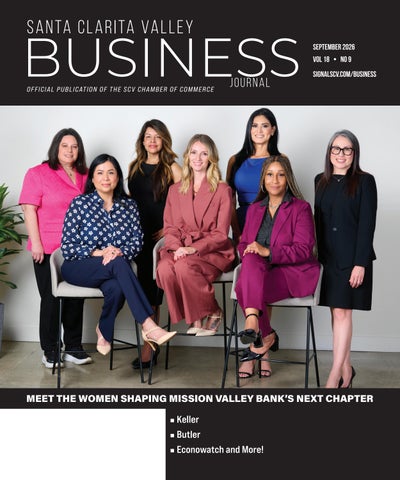
MEET THE WOMEN SHAPING MISSION VALLEY BANK’S NEXT CHAPTER
Keller
Butler
Econowatch and More!
2 · S A N TA C L A R I TA VA L L E Y B U S I N E S S J O U R N A L
S E P T E M B E R 2026
Business Banking With a Personal Touch. Solutions designed for your business. Service centered around you.
Celebrating 25 Years
SUN VALLEY
|
SANTA CLARITA
M i s s i o n Va l l e y B a n k . c o m
|
BURBANK
|
ARCADIA
S E P T E M B E R 2026
S A N TA C L A R I TA VA L L E Y B U S I N E S S J O U R N A L ·
3
Trusted Attorneys Since 1977
▪ Business & Tax ▪ Litigation ▪ Real Estate Premier Law Firm Specializing in Estate Planning, Business, Tax & Civil Litigation CA Board Certified Specialists in Estate Planning, Trust & Probate* Top Tier Wall Street Business, Tax, and Finance Experience
Sonia Chan Lee Partner, CAO
30 Years, Board Certified Estate Planning Specialist*, Wall Street & Int’l Business, Finance & Banking
Kevin Von Tungeln President & CEO
35 Years, Board Certified Estate Planning Specialist*, Probate, Elder Law, Insurance and Real Estate
Business, Real Estate, Probate, Trust, Financial & Consumer Litigation Free Trust, Will & Tax Review Service
我们会 我們會說廣東
Hablamos Español • • Nagsasalita kami ng Tagalog • •
说普通话 話 한국어 상담 가능
3 LA County Offices, 8 Attorneys & 20+ Professionals
Jong Lee Partner, CFO**
30 Years, Wall Street & Int’l Business, Finance, Tax, Private Equity, M&A & Restructuring
Christina Hahn Counsel
Serving Santa Clarita for over 25 years, Real Estate & Civil Litigation Specialist
Free Initial Consultation: 661-945-5868
Valencia Office: 27433 Tourney Rd, Suite 150, Valencia CA | 661-945-5868
www.TrustTVT.com
*Certified as a Specialist in Estate Planning, Trust and Probate Law by the State Bar of CA Board of Legal Specialization. **Admitted in New York.
Trusts & Probate
4 · S A N TA C L A R I TA VA L L E Y B U S I N E S S J O U R N A L
S E P T E M B E R 2026
C O N T E N T S NEWS & FEATURES 7 14 16 17 19
6
NOTHING HAPPENS WITHOUT ACCOUNTABILITY
Women Leaders Whose Work Reaches Across MVB Developing Stories The List: Financial Advisors Real Estate Report Econowatch
FROM THE EXPERTS 6 Ken Keller: Accountability 20 Paul Butler: All Organizations are Volunteer Organizations 22 Jeff Prang: Where Does the Money Go?
SCV BUSINESS VOICES 5 8
Henry Mayo SCVEDC
CONTRIBUTING STORIES
14
WHAT THE FUTURE MAY BRING
16 Kaiser Permanente 18 Thompson VonTungeln 21 Poole Shaffery
CHAMBER SPOTLIGHTS 11
Celebrating Our Community
SEPTEMBER 2026 | Vol. 18 | No. 9
PUBLISHER
17
Richard Budman rbudman@signalscv.com (661) 287-5501
CONDO SALES GROW; HOME PRICES SOFTEN
BUSINESS JOURNAL EDITOR Perry Smith
SALES REPRESENTATIVES Maureen Daniels •Chris Llanos Walter Portillo A proud publication of
SINCE 1919
SignalSCV. com
22
WHERE DOES THE PROPERTY TAX MONEY GO?
Santa Clarita Valley Business Journal (a Signal publication), © 2026, is published monthly by the Santa Clarita Valley Signal newspaper, Paladin Multi-Media Group, Inc., 25060 Avenue Stanford, Ste 141, Valencia, CA 91355. The SCV Business Journal is intended to provide business executives with a cross-section of industry news and information, trends and statistics that impact our growing community. Information gathered in the pages of the SCV Business Journal has been collected from what are considered reliable sources, and is believed to be accurate, but cannot be guaranteed. Articles may not be reprinted without publisher’s written permission. For reprint requests, please call (661) 259-1234.
S E P T E M B E R 2026
S A N TA C L A R I TA VA L L E Y B U S I N E S S J O U R N A L ·
Are Your Allergies Getting Worse? By Patrick Moody Henry Mayo Newhall Hospital
I
f you have an allergy — whether it’s to pollen, food, medication or something else — you know how it can derail your day. Allergic reactions range from mild to severe or even life-threatening. And if it feels like your symptoms are getting worse as you get older, you might be right. WHY ALLERGIES CAN CHANGE OVER TIME It’s not all bad news. Some allergies can improve or even disappear as you age. Allergic reactions to food are unpredictable, says Food Allergy Research & Education (FARE), and children may outgrow their allergies to dairy, eggs, wheat and soy. And of the estimated 10% of adults with a penicillin allergy, most will lose the allergy over time — even if they used to have severe reactions to the drug. However, you can develop an allergy at any point during your life. In fact, up to 15% of people with food allergies are first diagnosed as adults, says FARE. This might be due to trying new foods during adulthood. You may develop new allergies when you move to a new location too. Different types of plants and pollens can trigger allergic reactions, even if you haven’t reacted to them before. Allergic reactions to certain types of things may also become more common with age: Medications Older people often take more medications than younger people, which increases the odds of developing a drug allergy. Skin irritant Your skin becomes drier and thinner with age. This makes it more susceptible to an allergic reaction. Common triggers include plants, such as poison ivy; metals, like nickel; and lotion and other skin products. Insects Developing an allergy to an insect bite or a sting isn’t common, but it is possible. Ants, bees, wasps, hornets and yellow jackets are the most frequent culprits. Pollen and mold Research shows that climate change is making allergy seasons longer and more severe. That means these allergy triggers are more likely to be around for longer periods of time. For example, as the planet warms, the spring thaw happens earlier. Trees and other plants bloom and release pollen earlier. And, because the ground freezes later, the pollen season
lasts longer in fall too. In addition, climate change contributes to more severe weather events, like hurricanes and floods, which promote mold spore growth. ONE LAST NOTE If you can’t avoid allergens, medicine may help.
SCV BUSINESS VOICES
Pharmacies stock a wide array of over-thecounter medicines to help curb allergy symptoms. However, if these drugs don’t provide relief or if they cause unwanted side effects, such as sleepiness, talk with your doctor. Prescription medication or allergy shots may be the answer.
5
6 · S A N TA C L A R I TA VA L L E Y B U S I N E S S J O U R N A L
S E P T E M B E R 2026
Nothing Worthwhile Happens Without Accountability BY KEN KELLER
SCVBJ Contributing Writer
O
ne of the greatest challenges facing leaders today is creating accountability throughout an organization without becoming a micromanager. Employees say they want autonomy. Leaders want accountability. The problem occurs when accountability is confused with control. As a result, those in charge begin monitoring every detail, employees become frustrated, and performance suffers. The good news is that accountability and empowerment can coexist. In fact, the highest-performing companies achieve both simultaneously.
Clear Expectations
The first step is establishing clear expectations. Accountability cannot exist when employees are unsure of what success looks like. Every role should have clearly defined responsibilities, measurable outcomes, and performance standards. As an example, one company I worked at had a metric for every employee: pick up your phone by the second ring.
“
Employees say they want autonomy. Leaders want accountability. The problem occurs when accountability is confused with control. As a result, those in charge begin monitoring every detail, employees become frustrated, and performance suffers.”
One of the greatest challenges facing leaders today is creating accountability throughout an organization without becoming a micromanager. ©iStock
Assigning Ownership
The second step is assigning ownership. A common reason for failing initiatives is that everyone is involved, but nobody is accountable. Every project, objective, and key deliverable should have a single designated owner. We call it, “One throat to choke.”
Communication is Equally Important Communication is equally important. Leaders often assume employees understand priorities because they were discussed at a management meeting or included in an email. They don’t. Successful companies reinforce goals regularly. Employees need to understand what they are expected to do and why their work matters!
Measuring Results
Another critical component is measuring results rather than activities. Micromanagers focus on how people spend every minute of the day. Effective leaders focus on outcomes. If an employee meets expectations, achieving goals, and delivering results, how much oversight is necessary?
Safe Environment
Leaders must also create a safe environment for accountability. Employees should feel comfortable admitting mistakes; raising concerns and asking for help. When people fear punishment for every misstep, they learn to hide problems rather than solve them. Account-
ability should promote responsibility, not fear.
Regular Check-ins
Regular check-ins are essential, but these conversations should focus on progress, obstacles, and support rather than interrogation. Great managers ask questions such as, “What challenges are slowing you down?” and “How can I help?” instead of just demanding status updates. Trust plays a central role. Accountability grows when leaders trust employees to make decisions within defined boundaries. When people feel trusted, they are more likely to take ownership of outcomes and demonstrate initiative. Perhaps most importantly, leaders must lead by example and model accountability themselves. Employees quickly notice whether executives follow through on commitments, meet deadlines, and accept responsibility for mistakes. In the movie “Remember the Titans” two high school football players end a challenging conversation when one says to the other, “Attitude reflects leadership, captain.” A culture of accountability is built through clear expectations, consistent communication, measurable outcomes, trust, and leadership by example. Ken Keller advises small and midsize business owners on profitable growth.
S E P T E M B E R 2026
S A N TA C L A R I TA VA L L E Y B U S I N E S S J O U R N A L ·
7
Meet Leaders Whose Work Reaches Across the Bank and Throughout the Communities it Serves
F
rom executive operations and technology to community development, client relationships and branches across Southern California, several women occupy especially consequential roles in how Mission Valley Bank works, grows and serves its communities. To understand how Mission Valley Bank operates today, and what’s especially compelling about it, one must consider the entire operation. Women oversee the Bank’s operations, technology, workforce culture, central operations, community development and three of its branches. Another manages relationships with business customers. Some have spent most of their careers at Mission Valley Bank. Others arrived more recently with expertise in technology, organizational development and modern banking operations. Collectively, they illustrate how much a community bank depends on leadership distributed across the institution. That is particularly relevant as Mission Valley Bank marked its 25th anniversary in July. Founded in 2001, the Bank has grown to roughly $800 million in assets and four Southern California offices, including its Santa Clarita Valley branch on McBean Parkway in Valencia. The technology has changed. Customer expectations have changed. Regulatory demands have grown. But Mission Valley Bank has continued to define itself around relationship banking, a model that depends as much on the people and sys-
“
(From left) Michelle Hinshon, Maria Gonzalez, Laura Soto, Amanda Connell, Rachel Carrillo, Schanel Lofton, Alexandra Macias. Photos Courtesy Mission Valley Bank
tems behind the customer relationship as on the banker sitting across the table. Women now hold influential positions across virtually all of those functions.
An Enterprise View
At the executive level, Amanda Connell, Executive Vice President and Chief Operating Officer, brings more than 18
Women oversee the Bank’s operations, technology, workforce culture, central operations, community development and three of its branches. Another manages relationships with business customers. Some have spent most of their careers at Mission Valley Bank. Others arrived more recently with expertise in technology, organizational development and modern banking operations.
years of financial services experience spanning retail operations, back-office administration, Bank Secrecy Act compliance, regulatory compliance and information technology. Since joining Mission Valley Bank, Connell has focused on operational excellence, innovation and improving the experience of employees and customers. Her role reflects how complicated bank operations have become. A community bank must offer digital capabilities and operational efficiency comparable to much larger institutions while preserving the accessibility that differentiates it from them. Connell, a graduate of Pacific Coast Banking School, has spent much of her career building collaborative teams and customer-focused operations. At Mission Valley Bank, that gives her a broad view of how the Bank’s branches, technology, operations and people must work together. See MISSION VALLEY BANK, page 9
8 · S A N TA C L A R I TA VA L L E Y B U S I N E S S J O U R N A L
S E P T E M B E R 2026
SCV BUSINESS VOICES
The Quiet Work Behind Business Growth
N
BY ONDRÉ SELTZER PRESIDENT & CEO OF THE SANTA CLARITA VALLEY ECONOMIC DEVELOPMENT CORPORATION
ew business announcements, ribboncuttings and major relocations naturally attract attention. They are visible signs of economic momentum. Yet some of the most consequential economic development work occurs long before a public announcement, and sometimes without one at all. Business retention is sometimes described simply as keeping a company from leaving. In practice, it is far more active than that. Effective retention means helping existing businesses overcome challenges, adapt to changing conditions and identify opportunities to reinvest and grow within the community. Those needs take many forms. A company may be searching for a larger facility, assessing whether its current site and utility capacity can support new equipment or struggling to recruit workers with specialized skills. Others may need help navigating permitting, coordinating incentives, identifying training resources or connecting with real estate professionals and public agencies. The work is often quiet because these conversations involve sensitive business decisions. Companies may be weighing competing locations, approaching the end of a lease or facing an operational challenge not yet public. Building the trust for employers to share concerns early allows SCVEDC and its partners to help before a manageable issue becomes a reason to relocate. No single organization can address every challenge alone. SCVEDC often serves as the connector and problem-solver—first clarifying the business need, then assembling the public and private partners best equipped to address it. Depending on the issue, that may include the City of Santa Clarita, Los Angeles County, property owners, commercial real estate professionals, educational institutions, workforce partners and utility providers. Our role is to coordinate those conversations and help move a complex issue toward a practical solution. Retention also requires long-term relationships. A company’s needs change as it adds employees, introduces new technology, expands production or responds to industry shifts.
Regular business visits and ongoing communication help us understand those evolving needs and identify resources for the company’s next stage of growth. Over our first 15 years, SCVEDC supported approximately 663 companies and helped facilitate more than 24,000 jobs through attraction, retention and expansion projects, including approximately 174 completed business-attraction
projects. Those figures reflect an integrated mission: bringing new investment into the SCV while helping the employers already here continue to adapt, reinvest and grow. For the community, the value extends beyond a single business. Established employers support local families, purchase from other See SCVEDC, page 21
S E P T E M B E R 2026
S A N TA C L A R I TA VA L L E Y B U S I N E S S J O U R N A L ·
9
MISSION VALLEY BANK Continued from page 7
That interconnectedness is also reflected in the career of Maria Gonzalez, Senior Vice President and Central Operations Manager, one of Mission Valley Bank’s longest-tenured employees. Gonzalez has more than 30 years of banking experience and began at Mission Valley Bank as a financial services representative. She subsequently worked in merchant bankcard services, deposit operations, treasury management and digital banking. Her career progression mirrors many of the changes that have transformed banking itself. Gonzalez has led digital banking enhancements, treasury-management expansions and client-facing platform migrations, while strengthening operational processes, risk-management practices and compliance controls. She has also built and mentored teams across those functions. If Gonzalez represents much of the machinery behind the customer experience, Paula Bahamon, Senior Vice President and Community Development Manager, represents an important part of the Bank’s outward-facing relationship with its markets. Bahamon’s work focuses on economic development and financial stability, particularly in low- and moderate-income communities. Mission Valley Bank’s community-development efforts include expanding access to credit, supporting entrepreneurship and working with nonprofit and community organizations involved in affordable housing, education, healthcare and economic development. That community presence is especially visible in Santa Clarita, where Mission Valley Bank has supported organizations including the Boys & Girls Club of Santa Clarita Valley, College of the Canyons Foundation, Henry Mayo Newhall Hospital Foundation, Bridge to Home and the Santa Clarita Valley Economic Development Corporation.
The Trusted-Advisor Model
The relationship between a community bank and its business customers becomes more direct in the work of Rachel Carrillo, Vice President and Relationship Manager.
Carrillo has spent 14 years with Mission Valley Bank, beginning as a credit administration assistant. She describes her job in terms of longterm partnerships rather than individual transactions. “As a trusted advisor, I focus on building long-term client partnerships rather than short-term transactions,” Carrillo said. That can mean developing customized credit and deposit solutions, helping business owners solve operating challenges or simply understanding a company well enough to recognize what it may need next. It is also where the idea of relationship banking either becomes tangible or remains merely a slogan. That philosophy is equally visible in Mission Valley Bank’s branches. Laura Soto, Vice President and Branch Manager in Santa Clarita, has been with the Bank for 22 years. She started as a financial services representative and worked her way to branch manager. Soto considers relationship building and business growth through customer service among her most important accomplishments. Her longevity is particularly notable in Santa Clarita, where Mission Valley Bank competes against institutions with far larger branch networks and technology budgets. A community bank does not compete on scale. It has to make personal access and local decision-making valuable. In Sun Valley, Alexandra Macias, Assis-
tant Vice President and Branch Manager, followed another internal path. Macias joined Mission Valley Bank in 2017 as a customer service representative, then moved through positions as senior teller, branch utility employee and branch operations supervisor before becoming branch manager in 2022. When Mission Valley Bank secured its
“
See MVB, page 19
Mission Valley Bank’s community presence is especially visible in Santa Clarita, where the Bank has supported organizations including the Boys & Girls Club of Santa Clarita Valley, College of the Canyons Foundation, Henry Mayo Newhall Hospital Foundation, Bridge to Home and the Santa Clarita Valley Economic Development Corporation.”
10 · S A N TA C L A R I TA VA L L E Y B U S I N E S S J O U R N A L
S E P T E M B E R 2026
S E P T E M B E R 2026
S A N TA C L A R I TA VA L L E Y B U S I N E S S J O U R N A L · 11
Celebrating Our Community
We’re thrilled to invite you to join us in celebrating the exciting new businesses opening in our community! Each grand opening is not just a milestone for these businesses but also a chance for all of us to come together and support our local economy.
Mark your calendars and come be part of the excitement as new businesses open their doors right here in our community! These grand openings are more than ribbon cuttings — they’re celebrations of growth, local spirit, and fresh beginnings.
From marking special occasions to recognizing remarkable achievements, we feel honored to share in your celebrations. Our grand opening and ribbon-cutting events are FREE and open to everyone to attend! It’s a wonderful opportunity to connect with fellow community members, meet the passionate individuals behind these new ventures, and explore what they have to offer.
Everyone is welcome to join the festivities, connect with fellow community members, and show support for the entrepreneurs investing in the Santa Clarita Valley.
Let’s show our support and make these celebrations unforgettable! Bring your friends and family, and let’s celebrate the growth and vibrancy of our community together. We can’t wait to see you there!
Congratulations to Henry Mayo Newhall Hospital & AFC Urgent Care on your ribbon cutting. Go visit them at 19042 Soledad Canyon Road, Santa Clarita, CA 91351. Thank you to everyone who came out to celebrate and support them. Photo credit: Joie de Vivre Photographie.
Whether you’re launching a brand-new business or celebrating an important anniversary, we’d love to celebrate you with a memorable ribbon-cutting ceremony.
Brandon Gesicki, Field Representative for Senator Suzette Valladares, congratulates Henry Mayo President and CEO Kevin Klockenga and AFC franchise owners Curt Hafner and Lupe Hafner on their ribbon cutting. Photo credit: Joie de Vivre Photographie.
This is the perfect opportunity to showcase your business, connect with fellow entrepreneurs, and celebrate your hard work and success. Email us at hello@scvchamber.com to learn more about how we can assist in organizing your ribbon cutting or grand opening.
12 · S A N TA C L A R I TA VA L L E Y B U S I N E S S J O U R N A L
Andrew Taban, Special Assistant for Assessor Jeffrey Prang, congratulates co-owners Kim Latina and Susan Baker on their grand opening. Photo credit: Joie de Vivre Photographie.
S E P T E M B E R 2026
Celebrating Our Community
Congratulations to Beauty by Lid Towncenter on your grand opening. Go visit them at 24250 Town Center Drive, Suite 140, Santa Clarita, CA 91355. Thank you to everyone who came out to celebrate and support them. Photo credit: Joie de Vivre Photographie.
Congratulations to San Fernando Coffee Co – Stevenson Ranch on your grand opening. Go visit them at 24921 Pico Canyon Rd, Stevenson Ranch, CA 91381. Thank you to everyone who came out to celebrate and support them. Photo credit: Joie de Vivre Photographie.
Shannon Hurst, Field Representative for Congressman George Whitesides, congratulates owner Lida Aleksanyan on their grand opening. Photo credit: Joie de Vivre Photographie.
S E P T E M B E R 2026
S A N TA C L A R I TA VA L L E Y B U S I N E S S J O U R N A L · 13
14 · S A N TA C L A R I TA VA L L E Y B U S I N E S S J O U R N A L
S E P T E M B E R 2026
What the Future May Bring DEVELOPING STORIES BY PERRY SMITH
SCV Business Journal Editor
A
fter an Aug. 24 fire devastated a huge swath of the 24200 block of Main Street in Newhall, almost all talk of development in the city of Santa Clarita, temporarily. The shift was as dramatic as the sight of the east side of Main Street on the Monday morning after the fire, with firefighters spending nearly all day there after they got the conflagration under control. Just as the city looked to shore up the aesthetics and fence off the rubble by the following day, you can rest assured that city officials were already making plans for what to do next. As City Manager Ken Striplin pointed out, after the city’s leased community theater space was razed, The Main is not coming back any time soon. It’ll be interesting to see if a community theater is the next plan for the prime piece of real estate, which is next to a multimillion-dollar plan for mixed-use condos. In terms of future development, one of the big recent priorities for the Santa Clarita City Council is creating objective design standards for the city. The new design standards have been explained as a way for the city to retain regulation over local development, while state laws continually look for ways to remove that control — in order to address a state housing shortage. The city has seen these laws as an answer to that situation, like when the city wasn’t able to respond with any objective design-standards issues during the approval of the controversial Hartwell project. They were approved on a first hearing by the Santa Clarita City Council last month. Speaking of state laws, the city of Santa Clarita has definitely seen an uptick in lot splits for residential homes, which the city must allow, to a certain extent. Another Dutch Bros location has been seen in the plans for Valencia, with the growing chain looking to add a location
A look at Downtown Newhall on Tuesday., Aug. 25, about 24 hours after a fire ravaged this block of Main Street, leaving several businesses completely devastated. Photo by Katherine Quezada/The Signal
to 23630 Valencia Blvd. The proposal calls for the construction of a 1,025-square-foot Dutch Bros Coffee drive-through restaurant. The dual drive-through lanes allow for 18 vehicles to be stacked on-site. A customer walkup window is also available for walk up orders, which is on the opposite side of the drive-through service window under a weather-covered canopy. Henry Mayo Newhall Hospital is looking to start a farmers market at its Valencia campus. “By increasing access to fresh fruits, vegetables, and other nutritious foods for visitors, employees, and nearby residents, the market contributes to healthier lifestyles and strengthens community well-being. The farmers market hours are every Wednesday, from 9 a.m. to 2 p.m., and Thursdays, from 5-9 p.m. Bushfire Kitchen is seeking permission to obtain an alcohol license for its new operations at the mall. The location is a family-friendly restaurant serving new American cuisine, according to its application. “Bushfire Kitchen serves beer and wine in all its locations across Southern California and has strong training and systems in place to maintain a safe, welcoming atmosphere for its guests.” A developer represented by Stanford Clarita LLC is looking to subdivide prop-
erties in the 25500 block of Avenue Stanford in Valencia. The development entity is tied to a Beverly Hills PO Box, according to the records available at City Hall. There weren’t many details available at the moment, but it appeared to be early in the application process. Last month, residents had plenty to say about Belcaro Sand Canyon. The developer is now expected to pay an expanded development fee, after there was so much feedback that the contract for the EIR had to be expanded. At the end of the project’s second hearing in August, the Santa Clarita Planning Commission ordered staff to bring it back on an as-yet-undetermined date, along with recommendations for conditions of approval the commission can consider passing onto the City Council. There were 31 public speakers at the latest discussion, with all but two opposed to the project, which calls for 341 single-family homes on individual lots between Highway 14 and Sand Canyon Country Club, with approximately 30 acres of land north of the railroad tracks there being given to the city as open space.
S E P T E M B E R 2026
VA L L E Y I N D U ST RY ASS O C I AT I O N ADVOCATE.EDUCATE.INNOVATE.
S A N TA C L A R I TA VA L L E Y B U S I N E S S J O U R N A L ·
15
UPCOMING EVENTS Thursday, September 24, 5:30 PM, VIA After Five Hosted by Valencia Town Center at Salt Creek Tuesday, September 29, 11:45 AM, VIA Luncheon Update from Fivepoint Education Center, Child & Family Center (21545 Centre Pointe Pkwy) Thursday, October 15, 5:30 PM VIA After Five Hosted by New York Life at 25124 Springfield Ct, #170 Tuesday, October 20, 11:45 AM, VIA Luncheon Update: City of Santa Clarita Education Center, Child & Family Center (21545 Centre Pointe Pkwy)
Boots, Bowties and a Legacy Worth Celebrating: VIA BASH Returns November 6 This year’s VIA BASH is bringing a little sparkle, a little swagger—and a very special reason to celebrate. On Friday, November 6, the Valley Industry Association will take over the Hyatt Regency Valencia for “Boots & Bowties – The Cowboy Ball,” an evening that brings the Santa Clarita Valley business community together for fun, connection and an important cause. BASH has long been one of VIA’s signature events, but the impact of the evening extends well beyond the ballroom. Funds raised through BASH help support VIA programs, including Connecting to Success, its workforce readiness program serving approximately 3,500 students each year across eight William S. Hart Union High School District high schools. Connecting to Success brings business professionals into local schools to help students develop practical skills they will carry into college, careers and adulthood. From first impressions and professional communication to teamwork, financial literacy, customer service and responsible social media use, the program helps prepare students for that allimportant transition from the classroom to the workplace. To date, more than 43,000 students have participated in Connecting to Success—making every BASH ticket and sponsorship an investment in the next generation of our local workforce. Celebrating Kathy Norris This year will also be especially meaningful as VIA honors longtime CEO Kathy Norris, who will retire at the end of 2026 after 31 years of service to VIA and the Santa Clarita Valley business community. For more than three decades, Kathy has helped build relationships, champion local businesses and advance VIA’s mission. BASH will give members, business leaders, community partners and friends the opportunity to come together and celebrate the remarkable legacy she leaves behind.
A DVO C AT E • E D U C AT E • I N N OVAT E VIA.Spet2026BJ.indd 2
And while the evening has plenty of purpose, it will also have plenty of personality. Guests are encouraged to embrace the theme—boots meet black tie, western style gets a sophisticated twist, and the business community gets a chance to trade the boardroom for the ballroom. So pull out your boots, add a little sparkle and join us for a night that celebrates our community, supports our future workforce and honors a woman who has dedicated 31 years to VIA. VIA BASH: Boots & Bowties – The Cowboy Ball Friday, November 6, 2026 | 6:00 p.m. Hyatt Regency Valencia Tickets and Sponsorships are available at www.via.org
V I S I T V I A .O R G 8/25/26 11:23 AM
16 · S A N TA C L A R I TA VA L L E Y B U S I N E S S J O U R N A L
F
S E P T E M B E R 2026
Connecting Community, Business and Health in the Santa Clarita Valley
or Amy Wiese, creating healthier communities starts long before someone walks into a medical ofAmy Wiese fice. It begins by bringing together businesses, nonprofits, educators, civic leaders, and health care organizations around a shared commitment to improving quality of life throughout the Santa Clarita Valley. As Community Health Manager for Kaiser Permanente, Wiese serves as a bridge between health care and community organizations, helping develop partnerships that address the social factors influencing health and wellbeing through grants, volunteer engagement, community investment, and strategic collaboration. “Strong communities are built through partnership,”
Wiese said. “When organizations work together around a common purpose, we can create lasting change that improves lives.” Throughout the Santa Clarita Valley, Wiese has become known as a trusted collaborator who helps connect organizations, resources, and people to create meaningful impact. She has worked alongside organizations including Bridge to Home, Child & Family Center, Boys & Girls Club of Santa Clarita Valley, College of the Canyons, Samuel Dixon Family Health Center, Santa Clarita Valley Senior Center, the William S. Hart Union High School District, and the Santa Clarita Aquatic Center, supporting efforts that improve health care access, mental health services, educational attainment, workforce development, youth engagement, housing stability, and family support. Her leadership has helped
strengthen initiatives serving individuals experiencing homelessness, families facing economic hardship, young people pursuing educational opportunities, and residents in need of physical and behavioral health resources. “The Santa Clarita Valley is a remarkable community because people care deeply about one another,” Wiese said. “It’s inspiring to work alongside so many organizations and leaders who are committed to making this community stronger for future generations.” Beyond funding and program support, Wiese champions volunteerism and community leadership. She supports Kaiser Permanente employees and physicians who give back through service projects, charitable events, and nonprofit board service, including leaders such as Laura Gallardo with Bridge to Home and Dr. David Wong
with Child & Family Center. Colleagues describe Wiese as a connector whose ability to bring people together creates lasting results across the nonprofit, education, business, and health care sectors. “The greatest privilege of my work is seeing the impact these partnerships have on real people,” Wiese said. “Whether it’s a child finding support, a family accessing resources, or a nonprofit expanding its reach, those moments are what make the work worthwhile.” Having grown up in and now proudly calling the Santa Clarita Valley home, Wiese remains passionate about investing in the community that helped shape her. Through collaboration, service, and community investment, she is helping build a stronger future for generations to come.
T he L ist : C ommercial R eal E state Brokerage
address
PHONE NUMBER
website
DAUM Commercial
28494 Westinghouse Pl, Suite 312, Valencia 91355
(661) 705-2299
daumcommercial.com/office/valencia
illi Commercial Real Estate
5945 Canoga Ave, Woodland Hills 91367
(818) 501-2212
illicre.com
Jones Lang LaSalle
2233 North Ontario Street, Suite 150 Burbank 91504
(818) 736-4440
www.us.jll.com/en/locations/west/los-angeles
NAI Capital
25060 Ave Stanford, Suite 165, Santa Clarita 91355
(661) 705 3550
naicapital.com
Pathview Capitol Inc.
25000 Avenue Stanford, Suite 244 Valencia 91355
(888) 6295682
pathviewcapital.com
RE/MAX of Santa Clarita - Crissman Commercial Services
25129 The Old Road, Suite #212 Santa Clarita 91381
(661) 295-9300
crissmancommercial.com
SCV Commercial Real Estate Services
27240 Turnberry Lane #200 Santa Clarita 91355
(661) 714-5271
scvcommercial.com
Spectrum Commercial Real Estate, Inc.
28392 Constellation Road Valencia 91355
(661) 306-9600
spectrumcre.com
Stratton International
28005 Smyth Dr Valencia 91355
(661) 702-9700
strattoninternational.com
The Franco Realty Group
23890 Copper Hill Drive #376 Valencia 91354
(310) 993-6920
gofrancorealty.com
Valleywide Leasing, Inc.
25152 Springfield Court Suite 120 Valencia 91355
(818) 471-4272
valleywideleasing.com
S E P T E M B E R 2026
S A N TA C L A R I TA VA L L E Y B U S I N E S S J O U R N A L ·
17
Condo Sales Jump as Home Prices Soften BY DAVID WALKER
S
ales of condominiums in the Santa Clarita Valley increased 26.4% during July as prices of condos and single-family homes fell compared to a year ago, the Southland Regional Association of Realtors reported in August. Local Realtors assisted the close of escrow on 170 homes and 60 condominiums last month. The home tally was down 22% from July 2025 while condo sales rose. The condo total was the second highest of any month so far this year, yet well below the pandemic high of 143 condo sales of September 2020. The home total also was the second highest of any month this year and 52% below the pandemic high 327 homes sales set in June 2021. “Homebuyers, especially condominium buyers, are slowly adapting to the uncertainties of current market conditions,” said Nicole Stinson, President of the 10,000-member Association. “Many of them are finding a decent inventory with a wider selection than a year or two ago and encountering a growing number of sellers who are willing to offer concessions.” The median price of homes that closed escrow last month came in at $860,000. That was down 3.9% from July 2025, yet below the record high of $910,000 set in March 2024. The condominium median price reported in June of $540,000 was up 10.7% from the prior year and it, too, was below its record high of $650,000 set in June 2024. “Inventories of homes and condominiums remain elevated,” said Valerie Biletsky, the Association’s Chief Executive Officer, “but are drifting lower than the record levels set a year ago. The enthusiasm to buy seen in 2025 is still there, but consumer confidence has been tempered by events in the Middle East and questions about the economy here at home.” There were 321 condominium active listings at the end of July, down 1.8%. New condo listings were off 6% to 114. Similarly, the Association reported 548 active single-family home listings, down 24% from 2025. New home listings de-
Condominium sales increased during the previous month over the same time last year, based on the data from the Southland Regional Association of Realtors. ©ADOBESTOCK
clined 13% to 224 listings. SRAR’s Income-to-Loan guide for July found that an income of $124,862 was needed to qualify for an 80% loan of $432,000 on a Santa Clarita Valley median-priced condominium of $540,000. With the national average interest rate at 6.35% during July – compared to January 2022’s 2.97% and well below the 7.56% of December 2023 – the income needed to qualify decreased 21.5% compared to a year ago. The monthly PITI — principal, interest, taxes and insurance payments — totaled $3,122. For comparison, the California Association of REALTORS® reported that 19% of households statewide could afford to purchase the $916,750 median-priced home in the second quarter of 2026. That was down from 22% in the first quarter and up 17% from the second quarter of 2025. A minimum annual income of $228,400 was needed to make monthly payments of $5,710, including principal, interest, taxes and insurance on a 30-year fixedrate mortgage at a 6.54 percent inter-
Key Takeaways • Pending sales at the end of July totaled 106 homes, down 44%;/ • Over half (55.2% )of condos sold at list price. • Homes stayed on the market an average 41 days, same as 2025 est rate. Thirty percent of homebuyers could afford the $670,000 median-priced condo or townhome. A minimum annual income of $166,800 was required to make a monthly payment of $4,170. Chartered by the National Association of Realtors in 1920, the SRAR is the voice for real estate in San Fernando and Santa Clarita valleys. With nearly 11,000 members, SRAR serves as a trusted resource and partner to the real estate profession and the community at large.
18 · S A N TA C L A R I TA VA L L E Y B U S I N E S S J O U R N A L
S E P T E M B E R 2026
The Demand Letter is Not the Verdict BY CHRISTINA HAHN
Attorney, Thompson Von Tungeln
T
he envelope arrives and the story is always the same. A lawsuit, or a demand letter that reads like one, over a parking stall a few inches too narrow, a threshold half an inch too high, or a line of code a screen reader cannot read. The message beneath is simpler: fix it, and write a check to make us go away. For a small group of filers, what arrives dressed as a civil rights case is a lucrative business. We are not the first to say so. California’s own statute records that two law firms once filed 54 percent of the state’s construction-related access complaints, that the complaints were frequently boilerplate, and that they sought quick cash settlements rather than the correction of anything. The statute even has a name for these plaintiffs. It calls them high-frequency litigants. The ADA supplies the violation. California’s Unruh Civil Rights Act supplies the money. The federal statute lets a plaintiff
into state court and its stricter rules. A plaintiff must still prove a real barrier and a real likelihood of returning. Prompt, documented repair can moot the federal injunctive claim. On physical property, a Certified Access Specialist inspection obtained before the claim, followed by timely correction, can cut statutory damages sharply. That protection does not reach websites, and the widgets sold as an instant fix are not one. Regulators have said so. A demand is not a judgment, and paying quickly to make it go away is often the most expensive choice on the table. These claims can frequently be reduced, and in the right case defeated, but the strongest defenses reward the owner who acts early. If you have received a demand or a lawsuit over parking, access, or your website, call us at 661-945-5868. The initial consultation is complimentary. We would rather spend an hour with you now than watch you write a check you never owed.
force a fix and collect attorney’s fees, but awards no damages. Unruh adds at least $4,000 for every occasion a plaintiff was denied access, plus fees, and the occasions add up. That penalty, not the ramp and not the missing alt text, is the product being sold. The newest claim has moved from the parking lot to the browser. Blind and low vision plaintiffs allege that a website is incompatible with their screen reading software. If you have a storefront, an office, or a restaurant, your website is exposed. If you sell only online, with no physical place open to the public, recent California decisions give you a defense most owners never learn they have. What the demand letter will not tell you is that the marketplace has changed. The filers are more aggressive, but the defense has better tools than it had five years ago. Federal courts now routinely keep the ADA claim but decline to hear the Unruh damages claim, especially early in the case, which sends the filer
SCV ROTARY CLUB
A single partner you can depend on. Your team of Advisors for Commercial Insurance Employee Benefits 401(k) Plans
MEMBERSHIP OUTREACH
We’re looking for people who want to give back to the community.
With a focus on: Real Estate Professionals Distributors & Manufacturers Entertainment Construction Technology
ENJOY LUNCH ON US!
Visit us at
www.LBWinsurance.com
CA Insurance Lic. #0M93299 | Investment advisory services offered through Advus Financial Partners, LLC, an SEC registered investment adviser. SEC registration does not constitute an endorsement of the firm by the Commission, nor does it imply a particular level of skill or ability.Securities offered through United Planners Financial Services, member FINRA/SIPC. Insurance products offered through approved carriers. Foundation Risk Partners DBA LBW Insurance and Financial Services, Advus Financial Partners, LLC, and United Planners Financial Services are separately owned entities and are not affiliated companies.
Our network of 1.4m neighbors, friends, and leaders volunteer their skills and resources to solve issues and address community needs.
Ready to learn about becoming a member? Join us for a FREE lunch Wednesdays at Noon. SCV Senior Center 27180 Golden Valley Santa Clarita, CA 91350 www.SCVRotary.com Email for details: info@SCVRotary.com
S E P T E M B E R 2026
S A N TA C L A R I TA VA L L E Y B U S I N E S S J O U R N A L ·
MVB
Continued from page 9
first major vaulting client, Macias created procedures to process transactions and maintain the related general ledger accounts. Those procedures remain in use, and she has trained other employees in the work. At the Burbank branch, Schanel Lofton-Nesbit, Assistant Vice President and Branch Manager, has spent 19 years with the Bank. She describes community banking as something broader than processing financial transactions. Her branch maintains relationships with local organizations, including the Burbank Chamber of Commerce, and works to become an active participant in the community. One experience involved helping a business owner open and later expand the company’s banking relationship. By understanding the owner’s financial needs and long-term goals, Lofton-Nesbit connected the business with appropriate banking services. Over time, she says, the relationship grew into a partnership. That is essentially the business model Mission Valley Bank has spent 25 years working to preserve.
People and Technology
Two of the Bank’s newer leaders work in areas customers may rarely see but which increasingly determine whether a financial institution succeeds. Michelle Hinshon, Vice President of People & Culture, joined Mission Valley Bank in December 2025 with 14 years of
industry experience. She holds a bachelor’s degree in human resources and a master’s degree in clinical psychology. At Mission Valley Bank, Hinshon has worked on organizational development, leadership effectiveness, compensation governance, performance management, employee engagement and modernization of HR processes. Her responsibility is, in effect, much of the Bank’s human infrastructure. As institutions grow, culture cannot depend only on longstanding personal relationships. Leadership development, employee engagement and advancement become increasingly intentional. Meeta Autrey, Vice President and IT Manager, oversees another part of the Bank’s infrastructure. Autrey has 13 years of banking experience, an MBA with a specialization in Banking and Financial Institutions and a Project Management Professional certification. Among her recent initiatives has been helping launch Mission Valley Bank’s adoption of artificial intelligence. For a bank, AI cannot be evaluated solely on productivity. Security, reliability, privacy and regulatory requirements must also be considered. Autrey has emphasized balancing innovation with those obligations as Mission Valley Bank considers how emerging technology can improve the experience of employees and customers. The challenge is familiar throughout community banking: deliver increasingly sophisticated digital capabilities without losing the personal relationships that
19
distinguish smaller institutions.
A Broader Leadership Bench
Of course, a key figure in this story is regional banking pioneer Tamara Gurney, the Bank’s founder and former CEO, who has recently changed roles within the organization. She now serves as Executive Chair and Chief Executive Officer of Mission Valley Bank Bancorp, as well as Executive Chair and a Director of Mission Valley Bank. Her perspective provides useful context for an institution celebrating its first quarter century. “One of the things I am most proud of is seeing talented people grow into positions where they have a real impact on the Bank,” Gurney said. “I have had the opportunity to work with and mentor many of these women over the years, and each brings her own strengths, judgment and vision to the organization. Their accomplishments speak for themselves, and they will have important roles in shaping Mission Valley Bank’s future.” The larger story is not simply that many women hold senior positions at a Southern California bank. It is where they lead, and how. Together, they represent something larger than a collection of Women in Business profiles. They represent an impressive talent base spread across the institution, one that will help determine what Mission Valley Bank becomes in its next 25 years.
Economic Development Corporation 26455 Rockwell Canyon Road | UCEN 263 | Santa Clarita, CA 91355 | (661) 288-4400 | www.scvedc.org Econo Watch Housing Stats SCV Average Home Price SCV Average Condo Price SCV Home Sales (YTD) SCV Condo Sales (YTD) SCV Avg. # of Days on Market (SFH) SCV Single Family Home Inventory
Jul-26 954,000 578,400 1,078 401 41 573
Jun-26 923,200 585,200 908 334 33 563
Jul-25 982,800 730,900 1,124 378 41 667
Source: Southland Regional Association of Realtors (SRAR)
Average Rent Per Square Foot Office (FSG)* Industrial (NNN)*
Q2 2026 $2.87 $1.38
Q1 2026 $2.80 $1.37
% Change 2.50% 0.73%
Commercial Vacancy Rates Q2 2026 Q1 2026 Q2 2026 Sq Ft Office Space** 13.70% 12.30% 755,638 Industrial Space** 10.60% 10.30% 3,205,000 Total Avail SF 3,960,638 Source: Daum Commercial*, CoStar**
Unemployment Rates* Santa Clarita Palmdale Lancaster Glendale Los Angeles County State
Jul-26 4.9% 6.0% 7.1% 5.1% 5.2% 5.1%
Jun-26 5.0% 6.3% 7.2% 5.2% 5.3% 5.2%
% Change -2.00% -4.76% -1.39% -1.92% -1.89% -1.92%
*Source: Employment Development Department (EDD) - State of California*
20 · S A N TA C L A R I TA VA L L E Y B U S I N E S S J O U R N A L
S E P T E M B E R 2026
All Organizations are Volunteer Organizations BY PAUL BUTLER
SCVBJ Contributing Writer
H
aving worked for 18 years in Europe and North America as an employee and having served 336 client organizations across 32 states and 9 countries with staff training and development for the last 20 years as a business owner, I’ve come to a conclusion: All organizations are volunteer organizations. Why? Well, because employees choose how much of themselves to give based on how much they trust the leadership of their organization. We live in an imperfect world with imperfect people and certainly imperfect leaders, yet I’ve noticed the higher the trust in the “leader-ship,” the greater the “follower-ship” of the employees. It’s as if people yearn for someone or something to trust. Human beings are four-dimensional: body, mind, heart and soul (or spirit). An employee brings himself or herself to work — that’s the body, or the physical dimension. Human Resources will soon stop the paycheck if the person doesn’t show up. The other three dimensions, however — the mind, the heart, and the soul or spirit — are strictly volunteered. The mind, or the mental dimension, is someone’s willingness to contribute new ideas: thinking of new ways to improve old processes or creating innovative solutions to emerging problems. A fully engaged employee will offer their ideas. The heart, by design, is relational and shows a person’s passion for their work. As consumers or colleagues, we can always tell if an employee cares about what they do. We can feel it. When employees are treated well by their employer, they will often pass this on to their colleagues and customers — it’s really the hands and feet of the Golden Rule. The soul or spirit in a workplace setting could be expressed as someone’s intent to leave a legacy, to make a difference, or to lead a life well lived in the workplace. You can always tell when an employee is firing on all four cylinders — they make great workers, superb colleagues, outstanding service providers,
and exceptional leaders. One of the saddest aspects I’ve observed in workplaces around the world is when someone quits … but stays. Did you catch that? They’ve quit on three of the four dimensions, but the body still physically comes to work. They don’t contribute their ideas, they have no passion for their work, and there’s certainly no little light shining within them as far as we can tell. I remember a few years ago, we were asked to conduct a set of interviews with a critically important work team for a client that wasn’t functioning very well. The first interviewee walked in holding their job description in a stand-up plastic frame. I asked what it represented. The person replied, “If it’s not on here, I don’t do it.” It takes two to tango, but someone has to lead. The leaders of organizations have a noble, honorable responsibility to be people of high character and high competence. Isn’t that really the definition of trust? We seem to trust people when they’re decent human beings and good at what they do. Trust is the commodity leaders deal in. I remember my mother and father saying to me at about age 16, “Paul, whatever you choose to do, do it to the very best of your ability.” That nugget of wisdom served me well, and years later, I came to
“
©iSTOCK
… employees choose how much of themselves to give based on how much they trust the leadership of their organization."
more deeply understand the foundation on which their principle was based. I encourage employees to always go the extra mile (hence the title of this column) — to do everything to the very best of their ability. This choice makes work more enjoyable and can positively influence colleagues, customers, and even leaders around them. Their choices, like a pebble in a pond, can ripple out and make the workplace a better place to be. Yep, I am convinced all organizations are indeed volunteer organizations. Paul Butler is a Santa Clarita resident and a client partner with Newleaf Training and Development of Valencia (newleaftd.com). For questions or comments, email Butler at paul.butler@ newleaftd.com.
S E P T E M B E R 2026
S A N TA C L A R I TA VA L L E Y B U S I N E S S J O U R N A L ·
21
Forming an LLC or Corporation is Only the Beginning BY JASON BEAMAN Poole Shaffery
O
ne of the most common misconceptions I see with new business owners is that forming an LLC or corporation is the same thing as creating a properly structured business. It is not. The filing with the California Secretary of State is an important first step, but it is just a first step. The document you receive from the Secretary of State confirms that the entity exists. It does not, by itself, establish how the business will be operated or provide real liability protection. An LLC or corporation is a separate legal entity. The owners need to treat it that way to maintain the veil of liability protection that the entity is intended to provide. For a corporation, that means maintaining the appropriate corporate records, adopting bylaws, documenting significant decisions through minutes or written consents, issuing and properly documenting ownership, and keeping the corporation’s finances separate from the shareholders’ personal finances. An LLC has fewer formal requirements than a corporation, but that does not mean that the one sheet articles of organization is sufficient. The owner must treat the LLC as a separate legal entity and not the owner’s personal bank account. One of the most important rules is also one of the easiest to overlook: keep business and personal assets separate. The business should have its own bank account, pay its own expenses, and receive its own income. Using the company’s account to pay personal expenses or routinely paying business expenses from a personal account can undermine the distinction between the owner and the entity. The same principle applies to contracts. If you are operating through an LLC or corporation, use the company’s legal name when entering into contracts
and conducting business. The agreement should make clear that the company, rather than the individual owner, is the party to the contract. Business owners should not casually sign contracts in their individual capacity when they intend for the company to be responsible. These details may seem mundane and unnecessary when a business is just getting started. But they become much more important when something goes wrong. If a company is sued, has a dispute with a business partner, or an owner is accused of being personally responsible for a company obligation, the way the business was actually operated can become very important. Over the years, I have seen businesses that were technically formed but never
SCVEDC
Continued from page 8
companies, contribute to nonprofits and develop valuable institutional knowledge. When they expand locally, the benefits ripple through the broader economy and create opportunities for residents to build careers closer to home. At SCVEDC, we are proud to help attract new investment to the Santa Clarita Valley. But our commitment does not end when a company opens its doors. Some of the most meaningful economic development successes begin with a simple question to an existing employer: What do you need to keep growing here? The answer may never produce a headline. It can, however, help preserve jobs, support continued investment and strengthen the economic foundation of our community for years to come.
properly organized. The owners had the filing from the Secretary of State, but little else. That is not the same as having a well-structured business. For an existing business, it is also worth periodically having a lawyer conduct a corporate or LLC checkup. A review of the company’s formation documents, ownership records, contracts, minutes, and financial practices can identify problems before they become expensive problems. Proper formation is about more than filing paperwork. It is about establishing the entity correctly and then respecting the entity as a separate legal person. Taking the time to do that at the beginning is generally far easier than trying to reconstruct the company’s records after a problem arises.
Don’t settle for advertising your SCV jobs just on-line.
See your ad in PRINT and on our WEBSITE
Call now to advertise your employment opportunities. 661.287.5508 SKYBOX TEX classifieds@signalscv.com 100 YEARS
SignalSCV. com
22 · S A N TA C L A R I TA VA L L E Y B U S I N E S S J O U R N A L
S E P T E M B E R 2026
Property Taxes: Where Does the Money Go? BY JEFF PRANG
Los Angeles County Assessor
N
ow that the 2026 Assessment Roll has been closed as of June 30 and publicly released with a total net taxable value of $2.272 trillion, I thought it would be helpful if I broke down approximately where our portion of the money goes. I have done this before and I believe it’s important to repeat it again. First, I want to give you a brief description of Los Angeles County’s property tax system. Our role is one piece of a complex puzzle and is essential to the overall process. In fact, I often emphasize that the Assessor’s Office is, in many ways, the most important local government office. Other agencies simply cannot do their job until we have done ours. If we miss the mark, potential property tax revenue that should be collected is untapped. Most of our assessments are made via deeds and permits sent to the County Registrar-Recorder/Clerk. Then, the Auditor-Controller calculates how much money you owe in property taxes. Finally, the Tax Collector sends you the bills and collects payments. The property tax revenue collected by Los Angeles County is distributed back to local governments, which include cities, schools and community colleges, special districts, and redevelopment agency successor entities. This past year, your property taxes generated more than $27 billion dollars. Here is a look at how those funds are approximately distributed: *
School Districts — About 40%
Funding the public school system accounts for a significant percentage of money from local property taxes. Although both the federal and state governments kick in to help foot the nation’s education bill, local school districts still rely heavily on property taxes for financial support.
Unincorporated Areas — About 24 %
Communities that belong to the County
The property tax revenue collected by Los Angeles County is distributed back to local governments, which include cities, schools and community colleges, special districts and redevelopment agency successor entities. ©AdobeStock
but are not part of a city and therefore the County Board of Supervisors serve as city council and the Supervisor representing the area serves as mayor. County Departments provide the municipal services.
Incorporated Cities — About 15%
Los Angeles County has 88 incorporated cities, each with their own elected mayor and city councils.
Successor Agencies — About 14%
Manage redevelopment projects, make payments on enforceable obligations, and dispose of redevelopment assets and properties. Each Successor Agency has an Oversight Board that supervises its work. In Los Angeles County there are five Oversight Boards organized by Supervisorial Districts.
Special Districts — About 7%
Agencies that provide services to local communities such as libraries, sanitation, water, cemetery, etc.
Some other breakouts: Safety
Property taxes also pay for the salaries and supplies of public safety, firefighters and emergency medical technicians, or EMTs.
Spaces
Like to jog, bike and hike in your offhours? Unless funded by the state, private donors or the U.S. Government, public parks and recreation facilities are usually built and maintained with property tax revenue.
Streets
Money from property taxes goes toward maintaining most of the nation’s public streets and roadways. Property taxes also pay for routine maintenance that ensures public safety on the roads. Maintenance includes making the necessary streetlight and traffic light repairs within a county or city limits. Although general maintenance also includes street cleaning and patching potholes, tax dollars also are used to make improvements. *These percentages are approximate and change slightly each year based on property values and apportionment formula. For more on apportionment, contact the Auditor-Controller at auditor.lacounty.gov. To view the 2026 Assessment Roll Forecast, visit the Los Angeles County Assessor’s Office’s website at assessor. lacounty.gov. Los Angeles County Assessor Jeff Prang has been in office since 2014. Upon taking office, Prang implemented sweeping reforms to ensure that the strictest ethical guidelines rooted in fairness, accuracy and integrity would be adhered to in his office, which is the largest office of its kind in the nation and provides the foundation for a property tax system that generates more than $20 billion annually.
S E P T E M B E R 2026
S A N TA C L A R I TA VA L L E Y B U S I N E S S J O U R N A L ·
23
24 · S A N TA C L A R I TA VA L L E Y B U S I N E S S J O U R N A L
See how our integrated care and coverage model removes prior authorizations and claims delays — so that when doctors recommend care, your employees get it. Because you promise coverage that works as hard as your team.
Learn more at kp.org/promises
Commercial/KPIF members must use our doctors/facilities. A Kaiser Permanente physician must refer members before they can receive care from most specialists. Preauthorization is still required for KPIC and Medicare members.
S E P T E M B E R 2026