
WHY FRATERNITIES MATTER
SIGMA CHI EXPERIENCE PROVIDES A LIFETIME OF IMMEASUREABLE IMPACT
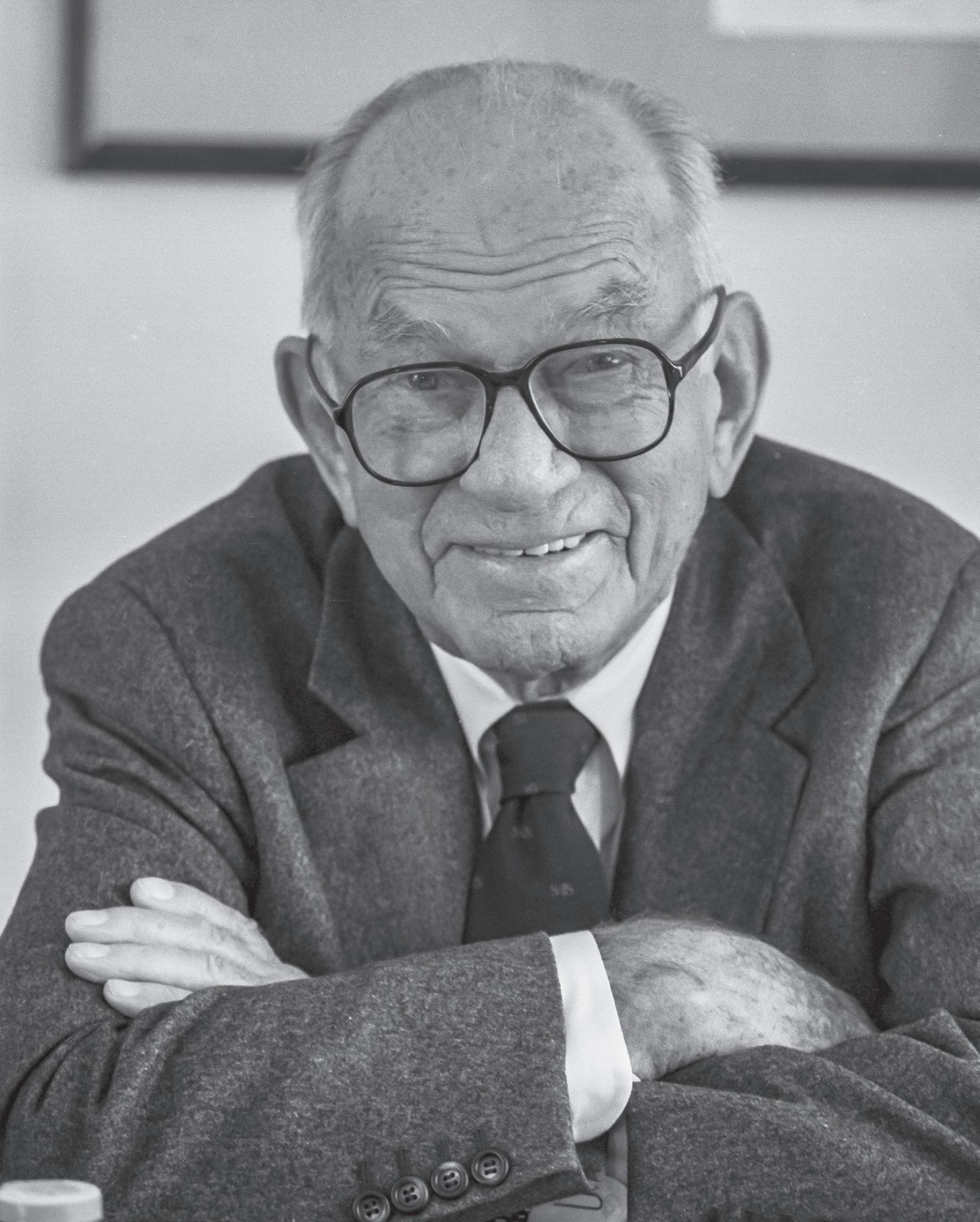
SIGNIFICANT SIG J. WILLIAM FULBRIGHT, ARKANSAS 1924
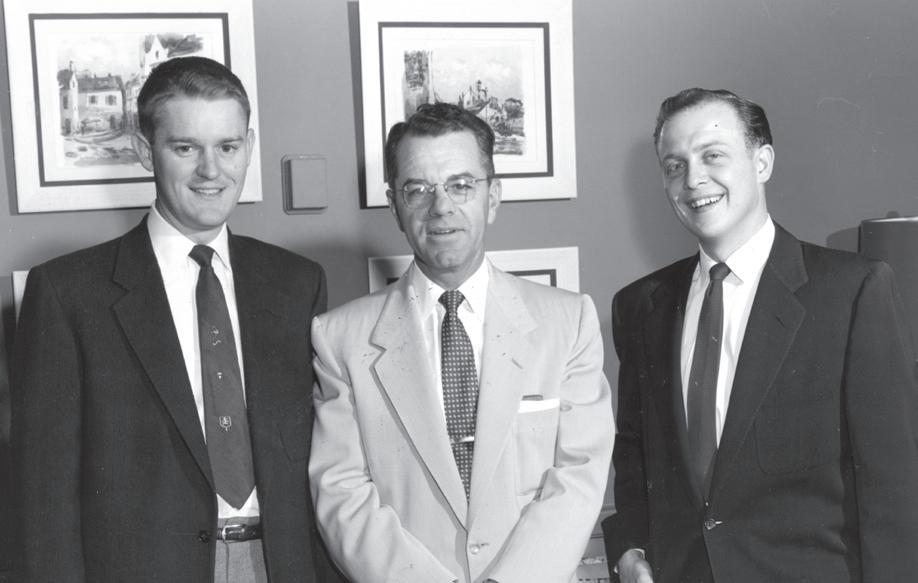
Significant Sig and former Arkansas Sen. J. William Fulbright, ARKANSAS 1924, is pictured sitting in the Washington, D.C., law office where he worked in 1989.

“SOME
OF THE BROTHERS I MET THAT JUNE DECADES AGO BECAME MENTORS, COUNSELORS AND LIFE-LONG FRIENDS — NOT BECAUSE OF ANY REASON
OTHER THAN I AM A SIGMA CHI.”
Hello, brothers!
My hearty congratulations to each of you who graduated this year. What milestones! Bachelors, masters, doctorates, med school, law school, MBAs — well done. We are proud of you and your achievements.
I am trying not to ask (because everyone else is), but … now what? For some of you, it is all mapped out. Residency. The bar — no, not that bar — the bar exam. Offers and jobs and careers and start-ups and life. It is waiting. We all wish you success.
Have you thought about where our Fraternity fits into all of this for you? You will always have the brothers in your chapter. Always. But you cannot physically take them with you. So, that’s it, then? Thanks, Sigma Chi, see you at the reunions? You can do that, but you would be missing out on some of the most rewarding parts of this lifelong adventure we pledged to pursue together. Not to mention the opportunities that our brothers across the country and around the world can offer you.
The declaration that “I AM a Sigma Chi” is one that developed extreme clarity for me as I began my personal journey to answer that “now what?” question. From the outset away from my undergraduate campus, other Greek-letter men who I encountered changed the verb to past tense. In my post-graduate studies at two universities, conversations about fraternal experiences had others saying, “I WAS in a frat,” or, “Yes, I WAS a blank-blank-blank at ABC college.” Even just one or two years out, they were done. That part of their experience, of their lives, was in the past. My feelings on the matter were totally different.
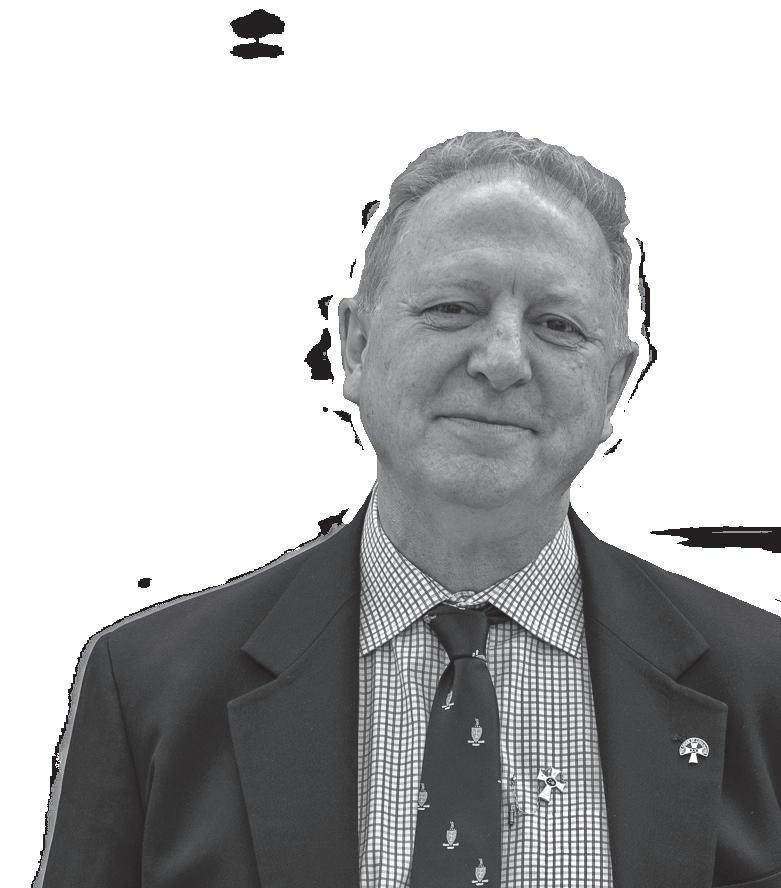
Six weeks after I walked the ceremonial stage for those degrees, I attended my first Grand Chapter. Some of the brothers I met that June decades ago became mentors, counselors and life-long friends — not because of any reason other than I AM a Sigma Chi. Giants in business and Fraternity who have allowed me to stand upon their shoulders and reach for my dreams, even to this day. Brothers S. Jack McDuff, Dick Hester, Rick Lewandowski, Mark Quiner and Joe Beers spring to mind, as do others who have left us for the Chapter Eternal.
It was the engagement of and by these alumni brothers that helped me integrate into the new and much bigger environments beyond western Kansas. Through them and because of their example I attended alumni chapter gatherings. Through those, I met men of experience and influence and wisdom in and about the community I was going to call home. These connections, introductions and welcome hands were key to starting the steps that would eventually answer my “now what” proposition. And I am certain this scenario happens again and again to so many others because of our Sigma Chi bonds — for those who recognize that graduation is not the end of the story, at least.
In the pages that follow, you will find stories like mine. You will find opportunities like these, whether you are on the first steps of “now what” or in the enviable and valued position to be able to help a brother as he is taking those first steps to find his way in life beyond the college years. I have been honored to be able to experience that role reversal, and it is truly rewarding. Fraternally we talk, even preach, of a

Corrections:Weerroneously reportedthedeathsofDavid Hanger, DEPAUW 2011,andSteve Saunderson, WASHINGTON STATE 1986.TheNSIprogramgoverning bylawswerechangedatthe2006, not2004,GrandCouncil.Andwe forgottomentiontheadditional legacySigmaChiHansellfamily membersofPerryHansellOwens, OREGON 1968,andWilliamTyler Hansell, WILLAMETTE 1992 Weregrettheerrors.
SUMMER 2024 / VOL. 143, #3
The Magazine of Sigma Chi, the official exoteric quarterly publication of the Sigma Chi Fraternity, has been published continuously since 1881. Its mission is to reflect through content the Sigma Chi experience; to instill and sustain pride in the International Fraternity; to educate and entertain its undergraduate members, alumni, parents and others interested in the Fraternity; to maintain a historical record of the activities of the Fraternity and its undergraduate and alumni chapters; and to present current issues affecting the Greek-letter system, the Fraternity and its members.
EDITORIAL TEAM CONTRIBUTERS
Ashley Szatala David Jones
Nathanael Hawthorne
CREATIVE DESIGN PRINTING ADVERTISING SALES
Thrive Hive Design Royle Printing Justin Hanen
CONTACT
The Magazine, 1714 Hinman Ave., Evanston, IL 60201 editor@sigmachi.org sigmachi.org/magazine
CALL: (847) 869-3655 FAX: (847) 869-4906
ADVERTISING
View our media kit at sigmachi.org/files/mediakit.pdf. Contact Justin Hanen at (847) 425-4413, or email justin.hanen@sigmachi.org to place an ad.
© 2024 Sigma Chi Fraternity | The Magazine of Sigma Chi (USPS325500) is issued quarterly by Sigma Chi Fraternity International Headquarters 1714 Hinman Ave., Evanston, IL 60201
Periodicals postage paid at Evanston, Illinois and at additional mailing offices.
POSTMASTER: Send address changes to The Magazine of Sigma Chi, 1714 Hinman Ave., Evanston, IL 60201.
lifetime commitment and the Sigma Chi network and the reciprocity that makes our brotherhood so unique and respected. That requires, inspires and even begs for engagement. You may be done with your studies, but the General Fraternity and your chapter has need of you. There are many deeply enriching reasons to proudly state, and show the world, I AM a Sigma Chi, now and forever. I hope you spend a couple of minutes reflecting on your reasons and then get involved. The rest of your adventure still lies ahead.
Proudly,
Bob Wilson
FORT HAYS 1981
73rd Grand Consul
HOW TO RECEIVE THE MAGAZINE | Undergraduates: Undergraduate members receive a digital copy of The Magazine through payment of semiannual dues through their chapter. Individual copies are emailed to each undergraduate, and five copies are sent via postal mail to the chapter editor or the chapter house. Recent graduates: The Sigma Chi Foundation gives each recent graduate a one-year complimentary membership in the Life Loyal Sig annual fund program, which includes four digital issues of The Magazine of SigmaChi. At the end of the year, recent graduates may continue to receive TheMagazine through the alumni options. Alumni: Alumni receive The Magazine by contributing to the Life Loyal Sig annual fund program. Persons contributing $1-99 annually receive a digital version of The Magazine via email, and those contributing $100+ annually receive one paper copy each quarter. For either of these, phone subscription sales at (847) 869-3655 or visit sigmachi.org/lifeloyal. A single copy of the current issue is $8.75 and can be purchased by contacting subscription sales. Past issues are $10.25 each.
PARENTS AND GUARDIANS | Your son’s Magazine is being sent to your address while he is in college. We hope you enjoy reading it, too. If he is not in college, or is no longer living at home, please send us his new permanent address (see below).
HOW TO CHANGE AN ADDRESS | Email your old and new addresses to addresschange@ sigmachi.org. You may also call (847) 869-3655, send mail to Address Changes, 1714 Hinman Ave., Evanston, IL 60201, or go to sigmachi.org > Membership > Update my contact info.
HOW TO GET PUBLISHED | Undergraduates: Each chapter editor is a correspondent for The Magazine of Sigma Chi. View deadlines and submission requirements at sigmachi.org. Chapter updates and photos must be submitted via sigmachi.org/submitcampuschronicle. Please upload the original photo file from the camera. Alumni: Alumni are encouraged to submit news and stories. Tell us about your alumni chapter events, and please include photographs — alumni chapters should email us at alumni.almanac@sigmachi.org or upload updates at chaptersystem.sigmachi.org. If you have news about an individual alumnus, email editor@sigmachi.org or send information and photos to the address above.
HOW TO SEND A LETTER TO THE EDITOR | We always welcome your comments — both criticism and praise — about this publication. Email editor@sigmachi.org, or send mail to Editor, 1714 Hinman Ave., Evanston, IL 60201.
GENERAL DEADLINES FOR SUBMISSIONS
Spring issue: Dec. 1 Fall issue: May 1
Summer issue: March 15 Winter issue: Sept. 1
“IF YOU SEE OPPORTUNITY EVERYWHERE, THE WORLD ABOUNDS WITH POSSIBILITY.”
ADVICE FOR THE SLUMP
Ilike coaching Little League Baseball. I’m not the most skilled or knowledgeable coach by any means. But what I do well, so I’m told, is build good teams and help kids feel like they’re part of a team regardless of their ability level. On a Little League team, there are three coaches: two coach the bases, and one manages the dugout. When the players are in the field there is plenty of direction and coaching to offer those in the field. On a team of 12, there are also a player or two who have to sit an inning out.
In our last game, I found myself sitting in the dugout with Kooper. I’ve coached Kooper and been the opposing coach of Kooper’s team before. I always root for him. He is a wonderful kid. Very earnest in his efforts. Very coachable. This had been a tough season for Kooper. He felt overlooked by some of the coaches. He didn’t hit as well as he’d have liked. He was down. I was able to share some thoughts with Kooper in that dugout that I thought might be good for some of you entering, enduring or recently exiting a slump of your own:
1. Despair is a self-fulfilling prophecy. If you’re stuck in a negative thought cycle, everything looks bleak and hopeless. However, optimism works the same way. If you see opportunity everywhere, the world abounds with possibility. Henry Ford was correct when he said, “Whether you think you can or you think you can’t, you’re right.”
2. Comparison is the thief of joy. I asked Kooper if he was bummed, in part, because of what he thought his teammates might think of his recent performance. He said he was. I then let him in onto something I’ve observed about youth baseball players:
“They’re all idiots.” Kooper smiled. “I was, too,” I told him. The problem is players tend to chase perfection while comparing their ability to the outcomes of other players. In reality, no player is perfect, and everyone strikes out. Players who hit once in every three at-bats in their career will end up in the Baseball Hall of Fame. Further, there are a dozen variables that determine what pitches you’ll see and the way a ball comes to you in the field. It’s different for every player in baseball. It’s different for everyone in life. “You’ll never be the best, Kooper, if you’re always trying to be the best Conner,” I told him.
3. If you find your skills are in a slump, find another way to contribute. In 2006, NBA Hall of Famer Steve Nash won the first of his back-to-back MVPs. In 2006, Nash only led the NBA in two categories: assists and high-fives to his teammates. You can actually raise your teammates’ performance with physical touch, I told Kooper. And raising the team up when all seems lost gets you out of your own head, helps you focus on the mission and breeds optimism.
Hang in there.
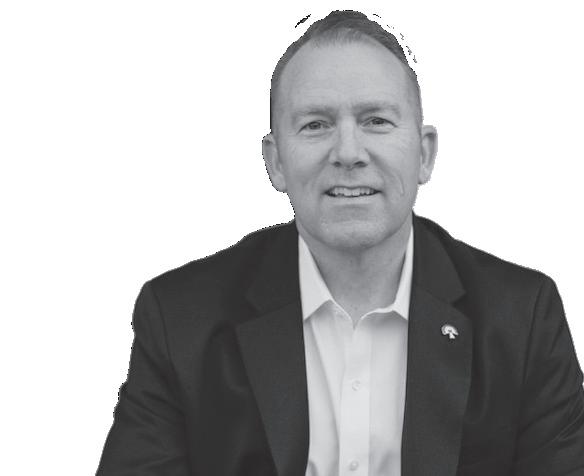
Jim Holcomb, CAL. STATE-SACRAMENTO 1994
Order of Constantine Sig and Grand Tribune

NSI
We are proud to announce our newest NSI members into Sigma Chi today! Comment someone below who should be NSI next.
GRADUATION
Congratulations to all of our brothers and sweethearts who are graduating this semester! We can't wait to see all you accomplish next! Tag a graduating brother or sweetheart below who you are going to miss the most. In Hoc Signo Vinces
SPRING BREAK
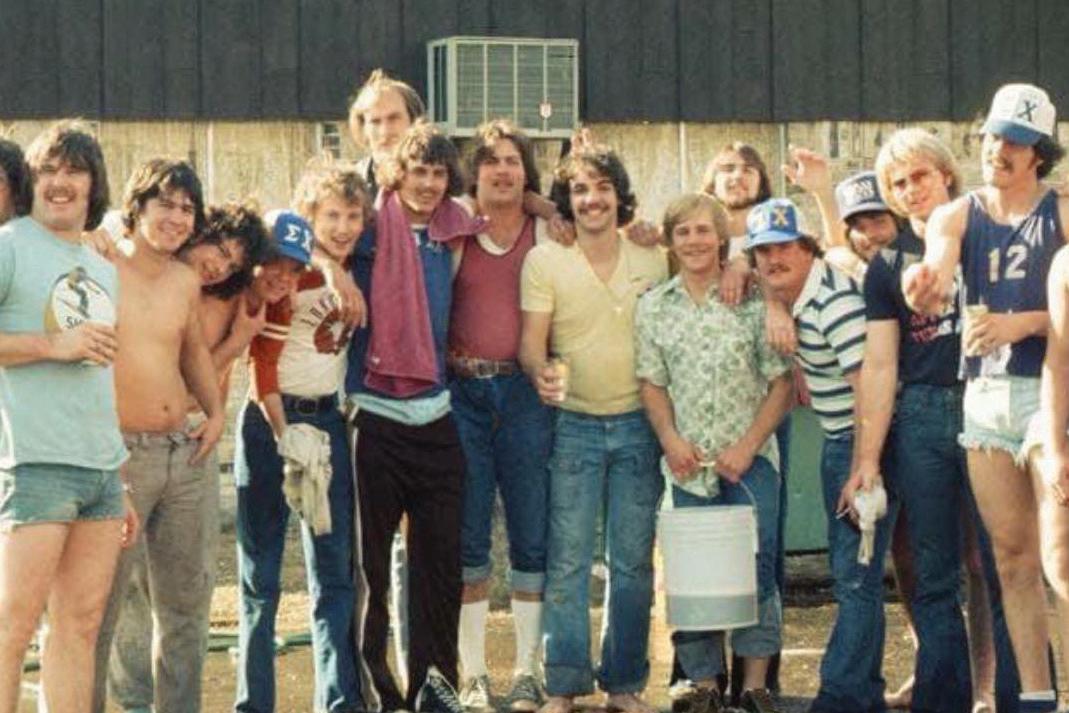
Is this the best spring break crew of all time? Tag your spring break squad. Safe travels to all our brothers, sweethearts and friends during your spring break.
EMPOWERING INDIVIDUALS THROUGH ADAPTIVE SPORTS
David Holzer, OHIO STATE 1982, has been a volunteer adaptive ski and kayak instructor for over two decades with Adaptive Sports Connection in Ohio
In 2003 David Holzer, OHIO STATE 1982, accompanied his son to an informational meeting with a nonprofit organization recently highlighted in the local newspaper so that his son could learn the organization’s needs for an Eagle Scout project he was doing. The organization, Adaptive Sports Connection just outside of Columbus, Ohio, was founded in 1992 and serves children, veterans and adults with disabilities through outdoor and therapeutic recreation and education.
While there, Holzer met with the board of directors and several participants and learned that they were developing programs for adaptive snow skiing and kayaking, two sports that Holzer loves and frequently does in his free time. He also was impressed with the mission of empowering individuals though adaptive sports, which carries a ripple effect of confidence into other aspects of their lives. The difference such an act can make is one Holzer was already familiar with. His father was an active volunteer with Easterseals — a national nonprofit whose mission is to increase independence, maximize opportunities, minimize barriers and enhance the quality of life for people with disabilities — and the young Holzer often accompanied him to events and activities for individuals with disabilities.
Soon after that informational Eagle Scout project meeting, Holzer trained to be an adaptive ski instructor and began volunteering with Adaptive Sports Connection in late 2003.
“The whole idea behind Adaptive Sports is getting people back out and doing things. There's a lot of people with disabilities who end up just not engaging in society, and what I have learned through Adaptive Sports is they just need opportunities,” Holzer says. “I've never come back from a day of volunteering feeling bad. You always get charged up.”
In the 21 years since first volunteering as an adaptive ski instructor, Holzer also has become a certified adaptive kayak instructor, has been a past president and member of the organization’s board of directors and looks forward to his retirement as a partner with Commercial One Realtors so that he can dedicate more
volunteer hours with Adaptive Sports Connection. For his volunteerism with the organization, Holzer has been named this quarter’s Mark V. Anderson Character-inActionTM Leadership Award recipient.
ORGANIZATION HAS A STATEWIDE IMPACT
Holzer joined Adaptive Sports Connection during an early growth state of the organization. Within 18 months of becoming a volunteer, he joined the organization’s board of directors and lent his business acumen to help build the organization and expand its volunteer base. Other people who joined in helping Adaptive Sports Connection grow included two additional Ohio State Sigs: Greer Rouda, 1977, who served on the board as well, and Jim Winters, 1978, who assisted with building the organization’s soccer program. Eventually, the board evolved from an active board to a governing board, and Holzer ended his board service to spend more time volunteering with participants.
Today, Adaptive Sports Connection currently offers adaptive cycling, kayaking, mountain biking, skiing and snowboarding and water skiing, as well as an amputee soccer program of which the MLS team Columbus Crew is a sponsor, and the program has two athletes on the national amputee soccer team. In addition, the organization has a veterans program. Adaptive Sports Connection serves thousands of individuals with disabilities and their families every year in 44 out of 88 Ohio counties, uses ski slopes throughout the state, and Departments of Veterans Affairs for Cleveland, Columbus, Cincinnati and Dayton participate in its veterans programming.
“Empowering individuals through adaptive sports is life changing for all involved, regardless of being a participant, volunteer/instructor or a donor to help create positive change,” says Adaptive Sports Connection founder and volunteer Steve Ricker. It’s an assessment Holzer agrees with after witnessing countless individuals blossom through their participation.
“I've never come back from a day of volunteering feeling bad. You always get charged up.” - David Holzer, OHIO STATE 1982
“Everybody’s always a little bit nervous to start with. It’s something new. But we have a really good team of volunteers who are trained in every aspect of the sport they're participating in. And part of our job is to make them feel comfortable through our professionalism,” he says. “Once they get out on the snow and get their first couple of runs in, as they progress, it's just so much of a boost for their confidence, which is our goal. By getting out and doing the sports, they build that confidence and they start to get back into enjoying life, knowing that if they can ski down a hill, they can probably do a lot more things than they never thought they could.”
VOLUNTEERISM SOON TO BE A FULL-TIME DEDICATION
Ricker credits Holzer’s volunteerism for making a difference in the lives of so many individuals and families.
“David's commitment over two decades and his leadership is allowing for generational growth of an incredible movement. His involvement with [Adaptive Sports Connection] as a long term, dedicated volunteer really sums up the culture
Character -In-action™
and commitment so many volunteers and community members have to fulfilling our cause,” he says. “We believe that as volunteers we get just as much, if not more, from being involved with the empowerment of individuals. It is [our volunteers’] incredible impact on lives and attitudes that allow so many individuals with disabilities and their families to say, ‘If I can do this, I can do anything.’”
Working with participants on the slopes, waterways and elsewhere is truly a joy for Holzer. He’ll be retiring in a couple years, and he knows how he’ll be spending his newfound free time: “Once that happens, it will be a full-time dedication for me.”
MAKING A DIFFERENCE IN YOUR LIFE AND THE LIVES OF OTHERS
A person with good character shows trustworthiness, respect and fairness to others, as well as responsibility and citizenship. Those members who go out of their way to help others and those who overcome obstacles and lead with integrity are good candidates for the Mark V. Anderson Character-in-Action™ Leadership Award.
Sigma Chi introduced the award to recognize the selfless acts of brothers. A formal recognition by the Fraternity allows non-members to appreciate the scope of the organization. For information about the award, see sigmachi.org/character
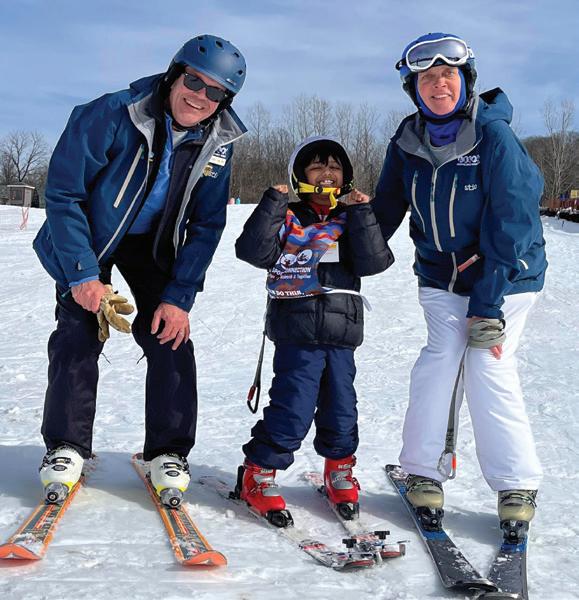
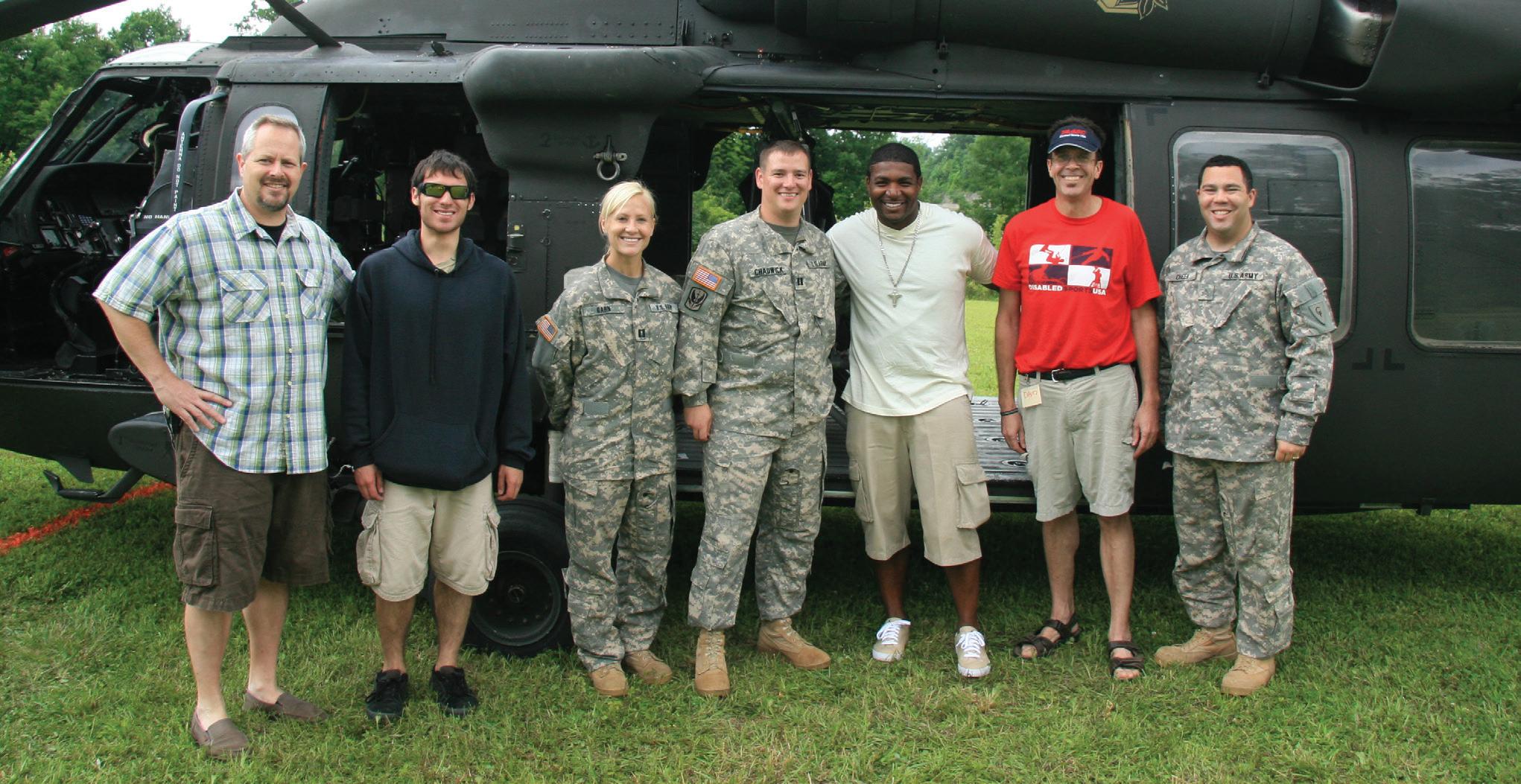
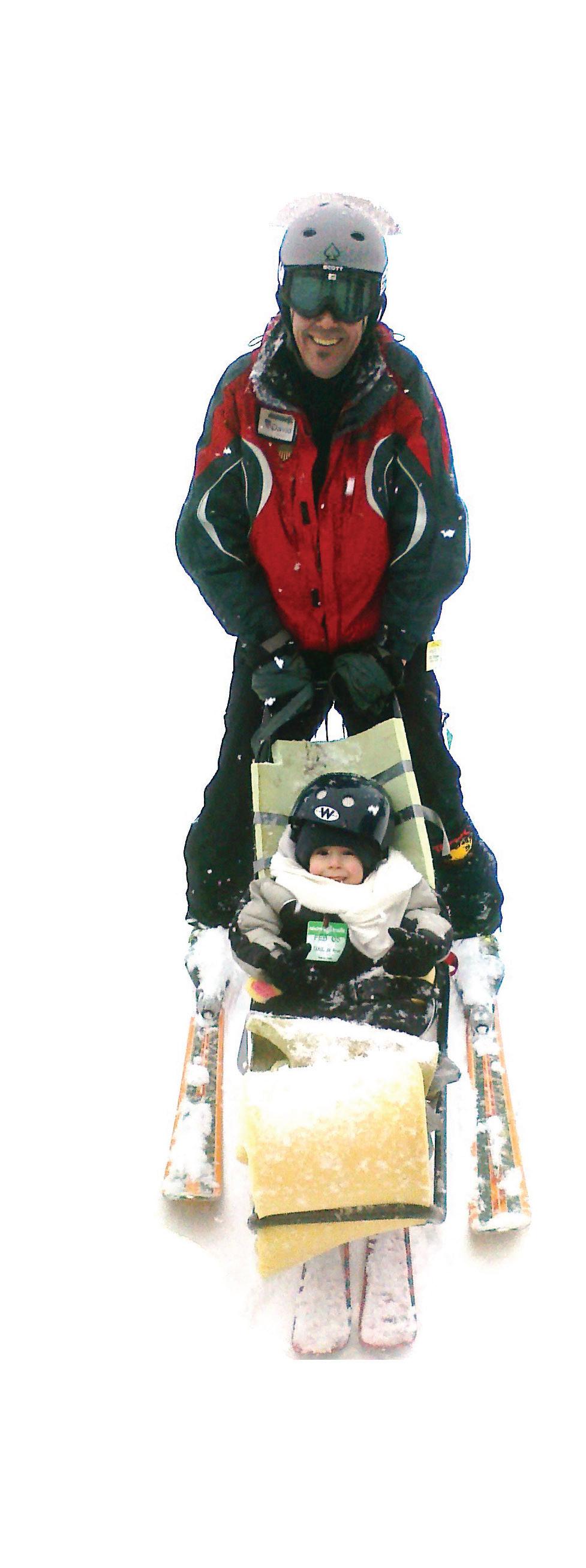
Left: David Holzer, OHIO STATE 1982, left, is pictured working with an adaptive ski participant. Middle: Holzer, second from right, is pictured with several veterans during one of Adaptive Sports Connection’s veterans programming events. Right: Holzer is pictured working with a young adaptive ski participant.
CONSTANTINE order of
Sigma Chi International Fraternity is proud to announce the 2023-2024 inductees into the Order of Constantine. Induction into the order is the Fraternity’s highest honor. It is bestowed upon Sigs who have devoted 20 or more years of service to Sigma Chi.
2023 ORDER OF CONSTANTINE SIGS
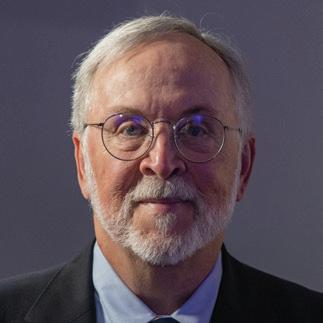
Daniel Benoit, DRAKE 1986
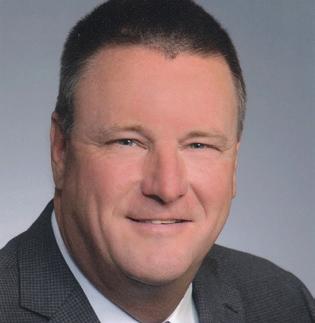
Benoit has been involved in financial aspects of the Fraternity, both internationally and at the undergraduate level, since 1986, predominantly with the Drake chapter. He was responsible for resolving a $20,000 debt by the chapter to the Fraternity, as well as fundraising for the chapter’s 40th anniversary. He earned Ritual Peer status in 2013 and was presented a Grand Consul Citation in 2017. He also served on the Grand Quaestor Commission from 2017-2019, as well as various province and national Leadership Training Workshops.
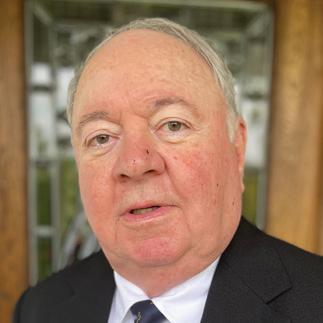
Thomas Bloomfield, TULSA 1982
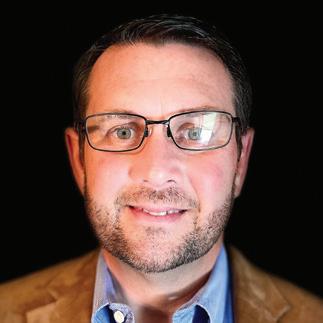
Bloomfield has taken charge of virtually every aspect involving the Tulsa undergraduate chapter and the Tulsa, Oklahoma, alumni chapter. He is active on the Ritual Advisory Board and has been a driving force of the chapter’s reunion and events. He helped the chapter win a Peterson Significant Chapter Award, as well as help the chapter earn the Thomas Cowan Bell Chapter distinction. For his work as a chapter advisor, he was awarded the Seven Lights Alumni Award and earned a Grand Consul Citation.
Jeremy Cushing, SOUTH ALABAMA 1996
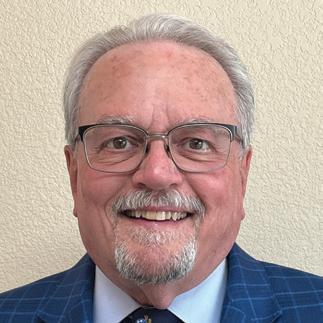
Cushing has been involved heavily in the Horizons Huntsman Leadership Summit since his graduation. From 2002 to 2008 he served as a guide and now currently serves as a session coordinator, which he started in 2009. For 10 years he served on the Consul’s faculty at the Leadership Training Workshops. With his involvement with Horizons, he has mentored hundreds of undergraduates and continued the mentorship far past the week-long retreat.
Beers
Joseph Durzo, SYRACUSE 1967
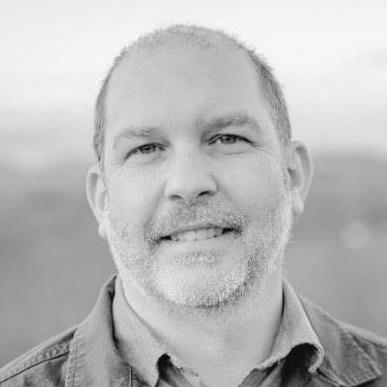
Durzo has played a crucial role to the Syracuse chapter during his 56 years with the house corporation. During his tenure, he has been instrumental in rallying alumni support during renovations. Durzo served on the Sigma Chi Foundation Board of Governors from 2014-2021, as well as the Sigma Chi Leadership Institute Board of Directors from 2016-2019. Durzo also served on numerous other committees. For his work professionally and with the Fraternity, Durzo was named a Significant Sig and earned two Grand Consul Citations, among other recognitions.
Jon Fisher, MISSISSIPPI
1984
Fisher has served the Mississippi chapter for the past 15 years after returning to Oxford, Mississippi, from Atlanta. Sigma Chi hangouts led to him working with the house corporation, then as a liaison between the house corporation and the chapter, and then serving as an assistant chapter advisor. When the chapter needed a new chapter advisor in 2013, Fisher stepped in to fill that role. During his tenure, he has overseen major changes in the chapter’s risk management and pledging, among other areas, and the chapter credits his leadership for it receiving Peterson Significant Chapter Awards from 2017 to 2021.
Roman Gaddis, NORTH GEORGIA 1997
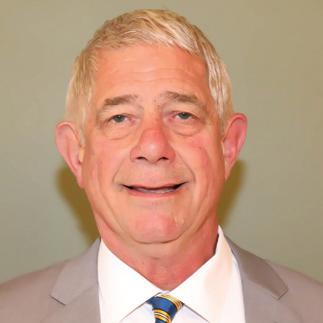
Gaddis has served the North Georgia chapter as a chapter advisor and assistant Grand Praetor. While volunteering as chapter advisor, the chapter has won nine Peterson Significant Chapter Awards consecutively under his tenure. He has also served on the Crossroads Committee in which he introduced new ways to train the undergraduate members. Gaddis has also been a Horizons Huntsman Leadership
Thomas Bloomfield, TULSA 1982
Jeremy Cushing, SOUTH ALABAMA 1996
Joseph Durzo, SYRACUSE 1967
Roman Gaddis, NORTH GEORGIA 1997
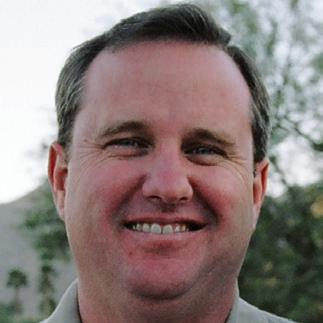
Harry Grandon, WEST VIRGINIA 1972
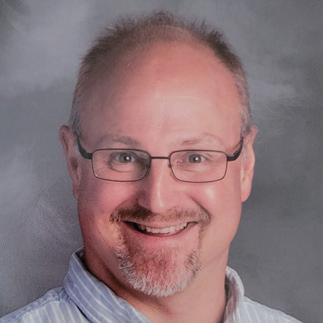
Elliott Hilsinger, CINCINNATI 1969
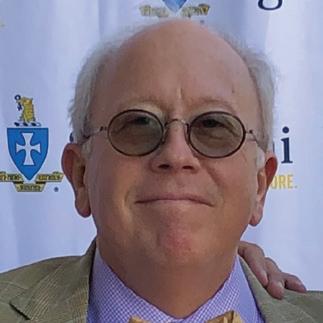
Summit guide since 2008. Among other support, Gaddis has also played a role in initiations across Georgia.
Harry
Grandon,
WEST VIRGINIA 1972
Grandon has traversed numerous issues at the West Virginia chapter as a chapter advisor. The chapter is the only one on West Virginia’s campus to have never had its charter revoked during Grandon’s over 20-year tenure. He was vital in the house corporation’s development campaign “For 700 North High” to revitalize the chapter house. Over $1.5 million was raised for the house’s restoration. For his efforts as chapter advisor, he earned the Seven Lights Alumni Award in 2021.
Elliott
Hilsinger, CINCINNATI 1969
Hilsinger has shown dedication to the Cincinnati chapter for more than 55 years through his efforts on the house corporation. While on the board, Hilsinger oversaw two capital campaigns. He has also served as Grand Praetor, but arguably his most significant achievements were establishing several scholarships through the Sigma Chi Foundation. He was awarded a Grand Consul Citation in 2005 and named a Significant Sig in 2011, among other accolades.
Robert Loftin III, ALABAMA 1979
Loftin has served most notably as the Alabama chapter advisor and on its house corporation. Despite relinquishing some responsibilities, Loftin still serves as legal counsel to the house corporation. As chapter advisor, the chapter earned four consecutive Peterson Significant Chapter Awards. In his roles with the Birmingham, Alabama, alumni chapter and house corporation, he was crucial in the planning, fundraising efforts and construction of the chapter house. He has also served on numerous committees and was awarded the Seven Lights Alumni Award in 2019.
Thomas Murphy, MAINE 1981
Murphy has served both the Maine and Rhode Island chapters. As the Maine assistant chapter advisor, he was vital in the campaign to reacquire the old chapter house and has headed many fundraisers for alumni and undergraduates, as well as bolstering relationships across generations of Sigma Chis. At the Rhode Island chapter, he is vice president of the house corporation. For his work as assistant chapter advisor, he was awarded the Seven Lights Alumni Award in 2022.
Marvin Pearson, WASHINGTON (SEATTLE) 1979
Pearson has served on multiple boards and committees, as well as undertaking mentorship to the undergraduates at the Washington (Seattle) chapter. One of his major contributions to the chapter is his assistance in initiation ceremonies. For the General Fraternity, Pearson serves as warden for the 1st Grand Consul John S. McMillin Memorial Mausoleum in Friday Harbor, Washington. He developed a history tour of the mausoleum for Sigma Chis to learn about the inaugural Grand Consul and his contributions.
Peter Potwin, OREGON STATE 1972
Potwin has taken the reins of the Oregon State house corporation after becoming treasurer and raising money to remodel many rooms in the house, as well as becoming owner and operator of the property. In 2010 he handed control over to others but quickly stepped back in after deteriorating conditions and financial hardships arose. Potwin was awarded the Seven Lights Alumni Award in 2012 for his work with the chapter and was named a Significant Sig in 2021.
Eric Reifschneider, SAN DIEGO STATE 1988
Reifschneider has been involved with several chapters in two states. At San Diego State, the University of San Diego and Boise State University, he has served as a mentor to the chapters and served on house corporation committees. He facilitated the Consul division at the Krach Transformational Leaders Workshop. Reifschneider and his father also worked to evolve the Fraternity’s curriculum for substance abuse, which was recently adapted into the Sigma Chi Leadership Institute’s educational programming. For his work with the chapters, he was awarded the Seven Lights Alumni Award.
Bruce Sadler, PUGET SOUND 1983
Sadler has consistently been involved with the chapter at Puget Sound. For many years he acted as the primary liaison between the chapter and the university and served as chapter advisor. With his assistance, the chapter earned a Peterson Significant Chapter Award in three consecutive years. He also helped the chapter traverse COVID-19 difficulties with attending school and running an organization. Along with his involvement with the undergraduates, Sadler has supported the Tacoma, Washington, alumni chapter as secretary and treasurer.
Robert Loftin III, ALABAMA 1979
Thomas Murphy, MAINE 1981
Marvin Pearson, WASHINGTON (SEATTLE) 1979
Eric Reifschneider, SAN DIEGO STATE 1988
Bruce Sadler, PUGET SOUND 1983
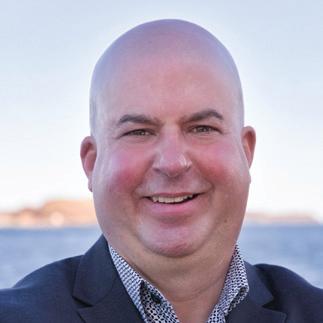
Anthony Sanderson, DALHOUSIE-ST.MARY'S 1997
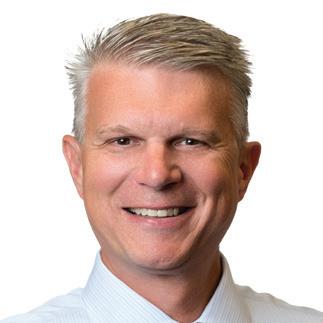
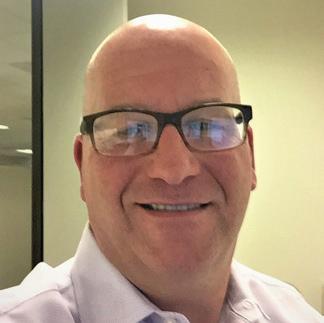
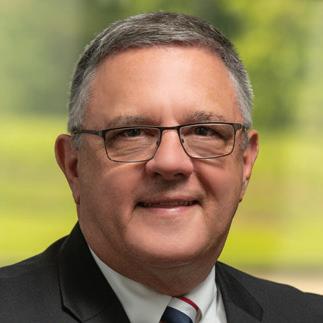
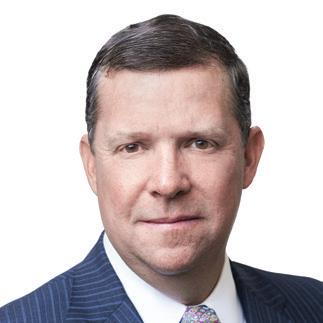
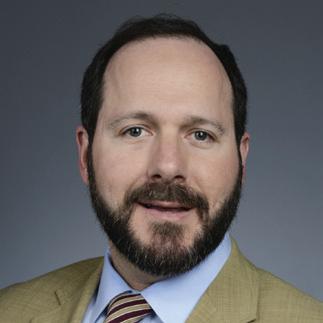
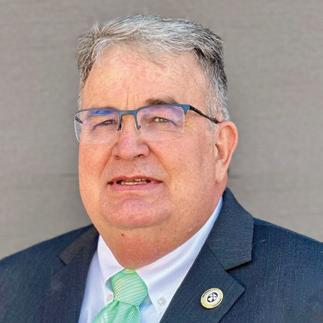
Anthony Sanderson, DALHOUSIE-ST.MARY'S
1997
Sanderson has been committed to the Dalhousie-St. Mary’s undergraduate chapter by serving in several roles, including as house corporation board member since 2009. He also has been a long-time member of the Halifax alumni chapter, of which he currently serves in a public relations role, as well as previously being elected to various other alumni chapter leadership positions. Notably, he started an Alumni Lunch Series in the mid-2000s that connected an undergraduate brother with an alumnus in the undergraduate’s field of study. Sanderson earned the Seven Lights Alumni Award in 2022 and a Grand Consul Citation in 2008.
Christopher
Shimala,
MIAMI (OHIO) 1992
For over 30 years, Shimala has helped the Miami (Ohio) chapter with its house finances through his efforts on the house corporation. From fundraising to assisting the Quaestor with his duties, Shimala has helped oversee the financial aspects of the chapter. He was a part of the team that helped the chapter raise over $4 million to reinvest in the house, as well as help the chapter avoid $17,000 in IRS penalties. In addition to his willingness to help with finances, he also takes on the role as mentor to the chapter officers by helping with job searches following graduation.
Rodney Smalling, TEXAS A&M-COMMERCE 1993
Smalling is Grand Praetor for the Northern Texas province and a Ritual Peer. He has sat on the Texas A&M-Commerce chapter advisory board since 2013. When Smalling was named Grand Praetor, he worked to rebuild the Texas Christian University chapter. He first joined the summer Leadership Training Workshop Quaestor faculty in 2015 and served as its chairman in 2020. Smalling currently serves as the undergraduate relations chair for the Dallas alumni chapter.
Marc Smith, MISSISSIPPI STATE 1979
Over the last 18 years, no one has facilitated more Horizons Huntsman Leadership Summit journeys than Smith. He was trained as a guide in 2004 and is always prepared to drop everything should another guide need to cancel. Smith is committed to continual mentorship and keeps in contact with his groups far past their graduation. He has also served at various Leadership Training Workshops as a faculty member teaching Quaestors. At the chapter level, Smith has hosted numerous retreats and province conferences.
John Smyth, AUBURN 1993
Smyth was first chapter advisor for the Auburn undergraduates from 2003 to 2013 and the Birmingham-Southern chapter advisor from 2008 to 2011. Smyth played a crucial role in the Auburn reactivation efforts by communicating with Fraternity staff, chapter alumni and the university, and as a lawyer he helped prepare chapter bylaws while the group was still an associate chapter. The chapter was reinstalled in 2019. Smyth also has been a member of the Auburn house corporation, and he played a role in two fundraising campaigns that collected nearly $1.7 million combined.
Ben Trachtenberg, YALE 2001
As the 2001 International Balfour Award winner, Trachtenberg worked with the Executive Committee while studying at Columbia Law School and abroad in Ireland. He serves as director of the Yale house corporation and helped the group win the Sigma Chi House Corporation Gold Award for 2020 and 2021. Previously he was the Missouri-Columbia faculty advisor. Trachtenberg also served as chairman of the Governing Laws Committee, which earned him one of two Grand Consul Citations. He also earned a Seven Lights Alumni Award in 2017.
Christopher Shimala, MIAMI (OHIO) 1992
Rodney Smalling, TEXAS A&M-COMMERCE 1993
Marc Smith, MISSISSIPPI STATE 1979
John Smyth, AUBURN 1993
Ben Trachtenberg, YALE 2001
Kendall Anderson, SOUTHERN UTAH 1995
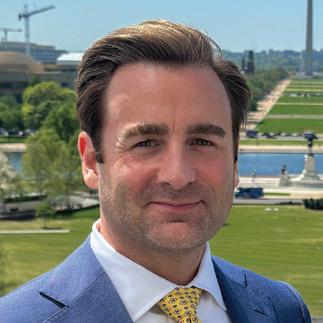
2024 ORDER OF CONSTANTINE SIGS
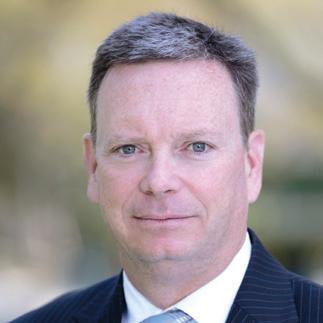
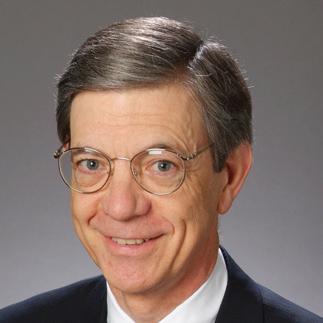
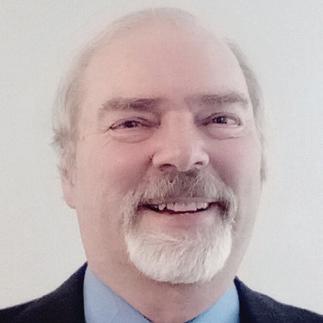
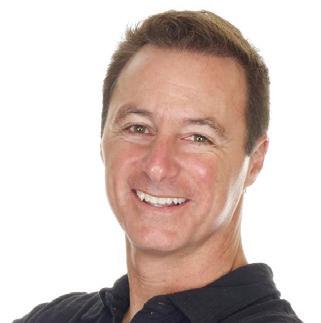
Kendall Anderson, SOUTHERN
UTAH 1995
Anderson is one of the Southern Utah chapter’s most involved alumni. He has served on the chapter’s advisory board since its inception and been an advisor for many of the chapter’s roles, including the Magisters and Ritual chairmen. Anderson, who is a Ritual Peer, often makes trips from his Nevada home to mentor the undergraduates, act as an interviewer and speak at events. He was involved with the chapter’s 30th anniversary celebration and is credited with gaining more alumni support for the chapter. He also is a facilitator at the Krach Transformational Leaders Workshop and for the Officer Training Academy Magister course.
David Ashinoff, WILLIAM &
MARY 2003
Ashinoff is the current Washington, D.C., alumni chapter president, Government Affairs Committee chairman, Alumni Legacy Committee chairman, and vice president of communications for the Fraternity and Sorority Political Action Committee. Prior to these roles, he was a member of several other committees and boards and has served on many summer workshop faculties. Ashinoff served as Grand Praetor of the Eastern Virginia province for 14 years and was dean of the Praetorial College for four of those years. He is credited for the successful installation of the Virginia Commonwealth chapter and is the financial advisor for the William & Mary chapter. He received the Seven Lights Alumni Award in 2020.
Kevin Bidenkap, ARIZONA STATE 1990
Bidenkap has been president of the Los Angeles County alumni chapter since 2015 and a member since 1991. He is credited for the chapter’s growth and co-chairs all its signature events. Bidenkap has been a Membership Review Team member, has served as a Pro Consul mentor for the California-Los Angeles chapter and a big brother for that and the Cal. State-Long Beach chapters, has acted as a local initiation interviewer and has worked with the local house corporations to help them secure resources and support. He also served as the Los Angeles Coastal province Grand Praetor for two years and received the Seven Lights Alumni Award in 2017.
Michael Bryson, PITTSBURGH 1968
Bryson led the $250,000 endowment for the Pittsburgh chapter after the idea was proposed at the chapter’s 100th anniversary in 2009. Through his organization of alumni by decade, participation in monthly progress meetings and personal contributions, the Beta Theta chapter was named a Bell Chapter by the International Fraternity after the five-year effort. In the 1980s, Bryson served on
the chapter’s house corporation and helped spearhead the move of the chapter house to the university’s new Greek-letter housing development. He has attended several Balfour Leadership Training Workshops as a group leader and once was a distinguished visitor. He was named a Significant Sig in 2006.
Robert Canfield, KENT STATE 1978
Canfield played a crucial role in helping reestablish the Pike’s Peak, Colorado, alumni chapter in 2004 and has served as its president and now vice president. Around that same time, he got involved with the Colorado College chapter by attending weekly chapter meetings and supporting recruitment, initiation, philanthropic and Ritualistic activities. Canfield also has worked for years to better the chapter house through renovations, repairs and new construction projects. He was chapter advisor from 2015 to 2016, and prior to that role, he had served as the New Mexico undergraduate chapter from 1984 to 1989.
Jim Caras, CALIFORNIA-IRVINE 1986
Caras has served his alma mater chapter since graduating. He was chapter advisor from 1987 to 1989 and later from 2018 to 2019. Caras also served as house corporation advisor from 2005 to 2006. He has acted as an initiation interviewer and provided building space for initiations. After the California-Irvine chapter was suspended in the 1990s, he was key in retiring the chapter’s university debt and helping with the chapter’s reinstallation. Caras later helped with the reinstallation of the California-Santa Barbara chapter despite living over 150 miles away. He has helped organize the local alumni group and has hosted an annual Lake Havasu trip for over a decade.
Nathan Cranston, MONTANA 2004
Cranston has been the Montana chapter’s house corporation treasurer since graduating, its Sigma Chi Building Foundation treasurer for 15 years and is the point person for chapter house-related items. He has helped coordinate and execute remodeling projects, ongoing property maintenance, budgeting and collections, and has acted as a liaison with the university. For this work, he received the William T. Bringham Best House Corporation Officer Award in 2018, and the house corporation has received numerous Outstanding House Corporation Awards since 2007. Cranston also is the Missoula alumni chapter’s vice president, helps organize the chapter’s annual golf tournament and coordinates Homecoming events.
David Ashinoff, WILLIAM & MARY 2003
Kevin Bidenkap, ARIZONA STATE 1990
Michael Bryson, PITTSBURGH 1968
Robert Canfield, KENT STATE 1978
Jim Caras, CALIFORNIA-IRVINE 1986
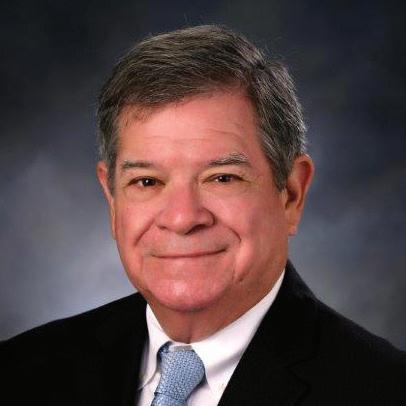
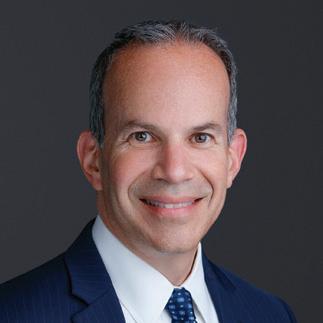
Marl Cummings III, ALABAMA 1975
Cummings is a founding member of the Constantine Housing Initiative board of directors. He has served as a property conservation consultant, has visited over 30 chapter houses to date and has developed individual solutions for each. He also helps lead the Housing for All initiative, which finds opportunities for young chapters to have a fraternal living environment. Cummings followed in his father and brother’s footsteps to become the South Alabama chapter’s house corporation treasurer and is involved in the South Alabama alumni chapter. He was key in the construction of the South Alabama’s chapter house and helped lead the capital campaign for the Alabama chapter house.
Mark Douglas, GEORGIA 1995
Douglas is the North Georgia province Grand Praetor and Ritual Peer. For years, he has been a volunteer for his home chapter, its house corporation and its chapter advisory board, as well as helping with initiation setups and interviews. He also has served at times as the Georgia Tech and West Georgia chapter advisor, has been president of the West Georgia house corporation, has done several membership reviews for the Chapter and Member Accountability Committee, and was part of the first Foundational Leadership Mentor class. Douglas also has acted as an alumni advisor to several North Georgia chapters and has assisted with the installations of the South Carolina and Tennessee chapters.
Jesse Dunbar, BELOIT 1995
Dunbar has been the Cincinnati alumni chapter president since 2020 — in addition to holding that role and role of vice president at various times since 2000 — and has been on the International Fraternity’s Diversity, Equity and Inclusion Committee since 2021. He has been heavily involved with the recruitment and initiation activities at the Cincinnati undergraduate chapter for over 20 years, has helped with the Ohio University and Miami (Ohio) reinstallations, and has been a Southern Ohio province workshop speaker multiple times. Dunbar also was assistant Grand Trustee from 2021 to 2023. He received the Seven Lights Alumni Award in 2015.
Bradley Gordon,
SOUTH ALABAMA 1994
Gordon has been involved with several undergraduate and alumni chapters due to his U.S. Marine Corps service and moving around. He currently is a member of the Washington, D.C., alumni chapter and assists with the chapter’s various events. Gordon has been a Horizons Huntsman Leadership Summit guide since 2007 and has served on the summer leadership workshop’s Consul, Pro Consul and Emerging Leader faculties as well as being a Journey facilitator in 2012. He also has served on the International Fraternity’s Marketing and Communications Committee. In addition, Gordon has assisted local chapters as a mentor, assistant chapter advisor, alumni interviewer and more.
Brandon Halaufia, UTAH STATE
1999
Halaufia has been the Utah State chapter advisor since 2010 and a Ritual Peer. Under his leadership, the chapter has received numerous Peterson Significant Chapter Awards and been named the university’s Greek Philanthropic Organization of the Year. Halaufia was twice awarded Chapter Advisor of the Year by the university’s Greek-letter system/Order of Omega and was twice voted Alumnus of the Year by the chapter. He is the alumni liaison and assists, when needed, with house corporation activities. He has been recognized for his prior facilitation and mentorship at the California-Los Angeles chapter and was a Journey facilitator in 2012.
Todd Larson, DRAKE 1998
Larson is the North Central province Grand Praetor and a Ritual Peer. In 2009 he became chapter advisor for the St. Thomas chapter and created an advisory board, helped establish the role of the house corporation and found volunteers for other chapter needs. He received the LeClerg Outstanding Chapter Advisor Award in 2019 and the Seven Lights Alumni Award in 2022. Larson also helped found the Greater Minnesota Alumni Chapter, is trained as a Foundational Mentor and has been a member of the annual summer workshop’s Ritual, Authentic Leadership and Emerging Leader faculties, among other mentorship and facilitator roles.
Mark Douglas, GEORGIA 1995 Jesse Dunbar, BELOIT 1995
Christopher Lastrapes, TULSA 2023
Richard Segal, YALE and HARVARD 1988
Marl Cummings III, ALABAMA 1975
Todd Larson, DRAKE 1998
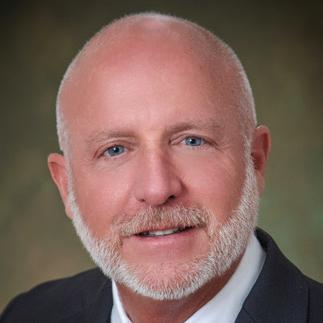
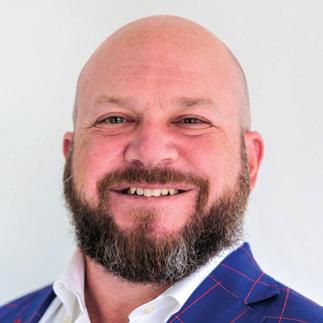
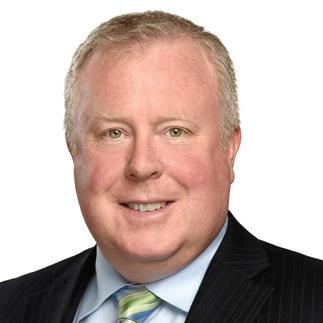
Christopher Lastrapes, TULSA 2003
Lastrapes has been involved with the Horizons Huntsman Leadership Summit since being an undergraduate participant. He became a Horizons guide in 2009, has been a session coordinator since 2016 and served on the Horizons Operating Board from 2009 to 2023, including a term as vice chair. While on the board, Lastrapes chaired several task forces, including the curriculum advisory and applications and marketing task forces. Other International Fraternity participation includes being a member of the Cornerstone Operating Board, the Education and Leadership Board and the History Commission, and he is currently a Foundational Leadership Mentor. Lastrapes received the Seven Lights Alumni Award in 2023.
Ron Powell, SAN DIEGO STATE 1985
Powell currently is a San Diego State chapter advisory board member. Previously, he was president of the California-San Diego’s house corporation from 1989 to 1996, the University of San Diego chapter advisor from 1992 to 1997, then the San Diego State chapter advisor from 1997 to 2006. He was twice named Southern California province Chapter Advisor of the Year, and the University of San Diego once named him Volunteer of the Year. He has been involved with the San Diego alumni chapter for decades. Powell received the Jay E. Minton Best Alumni Chapter Officer Award in 1995 and the Seven Lights Alumni Award in 2023.
John Santora Jr., KENT STATE 2002
Santora is a dedicated summer annual workshop facilitator in the Quaestor division, Officer Training Committee member and vice chairman of Team Krach. In 2015 he took over leadership of Team Quaestor, recruited and trained new facilitators while supporting existing facilitators, and helped build a reference website and modular training that became one of the inspirations for today’s Officer Training Academy. He received the Seven Lights Alumni Award in 2017 and the Outstanding Workshop Faculty Award in 2023. He also helped to reestablish the Akron, Ohio, alumni chapter, serving as president and treasurer, and served on the Kent State house corporation for nearly a decade.
Richard Segal, YALE and HARVARD 1988
Segal is a Grand Trustee, Chapter Advisory Board member and Foundational Leadership Mentor for the San Diego State chapter, longtime Universal Trial Board and Membership Review Team member, and current Member Accountability Committee member. After graduating Segal joined the Boston alumni chapter from 1988 to 1991, during which time he was assistant chapter advisor to the Harvard petitioning chapter and helped with its installation. He joined the San Diego Alumni Chapter in 1991 and was the California-San Diego chapter advisor until 1998. Segal was named a Krach Transformational Leaders Workshop Distinguished Visitor in 2023 and is a past recruitment division faculty member. He was named a Significant Sig in 2021.
Brian Keith Snyder, TROY 1985
Snyder has been the Auburn chapter advisor since the chapter’s reinstallation efforts in 2017 and is a Ritual Peer. He was key in helping reestablish the chapter, which has since received several Peterson Significant Chapter Awards, and in 2021 the university named it the fastest-growing Greek-letter organization in its history. Snyder was named the Auburn University Chapter Advisor of the Year in 2019. He also volunteers with the Troy chapter and has organized several of its alumni and undergraduate events. Snyder was a member of its house corporation from 1995 to 2016 and has served on its alumni advisory board since 2017.
Christopher Walters, ROANOKE 2000
Walters is a member of the Foundation Board of Governors, the Foundation’s Executive Committee and the Foundation’s Development Committee. He also is chairman of the Fraternity’s Enduring Leadership Committee and a member of the Investment Committee. Walters has been a Horizons Huntsman Leadership Summit guide since 2009 and is now a session coordinator. He also began serving on the Horizons Operating Board in 2010 and recently was made board chair. Walters has been a mentor to the Roanoke undergraduates and has been involved with their new house campaign and 150th anniversary celebration. Additional service includes serving on the annual summer workshop faculty and other International Fraternity committees.
Andrew Williams, DALHOUSIE-ST. MARY’S 1991
Williams has been a Dalhousie-St. Mary’s house corporation board member for over 20 years, has served on the Risk Management Foundation board since 2016 and has served as a founding member on the Constantine Housing Initiative board since 2017. He is chairman of CHI’s Property Claims Review and Property Conservation committees, and he mentors undergraduates on chapter house preservation, insurance and risk management. Williams also has been key in the ongoing property life safety and insurance protections for the Dalhousie-St. Mary’s chapter house, is a regular presenter at province conferences in Canada and the U.S. and is active in Halifax-area alumni events.
Brian Snyder, TROY 1985
Christopher Walters, ROANOKE 2000
Andrew Williams, DALHOUSIE-ST. MARY’S 1991
Efforts in Congress to Preserve, Enhance Fraternal Experience
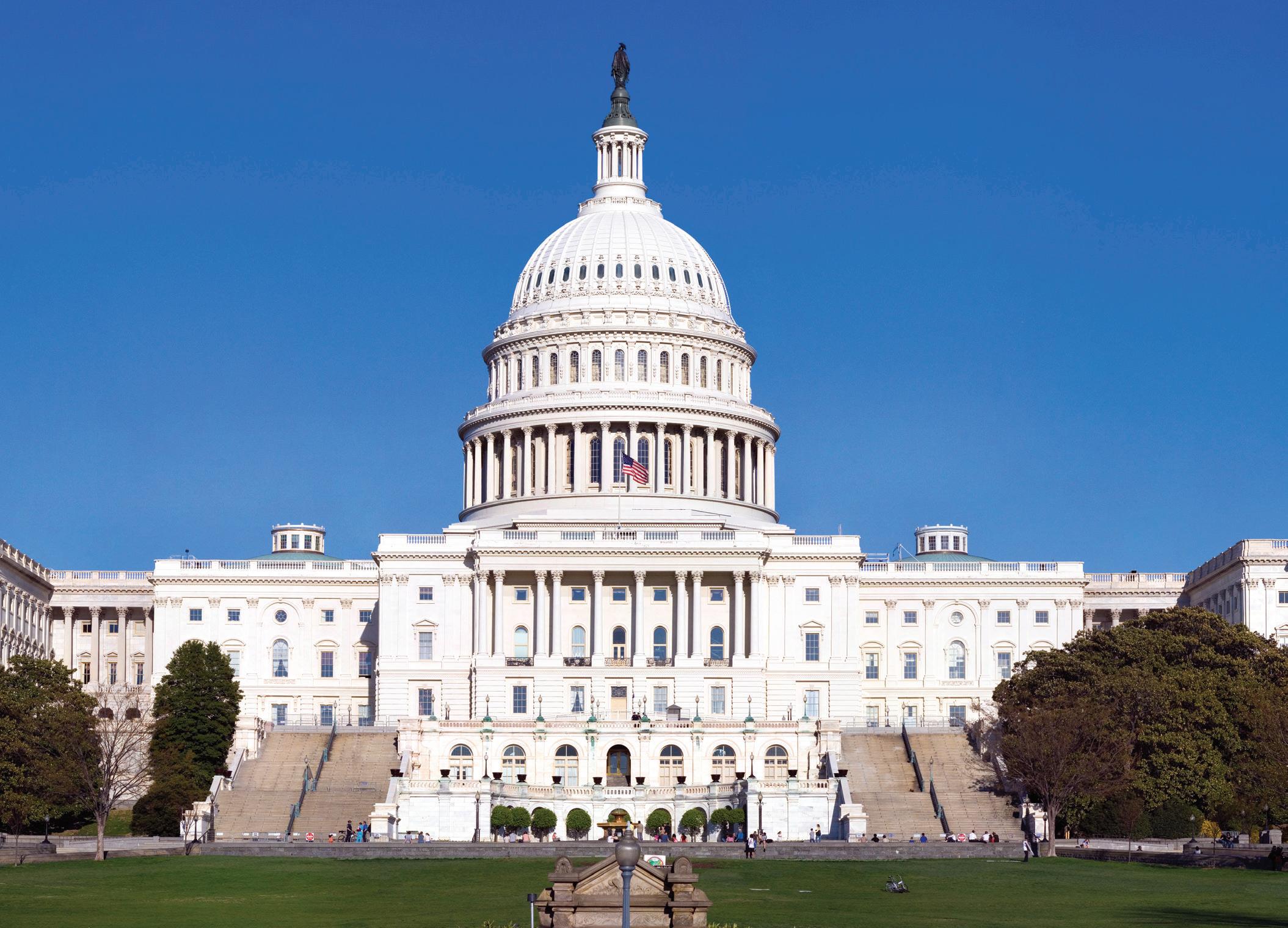
Sigma Chi — and Greek-letter life everywhere — has been under attack in recent years from egregious overreaching by third parties with attempts to control or limit the manner in which our Fraternity conducts its affairs. Work is underway to stop this intrusive behavior and, most importantly, prevent it from ever happening again — but we need your support to protect and preserve the fraternal experience once and for all.
IMPORTANT LEGISLATIVE DEVELOPMENT
On March 15, 2024, the House Education and Workforce Committee introduced the Respecting the First Amendment on Campus Act. Officially named H.R. 7683, the bill would apply to any campus receiving Title IV funding from the Higher Education Act [HEA]. Bottom line, this bill addresses crucial concerns surrounding freedom of association, specifically in the context of Greek-letter organizations. Specific provisions included in the bill would:
• Ensure students are educated on their First Amendment rights;
• Safeguard the freedoms of association and religion on campus;
• Prohibit institutions from forcing students, faculty, or applicants to take political litmus tests;
and, as it relates to Sigma Chi and fraternities everywhere:
• Preserve Sigma Chi’s right to operate as a single-sex organization;
• Allow the fraternity to regulate its own membership; and
• Prevent colleges and universities from taking any adverse action against a brother or chapter, such as a suspension, other disciplinary action, withholding financial assistance or access to on-campus housing, participation in extracurricular clubs, or withholding letters of recommendation because of the membership practice of the organization.
This legislation would finally put to rest an issue that has been plaguing our beloved Fraternity since nearly the very beginning of our existence.
GREEK-LETTER LIFE UNDER ATTACK
Since the Fraternity’s infancy, Sigma Chi has been aggressively fighting for its members’ rights. An early example of this is the Purdue case in 1877. In that case, the university president sought to ban students from joining Greek-letter societies. But, Sigma Chis fought back and were victorious.
Nearly 150 years later, Sigma Chi and the entire Greek-letter community remains targeted. There have been many documented cases of punishment being handed out to individuals, and even whole organizations, based on the actions of other groups on college campuses.
One recent case includes the University of Maryland impinging on the constitutional rights of its students who are members of the fraternity and sorority community.
As reported in national news, in an egregious overreach in March, the University of Maryland (UMD) administration unilaterally suspended activities for all 37 campus fraternity and sorority chapters, except culturally based organizations,andissuedano-contactorderbetweennewandinitiatedmembers. Impacting1in7studentsatUMD,thisunlawfulviolationofFirstAmendmentrights was executed without any reports of policy violations or allegations being shared with organizations or individuals. Further, hundreds of students were mandated to take part in investigative interviews, where agents of a third-party firm reportedly invaded their privacy asking them to turn over messages, images and calendar information from their phones.
After weeks of uncertainty, the University lifted the suspension for all but five organizations. While the University could have followed due process by investigating these organizations that had specific reported policy violations, they
held the community hostage for an investigation that was jarring, confusing and overwhelming to thousands of students who work to provide a safe environment. The impact of UMD’s actions also has potential long-term, downstream negative implications for the future of the entire fraternity community, including decreased member retention, lost revenue, reputational harm and a hit to recruitment.
- North American Interfraternity Conference | April 8, 2024
Even more egregious were the actions of Harvard University in 2016 when the institution announced it would punish students who joined off-campus, unrecognized single-sex organizations. Students were chastised for their affiliation by not being awarded “leadership positions in recognized student organizations or athletic teams … [and] will not be eligible to receive College-Administered fellowships [including the Rhodes, Marshall and Mitchell Scholarships which require the University’s endorsement],” according to court documents from 2019.
In a swift reaction, numerous single-sex organizations, with Sigma Chi in a leadership role, came together to fight back. Parallel lawsuits were filed at the state and federal levels. In the years that followed, members of Greek-letter organizations from across the country backed the fight against Harvard. It was in June 2020 when a confidential settlement occurred, after which Harvard relented and removed the discriminatory policy. Greek-letter life won. And we will continue to do so with your help.
HOW YOU CAN HELP
The introduction of legislation in Congress that would preserve and protect Greekletter life is not a coincidence. Rather, it’s the result of the collective work of interfraternal leadership advocating for the rights of our members. And, that work is made possible, in a large part, by the unwavering support of thousands of fraternity and sorority alumni who donate to the Fraternity and Sorority Political Action Committee [FSPAC].
When you support FSPAC, donations get pooled together to support federal candidates who, regardless of political affiliation, understand the specific needs, interests and concerns of fraternity and sorority members and their organizations. By utilizing these resources, FSPAC helps elect lawmakers who can champion our issues and pass important legislation like the Respecting the First Amendment on Campus Act, the Stop Campus Hazing Act, and the Collegiate Housing & Infrastructure Act.
Congressional action is the only way to fully protect our rights under the Constitution. Sigma Chi leaders and fellow fraternity and sorority members are on Capitol Hill to engage with Congress on the critical issues facing our organizations. Your swift action will help us preserve and protect the fraternal experience for generations to come — and we need your help today.
Please join the hundreds of Sigma Chis who have stepped up already to make a contribution to the FSPAC by making a personal contribution through the FSPAC’s website: https://donate.fspac.org/team/sigmachi.
Atthetimeofwriting,SigmaChihasraised$73,516—themostraised of the 55 organizations who participate in the FSPAC. The donation cycle ends Dec. 31, 2024.
ALUMNI CHAPTER NEWS
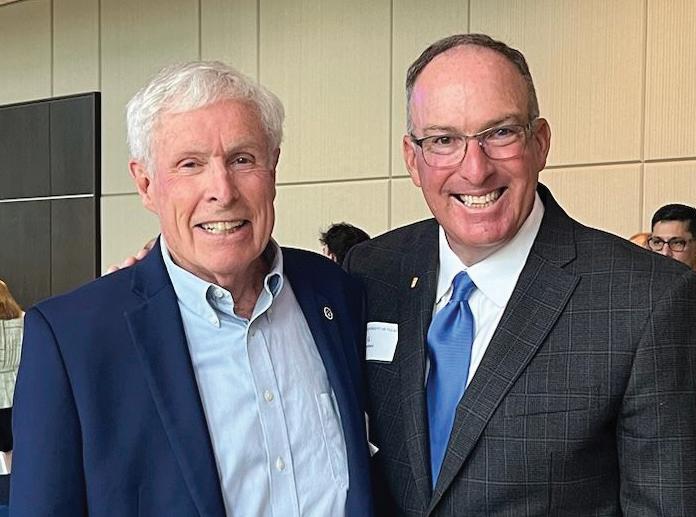
Newell, TULSA 1962, left, is pictured with Significant Sig Gerald Guerrieri, TULSA 1985, during the University of Tulsa 2024 Athletic Hall of Fame induction ceremony on April 27, 2024. Newell was inducted as part of the 1961 and 1962 track and field teams, and Guerrieri was inducted as an individual soccer athlete and coach.
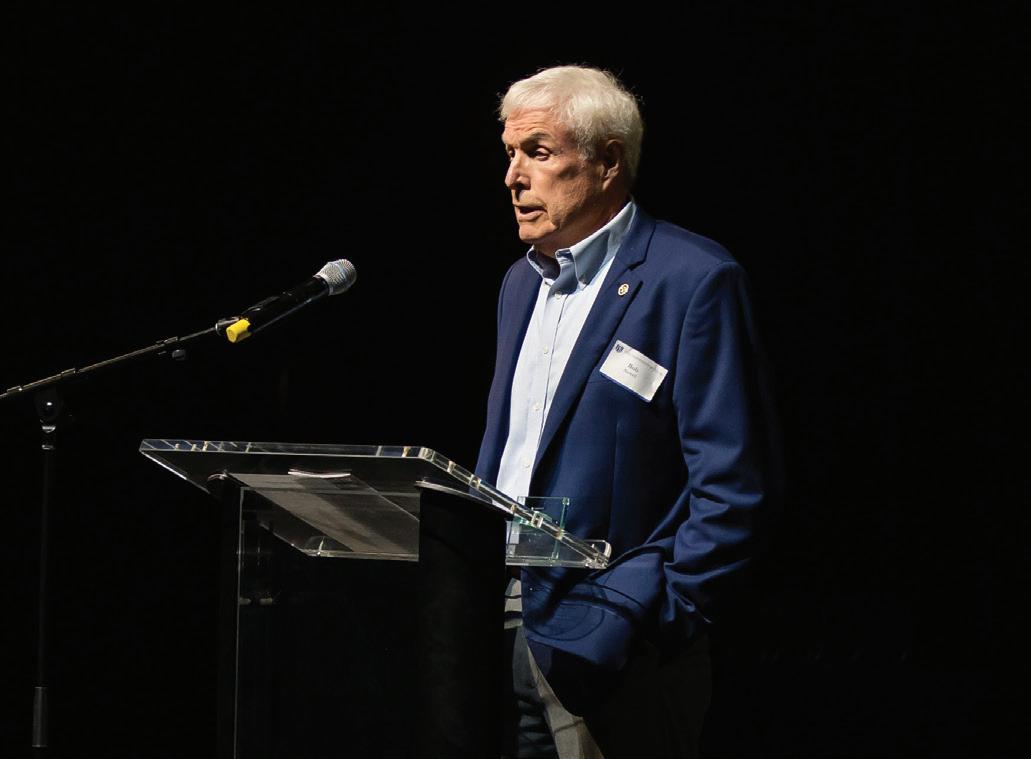
Newell,
, is shown April 27, 2024, during the University of Tulsa 2024 Athletic Hall of Fame induction ceremony. He was inducted as part of the 1961 and 1962 track and field teams.
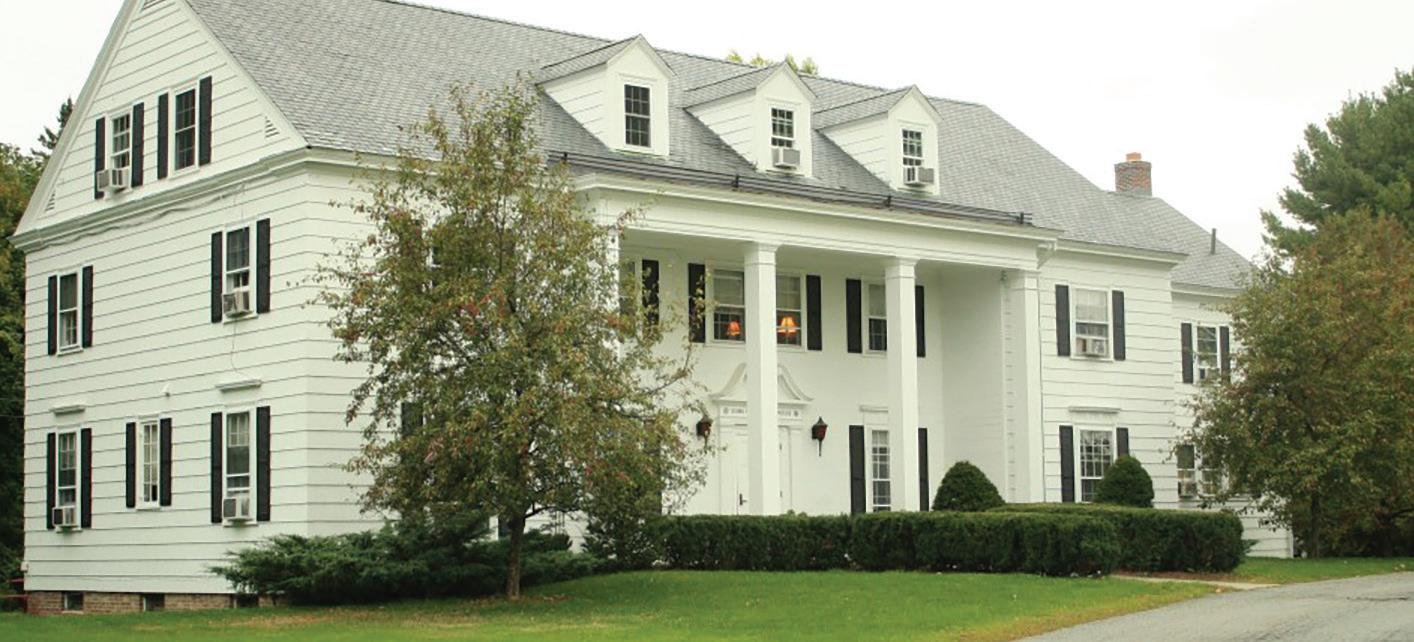

Big cheers for Phil Morse, MAINE 1964, whose generous gift is bringing the boys back home. After two decades as university offices, the Rho Rho chapter house at the University of Maine is returning to its roots. Soon, it will again be filled with young men eager to embody TheJordanStandard. The original Rho Rho chapter house was built in 1935, closed in January 1998 and was sold to the university that April. Scan the QR code for a virtual 3D tour presented by David Clough, MAINE 1980
Bob
Bob
TULSA 1962
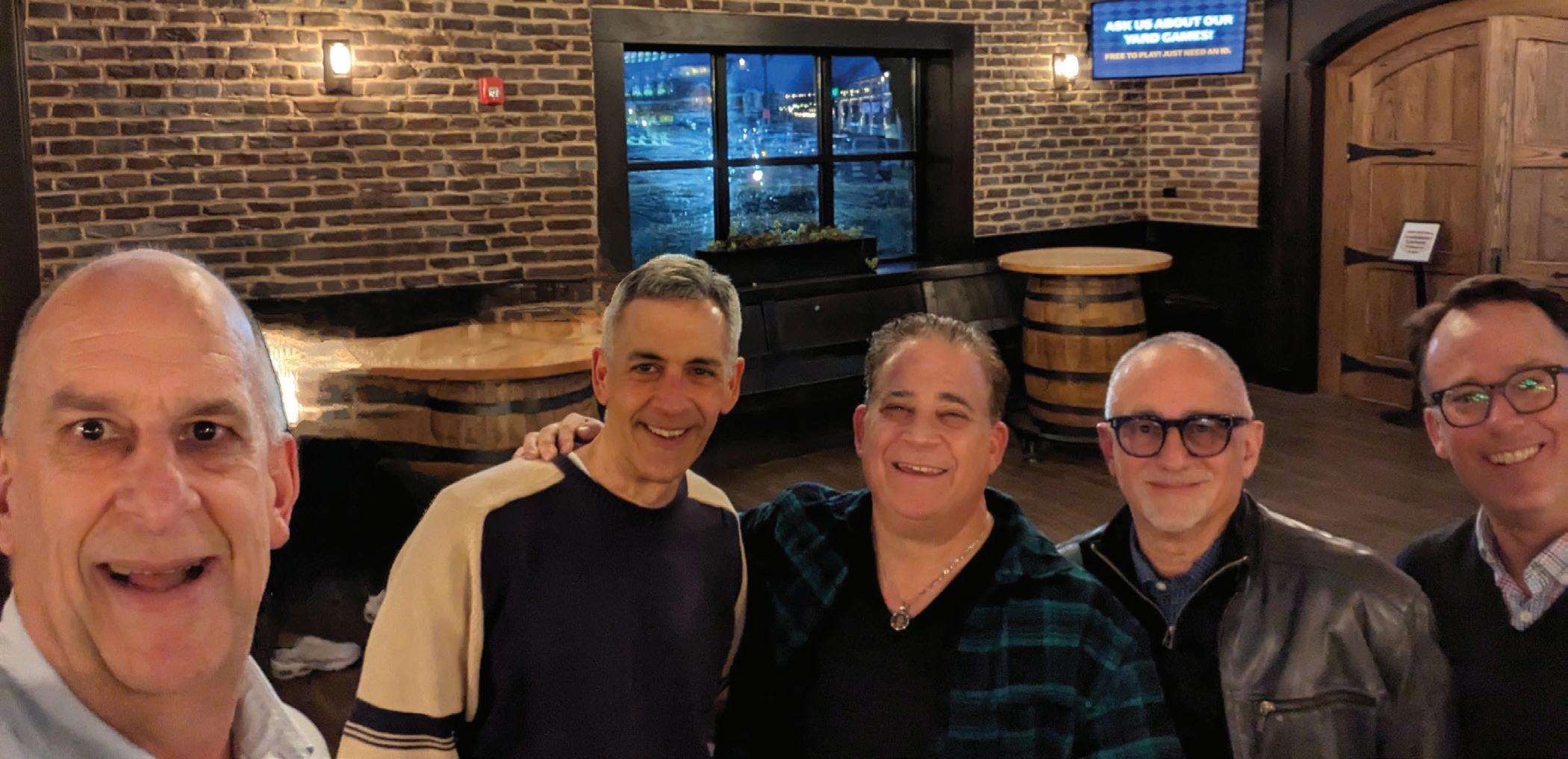
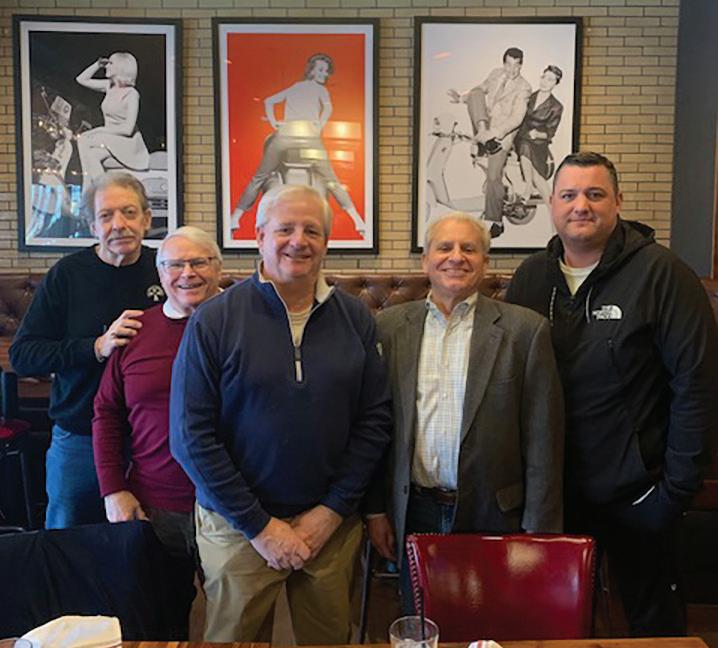
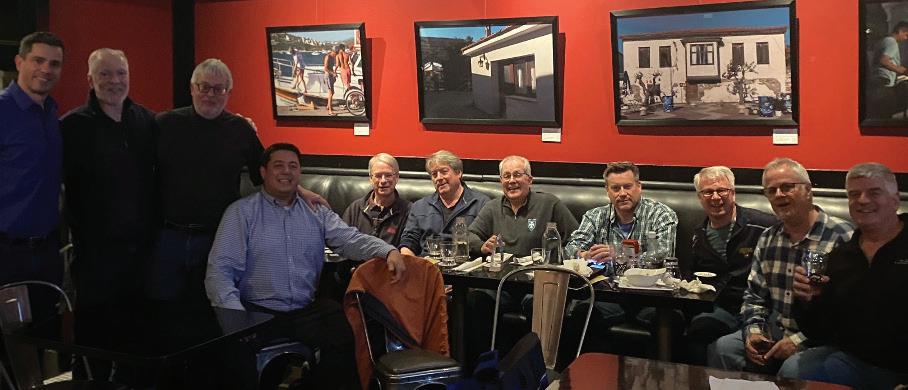
The Charlotte, North Carolina, alumni chapter members held their February social at the Sig-owned Olde Mecklenburg Brewery. Pictured, from left, are Mike Beroth, AUSTIN PEAY 1985; Nicholas Procopio, OSWEGO STATE 1991; Jamie Martino, SUNY-ALBANY 1989; Al Turovlin, VIRGINIA TECH 1978; and John Ault, TEXAS TECH 1987.
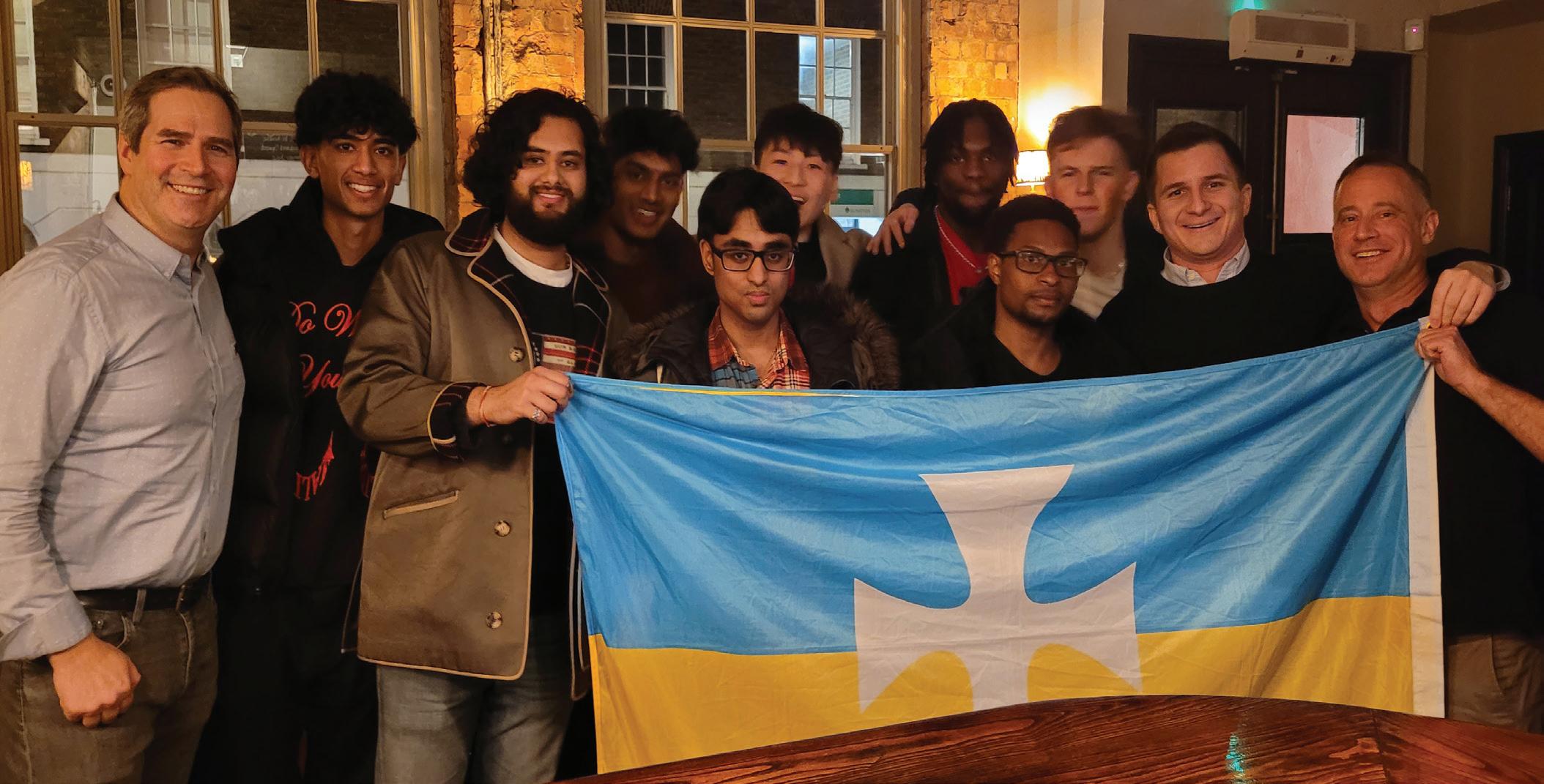
The London alumni chapter, pictured here, held a recruitment event on March 5, 2024, at the Wilmington Pub in London as part of Sigma Chi’s expansion efforts in the United Kingdom.
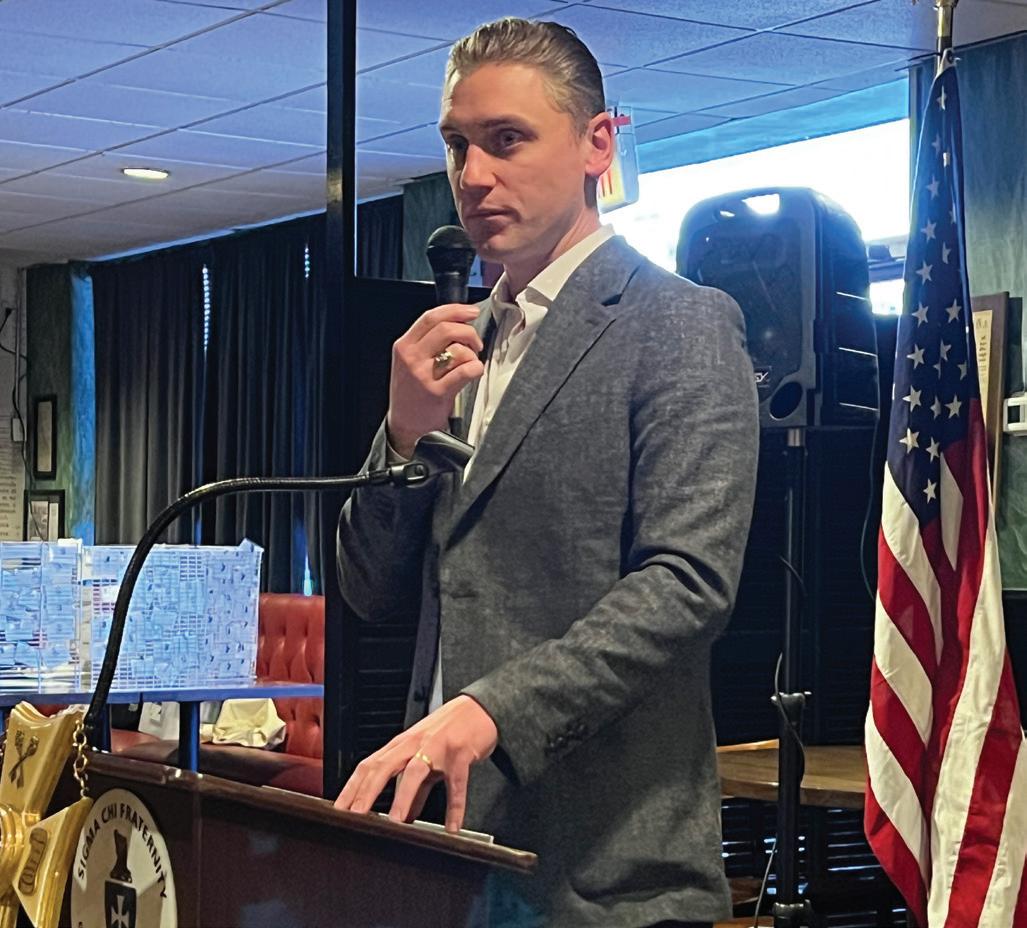
Sigma Chi Executive Director Mike Church, ILLINOIS 2005, pictured, spoke to over 50 brothers at the Dallas alumni chapter meeting in January. The chapter also was proud to host the Executive Committee and Grand Officers for an event.
Eastern Illinois Sigs are pictured April 6, 2024, with Consul Luke Denny, 2025, far left, after gathering in Charleston, Illinois, for the Eta Mu chapter’s first initiation since being rechartered in December.
Pictured with the Chicago-DuPage alumni chapter are chapter president and Order of Constantine Sig Bill Leonard, EASTERN ILLINOIS 1981; Barney Camponeschi, NORTHWESTERN 1973; Doug Wade, EASTERN ILLINOIS 1981; Marty Joseph, EASTERN ILLINOIS 1980; and Andrew Sok, RIPON 2007.
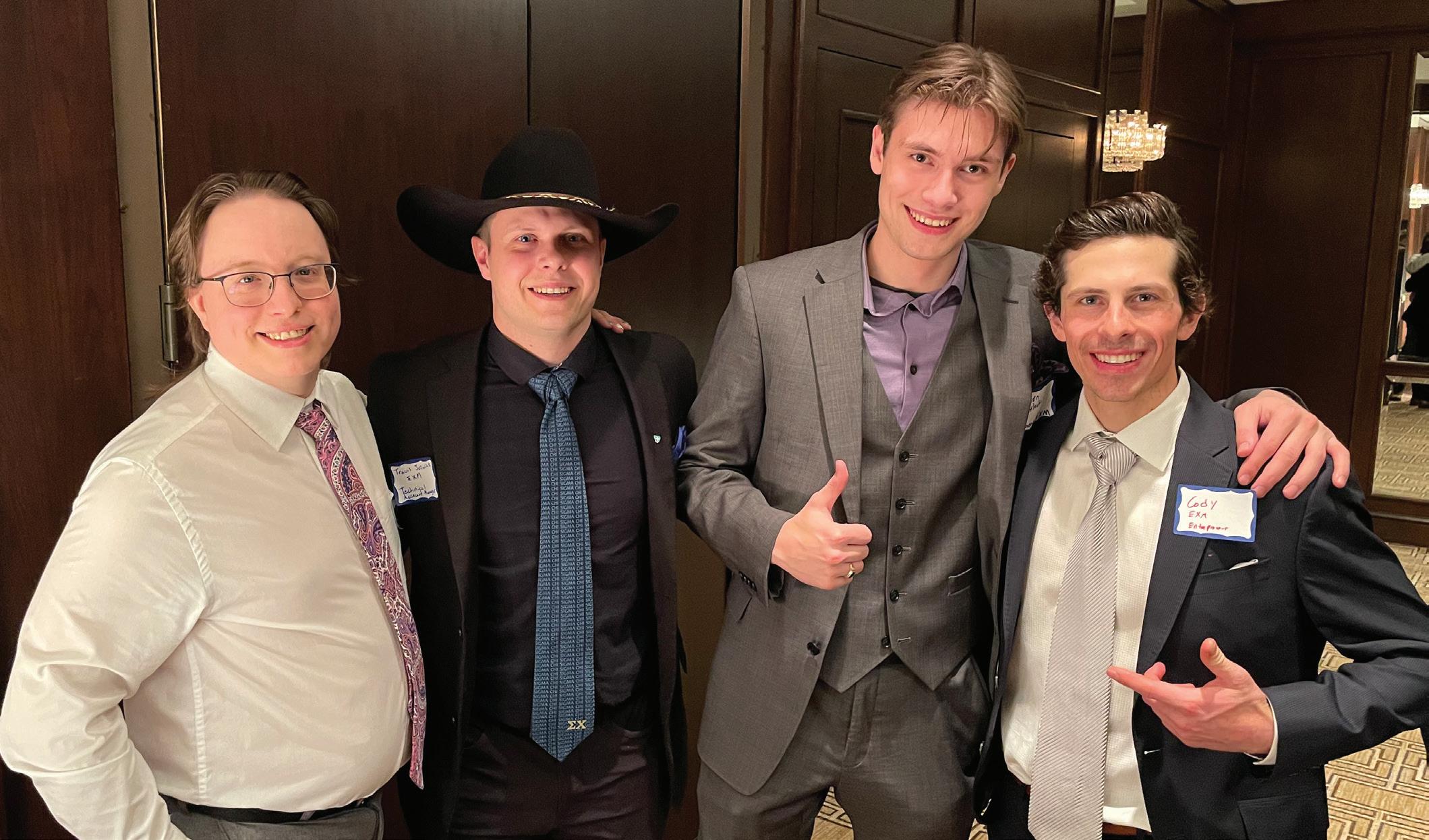
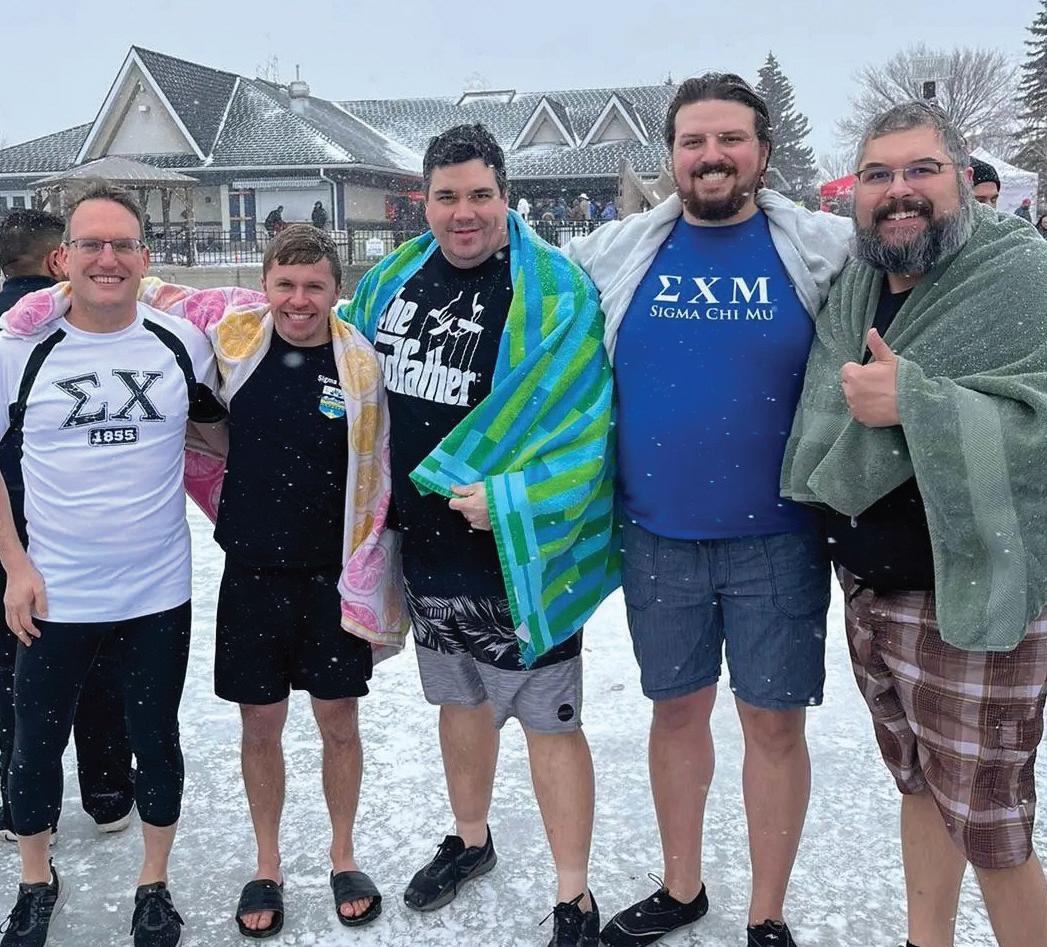
Calgary alumni are pictured participating in a Greek-letter networking event held in April 2024.
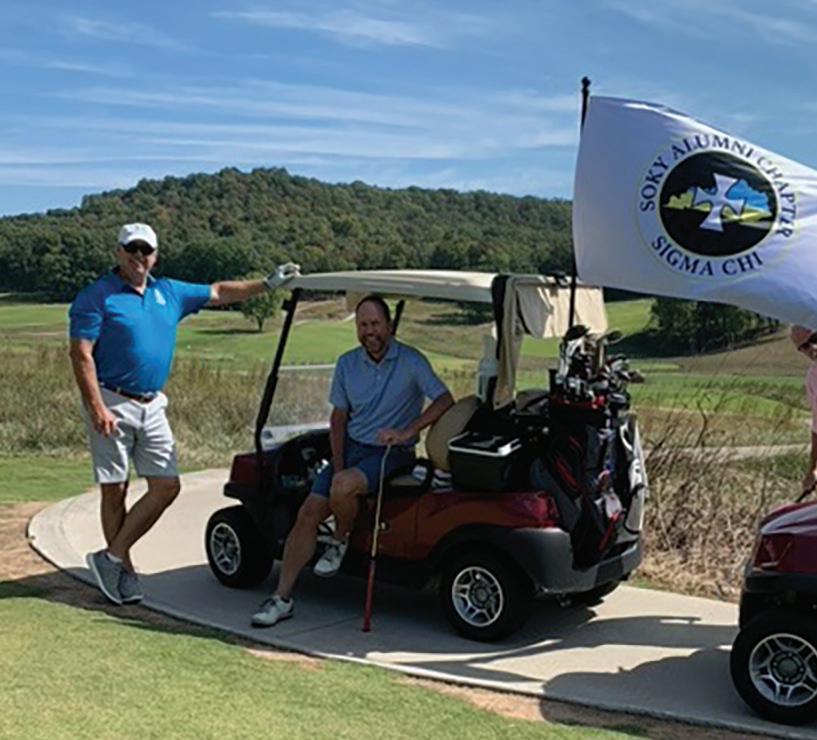
Eric Sack, Western Kentucky 1981, and Scott Blann, Western Kentucky 1981, display the Sigma Chi Southern Kentucky alumni chapter flag while golfing.
Pictured are the Calgary alumni chapter members after they took the Calgary Polar Plunge. The event was held in February and supported Special Olympics Alberta.
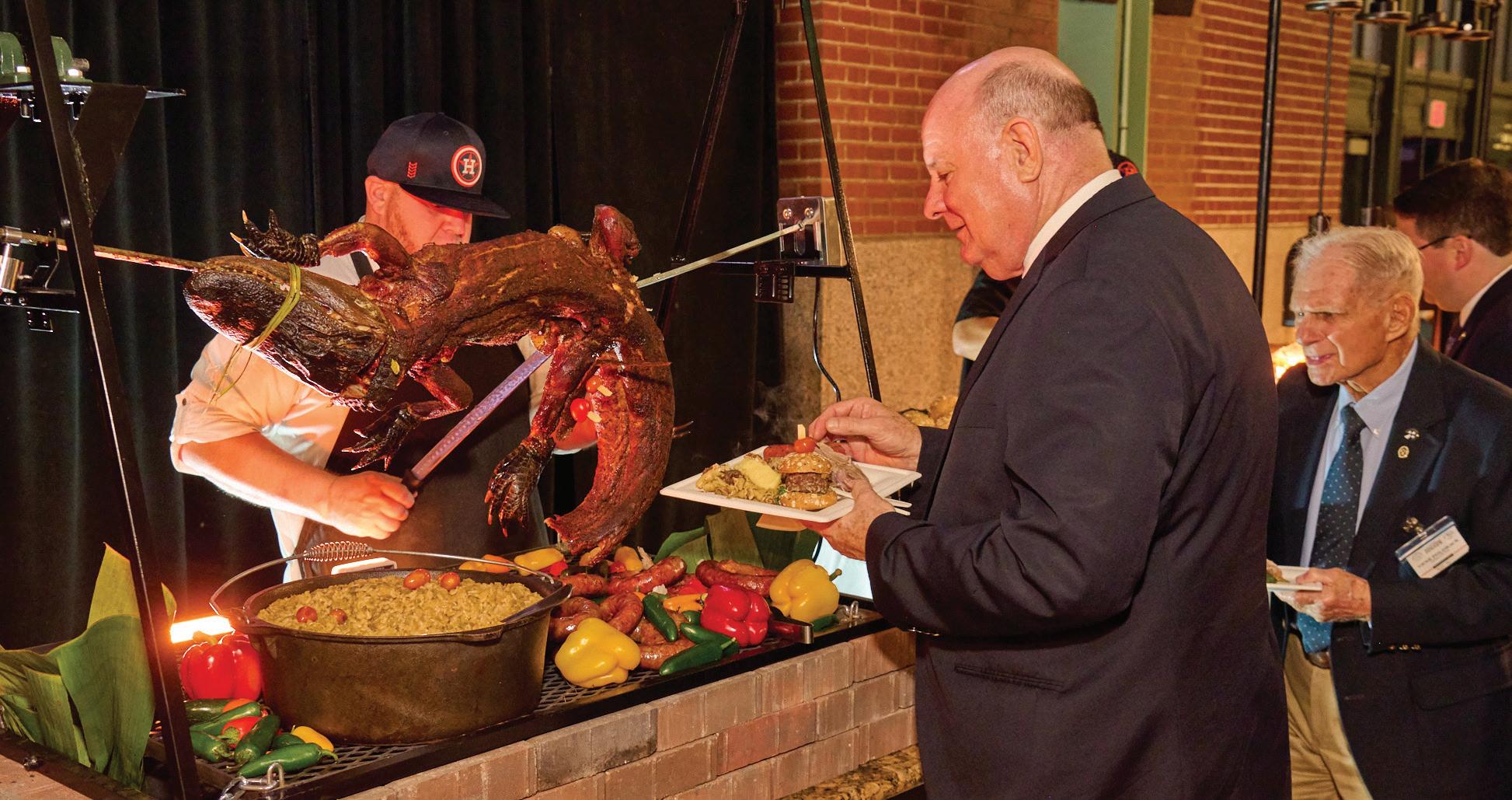
Niels Aalund, HOUSTON 1977, and Order of Constantine Sig Eugene Poldrack, SAM HOUSTON 1961, get ready to enjoy some alligator at the 77th annual Wild Game Dinner hosted Feb. 10, 2024, by the Houston alumni chapter at Minute Maid Park in Houston.
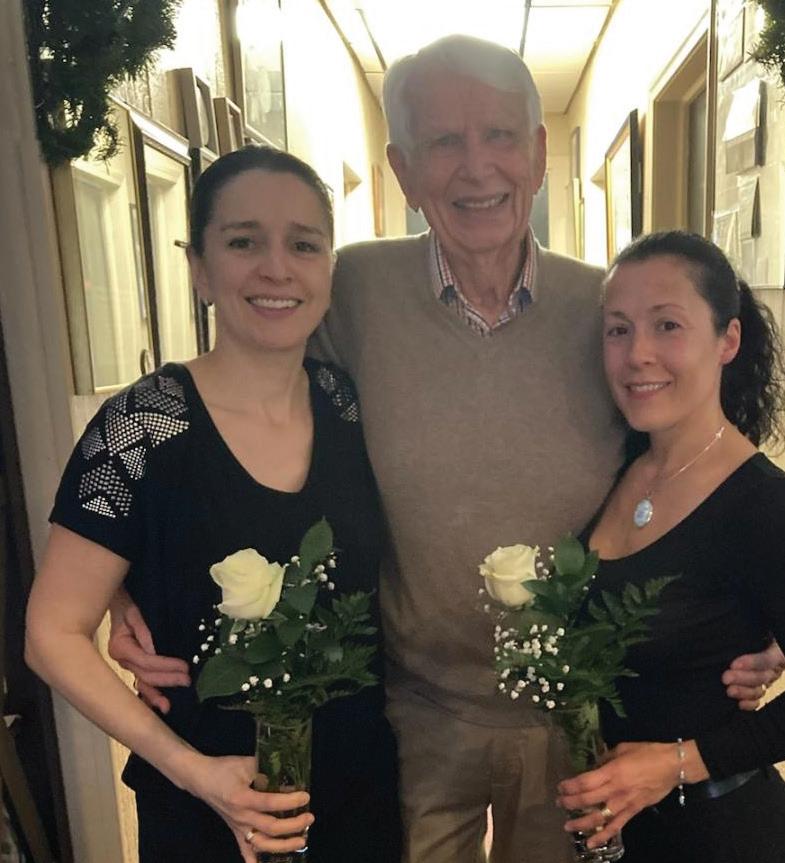
Chicago North Shore alumni chapter president and Significant Sig Mark Nagy, PITTSBURGH 1954, is pictured celebrating his 91st birthday with honorary sweethearts.
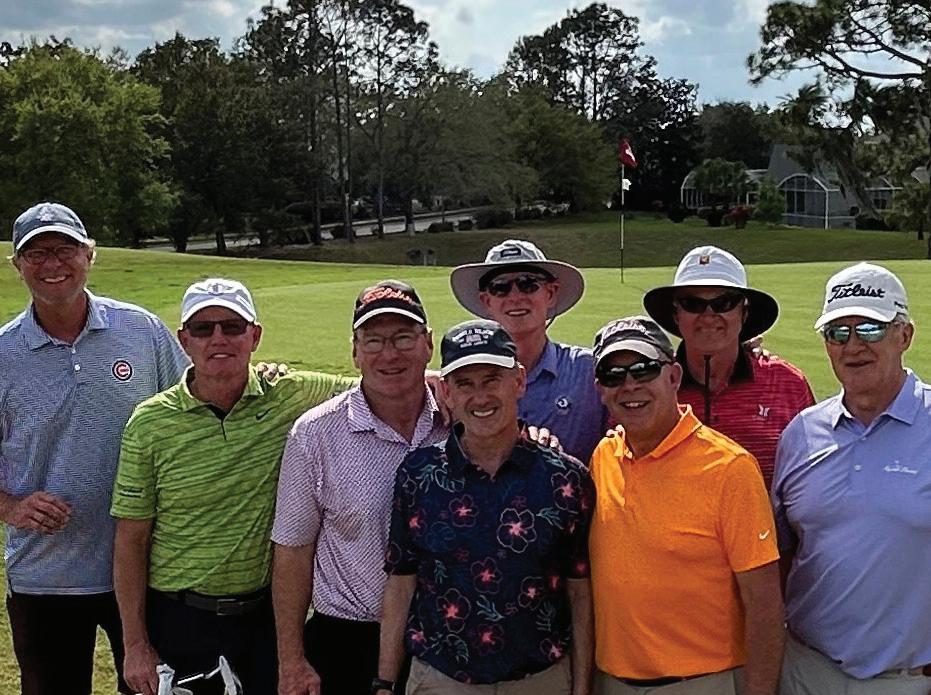
Illinois Sigma Chis enjoyed birthdays and golf in Florida. Pictured, from left, are Paul Lawrence, 1982; Bobby Larson, 1983; Mark Walsh, 1982; Mike Hartley, 1983; Craig Boyd, 1982; John Sutton, 1982; Jeff Kane, 1982; and Greg Dettro, 1981.
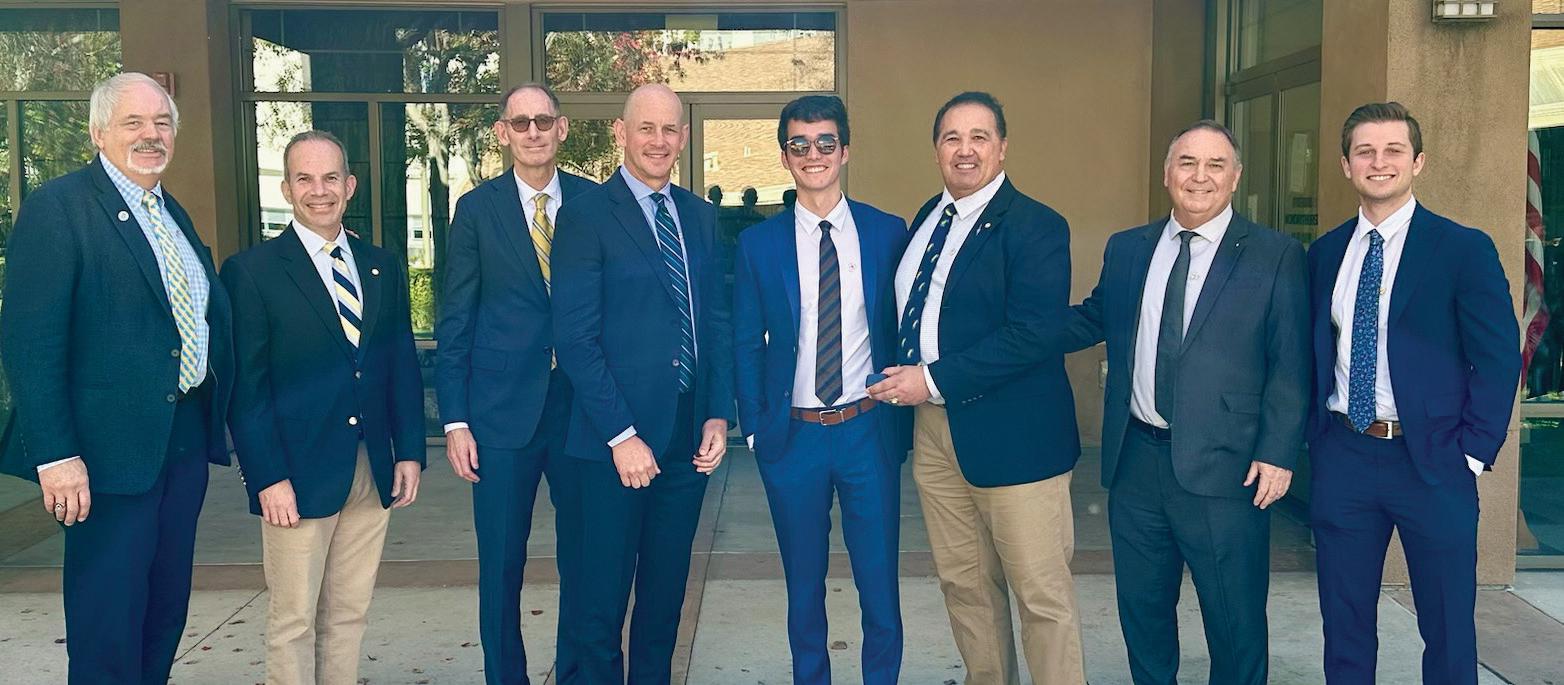
The San Diego Alumni Chapter presents a Consul’s badge to outgoing San Diego State University Consul Trey Chock, 2023, during the chapter’s Dec. 9, 2023, initiation. Pictured, from left, is Order of Constantine Sig Jim Lawson, SAN DIEGO STATE 1985; Significant Sig Rich Segal, YALE 1988; San Diego State Chapter Advisor Chris Ahearn, CAL. STATE-SAN BERNARDINO 1990; Order of Constantine Sig and Grand Quaestor Dan Shaver, TEXAS TECH 1993; Chock; Significant Sig and San Diego Alumni President Pat Suggs, NORTH GEORGIA 1983; Seven Lights Award recipient Ron Powell, SAN DIEGO STATE 1985; and past San Diego State Consul Joe Spinrad, SAN
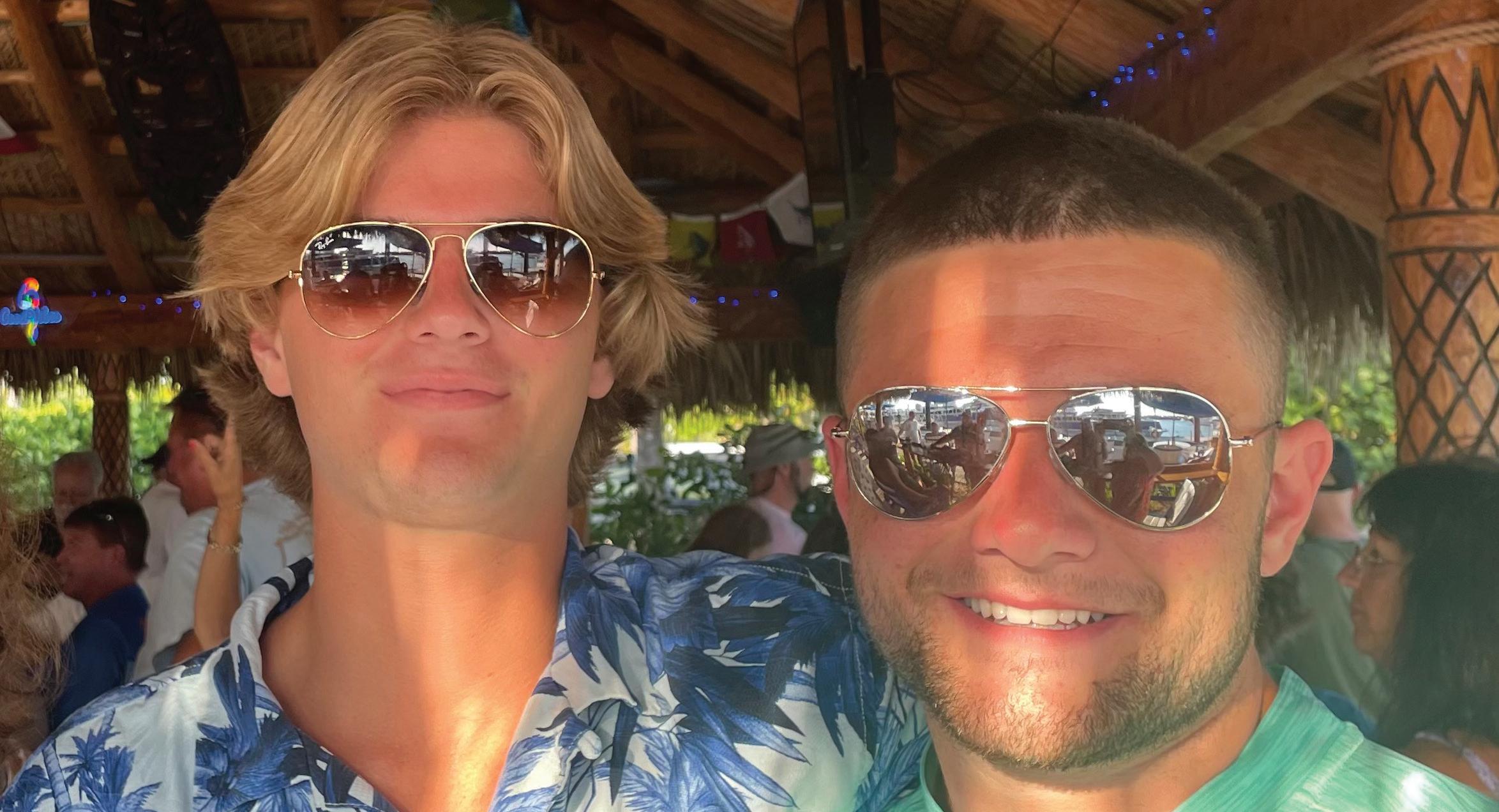
Biological brothers Brad Benwick, FLORIDA
COAST 2026, left, and Zach Benwick, JACKSONVILLE 2024, have both been Consuls of their respective chapters. Zach served as Consul during the 2022-2023 school year, and Brad was recently elected Consul for his chapter.
DIEGO STATE 2022
GULF
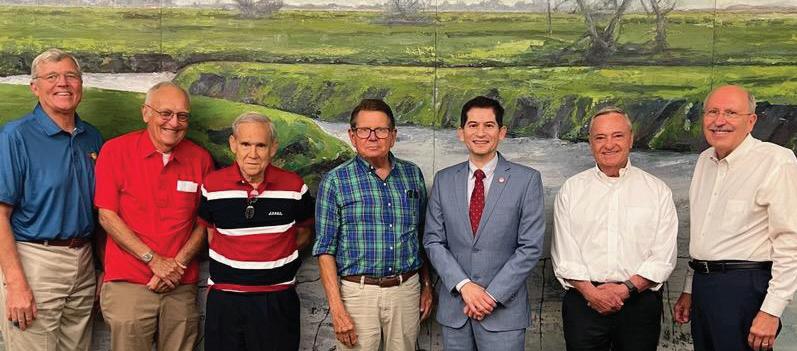
Fresno, California, alumni chapter members attended a luncheon hosted by Fresno State University President Saúl Jiménez-Sandoval, who shared news on the university and his support for the Greek-letter system. Pictured from left, are Significant Sig Bill Smittcamp, CAL. STATE-FRESNO 1975; Jerry Waters, CAL. STATE-FRESNO 1964; Order of Constantine Sig Bill Matesso, CAL. STATE-FRESNO 1965; Order of Constantine Sig Tom Downing, CAL. STATE-FRESNO 1967; Jiménez-Sandoval; Order of Constantine Sig and Significant Sig Mike Patton, CAL. STATE-FRESNO 1966; and Significant Sig Brad Fischer, CAL. STATE-FRESNO 1981
Montreal alumni chapter secretary Marc Perrault, MCGILL 1987, visited chapter president Nigel Fung, MCGILL 2001, on April 3, 2024, for a dinner party with Gamma Lambda diaspora living in Toronto. Brothers had a great night of catching up on decades of memories and current events.
ALUMNI CHAPTER ANNIVERSARIES
AUGUST
8/7/1934
Bartlesville, Oklahoma, alumni chapter, 90 years
SEPTEMBER
9/1/1914
9/9/2004
Fargo, North Dakota, alumni chapter, 110 years
Pikes Peak Region, Colorado, alumni chapter, 20 years
*Anniversaries are listed every five years.
1950s-era Bartlesville, Oklahoma, alumni chapter officers are pictured. Shown, from left, are Dr. Thomas Burris, OKLAHOMA STATE 1946, secretary-treasurer; Thomas Cubbage, OKLAHOMA 1931, president; and Richard Hunter, KANSAS 1951.
The Northern Virginia alumni chapter members are pictured during a social hour.
AUSTIN AREA ALUMNI The chapter celebrated the life of Order of Constantine Sig and founder of the alumni chapter, Tim Aynesworth, TEXAS-AUSTIN 1970
~ Steve Montignani, HANOVER 1974
CALGARY ALUMNI The chapter fostered a strong sense of brotherhood through dynamic support and engagement initiatives. The key to our growth has been supporting the Sigma Chi Mu [Mount Royal] associate chapter with Preparation for Brotherhood as they work toward installation. We also participated in and organized a number of events that showed our community spirit.
~ Andrew Forbes, BISHOP’S 2008
CHARLOTTE ALUMNI The chapter is off to a good start in 2024. We had a fun gathering in January at an indoor pickleball court with our sweethearts. February was back to our favorite — Olde Mecklenburg Brewery. March was an indoor mini golf with our sweethearts, and in June we celebrated Founders Day at the lake.
~ Mike Beroth, AUSTIN PEAY 1985
CHICAGO-DUPAGE ALUMNI After taking a few years off due to COVID-19 complications, Order of Constantine Sig William Leonard, EASTERN ILLINOIS 1981, was named chapter president. The chapter meets on the last Friday of the month at LaBarra restaurant from 11:30 a.m. to 1 p.m. in Lombard, Illinois.
~ Leonard
CHICAGO NORTH SHORE ALUMNI Monthly lunches at the Italian Kitchen in Deerfield, Illinois, are open to all Sigs. The chapter meets on the first Thursday of each month and has for over 20 years. Significant Sig Mark Nagy, PITTSBURGH 1954, leads the chapter and truly exemplifies the Spirit of Youth as we honored his 91st birthday recently.
~ Order of Constantine Sig William Bringham, ALBION 1975
CLARKSVILLE ALUMNI Sam Weems, AUSTIN PEAY 1982, spearheaded the creation of the Clarksville Sigma Chi Alumni Chapter Scholarship Foundation with the purpose of providing scholarships to eight Austin Peay brothers. Each scholarship is named after brothers who entered the Chapter Eternal who shaped our chapter.
~ Joshua Smith, AUSTIN PEAY 1995
DALLAS ALUMNI Executive Director Mike Church, ILLINOIS 2005, spoke to over 50 brothers at our January chapter meeting. Last year, we had 200 paid members of the chapter and were proud to host the Executive Committee and Grand Officers for an event. In May, we held a golf tournament to raise money for the L. Wayne Tucker Scholarship.
~ Order of Constantine Sig Jim Bloom, SAN DIEGO STATE 1982
FRESNO ALUMNI The chapter has close ties to Fresno State University President Saúl Jiménez-Sandoval. He hosted a lunch to share news on the university and his support to the Greek-letter system. He has been a guest speaker at our alumni meetings and will visit again.
~ Significant Sig Brad Fischer, CAL. STATE-FRESNO 1981
LONDON, UK, ALUMNI Our chapter gathered in January to compete in a pub quiz, earning second place. In March, we supported the Expansion Committee efforts to establish an undergraduate chapter in London. To contribute to establishing the first transatlantic undergraduate chapter, please visit sigmachi.uk.
~ Ryan Chen-Wing, WATERLOO 2006
MID-CITIES ALUMNI Our chapter is entering a renewed phase with newly elected officers driving innovative ideas and collaboration. While traditionally centered around the Texas-Arlington chapter, we are broadening our footprint with hopes to attract the vast community of non-Texas-Arlington Sigs living between Dallas and Fort Worth.
~ Mark Tzatzaris, TEXAS-ARLINGTON 2000
MISSOULA ALUMNI The chapter has grown and maintained membership by continuing our regular weekly luncheon meetings and events. These include an annual Homecoming tailgate and Captain’s Cup golf scramble. We also added a graduation reception to celebrate graduating Sigs.
~ Brad Cederberg, MONTANA 2006
MONTREAL ALUMNI On April 3, 2024, chapter secretary Marc Perrault, MCGILL 1987, visited chapter president Nigel Fung, MCGILL 2001, for a dinner party with the McGill alumni living in Toronto. It was a great night of brothers catching up on decades of memories and current events. ~ Perrault
NARRAGANSETT BAY ALUMNI The chapter is pleased to announce many of our recent alumni have been engaged, married or expanded their families. The Rhode Island alumni continue to contribute by being active on the university’s Greek[-letter] Alumni Council. We are also following state legislation that may affect Greek-letter life and undergraduate engagement.
~Philip Genereux, RHODE ISLAND 1993
NORTHERN VIRGINIA ALUMNI The start to 2024 was bustling for the chapter, actively bolstering both undergraduates and the Eastern province through a series of meaningful events. The inaugural George Mason University Homecoming and tailgate blended alumni and current members in a display of unity and spirit. The following alumni smoker deepened the bonds. These, and more, gatherings reflect the chapter’s vibrant activity in 2024, underscoring the enduring Sigma Chi journey of brotherhood.
~ Morgan Wright, MIAMI (OHIO) 1957
SOUTHERN KENTUCKY ALUMNI It’s official: The Southern Kentucky [SOKY] alumni chapter has been formed! The chapter, headquartered out of Bowling Green, Kentucky, held its first outing at the Park Mammoth golf course in September. We encourage all alumni with a tie to southern Kentucky to join our Facebook group and be a part of our next exciting outing.
~ Tony Rhoades, WESTERN KENTUCKY 1981

BY ASHLEY SZATALA //////////////////////
WHY FRATERNITIES MATTER
SIGMA CHI EXPERIENCE
PROVIDES A LIFETIME OF IMMEASUREABLE IMPACT

>>> Fraternity membership adds value to the educational experience while also benefiting the institution and community at-large.
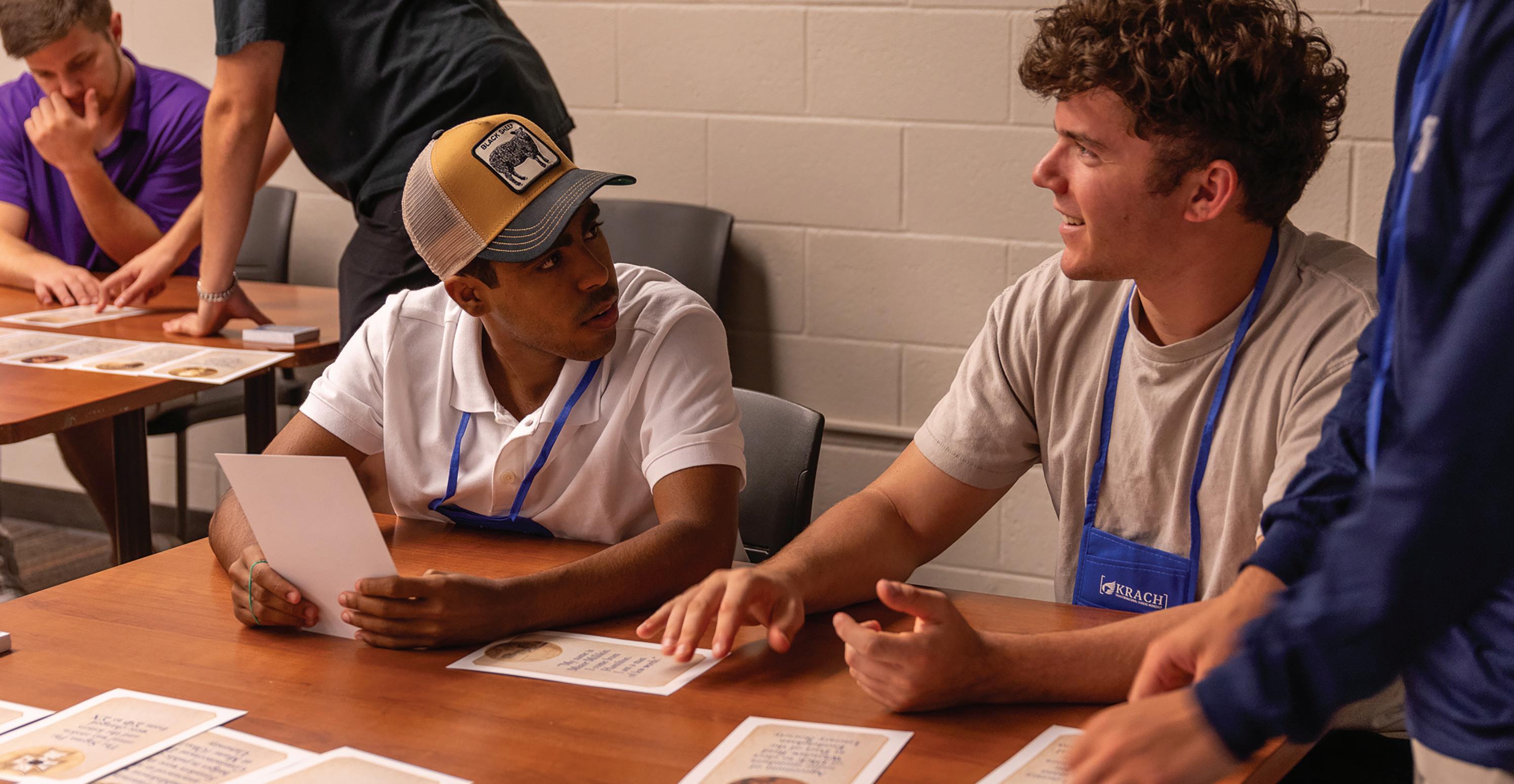
It’s no secret that the collegiate climate is not what it used to be – and its more different especially for men than it has ever been. The male student population is shrinking, and men now represent just under 40 percent of total college enrollment. In addition, once a male student enrolls in college, he is less likely than his female counterparts to come back to school year after year and to persist, ultimately, to earning a degree. With less men enrolling and staying in college, the significance and creativity of the recruiting practices used by chapters have taken on new importance.
As Richard Reeves, president of the American Institute of Boys and Men, has said: “The gender gap in higher education is wider today than it was in 1972, when Title IX was passed, but the other way round, with men earning only 42 percent of degrees.”
“Less men on college campuses — especially where the recruitment landscape is already tight and getting increasingly more competitive — means Sigma Chi needs to be able to offer a very strong narrative about the value of joining our Fraternity that really resonates with today and tomorrow’s student if we are to be able to maintain and grow our relevance,” says Executive Director Michael Church, ILLINOIS 2005
Reeves quotes several other data points that illustrate the challenges that men and boys are facing:
• In the average school district, boys are almost a grade level behind girls in English language arts (there is no gap in math).
• The risk of suicide is four times higher for boys and men than their female peers and has risen by more than a third among younger men since 2010.
“Sigma Chi needs to be able to offer a very strong narrative about the value of joining our Fraternity that really resonates with today and tomorrow’s student if we are to be able to maintain and grow our relevance. ”
- Executive Director Michael Church, ILLINOIS 2005
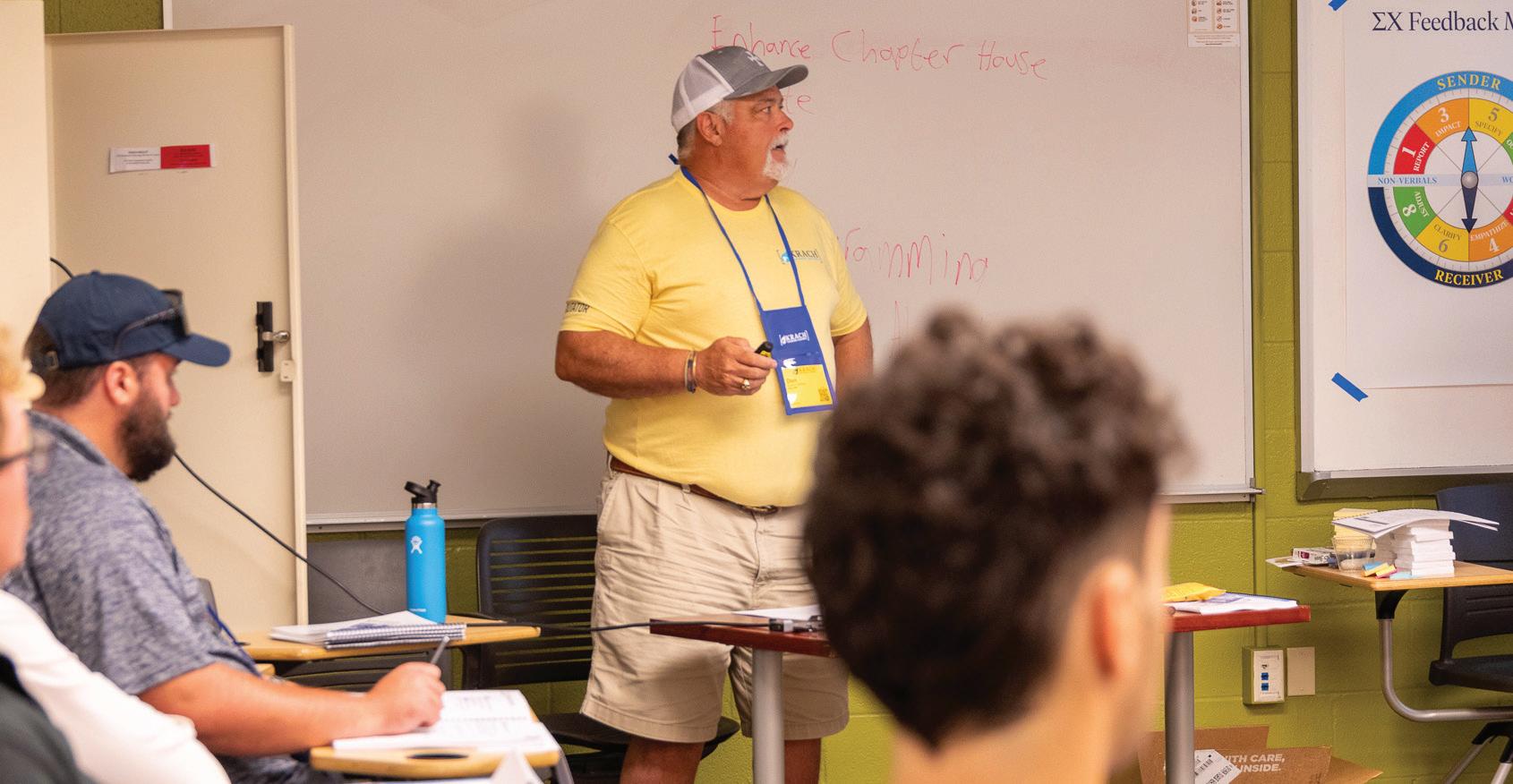
• Male deaths before the age of 65 resulted in over 4 million years of potential life lost in 2022, three times the number for women.
• Employment rates among Black men are lower than for white men, white women and Black women.
Sigma Chi can’t solve all of these problems on its own, but the Fraternity is committed to being a solution wherever it can. The good news, amongst the bad, is that fraternities and fraternal involvement actually enhance several critical outcomes regarding student, personal and post-graduate success as well as build stronger affinity for their alma mater and an improved overall educational experience.
And that is at the heart of the evolution of Sigma Chi and the message that we believe will appeal to the current generation of college students and the ones that will come after: You can have a high-quality educational experience, but Sigma Chi will enhance it with a lifetime of measurable impact.
WHY THE DOWNWARD ENROLLMENT TREND?
Although men’s enrollment in college has been declining for years, it is poised to dramatically drop in 2025. A major contributing factor to this drop is that the number of children born in the U.S. has been steadily shrinking, and during the Great Recession from December 2007 to June 2009, the number of births plummeted. According to Centers for Disease Control and Prevention data, births fell by 4 percent during that period, the most for any two-year period in more than 30 years. The CDC also shares that from 2007 to 2022, the national birth rate fell by 23 percent.
Another factor in the enrollment decrease is fewer men are choosing to go to college. The Pew Research Center says in a recent report that the number of 18- to 24-year-old men enrolled in college in 2022 was down by 1 million from peak enrollment in 2011. In other words, according to the research center, only 39 percent of young men who have completed high school are enrolled in college today, compared to 47 percent in 2011. The U.S. Department of Education’s National Center for Education Statistics supports this assessment. Its data shows that over the last five years, men’s full-time enrollment decreased by just over 6 percent, whereas all undergraduate enrollment decreased by over 2.5 percent. In addition, 131,000 less men enrolled in college just in the last year alone.
Their reason for not attending college is consistent across multiple studies: Their confidence in the benefits of higher education is low. A 2023 Gallup poll revealed that only 36 percent of respondents have “a great deal” or “quite a lot” of confidence in higher education, which represents a drop from 57 percent in 2015. In addition, a 2023 survey between the Wall Street Journal and research organization NORC found that 56 percent of people don’t think a four-year degree is worth the cost. Similar studies have also found that other reasons for not attending college include not being able to afford tuition, not feeling like the additional education was required for the job they wanted and personal preference of not wanting to attend college.
Compounding this enrollment challenge is the fact that men have lower retention rates once they do get to college. A study by the Brookings Institution shows that men enrolled in a four-year college are 10 percentage points less likely than women to graduate within four years; put another way, about 74 men
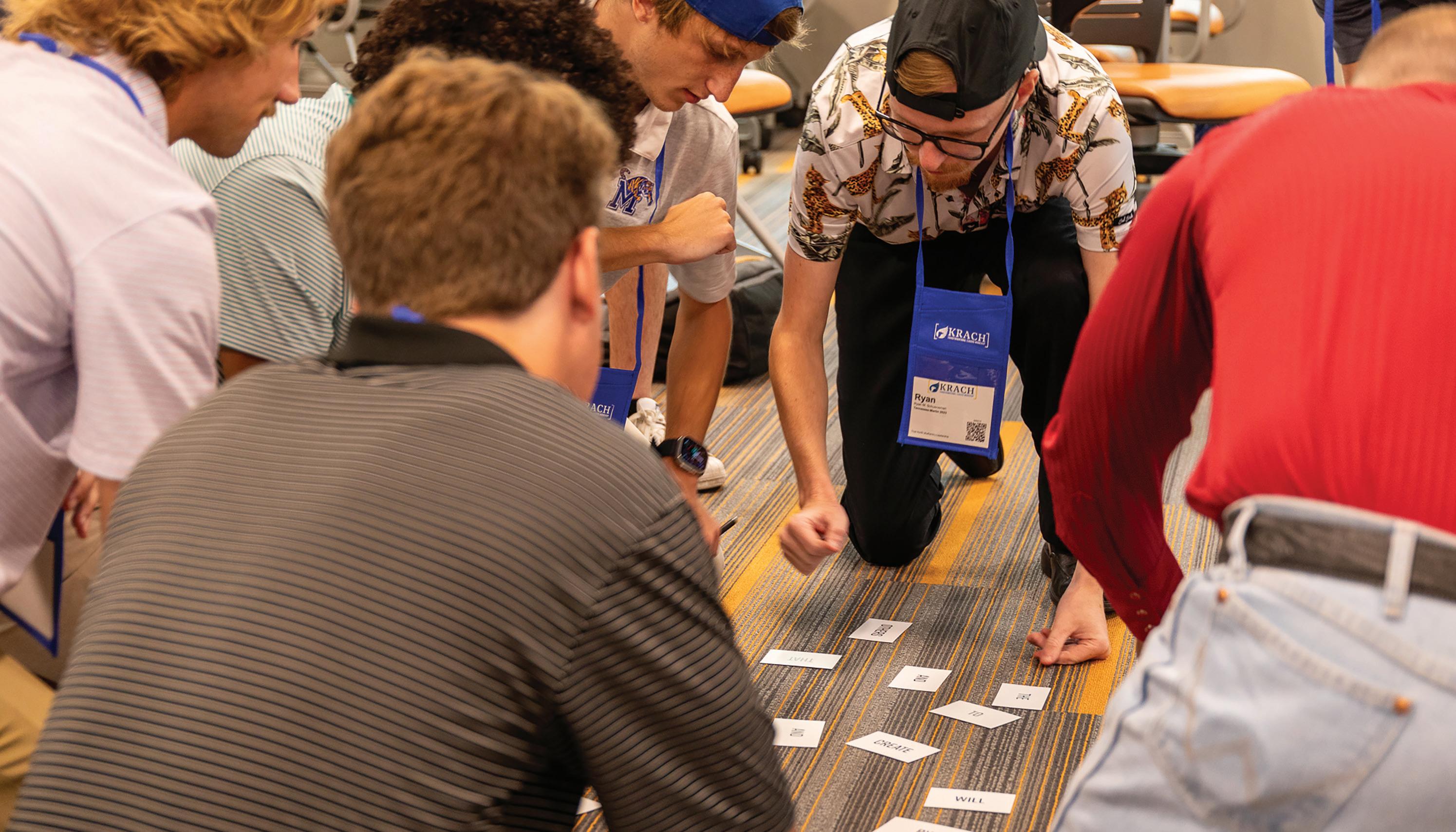
“Creating timeless bonds of strong friendships rooted in true brotherhood is what we do best, and that acts as a buffer or a salve against negative mental health indicators.”
- Executive Director Michael Church, ILLINOIS 2005
received a bachelor’s degree for every 100 women who receive one. A 2022 NIC analysis pointed out that where many men drop out occurs during the freshmanto-sophomore transition.
How is all of this impacting higher education? According to the North American Interfraternity Conference, declining enrollment is hitting regional public institutions in the Northeast and Midwest the hardest, while flagship, flagship-like, and toplevel private institutions’ enrollment remains steady. NIC data shows that men’s enrollment at schools with 10-plus Interfraternity Council chapters is down only 2 percent the last five years, but those with less than 10 IFC chapters are down 12 percent.
Ultimately, men who do attend college are seeking more value from the experience and a greater guarantee that the money and time spent in school is worth the professional outcome after graduation. This is where fraternities can help supplement the educational courses to provide that value-added experience while also benefiting the institution and community at-large.
OUR VALUE-ADDED EXPERIENCE
Studies show that fraternity membership connects men to their university and learning opportunities in ways non-affiliated students don’t get exposed to. Many of these connection points stem from the sense of belonging and community intrinsic
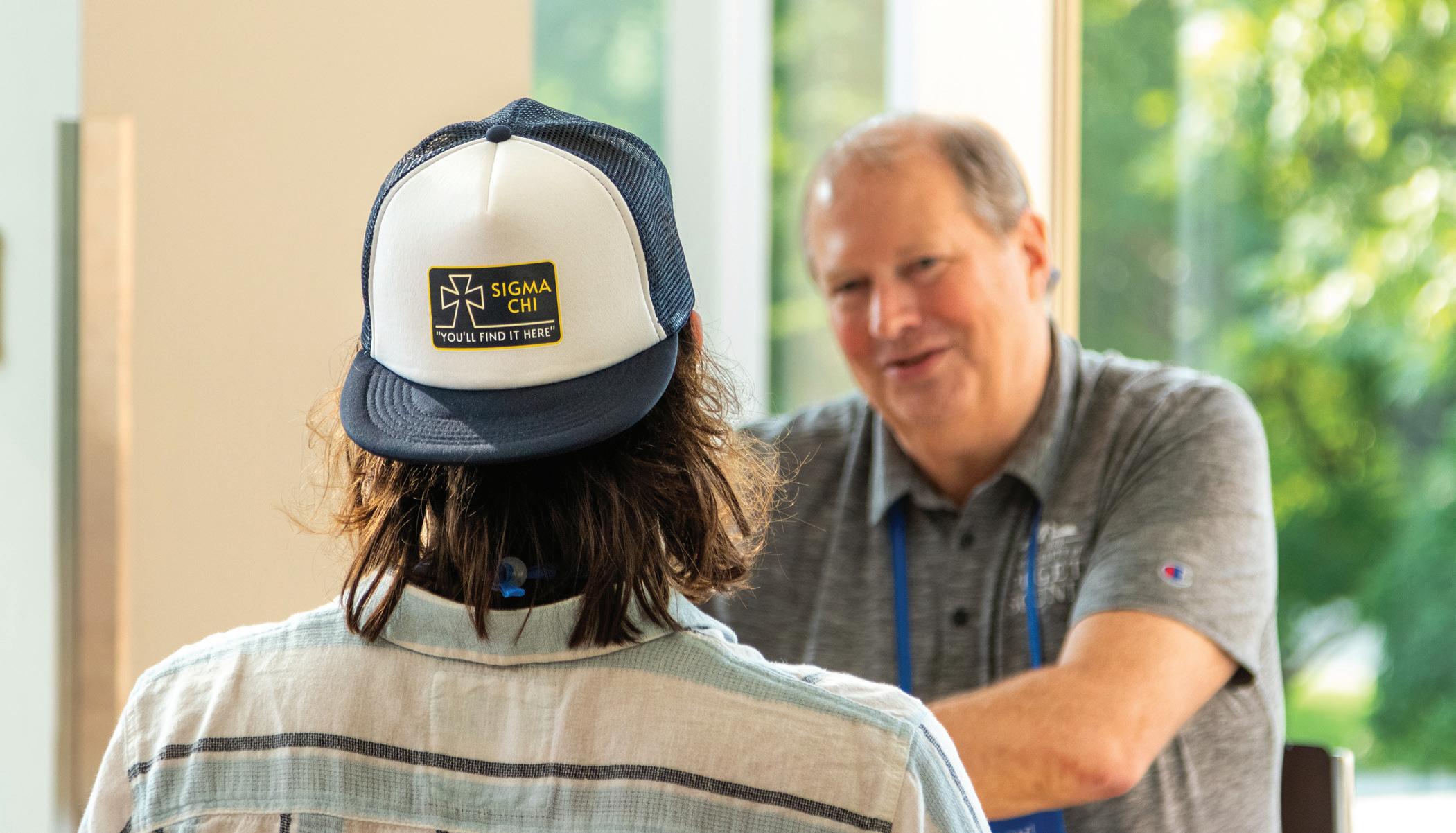
to a fraternal experience as well as the extracurricular activities fraternity members participate in. These activities, in turn, build affinity for their institution and their campus experience.
“U.S. Surgeon General Vivek Murthy has stated that we are facing ‘an epidemic of loneliness and isolation.’ This is hugely problematic when you consider that a person having close friendships is one of the leading contributors to whether a person has positive mental health indicators. And, so, this is how fraternities — and Sigma Chi especially — step in to facilitate being part of the solution,” Church says. “For example, one-fourth of college-aged men enter post-secondary education with a diagnosed mental health condition. Creating timeless bonds of strong friendships rooted in true brotherhood is what we do best, and that acts as a buffer or a salve against negative mental health indicators.”
Recent NIC research also indicates that fraternities provide strong leadership development and professional networking; create lifelong connection to their campus, community and friends; and help support stronger mental health.
According to that same research, fraternities also:
• Increase belonging and connectedness and decrease loneliness.
• Support academic success and insistence to graduate.
• Teach leadership development.
• Facilitate intentional spaces to create meaningful male friendships.
• Create purposeful, safe and positive rites of passage.
• Provide academic and personal mentoring and advising.
• Offer skills and career readiness training.
• Assist with networking for research opportunities and internships.
• Contribute to financing education and related opportunities.
• Build affinity for their institution and community through extracurricular involvement.
“Sigma Chi’s mission is to foster a brotherhood of transformational leaders who are committed to friendship, justice and learning. We take our mission seriously because we know we have an incredible opportunity to be a meaningful contributor to the betterment of the lives of the men who are worthy of the honor of being a Sigma Chi,” Church says. “We fulfill that mission by providing a network of friendship and brotherhood that lasts a lifetime and a personal development experience through our Transformational Leader Program that substantially increases the opportunities for the success of our men.”
Read the other stories contained within this issue of The Magazine to explore more in depth the great value that Sigma Chi brings to the lives of its men.
BY NATHANAEL HAWTHORNE, YOUNGSTOWN 2020
Sigma Chi alumni find bright futures with the Transformational Leader Program
College-aged men who join Sigma Chi are statistically proven to have better futures after graduation, especially when taking the Transformational Leader Program
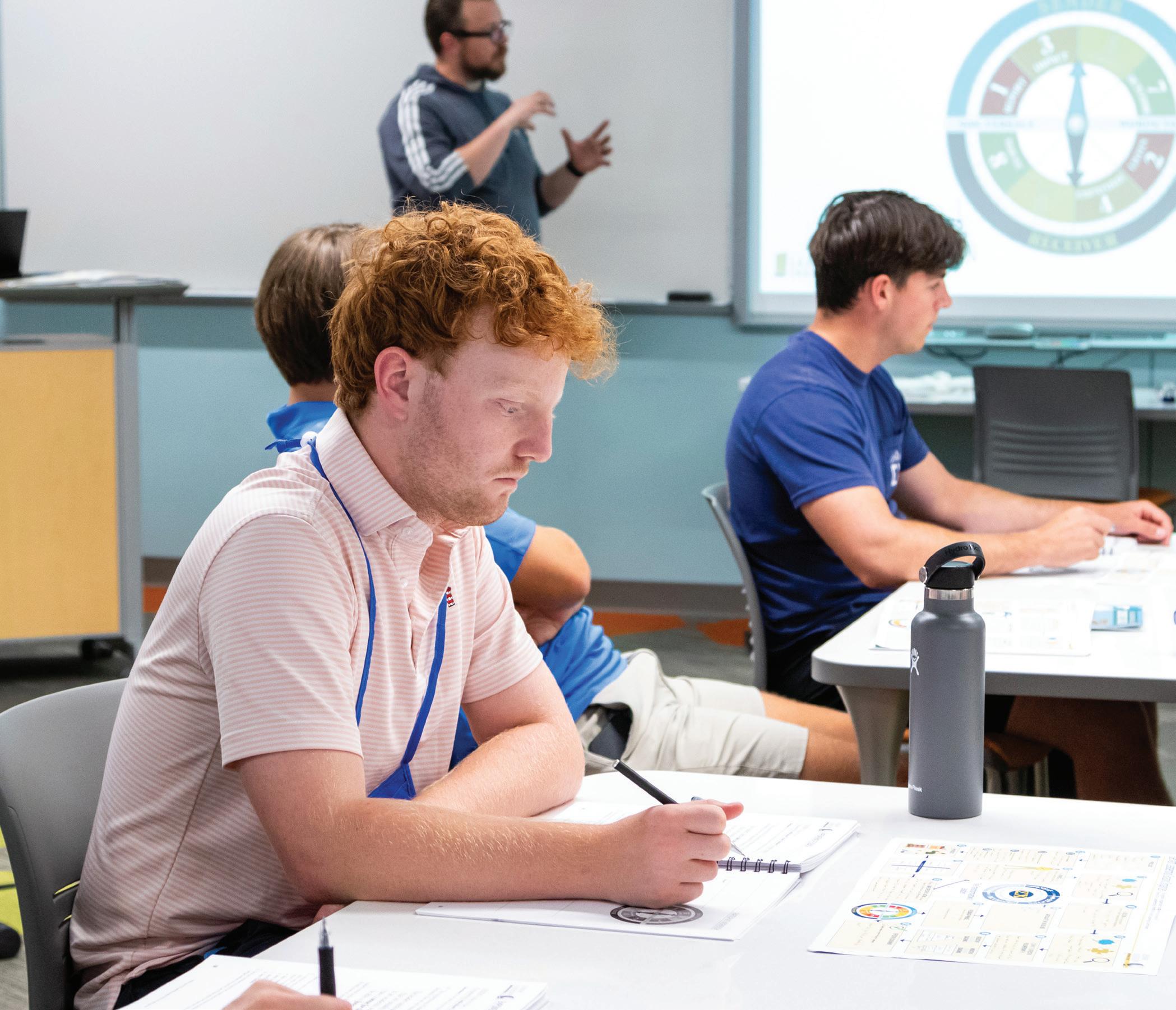
When the Sigma Chi International Fraternity launched the Transformational Leader Program in 2021, it did so with the vision that the skills featured within the many leadership courses would significantly improve the cultural stigma of what it means to be a fraternity man.
Kevin Kirwan, ALABAMA-BIRMINGHAM 2025, is living proof of that vision. Sigma Chi’s Transformational Leader Program, which officially became the Fraternity’s member development program at the 83rd Grand Chapter in Scottsdale, Arizona, in 2021, quickly has been compiling data and stories from brothers like Kirwan since its pioneering leadership certificates were introduced at Krach Transformational Leaders Workshop at Miami University in 2021.
The feather in the cap for the Fraternity is that the entire program, including multiple award-winning leadership experiences within it, is carefully crafted by the interfraternal landscape’s first and only Greek-letter affiliated accredited organization, Sigma Chi Leadership Institute [SCLI]. The organization earned ground-breaking accreditation from the Middle State’s Association’s commission on Elementary and Secondary Schools — recognized by the U.S. Department of Education — in 2022.
Since then, thousands of undergraduate brothers, like Kirwan, have earned leadership certificates and critical workplace skills at Krach TLW and Horizons Huntsman Leadership Summit. The results of these experiences for Sigma Chi members can now be displayed in incredible findings by Gallup following a threeyear partnership with Sigma Chi to track graduates of the program.
THE DIFFERENCE BETWEEN FRATERNITIES AND SIGMA CHI
According to the North American Interfraternity Conference [NIC], men who join fraternities as a whole loved their college experience. In research conducted by the NIC, 8 out of 10 fraternity members said they would rejoin their organizations. A survey conducted of Sigma Chi alumni who graduated between 2017 and 2023 expands upon that point. A staggering 94 percent of those surveyed said they would rejoin Sigma Chi if they had to start college over again.
NIC research proves membership in a fraternity connects its members to the university in a way non-members don’t experience. Graduates from universities who were in Greek-letter life are more likely to recommend and give back to their alma maters. Survey responses show that 89 percent of those young Sigma Chi alumni felt satisfied with their undergraduate experience. Those who receive at least one Transformational Leader certificate beyond Foundational Leadership, such as Preparation for Brotherhood and Ritual for Life, are twice as likely to find satisfaction with their Sigma Chi undergraduate experience. This means that every Sigma Chi will receive a high-quality leadership program just for pledging and being initiated — something no other fraternity can offer.
The data also suggests nearly half of fraternity members serve in leadership roles in some capacity. Sigma Chi members, however, are represented well among leadership positions. The Fraternity boasts 19 student body presidents at their universities across the United States and Canada. Also, Sigma Chi averages 2.3 Interfraternity Council officers per chapter.
Sigma Chi members also participate in other extracurricular activities. NIC research indicates fraternity members have a higher tendency to be involved, but of the young Sigma Chi alumni, 82 percent participated in a student club or organization outside the Fraternity and 53 percent participated in off-campus community organizations.






Transformational Leader Programs important in achieving promotion
Number of Transformational Leader Programs Taken
Transformational Leader Programs important in achieving raises
Number of Transformational Leader Programs Taken
Transformational Leader Programs important in achieving job growth
Number of Transformational Leader Programs Taken
Number of Transformational Leader Programs Taken
Even further accentuating the NIC research, while fraternity members spend significantly more time volunteering than those not in Greek-letter life, Sigma Chi undergraduates combined spent more than 100,000 hours performing community service or philanthropic work in the 2022-2023 academic year, on top of raising more than $5.2 million for philanthropies in that period, including over $4 million for the Huntsman Cancer Foundation.
THE TRANSFORMATIONAL LEADER PROGRAM
For several years, hundreds of undergraduate members have benefitted from Sigma Chi’s Transformational Leader Program, which teaches Fraternity members critical leadership and career skills that will benefit them personally and professionally throughout life. Statistics show that members benefit greatly from taking the program’s nine certificate courses, something that is already apparent for Kirwan.
Kirwan’s father, Kevin Kirwan II, says the leadership changes he’s seen in his son have been remarkable.
“I'm super proud of him, and I’ve noticed while he was going through the associate chapter to chapter journey [chapter was installed February 2024], I think [the leadership courses] gave him additional tools to navigate the process. He’s taken on some pretty big roles, and I don't know that he would have been as effective without either learning or having those leadership skills honed at Krach Transformational Leaders Workshop,” the elder Kirwan says of his son leading the chapter as Magister. “I think his leadership was always there, but you always need someone or something to peel the skin back on the onion. I think [the Transformational Leader courses] were the catalyst for him to get there a heck of a lot faster.”
Kevin Kirwan II also says he’s seen leadership growth in his son in other areas, too.
“I can see him internalizing some of those principles and using them,” says Kevin Kirwan II. “He’s a ton more confident when faced with some sort of adversity he needs to overcome. I’m super, super impressed with his development.”
Data from the NIC supports the idea of joining a fraternity in college. The survey of young Sigma Chi alumni not only backs up that data, but also shows that young men’s lives are better for joining the Fraternity. Since Sigma Chi is the only Greekletter organization offering leadership programs developed by an accredited learning service provider, joining Sigma Chi can truly be life changing.
According to a breakdown of the program, Sigma Chi’s Transformational Leader Program is anchored by personal and leadership development experiences designed to inspire and empower members to innovate and create change that will positively impact the Fraternity and ultimately the world. There are several courses offered through the Transformational Leader Program, such as the Servant Leadership, True North Leadership, Values-Based Leadership and Adaptive Leadership certificates. Each course serves to give undergraduate members the distinct advantage of learning how to lead in various aspects.
One of the more popular courses, the Servant Leadership certificate, equips participants with the skills to build high-performing teams, foster open communication and navigate constructive feedback, thus promoting an environment conducive to collaboration and growth.
Kirwan III explains the course offered him the opportunity to serve alongside his chapter brothers rather than from a higher perspective.
“It taught me that in order to lead, it’s not just the position, but it’s the respect of your fellow brothers and anybody else you’re going to be leading,” he says. “It’s helped a lot because when I got back [to the chapter], I was able to talk with my brothers not as this commanding presence or as this person above them, but as somebody who is their brother and on the same level as them.”
Each course empowers individuals to become impactful leaders in their personal and professional lives. The True North course delves deep into understanding one’s unique strengths and values, guiding to align their leadership practices with their true north.
“I learned a lot from the True North Leadership certificate. It focuses a lot on understanding myself and understanding how I can reach out to others and understand my best place to fit in the chapter, life as a whole and as a Sigma Chi moving forward. I think this is a course that really allowed me to understand my values and what ultimately will help me help my chapter,” says Ty Tetrick, OKLAHOMA STATE 2023
The Values-Based Leadership course explores the intersection of personal and organizational values. By prioritizing ethical leadership and enhancing overall wellbeing, undergraduates cultivate a culture of integrity and accountability, ensuring values-based decision-making permeates every aspect of their lives.
As the landscape of leadership evolves, adaptability emerges as a critical trait for navigating change and uncertainty. The Adaptive Leadership course empowers leaders to embrace change, champion growth and navigate dynamic environments with resilience. This course helps arm undergraduates with the tools to develop and communicate a vision for transformational change.
BY THE NUMBERS
Looking at the statistics of young Sigma Chi alumni who have taken, and earned certification in, Transformational Leader Program courses, it's apparent that more and more Sigs who enter the professional world upon graduation have found success.
Survey data explains that undergraduate brothers who receive at least one Transformational Leader certificate beyond Foundational Leadership are 32 percent more likely to have a job waiting for them prior to graduation, 32 percent are more likely to earn over $100,000 within five years of graduation, and 84 percent of young alumni report Transformational Leader Program courses were important or very important in job growth.
In terms of increased wages and promotions, 70 percent of young alumni believe the programs were important for increased pay, and 72 percent believe the programs were important when receiving promotions.
Joining Sigma Chi and taking the Transformational Leader Program works in many measurable metrics. While the data supports joining a fraternity in college, other research has shown, unequivocally, that joining Sigma Chi provides a much more enriching experience during college. When adding the Transformational Leader Program available to members, becoming a Sigma Chi makes better men on campuses, in the community and in the professional world.
BY NATHANAEL HAWTHORNE, YOUNGSTOWN 2020 //////
RITUAL PEER 2.0 A RESOUNDING SUCCESS
Since the rollout of the Ritual Peer 2.0 training, the Fraternity is looking at adding 300 new certified Ritual Peers
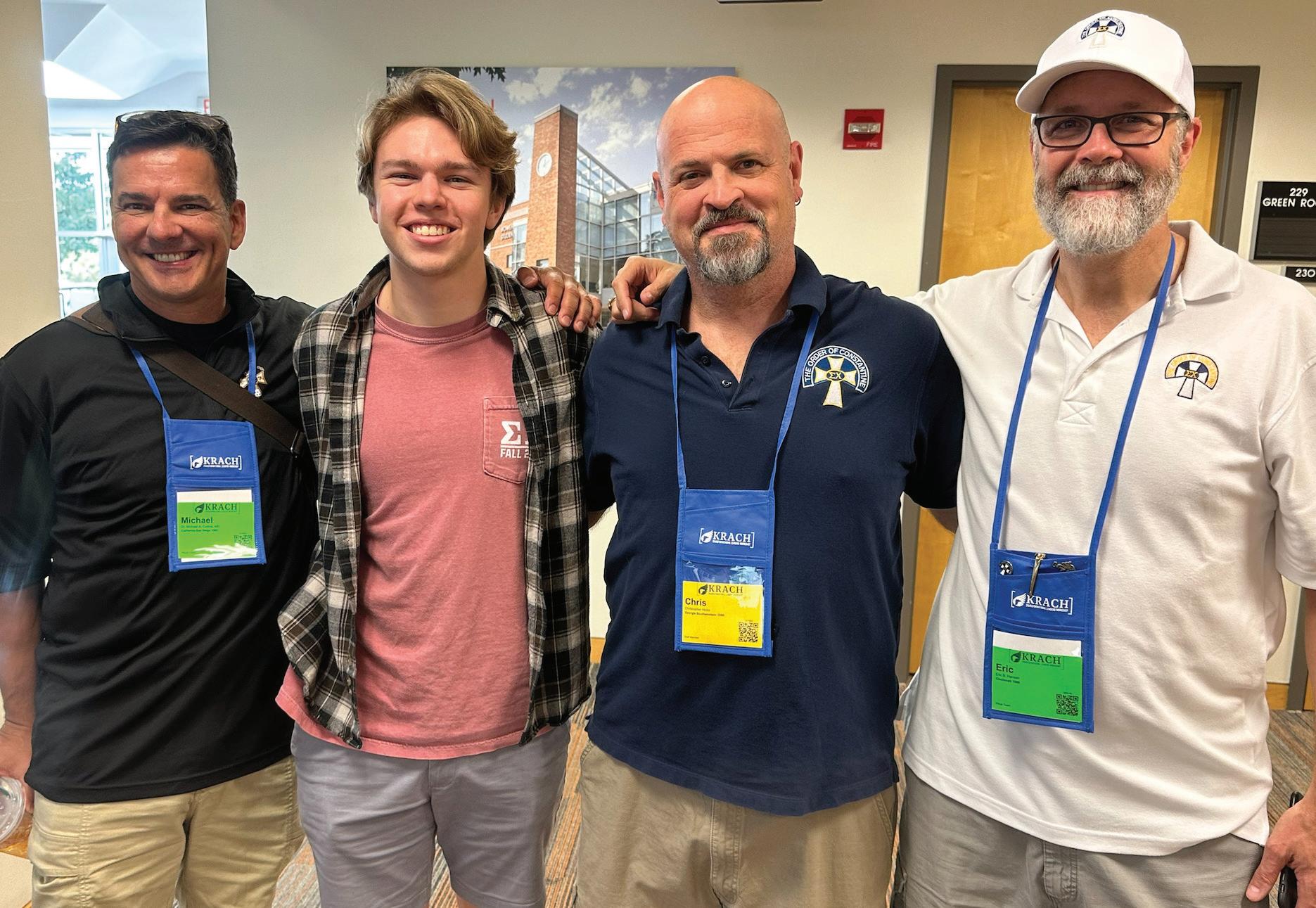
was the first undergraduate to earn his Ritual Peer certification under the new program. About 50 undergraduates ultimately became Ritual Peers at that first session. A revamped curriculum has reshaped the Ritual Peer program, and nearly 300 Sigs in total have earned Ritual Peer certification.
Pictured at the inaugural Ritual Peer 2.0 training session at the 2023 Krach Transformational Leaders Workshop are, from left, Grand Historian, Ritual Master and Order of Constantine Sig Michael Codina, CALIFORNIA-SAN DIEGO 1993; Tobias Klooster, HILLSDALE 2025; Regional Chapter Support Coordinator, Ritual Master and Order of Constantine Sig Chris Hicks, GEORGA SOUTHWESTERN 1996; and Ritual Education Committee Chairman, Ritual Master and Order of Constantine Sig Eric Hansen, CINCINNATI 1989. Klooster
Sigma Chi thrives off the efforts of thousands of volunteers who sacrifice their time, wisdom and love for the Fraternity, and becoming a Ritual Peer, for some, is the first way they give back to the organization.
At the 2023 Krach Transformational Leaders Workshop over 50 brothers became certified Ritual Peers, and from there the program was off and running after a several-year hiatus, according to Regional Chapter Support Coordinator, Ritual Master and Order of Constantine Sig Chris Hicks, GEORGIA SOUTHWESTERN 1996. Since then there has been a staggering total of 271 new certified Ritual Peers, and Hicks’ goal of 300 by the end of the academic term is becoming a reality.
a chapter by correctly filling out a certification manual. The manual serves as a bridge between the Ritual Peer and the chapter Kustos and is a benchmark of Ritualistic proficiency. When the needs of the manual are satisfied, the chapter then knows exactly what areas of the ceremonies of initiation need improvement.
“I didn’t really have a goal when this first started out, but the more this program goes on and the more people who actually want this to happen, I think we can hit that mark,” says Hicks.
DEVELOPING THE COURSE
Ritual Education Committee Chairman, Ritual Master and Order of Constantine Sig Eric Hansen, CINCINNATI 1989, and Hicks spent months developing an updated curriculum that dramatically shifted the focus of the program.
The previous program, now called Ritual Peer 1.0, was outdated and didn’t give the newly minted Ritual Peers the tools they needed to properly certify a chapter. Previously, the educational material focused a lot on the historical context of the Ritual, and only a small portion of the class was dedicated to giving practical advice on how to be a successful Ritual Peer.
Under 67th Grand Consul Dennis Santoli, WESTERN RESERVE 1967, correctly hosting the ceremonies of initiation would become part of the Peterson Significant Chapter Award criteria, so there needed to be some kind of system in place to verify proficiency and that the points could be given toward the award. That’s where the Ritual Peer program came into play.
“The issue with Ritual Peer 1.0 was that it taught a lot of material that was beyond the proficiency aspect. Ritual Peers are tasked with going into chapters and certifying them for competency. What 1.0 didn’t focus on as much was what we now call the LSPs of the Ritual,” says Hansen. “It’s logistics, setup and performance. … I think that’s why (Ritual Peer 2.0) has been so successful. Any brother can look at (Ritualistic ceremonies) and say they understand the LSPs.”
When Ritual Peer 1.0 was unveiled, Hicks estimates about 95 percent of the class was focused on the historical component of the Ritual, such as how it evolved into what it is now, and the other 5 percent of the classes went to practical practices of the Ritual Peer program. Ritual Peer 2.0 flipped those percentages and altered the program as a whole.
Hansen explains that the new curriculum is broken down into two parts. The first is an e-learning portion that teaches the Ritual Peers how to properly certify
“The resulting benefit in Ritual proficiency is that we become better brothers, understand our values a lot better and understand the difference in standards, values and ideals. We can articulate that in a more succinct manner,” says Hansen.
The second part of the class is four hours of classroom time. It’s during this classroom time that the engagement actually takes place and the Ritual Peer hopefuls can work hands on with the class facilitators. One portion of the classroom time, in terms of hands-on learning, is an experiential activity that can only be understood when taking the class.
Hicks says the hands-on learning of how to set up the ceremonies of initiation and run the ceremonies properly came from a need to give the attendees the chance to be as accurate as possible, albeit on a small scale.
“We knew a large-scale set up wouldn’t be practical. There would be enormous shipping costs trying to get everything for every ceremony, so we had to scale it down to make it more manageable,” says Hicks.
Hansen also adds that with the experiential activity, setting the ceremonies up in a fun, educational way makes it easier to remember for the real ceremony.
“Chris and his son Patrick, NORTH CAROLINA-CHARLOTTE 2024, determined the best way to show someone how to set up the Ritual is to actually set it up. It harkens back to a visual way of learning. When you’re physically building something, it gets stuck in your brain,” says Hansen. “You have a certain ceremony that gets built, and then have a discussion about what aspects are correct and which are incorrect. You get into the nuances that are in the Ritual without even opening up a book. We hit a real sweet spot with how to get people to understand.”
WHY CHANGE
The format of the original program was structured as three six-to-eight-hour classes over three days. The subsequent test to become a Ritual Peer was then taken at home. Both Hicks and Hansen noted that some people would only go to the classes to learn the history of the Ritual, get a copy of the Ritual Book and not take the exam. When becoming a Ritual Peer, there is a three-year commitment to assist undergraduate chapters with Ritual certification. Now there is time for the attendees to complete the test on site, and a staggering 99 percent of those who take the test become Ritual Peers.
When he became a Ritual Peer about 13 years ago, Hicks knew right away that the program needed to be changed.
“I’ve always said it was a great class, but it was focused on the wrong thing. The Ritual Peer’s job is to help the chapter plan, set up and execute the ceremonies properly. The history aspect doesn’t really give them the tools they need,” says Hicks.
As to why the program was in need of a change, aside from the curriculum itself, Hansen noted that the material itself was dry and outdated in some areas. With the creation of the Sigma Chi Leadership Institute and the professionals who
“This is a complete 180-degree difference from what it was before. I have people who call and want to have conversations about the Ritual. I didn’t experience that with the old version, whereas now I have more and more people requesting this program be held for them.”
- Order of Constantine Sig Chris Hicks, GEORGIA SOUTHWESTERN 1996
can help create a modern curriculum, Hansen suggested utilizing SCLI to help develop a more up-to-date course.
“[SCLI] helped us create the coursework of what the committee wanted, and it was the mechanism that helped create the curriculum,” says Hansen.
The addition of the hands-on portion of the course has been an overwhelming success, according to Hicks and Hansen. The discussions and interaction between undergraduates and alumni have been remarkable.
“I’ve been having the undergraduates find an alumnus to talk to because the alumni experience and the undergraduate experience is always different, so I want to encourage them to sit down with one another and talk,” Hicks says.
With the 99 percent passing rate, coupled with the new format of the program itself, Ritual Peer 2.0 has been an overwhelming success. Throughout Ritual Peer 1.0’s run of nearly 10 years, only 600 people became Ritual Peers. In less than
one year of Ritual Peer 2.0, it’s projected that over 300 new Ritual Peers will obtain their certification. This drastic change will have benefits for years to come, according to Hansen.
Hicks also sees the program as successful despite its infancy. He said he’s seeing excitement about the Ritual and all it entails in a new way.
“This is a complete 180-degree difference from what it was before. I have people who call and want to have conversations about the Ritual. I didn’t experience that with the old version, whereas now I have more and more people requesting this program be held for them,” he says. “It’s causing excitement for the ceremonies to be done the way they’re supposed to be done, and I think that’s what I’m most excited about.”
Welcome, Alabama-Birmingham
CHAPTER NAME: Mu Nu
INSTALLATION DATE: Feb.17, 2024
SIGS INITIATED AT INSTALLATION: 31
For many years, the associate chapter brothers at the University of AlabamaBirmingham fought to bring Sigma Chi to their campus. Pushback from the university, as well as internal issues, delayed the process. Many of the original group, including the chapter’s first Consul Connor Armstrong, 2018, graduated long before the chapter was even granted status as an associate chapter. With their backs against the wall, then-Consul Greg Newman, 2024, knew his group of 11 guys had to buckle down.
In the fall of 2015, Armstrong and a group of friends found themselves wanting to join a fraternity but didn’t care for the options available to them. As a joke, someone suggested starting their own fraternity. After research and knowing a recent transfer from Troy University, the group decided to look into Sigma Chi as a viable option.
The aspect of Sigma Chi that stood out the most to Armstrong and his friends was embodied in the Troy transfer student. The group saw his character and the values Sigma Chi expects of its members. Armstrong said the philanthropic endeavors and partnership with the Huntsman Cancer Institute resonated with the group.
After corresponding with Sigma Chi’s Director of Fraternity Growth Desmond Robinson, TARLETON STATE 2015, the wheels were in motion; however, those wheels would wind up being stuck for quite some time.
“The universities and other fraternities fought us on it. We had to keep fighting to get approval, and we wouldn’t go away until they accepted us,” says Armstrong. “By the time everything finally got approved, I was in my last semester.”
Armstrong credits his friend’s resiliency as to why the chapter stood its ground. For Armstrong, he admitted he and his friends wanted to leave their mark.
“We wanted to have a legacy and, when we come back as alumni, have that sense of pride that we started something. Looking back now, it’s something we’re all proud of,” says Armstrong.
As a soon-to-be graduate, when Armstrong found out Sigma Chi was able to be recognized, he said the group harbored no ill feelings toward the university or anyone else who opposed them.
“We were all excited because all the hard work finally paid off. It was total joy when we got the news,” says Armstrong.
Fast forward to 2020. Internal issues caused the associate chapter to suspend operations on campus for a year, and the impact of that sent shockwaves through the undergraduates. The year before Newman took the helm as Consul, he credits then-Consul Morgan Murphy, 2022, with setting the group on the right track.
“He spent his term cleaning up the pieces from our issues. Afterward we hit a spot of complacency, which led to a decline in our numbers, our collective GPA and basically in every metric.”
Newman became Consul in 2023 and right when his term started, the chapter received notice from Sigma Chi International Fraternity Headquarters explaining the group had to increase numbers and have a 16-person pledge class during the next recruitment season. That letter was a blessing and a curse, according to Newman.
“This was a death sentence. Some guys jumped ship, but the remaining 11 who stayed went from being stuck in phase one to completing phase two, phase three, and [then] our formal petition was accepted,” says Newman.
Also since receiving the letter, the group won UAB’s Chapter of the Year award, among numerous accolades from the university.
To ensure the chapter not only survive but thrive, Newman and several others on the chapter’s executive committee drove to all the chapters in the Northern Alabama province to get their approval as part of the formal petition process.
On that February day, the chapter’s charter was signed, and the Mu Nu chapter of Sigma Chi became official. For Newman, seeing the remaining group that stuck around after receiving the letter from Headquarters finally become brothers was all the gratification he needed.
Armstrong wasn’t able to make it to the installation, but knowing the chapter survived and is recognized, he hopes the story of the founding of the Mu Nu chapter will inspire others.
“To me the legacy part is having something that people remember us by at UAB. When people look back decades from now, they can see what we did and our resiliency. Hopefully that’s something they can be inspired by,” says Armstrong.
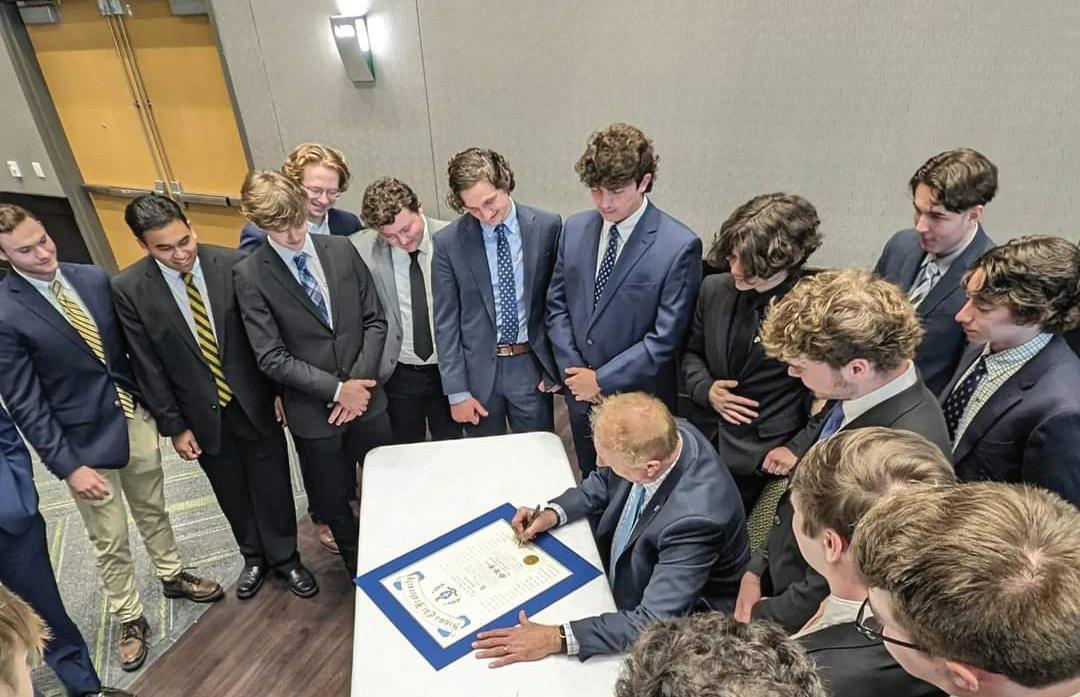
Members of the newly installed Alabama-Birmingham chapter gather around 73rd Grand Consul Bob Wilson, FORT HAYS 1981, as he signs the chapter’s charter on Feb. 17, 2024.
Welcome back, Southern Mississippi
CHAPTER NAME: Theta Delta
INSTALLATION DATE: March 16, 2024
SIGS INITIATED AT INSTALLATION: 32
When Trey Hebert, SOUTHERN MISSISSIPPI 2025, wanted to find a fraternity on campus, he was disappointed with the options. Hebert was familiar with Sigma Chi, as his father was a Sig at the university in the 1980s, but the chapter was no longer around. Hebert’s landlord at the time, Mitch Brent, SOUTHERN MISSISSIPPI 1984, asked Hebert and a friend if they wanted to start the chapter back up, but the two were wary because of their experiences. After a fateful conversation with some alumni, Hebert says it was their mission to bring the charter back.
How did you get led to Sigma Chi?
I was playing football here at the time. [Future Quaestor] Blake [Roberts, 2024,] and I were approached by our landlord, and he asked if we were interested in bringing a fraternity back to campus. We both looked at him and said no. Myself and our current Consul, Jack Tannehill, 2025, went through fraternity recruitment in our freshman semester. We both were on the football team and went through recruitment together and attended some events, but we were so turned off by fraternity life, we wanted nothing to do with it. Ultimately, [our landlord] Brent asked us to come to a dinner and listen to some alumni speak. As broke college kids, we happily accepted. Each alumnus spoke about what Sigma Chi means to them, the impact being in Sigma Chi had on their lives and what the brotherhood means to them. After talking in the parking lot for another hour after dinner, it took us by surprise that we were very interested. It was a once-in-a-lifetime opportunity to start up a fraternity. From then on, we were all-in on getting the charter back.
From the start, what was the alumni support like for the chapter?
Seeing the brotherhood gave us incentive to want to bring the chapter back. We held our first philanthropy event, the Sigma Chi Golf Classic. We ended up raising about $17,000 because our alumni were front and center. They wanted to buy a team, sponsor a hole and donate whatever they could to the chapter. It was like that the whole way. They donated to our Derby Days philanthropic event and donated to the installation banquet. Their generosity and how much Sigma Chi means to them was very evident in how they supported us throughout the entire process.
Was there one specific thing the alumni said or did that really struck home with you?
The biggest thing was when they talked about Sigma Chi. With other fraternities, people will say, “I was in this fraternity.” When they talk about being in Sigma Chi, they say, “I am a Sigma Chi.” It’s a lifelong thing. The brotherhood continues to grow. Seventy-third Grand Consul Bob Wilson, FORT HAYS 1981, said at our banquet that sometimes in the installation journey when you get that charter it seems like it’s the finish line, but it’s really just the beginning.
What was the mentality like for the chapter this semester leading up to initiation? There was a lot of relief and a lot of excitement. We went on a spring break trip right before initiation, and we had an amazing time. We grew the brotherhood closer and had a lot of fun. Much of it was curiosity, too. None of us had experienced the Ritual and didn’t know what to expect. We had a year-anda-half journey where we were constantly giving to Sigma Chi and it was such a rewarding feeling to be so close to initiation when the semester started.
When the charter was signed and you got a chance to hold it, what was going through your mind? It felt like the top of the mountain, the apex. It’s a struggle, it’s stressful and you feel like you’re always on the clock. There’s a deadline for everything, but in that moment you can sit back and enjoy all that’s happening. There was a lot of pressure to get the charter before the seniors graduated. I was feeling that pressure for a while, but holding that charter felt like you were on top of Mount Everest. It’s something I’ve never felt before. Our goal was to get the charter back by the spring 2023 semester so the seniors from the interest group could reap the benefits and get initiated. I would have hated for the guys who started this to not have been able to benefit from their hard work.
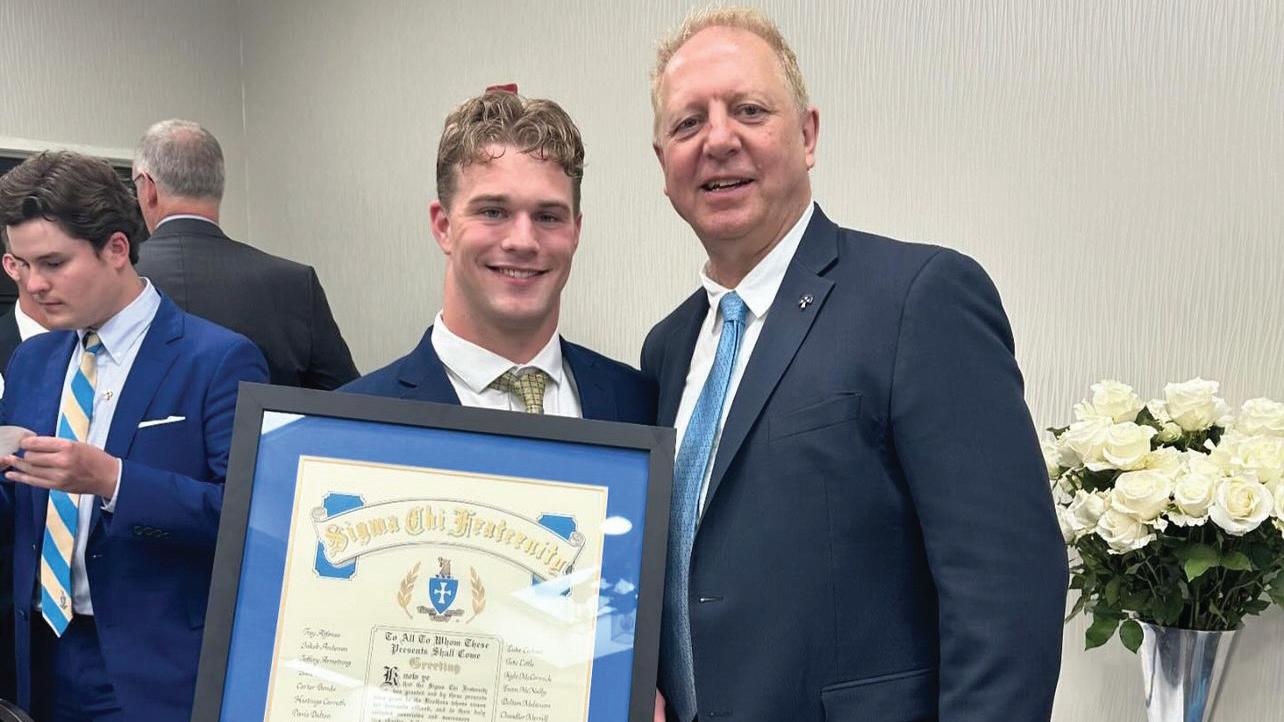
Magister Carter Bonds, SOUTHERN MISSISSIPPI 2024, is pictured March 16, 2024, with 73rd Grand Consul Bob Wilson, FORT HAYS 1981, during the reinstallation of the chapter.
CAMPUS CHRONICLES UPDATES
ALABAMA-BIRMINGHAM Mu Nu
This semester was big for us as our chapter was installed in February 2024 — the result of eight years of hard work and dedication by many of our members! We held our semesterly blood drive in collaboration with Lifesouth Community Blood Center. This effort resulted in 77 donations to our local community.
~ Logan Cook, 2025
BELOIT Alpha Zeta
The chapter emphasizes involvement with our campus and community. Our brothers volunteered to read at local elementary schools, and we planned one of the best Derby Days philanthropic events in recent chapter history. Our house is filled with young men ready to take on the responsibility of improving our organization and surpassing the standards of Sigma Chi.
~ Isaac Guttormson, 2027
BENTLEY Lambda Upsilon
In our spring semester the brothers rejoiced, and they bolstered the values of friendship, justice and
learning not only within the Fraternity, but also within the Bentley community. After initiating a class of 18 new brothers, we put our resolve and energy into raising over $35,000 for the Huntsman Cancer Foundation.
~ Aidan Toussaint, 2026
BRIDGEWATER
Theta Zeta
The chapter raised over $5,700, mostly from our successful Derby Days philanthropic event week, going well over our goal of $5,000. Additionally, the chapter alumni donated over $4,000, while the spring pledge class donated nearly $500, helping us surpass the
chapter’s overall goal of $10,000.
~ Caden Regan, 2025
BROCK Mu Zeta
The chapter recently hosted a remarkable formal where we crowned our sweetheart for the year ahead. Our dedication to philanthropy is apparent, having raised over $7,500 for the Huntsman Cancer Foundation through many triumphant Derby Days philanthropic events. We have also secured a new chapter house for the upcoming year, igniting excitement among the brothers.
~ Leo Nip Villasuso, 2027
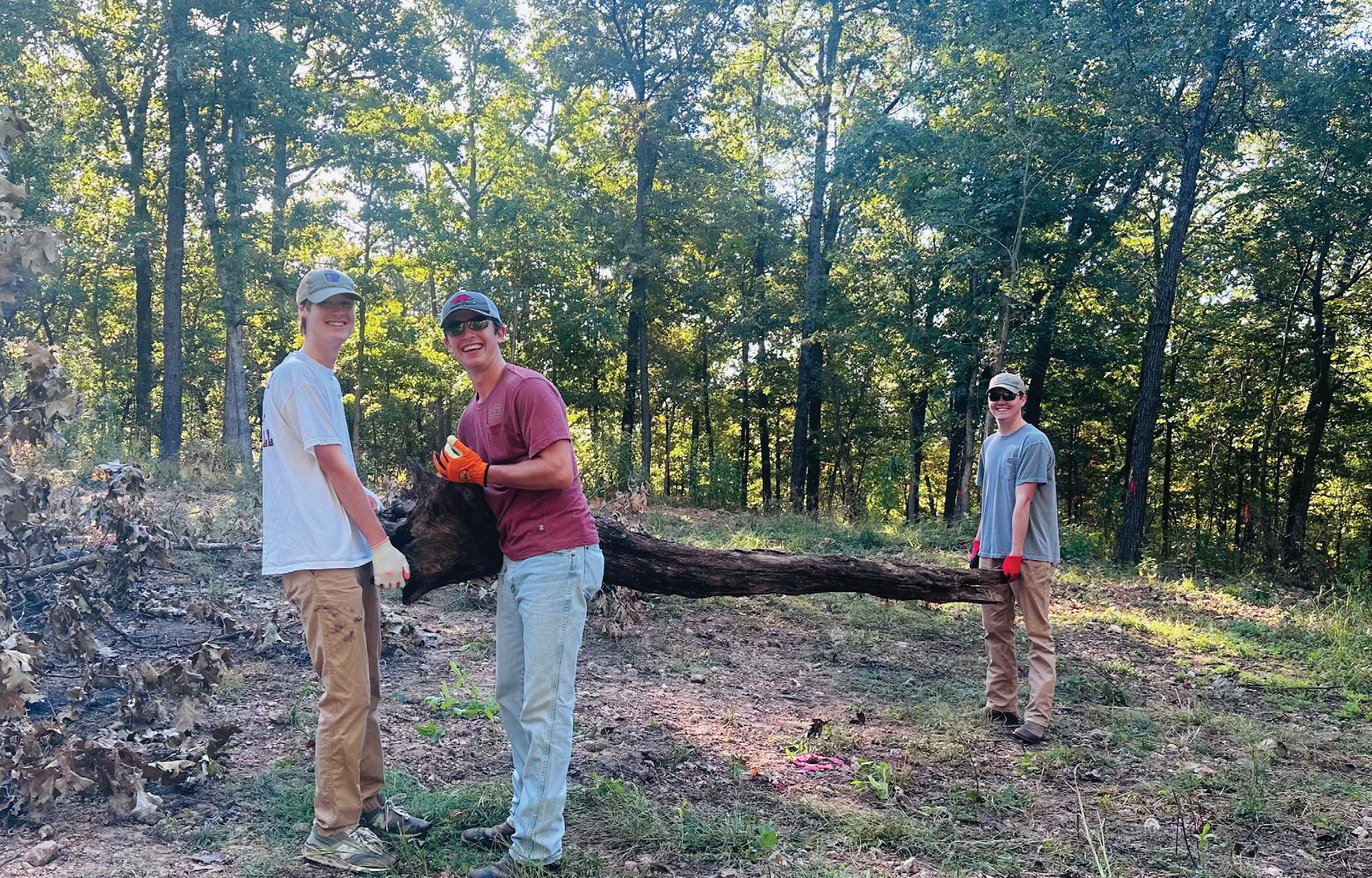
Arkansas brothers Alex Bobbitt, 2027, Evans Olaimey, 2027, and Isaac Cook, 2027, move a log to a burn pile at Hiding Place Hollow, an organization providing housing to missionary families on furlough.
CALIFORNIA-LOS ANGELES
Delta Eta
The chapter is stronger than ever after initiating 37 of the finest brothers in the fall of 2023. This year, we hosted a very successful Derby Days philanthropic event week, capped by our annual concert by our very own brothers.
~ Gabriel Weisiger, 2025
CALIFORNIA-MERCED
Lambda Delta
The chapter flourished this semester, quadrupling in size through successful recruitment. We raised substantial funds during our Derby Days philanthropic event and
launched a website for real-time engagement. Our community service chairman spearheaded impactful collaborations with the Red Cross and local homeless shelters. We hope to continue our momentum and embodying the spirit of Sigma Chi in all endeavors.
~ Manny Maldonado, 2024
CALIFORNIA-SANTA BARBARA Zeta Kappa
Through the implementation of new programs of inter-chapter communications, the indissoluble bonds between our brothers have never been stronger. We had a strong spring recruitment and are very
excited for these honorable men to be initiated.
~ Noah Malamut, 2026
CINCINNATI Zeta Psi
Our chapter has built off the momentum of obtaining a new chapter house in the fall term. Recently, our chapter won three awards from our Fraternity and Sorority Life Office. We initiated 15 new members in our spring pledge class, currently hold the second-best GPA among fraternities and are positioned to raise over $20,000 for Huntsman Cancer Foundation.
~ Chuck Gorman, 2026
CUMBERLAND Nu
We doubled down this semester in preparing our new chapter leaders for the upcoming summer full of Mission 365 opportunities. In addition to the transfer of power, our Kustos, along with our three Ritual Peers, held a Ritual revival workshop. We ended the spring semester with a new generation of Ritually educated leaders.
~ Joseph Mullins, 2024
EMBRY-RIDDLE (PRESCOTT) Kappa Phi
Closing the spring semester, our chapter received nominations for numerous awards, such as Chapter of
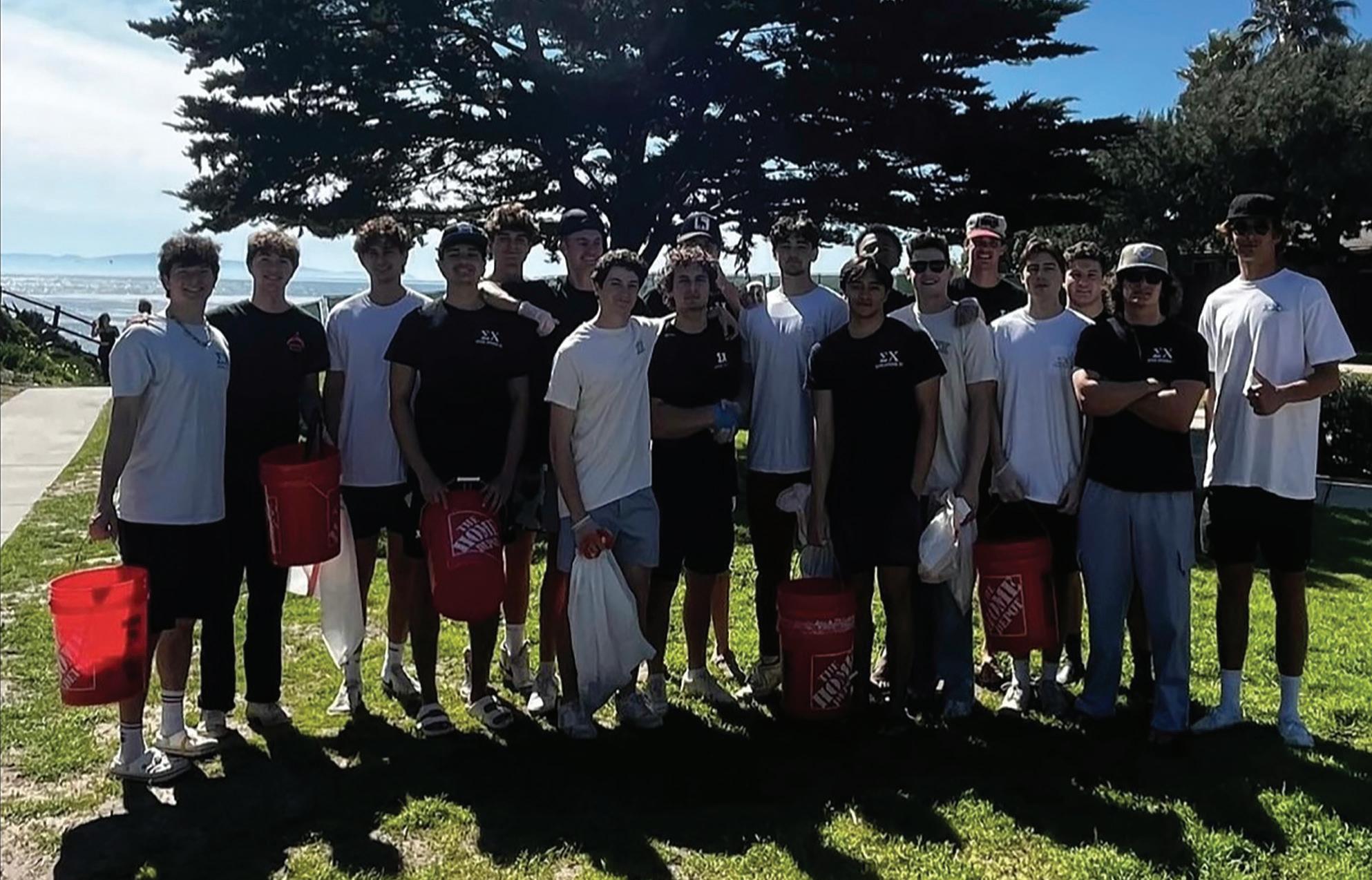
California-Santa Barbara Sigs and friends are pictured cleaning the beaches and larger community of Isla Vista, California.
the Year, Fraternity Member of the Year, Chapter Advisor of the Year and Outstanding Inclusive Leader, among others. Notably, brother Michael Zabriskie, 2024, led a research project aimed at assessing the visibility of facility dogs in higher education to reduce stress and improve mental health.
~ Kyle Appelhans, 2025
FLORIDA Gamma Theta
Our chapter’s biggest accomplishment this spring was our Derby Days philanthropic event efforts, highlighted by over $64,000 raised during the semester. Academically, we also continue to be a top chapter with a
3.52 GPA this semester. Additionally, our spring recruitment brought in seven new members.
~ Conor Lynch, 2025
GEORGIA SOUTHWESTERN
Eta Theta
The chapter partnered with First United Methodist Church of Americus, Georgia, to help donate to Operation Christmas Child. Shoeboxes were filled with essential items, such as toothpaste, toothbrushes, toys, Bibles and other necessities to support the daily lives of children in need while also introducing them to Christianity. Our chapter packaged and donated 75 boxes and cannot wait to participate
in this tradition again!
~ Freddie Updike, 2026
GEORGIA TECH Beta Psi
During our most recent academic term, the brothers continued improving our high academic standards. Over the fall semester, we posted an impressive 3.65 GPA, smashing the undergraduate average of 3.48. We had 69 brothers named to the Dean’s list or received higher recognition.
~ William Wood, 2025
IDAHO Gamma Eta
Our chapter posted a 3.3 GPA for the fall semester, placing us within the
top 3 compared to other fraternities on campus.
~ Nick Hernandez, 2026
ILLINOIS STATE Theta Rho
Our chapter’s most recent significant accomplishment during the spring academic term was Brother Levi Brooke, 2024, receiving the Fraternity Man of the Year award and Brother Joey Dubrock, 2026, helping our chapter win the Outstanding Collaboration Award at our Greek Gala. We also had a tremendous time watching the Super Bowl with the Bradley University Sigs and celebrating our brotherhood.
~ Will Hamilton, 2023
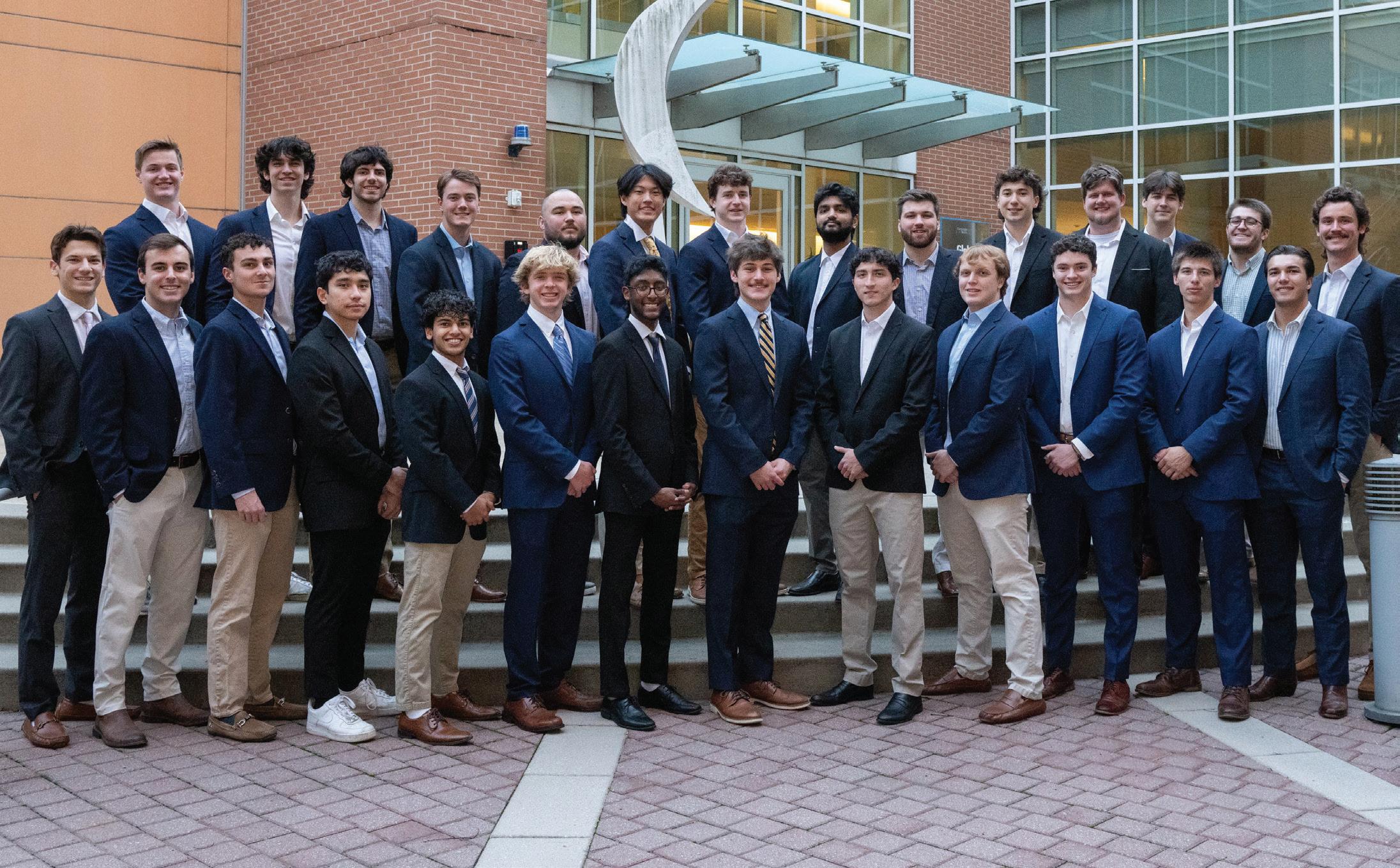
Brothers with the Georgia Tech chapter are pictured during the 2024 Beta Psi Foundation Banquet in February 2024. During the alumni banquet, the undergraduates received scholarships, and alumni received awards of recognition.
INDIANA Lambda
Consul Max Melrose, 2024, and Chapter Advisor [and Order of Constantine Sig] Ansley Valentine, WABASH 1990, were honored with the Interfraternity Council Member of the Year and IFC Advisor of the Year awards, respectively, for their exceptional contributions to the chapter and Greek-letter community. A successful Derby Days philanthropic event raised over $21,000. Furthermore, three freshmen brothers achieved a perfect GPA in their first semester, marking improved academics chapter-wide.
~ Luke Vaccaro, 2027
LOUISVILLE Iota Lambda
The chapter’s most significant accomplishment from the spring 2024 semester was the effort supporting the RaiseRED Dance Marathon. RaiseRED is the largest philanthropic organization on campus and raises money for cancer research. The chapter registered 60 brothers for the event and raised $91,000 — roughly 18 percent of the total dollar amount raised.
~ Matthew Merlo, 2027
MAINE
Rho Rho
The chapter worked on increasing initiation efforts as alumnus Phillip Morse, 1964, pledged to purchase back the old chapter house on
campus. The addition of the Heritage House to the chapter will promote more local events and bolster recruitment, philanthropy and brotherhood, as it will bring back many alumni.
~ Kade Kneeland, 2025
MEMPHIS Epsilon Kappa
The chapter was honored to meet with university president Bill Hardgrave to strategize ways to involve more Greek-letter community members with the campus, as well as get more people to go through recruitment.
~ Seth Khokhar, 2025
MONTANA Beta Delta
Experiencing a remarkable year, the chapter welcomed 22 new Sigma Chi brothers. Prioritizing community service, our members cleaned the Clark Fork River banks last autumn. This spring, we partnered with the National Marrow Donor Program and registered 100 individuals into the National Bone Marrow Registry. Our actions reflect our commitment to fraternity, community and service.
~ [Chapter Advisor] Cameron Slade, MONTANA 1985
NEBRASKA Alpha Epsilon
The chapter is proud to have initiated four brothers during the spring 2024
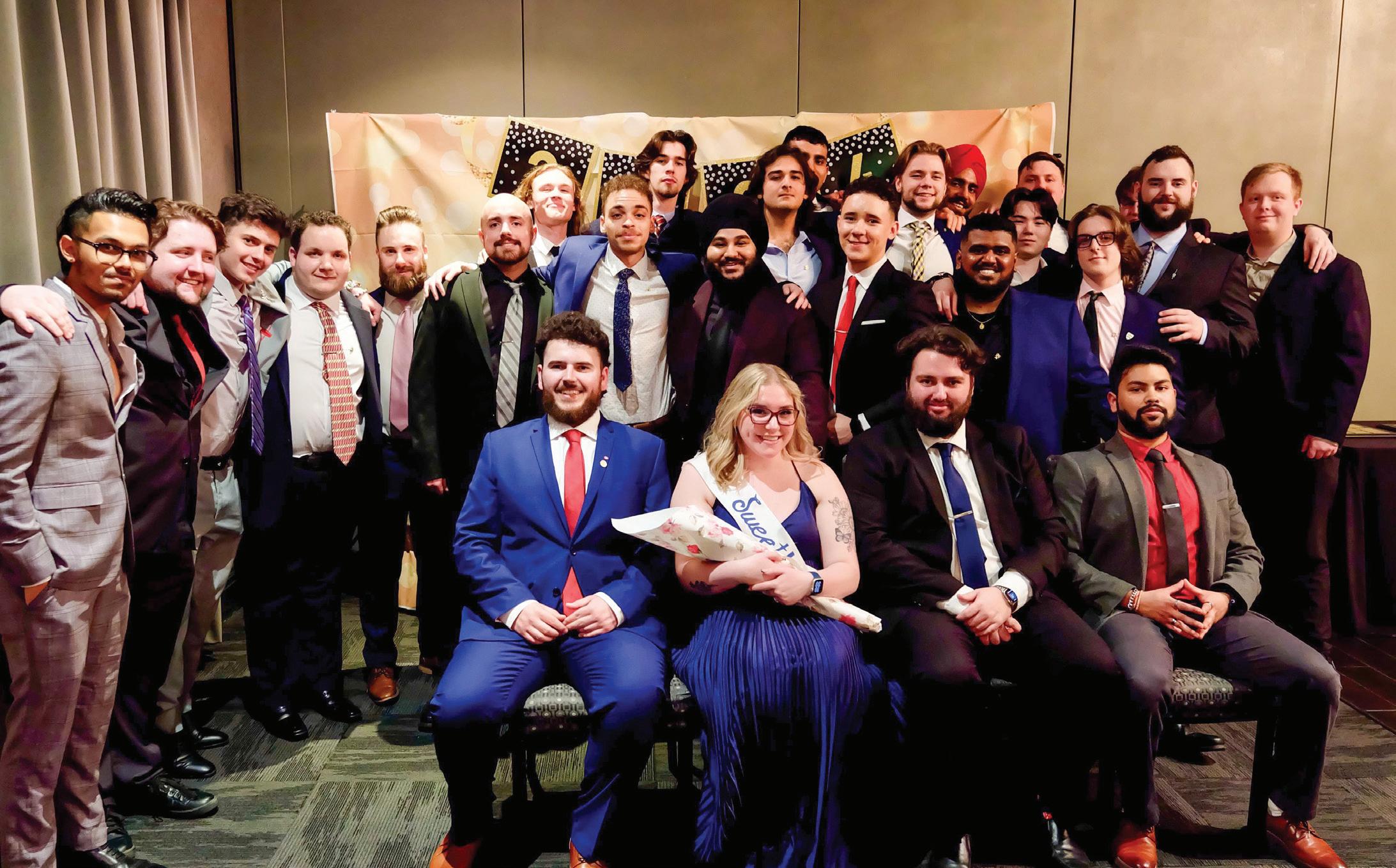
Brothers with the Brock chapter are pictured March 8, 2024, during the chapter’s Sweetheart Formal.
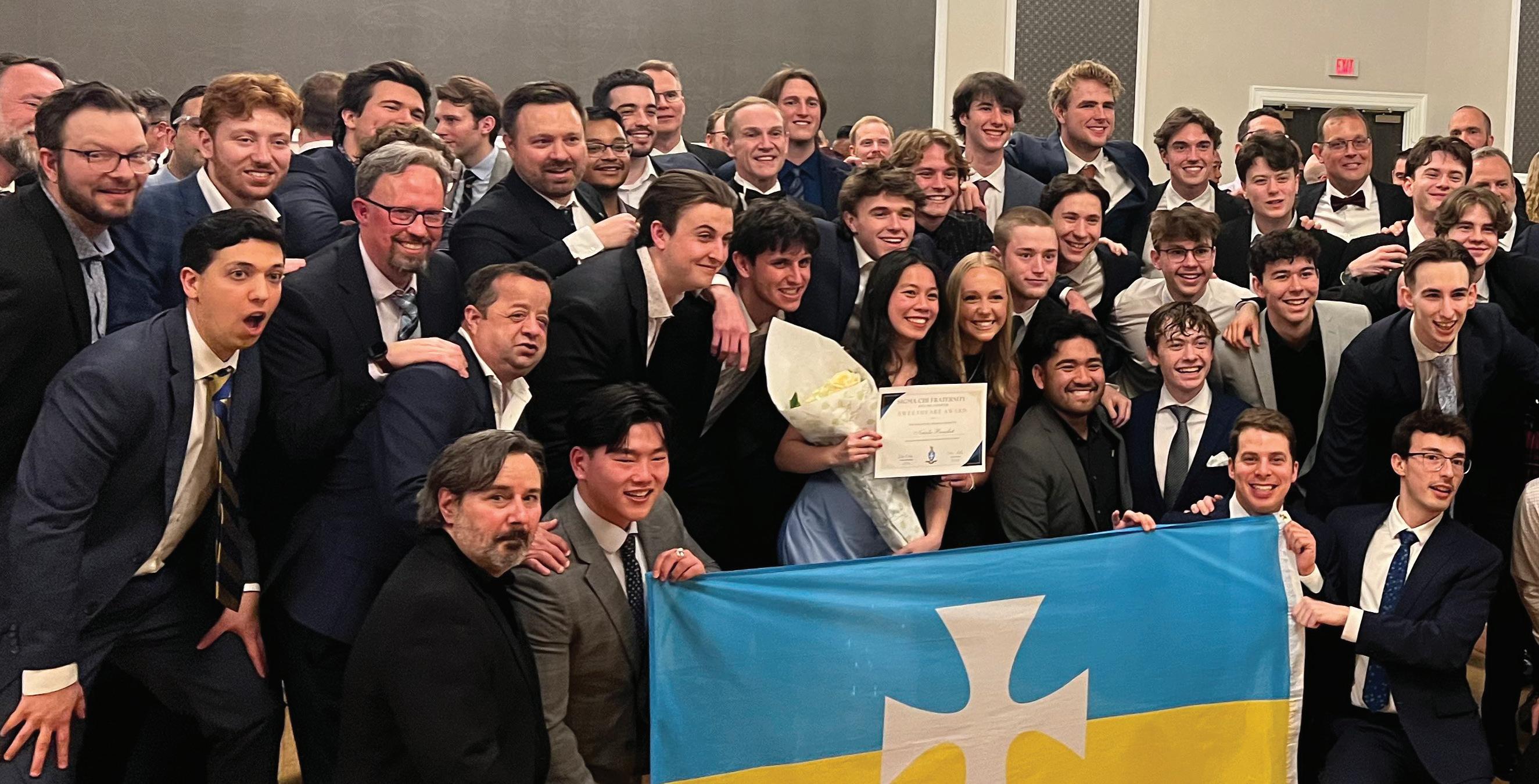
semester: Chase Wardman, 2027, Elijah Johnson, 2027, Kyson Haussler, 2027, and John Hazelwood, 2027 This is the first spring pledge class the chapter has had in two years, and we are proud to call them brothers.
~ Logan Walsh, 2026
NORTH CAROLINA-WILMINGTON Mu
Kappa
In the spring semester, our chapter flourished with a focus on brotherhood, leadership and philanthropy. We held our first chapter formal in Myrtle Beach, North Carolina, and we attended the North Carolina province conference. Academically, we achieved the highest GPA at 3.26 with 30 brothers earning a place on the Dean’s list.
~ Chase Radle, 2027
NORTH DAKOTA STATE Gamma
Tau
The chapter continued its tradition of service and brotherhood. We welcomed our new brothers in February thanks to our thriving recruitment efforts. In the spring semester, we constructed a vibrant social space for our brothers. We celebrated our 90th anniversary as a chapter and made bonds with past members.
~ Tyler Vanderhyde, 2025
RENSSELAER Delta Psi
In our most recent academic term the chapter initiated five new brothers; we scored a 93 percent rating on our fire and safety inspection score; 24 brothers made the Dean’s list with at least a 3.50 GPA; and we raised
almost $4,000 for the Huntsman Cancer Foundation. We’re looking forward to seeing what our next academic term has in store.
~ Ryan Ing, 2025
SAN DIEGO STATE Delta Xi
The chapter had an amazing spring semester with our Derby Days philanthropic event being a major highlight. In just one week, we were able to raise over $142,000 for the Huntsman Cancer Foundation. We look forward to the event next year and will hopefully shatter our goal of $150,000.
~ Amren Purewal, 2025
TEXAS TECH Epsilon Nu
The chapter had a busy semester hosting a very successful province
workshop Feb. 17, 2024. We had great attendance from all the schools in our province, and the programs were excellent. We initiated eight new, outstanding young men who will make terrific Sigs. Sadly, we said goodbye for now to 35 men who graduated in May.
~ [Chapter Advisor] Jim White, 1976
UTAH Beta Epsilon
The chapter prided itself in a significant philanthropic milestone for successfully raising over $259,000 with our eyes set on a larger goal of $300,000 by the semester’s end. We’re also proud to have initiated another strong class of 22 young men who have already started to make an impact in our chapter.
~ Samuel Evans, 2024
The Wilfrid Laurier chapter celebrated its 35th anniversary March 24, 2024, by hosting over 200 undergraduates and alumni members. Also during the event, 2023-2025 International Sweetheart Jordan Garrett, center, was able to announce the second term of chapter sweetheart Natalie Bounket, also center.
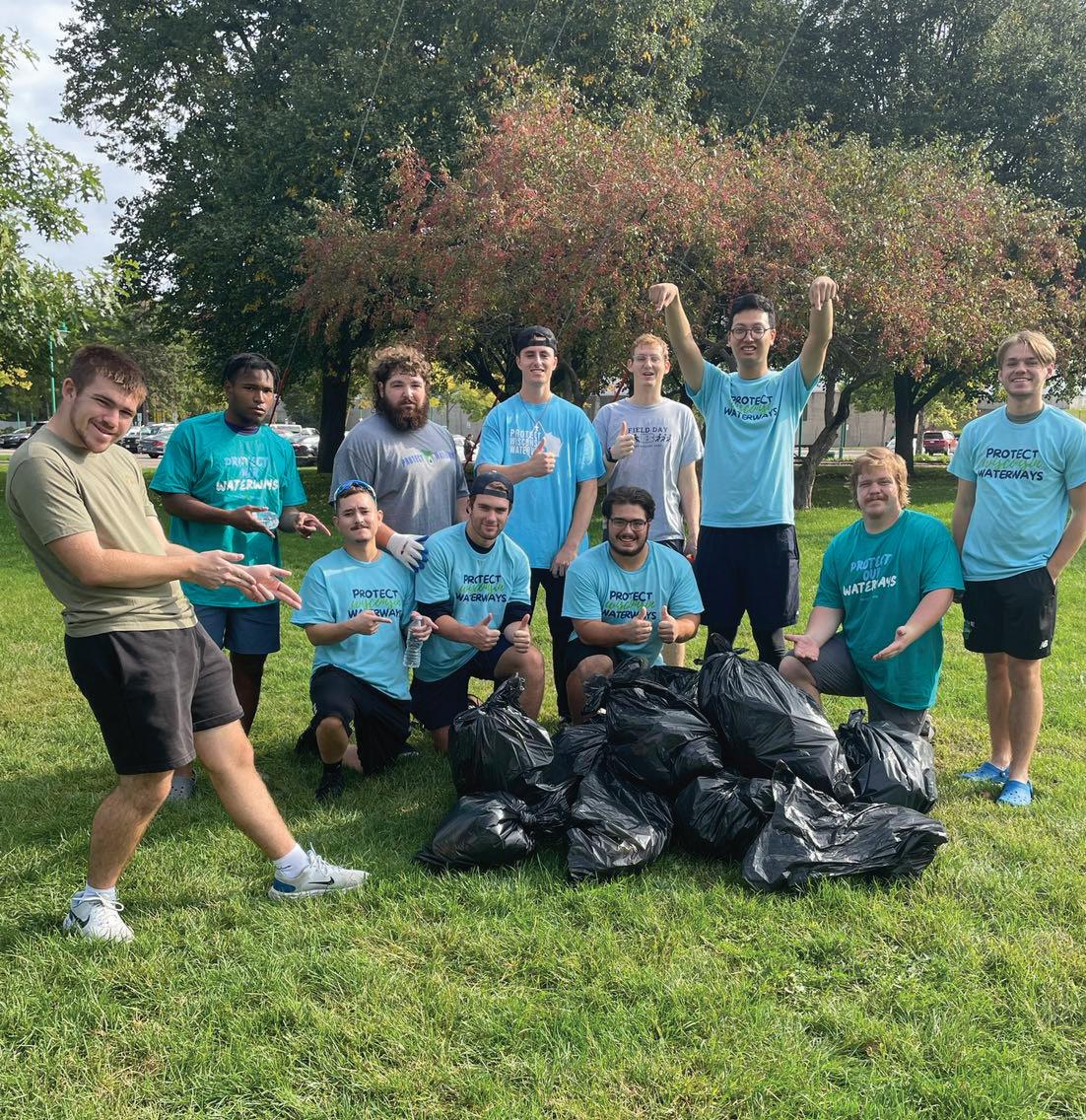
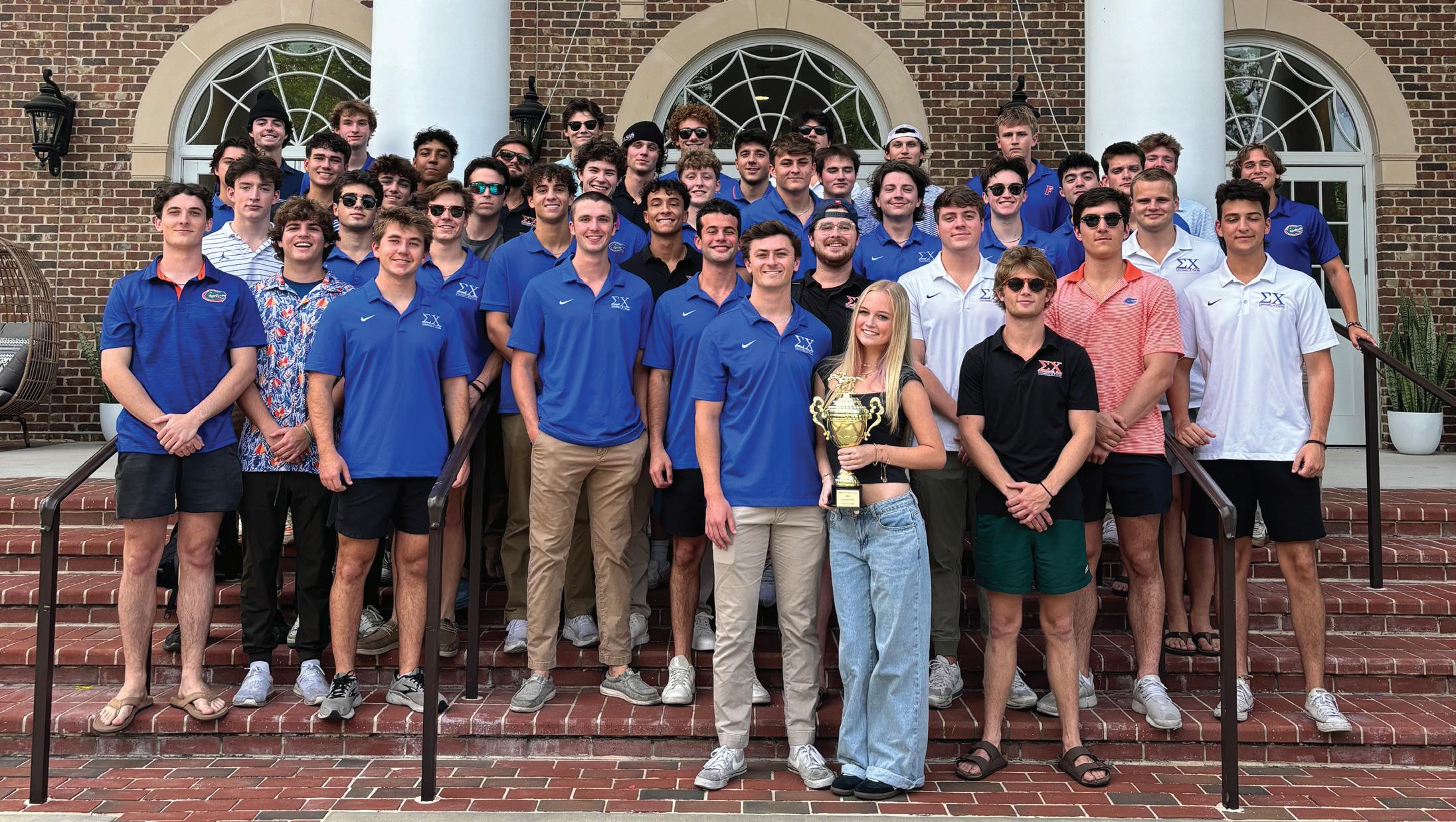
Brothers with the Florida chapter are pictured with their 2023-2024 Derby Queen, McKenna Chase.
Brothers with the Beloit chapter are pictured posing with the trash they collected during a fall cleaning event for a local river.
Peter Giner, SAN DIEGO STATE 2026, is excited after Kappa Alpha Theta secures the win in the dodgeball competition during the chapter’s Sigma Chi Olympics events.
A COLLEGE IN LOGAN, UTAH Gamma Kappa
The chapter raised over $20,000 through our Derby Days philanthropic event for the Huntsman Cancer Foundation this spring. Three new brothers were initiated, and we hosted our annual alumni golf tournament and banquet to celebrate brothers earning scholarships, celebrate our new sweetheart and bring together our amazing alumni who have built and supported our chapter.
~ Spencer Walker, 2025
WILFRID LAURIER Iota Mu
The chapter celebrated its 35th anniversary March 24, 2024, by hosting over 200 alumni and undergraduate brothers, and we raised over $500,000 in one night for the chapter’s housing project. We also want to congratulate our four graduating seniors and incoming
executive team as we look forward to the 2024-2025 academic year.
~ Roland Filler, 2024
WILLAMETTE Delta Zeta
The chapter worked together with other Greek-letter organizations to wow the crowd at “Mock Rock,” raising over $500 for local charities through exciting dances and games.
Our Fraternity’s commitment to philanthropy was in full effect this spring, showcasing our dedication to giving back to the community and making a positive impact beyond the borders of our campus.
~ Dylan Green, 2025
WILLIAM & MARY Zeta Upsilon
After its spring initiation, the chapter is in strong shape with 57 total brothers. Through our Derby Days philanthropic event, the chapter raised $3,700. Additionally, for the first time in recent chapter history,
three brothers were selected to attend the Horizons Huntsman Leadership Summit.
~ Drew Klepser, 2026
ASSOCIATE CHAPTERS
BELMONT Sigma Chi Upsilon
We had over 50 potential new members attend recruitment events and extended 20 bids. All 20 were accepted. We now have 39 active members for our associate chapter. We plan on hosting our inaugural Homecoming tailgate on Belmont’s campus in the coming semester. We also plan on having events sponsored by Sony Music to better connect with the Nashville community.
~ Hayden Orbaugh, 2026
MISSOURI-COLUMBIA
Sigma Chi Delta
The associate chapter recently
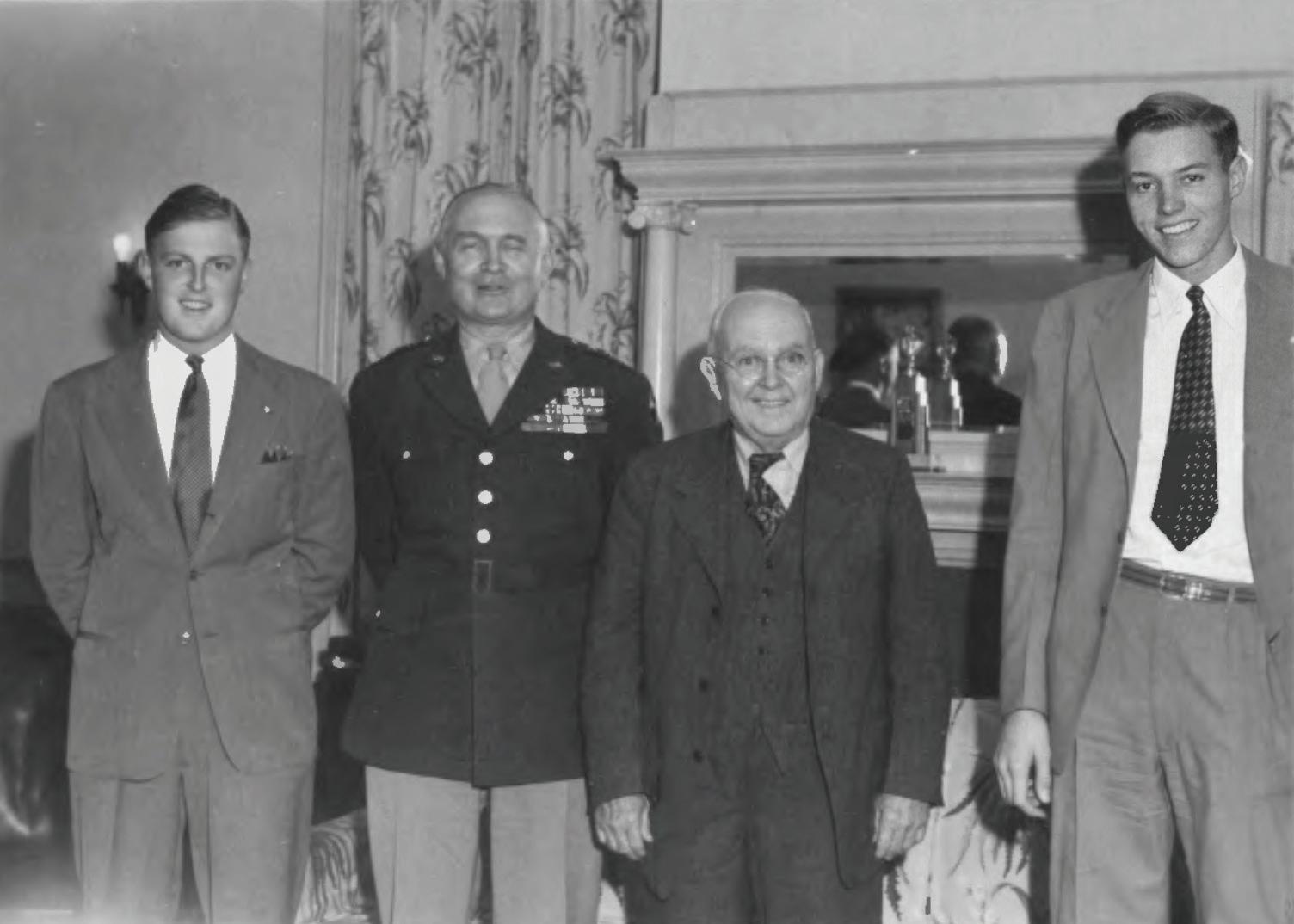
adopted a road to clean up each month. Brothers made their way to Richland Road in Columbia, Missouri, to pick up trash in hopes of making an impact in our off-campus community.
~ Tyler Thomas, 2025
WESTMINSTER Sigma Chi Tau
The associate chapter picked up another potential new member this semester. We have also tallied close to 130 service hours and don’t intend on slowing down. The spring semester was good for us, and we are getting ready for recruitment over the summer and throughout the fall semester.
~ Joseph Martin, 2025
CHAPTER ANNIVERSARIES
AUGUST
8/23/2014 Lambda Psi, 10 years
SEPTEMBER
9/24/1884 Alpha Nu, 140 years
Anniversaries are listed every five years.
Pictured on Oct. 10, 1946, are, from left, Dale Crittenberger, TEXASAUSTIN 1949; his father, Significant Sig and Army Lt. Gen. Willis Crittenberger, TEXAS-AUSTIN 1913; 17th Grand Consul Wilbur Allen, TEXAS-AUSTIN 1901; and future Significant Sig Thomas Frost Jr., TEXAS-AUSTIN and WASHINGTON & LEE 1948. Lt. Gen. Crittenberger was a corps commander in Italy during World War II, and later that day the chapter brothers were pictured having a lively dinner together.
Twenty-one brothers from the Georgia Southern chapter traveled to Panama during spring break to deliver water filters so families can have clean drinking water. The trip was a partnership between the university’s campus ministry Cru and the nonprofit Filter of Hope.
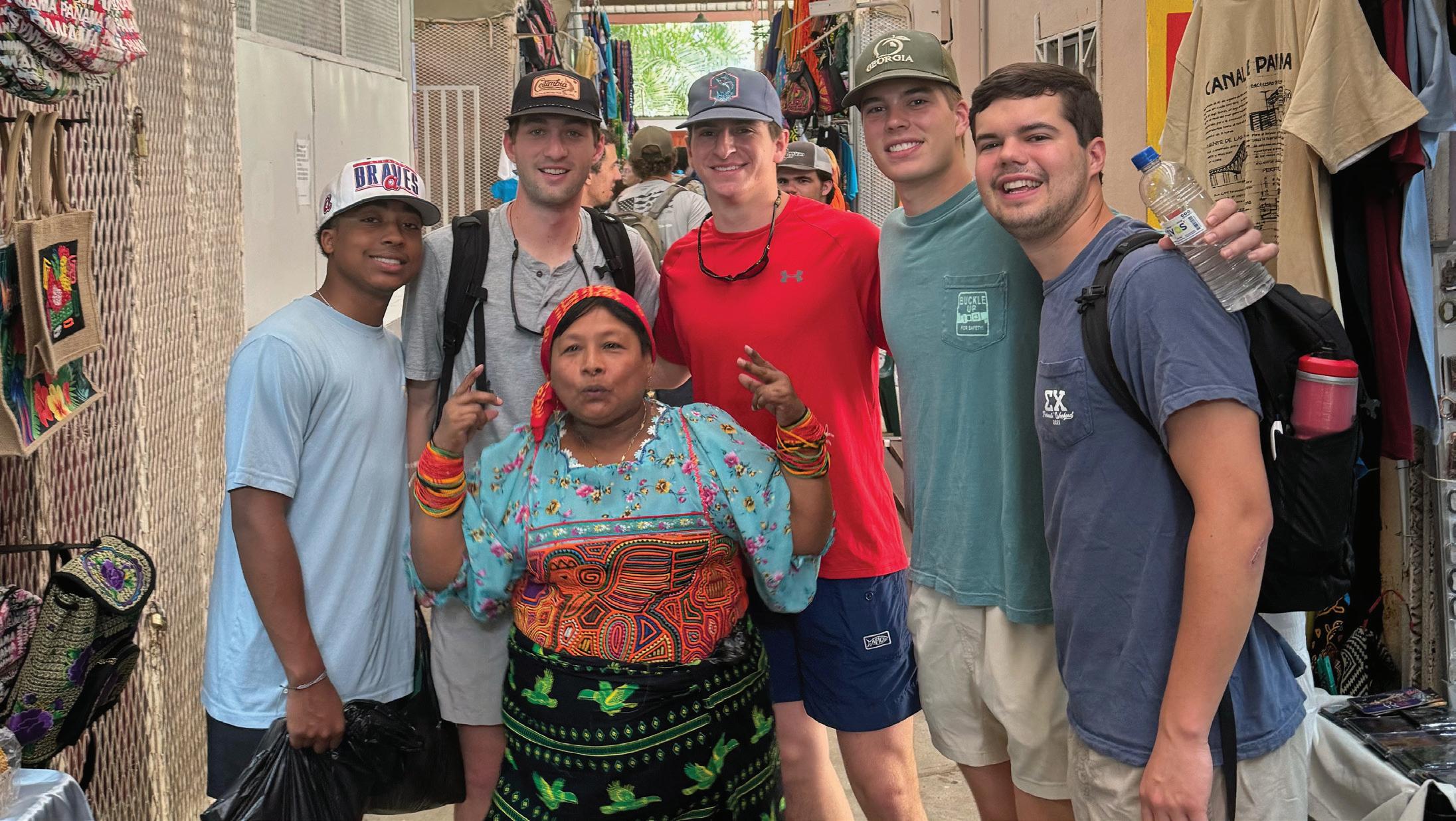
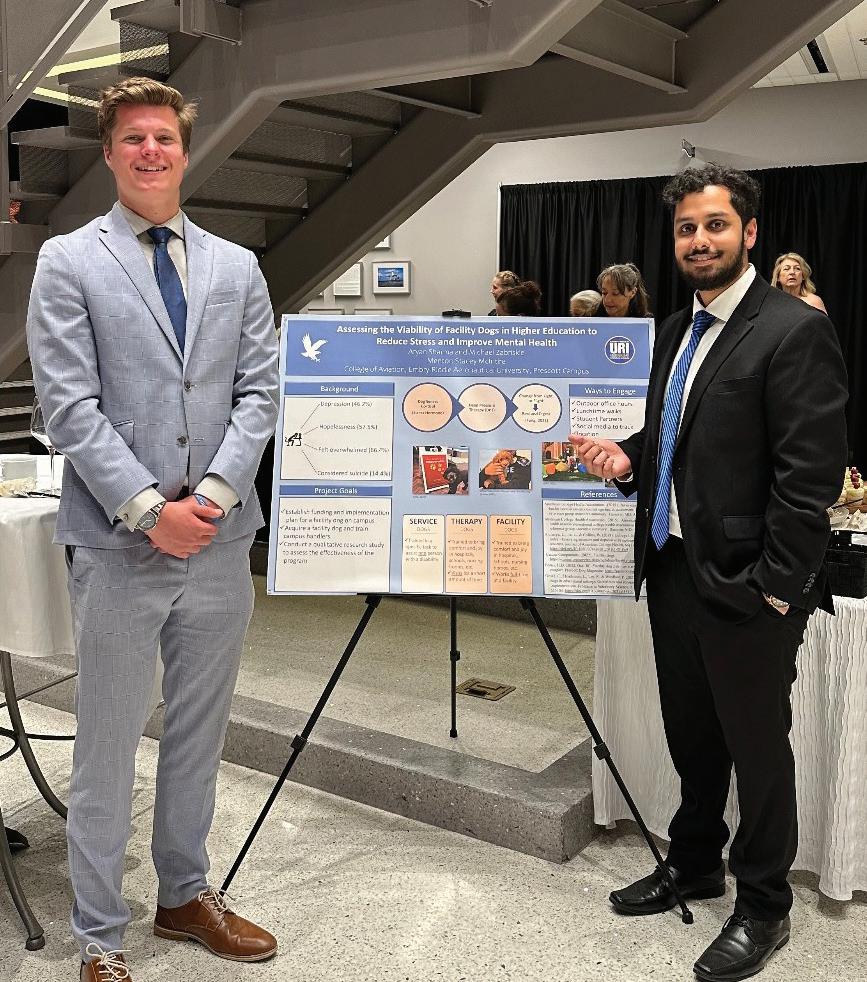
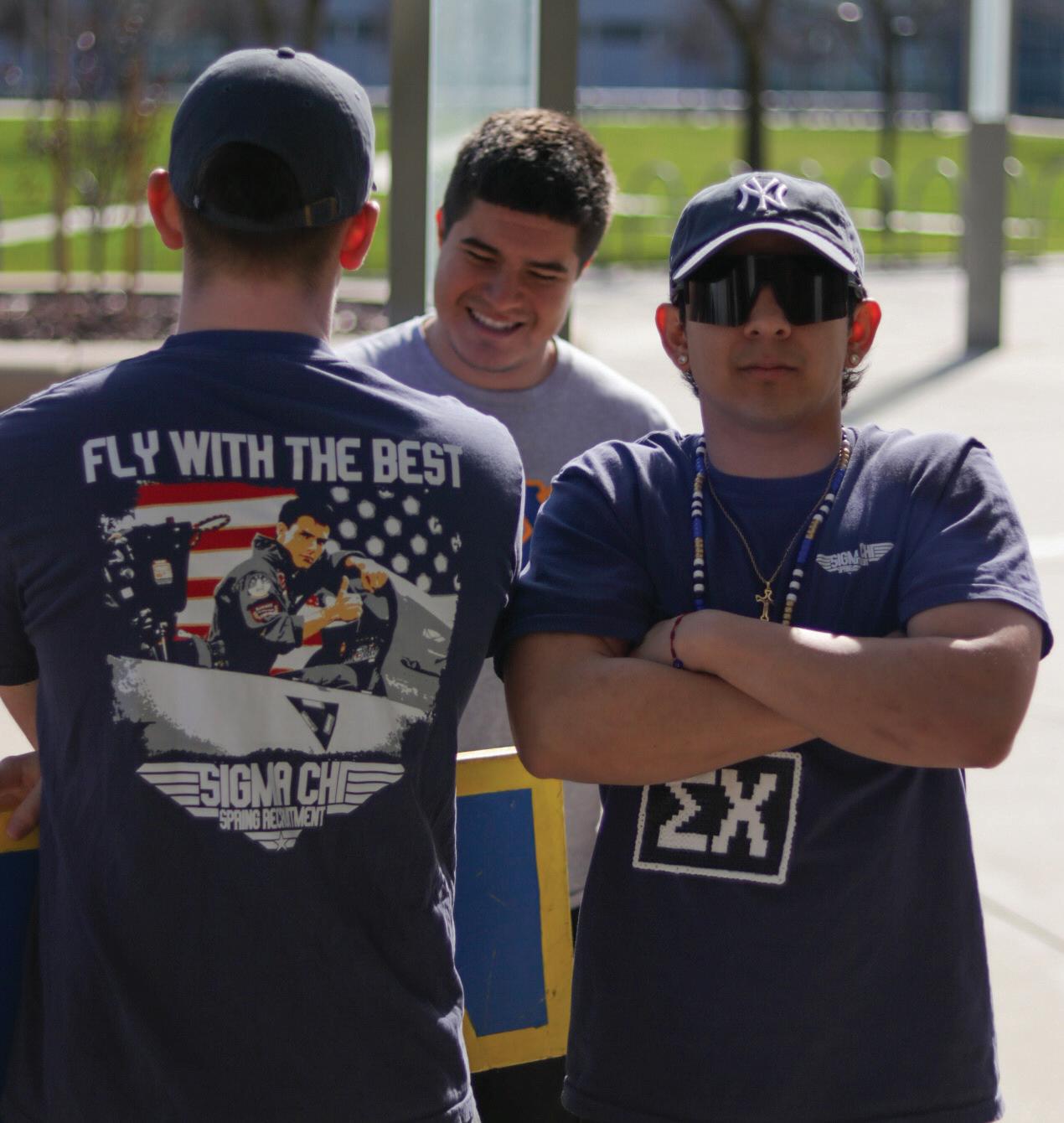
Pictured are Michael Zabriskie, EMBRY-RIDDLE (PRESCOTT) 2024, left, with study partner Aryan Sharma during Discovery Day on April 5, 2024, at Embry-Riddle Aeronautical University’s STEM Education Center in Prescott, Arizona.
California-Merced Sigs excitedly await Bid Day. Pictured are Serjio Orozco-Rivera, 2024, Malcolm Marshal, 2026, and Jayden Menchaca, 2026.
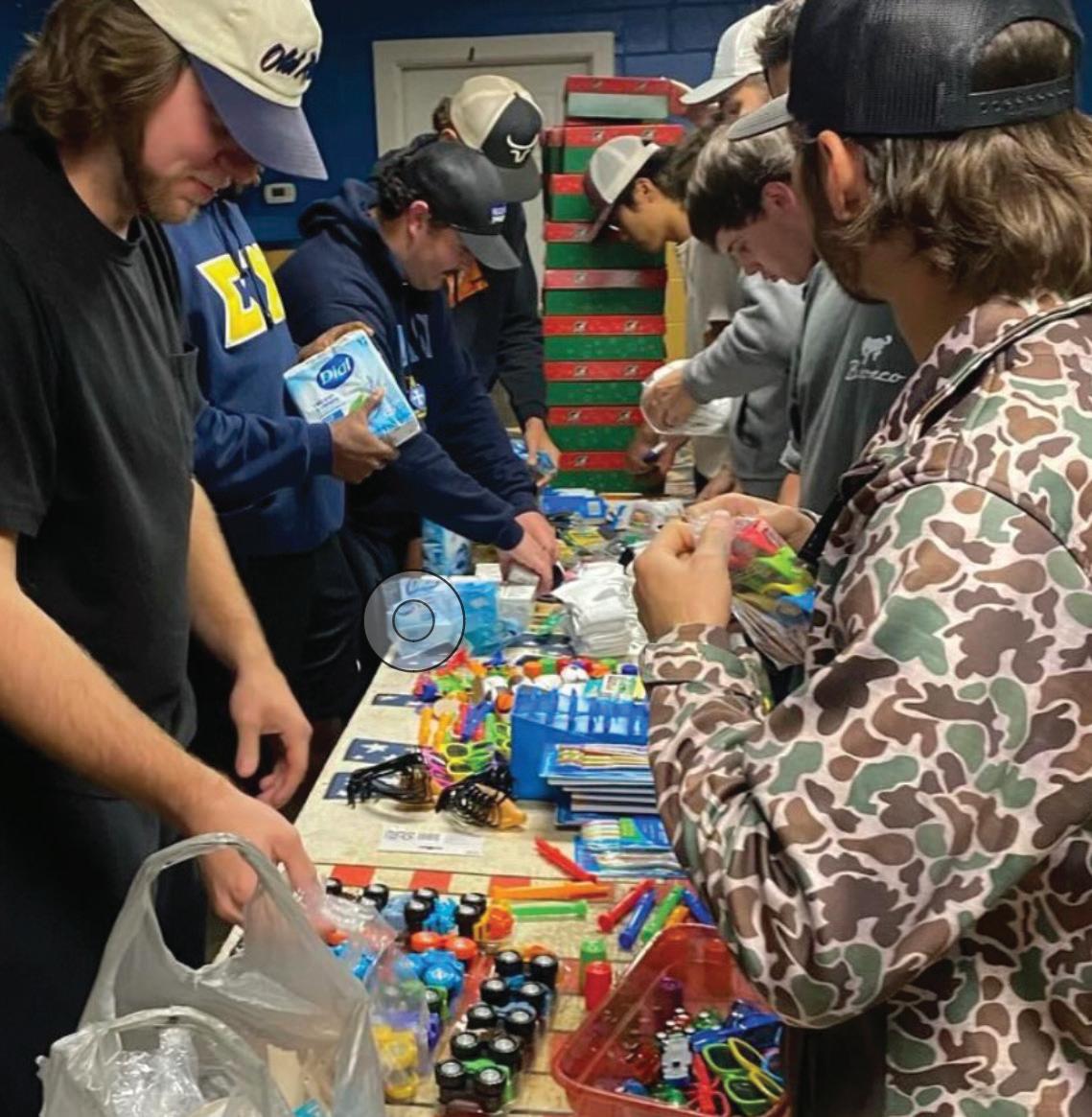
Members of the Georgia Southwestern chapter pack shoeboxes with essential items like toiletries and other convenient necessities as part of Operation Christmas Child held by First United Methodist Church in Americus, Georgia.
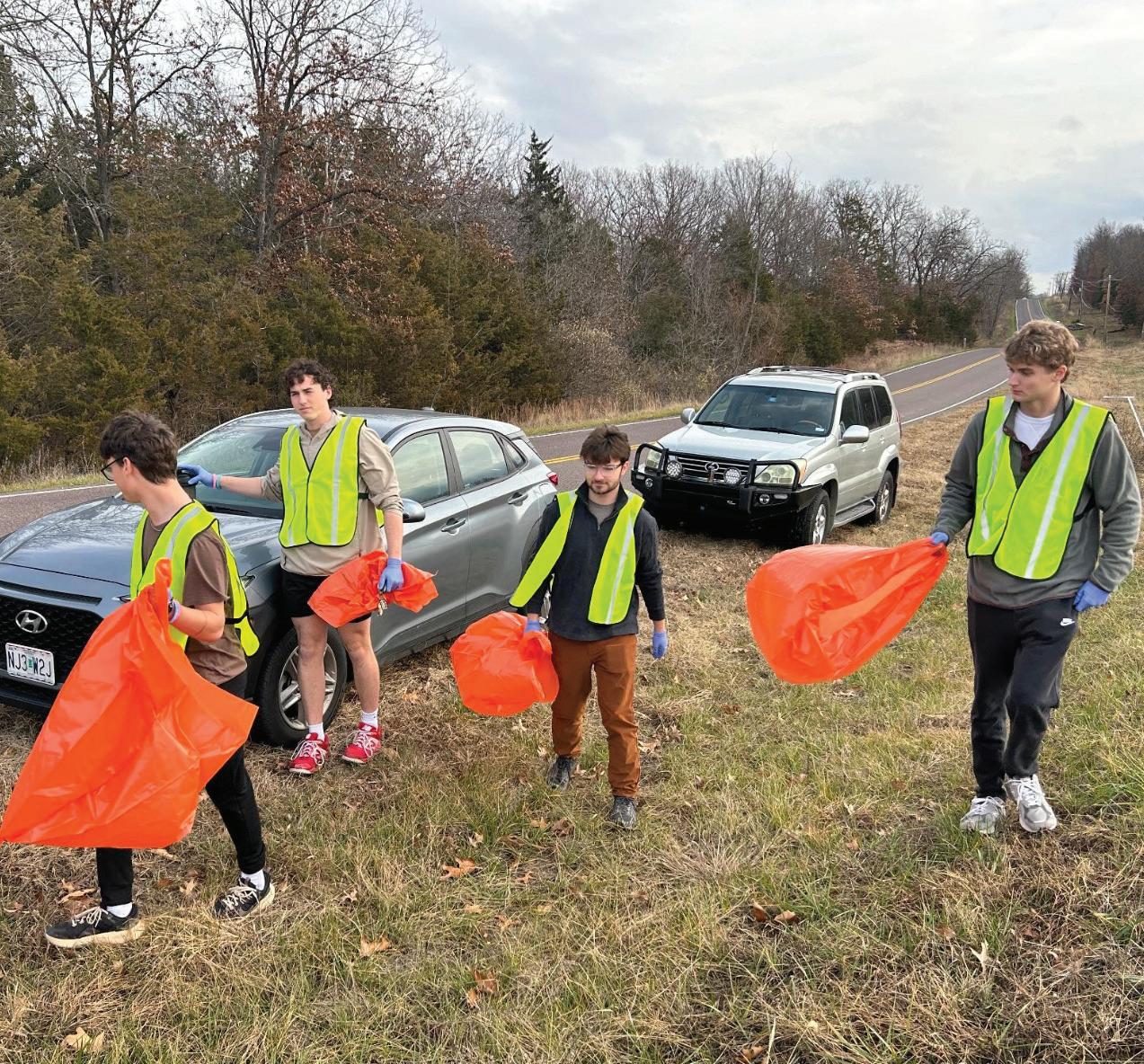
Members of the Missouri-Columbia associate chapter pick up trash along Richland Road in Columbia, Missouri, after having recently adopted the road to clean up each month. Pictured are Hagen Tatarsky, 2026, Trent Mayberry, 2026, Kolby Armon, 2026, and David Pearcy, 2026
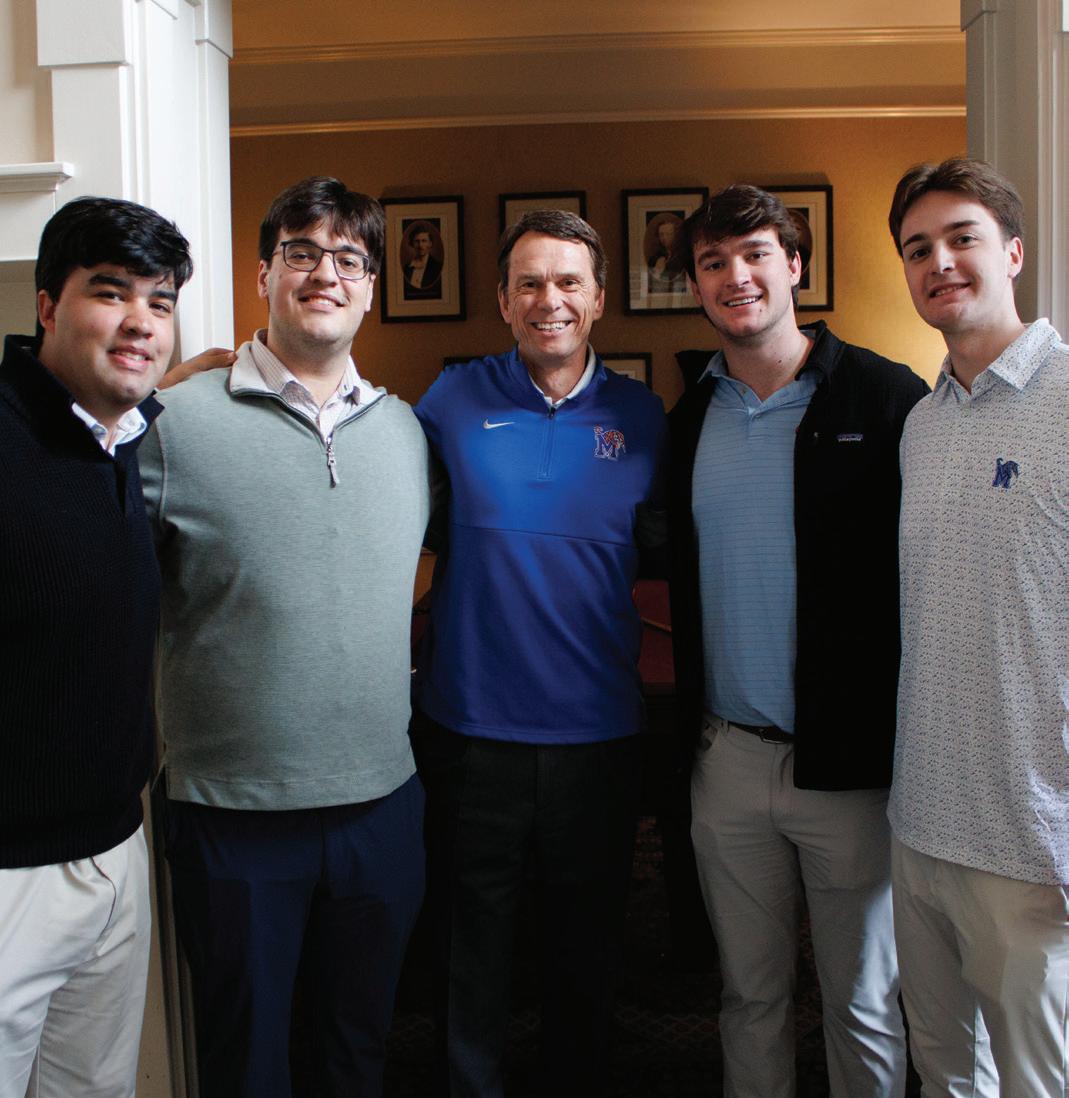
Brothers with the Memphis undergraduate chapter are pictured with university president Bill Hardgrave, center, after meeting to discuss with him ways to boost Greek-letter recruitment and involvement on campus.
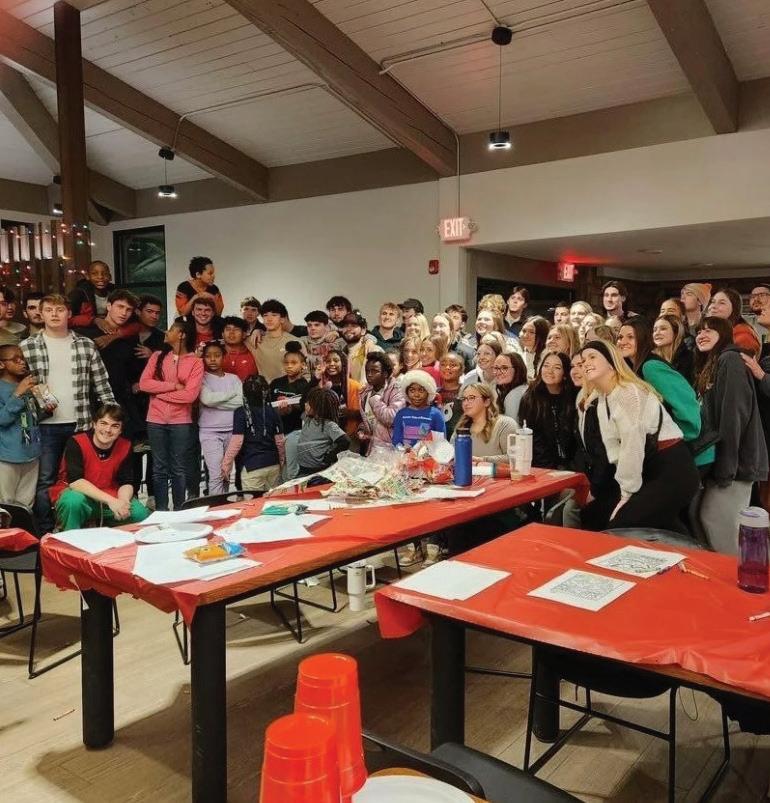
Members of the Cincinnati chapter and the Cincinnati Pi Beta Phi sorority are pictured during a Christmas party with their community service partner, Inner City Youth Opportunities. For Christmas 2023, they raised over $1,500 for gifts for the children at the Christmas party.
BY ASHLEY SZATALA //////
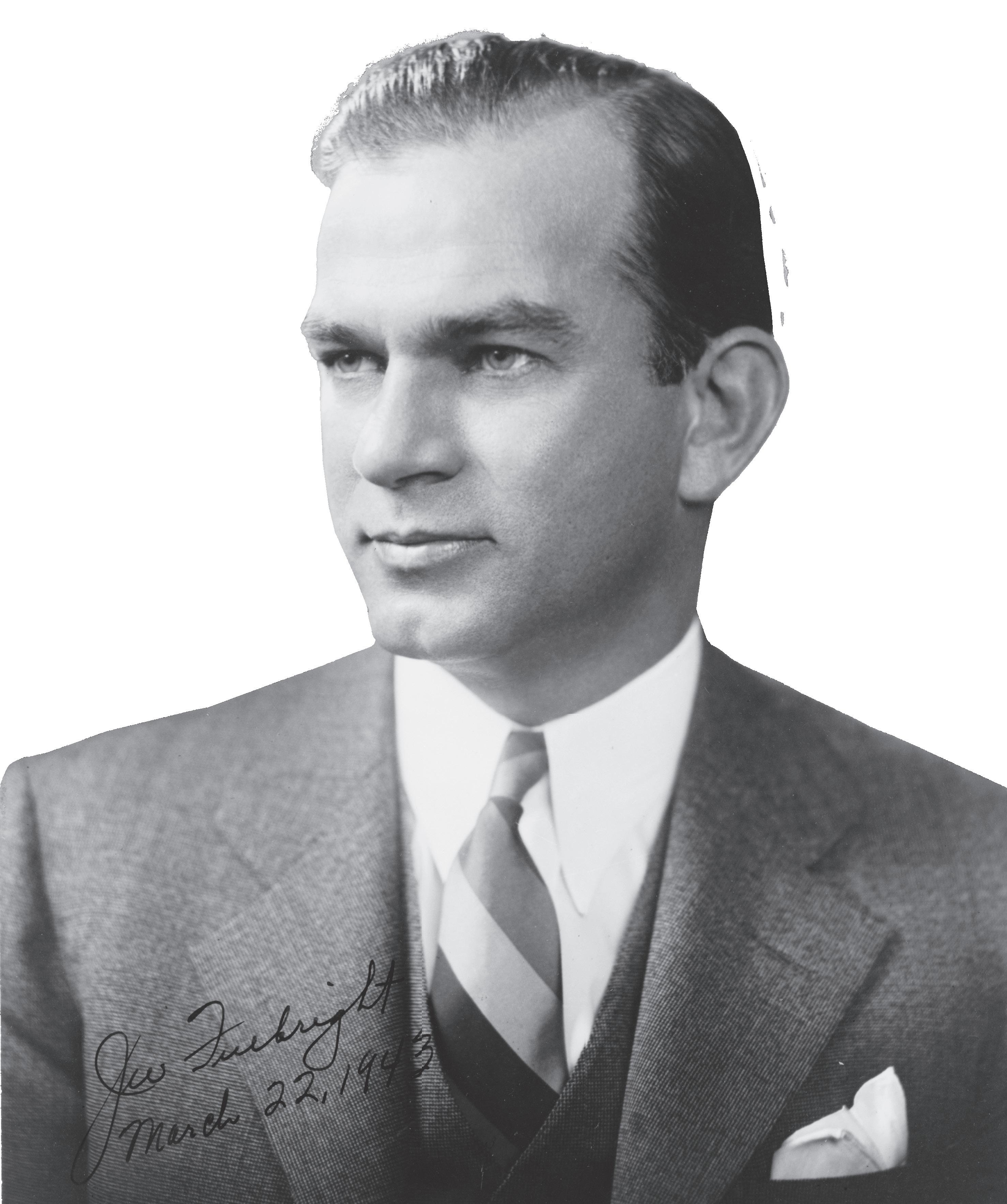
A LEGACY OF INTERNATIONAL LEARNING
The experience of Significant Sig J. William Fulbright, ARKANSAS 1924, studying abroad led to the creation of the Fulbright exchange program and shaped his political approach
Significant Sig J. William Fulbright, ARKANSAS 1924, is more well known today for the scholarship that bears his name than for his political career that lasted decades. The idea for scholarship’s formation is one that originated from Fulbright’s study abroad at the University of Oxford in England, an opportunity the Omega Omega chapter proudly announced to Fraternity members in TheSigmaChiQuarterly in 1925. The impact of the experience is one that left an indelible impact on Fulbright, his political approach and on the world today.
A LIFECHANGING EDUCATIONAL EXPERIENCE
James William Fulbright was born April 9, 1905, in Sumner, Missouri, and his family moved to Fayetteville, Arkansas, the following year. Fulbright was a bright student and enrolled at the University of Arkansas at age 16 in 1921. He was a star halfback on the university’s football team, was president of school’s student government organization and was Consul of the Omega Omega chapter in 1923. During his time in college, the chapter wrote glowingly in The Sigma Chi Quarterly of his athletic prowess and of his election as student government president. Fulbright graduated college at age 19 with a degree in political science. In 1925 he was selected as a Rhodes Scholar, an experience that would shape his adult life.
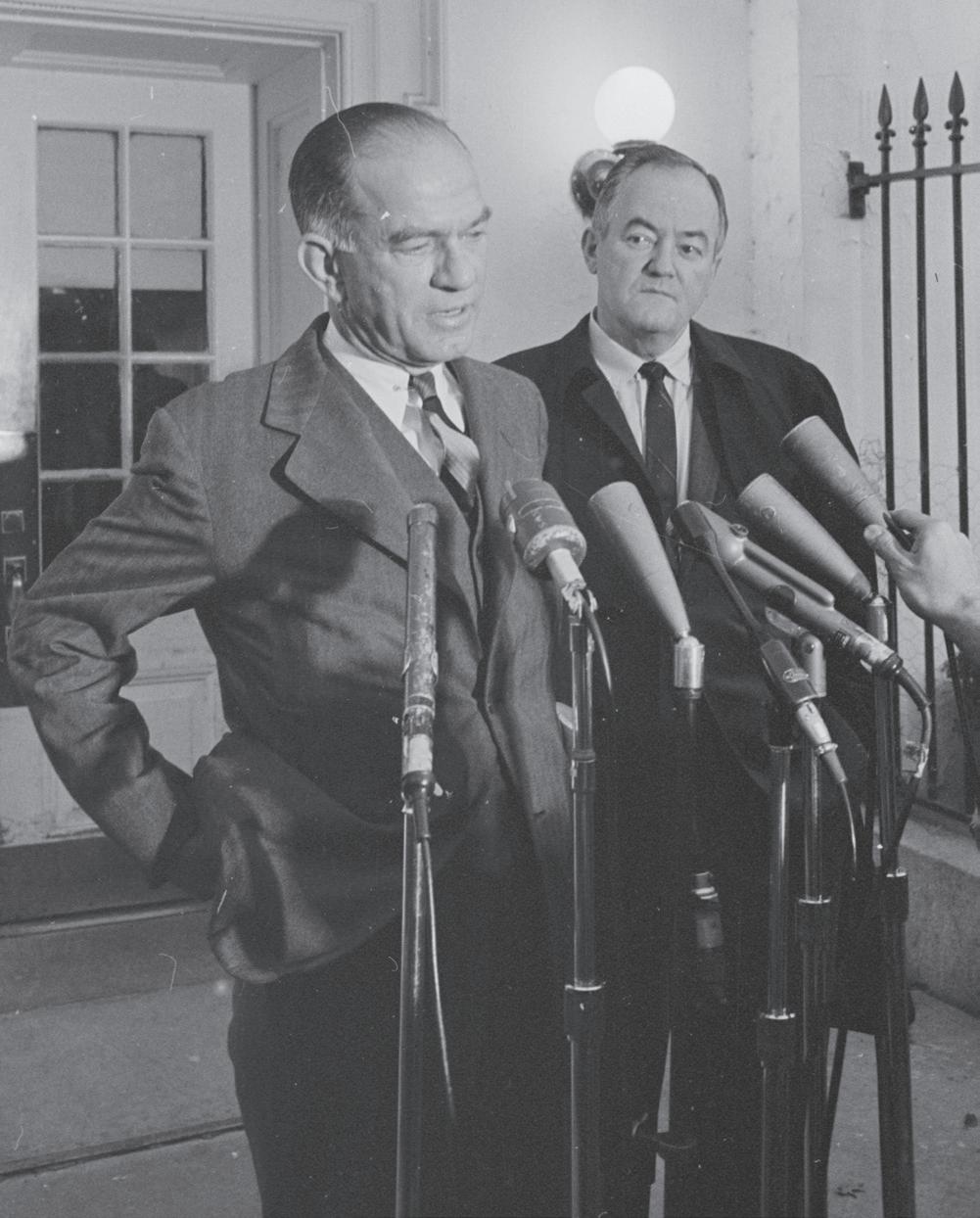
The Rhodes Scholarship, established in 1902 by De Beers diamond company founder Cecil Rhodes after his death, is an international postgraduate award for students to study in England at Rhode’s alma mater, the University of Oxford. The Omega Omega chapter proudly wrote in The Sigma Chi Quarterly of Fulbright’s selection. In the spring 1987 issue of The Magazine of Sigma Chi, Fulbright is quoted as saying, “The experience made a great impression on me. It was a great cultural shock to be taken from Fayetteville, Arkansas, to Oxford, England, without any intermediate introduction to the civilization. Naturally, that remained at the back of my mind.”
Fulbright earned a master’s degree from Oxford and toured Europe before returning to the United States to earn his law degree from George Washington University. He returned to the University of Arkansas in 1936 to join the law school faculty before being promoted in 1939 to president of the university at age 34. At that time, he was the youngest college president in the history of the United States. His tenure in that position only lasted two years.
A USE FOR FROZEN FOREIGN CURRENCY
Fulbright’s time at Oxford and in Europe led to a deep interest in international affairs. It was this interest that inspired his successful run in 1942 for the U.S. House of Representatives as a Democrat representing northwestern Arkansas. Shortly thereafter, he became a member of the Foreign Affairs Committee. He soon began making a name for himself as a politician.
In 1943 Fulbright introduced and successfully passed a one-sentence resolution calling for the creation and U.S. participation in an international organization to maintain world peace. His resolution helped lay the groundwork for the 1945 establishment of the United Nations. In 1944 he was elected to the U.S. Senate.
The following year, the United States had a surplus of foreign currency frozen abroad due to the sales of military surplus at the end of World War II. Thanks to the war and the founding of the United Nations, the country’s attitude — and that of lawmakers — was one of boosting international understanding. This combination of circumstances created the perfect timing for an idea of Fulbright’s, according to the winter 1956 issue of TheMagazineofSigmaChi. He knew Congress would not approve a student exchange program funded by the Department of the Treasury.
Significant Sig and Arkansas Sen. J. William Fulbright, ARKANSAS 1924, left, is pictured with Minnesota Sen. Hubert Humphrey speaking to the media on Oct. 24, 1962, during the Cuban missile crisis.
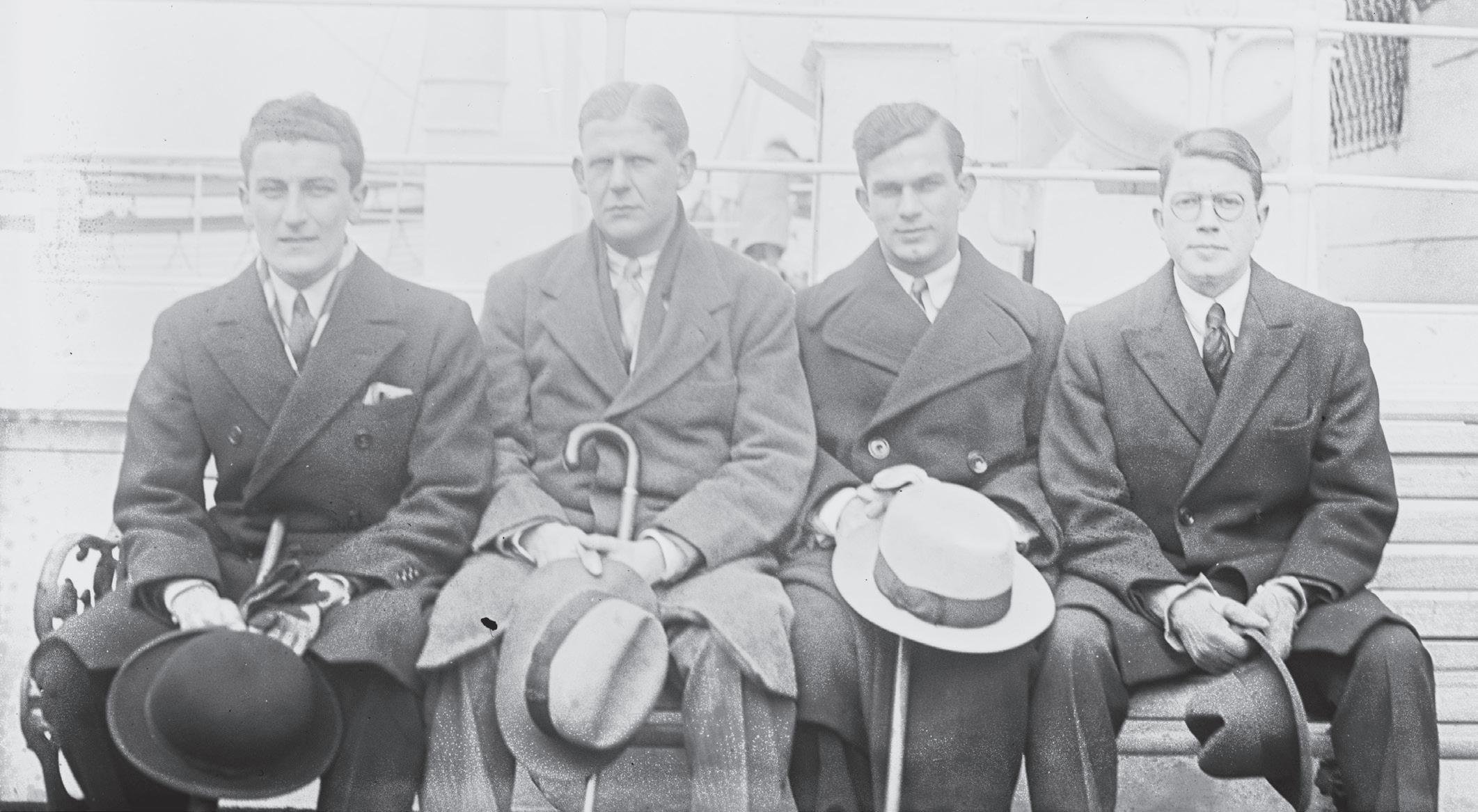
But it might approve one financed by money tied up overseas. “The No. 1 reason why I happened to think up this program was that I had had a Rhodes Scholarship,” Fulbright said in the spring 1987 issue of The Magazine of Sigma Chi
In September 1945, Fulbright introduced a bill to provide grants for an international educational exchange where the grants would be financed through the foreign credits accruing to the United States. The next fall the Fulbright Educational Exchange program was passed by the U.S. Congress and signed into law by President Harry Truman. Its founding purpose was “to increase mutual understanding between the people of the United States and the people of other countries.”
According to the Fulbright program’s website, Fulbright believed that if large numbers of people lived and studied in other countries, “they might develop a capacity for empathy, distaste for killing other men, and an inclination for peace.” He is also quoted as saying: “Our future is not in the stars but in our own minds and hearts. Creative leadership and liberal education, which in fact go together, are the first requirements for a hopeful future for mankind. Fostering these — leadership, learning and empathy between cultures — was and remains the purpose of the international scholarship program that I was privileged to sponsor in the U.S. Senate.”
Since its inception, over 400,000 recipients from the United States and 160 countries have participated in the Fulbright program, and about 8,000 people are selected for it each year, according to the Bureau of Educational and Cultural Affairs. Today it is considered one of the most prestigious scholarships in the United States.
‘A
LIFE THAT CHANGED OUR COUNTRY AND OUR WORLD FOREVER’
Fulbright remained in the Senate until losing reelection in 1974. Other highlights from his tenure in Congress include supporting the formation of a federal European union; opposing the anti-Communist investigations of Wisconsin Sen. Joseph McCarthy and helping censure him in 1954; and serving as chairman of the Senate Foreign Relations Committee from 1959 to 1975, during which time he stood alone in opposing the Bay of Pigs invasion during the Cuban missile crisis and was a vocal critic of the U.S. involvement in the Vietnam War.
After leaving Congress, he joined the Washington, D.C., law firm of Hogan and Hartson. President Bill Clinton, a fellow Arkansan who had worked during college as an intern in Sen. Fulbright’s office and regarded him as a mentor, presented Fulbright with the Medal of Freedom in 1993. Two years later, Fulbright entered the Chapter Eternal on Feb. 9, 1995, at age 89.
Clinton delivered the main eulogy at Fulbright’s funeral service. “[Fulbright’s was] a life that changed our country and our world forever and for the better,” he said. “In the work he did, the words he spoke, and the life he lived, Bill Fulbright stood against the 20th century's most destructive forces and fought to advance its brightest hopes.”
Significant Sig J. William Fulbright, ARKANSAS 1924, is pictured second from right with fellow teammates on the University of Oxford lacrosse team while he was studying abroad there as a Rhodes Scholar.

The White Rose Ceremony
In 1909, the service in memoriam was officially added to the Ritual. More than a century later, the beautiful White Rose Ceremony is publicly conducted as a final honor to the life of a Sigma Chi and to recognize the brother’s entrance into the Chapter Eternal.
The White Rose Ceremony may be conducted in two ways: as part of a memorial service and at a cemetery. In both, brothers who are present don white roses over their hearts. Then, each brother places his rose on the casket. After honor is called to the name of the deceased, the words spoken by the leader of the ceremony are short, yet poignant and true to the spirt of Sigma Chi:
“InasmuchasourdearlybelovedbrotherworeoverhisheartTheWhiteCrossofSigmaChi,whoseimmaculatewhitenesssymbolizedtousthepurityofhismotives, therefore, it is most appropriate that he now bear above his heart our emblem; and that we lay white roses upon his casket in token of the sweet memories we will always cherish of him we loved so well.”
The service in memoriam is one of four portions of the Ritual that can be conducted publicly. It provides a brief, but powerful glance at the meaningful words of Sigma Chi to those outside of our order, showing them the importance of the bonds of our brotherhood.
Denotes Life Loyal Sig
ORDER OF CONSTANTINE SIG TIM AYNESWORTH, TEXAS-AUSTIN 1970 , entered the Chapter Eternal Jan. 19, 2024. He was 77. Aynesworth was born Dec. 28, 1946, in Austin, Texas. He helped reactivate the Fraternity’s Austin alumni chapter in 1984 and served as its president. He led the effort to reinstall the University of Texas-Austin chapter in 2009 and served as colony and chapter advisor to the group from 2007 to 2011. Aynesworth also was a Cornerstone mentor from 2012 to 2013. Professionally, he was an architect in Houston and Austin, and he designed several renditions of the University of Texas-Austin chapter’s new house.
ORDER OF CONSTANTINE SIG MICHAEL MAYER JR., CAL. STATE-NORTHRIDGE 1978 , entered the Chapter Eternal Dec. 23, 2023. He was 68. Mayer was born July 2, 1955. He served Sigma Chi as a Los Angeles Coastal province Grand Praetor in the 1990s and was a Ritual Peer. Mayer was a member of the Southern California chapter’s installation team, and he served the Loyola Marymount chapter first as a co-chapter advisor and later as chapter advisor. From 1993 to 2001, and then from 2005 to 2007, he was a member of the Fraternity’s History Commission. He attended many Balfour Leadership Training Workshops and province workshops.
ORDER OF CONSTANTINE SIG BOB WARD SR., MISSISSIPPI STATE 1957 , entered the Chapter Eternal Feb. 17, 2024. He was 91. Ward was born Oct. 14, 1932, in Shreveport, Louisiana. He was a longtime member of the New Orleans and Shreveport alumni chapters and previously held the roles of president, vice president and treasurer for the New Orleans alumni chapter. He received the Jay Minton Best Alumni Chapter Officer Award in 2002. Ward also served as chairman of the 2001 Grand Chapter in New Orleans. Professionally, he worked in insurance and retired as vice president of Gillis, Ellis and Baker in New Orleans.

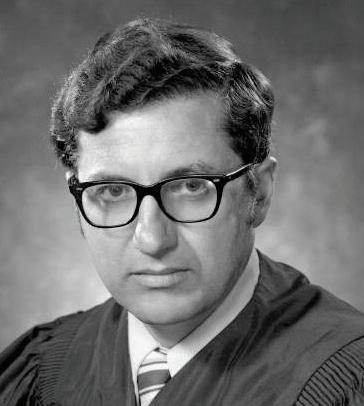
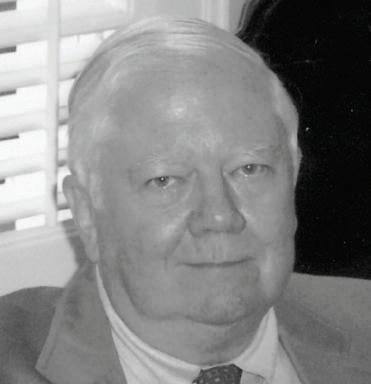
SIGNIFICANT SIG JAMES JOANOS, FLORIDA STATE 1956 , entered the Chapter Eternal Jan. 20, 2024. He was 89. Joanos was born June 28, 1934, in Tallahassee, Florida. He was a longtime lawyer and judge in Florida. He began his service as a Leon County, Florida, judge in 1971 and served in the circuit and appellate courts. He eventually became chief judge of the 1st District Court of Appeal, where he presided from 1980 to 2000. He retired to private practice with the Akerman law firm. Outside of work, Joanos was key in the establishment of Florida State’s College of Law, where he was an adjunct professor for more than 20 years, and he was past president of the university’s alumni association.
SIGNIFICANT SIG BOB LONG, AUBURN 1959, entered the Chapter Eternal Dec. 28, 2023. He was 86. Long was born March 4, 1937, in Atmore, Alabama. Professionally, he was a prominent Georgia banker who began his career at Merchants National Bank in Mobile, Alabama. After earning a Master in Business Administration from Harvard, he joined what later was called SunTrust Banks and now Truist Financial Corp. He retired in 2001 as chairman, president and CEO of SunTrust Banks in Georgia. He also taught finance and banking courses part-time at Georgia State University, Morehouse University and Louisiana State University. Long also held leadership roles in many charitable and civic endeavors.
SIGNIFICANT SIG JAMES MITCHELL, RENSSELAER 1951, entered the Chapter Eternal Dec. 17, 2023. He was 93. Mitchell was born April 19, 1930, in Manchester, New Hampshire. He began his higher education career in 1958 after joining the University of California, Berkley, civil engineering faculty. He retired from there in 1993 and joined the Virginia Tech faculty in 1994. There, he held the rank of university distinguished professor. Mitchell retired in 1999 but continued guiding research, co-teaching courses and presenting seminars until recently. He published more than 500 journal publications, conference papers, reports and more throughout his career, but his most notable publication is his textbook, Soil Behavior. He also received numerous awards and recognitions for his research and teaching.
SIGNIFICANT SIG FRANK POPOFF, INDIANA 1957 , entered the Chapter Eternal Feb. 25, 2024. He was 88. Popoff was born Oct. 27, 1935, in Sofia, Bulgaria, and his family moved to Indiana five years later. After graduating with his Master of Business Administration, he began working at the Dow Chemical Company, where he worked for the next 41 years. Popoff held various roles in marketing and business management, including president of Dow Europe, CEO of Dow Chemical Company and chairman of the board. He also received several recognitions for his leadership as CEO, for sustainable development and for international business.
SIGNIFICANT SIG ROBERT WOLVERTON SR., HANOVER 1948 , entered the Chapter Eternal Dec. 15, 2023. He was 98. Wolverton was born Aug. 4, 1925, in Indianapolis. He had a 70-year career in education that included more than 40 years at Mississippi State as a professor of classics as well as holding several administrative roles. These roles included vice president of academic affairs and head of the department of foreign languages. He retired from full-time teaching in 2020 at age 94. Career highlights include helping the university obtain a chapter of the prestigious Phi Beta Kappa honor society, receiving the John Grisham Master Teacher Award, being named Humanities Teacher of the Year and receiving the inaugural Robert Wolverton Legacy Award to honor those with distinguished service to the university’s College of Arts and Sciences.
Sigma Chi Fraternity CHAPTER ETERNAL
Alabama
1956 Don Newton of Birmingham, AL; 1/24
1992 John Camp III of Pensacola, FL; 2/24
Arizona
1965 John Mangum of Phoenix; 2/24
Arizona State
1961 Gary Walker of Scottsdale, AZ; 2/24
1967 Robert Cleary of West Yarmouth, MA; 2/24
Arkansas
1956 Joy Hill of Lonoke, AR; 3/24
1971 Maurice Little of Little Rock, AR; 2/24
1978 Richard Watkins of Mabelvale, AR; 2/24
1979 Douglas Parrish of Little Rock, AR; 2/24
Auburn
1964 Frank Raue of Mobile, AL; 2/24
Beloit
1952 Dick Quast of Kildeer, IL; 2/24
1963 John Lussow of Janesville, WI; 3/24
Bowling Green
1955 Edward Haller Jr. of Naples, FL; 2/24
1988 Mark Malo of Oakland, CA; 2/24
Bradley
1959 Norman Carrier of Darien, CT; 2/24
1961 Gary Hepburn of Surprise, AZ; 1/24
Brown
1962 Tristram Coffin of Waltham, MA; 2/24
1974 Neil Kiely of Barrington, RI; 2/24
Butler
1954 Herb Dixon of Scottsdale, AZ; 2/24
Cal. State-Fresno
1961 Alden Carey of Lodi, CA; 2/24
Cal. State-Northridge
1979 William Moore of Escondido, CA; 2/24
Cal. State-San Bernardino
1997 Victor Munoz of Miramar, FL; 2/24
California-Berkeley
1953 Charles Harrington of Lafayette, CA; 1/24
Central Florida
1978 Michael Scholla of Elkton, MD; 1/24
Central Michigan
1968 Donald Roberts of Croswell, MI; 2/24
Cincinnati
1953 James Katsanis of Cincinnati; 2/24
1955 Richard Mueller of Cincinnati; 3/24
1955 Bill Thurner of Cincinnati; 2/24
1956 Constandinos Condorodis of Cincinnati; 2/24
1990 Earl Schaub of Cincinnati; 3/24
Clemson
1992 Todd Cramer of Knoxville, TN; 2/24
Colorado State
1958 Richard Coon of Portland, OR; 2/24
1959 Marshall Strauss of Rockford, IL; 2/24
1961 Gus McCutchen of Port Townsend, WA; 2/24
Columbia
1959 Dudley Ferrari, MD, of Cary, NC; 2/24
Denison
1955 John Rodgers, MD, of Santa Barbara, CA; 2/24
DePauw
1964 Brent Bundy of Cincinnati; 2/24
East Tennessee
1974 Bill Barrett III of Bristol, TN; 1/24
1977 Michael Millard of Maryville, TN; 2/24
Eastern Illinois
1978 Steve Olson of Kouts, IN; 2/24
Eastern Kentucky
1990 Brian Doty of Richmond, KY; 2/24
Emory
1965 Robert Yanno of Miami; 2/24
Florida
1956 Guy Loudermilk Jr. of Palm Coast, FL; 3/24
Florida State
1964 Robert Wilcox of Mount Dora, FL; 1/24
George Washington
1951 Charlie Redmond of Clarksville, VA; 3/24
Georgia
1965 Bill Foster of Cumming, GA; 1/24
Georgia Southwestern
1974 Robert Knowles of Fayetteville, GA; 1/24
1979 Randy Coley of Hawkinsville, GA; 2/24
Georgia Tech
1958 Duane Hoover of Atlanta; 1/24
Hampden-Sydney
1964 Sid Druen of Columbus, OH; 1/24
1965 Robert Wimer of Amherst, VA; 2/24
Hobart
1964 Robert Harrington of Plano, TX; 2/24
Idaho
1965 Stuart Barclay of Hermiston, OR; 2/24
Illinois Wesleyan
1956 Don Albery of Columbia, MO; 1/24
Indiana
1958 David Wood of North Palm Beach, FL; 2/24
1982 Thomas Cole of New York; 1/24
Indiana (Pennsylvania)
1980 Geoffrey Miller of Ligonier, PA; 2/24
Iowa
1955 Robert Groom of Fayetteville, AR; 3/24
Iowa State
1956 Dennis Johnson of Fort Dodge, IA; 1/24
Kansas
1958 Tom King of Kerrville, TX; 1/24
Lafayette
1953 William Murgas of Brookfield, WI; 2/24
1965 John Kille of Easton, PA; 1/24
Lehigh
1956 Bruce Waechter of Ambler, PA; 1/24
Louisiana State
1948 Robert Bozeman of Dallas; 2/24
Maine
1968 James Goble of Ferndale, PA; 2/24
Maryland
1950 William Kiser of Shaker Heights, OH; 2/24
Memphis
1972 Jim Nicholson of Collierville, TN; 2/24
1984 Chris Holliday of Germantown, TN; 1/24
Miami (Ohio)
1954 Frank Batsche Jr., DDS, of Bellbrook, OH; 2/24
1955 Kay Earhart of Woodland Hills, CA; 2/24
1977 Michael Chagares of Vero Beach, FL; 2/24
Michigan
1949 Joseph Beel of Grand Rapids, MI; 2/24
Michigan State
1954 Donald Sutherland of Escondido, CA; 2/24
Middle Tennessee
2015 John Friant of Ooltewah, TN; 2/24
Minnesota
1950 Clifford Sour of Minneapolis; 12/23
Mississippi
1957 Jackson Herrington Sr. of New Albany, MS; 1/24
1977 Patrick Bryan of Starkville, MS; 3/24
1984 William Harrison of New York, NY; 2/24
1992 John Montgomery of Franklin, TN; 2/24
1995 Matt Root of McComb, MS; 2/24
2014 Boykin of Hollandale, MS; 3/24
Mississippi State
1952 John Pace of Baton Rouge, LA; 1/24
1958 Walter Miller of Galveston, TX; 2/24
1964 James Reed Jr. of Laurel, MS; 2/24
Missouri-Columbia
1983 Brian O'Rourke of Mission, KS; 2/24
Murray State
1981 Ken Haggard of Hopkinsville, KY; 2/24
2000 John Dismukes of Paducah, KY; 2/24
Nebraska
1948 John Pflug of Lincoln, NE; 2/24
1952 Charles Curtiss, MD, of Fremont, NE; 1/24
1961 Roger Evans of Corvallis, OR; 2/24
1986 James Trumbull of Scottsbluff, NE; 2/24
New Mexico State
1970 Rick Saari of San Angelo, TX; 2/24
North Carolina-Chapel Hill
1955 William Ward of Hendersonville, NC; 3/24
Northern Arizona
1970 Patrick Moneyhun of Portland, OR; 2/24
1994 Brandon Briggs of Scottsdale, AZ; 2/24
Northern Colorado
1987 Daniel Copeland of Boulder, CO; 1/24
Northwestern
1962 John Kays of Cape Coral, FL; 2/24
2009 Jon Mindrum of Oak Park, IL; 2/24
Ohio State
1955 Paul Ludwig of Westerville, OH; 1/24
1989 Conman Conley of Columbus, OH; 2/24
Oklahoma State
1959 Neil Martin of Muldrow, OK; 3/24
Oregon
1960 Joseph Carson of Yakima, WA; 2/24
Pittsburg State
1966 John Bumgarner of Lexington, SC; 2/24
Pittsburgh
1954 Paul Schrading of Pittsburgh; 1/24
Puget Sound
1982 Stephen James of Los Angeles; 2/24
1982 Robert Gregory of San Francisco; 12/23
Purdue
1959 Lloyd McKenzie Jr. of Bonita Springs, FL; 2/24
Rhode Island
1964 Marsh McClean of Jupiter, FL; 2/24
San Diego State
1962 Donald Halte of El Cajon, CA; 3/24
1969 Thomas Nettles of San Diego; 2/24
San Jose State
1964 Guy Shellman of San Jose, CA; 1/24
South Florida
1982 John Gorman of Washington, D.C.; 3/24
Southern California
1958 Al Provence of Georgetown, TX; 2/24
Southern Methodist
1965 John Kidd of Tucson, AZ; 2/24
Syracuse
1974 Roger Gilson Jr. of Ridgefield, CT; 2/24
Tennessee-Chattanooga
1961 Dick Sharpe of Weston, FL; 2/24
1964 Douglas Gordon Sr. of Orlando, FL; 1/24
1985 Scott Hendrix of Manhattan, KS; 1/24
Tennessee-Knoxville
1954 Benjamin Morton III of Virginia Beach, VA; 2/24
1955 James Culp Sr. of Tampa, FL; 1/24
Texas A&M-College Station
1999 Jeremy Barnes of Yoakum, TX; 2/24
Texas A&M-Commerce
1971 Dennis Stanley of Atlanta, TX; 2/24
Texas A&M-Kingsville
1974 Robert Jackson of Rockport, TX; 2/24
1982 Patrick Nemec of Corpus Christi, TX; 2/24
Texas Christian
1961 Lary Kuehn of Gainesville, TX; 2/24
Tulsa
1969 Bob Becher Jr. of Golden, CO; 3/24
Utah
1955 Roger Tonnesen of Mill Valley, CA; 2/24
1959 Gerald Peterson of Salt Lake City; 2/24
1960 Frederick Smith of Salt Lake City; 2/24
1962 Gary Larsen, MD, of Salt Lake City; 1/24
1962 David Malmquist of Atlanta; 1/24
1964 Hoyt Brewster Jr. of Cottonwood Heights, UT; 2/24
1970 Michael Jensen of Salt Lake City; 2/24
1973 David Buchman of Salt Lake City; 1/24
1989 Jeff Vincent of Salt Lake City; 2/24
1999 Justin Jensen of Draper, UT; 2/24
Utah State
1951 Gary Theurer of Gaithersburg, MD; 2/24
1961 Thomas Davis of Brigham City, UT; 2/24
Vanderbilt
1983 Samuel Johnson of Atlanta; 3/24
Virginia
1974 Robert Wheaton of Paradise Valley, AZ; 2/24
Wabash
1959 John Hollett III of Carmel, IN; 3/24
1959 Hoyt Miller, MD, of Cortez, FL; 2/24
Wake Forest
1954 Hervy Kornegay, MD, of Mount Olive, NC; 2/24
Wesleyan
1955 Harold Stuhl of Saint Louis; 2/24
West Virginia
1954 Bud LaFollette III of Sarasota, FL; 2/24
Western Kentucky
2003 Tom Groves of Louisville, KY; 3/24
Western Michigan
1989 Dave Young II of Berea, KY; 2/24
Westminster
1963 Paul Simmons III of Saint Louis; 1/24
1968 David Stubbs, MD, of Des Moines, IA; 2/24
1973 Brian McCabe of Schenectady, NY; 2/24
1977 Rich Richardson of Little Rock, AR; 2/24
Whitman
1985 Scott Lamb of Media, PA; 2/24
Willamette
1954 Dorence Noteboom of Beaverton, OR; 2/24
Wisconsin-Madison
1956 Donald MacLeish of Waunakee, WI; 2/24
1957 David Halling of Mequon, WI; 2/24
Wyoming
1950 Robert McFarlane of Beaverton, OR; 1/24
1983 Matt Fermelia of Cheyenne, WY; 2/24
The Sig List
1
2 3 4 5
Significant Sig Carey Bringle, TENNESSEE TECH and AUBURN 1991, was named by New York Tech a top 10 entrepreneur to watch out for in 2024. Bringle, an award-winning barbecue pitmaster, is the owner of Nashville, Tennessee’s Peg Leg Porker and Bringle’s Smoking Oasis. He is also the founder of Peg Leg Porker Spirits, where his bourbon was named the 2023 World’s Best Bourbon at the Tasting Alliance World Championship.
Significant Sig Maxie Anderson, NORTH DAKOTA 1956, was awarded the Congressional Gold Medal on June 13, 1979, for the first manned hotair balloon crossing of the Atlantic Ocean. Anderson, and two others, began their flight Aug. 11, 1978, at Presque Isle, Maine, and safely landed in Miserey, France, six days later. Anderson also was the first to cross the Pacific Ocean, launching from Nagashima, Japan, and landing in Mendocino National Forest in California less than four days later. He entered the Chapter Eternal in 1983 after a balloon accident in Germany.
Sigma Chi Leadership Institute board member Charles Nies, WASHINGTON STATE and ST. THOMAS 1988, has been named the 10th chancellor of the University of Minnesota Duluth, effective July 1, 2024. Nies previously served as vice chancellor for student affairs at the University of California, Merced.
Significant Sig Gordon Gould, UNION 1941, fought for years to gain recognition as one of the primary discoverers of the laser. He is believed to be one of the first to conceive the laser’s potential and to find the means enabling it to function. In October 1977, after a 38-year fight, Gould was finally recognized by the U.S. Patent office. Gould was inducted into the National Inventors Hall of Fame in 1991.
Significant Sig and world-renowned puppeteer Bil Baird, IOWA 1926, has several of his puppets in the Smithsonian National Museum of American History in Washington, D.C. Baird’s marionettes performed at the 1939 Chicago World’s Fair. Baird also created the puppets, wrote, produced and performed the “Lonely Goat Herd” put on by Maria and the Von Trapp family in The Sound of Music film.
Things to know, notice and tell a brother
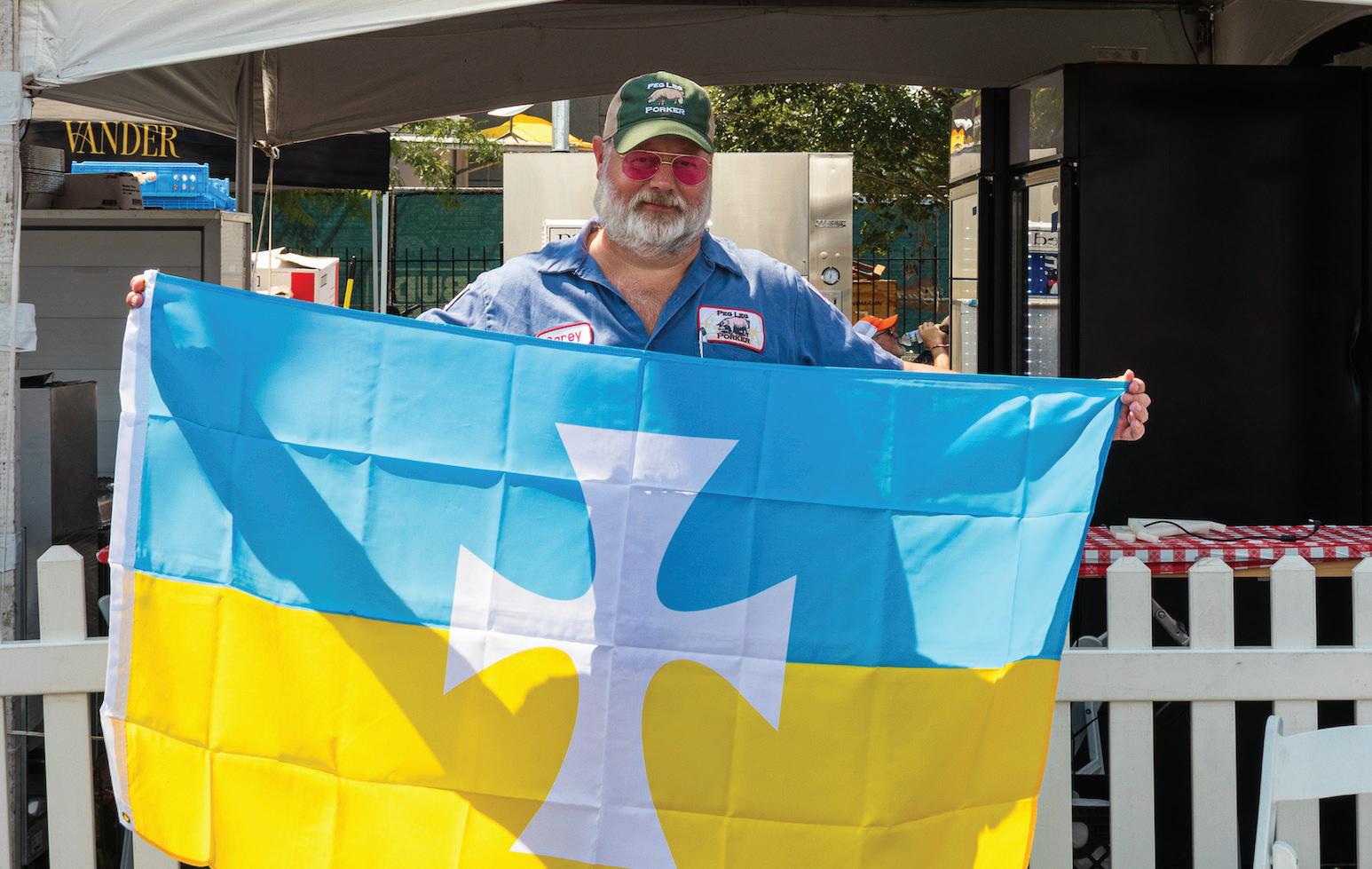
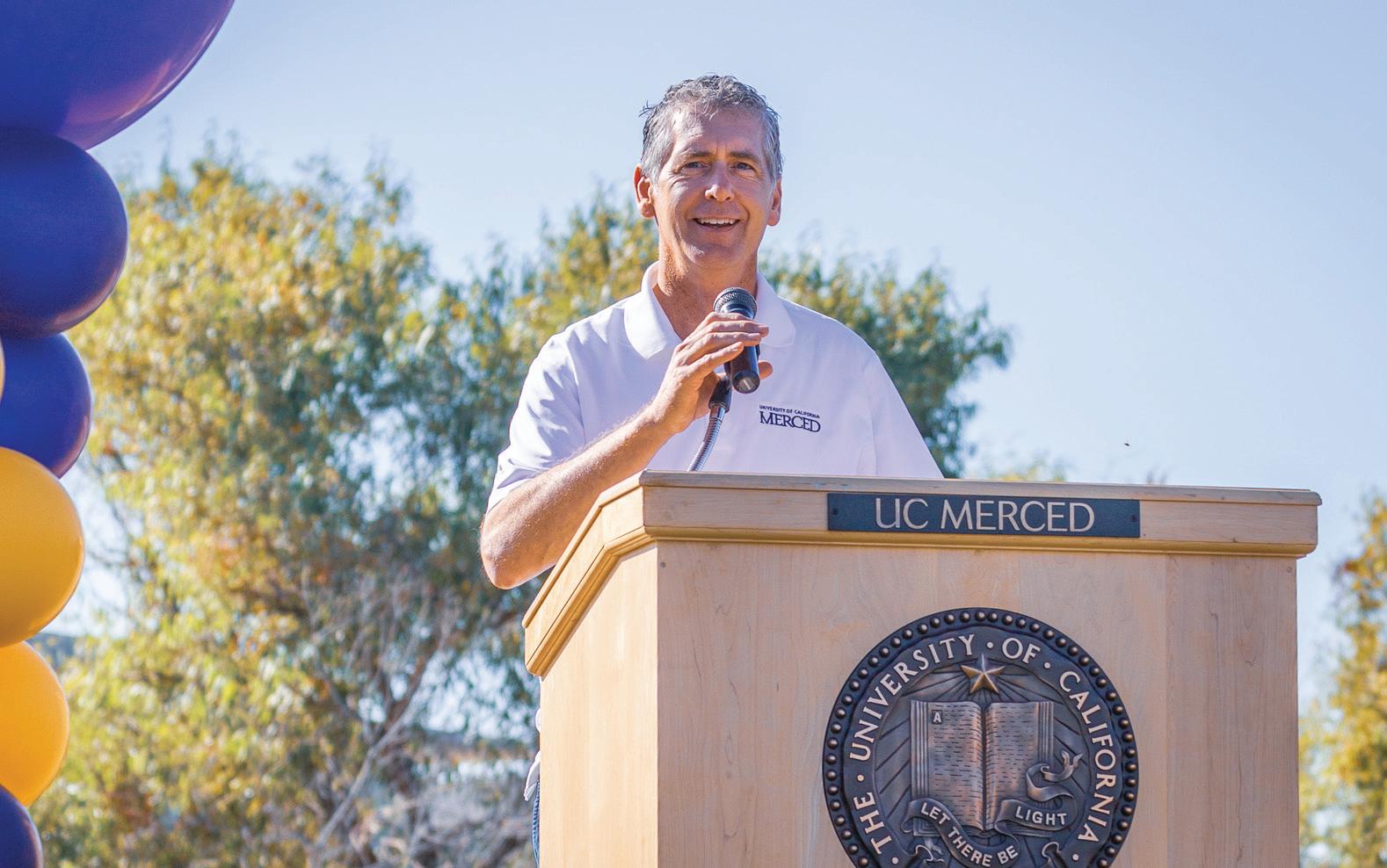
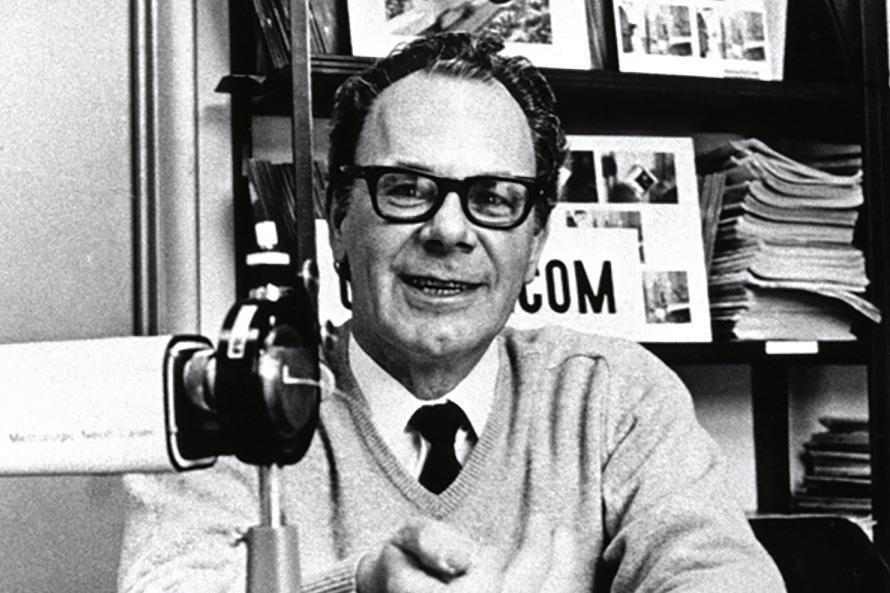
Significant Sig Carey Bringle, TENNESSEE TECH and AUBURN 1991
CHARLES NIES, WASHINGTON STATE and ST. THOMAS 1988
Significant Sig Gordon Gould, UNION 1941
BY THE NUMBERS
Sigma Chi undergraduate members are involved in their campuses and communities
19 student body presidents in the U.S. and Canada
234 undergraduate chapters
2.3
82%
Sigma Chis who participate in a student club or organization outside of chapter
$5.2 million raised for philanthropies in the 2022-2023 academic year average Interfraternity Council officers per chapter
100,000 hours of community service or philanthropical work in 2022-2023 academic year

Unlocking Others’ Potential
Krach Transformational Leaders Workshop, Horizons Huntsman Leadership Summit and Officer Training Academy facilitators share why they started volunteering, the joys of facilitating and why it’s an invaluable experience for others
Sigma Chi facilitators are alumni volunteers who teach values-based experiences to help undergraduate learners become transformational leaders who embody the skills demanded by our workforces and world. The many facilitators within Sigma Chi say it’s a rewarding role that makes a difference not only in the lives of undergraduate members, but also a difference in the facilitators’ own lives. Below, several facilitators from the Krach Transformational Leaders Workshop, Horizons Huntsman Leadership Summit and Officer Training Academy share why they signed up to volunteer, their facilitating experience and why it’s a role others should consider.
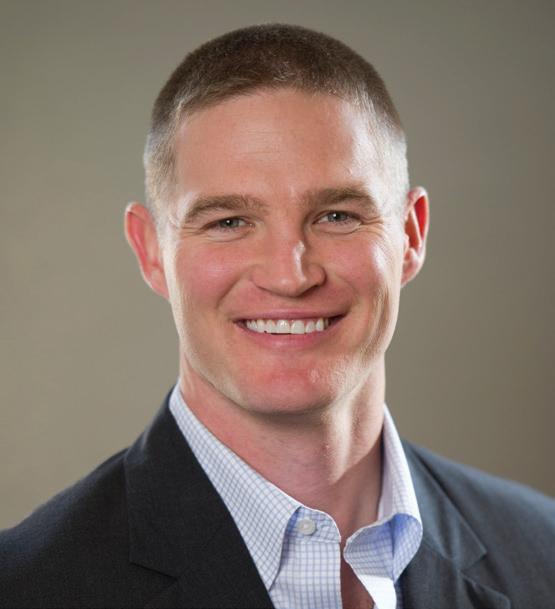
Robbie Kimbrough, CHARLESTON 2005 | Workshop facilitator beginning 2009 and Officer Training Academy co-chairman | 2022 Carlisle Outstanding Workshop Faculty Award
Robbie Kimbrough, CHARLESTON 2005, was a three-time attendee of what is now known as the Krach Transformational Leaders Workshop [TLW], and the facilitators he had there are men he has kept in touch with 20 years later. But it was the former chapter advisor at Furman University, Order of Constantine Sig Chris Brown, FURMAN 1989, who first encouraged Kimbrough to join the Consul faculty in 2009.
Since then, he’s facilitated in the Consul, Pro Consul and recruitment divisions, as well as the True North Leadership Certificate. Kimbrough has also been co-chairman of the Officer Training Academy [OTA], been part of the OTA Pro Consul faculty and has helped in other areas of the program.
A memorable moment in his facilitating experience happened at the 2023 Krach TLW when a comment was made in Kimbrough’s small group right before their lunch break. The men were talking about decision-making, instances where values are challenged and how to respond to those challenges. The comment was
about a negative situation going on in someone’s chapter and how to handle that situation. Kimbrough tried to steer everyone to a values-based decision, and when they returned from lunch, he set the scenario back up to give the men a chance to reevaluate their response.
“One of the coolest things I’ve seen as a facilitator is one of the guys in my group — definitely the most shy and quiet individual but very thoughtful and intelligent — he stood up and said, ‘I understand how difficult this is, and I’m disappointed in myself. I wanted to say something, but nobody else was. So, I just stayed quiet, and that was the wrong thing to do. I understand how important it is for someone to stand up and how easy it is sometimes to just go with the crowd. … I’m going to challenge myself to make sure that that never happens again.’ And it completely changed the whole dynamic of the group and everything that happened after that.”
His ability to connect with undergraduates while facilitating and mentoring has not gone unnoticed. Kimbrough was recognized with the 2022 William H. Carlisle Jr. Outstanding Workshop Faculty Award. “Being thought of on the same level as those men that I hold to such a high standard and such a high caliber of facilitator and brother was very special, and it was special to think that my brothers and peers see that I deserve to be there as well,” he says of the recognition.
Kimbrough adds that for young alumni looking to get involved in Fraternity volunteerism, OTA facilitation would be an ideal fit. It’s all virtual, so no vacation time is necessary; there’s flexibility with scheduling to meet with undergraduates and younger alumni already are at ease with working in a virtual capacity, he says.
“What’s cool about OTA is that we have the ability to reach more of our brothers than any other program. For someone just trying to learn if facilitating is something they enjoy, it’s a great opportunity to get involved in.” - Robbie Kimbrough, CHARLESTON 2005
“What’s cool about OTA is that we have the ability to reach more of our brothers than any other program,” Kimbrough says. “For someone just trying to learn if facilitating is something they enjoy, it’s a great opportunity to get involved in.”
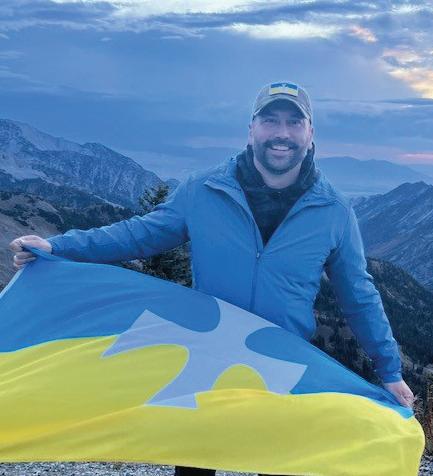
Justin Bala-Hampton, PACIFIC 2006 | Workshop facilitator beginning 2012, Officer Training Academy facilitator in 2021 and Horizons Huntsman Leadership Summit guide since 2022 | 2021 Carlisle Outstanding Workshop Faculty Award
Justin Bala-Hampton, PACIFIC 2006, remembers at what is now called the Krach TLW being inspired as an undergraduate by the different opportunities to learn about oneself and learn about one’s role as a chapter officer. He appreciated the alumni mentors’ perspectives, and seeing their time and devotion to the undergraduates’ development made him want to one day give back, too.
Today, he has been involved with the Fraternity through Krach TLW as a recruitment faculty member. He has also been involved in the Servant Leadership and True North Leadership faculties and the Mission 365 recruitment course. BalaHampton is a Horizons Huntsman Leadership Summit guide and a member of the inaugural Officer Training Academy recruitment faculty.
“[Facilitating] not only allows me to learn about myself even more, but also learn about the current undergraduate student and help them go through their own journey to becoming a better Sigma Chi and a better man for society,” BalaHampton says of the volunteer experience.
One of his most memorable facilitating moments happened during a 2023 Horizons session where members of his small group were connecting on a deeper level. An undergraduate mentioned that Bala-Hampton, due to his mentorship and care, was very much to him a father figure that was missing in his life, and BalaHampton and the young man still talk and maintain that connection today.
Connection with undergraduates is important to Bala-Hampton while facilitating, and with OTA, he had to find new ways to connect in the digital-only educational format. “[Facilitators] had to adjust with the technological times because this younger generation is very savvy in terms of technology, and we had to adjust to their version of communication and use our skills as a facilitator
to get creative in a virtual setting to keep the engagement going and have some vulnerability to have those serious conversations,” he says of the experience.
His ability to connect and make a difference in the lives of the undergraduates he’s mentoring was recognized in 2021 with him receiving the William H. Carlisle Jr. Outstanding Workshop Faculty Award. “I was very emotional because I never thought I was in the same caliber as those who have been awarded in the past, so that was a very meaningful award,” Bala-Hampton says.
Just as he was inspired in his youth by alumni mentors, Bala-Hampton encourages others to help inspire the younger generation.
“You have talents, expertise and life experience that you could share with another person who could potentially learn from you,” he says. “You can change men's lives without even knowing you're doing that by just sharing your story, how things work and the type of topics in the curricula that correlate to your life experiences.”
Gavin Philipps, PURDUE 1995 | Horizons Huntsman Leadership Summit guide since 2005
Gavin Philipps, PURDUE 1995, graduated four years before the inaugural summer of the Horizons Huntsman Leadership Summit. But today, his time on the mountain has significantly shaped him and others. Philipps got involved as a guide in 2005, and he recalls the experience being “eye-opening.”
“The magic of the experience is how collectively you form a deep level of brotherhood,” Philipps says. On day one, everyone arrives from different chapters; by day five, many feel closer to each other than they do yearslong friendships, he explains. The same is true for the facilitators. Facilitating has allowed Philipps to meet alumni brothers from around the globe whom he would have never met otherwise. He fondly recalls how often they stay up late into the morning, connecting and having deep conversations.
“I think facilitation is as much about giving to these young men as it is about you growing with the facilitators who are there,” he says. “We use the term ‘iron sharpens iron,’ and I feel like that's the case when it comes to facilitation.”
Philipps has been involved in many leadership situations, ranging from the Boy Scouts of America, Sigma Chi, the U.S. Marine Corps and corporate roles.
“It’s incredible the ripple effect facilitating Horizons has. [Students] go back [home], and then they maybe become a Consul, or president of a group, or they go lead in a church. It’s pretty cool to know I had a small role in helping them and that ripple effect they’re now having on others.” - Gavin Philipps, PURDUE 1995
“From an executive point of view, the experience these young men get is invaluable. Over the years, I’ve paid tens of thousands of dollars for people to come and do that [leadership] training at a corporate level,” he says. “Those pale in comparison to the experience that you can get being part of the Horizons experience.”
The Horizons experience is so impactful that Philipps has done the TRACOM Social Style training and similar experiential activities with his own corporate team. “The lessons you are teaching at Horizons are lessons you can take into your everyday business or personal life,” he says.
Mentoring and sharing that facilitating experience with others is something he’s passionate about just because the impact they can have is profound.
“It’s incredible the ripple effect facilitating Horizons has. [Students] go back [home], and then they maybe become a Consul, or president of a group, or they go lead in a church. It’s pretty cool to know I had a small role in helping them and that ripple effect they're now having on others,” he says. “That's what leadership is about. [Facilitation] definitely gives you the chance to do it in a different manner. The beauty of what that week does for people is that it sets them on a path to be better than how they came.”
For those who might be unsure if facilitating is right for them, Philipps has a simple message: “If you think, ‘I don't have the time to do this,’ you don't have the time not to. You will never look back and go, ‘I wish I hadn't done that.’ You're going to look back and go, ‘I can't wait for the next time I get to do this.’”
Shawn Rogers, NEW MEXICO STATE 2008 | Horizons Huntsman Leadership Summit guide since 2015 and workshop facilitator beginning 2008 | 2019 Seven Lights Alumni Award recipient
Shawn Rogers, NEW MEXICO STATE 2008, got to know Order of Constantine Sig and Fraternity Associate Executive Director Bill Scott, ARIZONA 1980,
through Scott’s involvement in the Southwestern province as Grand Praetor. It was Scott who encouraged the young alumnus to get involved as a Sigma Chi volunteer facilitator.
Rogers started out volunteering at what is now known as the Krach TLW and was on the expansion faculty for nearly 10 years. He then was on the Consul faculty and the True North Leadership Certificate faculty while also being trained and volunteering as a Horizons Huntsman Leadership Summit guide.
“Facilitating has changed a lot since I started at workshop back in 2008. Back then, we didn’t have the [Sigma Chi Leadership Institute] formal curriculum like we have today,” Rogers recalls. “Our focus was more on how to make undergrads the best [officer] they can be. Today, it’s really leadership-focused. It doesn’t mean the [former officer] training is any less valuable. It’s just different approaches.”
Working with the undergrads and helping them grow as individuals and leaders has been an enduring reason why Rogers continues to volunteer as a facilitator.
“It’s something extremely special — taking a group of essentially strangers, sticking them in a room together and leading a discussion with them or guiding them through a set of discussions or activities — and just watching that group create bonds and trust and become a high-performing team in just a couple days is truly magical,” he says.
That special moment has led to some of Rogers’ most memorable mentoring moments. Those include helping the Boise State associate chapter men at workshop develop as leaders and then seeing the group grow into a large, thriving chapter [chartered 2012], as well as making a positive impact in the lives of several individuals.
“Being a facilitator and working with the undergrads in that mentor capacity and helping them to grow, learn and expand their horizons is the most rewarding thing that I've done in Sigma Chi,” says Rogers, whose Seven Lights Alumni Award recognition made him thankful for the mentors in his own life who have allowed him to grow and get involved in Fraternity volunteerism. “And it’s something I would encourage others to do the same.”
HOW TO GET INVOLVED
Volunteering with Sigma Chi offers various opportunities, including serving as a facilitator for leadership certificates aimed at undergraduates. Facilitators engage directly with students to nurture their leadership skills, notably in flagship programs like the Krach Transformational Leaders Workshop and the Horizons Huntsman Leadership Summit.
The path to becoming a facilitator involves taking the Facilitator 101 course, including training sessions tailored to each program's requirements. For instance, Krach TLW facilitators may undergo weekly instructional sessions with their track leads. Additionally, facilitators must renew their certification every three years.
The recent accreditation of the Sigma Chi Leadership Institute by the Middle States Association Commissions on Elementary and Secondary Schools, recognized by the U.S. Department of Education, underscores the crucial need for top-notch facilitators to ensure the success of these programs. SCLI Associate Director of Special Events & Training Jesse Trout, AUSTIN PEAY 2006, emphasizes the heightened expectations for facilitators.
“SCLI’s accreditation means there is a higher expectation of facilitator performance,” says Trout. “Today, there’s a focus on a higher quality of facilitators, not quantity.”
Krach TLW boasts nearly 100 facilitators across four leadership certificate tracks, facilitating intense learning experiences over a couple of days. Conversely, Horizons demands top-tier facilitators due to the program's rigorous content and the necessity for sustained, long-term follow-up with respective groups.
Serving as a facilitator can be immensely fulfilling, offering the opportunity to mentor undergraduate students and contribute to shaping the future leaders of various industries. To get involved as a facilitator, please visit sigmachi.org/ home/alumni/get-involved/.
New e-learning course for alumni reacquaints them with Fraternity
Sigma Chi Today brings alumni up to speed on Fraternity’s evolution and how Sigma Chi continue to serve members today
A new learning opportunity for Sigma Chi alumni aims to reacquaint Sigs with the Fraternity of today and how it continues to thrive in the present.
Sigma Chi Today, launched May 1 under the charge of 73rd Grand Consul Bob Wilson, FORT HAYS 1981, is a one-hour e-learning course that has the vision to bring all 250,000 living alumni up to speed on the Fraternity’s evolution since the 1970s and how Sigma Chi continues to serve members today. The online course invites participants to rediscover the heart and soul of the Fraternity and reconnect with the bonds that have shaped their life since Initiation while also focusing on how the Fraternity has needed to evolve to a new landscape and a new generation within campus life.
Topics within Sigma Chi Today include how we consistently live our values through new initiatives and our strategic plan; a profile of today’s Generation Z undergraduate student; an outline on the Fraternity’s Transformational Leader program; and how to get involved as an alumnus volunteer.
Of particular note within the course is how Sigma Chi’s educational initiatives have been used to address various challenges facing Sigma Chis and chapters, whether that be empowering members to make values-based decisions through the Values-Based Leadership Certificate; the anti-hazing initiative weaved within Preparation for Brotherhood; or the leadership-building Krach Transformational Leaders Workshop and Horizons Huntsman Leadership Summit.
Today, all of these educational initiatives fall under the Transformational Leader program, which launched in 2021 and is an innovative and hybrid educational approach
to help develop leaders and teach them the necessary skills to overcome professional and personal challenges. It was born out of the realization that undergraduates were entering the workforce with a gap in their soft skills and ability to be effective leaders. Sigma Chi aims to lead the way and transform the interfraternal landscape by bridging this gap.
The course ends by reminding participants that Sigma Chi is a legacy that continues to shape who we are today. Together, we can amplify the impact of our shared values to ensure that the spirit of Sigma Chi thrives for years to come. We can continue to be a catalyst for positive change by volunteering in a local, educational, international or professional capacity. By doing so, we can spark growth in a new generation of Sigs.
Get reacquainted with the Fraternity by visiting sigmachi.org/sigma-chi-today.
To get involved as an alumni volunteer, visit sigmachi.org/home /alumni/get-involved; email alumni@sigmachi.org; or call 847-869-3655.

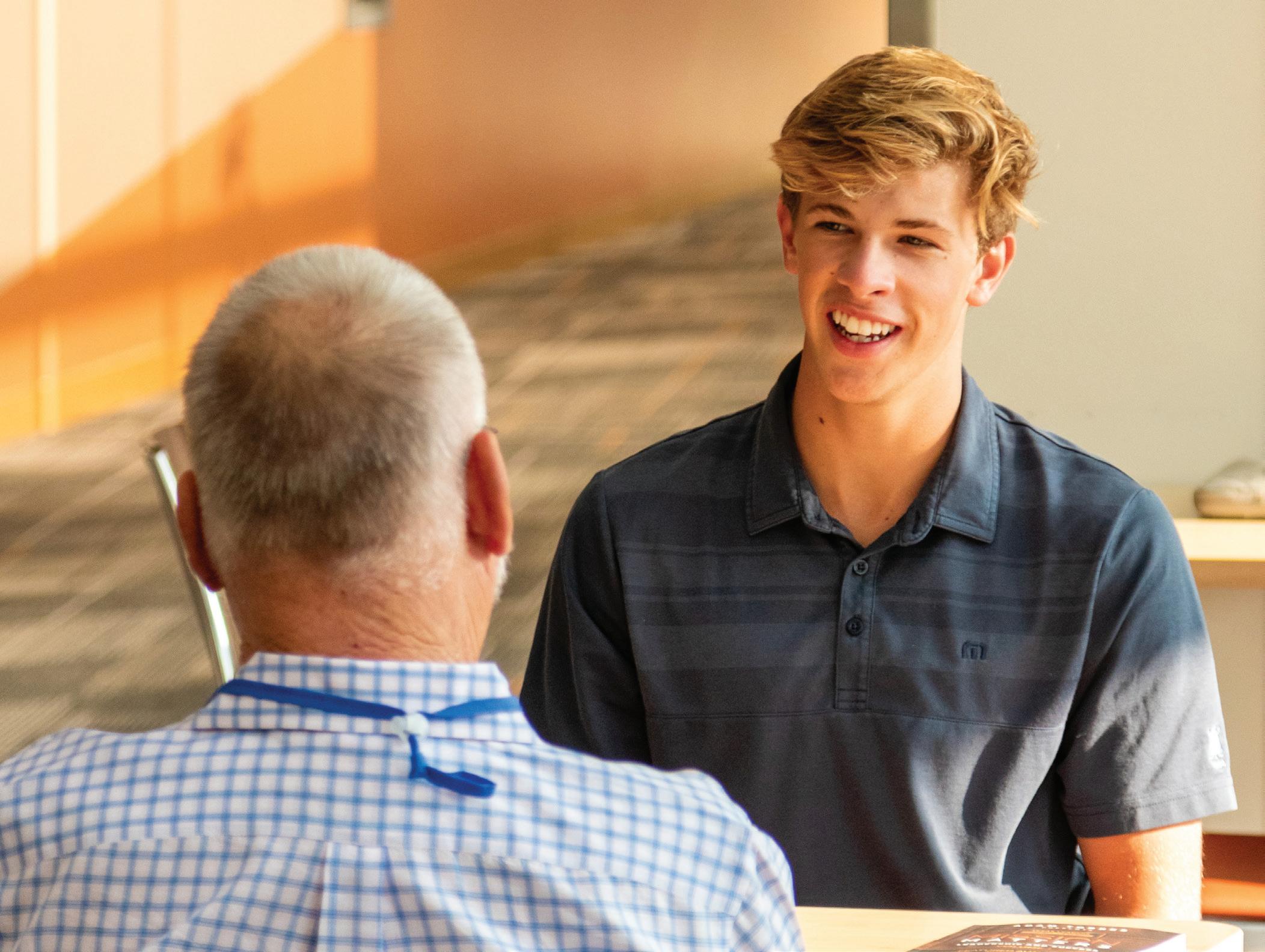
Today’s college student desires the values and benefits that come from fraternity membership, but they face financial hurdles that are unprecedented.
According to the Education Data Initiative and U.S. News and World Report, the cost of college has quadrupled in the last 40 years while wage growth has only increased 20 percent. North American Interfraternity Conference research shows that 65 percent of collegiate fraternity men pay some or all of their dues and tuition, and many work jobs in addition to balancing their academic and extracurricular commitments.
This, coupled with the enrollment cliff, puts many chapters at risk. Since 2010, the Thomas Cowan Bell Chapter Challenge has provided Sigma Chi alumni with a direct opportunity to help address these concerns and support our chapters with designated academic scholarships and transformative educational opportunities.
Moving forward, for the 2024 to 2025 academic year and beyond, chapters that receive Bell funding from their alumni will receive a new benefits package that better fits the Fraternity’s educational model and positions future Sigma Chi leaders to make a greater impact on their campuses and with in their communities.
The newly revised Bell Chapter Challenge program, announced by Foundation, Fraternity and Sigma Chi Leadership Institute leaders in May, will provide more flexibility to the chapter itself through educational credits that can be allocated to best address the chapter’s specific needs via General Fraternity and SCLI programming at the national, provincial and/or chapter level and increased academic scholarship support.
“Sigma Chi is clearly at the forefront of fraternities, through our Transformational Leader (program) and Sigma Chi Leadership Institute, to significantly change the paradigm of a fraternity man, particularly a Sigma Chi,” says Sigma Chi Foundation President John Price, OKLAHOMA STATE 1991. “The investment from our alumni to provide annual or endowment-level Bell support for our chapters directly enables our active brothers to be best prepared to be a respected leader in all aspects of life going forward.”
QUALIFYING FOR BELL
Beginning with the 2025 to 2026 fiscal year and beyond, prospective Bell chapters will need $10,000 in annual qualifying funds or endowment-level support by Dec. 31 of the prior calendar year.
Program Benefits for the 2024 to 2025 Academic Year and Beyond
>>>Blue Annual - $10,000 per year
• $3,500 in academic scholarships.
• $5,300 in educational credits, determined by the chapter, to be used toward additional attendee/s at Krach Transformational Leaders Workshop, or chapter, province and/or regional events with SCLI or approved educational leadership training.
• Up to $1,200 travel expense reimbursement, for legitimate expenses with receipts, for Krach TLW, regional or province conference with SCLI or approved educational leadership training.
• Admittance for chapter attendees at Krach TLW to a special Bell Chapter recognition dinner and a donor recognition plaque for the chapter house.
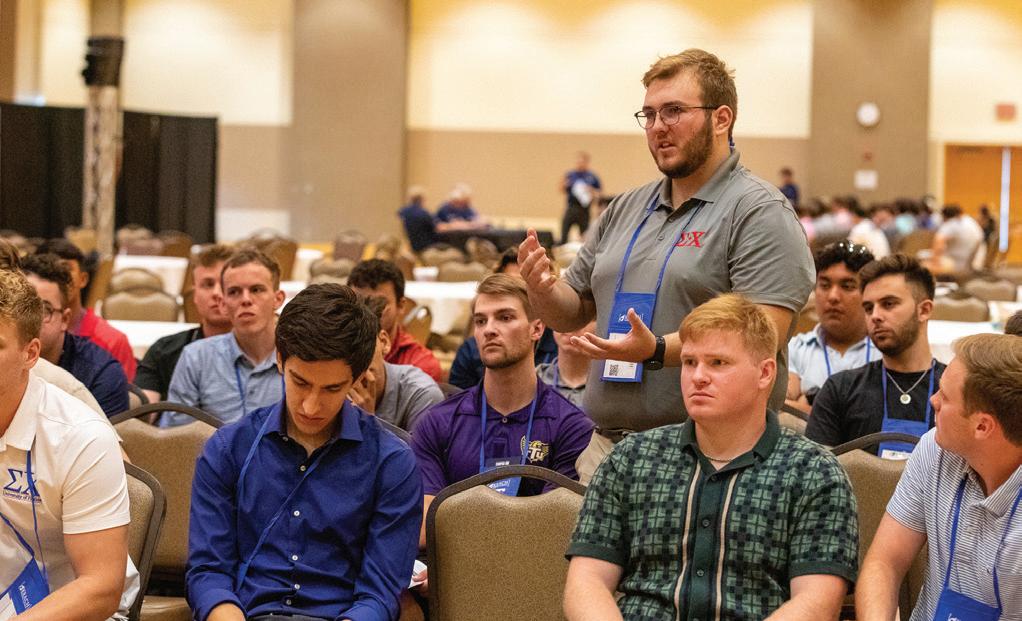
>>>Gold Annual - $20,000 per year
• $7,000 in academic scholarships.
• $10,600 in educational credits, determined by the chapter, to be used toward additional attendee/s at Krach Transformational Leaders Workshop, or chapter, province and/or regional events with SCLI or approved educational leadership training.
• Up to $2,400 travel expense reimbursement, for legitimate expenses with receipts, for Krach TLW, regional or province conference with SCLI or approved educational leadership training.
• Admittance for chapter attendees at Krach TLW to a special Bell Chapter recognition dinner and a donor recognition plaque for the chapter house.
>>>Blue Endowment - $250,000
• $10,000 Blue Level benefits per year (4 percent of endowment fund corpus)
>>>Gold Endowment - $500,000
• $20,000 Gold Level per year (4 percent of endowment fund corpus)
BENEFITS EXPLAINED
Scholarship quantities and amounts will be handled on a chapter-by-chapter basis, managed and decided by the Foundation Scholarship Committee, factoring in the number of applications from that chapter and other variables.
Each scholarship will be in an increment of $500 or $1,000, adding to the appropriate total for the Bell Chapter level. Should the Foundation receive only one qualifying applicant from a Bell Chapter, the applicant would receive a scholarship valued at the full $3,500 amount.
Guidance and direction on how each chapter may decide to use their educational credits will be provided by the Fraternity Executive Committee to ensure full clarity and proper protocol among chapters, chapter advisors and Grand Praetors.
For additional information on Sigma Chi’s Thomas Cowan Bell Chapter Challenge or to make a gift in support of your chapter’s Bell efforts, visit https://donate. sigmachi.org/bell or contact one of the Foundation’s regional development officers.
INAUGURAL BOURBON & BROTHERHOOD FUNDRAISER AND EVENT A SUCCESS
From a special guided tour by a bourbon industry legend to an exclusive Ritualistic ceremony in the tiny Oxford, Ohio, room where our Fraternity was born, winners of February’s inaugural Bourbon & Brotherhood auction and sweepstakes were treated to an exclusive weekend with memories that will last a lifetime.
One of the two auction winners, Derek Ferguson, ILLINOIS 2002, was joined by drawing winners Significant Sig Mark Dunning, HANOVER 1983, and Phil Millett, VIRGINIA TECH 1988, as well as 73rd Grand Consul Bob Wilson, FORT HAYS 1981, Fraternity Executive Director Michael Church, ILLINOIS 2005, and Grand Praetor Michael Sawyer, EASTERN KENTUCKY 1985, for the three-day event based in Louisville benefiting Sigma Chi’s Annual Fund.
The weekend’s capstone was a private Ritual experience at Sigma Chi’s Founding Site in Oxford, Ohio, where Grand Consul Wilson displayed the original Sigma Phi badge of Founder Daniel William Cooper, MIAMI (OHIO) 1857, and special visits with brothers and alumni volunteers from both the University of Miami (Ohio) and University of Louisville chapters.
Additionally, brothers participated in a special behind-the-scenes tour of historic Buffalo Trace Distillery and a private barrel selection guided by bourbon industry hall of famer and third-generation employee Freddie Johnson, a tasting at Rabbit Hole Distillery and a guided sensory walkthrough by Sawyer, proprietor of the award-winning John Parrott bourbon.
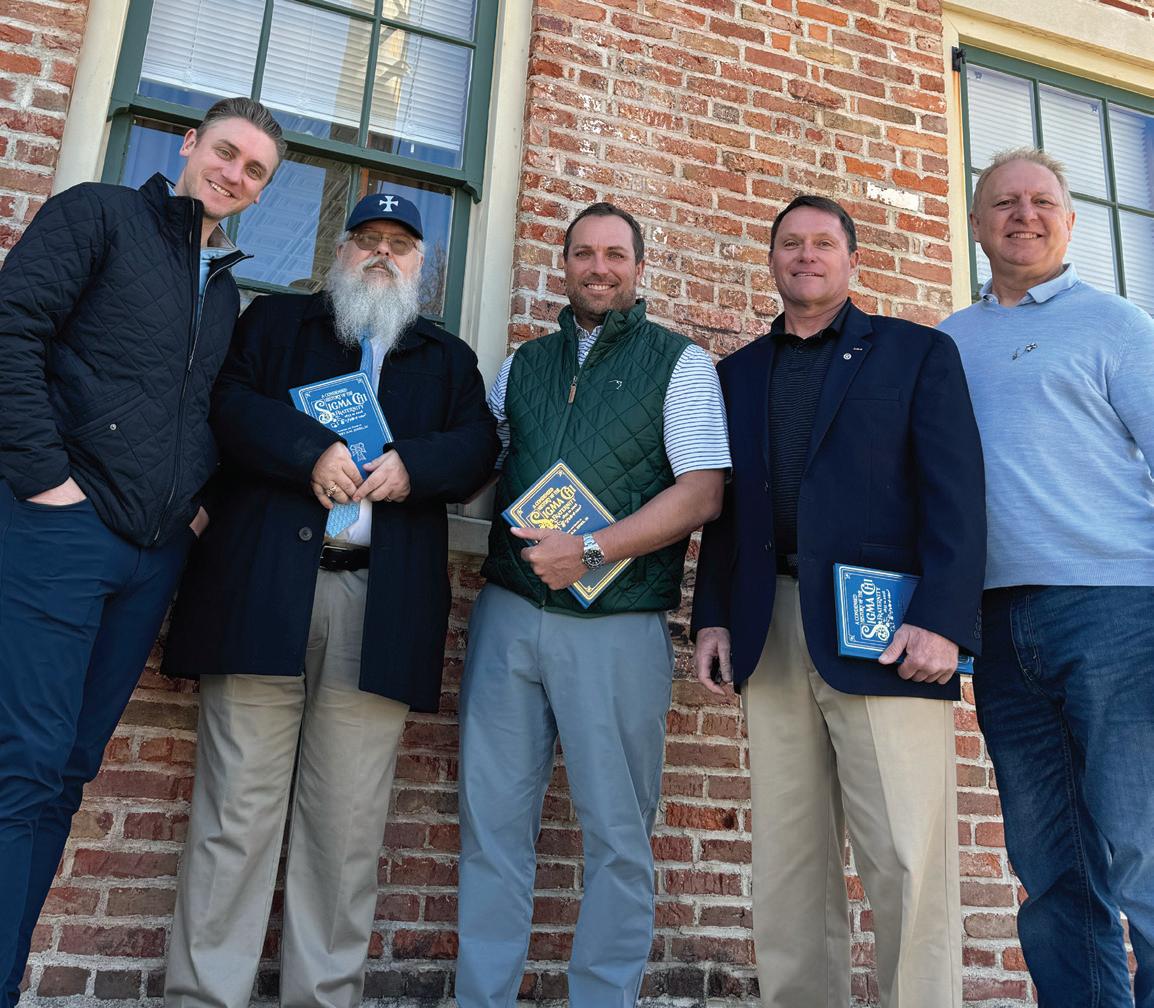
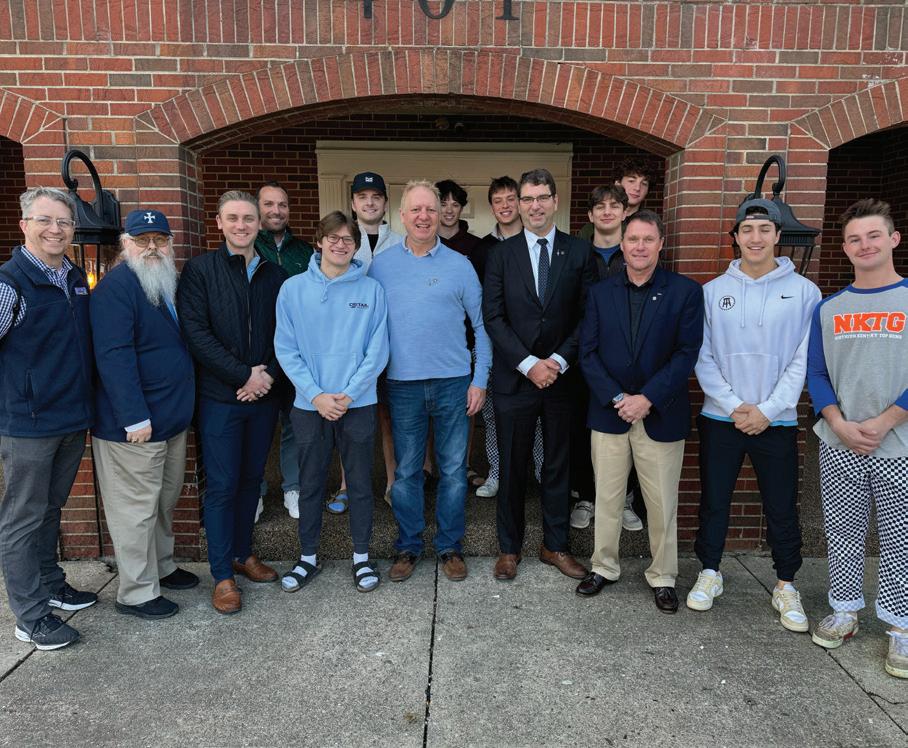
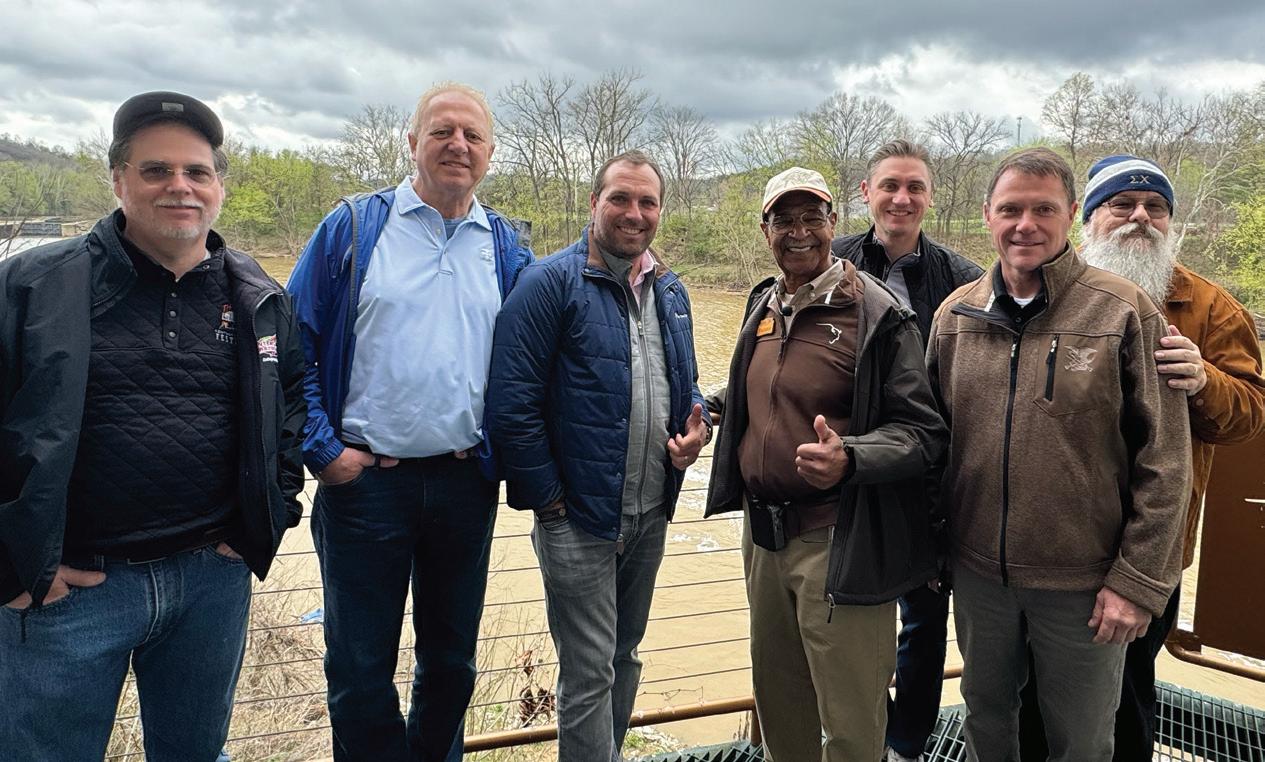
Above: Fraternity Executive Director Michael Church, ILLINOIS 2005; Significant Sig Mark Dunning, HANOVER 1983; Derek Ferguson, ILLINOIS 2002; Phil Millett, VIRGINIA TECH 1988; and 73rd Grand Consul Bob Wilson, FORT HAYS 1981, are pictured outside of the Sigma Chi Founding Site during the Bourbon & Brotherhood event held in April.
Right top: Bourbon & Brotherhood participants are pictured outside the Miami (Ohio) chapter house with Alpha chapter members in April.
Right bottom: Bourbon & Brotherhood participants are pictured in April during a behind-the-scenes tour of Buffalo Trace Distillery in Kentucky.
Joseph, Koskinen Named Foundation Governors
Emeritus
The Sigma Chi Foundation Board of Governors honored in May the board retirement of two brothers who have made an impact on the educational needs of undergraduate brothers across North America.
Fifty-sixth Grand Consul Bob Joseph, WILLAMETTE 1957, and Significant Sig Hon. John Koskinen, DUKE 1958, were each named Governor Emeritus for their contributions to Sigma Chi.
“We are proud to recognize the great impact Bob and John have had on Sigma Chi and our Board of Governors,” said Foundation Chairman Jeff Muir, GEORGIA 1971. “Through their service and longtime generosity, they have made a difference in our mission and directly benefited brothers across North America. We express our deepest appreciation to these men, and their supportive sweethearts, for their lasting support.”
Joseph has served Sigma Chi for more than 50 years at the local, regional and international levels. In addition to his term as Grand Consul, he has served as chairman of the Risk Management Foundation Board of Directors. He joined the Sigma Chi Foundation board in 2002 and has served as the board’s parliamentarian and chairman of the Audit and Compliance and Nominating Committees.
Koskinen, a renowned businessman and public official who served as Commissioner of the Internal Revenue Service and as non-executive chairman of Freddie Mac, joined the board in 2020 and has served as treasurer and on the board’s Audit and Compliance, Nominations and Governance and Development committees. He is a member of both the William Lewis Lockwood and James Park Caldwell societies recognizing his lifetime and planned generosity to support Sigma Chi.
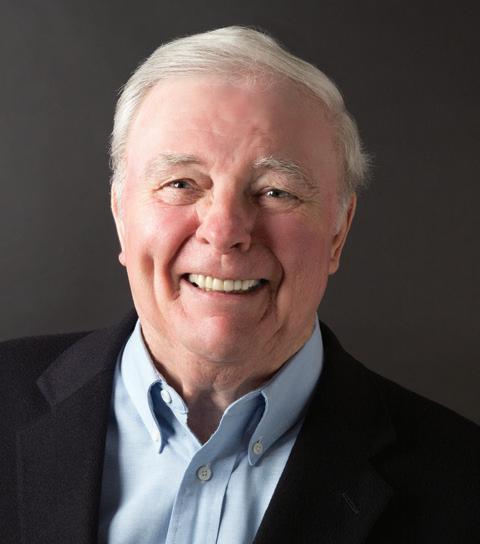
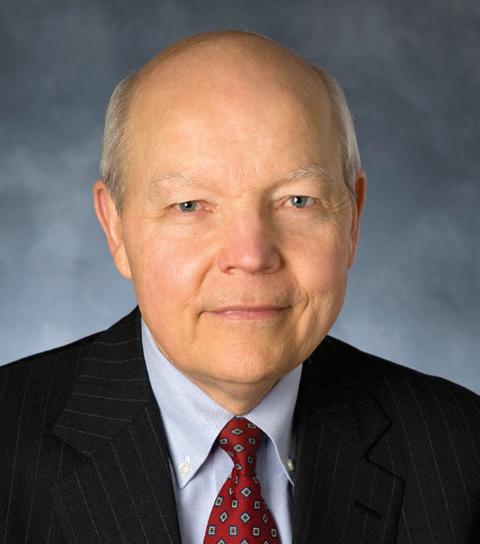
Horizons Day of Giving Supports Future Volunteer Training Efforts
On April 25, Sigma Chi hosted a private fundraiser to honor the 25th anniversary of the Horizons Huntsman Leadership Summit.
The inaugural Horizons Day of Giving was specifically designed for former Horizons volunteers and graduates since its inception in 1999 to acknowledge the significant role alumni volunteers have played in ensuring the program’s legacy of success.
April’s fundraiser captured funds to help support future volunteers through program-specific guide training efforts delivered by the Sigma Chi Leadership Institute.
The following is a list of donors who generously made contributions in honor of the Horizons milestone during the online campaign:
Huntsman Society (Gifts of $1,000+)
Michael Drew, CENTRAL FLORIDA 1998
McNair Circle (Gifts of $500 to $999)
Daniel Armas, RUTGERS 2002
Vincent Fernald, BRIDGEWATER STATE 1990
Gregory Schmidt, WILLAMETTE 2006
Christopher Walters, ROANOKE 2000
Snowbird Supporter (Gifts of $100 to $499)
Chris Brooks, COLLEGE OF IDAHO 2006
Larry Cukjati, PITTSBURG STATE 1975
Jarrett Duncovich, R.I.T. 2020
John Edwards, SAN DIEGO STATE 2005
Martin Erbele, NORTH GEORGIA 2011
David Hackworthy, ST. THOMAS 2012
Dave Kasch, LOYOLA MARYMOUNT 2001
Nate Kremer-Herman, HANOVER 2015
Christopher Lastrapes, TULSA 2003
William Ma, WINDSOR 2009
Simon Mutlu, SAN JOSE STATE 1999
Eli Snider, WILLAMETTE 2007
Horizons Ambassador (Gifts of $10 to $99)
Brett Collins, MEMPHIS 2004
Chris Hicks, GEORGIA SOUTHWESTERN 1996
Wes Holtsclaw, EAST TENNESSEE 2012
Andrew Hughes, SPRING HILL 2002
Zachary Niceley, INDIANA 2014
Jack Norrenberns, SOUTHEAST MISSOURI 2023
Brady Poche, TEXAS TECH 2025
Logan Walsh, NEBRASKA 2026
56th Grand Consul Bob Joseph, WILLAMETTE 1957
Significant Sig Hon. John Koskinen, DUKE 1958