




Ohio Tau History

Page 1

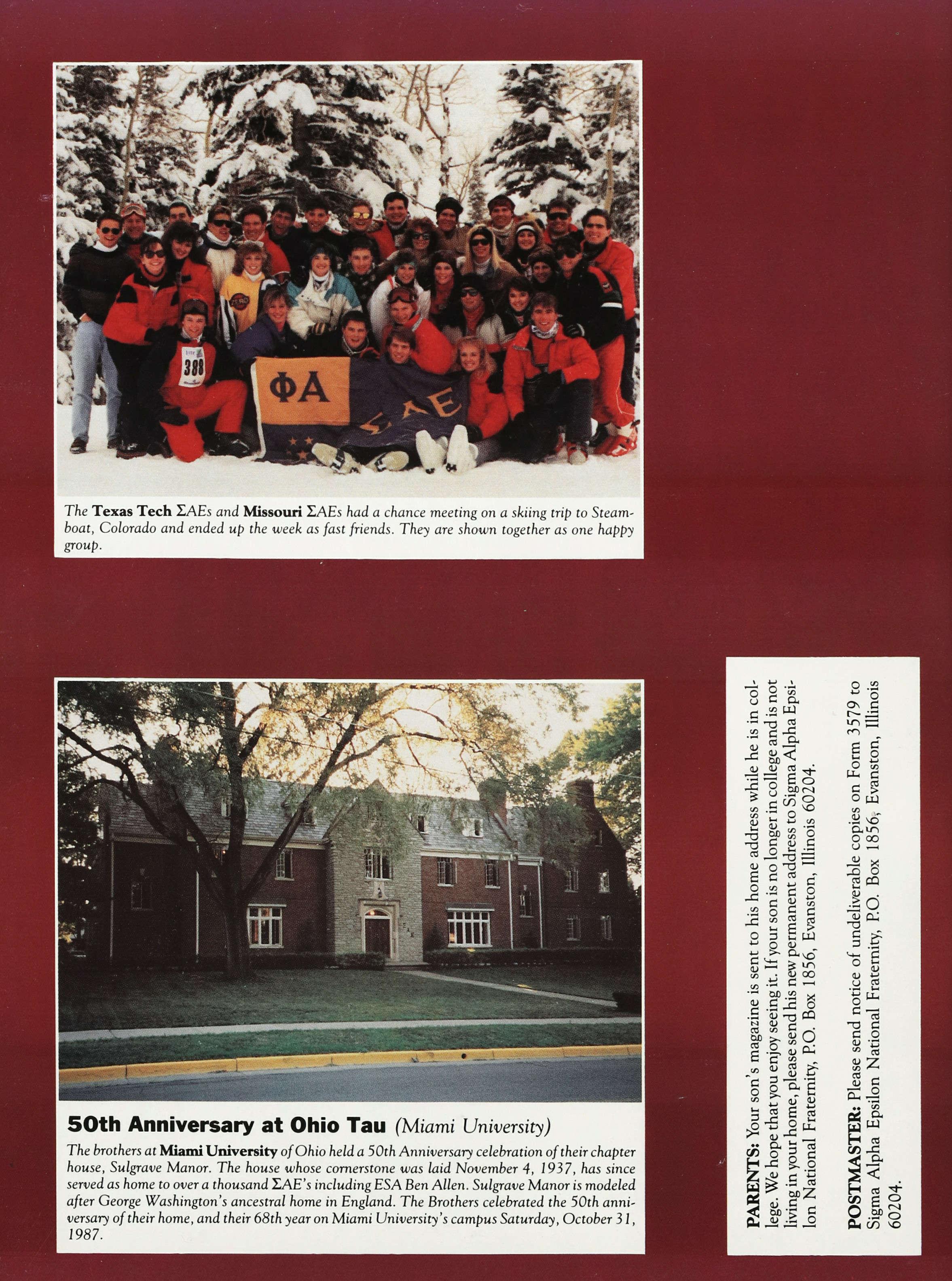
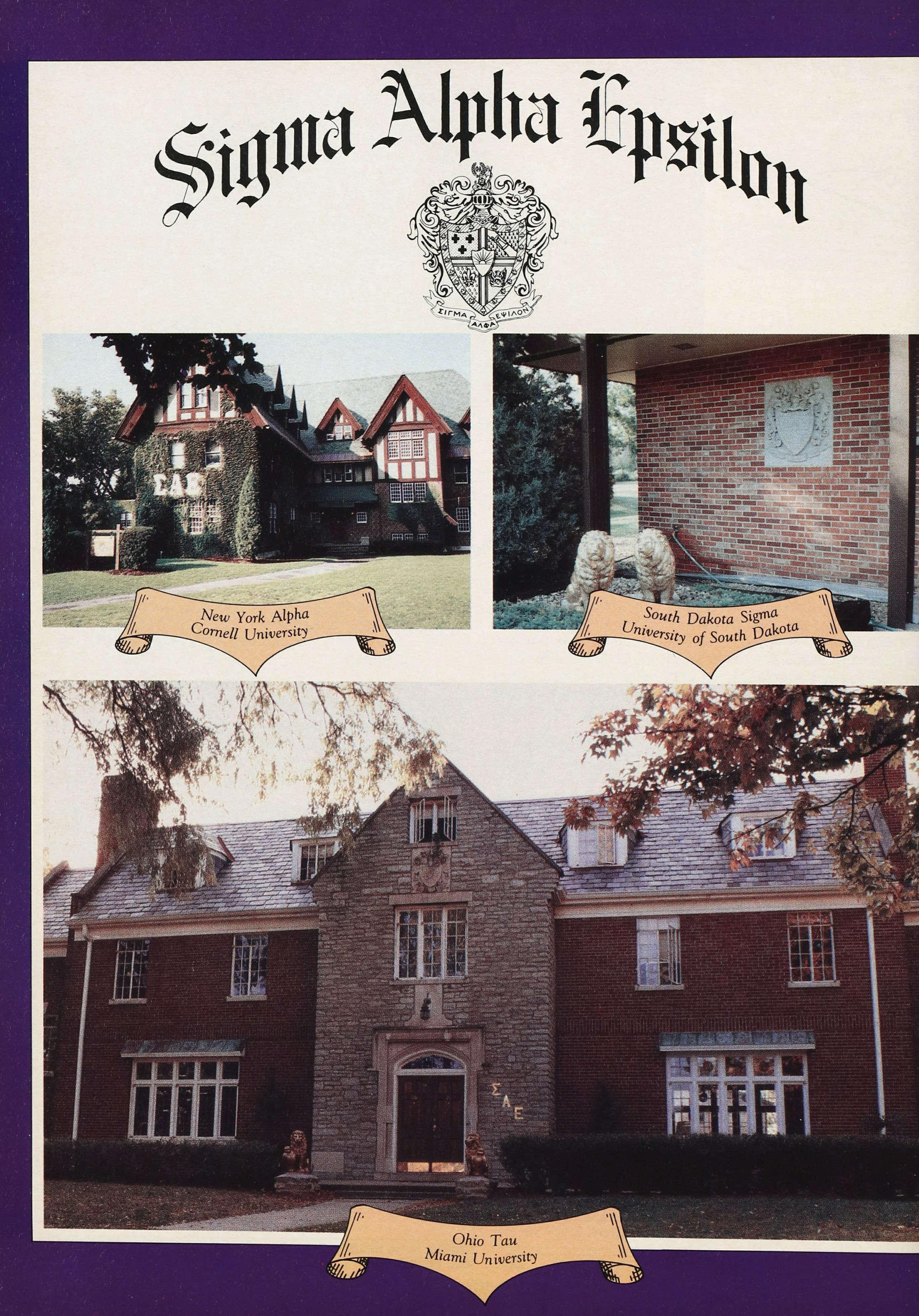
Corner Stone of New Miami House Laid ARKING the opening of a new in the history of Ohio era Tau chapter of Sigma Alpha Epsilon at Miami University, Oxford, Ohio, the cornerstone of the chapter’s new home was laid with appropriate ceremonies Saturday, November 6, 1937. The new house is located on the new Fraternity Row on which the University hopes to have all the fraternities situated in time. It faces the athletic field and its location is convenient with respect to all university activities. The exterior of the house has been modeled after “Sulgrave Manor,” the ancestral home of the Washington family in England, and its interior will contain features and conveniences which are new to fraternity house construction. It will be a fireproof structure and will furnish ample facil-

M

ities for housing the chapter’s full membership. Coinciding with home-coming day and the annual Miami-Ohio Wesleyan football game, the cornerstone laying attracted a large crowd of alumni and friends of the chapter. Marvin Clark, Ohio T T9, president of the Chapter

House Association, acted as master of ceremonies and, after the invocation by Dr. Eliot Porter, introduced Dr. A. H. Upham, president of Miami who expressed pleasure the fact that 2AE is now in position to build a modern home on the new Fraternity Row in which the university authorities are greatly interested. Short talks were made by Lauren Foreman, E.S.R., representing the Supreme Council; Archon Arthur H. Harris, representing Province Delta;

pert,

over

Alfred K. Nippert, Past E.S.A., who has played a great part in making the new house possible but was unavoidably absent from the ceremonies. Construction is proceeding rapidly, the foundations having been completed and it is expected that the house will be under roof before the weather becomes cold enough to interfere with outside work.

Edward W. Nippert, Ohio T ’22, rep-

By Gardner C. Waite, Mont. Alpha ’30

Sigma Alpha Epsilon

has been a consistent friend of the chapter since its installation in 1919, spoke on “The New Lodge,” as the consummation of plans which have long been in the making. Bruce Brandt, Ohio T ’38, Eminent Archon, accepted the house for the chapter. The cornerstone was then laid, mortar being applied by Dr. Whitcomb, Bruce Brandt, and Louis Nip-

University,

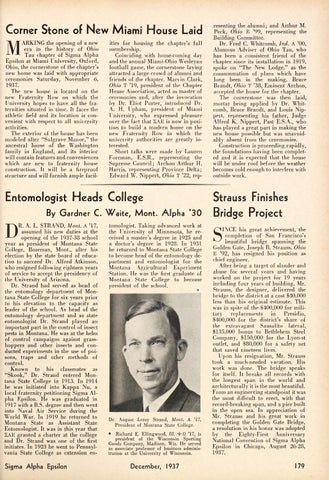
Entomologist Heads College R. A. L. STRAND, Mont. A T7, assumed his new duties at the opening of the 1937-38 school year as president of Montana State College, Bozeman, Mont., after his election by the state board of education to succeed Dr. Alfred Atkinson, who resigned following eighteen years of service to accept the presidency of the University of Arizona. Dr. Strand had served as head of the entomology department of Montana State College for six years prior to his elevation to the capacity as leader of the school. As head of the entomology department and as state entomologist Dr. Strand played an important part in the control of insect pests in Montana. He was at the helm of control campaigns against grasshoppers and other insects and conducted experiments in the use of poisons, traps and other methods of control. Known to his classmates as “Skook,” Dr. Strand entered Montana State College in 1913. In 1914 he was initiated into Kappa Nu, a local fraternity petitioning Sigma Alpha Epsilon. He was graduated in 1917 with a B.S. degree and then went into Naval Air Service during the World War. In 1919 he returned to Montana State as Assistant State Entomologist. It was in this year that 2AE granted a charter at the college and Dr. Strand was one of the first initiates. In 1923 he went to Pennsylvania State College as extension en-

resenting the alumni; and Arthur M. Peck, Ohio E ’99, representing the Building Committee. Dr. Fred C. Whitcomb, lnd. A ’00, Alumnus Adviser of Ohio Tau, who

tomologist. Taking advanced work at the University of Minnesota, he received a master’s degree in 1925 and a doctor’s degree in 1928. In 1931 he returned to Montana State College to become head of the entomology department and entomologist for the Montana Agricultural Experiment Station. He was the first graduate of Montana State College to become president of the school.

representing his father, Judge

Strauss Finishes

Bridge Project INCE his great achievement, the completion of San Francisco’s beautiful bridge spanning the Golden Gate, Joseph B. Strauss, Ohio E ’92, has resigned his position as chief engineer. After being a target of slander and abuse for several years and having worked on the project for 19 years including four years of building, Mr. Strauss, the designer, delivered the bridge to the district at a cost $40,000 less than his original estimate. This was in spite of the $400,000 for mili-

S

in Presidio, replacements $400,000 for the district’s share of the extravagant Sausalito lateral,

tary

$135,000 bonus

to

Bethlehem Steel

Company, $150,000 for the Lyon-st outlet, and $80,000 for a safety net

Dr.

August Leroy Strand, Mont. A T7, College.

President of Montana State

Richard E. Ellingwood, III. 'I'-D T7, is president of the Wisconsin Sporting Goods Company, Madison, Wis. He served as associate professor of business administration at the University of Wisconsin. ■

December, 1937

that saved nineteen lives. Upon his resignation, Mr. Strauss took a much-needed vacation. His work was done. The bridge speaks for itself. It breaks all records with the longest span in the world and architecturally it is the most beautiful. From an engineering standpoint it was the most difficult to erect, with that record-breaking span, and a pier built in the open sea. In appreciation of Mr. Strauss and his great work in completing the Golden Gate Bridge, a resolution in his honor was adopted by the Eighty-First Anniversary National Convention of Sigma Alpha

Epsilon

in

Chicago, August 26-28,

1937.

179


Turn static files into dynamic content formats.

Create a flipbook