MAESTRO OF CINEMA MARTIN SCORSESE
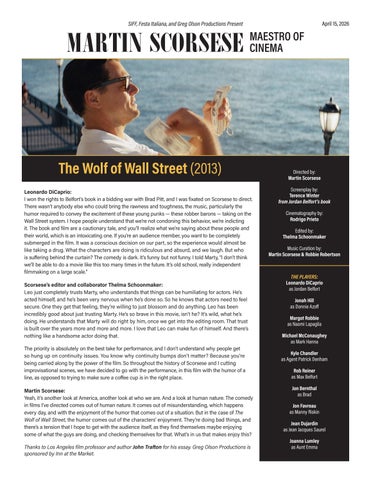
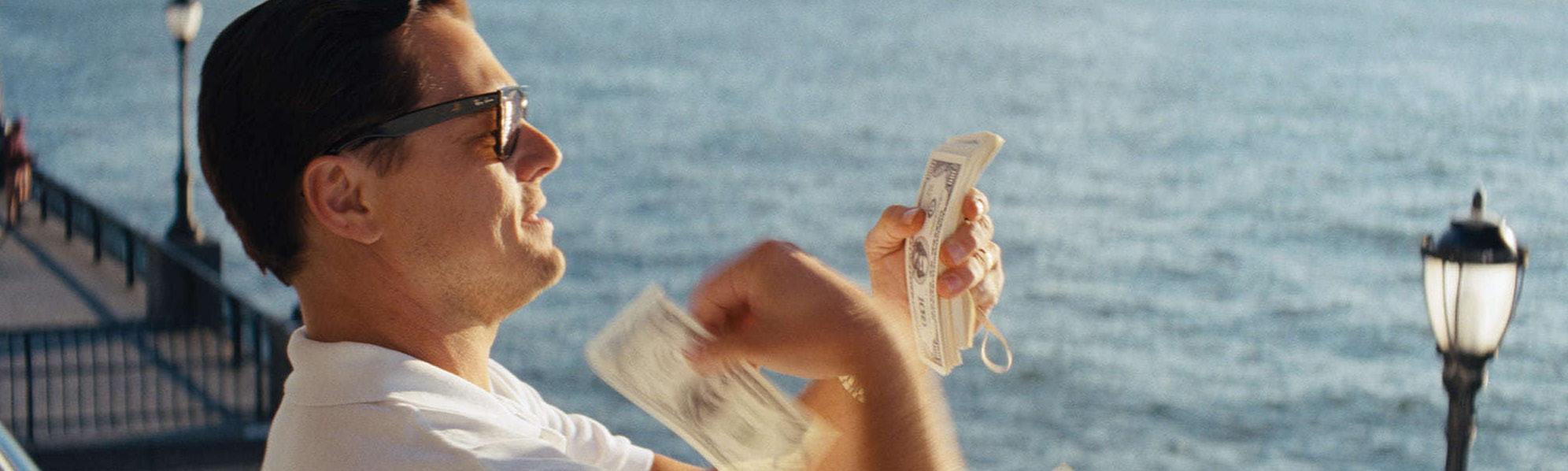
The Wolf of Wall Street (2013)
Leonardo DiCaprio:
I won the rights to Belfort’s book in a bidding war with Brad Pitt, and I was fixated on Scorsese to direct. There wasn’t anybody else who could bring the rawness and toughness, the music, particularly the humor required to convey the excitement of these young punks — these robber barons — taking on the Wall Street system. I hope people understand that we’re not condoning this behavior, we’re indicting it. The book and film are a cautionary tale, and you’ll realize what we’re saying about these people and their world, which is an intoxicating one. If you’re an audience member, you want to be completely submerged in the film. It was a conscious decision on our part, so the experience would almost be like taking a drug. What the characters are doing is ridiculous and absurd, and we laugh. But who is suffering behind the curtain? The comedy is dark. It’s funny but not funny. I told Marty, “I don’t think we’ll be able to do a movie like this too many times in the future. It’s old school, really independent filmmaking on a large scale."
Scorsese’s editor and collaborator Thelma Schoonmaker:
Leo just completely trusts Marty, who understands that things can be humiliating for actors. He’s acted himself, and he’s been very nervous when he’s done so. So he knows that actors need to feel secure. One they get that feeling, they’re willing to just blossom and do anything. Leo has been incredibly good about just trusting Marty. He’s so brave in this movie, isn’t he? It’s wild, what he’s doing. He understands that Marty will do right by him, once we get into the editing room. That trust is built over the years more and more and more. I love that Leo can make fun of himself. And there’s nothing like a handsome actor doing that.
The priority is absolutely on the best take for performance, and I don’t understand why people get so hung up on continuity issues. You know why continuity bumps don’t matter? Because you’re being carried along by the power of the film. So throughout the history of Scorsese and I cutting improvisational scenes, we have decided to go with the performance, in this film with the humor of a line, as opposed to trying to make sure a coffee cup is in the right place.
Martin Scorsese:
Yeah, it’s another look at America, another look at who we are. And a look at human nature. The comedy in films I’ve directed comes out of human nature. It comes out of misunderstanding, which happens every day, and with the enjoyment of the humor that comes out of a situation. But in the case of The Wolf of Wall Street, the humor comes out of the characters’ enjoyment. They’re doing bad things, and there’s a tension that I hope to get with the audience itself, as they find themselves maybe enjoying some of what the guys are doing, and checking themselves for that. What’s in us that makes enjoy this?
Thanks to Los Angeles film professor and author John Trafton for his essay. Greg Olson Productions is sponsored by Inn at the Market.
Directed by:
Screenplay by: Terence Winter from Jordan Belfort’s book
Cinematography by: Rodrigo Prieto
Edited by: Thelma Schoonmaker
Music Curation by: Martin Scorsese & Robbie Robertson
THE PLAYERS: Leonardo DiCaprio as Jordan Belfort
Jonah Hill as Donnie Azoff
Margot Robbie as Naomi Lapaglia
Michael McConaughey as Mark Hanna
Kyle Chandler as Agent Patrick Denham
Rob Reiner as Max Belfort
Jon Bernthal as Brad
Jon Favreau as Manny Riskin
Jean Dujardin as Jean Jacques Saurel
Joanna Lumley as Aunt Emma
Martin Scorsese
THE WOLF OF WALL STREET: AFTER THE BEAT DROPS
BY JOHN TRAFTON
On the set of The Wolf of Wall Street, Martin Scorsese would often be found just before a take with earbuds in, listening to music on his iPod or iPhone, calibrating himself to the rhythm of the scene he was about to shoot. It is a small, almost private gesture, but one that reveals something essential about his late style. For Scorsese, music is no longer simply something that accompanies the image in postproduction. It is something that precedes it, shapes it, and in many ways generates it. The scene begins not with the camera, but with a beat.
This practice is not incidental. It is legible in the finished film. The Wolf of Wall Street does not simply use music to structure its sequences, as in GoodFellas or Casino. It feels as though it has been shot from within music, as if the camera, the performances, and the editing are all responding to an internal soundtrack that the film is continuously chasing and re-creating. Scenes do not build toward narrative resolution so much as they crest, peak, and crash like songs. The film moves less like a story than like a playlist on shuffle, each sequence keyed to a different register of excess, propulsion, or collapse.
In this sense, The Wolf of Wall Street emerges as a kind of spiritual spin-off of GoodFellas or Casino, a film that returns to their central question: why are we drawn to these worlds? The catch is that The Wolf of Wall Street relocates this question to a new historical and economic terrain. If those earlier films mapped the underworld of organized crime, here Scorsese turns to the equally performative, equally ritualized sphere of late capitalist finance. The question that hovers, unstated but unavoidable, is whether the brokers of Wall Street are, in any meaningful sense, different from their underworld counterparts. Or, more provocatively, whether they are simply better crooks, more adept at packaging and selling the same fundamental structures of greed, violence, and desire.
If Goodfellas could be understood as a kind of musical — its rhythms structured by the rise and fall of popular songs — then The Wolf of Wall Street is something closer to a rave, or perhaps a corporate bacchanal scored by the logic of the playlist. The difference is not merely stylistic. It marks a shift in how cinema organizes feeling. In GoodFellas, music guides us through memory. In The Wolf of Wall Street, it traps us in immediacy. If GoodFellas operates as a kind of moral funhouse, then The Wolf of Wall Street transforms that space into something even more disorienting: a hall of mirrors with no exit. The film does not simply invite us to take pleasure in the excesses of Jordan Belfort and his world. It overwhelms us with them. Where Henry Hill’s story unfolds with a discernible arc, however destabilizing, Belfort’s is structured as a series of escalating intensities, each one demanding to be topped by the next. The question is no longer whether we enjoy what we are watching. It is whether we can locate the point at which enjoyment tips into exhaustion, or whether such a point exists at all.
Like Henry, Belfort speaks directly to us, but the nature of that address has shifted. Henry confides. Belfort performs. His narration is less an invitation into an inner life than a demonstration of control, a reminder that he can stop and start the film, redirect our attention, even rewrite the terms of what we are seeing. At one point, he halts the narrative to explain the mechanics of a financial scheme, only
to abandon the explanation midway through, assuring us that it is irrelevant so long as the money keeps flowing. The gesture is revealing. What matters is not understanding, but participation. We are not simply aligned with Belfort’s perspective. We are caught within his tempo.
This is where the film’s relationship to performance becomes crucial. If, as James Naremore suggests, acting is difficult to isolate because it is so easily absorbed into other elements of filmmaking, The Wolf of Wall Street pushes that instability to its limit. Leonardo DiCaprio’s Belfort is not just a character but a kind of organizing principle for the film’s energy. His body becomes elastic, excessive, at times barely controllable, most famously in the quaalude sequence where movement itself breaks down into a grotesque choreography of effort and delay. The scene is comic, but it is also diagnostic. It reveals a body pushed beyond its limits, struggling to maintain coherence in a world that demands constant acceleration. Performance here is not simply expressive. It is symptomatic.
Violence, too, undergoes a transformation. In Goodfellas, violence erupts suddenly, often shocking us into an awareness of its consequences even as we remain entangled in its rhythms. In The Wolf of Wall Street, violence is largely displaced, rendered abstract or offscreen, absorbed into systems rather than bodies. The damage inflicted by Belfort and his firm is real, but it is dispersed across anonymous victims, hidden behind the language of markets and transactions. What replaces physical brutality is a kind of affective excess: humiliation, degradation, spectacle. Office rituals become arenas of performance where bodies are exposed, tested, and consumed. The absence of visible suffering does not lessen the film’s intensity. It redirects it, making us complicit in a system whose effects we rarely see but continuously feel.
What emerges, then, is a different configuration of spectatorship. In GoodFellas, we are made aware, however fleetingly, of the tension between attraction and judgment. The film allows space for that discomfort to register, even if it never resolves it. The Wolf of Wall Street compresses that space. Judgment is not absent, but it is continually deferred, drowned out by the next surge of energy, the next escalation. The film does not ask us to reconcile our responses. It tests how long we can remain within them.
In this sense, The Wolf of Wall Street is not simply a continuation of Scorsese’s earlier work, but a recalibration of it. It reveals a world in which the mechanisms of attraction have become more efficient, more immersive, and more difficult to resist. The question is no longer just why we are drawn to these figures, but what it means that the systems they inhabit increasingly resemble the forms through which we experience them. Cinema here does not merely represent excess. It reproduces it, organizes it, and invites us to feel it from the inside. Like GoodFellas, it leaves us without resolution. But where that earlier film allows us to glimpse the possibility of distance, The Wolf of Wall Street closes that gap, asking us to confront what it means to remain inside the rhythm, even after the music should have stopped.