L.A. NOIR shadOws in pAradise
The Two Jakes (1990)
At the ending of Roman Polanski’s Chinatown (1974), written by Robert Towne, starring Jack Nicholson as 1930s detective J. J. Gittes and Faye Dunaway as his love Evelyn Mulwray, Gittes is a shattered man. Evelyn’s been killed, her young daughter Catherine spirited away by her incestuous father/grandfather. What happens next?
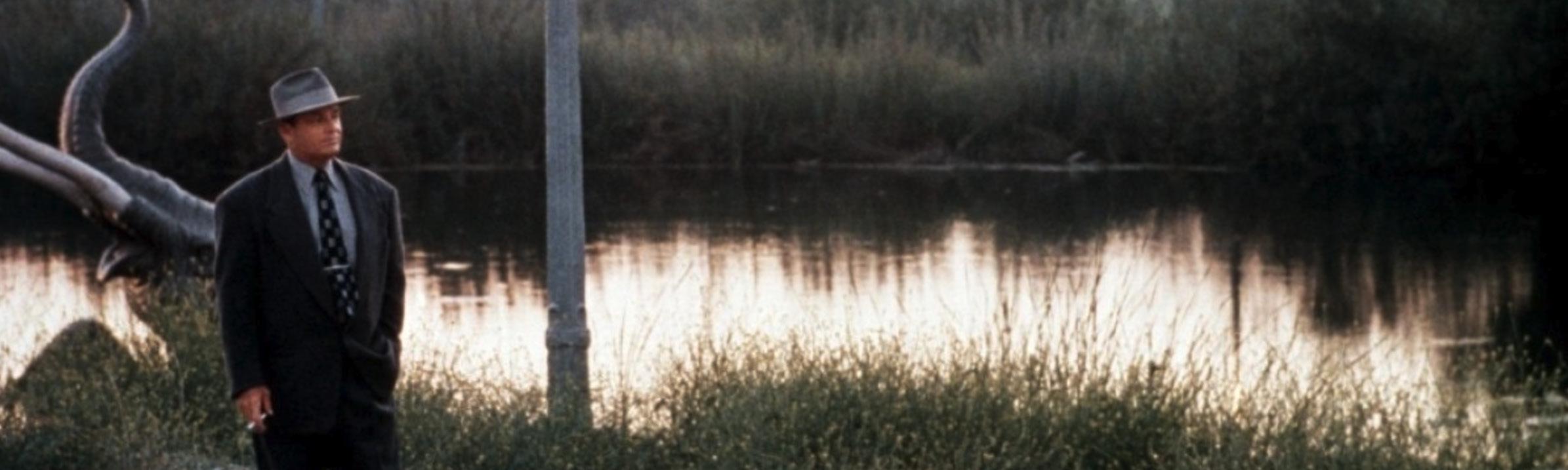
With Robert Towne writing and Nicholson directing, Gittes has fought in World War II and is back in L.A. As Nicholson says, “Gittes was originally kind of fast, full of piss and vinegar. Like America, he’s been through the war, he’s a bit less likely to go off, a bit more laid-back. Plus he’s heavier. At that point my cholesterol could have been spread on bread. I’m at least 75% of every character I play. Gittes owns his office building, belongs to the country club. He’s watching the new morality develop. He watches people being immoral all day, and he believes in divorce. He doesn’t believe marriage is an act of God, he thinks he’s helping people . . . .” He always does, full of good intentions, but he has a way of not seeing what’s really going on. In Chinatown he tells Evelyn that in the past “I thought I was keeping someone from being hurt, and actually I ended up making sure they were hurt.” And tragically, that dynamic repeats with Evelyn and Catherine.
Author Sam Wassojn (The Big Goodbye) notes that Nicholson as director emphasizes the idea of the past as present. “Nicholson doted on vintage costumes, tailoring, the color palette. He wanted the early scenes evocative of Charles Sheeler, painter of the rising 20th century technological landscape, later scenes recalling desert painter Maynard Dixon. He pictured a visual correlate to the theme of doubling, foreground-background layering, the film’s images melding in cross-dissolves, devising ways to state, in screen terms, the feeling of return.
Lifelong Angeleno Robert Towne’s “pastel sensibility” was attuned to “a light wash of colors with the delicacy of a gouche, the whisper of a pink-gold sunset, the scent of eucalyptus, desert wind and ocean salt spray.” But predatory capitalism was devouring his beloved land: “They’re going to mine it until it runs dry.” So in Jake Gittes Towne saw “A guy used to petty crime getting involved in a truly evil crime, allowing him to see larger implications, if he can. When a crime can no longer contain or content itself with the past, and insists on visiting the future, it’s no longer a crime—it becomes a sin, very difficult to punish.”
Deep, soul-searching themes, presented by master showmen. As Nicholson says, “At night producer Bob Evans and I sit up at his house alone, wondering if we’re the last ones left who feel the the main artery pumping blood into Hollywood is glamour, excitement and fun.”
Thanks to poet, film curator and teacher Tova Gannana for her film essay and her L.A. Cruising, Radio On pre-film playlist.
Cinematography
Music by: Van Dyke Parks
Edited by: Anne Goursad
THE PLAYERS: Jack Nicholson as J. J. Gittes
Harvey Keitel as Jake Berman
Meg Tilly as Kitty Berman
Madeleine Stowe as Lillian Bodine
Eli Wallach as Cotton Weinberg
Ruben Blades as Mickey Nice
Frederic Forrest as Newly
David Keith as Loach
Richard Farnsworth as Earl Rawly
Tracy Walter as Tyrone Otley
Joe Mantell as Walsh
James Hong as Kahn
Perry Lopez as Captain Escobar
Faye Dunaway as the voice of Evelyn Mulwray
Directed by: Jack Nicholson
Screenplay by: Robert Towne
by: Vilmos Zsigmond
THE TWO JAKES (1990)
FILM NOTES BY
TOVA GANNANA
According to Ernest Hemingway in A Moveable Feast, which he wrote at the end of his life, looking back on his cash-strapped time in Paris at 25, Ezra Pound had never read the Russians. Hemingway wrote that Pound was the best critic, helpful and kind to any poet: “I remember asking Ezra once when we had walked home from playing tennis out on the Boulevard Arago, and he had asked me into his studio for a drink, what he really thought about Dostoyevsky.” Ezra’s advice was to “Keep to the French,” as Hemingway “had plenty to learn.” Pound surprised Hemingway with this, because “At first there were the Russians; then there were all the others. But for a long time, there were the Russians.” A possible interpretation is that Pound was saying, “Read from where you’re planted.”
How would Hemingway have written the character of J.J. “Jake” Gittes (Jack Nicholson) in Chinatown (1974) before the war in his white three-piece suit, versus after the war in a blousy blazer in The Two Jakes (1990)? You don’t have to see both films to feel their presence in one another. Chinatown’s ending is bleak, making it ripe for some kind of return.
It’s no surprise that Gittes hasn’t left L.A. In The Two Jakes, Gittes has grown up, though the song remains the same: the mysterious Mulwray daughters plagued by father and grandfather; the orange groves and olive trees being sold for a water reservoir, and later tract housing; the land deeds disappearing like magician’s ink, reappearing like a rabbit in a hat trick. Gittes can spot the profits and the profiteers, but only with time. Gittes describes his profession in a voiceover as he pulls into his parking spot after leaving the police precinct: “When husbands and wives lie to each other, one of them comes to my office and lies to me. Frankly, if I waited for an honest client, I’d be sitting around until Rocky Graziano played Rachmaninoff at the Hollywood Bowl.”
Gittes is a bit like Bogart in Casablanca (1942): worried about his own hide, yet knowing full well that he’ll be the guy who helps everyone. But where Bogart was trim, Gittes looks bloated. Bogart, with his smile that was really a grimace; Gittes with his head tilted down and his eyes looking up. It’s their tics, the way we rarely see where they sleep; mostly the two are in cars or offices, lighting a cigarette, being knocked over the head with fists or information. To be a detective, one has to be ready to believe that the truth is a lie or that the “lie” is actually true.
Around 1956, Hemingway began work on his memoir, wherein he wrote, “They say the seeds of what we will do are in all of us.” In 1961, far from Paris, in Ketchum, Idaho, he committed suicide. Not all seeds will flower, though there are flowers that year after year, bloom in the same place in the same way.
Chapter Three, in which Gittes visits his client, Mr. Berman (Harvey Keitel), at Berman’s office in a housing development in the Valley, Gittes confronts Berman, “You know who Lou Escobar is?” Berman knows. “ He’s Captain of Detectives in Homicide.” They stand facing one another, sun streaming through the blinds, a drawing of a model home on the wall. Gittes accuses Berman of turning down Escobar’s sister’s housing application not in anger, but in disbelief. Berman replies, “You know who else couldn’t buy a house here? Me. I can build it and I can sell it, just as long as I don’t move in next door. They don’t want Mexicans or Jews around.” When he says “Jews” he points to his chest. The housing development has a Spanish name, El Rancho San Fernando. Berman’s
given name is Julius, but he goes by “Jake.” His wife, Kitty Berman, (Meg Tilly) is a blonde who colors her hair red. “Kitty” is a coverup for her given name, Katherine. Underneath the housing development “are millions of gallons of water and gas, and it’s getting hazardous,” Tyrone Otley (Tracey Walter), a builder for Berman, tells both Jakes, as he fills a bottle with water. He shakes the bottle demonstratively, and the water and gas fizz like a freshly poured root beer float.
Sell one thing but it’s really another, advertise for all but only a few are allowed, leave behind what’s unsolvable while carrying it around like a crossword, only most of the clues are missing. Gittes knows something has run amok. He runs his thoughts through a series of metaphors as he drives out to see Berman, the landscape dotted in transmission towers, “Memories are like that: Unpredictable as nitro, and you never know what’s going to set one off. Like the clues that keep you on the right track are never where you look for them: They fall out of the pocket of somebody else’s suit you pick up at the cleaners, they’re the tune you can’t stop humming that you never heard in your life, they’re at the other end of the wrong number you dial in the middle of the night. The signs are in all those old familiar places you only think you’ve never been before, but you get used to seeing them out of the corner of your eye, and you end up tripping over the ones that are right in front of you.”
In 1948, when The Two Jakes is set, “Now is the Hour” by Bing Crosby and “Mañana (is Soon Enough for Me)” by Peggy Lee would’ve played on the radio in LA: Titles reflecting the attitude of “Let’s let the past fade away.” “The Two Jakes” are J.J. Gittes, who knew the two Mulwray women, Evelyn (Faye Dunaway) and Katherine, who knew Tyrone Otley when he worked for Evelyn Mulwray’s corrupt father, Noah Cross (John Huston) in Chinatown. “The Two Jakes” are also Kitty’s attempt to drop “Katherine”, and Julius’ attempt to hide his illness with a tough exterior, to hide his ethnicity with an anglicized adaptation. “The Two Jakes” are California before each wildfire, and California rebuilding in the same lots.
Chapter Five — in which Gittes visits Kahn (James Wong) who had been Evelyn Mulwray’s butler in Chinatown — Kahn tends a greenhouse, from which he takes a break to sit with Gittes, “I see you survived the war. It’s been a long time, but I read about you in the papers once in a while.” They drink tea, overlooking the Pacific. Gittes presses Kahn about Katherine Mulwray’s whereabouts; he still doesn’t know she now goes by Kitty. “Odd flowers,” Gittes says, and removes his sunglasses. Kahn comes closer, “Yes. Isn’t that amazing they still grow here? It’s her favorite, she bred Them.” Gittes knows that Kahn is referring to Evelyn. Kahn continues, “You see those purple hues? they’re caused by the burning of the seed.”
Gittes finds himself alone with Kitty three times. In a beauty salon, he questions her while her face is covered in a green mask and she smokes nervously; she drops in on him unexpectedly in his darkened house; and in his office at the end of the film when there is no more past between them, only the open road of a memory-laden future. “We’ll always have Paris,” Bogart tells Bergman at the end of Casablanca. In that moment, on the screen we know we are Bergman, and if we can just make it onto that airplane and off the tarmac in time, Bogart has promised us a better world.