MAESTRO OF CINEMA
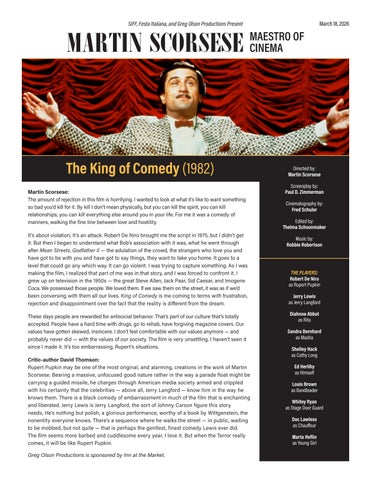
The King of Comedy (1982)
Martin Scorsese:
The amount of rejection in this film is horrifying. I wanted to look at what it’s like to want something so bad you’d kill for it. By kill I don’t mean physically, but you can kill the spirit, you can kill relationships, you can kill everything else around you in your life. For me it was a comedy of manners, walking the fine line between love and hostility.
It’s about violation, It’s an attack. Robert De Niro brought me the script in 1975, but I didn’t get it. But then I began to understand what Bob’s association with it was, what he went through after Mean Streets, Godfather II — the adulation of the crowd, the strangers who love you and have got to be with you and have got to say things, they want to take you home. It goes to a level that could go any which way. It can go violent. I was trying to capture something. As I was making the film, I realized that part of me was in that story, and I was forced to confront it. I grew up on television in the 1950s — the great Steve Allen, Jack Paar, Sid Caesar, and Imogene Coca. We possessed those people. We loved them. If we saw them on the street, it was as if we’d been conversing with them all our lives. King of Comedy is me coming to terms with frustration, rejection and disappointment over the fact that the reality is different from the dream.
These days people are rewarded for antisocial behavior. That’s part of our culture that’s totally accepted. People have a hard time with drugs, go to rehab, have forgiving magazine covers. Our values have gotten skewed, insincere. I don’t feel comfortable with our values anymore — and probably never did — with the values of our society. The film is very unsettling. I haven’t seen it since I made it. It’s too embarrassing, Rupert’s situations.
Critic-author David Thomson: Rupert Pupkin may be one of the most original, and alarming, creations in the work of Martin Scorsese. Bearing a massive, unfocused good nature rather in the way a parade float might be carrying a guided missile, he charges through American media society armed and crippled with his certainty that the celebrities — above all, Jerry Langford — know him in the way he knows them. There is a black comedy of embarrassment in much of the film that is enchanting and liberated. Jerry Lewis is Jerry Langford, the sort of Johnny Carson figure this story needs, He’s nothing but polish, a glorious performance, worthy of a book by Wittgenstein, the nonentity everyone knows. There’s a sequence where he walks the street — in public, waiting to be mobbed, but not quite — that is perhaps the gentlest, finest comedy Lewis ever did. The film seems more barbed and cuddlesome every year, I love it. But when the Terror really comes, it will be like Rupert Pupkin.
Greg Olson Productions is sponsored by Inn at the Market.
THE PLAYERS: Robert De Niro as Rupert Pupkin
Jerry Lewis as Jerry Langford
Diahnne Abbot as Rita
Sandra Bernhard as Masha
Shelley Hack as Cathy Long
Ed Herlihy as Himself
Louis Brown as Bandleader
Whitey Ryan as Stage Door Guard
Doc Lawless as Chauffeur
Marta Heflin as Young Girl
Directed by: Martin Scorsese
Screenplay by: Paul D. Zimmerman
Cinematography by: Fred Schuler
Edited by: Thelma Schoonmaker
Music by: Robbie Robertson