MARTIN SCORSESE
MAESTRO OF CINEMA

![]()

Martin Scorsese:
You know, this was the last film of mine my father saw and I dedicated it to him. He died during this period, and he was the one who took me to the movies as a boy. When I was making the film I was thinking very much about my father’s sense of obligation and responsibility — what he did for us, whether he was massaging me with alcohol to get a fever down or going through all the madness with my doctors, not having an education, not knowing how to deal with all this, I thought that Newland Archer has that kind of responsibility. I can identify with those feelings of wanting to take and not taking, of wanting to proceed with something and not proceeding. I had a late adolescence in a way, even up to the point when I made The Age of Innocence. It made me think, at the age of fifty, what if I’d been a different type of person, one who could have handled such things easily? Would my life have been very different?
I read a lot of history, the ancient world, the eighteenth and nineteenth centuries. I’m interested in the way these people lived, the physical details and the codes of their society. Sometimes from my townhouse that was built in the 1860s, late at night at one o’clock in the morning, I can hear a horse and carriage go by. That’s the sound of the nineteenth century. Maybe we’re yearning for a quieter time. I think we’ve lost something. What strikes me about The Age of Innocence is the brutality under the beautiful manners. People hide what they mean under the surface of language. In the Little Italy subculture I grew up in, when somebody was killed, there was a finality to it. It was usually done by the hands of a friend. It was almost like a ritualistic sacrifice. But in 1870s high society things were so cold-blooded. Which way is preferable? In my private life I’ve come to appreciate the ability to say a little in certain emotional situations and mean a lot.
When Newland first sees Ellen, it’s through his opera glasses. It’s not in just regular time. We did stop-frame photography, one frame at a time, printed each frame three times, and dissolved between each three frames. His heightened attention is conveyed. That took almost a year of experimentation to get right. The spirit of exquisite romantic pain, the idea that touching a woman’s hand would suffice, seeing her across a crowded room would keep him alive for another year. I shortened shots, like a brush swishing by, painting bits of color, Joanne Woodward’s voice, like Edith Wharton’s, whispering in your ear.
Thanks to The New Yorker poet, film curator and teacher Tova Gannana for her film essay.
Greg Olson Productions is sponsored by Inn at the Market.
Cinematography
Edited
Music by: Elmer Bernstein
Production Design by: Dante Ferretti
Costume Design by: Gabriella Pescucci

THE PLAYERS: Daniel Day-Lewis as Newland Archer
Michelle Pfeiffer as Ellen Olenska
Winona Ryder as May Welland
Alexis Smith as Louisa vad der Luyden
Geraldine Chaplin as Mrs. Welland
Mary Beth Hurt as Regina Beaufort
Alec McCowen as Sillerton Jackson
Richard E. Grant as Larry Lefferts
Miriam Margolyes as Mrs. Mingot
Robert SeanLeonard as Ted Archer
Joanne Woodward as Narrator
TOVA GANNANA
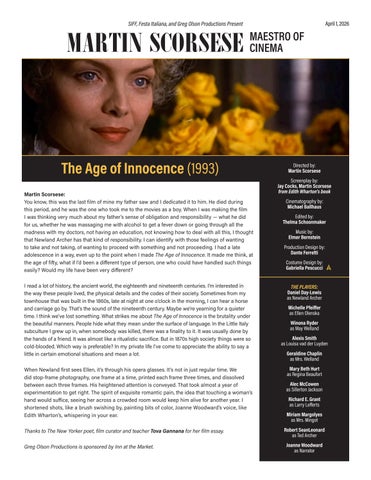
Yellow daisies on stage, white flowers in tuxedo lapels, jewels on women’s throats, and jewelled cuffs on white gloved hands, The Age Of Innocence (1993) opens at the opera. There is the performance being watched by the audience, and the sport of watching who is in the audience. Opera glasses for seeing the singers, and for looking into others’ opera boxes. It’s 1870 in New York City. It’s Edith Wharton in 1919 writing a 365-page novel in seven months while living just outside Paris. It’s Martin Scorsese without his pals Robert De Niro and Harvey Keitel. It’s the title sequence of roses shot through lace by Elaine and Saul Bass, who had a forty-year career creating film titles for the likes of Hitchcock, Kubrick, Wilder, who fell out of favor, were rediscovered by Scorsese and hired for GoodFellas (1990), Casino (1995), Cape Fear (1991). It’s Wharton in 1919 looking back on 1870 from across the ocean post WWI, it’s Scorsese taking a swing at the 19th century from the end of the 20th. It’s about culture as artifice deemed essential. It’s about rule following... but for how long? Your entire life?
Our hero, Newland Archer (Daniel Day-Lewis), climbs the staircase to greet his fiancee May Welland’s (Winona Ryder) cousin, Countess Olenska (Michelle Pfeiffer), who is at risk of being socially snubbed by the ruling class of “Old New York” of which Archer is a member. We never see “how the other half lives” in The Age of Innocence. It’s as if the tenements, the teeming streets of laborers and pushcarts, the hunger and poverty, don’t exist. But loneliness and the threat of isolation is a concern. People act by custom, not by whim; by bloodlines kept blue through family mergers. In The Age of Innocence, the characters are trapped by their actions... but were their actions predestined because of their birth? Newland is set to marry May, and he thinks he is in love, until he starts spending time with Countess Olenska and he realizes how persecuted she is by their crowd — perhaps not outwardly, yet personally — and without community backing, she will be ostracized, all because she made a break from her marriage; and that if things got messy, it was meant to be kept behind closed doors. While she had the courage to walk out, to return to New York, the New York she has returned to has a set of conditions to which she must abide. She seeks friendship and counsel with Archer, “Does no one here want to know the truth Mr. Archer? The real loneliness is living among all these kind people who only ask you to pretend.”
Archer thinks Countess Olenska “most plaintive and poignant”; he wonders about May: “What if all her calm, her niceness, is just a negation, a curtain dropped in front of an emptiness?” The very things that bring Archer and Countess Olenska together are what drive them apart: a sense of duty, curiosity, kindness. Archer extends his family support to include Countess Olenska; she in turn urges him to go through with his marriage to May so that both he and her won’t be left out of the social fray. In thinking of one another over their own happiness, they cause themselves deep regret. We know that for Archer, it’s lifelong. We see him in his old age.
This is his story: We begin with him in his opera box, wearing a boutonnière to match the others. He hears gossip and looks toward where Countess Olenska has just taken her seat. His jaw tightens. He is decisive: He exits, he climbs the stairs. At the end of the film he
is also seated, but outside, in a courtyard in Paris, his years evident in his grey hair. He looks up toward Countess Olenska’s window, slightly opened, curtains blowing in a carefree breeze. At this point, he is anything but moveable.
Wharton and Scorsese were both party to a New York City that is in the past: the Gilded Age and Mean Streets, times when adhering to Old World customs were part and parcel of surviving. Of course you could move to an apartment in the Village but could you go back home again?
Countess Olenska has been away a long time, when at the opera she waves her black feathered fan and tells Archer, “...so long I’m sure I’ve been dead and buried and this dear old place is heaven.” Later she admits that that was naïve: “It seems stupid to have discovered America only to make it a copy of another country.” As a woman, she is constrained on both continents. She ends up back in Europe. We never see her again, only her apartment window, which is shut by a male servant as a sunbeam hits the pane and momentarily blinds a settled Archer.
The Basses created the film titles for North By Northwest (1959), Vertigo (1958), Psycho (1960). From the 1960s to the mid 1980s, they were hired less by directors: “Whatever the reasons, the result was ‘Fade Out.’ We did not worry about it; we had too many other interesting projects to get on with. Equally, because we still loved the process of making titles, we were happy to take it up again when asked. ‘Fade In’...”
Hitchcock kept his backdrops as paintings even after it was considered old fashioned to do so. When in New York and in Europe, filmmakers were shooting on the street, his productions kept veteran artisans working, a ship in Marnie (1964) painted at port, never meant to set sail. Is what Archer regrets not that he married May — the wrong woman — but rather that he didn’t stand up for himself against what was chosen for him? Instead going along with what was fashionable at the time, and not because of anything other than certain social death.