MAESTRO OF CINEMA MARTIN SCORSESE
Taxi Driver (1976)
Travis is right on the edge, you know, right from the first frame. I think he has right on the surface a lot of the emotions, a lot of the problems, that most everybody has in them. When I read Paul Schrader’s script, I realized that was exactly the way I felt, that we all have those feelings, so that was a way of embracing them and admitting them, while saying I wasn’t happy about them. I connected to the anger and the rage and the loneliness — not being part of a group, I was always on the outside. You grow up in a neighborhood where a “man” is a guy who can go into a room and slam some people around and win. But I heard my father say different things about what a man is, that had to do with being morally strong. You don’t like a character, but in your deep dark secret self you’ve been thinking that way yourself. It’s from being pushed aside and rejected, rejected, rejected. It’s not a rational, good way to be, but it’s human.
New York is my city, and at that time there was a sense of the place just spiraling down into hell. I’m telling you, 42nd Street, Eighth Avenue, that was hell, shooting in those places. That was, like, biblical in my mind — fire and damnation and Jeremiah, and someday a real rain was going to come.
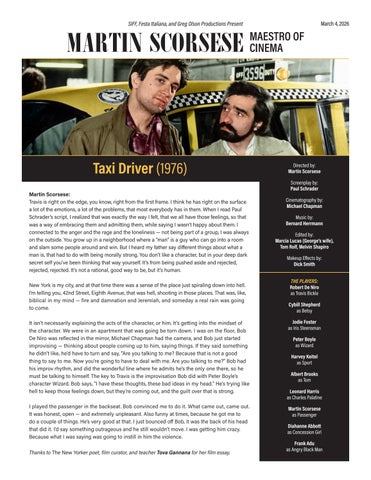
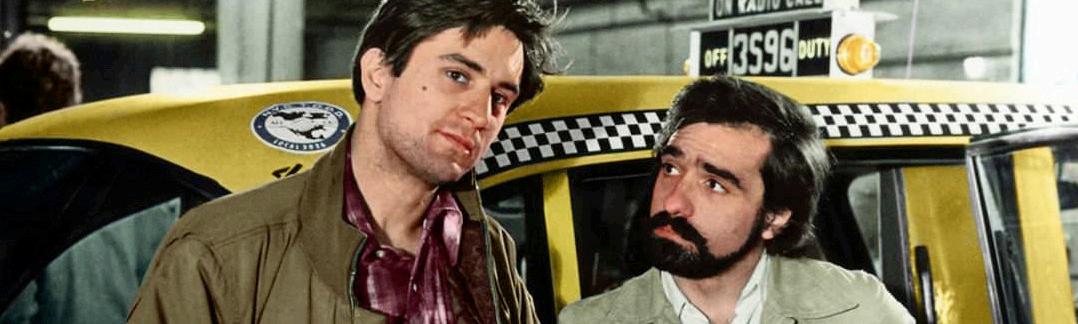
It isn’t necessarily explaining the acts of the character, or him. It’s getting into the mindset of the character. We were in an apartment that was going be torn down. I was on the floor, Bob De Niro was reflected in the mirror, Michael Chapman had the camera, and Bob just started improvising — thinking about people coming up to him, saying things. If they said something he didn’t like, he’d have to turn and say, "Are you talking to me? Because that is not a good thing to say to me. Now you’re going to have to deal with me. Are you talking to me?" Bob had his improv rhythm, and did the wonderful line where he admits he’s the only one there, so he must be talking to himself. The key to Travis is the improvisation Bob did with Peter Boyle’s character Wizard. Bob says, "I have these thoughts, these bad ideas in my head." He’s trying like hell to keep those feelings down, but they’re coming out, and the guilt over that is strong.
I played the passenger in the backseat. Bob convinced me to do it. What came out, came out. It was honest, open — and extremely unpleasant. Also funny at times, because he got me to do a couple of things. He’s very good at that. I just bounced off Bob, it was the back of his head that did it. I’d say something outrageous and he still wouldn’t move. I was getting him crazy. Because what I was saying was going to instill in him the violence.
Thanks to The New Yorker poet, film curator, and teacher Tova Gannana for her film essay.
Makeup
THE
Cybill Shepherd as Betsy
Jodie Foster as Iris Steensman
Peter Boyle as Wizard
Harvey Keitel as Sport
Albert Brooks as Tom
Leonard Harris as Charles Palatine
Martin Scorsese as Passenger
Diahanne Abbott as Concession Girl
Frank Adu as Angry Black Man
FILM NOTES BY TOVA GANNANA
Taxi Driver opens with a close-up of a cab and its driver: man and motor, flesh and steel, against the backdrop of the city, a sea of neon. The car is the silent star. Travis drives past kids opening fire hydrants. Later, he’ll exchange his taxi for guns.
Ronnie Lang’s saxophone in Taxi Driver (1976) sounds like an invitation, then drums come in sounding like rain beating through the clouds. Travis Bickle (Robert De Niro) wants to work long hours, stay up and out; he wants to see the city even though he says it makes him sick, but it keeps him from seeing himself during all those long days and nights driving. Bickle is a former Marine with an honorable discharge, fit in body, alone in spirit. He’s searching for a companion to sit with him in the front seat, but he’s a speaker — not a reader — and relationships elude him.
Travis is always in motion. His taxi cab is like an extension of himself. The rearview mirror is like a separate set of eyes, like a prosthetic through which he watches life from many angles, but when it comes to connecting with people, he’s like a blind man choosing between sugar and salt at a table.
When Travis isn’t driving, he’s taking in pornographic movies, asking out the young woman who sells him a ticket. She declines and redirects him to buy candy or soda. Her job is like his: There’s a fare involved. Who knows what she does when her shift is over?
In his cheap room, with its cheaply painted walls, Travis keeps a diary. He reads his taxi route aloud as he writes, “May 10th. Thank God for the rain, which helps wash away the garbage and the trash off the sidewalks. I’m working long hours now, six days a week, sometimes seven days a week. It’s a long hustle, but it keeps me real busy. I can take in $300, $350 a week, sometimes even more when I do it off the meter. All the animals come out at night: Buggers, queens, fairies, dopers, junkies. Sick, venal. Some day a real rain will come and wash all this scum off the streets.”
Bernard Hermann’s score feels like breath being sucked in. It makes it sound like it’s always night, accompanying Travis like a scent. It’s a presidential election year, and Travis has fallen for Betsy (Cybil Shepard), who manages volunteers in a campaign office with red carpets and black telephones. Betsy works with Tom (Albert Brooks), who’s like a William Powell to her Carole Lombard. They’re in their own 1930s screwball until Travis is spotted by Betsy, hanging back in his cab, watching her, his own way of romance. Betsy’s not thrilled by it; neither is Tom.
We see sunlight on the back of a man’s white shirt, the wide, windowed brick corner building toward which Betsy is walking as described by Travis: “I first saw her at Palantine headquarters at 63rd and Broadway. She was wearing a white dress. She appeared like an angel out of this filthy mass. She is alone.” Travis sits at his desk, his can of Coke before him, pen in hand. He’s both retelling and imagining Betsy. It’s as if he dug her out of the earth, an Eve to his very lonely Adam.
The presidential candidate, Senator Charles Palantine, is sold to us on buttons emblazoned with “We are the people.” Palantine is sold to us on the TV Travis is watching, he pitches himself in the back of Travis’ cab, and at a rally on a float. Palantine’s not so different from Travis; he’s also got a vision. Travis writes, “I believe that someone should become a person like other people.” He’s not yet 30, and yet, “Loneliness has followed me my whole life, everywhere: in bars, in cars, on sidewalks, in stores, everywhere. There’s no escape. I’m God’s lonely man.” Travis talks to people like he’s been rehearsing; he’s determined to get it right in order to get the right response, to say whatever is that an average person would say: “You’re only as healthy as you feel.” But he’s read by others in a way that he cannot read them. In his cab, he’s a voyeur.
Betsy orders black coffee and a fruit salad, and sits across from Travis. Kris Kristofferson’s song reminds her of Travis: “He’s a prophet and a pusher, partly truth partly fiction, a walking contradiction." Travis doesn’t know who is Kristofferson. Travis doesn’t like Tom. A late night fare Travis picks up doesn’t like that his wife is sleeping at another man’s apartment. He tells Travis, “I’m going to kill her with a Magnum 44 pistol.” Sport (Harvey Keitel) doesn’t like that twelve-and-a-half-year-old Iris (Jodie Foster), who Sport is pimping, tries to escape into Travis’ cab sporting a black eye. Sport retrieves her and hands Travis a twenty dollar bill. Travis won’t spend it; later he’ll hand it back. Men possessing women, trafficking girls. For all he misunderstands, Travis understands this: He wants consent.
Travis watches American Bandstand in the same tonal shades of blues as Senator Palantine’s campaign. He watches them while holding his newly purchased gun. He lies to his parents in a letter. He takes Betsy to a porn flick, not to shock her, but to bring her closer. “You’ve got to be kidding. This is a dirty movie,” Betsy says, and walks out, hopping into the first cab that passes. Travis could have said, “Yeah, it is,” but instead he tries to convince her that it’s a regular movie, so he loses her. She doesn’t want to be part of that audience with him.
“This is nothing for a person to do,” Travis tells Iris when he gets her alone. All the bouquets he’s sent to Betsy have been returned to him. His one room like a funeral parlour. Travis doesn’t get a letter back from his parents, but he does receive a handwritten one from Iris’ mom and dad, thanking him for returning her to them.
Betsy is gone from her desk at Palantine headquarters. Forgotten? Or promoted? For a spell, guns become Travis’ vehicle the way the yellow cab was. Travis polishes his cowboy boots with precision. In his white ceramic sink, he sets a bouquet of flowers aflame.