L.A. NOIR shadOws in pAradise
Heat (1995)
Writer-director Michael Mann:
Heat belongs to all the actors, it’s an ensemble piece, not a star vehicle. One of my best experiences as a director. The challenge was to tell an authentic story about people as complex as we all are. The film has an organic shape and size, and blessedly Warner Brothers didn’t want to make it shorter. The film is made for the big screen, the scale, the architectural construction, the revelation of character, all for the big screen. I want to get next to people who do what I want to make a film about. Some say it’s a film about love, without talking about it.
Critic-author Richard Brody:
Mann coordinates the various parts of his story with a juggler’s aplomb, maintaining an exquisitely calibrated balance of dramatic elements to heighten suspense with a musician’s sense of timing. The rhythms of the image-making, the substance of the script, the pacing of editing, the performances all seem subordinated to the overall balance, synthesis, and resolution of the elements of the story. Heat has the sense of a manifesto, of a throw down declaration that it will be a masterwork or nothing. It is a proof of Mann’s mastery, which is prodigious. He projects a worldview in his scripts—a hard-bitten ethos of deep plotting in solitude, a chess-like strategizing in monastic, self-sacrificing isolation, and he displays the results of that process in action. Mann’s movies are distinguished from less sophisticated and conventional modes of realism. He believes deeply in the reality of his characters, and he allows no breaks, faults, no fractures, excesses, loose ends, no figures or turns to stand out from the precisely calibrated design.
Critic-author David Thomson:
It is the assumption of Heat that everyone in Los Angeles is pressurized by the unlikelihood of survival. Small overtures of decency or ordinariness are chopped off by the ceaseless yet nameless tension. In the end, the most natural explanation is that this fever derives less from some bleak analysis of victory or money than from the remorseless, despairing beauty of Mann’s style. This is a world without boredom, rest, or humane reflection. What passes for philosophy is only the preening of cats for whom it is always night, and always the battle—even if you’re having a friendly cup of coffee with a soulmate in a diner.
Thanks to poet, film curator and teacher Tova Gannana for her film essay and her L.A. Cruising, Radio On pre-film playlist.
We are honored to have John Trafton, Los Angeles-based film professor, historian and author (Movie-Made Los Angeles and the forthcoming Los Angeles and Film: A Cultural History) with us to introduce Heat.
Music by: Elliot Goldenthal,
Edited by: Dov Hoenig, Pasquale Buba, William Goldenenberg
THE PLAYERS: Al Pacino as Vincent Hanna
Robert De Niro as Neil McCauley
Val Kilmer as Chris Shiherlis
John Voight as Nate
Tom Sizemore as Michael Cheritto
Diane Venora as Justine
Amy Brenneman as Eady
Ashley Judd as Charlene
Mykelti Williamson as Drucker
Wes Studi as Casals
Ted Levine as Bosko
Dennis Haysbert as Donald Breedan
Roger Van Zant as Fichtner
Natalie Portman as Lauren
Directed by: Michael Mann
Screenplay by: Michael Mann
Cinematography by: Dante Spinotti
Brian Eno, Michael Brook
Heat (1995) film notes by Tova Gannana for
Greg Olson’s L.A. Noir: Shadows in Paradise
On the top floor of a high-rise, in dim light, with windows looking out at the glittering city, Lt. Vincent Hanna (Al Pacino) is out to dinner with his LAPD Burglary and Homicide Unit and their spouses. They could almost be in the same building with Neil McCauley (Robert De Niro) and his band of thieves, who are dining out with their spouses on the first floor of a neon-lit strip mall.
Vincent dances slowly by a piano with Justine (Diane Venora), who will never be happy with him; she wants to be Myrna Loy to his William Powell.
In Heat (1995) the LAPD and the criminals seem to be the city’s only inhabitants. They’re each other’s opposites: good angels and bad angels. They work long hours, day and night. They ask a lot from themselves and from the women who want to be with them. They’ve served time, both in prison and on the job. They get a call, they answer. There’s a line between life and death: They’re on one side of it, waiting for the other.
Vincent’s suits are too big for him, at times cape-like, other times with just a fraction more fabric than needed. His too-big suits float him around L.A. Vincent dreams about ghosts; his suits feel like they’re inhabited by more than just him.
The most expressive face in Heat is Vincent’s. Like his too-big suits, his expressions are the expressions of more than just himself. Like passing shadows on the city streets, he is animate. Like Detective Jim Wilson (Robert Ryan) in On Dangerous Ground (1951), Lt. Vincent is black eyed, the seer for all of the city, leading LA, batty and blind, through the onslaught of an oncoming fog. In 1950s cinema, Jim had a chain of command above him to discipline him, to throw him out, to send him upstate to a snowy town, to solve a crime. Vincent will never leave LA. Above the city, in a helicopter, he hovers. Vincent is above, Neil is below. They’re each other’s heat.
Heat is about chaos; in sunny LA, it is darkness that reigns. People go about whatever it is that you go about when you’re not a criminal. Then a gunfight erupts in the center of downtown; the sound of bullets echoes against the buildings. Heat is also a film about codes among men that will always be broken. Thou shalt not...and thou usually does. From the legal to the moral, laws are broken. Neil says that he lives by his own code, one he heard and picked up: “Don’t let yourself get attached to anything you’re not willing to walk out on in 30 seconds flat if you feel the heat around the corner.” Turns out the heat is not the police, but instead the master of us all: time.
“Do you travel a lot? Does it make you feel lonely?” Eady (Amy Brenneman) asks Neil on their first encounter. “I’m alone, but I’m not lonely,” he replies. Eady and Neil kiss above the city, and the lights below look like stars. Eady is in graphic design, which in 1995 was the way of the future: To learn how to build online, to master the digital world.
Neil pulls his third and final job, not in stealing bearer bonds like in the film’s opening heist, but in bills – cool cash – in broad daylight, in public. This is what leads to the gunfight. Neil has gone from being the man in the mask to being the man running wounded.
Vincent searches for Neil in his helicopter with its lights above the city making rainbows.
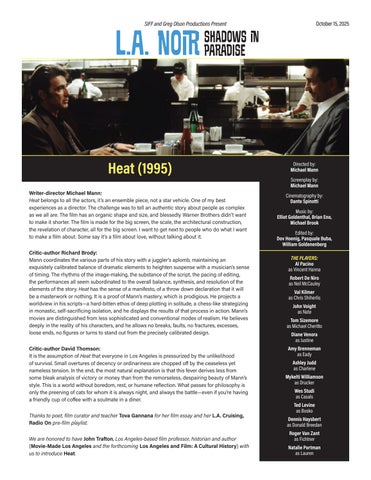
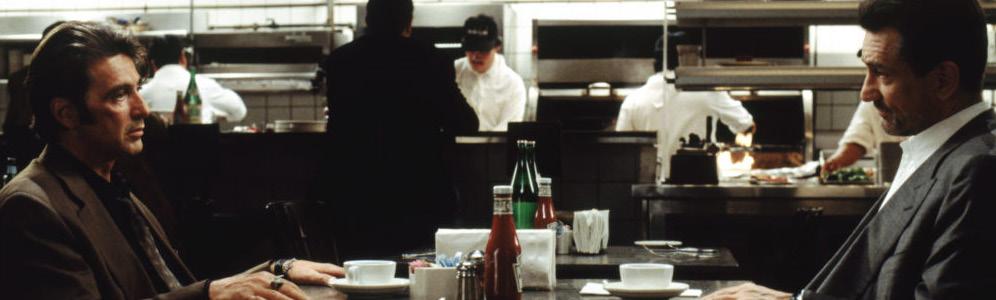
First, Vincent and Neil meet for coffee, two foes who have what friends would say “much in common”. Only Vincent and Neil having coffee at their table are in focus; everyone else in the restaurant is in the background, a blur. Vincent and Neil are at the center: two forces in the world that represent multitudes. In the language of American cinema, they’re cop and robber.
They share what it is they dream about: Singular dreams; dreams that repeat. Vincent is visited while he sleeps by “all the victims of all the murders I’ve ever worked sitting at this table, and they’re staring at me with these black eyeballs. There they are – these big balloon people –because I found them two weeks after they’d been under the bed.” Neil asks Vincent, “What do they say?” Vincent replies, “They don’t have anything to say. We just look at each other. They look at me and that’s it. That’s the dream.”
Neil’s recurring dream is: “I’m drowning and I’ve got to wake myself up and start breathing, or else I’ll die in my sleep.” Vincent tells him, “You know what that’s about?” Neil answers, “Yeah: Having enough time.”
Ultimately, Neil is not brought down by Lt. Vincent. In fact, he almost gets away. Instead, Neil is brought down by his inner heat, his inability to let things go. He veers off the highway to return to LA. His last lines to Eady are, “I’ll be right back. Keep the car running.”
Because they know one another’s dreams, either Vincent or Neil will die in the end; the other will have to keep living.