October 21, 2026
SIFF, Alliance Française, and Greg Olson Productions present
Nouvelles Femmes
Modern Women of the '60s French New Wave
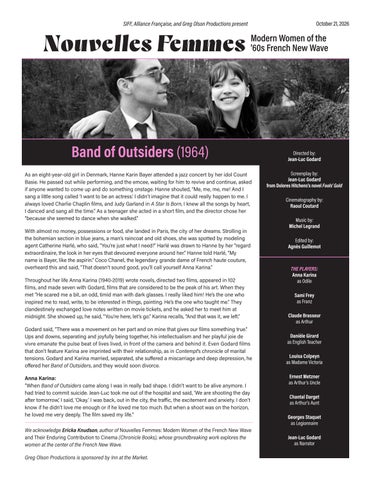
Band of Outsiders (1964) As an eight-year-old girl in Denmark, Hanne Karin Bayer attended a jazz concert by her idol Count Basie. He passed out while performing, and the emcee, waiting for him to revive and continue, asked if anyone wanted to come up and do something onstage. Hanne shouted, “Me, me, me, me! And I sang a little song called ‘I want to be an actress.’ I didn’t imagine that it could really happen to me. I always loved Charlie Chaplin films, and Judy Garland in A Star Is Born, I knew all the songs by heart, I danced and sang all the time.” As a teenager she acted in a short film, and the director chose her “because she seemed to dance when she walked.” With almost no money, possessions or food, she landed in Paris, the city of her dreams. Strolling in the bohemian section in blue jeans, a man’s raincoat and old shoes, she was spotted by modeling agent Catherine Harlé, who said, “You’re just what I need!” Harlé was drawn to Hanne by her “regard extraordinaire, the look in her eyes that devoured everyone around her.” Hanne told Harlé, “My name is Bayer, like the aspirin.” Coco Chanel, the legendary grande dame of French haute couture, overheard this and said, "That doesn’t sound good, you’ll call yourself Anna Karina.” Throughout her life Anna Karina (1940-2019) wrote novels, directed two films, appeared in 102 films, and made seven with Godard, films that are considered to be the peak of his art. When they met “He scared me a bit, an odd, timid man with dark glasses. I really liked him! He’s the one who inspired me to read, write, to be interested in things, painting. He’s the one who taught me.” They clandestinely exchanged love notes written on movie tickets, and he asked her to meet him at midnight. She showed up, he said, “You’re here, let’s go.” Karina recalls, “And that was it, we left.” Godard said, “There was a movement on her part and on mine that gives our films something true.” Ups and downs, separating and joyfully being together, his intellectualism and her playful joie de vivre emanate the pulse beat of lives lived, in front of the camera and behind it. Even Godard films that don’t feature Karina are imprinted with their relationship, as in Contempt’s chronicle of marital tensions. Godard and Karina married, separated, she suffered a miscarriage and deep depression, he offered her Band of Outsiders, and they would soon divorce. Anna Karina: “When Band of Outsiders came along I was in really bad shape. I didn’t want to be alive anymore. I had tried to commit suicide. Jean-Luc took me out of the hospital and said, 'We are shooting the day after tomorrow,’ I said, ‘Okay.' I was back, out in the city, the traffic, the excitement and anxiety. I don’t know if he didn’t love me enough or if he loved me too much. But when a shoot was on the horizon, he loved me very deeply. The film saved my life." We acknowledge Ericka Knudson, author of Nouvelles Femmes: Modern Women of the French New Wave and Their Enduring Contribution to Cinema (Chronicle Books), whose groundbreaking work explores the women at the center of the French New Wave. Greg Olson Productions is sponsored by Inn at the Market.
Directed by: Jean-Luc Godard Screenplay by: Jean-Luc Godard from Dolores Hitchens’s novel Fools' Gold Cinematography by: Raoul Coutard Music by: Michel Legrand Edited by: Agnès Guillemot
THE PLAYERS: Anna Karina as Odile Sami Frey as Franz Claude Brasseur as Arthur Danièle Girard as English Teacher Louisa Colpeyn as Madame Victoria Ernest Metzner as Arthur’s Uncle Chantal Darget as Arthur’s Aunt Georges Staquet as Legionnaire Jean-Luc Godard as Narrator
BAND OF OUTSIDERS BY JOHN TRAFTON Godard wanted you to know that his films had minds of their own. They were under no obligation to follow Hollywood structure, remain focused on character objectives, or satisfy plot-driven expectations. His films are filled with digressions, interruptions, and moments that seem to exist simply because Godard wanted them there. There is something almost Proustian about this wandering consciousness, although Godard disguises it beneath the surface of popular cinema. In Band of Outsiders (1964), ostensibly a crime film about three young people plotting a robbery, the digressions are often more memorable than the crime itself. There is the famous run through the Louvre, an exhilarating rush that subverts our expectations of both cinema and the spaces it depicts. There is the moment when the characters observe a minute of silence, an interruption that seems to serve no narrative purpose beyond drawing our attention to the experience of watching a film. Godard himself narrates, although he hardly does so in the traditional sense. Instead, he occasionally tells us what the characters are thinking, raising the question of how much we should trust him. He continually reminds us that what we are watching is an illusion, inviting us to become active participants rather than passive spectators. In some ways, Band of Outsiders is a companion piece to Breathless (1960). Both are crime films more interested in breaking cinema apart than delivering the thrills of a classic Warner Bros. gangster picture. (It makes you wonder what Bonnie and Clyde might have looked like had Godard agreed to direct it.) Yet beneath the playful formal experimentation is something unexpectedly melancholy. Godard's characters inhabit a world constructed from movies, romantic fantasies, and popular culture, but none of these things can quite tell them how to connect with one another. And then there is the Madison dance. Arthur (Claude Brasseur), Franz (Sami Frey), and Odile (Anna Karina) perform their wonderfully awkward, synchronized dance in a café, seemingly inhabiting an entirely different emotional universe from everyone around them. It is joyous, melancholic, and cinematic all at once—very Godard, in other words. The dance is another digression, but it feels so effortless that we almost forget how radically it interrupts the film. Notice how Karina's movements seem to exist just slightly independently of the choreography of the two men. She belongs to the trio, yet somehow remains apart from it. Godard's narration interrupts the music to reveal the characters' private thoughts, reminding us that their apparent unity is something of an illusion. The dance celebrates togetherness while revealing just how fundamentally alone these three people are. This brings us, inevitably, to Anna Karina. The relationship between Godard and Karina remains one of the most fascinating, creatively fertile, and emotionally turbulent partnerships in cinema history. Yet calling Karina Godard's "muse" as film histories so frequently do, seems woefully inadequate. Karina was never merely an image onto which Godard projected his ideas. Her spontaneity, humor,
intelligence, and extraordinary capacity for emotional contradiction gave their collaborations a vitality that cannot be attributed to Godard alone. Their films together repeatedly blur the boundaries between art, love, autobiography, and emotional cruelty. In A Woman Is a Woman (1961), Karina's Angela wants a child, while the men around her turn her desire into a game. In Vivre sa vie (1962), Nana is simultaneously the subject of Godard's fascination and a woman struggling to assert her autonomy. And in Pierrot le Fou (1965), love becomes an impossible escape, as Ferdinand (Jean-Paul Belmondo) and Marianne discover that they cannot inhabit the same romantic fantasy. The result is catastrophic. (More on that film in a few weeks.) Band of Outsiders occupies an especially interesting position within this evolving relationship. Odile is surrounded by two men who imagine themselves as characters in an American crime film, yet their fantasies continually threaten to overwhelm her own desires. Arthur and Franz seem to understand the world through the movies they have watched. Odile, meanwhile, remains something more elusive: playful, vulnerable, impulsive, and never entirely reducible to the roles the men assign her. This tension also makes Karina's absence from Contempt (1963) rather fascinating. Camille, played by Brigitte Bardot, is a woman who has stopped loving her husband, a development he seems intellectually incapable of understanding. Perhaps Camille anticipates something that becomes increasingly central to Godard's subsequent films: a man who can analyze almost anything except the woman standing directly in front of him. There is something deeply revealing about a filmmaker so adept at dismantling cinematic illusions yet seemingly so fascinated by the impossibility of fully understanding another person. Which brings us back to the dance. For a few extraordinary minutes, Odile is neither simply the object of Arthur and Franz's affection nor a figure confined within their cinematic fantasies. Karina commands our attention through the smallest gestures, the slightest changes in expression, and the wonderful unpredictability of her movements. The dance belongs to all three performers, but it is Karina who gives it much of its emotional complexity. She is simultaneously part of the choreography and something that exceeds it. In short: Anna Karina didn't simply inspire Godard's films. She helped make them possible. Perhaps this is where Nouvelles Femmes really comes together. Karina, Jean Seberg, Jeanne Moreau, and the other women who helped define the French New Wave were not simply beautiful faces inhabiting the visions of brilliant male directors. They were creative partners in the construction of the movement itself, even when film history failed to remember them as such. For a few moments in that café, Anna Karina seems to know it.