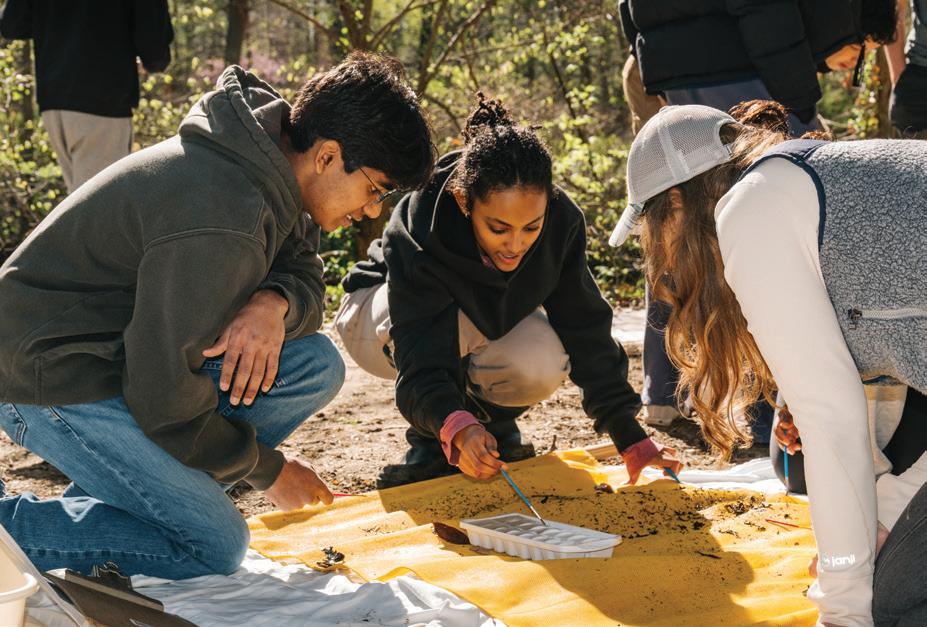
Budding biologists explore environmental and life sciences in the real world.
STUDENTS WITHOUT BORDERS
Alumni reflect on how learning abroad redirected their lives. PLUS Cora Carmody ’75 turns girls into tween tech titans.

Budding biologists explore environmental and life sciences in the real world.
Alumni reflect on how learning abroad redirected their lives. PLUS Cora Carmody ’75 turns girls into tween tech titans.
We launched Together We Shine in 2015 to enhance our mission for generations to come and we saw a groundswell of support from our community for this bold vision.
Now, we are called to complete our vision in this culminating phase. As members of the community, you understand the value of education and the role that Sidwell Friends plays as a Quaker school in the nation’s capital. Together, ours is a vision of a sustainable, accessible, and extraordinary place of learning for generations of students to come: one Sidwell, where together we shine.
Join us in making this vision a

EDITORIAL
Editor-in-Chief
Sacha Zimmerman P ’29
Creative Director
Meghan Leavitt
Contributing Writers
Zeeshan Aleem ’04
Loren Ito Hardenbergh P ’29
Victoria Tilney McDonough
Ellen Ryan
Michael Schuler
Digital Producers
Amber Lucia Chabus
Anthony La Fleur P ’30
Sarah Randall
Alumni Editors
Ava Delasanta
Kourtney Ginn
Clayton Willis
Contributing Photographers
David Dowling
Wyatt McConagha ’27
Cameron Whitman
LEADERSHIP
Head of School
Bryan K. Garman
Chief Communications Officer
Bill Burger
CONNECT WITH SIDWELL FRIENDS @sidwellfriends
Sidwell Friends Magazine 3825 Wisconsin Avenue NW Washington, DC 20016 202-537-8444
sidwell.edu/magazine magazine@sidwell.edu
ON THE COVER Photographer
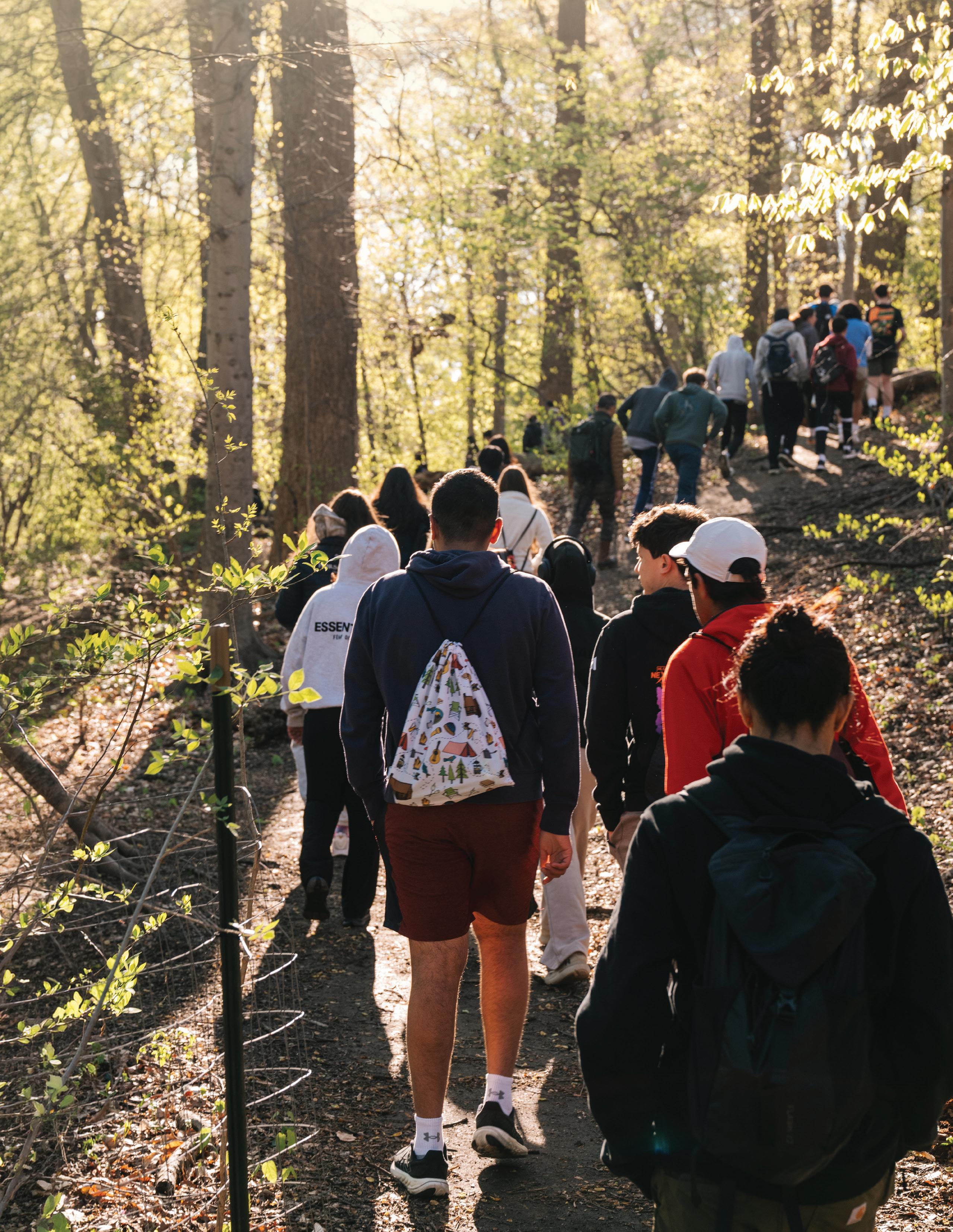
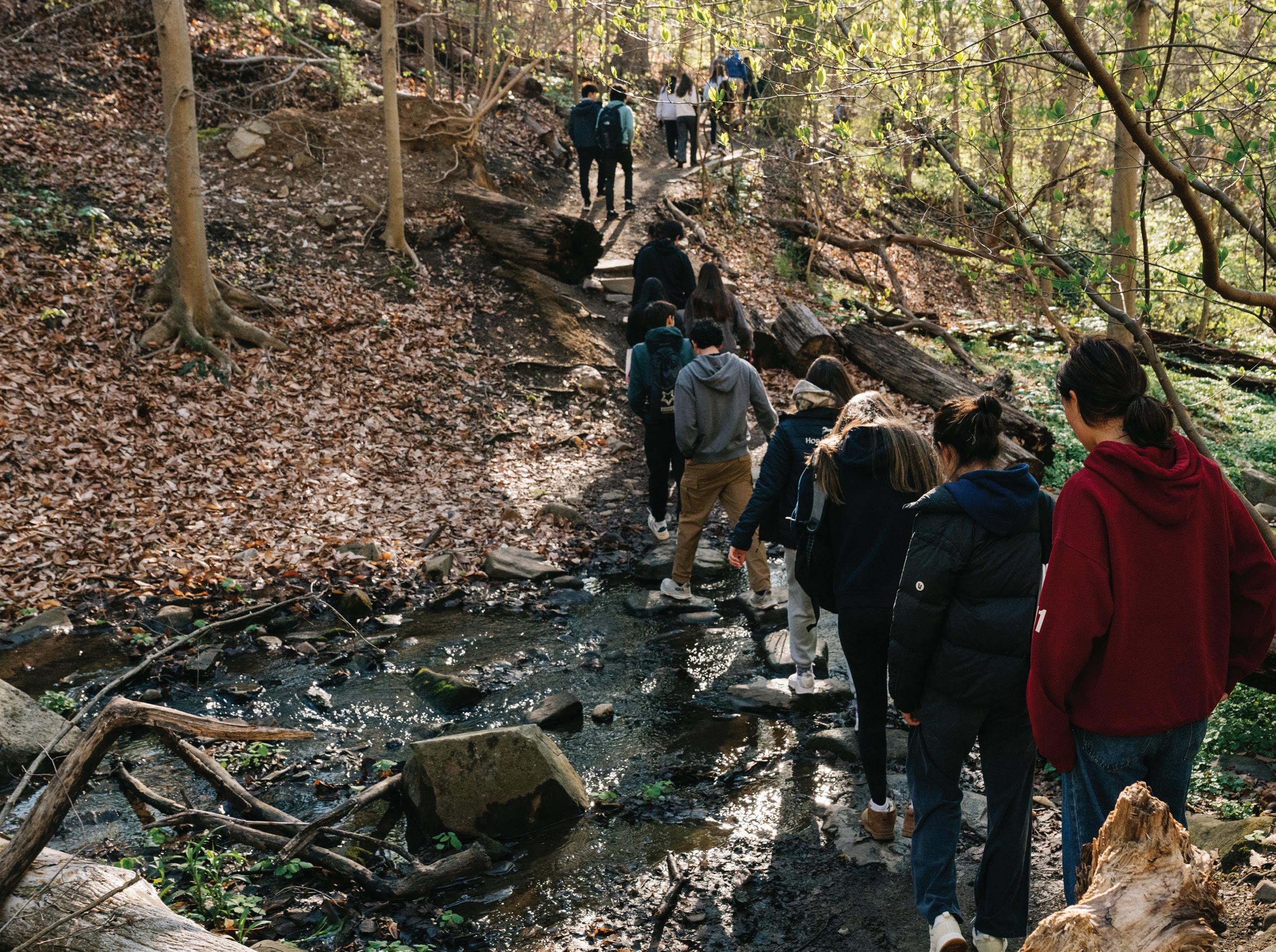
Cameron Whitman captures 11th grade biology students as they hike through Rock Creek Park.
Spring 2026 Volume 97 Number 2

DEPARTMENTS
2 FROM THE EDITOR
3 ON CAMPUS
Photography awards, athletic honors, a very funny iftar, a brief history of the School, a trip through China then and now, an MLK Day featuring a special exhibit, and much more.
18 THE ARCHIVIST
“Team Wannan: Remembering Pop, Charlie, and Their Gym”
22 FRESH INK
Marianne Bernstein ’74, Carol Carpenter ’61, Alice Echols ’69, Andrew Guthrie Ferguson ’90, Juliet Izon ’03, Kristin Kelly ’70, Tara Prakash ’25, Carter Wilson ’59
44 LIVING THEIR VALUES
“High-Tech Girl Power”
From the C-suite to camp, Cora Carmody ’75 encourages thousands of young women to embrace STEM studies.
47 CLASS NOTES
68 WORDS WITH FRIENDS
“Who Let the Bugs Out?”
69 LAST LOOK
“Art in Bloom”
FEATURES
24 BUGGING OUT
For more than 30 years, Sidwell Friends’ students have been studying tiny creatures in a stream in Rock Creek Park and compiling data on the health of the ecosystem.
36 LEARNING WITHOUT BORDERS
Alumni have long broken out of the classroom for study abroad programs in far-flung lands, where they encounter life lessons that reverberate across years and in unexpected ways.
SACHA ZIMMERMAN P ’29
For students and even some teachers, it may often feel like most of life takes place in school: the astringent scent of white board markers hanging sharp in the air, the whispers of backpacks and notebooks shuffling in and out of place, and the classic pie-plate clock keeping watch over the scene—all linger ubiquitously in the classroom. Or do they? At Sidwell Friends, the classroom is but one aspect of the whole learning endeavor; it’s a staging area for a raft of other experiences. Like Manny Jacquez’s “Page and Stage” senior seminar, where students read plays and then head to Arena Stage, Studio Theatre, Keegan Theatre, and Round House Theatre to experience those works as performances (see “The Play’s the Thing,” page 12.) Meanwhile, at the School’s Martin Luther King Jr. Day celebration, students and the whole community were transported to mid-century America’s civil rights movement through the arresting work of celebrated photographer Matt Herron (see “Joyful Resistance,” page 10). And at this year’s Zeidman Memorial Lecture, before a crowd of hundreds, writer Peter Hessler conjured two Chinas: An early 1990s rural communist nation on the cusp of change and a contemporary urban capitalist nation in the throes of an entrepreneurial explosion (see “A Tale of Two Chinas,” page 7).
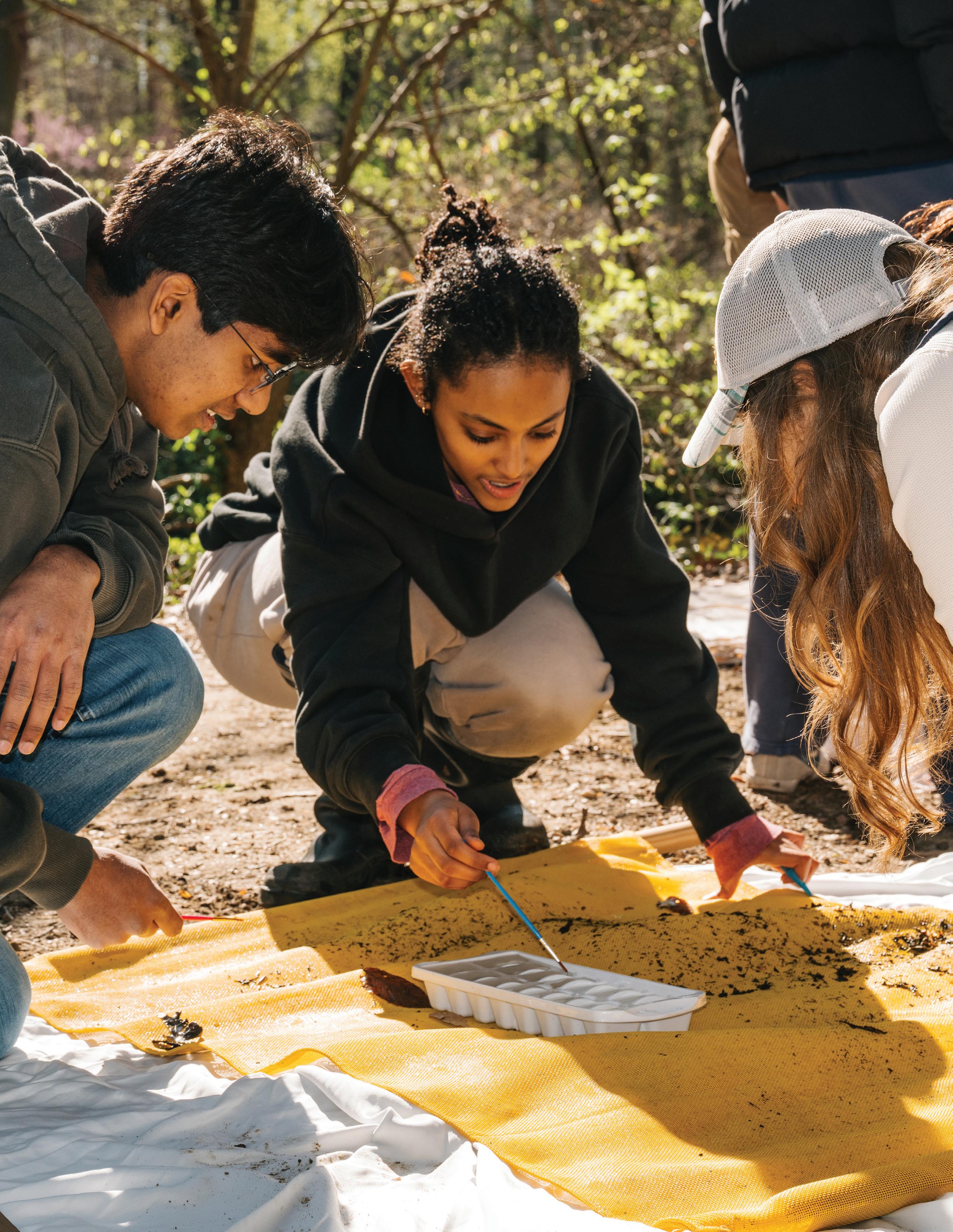
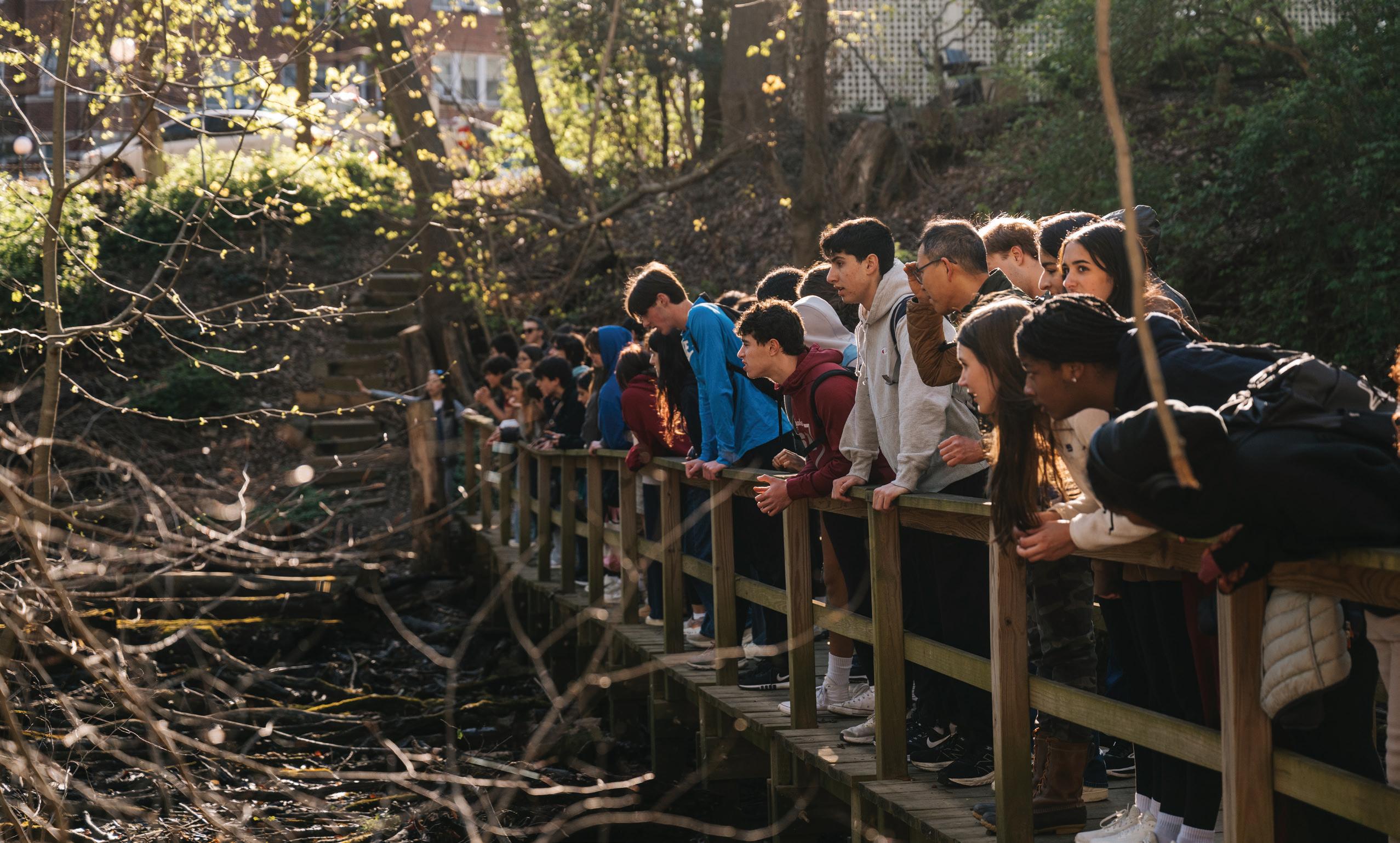
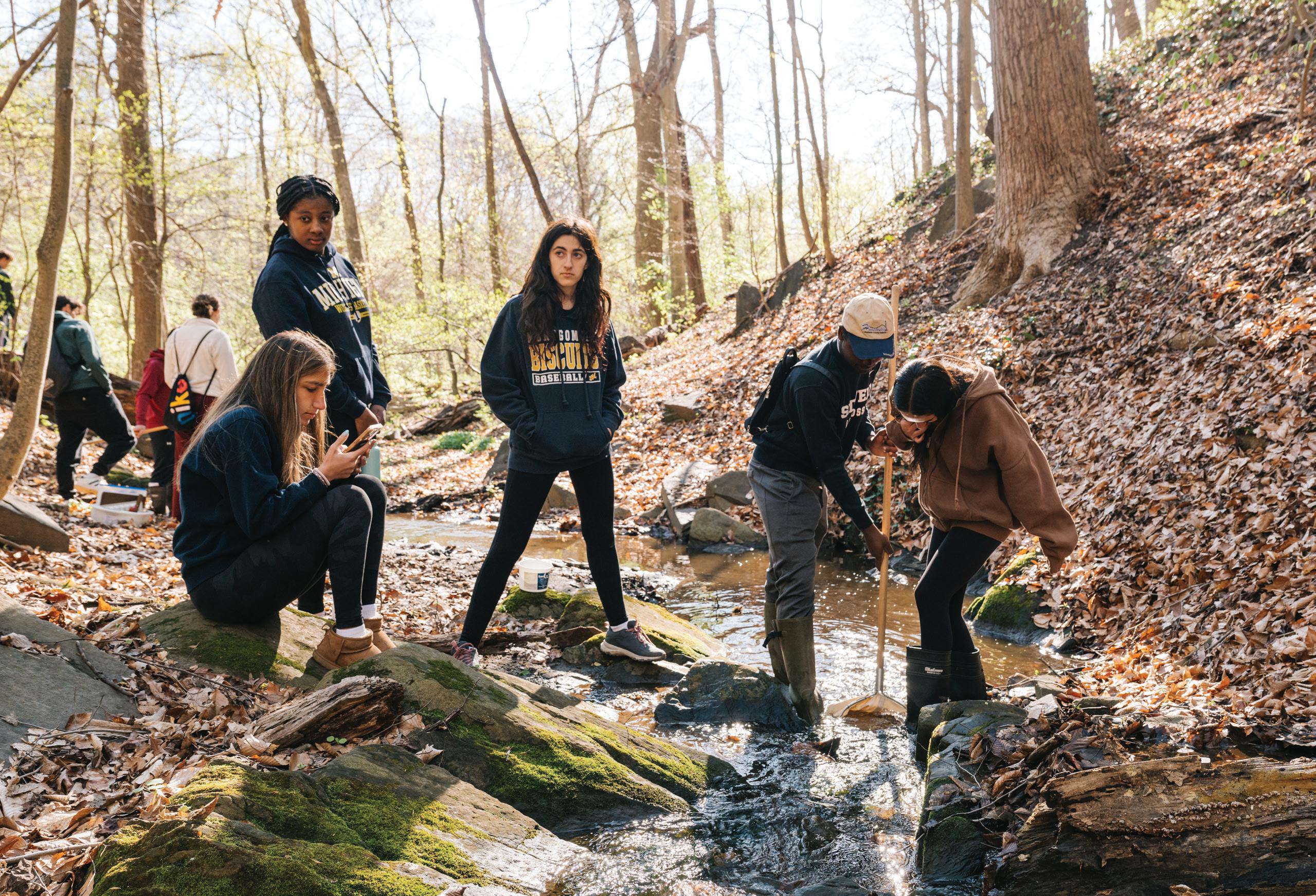
For 11th grade biology students, the walls of the classroom lab dissolve and the juniors find themselves hiking through Rock Creek Park to study tiny creatures with too many legs and no backbones. In “Bugging Out,” Victoria Tilney McDonough ventures out with the young biologists to a small stream where the class collects data on aquatic macroinvertebrates for Nature Forward’s Community Science Water Quality Monitoring Program (page 24). Sidwell Friends has been participating in the project for decades. What’s more,
their work has real impact, as the data they uncover annually goes directly to government agencies and environmental groups to help create new conservation protocols and track the effects of climate change on the water over time. Conducting science in the field also affords students a peek into the career of working biologists while they grasp the real-world value of the life sciences.
Cora Carmody ’75 puts a lot of emphasis on science in her life, too —especially computer science (see “High-Tech Girl Power,” page 44). The CIO of four companies over a successful career in tech, Carmody has long carved out time to pay it forward and mentor girls and young women in the STEM fields. Through her own initiative, Technology Goddesses, and a partnership with the Girl Scouts of America, Carmody leads summer camps devoted to technology and innovation, helps scouts earn a STEM badge (which she created), and gives girls opportunities to explore her world. By taking girls out of the classroom and away from the pressures of school, Carmody is bringing forth a new generation of female scientists, engineers, coders, and inventors. In other words, she is letting her life speak.
For many alumni, learning outside of the classroom means studying abroad. In “Learning Without Borders,” Zeeshan Aleem ’04 talks to half a dozen alumni who spent part of their high school or college education in another country (page 36). In Russia, China, France, England, and more, alumni discovered the value of cultural exchange, the complexity of new languages, and the powerful humbleness that arrives when one is no longer in the majority. These are not lessons that can be taught in a traditional classroom; these are the takeaways that come with complete immersion in a foreign land, which takes bravery, humility, openness, and curiosity— all traits of a Sidwell Friends grad

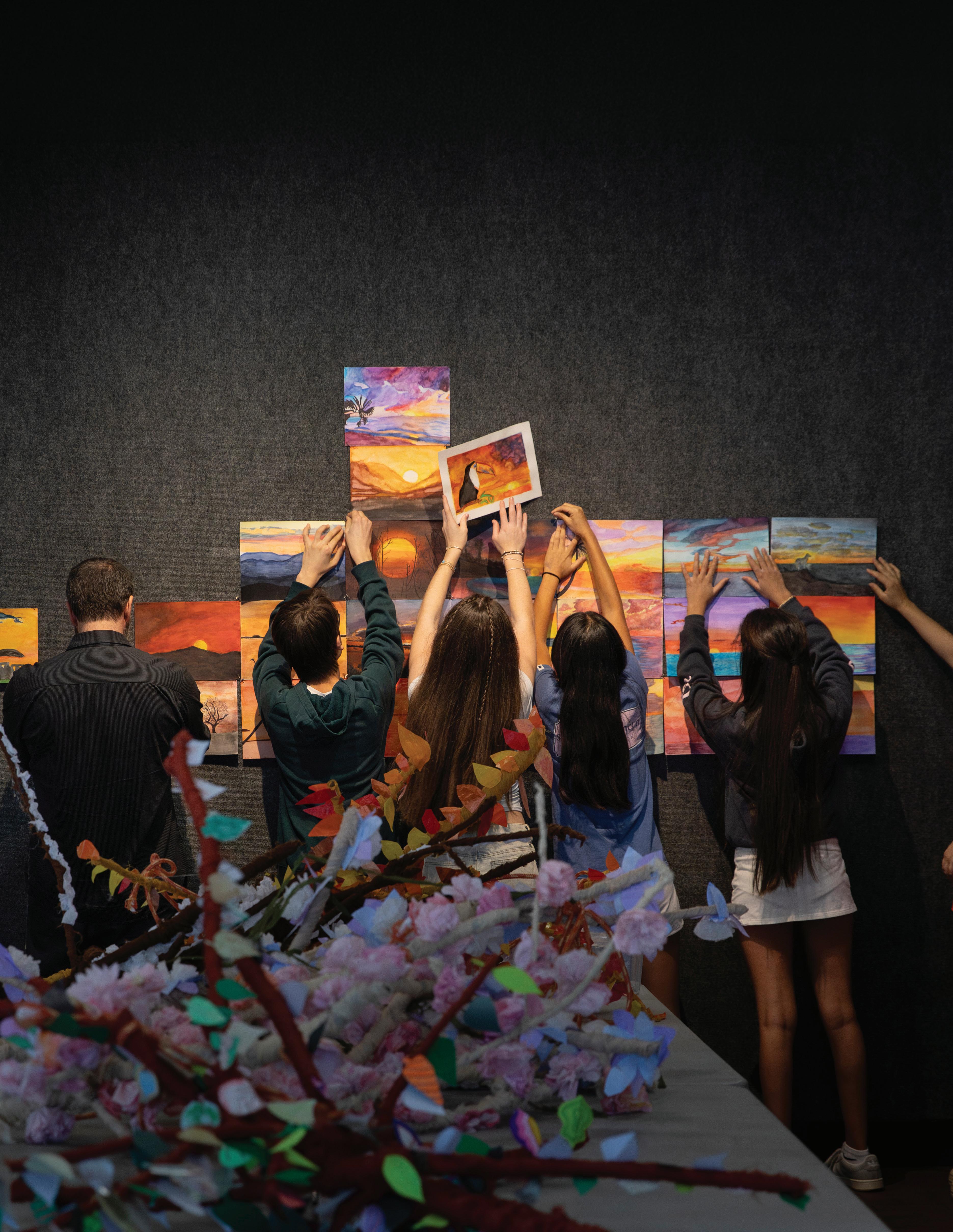
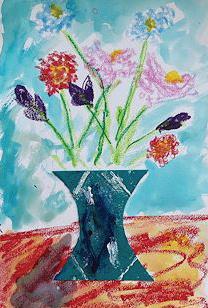
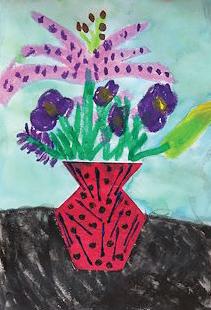
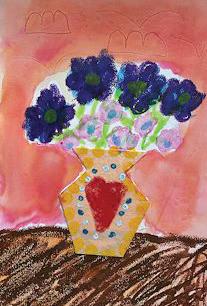
Middle Schoolers hang their artwork in the Kogod Arts Center Gallery.

Let’s keep the faith so that our students don’t lose theirs.
BY BRYAN GARMAN
In late February, I attended a discussion about faith and democracy at the National Cathedral. Since then, I have been reflecting on how our Quaker values can add to the conversation and foster resilience in our students during intensified national and global conflicts.
Cathedral Dean Randy Hollerith hosted a vibrant dialogue with Christine Emba, Peter Wehner, and Eboo Patel, the founder of Interfaith America who has addressed our students on two previous occasions. In his opening keynote, Patel asserted that an imperfect but consistent commitment to pluralism has defined U.S. history. “This is the prologue to American greatness,” Patel insisted. “To be a heritage American means to embrace the diversity of our sacred union.”
Patel offered a compelling counternarrative to those who have sought recently to define American heritage in homogeneous, ahistorical terms. What makes the union sacred, he argued, recalls the impetus for William Penn’s Holy Experiment: a vision that people of many faiths and backgrounds could one day live together as citizens. “This is a country that’s built on a set of propositions,” observed Wehner, a former speech writer for George W. Bush. Among those propositions is the notion “that all people are created equal.”
The panelists recognized that when it comes to practicing equality, the United States has lived its creed unevenly, even unjustly. We must not lose sight of this self-evident truth, especially as officials seek to scrub historical references to enslaved persons and Native Americans from national monuments. Purging our history assaults the dignity and exonerates from responsibility those who lived it.
It took centuries for the United States to move tangibly toward honoring equality at the ballot box. Forged through persistent struggles for justice and landmark Supreme Court decisions—and codified in the Voting Rights Act—a sacred consensus emerged in the 20th century, one that ostensibly made the vote accessible to all citizens. By the late 1960s, this commitment had become a central (if not yet universally agreed upon) pillar of our national profession of faith.
We now see efforts to attack this once sacrosanct principle, to gerrymander congressional districts, require voter identification, and deny birthright citizenship. Faith in what had served as a unifying if unrealized democratic standard has wobbled. Should we surrender this commitment, we run the risk of attenuating the moral ties that bind us, of forsaking the sacred for the profane. In fact, Emba warned that the vitiation of similarly
The desire to restrict the vote and revise longstanding definitions of citizenship to a narrowly defined group of so-called heritage Americans demonstrates little knowledge of American heritage.
“thick” social compacts has enabled “weak or flimsy moral frameworks” to emerge in our society, frameworks that promote “harsher” ideologies, including nationalism, nativism, racism, sexism, and authoritarianism.
The desire to restrict the vote and revise longstanding definitions of citizenship to a narrowly defined group of so-called heritage Americans demonstrates little knowledge of American heritage: Our history has been largely shaped by the ongoing struggle to obtain the citizenship rights that democracy promised and law denied, to unify diverse voices into a vibrant and representative body politic. Failure to proclaim this truth dishonors the promise and the struggle alike.
As educators in a Quaker school, how can we help students build capacity for practicing both pluralism and democracy?
As educators in a Quaker school, how can we help students build capacity for practicing both pluralism and democracy? The panelists offered several suggestions:
1. “Celebrate stories of pluralism,” said Patel, “and define the country around them.” As an example, Patel frequently cites the 1657 Flushing Remonstrance, in which colonists of New Amsterdam denounced the persecution of Quakers.
2. Honor the diverse people you encounter throughout your day. Patel encouraged us to demonstrate genuine and active curiosity about and compassion for one another. Small, simple gestures of kindness matter.
3. Emba, a contributor to The New York Times and senior fellow at Georgetown University, argued that we should “prioritize practice over belief.” It is one thing to preach the virtues of pluralism; it is another to let your life speak to them. The United States, Emba observed, is experiencing a “crisis of civic connection,” a failure to engage in meaningful conversation with those whose beliefs differ from our own. We cannot find common ground if we don’t seek it.
4. “Debate for truth not for victory,” offered Wehner. First called the Religious Society of Friends for the Truth, Quakers have long sought to discern truths that benefit the broader society rather than allowing a particular individual or group to “win.” How can we enter political discussions with the humility to discover what is best for humanity as opposed to what is best for particular interests, including our own?
5. Avoid cynicism because, as Wehner observed, it “corrodes the hearts of those who hold it.” In doing so, it inculcates a tacit resignation to the status quo, thereby permitting its holder to shirk social responsibility. Cynicism disables dialogue and confuses critical thinking for action.
When Benjamin Franklin left the Constitutional Convention for the last time, Elizabeth Willing Powel, a well-connected Philadelphia socialite whose husband had been born into a Quaker family, asked Franklin whether he and his fellow statesmen had designed a republic or a monarchy. “A republic,” he replied cautiously. “If you can keep it.”
This year marks the Republic’s 250th anniversary. As a young child, I recall with nostalgic longing the excitement I felt when we celebrated our bicentennial in 1976. I wonder if our students see the 250th as worthy of celebration. Improving our democracy, building a peaceful society that honors the sacred dignity of every human being, should be causes to which we all let our lives speak. Let’s keep the faith so that our students don’t lose theirs.
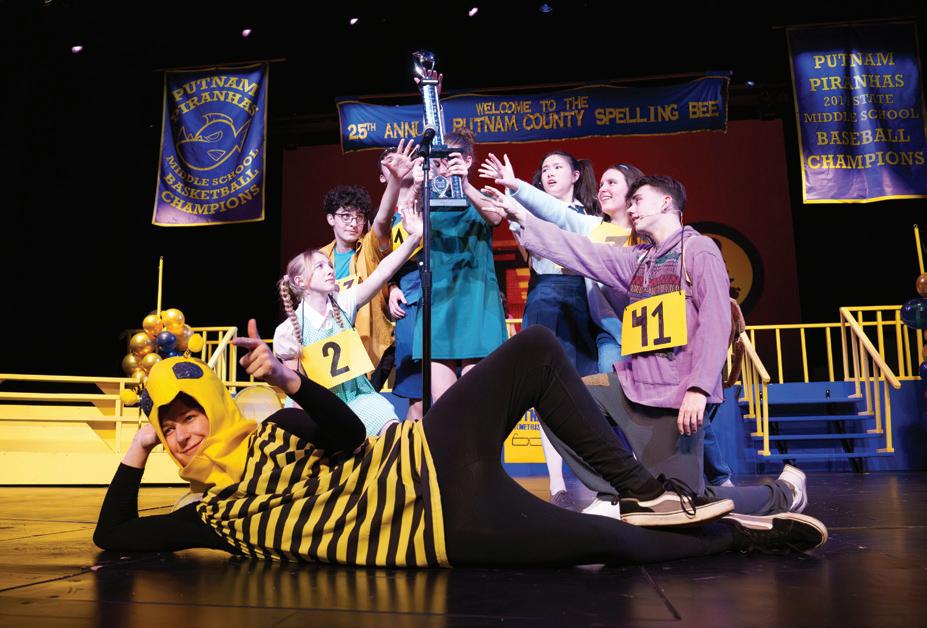
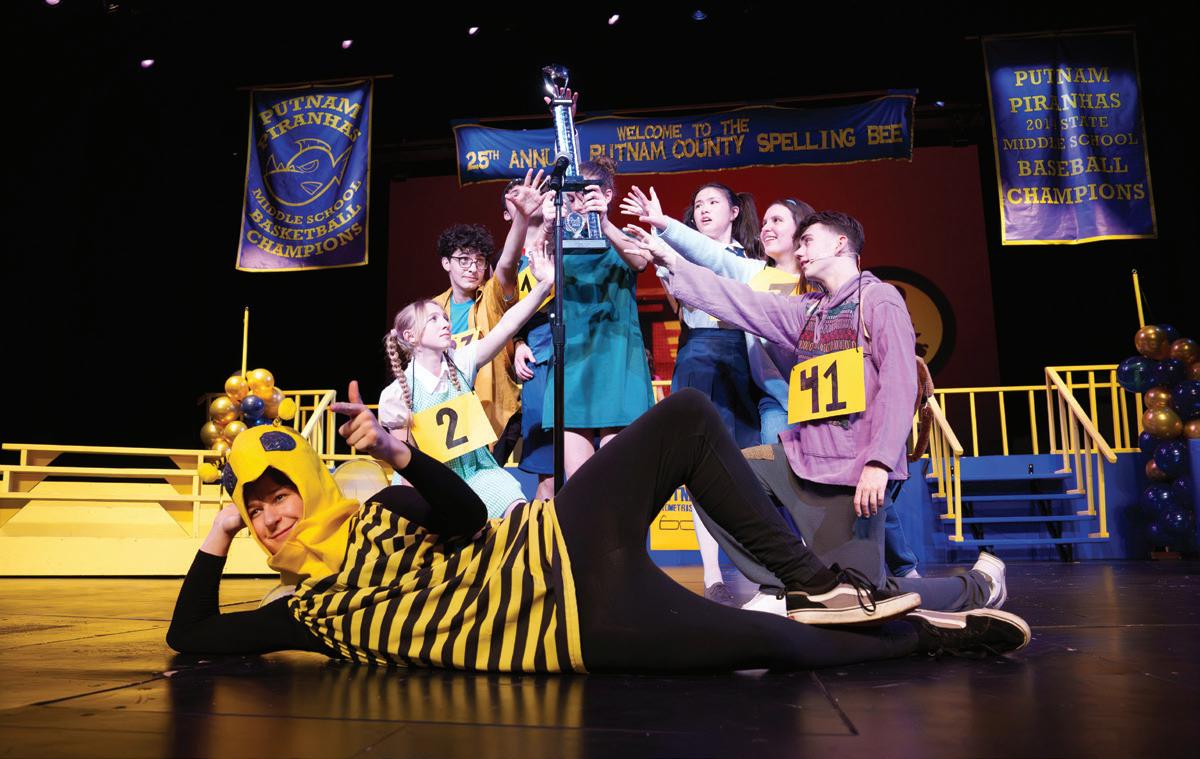
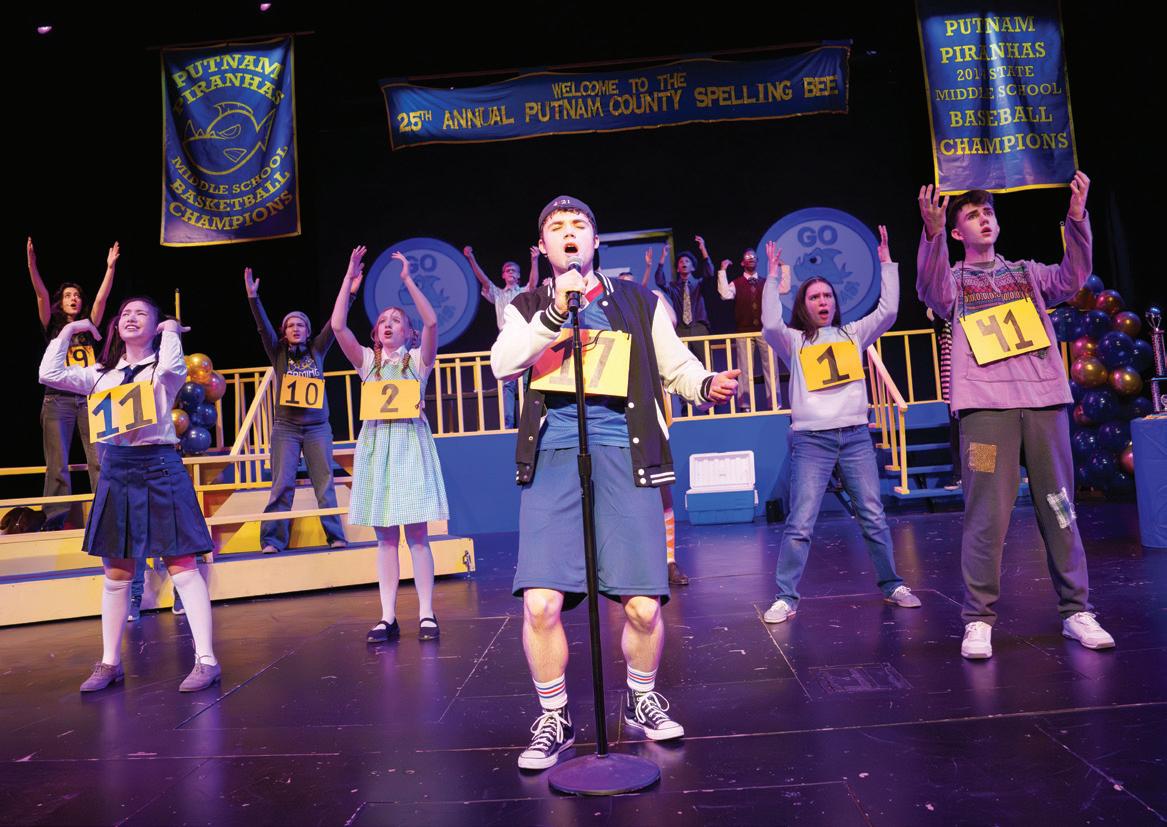
In this year’s spring musical, Upper School students played an eclectic group of tweens who vie for the spelling championship of a lifetime in The 25th Annual Putnam County Spelling Bee. As contestants white-knuckle adolescence and the heat of competition, their emotions run from A to Z—but they step up to the mic anyway because they love spelling, and because being a champion could solve everything.
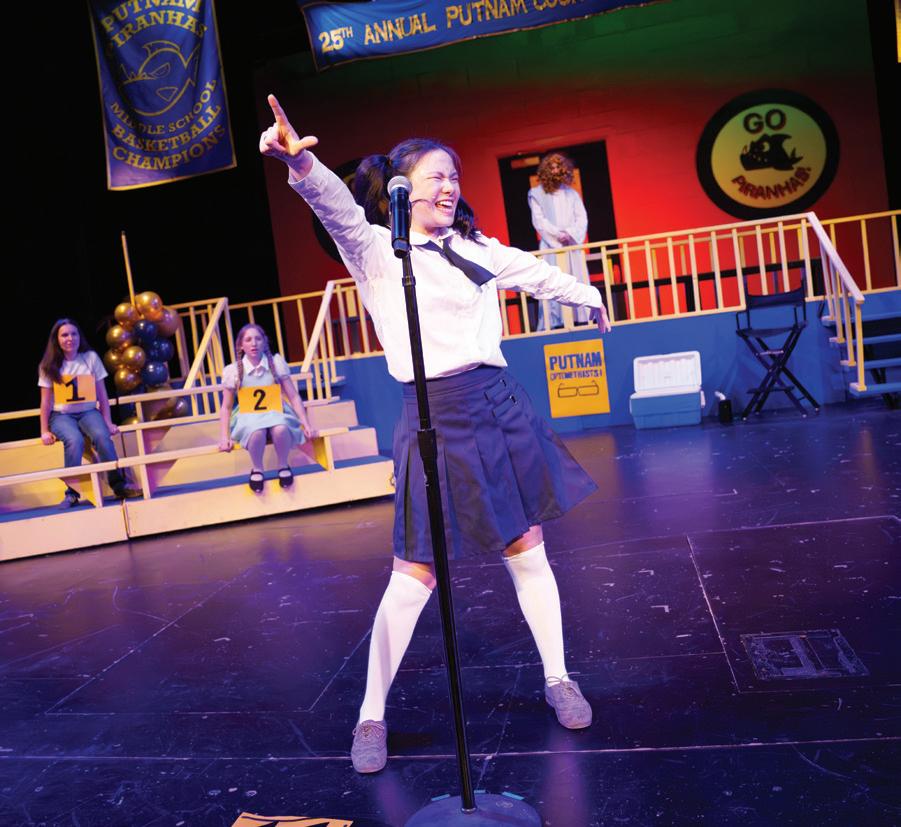
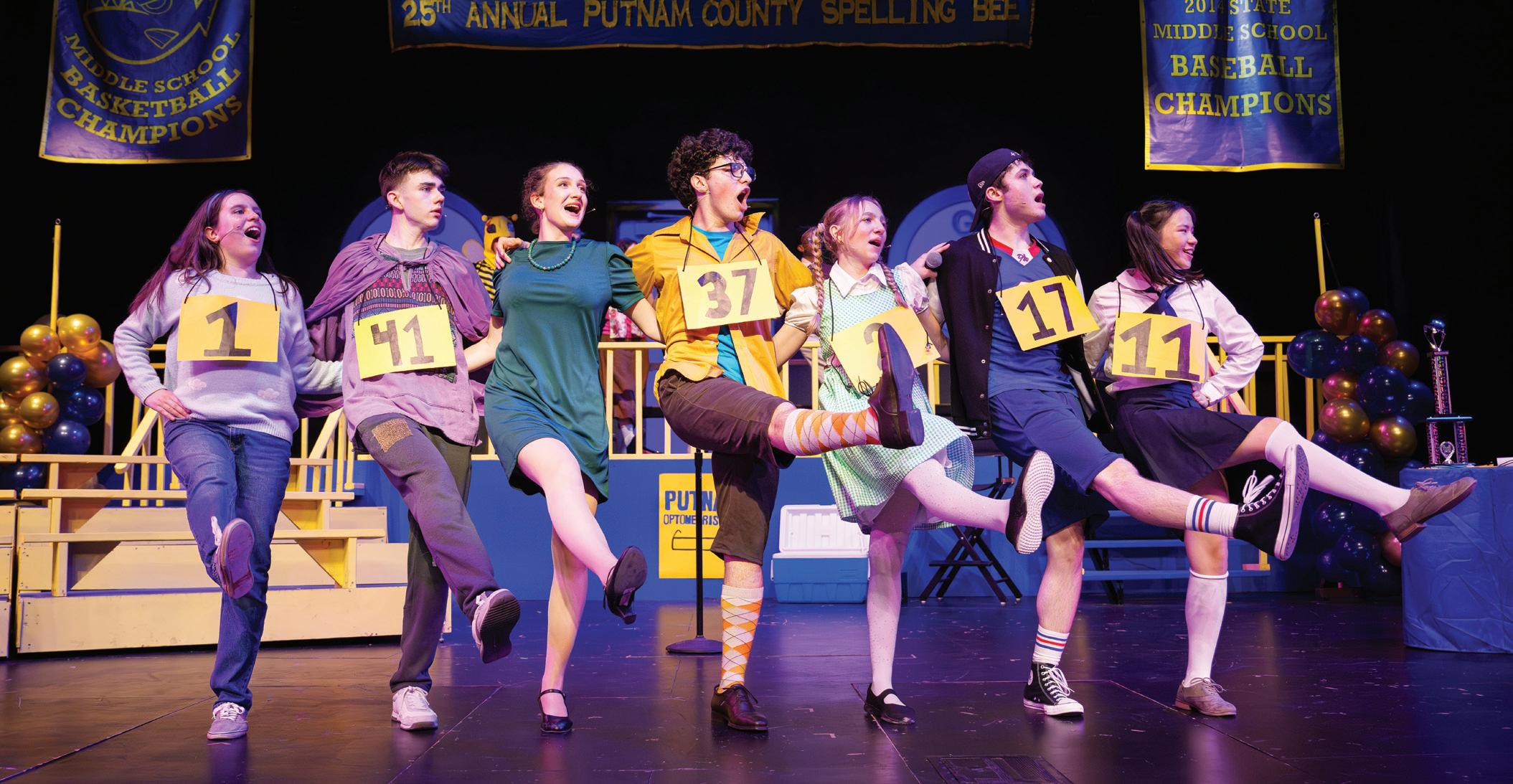
by Cameron Whitman
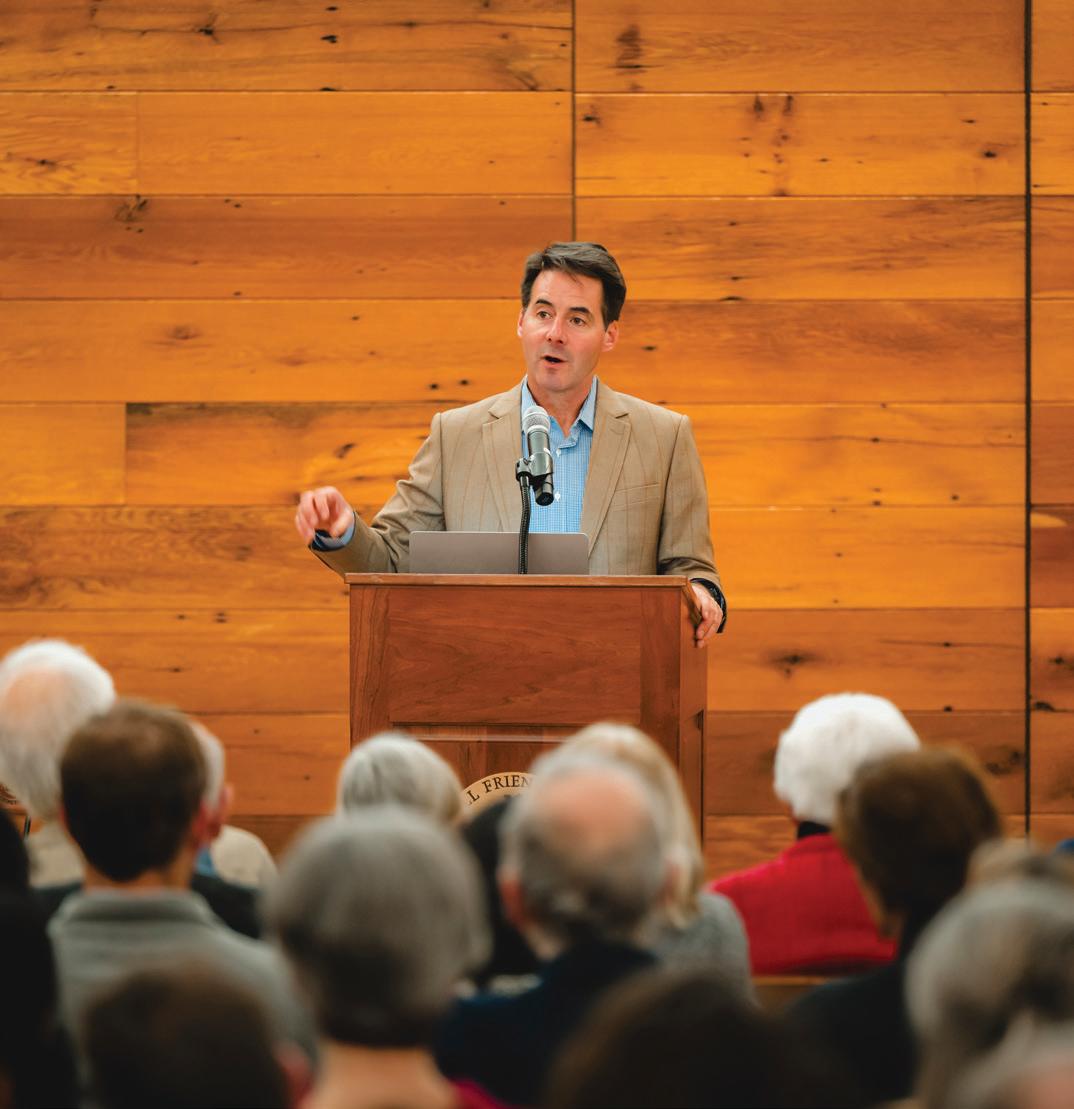
Journalist and writer Peter Hessler delivers the 2026 Zeidman Memorial Lecture.
In 1996, Peter Hessler paid 25 cents for a boat ride to an outcropping of rock, known as White Crane Ridge, which peeked up out of the Yangtze River in Fuling, China. White Crane Ridge is inscribed with 12 centuries of fishermen’s observations on water levels, weather, and fishing conditions—it’s a remarkable archaeological site. But Hessler, then a Peace Corps volunteer, knew that big changes were on the horizon, including a dam project that would swallow White Crane Ridge entirely.
The massive and looming Three Gorges Dam initiative provided the backdrop for Hessler’s first book, River Town: Two Years on the Yangtze, in which he details a China on the precipice of change. It’s a beat he has continued for 30 years as an author and a writer for The New Yorker. Before an audience of hundreds at Sidwell Friends, Hessler gave the keynote address at this year’s Zeidman Memorial Lecture, in which he detailed his exploration of modern China, then and now—also the subject of his latest book, Other Rivers: A Chinese Education
A large part of Hessler’s success dates back to those early days as an English teacher at rural Fuling Teachers College, where he taught and then befriended a generation of twentysomethings raised by Maoists. Over the decades, Hessler kept up a staggering level of correspondence with 100 of his students, giving his written work a ground-level and near-sociological perspective. “Those young people were already extraordinary just by being in college,” he said of his students. “In 1996, only 8 percent of Chinese people went to college, and the country was 83 percent rural.”
The students were also quite small and undernourished. They had few possessions and often wore the same clothes day after day. Many had seen intellectuals punished under Mao and diverted to jobs like cleaning and coal-mining. And Fuling itself felt a world away: It was eight hours by ferry to the nearest city, Chongqing. The lowest parts of Fuling near the river were degraded and unimproved, as they’d soon be submerged when the Three Gorges Dam would transform the landscape. And what of White Crane Ridge? In a backwater town with zero tourism, the local paper nevertheless had theories: everything from collecting rubbings of the centuries-old inscriptions to building an underwater museum.
Over the years, Hessler’s 100 students started to get married, have children, and make their way in an economically burgeoning nation. While in the 1990s, the
students could expect to make $500 a year, those who have gone on to teach now command nearly $38,000 (as of 2024) as English professors. And their universities, too, have grown. With more than half the population getting a college degree by 2019, schools like Fuling Teachers College saw enrollment spike tenfold.
What’s more, many students embraced the nation’s new entrepreneurial spirit. One student made a fortune selling walkie-talkies to one of the country’s largest labor forces: construction workers. Another sells external elevators, retrofitting thousands of 12-story walk-ups into more user-friendly buildings. Of course, the spread of capitalism across China has also meant the spread of fiscal inequality, rivaling if not surpassing America’s own wealth gap (the top .001 percent now own as much as the bottom 50 percent).
These days, China is also overwhelmingly urban. And the eight-hour ferry ride from Fuling to Chongqing is now a brisk 38 minutes by high-speed rail. The air quality is noticeably better; the rivers are cleaner. The Chinese are even standing taller, with men now 3.5 inches taller on average than in the 1990s.
“I was lucky to ride the changes of reform,” said Hessler, who returned to Fuling recently. After all, he had to check out the new $34 million underwater museum for White Crane Ridge.
The John Fisher Zeidman ’79 Chinese Studies Fund, created in his memory by family and friends in 1982, advances the study of Chinese language, history, and culture at Sidwell Friends. Since its inception, the Chinese Studies Program has grown significantly and includes the annual John Fisher Zeidman ’79 Memorial Lecture. For questions about the program please contact Helen Schreiber, director of donor engagement and strategic initiatives, at schreiberh@sidwell.edu
teams as well as his images of nature and wildlife. What’s more, he went on to win a rare National Gold Medal for the piece above, which will be exhibited in June in New York City.
Vincent Cohen ’26 won a Gold Key award for his short film about forgiveness and moving through difficulty.
Maira Zaidi ’27 won a Gold Key award for a photograph that transforms a tennis racket into a dramatic study of light and shadow.
Victoria Wang ’28 won a Gold Key award for her nighttime photograph of a city bus moving past an apartment building under spare lamplight. Her work will be included in a regional exhibition in Northern Virginia organized by Scholastic.
Sidwell Friends Upper School photography students recently won top awards at this year’s Southern Regional Scholastic Art and Writing Awards, the country’s longest-running recognition program for high school art and writing. “My students amaze me with their dedication to their work and for their wide-ranging subject matter,” says Lely Constantinople, Sidwell’s Upper School photography teacher. “The work of this year’s awardees represent the photography program’s emphasis on intentionality, experimentation, and discovering a unique artistic voice.”
Wyatt McConagha ’27 was awarded nine honors, including Gold Key, Silver Key, and Honorable Mention awards for his emotional and intimate photographs of Sidwell Friends athletes and

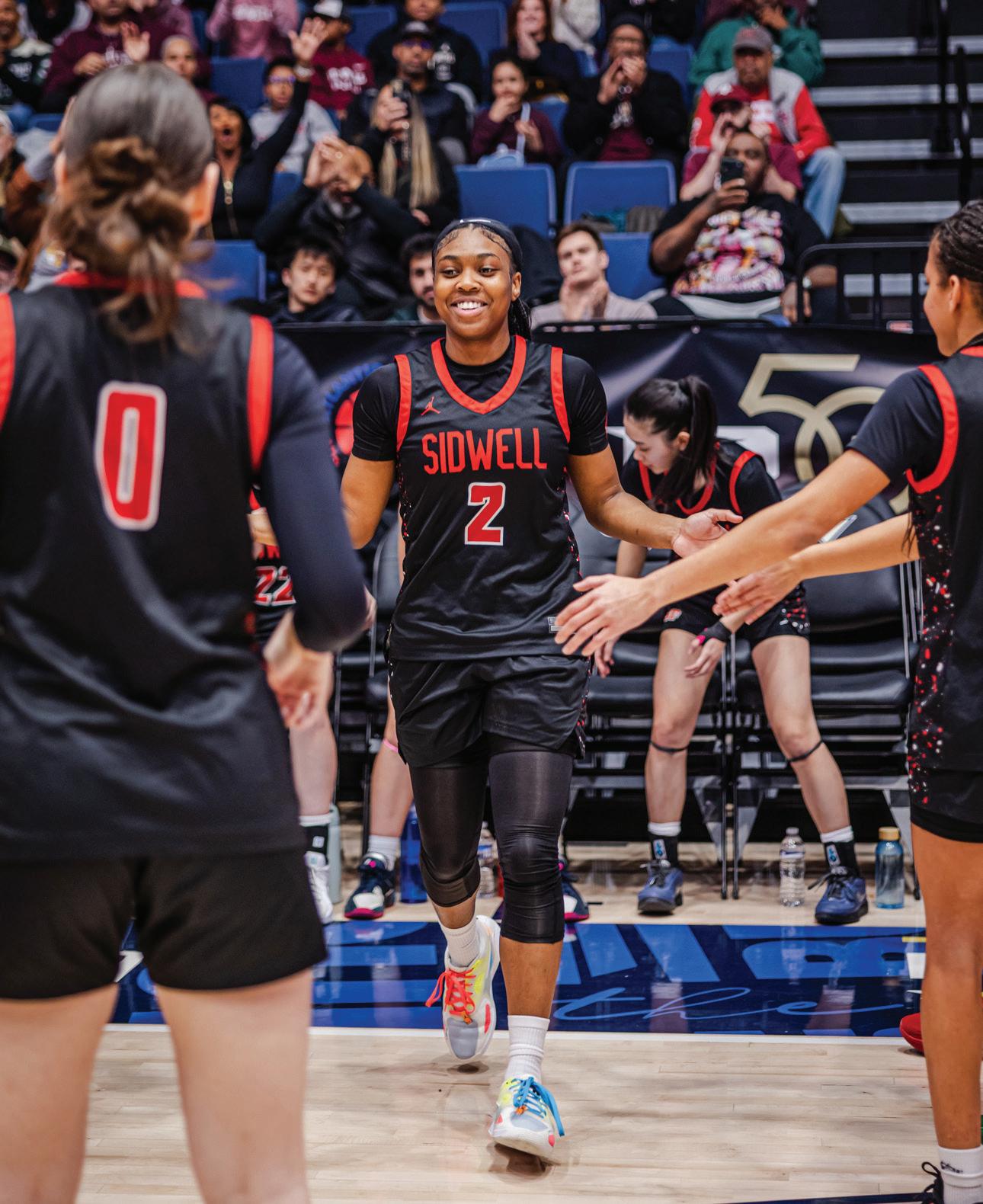
Autumn Fleary ’26 has been selected to play for Team East in the 2026 McDonald’s All-American girls’ basketball game on March 31. Held annually since 1978, the McDonald’s All-American game is a showcase for top players from across the nation. She is one of just 24 girls chosen this year. Fleary is the fifth Sidwell Friends girls’ basketball player in the last five years to be named a McDonald’s All-American, joining Kiki Rice ’22, Jadyn Donovan ’23, Kendall Dudley ’24, and Zania Socka-Nguemen ’24. “Autumn’s success is not just about talent; it’s about the relentless pursuit of excellence from a young age,” says Sidwell Friends Girls’ Basketball Head Coach Talen Watson. “She has maximized her basketball potential through dedication, hard work, and unwavering support from her village. In her senior year, Autumn has brought positive energy and enthusiasm to our team each day.” Fleary will head to Duke in the fall.
Sidwell Friends alum and UCLA senior Kiki Rice ’22 helped lead the UCLA women’s basketball team to the NCAA championship Sunday, April 5. The Bruins routed the University of South Carolina 79–51 in Phoenix, Arizona. UCLA finished its season with a 37–1 record. Rice, who led the Quakers to an undefeated season and national championship in her senior year at the Upper School, is the second Sidwell Friends basketball player, after Josh Hart ’13 in 2016, to play on an NCAA championship basketball team. She played all four college years as a starting guard for UCLA, which won its only other women’s championship in 1978. Rice finished the game with 10 points, 6 rebounds, and a team-leading 5 assists. Lauren Betts, the All-American center for UCLA, won the tournament’s Most Valuable Player award.
As a senior at Sidwell, Rice was named All-Met Player of the Year, DC Gatorade Girls Basketball Player of the Year, and Gatorade Girls National Player of the Year. At the end of the school year, she was named high school female athlete of the year by both Gatorade and MaxPreps. Rice was also a standout soccer player for Sidwell Friends, winning the DC Gatorade Player of the Year honor in her sophomore and senior seasons—bracketing a junior
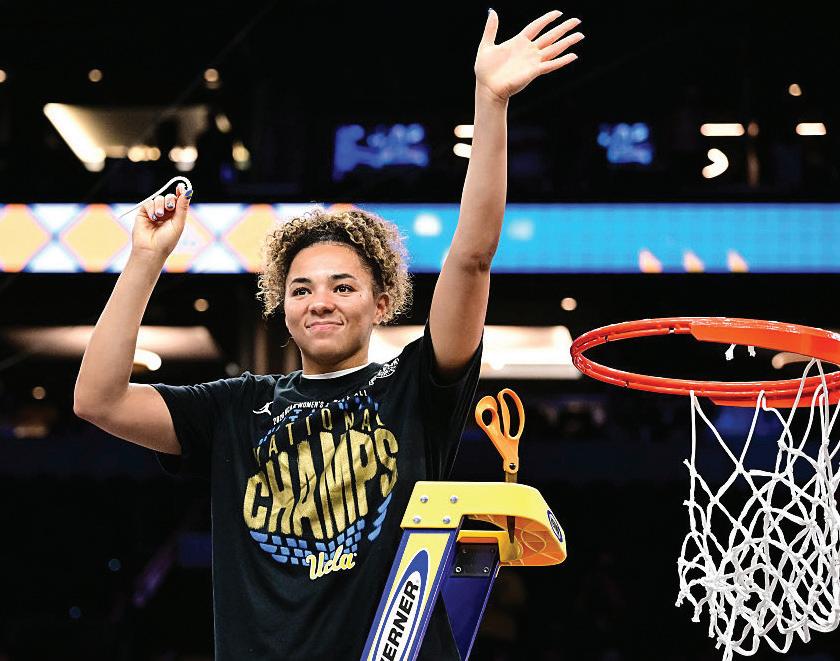
season canceled due to COVID. The Quakers won the DC State Athletic Association team championship both years.
At the NCAA post-game press conference, Rice reflected on the win: “Today was a fantastic display of our resilience. We had a feeling this was our time; this was our year. There’s no better way we could hope to end our career. We’re grateful for all the moments we spent together over these four years. It’s really rewarding because this is a special group of people.” Rice was the WNBA’s sixth draft pick and will play for the Toronto Tempos next season.
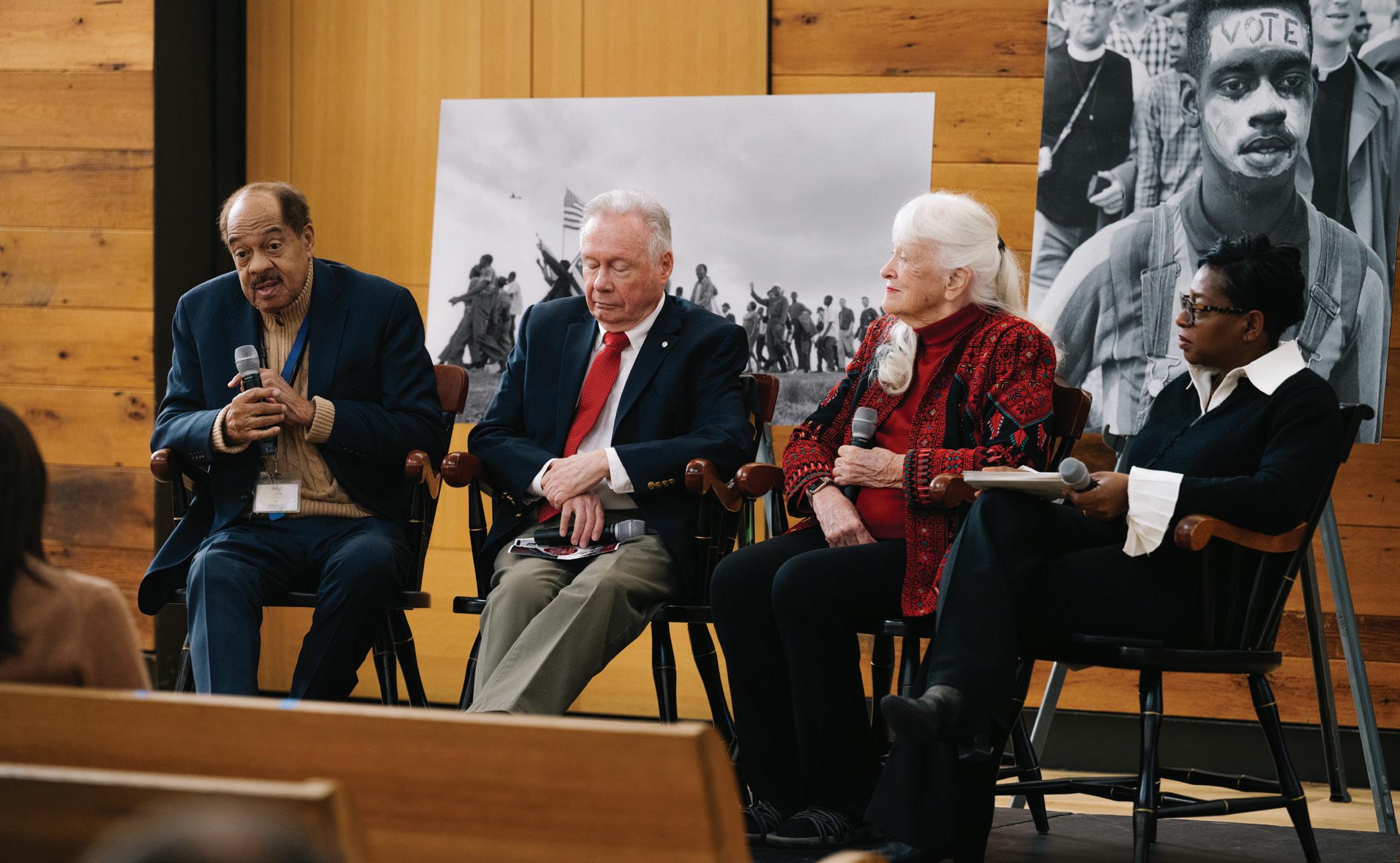
To honor the 40th anniversary of the Martin Luther King Jr. holiday, Sidwell Friends celebrated with learning, reflection, and service.
Looking at the large black-and-white photographs displayed on easels in the Rubenstein Gallery and along the walls of the Robert L. Smith Meeting Room, you could almost hear the voices of protest, courage, and conviction. One iconic image records marchers, flags in hand, against the horizon during the Selma-toMontgomery march in 1965. Another shows a police officer attempting to pull an American flag from the fingers of a 5-year-old boy while putting him under arrest. Yet another shows a Selma marcher wearing zinc oxide to prevent sunburn, the word “vote” spelled out in the cream across his forehead.
These and other photographs by civil rights photographer Matt Herron set the tone for Sidwell Friends’ Martin Luther King Day of Learning and Service—held on the 40th anniversary of the first observance of the federal holiday. Sidwell Friends held its first MLK Day in 2015, and then annually until 2020, when the pandemic made
in-person events like this impossible. Revived for this year’s anniversary by Parents of Black Students Co-Clerks Sheba Douoguih P ’26, ’30 and Shannon White ’31, along with Parents Association Vice Clerk Bomi Anise ’29, the celebration included an extraordinary panel of speakers followed by service projects and food-truck offerings. During the program, young children enjoyed time with performance artist and educator Jessica “Culture Queen” Smith. Head of School Bryan Garman and Endowed Faculty Chair of African and African American Studies Dr. Jewell Debnam kicked off the event with remarks about the timeliness of the program and the power that comes with uniting around a shared vision.
Michael DiMaggio, co-founder of Proximity Partnership Consulting, whose career has centered on advancing equity, access, and community-driven change, and Dr. Jeannine Herron, Matt Herron’s widow, spoke about the impact
of the photographs and the importance of recording cultural and historical events. In collaboration with Jeannine Herron, much of DiMaggio’s work includes trying to find people who were in Matt Herron’s photographs and bring them together. “There wouldn’t have been a Civil Rights Movement without young people—people who put their bodies and spirits on the line, who sacrificed so much in the name of change,” said DiMaggio.
“It is meaningful for people to see their young selves in these images, and for families to see the courage and sacrifices of their kin. The images may be 60-plus years old, but they speak volumes about yesterday and today.” Jeannine Herron, a neuropsychologist and co-founder of Head Start, shared a few insights about her life with her photographer husband and also spoke about her father, who instilled in her the importance of character and bearing witness, which she and her husband—both Quakers—lived through their work, activism, and daily actions.
They were followed by a panel remarkable for the fact that most of its members played active roles in
the Civil Rights Movement—having seen, experienced, and fought for freedom and equality in some capacity along with King and other leading activists. Panelists included Jeannine Herron; Walter Naegle, an artist and photographer, as well as the surviving partner of late American civil rights leader Bayard Rustin and the current executive director of the Bayard Rustin Fund; and Rev. Dr. Paul Smith, who, with King and Andrew Young as friends and mentors, entered the ministry in 1960 and soon became a stalwart marcher in the Civil Rights Movement. The panel shared stories and experiences and answered questions about having the courage to act in the face of danger, the conditions that brought different races and genders together in the fight for civil rights, and what this generation should know about fighting for freedom.
“Looking at the folks in these photographs—and there are so many young people!—I come alive,” Smith said of Matt Herron’s photographs. “I want to dance, to act, to make a contribution. Life always provides clues, so pay attention!”
Jeannine Herron shared some of her salient experiences, which included the power of the movement’s music. “We would all stand up, hold hands, and raise our voices in song,” she said. “It was incredibly unifying and gave us the courage to go out and face the danger of what lay ahead.” And with that, she brought the Sidwell Friends community audience to their feet, and with hands interlaced, the room filled with the words of “This Little Light of Mine.”
“When I look at [Matt] Herron’s photographs, I think of the quote, ‘Joy is its own form of resistance,’” Anise said. “During the program, there was a palpable, joyful energy in the room.”
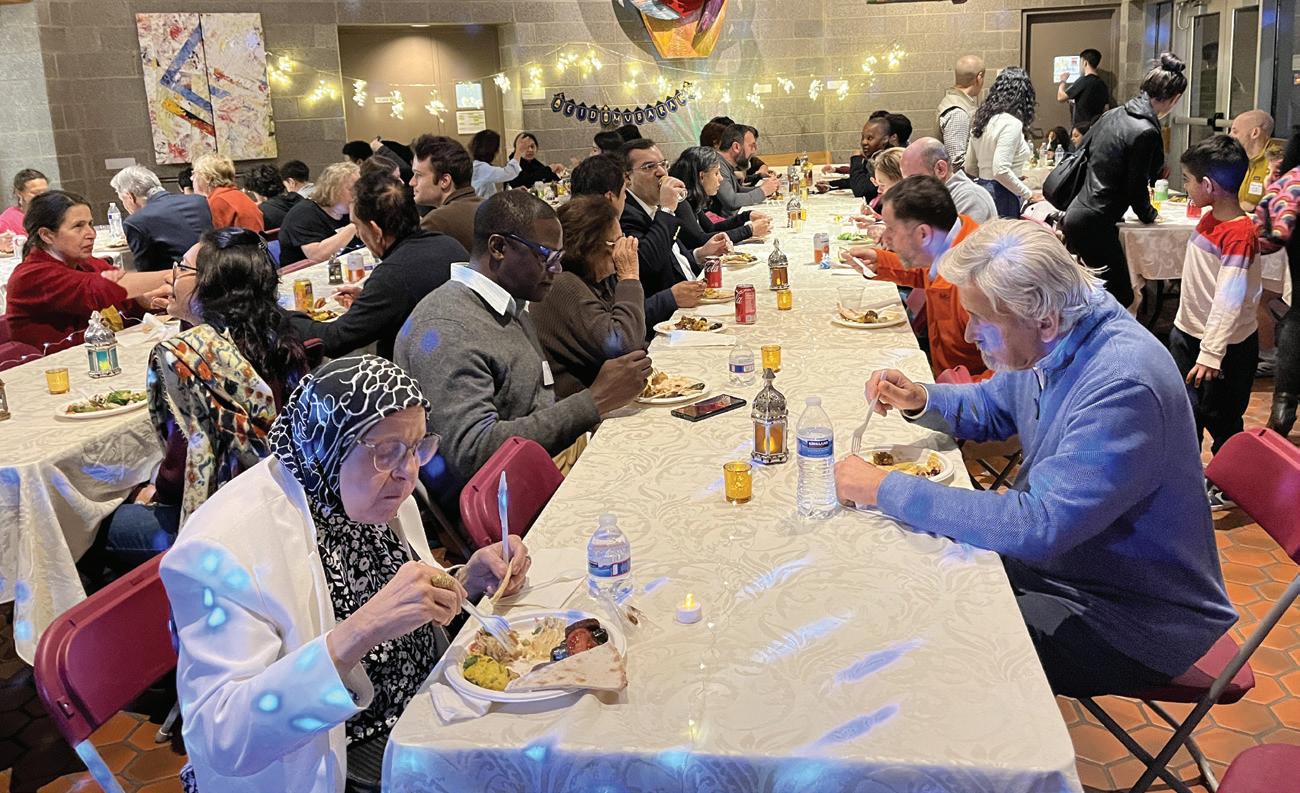
The annual Sidwell Friends Iftar welcomes comic Yasmin Elhady.
Sidwell Friends’ Muslim Student Association, together with the Parents of Students of Middle Eastern, Islamic, and North African heritage, hosted its annual potluck Iftar: a festive dinner to break the fast for those observing the Muslim holy month of Ramadan. Sidwell Friends families and staff of all faiths and beliefs joined the annual program, which this year featured Yasmin Elhady, a human rights lawyer, comedian, and star of Muslim Matchmaker on Hulu.
Elhady spoke of her family’s journey to America. Her father was cabinet minister in the Qaddafi regime in Libya. The only problem was—her father was morally opposed to Qaddafi. “So, it was pretty bad,” Elhady said irreverently. But it was pretty bad: The family lost everything and had to flee. “We went on a voyage of six different countries to seek asylum, and only the United States accepted us,” said Elhady. “This country saved our lives, and it saved our lives in a way that has forced all of us into public service.” In addition to her work as a human rights attorney, Elhady’s brother is a civilian engineer in the Air Force, her mother was a translator for the joint U.S. Hawaii Apache helicopter program, and her father was a civil engineer and played a critical role after Hurricane Katrina.
But patriotism isn’t the only reason for the calling to service. “Muslims believe that all children, every one of us who started as children, started off in goodness,” Elhady said. That goodness is “supposed to sustain your dignity. It’s supposed to create justice, and the Muslims have a higher calling to justice.” Those tenets mirror the light inside of all people that Quakers believe in, a theme Equity, Justice, and Community Director Natalie Randolph ’98 noted in her own remarks. Randolph also noted that it is easier to do hard things, like fasting during Ramadan, if you’re doing them with others.
Elhady agreed: “Community is the answer. We have to love each other harder.”
By reading plays and seeing performances, students explore the creative dynamic between page and stage in a Sidwell Friends senior seminar.
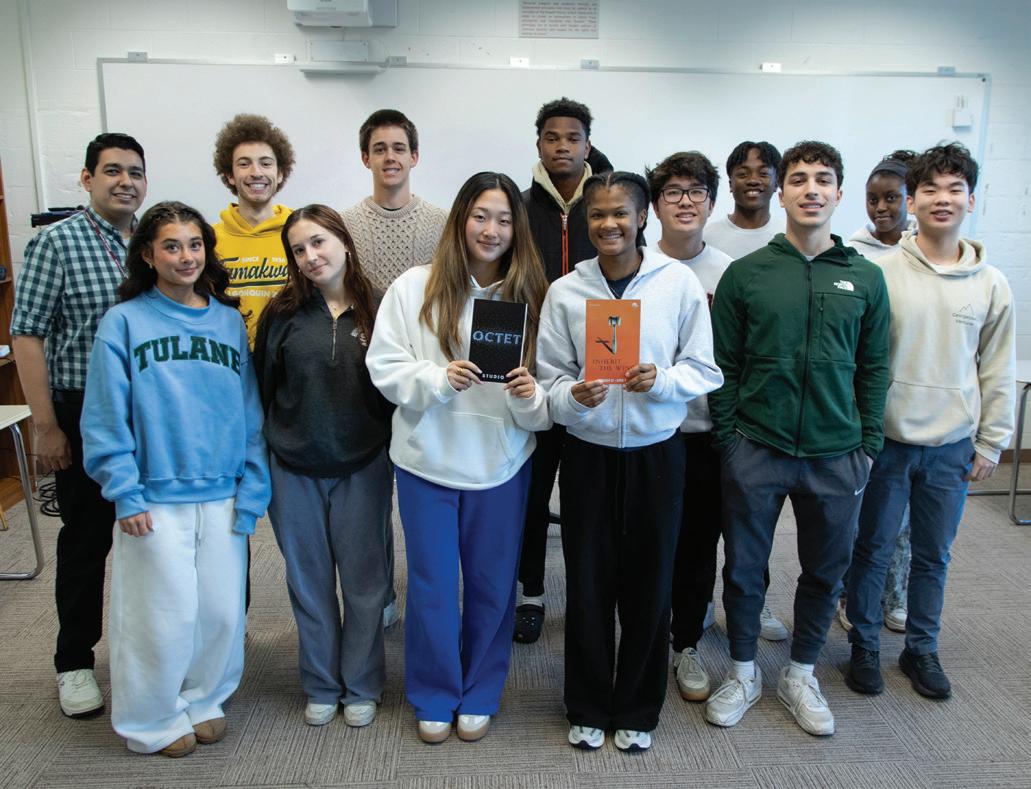
It’s a simple but brilliant idea: have students read plays and then see a production to explore the nature of the art form in its translation from author’s text to stage production. Students in Upper School English Teacher Manny Jacquez’s “Page and Stage” senior seminar are doing just that this spring, reading and taking in plays ranging from the classic Inherit the Wind to more recently heralded works, including The Minutes by Tracy Letts and What the Constitution Means to Me by Heidi Schreck.
One recent morning, the class of 12 students discussed Inherit the Wind, a riveting retelling of the titanic courtroom contest between Clarence Darrow and William Jennings Bryan over the teaching of evolution in what has become known as the Scopes trial. The students read the play and attended a production at the Arena Stage theater. With the drama fresh in their minds, students enthusiastically shared their thoughts and impressions on the clash between modern science and the religious fundamentalism the play recounts. They discussed how a playwright’s script guides but does not control how a producer or director might interpret the work. In addition to classroom discussion, students write analytical essays in class and compose both a performance review and a directorial concept.
“I could wax on about how the students are benefiting from getting to experience live performances in 2026 when content and entertainment have defaulted to streaming, but I’m more focused on students getting to experience community in various layers,” says Jacquez. “The kids always have pointed feelings about being a part of an audience, express admiration about the community of performers on stage and how they work together, and marvel at the work of the directors, designers, and crew who put on the show. I really feel like the class is implicitly suggesting an important lesson about communal effort, shared passion, and the grace of building something alongside other people.”
By the last play or two of the semester, Jacquez says he notices a significant shift in the depth of observations his students make. In their discussion of Inherit the Wind, students pondered the fact that though the trial took place in one courtroom, in one small town, it was being watched by the world. “We only saw an incomplete jury and in some ways the audience filled in the rest, making us—the audience members—judges,
too,” said one student. Another mentioned the symbolic gesture of the defense attorney holding the Bible in one hand and Darwin’s On the Origin of Species in the other: “Moving his hands up and down like a judicial scale seemed like he was saying that believing in both creationism and evolution is possible.” Another student noted how the staging harkened back to Shakespeare and the Greeks, while another still considered the power of silences and pauses: “So much can be communicated without saying anything.”
At the beginning of the semester, more than 80 percent of the class had never seen a non-musical live performance. Now they have seen a variety of very different performances, including an avant-garde a cappella musical (Octet), a raw drama about the risks of incarceration many youths face (Pipeline), and a biting comedy about small-town politics (The Minutes). “The balance of reading the plays and seeing them performed gets the students thinking about the dynamic between page and stage,” says Jacquez. In some cases, he says, reading the text is easier for students because they have fewer stimuli to keep track of. However, in the case of a play like Inherit the Wind, the text presents a dizzying amount of characters with often brief utterances, making it difficult to figure out how the people weave in and out of the story. For that play, seeing it performed helped the students better understand how the characters drove the plot.
Now in its third year, Jacquez believes the seminar has developed a following that will attract seniors for a long time to come. “Plays are not just text and not just the performance,” he says, “Students in the seminar come to understand the effort needed to put ideas in front of people to encourage them to think for themselves.”
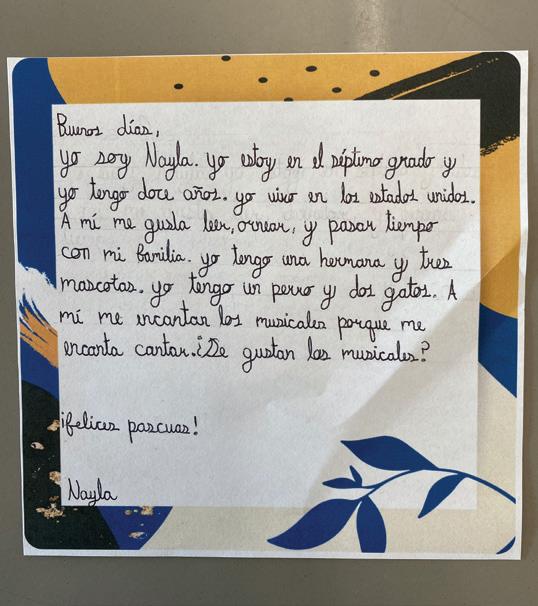
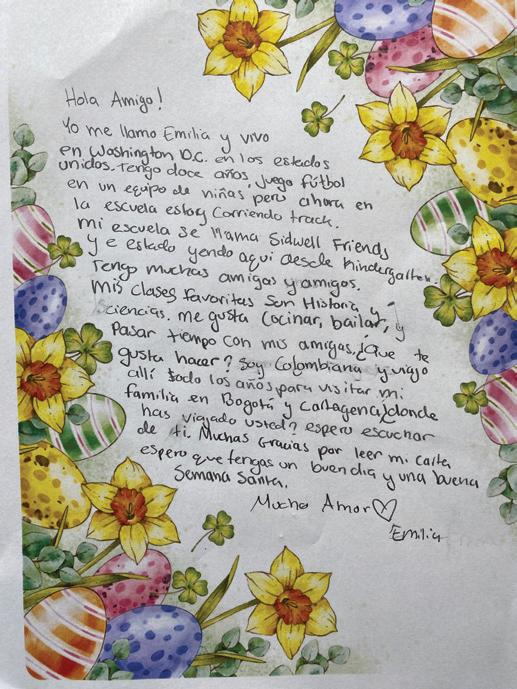
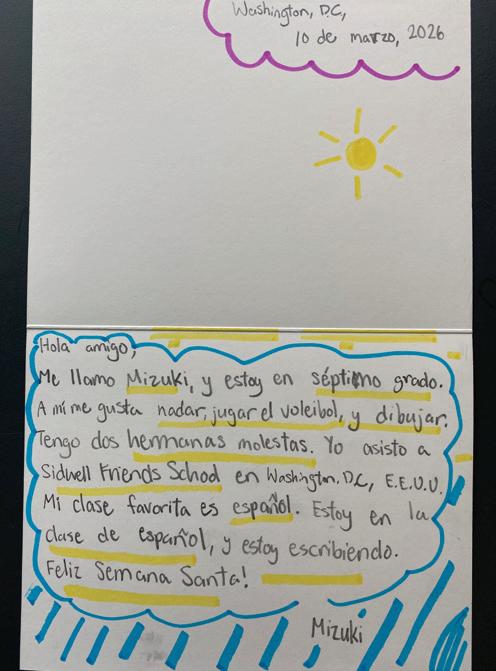
Spearheaded by a sophomore’s service project, 7th graders are writing letters to senior citizens in Spain.
Receiving a handwritten letter in the mail is pretty rare these days and is almost always a welcome arrival. A group of senior citizens in Seville, Spain, are about to receive such a gift. It’s thanks to Elena Gullo ’28 , who earned her Sidwell Friends service hours by working for two weeks last summer at Fundación Gerón, a senior residence in Seville. She was so inspired by the experience that she approached Spanish teacher Nan Pickens with a proposal. “Elena came to me with the idea of creating a letter exchange between our 7th graders and the older folks at the home—all in Spanish, of course,” says Pickens, who teaches 7th and 8th grade Spanish and is the Middle School language department chair. “My students have been studying Spain all year, and they were excited to write letters to the seniors in Sevilla. At this point in the curriculum, they are easily able to describe their lives and interests in Spanish, which is just what they did in the letters.”
Here are a few short excerpts from the letters:
“My name is Mizuki and I’m in 7th grade. I like to swim, play volleyball, and draw.”
“My favorite classes are history and science. I like to cook, dance, and spend time with my friends.”
“Do you like soccer? I like Barça. My favorite player is Szczesny, the goalkeeper.”
Gullo said that her experience at Fundación Gerón showed her that friendships can arise when you least expect them—even among people decades
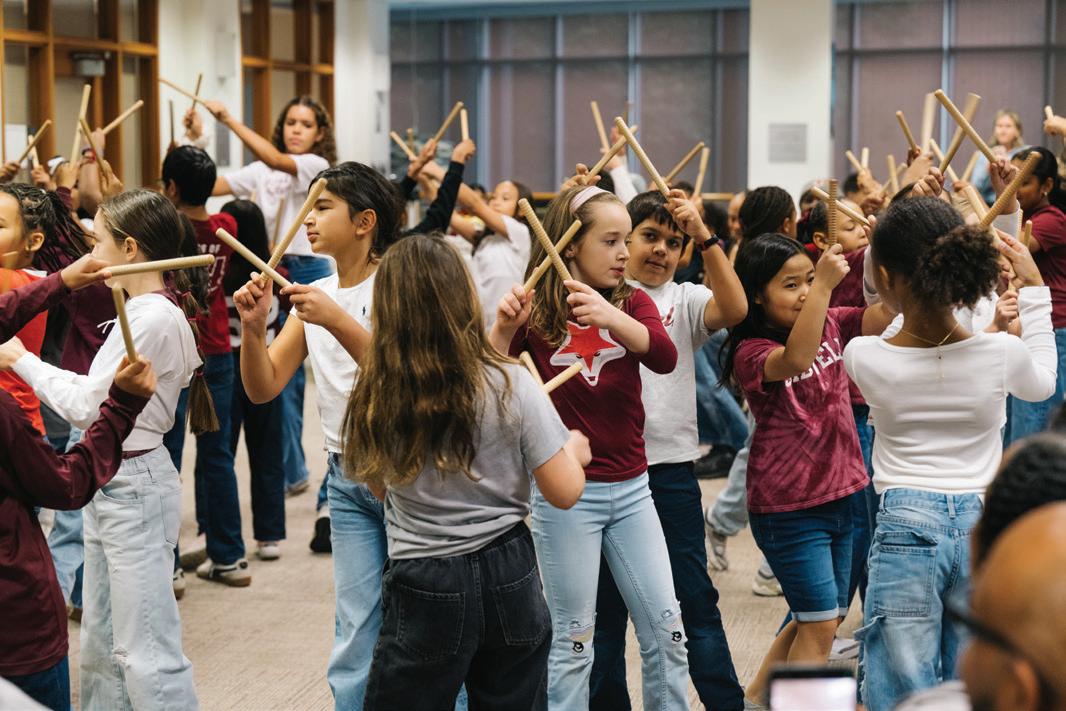
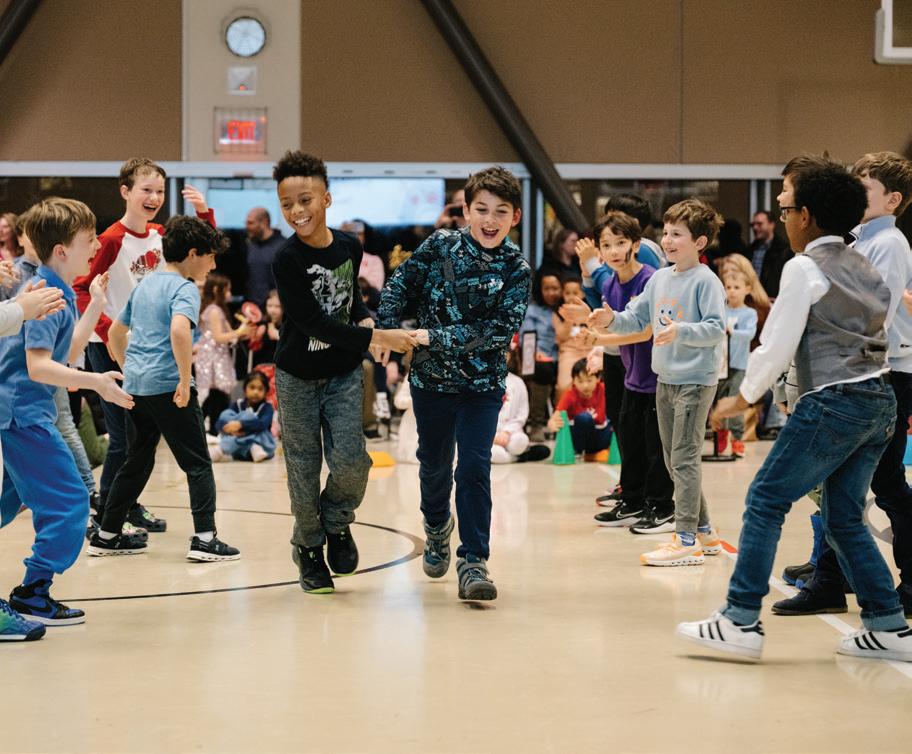
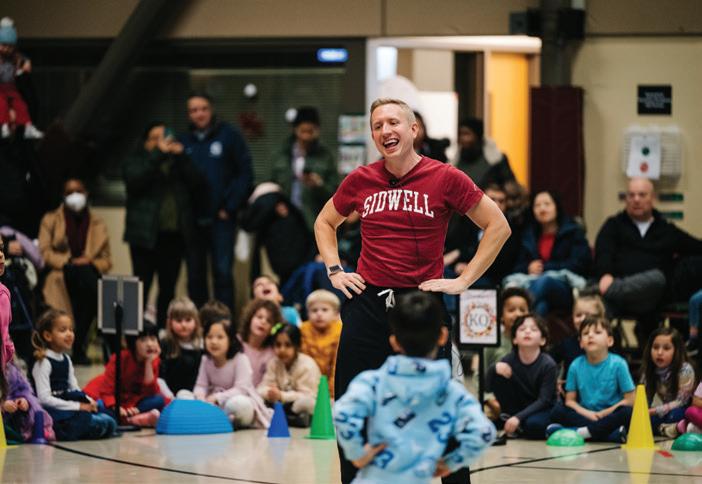
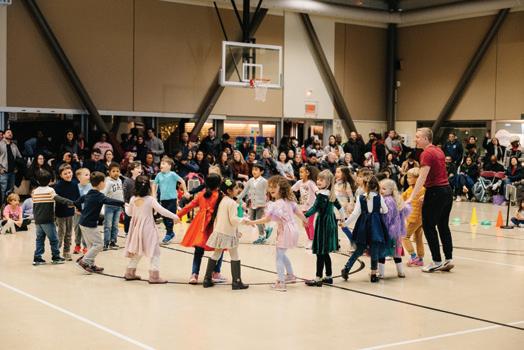
All together on the dance floor, the Lower School’s annual Folk Dance Night showcased the talents of the School’s youngest students.
in age and thousands of miles apart. “The seniors and I played a lot of board and memory games and shared stories about our lives,” she said. “I loved hearing their tales of growing up in Spain and they had so many questions about my life in the United States. They were so curious!”
For their part, the seniors in Spain were thrilled to receive letters from the “young Americans” and wanted to write back immediately. And Pickens seems as enlivened as the kids about the project. She says that letter writing is a great way for her students to practice writing their Spanish because their interests, passions, and questions create opportunities to use new vocabulary words and sentence structures. The transatlantic connections they make will only be an added bonus to the joy the letters are sure to bring the recipients.
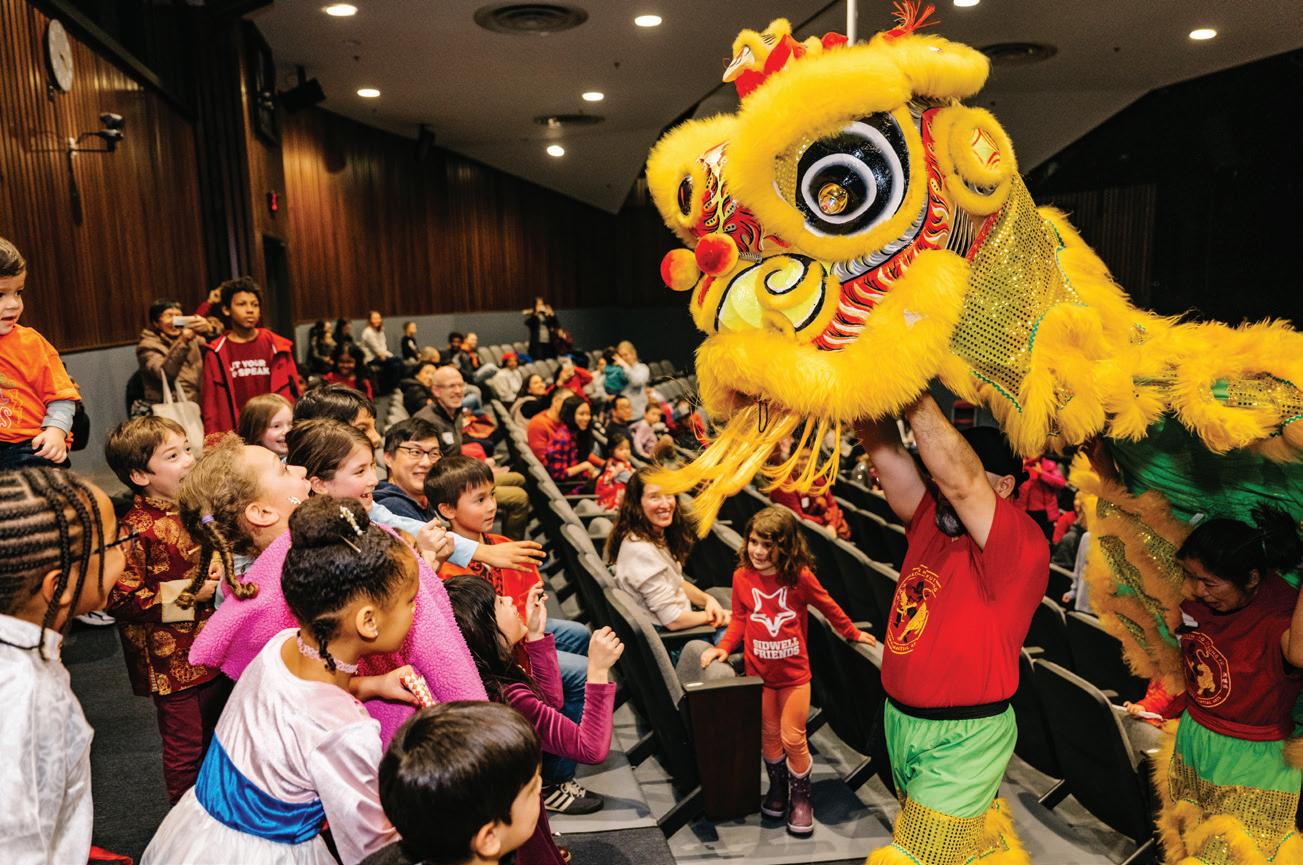
In February, the School community gathered to celebrate Lunar New Year with a lion dance, crafts, games, and food. Earlier that month, the Chinese Studies Program welcomed friends from Fudan Fuzhong, Sidwell’s sister school in Shanghai! The Fudan Fuzhong students jumped into Sidwell Friends life for a day by shadowing Upper Schoolers and joining different classes and workshops.
As part of their study of Sidwell Friends’ history, 3rd graders depict the School’s past, present, and future.
Each year, Sidwell Friends 3rd graders devote some classroom time to the study of the School’s history. For many, just the idea of a 140-year-old school can be hard to grasp. But with the help of their teachers, they persist and before long, it begins to make sense. “When you are 8 and 9 years old, any topic can be fodder for exploration,” says 3rd grade teacher Lauren Thomas. “The history of their own school is a subject near and dear to their hearts. They come to see that their experiences here at Sidwell can become part of the historical record, too; they are living history and history in the making.”
In their studies, the students learn to understand that every story has a perspective. They learn to gather facts and are introduced to the difference between primary and secondary sources. Next, with the help of Loren Ito Hardenbergh P ’29, the School’s archivist, the students pore over timelines, photographs, maps, and alumni interviews to understand how the School has changed over time. “Thanks to Lori Hardenbergh’s wonderful stewardship, the students visit the archives to learn how historians preserve artifacts for future generations and hear about the process by which she selects items and considers their historical value,” says Thomas. “For example, the students relish turning the key to the lock that was once installed on the Zartman House door, the very building in which they stand.”
Working together, the class creates a timeline of milestones in the School’s history, which they use as a reference to place each new fact, tradition, or event in historical context. They particularly enjoy interviewing alumni parents who share their oral histories. This year, two parents of 3rd graders, Conrad Caplin and Ali Mohamadi, came armed with photos, a letter jacket, and entertaining stories. A surprise appearance by PE teacher Jeff Gold produced big cheers as the 3rd graders heard his recounting of how the School has changed across his years as a coach and teacher.
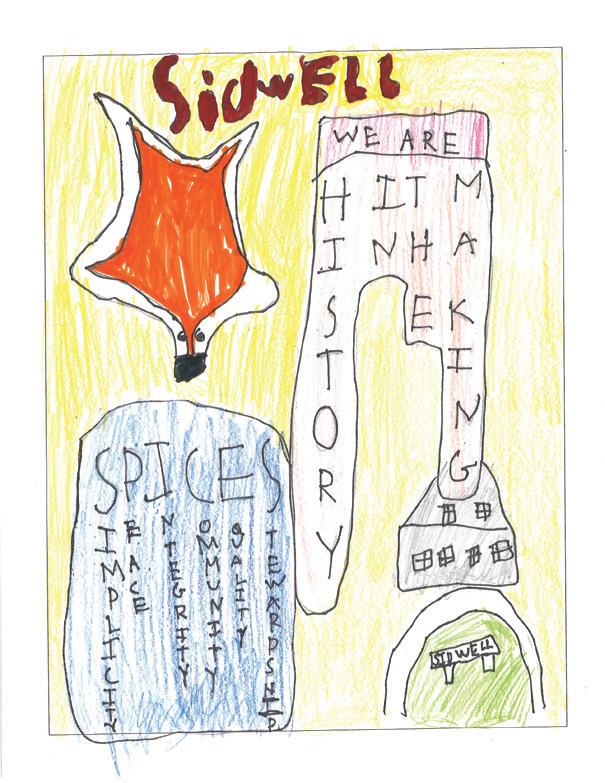
Each year, the students wrap up their unit with a class project. This year, students designed handmade tote bags. To help with the designs, teachers asked students to think about what Sidwell Friends means to them and how they think about the School’s history as it continues to evolve. Their designs—images of a fox, Zartman House, a Quaker hat, the Quaker SPICES, and more—were printed on transfer paper and ironed onto the canvas bags.
“Every Day, It
Holocaust survivor Irene Butter shares her story with the Middle School.
It took 40 years for her to break her silence. In the early 1980s, Irene Butter—who by then was in her 50s—decided she must start to share her story since 6 million others could not. Butter is a German-American public health scholar and a Holocaust survivor. She is professor emeritus of public health at the University of Michigan. A German Jew, she survived the Westerbork and Bergen-Belsen camps in her youth. Since deciding it was her duty to share her story, Butter has inspired thousands over the past several decades through her presentations, lectures, film, books, and peace work.
Butter came to Sidwell Friends to share her story with the Middle School. A tiny woman of 95 years, Butter shared the joys of her childhood in Berlin, her family’s move away from the growing Nazi oppression to the Netherlands in 1937—where they were neighbors with Anne Frank and her family—and then her traumatic experiences at the Westerbork and Bergen-Belsen camps. “Like all the Jews in Amsterdam who had come in hopes of escaping Nazi control in Germany, our lives started to shrink,” she explained. “One day we were mandated to wear yellow stars at all times, another day my bike was confiscated. Then we were told we could only go to the grocery after 3 p.m., when of course there was barely anything left to purchase.” Jews had to hand over their businesses, homes, and human rights.
A Swedish connection tried to secure Ecuadorian passports for the family to allow them safe passage, but the passports did not arrive before the family was rounded up in June 1943 and sent to Westerbork transit camp, a stopover for Dutch Jews before being sent to concentration or extermination camps. Butter explained that while Westerbork was not a death camp, it was terrifying, especially every Monday night when the names of those being transported would be read aloud.
The family managed to stay in Westerbork longer than most, but eventually in February 1944, they were put on a train to Bergen-Belsen concentration camp, where they were greeted by snarling dogs and violent guards. There were daily beatings, lack of food, overcrowding, and rampant diseases. “Every day, it was difficult to stay alive,” Butter said. “Like most of the others at the camp, my family got terribly sick.”
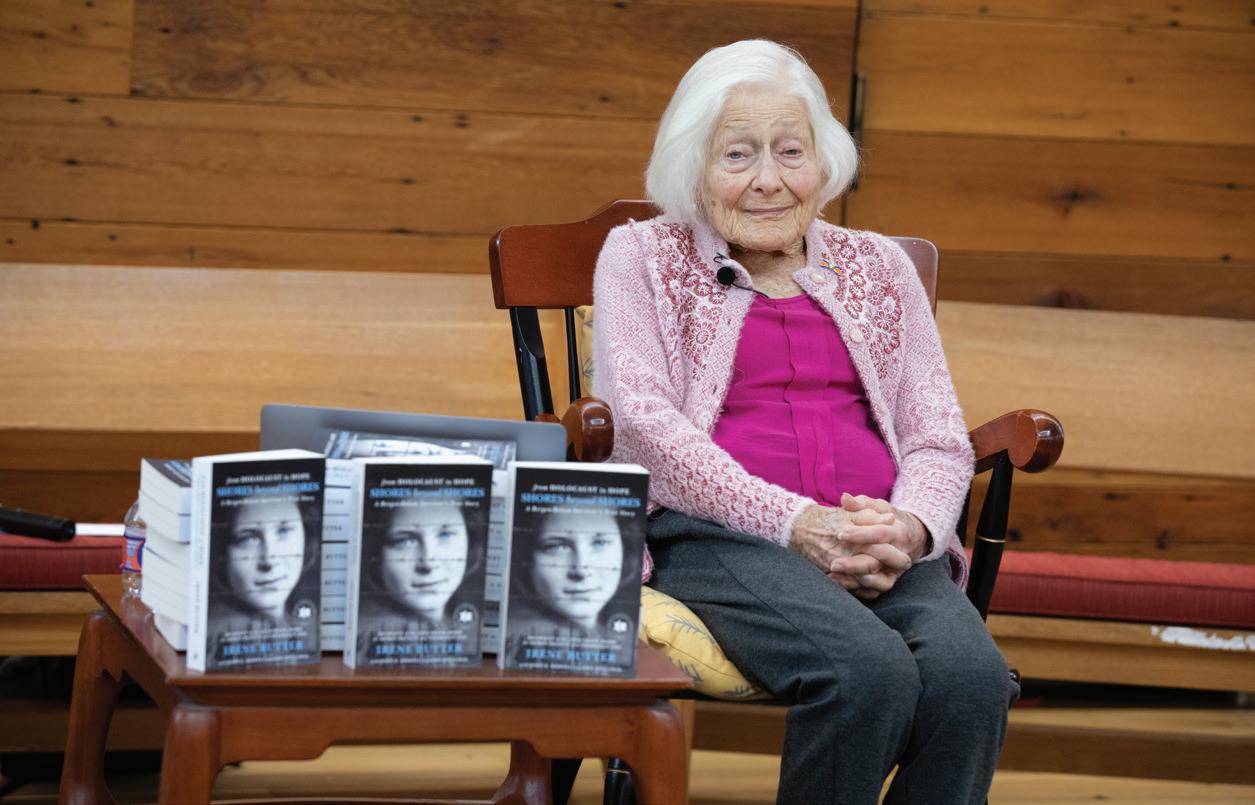
By a stroke of good luck, however, the Ecuadorian passports they had sought earlier were finally granted, which gave the family a different status. Though the Nazi regime knew the passports were not valid, they needed prisoners to trade for German prisoners held by the Allies. In January 1945, the family of four was taken via Red Cross train to Switzerland for a prisoner exchange. They were free but at a cost. Butter’s father died the second night on the train and when they arrived in Switzerland, her mother and brother were rushed to the hospital for their illnesses. Butter was sent to a refugee camp in Northern Africa.
Finally, after a long and lonely 18-month separation, Butter and her mother and brother were reunited in the United States. During those years after the war, when she kept her story locked inside, Butter married, went on to become one of the first women to earn a PhD in economics from Duke University, and had children. Then, as she started to share her story more widely, she began visiting schools and was moved by how much the audiences, especially students, appreciated her story. She pursued peace work, co-founding the University of Michigan Wallenberg lectures and Zeitouna, an Arab-Jewish women’s dialog group. And always, she emphasized the importance of standing up for those in need.
After her talk, students asked more about her childhood, her peace work, and life during the Nazi occupation. Many lined up afterward, several thanking her profusely for coming and saying, “I’m so sorry that happened to you.”

The swimming and diving program had a remarkable season with record-setting performances throughout the year. The girls’ team finished in second place in the DC State Athletic Association (DCSAA) Championship meet with multiple School records set throughout the meet, most notably in the 200-yard medley relay.
The boys’ and girls’ teams achieved a combined team score that yielded a second place overall finish. Patrick Jiminez ’26 and Trevor Donley ’27 were named the MVPs of the boys’ meet. Jiminez won the 200-yard individual medley and the 100yard butterfly races, while Donley captured the 200-yard freestyle and the 500-yard freestyle races.
Beau Amprey ’28 repeated as the DCSAA boys’ diving champion. This caps off a strong winter season that included a second place finish at the Washington Metropolitan Prep School Swimming and Diving League diving event as well.
Wrestling battled throughout the season to make great strides as a program. Dylan Verma ’26 and Griffin Miller ’27 emerged as MidAtlantic Athletic Conference (MAC) Champions in their weight classes, while Leo Jackson ’28 was tabbed as an All-MAC selection.
In the DCSAA Championship, Miller placed second in his 190-pound weight class. Jackson placed third at 175 pounds, while Hujja Moshood ’28 placed second in the heavyweight division.
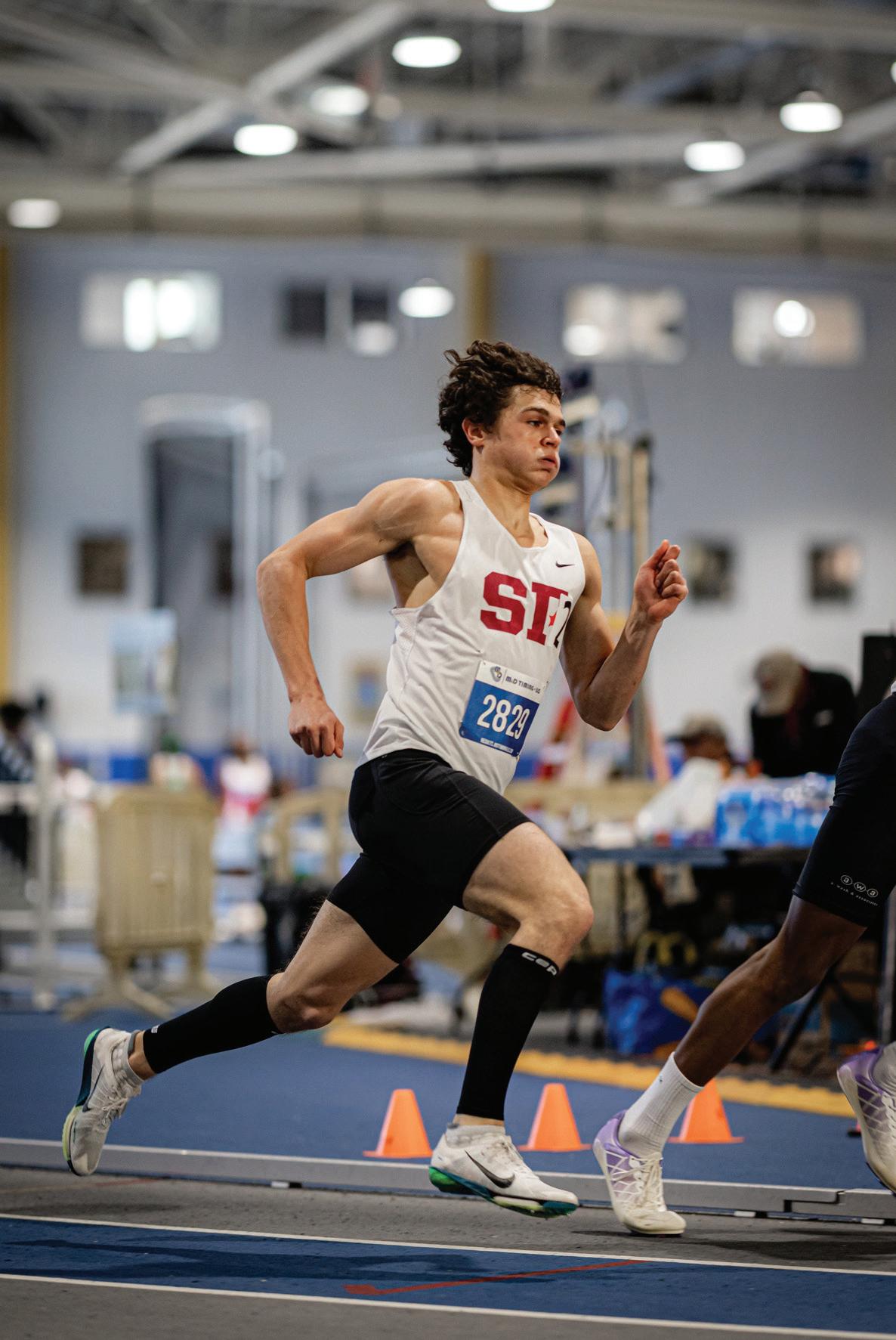
School records continued to pile up for the Quakers this winter as the program continues its stretch of success on the track. Osewe Ogada ’26 set a new School record in the 300-meter race with a time of 37.71 seconds at the Maroon and Black invite. Ogada would then go on to break that record at the DCSAA competition with a time of 36.83 seconds.
Avery Foxworth ’29 placed third overall at the DCSAA competition in the 300-meter dash. Her finish of 40.20 seconds set a new School record, besting her personal record by 2 seconds.
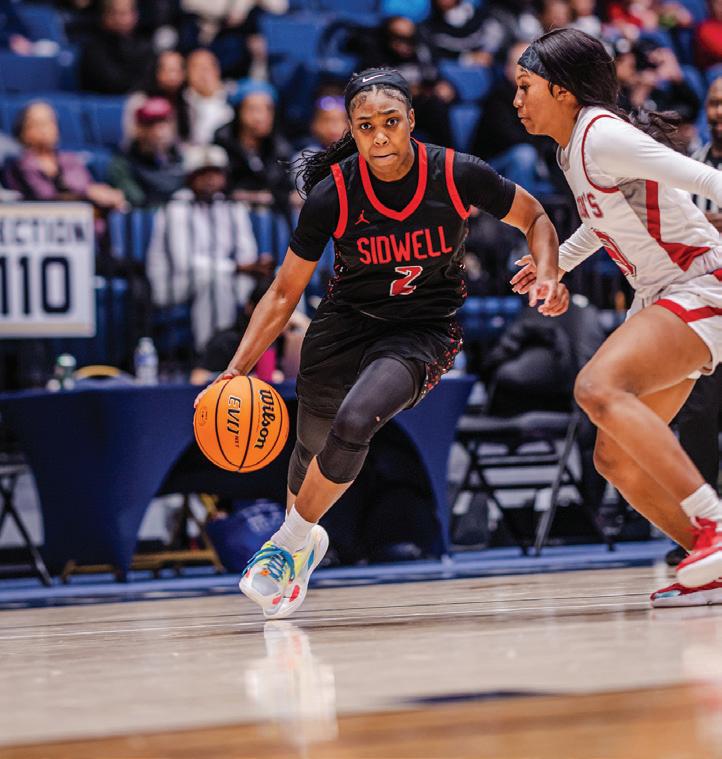

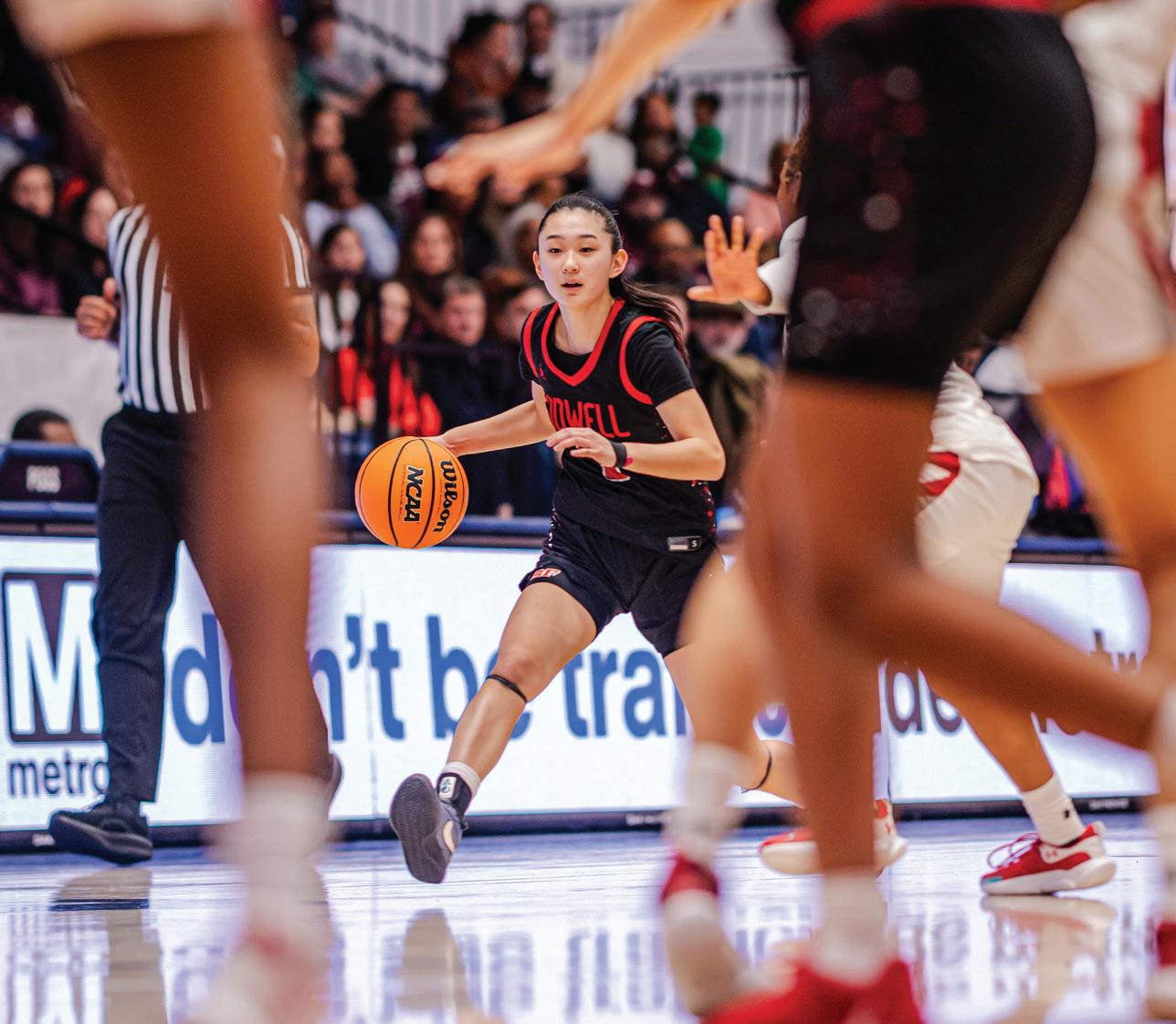
Girls’ basketball continued its dominance in the Independent School League (ISL) this season. They took down Bullis in the ISL Tournament Championship to capture the banner for the third consecutive year. Their season culminated with a runner-up finish in the DCSAA Tournament, dropping the championship game against St. John’s 61–57.
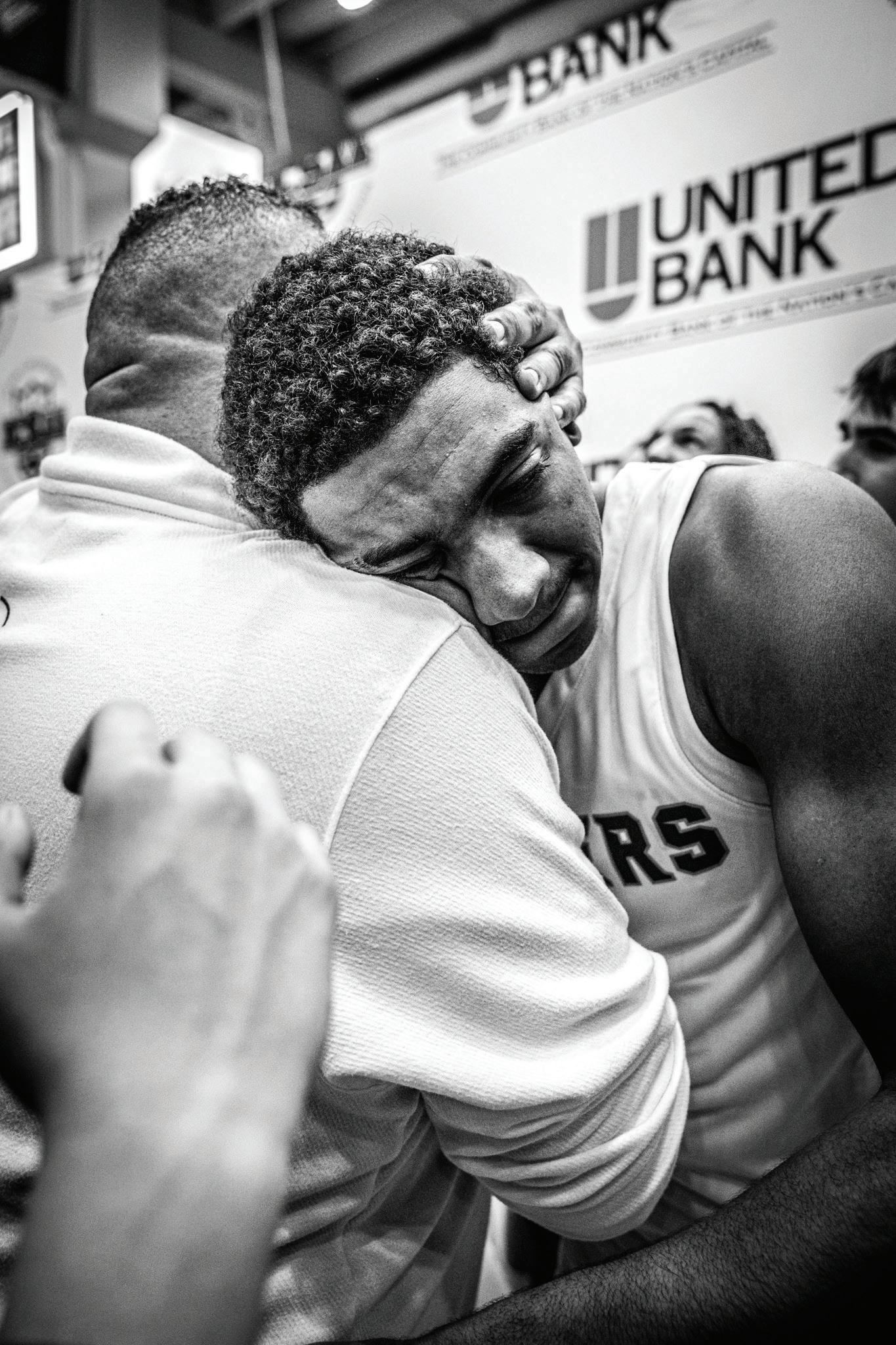
Autumn Fleary ’26 will play for Team East in the 2026 McDonald’s All-American Game. As one of only 24 players in the country to make the team, Fleary is the fifth Sidwell Friends student in the last five years to be picked for the exhibition. (For more, see “Sidwell Senior Makes All-American Roster,” page 9.)
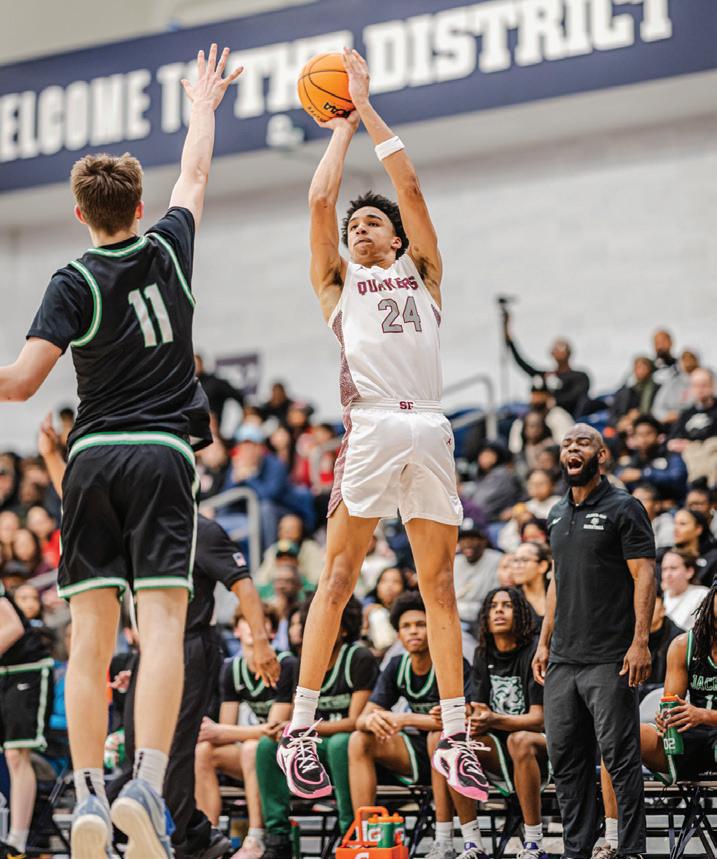
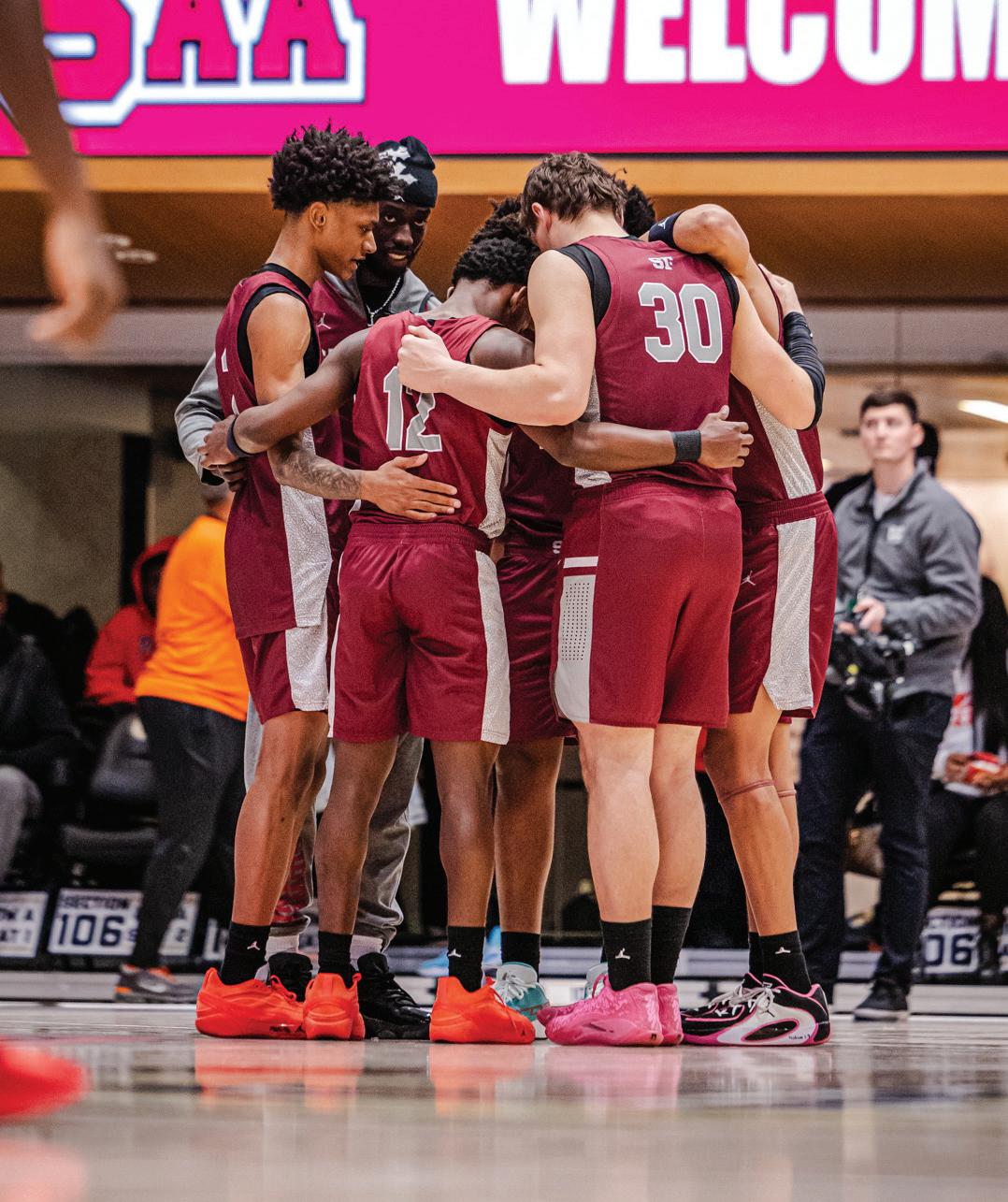
Sidwell Friends boys’ basketball cemented its status as MAC Champions for the fifth consecutive season. The team took the regular season crown and went on to defeat St. Andrew’s in the MAC Tournament Championship game 64–49.
The Quakers went on another memorable run in the DCSAA Championship. With a half-court buzzer-beater by Caden Williams ’27 to overcome Jackson Reed in the semifinals, the program finished as runner-ups to St. John’s. Jalyn Collingwood ’26, Ian Condon ’27, and Jadah Washington ’28 were selected as All-MAC members.
You can find more sports news at sidwell.edu/athletics and on X and Instagram by following @SFSQuakers.

BY LOREN ITO HARDENBERGH P ’29
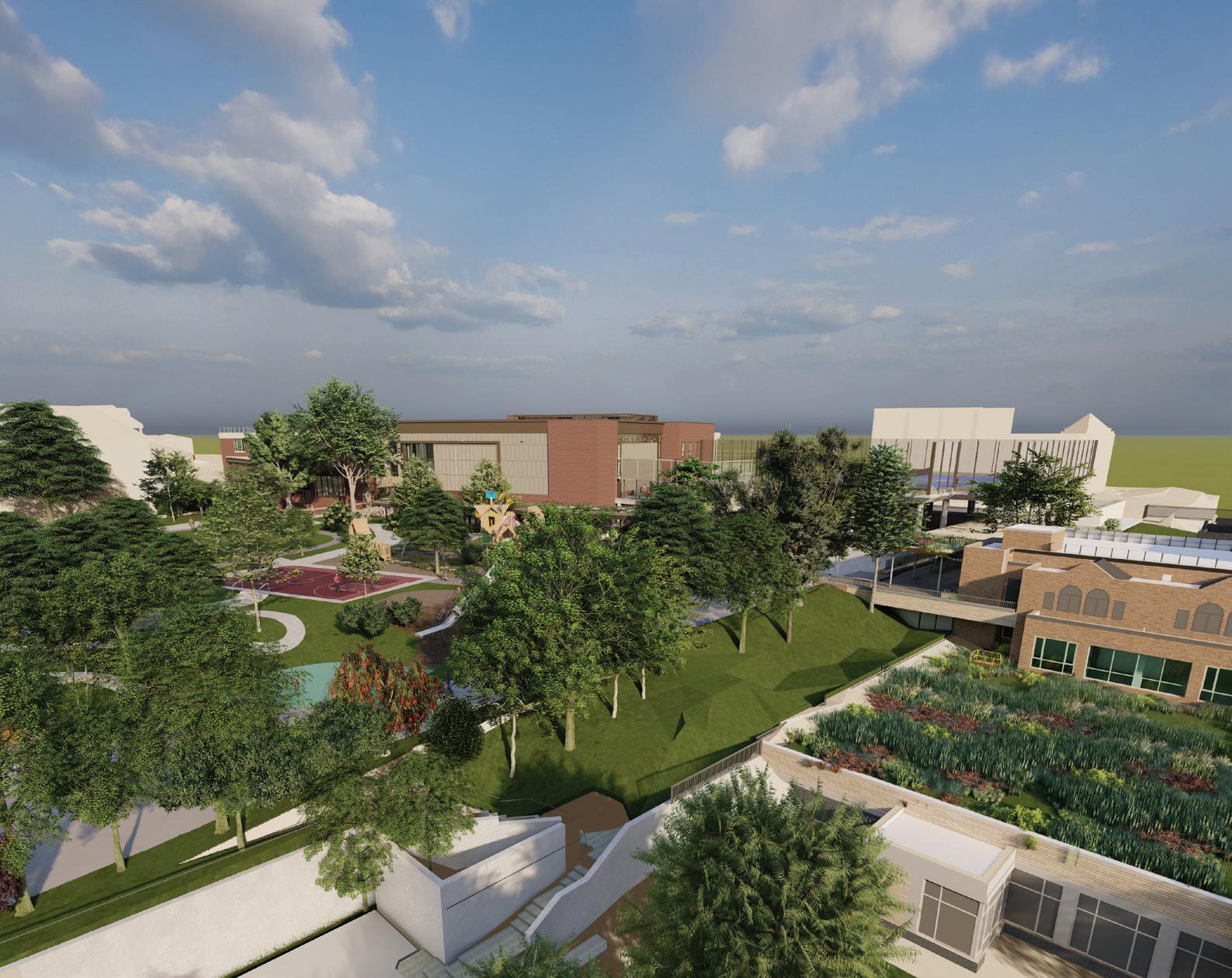
This summer, as the DC campus transformation continues, the Wannan Gym will be razed to make room for a central outdoor gathering and activity space for students from all three divisions. The father-son duo for whom the gym is named embodied the spirit of this evolving space. In their combined 70 years of service, Pop and Charlie Wannan ’37 coached and taught more than 2,000 students across the Lower, Middle, and Upper Schools, always encouraging play and sports as ways of building community.

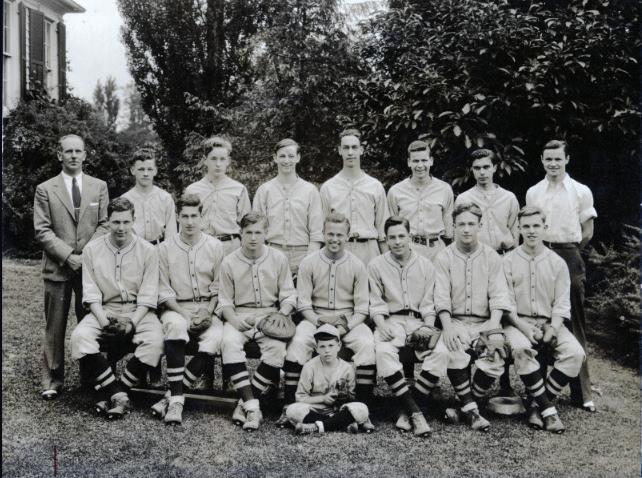
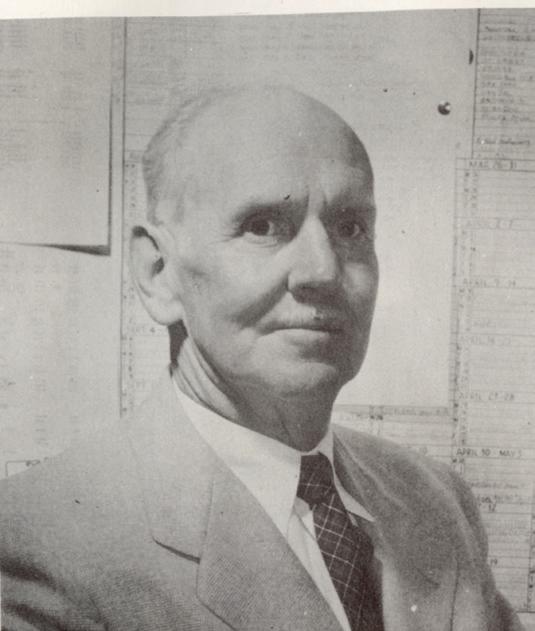
In 1923, Thomas Sidwell hired a man with a pencil-thin mustache and a love of sports. Charles Wannan soon became known as “Pop” Wannan, serving as a father figure to many students young and old. The range of sports he coached ran the gamut: basketball, baseball, football, tennis, soccer, and wrestling. One of the founders of the Interscholastic Athletic Conference, he was dedicated to providing structure and support for the athletics program during the 37 years he served the School as coach and boys’ athletic
director. By 1930, he was already an institution, earning a Quarterly yearbook dedication that year, and again in 1951. When Thomas Sidwell died six years later, Wannan was asked to speak at his memorial service.
While he loved competition, Pop’s goal was always to encourage participation above all else. If 26 students showed up to play soccer, then the game became 13 vs. 13 rather than the standard 11 vs. 11. If that meant that players got fewer touches, then he would throw a dozen balls on the field, yelling, “Everybody, go, go, go!” He was compassionate and cared for all his students, athletically talented or not. “Nobody ever came in last in a race,” remembered one alum. “He was obviously ‘saving his energy’ for the next event.”

1. Pop Wannan with the baseball team in 1933.
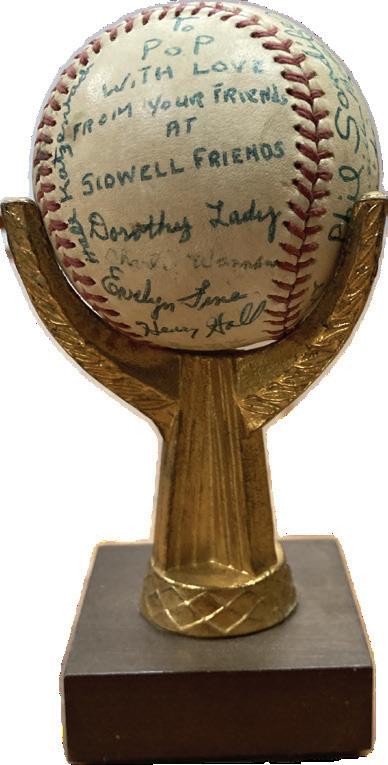
2. When Pop retired in 1960, his colleagues presented him with a signed baseball.
Donated to the archives by Charles Wannan III ’74.
3. Pop Wannan was so beloved by students, they dedicated the yearbook to him in 1930 and again in 1951. The Class of 1951 included this photo accompanied by a dedication: “A leader among men, In dignity he stands, A fair, impartial judge Of all that he commands.”
4. Charles Wannan’s nickname, “Pop,” was so indelible that it was embroidered on his wellworn coaching jacket.
Donated to the archives by Charles Wannan III ’74.
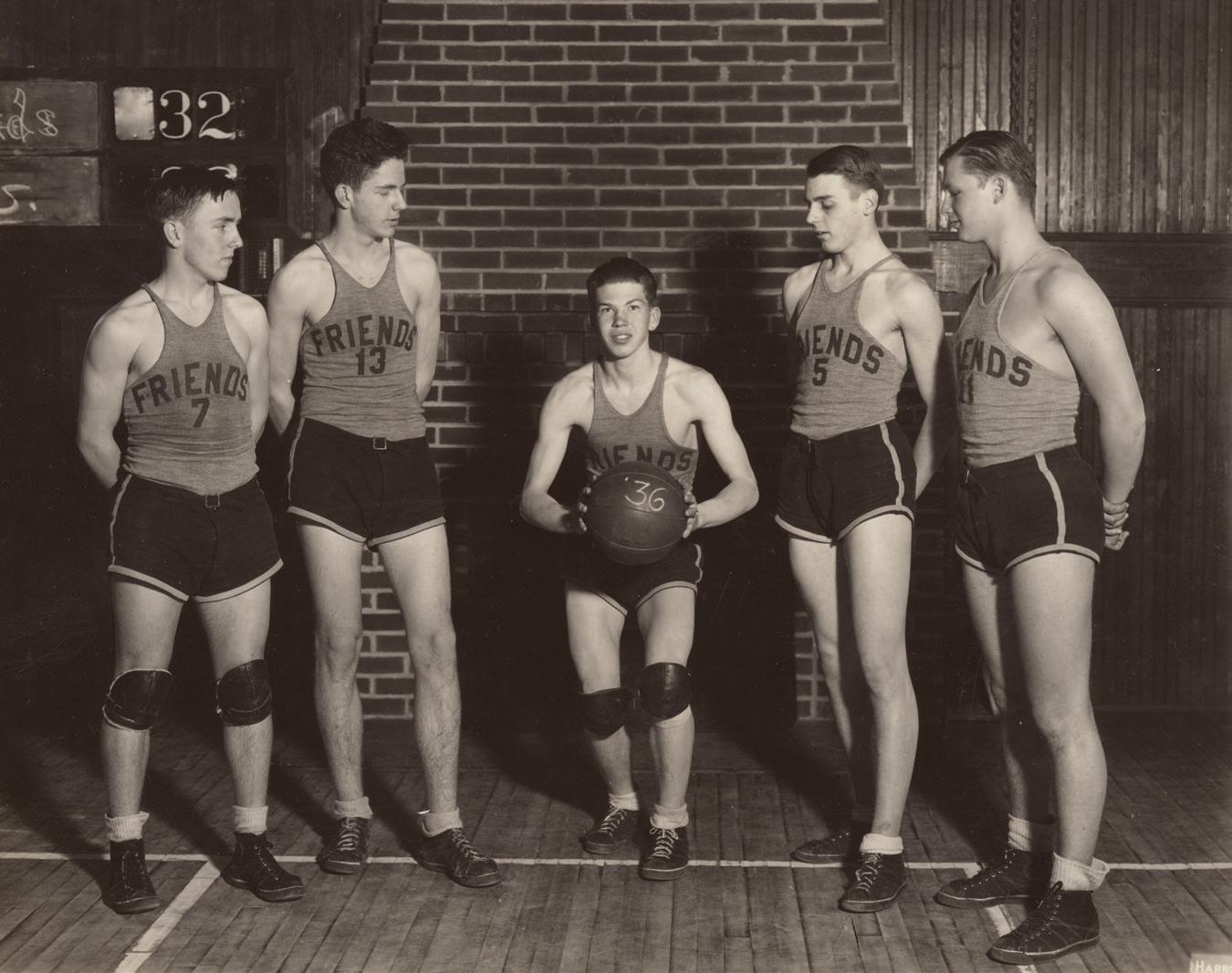
In addition to being a father figure for many, Pop was also an actual father to three Sidwell Friends students: Charlie ’37, Cliff ’39, and Jeanne ’44. It was Pop’s namesake who followed in his father’s footsteps to become a coach and athletic director at Sidwell Friends. As a student, Charlie played football, basketball, and baseball, serving as team captain and president of the Boys Athletic Association.

Wisconsin Avenue campus, 1936.
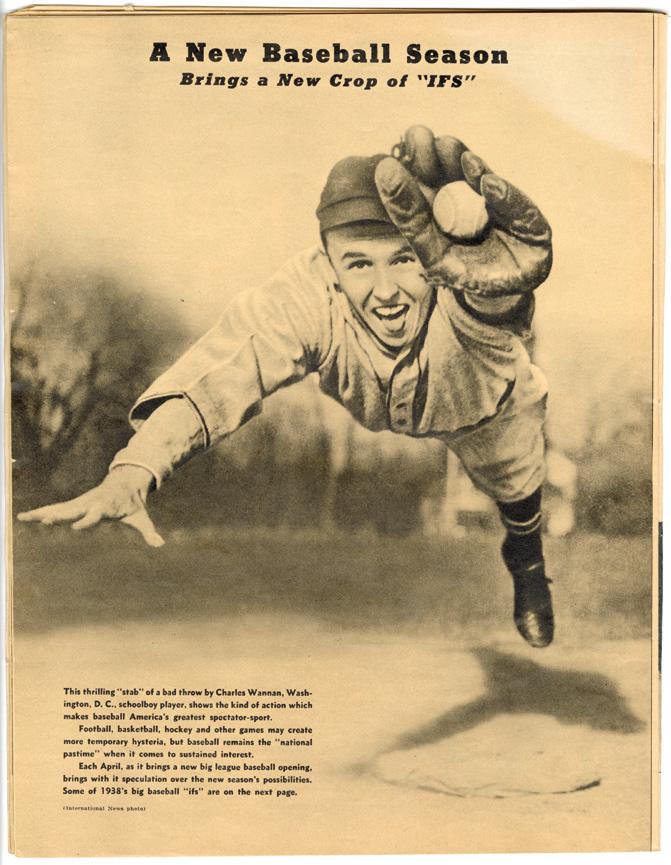
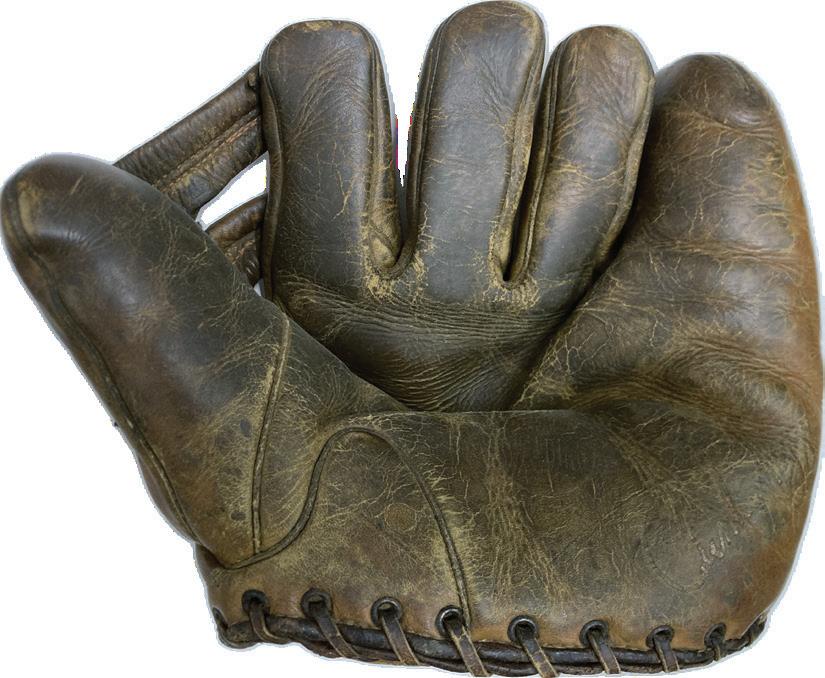
6. A photo of Charlie diving for a baseball was captured for a 1938 article in Look magazine.
7. The glove from the Look photo.
8. Charlie Wannan ‘37
After graduating from Sidwell Friends, Charlie joined the U.S. Navy during World War II and was wounded in the invasion of Normandy, receiving a Purple Heart before retiring from the service. Charlie was then hired to teach Lower School physical education as well as 5th and 6th grade science, dissecting chickens and teaching anatomy with “Susie Bones,” the resident skeleton. For a while, he was known as “Little Pop,” and the kindergartners could often be found trying to engage Charlie on the playground. He was
appointed athletic director in 1968 and received the Distinguished Alumni Award from his classmates the following year. Perhaps the highest honor he received was having the most famous lunch item in Sidwell Friends history named for him: “Charlie’s Special.”
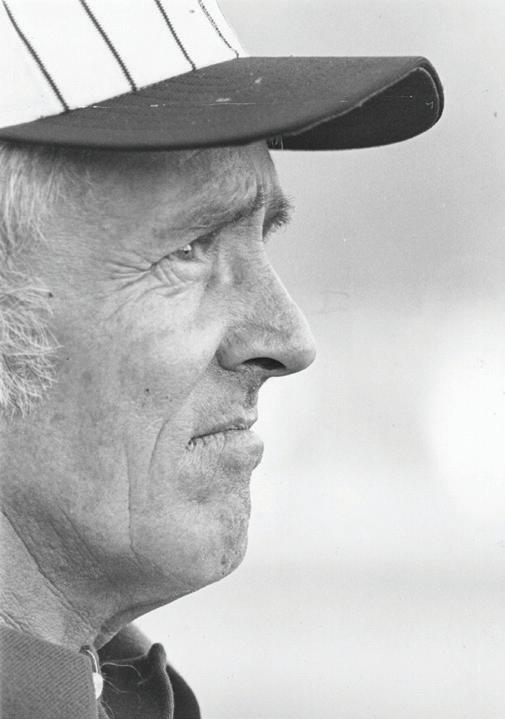
When he died in 1978, less than a year after Pop, a student shared, “Charlie had a unique talent with kids of all ages, kinds, and sizes, teaching them the qualities of friendship, sportsmanship, generosity, and kindness through his warmth of personality.”
Colleagues remembered how he lived out his teamwork ethic—if the baseball field needed cutting, Charlie would get the mower and cut the grass himself.
Together, remembers one alum, “the Wannans were special because they cared about each of us not only as athletes but also as unique individuals to be taught and encouraged and praised. They understood that many of the most important lessons of life can be learned on a playing field.”
When the Activities Building was constructed in 1958, alumni sought to recognize Pop with the creation of the Wannan Lounge. The centerpiece of that new building was the Kenworthy Gymnasium, a full-size gym with space for bleachers and a stage. Over time, however, the single court could not keep up with the demands of the growing student body. Head of School Earl Harrison remembered coaches coming into his office after tough losses, pointing out that if the team had only had space to practice more often, the outcome might have been different.
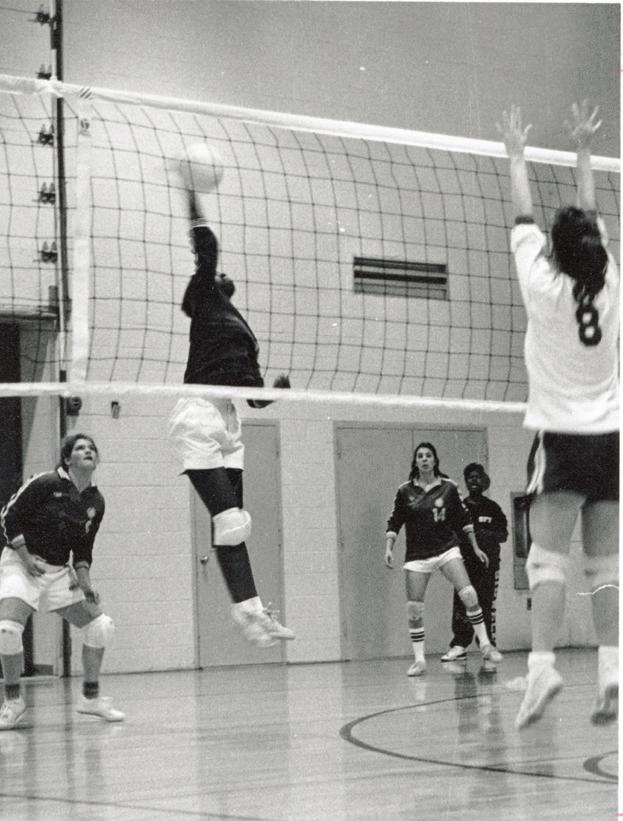
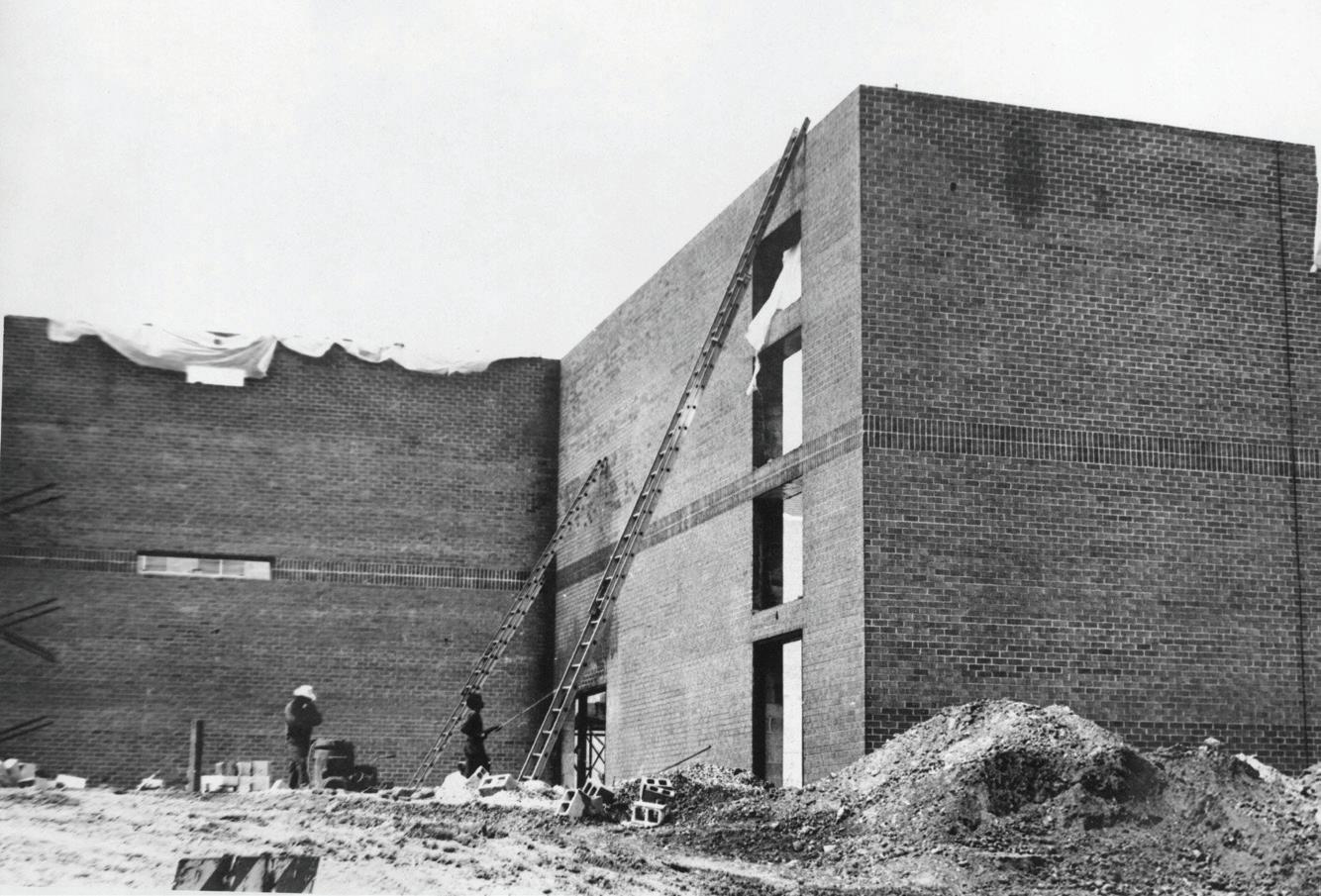
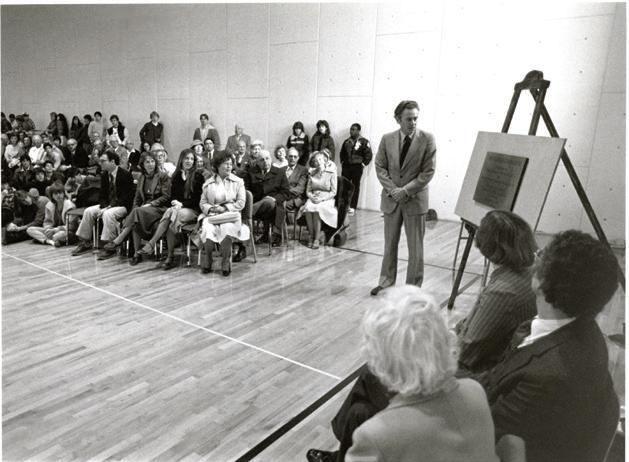
Through the success of the Centennial campaign, in 1982 Sidwell Friends would finally get its auxiliary gym—as well as a new office for the School nurse—with the construction of Wannan Gym. With “the new gym,” as it was first called, the wrestling team finally had a dedicated space, and scheduling challenges with the basketball and volleyball programs were relieved. When Pearson Athletic Center was built in 2010, the presence of two full-sized courts meant that “The Wannan,” as it was later known, would become an auxiliary space, used for rainy-day recess, futsal practice, and aftercare. The old
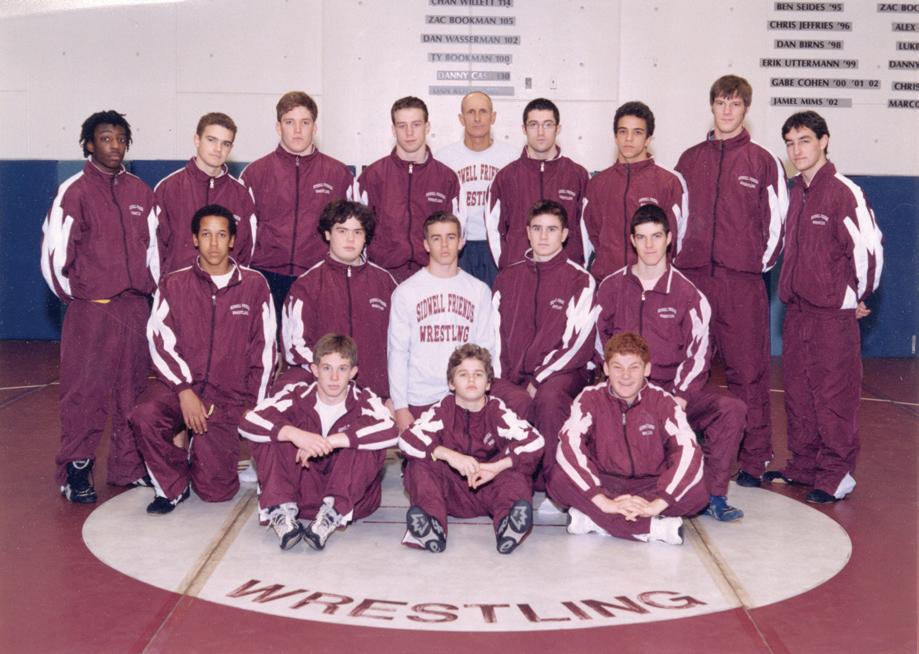
wrestling room was repurposed for batting cages in 2019. Phase Two of the original building plan, which involved building tennis courts on the roof, never came to pass.
The building is scheduled to be razed this June, but it has already escaped destruction once. On a cold morning in 1994, an unoccupied bus warming its engine up the hill from Wannan Gym somehow slipped into reverse and sped down the hill toward the Middle School only to have its trajectory interrupted by a speed bump, which caused the bus to veer and ram into the north wall of the Wannan Gym, leaving a huge hole and brick pieces strewn across the floor. Fortunately, no one was injured. This summer, the demolition crew will pay special attention to the east-facing wall that contains the 1981 cornerstone. Behind it, we believe, is a time capsule, waiting for a future generation of Sidwellians to open and inspect.
As we prepare to say goodbye, we will remember the Wannan Gym as the site for many all-school community events. Hundreds of
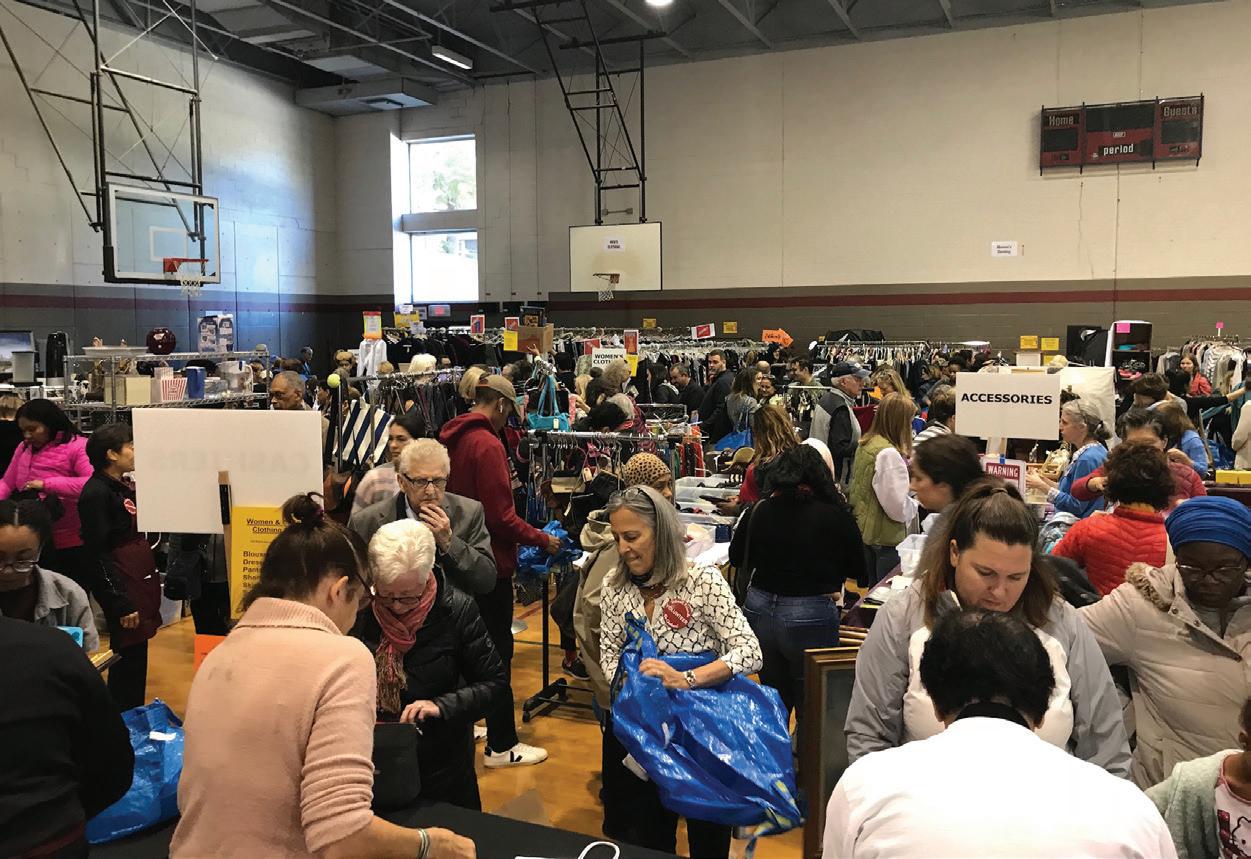
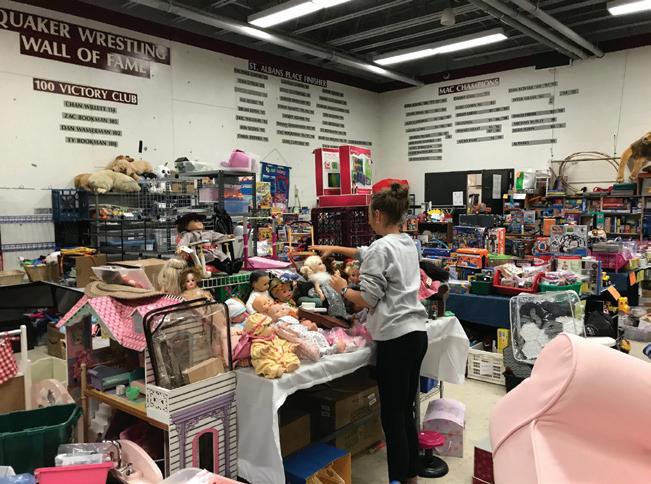
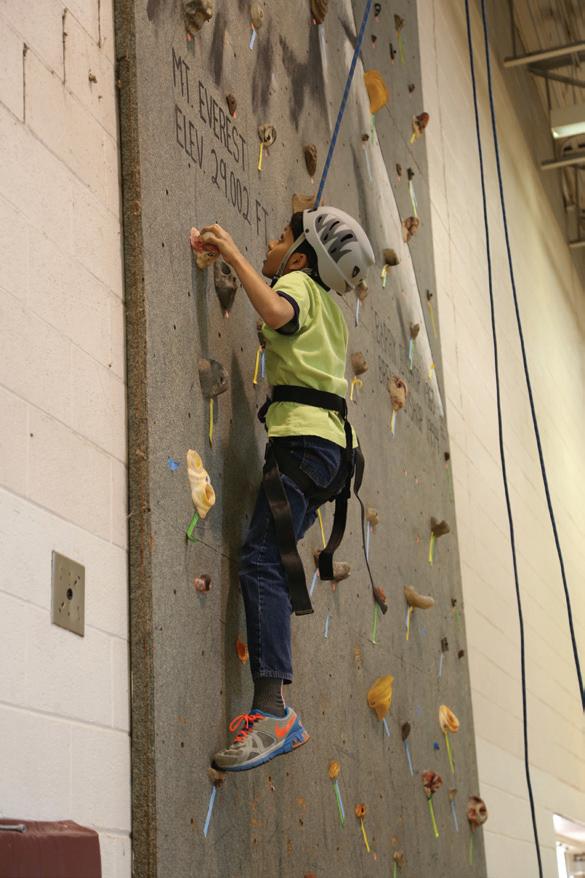
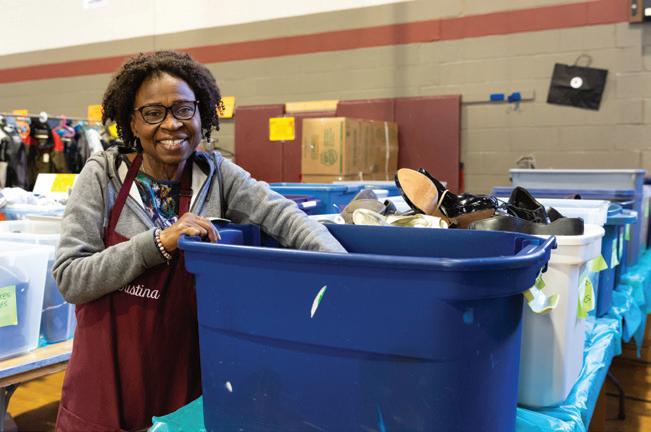
students spent Founder’s Day on the gym’s climbing wall, with Outing Club advisor and legendary biology teacher Melanie Fields carefully belaying from below. Others will remember Wannan Gym as the place where they danced all night to a live band at the Black Student Union’s Go-Go. It was also home to the Next-to-New Sale, the secondhand sale that raised funds for financial aid, while giving community members a great bargain-hunting experience.
In the fall of 2028, more than a century after Thomas Sidwell hired Pop Wannan and half a century after saying our final goodbyes to Pop and Charlie Wannan, Sidwell Friends will welcome the Lower School back to Wisconsin Avenue—to a campus that will be unified
9. Wannan Gym construction in 1981.
10. At the Wannan Gym dedication ceremony in 1983, Earl Harrison presents a plaque honoring the Wannans.
11. The volleyball team was able to practice more regularly once the Wannan Gym was built in 1982.
12. Former biology teacher Melanie Fields held Outing Club practices on the Wannan Gym’s climbing wall.
13. The back area of Wannan Gym served as the wrestling room until the Pearson Athletic Center was completed in 2010.
15. 16. 17. Over the years, teams of volunteers would transform the Wannan Gym into Next-to-New, a secondhand sale to raise money for student financial aid.
as it was during most of the Wannans’ many decades of service. It is fitting that the space where the gym that bore their name once stood will be used in a way that honors everything they stood for—a place for movement, for play, and for connecting as a true preK–12 community.
This summer, we also say goodbye to a structure that has served Sidwell Friends for longer than any other building in the School’s history: the humble Sensner building. The small brick structure has morphed to accommodate a dizzying array of needs in its 86 years. When first built in 1940, the original section was intended to serve as a bus garage, but instead it ended up being used for classes in ceramics, woodworking, and mechanical drawing. In 1955, two science classrooms were added on the west side, and it was dedicated as the Sensner Science Building in honor of the late science and math teacher George Sensner, known by hundreds of alumni as “Uncle George.”
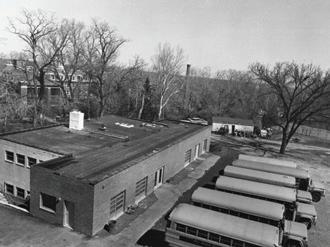
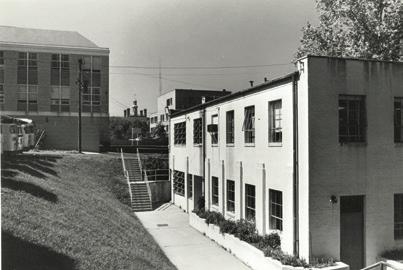
After the Centennial campaign, a brick addition was built along the southern face in 1980, leaving only the upper level visible from the center of campus. Over time, the bottom floor was used for carpentry, paint, and other facility maintenance purposes, while the top floor housed information technology and security. When the current parking garage was erected in 2006, many of these offices moved to the adjacent Campus Services building. Since then, Sensner has been used as a summer camp office, Middle School aftercare, and an engineering classroom.
Two of the most recent experiments in Mr. Sensner’s science building will live on in the new Upton building. In 2008, Associate Head of School
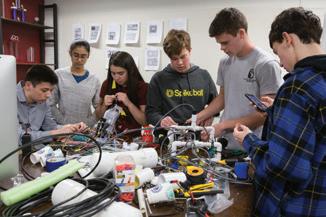
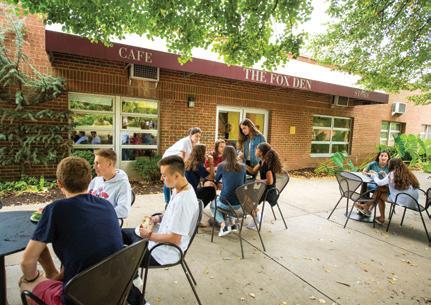
Ellis Turner reimagined what a school store could be, and the Fox Den was born. Three years later, the west end of the basement was transformed into a tworoom lab for the growing robotics program. This fall, when students cross the bridge near where the Sensner building currently stands, the first space they’ll see in the new Upper School is the next generation’s Fox Den. And when they head down to the lower level, they’ll encounter a space Uncle George would have surely appreciated—the School’s first purpose-built robotics labs.
Two novels tackle music and family as well as black-market antiquities; nonfiction books explore surveillance technology and the legacy of the 1960s; a memoir illuminates the Festival of Games; a book of photographs explores infinity; a book of poetry explores time; and a new translation is set in the Spanish Civil War.
Union Square & Co. (2026)
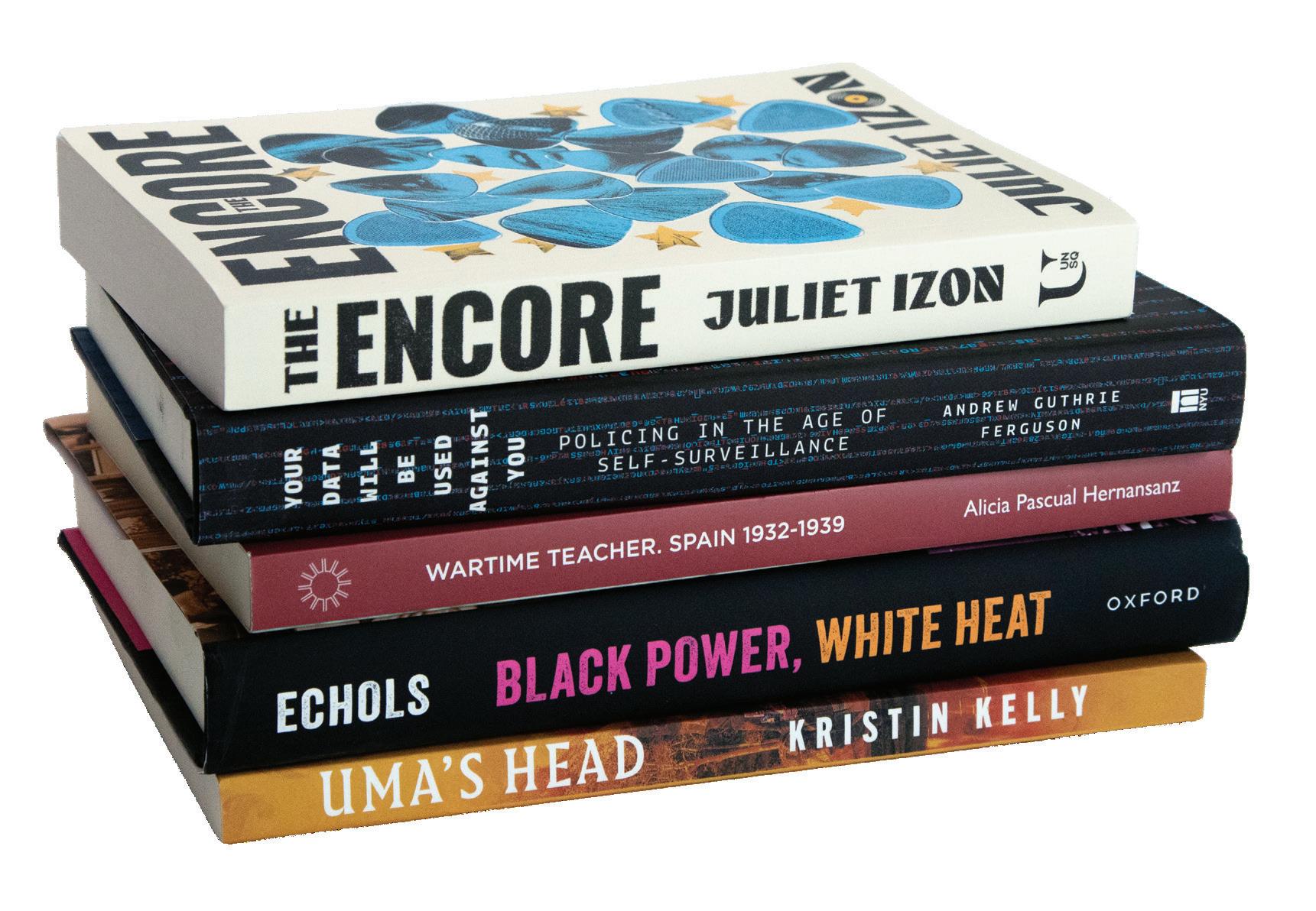
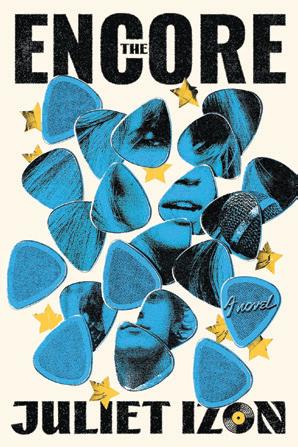
“In 2003, a chance encounter sparks an inimitable friendship between driven pianist and singer Anna Buckley and composer wunderkind Will Pendleton. As they strive toward careers as professional musicians, their bond deepens both from shared skill and the inexplicable sense that they’re kindred souls. But soon after graduation, one night forever alters the trajectories of their lives, destroying their relationship in the process. Twenty years later in New York, 16-year-old piano virtuoso Lottie Thomas is grappling with the confounding disappearance of the woman who gave her up at birth. When Lottie discovers the startling truth of her identity, the revelation catalyzes a chain of events that not only reunites Lottie with her birth parents, but forces them together on a rock tourbus for a careening cross-country journey.”
Andrew Guthrie Ferguson ’90
NYU Press (2026)
“For consumers living in a digitally connected world, smart technologies have built an inescapable trap of digital selfsurveillance. Smart cars, smart homes, smart watches, and smart medical devices track our most private activities and intimate patterns. While these devices allow users to receive personal insights by monitoring their every move, that data can be accessed by police and prosecutors looking to find incriminating clues. Digital technology exposes everyone, everywhere, all at once, and we have few laws to regulate it.”

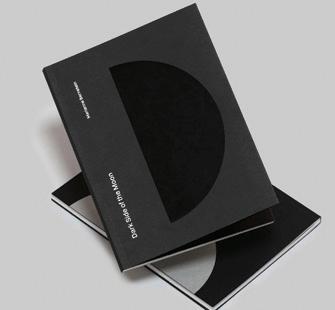
Marianne Bernstein ’74
studio FM milano (2026)
“The Dark Side of the Moon always turns toward what we cannot reach, a perennial companion orbiting half in secrecy. Beyond the thin layer of what we can perceive, there are infinities murmuring. There are frequencies too slow or too swift for our eyes, like the radiant distant noise of stars being born or the quiet shimmer of atoms dreaming in the dark. To live with the unknown, with wonder, is to find peace alongside these unseeable things. Bernstein’s images remind us that the unseen is not absence but abundance—a cosmos still unfolding behind the veil.”
Kristin Kelly ’70
Sticks on Fire Books (2026)
Oxford University Press (2026)

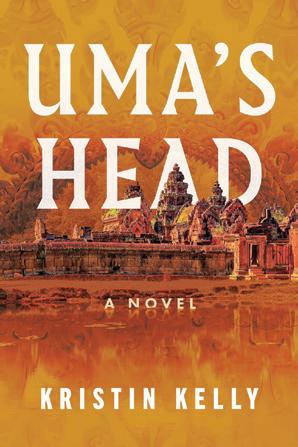
“When art curator Sarah Burroughs glimpses a halfhidden Khmer sculpture in her mentor’s Bangkok apartment, she doesn’t yet realize she’s staring at Uma’s head, a stolen national treasure— and a clue to a dangerous secret. Across the border in Cambodia, fellow curator Sam Heng uncovers a shocking diary written at the start of the Khmer Rouge’s brutal reign—by the father he never knew. Soon after, Heng vanishes without a trace. Thrust into the criminal underworld of antiquities trafficking, Sarah must join forces with a mysterious government official to find her missing colleague.”
Wartime Teacher (Spain, 1932–1939)
Carol Carpenter ’61 provided the English translation of the Spanish novel by Alicia Pascual Hernánsanz, which is based on Carpenter’s own mother-in-law.
Ediciones Doce Calles (2025)
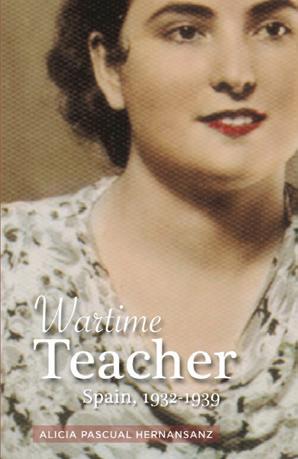
“A historical novel based on the true story of María, a young teacher in Aranjuez, as she navigates the Spanish Civil War, professional persecution, forbidden love, and eventual exile to Mexico.”
“One of the most divisive issues in recent progressive politics has been what role, if any, allies might legitimately play in other people’s movements. Historian Alice Echols explores what happened some 60 years ago when whites and Blacks came together in the fight against racism. She focuses on two Black-led organizations: the Student Nonviolent Coordinating Committee (SNCC) and the Black Panther Party. In SNCC, whites were, in part, meant to generate a ‘white heat’ so searing it would accelerate change. Results were mixed, and white activists formed new movements, from women’s liberation to draft resistance.”
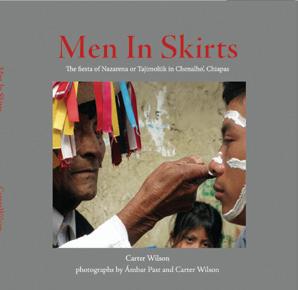
Carter Wilson ’59
Star Print (2025)
“Wilson evokes the sights, sounds, and flavors of the Festival of Games, an annual fiesta celebrated by Maya villagers in the highlands of Chiapas. Based on repeated visits and friendships with the villagers, Wilson describes the days-long revelry in which men dressed as a cross between monkeys and French soldiers or evil spirits called the Blackmen, and men wearing skirts to portray the Jungle Mother, the Abductress, and the Guatemalan Woman make appearances, and a procession of the saints is followed by a bawdy sexual burlesque in which genders and sexualities are flipped.”
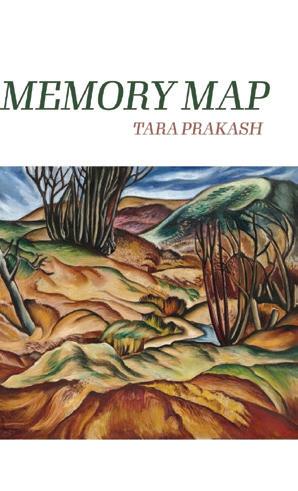
Tara Prakash ’25
Finishing Line Press (2025)
“Memory Map charts a deeply personal geography of family, remembrance, and loss, navigating the fragility of memory and the aging process through traditional and experimental poetry.”



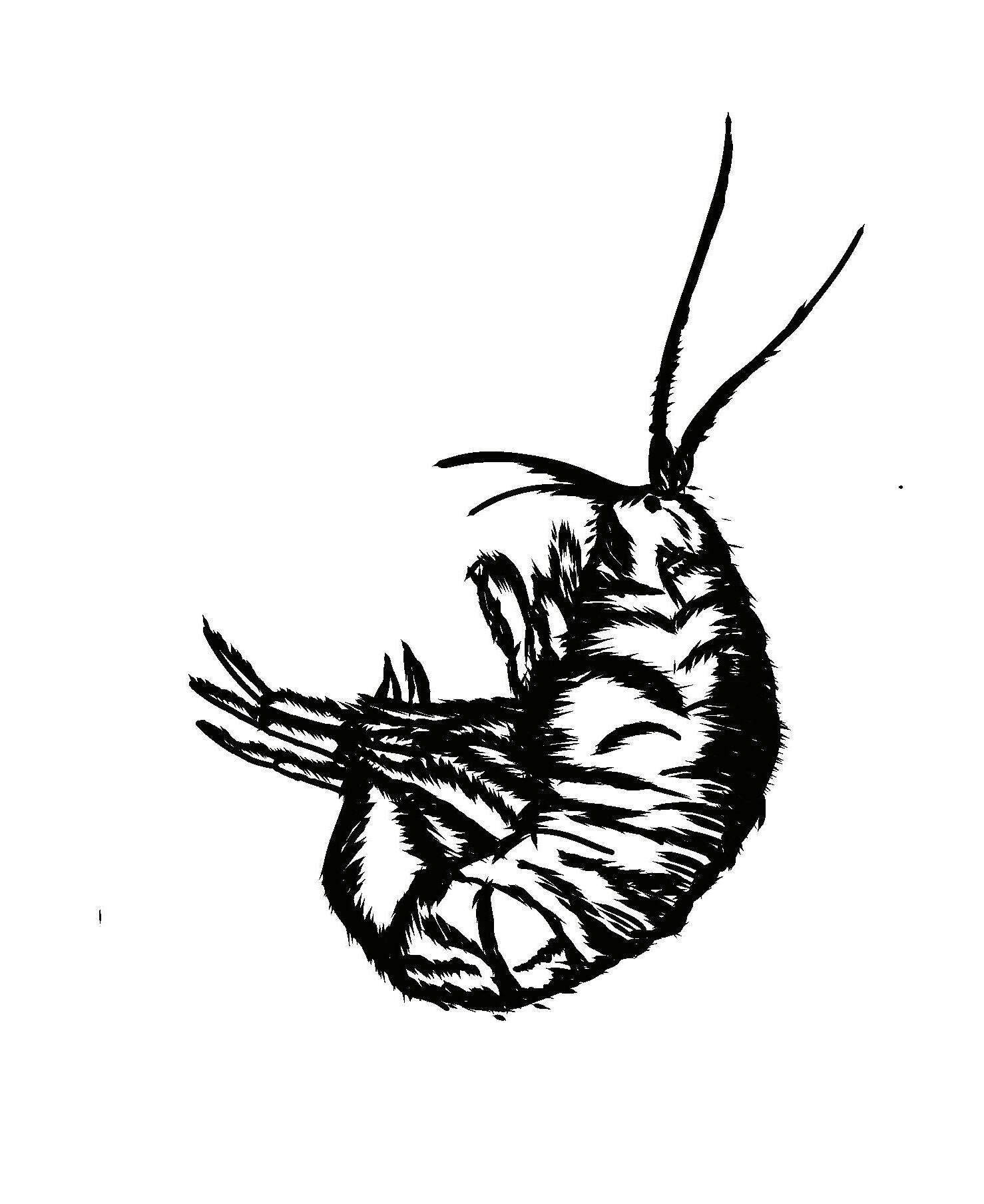






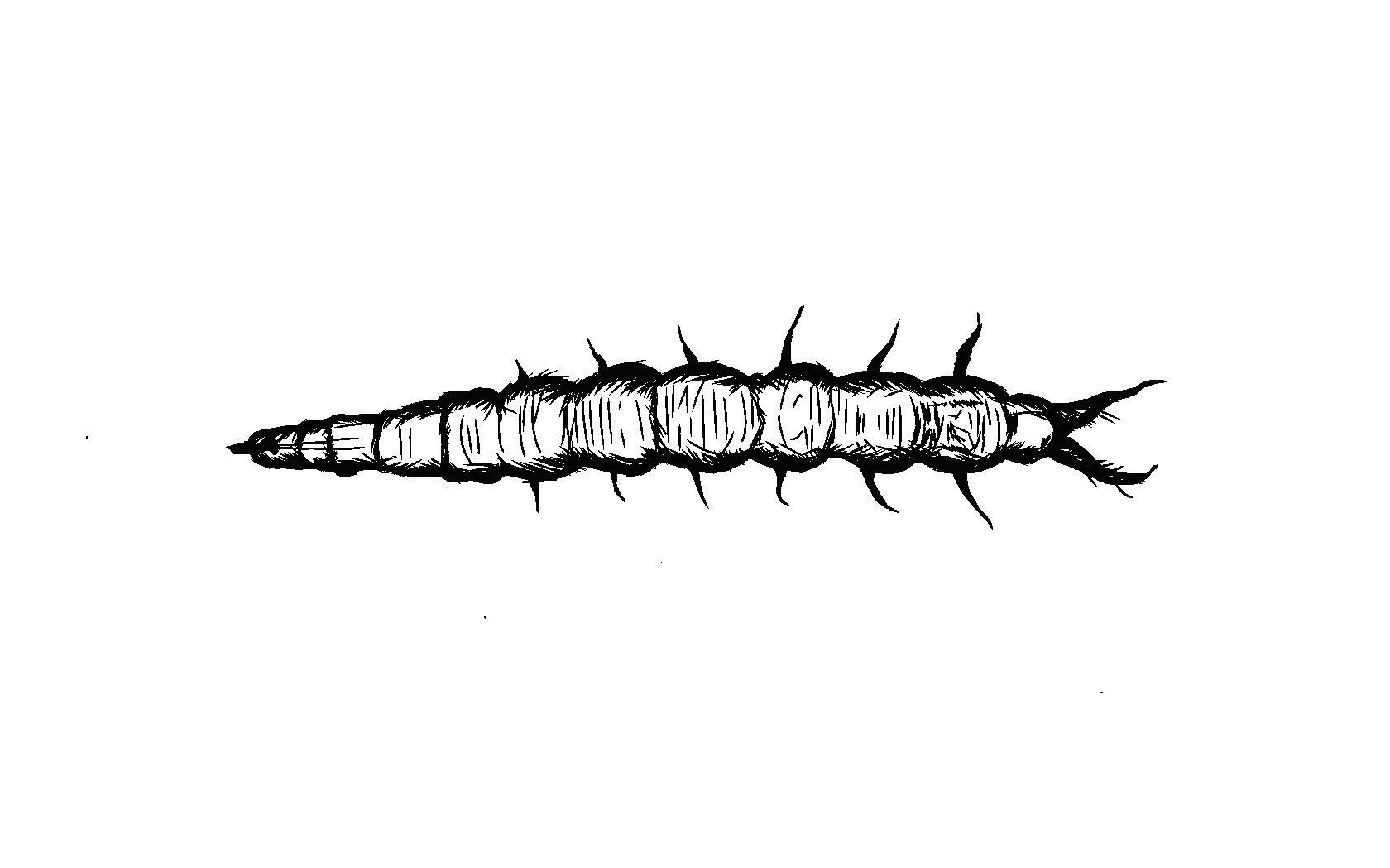
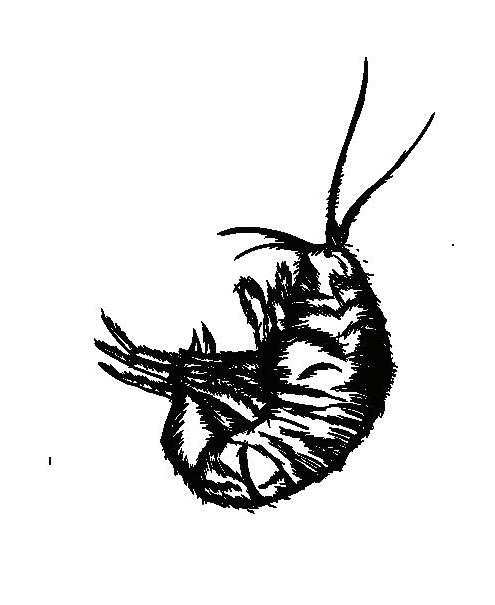
of their life residing on the bottom of streams. And although many of us don’t even know they exist, these tiny organisms can serve as biological indicators to understand the health of the stream.
They’ve been doing it since 1997 as part of Nature Forward’s Community Science Water Quality Monitoring Program, which relies primarily on volunteer groups to collect data three to four times annually, with a focus on aquatic macroinvertebrates at more than 25 stream sites in Washington, DC, and Maryland. Originally

Emily Boyer Fields Faculty Chair in Environmental and Life Sciences

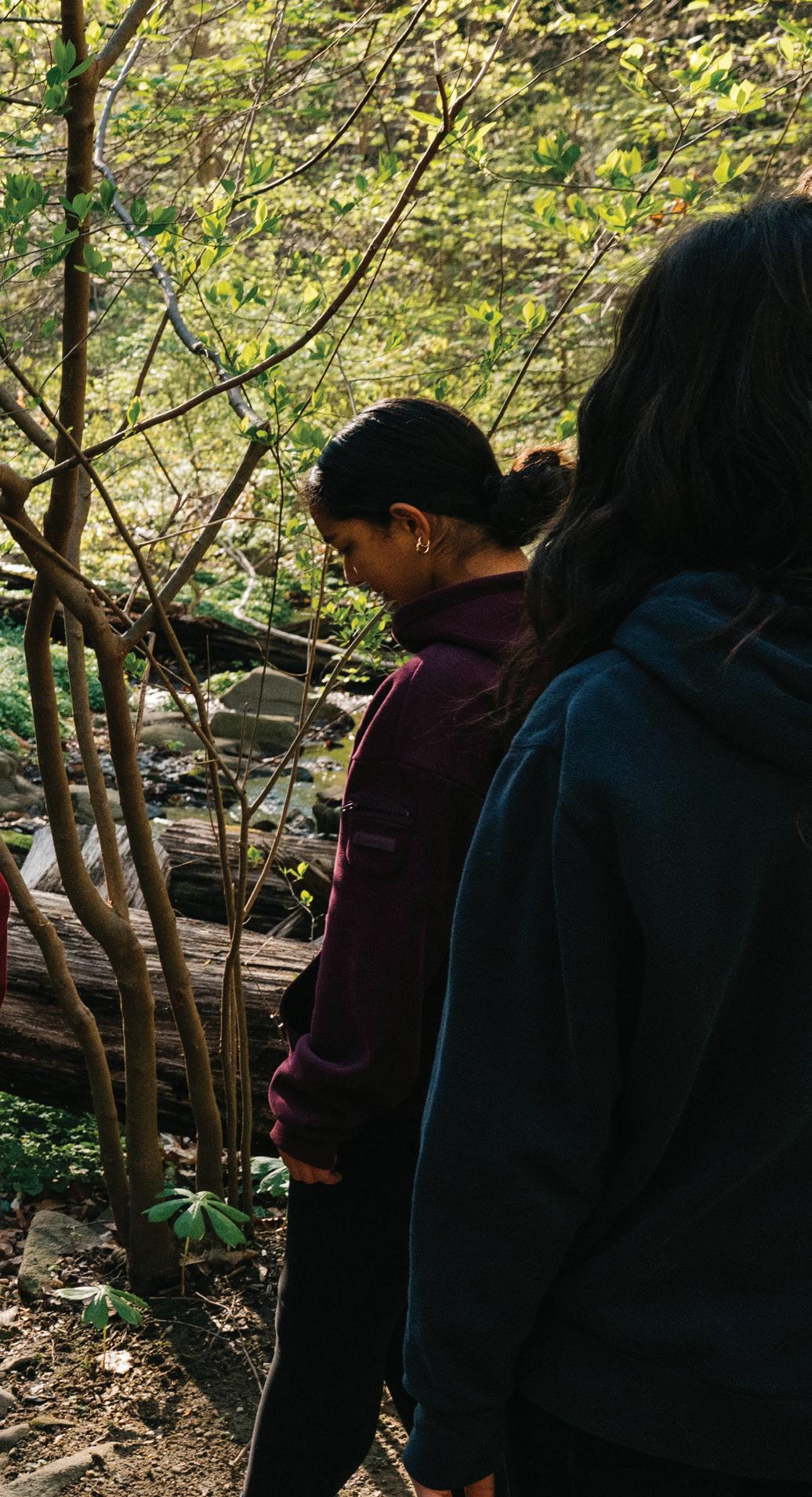


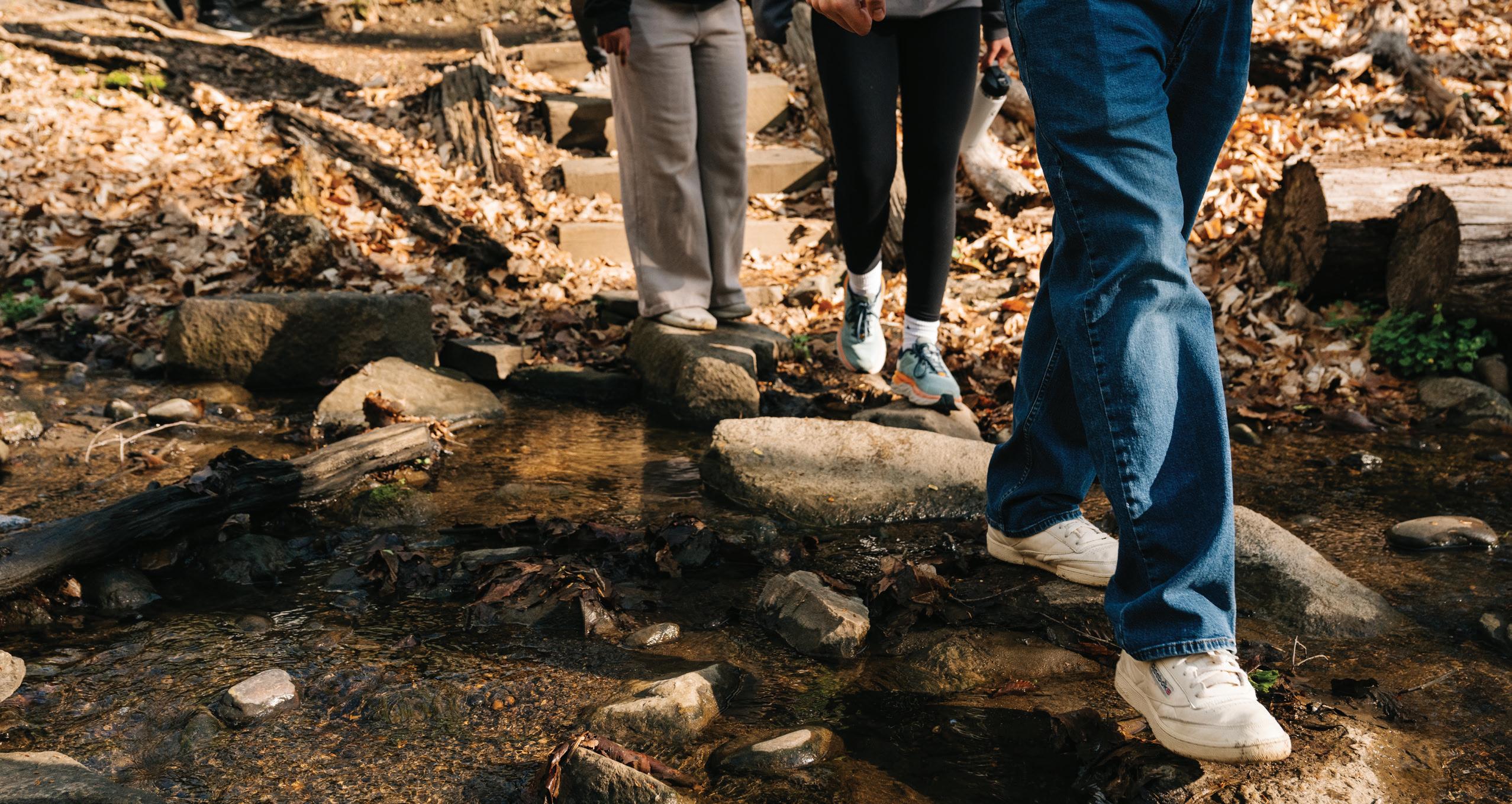



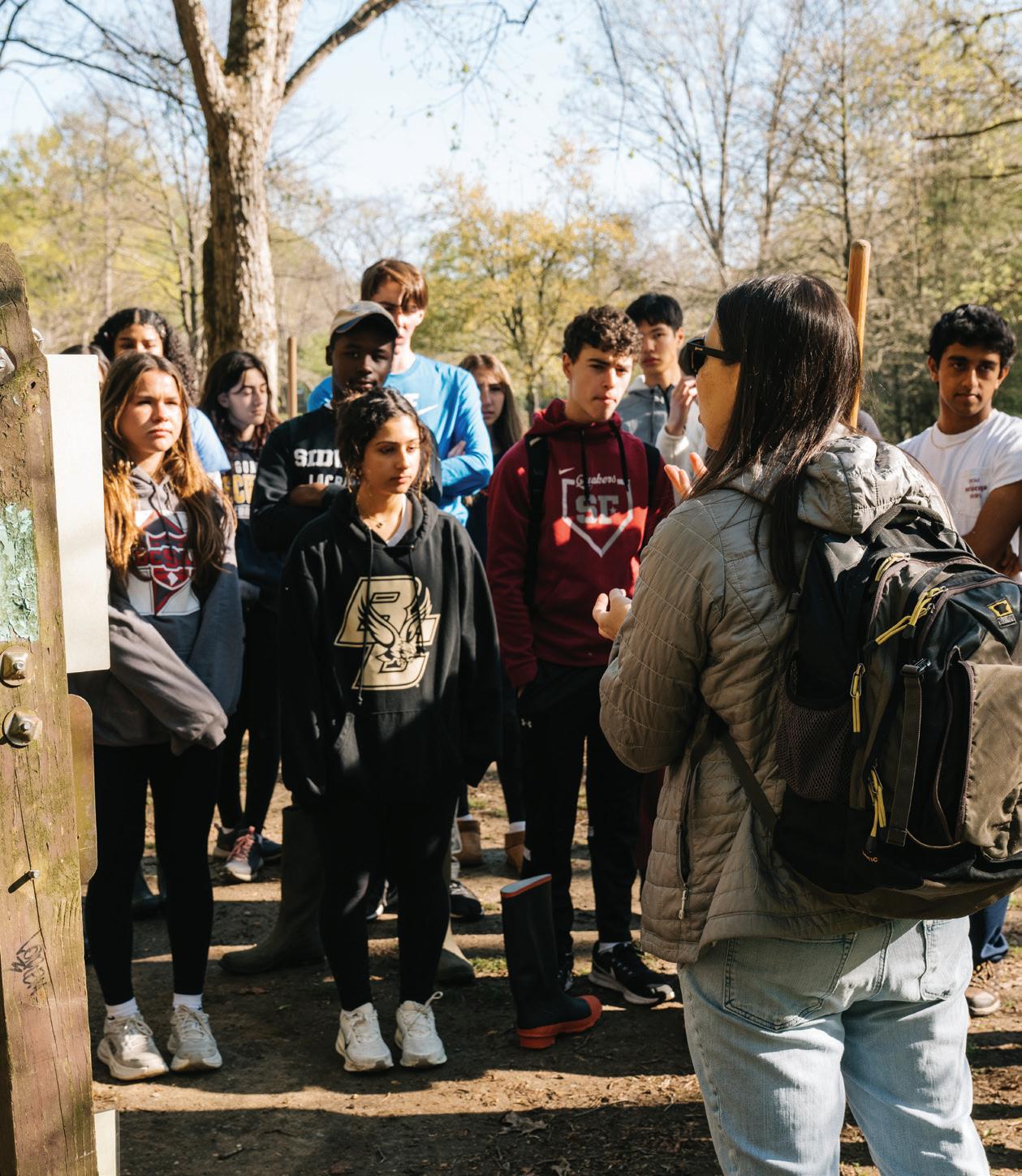



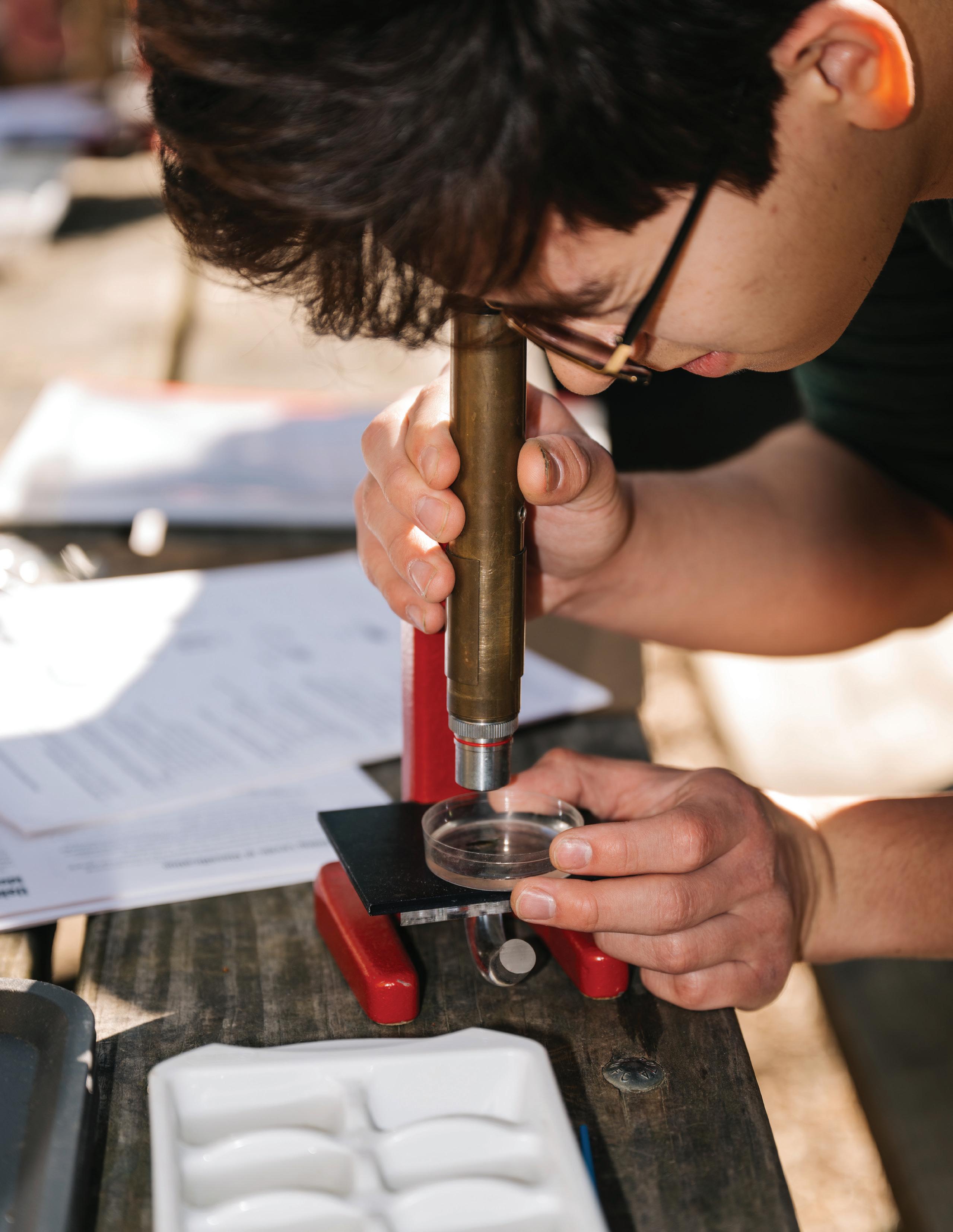
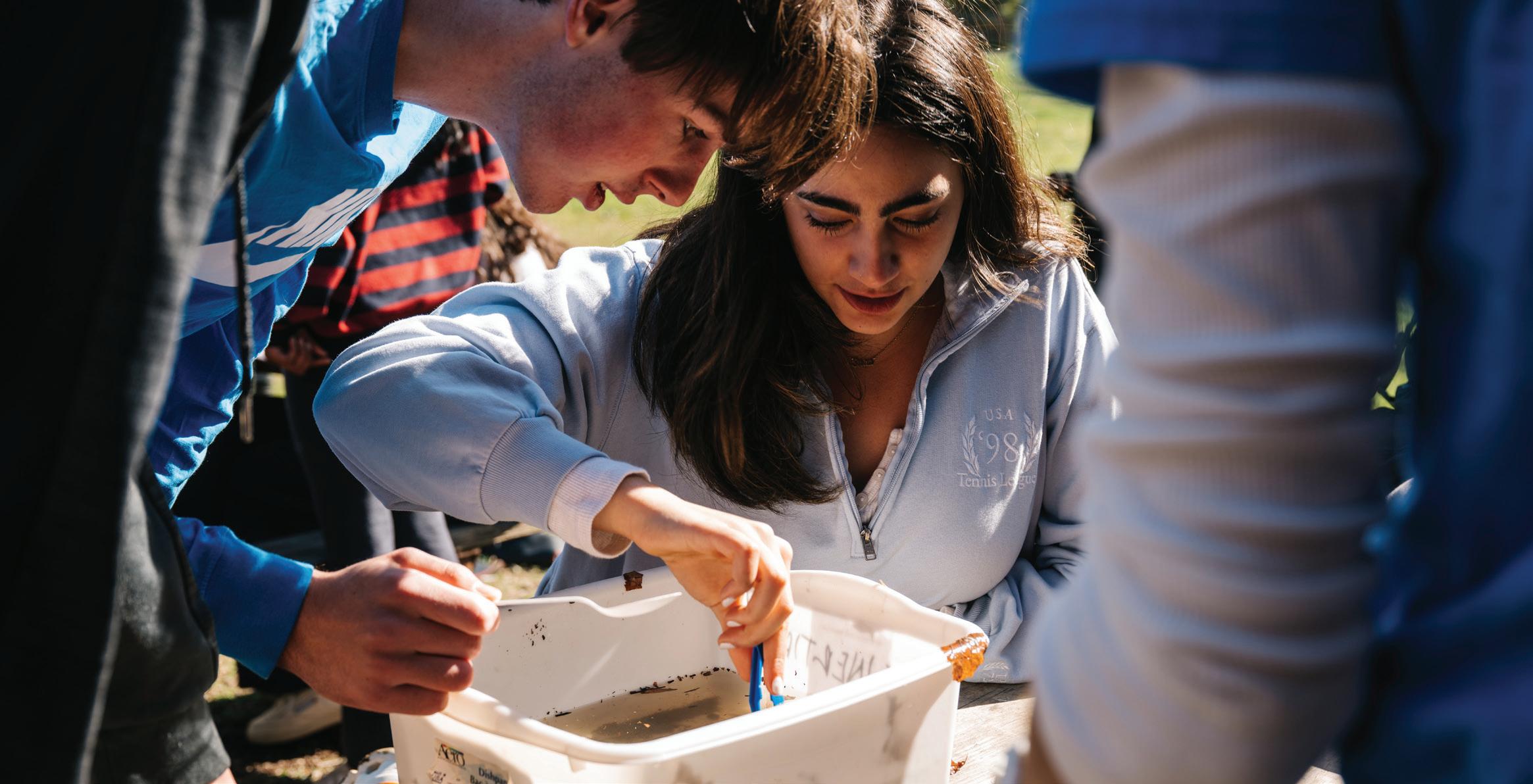
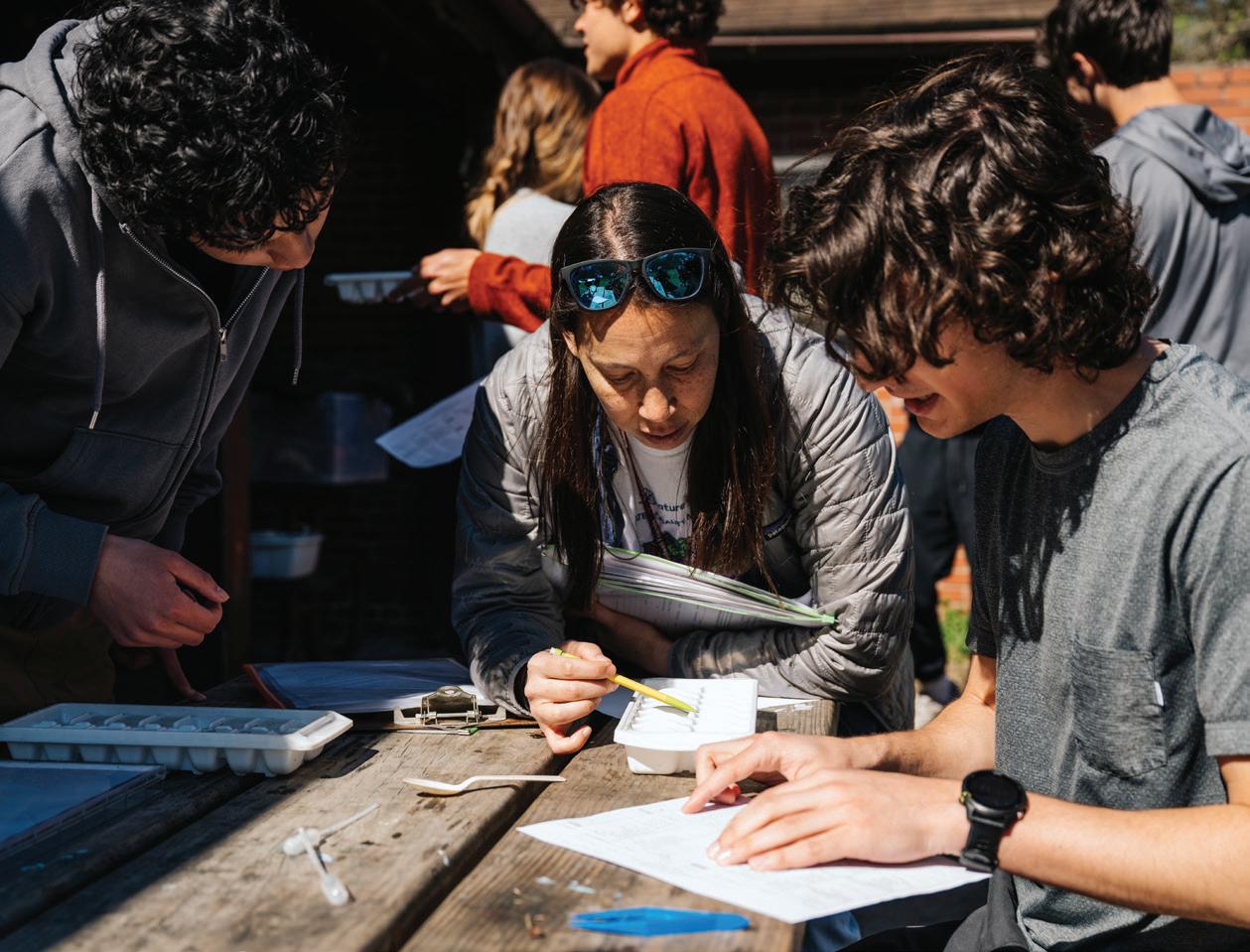
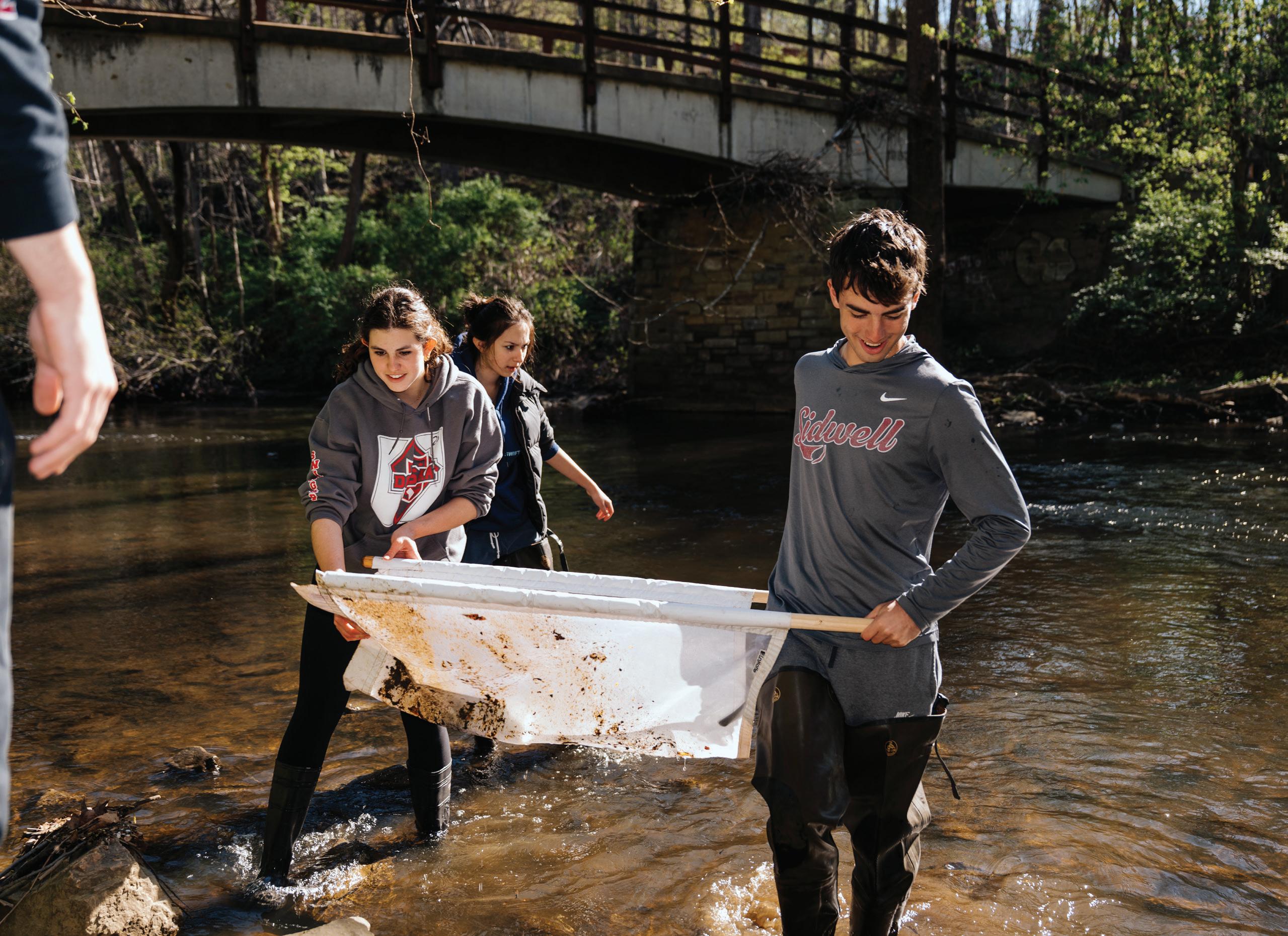
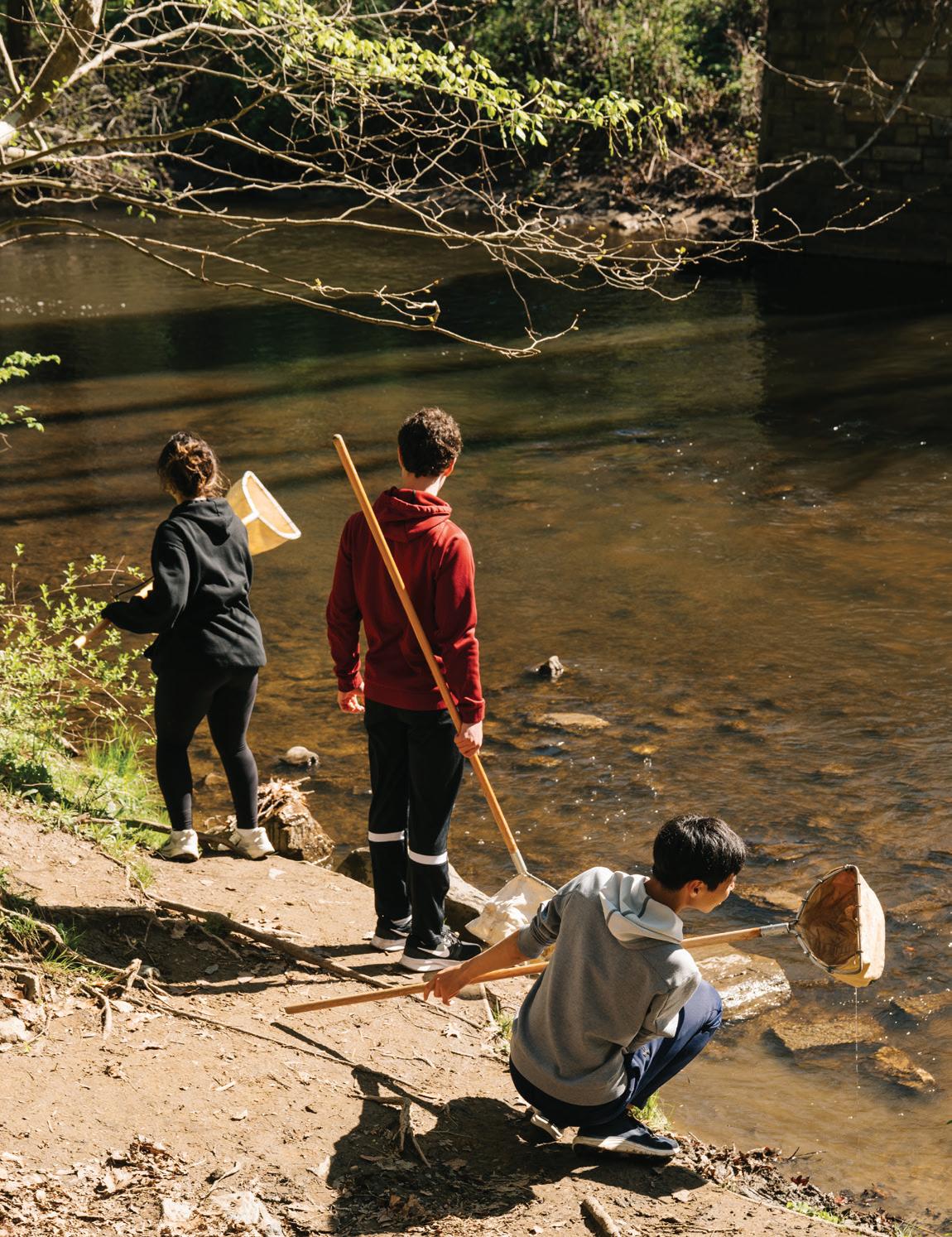
On the day of each stream-monitoring trip, students help load up a truck with everything they will need for their data collection: boots, buckets, pans, field microscopes, petri dishes, pipettes, nets, and ice cube trays to sort the different macroinvertebrates. Sidwell Friends’ Facilities staff drive the van to the site as Boyer and her students make the trek from campus. “The walk is a valuable part of the day,” says Boyer. “Since Sidwell is on a hill, we can see the path the water takes to run down into the stream, including passing under Connecticut Avenue, and how the











“I have also seen how our stream monitoring work is imbued with the Quaker values we teach at Sidwell,” says Boyer. “We are not only building our own knowledge but sharing it with the greater good in mind.”
“Climate change activism currently feels like a huge, international issue that no singular person or organization can truly impact,” Stone adds. “Being part of local climate change work helps to alleviate that feeling and inspire action.”
As part of the data-collection protocol at Reservation 630, Boyer’s class also conducts a habitat check, looking at water level and temperature, invasive plants, erosion, breaks in vegetation, and the presence of biofilm on stream rocks. “When we look at the data as a whole, we can see patterns and make recommendations to local government agencies like the Department of Energy and Environment and the National Park Service in an effort to improve stream health,” says Trilling. Based on the data, which can

reveal a great deal about the water quality and potential impacts of land use surrounding those streams, initiatives might include improved storm water mitigation, green- or red-lighting certain construction projects, planting vegetation to help buffer and filter water runoff before it enters the stream, or wetlands restoration. “We’re working with small creatures and small clues, but the data can impact local decision making on a large scale,” he says. “I can’t say enough about the team leaders and the volunteers, like the Sidwell group. They are who make it all work.”
Trilling says the best part of his job is getting out to the streams and working with the volunteer groups. “I’ve been out a few times with Emily and her class. The students are so engaged, so focused on the work, and Emily does an incredible job of explaining what they are seeing, what they are doing and why, and what’s impacting the stream,” he says.



Alumni have long broken out of the classroom for study abroad programs in far-flung lands, where they encounter life lessons that reverberate across years and in unexpected ways.
BY ZEESHAN ALEEM ’04
Many Sidwell Friends students and alumni have long viewed studying abroad as a rite of passage. Some traveled to China on a Zeidman Fellowship. Others participated in a School Year Abroad program. Many more opted to give it a go during their time in college. SidwellFriendsMagazine recently caught up with a half-dozen alumni to talk about their study abroad adventures. There was tremendous variation in the kinds of challenges they faced and nations they settled into. A lucky few were witnesses to memorable moments in history. But all of them had something in common: They were irreversibly changed by the experience.
Moving overseas to study as a young person necessarily involves taking on all kinds of challenges and discomfort—some predictable, others not so much. A major one: getting used to speaking in a foreign tongue.
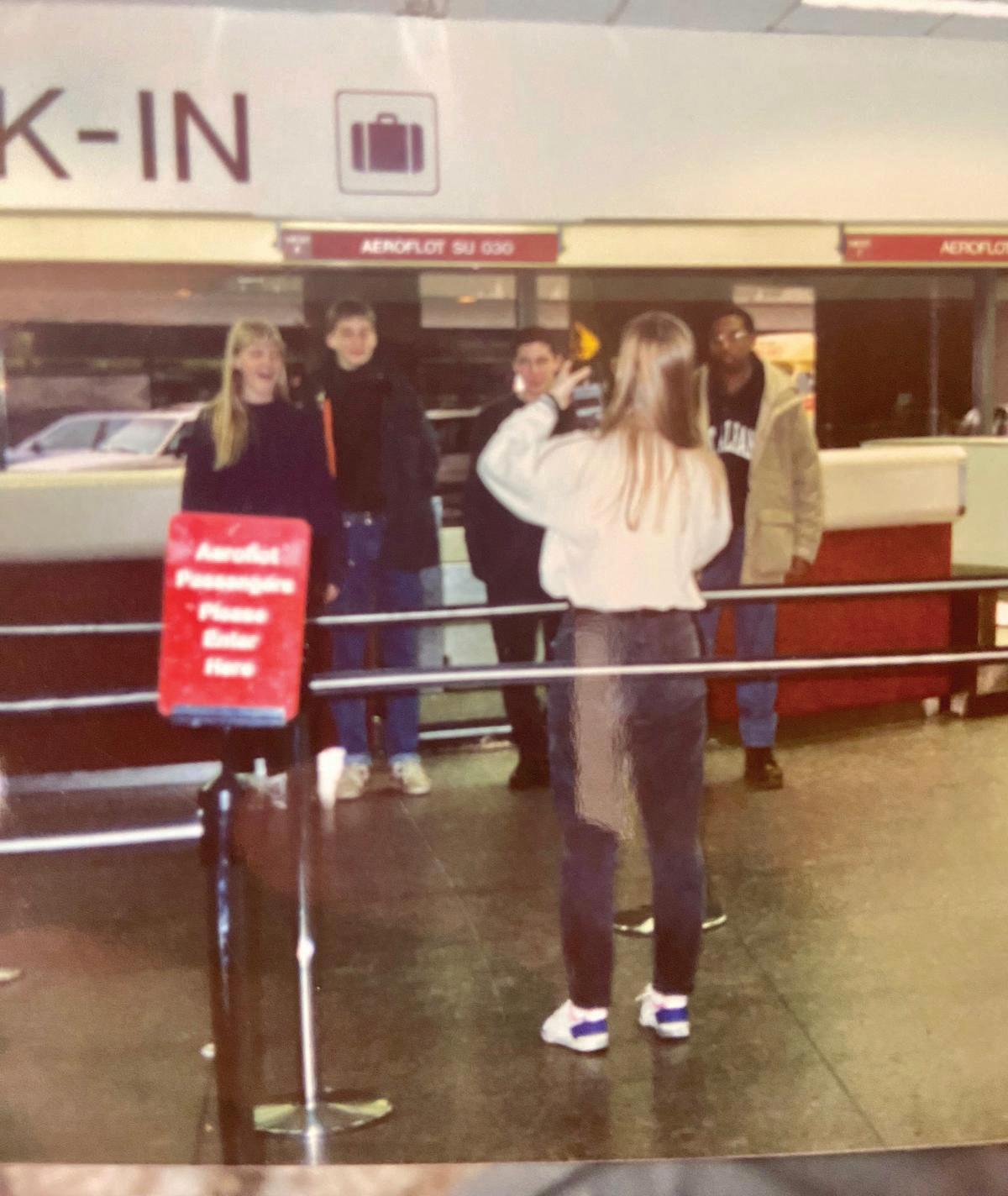
“Our Russian was not that good, so we got very little from each lesson,” says Dawid Walendowski ’91, who studied in Moscow for part of his senior year at Sidwell Friends under the auspices of an exchange program overseen by a consortium of DC schools. “It was more of a huge adventure than an academic exercise. It was funny, sitting with Russian kids and listening to their physics lessons, while trying to figure out the basic words.”
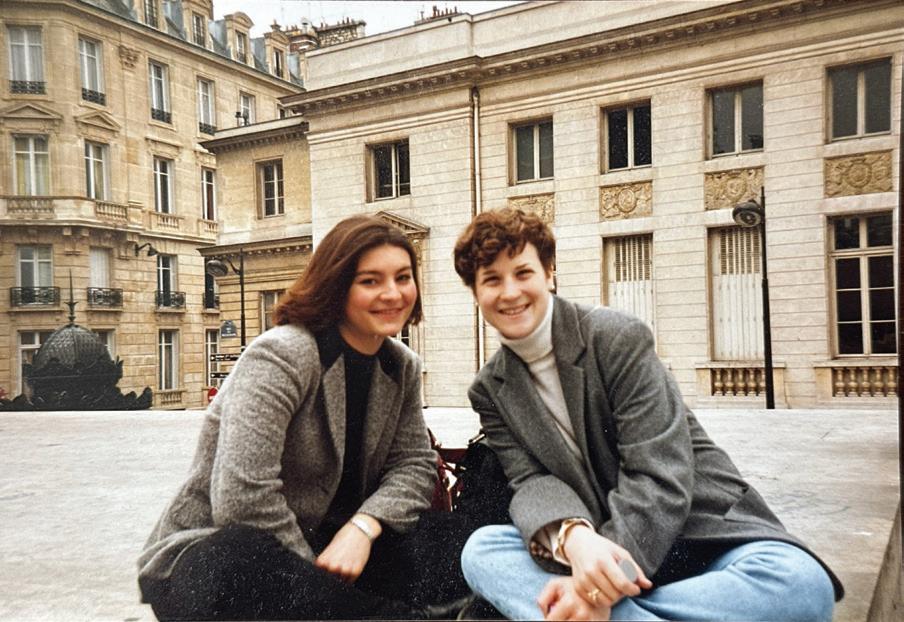
Emily Paster ’92 says her French before spending her junior year of college in Paris was pretty good—she was a French major at Princeton— yet it was still difficult to “live a life in French.” She improved “exponentially” after living there a while—to the point that she could defy stereotypes. “Someone asked if I was Canadian, because they didn’t think an American could possibly speak French that well,” Paster says. “I definitely dined out on that for a long time.”
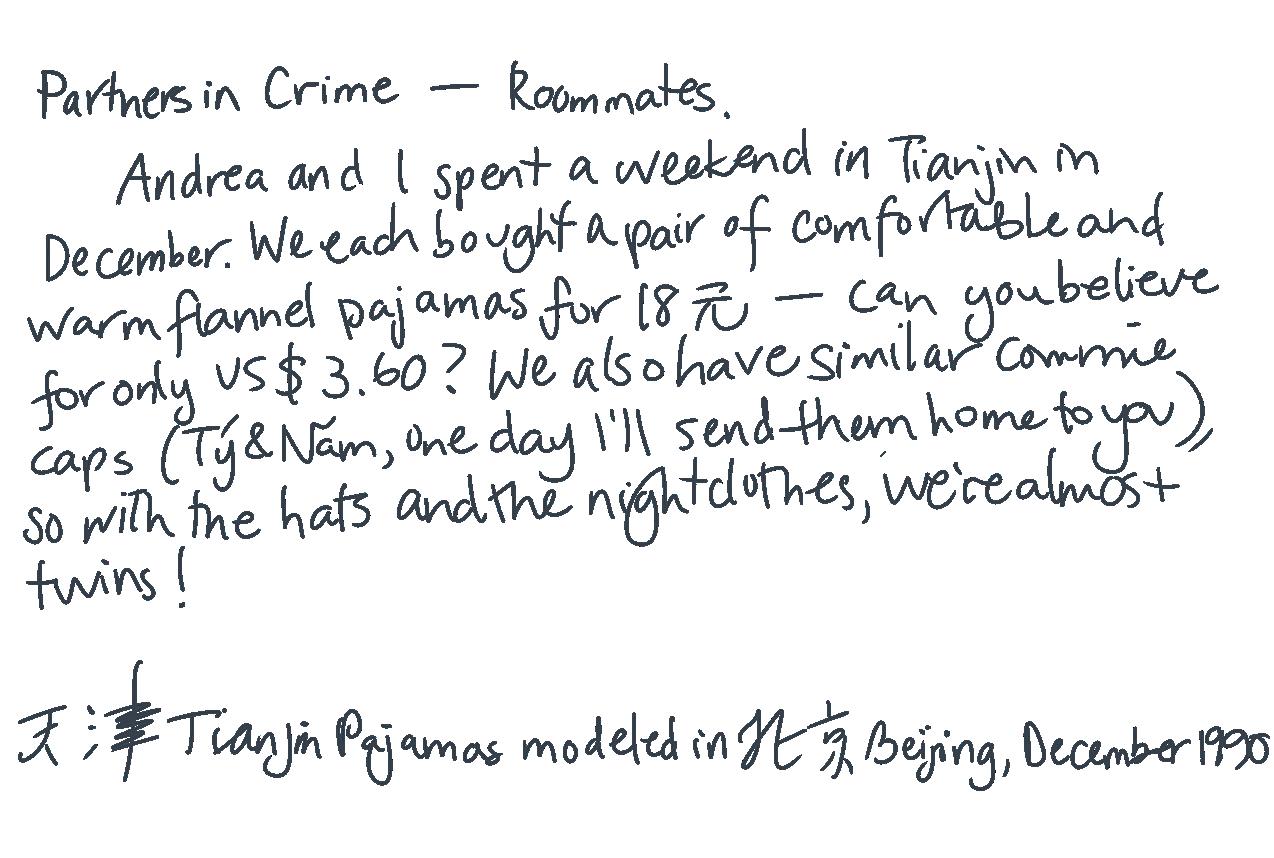
Thao Le ’89 had a unique experience picking up Mandarin while studying in Beijing for a year under a Zeidman Fellowship. In a postTiananmen Square world, relations between the United States and China were tense. Due to her Vietnamese heritage, Le says she consistently passed for Chinese, which helped open the door to conversations—and it made language acquisition more intense but also more effective. “The other Americans were white Americans, so they walked down the street and everyone looked at them,
“Partway through the semester, it started to click: I started to dream in Spanish.”
called them ‘ghosts’ and stuff,” Le says. “But they assumed that I was Chinese, so they would talk to me a mile a minute. At first I didn’t understand what they said because they were talking too quickly, but by the end of it, I was pretty fluent and was able to make my way around town.”
Radhika Bhattacharya ’99 says that she hadn’t spoken a lick of Spanish since her AP Spanish exam at Sidwell Friends a few years before doing a fall semester during college in Salamanca, Spain. Yet she was able to make breakthroughs rather quickly. “Partway through the semester, it started to click: l started to dream in Spanish, started to be able to feel as if I was not an idiot when I was conversing,” Bhattacharya says. “It was really satisfying to get over that hump, and to finally feel like I can be myself, even though it’s another language.”
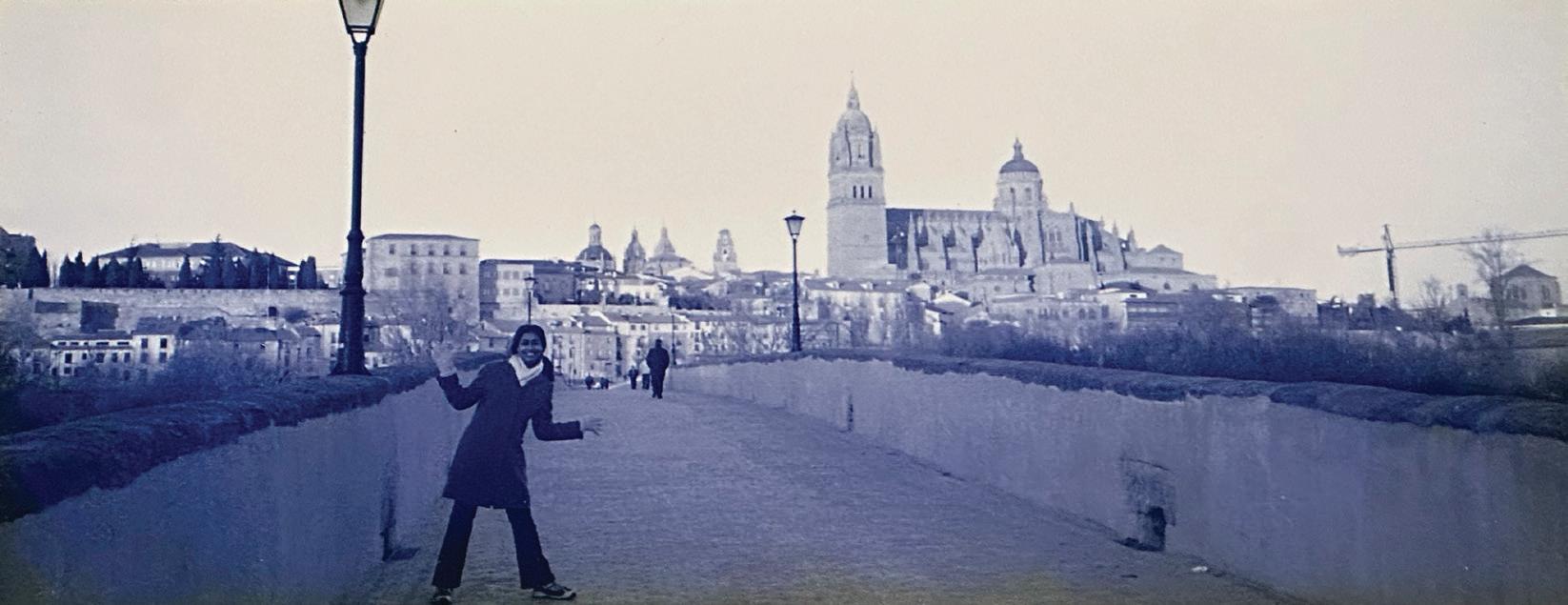
Radhika Bhattacharya ’99
High-speed internet makes it easy to stay in touch across international borders today: Texting apps, FaceTime, and social media allow instant connections with loved ones many time zones away. But until relatively recently, living abroad made it difficult to contact home, forcing students abroad to quickly develop newfound independence and to take bold steps into the unknown on their own.
Kiran Dhanji ’99 was incredibly excited to study at the University of Nottingham in England for her undergraduate degree—until the moment she arrived at her dorm room. “I remember closing my door and thinking, I’ve made the worst mistake of my life,” Dhanji says. “I looked out in the courtyard and thought, What have I done? Why didn’t I go to school in the States? Why am I so far from home? What made me think this would be a good idea?”
A text to her parents for reassurance wasn’t a technological option, and a call would have been expensive and required finding a payphone. But 30 minutes after her arrival, Dhanji heard a knock on the door—her fellow students invited her out to the student union bar. She made her first friends in Nottingham that very night.
Bhattacharya described experiencing the slopes of the “W curve” during her time in Salamanca in the heart of Spain. “At first, you’re super excited, and then you go down on the curve as you start to confront longer-term cultural differences,” she says. “Then you have a rise again as you really adjust.” (The same thing happens in reverse as you return home, completing the “W.”) For example, Bhattacharya says that in Spain dining out, even for lunch, can be an hours-long affair, which can be “jarring compared with an American tempo.” But after a few months in Spain, she found herself “luxuriating in the slower pace”— only to be discombobulated again at home when confronted with a brisk American pace.
Most alumni talked about how they rang home once a week or once a month and also wrote letters more.
“I got really good at writing letters and photojournaling,” Le says of her time in Beijing. “Back then we had film, so I would take tons of pictures, and I would write on the back of them. It really made me good at writing and telling stories; having that slowness, you really have to think and be reflective.”
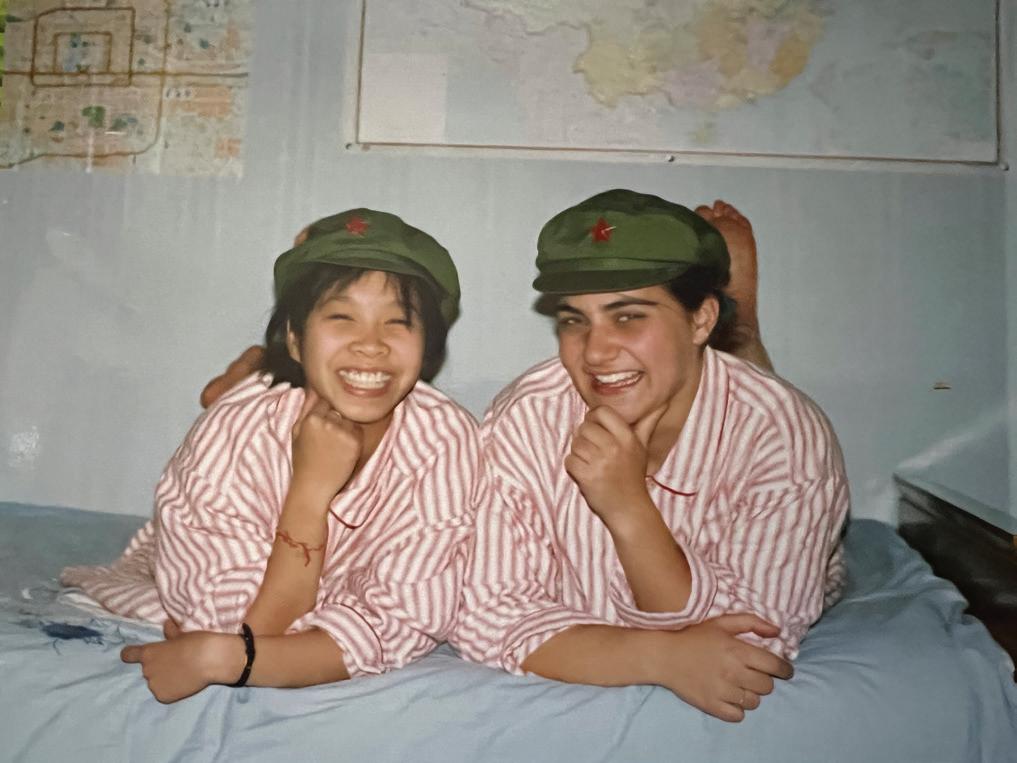
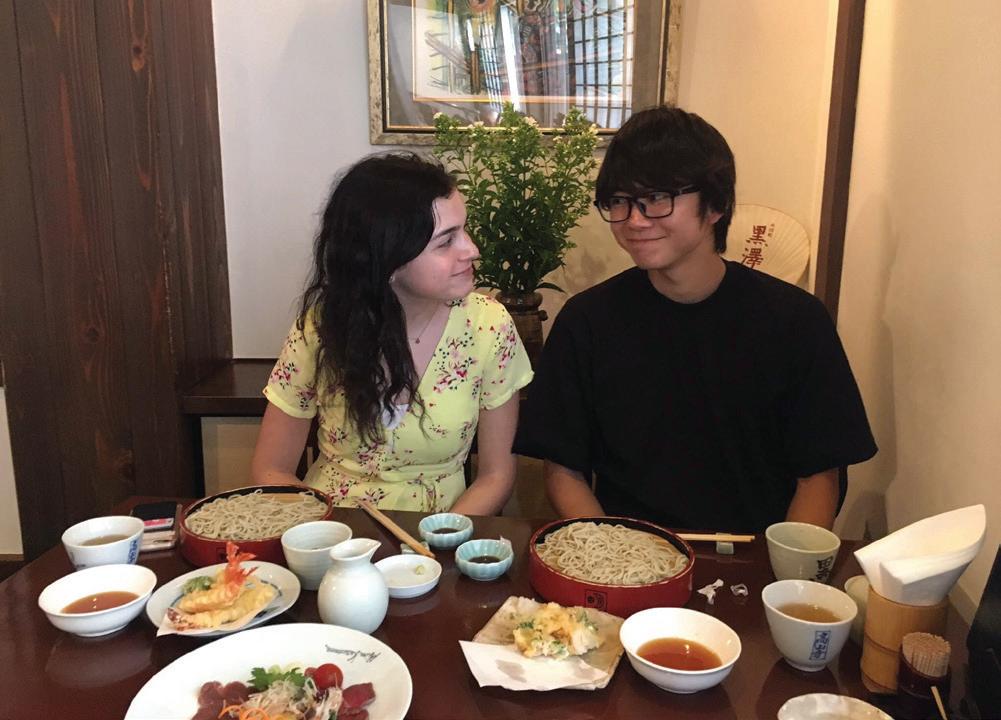
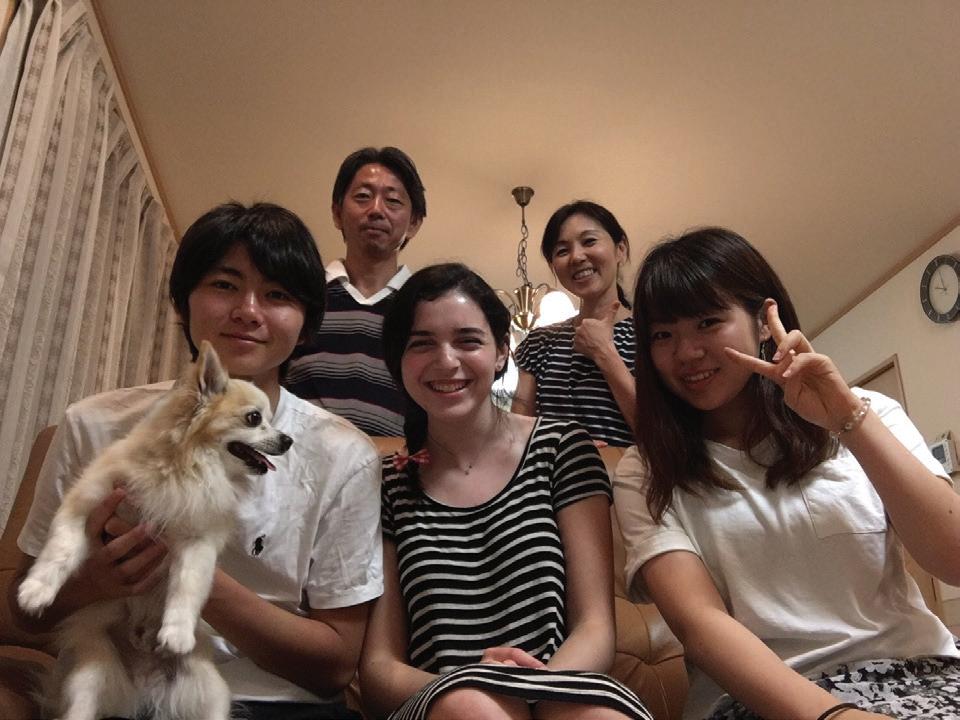
Overwhelmingly, students abroad are forced to be in the present with the people they live with. Sometimes that was the other students in their dorms and classes; sometimes it was a host family, who could introduce them to new cultures in unexpected ways.
Sophie Peikin ’19, who went to Japan through Sidwell’s Voices of Peace fellowship to learn about nuclear nonproliferation, quickly grew close to her host family in Tokyo, who were eager to teach her about their culture. “We went to a restaurant, and they said: ‘We’re gonna have raw horse. It’s a Japanese delicacy,’” says Peikin. “I was like, ‘I guess I’m gonna try it.’ It opened my worldview— and my palate—for sure.”
Paster says her host family in Paris were practicing Sephardic Jews—a revelatory experience for a young woman raised in an “entirely secular” household. (She has an Ashkenazi Jewish father and a Catholic mother, neither of whom are religious.) But Paster connected with this family—and their religiosity— deeply. “It was a truly life-changing experience,” says Paster, who is now a food writer. “I learned so much more about the Jewish diaspora by spending a year with this wonderful family, celebrating their holidays with them, learning all about their traditions, particularly their culinary traditions—because my first love is always food.”
Studying abroad introduces a variety of new cultures and unfamiliar routines into students’ lives. It also changes the way they think in ways big and small, both through direct encounters with new ideas and by prompting introspection about their old ones.
Shortly after arriving at the University of Nottingham, Dhanji recalls observing that most of the students seemed to have something she didn’t, but she couldn’t put her finger on it at first. Eventually it occurred to her that, as is especially common in Europe, many had taken a gap year before college—traveling and working around the world—and it endowed them with a maturity and ease that surpassed her own. “Whatever they had done in their gap year,” Dhanji says, “these British students had all come back to university with a better understanding of themselves
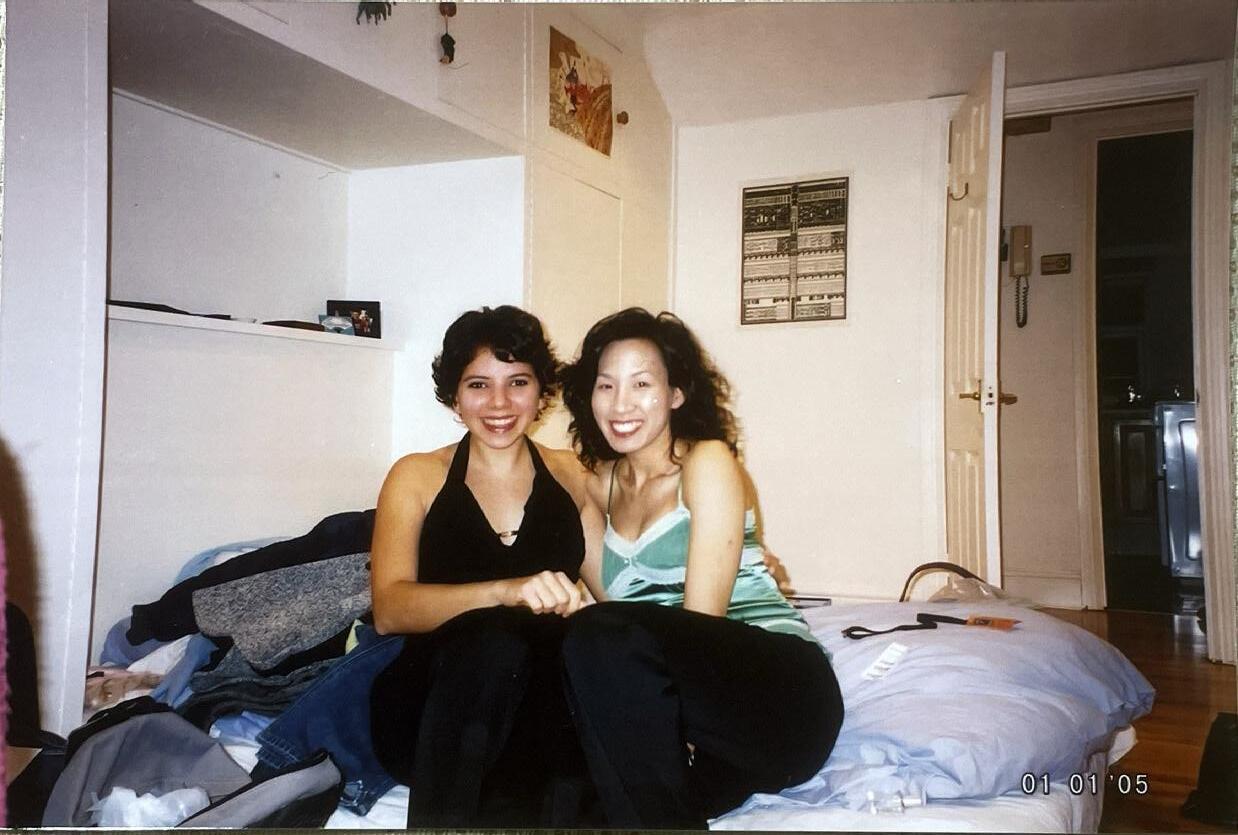
Dhanji’s hunch that a gap year would help her grow is precisely what inspired her to take one between her undergraduate degree and law school. And it was just four months into that gap year, which she took in Japan, when she realized she didn’t want to go to law school at all, and instead wanted to take a different path toward “making the world a better place and still getting to explore.” So she got a master’s degree in international relations.
In China, Le says she was struck by the way people there often took the long view of life. “One of the big things in Chinese culture is patience and persistence,” says Le. “There was a fable about an old man moving mountains a little bit at a time. Chinese people don’t think in terms of my lifetime, but in terms of generations. And I don’t know that America has that long-term view.”
Sometimes political and economic events can spark new outlooks and sensibilities for students abroad. Walendowski recalled being charmed by how the opening of a new McDonald’s in Moscow at the tail end of the Soviet Union was a massive cultural event. “There was a two-mile line to get a cheeseburger,” Walendowski says. “We invited some of the Russian kids to eat with us. It was kind of a sensation.” In the final throes of the Cold War, somehow the burger came to symbolize the possibility for warmer relations. “There was an openness to capitalism, and it was a very optimistic time,” Walendowski says. “These two opponents [the United States and the USSR] suddenly decided they were going to try to be friends and cooperate.”
Just months after he returned to the United States, the Soviet Union collapsed.
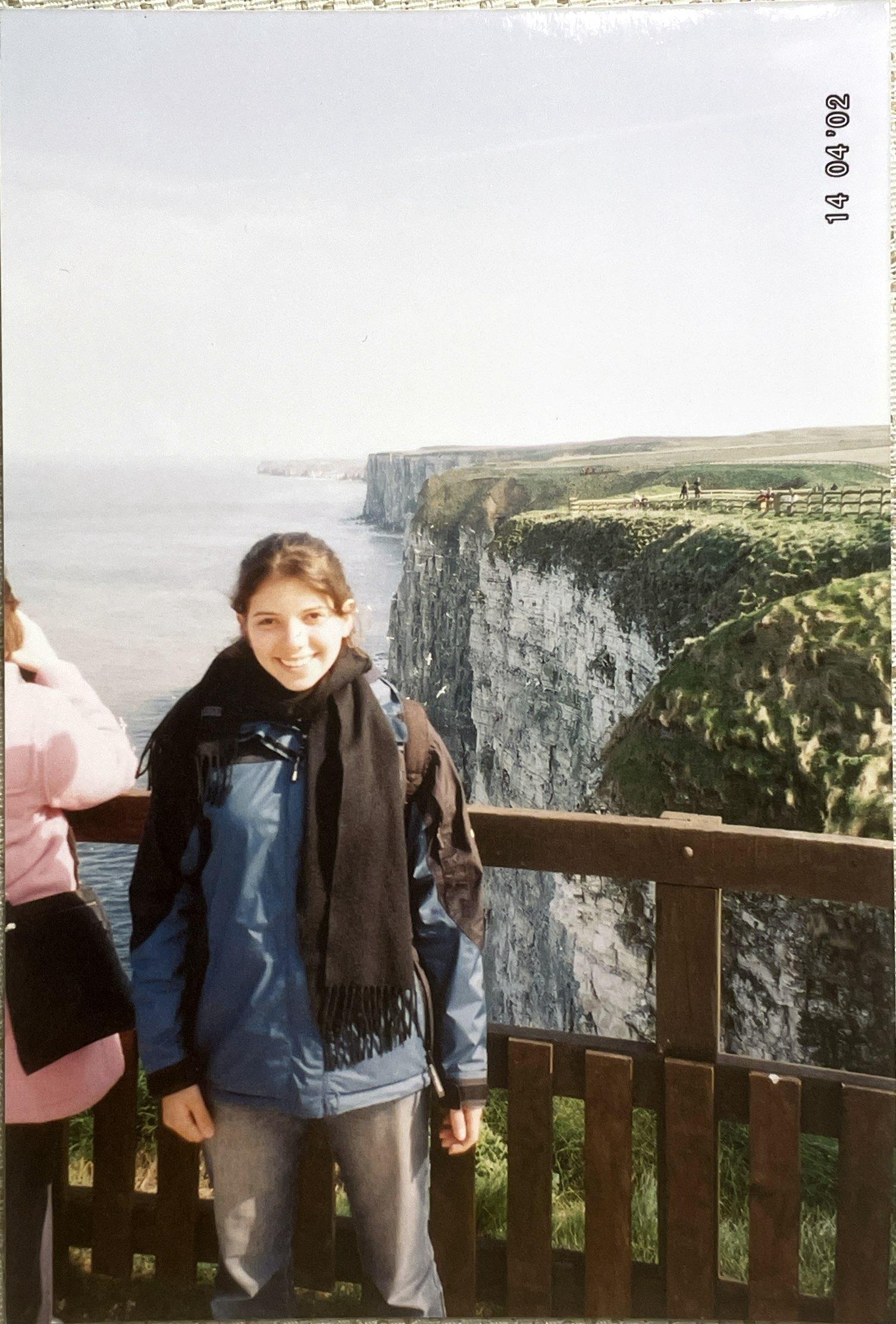
Kiran Dhanji ’99
“There was a fable about an old man moving mountains a little bit at a time. Chinese people don’t think in terms of my lifetime, but in terms of generations. And I don’t know that America has that long-term view.”
THAO LE ’89
Every alum described their time abroad as changing the course of their lives.
“Since studying abroad, not a day has gone by that I haven’t thought deeply about the things I saw or the people that I met,” Peikin says. To wit: Her high school trip to Japan inspired her, like Dhanji, to study international relations as well as Japanese. “The process of learning Japanese showed me that if I put my mind to something, I could really learn anything,” Peikin says. “I think that sense of empowerment determined the course of my life. Even when I was studying economics in college, I was like, Okay, well, if I can teach myself Japanese, then I can for sure figure out this integration question for econ. It was very applicable to different areas of my life.”
She now works at a French bank—and she’s learning French.
Sometimes breakthroughs can happen in unexpected ways. Paster was already a francophile before she arrived in Paris, but living with her Sephardic Jewish host family sparked an interest in her Jewish identity—and thereby altered the course of her life. “I thought, Wow, this was a really profound experience, but I didn’t know how it was going to play out,” Paster says. “Now, I am married to a Jewish man. We have raised our children in the Jewish faith. We belong to a synagogue. I do trace that back to that experience.”
And in her work as a food writer, she has also written about Jewish cuisine.
“Since studying abroad, not a day has gone by that I haven’t thought deeply about the things I saw or the people that I met.”
SOPHIE PEIKIN ’19
Walendowski says his trip to Moscow changed the way he thought about where he might belong, or at least where he might be most excited to live. He was born in Poland and moved to the United States when he was 6 years old, but he wasn’t sure where he wanted to live as an adult. “The experience in Moscow encouraged me to catch the Eastern European bug, to want to be a part of these fascinating changes that were happening in this part of the world,” Walendowski says of the dissolution of the Eastern bloc. “I’m sure that played a role in my decision to move over there years later.”
After finishing his bachelor’s and master’s degrees at Columbia, Walendowski moved to Poland— and he has lived there ever since. His Russian skills are also helpful in his work as a partner at a family history research business, which he does alongside work in finance.
Le says studying abroad in college “made me really hungry to see other parts of the world.” Filled with a sense that “the world is wide and wonderful,” after graduating, she entered the Peace Corps and worked in Mali, where she made use of the French her grandfather had taught her growing up—and learned Bambara, too.
Le, who is now a 1st grade teacher, ultimately married a man who also speaks Mandarin, and they sent their kids to a Mandarin-immersion school in California. They also spent a year in Taiwan to escape the pandemic—an experience their family loved.
Bhattacharya says that in her later work as a legalaid attorney, representing clients who couldn’t otherwise afford a lawyer, her Spanish skills have made a profound difference. “Not having to work through an interpreter, and getting to speak to my clients directly is huge,” says Bhattacharya, who now works as a lawyer for the Department of Health and Human Services. “It really helps cultivate a relationship with them in a way that might not have been otherwise possible.”
She points out that it changed the way she views immigrants in the United States more broadly as well. “I’m even more inclined to talk with people who are living abroad in the U.S.,” she says. “I have added respect and empathy for people speaking English as a second language and am perhaps more likely to befriend those who have gone out of their comfort zones and left their home countries to live here.”
“Your brain is being forced to understand and think differently and perceive differently and find completely different ways of understanding your exact same reality.”
KIRAN DHANJI ’99
Dhanji observes that studying abroad allows people to learn in completely new ways—and beyond textbooks. “Your brain is being forced to understand and think differently and perceive differently and find completely different ways of understanding your exact same reality,” she says. That complex cultural matrix, in turn, has helped her with her career. “I was promoted into senior-level management positions in my 20s,” says Dhanji, who now runs a public safety and security consulting firm specializing in aviation. “I think studying abroad was the reason I was able to work very well with very large groups of people, and I was able to understand different people’s perspectives.”
Indeed, learning in a foreign place fosters an openness to peace and stewardship—not just in one’s immediate community but around the entire world—mirroring the values of a Sidwell Friends education.
From the C-suite to camp, Cora Carmody ’75 encourages thousands of young women to embrace STEM studies.
BY ELLEN RYAN
hen Stephanie Hall started work at Jacobs Engineering, her second-level boss and soon-to-be mentor, Cora Carmody ’75, suggested that Hall volunteer with the local Girl Scouts as a way toward worklife balance. Hall manages data centers worldwide, is her home’s primary breadwinner, and is raising two children. Adding more—for balance? Hall thought, Do I even have time for this? But Hall understood that Carmody was speaking from experience. She had led a Girl Scout troop while serving as chief information officer of a Fortune 500 corporation, traveling internationally, and raising her own children.
The following summer, at a Girl Scout day camp in partnership with Technology Goddesses—the science, technology, engineering, and math (STEM) nonprofit Carmody founded in 2002—Hall’s daughter took part in a camper showcase of what the kids had learned and accomplished that week. Watching her 6-year-old’s presentation, Hall was stunned: “This camp unleashed more than I’d ever given my daughter credit for. And she couldn’t wait to go back.”
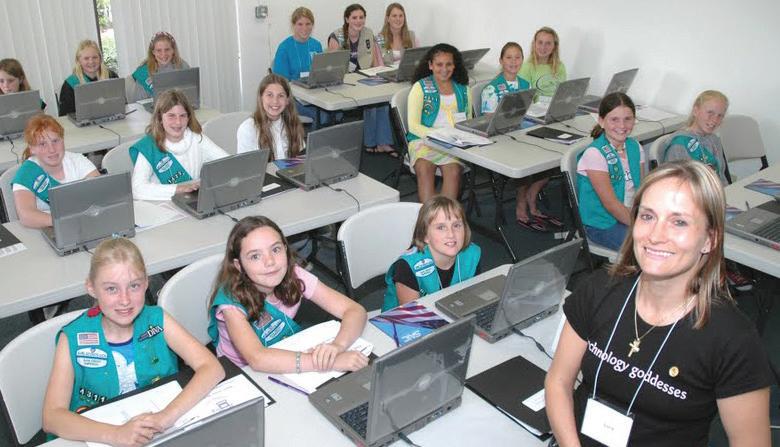
Carmody has mentored not just employees but thousands of children and teens, nearly all girls, for more than two decades. At the peak of a long, successful career in tech, serving as CIO at four different major firms—and usually the only woman in the C-suite—Carmody sought to pass on her example and her knowledge to children as young as kindergarten.
She never intended to launch a nonprofit. “I had no idea what I was starting,” says Carmody. “I had never reported to a woman. My motivation was to change the statistics.”
The tech guru recalls mentorship of her own from Sidwell Friends math teachers like Florence Fasenelli. For Fasenelli’s class, she and a classmate traveled to the Lower School for a project to understand why girls were less likely to continue their math studies.
She doesn’t remember the conclusion—but she wasn’t one of those girls. Always ahead of her time, Carmody left Sidwell Friends a year early to join a special college program, then jumped to Johns Hopkins University to earn a combined bachelor’s and master’s in math. She regularly attended one class in cleats in order to get to varsity field hockey on time.
Carmody blazed up the ladder in the DC area, in Southern California, and in between, working on projects like the first space station. Then, about 25 years ago, a Scout troop approached Carmody and asked her to create a screen saver (remember those?) they could sell to raise money. “No,” she told them, “but I’ll teach you how to create one.”
That was the impetus for Technology Goddesses (TG), which has inspired and encouraged thousands of girls (and a few boys) in the decades since. Its specifics have evolved, but the tech is always cutting-edge: TG, which works closely with the Girl Scouts of America, has
produced programs to show SoCal kids potential paths in coding, engineering, “loud technology,” the internet of things, cybersecurity, QR codes, online ethics, and more. In 2021, TG developed an AI badge for the Girl Scouts, and recently, the nonprofit has added units on deaf education and awareness.
During the school year, TG holds mentoring programs and field trips—to the Microsoft store, to Sony Pictures Entertainment, to Petco Park baseball stadium, behind the scenes at the Teen Choice Awards, and (when on the East Coast) the George Mason University TV and radio broadcasting program, and more. At each, they’ve found great female role models to talk with.
“If girls haven’t really grasped the importance of math or STEM by 3rd grade, or tried it at least,” Carmody says, “then they’re far less likely to continue that when they grow up.”
The stats are startling. Women received 20 to 22 percent of undergrad computer science degrees in 2025, down from 37 percent in 1984. Likewise, women in the computing workforce dropped from 40 percent in 1986 to 26 percent in 2017. In 2024, just 17 percent of those working in architecture and engineering were female. A big reason this matters: Studies show that STEM jobs pay well over twice as much as non-STEM jobs.
School-year activities at TG continue, but when Carmody moved to California in 2004, the group made summer day camps for preK–12 a main focus. Launched in 2005, the camp combines multimedia skills, web development, open-source-based graphic design, programming apps, and geocaching with more traditional camp activities, like arts and crafts, outdoor skills, and leadership.
Every camper needs a name tag: At TG, campers build their own with copper-tape paper circuits, so LED lights beam from the tag. Girls have made name bracelets for generations; at TG, the bracelets also translate letters into binary code.
“Some say they’re the only girl in their math or tech classes at school. Still!” Carmody says. “Here, surrounded by other girls, it’s a safe place to be a geek.” The longtime CIO and nonprofit leader knows that needs and personalities differ, and while some girls thrive on group hikes, others require one-on-one attention.
“I credit Cora Carmody with helping to save my daughter this last summer, who had been through traumatic experiences, and I was uncertain would be able to participate in camp,” one parent wrote as part of nominating Carmody for an award. “To my incredible surprise, Cora mentored her in ways I could never imagine, and [my daughter] shined in building an inventory system for Tech Goddesses’ camp materials. [Cora] saw potential where I had not [and]
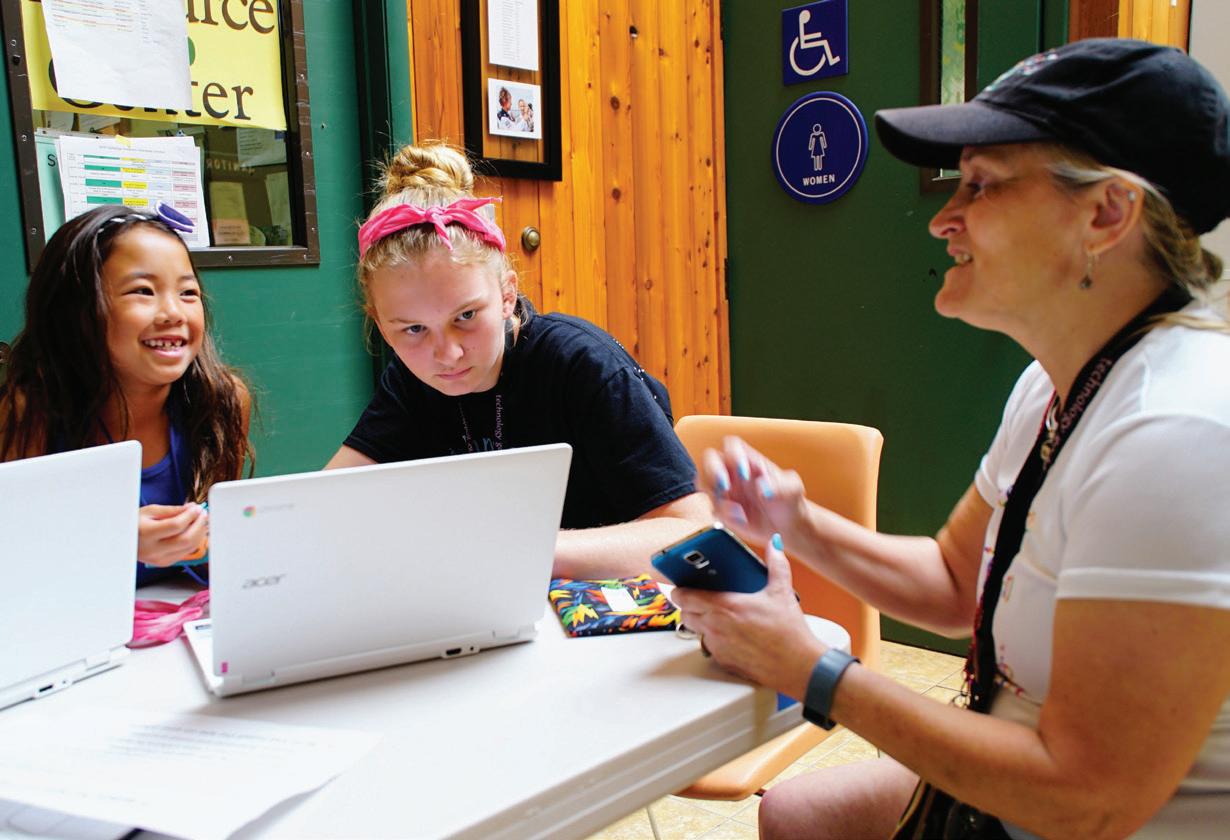
welcomed her and so many other campers that might be outcast with ‘hidden’ diseases or conditions.”
Could such insight trace back to Quaker meetings at Sidwell Friends? Absolutely. Carmody recalls meetings as “so powerful—to be open to any kind of religious thought, or not,” inspiring spiritual and mental freedom and community, which is a lot like the “freedom and support and confidence” TG offers girls. “How else would I build a program, if it weren’t as open and tolerant to different ways of thinking and believing?” she says. “That’s a cultural makeup that gets into your bones.”
Carmody has followed through in the real world as well. When the first group of TG 7th graders graduated from college, she hired two at Jacobs Engineering. Both now serve on the TG board of directors.
Such longtime loyalty is not unique. Stephanie Hall, who now lives and works in Florida, still takes vacation time to fly out to the California camp most summers with one or both of her daughters, who are now finishing high school. She mentors the campers and says of Carmody, “Her ability to connect to youth is stellar.”
Carmody herself modestly says her own philosophy is “girls leading girls,” or essentially staying out of the way: “A 3rd grader won’t look at a Girl Scout leader or a mom or a teacher as a role model as much as they’ll look at a 5th grader who thinks tech is cool. And the 5th grader is more influenced by a junior high or high school student-mentor.”
So, she sets up a sort of Socratic teaching method: “Challenge the campers with things they don’t think they can do”—and add a major dose of fun and creativity. The end result is a “sustaining chain of mentorship.”
“Through TG camp and mentoring,” Carmody says, “it’s like I have a gazillion daughters—and a few sons.”


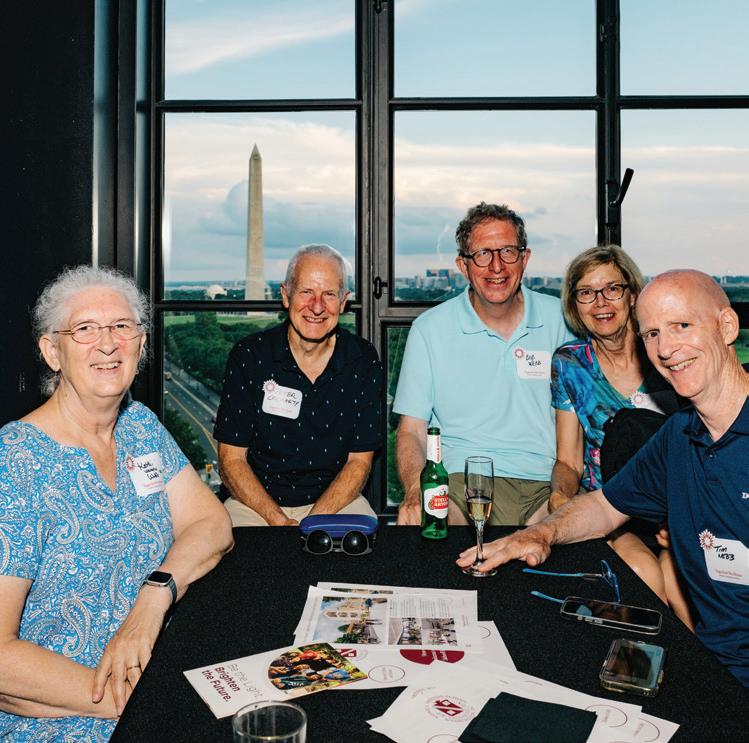

Fifteen years ago this spring, the School held its first Meeting for Worship in the brand-new Robert L. Smith Meeting Room. Just a year before, in April 2010, Upper School students and faculty gathered for their last meeting in the Kenworthy Gymnasium. After decades of setting out hundreds of folding chairs each week, the gym was transformed into a dedicated space for gathering and reflection.
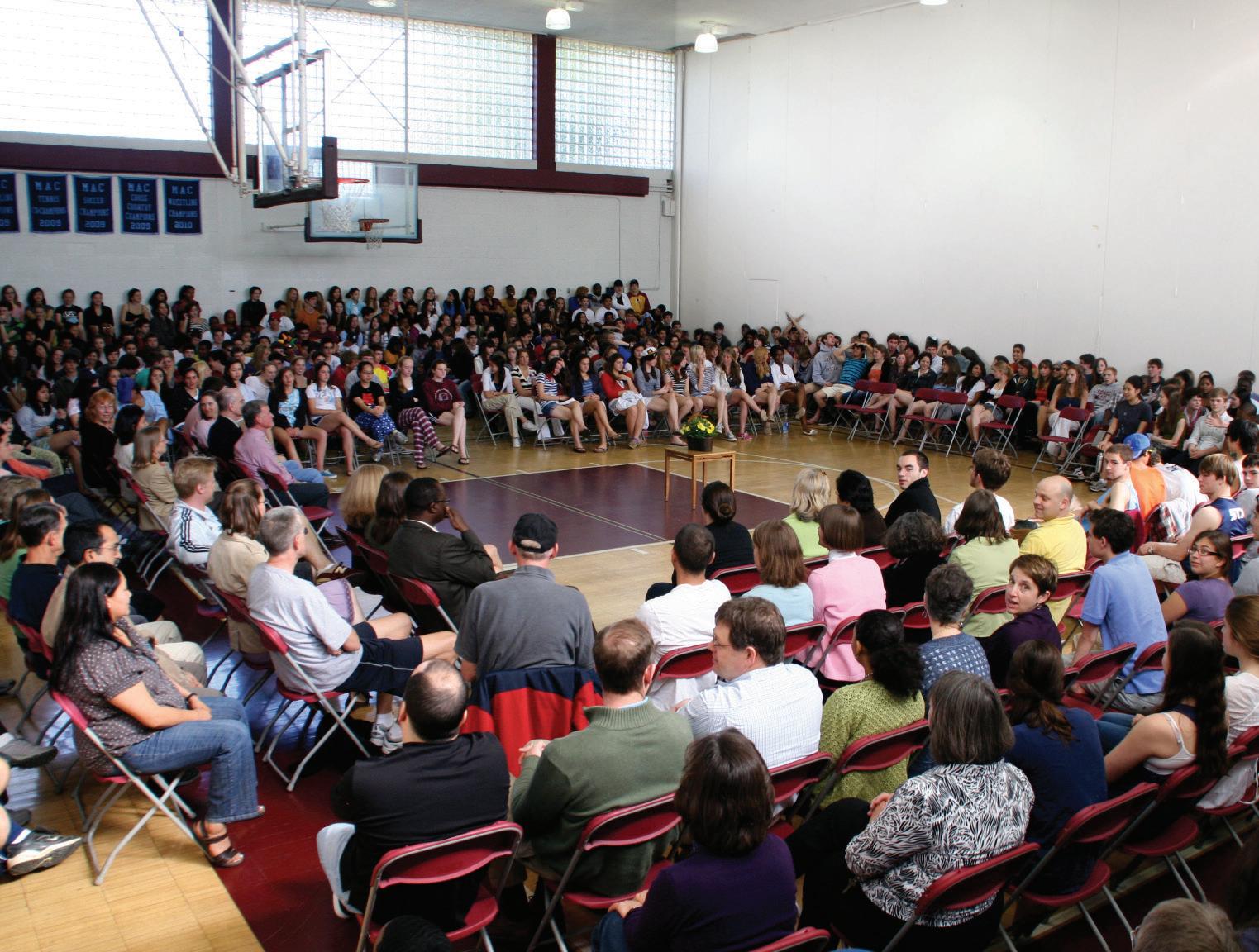
At a moment when social media often overwhelms, proselytizes, or vanishes before your eyes, Class Notes humbly offers respite. Here, you have a lasting, curated, and quirky window into the lives of your fellow alumni. Whether you knew them then, follow them now, or never met, you are all Friends.

RICHARD NICKLAS
rnicklas@mfa.gwu.edu
JAMES BOYER: “I continue to remain active as a faculty member at Yale School of Medicine, although at a reduced rate and often with Zoom attendance at conferences. This past November, I was invited to speak at a Nobel Conference in Stockholm on the ‘enterohepatic circulation,’ which was quite exciting as it was held in the Nobel Forum where the Prizes are chosen. This summer will be my 55th year of involvement with the Mt. Desert Island Biological Laboratory where I am an honorary board member.”
PEG ROBISON ESPINOLA: “I just read the Class Notes in the latest edition of the Sidwell Friends Magazine. Nothing about us—Class of ’54—except In Memoriam! Want you all to know that I at least am still alive and kicking in my life-care community on Long Island and in the immediate surroundings—relearning bridge, organizing postcard-writing campaigns and sign-writing parties, going to rallies armed with signs and my trusty rollator, and enjoying the proximity to my two kids and two grandsons who I didn’t have in Massachusetts. Oh, and I joined a choir, first time in a chorus since jr. high school. Love it! Hope this finds at least some of you alive and in decent spirits, despite everything going on within and around us.”
NANCY ABOLIN HARDIN nahardin@aol.com
WARREN OLNEY and his wife, Marsha Temple, have moved to 16012 Moorpark Street, #202, Encino, CA 91436 to be closer to Marsha’s son. On Zoom, Warren still periodically interviews national figures, including U.S. senators, former Washington Post reporters, and wellknown diplomats on America at a Crossroads. He also teaches, again by Zoom, a class of 150 students at Santa Monica College Emeritus on alternate semesters.”
TOM SIMONS: “In October, Peggy Simons fell on stairs and hurt herself, and although she’s recovering pretty well, it’s clear we can no longer live in a four-level house in Cambridge, Massachusetts. So, in late January, we’re moving to a pleasant assisted-living place across the Charles River. The Newbury of Brookline, 123 Fisher Avenue, Unit 311, Brookline, MA, 02445. It’s a quarter of our current space, but workable and affordable, if barely. Daughter Suzanne Simons ’86 and son Ben Simons ’88 are project managers for the move. Onward if not upward.”
Want to be a class representative? Contact alumni@sidwell.edu.
Want to be a class representative? Contact alumni@sidwell.edu.
ROBERT MYERS dr.rbmyers@gmail.com
PEGGY PABST BATTIN battin@utah.edu
FROM THE CLASS REP:
Our class, most of us born around 1940, grew up with manual typewriters, corded party-line telephones, and stick-shift cars. Sidwell Friends was progressive and visionary in many ways, from allowing girls as well as boys to take shop, to allowing students to carry their 8th grade teacher Mr. Abel up the Middle School’s central staircase in his wheelchair (there was no elevator), and to instilling in us not only the sense that we’d been born into the best country in the world, but also encouraging an outward-looking sense of the world. Our concern wasn’t just with local politics, but with national and indeed international issues. Also, as Steve Baer remarks (in another context), “There was no obstacle to expressing one’s views on any subject anytime, anywhere. Heavens, I used to tell Frank Barger and Thatcher Morse they were ***holes to their faces, argue with Mr. Atwood about his acumen to coach. There were no ‘safe spaces,’ only open, free spaces.”
Now, as we reach our mid-80s, and have a sense of the long scope of our lives, we treasure these histories using modern communication unimaginable in our earlier years. We have Dick Tracys on our wrists. We have intercontinental communication anywhere in the world. We have news from everywhere. And we use all this in a way that continues our bonds.
For example, Thatcher Morse (in Florida) and Bob Myers (in New Zealand) have had weekly (free) WhatsApp phone calls—“a delightful experience,” they report, even when interrupted as the lives of older people often are by such matters as sepsis, bleeding kidneys, broken ribs, pneumonia, and even a fall from an exercise treadmill. Those calls are, as one of them put it, “restorative.” In the contemporary world, where connection is so easily possible, many of us who are still here participate in a general Zoom every six weeks or so: Larry Aaronson, Peggy Pabst Battin, Reid Chambers, John Coffman, John Cox, Helene Rosenfeld Feldman, Craig Morgan, Thatcher Morse, Dave Price, Annette Eisenberg Stiefbold, and the class wit, Steve Stovall. We’ve lost many we cared deeply about, but we’re still having a good time.
—PEGGY PABST BATTIN
CLARK GRIFFITH ccgpa@ccgpa.com
KEEN STASSEN BERGER: “The most recent edition (2026, 13th edition) of my textbook on human development is now being used in colleges throughout the United States, and in several other countries. It includes my Sidwell Friends Middle School picture, as well as lessons learned from my Sidwell friends (Jeannie Crook, Suzy Fickel Kroeger, Joan Zweben—not mentioned by name but ’59 classmates will recognize them). I continue to write and publish with my married name—Kathleen Stassen Berger—but Sidwell knows me by the nickname I still have with my family: Keen.”
ELIZABETH FLETCHER CROOK and Fred Crook, always peripatetic, took two trips of note: “We had two very different travel destinations this year: Iceland and the Amazon River in Brazil. The challenge was not only making all the travel arrangements but fitting them around two major health challenges experienced by Elizabeth. The first was the emergency removal of a dangerously infected gall bladder 10 days before we were to leave
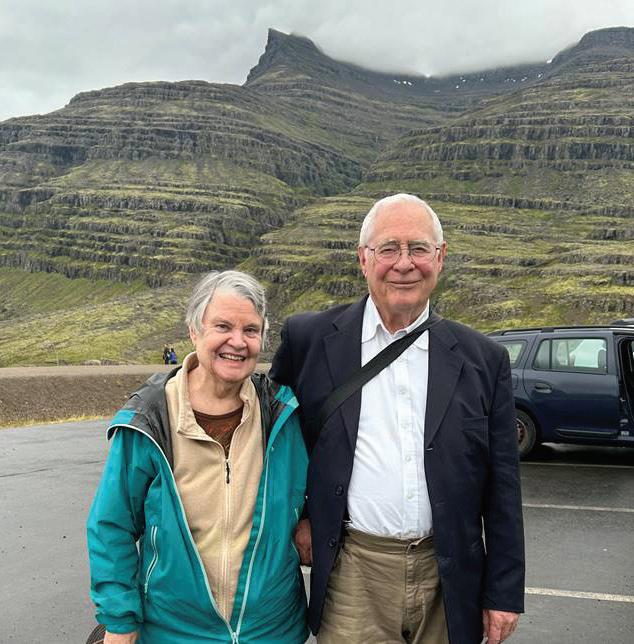
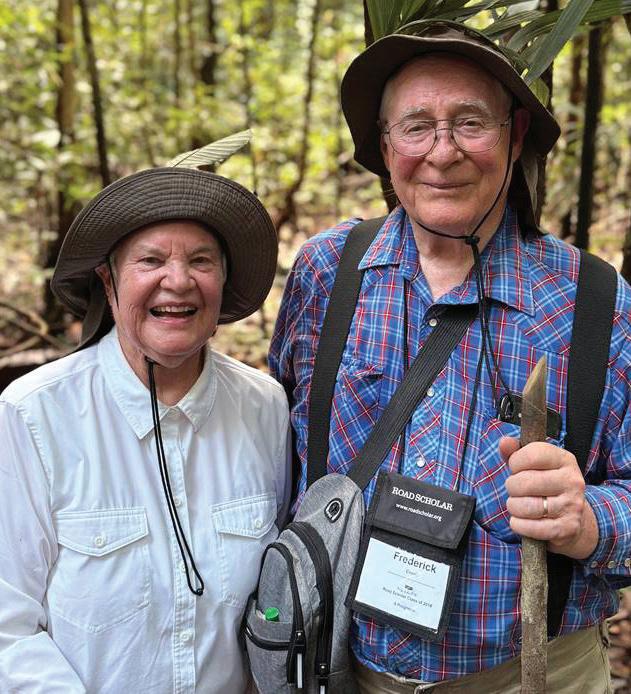
on our trip to Iceland and the second was the discovery of a kidney stone five days after our return from the Amazon.
“Iceland: To go or not to go? That was the question. We probably would never have another chance to go, would miss the chance to travel with dear friends, Russ and Debra Munk, and would lose the entire cost of the trip. Besides, wouldn’t it be as easy to recover aboard a Viking cruise ship as all alone in Alpine, Utah? After receiving a hesitant approval from the doctors, we gathered clothes and medical supplies and left for Reykjavik! We took a week traveling from charming tiny towns to lovely mountain scenery, circumventing the island. No soaking in the Blue Lagoon for us though!
“Amazon: What preparations we made for this trip! We got light, long-sleeved shirts, light pants, tight around the ankle, ponchos, sturdy walking sticks, hats, light backpacks—and then we sprayed them all several times with Permethrin and loaded up with DEET repellent for ourselves. We must have done a fair job; no bites for Elizabeth, only one for Frederick. Our travel group, 20 people organized by Road Scholar and consisting of teachers, principals, psychologists, lawyers, vets, etc. boarded a river boat and started our exploration of the Amazon and Rio Negro Rivers. Our day started at 5:30 am, quietly gliding down the huge river, stopping to see caimans (small South American crocodiles), boa constrictors, poisonous frogs, and many
birds. Frederick even caught a piranha! Restful times for lectures and study were during the heat of the day—lunch and early afternoon. We survived two walks into the rain forest jungles, thanks to our trusty walking stick.” (See photos above.)
BERNHARD GLAESER sends the following from Berlin: “Heide and I wish you a healthy New Year. It might not be peaceful. Berlin is freezing and in sledding mode. We were lucky to have barely escaped an act of terrorism on the electricity supply for southwest Berlin in early January. The temperature was and still is well below freezing. Meanwhile, Steglitz-Zehlendorf, a Berlin suburb of about 300,000 inhabitants, is without power. A far leftist group of unidentified people is blamed, and the sabotage was skilled, professional, and very successful. I suspect some Russian agency. A few days ago, the federal government offered a 1-million-euro award for useful information. Once again, we wish you a healthy, yet also peaceful, 2026.”
MARTIN MYERS: “We created our Class of 1959 Endowed Fund for Financial Aid in 2024 to provide financial assistance to ‘otherwise qualified students whose household income is at or below the median household income for the District of Columbia’ (which in 2023 was $106,287). The Sidwell Friends Advancement Office reports that, at the end of 2025, the principal of our Fund was $137,817. That is sufficient for Sidwell Friends to begin spending
our Fund’s income in 2027. However, the Fund income will be insufficient for us to assure that we make available the unique education—that we all experienced—to a child of a family with modest income. Classmates, together let’s try to expand our Fund principal to better meet our objective.”
DAVID WOOLPERT: “After an almost complete recovery from my torn right quad muscles four years ago, I tripped again and tore one of my right hamstring muscles last summer. Now I’ve recovered enough from that so yesterday I was able to do my normal weight-lifting routine at the local fitness center and then go with my wife on a four-mile cross-country ski trip not far from our home.”
CLARK GRIFFITH: “As for me, life in Minneapolis is, well, life in Minneapolis. I continue to recover from a decades-long battle and am now well. The first issue was NPH and the second ACDF. I use the Mayo shorthand. I also added two granddaughters within three days of each other. Alexandra Marx is in Bethesda and Nina Velasquez is in Forest Hills. A joint birthday party is planned for Westhampton Beach in August. You are all invited.”
1960
JODY HUTCHINSON-GRAFF mjodyh@yahoo.com
1961
BUNNY ROSENFELD bunnyrosenfeld4200@icloud.com
CAROL CARPENTER ESTEBAN provided the English translation for a historical novel based on her own mother-in-law. Wartime Teacher (Spain, 1932–1939) by Alicia Pascual Hernánsanz is available on Amazon and has sold out in Spain (see “Fresh Ink,” page 22). “The publisher didn’t give me a chance to proofread it, so though it has several errors, it is still a moving story about a country at odds within itself.”
CHETT BREED chettbreed@gmail.com
CHETT BREED: Suanna and I are more and more engaged with thoughts of shuffling off this mortal coil—to harken back to Mrs. Perkins (?) and Hamlet. Nothing morbid—it just seems the most natural of things to be exploring emotionally, intellectually, as we approach the bourne from which no traveler returns.
I’ve also been thinking of our Friends teachers, how many of them were idiosyncratic characters, thrilling to be taught by. Mr. Hoagland, Mr. K, Mr. Forsythe, Mr. Biggs, Sra. Supervía, Mme. Porte, Miss Rosebrook, Mrs. Darrigrand, and Mr. Lobban—undeniable personalities! And so forth. Was it that we were just adolescents and any teachers would have had such impact, or was it that they were really remarkable? Of course—really remarkable!
JUDY MCGREGOR CALDWELL: “Another thing to check off my bucket list: Alaska. ‘Magnificent’ can’t fully describe its beauty. The endless range of mountains still remain in my mind. At home, I’m getting ready for another show in Philadelphia. I spent Christmas with my sister, Sue McGregor ’60. We and Sue Anderson ’60 had a grand time on Christmas Eve lunch reliving memories of Sidwell. Sue is well. She just finished a half marathon in Athens, Greece. Wow, not bad for 84.”
JUDY MARKLEY WASTLER is writing her memoirs of her time as a flight attendant, and one of the great joys of the class rep position is being her reader. Travel, romance, big business, politics, divorce, travel. And that’s only the first few years! She mentions that perhaps she’s writing for her son, a brilliant idea for this period of our lives to be thinking of making an entertainment and an education out of our histories, all for our offspring as though they had been the ghostly but inevitable companions of our careers. You go, Judy!
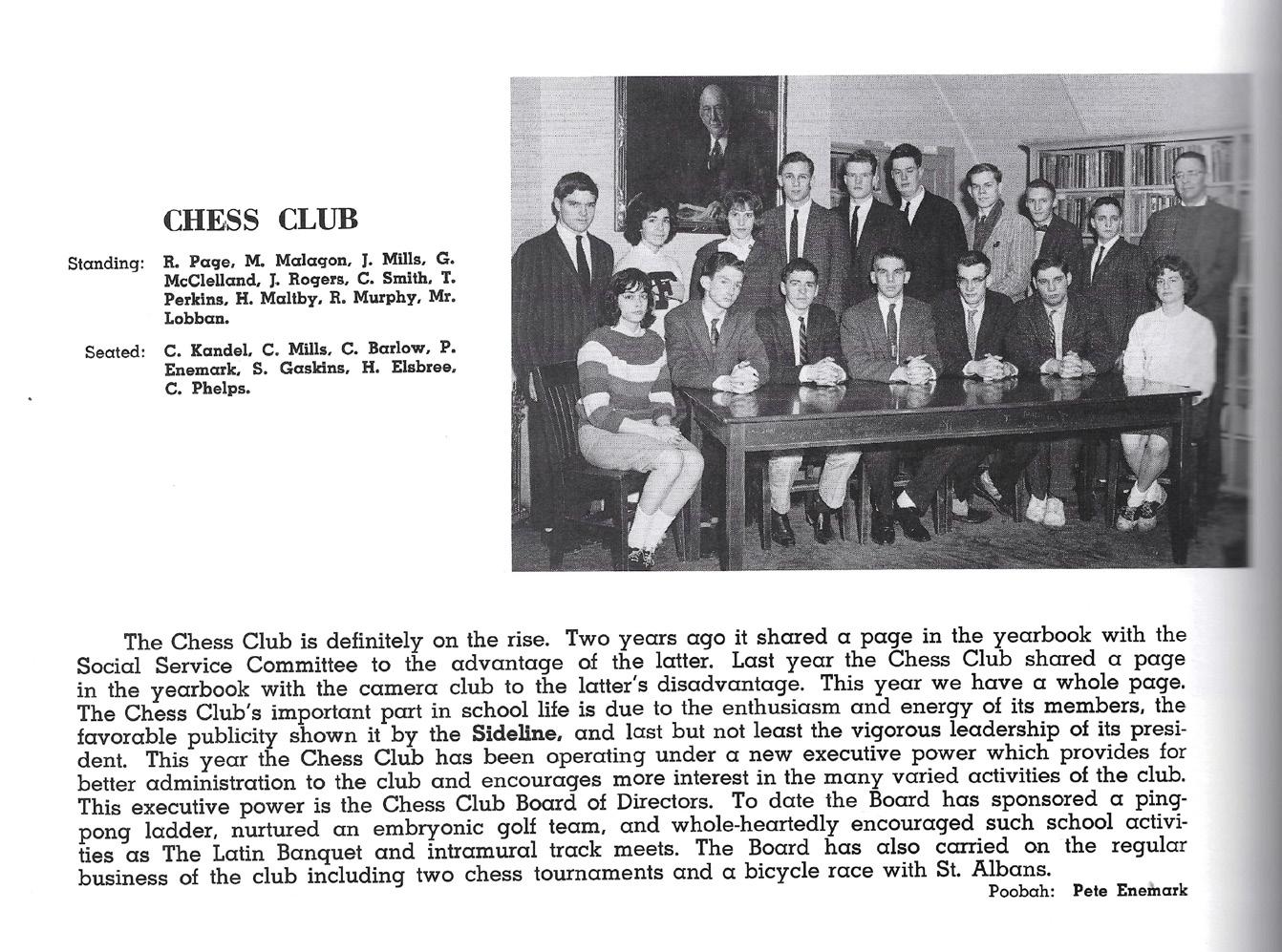
In the last issue of the Sidwell Friends Magazine, a group of students were identified as members of the 1962 Student Council. In fact, the group featured on page 51 of the Fall/Winter 2025/2026 issue are members of the Chess Club—seen here with complete information!
MARGO LEE HOFELDT margo10022@aol.com
JOHN BRODEY: “For those of you who have children/family nearby, I’m jealous. Living in California wine country has its advantages but ironically my son wound up in DC in 2015 where he began his career as a congressional reporter, which then led to his newest assignment as a national political reporter for The Boston Globe. And now my youngest daughter has moved there as well. They both love it, and so it seems I will be buying airplane tickets by bulk if I am to see them regularly. I couldn’t be happier. When my son, Sam, first got to DC, I flew in to show him some places that were part of my early life there, which, of course, included a stop at the Sidwell Friends campus. As we talked, he mentioned my lifelong fascination with languages and writing. He asked if there was a particular teacher who had stirred this interest in me. I didn’t hesitate as the words jumped from
my mouth, Miss Rosebrook our Latin teacher extraordinaire. She showed me how important words are, how essential Latin was in unlocking the secrets of their creation. It certainly seems that I successfully passed that passion on to my son. So, thanks Miss Rosebrook, you done good.”
ROSAURA EICHENBERG: “There is a glimpse of light on the horizon for us Latin Americans. We are dreaming of a free Latin America. Long time ago, when I was studying languages at the university in Porto Alegre, we students thought that Fidel Castro was a hero and Cuba a promising land. We could not be more wrong, as it is often the case with ideologies. After so many years and so hard times for the Cubans, Cuba is about to be free. My heart is filled with joy, even if Brazil still suffers under a stupid dictatorship. A free Cuba brings a ray of hope. Maybe we Brazilians will have a fair election in October and get our freedom back. A Brazilian guy in the Congress, 29 years old, has just walked 158 miles from Paracatu, Minas Gerais,
to Brasilia, asking for freedom and the end of censorship and political persecution. He started his walk alone on January 19, but when he arrived in Brasilia on January 25, there was a huge crowd with him. We Brazilians want to live in a free country. I guess we must pray and walk some more. God bless America.”
MARGO LEE HOFELDT: “We started off the New Year with a catered New Year’s Eve party in our apartment for 50 friends! It was a great group, the food was delicious, and the fireworks were awesome—so a good time was had by all. Since then, it’s been very busy but that actually started soon after the summer was over when we returned from Connecticut. I participated in another Flower Show, and much to my surprise, I received a Blue Ribbon for my table design; plus one of the plants that I entered in the Horticulture Division won the Growers Choice Award and Horticultural Excellence! Trust me… this was just luck, no green thumb. We enjoyed the holidays with our granddaughter and can’t believe that she’ll be 5 in July. Then in January, activities here really ramped up with Art Basel, Garden Club, and Orchid Society, plus events such as House Tours and the upcoming Kitchen Tour, where we visit people’s homes to see their kitchens and at each stop there is a restaurant with samples of their food and there is also a retail vendor. Besides all that, we have three theater subscriptions and the Miami Symphony Orchestra. We’re doing our best to enjoy every day!”
ALISON FEISS KRIVISKEY: “We have survived a very snowy winter here in Northampton, Massachusetts—it is New England after all. Life in our retirement community continues to be a pleasure, with so many interesting neighbors. We continue to take advantage of the cultural events in the area, benefiting from the presence of five colleges in a seven-mile radius (the University of Massachusetts, Smith College, Amherst College, Mount Holyoke College, and Hampshire College). One of our grandsons is a senior at UMass, and he is very helpful around the house—in exchange for meals at local restaurants.
Go to sidwell.edu/classnotes and let us know what you’ve been up to.
His brother is a sophomore at American University and loves being in DC. Our granddaughter is in the Doctor of Physical Therapy program at the University of Wisconsin. She teases us that she will have to be addressed as “Doctor Elise” when she graduates. Our 10-year-old grandson just moved to Bend, Oregon, with his parents. His father, my son Dave, retired from the U.S. Forest Service. He is establishing a new life teaching the practical skills he used in his 24 years with the Park and Forest Services at a community college. My daughter Kelly is in senior management at the Museum of Fine Arts, Boston, so we see her often. These are difficult times and we wish everyone strength to withstand the challenges.”
1964
LOUISE BERRY STRAIT lbstrait@gmail.com
1965
KEN LESURE ken.lesure@gmail.com
1966
CHRIS DEMATATIS cdematatis@aol.com
RHODA HIGHSAW BUSH and BRUCE BUSH moved this past fall from Frederick, Maryland to Ypsilanti, Michigan, having purchased a house just down the block from daughter Sarah Bush Hechler ’08, her husband, Jeff, and our 3-year-old grandson, Owen. It was bittersweet to leave Maryland after our 40 years there, but we love being able to grandparent up close on an almost daily basis. The weather gods have seen fit to welcome us with one of the colder and snowier winters this area has seen in a
while, but we are happily settled into a wonderfully friendly neighborhood, making friends and finding ways to continue the activities we enjoyed in Frederick. Ypsilanti is just 20 minutes east of Ann Arbor, Michigan, which offers many cultural activities and good medical care, and the state of Michigan has many wonderful recreational opportunities. If any classmates are visiting out this way, we would love it if you would get in touch: brucebush03@gmail.com, rhodopatch@yahoo.com.”
HOYT HILSMAN: “Greetings to all my Class of ’66ers. I’ve been living in Pasadena, California, for the past 40 years after migrating from the East Coast. Still working as a playwright and screenwriter—couple of plays produced this year and wrote/produced two indie films. Active in politics as chair of the United Democratic Headquarters in Southern California. Also, I am president of the Pasadena City College Foundation, which was honored with a $30 million donation from Mackenzie Scott as an outstanding minority-serving institution. My artist son Michael and his wife live nearby, and my wife, Nancy, is thriving as an artist after retiring from teaching. We travel as much as we can to Europe and Mexico, and sample our local Chinese and Latin American cuisine. Still managing to get around the tennis court. Would love to hear from fellow classmates!” (See photo below.)
1967
STEVE BATZELL swb.abacus@gmail.com
CHERYL DODDY HOWARD and her husband, Jeff, recently visited Paris, Normandy, and Mt. San Michel before spending two weeks in Greece. Cheryl continues to enjoy her university trustee board work and supporting diverse students. (See photo above.)
BOBBY MILLS: “I have taken a deep dive into Delaware politics having become a member of the Delaware Democratic Representative District 14 Committee in Sussex County Delaware and was chosen to be a delegate to the Delaware State Democratic Convention last June 21. I am currently working within the party to help register young voters and ensure their issues are addressed within the party. I will also be working as a judge at the polls for the upcoming midterm congressional elections.”

ROLLIE FRYE rolliefrye@gmail.com
LAURIE PRICE: “I’m grateful now to be retired from teaching anthropology. Bryan and I are able to travel more, often visiting friends and family (Oregon, Arizona) and enjoying the mountains and the California coast in our truck camper (our dog loves playing on the beach). As I write this, we are about to head off to the winter Olympics in the Dolomites, kind of a bucket-list item. But every day there is also worry about our human assaults on nature and about human violence and suffering. A couple of years ago, I took up acrylic painting. Surprisingly to me, I have had paintings included in several gallery shows in the past year. Sometimes I wish I could do idyllic landscapes or beautiful flowers. But what moves me to paint is our human impacts on other species, e.g. fossil fuels on coral and polar bears, Neonicotinoids on the bees, plastic waste on sea creatures. Sad themes, but good to have more time for the right brain! Through all the twists and turns of life, there are many warm memories of Sidwell Friends and friends in the Class of ’68.” (See photos below.)
1969
Want to be a class representative? Contact alumni@sidwell.edu.
ALICE ECHOLS published a new book, Black Power, White Heat: From Solidarity Politics to Radical Chic (see “Fresh Ink,” page 22). An American historian, Echols has written a book that re-exam-
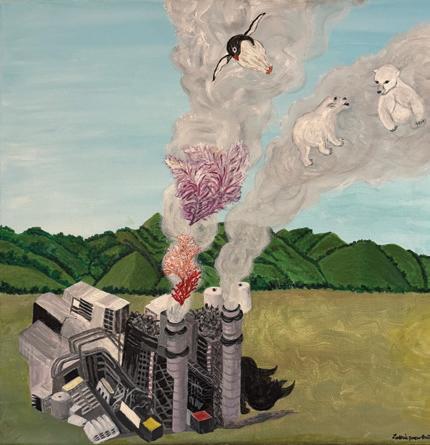
ines Black and white activists’ collaborations in the 1960s freedom movement. (See photo on next page.)
MARGARET WEAVER STEEL mwsteel22@icloud.com
BETSY GLASSMAN: “I have been plugging away at my songwriting and recording projects. My songs and videos are streaming on several sites, including Spotify, Facebook, and Instagram. Initially, I posted original songs recorded in the 1990s and a few covers while writing and recording new and nearly new material that will soon be streamed—so stay tuned. To access any and all sites go to: linktr.ee/betsysongs.” (See photo on next page.)
KRIS KELLY: “Uma’s Head, my novel about the illicit trafficking of antiquities in Southeast Asia, was published in late January (see “Fresh Ink,” page 22). Set in Bangkok, Phnom Penh, and the Angkor Archaeological Park in Cambodia, the book is inspired by historical events and explores the depths of friendship and betrayal, the long and lasting consequences of war, and the devastating effects of the looting of irreplaceable material heritage. It’s a part of the world in which I have spent a lot of time and about which I care a great deal. I hope that the book helps to bring the issues related to the illicit trafficking of antiquities to a general audience.”
JANET PERRY: “Alan and I are great-grandparents! Our granddaughter gave birth on December 6 to Noa Alexis McDaniel and she is adorable. We’re not sure how we feel about being
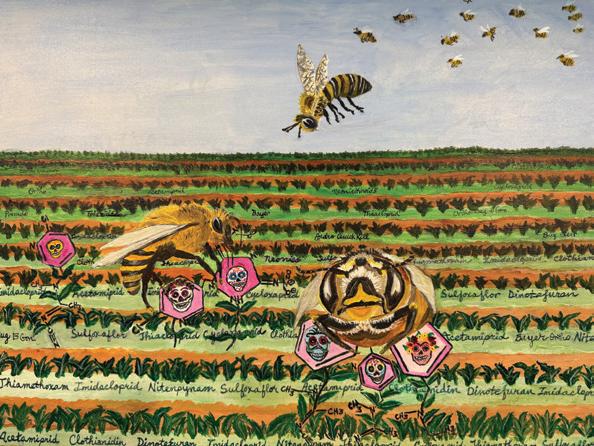
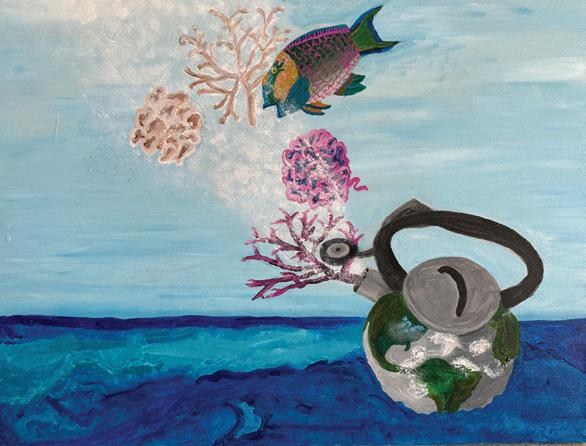
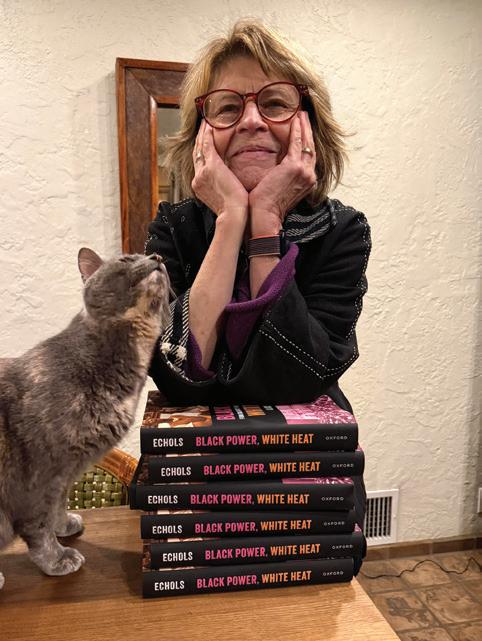
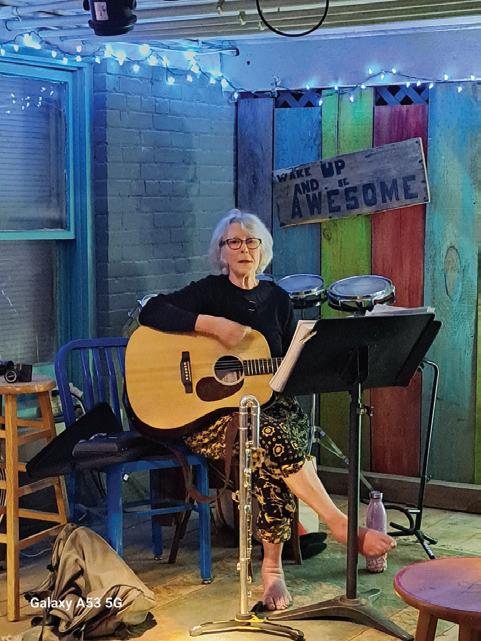
great-grandparents considering that in our minds we are still young and cool!”
CHRIS TUFTY: “Not much has changed here, though I have attended a few No Kings marches! Seems like the late 1960s all over again, when Sidwell Friends used to let us skip class to march against Nixon at the White House. By the way, we also celebrated our 30th wedding anniversary on Catalina Island in 2025!” (See photo above.)
MARY REYNER mary.reyner@gmail.com
BRIAN STEINBACH brian.steinbach@verizon.net
INGRID BEACH came to DC from her home in New Zealand to celebrate her mother’s 100th birthday on February 9, 2026.
MICHELE THOREN BOND: In between trips to London, Berlin, and New York to see her grandchildren, Michele visited classmate Ann Yoklavich in Hawaii.
JOHN EMORY: “I attended the 2025 Renaissance Weekend over New Year’s in Charleston, South Carolina, where I performed some of my parody songs on guitar along with my brother Marc Emory ’70. Shortly after my return from Charleston, on my birthday, I tripped on a root and banged up my right kneecap—to balance out my broken left ankle from last fall. This newer injury kept
me off the tennis court for over a week. Otherwise, I became an AARP volunteer last summer, supporting multiple local events. My younger son, Danny, quit his job in Ukraine after three and a half years in Kyiv, returning to the United States ahead of an expected brutal winter. He still has his condo on Wisconsin next to Sidwell Friends. Danny is poised to start a five-month French language program in France.”
DAVID HARDY tells us: “I now have seven grandchildren, two just older than I was when I graduated from Sidwell Friends—but I think I got a head start on grandchildren for most, if not all, of our class. After a wonderful five years in Woodstock, Vermont, I returned to Salt Lake City, Utah, in 2020 to be where most of my children and all my grandchildren are. I still practice law pretty much full time—but solo, and from my own studio apartment with a big picture window overlooking the Wasatch Mountains right in front of my table
desk. I enjoy not having to be around a bunch of big egos, and there’s not much impetus to quit. I’m still involved in music (soundcloud.com/user-314530335), performing solo acoustic gigs around town and sometimes playing with my sons’ band, The Hardy Brothers, at the Owl Bar at the Sundance ski resort— which I think must be the most fun a dad can have. The Wasatch trails, five minutes away, regularly beckon and I often succumb. A few of you might remember my family’s history with familial hypercholesterolemia (genetically runaway bad-cholesterol), and as the proud recipient of a preventative quintuple bypass in 1994 and 11 stents since then, I think I’m literally the bionic man. I am lucky to have serendipitously reconnected with Brad Clark a few years ago, and enjoy a wonderful friendship with him. He has so graciously supported and helped lead Encircle, an organization actively providing support to LGBTQ+ youth, young adults, and their families that I helped establish and expand when I returned to Salt Lake. Oh yes, and I still try to be a troublemaker for the powers-that-be here in Utah.” (See photos below.)
KEN MCCAULEY notes that in June, the Class of ’71 will begin our sixth year of monthly Zoom gatherings. “I am very grateful to and proud of my classmates who have been willing to come together every month and share their life experiences, reminisce about our days at Sidwell Friends, and have a few laughs together. We have participants from as far west as Hawaii, as far east as Great Britain, and as far south as Honduras. It’s

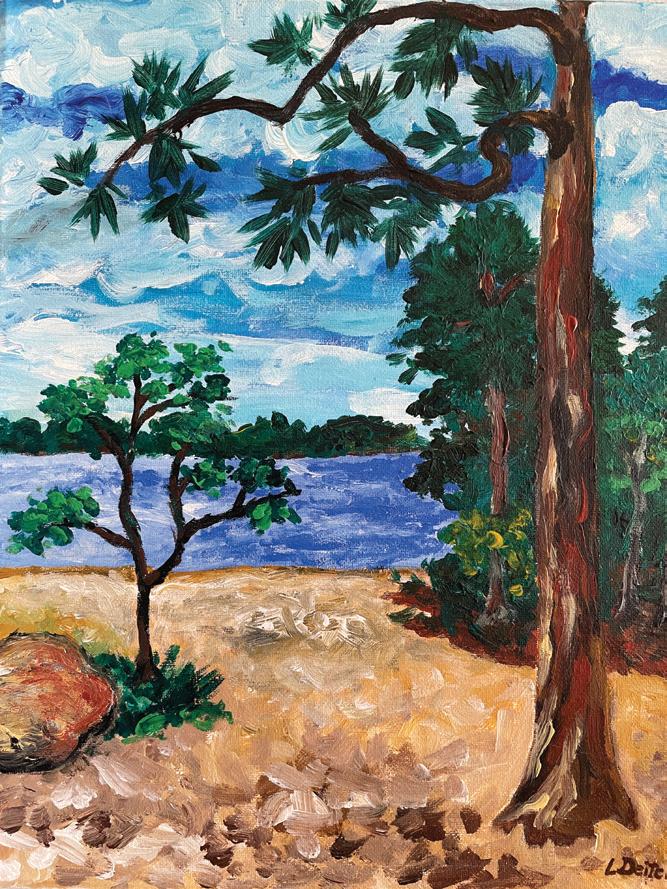
been a great pleasure to get reacquainted with everyone after so many years. It all started because we couldn’t come to campus for our 50th Reunion. Oddly, we have COVID to thank for these gatherings. My husband, David, and I have been fortunate to travel to Asia and French Polynesia this past year. In May 2025, we took a two-week land tour of Japan, including Tokyo, Hakone, Kyoto, Hiroshima, Miyajima Island, and Osaka, which included a day at Expo 2025. We particularly enjoyed our visits to the onsens, which are very deluxe Japanese baths. In November, we took a cruise from Hong Kong to Singapore, including Halong Bay, Danang, Ho Chi Minh City aka Saigon, Bangkok, Ko Samui, and ending in Singapore. In Bangkok, we visited the grand palace where the king lived who was the basis for The King and I, which was especially memorable as Mrs. Adams, my 3rd grade homeroom teacher at Sidwell Friends, introduced me to that musical. Over New Year’s, we continued our Rogers & Hammerstein tour in the South Pacific with a 10-day cruise in French Polynesia, including Mo’orea, Bora Bora, Raiatea, Huahine, Rangiroa, Fakarava, and Papeete, followed by four nights in an overwater bungalow at the Pearl Resort in Bora Bora. Spending a few nights in an overwater bungalow should be on everyone’s bucket list. Iorana to all!”
MARY REYNER and BRIAN STEINBACH are busy helping the 55th Reunion committee pull the event together. At the time of this submission, they were looking forward to seeing Elizabeth Reich and Ken McCauley at the end of February in Scottsdale, Arizona, and Palm Springs, California, respectively.
PATRICIA JONES WILL writes: “We have bought a no-generator or propane 25-foot class C motorhome, built on a Sprinter diesel chassis. Lots of solar panels on the roof. We are planning an epic three-month trip through the Canadian Rockies and Alaska. We have been planning for several months and are very excited for this new adventure. So much to see and do and we are not getting any younger.”
JOYCE
JACOBSON joyce@brastedhouse.com
Want to be a class representative? Contact alumni@sidwell.edu.
LISA WEINSTEIN DEITCH: “After a long career as an attorney and having studied art before law school, I am pursuing painting in retirement. I am inspired by nature and use expressive brushstrokes and vibrant colors to depict natural wonders. Two of my landscapes were recently accepted into different juried art exhibits. My painting, Pines Amid Clouds, will be shown at the Arlington Artists Alliance Gallery from February 26 to April 5 at Crossing Clarendon, which is across from the Whole Foods in Arlington, Virginia (see photo above).”
MICHAEL TAPSCOTT: “Many years ago, Pam and I honeymooned in Australia and Hawaii—an amazing experience. Fortunately for both of us, the Hawaiian culture became embedded in our lives. We have traveled to six of the major Islands during the last 35 years. During that time, Pam has been dancing hula, playing ukulele, and performing locally with a wonderful group/hui for 18 years
now. My collection of Aloha shirts has grown to over 100, we are members of the Washington, DC, Hawaii States Society, we attend lots of DC-area events, and we stay connected with the Hawaii Club at GW. During our 50th Reunion, a number of us talked about Hawaii primarily because Sam Guckenheimer was so passionate and peaceful while sharing stories about his adopted home on the Big Island, Hawaii. I promised Sam that Pam and I would visit during our next trip to the Pacific. Thanks to Sam’s patience and flexibility, and my old-man-driven desire to rid my life of any more empty promises, Sam joined us at a well-known local joint in Kona called Broke Da Mouth Grindz. Stylishly placed between an older laundromat and a former motorcycle repair shop, Broke Da Mouth’s food is... maika’i loa—simply awesome. What was more awesome was Sam’s willingness to drive north from his home to meet us there. For Pam and me, this was our first cruise of the Hawaiian Islands, and our schedule was too compressed to get to a rental car company and drive to visit him as we planned. Nonetheless, it was a joy to hang out with Sam in Kona, for great food, great coffee, and greater company. There is something very special about spending time with good people from our formative years. I worked in university admissions, student affairs, and administration for 45 years. Those experiences convinced me that high school is the gateway to the rest of our lives. Almost everything we become in life, is formed by our experiences in high school, and polished in the university/other life experiences. Seeing Sam was a great reminder of the connections we build when we are 18, and what happiness they can bring as we connect later in life.” (See photo below.)
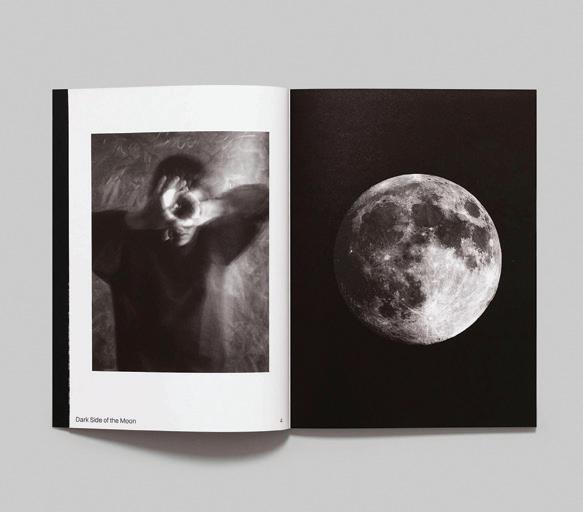

LESLIE WOLF-CREUTZFELDT lcreutzfeldt@yahoo.com
PAUL MARKUN pmarkun@gmail.com
MARIANNE BERNSTEIN KALB released a new book of photographs, Dark Side of the Moon (see “Fresh Ink,” page 22). “Dark Side of the Moon is a poetic journey exploring connections between our inner and outer worlds, reason and emotion, the known and the unknown. Scientifically, ‘the dark or far side’ of the moon is the view we cannot see from Earth. In this book of photographs, astronomical images from the far side of the moon are interwoven with dream self-portraits, scientific imaging of the artist’s interior body, and craters from nuclear testing sites.
Under the microscope, our bodies are a galaxy. Most likely our cells originated in outer space. All four building blocks of DNA and RNA (which encode our genes) have been found in meteorites. These represent the entire blueprint of who we are. Facts, reason, science, intuition, mystery, and emotion—we need to forge deeper connections to other realities and to ourselves.” See photo above. For more information go to mariannebernstein.com
KARL BOSTIC: “Well it’s been some year. I’m still in Israel covering the war for PBS NewsHour. I came on the second day of the war, October 9, 2023, and haven’t left. This period has been one of the most transformative times
in my life. Being in the middle of a war like this has brought out the best in people and the worst in people. I have seen both. I have been staying in a small hotel that catered at first to displaced families from the attacks of October 7, and then to diaspora volunteers from around the war—mainly from the United States and Canada. Last June, there was the 12-day war with Iran. Those were sleepless nights. Alarms and sirens wailed constantly, and we would spend nights in the bomb shelter of the hotel. Standing room only. It revealed a lot about people. Last August, I filmed a story and was attacked by a group of Israeli teenagers, because I was a foreigner. Being Black didn’t help. I was almost killed. The whole country still has a kind of collective trauma. I am now coping with PTSD from the attack. Weeks later, I was invited to spend Rosh Hashanah with the 300 kibbutz members of Nir Oz. The kibbutz was nearly destroyed in the October 7 attacks, and a quarter of the population killed or taken hostage (see photo above). Last fall, the remaining living hostages were released. I was in Hostage Square covering that. Thousands of people. A cathartic moment for everyone. I try to play tennis whenever I can to take my mind off all this. The values instilled in us by our parents and our time at Sidwell Friends have helped me get through all of this.”
Check out some of Karl’s reporting for PBS:
CAMILLA BRYCE-LAPORTE was featured in KUUMBA-LIVE!, a celebration of the sixth principle of Kwanzaa at the DAR Museum, sponsored by the Daughters of the American Revolution Museum and the African American Craft Alliance. KUUMBA-LIVE! is part of the closing events for the groundbreaking exhibition Fighting for Freedom: Black Craftspeople and the Pursuit of Independence. (See photo below.)
BETSY KARASIK: "I am fortunate to be well and enjoying studying guitar and Spanish among other pursuits. Recent travels in Mexico and Costa Rica have included many encounters with the kind and wonderful people there, underscoring the tragic vilification, scapegoating, and persecution of immigrants in this country. I am constantly reminded of my many privileges, including my Sidwell education, and try to give back, including volunteering for DC Books to Prisons (let me know if you have books to donate) and protesting the current regime whenever possible.”

LISA CARTER: “I just published a book about ethical meat farming called Hamburgers Don’t Grow on Trees: Raising Beef on a Family Farm with Kindness. Recommended by Temple Grandin and illustrated with my photographs, Hamburgers Don’t Grow on Trees is written for children, parents, and educators.”
STEPHEN CHANOCK enjoyed Thanksgiving 2025 with 18 family members including eight grandchildren and seven dogs (see photo below)! He was also elected to the National Academy of Medicine in October 2025 (see photo below).
JODIE DEMERE CLEMENTS: “In October 2025, my husband, Dennis, and I took a Viking River Cruise for a week on the Rhine River mostly in Germany and we had dinner with one of my nieces and her husband in Cologne. Our next cruise with Viking is also for a week from Lyon to Arles in France in April 2026. When we are home here in Huntsville, Alabama, we stay busy with our three grandchildren and our three children and their wonderful lives. I give thanks for our good health, and I give thanks for my Sidwell Friends Class of ’74! Most of us are turning 70 this year. Happy Birthday to us all!”
Want to be a class representative? Contact alumni@sidwell.edu.

MARY ANN MCGRAIL mamcgrail@yahoo.com
BETSY ZEIDMAN betsyzeidman@gmail.com
ADAM STERN adamcstern@aol.com
PETER MACDONALD pmacdona@skidmore.edu
CHERYL BASCOMB: “I retired at the end of December. It’s a tough time to be in higher ed (or the federal government, or public health, or lots of other places). I’m looking forward to traveling less, enjoying time with family and friends, and getting better at golf and hockey. I’m getting back to running (slowly) after a hip replacement. It looks more like hurrying than running, but I’m glad to be doing it. I have just finished a fun visit with my mother and was able to see Burr Gray ’75 and spent time with Marli Heimann Pasternak in her beautiful new home in Bethesda. She was just back from a bike trip in Portugal.”
HILARY KACSER: “You already know about my advocating for Washington, DC’s Department of Behavioral Health to fill the severe service gap and unmet need for people living with the
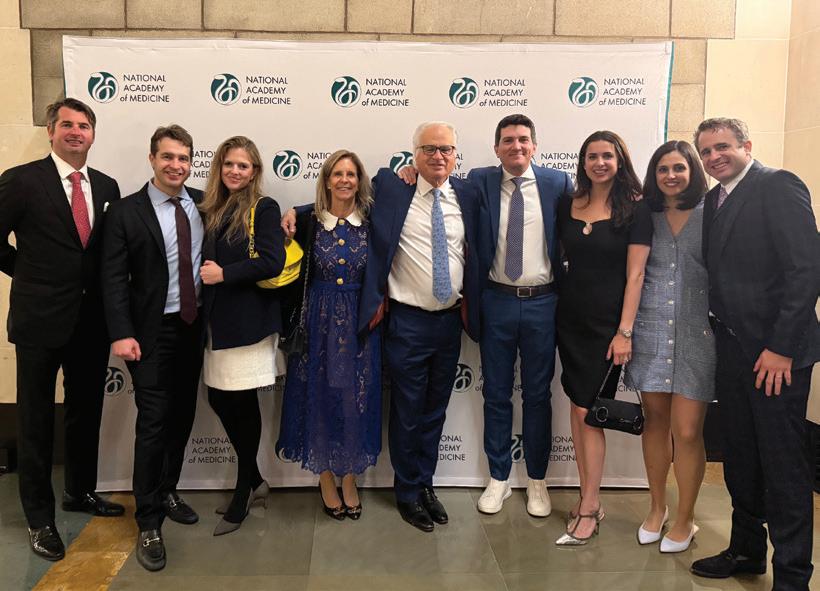


diagnosis, defined nearly 13 years ago, as hoarding disorder. You friends who have kindly supported this campaign and graciously engaged about this issue at reunions are most appreciated. Growing out of the original solo show, DisordR, The Play (a comedy about Pakrat Patty, the self-identified hoarder, who comes out of the clutter closet to shine light on recovery), the effort to provide cost-saving—and life-saving—early intervention and harm reduction continues (including through national coverage on NPR and a U.S. Senate Special Committee on Aging report). (See photo above.) You can help! DC Council hearings occur each spring, with many opportunities for DC elected officials to hear from you: tinyurl.com/SpeakOutOfTheClutterCloset. We all have mental health, and we all need good mental health. Here’s to your good health.”
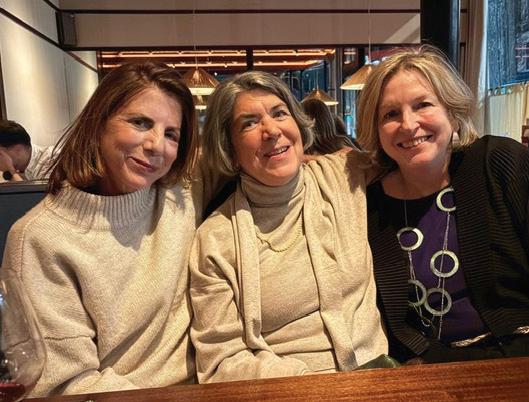
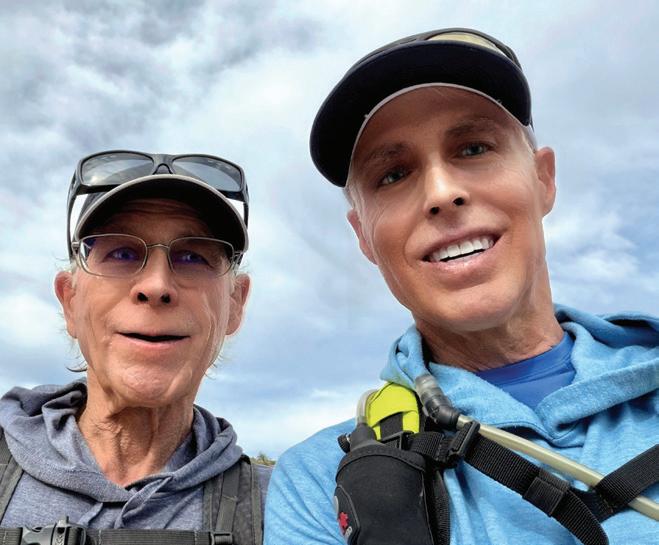
TED LEWIS bethesdated@gmail.com
KEENE TAYLOR keene@tayloragostino.com
DAVID THURSTON: “I am happily settled in the DC area where I have been running a tutoring business and working part-time in several DC public schools. Seeing a pressing need, several colleagues and I recently started a nonprofit to tutor and mentor low-income DC public high school students to equip them to succeed in higher education or in a professional trade. We started operating at the beginning of 2026 and have already begun work at a high school in Anacostia. I am the executive director, and the founding board members have years of experience with teaching and tutoring, college and career access, grant-writing, fundraising, etc. Please check out our website: BrightPathsDC.org. I am grateful for the enthusiastic support from a number of Sidwell Friends classmates as we work to get up and running. Having tutored in DC public schools for almost eight years, built strong relationships with students, and seen how such efforts can transform students’ lives, I am eager to expand this work.”
ROBERT WILDER: “What a pleasure to be reunited with former Sidwell Friends Middle School P.E. coach and wilderness instructor Gary Nussbaum. Gary was instrumental in fostering a love of
the outdoors that so many of my classmates and I share. After two hours hiking through the Sonoran Desert—more than 50 years later—he remains as fit and quick-witted as ever. Gary extends his warmest wishes to all of his former students.” (See photo above.)
WILLIAM RICE williamrice63@gmail.com
ANNE HALEY: “This is the year I turn from a 40-year practice of the law (ouch, 40?), trading profession for passion, as I leap (for joy) into a writing career. My first piece is completed, and I begin to send it out for hopeful publication in the coming weeks. And guess what that is? If we asked each of our classmates, would they recall who our high school commencement speaker was? I’m sure so. We are not yet so far gone as that, I pray. Well, my Uncle Alex’s landmark book, Roots, The Saga of an American Family, was published 50 years ago this year! In recognition of that anniversary, I have written a piece that celebrates the work, its impact on this progeny, the country, and the world. After that I have a yet unfinished memoir, a midlife humor book, and a series of children’s books teed up and waiting in the wings! I am excited about this next chapter and look forward to sharing it all with all of you.”
LOUISA SCHNEIBERG HOLLMAN: “Who can resist William’s Pulitzer Prize–worthy appeals for Class Notes? Obviously, I cannot. Not much new to report
since our wonderful 45th Reunion last May. Summer came and went. We spent much of it in Rehoboth at our home there. We love the beach, and I play a lot of pickleball. Thanksgiving and the winter holidays have also come and gone. It is now January and we head to LA next month for two weeks to visit our son in Santa Monica. I hope to see Eva Davis Semple ’80 while I am there. I have reconnected with Sonia Flanders McArdle ’81 who moved back to DC a few years ago. Steve and I visited Sonia and Rich in Truro, Cape Cod, last summer and had dinner in their beautiful Kalorama home recently. I very much enjoyed reading the tributes to Cathy Brown—especially from Lindsay Luke, who I do not believe has surfaced in 45 years! I’m still working as the executive director of The Defiant Requiem Foundation, and I am heading to New York City for a film screening of our documentary film at the Museum of Jewish Heritage. Our work seems more important now than ever. Warm regards to all.”
KERRY PELZMAN: “Good riddance to 2025: Here’s to community, friends, public servants, and more of the Light in 2026. A group of us gathered virtually in January and reminisced about Cathy Brown; the recent loss of Avyeris Andonyadis, Nephelie Andonyadis’s father (just a week after Sandra Bronfman and I got to pay him a visit and appreciate Nephelie’s years of devotion to his well-being); Radhika Rajagopalan Hariharan’s transition out of private practice; Sandra’s impressive year-long fellowship at the National Humanities Center in Durham, North Carolina, and progress on her latest book, focusing on Puerto Rican Nationalism and memory; my adjustment to involuntary retirement after 27 years with USAID’s Foreign Service and closing the Mission in Cambodia; and, most excitingly, Maryland Pao’s recent professional recognition as a recipient of the Academy of Consultation-Liaison Psychiatry’s 2025 Award for Excellence in Child and Adolescent Consultation-Liaison Psychiatry.”
WILLIAM RICE: “As a happy follow-on to our 45th Reunion last May, I got together with two classmates this past year. The first was James Dix, whom I used to bug in 10th grade English class by asking him to translate unlikely English phrases into Latin (“The farmer is always victorious”). All these years later, James was still willing to meet me at a deli in my Cleveland Park neighborhood—then reciprocated by inviting me to one in his Northern Virginia community. Along with catching each other up on decades of living, James was able to offer tips on a trip to Paris I took with my wife for our 10th wedding anniversary in October. The second classmate connection was with Charlie Kupfer, with whom I’ve been in more contact than James over the years but as with James, still not enough. Charlie and I used to act out scenes together in high school—drawing on source materials ranging from science fiction to spy novels to world history. Yet these improvised presentations were not performed in a drama class but in the hallways and fields of Sidwell Friends, often to our classmates’ confusion. Our discourse is more traditional now, but just as delightful.”
1981
ANDREW SZANTON aszanton@rcn.com
DOLLY FOX: “Everything is terrific on my end. I am super, super busy as usual. I had a huge success with my musical show, Slay This Way, last spring starring
some major, major players, including Darryl McDaniels from Run-DMC. (He is the co-chair of the Felix Organization for Foster Children, which I am on the board of). We raised a couple hundred thousand dollars for foster children. Slay This Way focuses on one of our summer camps, which happens to be the only existing summer camp in the entire United States for LGBTQ-plus children in foster care and their allies. I also sang in the production along with Broadway and Tony winner Christine Morales, RuPaul’s Drag Race All-Stars winner Ginger Minj, and many, many others. This is what I do for love and now have moved onto my other projects that hopefully will make me some money. I am producing Spotlight, the Dorothy Dandridge musical that had a very successful industry-only-staged reading and that opened this February at the Axelrod Performing Arts Center in New Jersey. Our hope is to get it to the West End in London and then to Broadway. In addition to that, I am co-executive producing a miniseries on Weimar Germany.”
BARTON RUBENSTEIN: “This past March, the boys from Sidwell gathered for poker, a game that has now been running for over 45 years! We basically have about 50 different conversations happening simultaneously, touching on all the past decades and at Sidwell Friends as well. The only rule is that if you mention anything related to medical issues, you have to put five dollars in the pot. The night is filled with continuous laughter and surprising outcomes on the
poker table. Other people who occasionally join the game are Jeremy Semple and Bryan Waters. Please let us know if you want to join!” (See photo below.)
JONATHAN LEVINE jlevine@sgtlaw.com
AMY THALER: “This past summer, my daughter, Blythe, had a wonderful internship working in the archives at Sidwell Friends, and she loved sharing her discoveries with me. She’s now in her second year at the University of Washington in Seattle, where she’s thriving. I’ve been spending a fair amount of time out there over the past year, which has made it easy to see her frequently— though it made her father wonder if I had turned into a helicopter mom and was now stalking her. When I’m not bouncing between coasts, I continue my work as a leadership coach and consultant, partnering with organizations on leadership development and people problems. During my Thanksgiving visit, I had the amazing opportunity to have lunch with my 1st-grade teacher, Karen Kalish, whom I haven’t seen since lower school. Bruce Gray and I also enjoyed hosting a dinner recently with Jason Horowitz, Maureen Kline, Eric Adler, Will Warshauer, and their partners. Finally, I crossed paths with Mark Stern in January a few times as well, making these visits feel especially full-circle.” (See photos below.)
LINDA GAUS gaushaus1965@verizon.net
GWEN PATTERSON-COBBS writes from South Carolina: “I opened my nonprofit Kingdom Healthcare Center (KingdomHealthcareCenter.org), providing free Pap Smears and physical exams, on September 13, 2025. We are able to provide care for women who are staying at one of the shelters here in Myrtle Beach.” (See photo above.)
JORDAN MUSS writes: “As with most of the class, the big 6-0 came for me this past year. I celebrated the last of my 50s by running a half-marathon in New Hampshire and winning a quart of maple syrup! Then in November, I ran another half in Arkansas, sadly winning the Seniors Division, an ominous start to my 60s. This is all part of my quest to run a half-marathon in every state; let me know if you have one you recommend.” (See photo above.)
NICOLE JANIN SHEEHAN: “Greetings from California and Jackson Hole! Officially, we are empty-nesters, so we spend much of our time visiting the grown kids (Boston, Colorado, LA!) and cherishing time with our 2-year-old granddaughter, Madeline. I am still keeping busy working for nonprofits, which is deeply gratifying. If you are in the Bay Area or in Jackson, let me know! I would love to see you all.” (See photo above.)

LINDA GAUS has exciting news: “My translation of Martina Hefter’s novel, Hey, Good Morning, How Are You? will be published in April 2026 by Penguin Random House UK with my name on the cover. Somehow, as I entered my 60s, my literary translation career was just getting started. Stay tuned for more works upcoming; AI hasn’t replaced all translators just yet!”
PATRICK HEWES reports: “Work continues. Wonderful summer weekends in New England. Fantastic awareness that while I am 60, now 61, energy and optimism remain strong. Very busy with parents’ care. Wondering as ever whether the Friends ethos is strong at school, how young people are navigating a current world contrary to the Quaker vision.”
AMANDA BIDLACK STRAND sends in this dispatch from Maine: “After raising our four children in the DC area, my husband, John, and I retired to the Bold Coast of Maine (Jonesboro in Washington County). We come back to DC regularly, and I hope to reconnect with the DC Sidwell Friends alum group in person one of these years. I so enjoy seeing everyone’s updates and news on FB and in the magazine. Would love to connect with other alums in Maine.”
1984
Want to be a class representative? Contact alumni@sidwell.edu.
1985
HILARY DAYTON
hcdayton@gmail.com
MAYA MACGUINEAS macguineas@crfb.org
TIP COFFIN tip@teamcoffin.com
NICKI HAMILTON BERNHEIMER and DAVID COLODNY were on hand to hear Alex Daniels’s tales of life on the punk music circuit traveling across the country as the renowned drummer of the cutting-edge punk band Swiz. The event was in New York City in December with members of the band to talk about their new autobiographical book, Swiz (see “Fresh Ink,” Fall/Winter 2025/2026). Swiz performed in DC in the late 1980s with Alex as its steady drummer—seen here in a picture from a Swiz concert (see photos on next page).
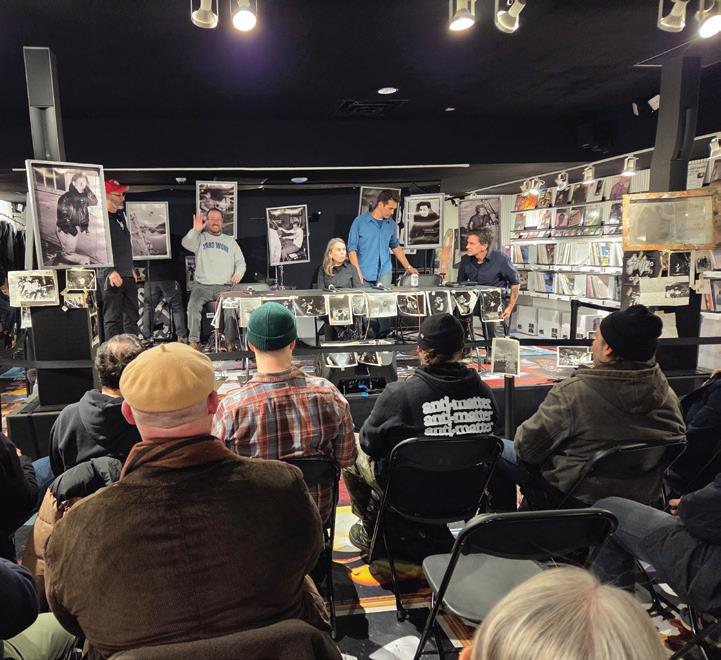
ANDY KAUFMANN: “Hey everyone, just a quick update. I’m still living the dream up in Downeast Maine. I now have two granddaughters! My son is exiting the Army after six years as a Blackhawk pilot and is awaiting decisions for entrance into master’s programs at BU, BC, Dartmouth, and Northeastern. My daughter Abigail and her partner moved to Nashville, and my other daughter was married and had a house built up here in Maine. I continue to guide on the lakes, rivers, and streams of Maine, as well as in Michigan, New Hampshire, and Massachusetts. I’m also continuing my service to veterans and first-responders as the program lead/director at Guardian Hills in NW Missouri. ‘Retired life’ is great because I’m doing what I love. Hope everyone is doing well.” (See photo below.)
LOUISE ANDREWS louiseandrews@me.com
ELIZABETH WYATT ebwyatt@aol.com
Want to be a class representative? Contact alumni@sidwell.edu.
Andrew Ferguson: “I have been making my way through the DC law schools as a law professor, now on number three at George Washington University Law School. My new book, Your Data Will Be Used Against You: Policing in the Age of Self-Surveillance, also just came out (see “Fresh Ink,” page 22). Hope to see everyone around DC.”
ELIZABETH TERRY: “Although the occasion was a sad one, it was good to catch up with Enid Logan Allen and Yasmin Holsey at Enid’s father’s memorial service in October. Enid is a sociology professor at the University of Minnesota, Yasmin is an OB/GYN in Maryland, and I am still in DC working in communications at Georgetown Law.” (See photo at right.)
TIM HANRAHAN tim.hanrahan@gmail.com
LEE BOYLE writes: “This past Christmas, Matt Wilson and I visited Aaron Millon who has been living in Rincon, Puerto Rico, for the past three-plus years with his wife, Debbie. This was my third Christmas in row visiting Aaron and Debbie, who are perfect hosts. They live steps from the world-class and consistent winter waves at Maria’s Beach, and I thoroughly enjoy daily body boarding and some surfing while there. Aaron runs a charter fishing business and, being a trained chef and former restauranteur, is considering a restaurant venture featuring fresh fish. In addition, Aaron, Matt, and I were happy to spend an evening with Chris Zeiner Noone ’90, who has lived in the nearby town of Isabella for the past several years.” (See photo on next page.)
EMILY PASTER emily.paster@gmail.com
JIM LOEFFLER: “After nearly 20 years at the University of Virginia, I made the move to Johns Hopkins in 2023, where I’m now the Posen Chair in Jewish History—and colleagues with fellow historian Francois Furstenberg ’90. My latest book, Exceptional Hatred: Antisemitism and the Fight over Free Speech in Modern America, comes out this summer. It grew out of everything I experienced during and after the events of August 2017 in Charlottesville. Meanwhile, I’m commuting to Baltimore from Shepherd Park in DC, where I live with my wife and our three kids (two 10th graders and a 12th grader).”
1993
CASEY COLEMAN HASSENSTEIN caseycoleman30@hotmail.com
1994
BETSY STOEL estoel@gmail.com
JESSICA GREEN: “I am grateful to say that I am now a Canadian citizen, along with my kiddos Hannah (13) and Milo (10). And I am thrilled to

announce the publication of my second book, Existential Politics: Why Global Climate Institutions are Failing and How to Fix Them (see “Fresh Ink,” Fall/Winter 2025/2026). Would love to reconnect with any Sidwellians passing through Toronto!”
LINNEA PASKOW will present Jacksonettes, a solo exhibition of paintings at Equity Gallery on Broome Street in New York City. The exhibition opens May 14 and runs through June 6. (See photo below.)
MARI PALMER MCDONALD mari.mcdonald@gmail.com
Want to be a class representative? Contact alumni@sidwell.edu.
ELLEN CORNELIUS ERICSON eccornie@gmail.com
Want to be a class representative? Contact alumni@sidwell.edu.
1999
LEMA KIKUCHI lema.kikuchi@gmail.com
Want to be a class representative? Contact alumni@sidwell.edu.
NICK FIEDMAN and OMAR SOLIMAN won two Emmy Awards and four nominations for their short-form documentary, HUNKS vs. The Hurricanes, which chronicled their company’s hurricane cleanup efforts in partnership with the mayor of Tampa following two historic storms in 2024. The 10-minute documentary can now be found on YouTube (see photo below). Watch here:
ELIZA ORLINS eorlins@gmail.com
MOLLY DONELAN CUPKA: “I wanted to share an update on a project that has grown into one of the most meaningful parts of my life. I am the founder and executive director of Up Ending Parkinson’s (UEP), a nonprofit that brings people living with Parkinson’s disease into climbing gyms across the
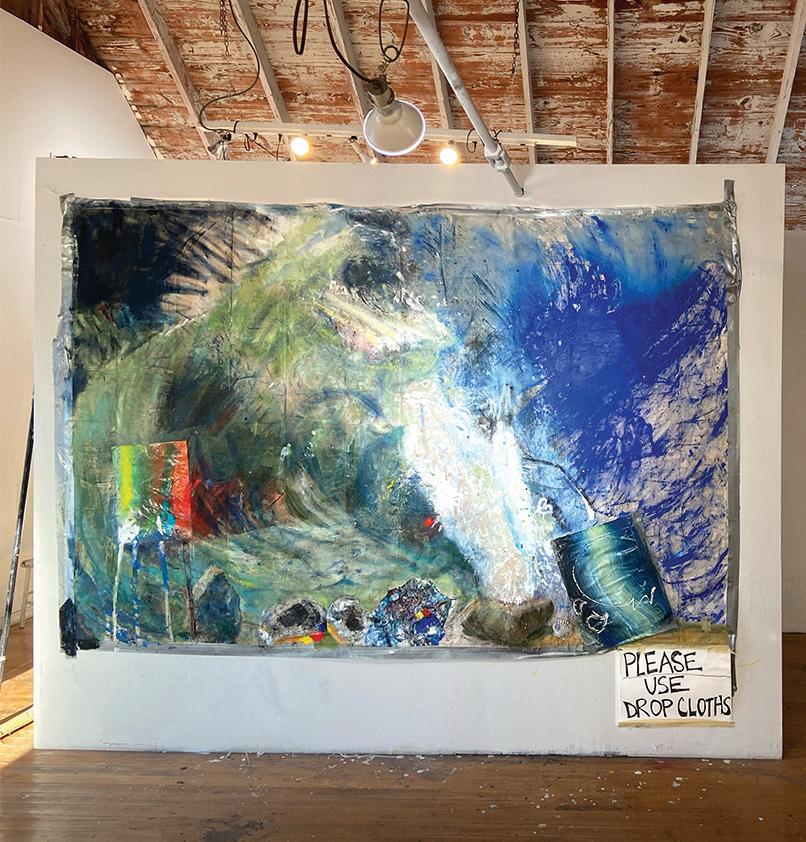
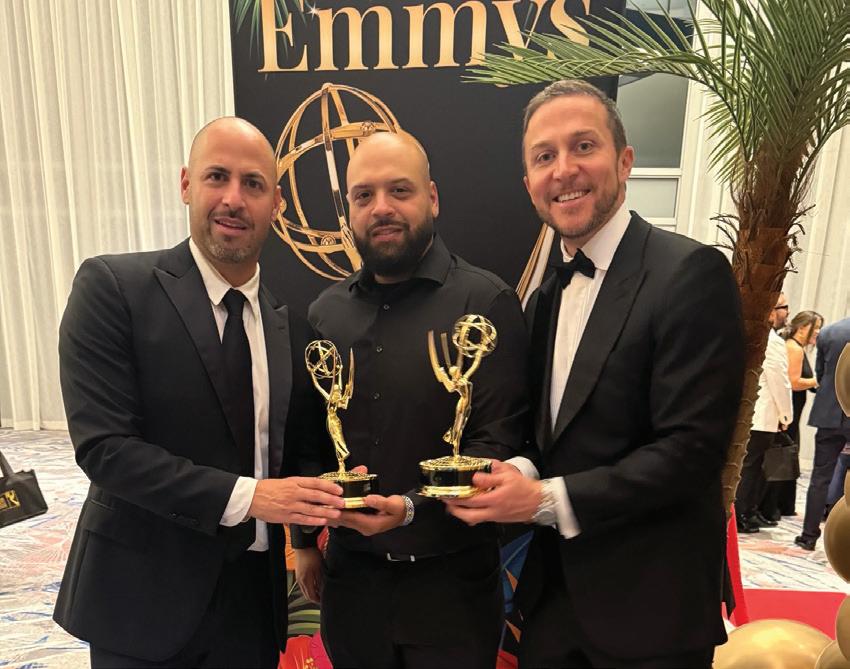
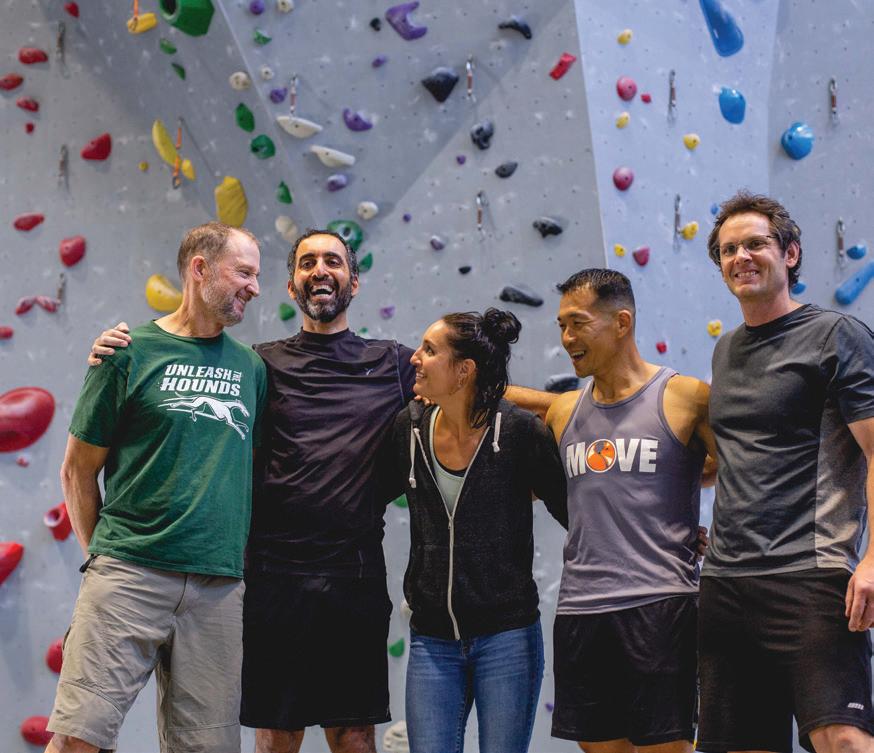
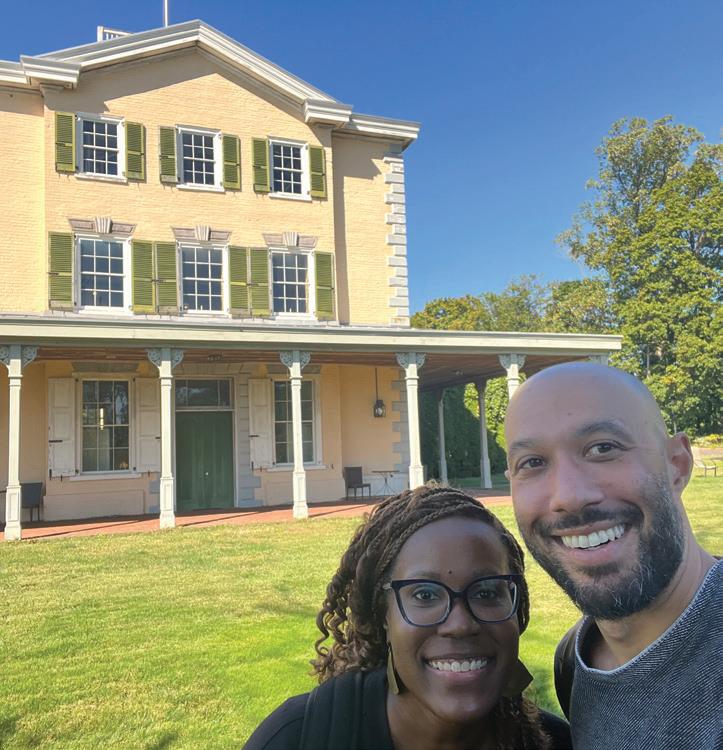
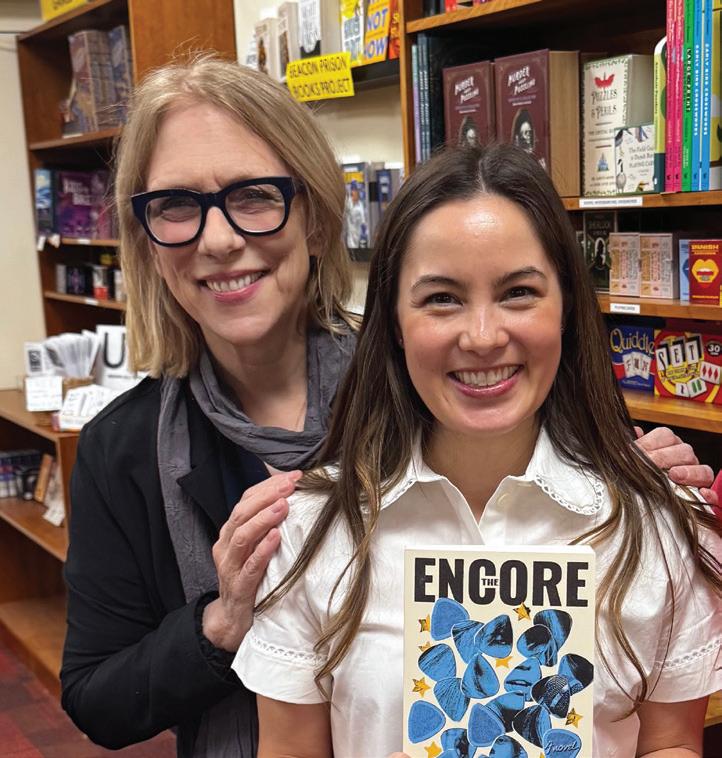
country for free, adaptive rock-climbing. What started as a small program in Virginia has grown into a national movement. Today, UEP serves more than 1,300 participants at 74 climbing gyms throughout the United States, supported by hundreds of volunteers, healthcare professionals, and gym partners. Participants range from newly diagnosed climbers to people in their 90s, along with care partners who often climb alongside them. In addition to community impact, UEP is contributing to research. In partnership with Marymount University, we published a study in the Archives of Physiotherapy demonstrating that rock-climbing may improve balance, motor control, and functional mobility for people with Parkinson’s disease. This research helps validate what our climbers experience every week. It’s been incredible to watch a grassroots idea grow into something that is changing lives, one climb at a time.” (See photo above.)
LYDIA KRUPSKY TOPPSTON: “This year marked one year of Lydia Eden Design, my residential interior design firm serving the Chicagoland area. Entrepreneurship has been both challenging and incredibly rewarding. I live in Lincoln Park with my husband, Aaron, and our two daughters, Cleo (7) and Sydney (4). Feel free to follow me on Instagram @LydiaEdenDesign and connect if you are ever in Chicago!”
MATT PEARSON and LARNIES
BOWEN ’03 have been collaborating on new museum projects while working together at Ralph Appelbaum Associates, the world’s largest practice dedicated to the planning and design of museums and narrative environments. In 2025, Matt and Larnies worked to re-envision two historic mansions through the lens of Black history. In partnership with the Newport Historical Society in Rhode Island, they completed designs for the new Edward W. Kane & Martha J. Wallace Center for Black History at the Wanton-Lyman-Hazard House, Newport’s oldest home. Also last year, Matt and Larnies guided the American Women’s Heritage Society through a concept study to reimagine the Underground Railroad Museum at Belmont Mansion, a historic home in Philadelphia’s Fairmount Park. (See photo above.)
CAMILO ACOSTA cbacosta@gmail.com
Want to be a class representative? Contact alumni@sidwell.edu.
JULIET IZON: “My big update is that my first novel, The Encore, was just published by Hachette imprint Union Square & Co. (see “Fresh Ink,” page 22). I did a reading
in DC in March and look forward to coming back to campus this May when I tag along to my husband’s (Mike Lewin ’01) Reunion.” (See photo above.)
Want to be a class representative? Contact alumni@sidwell.edu.
TESSA SOLOMON-LANE: “In 2025, I earned tenure at Scripps, Pitzer, and Claremont McKenna Colleges and am now an associate professor of neuroscience. I am spending most of my sabbatical year in SoCal, focusing on research funded by my NSF CAREER Award. Working with all undergraduate researchers, we’re studying how early-life social experiences shape development (social behavior, brain, and hormones) using a fish model system. I also took time away to travel with family and friends, including hiking the Trans-Catalina Trail!”
ALLIE LEVEY allie.levey@gmail.com
2006
JOHN SANDERS jsanders36@gmail.com
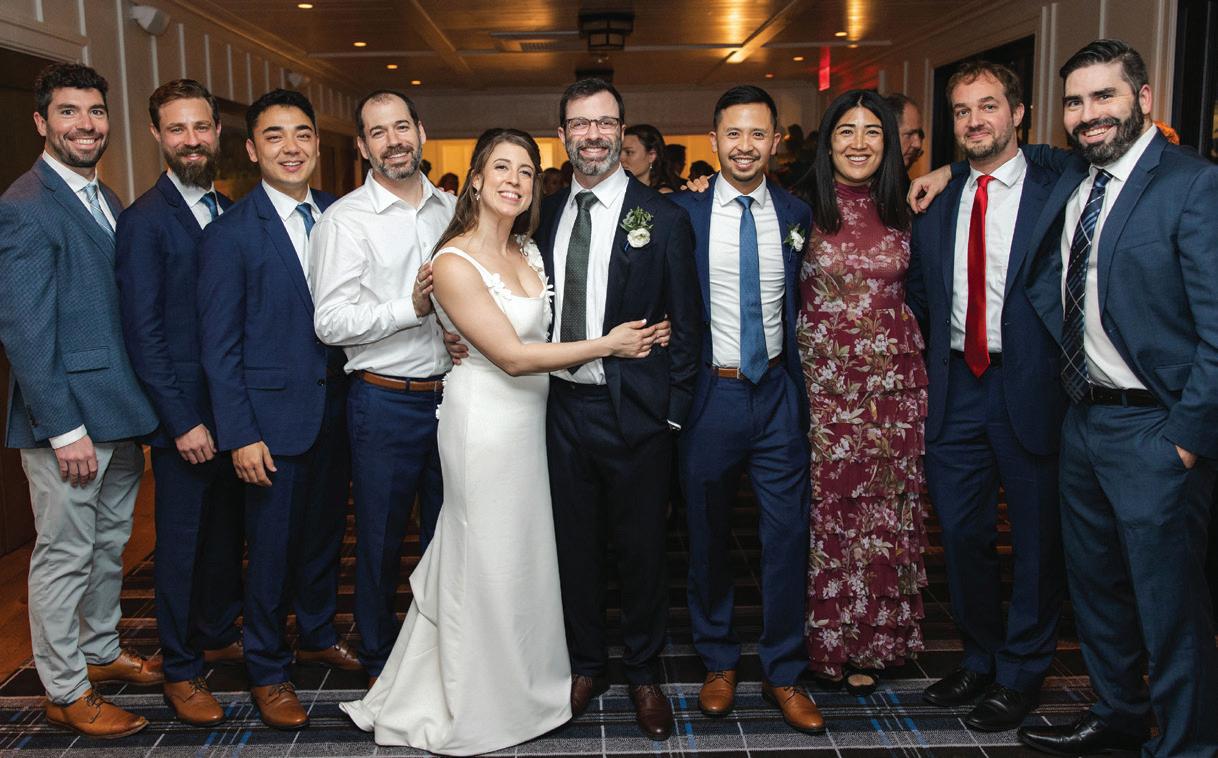
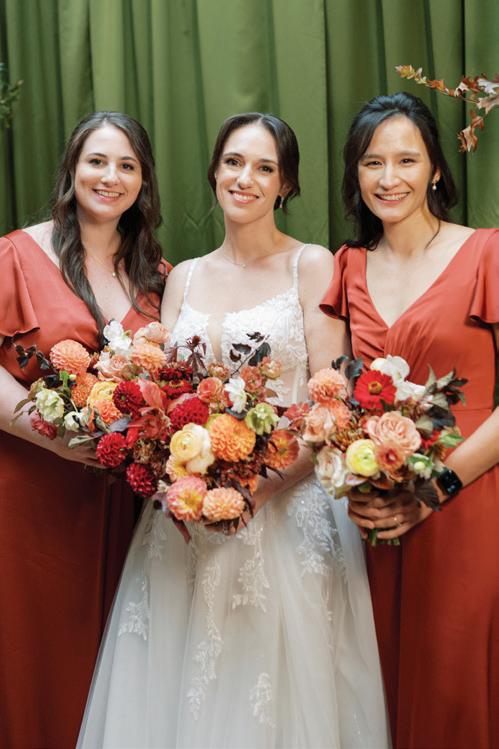
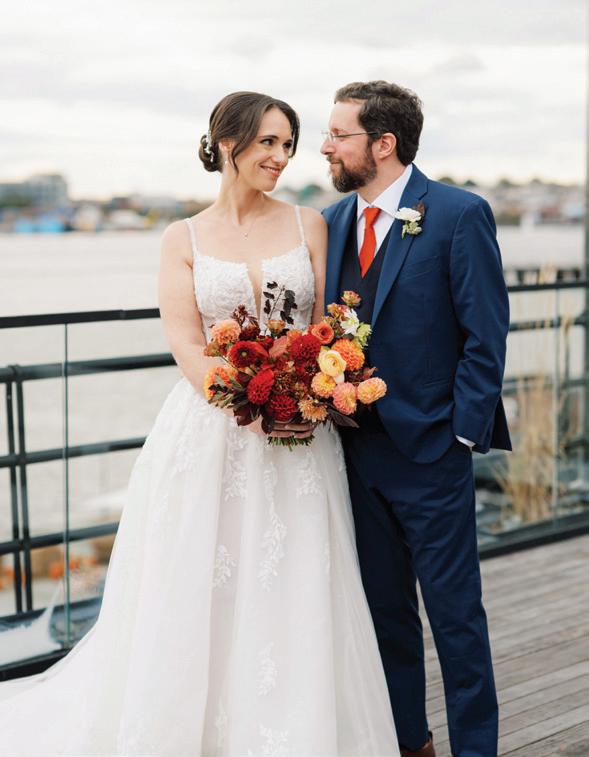
2007
ALEX AKMAN akman.alex@gmail.com
DAVID MULLINS married Liana Mensh on November 22 at The Crossvines in Poolesville, Maryland (see photo above).
2009
AMANDA CHUZI amanda.chuzi@gmail.com
2009
A.J. PARKS jhpiv13@gmail.com
SARAH PLOTKIN married her partner of 14 years, Matt Singer, on October 25, 2025, in Baltimore, Maryland. Throughout the wedding weekend, she was accompanied by her bridesmaids, Natalie Plotkin ’14 and Alexandra Over. The cocktail lounge-style celebration, featuring live jazz, brought together close friends and family, including longtime Sidwell friends Andrew Sanders and Spencer Connaughton ’10. (See photos above.)
2010
KAI ZHENG kaihuazheng@yahoo.com
2011
CAROLYN PEYSER carolyn.peyser@gmail.com
2012
SALENA HESS salenahess@outlook.com
JOHN VERGHESE jjv2116@columbia.edu
JODY FRYE: After meeting in Japan while teaching English on the JET Program, Jody Frye and Suzi O’Shea quickly became best friends. Friend-
ship turned to romance, and after living together for a year back in the States, Jody popped the question. They were married surrounded by fall leaves within sight of the Shenandoah mountains, reminiscent of Akita, Japan, where they met. Jody and Suzi Frye both live and teach in the DMV area with their fluffy Akita dog, Aki.
2013
CECILIA LAGUARDA xenia.cecilia.laguarda@gmail.com
The Class of 2009 takes a snow day.
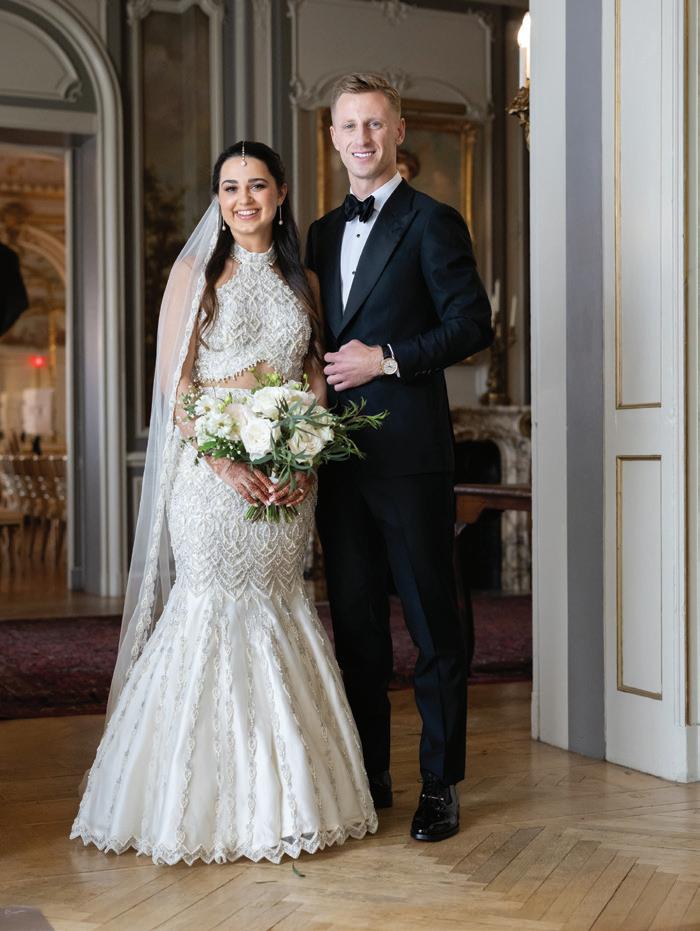
KEEP IN TOUCH!
Go to sidwell.edu/classnotes and let us know what you’ve been up to.
2014
AVIKAR GOVIL avikar.govil@gmail.com
2015
EMILY MILLER emillerusa@gmail.com
NATASHA COX: “In 2025, I married my husband, Mason Walsh. He’s a former EPL pro-soccer player from England who started a soccer academy in New Orleans and is expanding into partnerships around the country to run camps and clinics for kids. We’re settling into married life and enjoying this new chapter!” (See photo above.)
Natasha was also just named to the Forbes 30 Under 30 List in Education as founder of Avani Services, which offers in-person and online executive coaching, team building, and leader-
ship development to more than 500 individuals per year, including many at the White House, U.S. Department of Defense, US Department of Homeland Security, and FEMA. Cox and her team estimate $2.5 million in 2025 projected revenue. Congratulations! Check out the Forbes profile here: forbes.com/profile/natasha-cox
2016
TALHA JILANI jilani-talha@live.com
2017
MILAN VIVANCO vivancomilan@gmail.com
2018
BROOKE HARRINGTON brooke.leahy.harrington@gmail.com
2019
SOPHIE PEIKIN speikin2019@gmail.com
2020
TUNDAA DORJNAMJIM tdorjnamjim20@gmail.com
SOPHIE SMALL sophieannsmall0@gmail.com
2021
SAM BJARNSON sambjarnason21@gmail.com
2022
RASHI GUPTA rashigupta704@yahoo.com
2023 WILL KOOPERSMITH willkoopersmith@gmail.com
2024
KEVYN ORR kevynduaneorr@gmail.com
FRED BAO baofrederick@gmail.com
TARA PRAKASH: “I’m currently on a gap year before starting at Princeton next fall. This past fall, I traveled to Nepal for three months, in a mix of homestays, cultural immersion, and intensive language study. While in Nepal, I designed a curriculum and taught a weeklong workshop for 20 students at the Lord’s Light Academy, a local school in an under-resourced encampment in Boudhha. Becoming proficient in Nepali by the end of the semester inspired me to begin formally learning Hindi upon returning home, and I am now taking classes. My chapbook, Memory Map, was also published during this time (see “Fresh Ink,” page 22). Now, I am in Cape Town, South Africa, interning at Bush Radio, a community radio station founded during the apartheid era. I am contributing to their shows, researching and investigating my own stories, and preparing for my weekly hour on air. I am currently training for a half-marathon, which I’m run-
ning in Cape Town in mid-February. This spring, I am planning to return to Nepal to intern for several months at The Kathmandu Post, the country’s largest English-language daily newspaper.”
PAMELA BENSON, a former 6th grade homeroom teacher, was excited about the Sidwell Friends Magazine cover story, “Hearts and Crafts” (Fall/Winter 2025/2026), featuring the work of Perrin Doniger ’01: “Imagine my delight in reading that my former 6th grade student, Perrin Doniger, is a gifted ceramic artist. I am a proud owner of one of her early works, purchased at the 1996 Sidwell Friends auction.” Hang on to that piece, Pamela! (See photos below.)
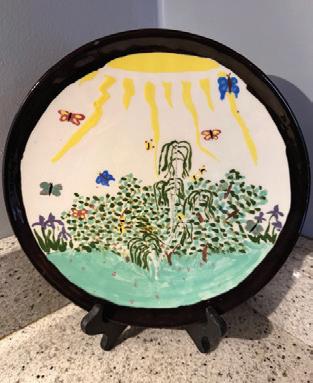
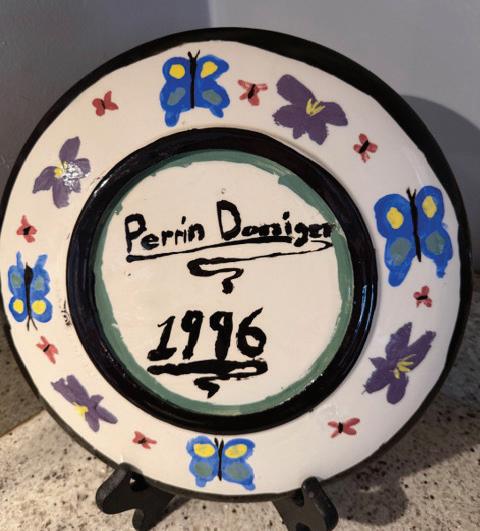
Have you updated your contact information recently? Want to connect with a fellow alum, or see who is in your area? Interested in networking with folks in your industry?
Join the new Sidwell Friends Alumni Network Directory, a hub for connection exclusively for Sidwell Friends alumni.
Questions?
Check out the User Guide on the Directory homepage or reach out to us at alumni@sidwell.edu
Leslie Adams ’73
May 20, 2025
Nancy Gibb Crowley ’52
May 16, 2025
Alan Walter Drummer ’75 January 20, 2026
Margie Ogilvy Franz ’60 December 16, 2025
Stephen Griffith ’63 February 12, 2025
Robert Jordan IV ’90 November 6, 2025
Diana Piotrow ’78 April 15, 2025
Anne Smallwood Schwartz ’53 May 14, 2025
Sylvia Yoshioka ’67
August 23, 2024
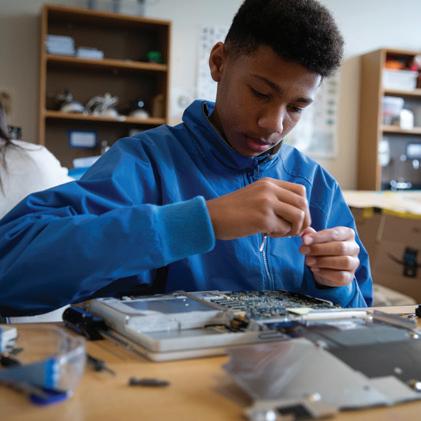
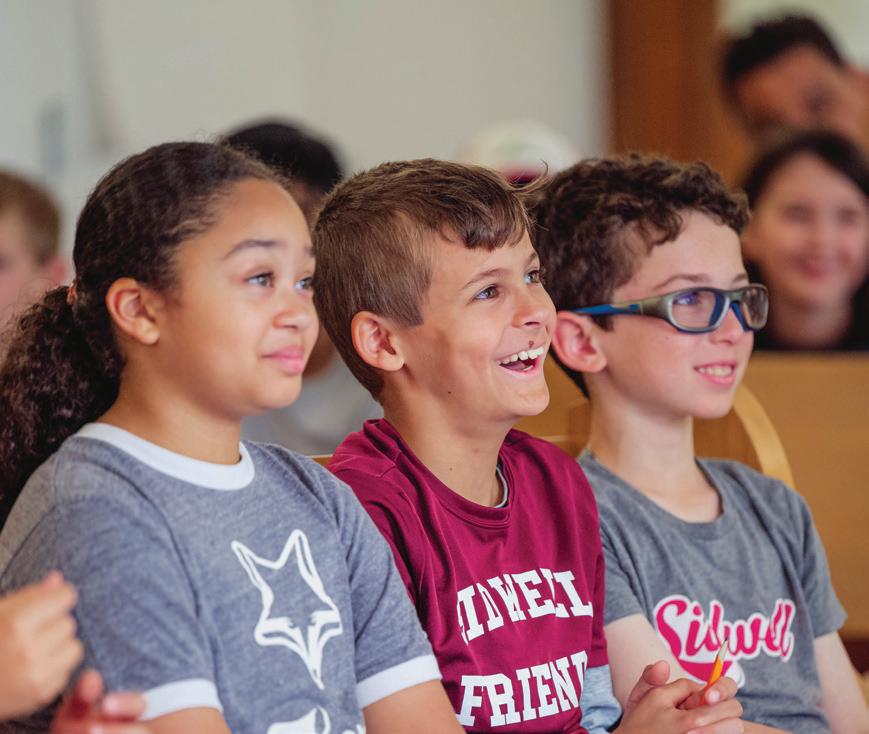


1 Like a run-on sentence 5 Without a date
Nanny on a farm
Opera highlight
Tie score in tennis
Drop-down list, perhaps
18 Ingredient in many lotions
19 Seafaring vacations for snails and slugs?
22 Moose’s cousin
23 Chicken piccata toppers
27 Grp. with geologists and biologists
30 Law firm abbr.
32 Winter coat material
33 Attorney’s field
34 Feudal Japanese assassin
36 Cost per louse?
39 Longtime hockey star Kovalchuk
40 Green Bay legend Brett 41 Low-pH stuff
42 Underground invertebrates?
44 Offer a thought
“Holy moly!”
Super-trendy 47 “Ideas change everything” organization 49 Perfect score, often
50 Places to watch Earthquakes and Hurricanes
52 By means of 54 What someone might say while feeling strange... or what they might say while cutting the first letter in 19-, 36-, and 42-Across
61 Send, as a package
64 Shoelace protector
65 Discount supermarket chain with a viral tote bag
66 Ringlike earring
67 Woolly animal that spits
68 Beloved celebrity
69 “Nothing to it!”
70 Tupperware toppers
Aloha State goose
Blacken the surface of
“Superfruit” from the Amazon rainforest
Is cheeky
Understand
Dealers shuffle them
Early philosophical hot spot
Tombstone lawman
Inspire 25 County south of Milwaukee 26 Where Spotify was founded 27 Total head-scratcher 28 Monumental support?
29 “Do I have a volunteer?” 31 Milk purchase, at times 32 Leading the league 35 Body part with teeth 37 “Ignore me!” for short
38 Cardi B’s field
40 Analog staple at an arcade 43 Collision sound
44 Norse god of war
48 Andrew Lloyd Webber musical set in Argentina
51 Like some fall days
53 “One more time!”
55 Wrinkly fruit
56 Pleased as punch 57 Rubies, e.g. 58 Ye Tavern
59 Japanese noodle
60 Scrabble piece
61 Countess’s pronoun
62 Org for a gated community
63 Apple mobile platform
In celebration of the Spring Equinox, the 2nd graders were inspired by the work of several masters, such as PierreAuguste Renoir, Mary Cassatt, and Vincent Van Gogh, to create original mixed-media still-lifes. Through the observation of floral arrangements at each table, students took time to examine shape, line, and color and utilized the artistic processes of drawing, watercolor painting, and collage to create works of art that express a sense of space and balanced composition.
KRISTEN CAMPBELL LOWER SCHOOL ART TEACHER