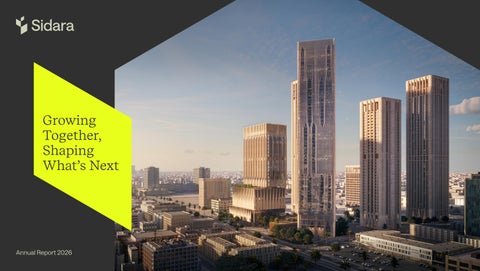
Growing Together, Shaping What’s Next
Annual Report 2026
Contents Introduction Governance Pillar Highlights Sustainability People Planet Appendix
3 8 12 34 38 43 48
Cover image: Al Yasmeen Mixed-Use Development, Riyadh, KSA 2
Introduction
Introduction
Governance
Pillar Highlights
Sustainability
People
Planet
Appendix
Welcome Growing Beyond Today 2025 was a defining year for Sidara. Alongside another year of strong performance, we took an important step in our long-term growth journey through the acquisition of Wood, which joined the group in early 2026, creating a larger and more diversified platform for the next phase of our evolution. Together, these achievements demonstrate the strength of our long-term approach and our commitment to continually investing in the capabilities, expertise and relationships that underpin sustainable growth.
A defining year
What gives me greatest confiidence is not the scale of our platform, but the strength of the people who power it. Their ability to innovate and deliver meaningful outcomes for clients remains the foundation of our success. Talal Shair
Sidara Chairman and CEO
Every day, our teams are helping clients tackle some of society’s most important challenges, creating places, infrastructure and solutions that improve lives, strengthen communities and shape a better future. In 2025, our companies generated more than US$3.6 billion in revenue while delivering projects that will leave a lasting legacy for generations to come. From Al Najd Agricultural City in Oman and a national data center program in the United States, to the award-winning Beijing Performing Arts Centre in China and the long-term transformation of Jomo Kenyatta International Airport in Kenya, our people continue to demonstrate the expertise, creativity and commitment that define Sidara.
These achievements are not the result of shortterm success. They reflect decades of thoughtful investment, entrepreneurial ambition and a belief that meaningful progress comes from continually evolving to meet the changing needs of our clients and our world.
Stronger together That mindset also informed our decision to pursue the acquisition of Wood. More than an increase in scale, Wood brings complementary expertise, broader sector capabilities and exceptional talent, strengthening our position in the global energy and materials sectors at a pivotal moment for the world economy, while reinforcing our standing as one of the world’s leading privately held planning, design, engineering and project delivery groups.
Powering the next era of growth
By continuing to invest in our capabilities and our businesses, we are positioning Sidara to help clients respond to these challenges while creating lasting value in the years ahead. What gives me greatest confidence, however, is not the scale of our platform, but the strength of the people who power it. Across every region and discipline, they bring expertise, creativity and an unwavering commitment to excellence. Their ability to innovate and deliver meaningful outcomes for clients remains the foundation of our success. I am incredibly proud of what we have achieved together this year and excited by the opportunities that lie ahead. With exceptional talent, expanded capabilities and a clear sense of purpose, Sidara is entering its next chapter from a position of strength. Talal Shair Sidara Chairman and CEO
At Sidara, we think in generations, not market cycles. As energy transition continues to reshape industries and societies, and advances in artificial intelligence, digital technologies and data-driven industries reshape economies, demand for energy, resources and infrastructure will continue to grow. Meeting these challenges will require innovation, technical excellence and collaboration on a scale we have rarely seen before.
3
Introduction
Introduction
Governance
Pillar Highlights
Sustainability
People
Planet
Appendix
Our Companies
Some of the most recognizable names in the design and engineering sectors are proud Sidara companies. We draw on the resources and expertise of the entire Sidara network as we partner with clients on diverse and ambitious projects around the world. Sidara is made up of leading, privately-owned specialist services firms with a diverse history and global presence. Our world-class planning, design, engineering, project management and energy firms are dedicated to achieving our clients’ ambitions and supporting sustainable communities worldwide. We operate through five verticals, known as Sidara’s “Pillars.” Led by Dar, Perkins&Will, TYLin, Currie & Brown and Wood, they combine deep market and sector expertise with capabilities spanning the project lifecycle, from planning and design through to project management and delivery. Our specialist brands operate within these Pillars.
Buildings & Infrastructure
Architecture
13,000 61
2,900
Employees
Employees
Offices
Dar provides design, planning, engineering, sustainability consulting, digital, facilities and project management services for buildings, cities, transportation, civil infrastructure, water and the environment. Dar Companies include CopperTree Analytics, Dar Ventures, Maffeis Engineering, PARA, R&H Rail, Su-Yapi, and Urban Initiatives.
Infrastructure & Engineering
Project Management
Energy & Materials
35
5,000
140
2,800
70
33,000 180
Offices
Employees
Offices
Employees
Offices
Employees
Perkins&Will is an award-winning, research-based, interdisciplinary architecture and design firm, the only Sidara business devoted exclusively to design.
TYLin is a global advisory, planning, and engineering firm committed to delivering infrastructure that connects communities to possibility.
Affiliates and subsidiaries include Schmidt Hammer Lassen Architects, McLennan Design, Portland, Nelson\Nygaard, and Pierre-Yves Rochon.
TYLin, Introba and Landrum & Brown are Sidara’s leading infrastructure brands.
Currie & Brown is a worldleading provider of project management, cost management and advisory services.
Offices
Wood is a leader in consulting, engineering and operations for the energy and materials sectors. Wood helps clients design, build and run complex industrial systems with precision and care.
Specialty Brand | Energy
1,700
9
Employees
Offices
Penspen designs, maintains and optimizes energy infrastructure to improve access to secure and sustainable energy for communities worldwide. Reporting basis: Company, employee, and office information on this page is current as of September 2026 and includes Wood. Unless otherwise stated, FY2025 financial and sustainability performance data presented in this report exclude Wood.
4
Introduction
Introduction
Governance
Pillar Highlights
Sustainability
People
Planet
Appendix
Regions & Markets We Serve Gross Revenue $3.65
2025
$3.15
2024
$2.72
2023
2025 Revenue by Region
$2.58
2022
$2.37
2021
2025 Revenue by Market
$2.25
2020 2019
$2.46
2018
$2.44 0.0
1.0
2.0
3.0
4.0
North America
39.9%
Buildings
47.5%
Middle East
35.1%
Transportation
34.4%
Europe/UK
9.5%
Petroleum Infrastructure
4.6%
Africa
8.9%
Sewage & Solid Waste
4.4%
APAC
4.9%
Power
2.4%
LATAM
1.7%
Water Supply
2.4%
North America and the Middle East continued to lead regional revenue contribution, while Buildings and Transportation remained our dominant markets.
Industrial Process
2.1%
Telecommunications
1.5%
Note: Revenue figures exclude the contribution of Wood, which was acquired in March 2026.
Manufacturing
0.7%
Revenue numbers in USD billions
2025 marked another record year for Sidara, surpassing USD 3.6 billion in gross revenue. This sustained growth was driven by the collective strength of our brands and rising demand for integrated, multidisciplinary solutions.
5
Introduction
Introduction
Governance
Pillar Highlights
Sustainability
People
Planet
Appendix
ENR Rankings The annual ENR Top 225 International Design Firms ranking lists the world’s leading design companies by global revenue, showcasing those shaping major infrastructure and development projects across borders.
Top 225 design fiirms working abroad
9th
Sidara Overall Ranking
Top 10 by region
1st
Middle East
3rd 6th Africa
USA
Top 10 by market
2nd
Buildings
8th
Transportation
Source: Engineering News Record 2026
7th
Sewer/Waste
Casablanca Stadium, Casablanca, Morocco 6
Introduction
Introduction
Governance
Pillar Highlights
Sustainability
People
Planet
Appendix
Sustainability Performance at a Glance
34%
12.8
50%+
25,000+
Of Sidara employees (excluding those in Dar site offices) are women – an improvement of 1%
Hours of recorded training and development per employee
Of Sidara employees recorded sustainability training in 2025
Volunteer hours, reflecting our commitment to community and positive impact
85.5%
891
15.5
73%
Of Sidara occupied floor area reporting measured energy consumption data
Average EUI in kgCO2e per capita across our occupied floor area – an improvement of 17%
m3/capita of annual water consumption based on benchmarked data of 62.5 liters of water per employee per day
Of floor area with collected water consumption data – an improvement of 33%
7
Governance Overview The Governance section provides an overview of Sidara’s strategic approach to corporate governance, including: – – – –
Governance Structures Sidara’s Committees Sidara’s Councils Risk & Compliance
Sidara continues to build on its robust Corporate Governance to ensure that there is a strong and resilient infrastructure in place, which not only aids the delivery of the long-term success of Sidara but is also adaptive to meet unexpected demands. Sidara’s Corporate Governance forms the benchmark against which the outside world is invited to judge Sidara’s activities.
Sidara 2030 Strategy Offsite, Hampshire, UK
Introduction
Governance
Governance
Pillar Highlights
Sustainability
People
Planet
Appendix
Governance Structure The Board The Sidara Board of Directors has the overall responsibility for the stewardship of the group and meets regularly. The board maintains high standards of governance and strives to ensure that both Sidara and the entities within its group meet these standards. The board is the principal decision-making forum for the group and exercises control of the group’s affairs. Certain matters, under Sidara’s governance arrangements, are reserved for decision by the board.
Board of Directors Talal Shair, Chairman and CEO Bashar Rihani, Executive Director Beshara Wakim, Executive Director Danny Aoun, Executive Director Neil Bruce, Executive Director Phil Harrison, Executive Director Sari Gedeon, Executive Director
Shareholders
Shareholders
Partnership Wealth Committee
Group Governance Advisory Board
Chairman / CEO
Corporate Center
Board of Directors
Councils: Innovation Sustainability Digital
Committees: Audit Investment Leadership Development Risk & Compliance
Executive Committee
Pillar Governance Board
Board
Board
Board
Board
Buildings & Infrastructure
Architecture
Infrastructure & Engineering
Project Management
Energy & Materials
“Governing bodies” includes Sidara Board of Directors, Sidara Executive Committee, and Pillar Board of Directors. 9
Introduction
Governance
Governance
Pillar Highlights
Sustainability
People
Planet
Appendix
Governance Structure Committees The board has five standing committees: – – – – –
Executive Committee Audit Committee Investment Committee Leadership Development Committee Risk & Compliance Committee
Executive Committee Talal Shair — Chairman and Group CEO Alan Manuel — CEO, Currie & Brown Bashar Rihani — Executive Director Bassam Shakhshir — Executive Director Danny Aoun — Executive Director Gillian Empringham — Group Chief People Officer Matthew Cummings — CEO, TYLin Michael Helou — Group Chief Strategy Officer Neil Bruce — CEO, Wood Nicolas Tissot— Group Chief Financial Officer Peter O’Sullivan — CEO, Penspen Phil Harrison — CEO, Perkins&Will Sari Gedeon — Executive Director Teymour Salaam — Group General Counsel Audit Committee Camille Sifri — Chairman (Non-Exec) Beshara Wakim — Committee Member Khalil Darawish — Committee Member (Non-Exec)
Investment Committee Talal Shair — Chairman Michael Helou — Group Chief Strategy Officer Nick Marsini — Non-Exec Sari Gedeon — Executive Director
Councils
Advisory Board
The Executive Committee is supported by three councils:
Joseph V. Del Raso — Chairman Partner, Troutman Pepper Locke
– – –
Sustainability Council Innovation Council Digital Council
Leadership Development Committee
Sustainability Council
Talal Shair — Chairman Abeer Tarawneh – Partner, Dar Charles Malek — Partner, Dar Gillian Empringham — Group Chief People Officer Sari Gedeon — Partner, Dar
Comprised of sustainability specialists from across our firms, the council develops and advances sustainability strategy, aligning environmental, social, and governance priorities while supporting clients with integrated advisory expertise. It also drives thought leadership, industry research, and advocacy to help shape a more sustainable built environment.
Risk & Compliance Committee Peter O’Sullivan — Chairman Ali Al Shabibi — Group Head of Assurance and Risk Management Andre Samaha — Partner, Dar Gillian Empringham — Group Chief People Officer Nicolas Tissot — Group Chief Financial Officer Nyree Quintero — Regional Chief Operations Officer, North America, TYLin Teymour Salaam — Partner, Dar Wajdi Abou-Izzedine — Partner, Dar
Innovation Council Comprised of innovation experts from across our firms, the group cultivates a culture of collaborative, client-focused innovation while establishing the platforms and processes needed to turn ideas into meaningful action. Digital Council
Prof. Avv. Andrea Gemma Partner, GPD Lex Italia Gregory McGowan Senior Strategic Advisor at Franklin Templeton Investments Jim Nicholson Former U.S. Secretary of the Department of Veterans Affairs Former U.S. Ambassador to the Holy See Joseph Assaf Founder, Ethnic Business Awards Hon. Michael Sukkar Former Australian Federal Minister Nicolas Marsini Retired Regional President, PNC Bank Raymond LaHood U.S. House of Representatives 1995-2009 U.S. Secretary of Transportation 2009-2014 Hon. Scott Morrison AC 30th Prime Minister of Australia
Comprised of experts in information technology, digital design, and digital consulting from across our firms, the council advances digitally enabled services that help clients navigate emerging challenges and opportunities. It also drives workflow transformation, innovation, and seamless collaboration across teams, disciplines, and geographies.
10
Introduction
Governance
Governance
Pillar Highlights
Sustainability
People
Planet
Appendix
Risk, Ethics & Compliance Risk, Ethics & Compliance Management Structure
Focus Areas
The following bodies have responsibilities relating to risk, ethics and compliance management at Sidara:
The following bodies have responsibilities relating to risk, ethics and compliance managem
Risk & Compliance Committee (RCC)
Enterprise Risk Profile and Risk Actions
Sidara’s Risk & Compliance Committee is responsible for providing oversight, review and challenge of Sidara’s risk and compliance management framework, and its significant risk and compliance exposures, and for reviewing management’s response thereto.
Sidara continued to strengthen its enterprise risk management practices during the year. Enterprise risks identified during the previous reporting cycle and their associated mitigation actions were periodically reviewed. The status of actions and emerging risk exposures were monitored throughout the year to support timely management responses.
Assurance & Risk Management Function The Sidara Assurance and Risk Function is responsible for ensuring that minimum standards of risk management practices are in place and that risks across the business are continuously identified, assessed, and dealt with in a structured manner. Group Ethics & Compliance Function The Group Ethics & Compliance Function is responsible for designing, implementing, and overseeing Sidara’s Ethics & Compliance program across all business pillars. The function sets Group-wide policies, standards, and controls to ensure business activities align with applicable internal requirements and external laws and regulations, while embedding a culture of integrity and ethical conduct throughout the organization. ERM and Compliance Forum A network of risk and compliance professionals responsible for implementing risk and compliance initiatives and promoting a consistent risk and compliance culture across Sidara.
Additionally, as part of enhancing the ERM methodology, enterprise risk workshops were planned for 2026 with senior leadership teams across the Group’s pillars to identify strategic and operational risks, assess potential impacts, and develop mitigation actions to strengthen the consistency of risk assessments across the Group. Emerging Risks and Technology Sidara continued to monitor emerging risks, including cyber threats, developments associated with the adoption and use of Artificial Intelligence, and environmental, social and governance (“ESG”) considerations, and incorporated these factors into its enterprise risk management activities to enhance the assessment of emerging risks and opportunities and support the Group’s broader sustainability objectives.
Business Continuity and Resilience Sidara periodically reviewed its business continuity risks to minimize business disruption, including the rising geopolitical risks across the locations from which we operate. Third-Party Risk Management program Sidara is enhancing its third-party risk management program by updating relevant policies and procedures to align with evolving risks and regulatory requirements, leveraging best-in-class screening and due diligence tools, and strengthening risk assessment processes across anti-bribery and corruption (ABAC), sanctions, and other key risk areas. Anti-Bribery and Corruption Sidara continuously reviews and updates its Anti-Bribery and Corruption (ABAC) policies and procedures to reflect emerging forms of bribery and corruption risk, strengthen related training and awareness programs, and ensure ongoing compliance with applicable international laws and standards. Speak-Up and Whistleblower Hotline Sidara is enhancing its whistleblower hotline, adopting a leading global reporting platform to strengthen the reliability, accessibility, and security of its confidential reporting channel for employees and external stakeholders. This reflects Sidara’s ongoing commitment to adopting best-in-class tools that support a culture of transparency, integrity, and protection from retaliation.
11
Pillar Highlights Introduction Our global group of specialist firms exists to elevate how people live, inspire global impact, and make room for cultures to shine. Since our founding 70 years ago, we have grown both organically and through a series of strategic acquisitions – seeking out companies rich in talent and culture, where our investment can add lasting value. Together, we have shaped Sidara into the worldclass group it is today – focused on long-term human and social advancement, and dedicated to building a healthier, more equitable world.
Across Sidara, our people bring together exceptional expertise, creativity and an unwavering commitment to excellence. Together, they are helping clients tackle some of society’s most important challenges and deliver outcomes that will leave a lasting legacy.
Talal Shair
Sidara Chairman and CEO Sidara at Passenger Terminal Expo 2026, London, UK
Introduction
Pillar Highlights
Purpose
Highlights
Dar is one of the world’s leading consultancies, providing design, engineering, sustainability consulting, project management, facilities management, and digital solutions and services for buildings, cities, transportation, civil infrastructure, water, and the environment.
Dar continued supporting strategic building and infrastructure projects, including nationwide ventures that aim to support sustainable development for vulnerable communities. –
Dar’s purpose is to empower clients and uplift communities — with every solution they deliver. Building on values of excellence, responsibility, empowerment, connectivity and courage, Dar pursues the vision of becoming the consultant of choice on the most ambitious projects, and a catalyst for change in the sectors that will shape the future of communities in the region and beyond.
Services: – – – – – – – –
Scoping Studies and Funding Advisory Master Planning Architectural Design Engineering and Infrastructure Design Project Management Facilities Management Sustainability Consulting Digital Solutions
dar.com
–
–
–
Governance
Pillar Highlights
Sustainability
People
Planet
Appendix
Egypt’s Haya Karima Initiative won the Dubai International Best Practices Award for Sustainable Development in Urban Infrastructure Planning and Management. Presented by the Dubai Municipality and UN Habitat, the award recognized the nationwide initiative, which provides essential infrastructure networks and community amenities for over 4,500 underserved villages across Egypt Dar signed an agreement with the King Hussein Cancer Foundation and Center, committing to support the foundation’s mission by providing design services for the Center’s future projects including a new pediatric care building and a hematologic oncology center Volunteers from Dar joined colleagues from TYLin and Introba in Rwanda to build the Kira Trail Bridge. The 75-meter suspension bridge in Rwanda’s Gasabo District now provides yearround access across the Rumirabahashyi River for more than 11,000 residents The Ain Sokhna Port registered a Guinness World Record certificate for creating the deepest artificial port basin on land, reaching 19 meters International Medical Center, Obhur, Jeddah, KSA
13
Introduction
Pillar Highlights
Governance
Pillar Highlights
Sustainability
People
Planet
Appendix
Dar Companies
Su-Yapi
R&H Rail
Dar Ventures
Urban Initiatives Studio
Su-Yapı is a Türkiye-based multidisciplinary services consultancy renowned for excellence in planning, design, engineering, and project management for infrastructure and water structures.
R&H Rail (Pty) Ltd is a specialist railway consultancy, focusing on the development, implementation and operations of railway system across Africa.
Dar Ventures is the venture capital arm of Dar, empowering innovators and researchers to deliver exceptional and innovative solutions and products that reimagine the architecture, engineering, and construction industry.
Urban Initiatives Studio is an internationally recognized urban design and planning consultancy based in London.
rhrailway.co.za
urbaninitiatives.co.uk
Jomo Kenyatta International Airport, Kenya
suyapi.com.tr darventures.vc
Maffeis Engineering
CopperTree Analytics
PARA
As a leading engineering company, Maffeis Engineering specializes in sustainable civil, structural, façade, and tensile design. Its innovative solutions transform the built environment, improving lives while preserving the planet.
CopperTree Analytics transforms complex building data into clarity. Their Kaizen platform empowers asset owners and building stakeholders to reduce energy and operating costs, mitigate risk, and ensure a building’s design intent is realized.
PARA are pioneers in digitallyenabled building design and operational performance, bringing data visualization and clarity for asset owners to create efficient, sustainable, and resilient building portfolios.
maffeis.it
coppertreeanalytics.com
paratwin.io AlRajhi Medicine, Riyadh, KSA
14
Introduction
Pillar Highlights
Governance
Pillar Highlights
Sustainability
People
Planet
Appendix
Project Highlights Al Najd Agricultural City
King Abdullah Financial District Reverse Osmosis Treatment Plant
Jordan Green Ammonia
International Medical Center in Obhur
Al Najd Agricultural City is designed to set a new national standard for sustainable living, agricultural innovation, and economic diversification. The city offers a pathway to strengthening Oman’s agricultural sector through cutting-edge technologies such as vertical farming, hydroponics and aquaponics.
Dar designed a pioneering brackish water reverse osmosis plant to support KAFD’s ambitious vision for sustainability and resilience. The plant will treat over 27,000 m3 of perched groundwater per day, turning a once-unused water source into a valuable resource for the district. Raw groundwater is collected through a subsurface drainage network at the foundation levels of buildings and is pumped into the treatment facility.
The US$1 billion Jordan Green Ammonia development scheme, being delivered through a joint venture between Dar and Penspen, is designed to produce 100,000 to 120,000 tons of green ammonia per year. Envisioned to be selfsufficient and highly sustainable, the plant will be powered by an independent 550 MW solar plant, complemented by a 500 MWh battery energy storage system.
Dar is designing a landmark new campus for the International Medical Center, creating a sanctuary for healing that honors Jeddah’s Hijazi heritage and cultural identity while celebrating the distinctive character of the city’s northern coastline.
The plant’s design leverages brackish water reverse osmosis, a technology that removes salts and impurities from moderately saline groundwater to produce high-quality treated water for multiple uses across the district.
The development’s water demands will be met through a dedicated desalination plant with an annual capacity of 2.5 million m3. Dar and Penspen have supported the project through its technical feasibility study and basic design.
Located in the Obhur district overlooking the waters of Sharm Obhur, the hospital occupies a prominent waterfront site and is designed to expand access to advanced healthcare services while supporting IMC’s vision for clinical excellence. The design balances state-of-the-art medical facilities with a strong sense of place, creating a patient-centered environment that promotes wellbeing, recovery, and human connection.
Learn more
Learn more
Learn more
Supported by AI-driven solutions, the city prioritizes sustainable water management and diversification of agriculture-based activities, such as post-harvest processing, agricultural education, and agritourism. The city will house 12,700 residents and create over 6,500 jobs.
Learn more
15
Introduction
Pillar Highlights
1
2
5
8
9
Governance
Pillar Highlights
Sustainability
People
Planet
Appendix
3
4
7
6
10
12
11
1. Big 5 Global Impact Awards 2025, UAE 2. Dar Tanzania Gala Dinner 2025, Tanzania 3. Luanda Infrastructure Financing Summit 2025, Angola 4. FIKA 2026, Rwanda 5. COP30 (Oman Pavilion) 2025, Brazil 6. Cairo Design Awards 2025, Egypt 7. Noble Gift Charity Initiative 2025, Poland 8. Dar Amman Gala Dinner, 2026, Jordan 9. Dar Pune Women’s Cricket Tournament 2026, India 10. Green Apple Day of Service 2026, India 11. Data Center Nation 2026, KSA 12. PROMOTE 2026, Cameroon
16
Introduction
Pillar Highlights
Purpose
Highlights
Wood is a global leader in consulting, engineering and operations for the energy and materials sectors. For more than a century, Wood has helped clients design, build and run the critical assets that keep industry running - combining deep technical expertise with disciplined delivery and a dependable approach.
Wood continued to win and deliver quality work on major projects for clients across Energy and Materials. –
– With around 33,000 people across 50 countries, Wood works across the full lifecycle of complex industrial systems, trusted by clients as they navigate operational demands today while preparing for a lower‑carbon future.
–
– From early‑stage consultancy and engineering design to reliable in‑field operations through to decommissioning and repurposing, Wood strengthens the Sidara Group with proven capability, global scale and an unwavering commitment to safe, sustainable performance.
Services: – – – – – – – –
Scoping, Feasibility and Advisory Concept, FEED and Detailed Design Engineering and Owner’s Engineering Project Delivery and Commissioning Operations and Maintenance Asset Management and Optimization Modifications and Life Extension Decommissioning and Repurposing
woodgroup.com
–
–
–
Launched Energy Transition and Digital Hubs in the Middle East to cater for increasing demand for decarbonization and digitalization expertise Wood experts supported ADNOC Refining to confirm its capability to produce lower carbon aviation fuel Wood continued to support major operators in the UK North Sea to optimize and maintain critical assets for the region’s energy supply Middle East teams secured over $1 billion in contract wins including a significant engineering, procurement and construction management (EPCM) contract to expand ADNOC Gas’s Habshan facility In the U.S., Wood extended its partnership with Ampol, delivering essential maintenance at its Lytton refinery U.S. teams are delivering a significant tenyear contract with NextDecade to deliver maintenance solutions at Rio Grande LNG in Texas Wood opened a new office in Darwin, Australia, to support growth in the Northern Territories
Governance
Pillar Highlights
Sustainability
People
Planet
Appendix
Central Area Transmission System (CATS) Terminal, United Kingdom
Barrancabermeja Refinery Clean Fuels Project, Colombia
17
Introduction
Pillar Highlights
Governance
Pillar Highlights
Sustainability
People
Planet
Appendix
Project Highlights ThaiOil Clean Fuel Project, Thailand
Woodside Gippsland, Australia
ADNOC Gas – Habshan Complex, UAE
Rare Earth Resources, United States
ThaiOil’s Clean Fuel Project (CFP), based at the Sriracha refinery, is one of the largest refinery modernization projects in Southeast Asia. The project will increase the refinery’s crude processing capacity from 275,000 to 400,000 barrels per day, reducing Thailand’s reliance on imported fuels and strengthening long-term energy resilience.
The Gippsland Basin is Australia’s most significant domestic gas supply region, with the Bass Strait providing around 40% of the east coast’s natural gas demand.
Wood is delivering a major engineering, procurement and construction management program to upgrade and debottleneck ADNOC Gas’ Habshan facility, one of the world’s largest gas processing complexes.
This project introduces an Alliance-model approach between Wood and Woodside, integrating teams, systems, and processes to drive improved productivity, eliminate duplication, and achieve the lowest total system cost of maintenance delivery. The Alliance structure brings together the best leadership talent from both organizations and prioritizes shared accountability, performance excellence, and safety.
The project enhances processing efficiency and modernizes critical infrastructure while maintaining continuous operations.
Wood’s long-standing history of scaling and commercializing new technologies in Wyoming led to securing a contract with Rare Earth Resources to undertake day-to-day operations on the RER Demonstration Plant during commissioning and full operations.
By applying specialist brownfield engineering expertise, Wood is enabling increased throughput and improved reliability, supporting ADNOC’s longterm gas strategy and ensuring continued energy supply from one of the region’s most strategically important assets.
The plant is a full-scale integrated facility for the extraction, separation and refining of rare earth elements – receiving significant funding from the United States Department of Energy. Throughout its operational lifespan, the plant is expected to yield up to 15 tons of high purity neodymium-praseodymium oxide, along with other rare earth products, reducing the country’s dependence on imports.
Learn more
Learn more
Learn more
It will also enable large-scale production of Euro 5 diesel – aligning operations with tightening regional emissions standards and shifting ThaiOil’s portfolio toward higher-value, lower-emission products.
Learn more
18
Introduction
Pillar Highlights
1
2
5
8
9
Governance
Pillar Highlights
Sustainability
People
Planet
3
4
7
6
10
Appendix
12
11
1. Safety Week, Chile 2. MS150 Charity Cycling Event, USA 3. Global Wood Cause, Colombia 4. World Environment Day, UAE 5. Adipec Energy Event, UAE 6. Wood Global Safety Week, KSA 7. Gastech Event, Italy 8. Around Wood in 30 Days 9. Stemovators 2026, UK 10. Wood Global Safety Week, UK 11. ASV Games 2026, UK 12. National Day for Truth and Reconciliation, Canada
19
Introduction
Pillar Highlights
Purpose
Highlights
Perkins&Will is an interdisciplinary research-based architecture and design firm. It was founded in 1935 on the belief that design has the power to transform lives.
Perkins&Will continued to broaden its impact by advancing its commitment to sustainability through an updated Living Design framework and growing its global presence through strategic acquisitions and projects in world-leading markets.
–
The firm’s leadership in design excellence has earned widespread recognition, including a No. 2 ranking on Interior Design’s Top 100 Giants list in 2026, No. 2 ranking on Architectural Record’s Top 300 Architecture Firms in 2026, and No. 2 ranking on Building Design+Construction’s Top 200 Architecture Firms list in 2026.
–
The firm is committed to creating a better, beautiful, more equitable world through Living Design, an approach that integrates environmental, social, and design considerations to advance ecological health and well-being.
Services: – – – – – –
Architecture Interior Design Branded Environments Urban Design Landscape Architecture Advisory Services (e.g., planning and strategies, regenerative design, digital innovation)
perkinswill.com
–
– –
Governance
Pillar Highlights
Sustainability
People
Planet
Appendix
The firm released its Bio- and Mineral-Based Materials Primer, examining the opportunities and limitations of currently available materials, such as bamboo, cork, hemp, and straw, through ecological, cultural, technical, and performancebased lenses The firm expanded its retail practice with the hiring of five acclaimed retail design strategists to design and deliver dynamic retail destinations
Three projects designed by Perkins&Will and Schmidt Hammer Lassen Shanghai combined studio – Beijing Performing Arts Centre, Shanghai Library East, and Shenzhen Energy Ring – were honored with RIBA International Awards for Excellence. No other practice earned as many recognitions from the Royal Institute of British Architects in their 2026 awards program Franklin Antonio Hall and The Rad Center – won 2026 AIA National Awards For the 7th year in a row, the firm earned a perfect score of 100 on the Human Rights Campaign (HRC) Foundation’s 2026 Corporate Equality Index, the leading benchmark for LGBTQ+ workplace inclusion in the U.S.
Beijing Performing Arts Centre, Beijing, China © Yumeng Zhu
20
Introduction
Pillar Highlights
Governance
Pillar Highlights
Sustainability
People
Planet
Appendix
Affiliates and Subsidiaries
Schmidt Hammer Lassen
Portland Design
Nelson\Nygaard
Schmidt Hammer Lassen (SHL) is one of Scandinavia’s most recognized and award-winning architectural practices.
Portland Design transforms brands into immersive and multisensory environmental experiences.
Nelson\Nygaard is a leader in holistic transportation planning, committed to mobility, accessibility, equity, and sustainability.
shl.dk
portland-design.com
William E. Carter School, Boston, Massachusetts, USA © Tom Harris
nelsonnygaard.com
McLennan Design
Pierre-Yves Rochon
McLennan Design is a regenerative architecture, planning, design, and product design practice focused on deep green sustainability.
Pierre-Yves Rochon (PYR) was founded in Paris in 1979 and has led interior architecture and design projects for some of the most luxurious hotels, restaurants, and residences across the world.
mclennan-design.com
pyr-design.com Western Washington University, Kaiser Borsari Hall, Bellingham, Washington, USA © Kevin Scott
21
Introduction
Pillar Highlights
Governance
Pillar Highlights
Sustainability
People
Planet
Appendix
Project Highlights West Bund Grand Theatre
BCIT Tall Timber Student Housing
Damen Green Line Station
Nicklaus Children’s Hospital Surgical Tower
Located on the banks of the Huangpu River, the West Bund Grand Theatre combines architectural elegance with a vibrant cultural program. Conceived as part of the Shanghai Municipal Government’s vision for a world-class waterfront, the venue serves as a destination for performances, exhibitions, and cultural events. Inspired by the river’s flowing waters, the building’s sweeping form wraps a 1,600-seat auditorium and a 200-seat black-box theater for experimental performances.
At the British Columbia Institute of Technology, a new mass timber residence is showing how low-carbon student housing can be delivered quickly, efficiently, and at scale. Completed in collaboration with Introba, the 12-story building adds 469 new beds, more than doubling on-campus housing capacity, and stands as Burnaby’s tallest mass timber structure. It also marks the first building on BCIT’s campus to achieve Canada Green Building Council’s Zero Carbon Building – Design Standard™ certification.
The Damen Green Line Station restores rail service to a Chicago neighborhood last served in 1948, spurring community-supported reinvestment and redevelopment on the West Side. Completed in collaboration with TYLin, the project creates a welcoming gateway through its transparent, light-filled architecture and intuitive passenger experience.
Outdoors, the theater embraces the public realm through a large plaza and generous terraces, including a rooftop terrace overlooking the riverfront. The venue plays a key role in establishing the West Bund as one of Asia’s leading cultural destinations, where performance, public art, and community life foster local expression and global exchange.
Using prefabrication and all-electric systems, the residence serves as a living lab for students to engage with sustainable design strategies firsthand, while community gathering areas and outdoor amenities encourage collaboration and belonging.
The station draws inspiration from Chicago’s industrial and architectural heritage, balancing function with a strong sense of place. Green steel trusses reference both the CTA Green Line and the city’s iconic steel bridges, while a mural by artist Folayemi Wilson celebrates the diverse people and cultures that have shaped the neighborhood.
The new five-story Surgical Tower at Nicklaus Children’s Hospital is a 120,000-square-foot expansion that transforms the hospital’s surgical capabilities with purpose-built facilities designed to support the next generation of pediatric care. Bringing together operating rooms, patient care areas, clinics, and support spaces, the tower modernizes the surgery department while improving efficiency and enhancing the experience for patients, families, and caregivers.
Learn more
Learn more
Learn more
Empathy and inclusion are embedded throughout the design, with strategies tailored to support children with a wide range of sensory and neurodiverse needs. Healing gardens, adjustable lighting, multisensory patient environments, and carefully considered wayfinding elements help create a calming atmosphere. Learn more
22
Introduction
Pillar Highlights
1
2
5
Governance
Pillar Highlights
Sustainability
People
Planet
Appendix
3
7
6
4
11 1. Board of Directors 2. Design charrette, Massachusetts, USA 3. Leadership Forum, Georgia, USA 4. Our World in Design Conference, Georgia, USA 5. Ralph Johnson’s Monograph Party, Illinois, USA ©Randall Starr 6. Wellness Week 5K Run, Brazil 7. Pride event, Mexico 8. MLK Day of Service, DC Central Kitchen, Washington, D.C., USA 9. Retail practice team 10. Dallas studio annual meeting, Texas, USA 11. Higher Education practice meeting, Canada ©Ronnie Lee Hill
8
9
10
23
Introduction
Pillar Highlights
Purpose
Highlights
TYLin is a global advisory, planning, and engineering firm dedicated to delivering infrastructure that connects communities to possibility.
TYLin, Introba, and Landrum & Brown collectively advanced the bold vision for sustained growth detailed in their 2030 Strategic Plan. That vision begins with deep commitment to their people — their achievement, employee experience, and wellbeing. It emphasizes intentional client relationshipbuilding as a catalyst to expand their market impact.
For over 75 years, the teams across the Americas, Asia, the United Kingdom, and Europe have advanced solutions in Buildings, Transportation, and Water that improve how people live, move, and connect.
–
TYLin designs with intention and creates infrastructure that not only solves problems but also unlocks opportunity.
Services: – – – – – – –
Advisory and Planning Alternative Delivery Buildings Engineering and Design Project Management and Construction Management Transportation Water
tylin.com
–
–
–
Through Thrive, TYLin’s social impact program, they continued to strengthen their Employee Resource Group (ERG) network by expanding opportunities for connection, inclusion, and professional growth. TYLin launched two new ERGs: Valor, which supports veterans and military families, and Horizons, which connects and develops early career professionals Together Week marked the first coordinated volunteer effort across all three brands, bringing employees together to support community organizations through volunteer service Their first Sustainability Report, Boundless, published in December 2025, speaks to the collaboration across the brands to deliver on their sustainability goals, build resilience across communities, and help clients navigate a changing world Numerous key leadership appointments within the global organization helped drive operational excellence in 2025. They included Chief Marketing Officer, Sector Leaders in Aviation and Rail +Transit, Practice Leaders in Advisory + Planning and Alternative Delivery, and Metro Area Executives and Growth Leaders
Governance
Pillar Highlights
Sustainability
People
Planet
Appendix
Redmond Technology Station Pedestrian Bridge, Redmond, Washington, USA Design-Build Institute of America (DBIA) National Award of Merit. © Kiewit
Formosa 6 Offshore Wind Farm, Taiwan © Fokke Baarssen
24
Pillar Highlights
Introduction
Governance
Pillar Highlights
Sustainability
People
Planet
Appendix
TYLin leads Sidara’s portfolio of infrastructure brands, which also includes Introba and Landrum & Brown.
Introba Introba is a global engineering and consulting firm with more than 700 specialists in five countries. Introba helps clients improve the performance, reliability, and sustainability of the built environment through mechanical, electrical, technology, security, and fire systems engineering, supported by digital advisory, systems integration, and sustainability consulting services.
Phoenix Sky Harbor International Airport (PHX) West Terminal Development Visioning and Advanced Terminal Planning, Phoenix, Arizona, USA. © Phoenix Sky Harbor International Airport/City of Phoenix Aviation Department
Lions Gate Hospital, Phase 3 Acute Care, North Vancouver, British Columbia, Canada © Brett Ryan Studios
Broward County Convention Center, Fort Lauderdale, Florida, USA
Nashville International Airport (BNA) Master Plan, Nashville, Tennessee, USA
introba.com
Landrum & Brown Landrum & Brown is a global aviation consulting firm with airports at the core of their DNA. Landrum & Brown brings passion and creativity to solve the most complex global aviation challenges with the potential to enhance the world. landrumbrown.com
25
Introduction
Pillar Highlights
Governance
Pillar Highlights
Sustainability
People
Planet
Appendix
Project Highlights San Jose Water, Smart Metering Program, California, USA
Arizona Department of Transportation, Interstate 10 Broadway Curve Improvement Project, Arizona, USA
Victorian Health Building Authority Rutherglen Residential Aged Care, Australia
Greater Orlando Aviation Authority: Planning Consultant Services, Florida, USA
To strengthen water resource management and advance long-term water security, San Jose Water launched a smart metering program serving more than 230,000 customers. The initiative helps reduce water waste, improve service, and optimize existing water supplies.
A reconstructed interstate has improved travel for millions of people in Metro Phoenix—and its construction process is now being recognized as a model for how to overhaul busy urban highways while limiting impacts to users and surrounding communities.
Introba provided electrical, mechanical, plumbing, fire engineering, and fire protection services for the Rutherglen Residential Aged Care facility, one of six projects delivered with the Victorian Health Building Authority.
TYLin supported the program by integrating smart metering into daily operations through process improvements, workforce planning, operating procedures, and advanced analytics. The program improved operational efficiency, reduced field visits and greenhouse gas emissions, and enhanced planning for future system growth.
TYLin served as prime design engineer, working with several specialist engineering subconsultants. The team was honored with an American Council of Engineering Companies (ACEC) Arizona Grand Award, in recognition of their innovative approach and the project’s regional impact.
The new 50-bed, fully electric facility is designed to promote resident wellbeing through private ensuite rooms and small, home-like households. A resilient and sustainable design, advanced nurse-call, fall detection, and building management systems enhance resident safety and operational efficiency, creating a modern, low-emissions aged care facility for regional Victoria.
Landrum & Brown (L&B) was selected to provide planning consultant services to support the Greater Orlando Aviation Authority’s (GOAA) ongoing airport planning, facility development, and capital program initiatives. L&B will provide on-call planning services that may include airport master planning, aviation activity forecasting, and terminal, landside and airfield planning.
Learn more
Learn more
Learn more
The work will help GOAA evaluate existing conditions, forecast future demand, identify operational and facility needs, and develop planning recommendations that support long-term airport development. Learn more
26
Introduction
Pillar Highlights
1
2
Governance
Pillar Highlights
Sustainability
3
People
Planet
Appendix
4
8
6
1.
7
5
9
10
11
Together Week San Diego office, Annual Thrive Program Volunteer Initiative 2. Global Executive Team & Asia Leadership Team Meeting, Malaysia 3. Europe/LATAM Leadership Meeting, Ecuador 4. Corporate Futsal Tournament, Sydney, Australia 5. Emergency shaft for the Halkalı–Ispartakule High-Speed Rail Line Tunnel, Turkey 6. ACEC Metropolitan Washington Awards Ceremony, USA 7. WEFTEC Conference, USA 8. Pilates and Lattes, London, UK 9. International Women’s Day, Sydney, Australia 10. ABC Carolinas Chapter Excellence in Construction Eagle Award: The Charlotte Douglas International Airport Concourse A Expansion Phase II, USA (© City of Charlotte) 11. New York Sustainable Cities Summit, USA
27
Introduction
Pillar Highlights
Purpose
Highlights
Currie & Brown is a world-leading project management, cost management and advisory services firm. They bring certainty to every stage of the asset lifecycle. From early strategy to project delivery, they help clients manage risk, control cost and keep complex programs on track.
Following the launch of Currie & Brown’s updated brand positioning in Q3 2025, the value of certainty has become a clear expression of the difference Currie & Brown makes for clients: helping them navigate complexity, manage risk, and move forward with confidence.
With more than 70 offices worldwide, Currie & Brown bring international experience and regional insight to every brief. Their teams help clients navigate local regulations, cultural context and commercial pressures with ease.
Currie & Brown focused on embedding this across their markets, work, and client relationships. –
Services: – – – –
Cost Management and Quantity Surveying Project and Program Management Advisory Services Building Surveying
curriebrown.com
–
–
–
Strengthening their leadership in key markets and sectors through strategic senior hires: Chief Operating Officers for APAC and the Americas, Life Sciences lead, and Head of Sustainability, APAC Sharing sharper market insight through thought leadership, including the Construction Certainty Index and Global Cost Report, to help clients understand cost trends, market pressures and future investment decisions. Valuing people by nurturing an inclusive working environment where everyone can contribute, grow and succeed. As part of this commitment, Group Chief Executive Officer Alan Manuel signed the UN Women’s Empowerment Principles, reinforcing support for gender equality across the business Investing in priority sectors and regions to support long-term growth, including the opening of the Malaysia office and continued expansion in Thailand
Governance
Pillar Highlights
Sustainability
People
Planet
Appendix
Nobu, Ras al Khaimah, UAE
28
Introduction
Pillar Highlights
Governance
Pillar Highlights
Sustainability
People
Planet
Appendix
Project Highlights Great Ormond Street Hospital NHS Foundation (GOSH)
Nobu, Ras al Khaimah
Tilbury2, UK
Data centers, USA
Currie & Brown is helping Great Ormond Street Hospital create a world-class Children’s Cancer center that will transform care for young patients across the UK.
Currie & Brown is helping bring the iconic Nobu brand to Ras Al Khaimah with cost certainty from the earliest stages of development.
Currie & Brown helped Forth Ports deliver Tilbury2, a major expansion that strengthens UK freighthandling capacity while keeping one of the country’s busiest ports operating throughout construction.
Currie & Brown is supporting a major technology client to deliver a national data center program across the United States, helping meet growing demand for digital infrastructure.
The development has significantly increased freight handling capacity and improved road and rail connectivity, creating a more resilient logistics hub on the River Thames.
Since 2016, Currie & Brown has provided project management, cost management and specialist advisory services. By managing risk, maintaining budget certainty and supporting the Trust’s long-term sustainability ambitions, Currie & Brown is helping create a specialist facility that will improve outcomes and provide better experiences for children, families and clinical teams. Learn more
Working alongside Enevoria Development, Currie & Brown has provided cost management from concept to tender, enabling the client to make informed decisions without compromising quality or design ambition. Due for completion in 2027, the development will strengthen Ras Al Khaimah’s position as a global destination for luxury tourism.
Tilbury2 demonstrates how clear planning, disciplined program management and collaborative delivery can turn complex infrastructure ambitions into lasting economic value.
Since 2020, Currie & Brown has provided cost management, estimating and project controls that give the client greater visibility, stronger commercial assurance and the confidence to make faster decisions. Their work is helping accelerate the delivery of critical digital infrastructure that underpins AI, cloud services and the connected economy, while improving certainty in a fastmoving and highly competitive market.
Learn more
Learn more
Learn more
29
Introduction
Pillar Highlights
1
2
5
6
Pillar Highlights
11
Sustainability
People
Planet
Appendix
3
4
7
9
10
Governance
12
8 1. Volunteering with The Bowery Mission, New York 2. Planting trees for Earth Day 2026 3. International Women’s Day donation drive, Peru 4. Tokyo Tower Climb 2026, World Suicide Prevention Day, Japan 5. Goodman Magic Mile charity run, Hong Kong 6. Charity fundraising, UK 7. Celebrating Currie & Brown rebrand, Singapore 8. Forest School Construction at Cumberland Arena, Crewe 9. Donation drive for Shishu Kalyan Kendra, India 10. Litter pick for Earth Day 11. Easter charity, Scotland 12. Green for Earth Day, Hong Kong
30
Introduction
Pillar Highlights
Purpose
Highlights
Penspen designs, maintains, and optimizes energy infrastructure to improve access to secure and sustainable energy for communities worldwide.
–
Penspen has been providing engineering, project management, asset management, and integrity services to the energy industry for more than 70 years, with offices in the United Kingdom, the United Arab Emirates, the Kingdom of Saudi Arabia, and Latin America.
–
Services: – – – – – –
Engineering and Project Management Asset Integrity Asset Management Digital Pipeline Integrity Management Solutions Knowledge and Training Energy Transition Consultancy
– –
–
penspen.com
C&I Engineering Solutions In 2024, Penspen acquired Aberdeen based C&I Engineering Solutions, a control and instrumentation engineering consultancy. ciengineering.co.uk
–
Recorded $500 million in new contract awards in 2025, Penspen’s best sales performance to-date, leading to their largest ever contracted backlog for 2026-29 Recognized by the UAE Ministry of Industry and Advanced Technology for its contribution to the national Industrialists initiative, highlighting Penspen’s commitment to support Emirati careers and advance the UAE’s long-term industrial vision Recognized by ADNOC as a top 20 contractor (by backlog contract value) for the first time Delivered several projects that bolster global energy security, including two critical onshore hydrocarbon transportation projects in Fujairah and Ruwais in the UAE. In Africa, Penspen delivered the feasibility study update for the Trans Saharan Gas Pipeline, enabling the landmark project to move to construction phase Produced reports that shape the planning of future energy infrastructure, including the Hydrogen Transition Pathways for UK Industrial Clusters study, and a Capability Gap Analysis for Newbuild Offshore CO2 Pipeline Transportation report for the North Sea Transition Authority Secured the engineering and design of Switzerland’s CO₂ transport network and supported national operators including Gas Networks Ireland and National Gas with services to inform the integration of future fuels including biomethane and hydrogen
–
–
Governance
Pillar Highlights
Launched new artificial intelligence functionality in its digital integrity management platform, THEIA, and secured awards for a major oil storage and transshipment terminal in Rotterdam and a Mexican natural gas pipeline operator Continued to deliver growth through C&I Engineering Solutions with the award of several major framework agreements from UK North Sea operators and a marked increase in offshore work scopes, specifically shutdown campaign support
Sustainability
People
Planet
Appendix
Penspen was engaged by Petrozim Line Limited to provide detailed engineering, procurement support, construction support, and commissioning & project completion support for the capacity upgrade of the Feruka–Harare Pipeline System in Zimbabwe. For more than 20 years, Penspen has supported Petrozim Line Limited in the development and enhancement of Zimbabwe’s fuel transportation infrastructure. Learn more
Feruka – Harare Multiproduct Pipeline Upgrade (MEA)
31
Introduction
Pillar Highlights
Governance
Pillar Highlights
Sustainability
People
Planet
Appendix
Project Highlights Engineering and Design of Switzerland’s CO₂ Transport Network
Asset Integrity and Management Services for ENGIE Pipeline Systems in Mexico
H2 Assessment and Biomethane QRA for Gas Networks Ireland
Rehabilitation & Integrity Reinstatement of Flowlines – Bab & Asab Fields
CO2 Pipeline Schweiz AG needed a robust highlevel pipeline infrastructure design to inform future investment decisions while also helping to establish appropriate technical standards for CO₂ pipelines in the country.
Since 2022, ENGIE Mexico has partnered with Penspen to support the integrity management of one of the country’s largest natural gas transportation and distribution networks. Serving more than 650,000 residential, commercial and industrial customers, ENGIE’s infrastructure comprises over 13,200 km of steel and polyethylene distribution pipelines and more than 1,300 km of transmission pipelines spanning multiple regions of Mexico.
As part of its energy transition strategy, Gas Networks Ireland (GNI) engaged Penspen to assess the feasibility of repurposing over 2,500 km of highpressure steel pipelines for up to 100% hydrogen service. Penspen’s Asset Integrity team conducted a detailed assessment of GNI’s gas transmission pipeline network. In a separate scope, Penspen performed a Quantitative Risk Assessment (QRA) of the biomethane injection facility and its interaction with the existing transmission infrastructure.
ADNOC Onshore initiated a major rehabilitation program to restore asset integrity, improve reliability and sustain production from two of Abu Dhabi’s largest producing onshore assets – Bab and Asab.
Through this partnership, Penspen supports ENGIE’s commitment to maintaining a safe, reliable and resilient natural gas network across Mexico.
Through this work, Penspen is supporting GNI’s ambition to deliver a net zero carbon gas network by 2045, while maintaining a safe, continuous, and reliable energy supply to more than 720,000 homes and businesses across Ireland.
Learn more
Learn more
Penspen was appointed to deliver a pre-FEED study for a proposed CO₂ transport network linking Basel and Zurich, with options for wider connectivity across eastern and central Switzerland. The study supports the early development of a national CO₂ pipeline system aligned with Switzerland’s climate objectives.
Learn more
Penspen was awarded a project by Galfar Engineering & Contracting to support the rehabilitation program. The project safeguards production from key ADNOC Onshore assets and aligns with the operator’s strategy to target crude oil production capacity of five million barrels of oil per day by 2027, and forms part of ADNOC’s ongoing field modernization program.
Learn more
32
Introduction
Pillar Highlights
1
2
5
6
Governance
Pillar Highlights
Sustainability
People
Planet
Appendix
3
4
8 1.
9
10
7
11
12
13
National Physics Conference DAIA with Mexican Society of Physics (SMF) 2. Innovation and Digital Award, 7th Grupo Energía Bogotá (GEB) Supplier Recognition Gala 3. Penspen’s Repurposing Pipelines for Hydrogen training course, UK 4. Recognition by UAE Ministry of Industry and Advanced Technology for Industrialists Program 5. Penspen CEO Peter O’Sullivan at World Pipelines CCS Forum, UK 6. Scotland Africa Business Association SDI Hydrogen Roundtable, Scotland, UK 7. “Zero Accident Company Recognition” from Mexico’s Ministry of Labor and Social Welfare 8. Panel on International Women’s Day, 150 Holborn, UK 9. Pipeline Technology Conference, Germany 10. Recognition by IGEM for Penspen’s asset management training courses 11. Delivering client demonstration of Penspen’s digital integrity pipeline platform, THEIA. Image © Ralph Thiele 12. Welcoming His Majesty’s Ambassador to the UAE, to Penspen’s stand at ADIPEC 13. Agentic AI-based technical advisory systems presentation, Germany. Image © Ralph Thiele
33
Sustainability Our Purpose Sidara companies are united under a shared purpose of responsibility, innovation and collaboration. We harness diverse talents and regenerative practices to shape resilient communities and ecosystems for generations.
Our Sustainability Vision Through collaboration we pioneer and advocate for a truly regenerative future. Our firms partner with communities to advance our industry and to shape a more equitable world. As a group of companies we always hold ourselves accountable for making a genuine difference to our planet.
I’m proud of the progress we are making. True leadership in sustainability requires more than advice. It demands action, accountability, and a commitment to embodying the standards we advocate for every day. Adam Mactavish
Chair of Sidara Sustainability Council & Director of Sustainability, Currie & Brown Beijing Performing Arts Center, Beijing, China © Yumeng Zhu
Introduction
Sustainability
Governance
Pillar Highlights
Sustainability
People
Planet
Appendix
Commitments Shared Commitments
Empowering Women
Net Zero Carbon
Empowering Women
The Women’s Empowerment Principles (WEPs) are a primary vehicle for corporate delivery on gender equality dimensions of the 2030 agenda and the United Nations Sustainable Development Goals.
The World Green Building Council’s (WorldGBC) Net Zero Carbon Buildings Commitment recognizes and promotes advanced climate leadership action from businesses, organizations, cities and subnational governments in decarbonizing the built environment, to inspire others to take similar action and remove barriers to implementation.
The UN Global Compact is the world’s largest corporate sustainability and corporate social responsibility initiative, with more than 25,000 corporate participants and other stakeholders in 167 countries.
The Sidara sustainability strategy is based on a common purpose and shared commitments. Sidara is signatory to the Women’s Empowerment Principles and all eligible companies within Sidara are signatories to the World Green Building Council’s Net Zero Carbon Commitment. These commitments to people and planet align with the focus areas which emerged strongly from our 2022 materiality work. This alignment was reinforced in our 2024 double materiality assessment. Decarbonization through design and diversity, equity and inclusion are key focus areas going forward.
By joining the WEPs community, Sidara signals its commitment to this agenda at the highest levels of the organization, and to work collaboratively in multi-stakeholder networks to foster business practices that empower women.
Our approach to governance is informed by Dar’s and Wood’s longstanding commitment to the ten principles of the UN Global Compact in the areas of human rights, labor, the environment and anticorruption.
These include equal pay for work of equal value, gender-responsive supply chain practices and zero tolerance against sexual harassment in the workplace.
Pillar Commitments
Sidara at WEPs.org
In addition to our shared commitments, our Pillars and brands undertake sector-specific commitments that relate to their operations. Further details of these commitments can be found on their individual websites.
Introba was the founding signatory of the commitment in 2018, later joined by Dar, Perkins&Will and Currie & Brown in 2021, and TYLin in 2023. Sidara’s group-wide Net Zero Carbon Buildings Commitment forms the basis of our approach to achieving net zero Scope 1 +2 greenhouse gas emissions from our operations. Sidara’s Commitment at WorldGBC.org
The UN Global Compact is a principle-based framework for businesses, stating ten principles in the areas of human rights, labor, the environment and anti-corruption. As participants since 2009 and 2018, respectively, Wood and Dar annually communicate progress and reaffirm their commitment to the principles. This commitment strongly informs Sidara’s wider approach to governance and the thoughtful application of the UN Sustainable Development Goals to both our operational footprint and societal handprint. Dar at UNGlobalCompact.org Wood at UNGlobalCompact.org
35
Introduction
Sustainability
Governance
Pillar Highlights
Sustainability
People
Planet
Appendix
Impact, Influence & Materiality Footprint & Handprint Through our initial materiality assessment, we concluded that our impact has two aspects: Footprint: to be a “good householder” and take responsibility for the impact of our operations. This we refer to as our ”‘footprint” and includes things like resource use and waste and emissions. Handprint: as businesses focused on consultancy services within the architecture, engineering, and construction (AEC) industry, we recognize that our greatest opportunity to have a positive impact is through the projects we touch. Throughout this report, we refer to examples of both our organizational footprint and the handprint we create through our work.
Materiality A double materiality assessment was undertaken in 2024 to account for financial materiality and to seek views of key clients and stakeholders as well as staff across Sidara. The top nine material topics from both an impact and financial perspectives were identified. In this report, we once again present performance data for the 2025 financial year (FY2025) across the 11 performance indicators identified during the 2023 materiality assessment.
People
Planet
Governance
GRI 405 GRI 302 Diversity, Equity Energy & Inclusion
GRI 2 Governance Structures
GRI 404 Training & Education
GRI 305 Emissions
GRI 201 Economic Performance
GRI 403 Health, Safety & Wellbeing
GRI 303: Pilot Water
GRI 205 Risk and Compliance
GRI 413 Local Communities
GRI 304: Pilot Biodiversity
Sustainability Linked Loans (SLLs) Emirates NBD facilitated Sidara’s first SLL in 2024, which demonstrates the alignment of our business operations with our foundational commitment to elevating sustainability. This experience has supported our access to further SSLs.
Looking Ahead In 2026, we will review the 2024 double materiality assessment in the context of the acquisition of Wood to determine if any of the weightings require adjustments and how this affects the prioritization of new metrics.
CAGBC expands zero-carbon skills training – Practitioner Micro-credential The Canada Green Building Council (CAGBC) partnered with Introba and others to develop the course content of the Practitioner Microcredential, which aligns with the Zero Carbon Building Standards. Learn more
Helping Bogotá build the future of education Currie & Brown are helping the International Finance Corporation and Bogotá’s Secretariat of Education deliver nine new public schools that will expand access to high-quality education across the city. Learn more
36
Introduction
Sustainability
Governance
Pillar Highlights
Sustainability
People
Planet
Appendix
Tracking Progress Target Setting Our sustainability program uses an “outcomesbased approach.” This identifies a desired end state, outlines how each aspect of this end state can be measured, and establishes targets and timeframes for achievement for each aspect. Recognizing that both internal and external circumstances evolve and shift over time, we have also set short- and mid-term targets as key checkpoints, giving us a clear basis to recalibrate and keep our strategy relevant. These are summarized within the Planet, People and Governance Roadmaps within the Appendix.
Data Collection We continue to mature our process of data collection through our portal. At the start of the year, we held intensive workshops with our IT team to further streamline and enhance our data infrastructure to support our ESG efforts. Our People, Planet and Governance Champions across the different Pillars continue to facilitate this process. The data portal enables performance to be tracked down to the level of the office or business and aggregated at Pillar, region and whole Sidara levels.
Data Verification – – – – – –
Staff Diversity by Gender, Age and Ethnicity Training and Education Energy Consumption Energy Use Intensity Greenhouse Gas Emissions Water
Limited third-party assurance has been obtained on three of Dar’s key performance indicators – Energy Use Intensity (EUI), share of women as senior leaders and managers, and proportion of employees trained on eco-design.
The assurance process provided insight on the accuracy of our data and quality of processes and controls. It will support the development of reporting across other material topics. We are also developing methodologies to roll out calculation of other metrics following the same process used for assurance.
Health Safety and Wellbeing are not currently tracked on the portal but this is in currently in development. AI was used to verify our manual quality control check of the data. In addition to AI confirming the manual quality control, AI was used to identify patterns in the data. This highlighted that in 2025, the impacts of climate change were more prominent in the Northern hemisphere, which helps to explain the regional results for 2025. It is also a useful reminder that while we focus on what we can to improve our processes and operations, there is still this larger context of climate change which has a significant effect on our overall numbers. We will continue to investigate the use of AI in our quality control checks and explore how it can assist us in the analysis of the data.
150 Holborn, London, UK © Luke Hayes
37
People Overview Sidara companies are united under a shared purpose of responsibility, innovation and collaboration. We harness diverse talents and regenerative practices to shape resilient communities and ecosystems for generations. Illustrated with stories of our own footprint and case studies from our handprint working on projects for clients, the People section provides an overview of Sidara’s social impact across: – – – –
Diversity, Equity & Inclusion Training & Education Health, Safety & Wellbeing Local Communities
Our Social Impact Roadmap can be found in the Appendix. It addresses eight social dimensions:
S1
Employee Diversity
S2
Remuneration
S3
Turnover
S4
Health, Safety, & Well-Being
S5
Training & Education
S6
Local Communities
Through our groupwide Data Portal, we are now collecting full, partial or pilot data across all 6 dimensions.
Connecting communities across Kigali’s Rumirabahashyi River Dar, TYLin, and Introba partnered to build the Kira Trail Bridge in Rwanda. Learn more
Introduction
People
Governance
Pillar Highlights
Sustainability
People
Planet
Appendix
Diversity, Equity & Inclusion Our Goals
2025 Performance
All companies within Sidara are dedicated to fostering and maintaining a workplace that is diverse, inclusive, and provides equitable opportunities for all. We strive to nurture a culture of respect and a sense of belonging across our companies globally.
Gender Diversity across Sidara
Staff Diversity (Gender) - By Pillar
Staff Diversity (Gender) - By Pillar Excludes Dar Site Offices
The percentage of women across the organization has slightly decreased from 28.2% in 2024 to 28.0% in 2025, still well above the industry average of 15% across all job classifications.
100%
100%
Our long-term goal of achieving gender equality within governance bodies, requires actively building a diverse pipeline of talent for the future
Excluding site offices for Dar, the percentage of women across the organization increased from 32.4% in 2024 to 33.8% in 2025.
50%
50%
The Sidara Leadership Institute, launched in 2024, is a key and important component in our strategy to nurture this pipeline.
Gender Diversity by Region
Gender Diversity Sidara operates in sectors that are carbonintensive and traditionally male-dominated. To accelerate the transition to a low-carbon future we need a diversity of voices at every table. Gender equality and decarbonization go hand in hand. Our support for the Women’s Empowerment Principles publicly affirms Sidara’s commitment to foster business practices that empower women and advance gender equality.
In 2025, Aisa Pacific recorded a 1 percent increase in women employees. However, Europe, North America and Africa recorded slight decrease in percentage women employees. The Middle East recorded no changes. Gender Diversity by Job Classification After an increase in the percentage of women across the Executive and Management and Senior Professionals last year, a slight contraction has been observed this year.
0%
0% Perkins&Will
Dar
TYLin
Male
Female
Currie & Brown Penspen Not Disclosed
Perkins&Will
Dar
TYLin
Male
Female
Currie & Brown Penspen Not Disclosed
Looking Forward We will look at the regions and job classifications where female representation is lower and explore opportunities to improve gender diversity, and representation where possible.
Gender Pay Equity We continue to refine our collection methodology with an intention to report on this in the future.
Note: Global industry average of 15% based on Society of Women Engineers (SWE) 2022 Report.
39
Introduction
People
Governance
Pillar Highlights
Sustainability
People
Planet
Appendix
Training & Education Our Goals
Sidara Leadership Institute
All Sidara employees have access to learning resources and clear career paths for professional and personal development.
The Project Management and Energy pillars did not report any data for 2025. They continue to work on addressing infrastructure constraints in this area.
Tracking Performance
The percentage of Sidara employees receiving sustainability and/or environmental awareness training remains steady at 50%. It is worth noting that 100% of employees in the Architecture pillar received sustainability and/or environmental awareness.
In addition to aligning our data collection around GRI 404 Training and Education, this year we also focused on training provided related to sustainability and/or environmental awareness. GRI 404 Training and Education includes the following metrics: – – –
Average hours of training per year per employee. Programs for upgrading employee skills and transition assistance programs. Percentage of employees receiving regular performance and career development reviews.
For FY2025, an average of 12.8 hours per employee was recorded for training. This an increase from FY2024 data of an average of 0.5 hours of recorded training per employee. For some offices, this was the first year they reported on this indicator and there were some questions about the accuracy of the data. Where this was the case, the data was not included. We will work to refine the methodology for this indicator to simplify it, to continue to improve our accuracy.
In 2024, the Sidara Leadership Institute welcomed its first and second cohorts of leaders to embark on a 12-month executive program designed to strengthen strategic thinking, leadership capability, and collaboration across all Pillars.
In 2025, Sidara proudly celebrated the graduation of these inaugural cohorts, marking an important milestone in our ongoing commitment to developing visionary leaders. This year, the Institute welcomed its third cohort, continuing the shared journey of growth, connection, and purposeful leadership across our global community.
Training and Education - By Pillar Average Training Hours per Headcount 18.00 16.00 14.00 12.00 10.00 8.00 6.00 4.00 2.00 0.00
Dar
TYLin
Perkins&Will
Total Average Hours
12.8
50%
Recorded training and development hours per employee
Of Sidara employees recorded sustainability training in 2025
The fourth cohort of executive leadership graduating following the 12-month Sidara leadership training program – empowering visionaries. Learn more 40
Introduction
People
Governance
Pillar Highlights
Sustainability
People
Planet
Appendix
Health, Safety & Wellbeing Our Goals Sidara is committed to helping our companies become the best places to work, placing the utmost importance on the health, safety and wellbeing of our employees. Our companies are dedicated to designing projects that minimize environmental impact while having a lasting positive influence on the health and wellbeing of the communities we serve.
Incident Management OHS Training Hours Comparison
Sidara’s 2025 health and safety performance demonstrates a strong overall position, with 53.2 million hours worked across 24 reporting companies and affiliates, no fatalities and two lost-time incidents, resulting in an LTI frequency rate of 0.038 per million hours. This places Sidara at the lower end of the selected external peer benchmark range, despite the significant scale and diversity of operations across the Group. Proactive safety activity also remained substantial, supported by high levels of safety observations, inspections and workforce engagement.
17,000 16,500 16,000 15,500 15,000
Lost-time frequency benchmark comparision
14,500
We are committed to maintaining our focus on keeping everyone safe from harm, ensuring our people go home safe. To achieve this, we are setting targets across Sidara to: – – – –
Increase OHS awareness training hours per capita by 10% Reduce Lost Time Incident Frequency to 0.2 Increase leading safety indicator reporting by 10% Collaborate on safety campaigns across Sidara companies
14,000
0.10
2024
Aecom
WSP 2024
OHS Training Hours 0.08
53.2m
0
2
Hours worked
Fatalities
LTIs
0.06
0.038
0.04
0.030
16.8k
0.038
0.70
Training Hrs
LIT / million hours
OCC. Injury / million hours
OHS Training Performance Sidara is committed to ensuring our people remain aware of health and safety risks associated with our work and understand their responsibility to protect themselves and others. This commitment is reflected in a year-on-year increase of more than 10% in occupational health and safety training.
2025
0.10 0.10
LTIFR per 1m hours
Our Targets
0.019 0.02 AtkinsRéalis
Sidara
Worley
Zero Harm
0.13
48.2
0.13 MVI / million hours
Near Misses / million hours
Think Safety
Work Safely
Home Safe
41
Introduction
People
Governance
Pillar Highlights
Sustainability
People
Planet
Appendix
Local Communities Our Goals
Areas of Focus
Sidara is committed to creating volunteering opportunities within our organizations where employees can be actively involved in the support of their local communities.
Pro Bono Work Supporting the communities in which we work and live through our design services. We partner with local non-profit organizations who need our services to advance projects which serve under-resourced communities. Volunteering Offering up our time by going directly into our local communities and engaging in volunteering activities, such as beach clean-ups, reforestation, and soup kitchen assistance.
25,000+ volunteer hours across Sidara STEM Education We offer support in the form of education and shared expertise to build an inclusive talent pipeline, ensuring our future teams are representative of the communities in which we live and work. To this end, we start early, engaging with school and university students regularly and introducing them to exciting opportunities within the engineering and design industries from an early age.
Building Equity Initiative
Indigenous Communities
The Building Equity Initiative (BEI), started in 2020 by colleagues within our Buildings Sector, is a force for good in the built environment. BEI aims to devote at least 1,000 hours annually to offering free or inexpensive professional design services to non-profit and public programs. Focused on housing, education, healthcare, and access to culture, BEI is a framework enabling us to create spaces that strengthen communities and address societal inequities. Building Equity Initiative projects are vetted to ensure they align with the BEI mission.
In 2025, Wood’s Indigenous Summer Intern program in Canada welcomed five Indigenous engineering students to the Calgary office, where they joined a cohort of interns working on real-world projects and gaining valuable industry experience.
Learn more
Learn more
Indigenous engineers make up less than 1% of Canadian engineers which underscores the importance of these initiatives. The program aims to foster professional growth, build confidence and create pathways to long-term careers in engineering.
42
Planet Overview Illustrated with stories of our own footprint and case studies from our handprint working on projects for clients, the Planet section provides an overview of Sidara’s environmental impact across: – – –
Energy & Emissions Water Biodiversity
Our Environmental Impact Roadmap addresses eight environmental dimensions: E1
Energy - Energy Use Intensity
E2
Energy - Greenhouse Gas Emissions (GHG)
E3
Refrigerants – GHG
E4
Water Consumption
E5
Operational Waste Generation - GHG
E6
Business Travel - GHG
E7
Employee Commute – GHG
E8
Supply Chain – GHG
With our groupwide Data Portal, we now gather comprehensive, partial, and pilot data across all eight dimensions. Here, we highlight our collaborative efforts to drive innovation and support a more sustainable, livable planet. 150 Holborn, London, UK
Introduction
Planet
Governance
Pillar Highlights
Sustainability
People
Planet
Appendix
Energy & Emissions Our Goals The overarching goal for Sidara is to achieve Net Zero Carbon Emissions. Our 2023 goal was to achieve “best” level of data quality for all data points in the energy use and emissions focus area.
Sidara’s Net Zero Carbon Buildings Commitment 1
Commit
Commit to operating all new and existing buildings within organizations’ direct control at net zero carbon, achieving maximum reductions of embodied carbon, and compensating any residual emissions in new developments and major renovations by 2030. Support all companies within Sidara to achieve the same.
2
Disclose
Annually measure, assess, and disclose the Sidara portfolio’s energy consumption and carbon emissions, to include Scope 1 and 2. For any newly built asset or major renovation, Sidara will complete whole lifecycle analysis for embodied carbon reduction.
3
Act
Implement a decarbonization roadmap that outlines a reduction-first approach, improving energy efficiency and securing renewable energy. Maximize the reduction of embodied carbon for any new developments or major renovations, compensating for all residual upfront embodied carbon emissions. Support Sidara in implementing energy conservation measures, procuring renewable energy and offsets, and procuring lowcarbon materials for new assets or major refurbishments under direct operational and financial control.
Our Zero Carbon Commitment In line with our World Green Building Council (WGBC) Net Zero Carbon Buildings Commitment, we monitor and evaluate greenhouse gas emissions (GHG) stemming from the buildings associated with our operational activities. The Global Infrastructure pillar is currently at the “Act” stage while the Architecture pillar is at the “Verify” stage.
Enhanced Data Collection As an occupier of leased real estate, we face ongoing challenges in collecting data from asset operators which results in the use of benchmark data where performance data is not available (see Methodology). Actual performance data collection of our occupied floor area has decreased from 88.2% in 2024 to 85.5% in 2025. This slight decrease is attributed to data quality issues, and this will be a focus for the coming year.
Third Party Review Third party limited assurance has been obtained on Dar’s energy use intensity data only. We plan to expand the coverage of the assurance program across all Pillars in future years.
4
Verify
Undertake independent third-party verification of energy performance and associated carbon emissions for assets and portfolios under direct financial and operational control. For the whole lifecycle, verify embodied carbon reduction to market baseline requirements upon building a new asset for own use or undertaking any major refurbishment to existing assets under direct control.
5
Advocate
Advocate in client engagements by promoting a low-embodied carbon approach and net zero carbon pathways; internally through efforts like Sidara’s Sustainability Council, and with industry partners by advancing thought leadership on sustainable infrastructure.
Advancing carbon capture ambitions Carbon capture and storage (CCS) will play a critical role in global decarbonization, with success dependent on the integration of capture, transport and storage infrastructure at scale. Drawing on experience across more than 175 CCS projects worldwide, Wood is helping clients repurpose existing energy assets, deploy digital technologies and develop collaborative CCS networks that can accelerate the transition to a lowercarbon future. Learn more
44
Introduction
Planet
Governance
Pillar Highlights
Sustainability
People
Planet
Appendix
Energy & Emissions Performance Overview
Energy GHG Emissions per Person (kgCO2e/capita) by Pillar – Year on Year Comparison
Global Office Energy Use Intensity (EUI) (kBtu/SF)
As we continue to improve our datasets to a performance basis, we observed a 17-percentage point decrease in the overall energy GHG emissions per person, down from 1,075 kgCO2e/ capita (FY2024) to 891 kgCO2e/capita (FY2025).
Dar Perkins&Will TYLin
Some of the drivers of changes in the data in this reporting period include: –
–
We noted an overall increase in energy consumption in 2025, and we believe this is attributable to the severity of heat waves, particularly in the Northern Hemisphere Despite the increase in consumption, emissions per capita are decreasing, but not uniformly. We believe this is attributable to the varying rates of grid decarbonization around the world.’
The typical EUI range for an office building is between 40 and 150 kBTU/sf. Our actual data set includes instances much smaller and much larger. We believe this may be attributable to either not including any pro rata share of base building energy use or including this entire load in error. In future years, we will develop a methodology to clarify these situations so these errors can be rectified. As in previous years, where an EUI value was significantly above the expected range with no specific explanation from local Champion teams, we assumed it was erroneous and substituted a benchmark value while investigating the cause of the outlier.
Currie & Brown Penspen 0
200
400
600
800
1,000 1,200 1,400 1,600
kg CO2/Person
2025
Size of circle denotes size of office (SF)
Operating Pillar
Proportion of Occupied Floor Area for which performance data was collected (%)
North America Middle East
2022
2023
2024
2025
2022
2023
2024
2025
LATAM
Dar
14.44
13.00
14.74
14.20
13.80%
100%
96.30%
95.70%
Europe
Perkins & Will
3.68
3.21
2.36
2.61
24.40%
80.0%
92.00%
86.00%
APAC
TYLin
4.54
4.59
3.73
3.60
0.30%
43.60%
71.20%
44.20%
Africa
Currie & Brown
3.07
2.31
0.86
0.46
26.70%
40.20%
81.60%
99.10%
Penspen Sidara (Total)
2023
Energy GHG Emissions per Person (kgCO2e/capita) by Region – Year on Year Comparison
Energy Use Intensity – EUI (kbtu/SF) =
Total Energy-Related (Scope 1 & 2) Greenhouse Gas Emissions (kgCO2e)
2024
0.71
0.28
0.23
0.22
56.40%
83.90%
100%
100%
26.44
22.91
21.92
21.00
14.90%
77.7%
88.20%
85.50%
0
500
1,000
1,500
2,000
kg CO2/Person
2025
2024
2023
45
Introduction
Planet
Governance
Pillar Highlights
Sustainability
People
Planet
Appendix
Water Our Goals
Performance overview
Water is an essential resource, but in many countries where we operate, business cases for conservation and efficiency are challenging.
We are still in a pilot phase to collect actual water consumption, which include our largest offices. We have prioritized the largest offices with the most significant impact. In 2025, we achieved a 73% of floor area with collected water consumption data compared to 55% in 2024. This represents a 33% year on year improvement in actual data collection.
Despite this commercial context, we acknowledge the need to monitor our consumption of this resource in the same way as we do energy.
Improved Data Collection For 2024, Sidara introduced a standardized approach to water use benchmarking across its offices, ensuring consistency and accuracy in tracking one of our most critical resources. Research indicates that typical water consumption in general office environments ranges between 50 and 75 liters per employee per day*. For reporting purposes, we adopted the midpoint of this range as our baseline: 62.5 liters of water per employee per day. In 2025, we continued to adopt this approach. The figure accounts for all major categories of office water use—restrooms, drinking water, cleaning, and other operational needs—providing a comprehensive view of actual consumption.
73%
15.5
of floor area with collected water consumption data
m3/capita annually benchmarked water data
Upon comprehensive review of the water use data, we found inconsistencies with the water metering approach, data collection, unit conversion, and reporting. This experience will inform the development of our water use methodology and data collection for future years. In terms of benchmarked water consumption data, there is an increase from 316,000+ m3 in 2024 to 365,000+m3 in 2025 but no changes on a water consumption per capita basis and it remains steady at 15.5 m3/capita.
Looking Forward As we have now more comprehensive actual water consumption data, we will move away from the benchmarking approach and use the actual water consumption data as the basis of performance. We will continue to work on improving the quality of actual water consumption data.
Note: *Water Research Foundation, U.S. government data, and UK data, as well as private sector research.
DC Clean Rivers Program TYLin serves as Program Manager for the DC Water Long-Term Control Plan. The $3 billion DC Clean Rivers Program, as it’s known, comprises multiple interrelated, complex projects, being implemented over 25 years. Learn more 46
Introduction
Planet
Governance
Pillar Highlights
Sustainability
People
Planet
Appendix
Advocacy Collaborative Advocacy
COP 30 Brazil
London Climate Action Week
Climate Week NYC
At COP30 in Brazil, Sidara brought together experts from across the group to contribute to global discussions on sustainable transport in Brazil and sustainable healthcare.
During London Climate Action Week 2026, Sidara companies hosted a panel exploring a key question – are we missing the real risks when designing for 2050 climates? The conversation pointed to a clear need for action – thinking beyond single risks towards a more whole systems approach, and embedding climate considerations more consistently into investment and decision-making.
During Climate Week NYC, Sidara companies joined forces with NYU and global partners to host the second annual Sustainable Cities Summit. Experts from across our network shared insights on climate-responsive infrastructure, material circularity, and the role of AI in reducing emissions.
Designing solutions to benefit people and planet is not enough. Together, we use our voice to champion a better future. Wherever we work, our goal is to shape places that bring communities together, strengthen local economies, and inspire a more inclusive, connected and uplifting world. Sidara companies have a proud history of driving positive change – especially in advancing lowcarbon places, supporting the energy transition, and exploring how materials and design influence health and wellbeing. Drawing on a global network of experts, our councils influence policies and industry standards, while offering strategic insight and guidance to our clients. By collaborating across Sidara and alongside industry and academic partners, we strengthen our collective impact.
Through participation in the UN Buildings Pavilion and engagement with industry leaders, policymakers, and partners, we showcased how integrated design, engineering, and consultancy can help deliver practical solutions to complex climate challenges while creating lasting value for communities.
This reinforces Sidara’s commitment to shaping a more sustainable built environment.
The summit highlighted the power of design and data to shape healthier, more resilient cities, and underscored our commitment to advancing urban sustainability through bold thinking and crosssector collaboration.
47
Appendix Methodology People Dimensions Planet Dimensions Governance Dimensions Glossary
Bambu Atmosfera, Ubatuba, São Paulo, Brazil © Alberto Ricci
Introduction
Appendix
Governance
Pillar Highlights
Sustainability
People
Planet
Appendix
Methodology Risk & Materiality Assessment
Data Collection
In 2024, we undertook a double materiality assessment, which identified the nine most material topics from both impact and financial perspectives.
The Sidara ESG data collection process bridged across eight (8) central environmental metrics addressing the topics of energy, emissions, refrigerants, water, waste, business travel, employee commute and supply chain; six (6) central social metrics addressing the topics of diversity, remuneration, turnover, health and wellbeing, training, and community impacts; and six (6) governance metrics addressing the topics of governing body diversity, policies, structures, economics, commitments, and risk.
– – – – – – – – –
Decarbonization through design Learning and skills development Business ethics and anti-corruption Talent attraction and retention Health, safety and wellbeing Socio-economic impacts on communities Advocacy for sustainability Sustainable and safe materials Diversity, equity and inclusion
The outcomes of the double materiality assessment will be included in next year’s report although most of the topics align with the nine GRI metrics against which we currently report progress. These indicators include energy, emissions, diversity and inclusion, local community, and economic performance: GRI 201 Economic Performance GRI 205 Anti-Corruption GRI 302 Energy GRI 305 Emissions GRI 401 Employment GRI 403 Occupational Health & Safety GRI 404 Training and Education GRI 405 Diversity and Inclusion GRI 413 Local Communities
The data collected was received in varied time periods across 2025 (annual, quarterly, monthly). To enable comparison, the data collected for the year 2025 is calculated on an annual basis. This method relied on the data available at the time of publication.
Environmental (E) Data The environmental data collection efforts for 2025 focused primarily upon energy and associated greenhouse gas (GHG) emissions from Scope 1 and Scope 2 sources. The other E metrics’ data was not available from all our operating companies and so have not yet become a detailed output of this 2025 report. Energy consumption was reported by operating company through utility bills and office square footage, to determine each office’s Energy Use Intensity (EUI) and greenhouse gas emissions.
Social (S) Data For the greenhouse gas emissions calculation, the U.S. Department of Energy’s EIA (Energy Information Administration) and AFDC (Alternative Fuels Data Center) GHG emissions factors were used. This enabled the calculation to consider both Scope 1 energy consumption from the grid, as well as diesel and/or natural gas consumption. However, all Sidara UK offices deviate from the approach described above. Due to legislative requirements, the latest 2025 carbon factors obtained from GOV.UK are used to calculate GHG emissions. In some instances, where energy consumption data were not available, a “benchmarking” approach was utilized, which accounted for office size, location and predetermined combinations of baseline building parameters (locations, program types, envelope constructions, usage profiles, conditioning systems, etc.) to output projected building energy consumption.
The Social data collection efforts for 2025 relied on some confidential information. For this reason, the data portal design was agreed with the Human Resources leads so that what was entered in the portal was sufficiently anonymized. Operating companies’ access to the portal is restricted to their Pillar only. Only the Sidara ESG Team can access all Pillars’ data. Corporate employees, regionally allocated employees and remote employees were associated with the office which they are geographically assigned to for the purpose of analysis. Educational training data was collected via the central data portal. Occupational Health and Safety (OH&S) data was obtained from the Sidara HSE Team, led by Sidara’s Head of OH&S.
Governance (G) Data The Sidara governance data comprises diversity data specific to governing bodies, along with reporting on policies, commitments, economics, risks and governance structures. Additionally, data are collected on anti-bribery and corruption training and education offerings. For 2025, these data were not available from all Sidara operating companies, and therefore limited performance data have been disclosed. ESG policies, including data collection methodologies, are under development. A third-party has provided feedback on the structure of this report. This report is not assured. 49
Introduction
Appendix
Governance
Pillar Highlights
Sustainability
People
Planet
Appendix
People Dimensions People Dimensions
Metrics
Reporting Frameworks
FY2023 Performance
FY2024 Performance
Now (FY2025 Performance)
Future (2030 Target)*
S1 Employee Diversity
Percentage of women by region
GRI 2 General Disclosures GRI 405 Just Label
28.2% Women (All Employees)
28.2% Women (All Employees)
28.0% Women (All Employees)
Female representation to increase by 1% per year
S3 Turnover
Rate of employee turnover by gender, by region, by age group (percentage)
GRI 401
Portal accepts data, which is being collected on pilot basis for internal reporting
Still under pilot phase
Still under pilot phase
TBD
Well-Being
Number of OHS training hours per capita by region (hrs/ capita)
JUST
OH&S training – 0.81 hr/ capita
OH&S training – 0.74 hr/ capita
OH&S training – 0.71 hr/ capita
S5 Training & Education
Average hours of training per employee by gender, by employee category (hours)
GRI 404
Training hours per employee – 15.9 hrs/ capita
Training hours per employee – 12.3 hrs/ capita
12.8 hrs/ capita
Training hours per employee by region and by employee category (hours/person)
Portal now enables data collection by employee category and region
Portal now enables data collection by employee category and region
Portal now enables data collection by employee category and region.
Percentage of employees who receive a regular performance and career development review by gender, by employee category (percentage)
Portal enables data collection by headcount to support pilot phase for FY2023. Evaluating feasibility of incorporating other category data in future years
Still under pilot phase
Still under pilot phase
16 hrs/ capita
* We will focus on developing future targets in the following few years.
50
Introduction
Appendix
Governance
Pillar Highlights
Sustainability
People
Planet
Appendix
Planet Dimensions Planet Dimensions
Metrics
Reporting Frameworks
FY2023 Performance
FY2024 Performance
Now (FY2025 Performance)
Future (2030 Target)*
E1 Energy (EUI)
Total energy consumption (kBtu)
GRI 302
178,742,420 kBtu or 188,583,262 MJ
169,775,951 kBtu or 179,123,136 MJ
176,057,801 kBtu or 185,750,839 MJ
30% energy reduction compared to baseline
Energy consumption per capita (kBtu/person)
WGBC NZCB
9,267 kBtu/person or 9,758 MJ/person
8,326 kBtu/person or 8,784 MJ/person
7,474 kBtu/person or 7,885 MJ/person
63.16 EUI kBtu/sqft or 602 MJ/sm
56.2 EUI kBtu/sqft or 638 MJ/sm
57.8 EUI kBtu/sqft or 651 MJ/sm
Average EUI (kBtu/sqft) E2 Energy (GHG)
Scope 1 & 2 GHG emissions (tCO2e)
GRI 305
22,266 tCO2e or 22,623,524 kgCO2e
21,920 tCO2e or 21,919,911 kgCO2e
20,997 tCO2e or 20,996,771 kgCO2e
30% emissions reduction (Scope 1 & 2) compared to baseline
Scope 1 & 2 GHG emissions per capita (tCO2e/person)
WGBC NZCB
1.15 tCO2e/person or 1,173kgCO2e/person
1.08 tCO2e/person or 1,075 kgCO2e/ person
0.89 tCO2e/person or 891 kgCO2e/ person
Net Zero Scope 1 & 2 Building Energy Emissions
7.99 kgCO2e/sqft or 86.04 kgCO2e/sm
7.3 kgCO2e/sqft or 78.55 kgCO2e/sm
6.9 kgCO2e/sqft or 74.24 kgCO2e/sm
Scope 1 & 2 GHG emissions per area (tCO2e/sqft) E3 Refrigerants (GHG)
E4 Water Consumption
Consumption of Ozone Depleting Substances (ODS) (metric tons of CFC-11e)
GRI 305
Methodology developed and incorporated portal to enable pilot data collection for FY2023
Still under pilot phase
Still under pilot phase
GHG emissions of refrigerant consumption (tCO2e)
WGBC NZCB
Methodology developed and incorporated portal to enable pilot data collection for FY2023
Still under pilot phase
Still under pilot phase
Total water consumption from all areas (gallons)
GRI 303
Total water consumption data collection now incorporated within Portal with pilot stage reporting in place, noting consumption from 34% of occupied floor area
Total water consumption data collection now incorporated within Portal with pilot stage reporting in place, noting consumption from 55% of occupied floor area
Total water consumption data collection now incorporated within Portal with pilot stage reporting in place, noting consumption from 73% of occupied floor area
Per office area water consumption data collection now incorporated within Portal with pilot stage reporting in place
Industry benchmark of 62.5 liters of water per employee per day
Industry benchmark of 62.5 liters of water per employee per day
Total water consumption per capita (US gallons/person)
Net Zero Scope 1 Building Refrigerant Emissions
10% reduction compared to baseline
* We will focus on developing future targets in the following few years.
51
Introduction
Appendix
Governance
Pillar Highlights
Sustainability
People
Planet
Appendix
Governance Dimensions Governance Dimensions
Metrics
Reporting Frameworks
FY2023 Performance
FY2024 Performance
Now (FY2025 Performance)
Future (2030 Target)*
G1 Diversity of Governing Bodies
Percentage of individuals within the organization’s governance bodies (by gender and age)
GRI 405
10% female representation Data by age not currently reported.
15% female representation Data by age not currently reported.
15% female representation
TBD
G5 Commitments & Certifications
Percentage of employees working for Sidara Pillars that are eligible for and signatories of the WorldGBC NZCB Commitment**
GRI 2 General Disclosures
94.6% of employees
Not available
Data collection methodologies under development
100% of eligible companies
* We will focus on developing future targets in the following few years. ** This metric has been revised from FY2022 due to the change in categorization of Sidara brands. Penspen is not eligible to become a signatory of the WorldGBC Net Zero Carbon Buildings Commitment. To enable like for like comparison, FY2022 data is restated based on the updated metric.
52
Introduction
Appendix
Governance
Pillar Highlights
Sustainability
People
Planet
Appendix
Glossary Audit: A formal examination of an organization’s or individual’s accounts or financial situation. Baseline: The baseline (or reference) is the state against which change is measured. A baseline period is the period relative to which anomalies are computed. Carbon Intensity: The quantity of emissions of carbon dioxide (CO2) released per unit of another variable such as Gross Domestic Product (GDP), output energy use or transport. CO2-equivalent (CO2e, CO2eq) emission: The amount of carbon dioxide (CO2) emission that would cause the same integrated radiative forcing, over a given time horizon, as an emitted amount of a greenhouse gas (GHG) or a mixture of GHGs. The CO2-equivalent emission is obtained by multiplying the emission of a GHG by its Global Warming Potential (GWP) for the given time horizon. For a mix of GHGs it is obtained by summing the CO2equivalent emissions of each gas. eGRID factors: The Emissions & Generation Resource Integrated Database (eGRID) is a comprehensive source of data on the environmental characteristics of almost all electric power generated in the United States.
Energy Efficiency: A ratio of service provided to energy input (e.g., lumens to watts in the case of light bulbs). Services provided can include buildingssector end uses such as lighting, refrigeration, and heating: industrial processes; or vehicle transportation. Unlike conservation, which involves some reduction of service, energy efficiency provides energy reductions without sacrifice of service. May also refer to the use of technology to reduce the energy needed for a given purpose or service. Energy Use Intensity (EUI): The ratio of energy consumption to floor space, typically expressed in kBtu/SF. Fugitive emissions: Leaks and other irregular releases of gases or vapors from a pressurized containment — such as appliances, storage tanks, pipelines, refrigerants, wells, or other pieces of equipment — mostly from industrial activities. Gender pay parity: 100% means 1:1 male-to-female pay ratio (achieving gender pay equity) >100% equates to where male employees are paid more than their female equivalent counterparts <100% equates to female employees who are paid more than their male counterparts.
Green power: Green power refers to energy generation sources that do not produce greenhouse gas emissions during their electricity generation operations and produce the least environmental impact among today’s offerings. Green power is purchased through the local municipality, typically at a premium rate. It should be noted that the actual electrons delivered to an asset (building) do not have a different carbon intensity than buildings which do not purchase green power. Purchasing green power financially supports more renewable energy being added to the local grid, and thereby helping to reduce the carbon intensity of the entire grid over time. Residual Emissions: Emissions which exist despite all feasible sustainability efforts to eliminate emissions. Scope 1 Emissions: Direct greenhouse (GHG) emissions that occur from sources that are controlled or owned by an organization (e.g., emissions associated with fuel combustion in boilers, furnaces, vehicles).
Scope 3 Emissions: Indirect GHG emissions are the result of activities from assets not owned or controlled by the reporting organization, but that the organization indirectly affects in its value chain. Scope 3 emissions include all sources not within an organization’s Scope 1 and 2 boundary. The Scope 3 emissions for one organization are the Scope 1 and 2 emissions of another organization. Scope 3 emissions, also referred to as value chain emissions, often represent the majority of an organization’s total greenhouse gas (GHG) emissions. Total Recordable Injuries Rate (TRIR): An internationally recognized OH&S metric, which measures annual injuries defined by the U.S. Occupational Safety and Health Administration (OSHA) as “any work-related injury or illness that results in death, loss of consciousness, days away from work, restricted work activity, transfer to another job, or medical treatment beyond first aid.”
Scope 2 Emissions: Indirect GHG emissions associated with the purchase of electricity, steam, heat, or cooling. Although Scope 2 emissions physically occur at the facility where they are generated, they are accounted for in an organization’s GHG inventory because they are a result of the organization’s energy use.
53
Disclaimer This Annual Report contains general information about Sidara and its subsidiaries and is intended for informational purposes only. To the maximum extent permitted by applicable laws and regulations, Sidara and its affiliates disclaim all representations, warranties, conditions and guarantees, whether express, implied, statutory or of other kind, nor does it accept any duty to any person, in connection with this Annual Report. Forward-Looking Statements This report contains forward-looking statements based on management’s current expectations, estimates, and assumptions. These statements are subject to risks and uncertainties, and actual results may differ materially. Sidara undertakes no obligation to update any forward- looking statements, except as required by law. Third-Party Information Sidara is not responsible for any third-party content referenced or linked in this report. Any reliance on such external content is solely the reader’s responsibility.
Limitation of Liability To the fullest extent permitted by applicable law, neither Sidara nor any of its affiliates, directors, officers, employees, or representatives shall be liable for any loss or damage arising from or in connection with the use of, or reliance on, this Report or its contents. Nothing in this Report is intended to create, and shall not be construed as creating, any legally binding obligation, representation, warranty, or commitment on the part of Sidara or any of its affiliates, except where expressly stated otherwise or required by applicable law.
sidaracollaborative.com