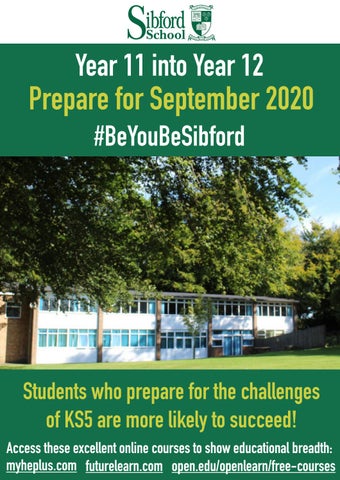
Year 11 into Year 12
Prepare for September 2020 #BeYouBeSibford
Students who prepare for the challenges of KS5 are more likely to succeed!
29 JUNE - 3 JULY 2020
Access these excellent online courses to show educational breadth: myheplus.com futurelearn.com open.edu/openlearn/free-courses
Art (Fine Art) Pre-course tasks to be completed by September 2020
Recording Information: A drawing a day Artists approach the recording of information in a wide variety of ways, but the ability to visually record information about the world as we see and experience it, is common to all. Over a period of 14 consecutive days, use your sketchbook to make visual notes about your surroundings/ thoughts/ feelings. Try to show us the world from your own unique perspective. You can ‘draw’ with all kinds of media, e.g: •
Pencil/pen/graphite
•
Watercolours/ inks/ paint
•
Collage & mixed media
•
Text & image combination
•
Wire
•
iPad/ drawing apps
•
Photography (no holiday snaps or selfies!)
Some days you may spend an hour or so creating something detailed (such as a tonal drawing), other days the task may only take 5 or10 minutes. You should end up with an exciting visual diary that gives us an insight into 2 weeks in the life of you! Recommended research
• Visit one exhibition or gallery & record the experience (photos/ leaflets/ tickets/ sketches, written or spoken word notes). This can form part of the task above or be separate from it.
Biology Pre-course tasks to be completed by September 2020
• Grade 7 or above preferred in GCSE Biology or in Combined Science. (Grade 6s will be considered on an individual basis) and at least a Grade 6 in GCSE Mathematics and English. • Consolidate work from GCSE Biology – read through the following topics, making a list of questions for concepts you are unsure of; - Pathogens & Disease - The Heart
- Transport methods (Diffusion, Osmosis, Active Transport)
- Lungs and CF • Read two of the books/articles below, and then write a book review (one side of A4) for the one you enjoyed the most. Required reading
• Look at the A level Biology page on Firefly and familiarise yourself with the AS units you will be taught
Recommended reading
• Any scientific journals, (Biological Science Review, New Scientist,Nature) • ‘A Short History of Nearly Everything’ • ‘Diversity of Life’ - E. O. Wilson - Bill Bryson • ‘Seven Daughters of Eve’- Bryan Sykes • ‘The Selfish Gene’- Richard Dawkins • ‘Genome’ - Matt Ridley
• ‘Amazing Tour of the Human Anatomy’ - Robert Winston
NOTES The AS exam may be taken if the student is not continuing to the second year of the course. The exam board for Biology AS is Edexcel. There are three components of the AS course, outlined as follows; 1. Paper 1 – ‘Lifestyle, Transport, Genes and Health’ (Topics 1 & 2). 2. Paper 2 – ‘Development, Plants and the Environment’ (Topics 3 & 4). 3. Core Practicals (8 core practicals in AS, 8 in A2). You will have these skills assessed and a PASS for this component noted on your A2 Biology certificate. Both Paper 1 and Paper 2 are worth 50% of your AS Biology grade. The exam board for Biology A2 is Edexcel. There are three components of the A2 course, outlined as follows; 4. Paper 1 – ‘Lifestyle, Transport, Genes and Health’ (Topics 1-6). 5. Paper 2 – ‘Development, Plants and the Environment’ (Topics 1-4 & 7&8). 6. Paper 3 – ‘General and Practical Applications in Biology’ (Topics 1-8 plus a prereleased article 8 weeks before the exam) 7. Core Practicals (16 core practicals in A2, 8 in AS). You will have these skills assessed and a PASS for this component noted on your A2 Biology certificate. Paper 1, Paper 2 and Paper 3 are each worth 33.3% of your A2 Biology grade.
Business Studies Pre-course tasks to be completed by September 2020
1. Read through the PowerPoint ‘Introductory Project’ available on firefly under the BTEC Level 3: Transition 11 to 12 and follow the instructions relating to the case ‘Starlight classics’. Use the report template to produce a detailed report advising the company of their marketing campaign and a presentation to be delivered in September. 2. Complete the MOOC’s course outlined in the PowerPoint: Marketing Fundamentals: Who is your Customer – Babson College 3. Look at the BTEC National Level 3 Extended Certificate in Business- follow the link below: https://qualifications.pearson.com/en/qualifications/btecnationals/ business-2016.html#tab-ExtendedCertificate 4. Subscribe to: https://www.tutor2u.net/ 5. Prepare and organise a lever arch file with file dividers. Each divider needs to represent each chapter from Unit 2 (Personal and Business Finance) and Unit 3 (Developing a Marketing Campaign). 6. Find out what the 4 assessment outcomes for BTEC are and write them down on the inside of your lever arch file.
Required reading
• P earson website: https://qualifications.pearson.com/en/qualifications/btecnationals/business-2016.html • Firefly: Business BTEC Level 3 – Transition 11 to 12. PowerPoint ‘Introductory Project’ • MOOC’s: Marketing Fundamentals: Who is your Customer – Babson College
Recommended reading
• Business/Economics review found on Firefly in the library section • Firefly – Business Studies webpage • The economist • BBC News: Business section
Chemistry Pre-course tasks to be completed by September 2020
• Preferred grade of a 7 or above in GCSE Chemistry or Combined Science (Grade 6 will be considered on an individual basis) and at least a grade 6 in GCSE mathematics. • Go through GCSE work to make sure you are confident with the topics below. Make a list of the things you are not sure of. • Register with the Royal Society of Chemistry’s ‘ChemNet’ by going online to: http://chemnet.rsc.org.
Required reading
• Read and complete the exercises in ‘Head Start to A level Chemistry (CGP A level Chemistry)’.If you have any difficulties, go back to your GCSE notes. Focus particularly on: • - -
Recommended reading
The structure of the atom in terms of Protons, Neutrons and Electrons Bonding types and properties of substances Moles including calculations Balancing equations Organic Chemistry: Alkenes, Alkanes, Alcohols, Carboxylic Acids and Polymers
Try to read one of the following books (or another general science book if you find one that looks interesting): • ‘Mendeleyev’s Dream’- Paul • ‘A Short History of Nearly Strathern Everything’ - Bill Bryson • ‘From Atoms to Infinity ’ - Mary and John Gribbin
• Any relevant magazines and journals such as Science Focus, New Scientist or Catalyst Magazine
NOTES We follow the OCR B ‘Salters Chemistry’ course at A level. In contrast to the traditional ‘topic-based’ approach, Chemistry B (Salters) is ‘context-led’. Chemical concepts are introduced within a relevant context, the course being written as a series of units based on contemporary issues in chemistry. Students study the chemistry in a spiral way so that chemical ideas, introduced in an early topic, are reinforced later. Assessment is as follows: (01) Fundamentals of chemistry - 110 marks - 2 hours 15 minutes written paper (02) Scientific literacy in chemistry - 100 marks - 2 hours 15 minutes written paper (03) Practical skills in chemistry - 60 marks - 1 hour 30 minutes written paper (04) Practical Endorsement in chemistry (continuous assessment)
Countryside Management Pre-course tasks to be completed by September 2020
• For the first unit of study you will be studying woodland habitat management. You are to spend some time over the summer researching the history of UK woodlands and their management. • Make notes (ideally word processed) which discuss the historical influences that have created the current level of woodland in the UK from 100,000 BC to present day. • Explain the development of woodland types and management systems such as coppicing, woodland pasture and the development of the Forestry Commission.
Required reading
• https://h2g2.com/edited_entry/A87783673 • http://www.google.co.uk/url?sa=t&rct=j&q=&esrc=s&source=web&cd= 7&ved=2ahUKEwjIm6S8q8_iAhXmShUIHRnbBF8QFjAGegQICRAC&url= http%3A%2F%2Fwww.bucksplantcare.co.uk%2Fapp%2Fdownload %2F5797614401%2FA%2Bbrief%2Bhistory%2Bof%2Bwoodlands %2Bin%2BBritain.pdf&usg=AOvVaw2NecMavrZ0QOCoVbj0U9e9 • https://www.conservationhandbooks.com/woodlands/a-brief-history-ofwoodlands-in-britain/ • https://www.conservationhandbooks.com/woodlands/a-brief-history-ofwoodlands-in-britain/coppicing/ • https://www.conservationhandbooks.com/woodlands/a-brief-history-ofwoodlands-in-britain/wood-pastures/ • https://www.conservationhandbooks.com/woodlands/a-brief-history-ofwoodlands-in-britain/forests/ • https://www.conservationhandbooks.com/woodlands/a-brief-history-ofwoodlands-in-britain/the-planting-of-woodland/ • https://www.conservationhandbooks.com/woodlands/a-brief-history-ofwoodlands-in-britain/the-20th-century/
Design and Technology Product Design Pre-course tasks to be completed by September 2020
1. Sketch book. You will need to start a sketch book. A5 hard back plain book. On each page draw a different product. Example just sit at your desk and sketch the object on your table, draw the pencil pot, a stapler, in the kitchen you could draw all the equipment. The key points are: a. That you draw one product per page. b. Don’t cross out or rub your work out. 2. Find your favourite designer and design movement. Discover a designer and design movement. It doesn’t matter what they design (Fashion, industrial, product, graphic). Produce a A4 page on both explain who/what they are and what they do. Add why you like them. 3. Find and define the key words: Plasticity (Malleability and Ductility), Elasticity, Brittleness, Toughness, Hardness, Durability, Stability, Bending Strength (Stiffness), Tensile Strength, Shear Strength and Torsional Strength.
Drama and Theatre Studies Pre-course tasks to be completed by September 2020
Research and prepare a short two to five-minute PPT presentation (maximum 10 slides) on one of the following: • A theatre Practitioner from the list below • Frantic Assembly • Artaud • Complicite • Stanislavski • Brecht Do the following: • Try and watch as much theatre and film as possible • Read a recently released theatre production written review – make notes (500 words) on how they structure the review.
Suggested visits
• RSC - use Firefly –Drama – ‘What’s on’ and sign up for a summer workshop.
Useful equipment and reading
• A laptop computer
• Theatre visit, any theatre, anywhere.
• A level theatre companion book (provided by the Drama department) • Set up a Google Docs account (essential for Comp 2 Devised) Ideally but not essential Your own 32/64GB USB memory stick (labelled) Useful additional reading: • Antigone by Sophocles • Yerma by Frederico Garcia Lorca
Economics Pre-course tasks to be completed by September 2020
Focus is COVID - 19 and the impact on the UK economy. 1. Write a short report (3/4 pages) analysing the impact of COVID-19 on the UK economy. Analyse the intervention of government, the Bank of England and any other institutions that you think are relevant. Support your report with relevant research throughout. 2. Look at the AQA Economics Specification (code 7131) and organise a lever arch file with file dividers or set up an electronic folder with all relevant topics and subchapters. 3. Student also needs to find out what the 4 assessment outcomes are and write them down on the inside of their lever arch file.
Recommended reading
• Copies of ‘The Economist’ will be very useful to you as will financial sections of broadsheet newspapers (for example The Guardian, The Times, The Telegraph or the Independent). Make a note on any key things you find from reading these. • Awareness of the AQA economics website is crucial. • Make use of Firefly (Economics webpage) for further support. • Economics Reviews magazines located on the Resources tab in Firefly in the Research and Library folder.
Related articles /research
Inflation • https://www.bbc.co.uk/news/business/economy • https://news.sky.com/video/is-deflation-now-a-risk-for-uk-economy-12008562 Gross Domestic Product • https://www.bbc.co.uk/news/business-13200758 • https://news.sky.com/video/markets-reflect-long-road-back-for-useconomy-12004851 Unemployment • https://www.bbc.co.uk/news/uk-northern-ireland-53060575 • https://news.sky.com/video/painful-decisions-for-employers-tocome-12008182 Inequality • https://www.bbc.co.uk/news/av/uk-england-london-52504740/coronaviruspandemic-exaggerates-london-s-inequality
MOOC to complete
Click the link below to register for the MOOC. • https://unifrog-eu-west-2.s3.amazonaws.com/student/2b2e8/shortlist/ y5d6peuasa6ba92cn96c2ex4cb11t74a35ybwd7c.pdf
English Literature Pre-course tasks to be completed by September 2020
Required reading
Make research notes on the following to submit in your first lesson: •
Tragedy as a genre – Greek/Classical/Shakespeare/Modern/Domestic
•
Aristotle’s Poetics
•
Victorian (around 1890) society – education, the role of women, poverty, rural and urban lifestyles
•
A sense of what ‘Romantic’ poetry means
Read these texts, make ‘initial thoughts’ notes ready for September: (if necessary, see your teacher for exact details before the summer holidays) • Othello/King Lear by William Shakespeare (The New Cambridge Shakespeare, updated) • Any poetry by Keats, Hardy • Tess of the D’Urbervilles by Thomas Hardy (Penguin Classics recent edition) • The Crucible by Arthur Miller (any edition – this is a ‘warm-up’ text) • The Glass Menagerie by Tennessee Williams ( ditto – ‘warm-up’)
Recommended reading
You should read as widely as possible from a variety of different time periods and genres. There is a SUGGESTED reading list on Sibford School’s Firefly site – go to the ‘Library and Research’ tab, look for ‘Book Lists’, then ‘Year 12 Reading List’. Anything that particularly interests you from the following recommendations would also be good: • ‘All My Sons’ & ‘A View from the Bridge’ by Arthur Miller • ‘Hamlet’, ‘Macbeth’, ‘Titus Andronicus’, ‘King Lear’, by William Shakespeare • ‘Saturday’ & ‘On Chesil Beach’ by Ian McEwan • ‘A Thousand Splendid Suns’ by Khaled Hosseni • ‘The Reluctant Fundamentalist’ by Moshin Hamid • ‘Invisible Man’ by Ralph Ellison • ‘The Handmaid’s Tale’ by Margaret Atwood • ‘Their Eyes Were Watching God’ by Zora Neale Hurston • ‘Heart of Darkness’ by Joseph Conrad • ‘Jane Eyre’ by Charlotte Bronte • ‘A Doll’s House’ by Ibsen
ESOL Pre-course tasks to be completed by September 2020
You should already have covered all the grammatical structures at an Intermediate/B1/B2 level. It would be a good idea to revisit this grammar before starting your 6th form studies. I would recommend working through English Grammar in Use by Raymond Murphy to fill any gaps you may have.
Recommended activities
You should have reached the level now where language progression involves many fun activities. Make sure you do some or preferably all of the following every week: • read in English for pleasure. Choose a writer you enjoy and read the novel in English • keep up with current affairs by listening to the news in English • watch as many films and TV series as you can (with or without subtitles) Make use of the following websites: • https://learnenglish.britishcouncil.org Quizlet - Sibfordesol • https://elt.oup.com/student/headway/upperintermediate
Extended Project Qualification (EPQ)
Pre-course tasks to be completed by September 2020
Download the Production Log from Firefly. (Subjects – Extended Project – Level 3 Project) Complete your name and candidate details and save the file. Familiarise yourself with the production log. • You will complete the sections of the production log throughout your EPQ learning journey (approx. one page per month). It will form part of the evidence to support your research project and findings. • The most useful thing you can do over the summer holidays is to explore possible topics for your research project. It will help you tremendously if you come to the first lesson with a shortlist of possible ideas (or one firm idea). • If you are sure about what you want to research and wish to start collecting information, don’t forget to log all sources. For books you need to include the Author, title, place of publication, date of publication, publisher. • For online sources you need to include Author, title, URL (web address) and date accessed.
Geography Part 1 - Human Geography Pre-course tasks to be completed by September 2020
•
Download BBC news app (or something equivalent).
•
Find articles relating to MIGRATION over the course of the summer.
•
Summarise and save these articles in following headings: Causes of Migration, Impacts of Migration
•
In particular, look at the migration within the EU and migration coming from outside the EU (Syria and Africa). You could also look at the migration corridor between Mexico and USA.
•
Make sure you make a note of your source and think about the reliability of each source you use. What do you notice about the impact of different sources regarding Migration – can you give/save any examples of biased representation of Migration?
Part 2 - Physical Geography Pre-course tasks to be completed by September 2020
• For the first lesson back after the summer holidays you must have written a fact file on the NILE DELTA. • You must include information about: 1.
The location (including a map)
2.
Formation of Delta
3.
Physical characteristics of the Nile Delta
4.
Landforms of the Nile Delta
5.
Causes of high erosion in the Nile Delta
History Pre-course tasks to be completed by September 2020
AQA History (7042) Component 1C: The Tudors, 1485-1547 Core textbook: Oxford AQA History The Tudors: England 1485-1603. Write a review of any history book you read over the summer. Component 2N: Revolution and dictatorship-Russia, 1917-1953 Core textbook: Oxford AQA History Revolution and Dictatorship: Russia 191753 Read and note Jez Ross hand out ‘The Russian Empire, 1891-1914’. Write a letter to Lenin arguing the case for launching a popular revolution on the eve of the First World War. Argue on the basis of social discontent amongst the working class and the peasants, the weakness of existing political and social institutions and the unpopularity of the Romanov dynasty.
Recommended reading
Component 1C: The Tudors, 1485-1547 The Tudor Queens of England by David Loades. The Sixteenth Century by Patrick Collinson. The Prince by Niccolo Machiavelli. Thomas Cromwell by Diarmaid MacCulloch Wolf Hall, Bring Up the Bodies or The Mirror and the Light by Hilary Mantel. Component 2N: Revolution and dictatorship-Russia, 1917-1953 The Noise of Time by Julian Barnes. The Master and Margarita by Mikhail Bulgakov. Darkness at Noon by Arthur Koestler. Ten Days Which Shook the World by John Reed. Everyday Stalinism by Sheila Fitzpatrick. Revolutionary Russia, 1891-1991: A Pelican Introduction by Orlando Figes.
IT
BTEC National Level 3 Pre-course tasks to be completed by September 2020
Unit 3 – Using Social Media in Business Explore the impact of social media on the ways in which businesses promote their products and services. Complete the task tables provided on the IT Firefly page here: Consider: • How a business might promote itself or its products/services and communicate/interact with its customers or potential customers without using social media. • How a business might benefit from having a social media presence. • How existing businesses use social media to promote themselves or their products/services and communicate/interact with customers or potential customers. Find out who the typical users are for each of these social media sites: •
•
•
•
YouTube
•
•
Mathematics and Further Mathematics Pre-course tasks to be completed by September 2020
• GCSE grade 6 standard in Mathematics is required, though a 7 or above is preferred (and recommended). The A level course will be extremely challenging (and perhaps not possible) if a grade 7 level of understanding or above is not achieved at GCSE. • Students wishing to study Further Mathematics are advised that a grade 8 standard or above is desirable. • Students must have completed as much of the ‘Head Start to A level Maths’ pack as necessary. This will be provided by the Mathematics department and an exam will be given approximately two weeks into the course which will test whether students have understood the work from the pack and will enable us to gauge the appropriateness of the course for each student. • MyMaths.co.uk can also be used to assist the reviewing of GCSE materials.
NOTES • It is important to remember that at A level, much of the work deemed to be ‘7 or above’ at GCSE becomes a standard expectation, so reviewing using the ‘Head Start to AS Maths’ pack towards the end of the summer holidays is essential. • The new A level course requires a specific kind of calculator (the GCSE ones are in general not high enough spec). We will provide this at the beginning of the course so that everyone has the same version, so please do not feel that you need to get one in advance. • Those taking Further Mathematics need to appreciate that not all the combinations of subject options will be available. The options will need to support the strengths of the majority of the class and will be finalised in September.
Media
Creative Digital Media Production BTEC National Level 3 Pre-course tasks to be completed by September 2020
Suggested visits
Research and prepare a short presentation (no more than 10 slides) or poster on one of the following: •
A favourite scene/s from a film or television series
•
A film director of your choice
•
A film festival in the UK or abroad
•
A career that interests you in the media world (film)
•
A media organisation of your choice (BBC, Sky, BBFC)
• BFI British Film Institute in London, Southbank • National Media Museum, Bradford • BBC studios Media City, Salford or Birmingham – need to book online
Useful equipment and reading
A pair of comfortable headphones (no need for expensive ones) labelled The Digital Filmmaking Handbook (Brindle) Quercus £4.99 (Book People) Ideally but not essential: Your own 32GB high quality SD card for filming (labelled) Your own 32/64GB USB memory stick (labelled) Useful additional reading: Making Short Films: The Complete Guide from Script to Screen (Thurlow) Bloomsbury In addition, if you have completed any practical work for GCSE media or as your own project, please bring this with you to the first lesson you attend.
Music Pre-course tasks to be completed by September 2020
• 30% of the AS/A level music examination is a recital performance. The summer break is a great time to spend some time exploring and discovering new pieces that you would like to play. What are your musical goals for the next two years? • List the pieces you are studying / want to study/learn • 30% of the A level examination is composing. Have fun developing your ideas and trying out your ideas. You set your own brief for the first composition.
BTEC Music
Level 3 Musical Perfromance
Pre-course tasks to be completed by September 2020
• Continue exploring new repertoire and developing original compositions. • Do some research about working in Music Industry and event management, for example, booking venues and artists, health and safety and PRS.
Physics Pre-course tasks to be completed by September 2020
• Preferred grade of a 7 or above in GCSE Physics or Combined Science (Grade 6 will be considered on an individual basis) and at least a grade 6 in GCSE mathematics. • Consolidate work from GCSE Physics, particularly: Waves and the Electromagnetic spectrum, Forces, Electricity. Websites such as ‘Pass My Exams’ are good for this: http://www.passmyexams.co.uk/GCSE/physics/ index.html. • Sign up to Qubit - https://www.iop.org/education/student/index.html which is aimed for students aged between 16 and 19 studying physics; regular e-newsletters are sent out on behalf of the Education team and will provide you with tips and guidance, information about careers in physics, upcoming events and what’s new in physics.
Required reading
• New Scientist magazine or Physics Review (available of the library resources tab on Firefly.) • One of the following popular Science books: • ‘The Big Bang’ by Simon Singh • ‘A Short History of Nearly Everything Parts I - III’ by Bill Bryson
Recommended reading
• Work through the Student Maths Support pdf from Edexcel – See Physics Firefly page.
NOTES The exam board for A level Physics is Edexcel. There are four assessment components to the A level course. • Paper 1 Topics 2 -3, Advanced Physics I (worth 30% of the A level grade). This covers topics in mechanics and electricity and experimental methods. • Paper 2 Topics 4 - 5 Advanced Physics II (worth 30% of the A level grade) This covers topics in Waves, and materials and experimental methods. • Paper 3 All topics and Practical Principles (worth 40% of the A level grade) • Core Practicals (PASS noted on your A2 Certificate)
Psychology Pre-course tasks to be completed by September 2020
Psychology Media Project Complete a psychology media project, involving writing short reviews of TV shows, books, films and/or websites related to psychology. More detailed information about the project will be sent to students interested in A level Psychology. Full details of this project will be emailed by the subject teacher to those who have expressed an interest in taking Psychology.
Recommended reading
There are hundreds of books about different areas of psychology. Here is a link with some interesting books you might enjoy: • https://www.waterstones.com/category/politics-society-education/ psychology.
Religious Studies Pre-course tasks to be completed by September 2020
In 500 words – why do I want to study Religious Studies? Choose one of the following and prepare a presentation (in any format) for the class: • Hume’s Fork • Occam’s Razor • Schrödinger’s Cat • Pascal’s Wager • The Trolley Problem Keep a diary of news events/articles relating to current religious/moral/ethical events. Keep a muse/thought journal – personal glimpses of thunks, wonderings, flitters of philosophical thought from your life wanderings…
Recommended research
Take a look at the reading list and find/read/research as much as you can – for the biblical texts use Bible Gateway online. Watch films with a philosophical/ethical or religious viewpoint – write a summary of the film as a review and, more importantly, include the key philosophical/ethical points that have been raised. For example currently on Netflix: • The Good Place • The Two Popes • Erin Brockovich For example currently on Amazon: • The Switch • The Diving Bell and the Butterfly • The Matrix
Sport & Physical Activity OCR Technical Level 3 Pre-course tasks to be completed by September 2020
Unit 1 1. Create a model of the skeleton and label all of the bones that you need to know for your syllabus. Be creative in your design and bring it to the first lesson back. Axial skeleton • •
Cranium Sternum
•
Ribs
Appendicular skeleton
• Vertebral column – to include cervical/thoracic/lumbar/sacrum/coccyx •
Ilium
•
Tibia
•
Scapula
•
Ulna
•
Ischium
•
Fibula
•
Clavicle
•
Carpals
•
Pubis
•
Tarsals
•
Humerus
•
Femur
•
Talus
•
Radius
•
Metacarpals • Phalanges •
Patella
•
Metatarsals
2. It will really help you to learn early on all the muscles that you are expected to know for this course. These are listed below: • Deltoid • Erector spinae group • Biceps femoris •
Latissimus dorsi
•
Pectoralis major
•
•
Trapezius
•
Semimembranosus
•
Internal and external • obliques • Iliopsoas •
Teres major
•
Gluteus maximus
•
Gastrocnemius
•
Biceps brachii
•
Gluteus medius
•
Soleus
•
Triceps brachii
•
Gluteus minimus
•
Radio-ulnar
•
Adductor longus
•
Pronator teres
•
Adductor brevis
• •
Supinator muscle • • Wrist flexors
•
Wrist extensors
•
Rectus abdominus • •
•
Semitendinosus Tibialis anterior
Adductor magnus Rectus femoris Vastus medialis Vastus intermedius Vastus lateralis
For each one learn where it is as well as its function (what action it performs). Unit 2 1. Complete 3 session plans in detail for the sport that you wish to coach in next year. Remember to use the OCR template that you have done your first session plan on and to make each session progressive.
Textiles Pre-course tasks to be completed by September 2020
Recording Information: Line / Colour / Texture / Pattern Textile artists approach the recording of information in a wide variety of ways, but the ability to visually record information about the world as we see and experience it, is common to all. Over a period of 14 consecutive days, use your sketchbook to make visual notes about your surroundings/ thoughts/ feelings. Try to show us the world from your own unique perspective. You can ‘record’ with all kinds of media, e.g: •
Pencil/pen/graphite
•
Fabric & stitch
•
Watercolours/ inks
•
Collage & mixed media
•
Patchwork
•
Text & image combination
•
iPad/ drawing apps
•
Photography (no holiday snaps or selfies!)
Aim to demonstrate a good use of line, colour, texture and pattern in your work thinking about how you could adapt your ‘visual notes’ in to textile pieces. Some days you may spend an hour or so creating something detailed (such as a tonal drawing or stitched embroidery), other days the task may only take 5 or 10 minutes. You should end up with an exciting visual diary that gives us an insight into 2 weeks in the life of you! Recommended research
• Visit a textile exhibition / collection & record the experience (photos/ leaflets/tickets/ sketches, written or spoken word notes). This can form part of the task above or be separate from it. • Many museums have online virtual tours you can access if you can’t physically visit them.