APRIL 2020.
Sibford School Pastoral Matters Edition 1 - The Virus Edition
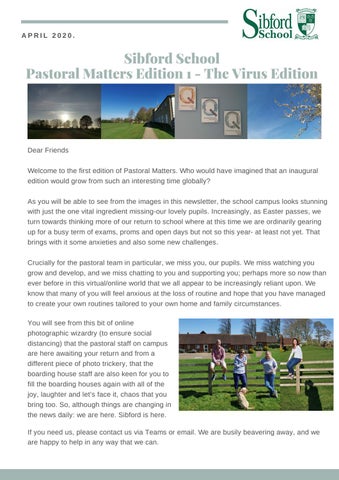
Dear Friends Welcome to the first edition of Pastoral Matters. Who would have imagined that an inaugural edition would grow from such an interesting time globally? As you will be able to see from the images in this newsletter, the school campus looks stunning with just the one vital ingredient missing-our lovely pupils. Increasingly, as Easter passes, we turn towards thinking more of our return to school where at this time we are ordinarily gearing up for a busy term of exams, proms and open days but not so this year- at least not yet. That brings with it some anxieties and also some new challenges. Crucially for the pastoral team in particular, we miss you, our pupils. We miss watching you grow and develop, and we miss chatting to you and supporting you; perhaps more so now than ever before in this virtual/online world that we all appear to be increasingly reliant upon. We know that many of you will feel anxious at the loss of routine and hope that you have managed to create your own routines tailored to your own home and family circumstances. You will see from this bit of online photographic wizardry (to ensure social distancing) that the pastoral staff on campus are here awaiting your return and from a different piece of photo trickery, that the boarding house staff are also keen for you to fill the boarding houses again with all of the joy, laughter and let’s face it, chaos that you bring too. So, although things are changing in the news daily: we are here. Sibford is here. If you need us, please contact us via Teams or email. We are busily beavering away, and we are happy to help in any way that we can.
Online Safety - For Parents We recognise that due to the current situation children and our young people (as well as parents and carers) are going to be spending considerably more time online. This is not always a bad thing. Here, and in the attached PDF, we cover a few of the crucial areas for parents and pupils to consider when keeping safe online. Don’t worry so much about screen time – our young people are going to be at screen. Instead, focus on screen use. What are they actually doing when they are online? There should be a good balance of different activities: some work, some socialising, some researching/ learning new things, reading the news etc but keep the work separate from all those things. Work is work (and begins at 0840 daily Monday-Friday). https://www.internetmatters.org/resources/screen-time-tips-to-support-11-14-year-olds/ https://www.internetmatters.org/resources/screen-time-tips-to-support-teens/ Talk to your children – take time to understand what your child is doing online – don’t always assume that they are up to no good! There is a swathe of evidence to suggest that there are people out there right now exploiting the current situation to trick our young people when they are at their most vulnerable. The most important thing is that if something went wrong our young people would know that they would be able to come and speak to you or to us. The way we react when our children tell us about a problem is absolutely crucial, overreacting is not an option. Change passwords often and check that you are happy with the content/tenor/language of the groups that your child is a member of. Insist they have some tech-free times. Give their brains time to breathe.
Online Safety - For Pupils Whilst tech is great and so important at the current time, we all need a break from it. Most guidance suggests that having tech-free mealtimes and not having devices in bedrooms overnight is the most sensible. Taking part in family activities or playing games is thought to be beneficial. Talk to your family. All of the old rules continue to apply. Protect and change passwords; don’t talk to strangers; remember that what you post now could affect your future prospects and crucially, never post anything that you wouldn’t like your Granny to see- either in image or text! If you need any support with any of this, please contact any member of the pastoral team for a chat.
Registration We are trying to keep to the format of the school day as much as is possible. To that end we ask that you register once a day with your tutor in the morning registration period. Your tutor will be available on Teams from 0840 onwards. You can check in with them at that time by appearing on Teams and saying hello or by popping a thumbs up on your tutor group Teams page in chat. If you are in SFL or some other activity at that time, you can put that thumbs up or even just send an email when you come out of that.
Tutor Time Tutors will expect you to appear for the normal Tutor time/PSHE slots every week on Wednesdays and Fridays.
Pastoral Staff Availability The Senior School Pastoral Teams chat will always have someone online during Monday to Friday at 1:30-2pm so if you want to just drop in and say hi you can, and if you need more support , we can take it from there. Otherwise drop your tutor or one of us an email if you need our help.
Managing Microsoft Teams Lessons - A Reminder Whilst participating in your lessons at home online via Microsoft Teams, please note the following rules, which are in place to keep all our community safe: Try to find a quiet space where you can focus on your lesson uninterrupted by any members of your household. Any computers used for Microsoft Team lessons should be in appropriate areas, for example, not in bedrooms, and where possible with a neutral background in video shot. Use the ‘blur background’ function during team meetings. You must wear suitable clothing. No PJs, onesies, revealing clothing etc. Think of being suitably attired as if for a casual’s day. Your staff will teach in group lessons only. They will not conduct any form of 1 to 1 session. Microsoft Teams automatically records lessons on their back up system. Remember, you will always be visible so behave and communicate appropriately as you would in school. Normal technology rules apply whilst in a web lesson. Mobile phones should not be used to film/photograph any part of the lesson. Pupils must not invite or disinvite others into groups.
Boarding Life Despite missing the energy that the boarders bring to the houses, Houseparents and their families have still been busy. We have been holding weekly 'Virtual Boarding House’ meetings, which have meant that Sibford has still been able to connect with Britain, Europe and China. Students and staff have shared some great tips for our isolation: favourite recipes, learning languages, arts and crafts, inspiring music, online exercise videos, and even raising sea monkeys! It is wonderful how technology can still be used to see everyone and to share how we're doing -it is great to see the community supporting each other from afar. The boarding staff have also been making great efforts to support others on campus and in the wider community. Penn House has taken on the role of Postman Penn by receiving all of the post during closure and Greg Symes (Head of Design Technology) has had the school’s 3D printer whirring away making parts for Personal Protective Equipment for NHS staff. Chocolate treats were also delivered to every household on campus on Easter Sunday; everyone was extremely grateful. On the note of gratitude, the Sibford community wholeheartedly joined in with clapping loudly for the NHS, carers and keyworkers – much clapping, cheering and banging of saucepans could be heard far and wide – a great sense of unity even in difficult circumstances. There have been a few birthdays whilst away – Houseparents are hoping to find ways to celebrate students’ birthdays interactively while on closure and we will make sure that those who miss out get their cake and gift when we are back. Tara celebrated a birthday this week; the Symes’s all sang Happy Birthday loudly from a safe distance and Bunny Baker will also spend a day trying to ignore her son reminding her that she is another year older but the Knowles’ household are on cake making duty. How many candles?!? Keep in touch everyone; we will see you soon. Apart from email and Teams contact, please don’t forget you can keep up with boarding news via Twitter @SibfordBoarding.
Be safe everyone; we are looking forward to getting our Sibford family back again but, in the meantime, we will reach out to you across the wifi. Think of my favourite Dumbledore quotation that adorns the wall of my office: "Happiness can be found even in the darkest of times, if only one remembers to turn on the light".
Tracy Knowles Assistant Head Pastoral Designated Safeguarding Lead
Useful Information Mental Health - A Self help Guide (attached) Please also see the attached AACOSS Leaflet - Online Safety - Tips for young people. NSPCC Help Link : https://www.nspcc.org.uk/keeping-children-safe/our-services/nspcc-helpline/ Childline Help Link: https://www.childline.org.uk/get-support/contacting-childline/ Police: 999 NHS: 111
Mental Health - A Self Help Guide We appreciate that many of our pupils and perhaps even parents will be anxious during this time of pandemic. Ordinarily we can work with our young people to ease the anxiety and we hope to continue to do so remotely if possible. Tutors, Heads of Key Stage, House staff and myself are all easily contactable and keen to help. We have to keep reminding ourselves that it’s not 'how awful I have to stay indoors' but 'how lucky I am to have somewhere safe to stay'. For those of you who are keen to help yourselves, a few ideas for self-help are here but, again, contact us directly if you need us. Draw a circle of control - At the moment you may feel as if you have no control over much of what is happening, but the truth is that if we look at things closely there are lots of things we do have control over. You can create your own circle of control. You draw what you can control on the inside and what you cannot on the outside, so you can think of all the things you can control right now and add to them as time passes. Don’t hesitate to meditate - Meditation is a great way of clearing our minds of worries. You can find great meditations on YouTube or apps such as Calm, which can talk you through how to relax your body and mind. You may want to do this before bedtime when you’re chilling out before you go to sleep. Grounding Techniques - You can also use grounding techniques such as using your five senses. Look around the room. Use your fingers as you count up your five senses. Look for something you can… See. Focus on something. It could be a pencil on the desk. What colour is it? Ask yourself if it is blunt or in need of a sharpen. Hear. What can you hear? It could be the clock on the wall; someone cutting the grass outside; birds singing. Listen carefully and try to separate out each individual sound. Touch. It could be the seat you are sitting on or the clothes you are wearing. Think about the textures or what it is made of. Are your feet firmly on the ground? This will help you feel grounded. Smell. Can you smell food being cooked? Or the smell of your washing powder? Taste. Can you still taste your toothpaste? Or the meal you just ate? What was the last thing you ate? Was it sweet or savoury? Keep a journal - Because you have got a long stretch of time ahead where you’re going to be stuck indoors at home you run the risk of feeling bored. Inside you can write down the things that you have been doing, and stick in photos or draw pictures. One day, diaries from the pandemic of 2020 will be historical documents - see Samuel Pepys. It’s really important that we all remember that this period of isolation is in order to stay safe and it is not for forever! Perhaps write a letter (yes, a letter not an email!) to friends and family; make plans for what we will do when we can leave the house again.
Mental Health - A Self Help Guide Rating your mood - It’s important that you allow yourselves to feel scared or confused or to even feel angry at the coronavirus. It is really annoying. Share your feelings with friends, family or us because if you talk about it, it will feel better. And breathe - Sometimes when we are anxious or stressed, we can find it hard to breathe and to slow our heart rate down. Focus on taking deep breaths it can help you to feel calmer. Spread the fingers on one hand out, and take a finger of your other hand, and trace your way up and down you thumb and fingers as you breathe in and out. As the finger runs up, you breathe in, and as it runs down, you breathe out. These five deep calming breaths can help when you are feeling overwhelmed.