The
BOLT
March 2026 Volume 24 Issue 4 lightningboltonline.com Sage Hill School 20402 Newport Coast Drive, Newport Coast, CA 92657
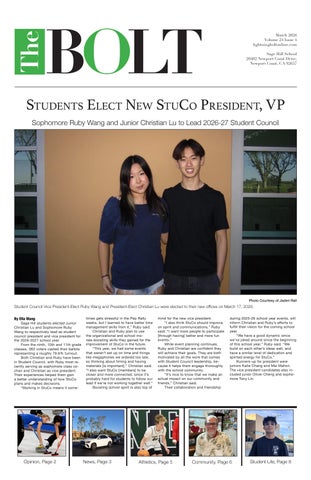
Students Elect New StuCo President, VP Sophomore Ruby Wang and Junior Christian Lu to Lead 2026-27 Student Council
Photo Courtesy of Jaden Rall
Student Council Vice President-Elect Ruby Wang and President-Elect Christian Lu were elected to their new offices on March 17, 2026. By Ella Wang
Sage Hill students elected Junior Christian Lu and Sophomore Ruby Wang to respectively lead as student council president and vice president for the 2026-2027 school year. From the ninth, 10th and 11th grade classes, 363 voters casted their ballots representing a roughly 79.6% turnout. Both Christian and Ruby have been in Student Council, with Ruby most recently serving as sophomore class cochair and Christian as vice president. Their experiences helped them gain a better understanding of how StuCo plans and makes decisions. “Working in StuCo means it some-
Opinion, Page 2
times gets stressful in the Pep Rally weeks, but I learned to have better time management skills from it,” Ruby said. Christian and Ruby plan to use the organizational and school morale-boosting skills they gained for the improvement of StuCo in the future. “This year, we had some events that weren’t set up on time and things like megaphones we ordered too late, so thinking about timing and having materials [is important],” Christian said. “I also want StuCo [members] to be closer and more connected, since it’s probably hard for students to follow our lead if we’re not working together well.” Boosting school spirit is also top of
News, Page 3
mind for the new vice president. “I also think StuCo should improve on spirit and communications,” Ruby said. “I want more people to participate [through having] better and more fun events.” While event planning continues, Ruby and Christian are confident they will achieve their goals. They are both motivated by all the work that comes with Student Council leadership, because it helps them engage thoroughly with the school community. “It’s nice to know that we make an actual impact on our community and friends,” Christian said. Their collaboration and friendship
Athletics, Page 5
during 2025-26 school year events, will inform Christian and Ruby’s efforts to fulfill their vision for the coming school year. “We have a good dynamic since we’ve joked around since the beginning of this school year.” Ruby said. “We build on each other’s ideas well, and have a similar level of dedication and spirited energy for StuCo.” Runners-up for president were juniors Katie Chang and Mei Mahon. The vice president candidates also included junior Oliver Cheng and sophomore Tony Lin.
Community, Page 6
Student Life, Page 8
2
The Bolt March 2026 Sage Hill School
Opinion
Don’t Drop the Ball: Sports Aren’t Apolitical By Isabella Huang
Sports and politics do not occupy separate spheres. At the Milano Cortina Winter Olympics, freestyle skier Hunter Hess told reporters he felt “mixed emotions” competing for the United States in light of the current political environment. President Trump fired back on Truth Social, calling Hess “a real loser” and saying it was difficult to support him. The president has joined a chorus calling for athletes to divorce politics from their careers and to “stick to sports.” The demand has emerged in response to Winter Olympic athletes speaking out against the Trump administration. Figure skater Alysa Liu, daughter of a political refugee, called on people to “notice the faults in our own government.” Snowboarder Chloe Kim, the child of first-generation immigrants, urged the public to “lead with love and compassion.” The U.S. women’s hockey team declined a White House invitation after Trump made a demeaning comment in a phone call to the U.S. men’s ice hockey team; Hilary Knight called it “a distasteful joke.” Athletes faced coordinated online harassment severe enough to prompt a statement from the U.S. Olympic and Paralympic Committee.
This is not a new dynamic. At the 1968 Mexico City Olympics, Tommie Smith and John Carlos raised blackgloved fists during the 200-meter medal ceremony in protest of racial injustice as the “Star-Spangled Banner” played. Smith and Carlos were expelled from the Games and ostracized from the athletic community. A 1968 Time magazine derided the scene as “Angrier, nastier, uglier,” a play on the Olympic motto “Faster, Higher, Stronger,” calling it “the theater of the absurd.” Meanwhile, Black athlete Willie Davenport was lauded for forgoing politics, standing “straight and tall” at the podium. The message then, as now, was that the fight for civil liberties only matters when it doesn’t interfere with our sports: the escapist spectacle that shields us from uncomfortable realities, if only for the length of a game. The demand to keep politics out of sports rests on a premise that has never been accurate. Sports and politics were never two separate things. Rather, sports have always served as a political tether. The ancient Greek Olympics served as a mode for city-states to establish dominance over their neighbors and rivals. And the influence of sports in a political
society cannot be denied. Sports fans worship athletes as heroes, sing anthems that affirm our national supremacy and memorize player facts and statistics. Anything so closely interwoven with the fabric of our inherently political lends itself as a political platform. At the centers of our societies and so heavily televised, what gives for sports to be immune to politics? In all its glory, the Olympic Games are no different from every sporting event: never escaping the politics of the nations that send athletes to compete in them. NFL quarterback Colin Kaepernick kneeled during the national anthem to protest police brutality and racial injustice, a movement reignited after the 2020 murder of George Floyd. Ukrainian skeleton athlete Vladyslav Heraskevych was disqualified from competition at the 2026 Olympics for wearing a helmet bearing the names of fellow teammates killed in Russia’s invasion of his country. In each case, athletes who chose to speak paid a significant price. The Olympics only serve to amplify the intense nationalism that sports provoke. In representing the nation, Team USA athletes are intrinsically political figures with the power to define what it means to be American. Their words and
actions are broadcast to the nation, shaping the subjectivities of those who watch them on television. When athletes are condemned for expressing dissent, the message is not that sports should be protected from politics. It is that certain political positions should be protected from scrutiny. The United States was intended to be a nation of civil discourse. Our right to protest is enshrined within the First Amendment. Protesters across this country are being tear-gassed, shot and killed for exercising the same rights these athletes invoked from a press conference microphone. Why do sports suddenly incite the notion that we need to be blindly nationalist? Why silence athletes on a platform now? Everything these athletes do is political, magnified by the slew of cameras and reporters that follow the world’s best athletes through every moment of their Olympic journey. Watching a sports game was never meant to be an escape from the politics of the real world. If a demonstration of civil unrest makes you uncomfortable at a sporting event, remember that sports and politics were never separate.
Why We Pretend to Understand Olympic Curling Every Four Years By Maya Desai
It’s almost predictable. Every four years, curling transforms into a global sensation. Across television screens, sports media and tweets, curling dominates conversations and transfixes audiences globally. Overnight, a sport ignored for years becomes the center of attention. The combination of high-risk, intense strategy mirrored with long, quiet stretches of stone dragging on ice creates an element of spectacle that captivates viewers at first glance. The pageantry of curling is both oddly intense and satisfying. First featured in the Olympic program in 1924, curling fittingly began as a demonstration sport, an event held to increase engagement and introduce spectators to local and emerging sports. Sixty years and three Olympics appearances later, the 1998 Nagano Winter Games included curling as an official sport.
Despite its seemingly long history, curling continues to hold the same mystifying nature: various shot types, strategic sweeping techniques and different ice qualities sport. Despite its seemingly long history, curling continues to hold the same mystifying nature: various shot types, strategic sweeping techniques and different ice qualities. So why do we all become curling experts every four years? Perhaps what makes curling so popular is how straightforward and imitable it appears. Does your pulse quicken, your breath abate and do you momentarily feel as if you are the one sliding down the ice during a curling shot? You may think the reason is community: when you feel part of a fandom — the 10 years you have spent devoted to a certain team’s success or the heartwarming, tragic backstory of an athlete — why would you not react? But the true answer: mirror neurons. Mirror neurons in our brains fire off in rapid succession when we perform an
action or observe the same action done by another. During any sporting event, our nervous systems internally simulate an athlete’s performance on our own motor representations. But especially during the Olympics with a sport as seemingly simple as curling, your close observations simulate the performance—your body experiences an invisible workout. The sport appears easy to imitate because you are actually mimicking it. There is also a social element rooted in national pride in curling, one that feels especially significant in a country as politically polarized as the United States. Mark Twain once wrote, “Patriotism is supporting your country all the time, and your government when it deserves it.” The Olympics have long established themselves as political games: the famous Black Power salute of Tommie Smith and John Carlos in protest of racial discrimination, the ban of Russia in the last two Olympic games following its invasion of Ukraine and, in the most recent games,
U.S. athletes speaking out against President Donald Trump and his immigration policies. “I chose to utilize one of the amazing things about the United States of America (freedom of speech) to convey how I feel,” said American figure skater Amber Glenn, defending her comments in support of the LGBTQ+ community. Her statement highlights how, even in moments of division, athletes will redefine what it means to represent their country. The sentiments reflect a deeper truth about patriotism. Watching a curling team during the Olympics is no longer just a single electrifying movement, it becomes symbolic, a small but meaningful representation of how we balance our collective unity and individual identity. Pretending to understand curling is not simply about the sport itself anymore; for a moment, it doesn’t just unite our self-confidence or imitation skills, it unites a nation.
THE BOLT
T
he Bolt is a student newspaper and serves the public forum at Sage Hill School. Its content - news, editorial, opinion, and feature - is protected by Education Code 48907, the state student rights law and the California Constitution which guarantees all citizens the right of freedom of speech and of the press. Opinions expressed do not represent the views or beliefs of Sage Hill School and its administration. The Bolt accepts signed letters to the editors from members of the Sage Hill community which may be posted as comments at lightningboltonline.com, or addressed to Editors-in-Chief Arya Rawal, Katelyn Yeh and Maya Desai and put in their mailboxes on campus. These letters may not exceed 150 words or they will be edited for inclusion.
Editors-in-Chief Arya Rawal (Bolt), Katelyn Yeh (Bolt) & Maya Desai (Online) Editorial Board
Amy Choi, Taite Nicholson, Kenzie Chang, Maria Neemuchwala, Isabella Huang, Doyoung Lee, Ella Wang, Jenny Li, Linda Liu, Tina Tahbaz & Johnathan Yan
Writers Suri Li, Elisa Xu, Nate Yoo, Mika He, Grace Ma, Jennifer Lee, Chaaya Springer, Leo Lin, Milan Desai, Nicole Bo, Jessimi Lyu, Nathan Tang, Nikki Petrie, Colette Moshayedi, Maria Wang and Melissa Yu Photographers and Artists Nathan Tang, Leo Lin, Giselle Barron, Tina Tahbaz, Penelope Pan, Chaaya Springer and Jessimi Lyu Adviser Daniel Langhorne
Scan this QR code to check out our Instagram or find us at lightningboltonline.com for the latest news!
News
The Bolt March 2026 Sage Hill School
3
Drivers’ Bad Behavior Still Vexes Morning Drop-Off By Taite Nicholson
The student parking lot fills by the school day’s start with more than just student drivers. Parents dropping off their children have increasingly begun using the student parking lot instead of the designated drop-off, creating congestion, frustration and safety concerns. Student drivers are left to navigate a maze of parked cars and parents idle in lines wrapping around the lot’s edges. Parents dropping off their children enter the student lot — instead of the roundabout — let their students get out at the crosswalk, and line up their vehicles to exit campus. An email signed by Safety & Security Manager Adam Patterson was sent to the Sage Hill community on Sep. 2, 2025. It reinforced student parking lot policies around parents parking in the designated student lot, reminding parents of the appropriate drop-off location and clarifying that drop-off in the student parking lot was prohibited. Any parents who failed to adhere to this rule would have to wait until 8:10 a.m. to leave the lot and be prohibited from forming a line to exit. “Prior to that communication, I would count as many as 60 vehicles trying to drop off and then lining up to exit the lot before 8:10 a.m.,” Patterson said. “Today, for example, I counted only eight. We have made it increasingly more inconvenient to not go with the program.” But recent comments from students still indicate an issue. “I think they need to lock the parents in the lot until 3 p.m.,” senior Dharma Le expressed her irritation, in jest. “It can add 10 minutes to my commute depending on the circumstances.” The flow of traffic remains altered for students entering the lot and attempting to find a parking spot, often having to simultaneously navigate a forming line
Tina Tahbaz | The Bolt
Vehicles line up as drivers wait for campus safety officers to reopen the student parking lot’s exit around 8 a.m. on March 19, 2026. of parent drivers whose children have already exited their vehicles. Safety remains a top priority for Sage Hill administrators. “We have taken steps to limit the opportunity for parent drivers to drop off students in the front aisles of the student parking lot,” Patterson said. “You may have noticed the addition of traffic barricades in the [backside] opposite of the flagpole that discourage vehicles from easily looping through to the front rows.
These traffic control devices are in addition to safety staffing in the parking lot,” Patterson said. Safety officers observe and approach drivers attempting to unsafely circumvent the traffic control system whenever feasible. As Sage Hill plans to open its middle school in August, school drop-off will become more complex. Start times for middle and upper schools are scheduled to be staggered 30 minutes apart – 8 a.m.
and 8:30 a.m. respectively. But future middle school parents could potentially opt to use the student parking lot as well. Ultimately, the responsibility to adhere to parking policies designed to keep the community safe falls upon Sage Hill students and parents. “Drivers will draw their own conclusions about how best to use their time during drop off. The drop-off process is much faster if you follow the designed flow,” Patterson said.
Celeste Ng Inspires at Sage Center Speaker Series By Chaaya Springer
Renowned author of the novel Everything I Never Told You, Celeste Ng, visited Sage Hill School to share her own story on Feb. 10. The Sage Center Speaker Series ended its 2026-27 program with Ng speaking to both the freshman class and parents during her evening discussion in the Kazu Fukuda Black Box Theater. “I was always drawn to storytelling, and I think that part of it was my parents. Even though they weren’t writers, they did love to read,” Ng said. Growing up in a family of scientists, Celeste Ng stood out as a budding author. Ng felt her upbringing added a unique sense of individualism to her stories that reflected herself within her characters. Because, as a child, Ng found that most of the novels she read contained characters that did not resonate with or represent her. “Growing up in the 80s and then the 90s, there were not a lot of books about Asian Americans. And I had to give my mom credit, because I think she recognized this much earlier than I was aware of,” Ng said. From a very young age, Ng had the privilege of options. Her mother selected
any novels she could find about Asian American authors, which meant that Ng saw these figures in literature on occasion. However, these characters still were not like her. From immigrants challenged by culture shock in The Joy Luck Club to stories of those in Japanese internment camps, none of them reflected her Pittsburgh experience. She wanted her books to bridge that gap in storytelling. However, Ng shares that even though the experiences she read about weren’t necessarily hers, they were still a part of her journey through the literary world and the real one. “I still connected with Laura Ingalls. The characters didn’t seem to resemble me, but I would feel the kinship with them because of something that they were experiencing. So in that sense, I saw myself a lot,” Ng said. Because everyone has something in common with each other, you just need to search for it. As an author, she set out to do both: create stories that represent diversity among youth and cross boundaries of race, ethnicity, gender, sexuality, and human identity. She believes that people
Courtesy of Sage Hill School
Celeste Ng speaks to ninth graders in the Kazu Fukuda Black Box Theater. can identify with a character even if they do not necessarily look like them. “Your story is absolutely important,” Ng said. “I’m a firm believer that everyone’s story matters and that if you don’t
share those stories, nobody else is going to get to hear them.”
4
The Bolt March 2026 Sage Hill School
News
FLIK’s New Custom Drinks Win Over Students By Grace Ma
FLIK recently introduced their newest addition to their menu: custom drinks. The menu features made-to-order coffee, iced tea, boba, and fruity refreshers, and these new drinks have been a hit since their launch on Feb. 25. With the introduction of the “Sip Sequence” by FLIK, each day of the week has been assigned two unique drink flavors. Typically, the two drink flavors of the day are made and sold early in the morning from around 9 a.m. to 11 a.m. Later in the day, custom drink orders are available for purchase. Around three weeks after their release, the most popular drinks have been the Thai Milk Tea and Strawberry Lemonade. Generally, reviews for FLIK’s newest drinks have been overwhelmingly positive. Many students described them as authentic and similar to drinks from other boba shops that they have tried. “I like that the strawberry lemonade is fruity, sweet and refreshing, with hints of lemon,” freshman Claudia Kwon said. Head Chef Joseph Stilson shared his motivations behind bringing custom drinks to FLIK. “I often see students going off campus to buy drinks, so I wanted to offer drinks at FLIK to make them more accessible,” Stilson said. Through a partnership with SIP Studio, FLIK was able to curate a menu and bring in the supplies needed to make the drinks daily. The launch of custom drinks in FLIK has undoubtedly been a success, earning the approval of Sage’s student population. From fruity refreshers to classic milk teas, the drinks have quickly become a go-to treat for students during breaks and lunch time.
FLIK staff member Zuleyma Aguilar serves a strawberry milk tea to sophomore Lindsey Lee.
Grace Ma | The Bolt
Super Bowl LX Bets Hit Record $1.76 Billion Amid State Betting Bans
By Doyoung Lee
Americans bet a record $1.76 billion on Super Bowl LX, the championship match between the Seattle Seahawks and the New England Patriots on Feb. 8, amid strict state bans on traditional sports betting. The record reflects the use of alternative platforms such as prediction markets and fantasy sports rosters, which controversially circumvent state laws. California, the host state of Super Bowl LX, remains opposed to sports betting. In 2022, Californians faced two ballot measures: Proposition 26 would have allowed in-person betting at horse racing tracks and tribal casinos, and Proposition 27 would have legalized online sports betting. Supporters spent $300 million in advertising, twice the $150 million spent by opponents, making it the most expensive ballot measure in California history. Californians overwhelmingly rejected both measures.
The minimum legal gambling age remains 21 for traditional casinos, but expanding online options for 18-year-olds and weaker age verification may pose risks to younger users, public health officials say. With traditional betting banned, Californians find new ways to participate in the nationwide excitement. Prediction markets such as Kalshi and Polymarket allow users to trade contracts with payouts tied to real outcomes. These contracts are regulated by the Commodity Futures Trading Commission (CFTC), freeing them from state gambling restrictions. Another popular option is daily fantasy sports, where users draft virtual teams of real athletes and earn rewards based on individual performance. Alternative online gambling is raising concerns about youth access. Social media influencers increasingly promote gambling sites and encourage viewers to participate through promotional deals.
Punishments between friends for underperforming fantasy sports rosters often involve posting embarrassing videos on social media, helping increase exposure and normalize gambling as casual entertainment. The expansion of gambling options caters to younger or casual audiences. During Super Bowl LX, betting extended beyond simple win-loss outcomes to nearly every facet of the event. Novelty bets, including the color of the Gatorade dumped on the winning coach and the length of the national anthem, turned even minor moments into wagering opportunities for new users. As prediction markets expand, several states have attempted to assert jurisdiction. For example, the prediction site Kalshi is in legal battles with regulators in New York, Maryland, New Jersey, Connecticut and Tennessee. Still, the company is not afraid to advertise in these litigious states. In New York, Kalshi promoted their platform by offering users
$50 toward groceries, while competitor Polymarket opened a five-day free grocery store, widely seen as a reference to New York Mayor Zohran Mamdani’s proposal for city-run stores. Mamdani opposes the sites, even as they align with his affordability initiatives. Responding to the Polymarket store, he shared a photo captioned, “Heartbreaking: the worst person you know just made a great point.” Legal scholars warn that conflicting court rulings may send the matter to the U.S. Supreme Court. Meanwhile, the CFTC is siding with prediction markets. “The CFTC will no longer sit idly by while overzealous state governments undermine the agency’s exclusive jurisdiction over these markets by seeking to establish statewide prohibitions on these exciting products,” CFTC Chair Michael Selig said.
5
Athletics
The Bolt March 2026 Sage Hill School
Girls’ Basketball Makes School History Against Sierra Canyon, Reaches State Semis By Jessimi Lyu
The Girls’ Basketball team recently concluded their season after losing to Ontario Christian High School in the state semifinals, setting an impressive 28-6 overall record. The team also clinched its fourth consecutive Pacific Coast League (PCL) championship with a 65–50 win over Rosary Academy, finishing with a perfect 8-0 record in league play. Their performance at the CIF-SS Open Division Pool Play was stellar. The team played its long-standing rival, Mater Dei High School, on a thrilling Wednesday night with a 56-45 win that pumped up the home crowd. In the quarterfinals, the Lightning narrowly beat Oak Park High School by one point, to extend a 22-game winning streak. However, in the Open Division semifinals, the Lightning faced Ontario Christian and ultimately fell 86-54, ending their playoff run just short of the state championship game. Head Coach Jethro Julian said recalibrating after losses is equally as important as cheering after victory. He hopes to cultivate both “mental maturity and basketball proficiency” among his players. Even though the team suffered from a setback, he stresses the imperative of having faith in oneself. “Before every game, I tell the girls to believe in the time and effort they put into basketball,” Julian said. For senior captain Alyssa Cuff, four years of basketball meant after-school practices with teammates, tears of joy after victories, unwavering support from coaches and countless shared memories. “High school cannot be the same without my teammates and coaches who are always there for me,” Alyssa said. “Playing basketball also gives me the rare opportunity to meet new people whom I otherwise would never have the chance to talk to.” Though her high school basketball career is coming to an end, senior captain Amalia Holguin said the les-
sons she learned through basketball, like resilience and collaboration, will benefit her college basketball career with University of Texas, Austin. Amalia encourages prospective students interested in basketball to focus on “sticking through it even when things get tough.” The Lightning pulled off a stunning postseason upset, defeating California’s No. 1 seed, Sierra Canyon, by three points in the semifinals of the CIF Open Division SoCal Regional Tournament on March 7. This marks the first time in Sage’s tenure in the Open Division, with Los Angeles Times sports columnist Eric Sondheimer describing the game as “one of the most shocking upsets in state basketball history.” The Lightning’s unprecedented success this season stands as a testament to years of hard work, resilience and the players’ confidence in their expertise and mentality. “I’m so proud of my team because of their dedication, hard work and commitment. We show up everyday for each other,” Julian said.
PHOTO CAPTION
PHOTO CREDIT | HERE
Tina Tahbaz | The Bolt
Senior Amalia Holguin (10) faces off with the Mater Dei Monarchs on Feb. 18.
Junior Kam Klamberg (33) shoots from the free throw line on Feb. 18. Tina Tahbaz | The Bolt
Beach Volleyball Sees Competitive Start to Season By Colette Moshayedi
Freshman Amelia Crimbchin in action on the sand.
Courtesy of Sage Hill School
Girls’ Beach Volleyball opened its season with strong energy and steady improvement across multiple close games. The team has remained competitive across the board with a 3-1 record. On Feb. 26, the team’s 3-2 win over Calvary Chapel High School marked their first victory of the season. The win reflected a full team effort across several pairs. Sophomore Mia Buccola and senior Kasey Ray worked together to deliver decisive 21-12 and 21-16 victories to help seal the match. Mia emphasized the team’s developing chemistry. “Even in the matches we’ve lost, the games have been really close,” Mia said. “We’re learning how to adjust faster and trust each other more on the court.” More recently, the Lightning faced Foothill High School. Although Sage Hill ultimately fell short, every game remained close, demonstrating the team’s resilience and growth early in the season. Beyond varsity competition, the
program has shown unity between levels. Freshman Ella Jalili highlighted the team’s supportive atmosphere. “One of my favorite parts of beach volleyball is how connected everyone is,” Ella said. “Varsity and JV practice together a lot, and we’re always cheering each other on during matches.” Junior and Team Manager Suri Yaghmai also highlighted the group’s positive mindset and work ethic. “This team brings a lot of energy to both practices and games,” Suri said. “They hold each other accountable but also keep things encouraging. You can really see the growth from week to week.” As league play continues, Sage Hill looks to build on its early momentum and turn close games into consistent wins. With strong communication, improved coordination and a unified team culture, the Lightning are positioning themselves for a competitive season ahead and a spot in CIF competition.
6
The Bolt March 2026 Sage Hill School
Community
Vancouver Beyond the Skyline By Jessimi Lyu
Over mid-winter break, I visited Vancouver again for the third time with my family. Even though I am familiar with the benefits this city has to offer, I still find my mouth watering at the sight of traditional Chinese dishes and marvel at the natural beauty while crossing the Capilano Suspension Bridge. Other tourist spots like Stanley Park and the Granville Island Public Market, combined with Vancouver’s reputation for environmental sustainability and cultural diversity, explain why it functions as a major Canadian city and a cross-cultural bridge. One of Vancouver’s most distinctive features is its Chinese diaspora, largely concentrated in Chinatown. As the oldest and largest Chinatown in North America, it initially provided a space for early Chinese immigrants facing the Chinese Exclusion Act of 1923 to unite and advocate for rights. Nowadays, it continues to preserve Chinese culture. Local initiatives like the Vancouver Chinatown Revitalization Committee and the “Chinatown Vision” and Neighbourhood Plan explicitly strive to protect both the tangible heritage and the intangible culture of Chinese communities, like calligraphy and the dragon dance performance. Since I have been craving the timeless comfort and flavors of home, the authentic restaurants offering dim-sum dishes and steamed buns were a go-to destination for me. What truly distinguishes Vancouver from other metropolitan areas is its abundance of green space. In particular, the Capilano Suspension Bridge offers visitors an immersive experience in the city’s lush natural
landscape. After crossing a wobbly bridge overhanging a turbulent river, we arrived at a cozy cafeteria and ordered hot chocolate, saving us from the chilling winter. Another natural enclave within Vancouver, Stanley Park provides an escape from the fast-paced urban life. People of all ages biked along the scenic trails encircling the lake, while seaplanes carrying tourists glided overhead against the Vancouver skyline, leaving an indelible impression on everyone aboard. In the southeast corner of the park stand nine First Nations totem poles that preserve and honor Indigenous culture. Last but not least, the peninsula home to Granville Island Public Market feels less like a tourist attraction and more like a shared neighborhood space. Here, both locals and tourists shopped for handmade crafts, local delicacies, and fresh fruits. Barter is a common practice, yet it is precisely this exchange that infuses the market with a sense of warmth. In addition, casual conversations between vendors and visitors foster cross-cultural exchanges of perspectives and ideologies. As we wander through the bustling aisles, the market’s vibrant energy offers a glimpse into the everyday life of the city beyond its scenic landmarks. Together, Vancouver’s blend of cultural heritage, natural beauty, and everyday human connection makes it a city where people from all backgrounds feel welcomed and included. I look forward to, one day, visiting this unique city again and continuing to explore its many possibilities.
Courtesy of Jessimi Lyu
Crowds gathering at the Granville Island Public Market.
Courtesy of Jessimi Lyu
A colorful “Welcome to Chinatown” mural in both Chinese and English in Vancouver’s Chinatown.
Teacher Spotlight: Stephen Schumacher
By Nicole Bo
Nicole Bo | The Bolt
Stephen Schumacher will start his 14th year as a member of the History & Social Studies Derpartment.
AP World History and AP U.S. Government and Politics teacher Stephen Schumacher has been teaching for 26 years in total and is heading into his 14th year at Sage Hill School. Beyond teaching, he serves as the faculty advisor for the Model United Nations chapter, guiding students through their conferences, with particular enjoyment in mentoring them during Berkeley MUN and South Orange County MUN. After attending college at California State Polytechnic University, Pomona, and earning a B.A. and M.A. in History, Schumacher has led a colorful career teaching in multiple parts of the world, including East Los Angeles, Santa Margarita Catholic High School, Orange Coast College and Cal Poly Pomona. Notably, he also taught in Beijing, Leschan and Sichuan, which provided him with insight into Chinese culture and education. Outside of the classroom, Schumacher enjoys watching soccer, running trails and strolling along the beach with his family. He also loves traveling to the
Eastern Sierra Nevadas and abroad. Schumacher describes his teaching style as “controlled chaos” sprinkled with the occasional dad joke. He believes that students thrive when held to high expectations with strong support. He is continually inspired by students and excited to see what the future holds for them. “I think it is important for students to develop their analytical thinking skills so that they can go out into the world with the ability to think critically and ask questions. I also hope they are compassionate and empathetic global citizens,” he said. Recognizing that a central continuity in world history is inequity, he hopes that his students will actively live Sage Hill’s mission by using the knowledge that they have learned in class creatively, compassionately and courageously throughout their lives. Naturally for a history teacher, Schumacher believes that learning from the past will help everyone make more informed choices. “Teaching makes me hopeful that tomorrow’s world will be kinder and more just,” he said.
Arts & Entertainment By Maya Desai
Welcome to our poetry corner, where we will discuss a poetic form known as common meter today. Common meter grants authors an easy-to-follow structure with freedom in subject but structure in harmony and tune. Common Meter Poetry Common meter poetry is a poetic form with a structure that easily makes hymns and ballads. This poetry features four-
Ink and Inspiration
line stanzas known as quatrains that alternate between iambic tetrameter, which includes eight syllables, and iambic tetrameter with six syllables. To increase emphasis and create flow, iambic meter uses metrical feet that alternate unstressed syllables and stressed syllables. Iambic meter is considered speech-like, which creates easy-to-speak lines that contribute to the common meter’s song-like rhythm. Common meter poetry features a rhyme scheme of abab or abcb in its pattern as well. This
structure creates poems that are lyrical in verse, inspiring timeless works that relate to varying subjects such as daily activities and conversation or death and memory. Often associated with common meter, Emily Dickinson took the traditional 19th-century common meter of Protestant hymns to create subversive and diverse poems. She used methods such as slant rhyme, which creates near rhymes, along with unconventional punctuations
like dashes to create variations of the common meter form. To generate cadence and songlike quality, she used common meter in her works, such as the poem“Because I could not stop for Death” with the verses, “Because I could not stop for Death/ He kindly stopped for me/ The Carriage held but just Ourselves/ And Immortality.” Her writing, along with other common meter poetry, demonstrates a steady, heartbeat-like flow that is natural and melodious.
The Bolt March 2026 Sage Hill School
7
Excerpt from “Moon” On the evening you stole the moon I whispered in somber Weave the fright under moonlight and Don’t forget to wander But you stared doggedly down on The Earth beneath Your feet With little care and much glare As you watched Earth and I deplete
Review: Celeste Ng Captures Our Missing Hearts
By Elisa Xu and Linda Liu
Celeste Ng’s dystopian novel, “Our Missing Hearts,” is overwhelmingly reminiscent of today. The novel, touching on themes such as racial oppression, censorship and the danger of resistance, beautifully conflates the art of storytelling and meaningful social and political change. Bird Gardener, the novel’s 12-year-old protagonist, lives in a near-future, post-depression United States where injustices against Asian Americans have reached a peak. After intense economic strife coined as the Crisis, the government imple-
ments the PACT policy, standing for the Preservation of American Culture and Traditions. Bird’s mom, Margaret Miu, a Chinese American poet whose works inspired much of the resistance against PACT, mysteriously leaves when he was nine years old. Bird receives a cryptic letter and embarks on a journey to find his mother in New York City. Ng uses graceful prose to capture an extraordinarily powerful story. By weaving traditional Asian stories in the plot, she highlights the beauty of Asian culture by juxtaposing it with the rampant discrimination of their society. Although Ng’s lyricism
was extremely captivating, we thought that the pacing of the novel could have been improved. Specifically, the second half of the novel largely focuses on portions of the past, disrupting the previous linear storytelling of the first half. While the past does give readers insight into Margaret’s turbulent past, we felt that more of the novel could have been used to center on the current oppression of the dystopian society that Ng works so hard to create. We recommend the book to any Sage students who enjoyed reading “Everything I Never Told You” in their freshman year. Ng
utilizes a similar style of writing in both novels and touches on the challenging aspects of the Asian American experience with nuance. Additionally, readers who like to spend time in dystopian worlds such as Ray Bradbury’s “Fahrenheit 451” would like “Our Missing Hearts,” where similar themes of political censorship are present. As a criticism of anti-Asian sentiments in the United States as well as a warning against politically institutionalized racism, the novel captures the instability of collectively ignorant societies. Although PACT enables governments to legally remove children
away from their homes, fear silences opposition to the oppressive regime. With current events such as increased crackdown of Immigration and Customs Enforcement in Minnesota, some people have similarly become immobilized and ignorant as a result of fear and desensitization. Novels like “Our Missing Hearts” cultivate awareness and urge action against these issues. Through her novel Ng shows her readers how, as educated individuals, we are obligated to take action and speak out for those who are silenced by violent oppression.
March Crossword
By Leo Lin and Nathan Tang Across 1. Grieving general upset at boss’s son 4. Midgets talk a long walk to dispose of an evil piece of jewelry 6. Ping-pong hustler tries to become world champion 7. Chef loses joy of cooking 8. FBI agent chases very committed liar 10. Kid tries to run through brick wall 12. Island girl learns from the Rock how to sail 14. Engineers try to embarrass Italians with car 16. Single father teams up with amnesiac to find overcurious son 17. Agents chase bad guy both forward and backward 18. Black pianist faces racism with Italian bodyguard 21. Two people could have fit on the door 24. Child defends property with homemade inventions 27. Billionaire trying to get back with his ex 28. Fighter pilots compete for bragging rights 29. Cat leaves home after workplace accident 30. Professional killers stuck on awkward group trip Down 2. Villain collects shiny rocks to solve overpopulation 3. Main character does the impossible with plot armor 5. Survival competition but disturbingly official 9. Family formed through illegal driving 11. Man searches for patient and finds himself 13. Billionaire makes expensive metal pajamas for heart issues 15. Veteran racer mentors kid while driving dangerously 19. Female Frozone has to let it go 20. Criminals perform extremely complicated nap 21. A group of 12 midgets and 1 extra small midget steal from a greedy lizard 22. Cowboy doll experiences workplace replacement anxiety 23. Space trip becomes extreme parenting problem 25. Tall blue people fight regular people 26. NASCAR but with feelings
8
The Bolt March 2026 Sage Hill School
By Milan Desai
“I thought Winter Formal was fun, and the venue chosen was super cool. I really enjoyed being able to walk around with all my friends to look at the cars and take some photos at the Photo Booth.” - Sophomore Mila Schneider
Student Life
WOFO Thoughts
“WOFO was really fun and a great chance to spend time with my friends! I had so much fun being with all my peers!” - Freshman Rani Mirchandaney
“WOFO at the car museum with the Formula 1 theme was a fun change from a normal school event. The vibe was pretty good, and it was nice seeing everyone dressed up and just hanging out. It wasn’t anything too crazy, but it was still a good night overall. For example, I spent a lot of time just walking around the museum with my friends, talking and laughing, which honestly ended up being my favorite part.” - Senior Sascha Pirghi
“I thought the WOFO dance was very well planned and enjoyable for everyone. I liked how there were many things to do during the dance, like look at cars, dance, or play games.” - Junior Oliver Cheng
“I thought it was very engaging, super fun, and I liked the environment. I also liked how there were many games there, but I wish there was more filling food.” - Freshman Sohum Shah
“I really enjoyed the venue this year. The space was incredible, and it was awesome to see all the cars up close. The blackjack table was also a unique addition, and it was great spending the night with my friends while seeing everyone dressed in such cool outfits” Senior Evan Zouras