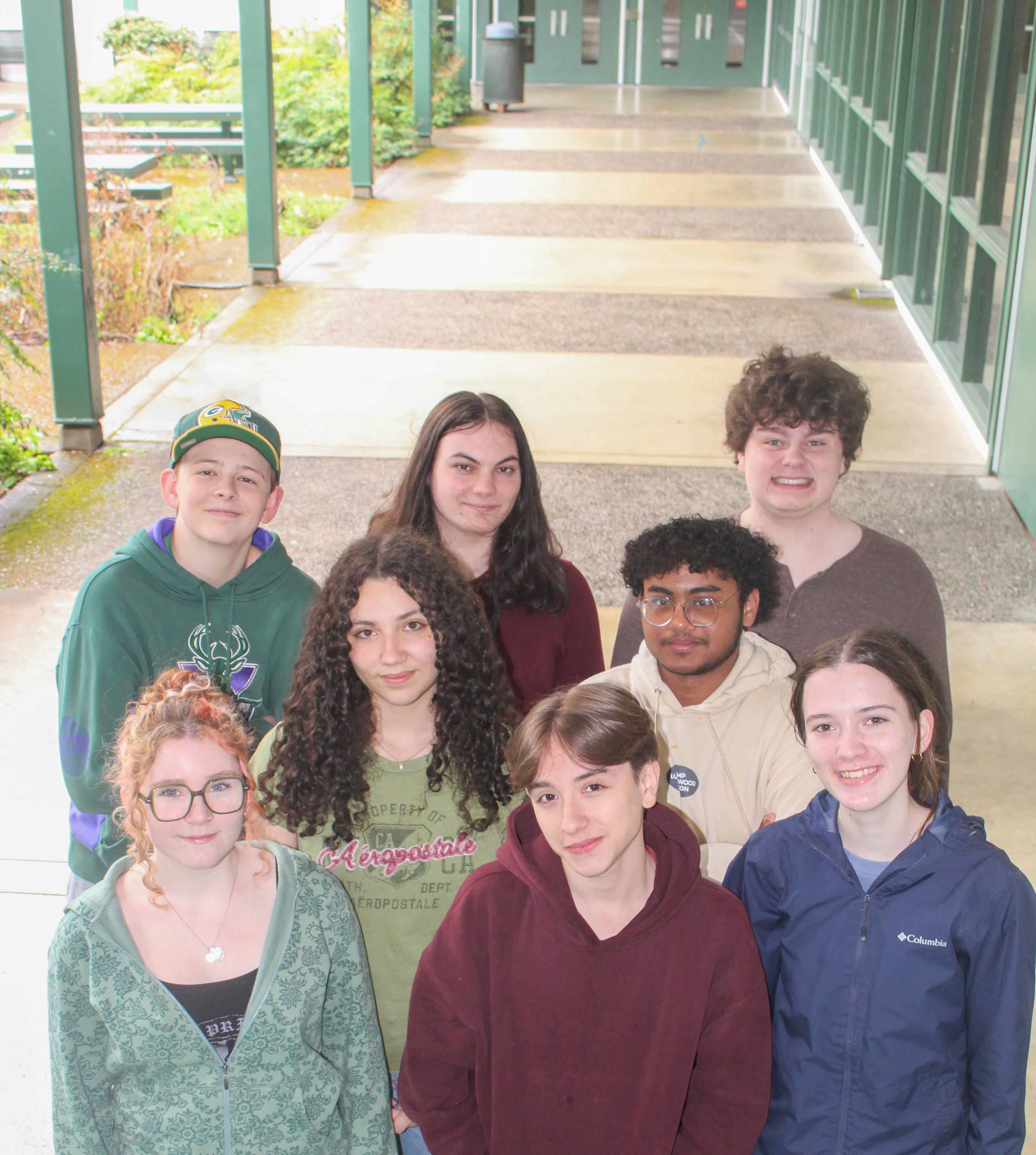
How confident are you that you or your peers could answer important questions about your country and the world around you? With increasing academic apathy and reliance on large language models amongst students, the answer to that question can seem uncertain. “I feel like people are starting to rely more on having quick answers than a baseline understanding [of a subject]. In school, it’s very easy to have AI do things for you. But what happens when you need to apply that information? You got through school using AI, so when you get to college you know basically nothing,” said senior Adaline Thompson.
What has for years been an anticipatory anxiety surrounding large language model use in schools has been validated to some extent; according to an academic paper titled “The Risks of Human Overreliance on Large Language Models for Critical Thinking,” “Research suggests that while LLMs can augment human cognition, there is a risk of atrophy in certain cognitive skills if they are consistently outsourced to AI” (Duenas and Ruiz 6). As students increasingly fail to see the point in memorization and other menial tasks, cognitive muscles get less and less exercise. Atrophy, as the paper puts it. Rote memorization skills aren’t the only thing at stake when education systems fall short: young adults often feel unprepared to engage with their government after graduating high school. Senior Vieira Miller said, “[Civics] isn’t something we’re really taught. We’re taught presidents and the broad strokes of governmental structure, but not how to interact with our local government.” This can lead to issues such as heightened susceptibility to propaganda and political manipulation, decreased
motivation to vote, and a general feeling of helplessness and exhaustion regarding politics. Some argue that a large portion of what’s taught in school doesn’t matter; this sense of meaninglessness may be a contributing factor to academic apathy. However, junior Oria Reid doesn’t entirely agree with that notion: “Even if it doesn’t really affect me, it’s important to know what has happened in the world. Science and math are very important, but people can manage somewhat well without a great deal of skill in those areas.”
What does all this mean for the future? Reid said,“I have hope, but faith might not be the right word. The kids growing up on iPads are breaking my heart…there’s so little communication now. I really hope they do alright, but I wouldn’t say I have faith that they will.” Indeed, dropping test scores and the prevalence of iPad-kid horror stories may seem grim, but there’s no sense in giving up now. Miller’s stance is similar, if more pessimistic: “AI is ruining the minds of children…we’re losing ourselves. All these little kids are relying on AI to answer things for them…If you can’t think for yourself, you can’t act for yourself.”
Thompson still sees some hope in the future and the youth: “I worry, but that doesn’t mean I don’t have faith in the future generation. They do seem to have given up a little bit, though.” As they say, the only way forward is through.
Duenas, Tom, and Diana Ruiz. “The risks of human overreliance on large language models for critical thinking.” Research Gate 2.26002.06082 (2024).
Jessica Fitch editor-in-chief
Sheldon Students Smart?
SHS Review
Michael Renzie & Parks Herndon staff writers
Various levels of student engagement in class can lead to different experiences with your peers, sometimes as a path to seclusion or a gateway to making new friends. With a large student body, it’s easy to feel lost in a big crowd of students at school or become stuck in a small bubble of people. Your experience at Sheldon High School may be the same as your friends or it may be very different. For some students, like senior Owen Sinclair, it is a place of connection. He has met a lot of his best friends at Sheldon. “I met my best friend in freshman science class back when we didn’t care about anything,” Sinclair said. Sinclair also said that you don’t need to have one friend since elementary school that you’re always with. Getting to know people is one of the greatest things Sinclair said he’s done.
Another senior, Matthew Gores, said that over his four years at Sheldon, everybody has “secluded into their own friend groups and their own sort of demographics.” Gores said that technology even
helps with the separation of students even after the ban of all personal devices. He said that people are supposed to hang out during lunch, but since the phone ban, that’s when students want to be on their phone even more than they used to. One word Gores used to describe Sheldon was ‘broken.’ Gores explained that there’s a lot of hurt and it’s clearly visible whether it be from the teachers or the students. “It’s a community that feels very disconnected from itself,” Gores said.
Depending on who you surround yourself with or what you involve yourself in, your experience at Sheldon will be vastly different from others. During your time in high school, it’s important to try new things and make an effort to meet new people.
“The kids growing up on iPads are breaking my heart…I really hope they do alright, but I wouldn’t say I have faith that they will.”
-Oria Reid (Jr.)
This Place Smells weird
The amount of axe body spray in the hallways burns the hairs in my nose.
Premium Educational Experience
All of my teachers are great!
graphic by Jessica Fitch
Crazy Chemistry: Teacher Bromances
Ryley Bainter & Hewson Baldwin staff writers
Do you love your bro? Odds are you do. Every bro loves his bro. Even teachers love their bros. Some people like to call this bro-therly love a bromance. There are many teacher bromances at Sheldon. Two of the most wellknown bromances around the school are the chemistry bros: Mr. Whalley and Mr. Emmick and the math bros: Mr. Wright and Mr. Martell.
These bros first met here, at Sheldon High School, in room S10, Mr. Sanderson’s room at the time, in 2009. Emmick’s first impression of Whalley was a little out of the bro-rdinary. He thought that Whalley was pretty bold because he ate one slice of pepperoni pizza and he was cussing as he ate it.
Whalley had a different first impression of Emmick. “He was a big goof; I still think that,” said Whalley. Since then, the chemistry bro’s friendship has only grown. What can be attributed to this long lasting bro-ship? Emmick and Whalley attribute it to their shared interests, including family and teaching. Every set of bros sometimes has its disagreements, though. For the chemistry bros, they often argue about what rap song is the best. If the argument is about science though, Whalley claims he always wins. In any bromance, quality time between bros is one of the most important parts of a strong friendship. The chemistry bros don’t get to hangout outside of school too often because they both have families. However, they enjoy going to movies, seeing bands, and getting Dave’s Hot Chicken sandwiches. One of Emmick’s favorite memories with his bro Whalley comes from one time when they went to the movie “Deadpool” together. “During the credits I said, ‘This is just the credits,’ and he said, ‘No this is really funny,’ and I remember laughing so hard I couldn’t breathe at one point,” said Emmick. Good memories like these are core to any bromance.
Mr. Wright and Mr. Martell are math bros who love spending time together, fishing, coaching, and watching baseball. They have been friends since Wright’s first year teaching at Sheldon, which was when Martell was a senior on the football team. And ever since Martell started working at Sheldon, “Our friendship has blossomed like a spring flower,” said Wright. If you play baseball or football, you have probably seen this bromance, and love having them as coaches.
Wright and Martell love talking about baseball and math during the day, and their only disagreements come when talking about sports. “The only disagreement I can think of is the Dodgers are way better than the Yankees, and he can’t seem to figure that out,” said Wright.
While they may disagree about who is the better baseball team, these two have a great respect for one another. “He stands up for what he believes in, he’s a hardworker,” is what Wright respects most about Martell.
Now since these two bros also coach football and baseball, that also helps them get closer as bros. “Coaching can be more emotional, so it has made us even tighter, we dealt with tough things, the highs and lows of the sports,” said Wright.
These two love coaching and helping young people grow in sports, and in life. Those who they have coached have been influenced by them. “They have always taught me to be the best person I can, and be the best I can,” said sophomore Mikah Valadez. Many other athletes agree with this point of view.
Now what would be a bromance without some embarrassing information about the other? “Mr. Martel has a personal dojo in Coos Bay, and I go watch him practice his karate there sometimes,” said Wright.
Both these bromances show how close teachers get when they get to work with each other in the classroom, or on the field. Don’t forget to say “love you” to your bro next time you see them.
Teachers Say the Darndest Things
Andy Brown staff writer
The teachers at Sheldon High School have undoubtedly made a impact on their students, from assigning homework to changing their students perspectives on life. Some teachers are known for the use of their words, and their ability to make a memorable experience when talking with their students. The things teachers say not only show the effects of teachers on their students, but they show the unique aspects of the teachers at Sheldon High School.
Senior Luke Smith, has described Mr. Whalley as being the “most quote worthy” and said, “He’s got a lot of weird things to say, about a lot of weird subjects” Smith described his experience in Whalley’s class as a “roller coaster” and said he “never
knew what he was going to expect from the guy.” Smith also has high praise for Whalley and stated, “I enjoy his classes; he always gave me a new perspective of how teaching should be done.” Smith is an active student in Whalley’s College Now Chemistry class.
Senior Myles Kincaid stated, “Mr. Neeno is a just a quotable guy; he’s got a presence that is just different from any other teacher at Sheldon.”
“He’s got a lot of weird things to say about a lot of weird subjects.”
-Luke Smith (Sr.)
Kincaid attributes on in-depth learning experience from taking his class, due to his Neeno’s way with words.
“There [was] this one time where we were discussing the economy, and somehow it led to him explaining the Crips, which really caught my eye,” said Kincaid. “I
also just love when he talks about his experiences in life, because he just has a way of talking that draws my ears in,” Kincaid mentioned. Kincaid is a part time student, only attending two classes in the final semester of the school year.
Senior Eli Wallace said, “I really like talking to Brancato; he’s a character, the kind of person you remember talking to and being like, that’s an interesting fella.” Wallace, a player for the Sheldon basketball team, believes his admiration for Brancato goes deeper than the classroom setting: “I’ve known the guy [since] before my first class with him, and he’s always gave me a new understanding of life;” and “I also just loves this guy’s stories, man. He always tells the most ridiculous BS stories about his past, but in a weird way. I’m drawn to it like a moth to a lamp,” said Wallace.
The teachers at Sheldon High School have had a longstanding relationship with their students. Whether it be through their effective teaching style, or their way of talking that leaves a mark on their students, ultimately they are the heartbeat of Sheldon High School.
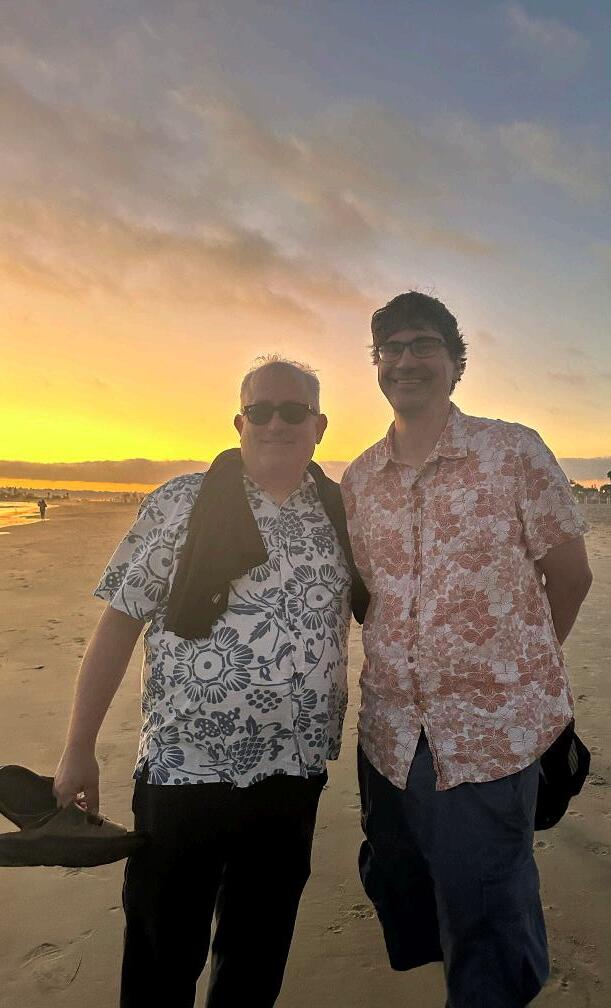
Whalley and Emmick enjoying the sunset at an AVID conference in San Diego.
photo by Kate Tierney
What Makes the Cut: 4j Budget Deficit Concerns
Cedar Hagen staff writer
Some teachers at Sheldon have been around for past budget cuts. Literature and drama teacher Mr. Cabrera said that when he started teaching, budget cuts were more frequent. “Sometimes they don’t turn out as bad as we think, but we never know,” said Cabrera; “I think things have usually been better than the worst case scenario.” The thing about 4j budget cuts is that the info isn’t widely known regarding what will be changing, so at this point it’s a guessing game for most. We do know that extracurriculars like music, drama, or arts tend to be vulnerable when there are budget cuts. Usually, class sizes increase in all subjects.
Mr. Thornton, a math teacher who teaches four different math classes and all grade levels, thinks that all classes could be affected by budget cuts. “I think our electives program, even if there’s not enough students in a class then the district thinks there should be, those are still beneficial classes. In all honesty, all classes could get affected by budget cuts,” said Thornton.
Although some higher level math classes he teaches may not be impacted, he still believes that more funding for the school can benefit each student in the long run. Thornton explained that when you start increasing class size, it can be a negative for students and teachers. “Give students
ICE Out Walkout
Kennedy Zuniga & Tali Ritchie-Tuisue staff writers
In a remarkable display of youth activism, Sheldon students have been organizing walkouts. Whether it’s to protest gun violence or ICE, Sheldon students have been standing up and speaking out. Senior Charlie Stanford is at the center of it all. Stanford has organized multiple walkouts, one centered around gun violence. He’s also attended many protests over the years. Stanford works with senior Kaleia Davis to organize these walkouts. They print flyers and post on social media to spread the word. Stanford stated that walkouts are essential to bring awareness to pressing social issues affecting communities nationwide because “injustice anywhere is injustice everywhere.”
Stanford said that all walkouts are peaceful and do not encourage violence: “I have never seen any violence at these walkouts. Confrontations, yes, but never physical violence.”
Stanford shared that the walkouts have been successful and have had a good turnout: “A lot of the time I see people I don’t expect to be there and it’s really amazing.” He hopes to continue to spread awareness and hopes
more opportunities. We can bring more people in, to help students, instead of letting people go,” said Thornton From a student perspective, budget cuts would be bad if favorite classes or teachers get cut. Also, if important classes lack the materials they need, that would be a huge issue. Things like better materials for science classes, newer textbooks, or more art supplies could be beneficial to classes. “Maybe that, or stuff for more hands-on learning and experimenting, instead of just sitting down and listening to a lecture,” said sophomore Chloe Brown. A common critique heard among students is that too much learning is done sitting down and taking notes, which doesn’t work well for everyone. With budget cuts, that would mean less funding for things like field trips and fun or unique learning opportunities. Overall, hopefully students and teachers aren’t too affected and the school is able to make things better and not worse.
students understand the impact of their actions.
to inspire other students to use their voices. With more walkouts already being planned, Stanford is committed to creating change and standing up for those around him. Students across the United States have been organizing walkouts, leaving class to protest actions by U.S. Immigration and Customs Enforcement and to show support for immigrant communities. Lit/Civics teacher, Pylaar Solomon, supports walkouts when they are well planned and have a clear purpose. “I think they are great if they are organized in advance and if they’re for a concrete reason,” Soloman said.
These walkouts have also raised questions about how missing class affects students’ learning and classroom routines. “I think it’s fine if it’s a part of their civic duty, and as a civics teacher, I’m okay with that,” Solomon said. Solomon explained that while student voices and civic engagement matter, walkouts should be planned thoughtfully and centered around clear goals so that
As walkouts continue to gain momentum at schools across the country, students are dedicating significant time to participating in these walkouts. Sophomore Alexa Metzger, said, “If I went to a walkout, I would spend as long as it takes to get the message out.” Metzger said that participating in the walkouts is not just about leaving class, it’s about raising awareness and making her voice heard on issues that matter to her and her community.
Student walkouts, whether addressing ICE actions or other social issues, aim to highlight injustice, to demand change, and encourage public discussion. “I think ICE walkouts send a message and bring communities together, uniting people who are fighting for the same cause. The younger generation should also speak their minds.”
Many students say that participating in walkouts helps them feel empowered and part of a larger movement. At the same time, some teachers emphasize the need for students to stay informed and organized, so their message is clear while minimizing disruption to learning. The discussions around walkouts show that activism in schools is not just about protest, but also about encouraging dialogue and civic engagement.
photos by Claire Craig
Public posters and graffiti on the corner of Pearl St and E 7th Ave. where the studentled protest took place.
(L to R) Seniors Kaia Muilenburg, Marley McNutt, and Cassidy Aumack picketing at the Federal Building downtown.
Seniors Ash Campbell and Grace Sales picketing and waving to cars off of E 7th Ave downtown.
Teen Helplines Rated
Claire Craig editor-in-chief
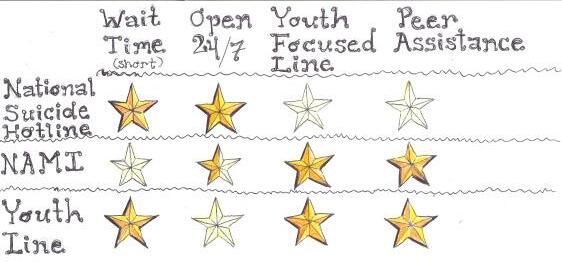
The term ‘teenagers’ came about as the industrial era demanded workers, consumers, and capable young men to enlist in the military. Now, in the age of overwhelm, adolescents are not necessarily worried about the draft, nor highly unsafe factory conditions killing them at work, but teens are still bombarded by a multitude of stressors daily. When teenagers don’t have a viable network of people or healthy habits to assist with mental distress, they may feel helpless or alone. Even when one does have a support system to assist with their struggles, they may not feel comfortable or safe reaching out to discuss feelings of depression, panic, or anxiety. To combat this sense of loneliness, non-profits such as Youth Line or the National Alliance on Mental Illness have created over-the-phone helplines to provide an anonymous, easily-accessible resource for those struggling. Hotlines respond primarily to urgent crisis calls. Helplines are geared towards critical but not dire situations where they may provide different assistance or pathways to other resources. But which of these resources are the best for teens? To decide this, three organizations will be evaluated on five factors: Do they have a youth-focused helpline? Is it available 24/7? When you call, would you be speaking with someone close to your age? And how long is the wait time before connecting with a representative? (see graphic
for final ranking)
The national suicide hotline (dial 988) is typically suggested first when discussing hotlines or helplines. While valuable, the high volume of calls it takes from across the country may not make it the most readily available place of assistance. According to recovery.com, 11% of calls go unanswered, despite taking calls 24/7. As of July 2025, due to the policies of the Trump administration, federal funding for the LGBTQIA+ services offered by their “press 3” option is no longer available. Death by suicide in the queer community is a prevelant issue, and one that needs to be taken seriously via provided aid; cutting resources for queer youth undermines their ability to escape dangerous or hateful situations. The hotline also does not provide a youth-focused call line, instead focusing on help for all persons regardless of background, age, or sex.
The Plight of Senioritis
Thomas Follett staff writer
Every year, many seniors begin to experience a severe lack of interest in school and a lack of motivation, commonly known as senioritis. Senoritis can affect different seniors in different ways, and at different times. Some will work to make their class schedule have as few classes as possible, or make the classes they have as easy as possible. Others will choose the hardest classes in school while others will choose to graduate early, so they can be done with school. One such example is senior Hunter Lessar. Lessar graduated from Sheldon halfway through the 2025-2026 school year upon completing his credit requirements to graduate. “I don’t regret my decision [to graduate early] at all.” said Lessar. “I wanted to get going on my enlistment with the military, and I wanted to start a full time job in the meantime.”
Lessar made his decision to pursue this pathway more than a year ago, “I decided about halfway through my junior year. I saw the opportunity and took it,” said Lessar. There are many different ways to describe seniorities. Senior Flora Stubbert said, “I think senioritis is when you see the finish line of high school and then you feel like you just wanna stop; you just get burnt out and you’re like ‘I’m almost done, so I don’t have to try anymore.’”
Stubbert went on to mention how senioritis has personally affected her. Stubbert said, “I think I did start feeling it on like the first day of school. I was really excited to come back to school and then I got home after that first day and I was like ‘I think I’m ready to be done’ and then now that we’re in the second term I feel like I can see the light and I’m like, ‘ok, whatever, it doesn’t matter anymore.” While her story is one example of how students
experience seniorities, there are many ways that students deal with it.
A classic example of someone who has been affected by senioritis is senior Logan Fox. Fox’s schedule consists of “Future build on A-days, economics fifth period on B-days,” said Fox. That’s it.
While Fox could have taken the same path as Lessar, choosing to graduate early, he instead chose to stay untill the end stating, “I had the opportunity to graduate early, but I didn’t because I wanted to play my senior season of lacrosse.”
Sleepy Students
Aiden Kennedy staff writer
Sleep deprivation is a common issue in high school students. Junior Rowan Pacheco said she usually gets three to five hours of sleep on school nights which makes morning difficult. “I would like to change it because I wake up really grumpy and it’s hard for me to wake up in the morning when I don’t get enough sleep,” Pacheco said. Because of the lack of rest, Pacheco often uses caffeine to stay awake during the day.
Pacheco explained that schoolwork is one of the main reasons she stays up so late. Homework sometimes even keeps her up until around two in the morning. “I feel like my teachers give way too much work for me to handle on a daily basis,” said Pacheco. During the weekends, Pacheco tries to make up for lost sleep, sometimes getting between eight and fourteen hours of rest.
Sophomore Jake Essin shared a similar experience with
Another national resource is the National Alliance on Mental Illness, or NAMI (dial/text 6264 or call 1-800950-NAMI). Open Monday through Friday, 10:00 A.M. to 10:00 P.M. they provide over-the-phone assistance as well as a text option. When you call, you’ll be speaking to a trained younger representative. NAMI call specialist Rachel said, “This kind of resource is crucial, it allows people to call in anonymously, [which] takes out a lot of the stigma. It really provides a safe space to address issues that can be scary to confront… within their own communities.” It was about a three minute wait before the call became connected with Rachel after dialing. NAMI’s website, nami.org, provides many resources to click through and connect with when looking for information on a specific issue or specific person to talk to.
Finally, Youth Line, as the name suggests, provides mental health services specifically for younger folks aged 10-24 (dial 877-968-8491). Initially established as a regional resource in central Oregon and the surrounding PDX area, it soon grew to become a nationally-available line. It remains grounded in its Oregonian roots thanks to Oregon organizations and donors. The volunteers and interns on the other end of the phone are young adults themselves, trained to handle and discuss mental health, and supervised by “highly skilled clinicians,” as stated on their website, theyouthline.org. Youth Line receives calls, emails, and texts daily from 4:00 PM to 10:00 PM, while inquiries at all other hours will be answered by their parent organization Lines for Life adult crisis line. They also provide a helpline designed to support native and indigenous communities, acknowledging the various systemic boundaries to receiving support (text YLNATIVE to 838963).
While a variety of anonymous, judgement and cost free hotlines and helplines seek to minimize distress for America’s youth, young people’s worries will be ever present. Struggling or feeling helpless in your situation may feel all-consuming, but remember that you are not alone; your peers are going through hard things just like you. If you believe help cannot be found safely or comfortably at home, school, or any other space, do not hesitate to call the numbers listed. All teenagers deserve someone to speak with about their distress, no matter how critical or trivial. You are loved!
sleep during the school week. Essin said they usually get around six to seven hours of sleep a night but still feel tired most mornings. “I wish I got more sleep because I have a hard time falling asleep.” Essin said.
At Sheldon, balancing sports can also impact sleep. Sophomore Zahir Escobar said he usually gets around seven hours of sleep per night, but doesn’t feel fully rested in the morning. “Each time I wake up I feel really tired and I wish I could sleep more,” Escobar said. His schedule and his soccer practice makes it harder to get rest. Escobar said that even though he tried to maintain a consistent routine, going to bed around eleven and waking up at seven thirty still leaves him feeling low on energy and believes that lack of sleep affects his athletic performance.
Escobar said, “A lack of sleep can make you really tired throughout the day. It’ll mess you up if you do sports.” While each student has their own schedule, they all share one thing in common, not getting enough sleep. Between homework, sports, and daily responsibilities, sleep often becomes less important. As a result, many students continue to feel tired throughout the day, showing that sleep deprivation is a real issue at Sheldon.
graphic by Claire Craig
graphic by Andrew Cottle
Meta AI Glasses Lay Down the Law
Maxwell Berry page editor
Meta AI glasses are a fad that have revolutionized many different industries, combining photography, functional style, and technology into one design. After the Oregon government’s statewide mandate of personal electronics in school, we have to ask ourselves if the use of these glasses in school is in accordance with this policy.
The basic way that Meta AI glasses work is that Meta outfitted a standard pair of Ray Ban glasses with new features. These include things like a 3k camera, open ear audio, and voice activated AI that can do a variety of tasks. Now the debate arises: should we be able to have these glasses at school? After all, they can help people see.
“I think maybe you should as long as they don’t become a distraction,” said junior Skyler Anderson. This is a discussion with two sides because if you think that high schoolers can handle the responsibility of having AI and a camera on at all times then it makes sense. However if people handle these glasses without care, the administration could have a major problem on their hands.
shows if someone is recording can easily be covered. This is many people’s main issue with the design of the glasses. This design can encourage misuse and the abuse of these devices.
The personal electronics policy in Oregon is very new and a big adjustment for students and teachers alike. The official rule is that no use of personal electronic devices is allowed during school hours. Do we consider AI glasses to be PEDs? Should we be buying these glasses? “No I wouldn’t… I think they’re creepy and invasive,” said an IHS civics and literature teacher, Ms. Solomon. The other fact about Meta AI glasses is that the light that supposedly
There is however a greater question to be asked when thinking about Meta AI glasses: should people be allowed to record in school without anyone’s consent? Junior Madison Creach stated: “Well, obviously you should not be able to record anyone without consent in any way. And I think that them being turned on in a public space is kind of a hard topic because… you could accidentally record people” This brings up a debate about the fact that when you’re filming something, it’s really hard to ask every single person what they think. Is it best to just do it and try to be respectful and thoughtful or simply not record? This brings up a great ethical dilemma. It is illegal in Oregon to record a conversation with someone withouttheir knowledge or consent. Now it is also against the law to use personal electronic devices in school, so just leave the Meta AI glasses at home.
grapics
by Maxwell Berry
AI In Schools: When Is Enough Enough?
Claire Green staff writer
Senior Jeethika Inparajah shared her experience with using AI in school. She expressed how AI has helped clarify questions she may have on school work: “I use AI for schoolwork when I’m confused, and it teaches me step-by-step.” AI is extremely beneficial for education when more in depth explanation is needed, and it is able to provide more gradual explanations. Students often use it for study guides, practice quizzes, and memorization flashcards for schooling. These are a few of the many reasons AI is useful for students and not just for cheating. When people think about AI in schools, they typically think of students using it to cheat, but AI can actually be very beneficial in schools.
Freshman Cruz Pineda, communicated that AI has personally helped him in his classes. “In math, I use it to know what steps to take to get to the final equation.” At Sheldon, freshmen are required to take Algebra 1 to graduate. In Algebra 1, lots of the problems require many steps to solve, and AI helps to deconstruct each step in order to not get confused. Without a clear understanding or when forgetting a step, it can mess up the equation resulting in the wrong answer.
Sophomore Wudi Alud believes that AI can be used for
good purposes, but that people can sometimes over-rely on it. “I think we depend on it a little too much, including teachers,” said Auld. The privileges of AI can easily be abused, and this has led to many conversations about when enough is enough in terms of utilizing AI. Using it to learn is good, but using AI to cheat is not.
graphic by Maxwell Berry
Meta AI glasses
How Is Social Media Affecting Beauty Standards?
Khaya Ainis-Michael editor-in-chief
Beauty standards have existed all throughout history, and “ideal bodies” have been portrayed in countless art pieces. Over time, these depictions have shifted from sculptures to paintings and now to pictures. Sharing pictures online has only sped up the process of creating a specific standard since images are able to be spread a lot faster. Namely Facebook—one of the largest social media platforms in the world—which was started as a way to rate the attractiveness of students at Harvard. Since its conception, social media has been a way to compare and curate yourself to others.
“People are only posting their best moments all the time, and it forces people to feel like they’re left out or they’re less important because they’re not doing something crazy or extravagant all the time,” said senior Matt Gores. Curating moments in order to seem more “perfect” has become a lot more common; where before someone would go on a hike to get exercise, now they might go to get cute sunset pictures. So much more is being done solely for the purpose of taking a photo of it, and the authenticity behind it has disappeared.
Senior Makeda Kidanemariam has a lot of experience with social media, and she has been posting on it from a very young age. “Everybody is on it. Like, even if it’s a small amount, it’s just what’s normal nowadays. So it’s what’s gonna impact and influence people the most,” said Kidanemariam.
With every new trend, the distinctions between online and offline lessen more and more. Things that were previously regulated to one’s phone begin to be brought up in everyday conversations, and the ideas being perpetuated
on social media become regular opinions that even people without it hold. One of the biggest opinions are those regarding looks.
Social media creates echo chambers, and when people post, they often forget that they are posting for everyone to see. Algorithms are created so that once you interact with one thing, it will be consistently recommended, whether it’s applicable to you or not. “When you see people on social media talking about their bodies… it can be really harmful, because you see what other people are doing and think that you should be doing that as well,” said senior Cadence Fury; “it’s important to treat your body in a healthy way, but what’s healthy for some people isn’t what it looks like for other people.” Due to the unifying aspect of social media, it’s easier to find people who look and act like you. But it is also easier to forget that we are all different, and sometimes things we see are not achievable.
A huge contributor to this is the people who are setting the trends that people follow. “Oftentimes, popular creators are more conventionally attractive, so people tend to compare themselves to what they see on their screen,” said Kidanemariam.
Because of the obsession with physical perfection, potentially-destructive methods to better one’s appearance have become normalized. Things like “bonesmashing,” “looksmaxxing,” and the rise of “black pill” influencers and mindsets have been a growing topic regarding men’s looks. Women are often faced with trends like the “sunglasses challenge” and “Brandy Melville door challenge” which are similar variants to their male counterparts. Most trends have to do with “body checking” which not only affects the viewers, but also the creator if the challenge doesn’t go as intended.
“For guys it’s a lot more gym progress or just doing things, it’s usually more about doing things like ‘I’ve
The Takeover of Needohs
Aiden Gonzalez page editor
Needohs have made a comeback since their popularity in 2020, and have begun to rise in popularity once again amongst high school students. A Needoh is a type of squishy toy that can come in many different shapes, sizes, and colors. Sophomore Priseis Casassa has joined the Needoh trend, and often plays with them in class. “I like them; I think they are cool and they are nice to play with in class…there are lots of types, too,” said Casassa. The sudden appearance of these squishy toys in high school has come from their increasing popularity on the internet and through word of mouth. Additionally, students seem to enjoy playing with Needohs in class, and even in the hallways. “I saw that everyone had them and I saw them all over TikTok and I was like, ‘those are fun’…I also wanted something to fidget with in class,” said Casassa. The popularity of Needohs doesn’t just include Sheldon, but many other schools across the nation. As Needohs get more popular, people are noticing them more, and going to different stores to find them. Freshman Amelia Eichner has noticed many things about the Needoh trend, especially where to get them. “You can get them at stores like Target and Bi-Mart. Those are the best places to get them, but they are always sold out and people steal
accomplished this, I’ve accomplished that’ and I feel like for girls it’s a lot more about just purely looks,” said Gores. While there are expectations for both, they are based on completely different things.
“For women, there’s the image of being slim and petite and just always being put together and for men you’re supposed to be strong and masculine,” said Kidanemariam. The main thing these separate expectations have in common is that they are often unachievable. And with the continual expansion of social media, that expectation will only increase.
them,” said Eichner.
The hype revolving around Needohs has led to stores being constantly sold out of them. Additionally, some people go as far as to steal Needohs just to get one. Needohs have become something you are guaranteed to see at least once a day at Sheldon High. “I see someone with a Needoh everyday…All of my friends have Needohs, some more than me,” said Eichner. The squishy toys are so popular, they have become a daily sight in school, yet impossible to come across in stores.
Needohs aren’t just a simple squishy toy, they are something fun that can help students focus on school work. Senior Kallahan Brown contends that Needohs are a fun yet helpful tool in class. “I 100% think Needohs should be allowed in school…I was literally failing French but when I got a Needoh it genuinely helped me pass,” said Brown. Although it may seem like just another fun trend, Needohs help students stay less stressed in the stressful environment of school. The large variety of these squishies gives students something fun to search for in stores and to collect. “They are fun to collect…there are so many different types of Needohs, at least like 20 of them,” said Brown. Needless to say, Needohs have made a comeback and will be around for a while, so what are you waiting for? Go get yourself a Needoh!
photo by Claire Craig Kallahan Brown (Sr.) holding her Needohs.
graphic by Aiden Gonzalez
Varsity Choir’s Trip To NYC!
Lizzy Cantwell editor
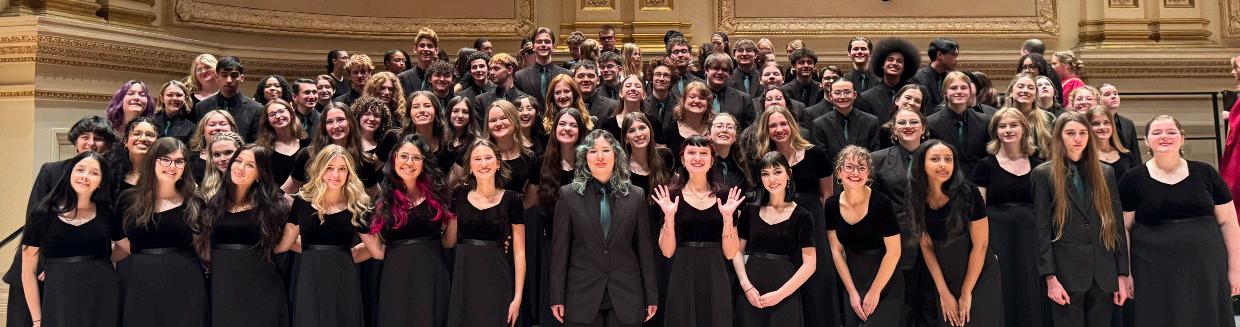
Over spring break of 2026, 71 students from Sheldon Varsity Choir traveled to New York to perform in the Harmonic Convergence concert at Carnegie Hall. The convention at Carnegie Hall was an opportunity to work with some of the best coral clinicians in the country. During the convention, the choir attended a workshop with composer Andrea Ramsey, and performed a mass world premier piece. Not only did the choir perform both Saturday and Sunday but they also traveled around New York to some of the most famous tourist attractions including Top of the Rock at Rockefeller Center, 9/11 Memorial, Ellis Island, the Statue of Liberty and attended the Broadway production of “The Great Gatsby.” Varsity choir is an audition-based group offering the opportunity for singers to gain a greater understanding of choral music. This year the choir consists of students in grades 10-12 under the direction of choir teacher Megan
Perdue.
Originally, Perdue believed she would go on to perform as a piano and vocal artist. Soon after, she had the opportunity to work with a choir before school, due to her father being a choir teacher. She quickly fell in love with the experience of seeing the students be able to connect over something they all cared about while producing music. “Students making connections with one another, especially when they’re from different social groups and different backgrounds, coming together to create art is pretty magical, and being able to facilitate that opportunity is an honor and why I love being a teacher,” Perdue said. Perdue decided to take Sheldon’s choir on this once-ina-lifetime trip after reminiscing on the memories that she had made at the same convention while teaching at Lake Oswego High School. Perdue believes that performing at large conventions such as the one at Carnegie Hall is the best way for students to connect with one another and share their love of music.
Sophomore Lily Baker was among the group traveling to
NYC. Baker most enjoyed the experience of performing at Carnegie Hall out of all the sights and attractions the choir visited while in New York. Baker said it was an honor to be able to perform with all the other talented singers on a stage known all over the world. “It was incredible to see all of the different schools come together and sing the songs they had practiced for so long,” said Baker. Baker enjoys being in choir not only because of the opportunity to perform and sing, but also because of the friendliness and positive atmosphere that is present throughout the group. Sophomore Alice Chvatal has been involved in choir for five years. Chvatal originally joined choir because of her love to sing and make music vocally, but quickly realized that singing not only is a way to produce music, but is also an effective way to de-stress and cope with hard times. In varsity choir, the experience of being in a choir varies for each student. For Chvatal this was the first choir festival she had ever attended. Chvatal explained that even though the experience was a bit nerve wracking, “Singing at Carnegie Hall felt very surreal and like a big achievment.”
Extra! Extra! Read All About Sheldon’s New Musical
Chloe Crook staff writer
Sheldon High School proudly presents Disney’s Newsies in April 2026, set in 1899 in New York City. It is based on the real-life Newsboys’ Strike of 1899, wherein young street newsies protested against unfair rise in the cost of newspapers set by publishers. The 1992 Disney movie & musical follows a group of orphaned and runaway newsies and their strike against Joseph Pulitzer. The leader of the newsies, Jack Kelley, partners with David and his younger brother Les to organize the strike.
Choir director Megan Perdue said that the decision to stage Newsies this year was based on the department’s goal of keeping each production different from the last. “We try to have contrasting shows every time. Hadestown has more of a modern theme and heavier music, while Newsies has a Disney score and an uplifting message,” Perdue said. “We have one student, Quieten Heise, who learned how to do a backflip for the show. He’s a pretty good gymnast,” Perdue said.
Senior Charlie Stanford plays Jack Kelly, the leader of the strike against Pulitzer. Jack Kelly’s “yearning for Santa
Fe” is more than a desire for a change of scenery: “Really, he doesn’t know that much about it. It’s somewhere he can break away and find his own way. He is stuck working for a person that doesn’t have his best interests in mind; he wants that freedom,” Stanford said.
According to co-costume manager sophomore Lilyana Baker, the most challenging transitions involve changing the characters from high society into rugged layers of a newsie. While some choices prioritize the show’s stars and the newsies themselves, other details lean into fan-favorite symbolism. “Katherine’s change into an orange skirt symbolized her becoming Jack’s ‘new Santa Fe,’ because he paints Santa Fe as an orange desert. He’s always longed to go to Santa Fe, but once he met Katherine, that changed,” Baker said.
Varsity Choir poses for a photo in Carnegie Hall.
photo curtesy Megan Perdue
Graphic by Lizzy Cantwell
If There Was No More Tomorrow
Fateen Anzum Anto page editor
Life is unpredictable, and most people rarely stop to think about what they would do if our time suddenly ran out. Imagine having only 24 hours left to live— how would you spend them? For Jim Nelson, KRVM Development Director and DJ, his first reaction would be panic. But after that initial shock, his focus would turn to what truly matters—his children. He said he would spend the day with them because they are his closest friends and his greatest pride. He also reflects on the chances he missed to make peace with people who are no longer alive. Even with fear and regret, he believes it’s important to live fully in the moment. “You think you have more time, but live your life as if you don’t,” said Nelson. That means cherishing the people and moments that matter most today, instead of waiting for a tomorrow that might never come.
Sophomore Zane Ahrenholtz imagined his final day very differently. For him, the first thought is adventure. “I would go to a motorcycle dealership, and I would steal a motorcycle and ride it very fast,” said Ahrenholtz.
He would also want people in his life to know the
truth about the end being near so he could say goodbye. At the same time, he pictures much of the day on the open road, enjoying the freedom of the moment. In his mind, the perfect ending would look almost cinematic. “Adventure—I’d want to drive off into the sunset in the middle of nowhere on a motorcycle,” shared Ahrenholtz.
Thinking about the question also made him reflect on how people live their lives now. Instead of always playing it safe, Ahrenholtz believes life should include more risks and bold choices. As he puts it, “Take risks; life is boring if you don’t take risks.”
Heaven Mae Gonzales, a seventh grader, wouldn’t want her last 24 hours to be serious or sad. “I’m exposing everyone,” she said with a grin. Instead of doing anything serious, Gonzales would spend the day finally saying what she’s been holding back. That means calling out her friends for the dumb stuff they’ve done, admitting when she lied about homework, and blurting out things everyone was too scared to say. “If it’s my last day, there are no consequences,” Gonzales explained. She’d also do random, silly things just for fun—walking into places like she owned them, stealing snacks, and acting way more confident than usual. “People would be like, ‘What is wrong with her?’” she laughed.
realize how much people hold back in everyday life: “It shouldn’t take your last day to finally say what you want.”
But even with all the chaos, Gonzales wants a real moment at the end—probably sitting with her friends, laughing about everything that happened that day. Thinking about it made her
Hearing how people would spend their last 24 hours makes one thing obvious: life is too short to hold back. Some would chase thrills, some would make amends, and some would just go a little wild. Whether serious, silly, or daring, the message is the same—stop waiting for the “right moment” to live, speak, or act. If the last day teaches anything, it’s that life is meant to be fully, unapologetically lived—right now.
Bathroom Hide & Seek: Stall Campers
Matthew Schuck staff writer
There is a very mysterious problem that largely goes unnoticed in the high school community – kids camping in the bathroom. While bathrooms are meant to be private places, the issue of camping stretches the boundaries of safety in this area. Due to the unsupervisable nature of the bathroom, this strikes an interesting question: “What is truly going on in the school bathroom?”
Senior Myles Kincaid described one experience with bathroom campers saying, “One time I just walked into the bathroom, and the stall was locked for a good 30 minutes!” He said he was so frustrated that it ruined his day, and he later found out that it was not a person in there, but that someone had thrown a trash can into the stall and somehow
locked it. Bringing it all together Kincaid stated, “Ya know, as I was deceived with the trash can in the stall, there might be a more illusionary factor to bathroom camping than you would think.”
Senior Mason Stucky said, “I haven’t seen it myself but I feel there is a big problem if it is going on. As a state champion wrestler I’ve also visited a lot of schools, and I haven’t really noticed this problem at any of them. It kinda makes me wonder if this is actually happening here, or if it’s just a rumor.” Stucky felt that if it is real, he doesn’t know how that would prevent it, as he believed that you certainly can’t monitor it with cameras or anything of that sort.
Junior Charlie Posen had a very interesting take on the bathroom situation, feeling very bad for the staff who have to deal with it. “Our great staff at Sheldon High School shouldn’t have to be dealing with this. From kids skipping
class, to kids vaping in the bathroom, or even to the mess that janitors have to clean up. I don’t think that any of it is kind or fair.” Posen said that he had no interesting experiences in the bathroom, but had heard lots of stories from friends, and he just didn’t appreciate that it was going on.
Camping is a very common thing in our society. However, it has a dark side as it unexpectedly occurs in private places such as bathrooms. Will bathroom camping continue to happen and usually go unpunished? Only time will tell.
graphic by Fateen Anzum Anto
Students pretending to bathroom camp.
photo by Claire Craig
The Importance of Clubs at Sheldon
Camen Uria Carrillo & Janeza Carrillo staff writers
Sheldon High School hopes to see more clubs available this year, giving students more opportunities to get involved and feel part of the school community. According to the senior Charlie Stanford, clubs play an important role in student life because “they are a great way for students who haven’t been in leadership positions or haven’t been involved to participate more actively in school.” He also explained, “Clubs are perfect for those who want to try something new to kind of jump into something,” highlighting how these new clubs can help students discover interests, gain confidence, and build connections at Sheldon High School.
Sophomore Camila Gonzalez also shared her experience in the Latino Student Union. Gonzalez said, “We do
fun activities and at the same time learn about latino culture.” She also added, “A sewing club will be really popular,” highlighting that students would be able to have fun and enjoy themselves. These perspectives support Sheldon High School’s goal of offering clubs that encourage creativity, participation, and a stronger sense of community.
Another student, junior Ellie Jacobson, is currently part of the magazine club, and she shared her thoughts on how new clubs could positively impact student life. Jacobson said, “An Interact club will help students make more friends,” showing how new clubs can create stronger social connections. In addition, she expressed interest in creative clubs related to art and reading, and noted that unique ideas, such as a Beyblade club, could surprise students while still being fun and engaging for the school community.
Why You Should Join NASU
Gavin Lees staff writer
Native American Student Union is one of the underrecognized student unions at Sheldon high school. NASU does many activities such as beading, drum making, and learning native history. Sheldon teacher Shiloh Jackson, the leader of Sheldon NASU, wants more people to join the student union. “I think people should join NASU because we get to do fun things including different crafts like the drum making, and we get to learn the origin of the things that we are making, why they are important, and what impact they have on the culture of different tribes,” said Jackson. NASU can help you learn more about different tribal activities. You don’t have to be Native American to join NASU. “I think anyone who
is either native, whether they are knowledgeable about their tribal culture or not, they should come, or anybody who just wants to be here as an ally should come and learn about different tribes and cultures,” said Jackson. Some students at Sheldon are interested in joining NASU. Sophomore Noah Phillips isn’t Native American, but he wants to support NASU. “For me, it is the same as for most affinity groups. Even though I’m not a Native American, I would still want to support them. That’s why I would join,” said Phillips. He wants to support his friends by supporting NASU.
Sophomore Andrew Colton is one of the few Native Americans at Sheldon but isn’t in NASU. He said he knows everything he needs to know about his tribe, but he could learn more. “My tribe is the Chippewa tribe. They are right next to the Great Lakes and are very powerful. They liked fishing more than hunting. Also, they used to
Niche Clubs at Sheldon
Andrew Cottle page editor
At Sheldon High School the option to create clubs is given to students. Lots of clubs have been created, giving spaces for people to explore their interests and identities in a safe space. Because of that new clubs are being created all the time, by all sorts of people for all sorts of reasons: some based on culture, and others to provide a place for people with a common hobby. The groups can be big, and some can be small. Some are common knowledge, and others only are known about by the members themselves. With all the variety of clubs, there has to be clubs lesser known than the rest. But what are they, and why did they start?
Sophomore Ezekiel Davisson was upset by the fact that at school there isn’t much time to play table top games with his friends like he wanted. Everyone was already doing so much stuff and by the time they finished, the day was already over. Davisson decided to start a club where he and his friends can play after school: The Table-Top Strategy Club. “Usually when we meet we bring our miniatures and play Warhammer together; it’s really fun,” said Davisson. The club is just starting out, but it has a strong group of devoted members. When sophomore Hunter Barnes’ sister joined the Ultimate Frisbee team, he had no choice but to join as well. But after the season ended, he decided to continue playing for the team without her, eventually becoming one of the team captains. Ultimate is a non-contact, self refereed sport with the objective being to catch a frisbee in the other
be one of the biggest tribes,” said Colton. Even though Colton knows everything he wants to know about his tribe he could still join NASU for other reasons. He could join NASU to make connections with other Native Americans in this school.
team’s endzone. Barnes said that until last year, the Frisbee team didn’t have enough players to play actual games, but now that he and his teammates joined, they can finally play games. Barnes said, “Ultimate is a great way to get more physically fit while not having to worry about getting hurt. It’s also a great way to meet new people.”
Tea Club is a club about tea. It meets twice a month in Ms. Morrison’s room at lunch, where members can enjoy many new types of tea. Secretary Bella Jorgensen described the club as “a place where you can go to just have a really chill lunch with your friends and enjoy tea, hot drinks, and snacks. It’s just a very nice place to go and take a break.” There are also games to play while you indulge in these treats, giving a fun twist to the experience. Jorgensen invites all to check out her club, where you can eat, drink, and be merry.
graphic by Andrew Cottle
Athletes’ Attitudes on the Spring Season
Isabella Curtiss staff writer
As winter ends and the weather starts to warm up, spring sports are getting underway. Many student athletes have been preparing for months to get ready for the season. Sophomore soccer player Madiysn Proden shared what it’s like getting ready for the season and balancing athletics with school. Proden said the changing spring weather doesn’t really affect soccer, but she still prefers spring sports over fall sports because “it’s less cold.” Even though the season is only just starting, she began preparing back in December when her club season started. Since then, she’s been doing club practices, workouts, and other training to stay in shape. Her typical practice routine includes soccer drills like shooting and small games, followed by workouts in the gym.
Outside of school practices, Proden also goes to the gym and goes on runs to continue improving her fitness. She said she’s especially excited for traveling to Seattle tournaments and gaining new players for the team this season. Even though balancing school and sports can be challenging at times, Proden said she tries to stay on top of
her schoolwork. Playing a sport is worth it and encourages other students to come support spring sports because “it’s a great community and you make lots of friends,” Proden said.
Sophomore track runner Sela Venables said the changing spring weather can affect races. “Sometimes it’s harder to race in the rain,” said Venables. Even with unpredictable weather, she still enjoys competing during the spring season. Venables said she prefers spring sports over fall sports because “it’s a nicer environment and athletes get to spend more time outside in the nice weather.” To get ready for the season, Venables mainly focuses on workouts. At a typical practice, the team runs on the track and then does additional workouts afterward. Balancing school and sports can be difficult, but Venables said she manages by doing homework whenever she has free time. She added that one of the hardest parts of being a student athlete is the heavy workload. This season, Venables is most excited about racing and spending time with her teammates. For underclassmen thinking about joining next year, Venables recommends it because “it’s a fun and exciting environment where you can have a great time with your friends while competing.”
Sophomore Kate Peterson, track runner and jumper,
believes spring sports stand out compared to other seasons. “Spring sports are better because it has more community and work ethic,” said Peterson. She explained that the team environment helps athletes push each other to work harder and improve throughout the season. Preparing for the season takes dedication and consistent training. “I do lots of plyometrics to get my legs ready for jumping,” Peterson said. These workouts help build strength and power, which are important for events that involve speed and jumping. She also trains year round, especially focusing on improving her speed. During the season, practices are designed to help athletes get stronger and more prepared for competitions. Peterson said a typical practice starts with a long warm-up, followed by a challenging workout, and then run-throughs to practice jumping. Looking ahead, Peterson said she is most excited for varsity districts, where athletes get the chance to compete at a higher level and represent their school. Peterson encourages students to come support and join the teams this spring. “Do it! You won’t regret it,” she said, adding that having a crowd cheering makes competitions even more exciting for athletes.
Back On Track
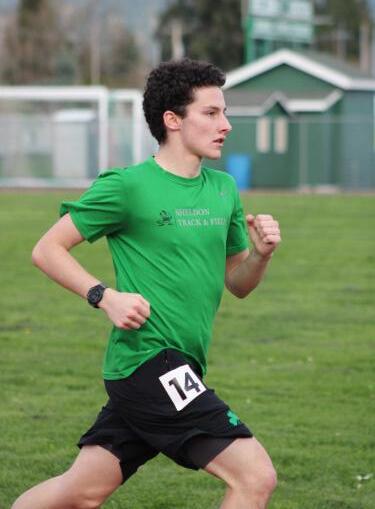
Chase Becker (So.) runs the 1500m at Sheldon’s innersquad meet.
photos by Claire Craig
Ronan Sterling & Sergio Vicente staff writers
Sheldon High School Track and Field is more than just a sport. It’s a community where students can stay active, make friends, and challenge themselves. Monday through Thursday after school, athletes go to the track to run, jump, and throw. The team is welcoming to everyone of all experience levels, and helps new athletes feel comfortable. Practices can be hard, but teammates always support each other and try their best. Sophomore Kevin Sanchez-Cruz says the team is a great place to start something new. “Just show up if you want to try it,” Sanchez-Cruz said. Track and field isn’t only about doing good in your events, but about putting in effort and improving.
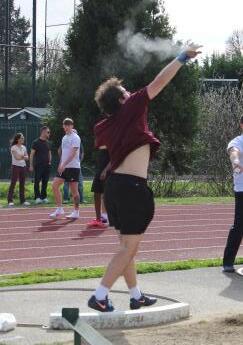
Zahir Escobar, a sophomore who throws shot put and discus, said track isn’t just about running laps around the field. As a thrower, he spends most of his time working on his strength and technique, trying to throw a little farther each meet. “People think we just stand there and throw, but it’s actually hecka technical,” Escobar said.
“If your form’s off even a little, the throw’s not going anywhere.” He likes the challenge of trying to beat his own personal record while competing against his friends in a good way. Even on days when his arms feel sore from lifting, Escobar shows up ready to work because he knows the effort will pay off in the ring.
Sophomore Colin Phillips also enjoys being part of the Sheldon track and Field team. He said one of the best parts of the sport is how everyone encourages each other to improve. Even though practices can be tiring, he believes the team environment makes it worth it. “Everyone’s working toward their own goals, but we still support each other,” Phillips said. He explained that seeing teammates push themselves motivates him to do the same, and it helps the whole team get better throughout the season.
Aaron Hartsfield (Jr.) launches a shotput at the innersquad meet.
Welcome to New York! pg.8 editor........Lizzy Cantwell
Time Flies pg.9 editor..............................Fateen Anto
Club Sandwich pg.10 editor...................Andrew Cottle
Best in Show pg.11 editor..........................Claire Craig Backpage editor.......................................Claire Craig Editor-in-chief..............................Khaya Ainis-Michael Staff Adviser..........................................Greg
Staff Writers:
Ryley Bainter
Hewson Baldwin
Andrew Brown
Janeza Carrillo
Chloe Crook
Isabella Curtiss
Thomas Follett
Claire Green
Michael Renzi
Tali Ritchie-Tuisue
Matthew Schuck
Ronan Sterling
Carmen Uria Carrillo
Sergio Vicente
Kennedy Zuniga
Deigo Valdivia-Camacho and Khaya AinisMichael picketing in front of the Federal Building Downtown. photo by Claire Craig Backpage photo illustration by Gavin Lees and Fateen Anto