Why High Purity Ingredients Fail Stability Tests in Pharma
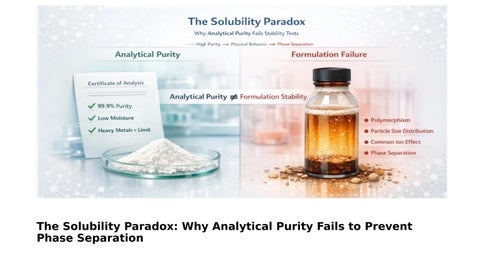
The Solubility Paradox: Why Analytical Purity Fails to Prevent Phase Separation
Informational
• It is a scenario that causes endless friction between the procurement desk and the R&D bench.
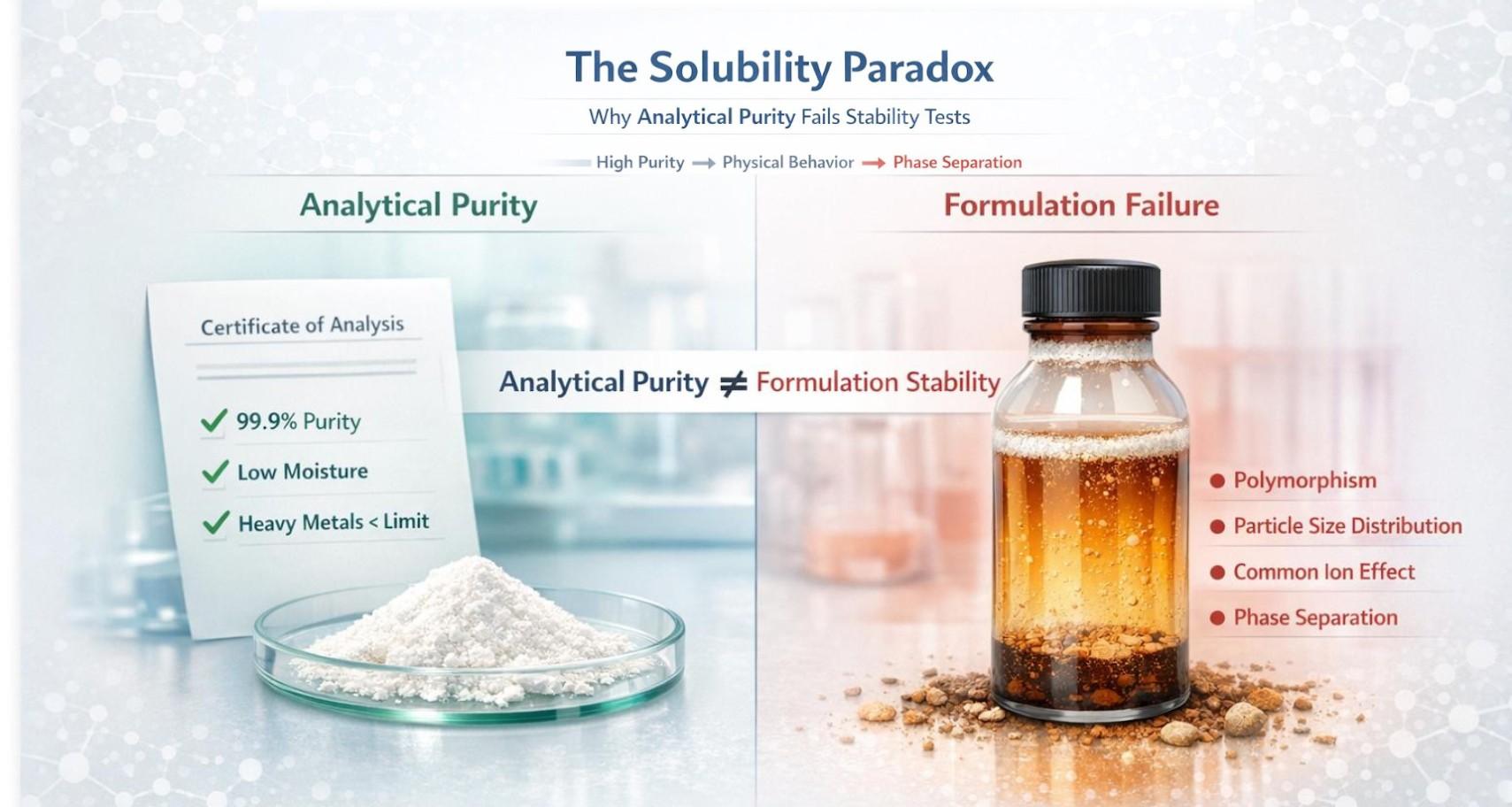
• Procurement secures a fantastic price on a new batch of raw materials. The certificate of analysis arrives, and it is flawless. The assay reads 99.9% pure. Moisture levels are exactly on target. Heavy metals are practically non-existent. On paper, it is a premium ingredient ready for the manufacturing floor.
• But three months into the accelerated stability trial, the liquid formulation develops a chalky ring around the neck of the bottle. Or worse, the suspension compacts into a hard layer at the bottom of the vat, completely refusing to resuspend.
• Why does a chemically perfect ingredient fail so aggressively in the mixing tank?
• Because the certificate only tells you what is in the drum. It provides zero insight into how that powder will physically behave once it interacts with your solvent system. As one of the globally recognized leading pharmaceutical distribution companies, we frequently step in to help R&D teams untangle this exact problem.
• Here is the reality of the solubility paradox: analytical purity is just a chemical snapshot. Longterm formulation stability requires physical engineering. Here is why pure ingredients crash out, and how to spot the physical risks before you scale up.
The Hidden Impact of Crystal Structures (Polymorphism)
• Molecules are stubborn, and they do not always dry the same way twice. Depending on the temperature and cooling rate at the manufacturing plant, the exact same chemical can crystallize into completely different structural shapes, known as polymorphs.
• The industry learned this the hard way with the famous Ritonavir (Norvir) case in the late 1990s. The drug was chemically pure and initially formulated successfully. However, a lower-energy, far less soluble polymorph suddenly appeared in the manufacturing lines. The chemical purity had not changed, but the physical solubility vanished, forcing a massive product recall and complete reformulation.
• If an active pharmaceutical ingredient supplier in India slightly alters their reactor cooling time to speed up production, you might receive a tightly packed, insoluble polymorph. The assay will still read 99.9% pure, but your formulation will fail.
• This is not a theoretical risk. It is why our documented quality assurance methodology mandates the strict scrutiny of crystal structure and physical behavior, rather than relying solely on the top-line chemical assay. You cannot formulate a stable product with a chemical you cannot dissolve.
Navigating Complex Ionic Environments
• You are almost never dissolving an ingredient into pure water. Your formulation is a highly crowded, reactive environment packed with buffers, preservatives, and co-solvents.
• When you introduce a highly pure ingredient into this crowded room, you have to account for the common ion effect. For example, if you add a highly pure calcium-based powder to a liquid that contains trace sulfates from another excipient, those ions will instantly react. They precipitate into calcium sulfate, dropping to the bottom of your tank as a white, gritty layer.
• We see this frequently with dense nutritional syrups. When sourcing mineral fortifiers, the raw analytical purity of the mineral is irrelevant if the specific salt form mathematically clashes with the rest of your formula. Experienced pharmaceutical excipient suppliers map out these ionic relationships beforehand to maintain a homogenous, liquid state, rather than hoping the highshear mixer will solve the problem.
Optimizing Particle Hydration and Flow
• Sometimes an ingredient fails to stay in solution because it was never properly wetted in the first place. This comes down to particle size distribution (PSD) and thermodynamic energy.
• If a powder is milled inconsistently, it will have a massive variance in particle size , large chunks mixed with ultra-fine dust. When dumped into a solvent, the ultra-fine dust rapidly hydrates, forming a thick, gel-like skin around the larger dry chunks. The solvent cannot penetrate this skin to dissolve the core.
• Your high-shear mixer will run at maximum RPM, wasting massive amounts of energy trying to tear these unhydrated clumps (often referred to in the industry as fish eyes) apart. Over a few weeks on the warehouse shelf, gravity takes over. The clumps settle, the particles undergo Ostwald ripening, and your product physically separates.
Stop Flying Blind on the Scale-Up
• If you want to guarantee stability before moving to commercial manufacturing, you have to stop accepting the basic CoA as the only source of truth. Relying purely on a standard chemical assay leaves your R&D team flying blind to the physical realities of the powder.
• You need physical data. You need the Particle Size Distribution (PSD), the bulk density, and the exact polymorphic form. We ensure that every certificate and technical dossier we provide is backed by this specific, actionable mechanical data to prove operational compliance.
• Analytical purity is your baseline, but physical compatibility is the finish line. Don't let a physical mismatch ruin a perfectly good chemical formula.
• To get the precise technical specifications, physical data parameters, or scale-up support you actually need, please contact our team today.