Sourcing Corticosteroids & Hormones: Mitigating API Risks
Sourcing Corticosteroids and Hormones: Mitigating Impurity Risks
in High-Potency APIs
Informational
• The margin for error in pharmaceutical manufacturing is always narrow. But when you transition to handling High-Potency Active Pharmaceutical Ingredients (HPAPIs), that margin effectively disappears.
• Hormonal therapies require therapeutic doses measured in fractions of a milligram. At this microscopic scale, a 0.1% impurity isn't a minor deviation. It is a severe patient safety risk and an immediate trigger for regulatory rejection.
• For QA and procurement teams handling high-potency API sourcing, standard vetting procedures fall dangerously short. A basic chemical assay might confirm the identity of the powder, but successfully bringing a steroidal product to market requires forensic-level supply chain control.
• As one of the globally recognized leading pharmaceutical distribution companies, we see firsthand where formulations fail. Here is the technical reality of sourcing these sensitive molecules, and the exact parameters formulators must secure to prevent a catastrophic batch failure.
The Transit Threat: When Logistics Degrade Chemistry ?
• Steroidal APIs and hormonal compounds are exceptionally fragile. Depending on the exact molecular ring structure, the active ingredient can degrade rapidly when exposed to oxygen, ultraviolet light, or thermal fluctuations.
• A batch can leave a reactor at 99.9% purity and arrive at your receiving dock at 98.5%. The synthesis didn't fail; the logistics failed. If a shipping container sits on a hot tarmac during global transit, thermal degradation accelerates instantly.
• Mitigating this risk requires an absolute commitment to supply chain integrity. Reliable pharmaceutical raw materials suppliers do not leave transit to chance. They mandate specialized, opaque, climate-monitored packaging. The strict environmental controls established inside the manufacturing plant must extend across the ocean. If the transit data is unverified, the integrity of the molecule is void.
Surviving the Impurity Audit
• Regulatory agencies including the USFDA, EMA, and CDSCO scrutinize hormonal products with extreme prejudice. A basic assay simply will not survive a modern audit.
• Quality control teams must prove the material aligns with the absolute latest pharmacopeial monographs. But vetting an active pharmaceutical ingredient supplier in India requires digging significantly deeper into related substances.
• Consider genotoxic impurities. Under ICH M7 guidelines, mutagenic risks in HPAPIs are ruthlessly capped. Formulators must strictly control these below the Threshold of Toxicological Concern (TTC) of 1.5 micrograms per day for patient safety. Heavy metals fall under ICH Q3D, demanding precise parts-per-million (ppm) or parts-per-billion (ppb) testing validation.
• Evaluating a specialized corticosteroids and hormones API pharma company demands radical transparency. Sourcing teams need immediate, unfiltered access to typical certificates of analysis, detailed impurity profiling data, and verifiable MSDS documents to guarantee the synthesis pathway left zero toxic byproducts behind.
Why Particle Size Distribution Is Critical for
Corticosteroid Bioavailability ?
• With high-potency molecules, passing the purity test is only half the mandate. The physical mechanics of the powder dictate how the drug actually performs in a patient's body.
• Steroids are frequently pressed into low-dose tablets, blended into thin topical creams, or suspended in liquids. Achieving content uniformity in these formats is a massive mechanical challenge. If the API particle size is highly inconsistent, the active ingredient will not distribute evenly within the blender. In fact, unchecked PSD variance can easily cause a 20% content non-uniformity in the final dosage form.
• Imagine Tablet A receives 0.7mg, while Tablet B receives 0.3mg. In hormonal therapy, this variance causes severe adverse clinical events.
• Sourcing from elite API manufacturers in India involves locking down these physical parameters. Strict milling protocols and a narrow Particle Size Distribution (PSD) ensure the API integrates predictably into your formulation matrix, delivering the precise bioavailability the clinical data demands.
The HPAPI Sourcing Checklist
• You cannot guess your way through high-potency formulation. To guarantee stability long before hitting commercial scale-up, procurement and R&D must demand specific data alongside every order of corticosteroids and hormones.
• Before authorizing a new supplier, ensure you secure:
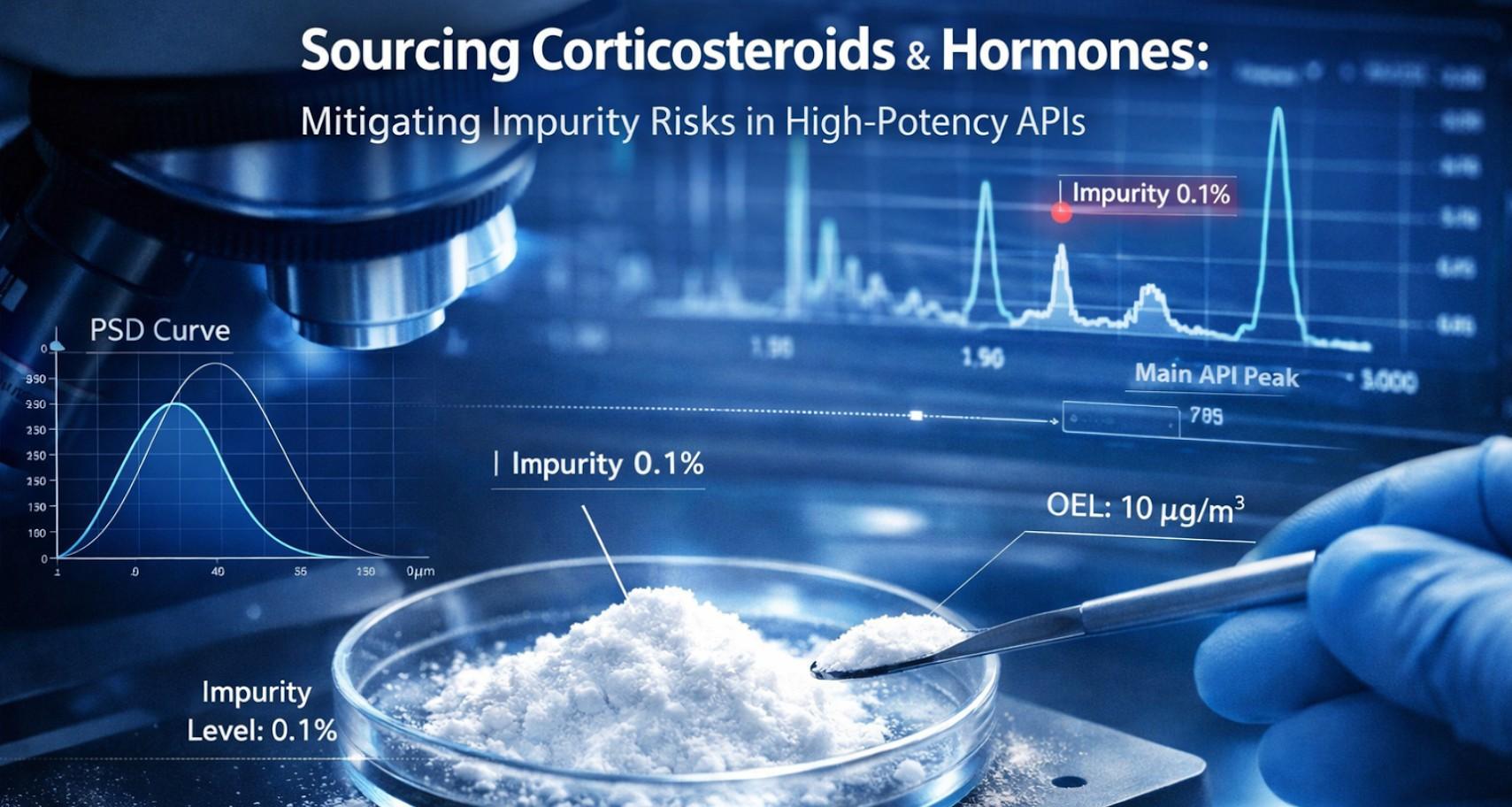
• PSD Curves: Essential for modeling dissolution rates and guaranteeing content uniformity. (Example PSD curves and impurity chromatograms are available upon request).
• Complete Impurity Profiling: Including related substances, residual solvents, and ICH-compliant heavy metal screens.
• OEL (Occupational Exposure Limit) Data: Critical so your facility can deploy the correct containment infrastructure to handle the powder safely.
• Verifiable Transit Protocols: Hard proof of climate-controlled, opaque packaging.
• Sourcing high-potency molecules is never about chasing the lowest price per kilo. It is about securing the exact documentation, physical data, and logistical transparency required to keep your product safe, compliant, and on the market.
• Request impurity profiling data and PSD specs for your next corticosteroid order contact our technical team today.