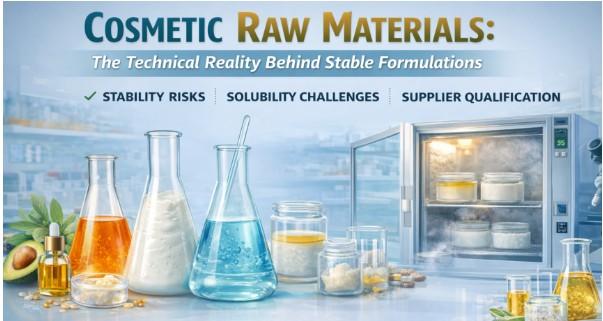
Cosmetic
Raw Materials: The Technical Reality Behind Stable Formulations
Cosmetic Raw Materials & Ingredients
• There is no sinking feeling quite like opening a stability chamber and seeing a layer of oil floating on your finalized luxury cream.
• On paper, the formula was perfect. In the beaker, it felt silky. But three months later, it failed. While it’s easy to blame mixing speeds or cooling times, the root cause is often the cosmetic raw materials themselves.
• For formulators and buyers, selecting ingredients isn’t just shopping it’s risk management. A product is only as stable as its weakest chemical link. As part of our pharmaceutical distribution portfolio, we see firsthand how sourcing decisions dictate product survival.
The Two Pillars of Formulation
• We often over-focus on hero ingredients, but stability lives in the balance between two functional groups:
• Active Cosmetic Ingredients: The marketing stars retinoids, peptides, and extracts that promise results.
• Cosmetic Excipients: The engineering team emulsifiers, preservatives, and stabilizers that keep the product together.
• Here is the hard truth: A generic active in a robust chassis beats a premium active in a weak base. If your cosmetic excipients can’t hold the structure under stress, the potency of your actives is irrelevant.
Performance Drivers: Beyond the Datasheet
• When sourcing cosmetic formulation ingredients, you need to look past the sales brochure and understand the physical chemistry.
• The Solubility Trap: Solubility isn't guaranteed. Salicylic Acid, for example, resists water. If you miscalculate the solvent ratio, it recrystallizes, turning a smooth serum into liquid sandpaper.
• Texture & Rheology: Consumers judge quality by feel. If a lotion is too runny, it feels cheap. Rheology modifiers fix this, but salt-sensitive thickeners can collapse instantly if paired with the wrong botanical extract.
• Bioavailability: If a molecule can't penetrate the skin, it’s just surface decoration. You can explore our cosmetic raw material portfolio to see how specific delivery systems improve absorption rates.
Stability
• Stability testing reveals every shortcut. When evaluating bulk cosmetic ingredients, you are essentially looking for their breaking point.
• Oxidation: High-end plant oils are trendy but chemically fragile. Without the right antioxidants, they turn rancid (and smell like old crayons) within months.
• The Bio-Burden: Natural clays and powders often carry a microbial load. If you don't account for this, your standard preservatives will fail. Our sourcing aligns with strict standards, similar to those used for active pharmaceutical ingredients, to ensure rigorous control.
• Packaging Risks: Aggressive ingredients (like essential oils) can eat through plastic. Stability isn't just about the liquid; it's about the container too.
Compatibility Wars
• Formulation is a series of invisible chemical battles. A few common clashes:
• Ionic Clash: Mixing positive (cationic) conditioners with negative (anionic) thickeners creates an instant, gummy mess.
• pH Drift: If your buffering agent degrades, the pH shifts, and your preservative stops working.
• Trace Impurities: Unknown contaminants can trigger secondary reactions. Formulators must assess intermediates to ensure high purity and prevent these surprises.
How Smart Buyers Evaluate Suppliers?
• Cosmetic ingredients suppliers often promise consistency, but can they scale?
• The CoA Reality Check: Don't just file the Certificate of Analysis read it. Did the purity drop from 99.5% to 98%? That 1.5% gap could be a skin irritant.
• Regulatory Safety: Reliable cosmetic chemical suppliers ensure documentation aligns with current global frameworks (EU/US) to mitigate compliance risks down the road.
• Scale-Up consistency: If you move from a 50kg pilot batch to 5 tons, will the particle size stay the same? Variations here can completely alter the final product's color and feel.
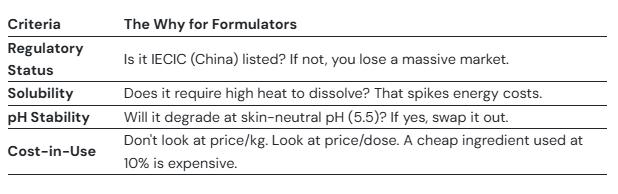
The Selection Matrix
• Use this quick checklist before approving any new raw mater
Conclusion
• Great products are engineered, not just mixed. The difference between a stable bestseller and a recalled failure often comes down to the quality of the cosmetic raw materials chosen in week one.
• Demand technical transparency, not just chemicals.
• For specifications or documentation reviews, contact our team.