




Box 87
Elm Creek MB R0G 0N0
Email: shorthornreport@gmail.com Adrianne Vandersluis 204-750-2574
Publication Mail Agreement #44028015
Return undeliverable Canadian addresses to: The Canadian Shorthorn Report Box 87 Elm Creek MB R0G 0N0
Advertising Rates
Single Issue Rate 4 Issue Rate
Full page $800 $750
2/3 page $600 $570
1/2 page $475 $450
1/3 page $400 $380
1/4 page $325 $305
1/6 page $275 $260
Business card $65 $45
All ads are full colour
Photos should be no smallerthan 300 dpi (2480x3507 pixels) to avoid blurryresults.
Yearly Subscription Rates: Canadian -$24
US - $30 US Foreign- $55
GST applicable on all fees -BN806961447
Spring February 15
Herd Reference July 1 August 1 Fall September 15 October 15
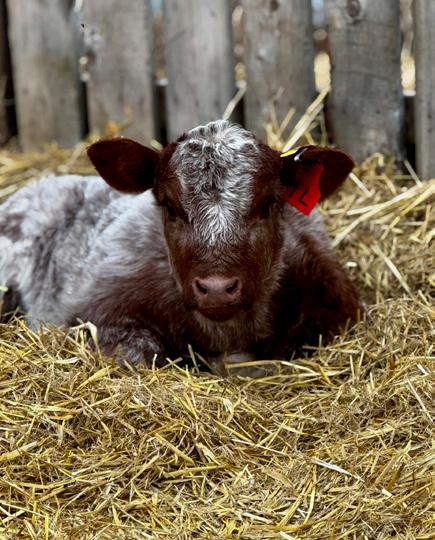
The Canadian Shorthorn Report is looking for pictures to use in the magazine.
Individual or group pictures of bulls, cows, or calves in all seasons, If you have any that you would like to share, please send them to: shorthornreport@gmail.com
Spring is just around the corner, and we are well on our way to having the 2026 crop of Shorthorn calves on the ground. I am sure we all have one or two favourites picked out already. Bull sales have started and if you are still looking, there are a good selection to choose from, either by private treaty or in one of the sales being held across the country. There is still a bit of time to get that semen you want for breeding season shipped to your farm. Breeders are always happy to answer any questions you have about their breeding stock. To all the 4-H members showing Shorthorn & Shorthorn influence projects in the next few months, I wish you all a successful show season, and don’t forget to send your pictures in! Adrianne

With spring comes the optimism of new life and the long wait of planned matings we’ve been anticipating. Those will be some of the genetics that will shape out breed for tomorrow.
As purebred breeders we have an obligation to make sure we do some of the fundamentals correct. Get your WHR in early and start registering your calves as they are born. It makes a large job in some cases a lot easier. Submit accurate birthdates, birth, weaning and yearling weights. Tattoo calves properly! I’ve seen way too many inaccurate, faint or no tattoo at all. Check them before you exhibit or sell your stock. Transfer the bulls and females soon after they’ve been paid for.
With the new year, contracts is also a time of new or renewals, such is the one with the Canadian Shorthorn Report, the official breed publication for the Canadian Shorthorn Association. I challenge every breeder to place an ad, you decide size, in at least one issue in the breed magazine. This is the best cost effective avenue to get word out as to where you are and what your operation is all about.
Social media is a good place but not everyone has Facebook, Instagram, Twitter, etc.
I encourage those that are able to attend the 140th Annual General Meeting of the Canadian Shorthorn Association being held in Kamloops, B.C., May 28-30. The B.C. Association is working hard at creating a memorable event.
The Shorthorn breed has seen steady growth over the past number of years and it is a result of you the breeders, breeding, promoting, exhibiting and merchandising top quality Shorthorn animals!
Richard Moellenbeck
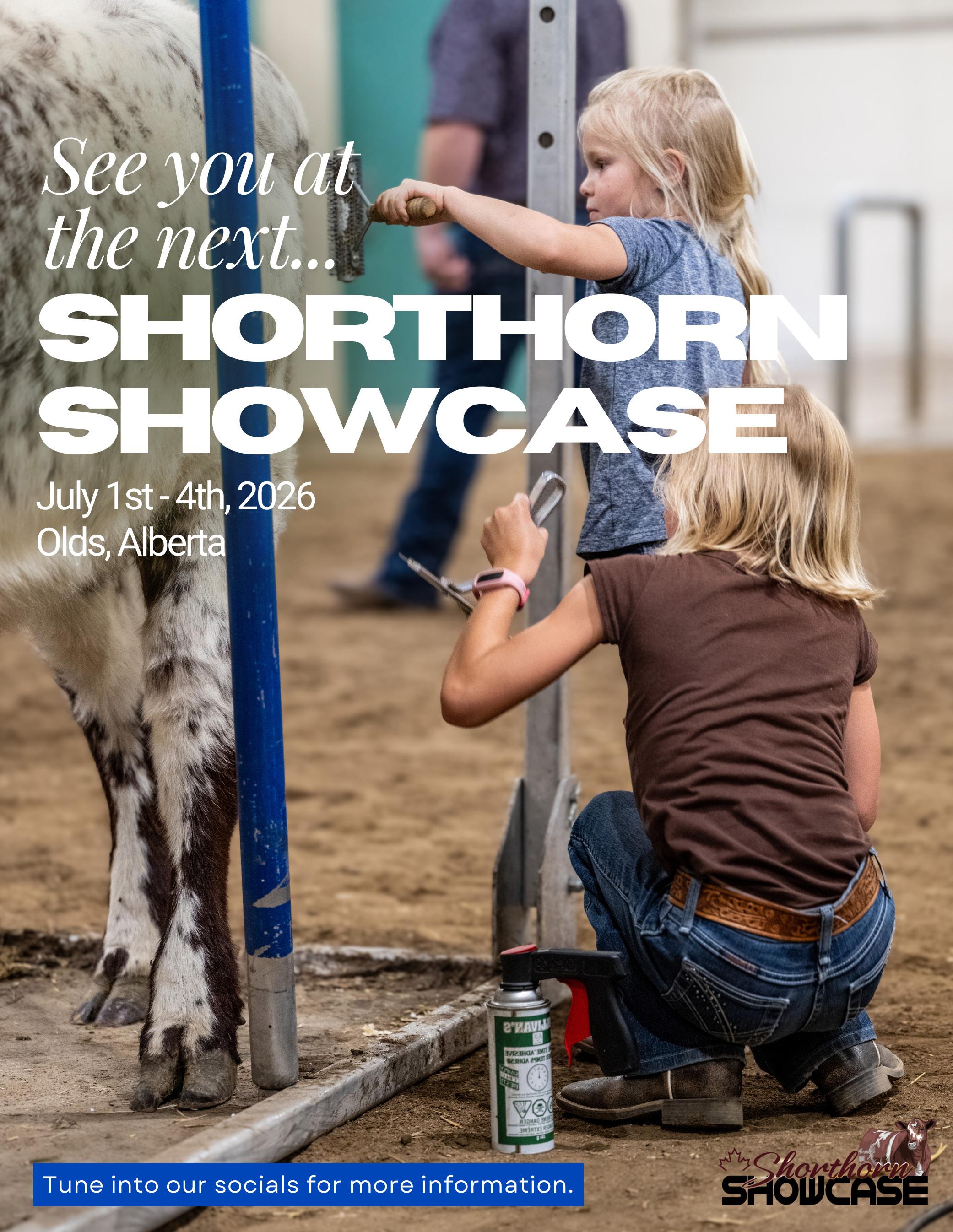
The CJSA board has been busy planning many events and opportunities for juniors coming up this year! February 18-20th will be our Stars Leadership Conference in conjunction with the Canadian Junior Limousin Association in Vermillion, AB. We have 34 juniors joining us from all over the country, with about two-thirds of the juniors being Shorthorn members. This conference is an opportunity for youth to make networking connections in the agriculture industry and develop skills that will make them a successful next generation working in the cattle industry! Juniors will be taking in all there is to learn from guest speakers, workshops, and a tour of Lakeland College’s Student-Led Farm. Coming up mid-March, the CJSA board will be hosting another online Fundraiser Auction on DLMS FarmGate. This will be an opportunity for breeders to support the junior program by bidding on featured lots of Shorthorn frozen genetics. July 1st to 4th will be our National Shorthorn Showcase in Olds, AB, with the opportunity to stay for Summer Synergy afterwards. This weekend will provide an opportunity for juniors to build lifelong friendships, develop leadership and cattle knowledge, and represent the future of the Shorthorn breed! Be sure to watch for registration opening in early April and stay tuned on the CJSA Facebook page for updates on all our exciting upcoming events.
Katherine Possberg, CJSA President
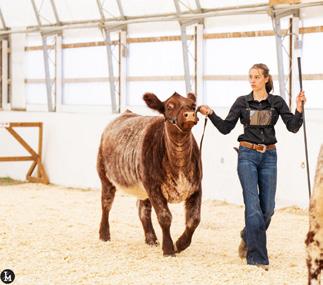
The Canadian Junior Shorthorn Association is excited to welcome Mackenzie Nunn of Ontario to the CJSA Board of Directors. Mackenzie brings a strong background in leadership and junior involvement, along with a genuine passion for the Shorthorn breed and the people who make the industry what it is. She has been actively involved in 4-H, serves on the Ontario Junior Shorthorn Board, and is secretary of her school’s student council. As secretary of her 4-H Beef Club, she was also recognized as Top Secretary of the Year for Durham West County. Mackenzie is especially passionate about making sure junior members feel welcome, included, and encouraged to get involved. Being newer to the breed herself, she understands how important it is to create events and opportunities that are approachable and fun, while still helping juniors learn, grow, and build confidence. She’s eager to help plan and promote activities that bring juniors together, encourage new friendships, and make CJSA events even more engaging. With her positive attitude, strong work ethic, and genuine love for the Shorthorn community, Mackenzie will be a great addition to the CJSA Board. We’re looking forward to having her on the team and to the energy and ideas she’ll bring as she helps support junior members and the future of the breed.
The Canadian Junior Shorthorn Association is pleased to announce the four recipients of the 2026 STARS Leadership Conference Travel Bursary Program. Each recipient has been awarded $500 to assist with travel expenses to attend this year’s conference in Vermilion, Alberta, taking place February 19–20. The program is designed to support junior members aged 16 and over who demonstrate a strong interest in the Shorthorn industry and a commitment to developing their leadership skills within agriculture. Applicants are required to be CJSA members and to submit a written application outlining their travel plans, their reasons for attending, and their passion for the Shorthorn breed. The STARS Leadership Conference continues to play an important role in developing the next generation of Shorthorn leaders by providing opportunities for education, networking, and personal growth. The 2026 bursary recipients represent a group of motivated young people who are eager to learn, connect, and contribute to the future of the breed.
Isabelle Strachan will be travelling from Ontario to attend the conference and plans to pursue a future in large animal veterinary medicine. Coming from a family with generations of involvement in Shorthorns, Isabelle is passionate about carrying on the tradition of the breed while continuing to learn how to advance it in modern production systems. She sees the conference as an important step in building knowledge and experience that will support both her education and her long-term goals in agriculture. This is Isabelle’s second SLC Conference.
Madeline Lehrbass is eager to attend the conference to expand her understanding of the cattle industry and further her interest in breeding Shorthorn show cattle. With a strong background in 4-H and showing cattle, Madeline is focused on producing well-rounded cattle for future junior members and views the STARS conference as a valuable opportunity to grow, learn, and gain broader industry perspective.
This is Madeline’s first SLC Conference.
Mitchell Ormiston, travelling from Ontario, is excited to build his knowledge of both the beef and Shorthorn industries while continuing to grow as a young leader. Actively involved in showing and junior events, Mitchell recently became the owner of a purebred Shorthorn heifer and is committed to long-term involvement in the breed. He looks forward to using what he learns at the conference to help promote Shorthorns and strengthen his leadership skills. This is Mitchell’s second SLC Conference.
Colin Ormiston brings a strong background of involvement in both the Shorthorn and 4-H communities, including participation in national and provincial Shorthorn events and service within the Ontario Junior Shorthorn Association. Currently studying at the University of Guelph, Colin views the conference as an opportunity to continue building his network within the industry and further develop the leadership skills he has already been putting into practice.
This is Colin’s second SLC Conference.
The Canadian Junior Shorthorn Association congratulates all four recipients and looks forward to seeing the impact they will continue to have on the Shorthorn breed and the junior program in the years ahead.

Submitted By: Shayla Chappell
The Paper Trail explores the records, registry processes, and performance data that support every registered Shorthorn. From forms to figures, this series is designed to help breeders better understand how strong documentation, sound management, and professional presentation work together to support the long-term success of the Shorthorn breed.
Marketing seedstock cattle today requires more than good photos and a sale date. Buyers, whether they are commercial producers or fellow purebred breeders, are more informed, more comparative, and more strategic than ever before. While phenotype still opens the door, certitude closes the sale. That certainty is built through reputation, transparency, and professionalism. Understanding how different buyers evaluate breeding stock allows Shorthorn breeders to position their programs effectively within the broader beef industry.
Buyer A: The Commercial Cattlemen Focused on Function and Return
Commercial cattlemen approach seedstock purchases with a practical lens. Their investment must translate into measurable value within a working cow herd. For these buyers, the primary considerations often include:
Calving Ease & Reliability
Reducing labour, minimizing loss, and maintaining consistency are critical. Bulls must work without creating problems.
Performance & Pounds
Growth, efficiency, and payweight drive profitability
Commercial producers want cattle that add value at weaning and beyond.
Longevity, fertility, udder quality, and structural soundness matter just as much as growth. Replacement females must stand the test of time.
Consistency Across a Sire Group
Uniformity is valuable. Buyers appreciate when a program produces predictable cattle year after year. For this audience, marketing that emphasizes how cattle will perform in real-world conditions tends to resonate quite heavily. As a bonus, performance data and EPDs help support decision-making. Commercial buyers are often influenced by reputation, customer service, and confidence in the registration information that backs the animal.
Purebred and seedstock breeders evaluate cattle through a longer-term, strategic lens. Their purchases often shape the direction of their program for years to come. Key considerations frequently include:
Proven maternal lines and influential sires carry weight in not just a physical sense. Buyers want to understand the story behind the animal.
Complementary Genetics & Balance
Rather than chasing extremes, many purebred breeders look for cattle that move their herd forward while maintaining structural integrity and maternal function. Animals that introduce new options or strengthen weak areas within a herd attract attention.
Future Marketability
Seedstock breeders consider how a purchase will impact future bull sales, female demand, and overall program branding.
For purebred buyers, marketing that communicates vision, program direction, and long-term opportunity is especially effective.
While commercial and purebred buyers are often discussed as two distinct audiences, the reality is that they share many of the same foundational goals. Both are investing in cattle that will improve their operations, strengthen maternal function, maintain structural integrity, and add long-term value. The difference is rarely in the goal; it is usually in the emphasis. Despite their slight differences, commercial and purebred buyers share several common expectations:
● Accurate and strong records
● Professional communication
● Programs that stand behind their product
In a competitive beef marketplace, credibility matters. Attention to detail, whether in registration, advertising, or follow-up, signals reliability and builds trust.
The Canadian Shorthorn Association provides several tools to help members connect with both audiences:
● CSA Facebook Page
● Digital Beef Marketplace
● Digital Beef Catalog Builder
● E-blasts to Members & Commercial Buyers
● Member & Commercial Buyer Mailing Lists
● The Canadian Shorthorn Report Magazine
● CSA Website Semen & Embryo Classifieds
These tools are most effective when paired with clear messaging and strong visuals. High-quality photos, concise
footnotes, and consistent branding elevate perception within the purebred space. Help the association help you as a member. Take advantage of what the CSA has to offer you in these spaces.
As sale season progresses and breeding decisions approach, buyers are actively evaluating options. This is a window when:
● Producers are selecting herd bulls
● Purebred breeders are planning matings
● Interest in semen and embryo packages increases
● Buyers are comparing programs across breeds Visibility and preparation matters. Ensuring cattle are
properly registered, listed, and professionally presented allows Shorthorn breeders to drive successful sales in this decision- heavy period. Marketing is not a one-time event tied to sale day- it is an ongoing process that blends reputation, relationships, and merit.
Accurate records, clear communication, and thoughtful promotion all contribute to that alignment. When combined with quality cattle and strong program direction, they create a lasting impact. Because in today’s beef industry, success is built not only on what stands in the pasture, but on how hard it is to overlook that “complete package” you have to offer in the competitive marketplace.
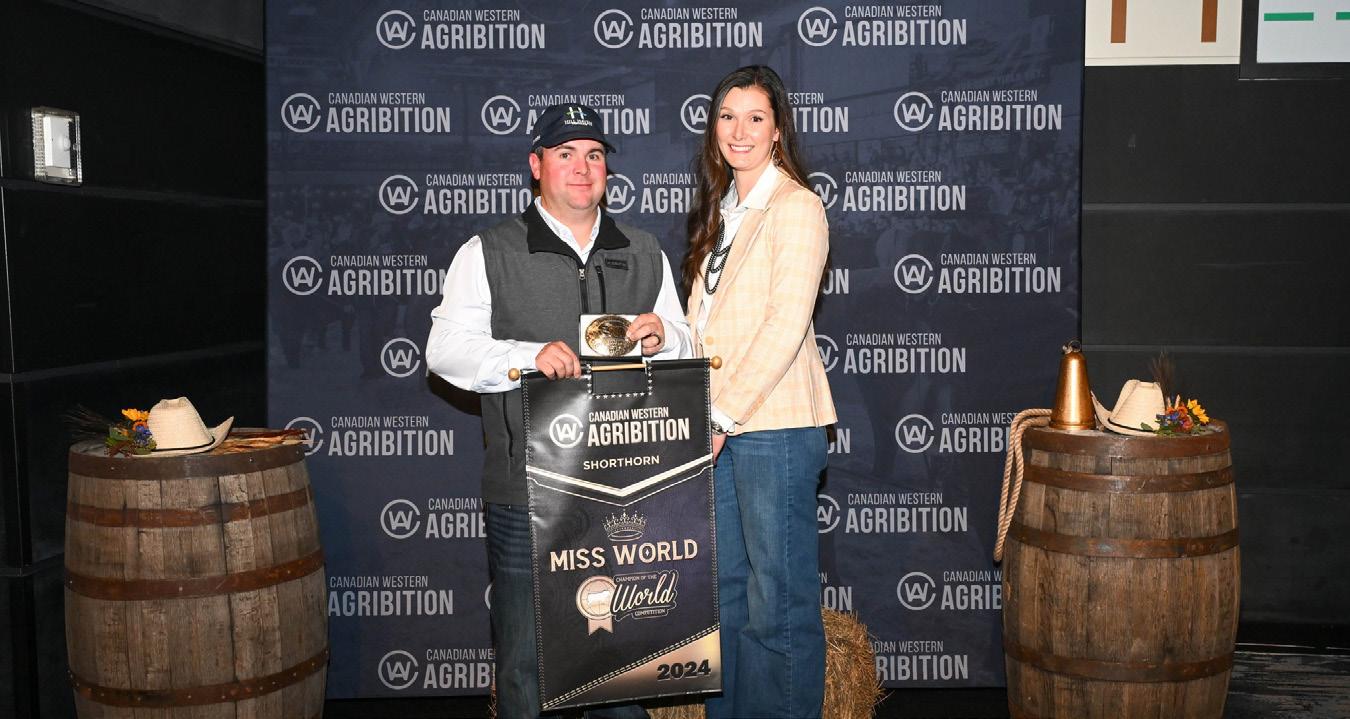
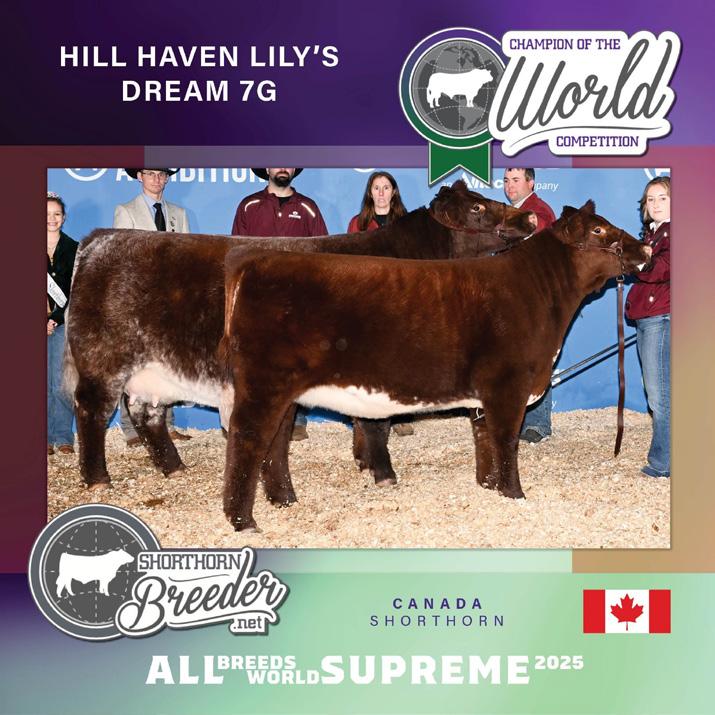
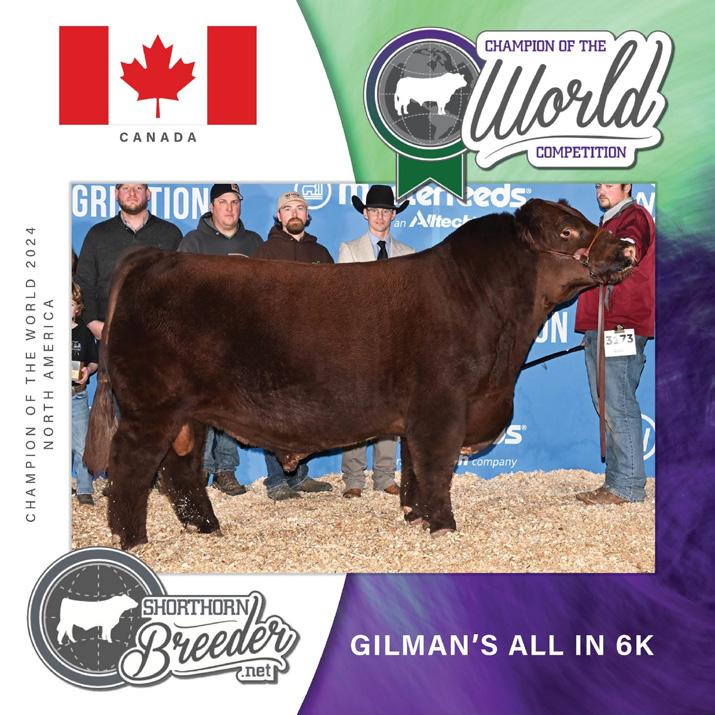
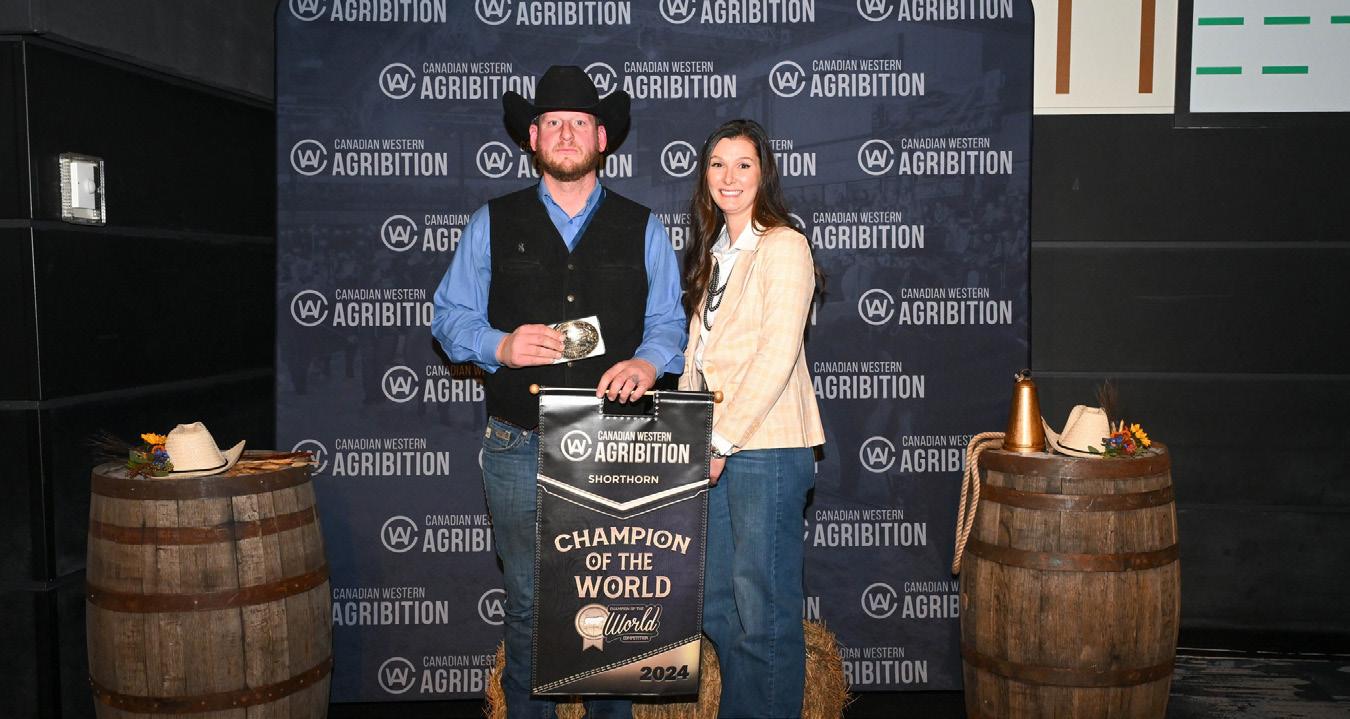
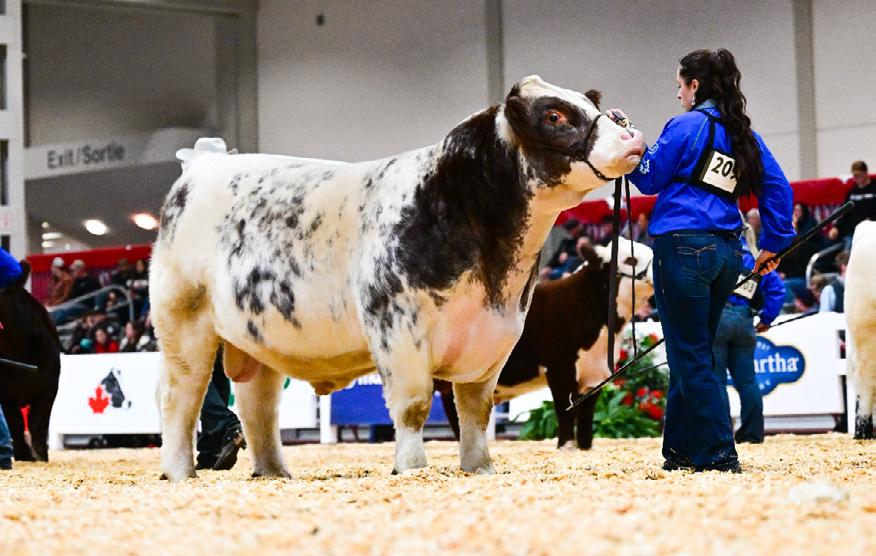
At the Agribition event this past November, the prestigious Champion of the World awards were presented during a ceremony held in conjunction with the show. This annual recognition highlights outstanding cattle excellence on a global stage, judged against stringent standards for conformation, breed character, and overall quality.
Champion Bull - Gilman’s All In 6K
The top honor for the bull division went to Gilman’s All In 6K. Owner Darnell Fornwald accepted the championship banner.
Champion Female - Hill-Haven Lily’s Dream 7G
In the female division, Hill-Haven Lily’s Dream 7G earned the championship. Hill Haven’s herdsman, Matthew Hargrave, was in attendance to accept the championship banner.
This marks the second year in a row that Canada has swept the Championship, winning both the bull and female sides of the breed- a testament to the depth of quality and competitive breeding programs in Canada. submitted by CSA
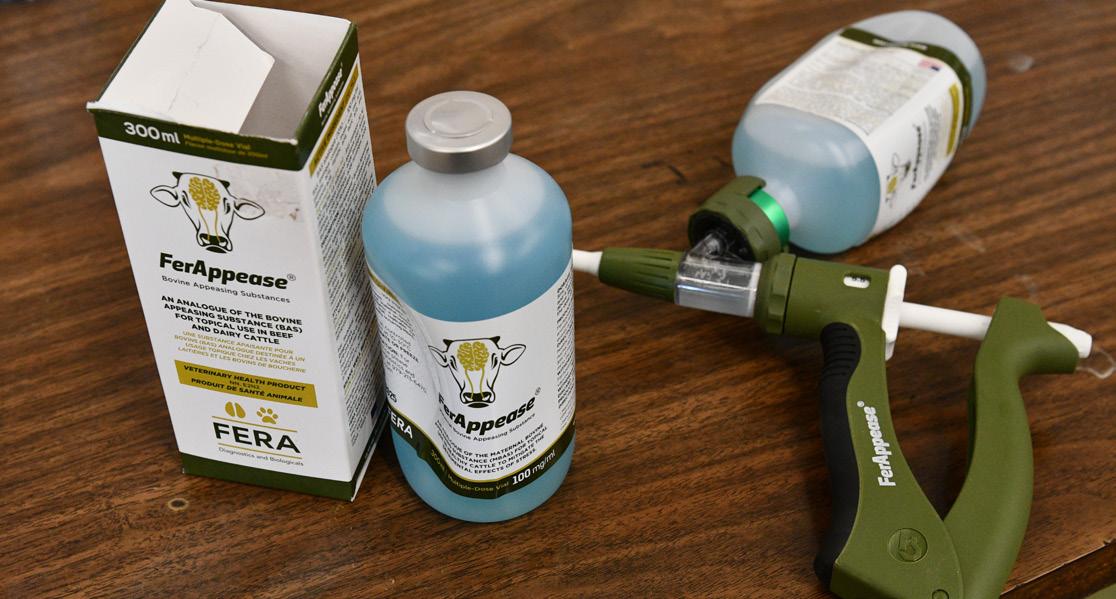
The first Canadian study of a new product that mimics a pheromone that helps mother cows soothe their upset calves has found it will likely boost the profits of cow-calf producers.
Researchers at Olds College of Agriculture & Technology found that every $1 Cdn. spent on treating newly weaned heifers with FerAppease resulted in a profit of $6.47. It represents a return on investment of about 647 per cent, said Dr. Desiree Gellatly, who is a research scientist at the College’s Technology Access Centre for Livestock Production (TACLP). “Based on our results, and the publishing of studies that have been done so far in the U.S., it’s definitely worth it.”
A 28-day initial or pilot research project led by Gellatly was launched on Oct. 2. It found that FerAppease helped improve the live weight and live weight gain of 11 heifers compared to an equal number that didn’t receive the product.
The study also showed that FerAppease lowered the costs of production by enhancing the feed efficiency of treated heifers. Feed efficiency was evaluated by calculating the gain-to-feed (G:F) ratio, which is the average live weight gain divided by the average daily dry matter intake. FerAppease is being sold by Texas-based FERA Diagnostics and Biologicals Corp. as an inexpensive way to lower stress in cattle. The doses used in the study cost $4.27 per 10 millilitres, with a 300-millilitre bottle containing 30 such doses costing about $128.
It is a synthetic liquid that seeks to simulate the effects of a natural pheromone secreted by lactating or milk-producing cows, said Gellatly. “All mammals, including humans, have a pheromone called the maternal appeasing substance,” she said.
FerAppease is attracting attention from Canadian beef producers because U.S. studies have shown it can lower stress even for older cattle, said Gellatly. Scientists are examining its ability to improve everything from feed efficiency and weight gain to boosting immune systems against infections, she said.
It could also make it easier for beef producers to handle and transport their herds by making them more docile. The College’s pilot study involved Angus-influence heifers averaging eight months old that were cared for under the guidelines of the Canadian Council on Animal Care.
The heifers were subjected to stress through practices that simulated those of the majority of cow-calf producers in Western Canada. It included abrupt weaning followed by transport in cattle trailers to simulate travel to feedlots or auction marts, said Gellatly.
“I wanted to see how the FerAppease would affect the immune responses of those animals because we know once we put them in the feedlot at weaning time, they tend to get very sick due to multiple stressors.”
The stress experienced by newly-weaned calves due to hauling conditions in Western Canada was simulated in the pilot study by separately moving the experimental and control groups into a pen and loading them into two separate livestock trailers. They were transported for an hour for a distance of about 84 kilometres, said Gellatly.
“The reason we put them in trailers is that normally in a commercial operation, the cow-calf producers wean the animals as soon as they are separated from their mothers. They go straight to the truck and they are sent to the auction mart.”
Researchers applied doses of five millilitres of FerAppease to the muzzles of each of the 11 heifers in the experimental group, along with a further five millilitres to the nuchal area behind the ears for a total of 10 millilitres per animal. The heifers in the control group only received water.
The pilot study found that FerAppease influenced factors such as shrunk body weight, which is an important measure of weight loss during shipment to feedlots from cow-calf operations, said Gellatly. “There was specifically a statistical tendency toward significantly shrunk body weight of about three pounds for each of the water-treated heifers compared to the FerAppease-treated heifers.”
The finding suggests greater differences might have been observed if more cattle had been involved in the study, said Gellatly. Heifers treated with FerAppease were also 22 pounds heavier at the end of the 28-day trial compared to the water-treated heifers, representing a difference of about 0.7 pounds per day of live weight gain, she said.
Gellatly plans to follow up with a larger study involving more cattle, as well as looking at the ability of FerAppease to improve things such as heifer pregnancy rates through
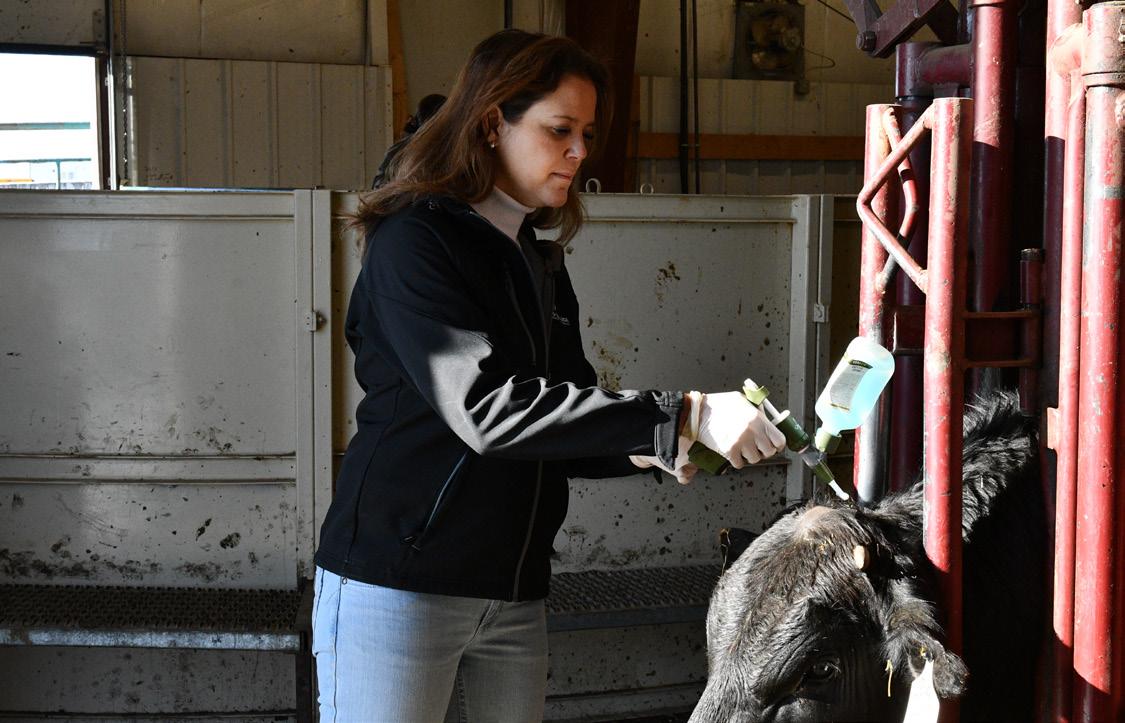
artificial insemination that could help boost the profitability of cow-calf producers.
This article was reprinted with permission from Olds College. Check out their website for more articles and more information of what is happening at Olds College Smart Farms, https://www.oldscollege.ca/smart-farm-research/ index.html

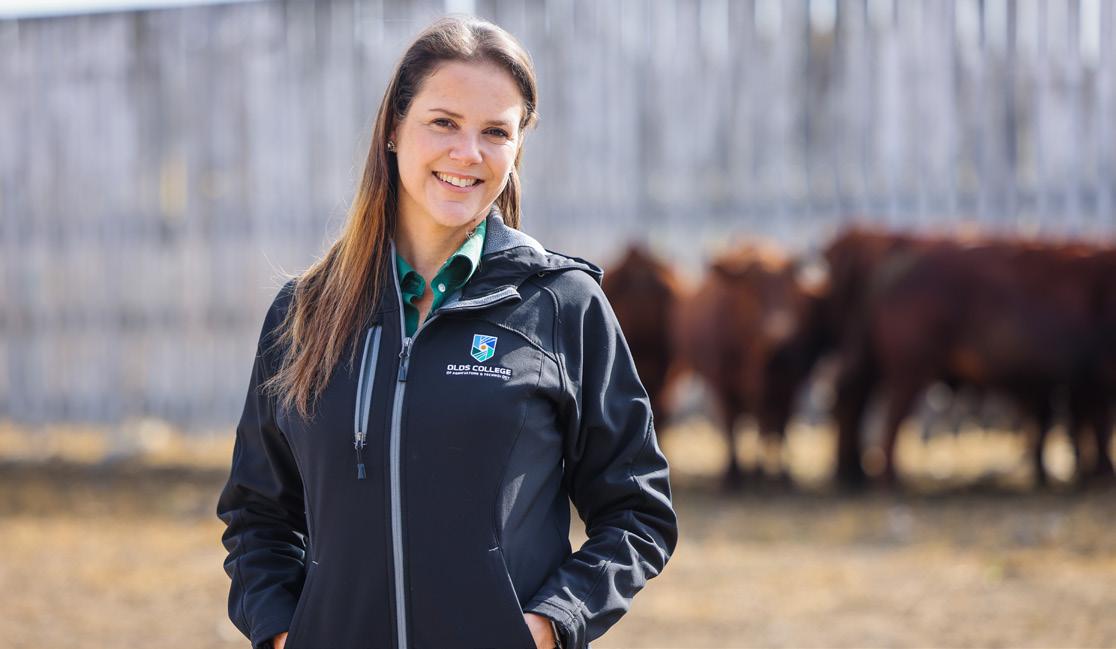

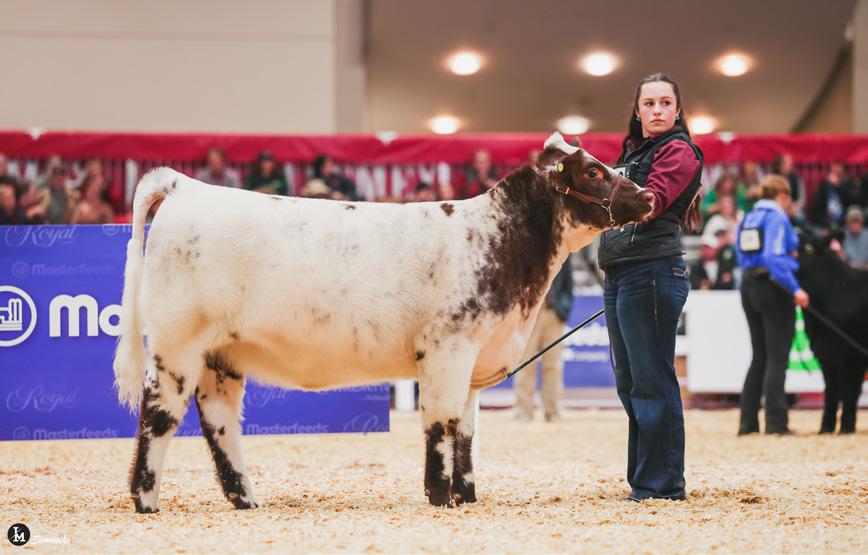
Emmett will be graduating this spring from George McDougall High School and plans to pursue an apprenticeship in welding
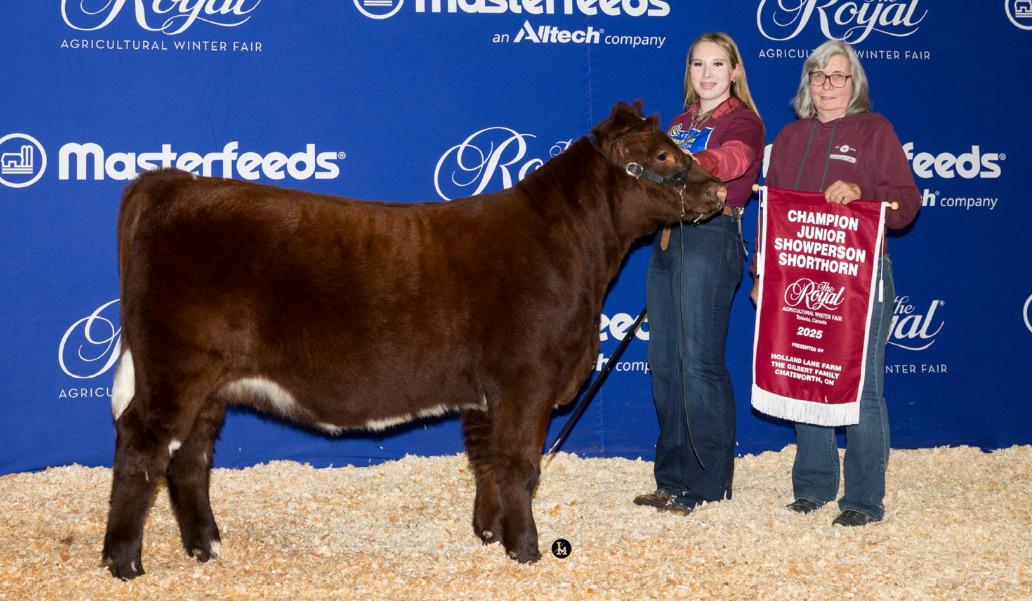
won 1st place showmanship at the Emerson Clark show at the 2025 RAWF
Many thanks to Shannon Kingston of Holland Lane Farms for lending Holland Lane Mable Netty 11N for the show.
To all Shorthorn Breeders and Shorthorn Enthusiasts.
The BC Shorthorn Association will be hosting the 140 th Annual General Meeting of the Canadian Shorthorn Association, May 28 th to 30 th , 2026 at Kamloops BC.
This AGM will include several ‘West of the Rockies’ themed events, Farm and Ranch related presentations and several guest speakers.
We are also planning a great banquet, fundraising and entertainment evening on May 30 th .
We invite you to mark your calendar and come on out ‘West of the Rockies’ for the CSA, AGM in 2026!
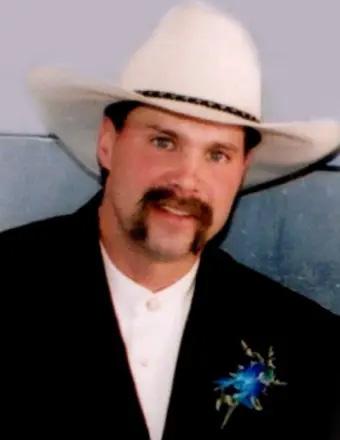
It is with tremendous sadness that we announce the passing of Robert Pomajba. At his home surrounded by his family, on Thursday January 8, 2026, just shy of his 59th birthday, on his own terms after a bull-headed battle with cancer.
Missing his steady and loyal ways, and his quiet sense of humour is his much-loved wife Carolyn, and his two pride and joys, son Cole and daughter Abby. Also survived by his mother Geraldine, siblings Paul (Fiona), Valerie (Marc), Elaine-aka Billy (Ryan). Just Rob to nieces Olivia (Kevin) and Hilary, Sydney, Ruby and nephew Griffin. Predeceased by father, Frank. Also missed by his in-laws Eileen and Chris Smith and sister-in-law Shannon Lumsden.
As a lifelong farmer, Rob was deeply connected to the land and knew only the satisfaction of a hard day’s work. He could fix just about anything (mostly things he broke), back an 18-wheeler loaded with angry cattle through the eye of a needle and into your back pocket, grow an excellent crop, and raised simply the best beef cattle.
Following in his father’s footsteps, his love for showing cattle started in 4-H. It culminated in a lifelong passion and Grand Champion wins at the Royal Agricultural Fair in 1989, 1995, 1997 and 2023. Rob was 4H Leader, passing along his passion, knowledge and dressing skills to the next generation.
Rob loved the purity and simplicity of the cowboy way, feeling most comfortable in a saddle, and using his horses to round up lost or escaped cattle and check pasture land. Many friendships and lifelong bonds were forged being a part of the Ontario Rodeo Circuit, competing in Team Penning, and mastering the fearless job of being a pick-up man on his trusty ride Baldy.
He proudly served his community for over 20 years as a dedicated member of Station 7 Fire Department. He will be remembered for his unwavering and fearless focus to do what was required to get the job done, protect his fellow volunteers, and his creative driving skills to be first on scene.
Special thanks to Pete and Gail Blonde, Don Turner, Jeremy Van Kesteren, Ben Rhodes, and Dr. Lotje Kouwenberg for their unwavering friendships.
Family and friends are invited to the Alexander & Houle Funeral Home, 245 Wellington St. West, Chatham, 519-3522710, on Saturday January 10, 2026, with visiting from 2 to 4 pm and 7 to 9 pm. Reflections will be shared at 8:00 pm. To honour the cowboy life, he lived with such conviction, you are encouraged to wear jeans and boots. Cremation will have taken place. In lieu of flowers, donations to Eir Centre or the Firefighters’ Association of Ontario would be appreciated by his family. On-line condolences may be shared at www.alexanderandhoulefuneralhome.ca
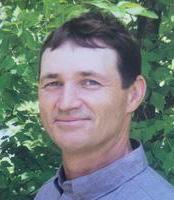
– January 25,
Hector “Toe” Lamontagne passed away on January 25, 2026, where he loved to be the most— on the farm. Born on March 29, 1967, Hector was a farmer through and through, born to the land and devoted to it for his entire life.
He was the beloved son of Edward and Sharon Lamontagne, a proud and devoted dad to Dylan and Devon—his sun and moon—and a deeply proud Papa to Clarice, Lucien, and Scarlett. His family was the centre of his world, and everything he did reflected that devotion.
As a young child, Hector lived in the Dumas community before moving to Wawota, where he married JJ, and spent the rest of his life building deep roots in the community he loved. He was well known and highly respected in the cattle community and was a strong, active supporter of the Wawota Wildlife Federation.
Hector loved fishing and hunting with his boys, cherished time outdoors, and had a lifelong passion for sports. A hockey player in his younger years, he was famously known for his elbows—something many never forgot. He served his community faithfully as a member of the RM Council for decades, always outspoken, always engaged, and always committed.
Hector was an amazing storyteller. He loved to poke the bear and believed that if he didn’t harass you, he probably didn’t like you. His humour, honesty, and larger-than-life personality left a lasting impression on everyone he met. Hector is survived by his parents, Edward and Sharon; his children, Devon and Dylan (Celeste); his grandchildren, Clarice, Lucien, and Scarlett; his sister, Evelyn (Ray); nephews Nicolas and Caelan; as well as numerous aunts, uncles, cousins, and friends.
Passionate about all things in his life—his family, his farm, his community, and his stories—Hector “Toe” Lamontagne will be deeply missed and fondly remembered.
Funeral service will be held from Wawota Town Hall Wednesday, February 4, 2026 at 2:00 p.m. with Fr. Joseph Villlamartin officiating. A private interment for family will be in Dumas Cemetery. For those who so desire, memorial donations may be made to Dumas Cemetery, P.O. Box 419, Wawota SK., S0G 5A0, or to Wawota Wildlife Federation, P.O. Box 399, Wawota SK, S0G 5A0 in memory of Hector.



Welcome to spring! Calving is underway and winter is slowly slipping away … finally. Bull sale season is now upon us. This year the ASA again offered our members advertising for their private treaty bulls in a Facebook post that was boosted to reach a larger audience. We were happy to see an increase in members taking advantage of this advertising opportunity. The ASA is dedicated to provide our members with the tools to help their programs grow. Full page ads were placed in the Charolais Banner and Simmental Country to promote our breeders and the advantage of using Shorthorn genetics in crossbreeding programs. These ads were in their latest issues that have been sent to cattlemen across Canada.
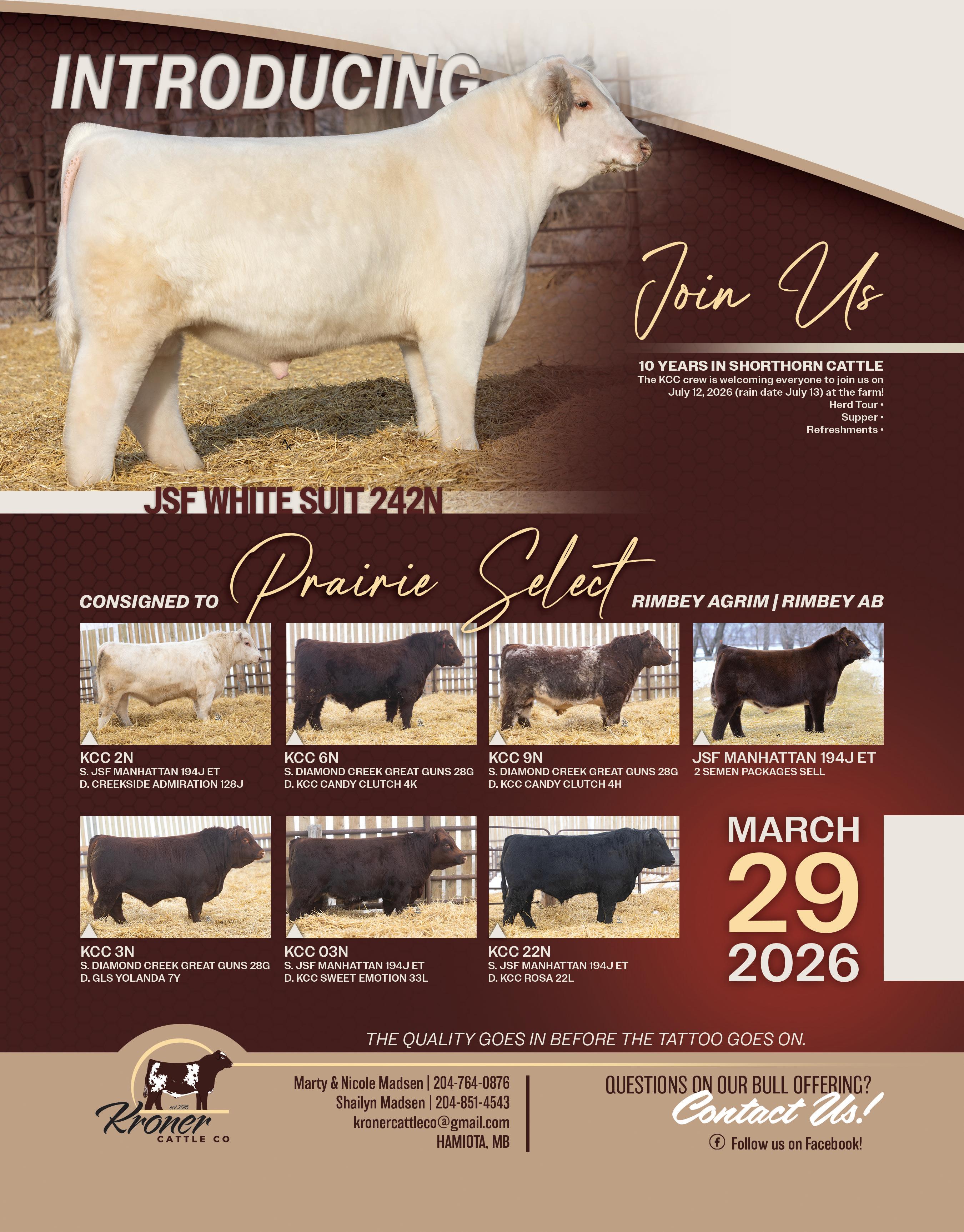
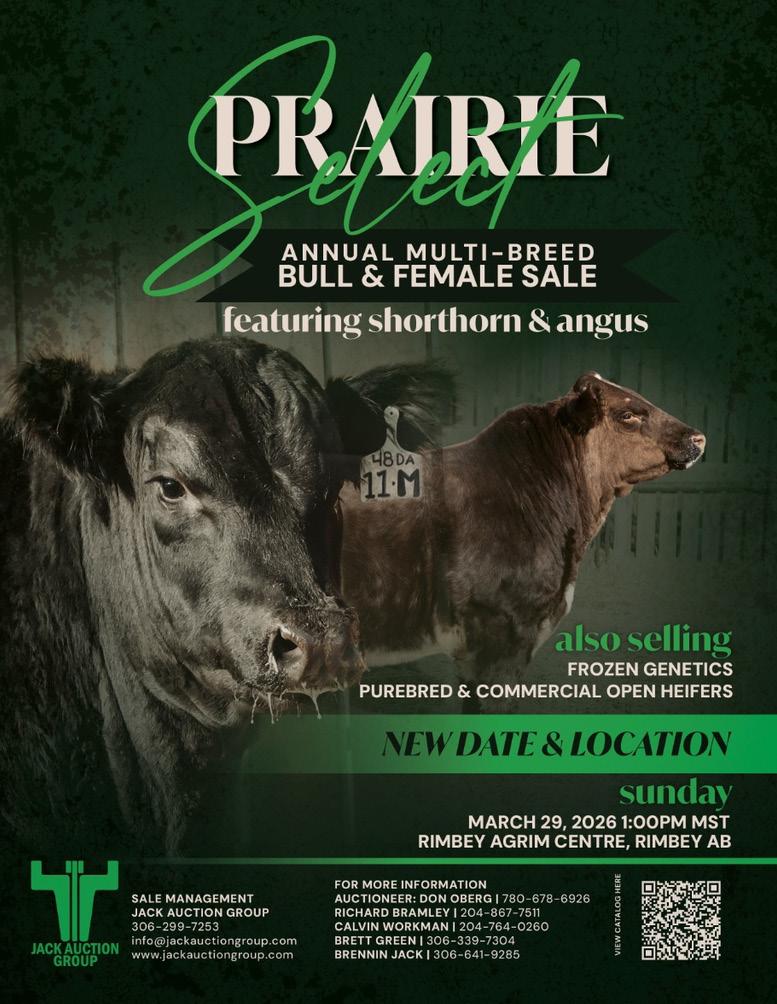
Our ASA website is happy to support our members and their sales. For the upcoming bull season, there are 2 sales in Alberta. On March 26 is the 8th Annual Western Prime Shorthorn Bull and Female Sale at NCL in Clyde, AB. Following that on March 29 is the Prairie Select Annual Shorthorn and Angus Bull and Female Sale in Rimbey, AB. We are happy to promote sales that have Alberta breeders in it. If you have a sale or event that you would like promoted, please reach out to albertashorthorn@gmail.com.
4-H season is well underway and we are encouraging all 4-H and cattle clubs to submit their members whom have Shorthorn or Shorthorn influence projects to the ASA office to receive an incentive gift.
Every year we also enter these members into a draw for certificates that can be used on the purchase of a Shorthorn or Shorthorn influence animal from any Alberta breeder. We are accepting nominations for Commercial Breeder of the Year. If you know of a ranch/farm that deserves this award, please visit our website to view the criteria for nominations. The winning nominee will be celebrated at our AGM in June. Happy calving!
Alberta Junior Shorthorn Association
The Stars Leadership Conference was held in Edmonton and Vermillion, AB this February. It was great to have all the young cattle enthusiasts in the province. The AJSA is now looking forward to the National Junior Show that will be held in Olds, AB July 1-4, 2026. This will be a great event for Juniors from across Canada to come together and share in their love for Shorthorns and showing!
The AJSA is also planning on hosting a new event in April! They are organizing a great opportunity to learn more about fitting show cattle from Mitch and Sam of Mapleview Livestock. The event information will be posted on the ASA website under the Events tab. Check Facebook for posts from the AJSA to stay up to date on all things Junior related. Moving forward, the AJSA group of hard working, dedicated youth are ready to promote and share their love of the Shorthorn breed. Shari Barto, ASA Secretary
Howdy folks! As calving season is rolling along and the cattle markets continue to set new record highs each week there is more optimism in the industry than we’ve ever seen!
This January we held our AGM in Brandon where a large portion of our membership met to discuss topics from the past year and plan towards a strong 2026. This year we had four expiring board positions . We would like to thank Michelle Mott and Shailyn Madsen, who both stepped down from the board, for their past couple years of commitment to the association. Lesley Hedley and Isabel Acheson were both re-elected while Shane Weatherall and Grayson Ross were both newly elected to the board. Our current board of directors are Lesley Hedley-President, Terrance Vodon-Vice President, Isabel Acheson-Director, Grayson Ross-Director, Tyler Vodon-Director, Shane Weatherall-Director, Ian SmithDirector, Nicki Stewart-Secretary/Treasurer.
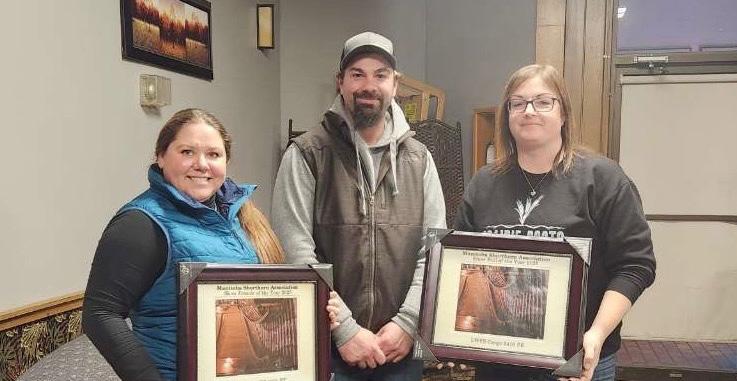
At the AGM the awards for 2025 show bull and show female of the year were awarded as follows:
2025 Show Bull of the Year - LWFS Cargo 2410 PE (Wildweather Cattle Co.)
2025 Show Female of the Year - CSF Margie HC 2331 ET (Wildweather Cattle Co.)
Congrats to Wildweather Cattle Co. on a successful show year!
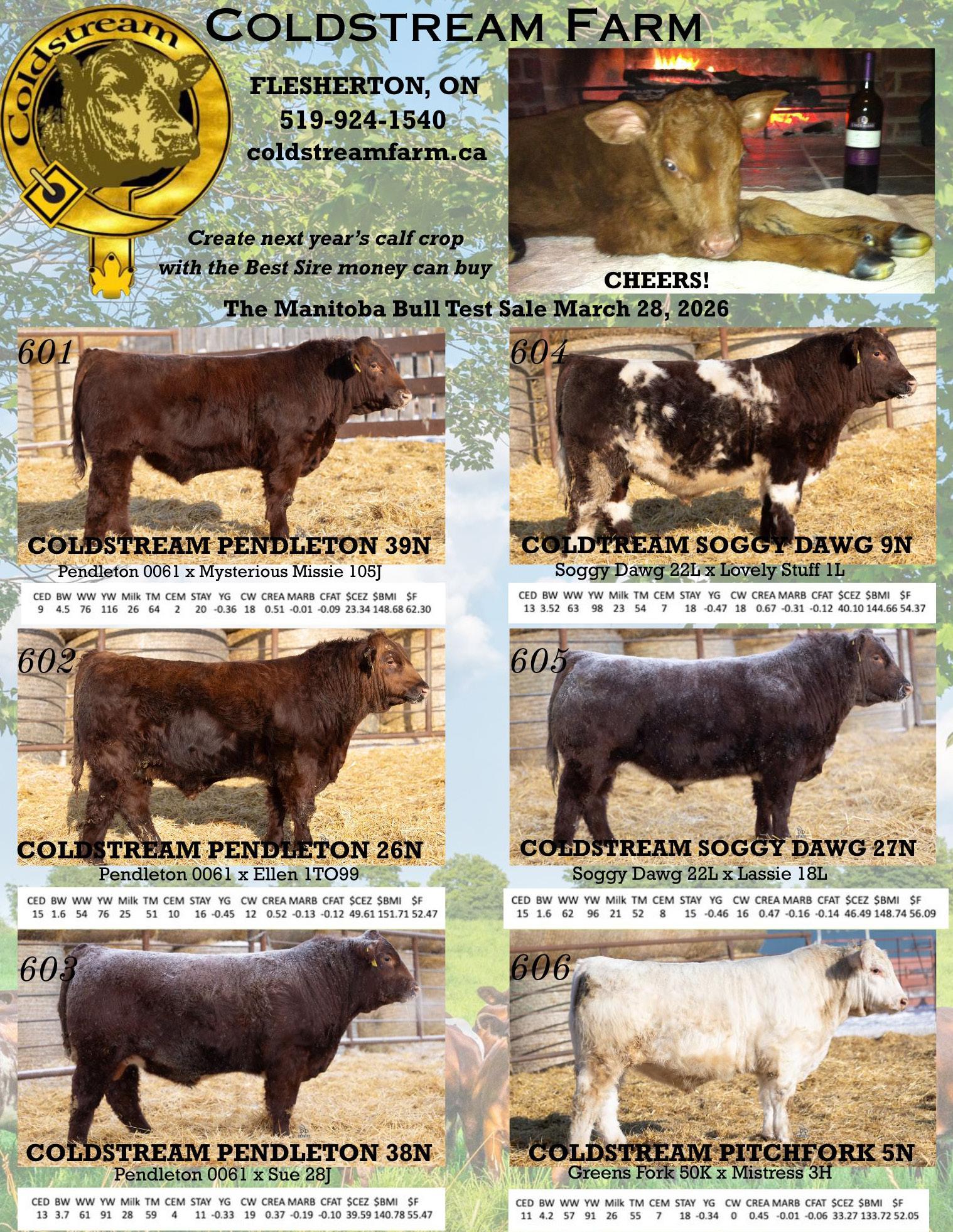
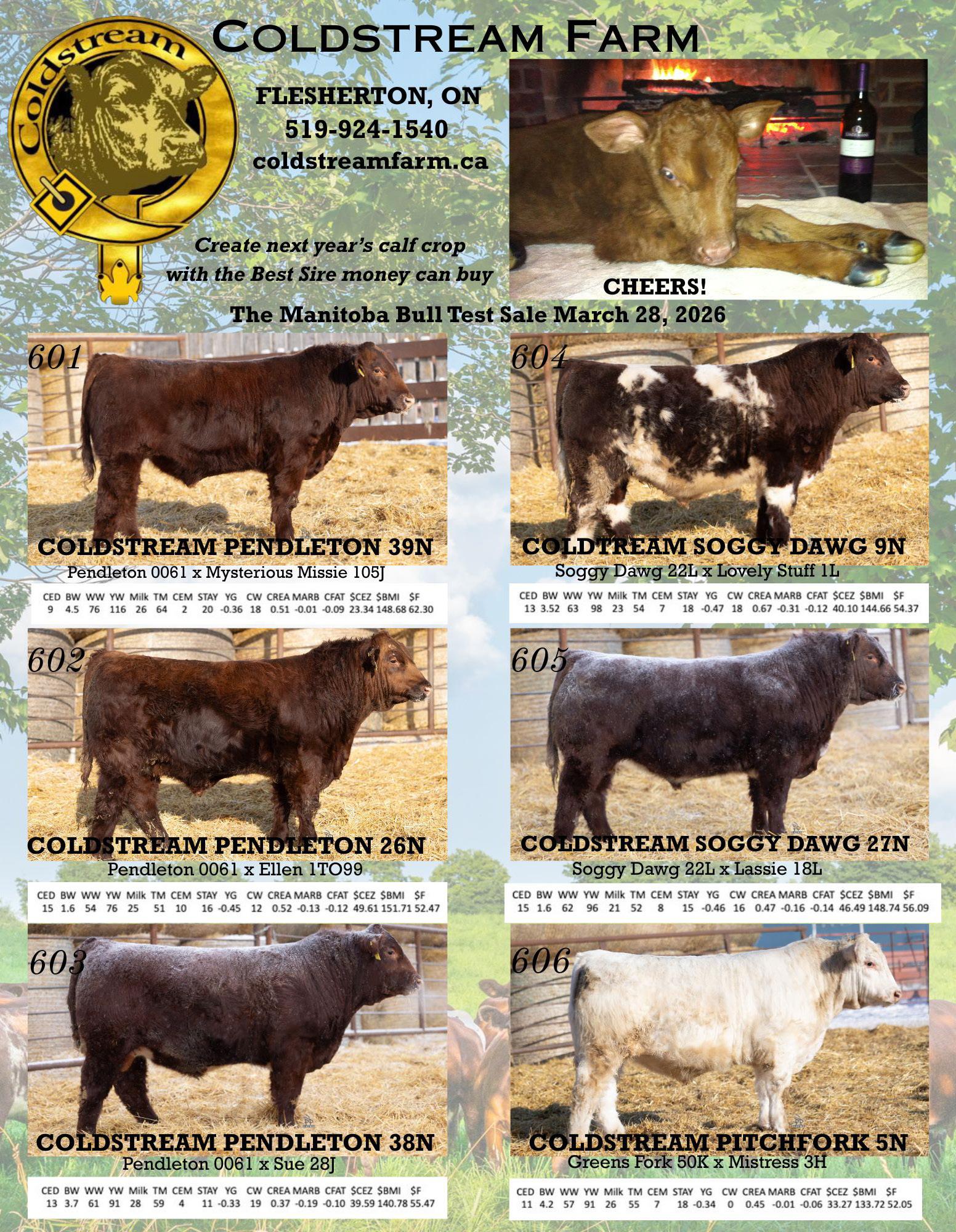
There is once again a very strong selection of Shorthorn bulls and females available at the Manitoba Bull Test Station. Sale day is March 28, 2025, watch your mailboxes for catalogues!
As we look forward to a busy 2026 we wish you all the best with calving and a successful bull sale season!
Terrance Vodon, Manitoba Vice - President
Here we are amidst another Saskatchewan winter. I hope everyone is keeping well & warm, and that chores & calving are going smoothly for all. Things continue to tick along as usual with the Saskatchewan Association – our AGM was held in January 2026 and saw no changes to our Board of Directors. Promotion is, of course, one of our biggest discussion items and the Board continues to work on various projects in this regard. A reminder that we’ve developed a directory for Saskatchewan breeders – this is a very interactive, user friendly map & a great asset for those who are looking to advertise. In addition to this, we’ve begun updating our website! We are excited to get this up & running and look forward to showing everyone.
It’s a real exciting time to be in the cattle business and of course, the Shorthorn breed. We saw an incredible set of cattle shown from our Saskatchewan Shorthorn breeders

this past fall, and Canadian Western Agribition saw cattle from across Canada exhibiting again. It was another great week and the show was well attended!
Congratulations to our champions and to all who exhibited – this was such a great representation of our breed. On the note of Canadian Western Agribition, we would also like to extend another thank you to our show personnel and all volunteers/sponsors - CWA would not be possible without this! Our fall fundraisers were well received as well: Noah’s Arc Welding (Noah & Joceline Rempel) donated a tack box which raised over $8500 for the Association. In addition to this, we brought the silent auction back as part of our booth & annual banquet. This was sponsored by a variety of breeders/businesses and raised over $1000.00. Thank you to our sponsors & all who participated in these fundraisers! Our 2025 award recipients were Gerry & Betty Wyatt as Honour of the Breed, and Eugene Desroches as Commercial Breeder. Congratulations again to our awardees!
More information, nomination forms, and listings of past recipients will be posted on our new website. A reminder to keep an eye on our Facebook page for updates on Canadian Western Agribition and the Association in general. Additionally, if you have any photos you’d like to submit for promotions, Facebook, or our website, please send us an email – we are always looking!
Best wishes for 2026! Anna Rintoul, Secretary/Treasurer
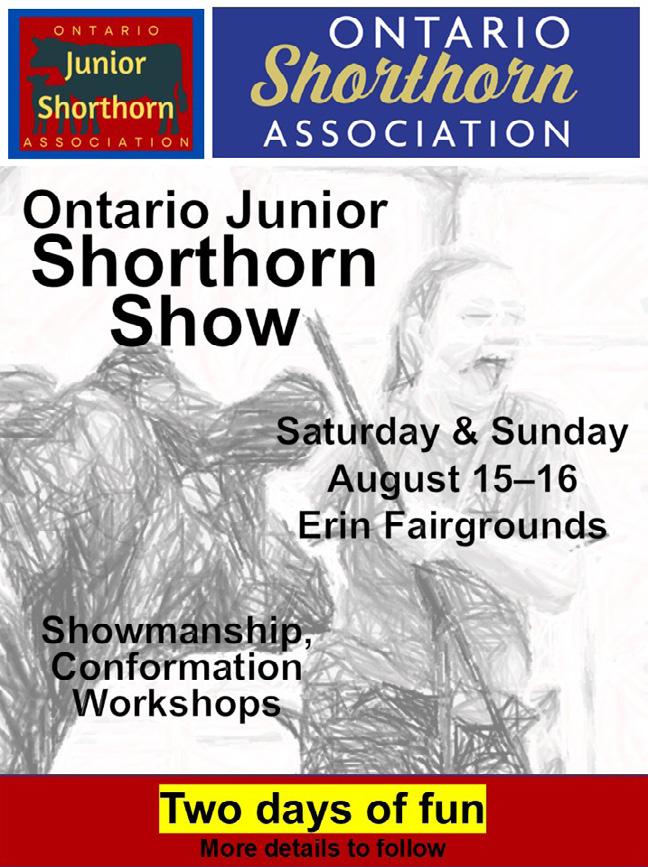
Greetings from Ontario, below are a few of the initiatives that the OSA and OJSA are currently working on. Upcoming Ontario Junior Shorthorn Association Show
The OJSA will be holding it’s annual Junior Shorthorn Show on August 15 th and 16 th at the Erin Fairgrounds. This year we anticipate over 75 juniors exhibiting over 100 head of cattle. The juniors will experience educational workshops plus showmanship and confirmation classes with banners and prizes to be won by these young Shorthorn enthusiast and breeders. The OJSA relies on the generosity of businesses, individuals and breeders to make this event a reality. Sponsorship funds will be applied directly to either facility rental, meals for the juniors, prizes, or direct expenses of the event. Donations can be e-transferred or mailed to Mike Andison, OSA treasurer at treasurerontarioshorthorns.com, 20720 Sideroad 18A, Cannington, ON, L0E1E0. If you have any questions about the show or the sponsorship program, please reach out to Pat Thibodeau the show chair at tibsshorthorns@ gmail.com or by calling 416-319-1901.
The OJSA would like to acknowledge a few sponsors who have already made generous donations.
Ross Laycock & Shannon Kingston, Trailview Shorthorns
Don Jack, Coldstream Farm
Ray Stanton, Hillside Farms
Doug & Nancy Brown & Family, Glenrothes Farm
Dale Asser, Hill Haven Shorthorns
Mark Dixon, Dixon Creek Farm
Gabriela Kott, Gableton Farms
Joanne & Dave Currie, Flightpath Shorthorns
Reed, Jane, Shelby & Josie Crawford, River Point Cattle Company
And a few anonymous donors
Summer picnic
This year the OSA has decided to forgo the annual picnic in favour of a banquet on Saturday of the Junior show.
The 2026 James W. Rummerfield Award Program
With sincere thanks to James Rummerfield, the Ontario Shorthorn Association is excited to announce continued and expanded support for Shorthorns at the Royal and select local Fairs for 2026.
•Each Breeder’s herd exhibited at: Barrie, Lindsay and Markham Fairs will receive $100.
•Each Breeder’s herd exhibited at the Royal Agricultural Winter Fair will receive $500.
•Each two-year-old female with calf exhibited at the Royal Agricultural Winter Fair will receive $250.
•Each cow with calf exhibited at the Royal Agricultural Winter Fair will receive $250.
•Each two-year-old bull exhibited at the Royal Agricultural Winter Fair will receive $250.
•Each exhibitor may receive only one award per class at the Royal and one award per herd at the designated fairs.
Once again in 2026, the All-Star Series Program in Memory of George & Audrey Brown sponsored by James W. Rummerfield will provide awards of $250 and $150 to the All-Star Champion and Reserve Champion Female & Male receiving the highest points at the following fairs: Barrie, Brigden, Erin, Lindsay, Markham, Renfrew, Royal. The OSA extends its gratitude to James for his very generous support of the Shorthorn breed through these awards.
Annual General Meeting
This year’s Ontario Shorthorn Association AGM will be held on April 18 in Douro-Dummer. On the agenda:
•Election of new board members
•Awards for All-Star Conformation and Showmanship Series
•OSA Financial reports
•Upcoming Junior show
•And more
Have a great early and welcome spring.

Most cattlemen use vaccines to prevent disease in their herds. A consultation with a veterinarian who knows the herd and management practices, can give solid advice on the best vaccination program for the herd. But how the medication is administered may have an impact on how effective the medication will be.
The gauge of the needle refers to the thickness of needle. 18 gauge is generally recommended for calves, 16 gauge for cows. The viscosity of the vaccine should also be considered when selecting the proper gauge of needle. For subcutaneous injections, use 1/2”- 3/4” length needles, for intramuscular injection 1- 1 1/2” length is recommended.
SUBCUTANEOUS
Change needles often. If a needle is dull, burred, or bent discard it in a sharps bin and replace it. If your herd has any blood- borne pathogens, change needles after each use. The best way to prevent broken needles is to restrain the animal properly in a chute with a head lock, and to use the correct length for the type of injection being done. Never try straightening a bent needle, it has a much higher risk of breaking. When refilling your syringe, use a fresh, clean needle, to avoid contamination of the vaccine bottle. Do not dip the needle in sterilizing solution between each cow. The sterilizing solution can severely aggravate the muscle tissue causing abscesses. If you are worried about cross contamination between animals, use a fresh needle for each cow.
Keep the top of the bottle clean, use an antiseptic wipe if needed. When vaccinating multiple animals at once, using a multi-dose repeater gun, or a bottle mount system can be very beneficial. This will reduce the amount of times the bottle is exposed to dirt or germs and possibly contaminating the vaccine. It can also make things more efficient by reducing the time it takes to refill the syringes. Keep the medication at a proper temperature. A cooler at chute side can be handy to keep medicine from freezing and away from direct sunlight. For vaccines that need mixing, wait as long as possible to mix together. Modified live vaccines start to degrade quickly and should not be used after 1 to 2 hours.
It is important to read the label for proper directions on administration of any drug. If a drug is not placed properly it can cause swelling and cysts at the injection site. It also makes the drug less effective. Intramuscular injections are done with longer needle, usually 1 -1 1/2” to make sure it reaches the muscle in the cow, where as a subcutaneous
injection is done with a shorter needle. Double check the dosage of your medication. When in doubt call your veterinarian for advice. Vaccines are usually a low dose, but some medications to treat sick animals, have a maximum amount per injection site. Follow the label carefully to reduce stress to the animal, and swelling at the injection site. Some vaccines require a booster several weeks after initial dose. Time these as close to label directions as possible for full efficacy of the drug. Mark down the date you vaccinated, the withdrawal times of the medicine you are administering along with the cow’s ID or the group you are vaccinating so that you clear the withdrawal period in case you end up shipping something. This also includes any pour on products. Many have a withdrawal period for animals going to slaughter.
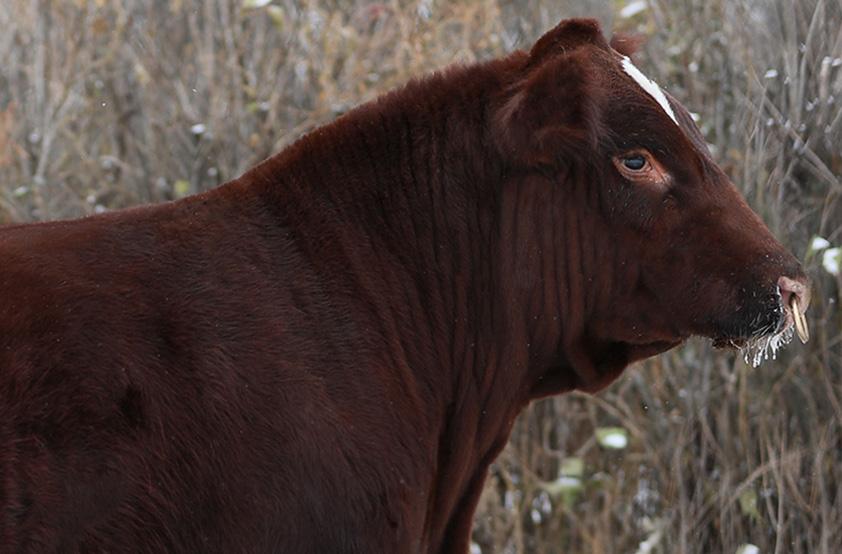
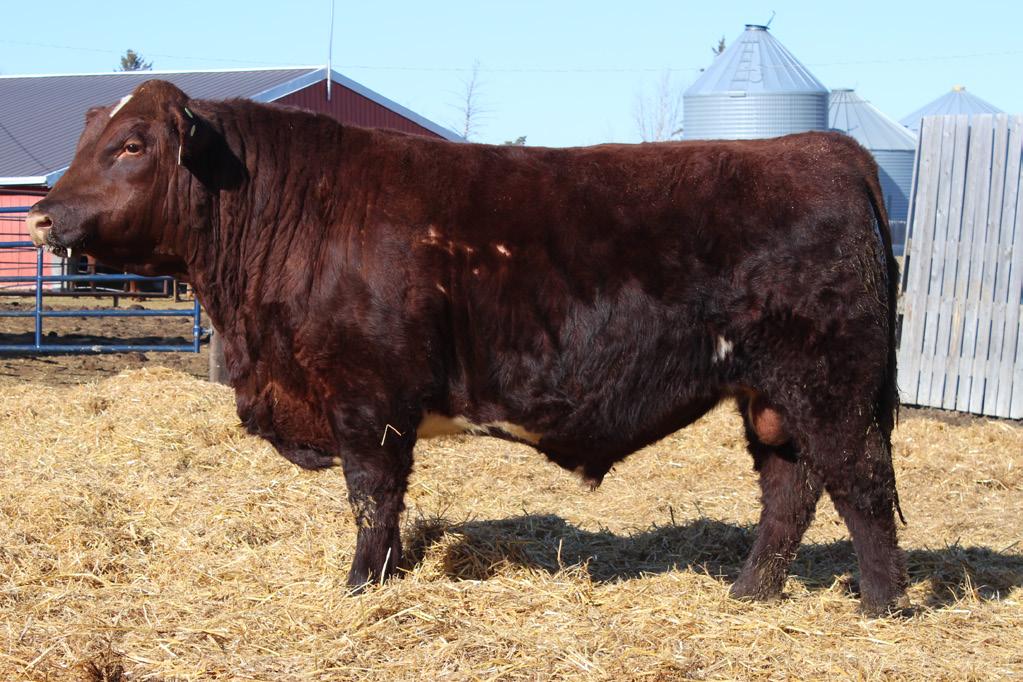
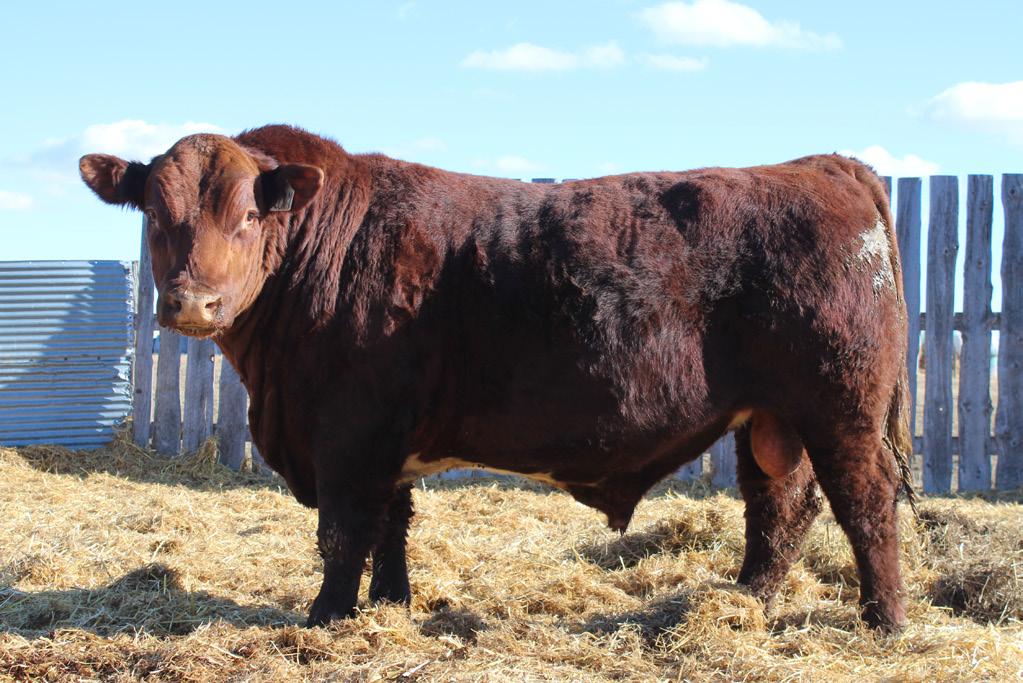
The best place to medicate a cow is in the neck. Ideal placement is inside the triangle shown in the picture below. If you are doing multiple vaccinations at once, make sure to vaccinate in different spots in the triangle. A hand-width between vaccination sites will help the tissue to recover and avoid the vaccines from mixing. Mixed vaccines may cause a drug reaction in the animal, or they may deactivate each other.
It is important to dispose of used, dirty, and broken needles in a proper manner. Set up a sharps bin in your barn or by your chute, somewhere convenient for needle disposal. When the bin is full, take it to a safe disposal site. Many vet clinics offer this service.
Syringes should be cleaned properly after each use. Wash the outside of the syringe with hot soapy water. The inside should be cleaned with hot water over 83oC. Do not use soap or detergent on the inside of the barrel. Detergent can affect modified live vaccine making it ineffective. A small bottle brush is a handy tool to help clean syringes properly. After cleaning, the syringes should be sanitized in a pot of boiling purified water. Boil syringe parts for 5 minutes, and cool before reassembling. Before next use, rinse with hot water and cool before filling with medication.



Reprinted with permission from the BCRC website
Improving the genetics of your beef herd starts with knowing which traits you can change through genetics and which traits respond better to management practices. Because cattle have a long generation interval, every bull or replacement heifer you choose affects your herd for years. That’s why understanding heritability — and how traits interact with each other — helps ensure your breeding decisions move your herd toward your production goals.
What
Heritability tells us how much of a trait is controlled by genetics versus the environment and/or management. It’s expressed as a number between zero and one:
High heritability (over 0.40): Traits are strongly influenced by genetics, meaning you can make changes more quickly by selecting the right replacements and bulls.
Examples: ribeye area, marbling, weight and growth traits. Moderate heritability (0.15 to 0.40): Traits that can be improved through both genetics and management. Examples: milk production and calving ease.
Low heritability (less than 0.15): Traits are mainly influenced by crossbreeding (e.g., heterosis/hybrid vigour and management (e.g., nutrition, colostrum, vaccination). Examples: fertility, reproductive efficiency and disease resistance.
Weaning weight has a heritability of 0.24 to 0.30, which
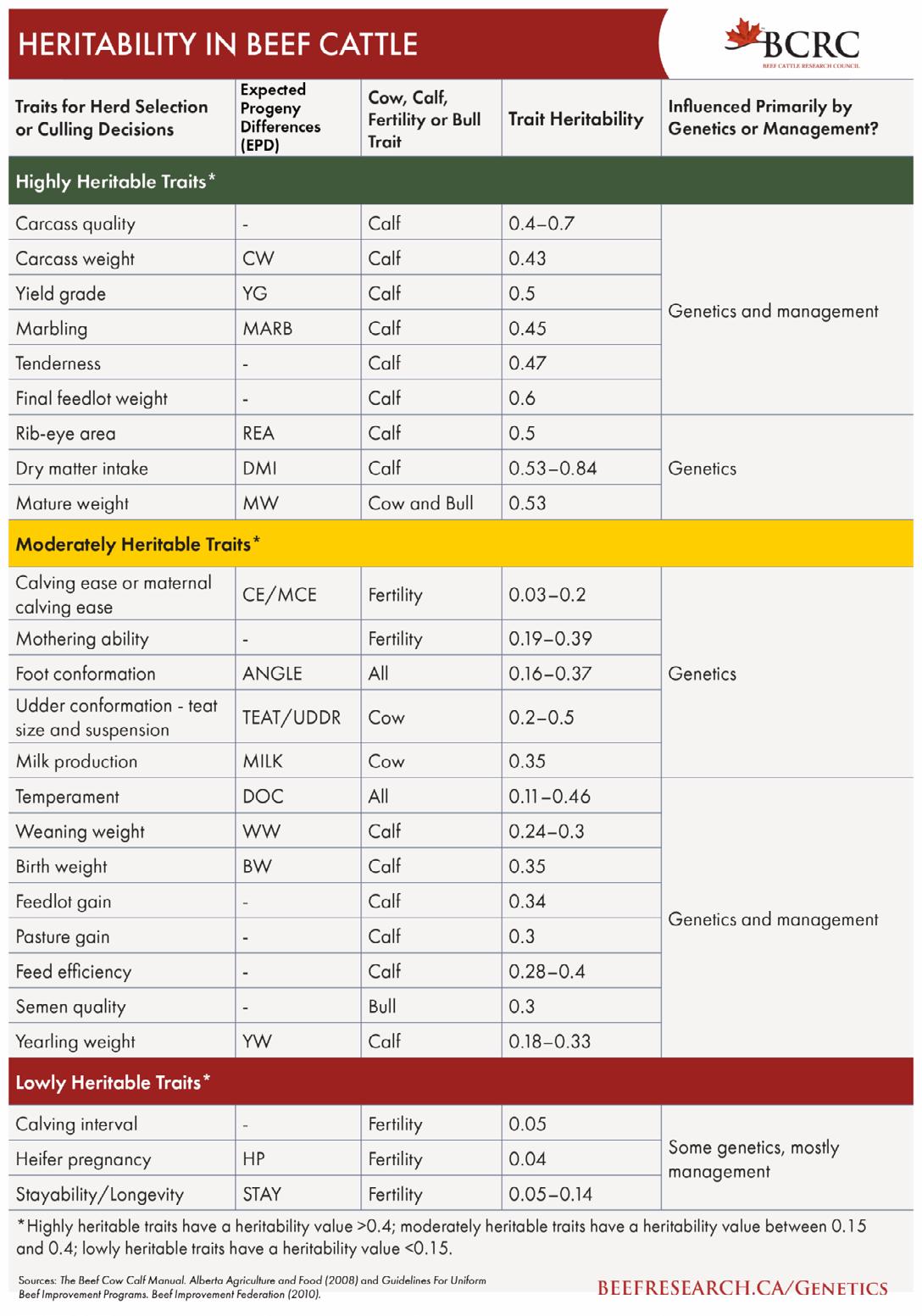

means that 24% to 30% of the differences we see in weaning weights between cattle in a herd are caused by genetics. Table 1 provides a summary of the heritability of common traits. The higher the heritability, the more progress you’ll make through selection. Traits with low heritability still matter — they just require dedicated management to go along with genetic decisions.
As an example, improving pregnancy rates in beef cattle cannot be achieved through genetics alone. This is primarily due to fertility traits having low heritability and being heavily influenced by management factors such as nutrition, body condition, health and breeding season management. Until those areas are optimized, selecting new genetics alone won’t move the needle.
In contrast, calving ease is moderately heritable, and information can be used strategically when planning a heifer breeding program. Selecting sires with high calving-ease genetics can help avoid calving difficulties.
Traits don’t work in isolation. Selection for one trait can cause an increase or decrease in the expression of another, sometimes in ways you don’t want. Trait correlations are expressed as a number between +1 and –1.
A positive (+) genetic correlation means that as one trait increases, the other also tends to increase. A negative (-) correlation means that as one trait increases, the other tends to decline. Despite the positive/negative labels, neither automatically indicates whether the relationship is beneficial. A correlation is considered favorable when selection for one trait leads to a desirable change in another. Table 2 shows examples of some trait correlations. Understanding these relationships helps avoid unintended consequences. For example, weight and growth traits tend to be positively correlated. So, selecting heavily for low birth weights will ultimately lead to smaller heifers that may be more prone to calving difficulties or calves that don’t grow as well as desired. Similarly, selecting large weaning or yearling weights will eventually produce bigger mature cows that cost more to feed.
These relationships mean that selection decisions should be made with your operation’s goals in mind. A herd keeping replacement heifers may prioritize balanced growth and moderate mature size, while a cow-calf operation selling all calves at weaning may put more emphasis on growth and weaning weights because they aren’t keeping replacements.
Key Questions to Ask When Managing Trait
•Is this trait something I can improve through genetics (e.g., growth, carcass traits), or would crossbreeding and/ or management be a more effective strategy (e.g., fertility, health traits)?
•Will improving this trait support my overall goals (e.g., fertility, feed efficiency, carcass quality)?
•What traits need to be balanced so I don’t create problems elsewhere (e.g., heavy calf weaning weights often lead to large mature cows)?
Use of Selection Indexes to Make Balanced Progress Selection indexes help simplify genetic decisions by
Milk Calving Interval Positive High Cows that produce more milk may take longer to rebreed due to higher energy requirements.
Milk Total Energy Intake Positive Moderate Higher-milking cows usually require more feed to maintain body condition
Calving Ease Direct Maternal Calving Ease Negative Low to Moderate Improving calving ease direct of an animal itself can slightly reduce a daughter’s calving ease.
Fertility Leanness Negative Moderate-High Fast growing, lean genetics become larger cows that can have difficulty maintaining body condition and rebreeding
Yearling Weight Mature Cow Size Positive Moderate-High
Milk Weaning Weight Positive Moderate
Selecting for faster growing and larger calves often increases mature cow size
Higher milk production typically results in a higher calf weaning weight
Birth Weight Mature Weight Positive High Smaller calves generally grow into small cows and bigger calves often become big cows.
Yearling Weight Carcass Weight Positive High
Yearling Weight Marbling Negative Low-Moderate
Yearling Weight Ribeye Area Positive Moderate
Selecting for yearling weight will usually increase carcass weight.
Selecting for yearling weight may decrease marbling slightly
Selecting for yearling weight tends to increase ribeye area.
*A positive (+) genetic correlation means that as one trait increases, the other also tends to increase. A negative (-) correlation means that as one trait increases, the other tends to decline.
combining several traits into one value that reflects your breeding goals while also accounting for trait correlations behind the scenes, making it easier to avoid unintended trade-offs and helping prevent single-trait selection. Think of a selection index like a financial index: instead of tracking every single trait (or “stock”) on its own, the index combines them into one value based on their economic importance. Like expected progeny differences (EPDs), indexes are breed-specific, so they cannot be compared across breeds, unless the genetic evaluation contains information from several breeds. Knowing which indexes fit your operation can make bull buying simpler and more profitable. While indexes are extremely useful, they should be used alongside visual appraisal, structural soundness and good management to make the most informed selection decisions.
Examples of selection indexes include:
•All-Purpose Indexes
-Best for herds where heifers are kept and steers are marketed from the same calf crop
-Balanced across maternal and terminal traits Examples: Canadian Angus Association’s Canadian Balanced Index (CBI), Canadian Simmental All Purpose Index (API)
-Best for herds where heifers are kept and steers are marketed from the same calf crop
-Balanced across maternal and terminal traits Examples: Canadian Angus Association’s Canadian Balanced Index (CBI), Canadian Simmental All Purpose Index (API)
•Maternal Indexes
-Designed to build better mother cows
-Prioritizes fertility, milk and stayability
-Example: Canadian Hereford Association’s Maternal Productivity Index
•Terminal Indexes
-Used when all calves are sold and none kept for replacements
-Focused on growth, feed efficiency and carcass traits like marbling and ribeye area
Example: Canadian Charolais Association’s Terminal Sire Index
Building a more productive herd starts with understanding which traits are driven by genetics and which ones respond more to management. Knowing the heritability of key traits and how those traits interact helps ensure that breeding decisions move your herd in the right direction without creating unwanted challenges.
References:
Additional Resources,Canadian Beef Improvement Network Dashboard ,AgSights: Bull and Replacement Heifer Genetic Evaluations
Acknowledgements:
Thanks to the following individuals for contributing their time and expertise to review this article and related resources: Karin Schmid, Beef Production and Extension Lead, Alberta Beef Producers
Chelsey Siemens, Livestock and Forage Extension Specialist, Saskatchewan Ministry of Agriculture
Macy Liebreich, Chief Executive Officer, Canadian Beef Breeds Council
Stephanie Lam, Director of Research, Livestock Research Innovation Corporation

Mark Your Calendars!
Mar 7-9 On Target Shorthorn Sale
Mar 10 CJSA Frozen Genetic Sale
Mar 21 Bender/Star P Farms Online Sale
Mar 26 Western Prime Sale
Mar 28 MB Bull Test Station Sale
Mar 29 Prairie Select Sale
April 2 Who’s Your Daddy Sale May 28-30 CSA AGM Kamloops,BC
July 1 CJSA National Shorthorn Showcase
August 15-16 OJSA Show
Sept 19 Shadybrook Production Sale
TBD Olds Fall Classic
Oct 28-31 Manitoba Ag-Ex
Nov 4-7 Farmfair International
Nov 6-15 Toronto Royal Nov 23-28- Agribition

Dr. Christine Ewert Hill & Dr. Clarke Hill (306) 452-3803 (H) (306) 452-7867 (C) christine.ewert@gmail.com