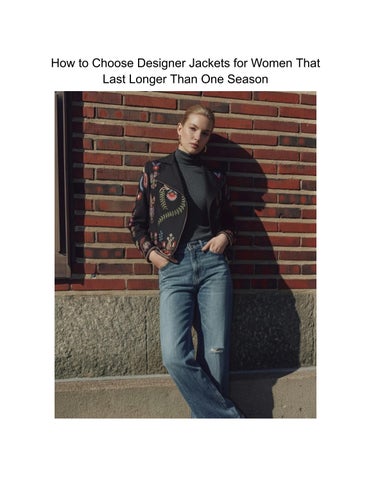
How to Choose Designer Jackets for Women That Last Longer Than One Season
The Problem With Buying a Jacket You Regret Almost every wardrobe has one: the jacket that looked perfect on the hanger or in a photo, but sits untouched after two wears. Maybe the shoulders pull when you reach forward. Maybe the fabric pills after a single wash, or the color clashes with everything else you own. Outerwear is one of the most visible pieces in your wardrobe and one of the easiest to get wrong. It frames every outfit underneath it, so a poor choice affects everything you wear it with. When the price tag is higher, as it often is with designer jackets for women, the cost of a mistake grows too. The good news is that a smart purchase comes down to understanding a few fundamentals, not luck or a bigger budget.
What “Designer” Actually Means in Outerwear The word “designer” gets attached to everything, so it helps to know what it should mean in practice. Designer jackets are typically defined by three things: considered design, quality of construction, and attention to detail. Design means the silhouette has been thought through. The proportions, the way the collar sits, and the placement of pockets all serve both style and function. A well-designed jacket looks intentional from every angle, not just from the front. Construction is where quality hides. Look at the seams, the lining, and the stitching around buttonholes. Clean, even stitching and properly finished interiors signal that the piece was made to be worn for years. Materials matter just as much. Wool blends, genuine leather, structured cotton twill, and quality technical fabrics each age differently. A heavier, well-woven fabric tends to hold its shape, while thin or loosely woven material loses structure quickly. Understanding these three pillars makes it much easier to tell a genuinely good jacket from one that simply carries a premium label.
A Practical Framework for Choosing the Right Jacket Before you buy, run any jacket through these five checks. 1. Define its job. Is this a daily work layer, an evening statement piece, or a travel companion? A jacket that tries to do everything usually does nothing well. Be specific about where and how often you’ll wear it. 2. Check the fit in motion. Stand in front of a mirror, then reach forward, raise your arms, and sit down. The shoulders should sit at the natural shoulder line, the sleeves should end near the
wrist bone, and the jacket should close comfortably over the layers you’d realistically wear underneath. 3. Match the color to your existing wardrobe. Count how many items you already own that would pair with it. Neutrals such as black, camel, olive, and charcoal are versatile, but a bolder shade can work if it complements at least four or five pieces you already have. 4. Inspect the fabric and finish. Feel the material. Check that patterns align at the seams, that the lining is smooth, and that zippers and buttons feel solid rather than flimsy. 5. Calculate cost per wear. Divide the price by the number of times you realistically expect to wear it. A higher-priced jacket worn 100 times often costs less per wear than a cheaper one worn five times.
Example: Choosing a Jacket for a Busy Work Week Imagine a woman who commutes by train, attends client meetings, and often goes straight from the office to dinner. She needs one jacket to cover all of it. She starts with the job: smart enough for meetings, relaxed enough for evenings. That points her toward a tailored but not rigid cut, such as a structured blazer-jacket in a mid-weight wool blend. Her wardrobe leans toward navy, white, and grey, so a charcoal or deep black piece fits easily. In the fitting room, she tests the reach-and-sit check and finds the sleeves pull slightly. She moves up half a size and the problem disappears. She confirms the lining is smooth, the buttons are firmly attached, and the shoulder line is clean. Divided across roughly 90 wears in a year, the cost per wear is modest, and the jacket works with nearly everything she owns.
Buying With Confidence A few habits protect you from disappointment, whatever you’re shopping for. ● Read the product details closely. Fabric composition, care instructions, and sizing charts should be clear. Vague descriptions are a red flag. ● Look at real photos. Images from several angles, and ideally on different body types, give you a more honest picture than a single studio shot. ● Check return and exchange policies. Fit is personal, and a fair policy shows a brand stands behind its products. ● Be cautious of unrealistic discounts. Heavy markdowns on pieces labeled “designer” can signal inflated original prices or lower quality. ● Buy for your climate. A heavy coat is wasted where winters are mild, and a lightweight layer won’t help in cold weather. Take your time, and don’t let urgency tactics push you into a purchase you haven’t tested against your own checklist.
Final Thoughts
The best designer jackets don’t just look impressive. They fit your life, hold up over time, and make getting dressed easier. By defining the jacket’s purpose, testing the fit in motion, and judging the fabric and finish, you can shop with clarity instead of guesswork. If you’d like to see how these principles look in practice, explore the outerwear collection at avld clothing. Take your checklist with you, compare silhouettes and fabrics at your own pace, and choose the piece that genuinely suits the way you live. A good jacket should earn its place in your wardrobe season after season, and AVLD is a name worth browsing when you’re ready to build that foundation.