

Economic Growth
Macroeconomics
Game Theory
Development
Environment International Trade
PhD Scholar Department of Economics
Do educated leaders perform better?
Evidence on parliamentary effort and constituency outcomes in India Economic Modelling (2025)
Using a causal framework, the research shows that postgraduate Indian MPs show significantly higher legislative effort. They participate in 30 more debates, ask 126 more questions, and have 6% higher attendance rates Crucially, their constituencies see higher internet growth, lower anemia among women, and improved clean fuel access, showing that education enhances governance
Dr. Punarjit Roychowdhury
Associate Professor and Head of the Department of Economics
Dr. Gaurav Dhamija Binay Shankar
PhD Scholar, Class of 2019
PhD Scholar
Urbanization and Women Empowerment: Evidence from India
Journal of Population Economics (2025)
This study examines how urbanisation affects women’s empowerment in India using satellite-based nighttime light data. Results show improvements in labour participation, mobility, household agency, information access, and reporting of domestic violence, but negative effects on financial autonomy and mixed health outcomes, highlighting the need for complementary policy support alongside urban expansion.
Dr. Kriti Manocha Assistant Professor
Journal of Economic Theory (2025)
We introduce a model of decision-making based on a procedure of rejection, in which the decision maker iteratively rejects the worst or minimal alternatives. We axiomatically study the correspondence of non-rejected alternatives and show that this procedure provides a procedural foundation for selecting the maximal set. The model can also account for anomalies observed in decision theory, such as the twodecoy effect and the two-compromise effect.
Professor
Gitanjali Sen Anshika
PhD Scholar
Professor
Money Matters: Evidence from a Conditional Cash Transfer Scheme on Child Health, Journal of Human Capital (2026)
We study the effect of maternity-benefit conditional cash transfer program in India on child and mothers. Leveraging spatial and temporal variation, the difference-indifferences matching estimates show reduced neonatal mortality. The amount transferred matters more than meeting conditions by helping in nutrition and health-care utilisation, with limited effects on maternal outcomes.

Research in the department focusses on China-South Asia relations, Sino-Indian border areas, Indian and Chinese worldviews, and centre-province relations in China. International and comparative political economy are investigated with an emphasis on China and the developing world, as well as international negotiations and global economic governance
Global Order and International Relations
Interests encompass disciplinary histories of International Relations (IR) with a particular focus on India; theories of IR especially vis-à-vis the global South; the intersections of international law and world politics and the study of international organizations and global governance The historical and colonial constitution of global order and the entanglements of race, religion, gender, caste, and class are also pursued
Research in the area focusses on Agricultural and Rural Innovation, Institutional Economics, STS (Science, Technology, Society Studies), and Environment and Governance Studies, with a focus on the Himalayan Region in Asia.
Assistant Professor, Department of International Relations and Governance Studies
Nuclear Technoscience in the Global South
Dr. Kapil Patil, Assistant Professor in the IRGS Department, has been awarded a Research Grant from the American Institute of Physics (AIP), Maryland, for his project titled “Nuclear Technoscience in the Global South.”
Department of International Relations and Governance Studies
Nuclear Technoscience in the Global South
Professor Raina was awarded the UNESCO Bernard Maris Chair in Economy and Societies, hosted by Sciences Po Toulouse, France.
In this capacity, Professor Raina is working on a research project titled “Re-embedding how: Agrifood Systems, Social-ecological systems, and the Planetary”

The intersection of life, law and government as an analytic suggests a convergence of life as a sociobiological sphere with legal research and governmentalities. Our work in this area develops questions that empirically engage with life and law on the ground as it unfolds in constitutional and governance practices in local and regional ecologies and often, with a comparative lens on global resonance.
Locating individuals within their larger social context and historical processes, we explore the ways in which bodily practices, diseases and illnesses, and physical and mental healing and therapeutics take us beyond the biological and psychological to the social. The intent is to lead to fruitful collaborations across disciplines, from sociology and anthropology to psychiatry, psychology, and biomedicine.
Sociological investigations foreground that all forms of human life are not only determined and constrained by various types of technologies and ecological processes, but that they are often beyond human manipulation and control. Our research gives analytical emphasis to how beings – human and non-human – are entwined and affect the world they are situated in, such that policy, environmental projects and global alliances must take these entanglements into account to understand issues like climate change and AI.
Associate Professor and Head, Department of Sociology
Charles Wallace India Trust Visiting Fellowship 2026
Dr. Subhashim Goswami has been awarded the Charles Wallace India Trust Visiting Fellowship 2026 at Queen’s University Belfast. As per the terms of the fellowship, Dr. Goswami will be affiliated with the School of History, Anthropology, Philosophy and Politics at QUB for a period of three months, from 1st of April to 30th of June 2026.
Assistant Professor, Sociology
Dr. Vasundhara Bhojvaid is part of a five-year project, funded by the French National Center for Scientific Research (CNRS), Paris, and led by Professor Frédéric Keck (CNRS). The project, “The social perception of health risks linked to airborne dust,” starting in 2026 studies perceptions of air quality in Tucson (Arizona), Dakar (Sénégal), Paris, Berlin, Hong Kong and Delhi. Dr Vasundhara Bhojvaid will be looking into the Delhi initiative of the project..
Assistant Professor, Sociology
American Academy of Religion’s International Collaborative Research Grant 2026
Dr. P.C. Saidalavi, along with Dr. Nidhin Donald (Humboldt University) and Dr. Joel Lee (Williams College, Massachusetts), won this year’s American Academy of Religion’s International Collaborative Research Grant to organize a workshop at the International Center for Ethnic Studies, Colombo. He will co-edit a volume out of this workshop
Professor Roma Chatterji
Visiting Faculty, Sociology
Book Publication: ‘Superheroes in Indian Comics’
This volume presents the work of three publishing houses based in Delhi and Mumbai that publish superhero comics. It analyses their techniques of narration associated with the serial publication of commercial comics, such as open-ended plots, frequent reboots of the storyline, extended story arcs, and a complex narrative universe, to throw into sharper relief the value of superhero comic books as distinct from graphic novels. Through an exploration of commercial superhero comics, the authors draw attention to a fluidity embedded in superhero comics, which is influenced by external pressures of distribution and production that are generally ignored in the desire to view acomic text as a discrete and disembodied whole
Assistant Professor, Sociology
Book Publication: ‘Seeking Allah’s Hierarchy: Caste, Labor
Dr. P.C. Saidalavi published a book, “Seeking Allah’s Hierarchy: Caste, Labor and Islam in India”. Philadelphia: University of Pennsylvania Press. It is an ethnographic study of a Muslim barber community in South India, unravelling how these barbers negotiated concepts of hierarchy through Islamic values of piety, genealogy, morality, and wealth. Through this close study, Saidalavi argues that Muslim hierarchy exists and operates on its own terms; it is neither a replica nor a watereddown version of caste in Hinduism.
Ph.D. Scholar, Sociology
Research Grant by the Indian Pastoral Network in 2025
Manish Kumar was selected for the research grant by the Indian Pastoral Network in 2025. The grant affords a total sum of Rs. 1 lakh as financial support for fieldwork and mentorship support to scholars specialising in pastoralism.
Ph.D. Scholar, Sociology
Vedant received the Sustaina India Fellowship for a six-month residency. He presented a mixed media art installation project titled "Spillage and spoilage: How does the story of milk reveal its origin, fragility, and journeys across Delhi-NCR” as a part of this project at the Sustaina India 3.0 Art Exhibition, 1-15 February 2026.
Ph.D. Scholar, Sociology
Writing Fellowship
Thesis Writing Fellowship (October 2025 -February 2026) - Awarded by the Center for Sciences and Humanities (CSH), Delhi. Amount: Rs. 2,40,000 (two lakh forty thousand).
Adithya will be the second undergraduate student from the Department of Sociology to be offered admission into the competitive Master of Arts Program in Social Sciences (MAPSS) at University of Chicago, specialising in Sociology He has also been offered a Phoenix Research Scholarship of $20,000.00.
B.A. (Research)Sociology 3rd Year Student
The Student of the Year Award 2026 was presented to Abhipsa Munsi, recognising her outstanding all-round performance in academics, student life, university representation, and co-curricular achievements, exemplifying holistic excellence and leadership
The Vice Chancellor's Award 2026 was presented to Shruti Venkatesh for academic excellence. It was given to her in recognition of her outstanding first-year academic performance across the university, demonstrating rigour, consistency, and excellence.
Ph.D. Sociology, 2021
Shagufta is a Lecturer in Global Health and Social Medicine and GTA Lead at King's College London, and PGR Deputy Director in the �������������������� ���� ������������ ������������ ������ ������������ Medicine. She earned her Ph.D. in Sociology and Social Anthropology from Shiv Nadar University in 2021, becoming one of the inaugural students in the Sociology Ph.D. program.
B.A. (Research) Sociology, 2019
Neeraj works as a Partnerships and Communications Manager at the Oxford India Centre for Sustainable Development (OICSD). He earned a B A. in Sociology from SNU in 2019 and did a Master’s from SOAS, London in 2022.

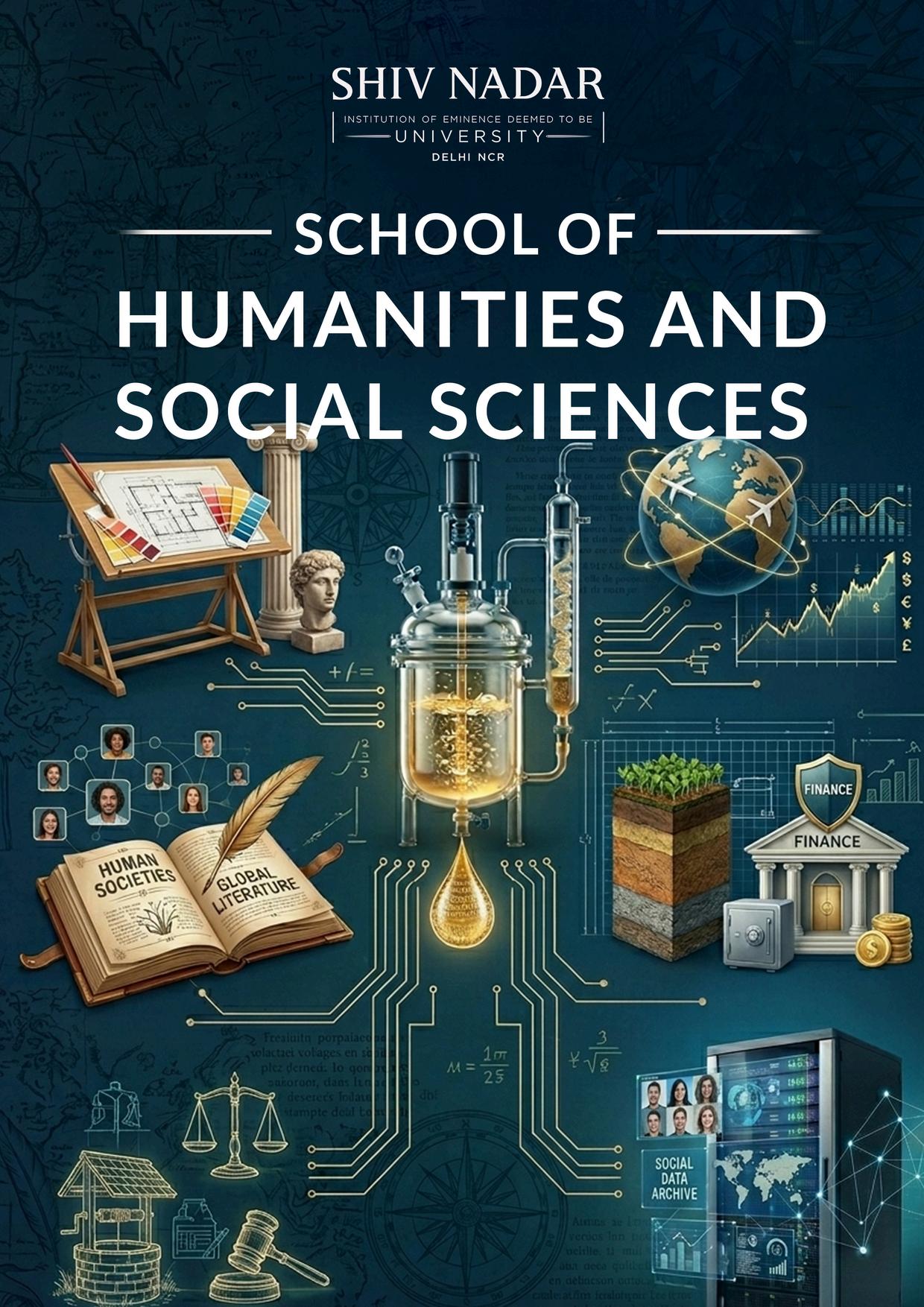
School of Humanities and Social Sciences

Bringing together scientists, engineers, social scientists and cultural studies scholars, the Center contributes to research, teaching and public policy in unique and significant ways.
Fellow, Centre of Excellence for Himalayan Studies
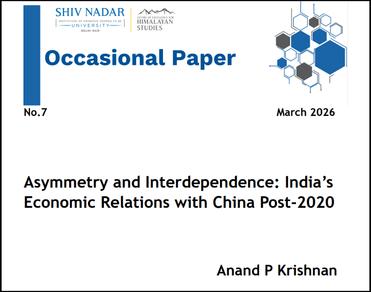
Occasional Paper :Asymmetry and Interdependence: India’s Economic Relations with China Post 2020
Published in/for : Centre of Excellence for Himalayan Studies(CHS), Shiv Nadar University, Delhi-NCR, March 2026
The Occasional Paper explores the discourse in the India-China economic relationship after the Chinese transgressions in Eastern Ladakh in 2020. It delves into the growing trade imbalance for India and its dependence on Chinese resources, along with analysing the factors that compel China not to discount India in its economic and investment calculations.
Fellow, Centre of Excellence for Himalayan Studies
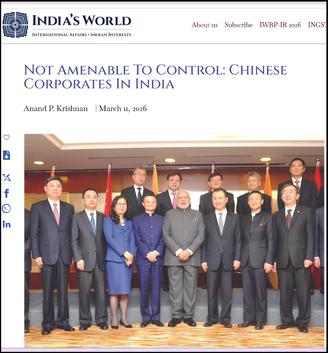
Published in/for : India’s World Magazine, March 2026 edition
The essay examines the absence of Indians in higher management positions of Chinese companies operating in India in spite of directives issued by the central government directives A combination of Chinese political norms and business practices, along with weaknesses in India’s bureaucratic capacity lie at the heart of this issue
Dr. Devendra Kumar
Associate Fellow, Centre of Excellence for Himalayan Studies
Journal Article: BRICS Expansion: China–India Relations and Contentions Over its Role
Published in/for: Asian Affairs, November 2025
This journal article examines the evolution of China’s views of India and its role in BRICS membership expansion since the establishment of the group in 2009
Dr. Devendra Kumar
Associate Fellow, Centre of Excellence for Himalayan Studies
Journal Article:Vanishing Quotas: Tibetan
Political Disenfranchisement in Xi
Jinping’s New Era of Han-centrism.
Published in/for: The China Journal, Issue 94, Issue 2, (July 2025): 1-29 (Co-author James Leibold).
This article is first major outcome of a long-term study of China’s policies in Tibet since 1980. It examines the changes in the political representation in the Chinese Communist Party and state institutions and analyses the implications of the decline in Tibetan political representation for understanding China’s Tibet policies.
Associate Fellow, Centre of Excellence for Himalayan Studies
Project Report Chapter: Chinese Influence Operations Among Tibetan Diaspora in India and Nepal
Published in/for: Centre for Social and Economic Progress, New Delhi Dr. Devendra Kumar
Project Report Title: China’s Influence in South Asia Project Report, 2nd Edition (edited by Dr. Jabin T Jacob and Dr. Constantino Xavier), July 2025
This chapter is based on a larger study examining China’s policies in Tibet since 2008. The chapter focuses on the internal capabilities of Chinese institutions in the Tibet Autonomous Region and its implications for China’s influence operations among Tibetan diaspora in India and Nepal.
Dr. Anand P Krishnan Fellow, Centre of Excellence for Himalayan Studies
Project Report Chapter: ‘Building Influence by “Rising Step by Step”?
Chinese Capital’s Permeation of India’s Electronics Industry’.
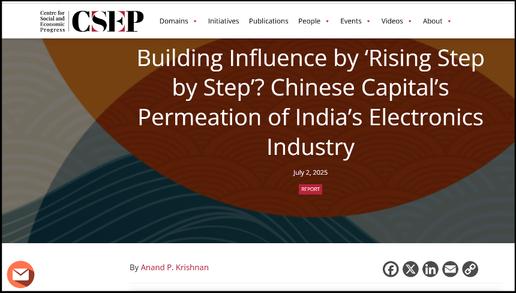
Project Report Title: How China Engages South Asia: In the Open and Behind the Scenes. (edited by Dr. Jabin T Jacob and Dr. Constantino Xavier.) July 2025.
Published in/for: Centre for Social and Economic Progress, New Delhi
This chapter investigates the growth and expansion of Chinese smartphone companies in India. It analyses their ability to embed themselves in the consciousness of Indian consumers and skillfully negotiate turbulences in the India–China bilateral relationship
Dr. Devendra Kumar
Associate Fellow, Centre of Excellence for Himalayan Studies
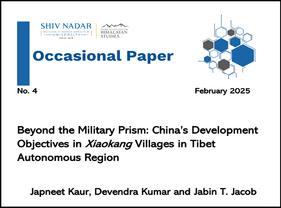
Occasional Paper : Beyond the Military Prism: China’s Development Objectives in Xiaokang Villages in Tibet Autonomous Region. (Co-authored with Japneet Kaur and Jabin T Jacob)
Published in/for : Centre of Excellence for Himalayan Studies(CHS), Shiv Nadar University, Delhi-NCR, February 2025
The study was carried out at the CHS on mapping China’s policy of developing more than 600 border Xiaokang villages across India-Tibet border. The first report was published in 2025 covering five counties in the western and Sikkim sectors of India-Tibet border.
Dr. Jabin T Jacob
Director, Centre of Excellence for Himalayan Studies & Associate Professor, Department of International Relations and Governance Studies
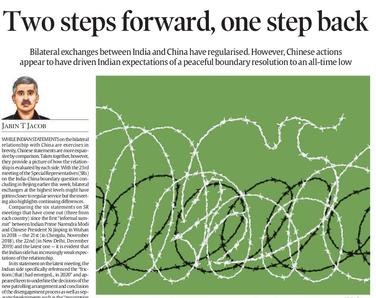
Analysis:
Published on 21 December 2024
While bilateral exchanges between India and China are on the path to regularisation, expectations of a boundary settlement are at an all-time low
Director, Centre of Excellence for Himalayan Studies & Associate Professor, Department of International Relations and Governance Studies
Published on 9 December 2024
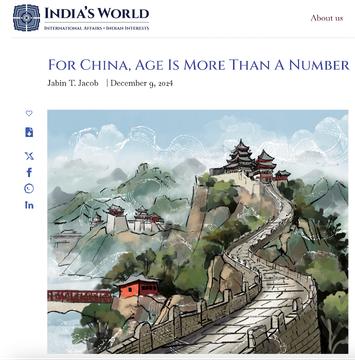
China and India are both ancient civilizations but the former attempts to portray itself as the superior civilization by subtle uses of language and diplomatic protocol
Fellow, Centre of Excellence for Himalayan Studies
CHS Publication: Commentary
Published on 22 November 2024
On India’s efforts to increase telecom connectivity in the country’s border regions through a special programme, its role in regional development
Dr. Devendra Kumar
Associate Fellow, Centre of Excellence for Himalayan Studies
CHS Publication: Issue Brief
Published in November 2024
On the 30th Anniversary of Tibet Aid Program, it assesses the directions the program is taking and analyses shifts and continuities during Xi Jinping’s period.
Dr. Anand P Krishnan
Fellow, Centre of Excellence for Himalayan Studies
CHS Publication: Commentary
Published on 24 October 2024
On the detention of Indian solar panels by US Customs due to their components emanating from Xinjiang and how Indian manufacturing is inextricably dependent on China
Associate Fellow, Centre of Excellence for Himalayan Studies
CHS Publication: Issue Brief
Published in October 2024
Dr. Jabin T Jacob
The study analyses economic and technology zones in Tibet as a key pillar of China’s emerging economic strategy in the post-2008 period.
Director, Centre of Excellence for Himalayan Studies & Associate Professor, Department of International Relations and Governance Studies
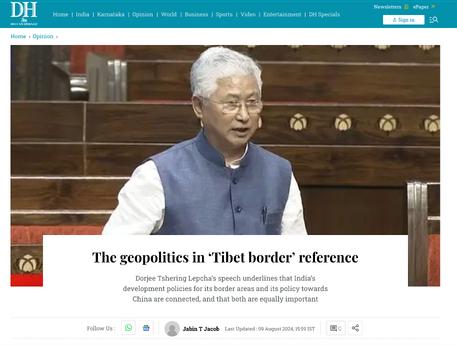
Analysis:
Published on 9 August 2024
Highlights the fact that India’s border development policies and its China policy are connected and both are equally important - one cannot take priority over the other
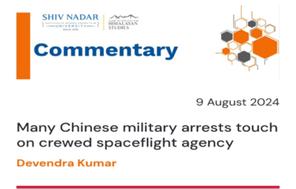
Dr. Devendra Kumar
Associate Fellow, Centre of Excellence for Himalayan Studies
CHS Publication: Commentary
Published on 9 August 2024
On China’s anti-corruption campaign in the People’s Liberation Army