FEATURE


Not content to live the life of a quiet and benign elder statesman, former President Jimmy Carter ’47 founded an activist organization firmly rooted in scholarly research.AtThe Carter Center, he is intimately involved with day-to-day operations and spends at least one week each month at the headquarters in Atlanta, GA. In the week Shipmate visited the Center, the 90-year-old Carter had just returned from a 10-day trip to Beijing, Qingdao, Xian and Shanghai, China; was on tap to meet with students at Emory University for the 33rd Annual Town Hall, where he is a distinguished professor; was scheduled to speak with guests at the Center at“A Conversation with the Carters” event; and attended the Atlanta Falcons game against the Tampa Bay Buccaneers.
In what many call his fourth career— the first three being farmer, naval officer and politician, President Carter, along with his wife Rosalynn Carter, founded The Carter Center in 1982.
“We concentrate on two main issues—peace and human rights,” explained Carter. “We interpret human
rights in the broadest way possible. AtThe Carter Center, we believe that a human right is a home in which to live, food to eat, medical care, adequate education as well as the right for freedom and electing your own officials.”
The Carter Center has observed nearly 100 elections around the world and is dedicated to promoting democracy and freedom. Carter tied his current work to his past by describing it as “doing the same thing that I learned as a Naval Academy midshipman and later in public life.”
Born in 1924 in Plains, GA, Jimmy Carter’s humble beginnings on a peanut farm are well documented as was his rise to be the first, and only, Naval Academy graduate to serve as president. He was the first in his family to finish high school and have ambitions for college.As a child of the Great Depression, he knew he needed to attend a school for free. He had two choices—the U.S. Military Academy or the U.S. Naval Academy.
“If anybody asked me ‘what do you want to do when you grow up?’ I didn’t
say I wanted to be an engineer or a fireman or that sort of thing,” said Carter. “I said I wanted to go to Annapolis and be a naval officer.”
His family members served in the military—his father as a first lieutenant in the Army duringWorldWar I and his uncle,Tom Gordy, in the Navy. For Carter, the Academy was the first step in what would be a lifetime of service.
The 1947 Lucky Bag noted “Jimmy’s many friends will remember him for his cheerful disposition and his ability to see the humorous side of any situation.” His good nature combined with his southern upbringing made him a credible advocate for Midshipman Wesley Brown ’49, who would become the first African-American graduate of the NavalAcademy. Both midshipmen ran cross country together and became friends.
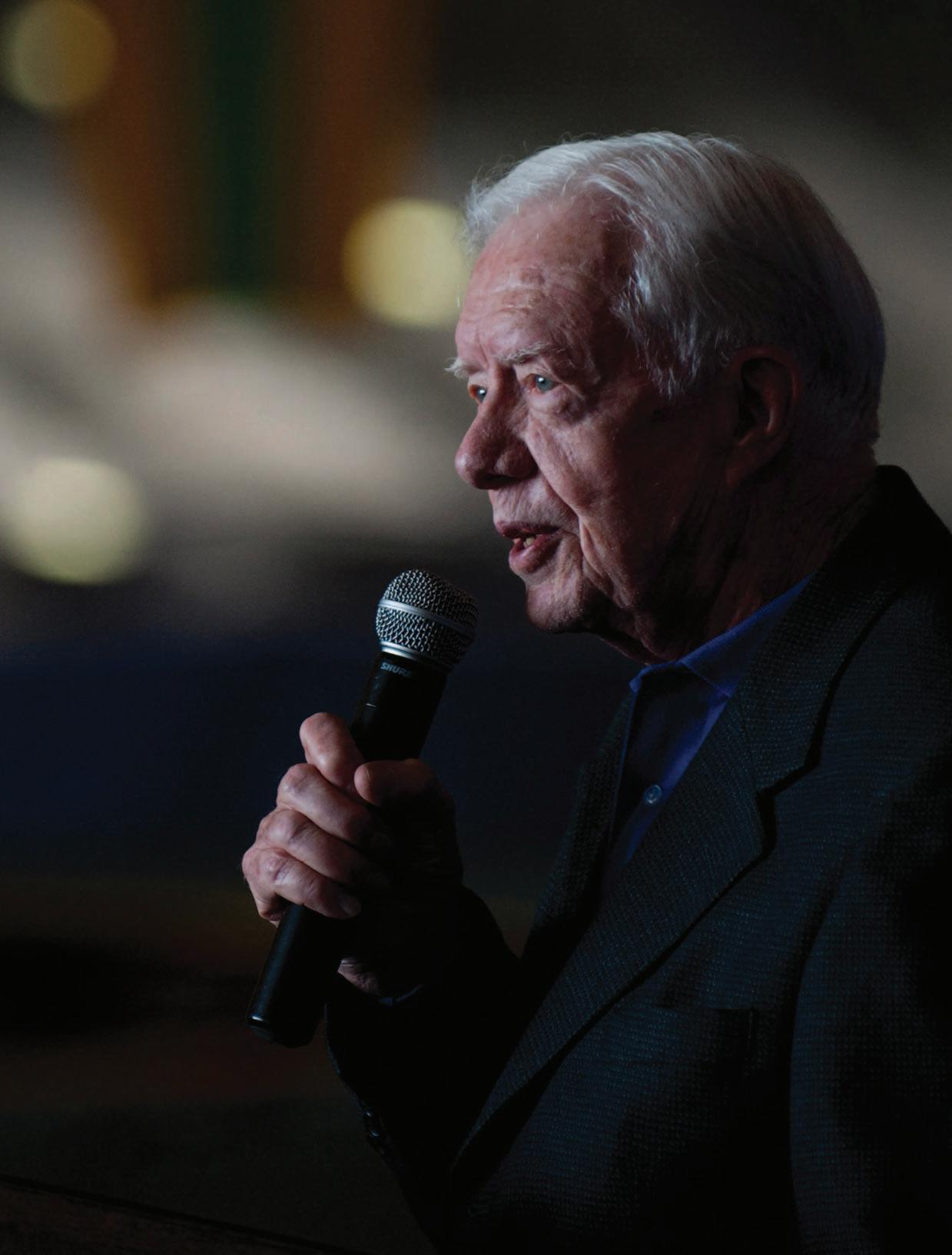
“I was very supportive ofWesley Brown, and since I was from southwest Georgia and spoke up on his behalf, I think it made a little bit more impact than if I had been a northerner speaking for him,” said Carter. “He was a fine midshipman.”
Steven Hochman, Ph.D., director of research atThe Carter Center, has worked directly with President Carter since 1981 and said Carter “didn’t just go along with the system” regarding Midshipman Brown because he “had a strong moral feeling in standing up for Brown.”This moral compass would continue to guide Carter through his years at the Academy, in the Navy, through his presidency and beyond.
While his work atThe Carter Center covers many areas, he has focused on women’s rights and equality. He was president when women were integrated into the service academies.Although President Gerald Ford signed the Defense Authorization Bill of 1976 on 7 October 1975,
Jimmy Carter grew up next door to Rosalynn Smith in Plains, GA.
“I was three years older, and I looked into the cradle and saw my future bride lying there as a newborn baby,” he remembered. They were married days after graduation.
They started out in Norfolk, VA, and learned early on to give each other space so they could develop their own interests. Then, they tried to find activities they could share, like downhill skiing and fly fishing. But the real secret is that they made a rule—“that they almost always maintain”—to resolve differences before they go to bed.
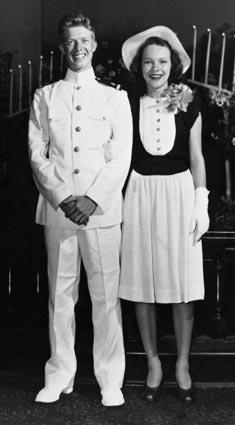
ENSJimmyCarter,USN,and RosalynnSmithweremarriedon 7July1946. Photo courtesy of the Jimmy Carter Library
President Carter would see the first class of women graduate from the service academies. In 1980, he would go so far as to propose all women ages 18 to 20 register for the draft, but still opposed women engaging in combat.Today, he is a strong advocate of women serving in combat positions in the military. His position has evolved over time and with his views on the world.
“I think one of the things that establishes a woman’s equal rights in the mind of the public is equal service in the military, as well as all aspects of life,” said Carter. He cites examples from other countries.
“One is Nicaragua and the revolution that took place while I was president, women served equally.Now Nicaragua is ranked as a top country in the western hemisphere in making sure women have equal rights with men.The other one is China. Under the laws of China, women have higher guaranteed rights as equal to men than any other country that I know of, and it’s because women served side by side with men in the revolutionary war in China.”
His shifting perspective on women in the military and women’s rights has somewhat mirrored his relationship with his wife of more than 68 years.
“He admits that when he was a young man, he didn’t ask Mrs. Carter, Rosalynn, what she thought about him running for political office; he just went and signed up,” explained Hochman. “It is a very different attitude than you would think, but through the years, they became great partners. She became his most important advisor.”
Another advisor to the president wasAdmiral Stansfield Turner ’47, USN (Ret.), who Carter convinced to leave the Navy and serve as the director of central intelligence.
“He means what he says.There is nothing duplicitous about him. I once suggested to him that he could get out of a difficult situation by telling a small fib. I’ll never forget his response: ‘Stan, you know we can’t do that,’” recalledTurner. He added, “I think that because he is a man of principle, he will go down as one of our greatest presidents.”
“One of the key things about negotiating a peace agreement is just to get two adversaries to communicate with each other or through a mediator,” said Carter. “So, if a husband and wife can at least communicate right before they go to sleep at night, I think that’s a good way to stay together.”
Carter describes the Class of 1947 as “extraordinary” with many accomplished graduates including two Medal ofHonor recipients—Captain Thomas J. Hudner ’47, USN (Ret.), and ViceAdmiral James B. Stockdale ’47, USN (Ret.). He said of these fellow Distinguished Graduate Award recipients, “to be equated with them was a great honor and treasure for me.”
Admiral J. Paul Reason ’65, USN (Ret.), a 2010 Distinguished Graduate Award recipient said of his former
boss, “President Carter is an exemplary graduate and truly honest man. I was honored to serve as his naval aide.”
“He [Carter] is open to ideas,” said Hochman. “A lot of people in politics are focused on their own things. President Carter is a listener.” After he listens to many viewpoints and hears the argument, he makes up his mind and wants action.
Carter hasn’t always made popular decisions, but he has had a steadfast belief in them. In his farewell address to the nation on 14 January 1981 he said, “Thoughtful criticism and close scrutiny of all government officials by the press and the public are an important part of our democratic society. Now as in the past, only the understanding and involvement of the people through full and open debate can help to avoid serious mistakes and assure the continued dignity and safety of the nation.”
And Carter faced plenty of criticism and scrutiny in public office and in the years after he was “retired early” from the presidency. Even now, his conviction is stronger than any
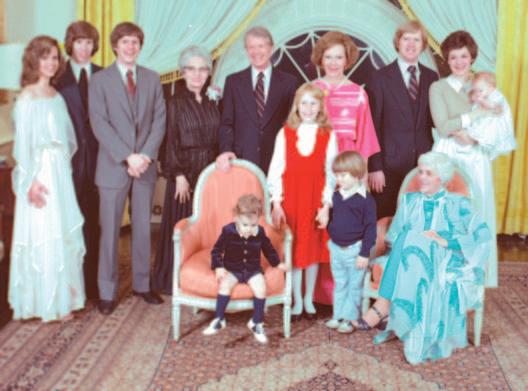
EveryChristmas,theCarterfamilygetstogetherfordinner.Hisfamilyisquite largewithfourchildren,12grandchildrenandninegreat-grandchildren.
“Wetrytokeepourfamilytogether,”hesaid.“It’sveryreassuring.My grandchildrenandgreat-grandchildren—andthestudentsIteachatEmory— keepmeyoungatheartandkeepmeabreastofmoderndayevents.”White HouseportraitoftheCarterfamily26March1979. Photo courtesy of the Jimmy Carter Library
regrets. “I’ve always been willing to take a chance on being criticized if I thought my decision was the right one,” he said. Peace and human rights have been guiding lights for Carter throughout his life and have been evident in his service. As governor, he surprised many—and received national media attention—for unapologetically calling for the end of segregation in his inaugural address on 12 January 1971.
“… I say to you quite frankly that the time for racial discrimination is over,” said Carter to Governor Lester Maddox and his fellow Georgians. “Our people have already made this major and difficult decision, but we cannot underestimate the challenge of hundreds of minor decisions yet to be made. Our inherent human charity and our religious beliefs will be taxed to the limit. No poor, rural, weak or
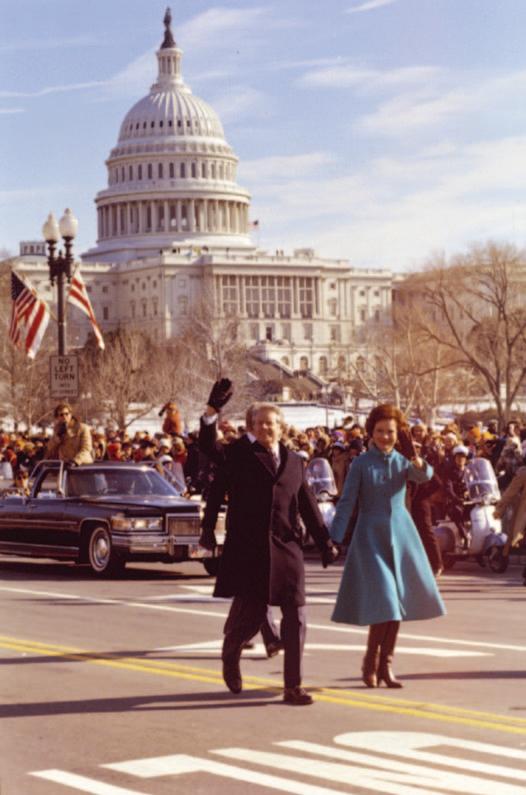
TheCarterswalkeddownPennsylvaniaAvenueduringtheInauguralParadeon 20January1977.
black person should ever have to bear the additional burden of being deprived of the opportunity of an education, a job or simple justice.”
Not one to back down from difficult decisions or the defense of them, Carter recognizes some of his were far from popular.
“When I normalized diplomatic relations with China, it was very unpopular at the time because we had been allied with Taiwan for 30 years before that.When I worked to negotiate peace between Israel and Egypt, I was criticized by a lot of people because I reached out equally to the Arabs and the Palestinians, along with the Israelis.When I gave away the Panama Canal to the Panamanians, it was the best thing that I did, perhaps, while in theWhite House.That was, and is still being, criticized.”
Hochman offered perspective on Carter’s still controversial identity.
“People who don’t like what he’s done in recent years have gone back and attacked him for earlier decisions. I think historians and scholars have shown that many of the things he did were well thought-out—things like the environment, energy. He was right on so many issues, but because he continues to speak out on things he thinks should be talked about—and some of them are controversial—he doesn’t have 100 percent support now.”
In recent years, Carter has continued to take strong stands on big issues including the role of the NSA in our democracy, the peace process in the Middle East, women’s rights around the world and sexual assault in the military and on college campuses.
However, Carter also remains involved in issues and causes that do have resounding support. His work throughThe Carter Center on fair elections and promoting peace and health programs around the world have been supported by many and recognized for their successes. He is probably best known for his, and Rosalynn’s, volunteerism with Habitat for Humanity.Their involvement began in 1984 and continues today.
Last spring, the Midshipman Action Group (MAG) headed to Georgia for a Habitat for Humanity project.
“Traveling to President Carter’s home state to volunteer for a project he himselfholds near and dear was very inspiring,” said Midshipman McKenzie Barnett ’17, MAG project leader forWreathsAcrossAmerica and 25th Company MAG representative. “Throughout the week that we were there we were able to clear the yard of storm damage and neglect, put
up walls for new rooms, lay new floors and tear down old walls to aid in replacing water lines and running electricity. However, the thing I am most proud of is the relationships we made as a team, and the fact that our volunteer hours aided in providing our house’s new owner a new beginning. If you ask anyone from that MAG trip, the one thing they will tell you without a doubt is that we wish we could have done more.”
The Midshipman Action Group at the Naval Academy continues in Carter’s footsteps with work with Habitat for Humanity. But would the former president want midshipmen to follow in his footsteps? His advice to midshipmen thinking of a political career: “Stay in the Navy,” Carter quickly states with his signature grin.
His advice to the graduating Class of 1978 wasn’t so different.
“You and I leave here today to do our common duty— protecting our nation’s vital interests by peaceful means if

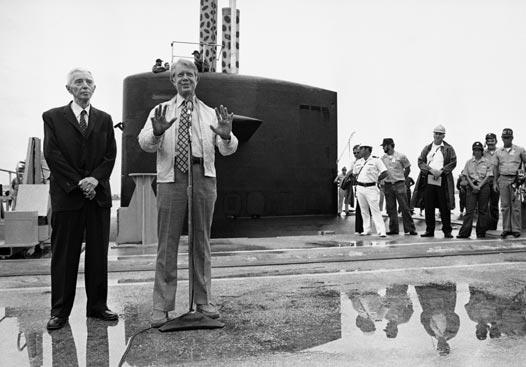
Lieutenant Carter hoped to be a part of the newly created nuclear-powered submarine program, but he would have to be approved by then-Captain Hyman Rickover ’22, USN. Carter still describes Rickover as the second most influential man in shaping his life, the first being his father. He vividly remembered his first meeting with Captain Rickover for the interview.
“It was one of the most dramatic and disturbing events of my life because he asked me questions about everything imaginable,” recalled Carter. “Every time I thought I knew the subject, he would ask me enough questions to prove that I didn’t know as much as he did.”
By the end of the interview, Carter was convinced that he wouldn’t make it into the program. Rickover had one last question for the young officer about his time at the Naval Academy. He asked, did you always do your best?
“I started to say, ‘yes, sir, I did.’ But, there are a lot of times when I could have studied harder, could have worked harder,” said Carter. “So, I finally gulped a couple of times and said, ‘no, sir, not always.’ He looked at me with his very cold eyes and said, ‘why not?’ And then he turned around and began to work on papers behind his desk and ignored me.”
Carter left Rickover’s office, dejected. However, he was called into service on the building of SEAWOLF the second nuclear submarine.
But, their story doesn’t end there. While Carter’s Navy career ended before SEAWOLF went to sea, Rickover would serve in the Navy for an unprecedented 64 years and through Carter’s term as Commander-in-Chief where they met again in service to the nation.

Home is Where the Heart Is FormerPresidentJimmyCarterkicksoffconstructionforHabitatforHumanity’s 31stannualJimmy&RosalynnCarterWorkProject.Morethan5,000volunteers joinedtheCarterstohelpbuildandrepairmorethan100homesinNorthTexas the week of 6 October 2014. Photo courtesy of PRNews/Habitat for Humanity Intl
possible, by resolute action if necessary,” he said at their graduation. “We go forth sobered by these responsibilities, but confident of our strength. We go forth knowing that our nation’s goals—peace, security, liberty for ourselves and for others—will determine our future and that we together can prevail.”
Although, during the same speech he recognized many would not remember his words that day, much like he couldn’t recall much of what Admiral Chester Nimitz, USN, Class of 1905, said at his own graduation. He continued, “My one hope was that the graduation services would be brief.As will be the case with you, I was disappointed.”
During the same visit, Carter asked to see his old room. The two lucky plebes who inhabited that very room “cleaned it for days ahead of the visit” and had the opportunity to meet everyone in their chain of command, except forVice President

Walter Mondale, recalled Lieutenant Commander Nelson Moe ’81, USN (Ret.).
“My roommate [David Pointek ’81] and I got our Lucky Bags signed by him,” said Moe. “He and Rosalynn were very gracious.”
Carter has built a lasting legacy at the Naval Academy, in the Navy, in Georgia and for the nation, but he’s not yet done creating it. From the time he was a midshipman to today, he has been focused on preserving peace.
“When I went into the Navy, I did it with the idea of defending my country if necessary, but to use the strength of our military forces to preserve peace,” he said. “While I was in theWhite House, we never did go to war.We never fired a bullet, we never dropped a bomb, we never fired a missile, and I was very proud of that.We also protected the interest of our country. I think that one of things that I feel about the U.S.
military is to keep it strong, keep it able, keep it ready, but use it very sparingly and only when it’s justified.”
And at 90, having just celebrated his birthday with family atThe Carter Center in October, Carter shows no signs of slowing down or shifting his focus.
“If he sees something that needs to be done and he thinks he can have an influence, it is very hard for him to resist not getting involved,” explained Hochman. “He is not someone who says ‘I’m retired.’”
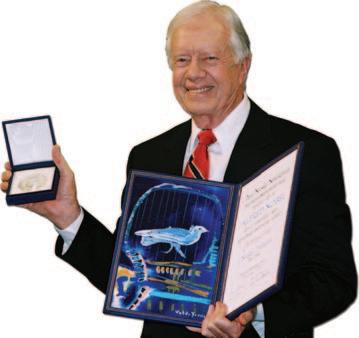
You may know President Carter was the second Naval Academy graduate to receive the Nobel Prize. The first was Albert A. Michelson, Class of 1873. Michelson’s for physics in 1907 and Carter’s for peace in 2002.
Also in 2002, Carter received the U.S. Naval Academy Alumni Association Distinguished Graduate Award for his lifetime of service to the Naval Academy, the Navy and the nation. Carter, however, remains the only Naval Academy graduate who has received a Grammy Award. The National Academy of recording Arts and Sciences bestowed the honor of “Best Spoken Word Album” to Carter for “Our Endangered Values: America’s Moral Crisis” in 2007.As of press time, Carter was nominated for the 2015 Grammy Award in the same category for his latest book, “A Call to Action: Women, Religion, Violence, and Power.”
Throughout his lifetime of service, Carter has received countless awards including the Silver Buffalo Award, Boy Scouts of America (1978); Martin Luther King Jr., Nonviolent Peace Prize (1979); Harry S. Truman Public Service Award (1981); Conservationist of the Year Medal, National Wildlife Federation (1993); Kiwanis International Humanitarian Award (1996); United Nations Human Rights Award (1998); Presidential Medal of Freedom (1999); and the American Peace Award along with Rosalynn Carter (2009), among others.
Carter was awarded the Nobel Peace Prize “for his decades of untiringefforttofindpeaceful solutionstointernationalconflicts, toadvancedemocracyand humanrightsandtopromote economicandsocialdevelopment.”
Photo courtesy of The Carter Center