Shiplake College
Reading the Curriculum Map
Shiplake College is a Thinking School. This involves making thinking explicit.
Part of this involves using a consistent set of tools for presenting certain types of information- these are called thinking frames. One important skills is sequencing.
This guide uses sequencing frames to display the curriculum through Key Stage 3 - Years 7, 8, and 9 - in all our subjects.
The sequence of events go within the frame, arrows at the start and end show continuity.
Surrounding the frame is the thinking lens. Here we draw out themes and skills common across the sequence that are essential for the subject.
At the bottom of the thinking frame is the curriculum rationale. Here, Heads of Department have also described and justified the aims and objectives of the curriculum, and how topics progress and tie into our KS4 and 5 curricula.
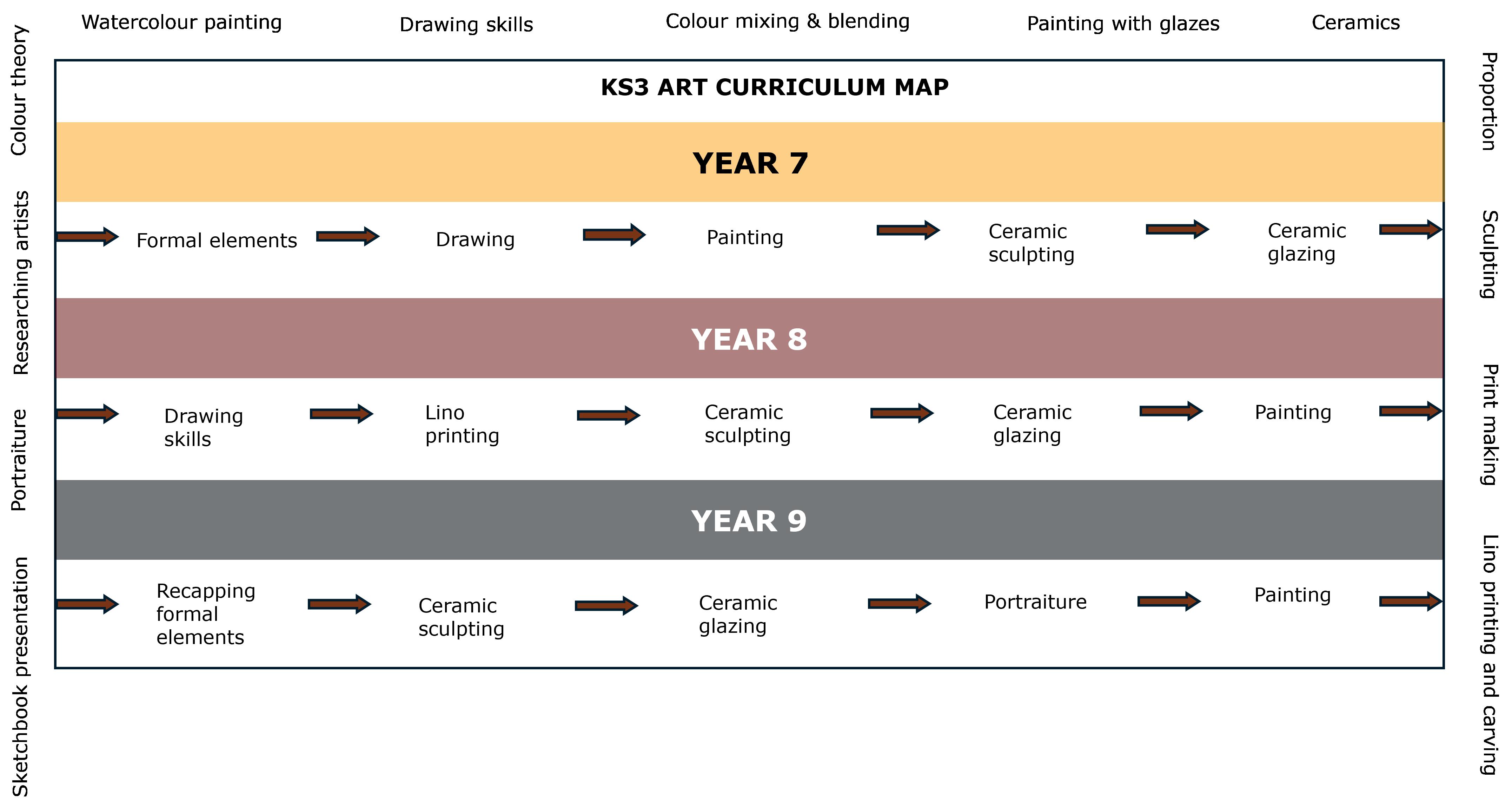
Curriculum Rationale: Key Stage 3 will be taught with a variety of materials, and the techniques will be more challenging as the years go on with pupils building on skills each year and gaining confidence and knowledge to prepare them for GCSE and above. Pupils will explore a variety of themes such as underwater, sweets & treats, shoes, insects and portraiture. All these projects will be presented in a sketchbook which will show important drawings skills, artist research, trying new materials, and creating their own designs. The curriculum rationale is designed around the National Curriculum of Art.
Art Curriculum Map
curriculum rationale is designed around the National Curriculum of Art.
Head of Department: Miss Keli Jiggens
Careers
Head of Department: Mrs Louise Rapple Moore
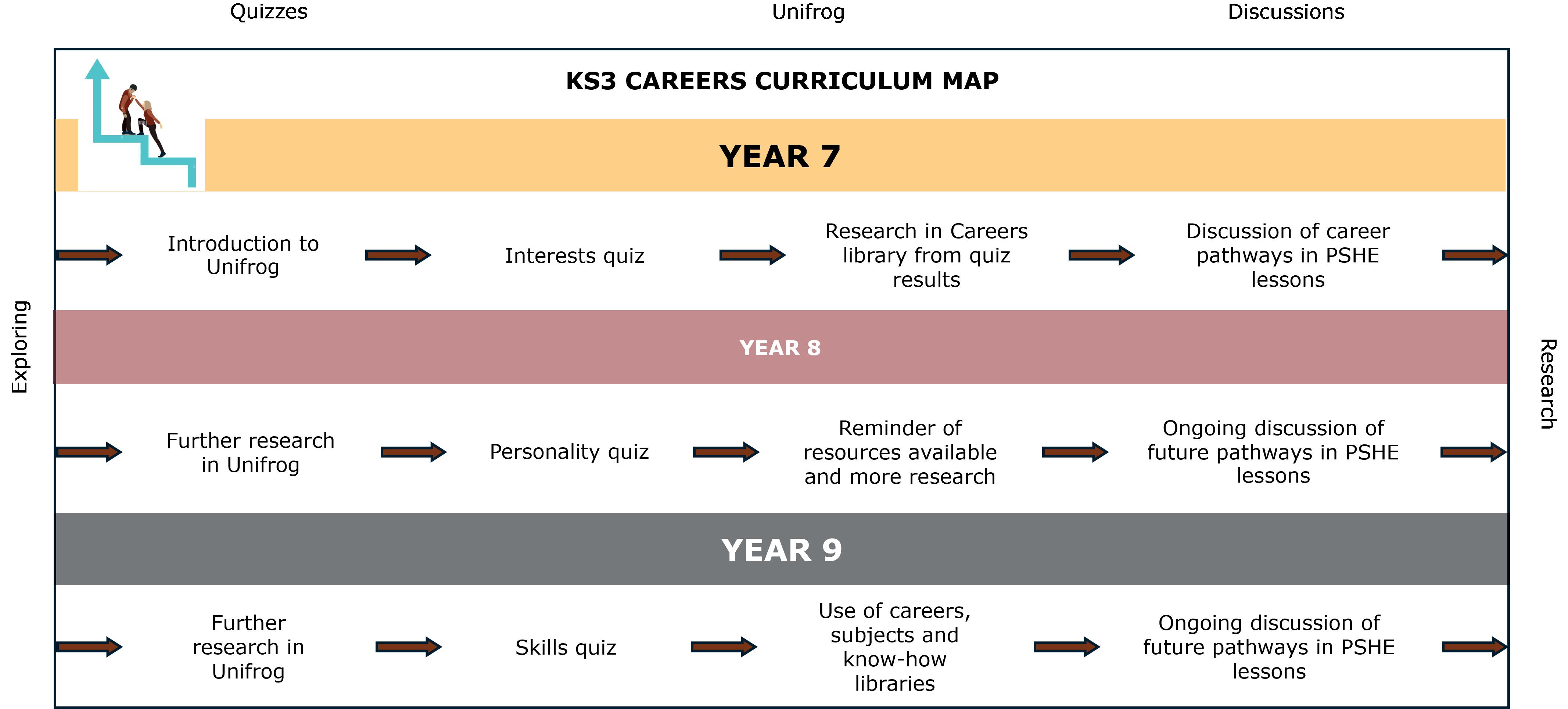
Curriculum Rationale: At Key Stage 3, pupils are introduced to Unifrog. At this stage, they undertake personality, interests and skills quizzes to help them think about where their skills lie and what kind of areas might be interesting for them in the future. They explore various options in the Careers, Subjects and Know-how libraries in Unifrog and PSHE teachers will help them discuss future pathways.
Computer Studies Curriculum Map
Head of Department: Mr Pete Redrup
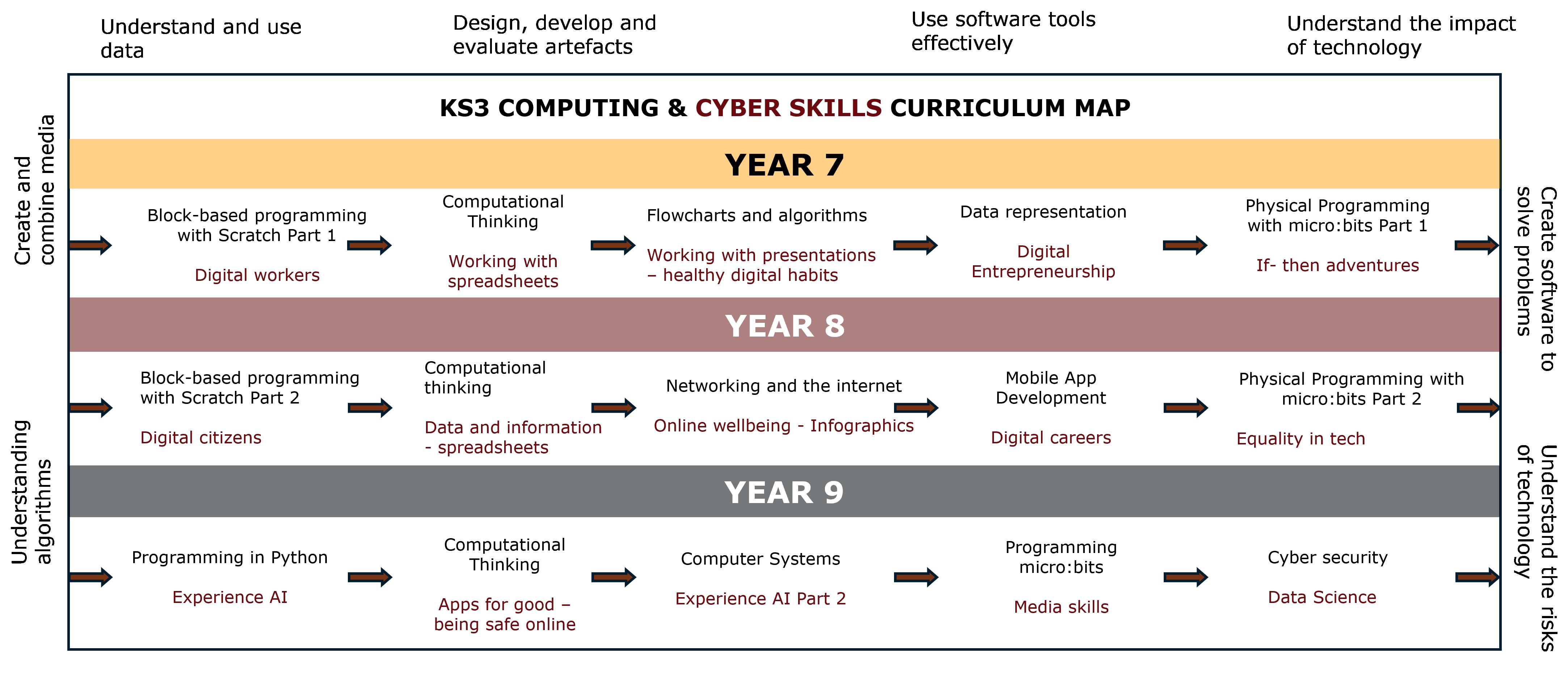
Curriculum Rationale: Computer Science, ICT and Digital Literacy skills are delivered via Computing and Cyber Skills lessons. For Computing we provide an ambitious spiral curriculum, whereby key principles are encountered several times, in increasing depth and sophistication, to embed knowledge and skills more effectively over time. For example, important aspects of coding such as sequence, selection and iteration will be first encountered with Scratch in Year 7 then 8, with App Lab (JavaScript) also in Y8 and then with Python in Y9. If pupils opt for GCSE or A Level Computer Science they will encounter the same principles again, in much greater depth. Cyber Skills topics are selected to provide a balance of ICT and Digital Literacy elements, and pupils are taught to work creatively and collaboratively using digital tools.
DET Curriculum Map
Head of Department: Mr Liam Fuller
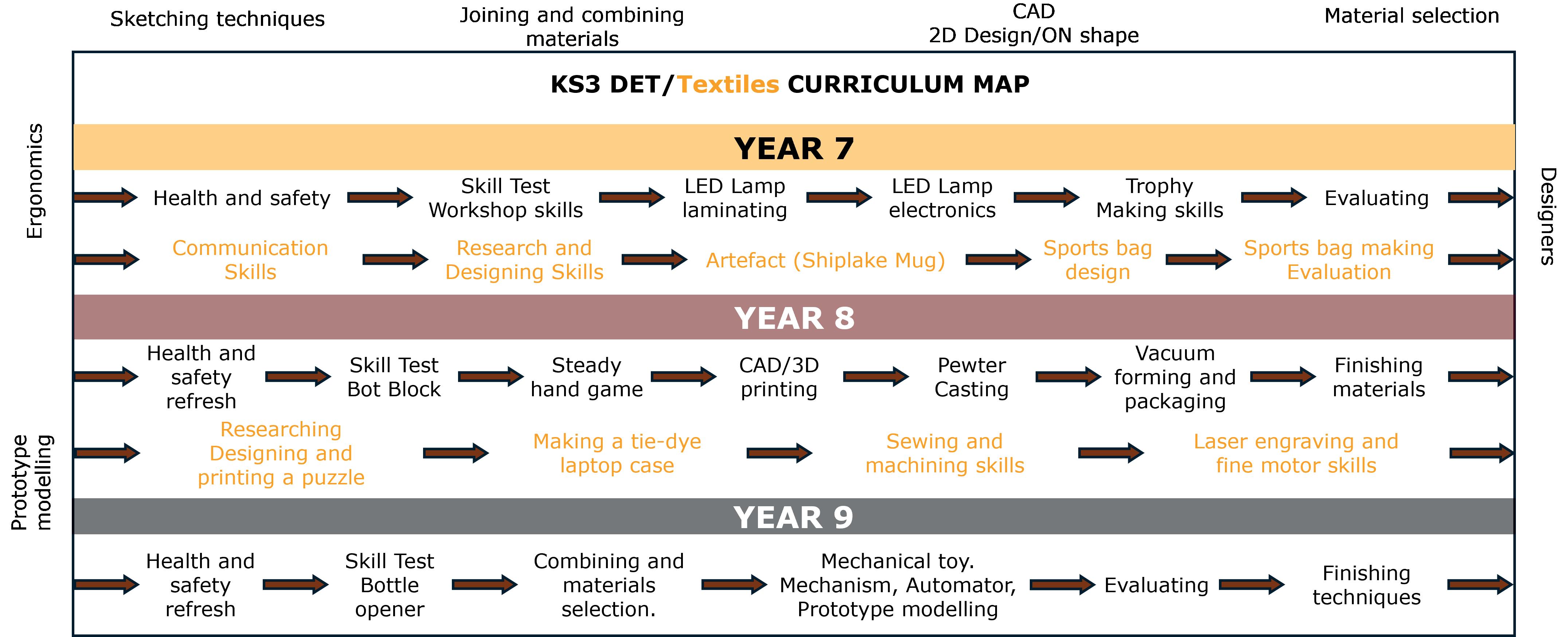
Curriculum Rationale: Each scheme of work offers the opportunity for development of skills, communication and technical knowledge. This helps to build a basic level of understanding that are used in both GCSE and A-level. The knowledge and skills are built upon from previous years to expand terminology required to be successful for GCSE. In each year, there are a range of different projects that will develop skills required in GCSE and A-level. Throughout the KS3 curriculum, there are some links to computing, science and maths that help develop the STEM skills.
Drama Curriculum Map
Head of Department: Mrs Emma Farrell
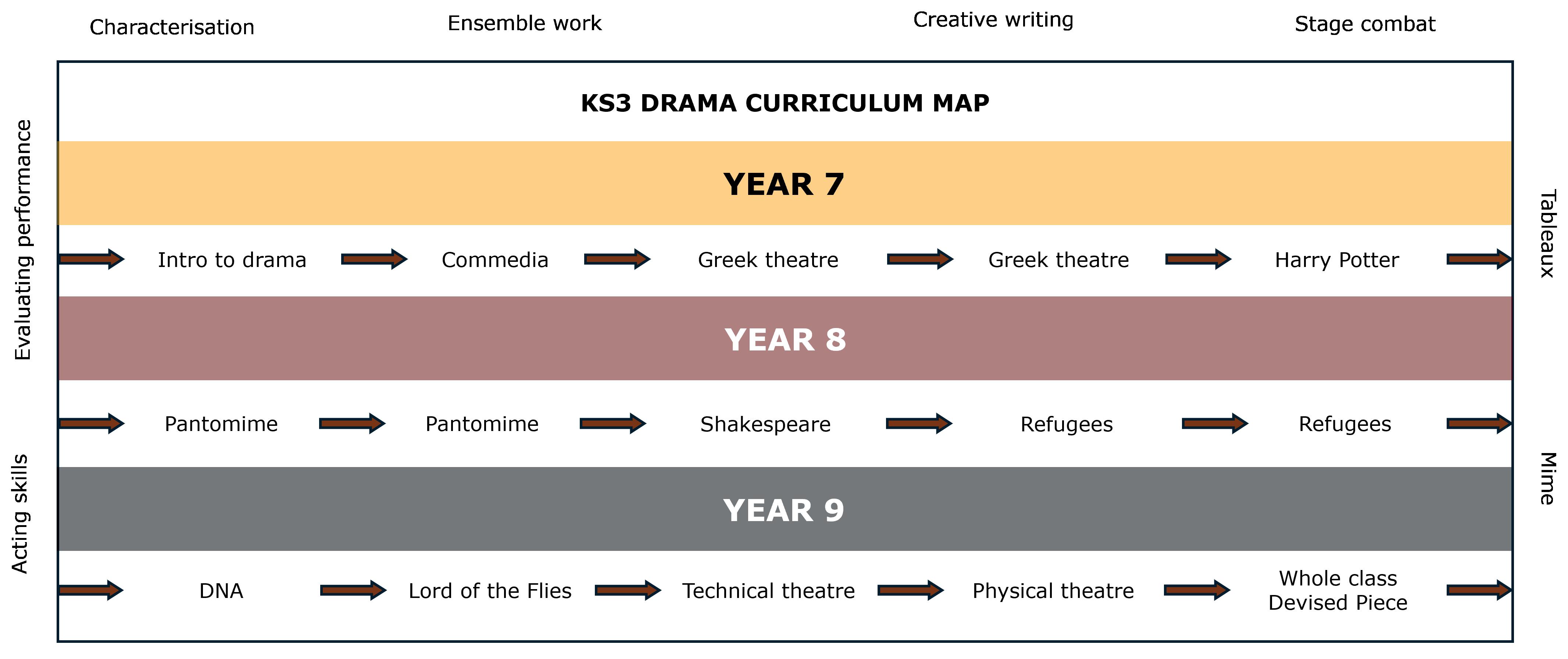
Curriculum Rationale: Each scheme of work offers the opportunity for development of collaboration, communication and creative skills and offers a range of styles and genres for pupils to experience. This helps to build a basic level of understanding that are used in both GCSE and A-level. The knowledge and skills are built upon from previous years to expand terminology required to be successful for GCSE. In each year, there is at least one opportunity to devise from a stimulus which is a similar process to that of the devising module for GCSE and A-level. Throughout the KS3 curriculum, there are some subtle links with English such as incorporating poems, the focus on the structure of Shakespearian language and the opportunity for pupils to practice their creative writing for monologues.
English Curriculum Map
Head of Department: Mrs Jess Brooks
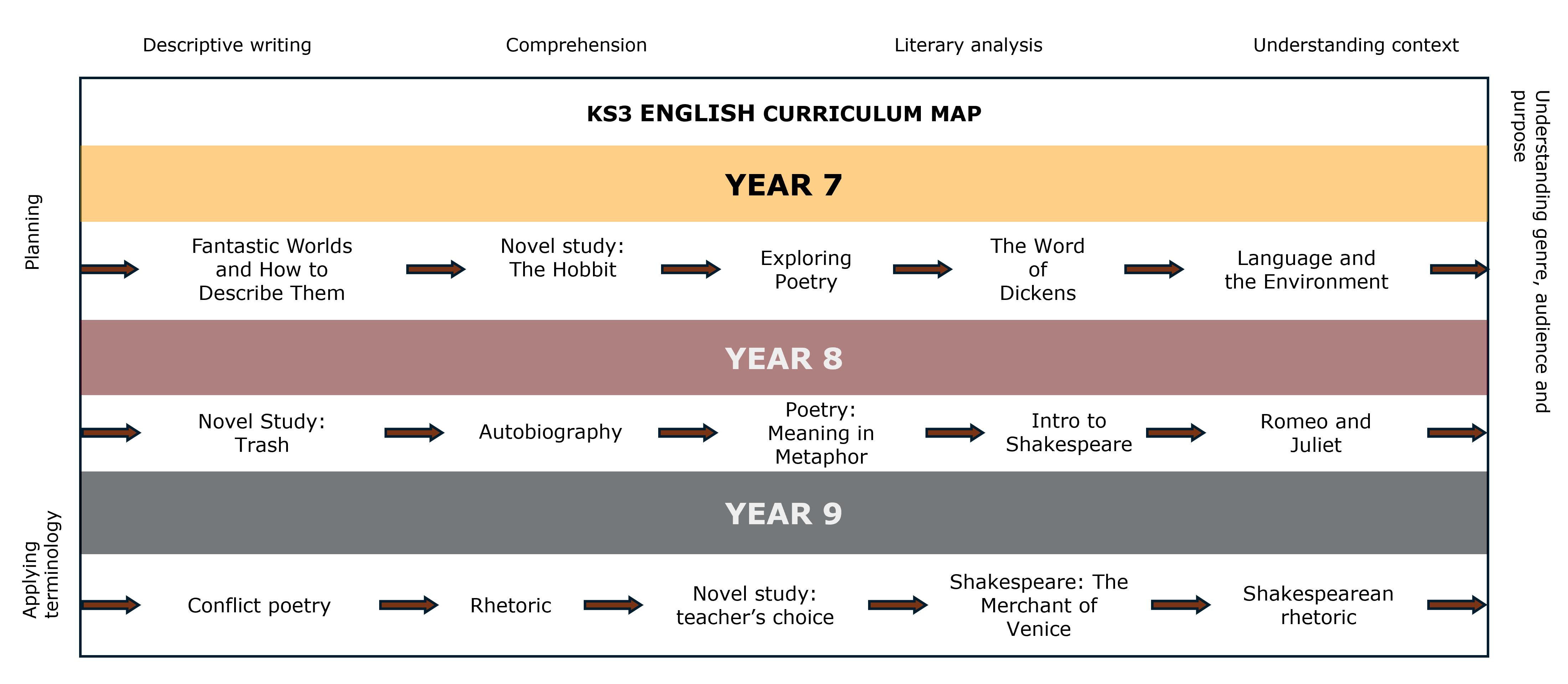
Curriculum Rationale: The Year 7 curriculum is designed to be engaging and enjoyable, but it also allows students to develop a wide range of core skills that will help them in the years to follow. This is a text rich curriculum, with a wide variety of fiction and non-fiction. In Year 8 we introduce 19th Century literature with links to the gothic in Year 7– a chance to recognise features of Victorian novels. We continue to develop a toolbox of poetic terminology and encourage reading for implied reading to develop deeper understanding alongside appreciation of poetry. There are also conventions of a Shakespearean tragedy in preparation for GCSE. Year 9 sees Greater consideration towards poet’s intent and historical context. Development of tools for analysing a more sophisticated novel, including a focus on context and themes. Further conventions of Shakespearean tragedy, alongside familiarity with modern (Shakespearean) English in preparation for GCSE.
French Curriculum Map
Head of Department: Mr Ari Alejandro
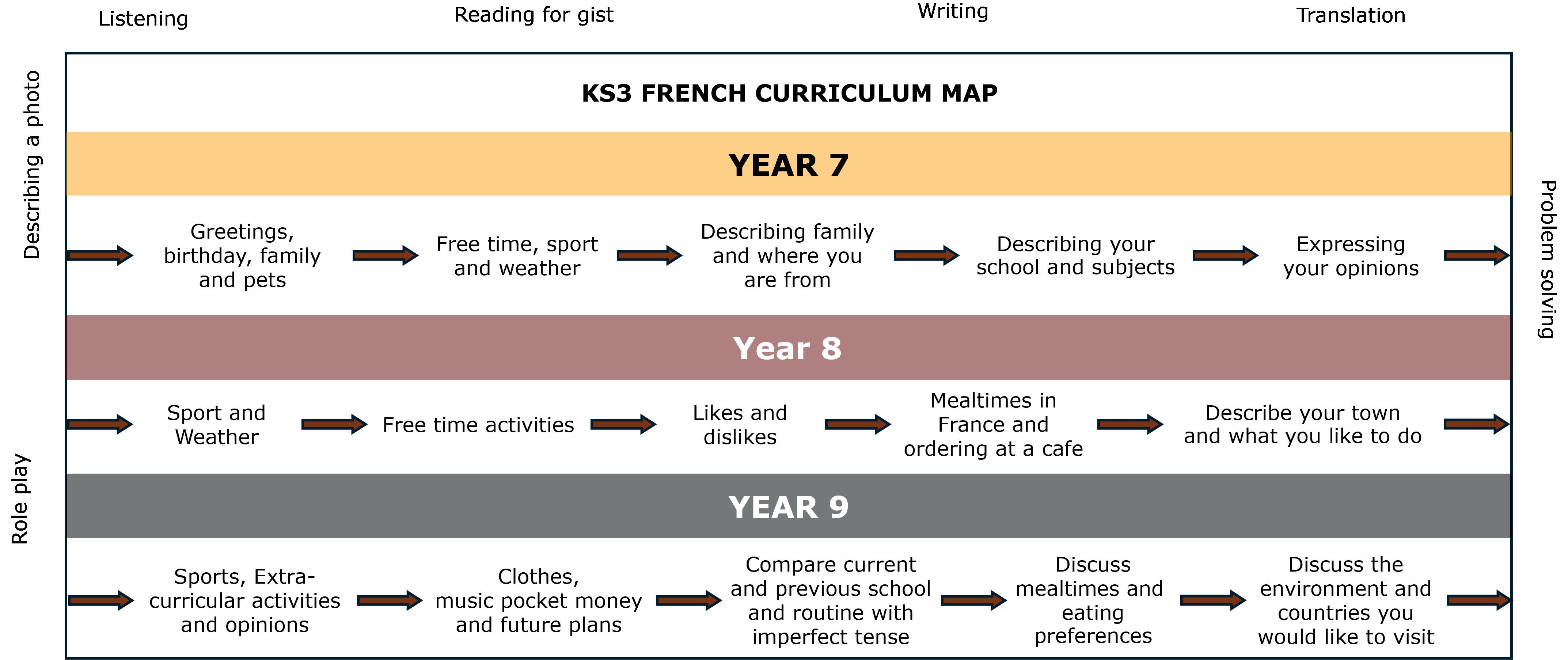
Curriculum Rationale: The Dynamo 1, 2 and 3 course has been chosen as it equips pupils with the language learning skills they require for GCSE study (listening, reading, writing and translation) and introduces them to exam-style questions and techniques. Vocabulary and structures are recycled throughout, gradually building up a base of the basics required at GCSE. There is clear grammatical progression with activities and scaffolding designed to build confidence and skills in the 4 areas tested at GCSE: speaking, listening, reading and writing. There are also opportunities to deepen cultural understanding and promote life-long language learning.
Geography Curriculum Map
Head of Department: Mr Jack Cooper
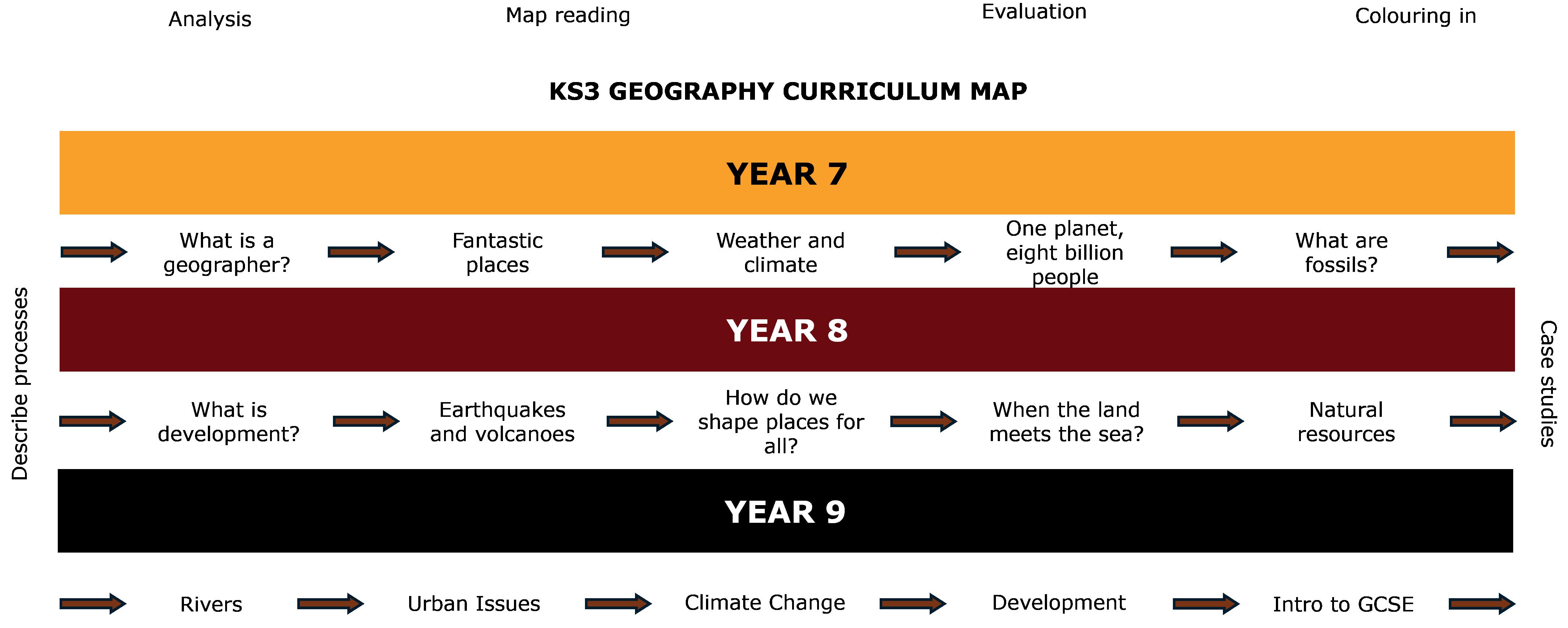
Curriculum Rationale: The KS3 Curriculum is about exploration and designed by the department to be engaging and instil passion for the subject in our students. The Year 7 curriculum has a core focus on geographical skill, making sure all students are able to explore geography at the same level. We explore both human and physical geography stretching old concepts and introducing new knowledge from how weather and climate works to answering questions around the discovery of fossils. In Year 8, we follow the same pattern as Year 7 going from human geography to physical, looking in depth at topics which help students understand the wider aspects of geography. We also cover key knowledge building towards the GCSE in Year 10 looking at earthquakes and coastal process. The year is designed to add another layer of knowledge and to create curious learners. Year 9 has a focus on core skills and looka at future issues of our planet again by enquiry-based learning build on previous knowledge and allows students to ask questions and become passionate about geography. Emphasis is put onto the core skills for GCSE with increased essay writing and exam style questions. In the spring term, the Year 9s will do a trail unit of GCSE geography to get them ready for the next stage.
History Curriculum Map
Head of Department: Mr Joe Player
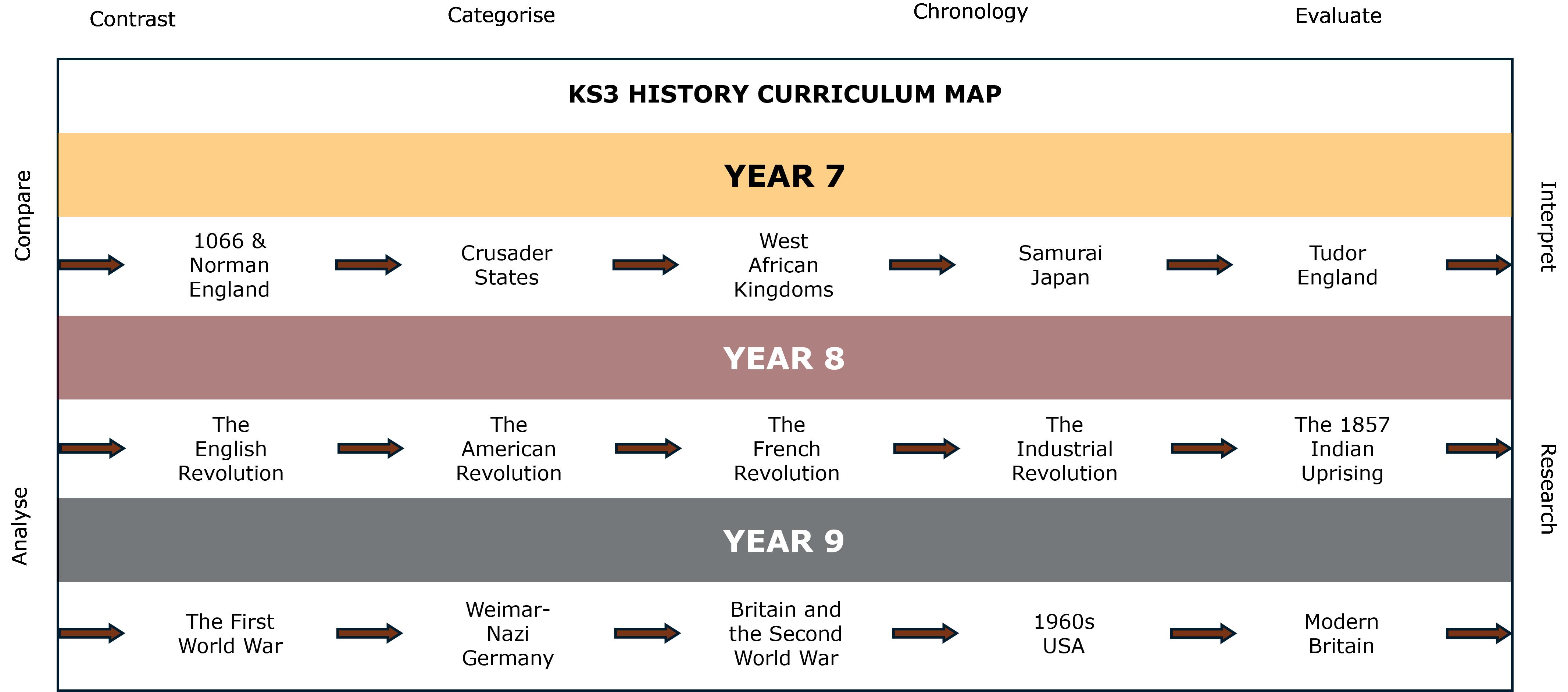
Curriculum Rationale: From the beginning, KS3 History introduces students to key terms, key skills, and key ‘second order concepts’ essential for understanding History, e.g. change/continuity, cause/effect, similarity/difference. These concepts and vocabulary are directly linked to GCSE and A-level demands. Our curriculum is also as diverse as possible, with an exciting balance of English and internationalism, allowing students to make comparisons over the periods they are studying e.g. life for women in Norman England, Mali Kingdoms and Samurai Japan; or the reasons for the French Revolution compared to the American Revolution and the Indian Uprising.
Maths Curriculum Map
Head of Department: Mr Adie Davis
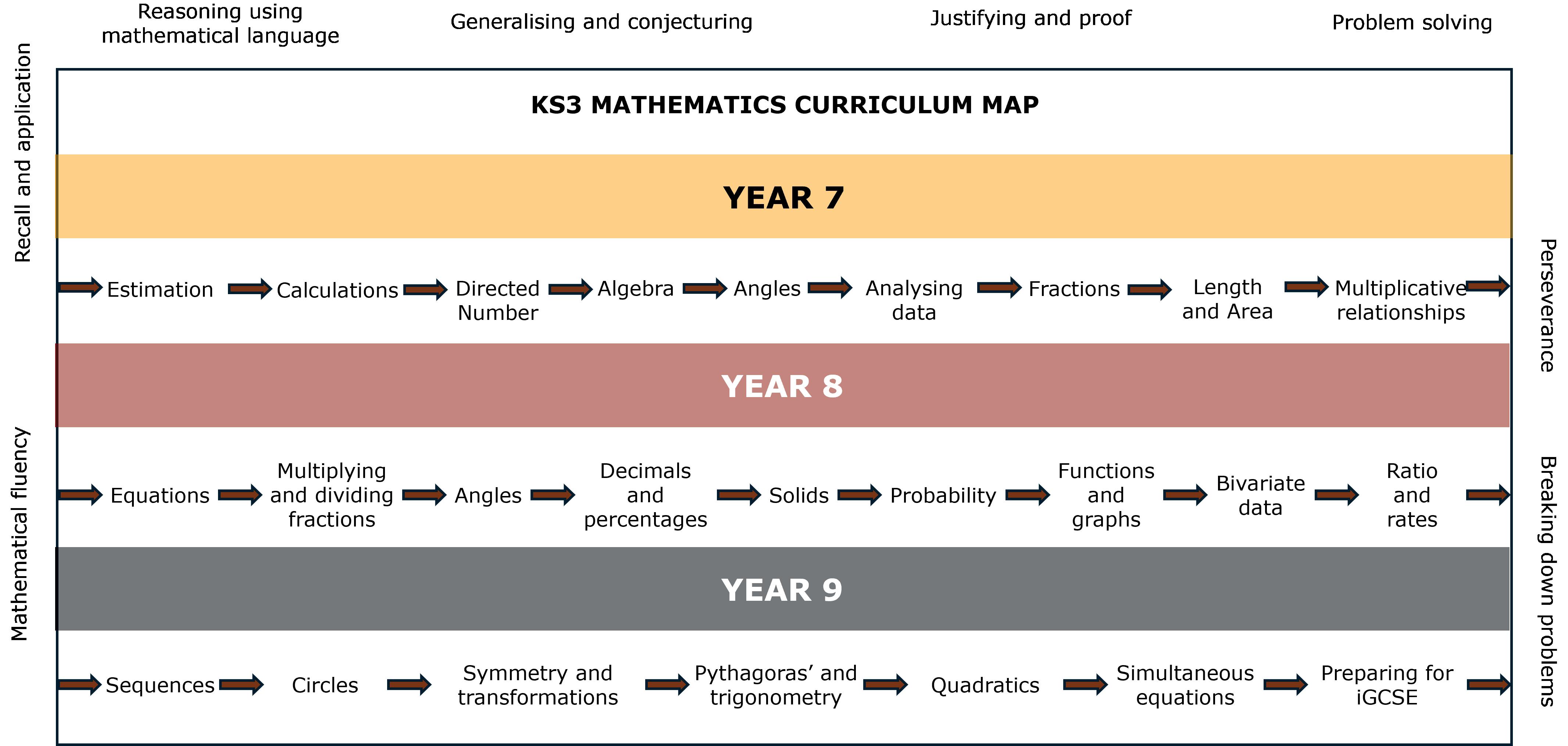
Curriculum Rationale: Guided by the research-driven LUMEN Mathematics curriculum, students consolidate and extend upon topics learnt in Key Stage 2, progressing their understanding of algebra, proportional reasoning and space and measure. By Year 9, they will have covered and consolidated all topics covered under the foundation iGCSE specification in preparation for starting Key Stage 4.
Learning Development
Head of Department: Mrs Gina Partridge
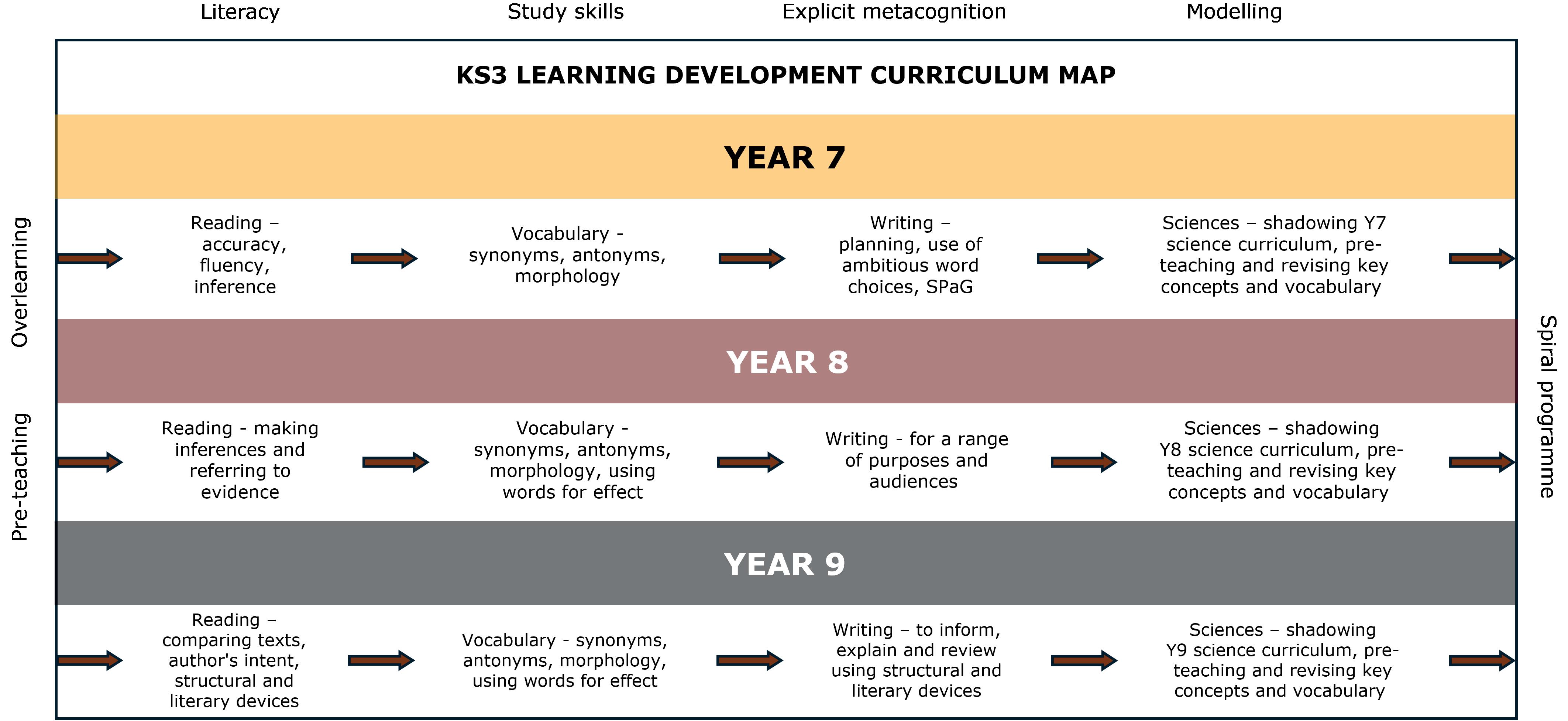
Curriculum Rationale: In Learning Development, we do not teach a specific curriculum. Instead, we take a proactive approach by preteaching and overlearning the key concepts and associated vocabulary of English and the sciences that pupils with dyslexia find challenging. In KS3, following a structured, cumulative and multisensory approach, we continue to develop pupils’ reading accuracy and comprehension, expand their vocabulary, improve their planning, writing and editing skills, and aid their retention and recall of scientific keywords. We also build pupils’ self-esteem and resilience through explicit teaching of metacognition and modelling a range of study techniques to alleviate difficulties related to dyslexia by allowing pupils to discover the best study methods that suit their individual needs.
Music Curriculum Map
Head of Department: Mrs Amy Hynes
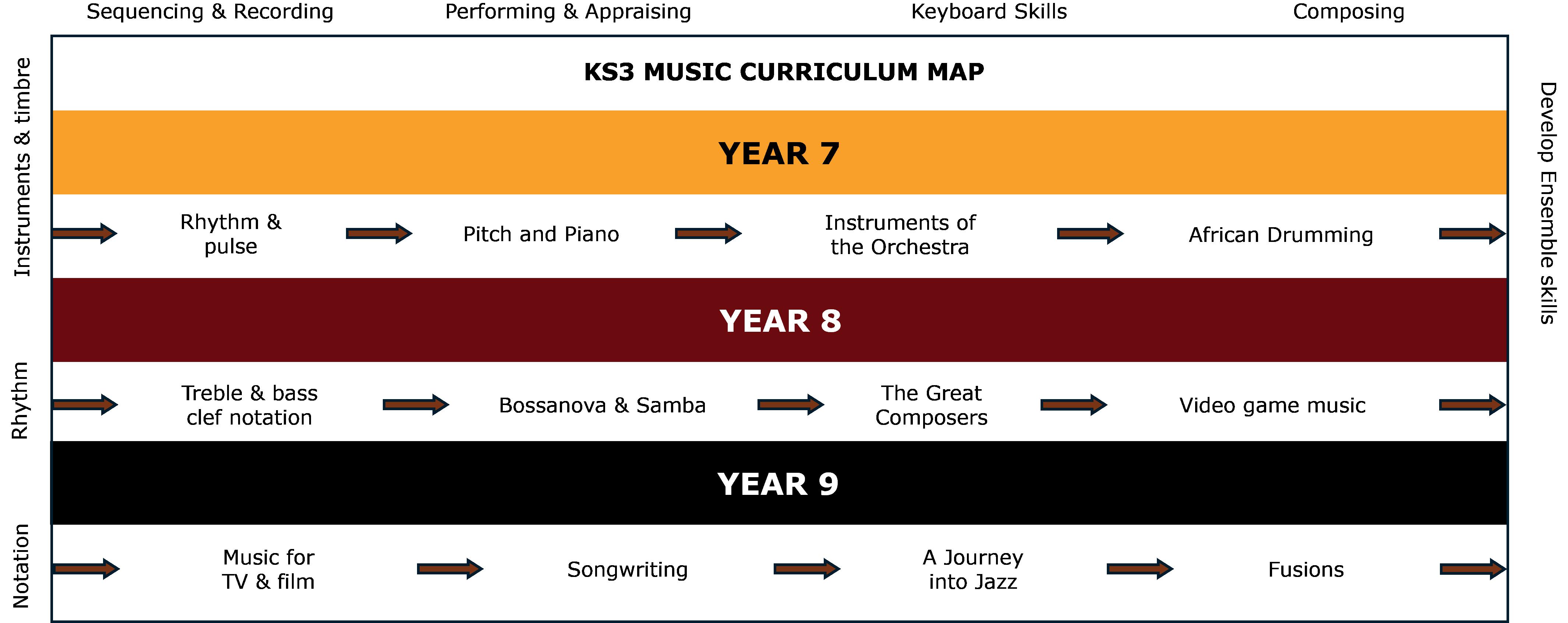
Curriculum Rationale: By the end of Year 9 pupils will have: gained an aural knowledge of some of the great musical output of human civilisation; engaged with creative processes through improvisation and composition; built an understanding of how musical elements work and discussed how these interact with subjective and objective models of musical meaning; developed knowledge of a wider range of notes and improved their fluency in music notation. Above all else the curriculum promotes collaboration, discovery, leadership, creativity and decision-making.
Physical Education Curriculum Map
Head of Department: Mrs Katie Neill
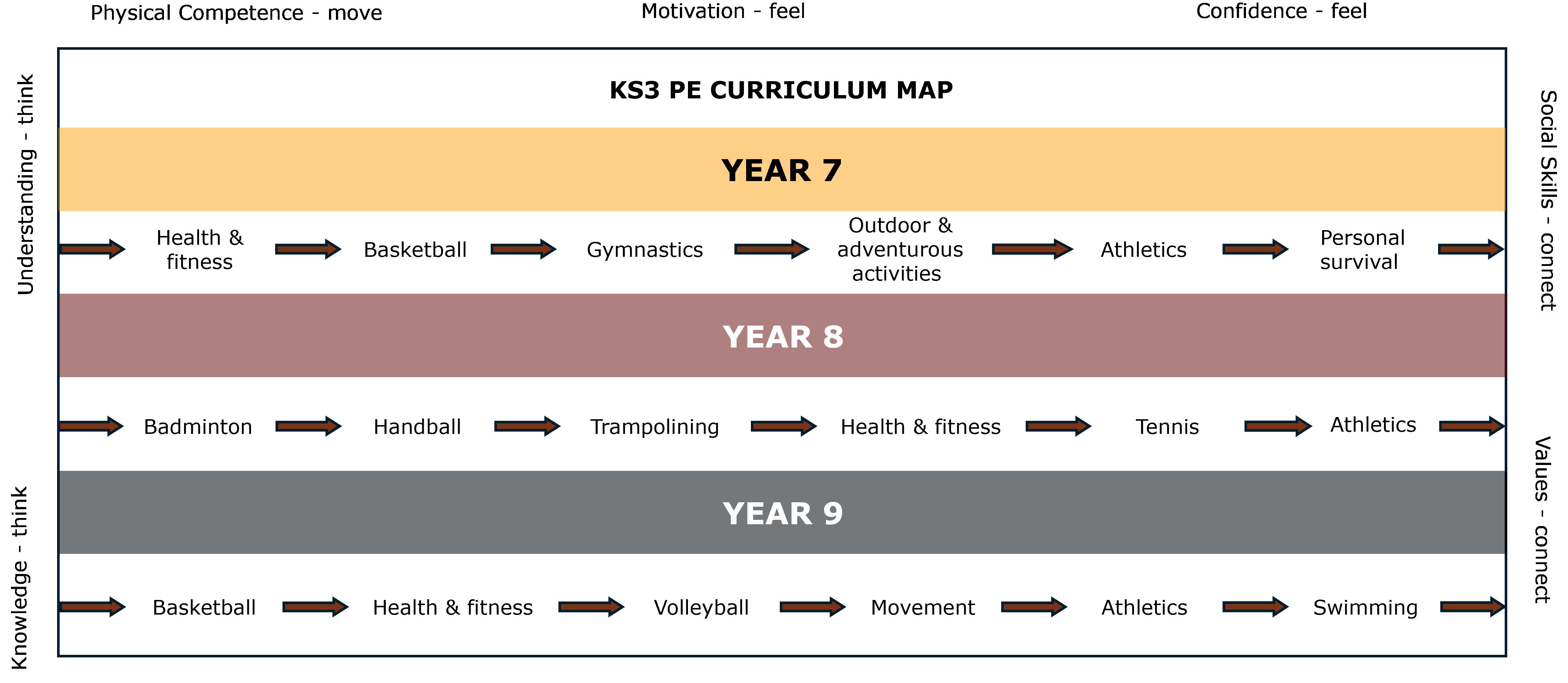
Curriculum Rationale: The PE curriculum is designed to develop student’s physical literacy through a number of different activities. Physical literacy can be divided into four key strands; they are physical competency, motivation, confidence and knowledge & understanding of health. The study of and participation in health and fitness focussed lessons runs throughout the curriculum in Year 7, 8 & 9 to underpin all four strands of physical literacy. Where other activities are repeated in each year of study the complexity of skills progress, motivational factors and confidence building activities develop to further enhance physical competency, social skills and values. The curriculum covers a breadth of study to compliment our games and co-curricular provision whilst exposing students to new opportunities.
PSHEE and RSE Curriculum Map
Head of Department: Mrs Fiona Dunn
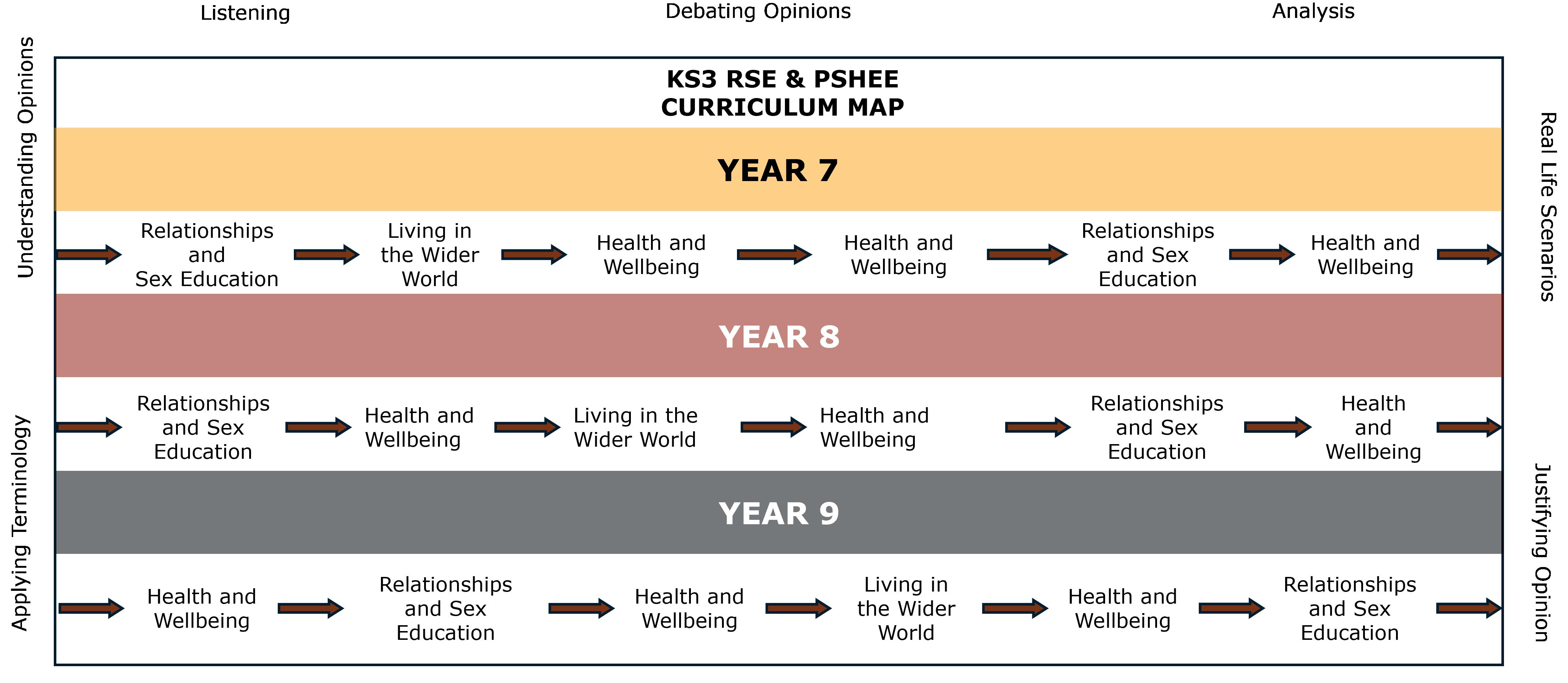
Curriculum Rationale: The PSHEE and RSE curriculum is designed to develop student’s understanding of topics facing them in everyday life. The study of Health and Wellbeing, Living in the Wider World and Relationships & Sex Education focused lessons in Year 7, 8 and 9 enables the students to underpin all 3 areas of challenges and topics facing them in today’s society. When other areas are repeated in each year of study, the content/topic of each lesson changes to develop a spiral based curriculum and deeper understanding for which is age appropriate. The curriculum covers a breadth of study to complement what is covered in various other subjects whilst exposing students to on trend topics and statutory guideline teaching topics.
Religious Studies Curriculum Map
Head of Department: Miss Nicola Jones
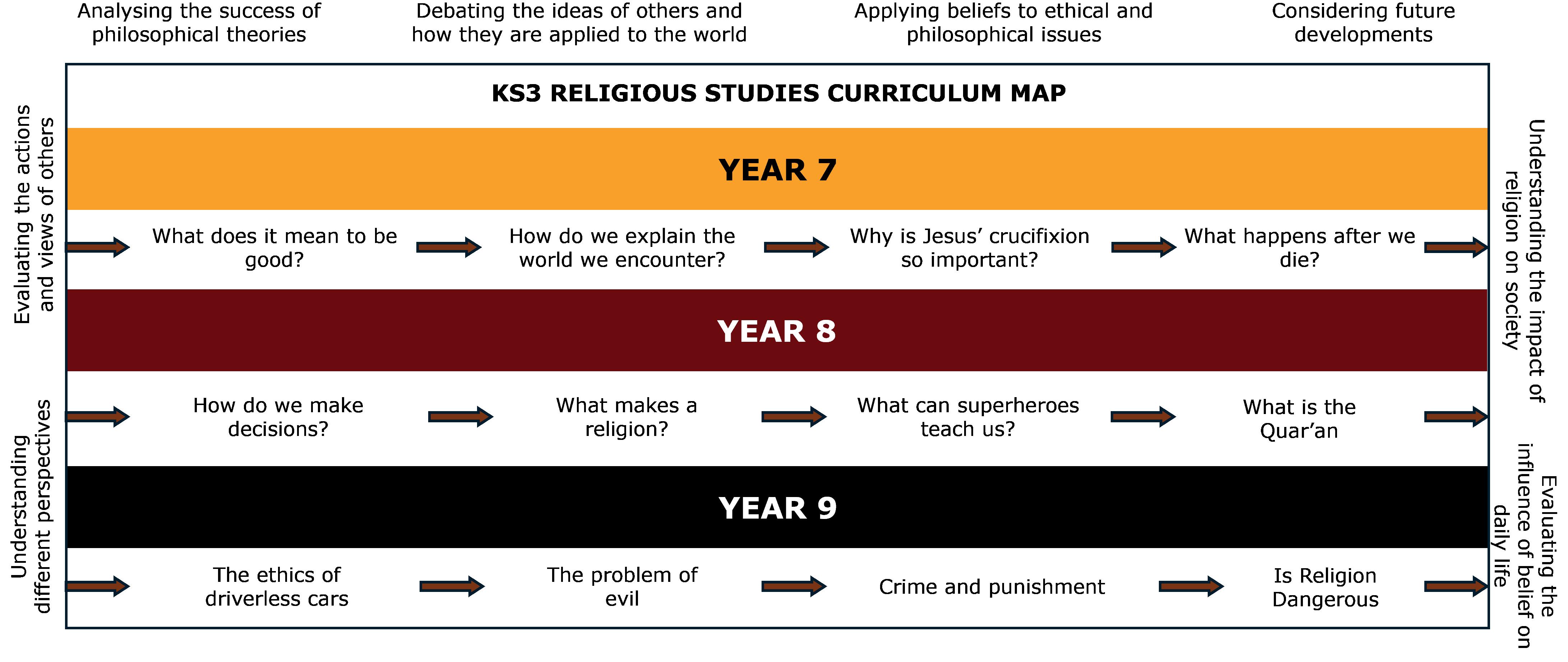
Curriculum Rationale: Much of T&P KS3 covers parts of GCSE and A-level courses at an introductory level to give students a good grounding in complex ideas to help students foster an interest in the subject. Cross-curricular links are with history, English and science departments. Year 7 serves as an introduction to the higher-level thinking skills required with philosophy and ethics introduced in the first topic. There is later work on specific religions which feeds into understanding for GCSE. Year 8 builds on the ethical knowledge from earlier by looking at specific ethical dilemmas and considering how different believers might respond to them. Some of these are also directly studied at GCSE and A-level. Likewise, the ‘Does God exist?’ topic is a simplified starting point for a greater philosophical problem considered in the examination years. Year 9 again shares some topics covered in the examination years at an introductory level. This serves to introduce concepts to the students in the hope that it is challenging and engaging in order to encourage uptake at GCSE level.
Science Curriculum Map
Head of Department: Mrs Sarah Kenyon
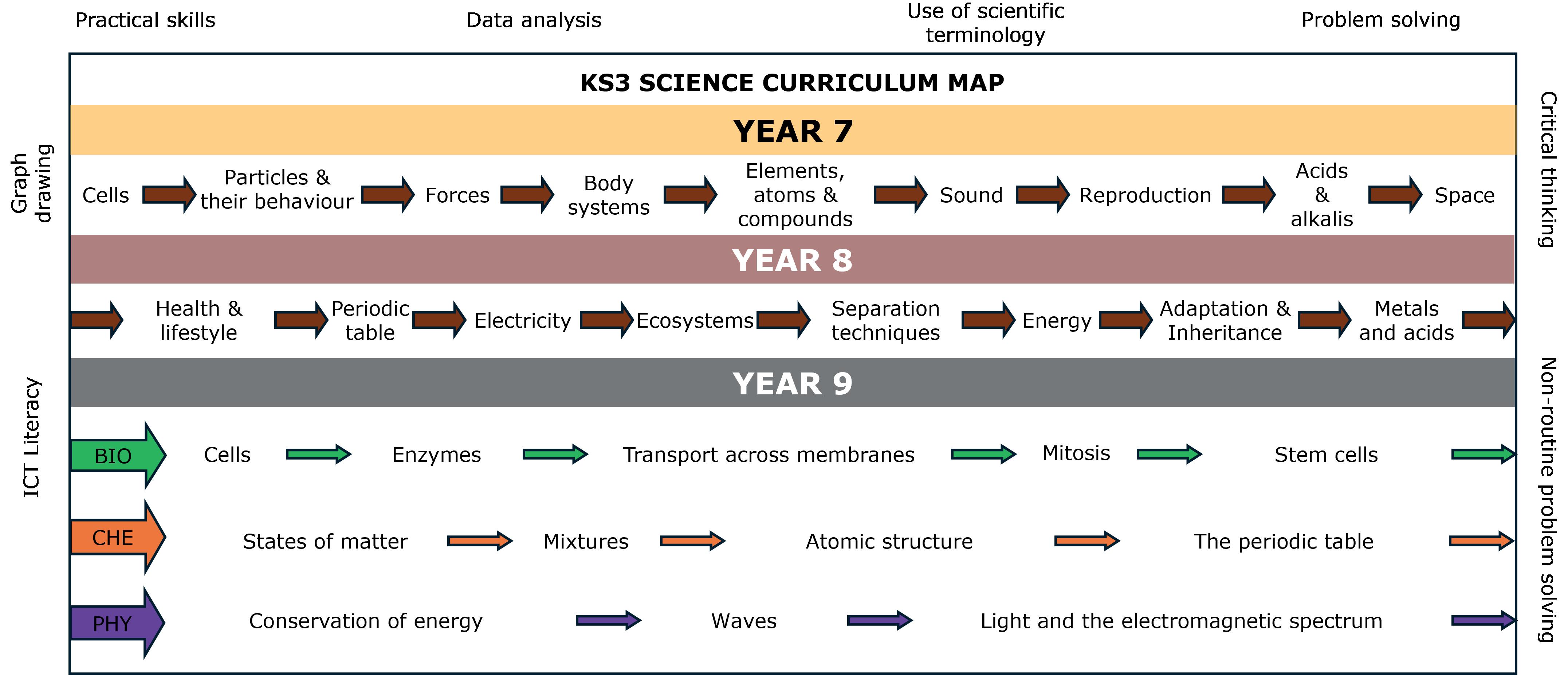
Curriculum Rationale: In Year 7 and 8 we use the Oxford Smart Activate scheme for KS3 Science because it offers a well-structured, engaging curriculum that supports every child’s progress. It builds on primary science knowledge and prepares students for GCSEs through clear learning pathways and exciting, real-world contexts. The scheme encourages curiosity, independent thinking, and confidence in science. With digital tools like Kerboodle, we can track progress and tailor support to individual needs. It also celebrates diversity in science, helping students see themselves as future scientists. We believe this approach makes science meaningful, inclusive, and enjoyable for all learners. In Year 9, students follow the Edexcel GCSE Sciences curriculum on the three-year GCSE route. Year 9 is used to teach the foundation topics. This approach enables students to spend more time developing practical and analytical skills, getting to grips with the ‘How Science Works’ component of the course. It also prepares students and helps make decisions as to whether students will continue with Combined Science or Triple Award Science in Year 10.
Spanish Curriculum Map
Head of Department: Mr Ari Alejandro
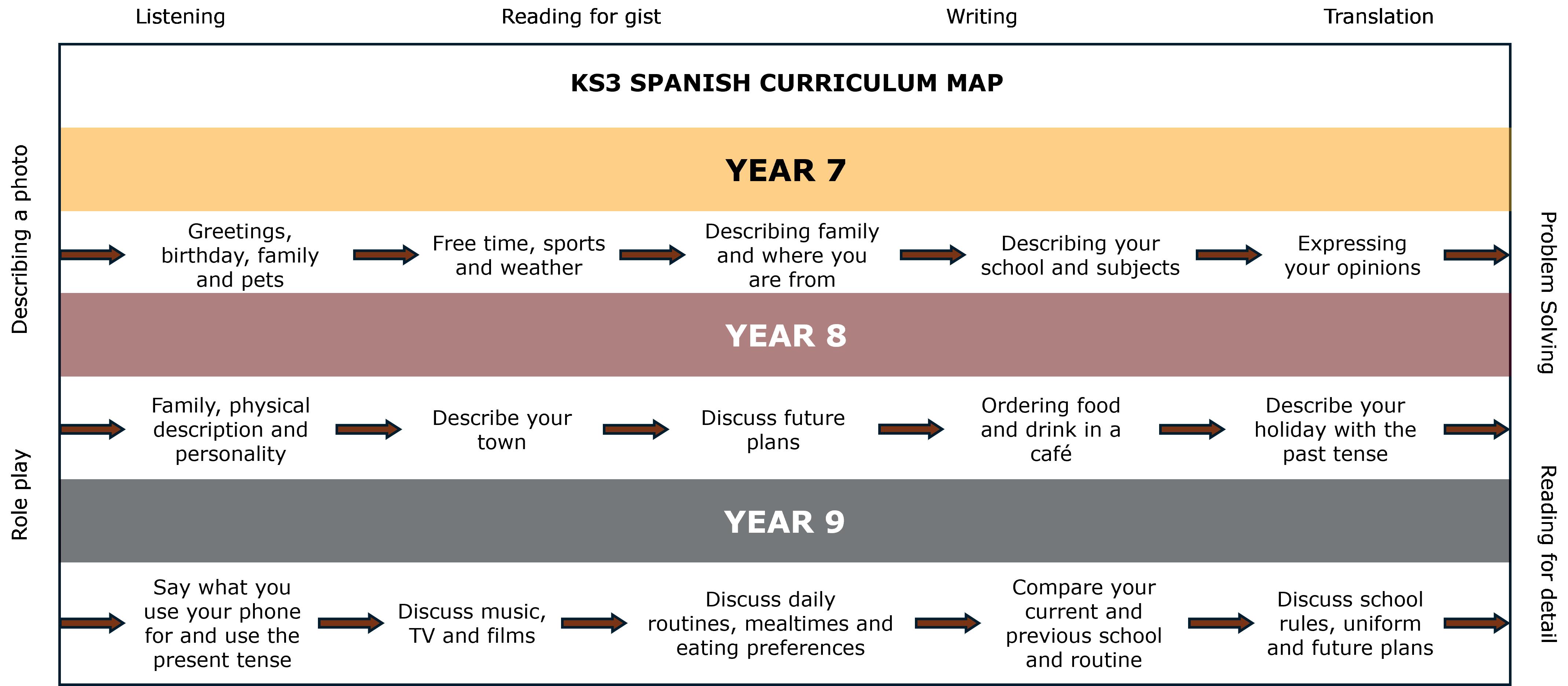
Curriculum Rationale: The Viva 1, 2 and 3 course has been chosen as it equips pupils with the language learning skills they require for GCSE study (listening, reading, writing and translation) and introduces them to exam-style questions and techniques. Vocabulary and structures are recycled throughout, gradually building up a base of the basics required at GCSE. There is clear grammatical progression with activities and scaffolding designed to build confidence and skills in the four areas tested at GCSE: speaking, listening, reading and writing. There are also opportunities to deepen cultural understanding and promote life-long language learning.