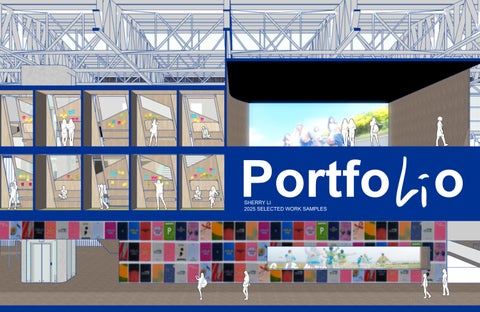
Portfo
SHERRY LI
2025 SELECTED WORK SAMPLES
Emotional Architectures of Connection 63 Flushing Ave, Brooklyn, NY 11205
NeuroHorizon: Bridging Individuals Through Movement 10010 North Torrey Pines Road, La Jolla, CA
Nara Teahouse: Where Urban Life and Serenity Embrace in Soho 110 Prince St, New York, NY 1940s Woodside Townhouse: Adaptive Reuse 2841 56th Pl, Woodside, NY 11377
Rejuvenating Macau:
Fantopia
63 Flushing Ave, Brooklyn, NY 11205
BFA Interior Design
[Innovative Design Award]
Spring 2025 Design Studio 6
Instructor: Nina Freedman
Fantopia explores K-pop fandom as a constructed theater of desire and control, where fans and idols participate in a reciprocal gaze shaped by digital platforms and industry systems.
The design translates Freud’s psychic triad into a sequential spatial journey that guides users from raw emotional immersion to reflective mediation and finally to critical evaluation. Each zone employs distinct atmospheres, including saturated dreamlike environments, neutral reflective spaces, and museum-like clarity, to mirror shifts in psychological state. Through this choreography of spaces, the project exposes the social, emotional, and ethical structures embedded in fandom culture and invites users to question their own roles within it.


wants you to do what’s morally right.

tries to balance what you want and what’s right.
wants what feels good right now.
CONCIOUS
UNCONCIOUS
Fantopia transforms Freud’s Id, Ego, and Superego into three spatial zones that lead visitors from immersion to reflection to critical awareness.


The idea of holding, trading, and arranging these cards shaped the use of repeated rectangular modules throughout the space.
At the same time, the design borrows from the flexibility of paper itself. Folding and unfolding isn’t just a visual reference—it becomes part of how the space works. Sliding doors, foldable tables and chairs, and movable dividers let users change their surroundings depending on what they need in the moment, whether that’s privacy, social connection, or time for reflection.


Extracting the geometry from a box of trading cards...
Using the geometry to design mechanism behind doors.
The model studies and early sketches explore the concept of a space where memory, fantasy, and critical thinking can all overlap through repeating shapes, folding structures, and soft gradient colors that hint at emotional shifts and transitions.
Elevation View of Concept Model
Plan View of Concept Model


Inspired by Freud’s Id, Ego, and Superego, the project unfolds as three sequential zones that guide visitors from emotional immersion to self-reflection and critical awareness. Each zone is defined by technologically mediated environments: the Id Space immerses visitors through projection walls, AI idol interactions, and a sound-insulated Scream Room; the Ego Space introduces VR reversals, testimonial recording, and data visualization to prompt introspection; and the Superego Space opens into interactive ethical simulations and digital archives of fan activism that encourage dialogue. As illustrated in the exploded diagram and floor plan, technology operates as the connective tissue that choreographs this psychological journey.

Expression at the Fanfiction Projection Wall

Reflection at the Observation Core

Observation
at the screening auditorium

Connection at the Dialogue Roundtable

An Archive Room that preserves fan-made items and related literature, a physical metaphor for a fan’s heart being seen, held, and valued.


NeuroHorizon
10010 North Torrey Pines Road, La
Jolla, California, 92037
2024 John P. Eberhard Student Design Competition
[Honorable Mention]
Spring 2024 Design Studio 4
Instructor: Victor Dadras
Partner: Irene Kwon
NeuroHorizon explores how movement stimulates brain development and strengthens neural pathways, using spatial design to enrich human interaction and cognitive awareness. By aligning interior rhythms with natural cycles—especially the path of the sun—the project creates environments that encourage the body to move intuitively and reconnect with the surrounding landscape.
The boardwalk leads to a calm, open platform overlooking the Pacific Ocean, offering a moment of stillness after a journey of guided motion. This final space invites contemplation and restoration, allowing visitors to deepen their connection with nature and themselves.

Beyond the end, a new horizon.

The boardwalk culminates in a tranquil open space, designed for quiet contemplation and unobstructed views of the Pacific Ocean. This serene spot encourages visitors to connect with nature, fostering deep reflection and renewal.

Through ramps and pathways aligned with the sun, the project highlights its movement, offering a timeless connection that resonates with all generations.


By designing spaces that allow for the observance and appreciation of the sun's movement, the project offers a shared experience that bridges generational gaps.
Third Floor Ball Room at Night


500 ft Boardwalk (5 min walk in 3 mph)
Initial Sketch of Building Elevation
Physical Model Exploring Building's Relationship with its Surroundings
L2 PLAN SCALE: 1/8" = 1'
Nara Teahouse
110 Prince St, New York, NY 10012
Fall 2022 Design Studio 1
Instructor: Nina Freedman
Soho’s urban fabric is shaped by narrow streets, historic walk-ups, and a long tradition of small, craftdriven storefronts. This context provides an intimate backdrop for Nara Teahouse, where neighborhood history and contemporary city life meet.
The clients, a family rooted in Japanese tea culture, envisioned a place where their heritage could be shared authentically. They needed a setting that supported both their daily rituals and a welcoming environment for guests.
The design merges living and retail functions by placing the residential quarters directly behind the teahouse. This arrangement allows seamless movement between home and work, while the front-of-house space remains open, warm, and crafted to reflect the calm precision of their tea practice.


ZEN
Physical Model in 1'-0"=1/4" Scale


inspired Dry Garden
A meditative entry space for the tea house, designed with raked gravel and minimal elements to evoke tranquility and cultural immersion.


Zen
Physical Model Built with Wood, Rice Paper and Tea


GROUND FLOOR PLAN
SECTION A-A
Wall Partition Model Built with Wood Rice Paper and Tea
1940s Woodside Townhouse:
Adaptive Reuse
2841 56th Pl, Woodside, NY 11377
This project renovates a 1940s worker’s townhouse in Woodside, Queens, transforming its originally utilitarian layout into a contemporary and flexible home.
The closed kitchen is reconfigured into a half-open communal space that enhances light, connection, and daily living, while the basement is adapted into an independent suite with its own bathroom, kitchen, and studio-bedroom. Together, these interventions reinterpret the historical practicality of the neighborhood’s mid-century housing for modern patterns of openness, autonomy, and multigenerational living. The project began in June, construction started in July, and was completed in December.


The townhouse in Woodside, Queens, was built in the 1940s, when the neighborhood was expanding to house New York City’s growing working- and middle-class population. At the time, Woodside was a residential hub for immigrants, factory workers, and railroad employees, defined by modest brick rowhouses designed for durability, affordability, and efficiency.


Sun path study identifying hours of direct sunlight in the kitchen


The southeast-facing kitchen receives the strongest natural illumination in the townhouse. Direct sunlight enters the space 5:30–9:00 a.m. from May–August and 8:00–10:00 a.m. from September–April, providing consistent morning daylight year-round. The lighting strategy therefore prioritizes maximizing natural light and implements minimal, unobtrusive artificial fixtures for post-sunset use, ensuring visual clarity without compromising the space’s openness.
DAYLIGHT DEMONSTRATION ON GROUND FLOOR PLAN
Townhouse Facade Original Kitchen Layout


Finial Kitchen Design
The height difference between the counter and the bar table helps conceal clutter on the work surface.


The original basement layout lacked adaptability and offered minimal quality of living, functioning mainly as a communal area and storage. The redesign focuses on transforming it into a selfsufficient, livable unit.
To achieve the client’s goal of potentially separating this level from the main house, an electrical kitchen and sink were added along the corridor, maximizing functionality within a limited footprint.


The understair area was opened up and rebuilt as a compact dining space for two to four people.
Detail Drawing and Elevation of Kitchen Area
Initial Vision of Space
Sketch of Original Condition
Elevation of Dining Area


The studio bedroom is defined by a low partition that gently separates the sleeping zone from the workspace. While offering a degree of privacy for the bed, the short wall still allows light to permeate the entire room, which was essential for creating a warmer, more welcoming, and homelike atmosphere within the compact space.


Original Condition of Basement
BASEMENT FLOOR PLAN
Studio + Bedroom Separated by a Short Wall
Ink Drawing of Studio
Studio Work Space
Semi-Private Area
Rejuvenating Macau: Rooftop Art
11 Tv. do Roquete, Macau
2024 Summer Internship
Company: BENOY
Collaborators: Interns and Senior designers from Benoy East Asia studios.
The Macau Rooftop Rejuvenation project brings new vitality to the city’s UNESCOlisted Historic Centre through murals that merge art, culture, and urban renewal. Drawing from azulejo-inspired geometry, auspicious Chinese cloud motifs, and maritime symbols rooted in Macau’s history as a port city, the designs honor the region’s blended heritage.
A restrained yet contemporary palette of deep blues, terracotta reds, and muted golds maintains visual cohesion while respecting the district’s architectural character. Durable textured paints and weather-resistant finishes support longevity in the subtropical climate, and the strategic placement of motifs along key sightlines allows the rooftops to read as a continuous cultural tapestry across the skyline.


Visible from various key locations across the city, the murals offer dynamic perspectives that shift with the viewer’s position. This creates an engaging experience, encouraging exploration and fostering a deeper connection between the public and Macau’s storied environment.


Rooftop Condition Before Mural
Senado Square: Senado Square is a historic public plaza in the heart of Macau, known for its Portuguese mosaic pavement, colonial architecture, and vibrant urban life.
Ruins of St. Paul’s: The Ruins of St. Paul’s is Macau’s iconic 17th-century church façade, symbolizing the city’s blend of Portuguese and Chinese cultural heritage.
City of Macau

The rooftop murals reinterpret Macau’s layered heritage through a contemporary lens, turning overlooked surfaces into meaningful cultural markers. Each composition blends Chinese symbolism and Portuguese ornamentation into simplified forms that complement the surrounding architecture, enriching the district’s identity and offering a renewed way to experience the city from above.

Heritage and Modernity
Creative Projects
My personal creative practice spans ceramics, crochet, and nail art, with a shared focus on craftsmanship, tactility, and everyday rituals. As a ceramicist, I create handmade tableware and plant pots that balance function and expression, drawing inspiration from nature, birds, and simple organic forms to bring warmth and character into domestic spaces.
Alongside this work, I practice as a self-taught nail artist, a discipline I began during the pandemic and have pursued for nearly six years. My nail art emphasizes polished, luminous, and joyful designs that enhance personal expression, while crochet serves as a complementary medium for slow making and material exploration, reinforcing my interest in creating comfort through handmade objects.


Planter 01: 5" x 5" x 4"
Shell Bowl: 7" x 9"


Lone Bird 03: 7" x 7"
Lone Bird 03: 5" x 5"
Lone Bird 01: 4" x 4"


More Designes @niaji_nails