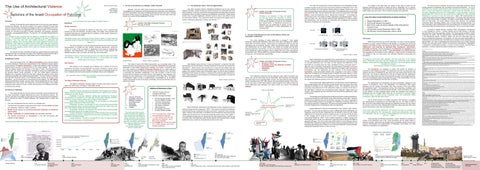
The Use of Architectural Violence Violence::
Written by Shereen Raslan
Tectonics of the Israeli Occupation of Pal Palest estine ine Foreword October 7th brought the world’s attention back to the recurring news segment of Israel and Palestine. As any act of violence, the events of October 7th were “acts of terror” and an atrocity; the taking of hostages as well is an international war crime. Innocent civilians across the segregated land are being caught in the reactionary crossfire of a decade’s long legacy of settler colonialism, land grabbing, apartheid, occupation, and geopolitical tensions. To quote the U.N. Secretary-General Antonio Guterres: “It is important to also recognise that the attacks by Hamas did not happen in a vacuum. The Palestinian people have been subjected to 56 years of suffocating occupation. They have seen their land steadily devoured by settlements and plagued by violence; their economy stifled; their people displaced and their homes demolished. Their hopes for a political solution to their plight have been vanishing, but the grievances of the Palestinian people cannot justify the appalling attacks by Hamas and those appalling attacks cannot justify the collective punishment of the Palestinian people.1” For the past 75 years, the State of Israel has systematically and systemically controlled the lives and restricted the rights of the Palestinian people with the help of their Western allies, including the United States and the United Kingdom. Background Context One could argue that the 1917 Balfour Declaration serves as the foundation for Zionist statehood. Without any representative of the Palestinian people present in the making of the Balfour Declaration, it states that Palestine under the British Mandate was to provide “a national home for the Jewish people”2. This document acted as catalyst towards the formation of the state of Israel. The following years ensued with civil unrest and nationalist movements among the Palestinians and the growing migrant Jewish population. In 1947 the United Nations partitioned Palestine into a separate Jewish and Arab state, despite the rejection of the native Palestinian population and neighbouring Arab states3. The land of Historic Palestine was split with 45 percent given to the Palestinian Arab majority (70 percent of the population) - and 55 percent given to the growing Zionist majority. The 1948 Nakba, meaning Catastrophe in Arabic, was the violent, forced displacement of over 750,000 Palestinians from their homes, the destruction of at least 530 villages, and multiple massacres with a death toll of up to 15,000; with the seizure of 78 percent of the land by Zionist armed forces4. Architecture in Apartheid This article will discuss how the tactics of domicide, Israeli Architecture and the mass construction of illegal settlements are tools of architectural violence. The research will refer to the Rights of Adequate Housing and International Humanitarian law in outlining the state of Israel’s violations. Our research aims to clarify and illustrate:
• • • • •
The use of architectural tools for control in a contested land That the Israeli Occupation is about the control of land, and that shelter and land are intertwined. Therefore, shelter is political. Shelter directly impacts one’s access to resources, healthcare, and livelihood opportunities Shelter, livelihoods, and cultural identity are interrelated with land The physical interventions, or “boundaries”, in the built environment are methods of soft violence
“The planned and deliberate destruction of homes or the destruction of cities or land
Definitions
Research by: Fadhlin Shameer Sara Fathallah Shereen Raslan
1 - The Use of Architecture as a Weapon of War: Domicide Between 1947 and 1949, Zionist armed forces enforced the UN Partition10. The Nakba was the deliberate mass dispossession and destruction of the Palestinian urban and social fabric, with many not realising that they wouldn’t ever return - leaving the deeds of their houses and belongings. Some still hold onto the keys of their lost homes, as a symbol of their legitimacy to this day.
as an instrument of war gives shelter its political nature.” 5
!
Shelter and Home
1.1 - The Palestinian Home: Theft and Appropriation Like other Levantine nations, Palestinian Architecture has its own distinct regional character. Vaulted ceilings and arched windows are constructed with local white limestone. To this day, some of the most appreciated and celebrated vernacular architecture within the State of Israel are by Palestinian construction. Today, labour workers from occupied Palestinian territories travel to work in the State of Israel as construction workers: “The construction sector accounts for the largest share of workers, followed by agriculture, industry, and services.” 12
2 - The Use of Architecture as a form of Surveillance, Divide, and Intimidation: Settlements
Soft violence is not a physical act of violence, but a method of control to dominate on the basis of social prejudice8. Its power is symbolic in nature, and is active in the architecture of those it targets. It may not pose an immediate threat, but is an underlying one and has the capacity to facilitate violence and subjugation. “...soft, insensible, almost invisible form of violence, exercise by symbolic channels.” - Pierre Bourdieu The Right of Adequate Housing
Angela Kirkwood
Badran, Chapter 5, pg 384-395
The State of Israel’s first official interventions, as a sovereign state, in the built environment was through the process of domicide. Domicide is the systematic destruction of vital civillian infrastructure, buildings, and homes. It should be seen as a clear violation to the Rights of Adequate Housing and as a tactic leading to ethnic cleansing. Methods of domicide are used in order to displace, harm, and erase a community and population. Additionally, in the case of Israel, in order to move forward with land clearance and down the line, land grabbing. Land clearance can presently be seen taking place in the bombardment of the Gaza Strip. This degree of devastation makes a house or neighbourhood uninhabitable for its occupants, makes it impossible for them to live there comfortably, and ensures that they have no option but to leave.
Abed Badran coined the term “crush and transform” to describe the theft, appropriation and transformation of existing Palestinian homes that were saved from demolitions13. These houses were transformed to house the first settlers after the 1948 Nakba. The preserved homes were adapted to fit the cultural norms of the first settlers, the majority of which were of European origins. As can be seen by Badran, Palestinian stone houses are shown in contrast to the modernist style extensions in black. These hybrids are some iterations of architectural appropriation, to house the new growing population. Badran, Chapter 5, pg 403-419
The Rights of Adequate Housing outlines conditions that protect a person’s right to live with privacy and dignity. These rights include: • “Security of tenure: Housing is not adequate if its occupants do not have a degree of tenure security which guarantees legal protection against forced evictions, harassment and other threats. • Availability of services, materials, facilities and infrastructure: Housing is not adequate if its occupants do not have safe drinking water, adequate sanitation, energy for cooking, heating, lighting, food storage or refuse disposal. • Affordability: Housing is not adequate if its cost threatens or compromises the occupants’ enjoyment of other human rights. • Habitability: Housing is not adequate if it does not guarantee physical safety or provide adequate space, as well as protection against the cold, damp, heat, rain, wind, other threats to health and structural hazards. • Accessibility: Housing is not adequate if the specific needs of disadvantaged and marginalised groups are not taken into account. • Location: Housing is not adequate if it is cut off from employment opportunities, health-care services, schools, childcare centres and other social facilities, or if located in polluted or dangerous areas. • Cultural adequacy: Housing is not adequate if it does not respect and take into account the expression of cultural identity.”9
a. Palestinian City
The urban planning of Israeli settlements is strategic16. Their spatial distribution disconnects Palestinian cities from each other, disrupting the existing urban fabric and social cohesion. Where there are settlements, there are also the supporting road and transport systems. Within the apartheid regime, Israeli roads and infrastructure are for Israeli citizens only. Roads cut through and surround existing Palestinian communities, as well as restricting the freedom of movement of the Palestinian people throughout what is legally their land under International Humanitarian Law. This has effects on a person’s access to education, to healthcare, to resources, and employment opportunities.
The home embodies not just the physical architectural form but the symbolic representations of oneself and their identity: emotional attachments, someone’s routine, or a way of life. Its location is dependent on its access to employment, education, vital infrastructure, and community. The home is what grounds and stabilises people to their connection with their land and communities.
Soft Violence
“Housing is not adequate if it does not respect and take into account the expression of cultural identity” - Palestinian homes cannot be adequate to the Zionist population as they do not represent their cultural norms - or Palestinian homes are not respected and are inadequate as homes, as the cultural craftsmanship is being appropriated as someone else’s
Pre 1948
“Adequate housing, even if temporary, protects people’s dignity and gives them the opportunity to lead a normal life. Shelter is also key to reducing vulnerability and build resilience.”6
“The feeling of having a home and being at one’s own safe and secure place filled with familiarity, comfort, and emotional attachment, is a both intimate and socially shared aspect of the sense of belonging”7
Violation of the Right of Adequate Housing: Cultural Adequacy
!
Violation of the Right of Adequate Housing: Security of Tenure
A shelter can physically be defined as walls and a roof, a structure that protects you from the elements, provides privacy, and safety. One’s physical and emotional well-being are correlated with the conditions of their shelter. Everyone is entitled to protection and shelter.
Pre-1948, the development of Zionist settlements were strategically situated at critical circulation routes and main roads at the outskirts of a Palestinian City18. The settlements filled in the voids between existing cities and villages, slowly surrounding them and separating communities from each other. The settlements had control of the entry points into cities. This also allowed the easy access of armed forces in the 1948 Nakba, to enter the Palestinian City to “cleanse and confiscate”19 - to envelope the city and take control. This pattern is called “segregation and defragmentation”, where cities are taken over and culturally erased through demolitions of historic centres and development, and the process of condensing and enveloping the remaining Palestinian inhabitants into small ghettos.
Statistics of Destruction in Gaza !
11
۞ 100,000+ housing units are completely destroyed ۞ 250,000+ damaged buildings: • Security of Tenure • 432 Educational facilities - more • Availability of Services, than 60 UNRWA Facilities Materials, Facilities, • 175 Press Headquarters and Infrastructure • 199 Gaza Heritage Sites • Habitability • 624 Places of Worship • Accessibility • 186 Ambulances • Location • 93 Hospitals and Clinics • 20 WHO WASH Facilities “We must demand that all parties uphold and respect their obligations under international humanitarian law, take constant care in the conduct of military operations to spare civilians and respect and protect hospitals and respect the inviolability of UN Facilities, which today are sheltering more than 600,000 Palestinians.” U.N. Secretary-General Antonio Guterres, October 2023
۞ 70% of housing units in Gaza have been damaged or destroyed ۞ 1.7 million people have been left homeless and displaced - that is 80% of the population ۞ Not a single fully functioning hospital for 2.2 million people - only 12 are partially functioning
Violation of the Right of Adequate Housing: • Security of Tenure • Availability of Services, Materials, Facilities, and Infrastructure • Habitability • Location
!
The Palestinian Territories that are subjected under Israeli Occupation and military law, are the Gaza Strip and the West Bank. Both territories are separated from each other by the sovereign State of Israel. The Gaza Strip has been under a military blockade since 2007, after Hamas was democratically elected. Since then, no one can enter or leave Gaza without a permit issued by the state of Israel. All Israeli settlements were withdrawn from Gaza in 2005, as a result of the Second Intifada17. Gaza “Iron Wall” Barrier
West Bank Apartheid Wall Watchtowers
Baron Rothschild, influenced by the Palestinian homes, designed houses for newly oncoming Zionist immigrants in 190014. The houses mimicked the Palestinian style through the use of vaults and the stone construction, vernacular to the Levantine region. However, they were later on modified to accommodate the new tenants as the “settlers did not want to live in houses that looked like Arab houses (Turel, 2008)”15. The modifications added were to “westernise” the Arab looking houses, with the use of red tile roofs. This might have been the first iteration of the present style of Israeli settlements today, which are characterised by their red tile roofs.
Types of Architectural Boundaries in Apartheid
Vegetation & The Green Line
Checkpoints: Turnstiles, Caged Routes and Walkways
Settlements Segregated Road Networks
The settlers in the West Bank are citizens of the State of Israel and are therefore protected and conform to Israeli civil law on Palestinian soil. In contrast, Palestinians in the West Bank are not protected by the Israeli state, and conform to Israeli military law and control. This is colonial occupation and apartheid.
Laws that deem Israeli Settlements as illegal violations:
26
Hague Regulations of 1907 The Fourth Geneva Convention War Crime under the Rome Statute of the International Criminal Court ۞ UN Security Council Resolution 465 in 1980 ۞ UN Security Council Resolution 2334 in 2016 ۞ ۞ ۞
b. Zionist Settlement
Conclusion Post 1948
c. Cleansing & Confiscation
d. Demolition/Segregation & Defragmentation Badran, Chapter 5, pg 360
Within the built environment of the West Bank, it is clear to see the systemic imbalance of power. Israeli Architecture built illegally on occupied land serves the purpose of the State of Israel, and disrupts the way of life of the Palestinian people. Settlements, road networks, the Apartheid Wall, checkpoints, watchtowers, barricades and fences, and the management of earthworks and vegetation all act as methods of obstruction and control27. These boundaries act as physical barriers that segregate the land based on ethnic affiliations, restrict access to infrastructure and facilities to only one social group, and suffocate Palestinian communities and economies.
Israeli settlements are residential zones constructed to house only citizens of Israel. They are funded by the State of Israel and external donors, and built illegally on occupied Palestinian land. The state of Israel supports the settlements in the West Bank by “providing lower tax rates, subsidised housing, and easier loans”20. Agencies such as Amnesty International, the International Committee of the Red Cross, and the United Nations deem the settlements as illegal under International Humanitarian Law. The settlements are clear violations of the Fourth Geneva Convention; a law that protects people under occupation in war zones. It clearly states that it is illegal for an occupying power to transfer and house citizens in a land that they are occupying21. However, the process of land grabbing in the West Bank through the use of settlements and population transfers were in motion since Israel first seized the Palestinian territory in the 1967 Arab-Israeli War22.
“It created an environment that’s unlivable. The crime was done on the drawing board. Settlements have been built like wedges that consciously create material damage, cutting apart the fragile Palestinian built fabric. This is architecture used by architects as a weapon.” - Eyal Weizman, Director of Forensic Architecture28
Fast forward today, illegal settlements in the West Bank restrict Palestinians from moving between their own territory as they would have to go around the Israeli settlements protected by the Israeli Defence Forces. The residential zones and supporting built infrastructure of the settlements make up 3 percent of the land in the West Bank23. However, the accompanying roads, highways, military bases and outposts, and designated security areas that come along with the settlements, make up 40 percent.
The watchtowers and checkpoints are tools of apartheid, designed for the purpose of surveillance, control, and degredation. The checkpoints utilise caged walkways that are usually overcrowded, with many queuing in line hours before the checkpoints open29. The experience is tiring, time consuming, unsanitary, and humiliating as people are herded through like animals. These boundaries are actors of soft violence, as they symbolise Israeli control and dominate every aspect of Palestinian life. As of August 2023, there are “49 checkpoints constantly staffed by Israeli forces or private security companies, (and) 139 occasionally staffed checkpoints” within the West Bank alone.30
This strategy of land grabbing directly affects and delays ongoing negotiations, as Israel has funded and controls these huge, self-sustaining communities - using the settlements as legitimate claims to the land they rest upon. The cycle of negotiations is an endless losing process in the struggle for a Palestinian sovereign state due to the ongoing expansion of settlements, the seizure and appropriation of houses, and the forced displacement of Palestinians within the West Bank. Israeli settlements today are characterised by their “western style” sloping, red roofs24. The red roofs are distinct in order to differentiate Israeli settlements and Palestinian ones from the sky. Palestinians are not allowed to have red roofs. Israeli settlements are intentionally situated at higher ground, on the tops of hills because of their vantage point in order to act as a form of surveillance - monitoring the surrounding Palestinian cities25. From a military standpoint, a higher vantage point means being able to survey your opponent in ways they cannot, but also the ability to approach with ease. This can be seen in the 2002 invasion of Jenin Refugee camp in the West Bank. Bulldozers charged into the dense urban area destroying homes, and damaging walls allowing foot soldiers to move through Palestinian homes discreetly. Utilising the Palestinian homes, in their art of war.
The boundaries are designed to control and restrict the freedom of movement of the Palestinian people. The settlements and their accompanying road systems are forms of apartheid as they serve only one social group living on the same land. The cluster of settlements on the top of hilltops and the watchtowers used by the military both look down and symbolise the power of the Israeli Apartheid. The use of checkpoints clearly showcases the power of the Israeli Military over the movement of the Palestinians and their lack of freedom.
Due to Israel’s policies and military occupation, the economy is struggling and opportunities of employment in the West Bank are low. The State of Israel is also in control of agricultural lands belonging to Palestinian farmers and can restrict the access to their own lands, affecting their livelihoods. Many labourers with Israeli issued work permits, cross over into Israel to work. “Who builds those [Israeli] settlements? The workers! And then we complain why Israel builds settlements. We - the labourers - are the ones building them, but there is no alternative. We are not doing it to build settlements, but if we don’t work, we can’t live. – Wajih”31 These physical architectural boundaries in place, facilitate the policing and control of the Palestinian way of life. These boundaries aid the Israeli military in enforcing curfews, military law and brutality such as detentions without trial and due process, disconnection and fragmentation of Palestinian communities, and other methods of intimidation and degradation.
The control of land is political, as Israel is the responsible power for issuing building permits on Palestinian soil. According to Amnesty International: “The Israeli authorities have created a discriminatory urban planning and zoning system. Within Area C, where most settlement construction is based, Israel has allocated 70% of the land to settlements and only 1% to Palestinians. In East Jerusalem, Israel has expropriated 35% of the city for the construction of settlements, while restricting Palestinians to construct on only 13% of the land.”32 Since 1967 Israel has been in control of the water resources within the West Bank33. This means they also have the power to shut off the water. In addition, the State of Israel steals rainwater coming from the West Bank, and Israeli Defence Forces have removed and damaged community water harvesting cisterns. Due to Israeli urban planning policies, it is near impossible to get a building permit from the Israeli Army to construct new water collecting facilities and infrastructure in the West Bank. This is a human right violation. According to Jewish historian, Zachary Foster, demographic management is a key strategy for control34: a Jewish majority and an Arab minority, or perhaps the elimination of the Arab population entirely. The Zionist agenda conflates “Jewish prosperity and safety” with the dispossession, disenfranchisement, and expulsion of the Palestininan people. Therefore, shelter and land are intrinsically used as tools of architectural oppression. As architects, we have the social responsibility to understand and prevent the use of architecture as a weapon of war, oppression, and discrimination. Our role in manipulating the built environment and in urban planning policies can have great social, cultural, and economic repercussions. Segregation or Apartheid is orchestrated by design - in order to control, monitor, and dominate a population, a system requires the proper infrastructure to facilitate it. Footnotes 1 “UN Chief Says Hamas Attacks Didn’t Happen in a Vacuum.” YouTube, October 25, 2023. 2 Zena Al Tahhan, “More than a Century on: The Balfour Declaration Explained,” Al Jazeera, November 2, 2018. 3 Ad Hoc Committee on the Palestine Question, and Alex Winder. “UN Partition Plan, 1947 - Paving the Way to the Impending Nakba.” palquest, November 2021. 4 Haddad, Mohammed. “Nakba Day: What Happened in Palestine in 1948?” Al Jazeera, January 10, 2024. 5 Charles Parrack, Brigitte Piquard, and Cathrine Brun, “Shelter in Flux,” Shelter in flux | Forced Migration Review, June 2017. 6 “Shelter and Settlements,” European Civil Protection and Humanitarian Aid Operations, May 4, 2023. 7 Tuuli Lähdesmäki et al., “Belonging and Home,” Learning Cultural Literacy through Creative Practices in Schools, November 3, 2021, 99–115, https://doi.org/10.1007/978-3-03089236-4_7. 8 “Symbolic Violence Defined and Explained with Examples.” Web log. Cultural Reader Article Summaries and Reviews in Cultural Studies (blog). Blogspot, July 8, 2021. 9OHCHR, “The Human Right to Adequate Housing | OHCHR,” United Nations Human Rights Office of the High Commissioner, November 26, 2021. 10 Al Jazeera, “Maps and Data Visualisations about Palestine,” Destroyed Palestinian villages: depopulation statistics and maps - Palestine Remix, August 20, 2020, https://remix. aljazeera.com/aje/PalestineRemix/maps-and-data-visualisations.html. 11 So Informed (@so.informed), An update on Gaza | 3.7.24, March 7th 2024, https://www.instagram.com/p/C4NvnsSO4F9/?utm_source=ig_web_copy_link&igsh=MzRlODBiNWFlZA==. 11 Sanders, Bernie. “It Is Time to Say No to Netanyahu’s War Machine.” YouTube, March 7, 2024. https://www.youtube.com/watch?v=4rtDwSu2GPU. 11 UNRWA. “UNRWA Guesthouse in Southern Gaza Receives Three ...” United Nations Relief and Works Agency for Palestine Refugees in the Near East, November 13, 2023. https://www.unrwa.org/newsroom/official-statements/unrwa-guesthouse-southern-gaza-receives-three-direct-hits-israeli-Forces. 12 Keren Manor and Wael Alhersh, “Palestinian Labor in Israel,” Interactive Encyclopedia of the Palestine Question, March 21, 2009. 13 Abed Badran, “Space Design, Making and Tectonics in Palestinian Architecture in Israel: Impacts of the ‘Israeli Project,’” Space Design, Making and Tectonics in Palestinian Architecture in Israel: Impacts of the Israeli Project (thesis, Cardiff University , 2018), 389-419. 14 Ibid, 69. 15 Ibid. 16 Abdullatif, Karim. “Apartheid Architecture: The Violent Urban Design in Occupied Palestine.” Scene Now, October 22, 2023. https://scenenow.com/Home/Apartheid-Architecture-The-Violent-Urban-Design-in-Occupied-Palestine#:~:text=%E2%80%9CIt%20created%20an%20environment%20that’s,by%20architects%20as%20a%20weapon.%E2%80%9D. 17 The Editors of Encyclopædia Britannica, “Israel’s Disengagement from Gaza,” Encyclopædia Britannica, October 24, 2023, https://www.britannica.com/event/Israels-disengagement-from-Gaza. 18 Abed Badran, “Space Design, Making and Tectonics in Palestinian Architecture in Israel: Impacts of the ‘Israeli Project,’” Space Design, Making and Tectonics in Palestinian Architecture in Israel: Impacts of the Israeli Project (thesis, Cardiff University , 2018), 360. 19 Ibid. 20 AJ+, “Israeli Settlements Explained,” YouTube, July 1, 2014, https://youtu.be/1sib5HbdEV4?si=1dOV71BGNOZ_6nVt. 21 Amnesty International, “Chapter 3: Israeli Settlements and International Law,” Amnesty International, July 29, 2021, https://www.amnesty.org/en/latest/campaigns/2019/01/chapter-3-israeli-settlements-and-international-law/. 22 AJ+, “Israeli Settlements Explained,” YouTube, July 1, 2014, https://youtu.be/1sib5HbdEV4?si=1dOV71BGNOZ_6nVt. 23 Ibid. 24 Abdullatif, Karim. “Apartheid Architecture: The Violent Urban Design in Occupied Palestine.” Scene Now, October 22, 2023. https://scenenow.com/Home/Apartheid-Architecture-The-Violent-Urban-Design-in-Occupied-Palestine#:~:text=%E2%80%9CIt%20created%20an%20environment%20that’s,by%20architects%20as%20a%20weapon.%E2%80%9D. 25 Ibid. 26 Amnesty International. “Chapter 3: Israeli Settlements and International Law.” Amnesty International, July 29, 2021. https://www.amnesty.org/en/latest/campaigns/2019/01/chapter-3-israeli-settlements-and-international-law/. 27 OCHA. “Movement and Access in the West Bank: August 2023.” Movement and Access in the West Bank | August 2023, August 25, 2023. https://www.ochaopt.org/2023-movement. 28 Abdullatif, Karim. “Apartheid Architecture: The Violent Urban Design in Occupied Palestine.” Scene Now, October 22, 2023. https://scenenow.com/Home/Apartheid-Architecture-The-Violent-Urban-Design-in-Occupied-Palestine#:~:text=%E2%80%9CIt%20created%20an%20environment%20that’s,by%20architects%20as%20a%20weapon.%E2%80%9D. 29 AJ Labs, and Active Stills. “Israel’s Military Checkpoints: ‘We Live a Life of Injustice.’” Israel’s military checkpoints: “We live a life of injustice,” 2018. https://interactive.aljazeera.com/ aje/2018/commuting-through-israeli-checkpoints/index.html. 30 OCHA. “Fact Sheet: Movement and Access in the West Bank, August 2023 - Occupied Palestinian Territory.” ReliefWeb, August 25, 2023. https://reliefweb.int/report/occupied-palestinian-territory/fact-sheet-movement-and-access-west-bank-august-2023. 31 AJ Labs, and Active Stills. “Israel’s Military Checkpoints: ‘We Live a Life of Injustice.’” Israel’s military checkpoints: “We live a life of injustice,” 2018. https://interactive.aljazeera.com/ aje/2018/commuting-through-israeli-checkpoints/index.html. 32 Amnesty International. “Chapter 3: Israeli Settlements and International Law.” Amnesty International, July 29, 2021. https://www.amnesty.org/en/latest/campaigns/2019/01/chapter-3-israeli-settlements-and-international-law/. 33 Amnesty International. “The Occupation of Water.” Amnesty International, November 29, 2017. https://www.amnesty.org/en/latest/campaigns/2017/11/the-occupation-of-water/. 34 Halper, Katie. “Jewish Historian Debunks Zionist Propaganda with Zachary Foster.” YouTube, February 21, 2024. https://www.youtube.com/watch?v=hLQye3x2YSI. Collage 1 AJ Labs. 1917 Pre-British Mandate Palestine. Al Jazeera. Al Jazeera, November 27, 2023. https://www.aljazeera.com/news/2023/11/27/palestine-and-israel-brief-history-mapsand-charts. 2 Britain, France Draw Borders of Modern Middle East. World101. Council on Foreign Relations, March 2020. https://world101.cfr.org/sites/default/files/styles/fluid_1200/public/ images/photo/2022/06/MENA-H1.png.webp?itok=g3-JaTSQ. 3 Ettinger, Shmuel. The Balfour Declaration of 1917. My Jewish Learning. My Jewish Learning, March 2024. https://www.myjewishlearning.com/article/the-balfour-declaration/. 4 AJ Labs. 1920-1946 Jewish Immigration to Palestine. Al Jazeera. Al Jazeera, November 27, 2023. https://www.aljazeera.com/news/2023/11/27/palestine-and-israel-brief-historymaps-and-charts. 5 AJ Labs. 1947 UN Partition Plan (Resolution 181). Al Jazeera. Al Jazeera, November 27, 2023. https://www.aljazeera.com/news/2023/11/27/palestine-and-israel-brief-historymaps-and-charts. 6 AJ Labs. 1948 Palestinians Expelled. Al Jazeera. Al Jazeera, November 27, 2023. https://www.aljazeera.com/news/2023/11/27/palestine-and-israel-brief-history-maps-and-charts. 7 Nassar, Maha. Palestinians leave their Jerusalem neighborhood during the 1948 Arab-Israeli War. The Nakba at 75 – Palestinians’ Struggle to Get Recognition for Their ‘Catastrophe.’ The Conversation Trust, May 11, 2023. https://theconversation.com/the-nakba-at-75-palestinians-struggle-to-get-recognition-for-their-catastrophe-204782. 8 David, Eldan. By the time the war was over, some 700,000 Palestinians left or were expelled from their homes. What Is the Palestinian Nakba and Why Does It Matter? Deutsche Welle, May 15, 2023. https://www.dw.com/en/what-is-the-palestinian-nakba-and-why-does-it-matter/a-65539735 . 9 Abed Badran. “Space Design, Making and Tectonics in Palestinian Architecture in Israel: Impacts of the ‘Israeli Project,’” Space Design, Making and Tectonics in Palestinian Architecture in Israel: Impacts of the Israeli Project (thesis, Cardiff University , 2018), 363. 10 Hussein, Muhammad. Port Said seen from the air during the Suez Crisis. Remembering the Suez Crisis and the tripartite invasion of Egypt. Middle East Monitor, October 29 2022. https://www.dw.com/en/what-is-the-palestinian-nakba-and-why-does-it-matter/a-65539735. 11 Gamal Abdel Nasser. The Arab Republic of Egypt Presidency. https://www.presidency.eg/media/54805/%D8%AC%D9%85%D8%A7%D9%84-%D8%B9%D8%A8%D8%AF-% D8%A7%D9%84%D9%86%D8%A7%D8%B5%D8%B1jpg.jpg. 12 AJ Labs. 1967 Israel Occupies Gaza and the West Bank. Al Jazeera. Al Jazeera, November 27, 2023. https://www.aljazeera.com/news/2023/11/27/palestine-and-israel-briefhistory-maps-and-charts. 13 Al Jazeera. 2017. Six-Year Intifada Was Saturated with Civil Disobedience, Well-Organised Strikes, and Communal CooperativesImage. Edited by Shatha Hammad. https://www. aljazeera.com/news/2017/12/10/stories-from-the-first-intifada-they-broke-my-bones. 14 AFP. 2017. Palestinians with a Portrait of PLO Leader Yasser Arafat React as Foam Thrown by Israeli Soldiers Drops from a Roof during Clashes in January 1988 in Nablus in the West Bank Image. Edited by Chloé Benoist. https://www.middleeasteye.net/news/thirty-years-after-first-intifada-palestinians-look-past-fresh-lessons. 15 Hershorn, Gary , and Reuters. 1993. PLO Chairman Yasser Arafat (Right) Shakes Hands with Israeli Prime Minister Yitzhak Rabin as President Bill Clinton Looks on after Signing the First of the Oslo Accords on the White House Lawn, September 13, 1993. https://imeu.org/article/explainer-the-oslo-accords. 16 Hermony, Ariel , and Israel Defense Ministry. 2021. Israel Completed the Construction of a Barrier around the Gaza Strip, to End the Threat of Cross-Border Attack Tunnels. https:// www.i24news.tv/en/news/israel/defense/1638891792-israel-announces-completion-of-gaza-barrier. 17 AJ Labs. 1993 & 1995 Oslo Accords. Al Jazeera. Al Jazeera, November 27, 2023. https://www.aljazeera.com/news/2023/11/27/palestine-and-israel-brief-history-maps-andcharts. 18 Gallo. 2010. What Began as a Few Hundred Protesters Throwing Shoes at Sharon(***)S Police Escort Erupted into Demonstrations across the Palestinian Territories . Getty Images. https://www.aljazeera.com/gallery/2010/10/3/remembering-the-second-intifada. 19 Awad, Ammar , and Reuters. 2020. Ariel Sharon Sparked the Uprising When He Stormed Al-Aqsa Mosque Compound in Occupied East Jerusalem with More than 1,000 Troops. https://www.aljazeera.com/news/2020/9/28/palestinian-intifada-20-years-later-israeli-occupation-continues. 20 AJ Labs. Occupied West Bank - Illegal Israeli Settlements. Al Jazeera. Al Jazeera, November 27, 2023. https://www.aljazeera.com/news/2023/11/27/palestine-and-israel-briefhistory-maps-and-charts. 21 Beiler, R.R. and Encyclopædia Britannica (2024) Gilo: Jewish settlement near Bethlehem [Image]. Available at: https://www.britannica.com/place/Israeli-settlement#/media/1/2173066/236049 (Accessed: 11 March 2024). 22 Leinbach, Annelisa . n.d. An Israeli Guard Tower at the Qalandia Military Checkpoint in the Occupied Palestinian Territory, Separating East Jerusalem from Ramallah. Accessed March 11, 2024. https://www.hrw.org/news/2020/04/15/covid-19-restrictions-offer-window-palestinian-experience. 23 Ziv, Oren . 2014. A Palestinian Youth Placed a Flag on the Israeli Separation Wall during a Protest Marking Nine Years for the Struggle against the Wall in the West Bank Village of Bil’inImage. https://thegroundtruthproject.org/documenting-sides-separation-wall-israel-palestine-divide/. 24 Amra, Ashraf , and APA Images. 2019. Great March of Return. https://cdn2.opendemocracy.net/media/images/Great_March_of_Return_30KvHAh.width-800.jpg. 25 Beiler, Ryan Rodrick . 2011. The Separation Wall in the Occupied Palestinian Territory and behind It an Israeli Settlements. https://news.un.org/en/story/2020/12/1080542.
Pre British Mandate Population living in illegal settlements Zionism and the Jewish migration to Palestine due to centuries of European antisemitism
1916 Sykes–Picot Agreement
Ottoman Palestine
1920 League of Nations Mandate
1917 The Balfour Declaration
1918 to 1948 The British Mandate for Palestine
1922 Fall of the Ottoman Empire
Pre 1948 Jaffa
1947 UN Partition Plan for Palestine
1948 Al Nakba Arab-Israeli War
1973 Yom Kippur War Syria and Egypt attack Israel - Israel wins but returns the Golan Heights
Post 1948 Tel Aviv-Yafo
1950 Further Demolitions of Palestinian houses and communities
1956 Suez Crisis British, France, Israel invade Egypt for control of the Suez Canal
1967 6 Day War Israel vs. Egypt, Syria, Jordan - Israel seizes Sinai Peninsula, Golan Heights, and the West Bank
2004 UN declares Israeli “Apartheid Wall” and settlements in Golan Heights and West Bank are illegal
1987-1993 First Intifada, The First Uprising 20 Years of Israeli Occupation of the West Bank and Gaza Strip
1990 Negotiations for Water Resource
1993 Oslo Accords
1994 Construction of the Israel - Gaza Barrier
2000 - 2005 Second Intifada, The Second Uprising
2005 Withdrawal of Israeli settlements in Gaza
2008 2007 2012 Gaza Blockade Military Operations
October 7th 2023 Hamas attack on civilians
2014
30 March 2018 27 December 2019 Great March of Return Peaceful protests in Gaza
10th May 2021 11 Days of Fighting Due to Sheikh Jarrah evictions and Al Aqsa Mosque struggle
Israeli bombardment of Gaza Strip