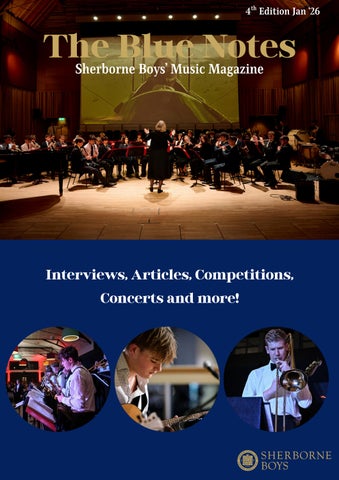
4th Edition Jan ‘26
The Blue Notes Sherborne Boys’ Music Magazine
Interviews, Articles, Competitions, Concerts and more!
CONT Table of Contents
Pg.2
The B u Sherborne
Boys’
INTERVIES, CONCERT ARTICLES
04 >> 05
>>
>> 11
Welcome and Editors Notes
Interviews: Simon Eadon
Friday Lunchtime Recital: Swing Band, Strings, Mince Pies and more...
TENT Table of Contents
Pg.3
ue Notes Music
Magazine
STORIES AND MORE...
>>
Articles, Stories and more
24
>>
Save the dates
30
>>
Thanks…
33
Welcome The Blue Notes - Edition 3 - Oct ‘25
Pg.4
Welcome again, this time to the 4th Edition of The Blue Notes. In this edition, you will see events which took place in the last half of the Michaelmas term. During this busy time in the lead up to Christmas, as well as the triumphs of the Joint Schools’ Production of Les Misérables, everybody in the Music Department including boys and staff have managed to provide you with some wonderful articles in here which I hope you will be able to find for yourself. Throughout the edition, you will see a range of many different articles and stories ranging from the usual Friday Recitals at Cheap Street Church, along with many Joint School events which have been seen. Including the Chamber Choir and Madrigals Society trip to Exeter Cathedral, ‘A Night at the Movies’ which showcased talents from both Sherborne Boys and Sherborne Girls. As well as the Life and Works of Benjamin Britten to how the Baroque period became unexpectedly pivotal in establishing female artists. There certainly is something in here for everyone and I do hope that you find an article which interests you! Happy reading. Sirtaaj G (4a) Editor-in-Chief
An interview with... Retired DECCA Grammy Winner, Sound Engineer
Simon Eadon Interview by Sirtaaj G (4a) How did you first get into Recording Engineering? Was there a particular moment or influence that set you on this path? I really got into recording by mistake. I wanted to go into film production, more than anything else, as a cameraman with the possibility of becoming a director. When I left school, I didn't go to university (graduates were leaving university and unable to find work in the late 1960s) and I had an interest in electronics, but no qualifications, so my father arranged for an interview with a colleague of his from the war who worked for the Decca Radar and Navigator Company. Decca was a large company which had recording studios for its various labels in West Hampstead, a record pressing plant and a manufacturing plant making televisions, record players and stereograms in Battersea, and a Radar and Navigation section in New Malden. So I set off for New Malden and had very good lunch with this chap who, over the course of this meal, realised that I was clearly interested in classical music and recording. He offered to arrange an interview at the recording studios where I was interviewed by Arthur Haddy, the head of Decca Studios. I was taken on for six months, at the end of which I would be retained or dismissed. Six months ended up being twenty-seven years until 1997 when the entire recording department was made redundant on the company’s sale to Universal. Fortunately, because I’d worked for Decca for so long, people knew my name in the recording industry, and it was perfectly possible to carry on with my job as a freelancer.
Pg.5 What kind of music did you grow up listening to? My parents had broad tastes in music. Neither of them were musicians. They played records of classical music and they also played a lot of light music and jazz. Their two blind spots were opera and chamber music. Both these I discovered when I went to Decca and really enjoyed both genres, but I just couldn't understand why they didn't.
When I started at Decca I began in the back rooms copying master tapes. In those days, music was issued on vinyl and because vinyl was heavy, exporting thousands of LPs was expensive. My job was to make a perfect copy of the master tape that would be sent to our licensees abroad - France, Italy, Germany and Japan, for example – and they would cut their own discs and press them locally. The only country where that didn't apply was the United States. We had to send LPs to the United States. During the Second World War, Decca had to sell all its foreign assets. It meant that Decca could not use its own name in the United States once the war was over therefore all the records were pressed under the “London” label. Americans record collectors wouldn't believe that these LPs were pressed in Battersea, so they would order special imports from the UK that had the “Decca” label on because they considered them to be superior pressings, but actually they all came out of the same factory and were identical!
Have you always been connected to music when you were younger and was there a certain point when you knew that you wanted to pursue music? I think, the most memorable ones were before joining the Recording Department – attending opera recordings in Kingsway Hall (a large Methodist church just below Southampton Row and above the Strand in London which had the most sumptuous acoustics). It was designed as a church for the Methodists rather than a recording venue with amazing acoustics. It was as grubby as hell - but everything recorded there sounded fabulous. We shared the venue with EMI.One especially thrilling memory was attending the recording of Rigoletto. Two of the great opera stars of the day, coloratura soprano Joan Sutherland and tenor Luciano Pavarotti, were among the cast recording the famous quartet. It was a privilege to hear them - and at close quarters. The added bonus was, of course, you never do just one take: there would be retakes, and it was a joy to be able to hear it sung again and again. Another musician I remember was Vladimir Ashkenazy, incredible pianist, and it was always a pleasure going to his sessions. As for my first recording session as an engineer ‘flying solo’, that was a recording of contemporary music by Ligeti: Melodien, in July 1975. It went well and everybody seemed very pleased with it.
Simon Eadon is a highly respected classical-music recording engineer whose career began at the Decca Record Company in the early 1970s, where he worked until the closure of its classical department in 1997. After moving into freelance work, he became known for his calm, natural, and uncluttered approach to recording, focusing on clarity, balance, and faithfully capturing the acoustic character of each space. Over the course of his career, he has worked on well over a thousand recordings spanning orchestral, choral, chamber, and solo repertoire, earning a reputation as one of the most experienced and trusted engineers in the field.
An interview with... Retired DECCA Grammy Winner, Sound Engineer
Simon Eadon Interview by Sirtaaj G. (4a) What do you think is the most important skill a recording engineer can develop which is not technical? I think the most important skills that an engineer can develop are diplomacy and empathy. It is also vital to be honest when you feel that either the artist is asking for something which is impossible, or the producer perhaps wants to do something which is not necessarily in the best taste - and to take criticism when you might be guilty of both yourself! A comprehensive sense of humour and ability to appreciate the ridiculous are essential. It is crucial to be able to make good tea and coffee - or knowing where to get them. It is a skill which you have to pick up early on, and I can confirm that it's a talent which you will need all the way through your career, however grey-haired and senior you become. I can remember I used to cook breakfast for the whole of the Choir of Trinity College, Cambridge when the college kitchens were shut on a Sunday morning! College staff weren’t too impressed when the smoke alarms went off as a result. I think that the most important non-technical thing you can do is knowing how to be diplomatic, how to be a team player, and just communicating both with the artist and the producer. When you started at Decca, what was the environment like compared to when you retired? It was so different in the 1970s working in a studio complex. There were three studios, two of them were pop orientated, and the third, and largest one, could accommodate a band of light orchestral musicians. There would be tea breaks, morning and afternoon, and a bizarre hangover from the war, when on Monday mornings only, you were served a cheese roll – we assumed it was to do with war and post-war rationing. The rolls stayed through the 70s, even when we moved buildings in the 80s. There would also be Christmas parties, and milestone anniversaries. Once you become a freelancer you don't have that bonhomie and the ability to come and chat to people or discuss ideas. You're very much on your own. I think that's a sad part about going freelance. On the other hand, you were your own boss, and if you needed an expensive item of equipment, you didn't have to go cap-in-hand to head office and seek capital investment permission. There was no administrative red tape. Either you needed a bit of kit and you had the funds and you went and bought it, or not.
Recording in Westminster Abbey, one of the many 'privilege locations' Simon Eadon has worked in
Pg.6
A privilege to record with: Sir Mark Elder and the Hallé in Manchester's former BBC studios Do you think a career for Recording Engineers is heading in the right direction today? There will always be the need to record spoken word, music, live events. If that is what you are interested in, then yes! You will meet some incredible people, people who become really good friends. The one thing I would take away is the education I have had in cuisine because you eat at some amazing restaurants around the world! Allin-all, I think it has been a fantastic job – I have been so lucky because it has been fun from day one until my last recording session at St John’s College, Cambridge. I would do it all again at the drop of a hat because it has been brilliant.
An interview with... Retired DECCA Grammy Winner, Sound Engineer
Simon Eadon Interview by Sirtaaj G. (4a)
Pg.7
What is a moment in the recording studio that you will never forget? Sorry to keep harping on about Joan Sutherland (she cropped up on an ‘Only Connect’ wall recently!) – but this one concerns her. We were recording an opera by Massenet (‘Esclarmonde’) and we weren't getting the effects that we really wanted from her. I forget exactly the story of the opera, but she has to summon up the spirits of the deep and of the skies and then has to belt out a top C, and it was getting towards the end of the session. We thought if she could go up to the balcony of Kingsway Hall and deliver it from there, it would give us the desired sonic effect that we wanted. Time was of the essence, so she had to really dash up the stairs to the gallery then come down to the front of the balcony. We literally had time for one take, (no try-out) and that would be it - so the orchestra had to be perfect, she had to be perfect and we had to get the balance right. Needless to say it was perfect and it was a tremendous moment. We did some wonderful recordings with Winchester Cathedral Choir with the Bournemouth Symphony Orchestra and Waynflete Singers. We were given limited technical resources because other recordings were going on elsewhere. (Decca could record at about four different locations at once, and I think they had reached the limit.) We only had a small mixing desk and yet had a full symphony orchestra, organ, chorus and Cathedral Choir. They were very special recordings. David Hill was conducting, and they still sound marvellous. Another memorable recording, was with the Philip Jones Brass Ensemble. Again, we had limited technical facilities to record a brass arrangement of the Bernstein West Side Story Suite. There were three trumpets, three trombones, French horns, tuba and percussion. We thought “percussion” would be bass drum and cymbals. But no, it was a drum kit, and we only had two channels left for this drum kit. If you've been to a major pop Studio, you may get ten mics on drum kit, or even more. We used two omni-directional microphones placed near the tom toms, and just panned them left and right, and created the most incredible stereophonic effect. You wouldn't know it was only two microphones. So that was special.
What does it feel like winning a Grammy? I must admit, I was incredibly proud to win a Grammy even though it now lives in the downstairs loo. I've been nominated often enough, usually in the role of Best Engineered recording. It has to be said, the Grammys are quite US-centric. I always felt if you were a British orchestra, you weren't at a great advantage, because American orchestras would join NARAS, which is the voting body, and typically vote for themselves. The Grammy award I won was actually for a recording of the Beethoven String Quartets with the fantastic Takács Quartet. I didn't ever think about going to go to the ceremony. Los Angeles is a long way to go if you were to find yourself not coming first!
'Alina Ibragimova with Cédric Tiberghien at Henry Wood Hall
The Takács Quartet in the studio: a long-standing
Recording in Zurich's Tonhalle, one of Eadon's favourite venues When you walk into a Hall or Studio, what is the first thing you listen for or look to? It's quite hard to resist the temptation to clap one's hands, because that's always what you do to see how the acoustics behave and to see how the sound decays. When I went to hear the Joint Sherborne Schools Choirs singing in Exeter Cathedral recently I did clap my hands - there weren't too many people around. I also tend to listen for heavy traffic, passing buses and planes overhead. These things can really ruin a recording session. Even though I'm retired and have no intention of recording in these places, it's just a force of habit.
An interview with... Retired DECCA Grammy Winner, Sound Engineer
Simon Eadon Interview by Sirtaaj G. (4a) How has recording technology changed since you started? It has changed unbelievably. When I started off we were recording onto quarter inch magnetic tape running at 15 inches per second. Tape was expensive. Multi-track tape, which was typically one inch or two inches, was very expensive. Once digital recording took over, and moved away from tape storage to become solid state memory-based you could have as many tracks as you liked. Every microphone can now be recorded onto its own track. You can remix it afterwards to your heart's content. But the danger with that is you can take your ear ‘off the ball’ because you assume you can fix everything afterwards in the mix. If the balance is not right in the studio it won't ever be right on tape. This idea that you can re-mix everything and get it absolutely wonderful after the event is not necessarily true. Ensuring a proper balance at the time of recording is absolutely crucial. If, for example, the brass is playing too loudly it will bleed into every other microphone. Simply muting the brass mic in the mix will solve nothing. But having said that, the great advantage of digital technology is editing. You can rehearse an edit – the editing process is non-destructive. In the old analogue days you used a chinagraph pencil to physically mark the tape and a razor blade with a cutting block with a forty-five degree angle. The join was secured with sticky tape. You had no control over the level going from one take to another and hoped that the tempi were the same. Editing now is so much more refined.
Stephen Layton with Trinity College Choir
Pg.8 If you had the chance to record with any artists who would it be and why? There certainly are artists I would love to have recorded. I was really lucky. I met some truly amazing legendary artists who were at the top of their game. Of course, some could be tricky. There were some well-known for that, but the great thing about recording sessions is that you're looking at a two to four day period, and then it’s all over – you move on to your next job: different musicians and different venue. Musicians are a fascinating breed. The German conductor, Herbert von Karajan had a reputation for being terse and dictatorial on recordings. Nevertheless, I wished I'd recorded with him, because like all these musicians he was enigmatic and had something musical to say. And It's strange how someone like Joan Sutherland, for instance, was the most down to earth person you could possibly meet, not a prima donna at all. Pavarotti could be prickly. He always felt his voice was never loud enough in the mix - of course, it really was. He possessed the most stunning operatic tenor voice I have ever heard. It wasn’t just the quality of his voice, it was also how he used and coloured words. Yet another singer with a thrilling voice (and wonderful diction), baritone Bryn Terfel, who I worked with a lot, is just a perfectly ordinary, down to earth chap. Over a decade after I’d left Decca, I worked with him on Elgar‘s Dream of Gerontius with the Hallé Orchestra conducted by Mark Elder. He invited my assistant engineer and me for a meal. I wondered why, because there must have
Simon Eadon and Neve 96 channel desk been other more important people to eat with - such as the conductor! He treated us to a delicious curry in Manchester and we chatted over old times. So some artists are real stars and such fun to be with and easy to work with. Conductor David Zinman and the Zürich Tonhalle Orchestra were an especial pleasure to work with, both socially and musically. There is music which I have never recorded. And yet I must have recorded about five or six versions of Handel’s Messiah! I wish I'd recorded Saint Saen's Symphony 3, the ‘organ symphony’, which I really like, and the Verdi Requiem but they just never crossed my path. Thinking about Messiah recordings, there is an amusing story when we recorded it at King's College, Cambridge. There was a horrendous bug going around the choristers and one of the senior boys went up to Stephen Cleobury, the Director of Music, before a take of Since my man came death, and he said he wasn’t feeling well. Stephen asked him to try and stick with it because it was an important chorus. Anyway, the boy did, and at the end of the take, there was the famous reverberation of King's College Chapel dying away. The silence was then shattered as he vomited spectacularly onto the stone floor. My main concern was that the tape machines were still running so that we could play it back afterwards. And they were – that tape still exists!
Friday Lunchtime Recitals Cheap Street Church, Friday, 1.45pm
The Blue Notes
Pg.9 Swing Band Under the direction of Mr Marks 07 November
The first lunchtime recital after the half-term saw the Sherborne Boys Swing Band in performance. Under the direction of Mr Marks, the Swing Band performed a set of eight songs for the audience, including two new numbers. To start the concert off, we heard Joe Zawinul’s Bird Land. This song included lively and fast runs and set a high bar for the rest of the concert. Next, we moved on to Chick Corea’s Spain, from here we heard from new pianist Benji R (L6c), as well as being introduced to new trumpeter Luke AD (4b). Next, the Swing Band performed a well-known number of theirs, with new vocalist Forest P (U6b). Forest sang Sinatra’s Fly Me to the Moon. We then heard from Swing Band vocalist Sam B (U6f). Sam sung Irving Berlin's Let’s face the music and dance.
Seen in the Photos: Archie S-B (U6f)
Patrick R (U6e)
from back to front: Archie S-B (U6f), Patrick R (U6e), Ben H (L6b)
During this, we heard a solo from Tenor Sax player Ben H (L6b) who really showed a great feel for the music. Next, we moved on to Murtha’s Mr Zoot Suit, again sung by vocalist Sam, this time with soloist Archie G (U6f, Captain of the Swing Band) and Charlie S (L6f) on the trumpet. As we drew near to the end of the concert, we heard Louis Prima’s Just a Gigolo, again sung by Sam, we heard solos from Archie S-B (U6f) on the Trombone and another great solo from Ben H (L6b) on the Tenor Sax. As the concert came to an end we heard the final piece an all-time Swing Band classic, Jerry Grey’s Pennsylvania 6-5000, during which there were solos from Charlie S (L6f) on the Trumpet and Patrick R (U6e) on the Alto Saxophone. The concert was a great way to get everybody into the weekend with their feet tapping. Swing Band 2025: Trombones:
Trumpets:
Archie S-B (U6f, Sch.Mus) Jack M (5a, Sch.Mus) Edward K (5g, Sch.Mus) Mr Young (Sch.Cho.)
Archie G (U6f, Sch.Mus, Captain of the Swing Band) Charlie S (L6f, Sch.Mus) James H (L6a, Sch.Mus) Luke A-D (4b, Sch.Mus) Ben T (5f)
Saxophones:
Rhythm Section
Ben H – Tenor Sax (L6b, Sch.Mus) Eason T – Tenor Sax (3f, Sch.Mus) Patrick R – Alto Sax (U6e, Sch.Sp) Michael P-M – Alto Sax (5g) Fred M – Alto Sax (3a, Exh.Mus) Henry F – Baritone Sax (5e, Sch.Mus)
Benji R – Piano (L6c, Sch.Mus) James W – Drums (U6b, Sch.Mus) Harry N – Bass Guitar (L6f) Thomas M – Bass Guitar (L6b) Edmund W – Guitar (5f, Exh.Mus)
Friday Lunchtime Recitals Cheap Street Church, Friday, 1.45pm
The Blue Notes
Pg.10
Strings 14 Nov The next lunchtime concert saw our string players in performance. Throughout this concert, we saw the many talents of all the string players with their abilities on their instruments. To begin the concert, we first heard from Marc F (U6a) on the Violin. Marc performed Bartok’s Rumanian Dances, which included Joc du bâtă, Brâul, Pe loc, Buciumeana, Poargă Românească and Mărunţel. Marc was accompanied by Mr Walker and really showed off his great control over his harmonics – a tricky skill to master. Next, we heard from Frazer F (5f) on the Cello. Frazer performed Goltermann’s Nocturne and was accompanied by Mr Davey. Frazer created a beautiful, rich sound from his Cello which was closely followed by another performance on the Cello.
Frazer F (5f) Marc F (U6a) This time given by Lucas C (5b). Lucas played Vivaldi’s Sonata for Cello RV42: Allemanda beautifully and created a wonderful tone on the Cello. We next heard from Sam O’B (3e). Sam performed Mozart’s Sonata in E Minor, KV304: Allegro. Sam was accompanied by Mr Davey and really showed his technical ability on the Violin. As we drew closer to the end of the concert, we next heard from Zeeshan M (L6f). Zeeshan performed Henry Eccles' Sonata in G Minor: Largo and Allegro. Zeeshan provided a lovely sound on the Cello and really amazed the audience. To close a wonderful concert, we heard Nathaniel B (4e), who this time was accompanied by Perseus W (4c). The duo performed Vittorio Monti’s Czardas and provided a spectacular performance for all. Perseus showed real professionalism with his accompanying, and the two proved an entertaining spectacle.
Instrumental and Vocal Soloists III 21 Nov Review written by Mr O’Neill (Sch.Org) Haunted by another day of rain, the weekly Friday Lunchtime Recital strikes once again to liven spirits. We began calmly with Debussy’s La Cathédrale Engloutie performed marvellously by Frazer F (5f), the echoes of the underwater cathedral vividly clear. We moved on to a spritely, titillating performance from Edward K (5g) on the trombone, transporting us to jazz clubs of the city with Broadband Bossa.
Luke A-D (4b) Louis R (L6e) Continuing on the theme of luscious tones, Cedric v-S (L6a) brought Quilter’s setting of O mistress mine to life; Shakespeare would be proud. Luke A-D (4b) brought a popping rendition of Akira Yuyama’s Popcorn, with careful articulation and immaculate phrasing. Marking the middle of the recital, the angelic tone of Henry C (3b) shone through in Faure’s In Paradisum. Louis R (L6e) took us to the Classical period, playing the first movement of Haydn’s Concerto, a piece requiring endurance and skill which Louis masterfully demonstrated. Edward K (4g) returned for his second appearance of the recital, singing Thus when the sun, an aria from Samson, where he took on the eponymous role, sharing his power and skill. To finish, and a perfect end to the recital, we had Benjamin H (L6b) grace us with one of his pieces he’ll be taking for this diploma at the end of the term, Sandgate Jig. Wonderful line, supreme accuracy and an epic finale.
Friday Lunchtime Recitals Cheap Street Church, Friday, 1.45pm
The Blue Notes
Pg.11
Pianists 28 Nov After a restful break, our Pianists came in for another Lunchtime Recital. To begin the concert, we heard a wonderful performance from Manu M (4g), who performed Ffrench’s Last Song. Manu performed wonderfully and set the tone for the rest of the concert. We now heard from Bosco Z (3f) as he made his Friday Lunchtime Recital debut. Bosco performed Heitor Villa-Lobos’ O Polichinelo. Bosco gave a fast-paced, entertaining performance for us all, which was followed by Louis R (L6e). Louis performed Brahms Rhapsody in G Minor; he created a wonderful sound on the piano and showed great structural awareness through his playing. As we carried on throughout the concert, we heard from Frazer F (5f) who performed Debussy’s Hommage à S. Pickwick Esq. Frazer’s piece had some great dynamics throughout, really bringing shape to it.
Ian L (L6d) Manu M (4g) As we drew near to the end of the concert, we heard from Sam R (U6e). Sam performed Copland’s Cat and Mouse Scherzo. Sam’s piece included great tonal colours and articulation, all of which provided great character to his piece, really showing the complex relationship between a Cat and a Mouse. Moving on, Patrick R (U6e) took to the stage as he performed an arrangement of Nikki Iles’ A Nightingale sang in Berkeley Square. Patrick’s piece had a great feel to it and showcased some great dynamics. And lastly, to close off another wonderful Lunchtime Recital, we now heard from Ian L (L6d) ATCL LTCL. Ian performed Rachmaninov’s Op.33 No. 3 and Op.39 No.5. Ian, as ever, blew the audience away with his breathtaking performance. He filled the church with sound and really created a wonderful feel for his pieces. It really was a great performance to end another successful recital.
Mince Pies 5 Dec As the last Friday Lunchtime Recital of the term fell upon us, the musicians changed from the usual Cheap Street Church over to the Tindall Hall in the Music School. Members of the public were invited to enjoy some Christmas tunes, from various chamber groups and ensembles, along with a nice warm Mince Pie – and packed out the Hall to the rafters! To begin the concert, we first heard from the Symphonic Strings, under the direction of Miss Allen, the Symphonic Strings performed Corelli’s Christmas Concerto Op. 6, No. 8, including movements: Vivace—Grave, Allegro, Adagio—Allegro—Adagio, Vivace, Allegro, Pastorale. We then heard from the Barbershop Group.
Sherborne Boys Symphonic Strings Sherborne Boys Swing Band The small group of selected boys performed two songs. The first being, Gaudete Trad arr. Brian Kay. The second was You raise me up – Lovland arr. Ben Parry, both of which were sung beautifully. We then heard from the Brass Trio. The Brass Trio consists of two trumpets and a baritone. As a group, they performed a Christmas Medley for Brass Trio arr. Grewal, which was closely followed by another brass group; this time, the Sherborne Boys Brass Band. Under the direction of Mr Costin, the Brass Band performed two pieces. First, we heard a Christmas Medley, arranged by Mr Costin, which was then followed by an arrangement of We wish you a Merry Christmas. As the concert soon came to a close, we heard the Sherborne Boys’ Swing Band. Under the direction of Mr Marks, the Swing Band performed two numbers for us all. The first was one of the Swing Bands newly learnt pieces; Chick Corea’s Spain which was followed by a Swing Band Christmas special song, this time it being Brooks’ Everybody’s waitin’ for the man with the bag. The Swing Band wonderfully closed a great concert and are ready for a new year ahead of much more music to come.
Joint Schools’ Unplugged The Blue Notes
Pg.12
Wednesday 12 November, 8.00 pm, Sherborne Girls Article written by Mr Lehnert
In November of the Michaelmas term, Sherborne Schools’ annual Unplugged concert returned to showcase the remarkable musical talents of students in an intimate, acoustic setting. Designed for both Upper and Lower Sixth pupils, alongside younger performers, the event continues to celebrate contemporary music in its most authentic form, prioritising raw musicianship.
Hector S (5m)
Front to back: Freddie L (5m), Hector S (5m)
Edmund W (5f)
This year's concert proved to be an exceptional evening of musical excellence, with a stunning guitar duet performed by two Fifth Form students, Hector S (5m) and Freddie L (5m). Their original mashup of various songs was brilliantly executed to the highest standard, captivating the audience throughout the performance. Given the extensive musical background of both performers, the seamless performance was met with enthusiastic applause that reflected the crowd's genuine enjoyment. The undisputed highlight of the evening came from a Fifth Form band that has been playing together since the Third Form. Performing Friday I'm in Love by The Cure, the group, featuring Will P (5b) on electric guitar, Eddie R (5b) on drums, Edmund W (5f) as vocalist and guitarist, with Freddie L (5m) stepping in at the last minute on bass guitar, delivered what many considered the finest rock performance seen at the school in years. Edmund’s vocal performance was superb, expressing himself with remarkable confidence and authenticity. Eddie’s drumming was faultless, his rhythmic precision providing the perfect foundation for the ensemble. Will’s guitar solo was executed with impressive technical skill, while Freddie’s last-minute addition on bass demonstrated remarkable adaptability and musicianship. The band's weeks of rehearsal were evident in their tight ensemble work and genuine chemistry on stage, leaving the audience eager to hear what they will perform next. Although they did not perform, we must recognise the huge efforts that went into the preparation and delivery of the evening from Charlie (U6m) and James W (U6b). We look forward to seeing both of these Upper Six boys perform at next term's Unplugged, as this will be their final acoustic performance.
A Night at the Movies The Blue Notes
Pg.13 Featuring the Joint Schools’ Wind Band Under the direction of Mrs Jackson, Friday 14 November, 7.30 pm, Sherborne Girls.
This year, a new concert was introduced to members of the public and took place at Sherborne Girls. A night at the movies was an evening for members of the public and pupils to come and enjoy an evening of films accompanied by various bands and ensembles from Sherborne Girls and Boys. The evening began with one of Sherborne Girls’ own formed bands, Hold Your Praise. They performed Eye of the Tiger, which was wonderfully accompanied by images of the Rocky movie in the background. We heard from the Sherborne Girls Guitar ensemble. The guitar ensemble played one of Vivaldi’s Four Seasons: Winter. The audience enjoyed wonderful snowy scenes and breath-taking views of the natural scenery behind on the projection. We then moved on to the Clarinet Ensemble who played John Barry’s Returning Home. We then heard from three more Sherborne Girls ensembles. First, we heard the Sherborne Girls Jazz Ensemble, who played Newman’s You’ve got a friend in me from Toy Story. We then moved on to the Sherborne Girls’ Madrigal Society, under the direction of Mr Cracknell. They sang Dolly Parton's Light of Clear Blue Morn, featuring soloist Scarlet O’B. We then moved on to the Sherborne Girls String Orchestra, who played three pieces. The first we heard from them was Somewhere Out There from An American Tail and then next was the 1st and 5th movements from ‘Psycho’.
William L (U6d)
As we came near the end of the show, we moved onto the Joint Schools’ Wind Band. Led by William L (U6d) and under the direction of Mrs Jackson, the Wind Band performed a set of eight songs accompanied by eight movies. We first heard the classical Twentieth Century Fox Theme Tune to open the first movie, Highlights from the Star Wars Saga. Accompanied by various clips of the Star Wars movie, the Wind Band played classic songs which are featured throughout the film. Next, we heard Flashdance What a Feeling, which included a solo Mrs Jackson from Ianto D (4f) on the Baritone horn. We moved on to the As we drew nearer to the end of the concert, we came down to our beautiful pictures of Africa as the Wind Band played the Main last three pictures of the evening. This included Cinema Paradiso, Theme from Out of Africa, which was followed by two Pipers. The Aladdin and Gonna Fly Now from Rocky. Cinema Paradiso included two pipers performed the Gael from Last of the Mohicans, which was wonderful solos from both the woodwind and brass sections of the wonderfully accompanied by our percussion section, including band. The Wind Band wonderfully wrapped a wonderful evening at Sherborne’s first “A Night at The Movies”. James W (U6b) and Mr Marks, on the bass drum.
Joint Schools Choral Evensong & Open Rehearsal The Blue Notes
Pg.14
Joint Schools’ Choral Evensong at Exeter Cathedral article written by Mr Eadon Wednesday 19 November saw the combined Sherborne Boys’ Chamber Choir and Sherborne Girls’ Madrigal Society visit Exeter Cathedral to sing Choral Evensong. The Cathedral staff were splendidly warm in their welcome – most Cathedrals make visiting as a choir a delight, but Exeter really made us feel like part of their own team! Messrs Cracknell and Eadon directed, and Mr Costin accompanied as we sang William Smith’s Responses, Gibbons’ Second Service and Janet Wheeler’s Alleluia! I heard a voice.
Singing the Gibbons canticles commemorated his death 400 years ago in 1625 – he was a composer of great repute in this country in his lifetime and died at the age of only forty-one while travelling to Canterbury Cathedral with the Chapel Royal to receive Charles I’s bride, Henrietta Maria. The choirs also had all of the psalms of the day to contend with, but, in spite of having around eighty verses of psalmody, sang admirably with clear diction and direction.
SSSO & Sinfonia Open Rehearsal article written by Sirtaaj G (4a) The 2 December saw the Joint Sherborne Schools’ Symphony Orchestra and Sinfonia Orchestra “performing” at an open rehearsal for parents at Sherborne Girls. The rehearsal included a run-through of each song with the orchestra’s chosen conductors. To start the evening, the Sinfonia Orchestra, including members from both Sherborne Boys and Girls, as well as members from Sherborne Prep. Under the direction of Mrs Jackson and Mr Eadon, we first heard Mrs Jackson conduct Bizet’s Toreador’s Song arr. Glyn & A J Smith. Mrs Jackson also conducted Haydn’s Trumpet Concerto finale. We then moved on to Mr Eadon who conducted Saint-Saëns Danse Macabre.
Next on stage was the Sherborne Schools’ Symphony Orchestra. The Symphony Orchestra is conducted by four conductors, including Mrs Jackson, Mr Davey, Mr Eadon and Mr Costin. To start off the orchestra, the first piece was under the baton of Mrs Jackson. Mrs Jackson conducted Nicolai’s Overture to The Merry Wives of Windsor. We were next conducted by Mr Davey, who conducted Mussorgsky’s Night on a Bare Mountain. We then moved on to the third conductor, Mr Costin. Mr Costin conducted William Mathias’ Serenade, which was then followed by Mr Eadon, who conducted Eric Coate’s London Suite. This year's open rehearsal was an insight into what both orchestras will be performing later in the year. Don’t miss the SSSO perform at the Cadogan Hall in London on 10 March 2026.
Modulus String Quartet The Blue Notes
Pg.15 Article input from Frazer F (5f), Ian L (L6d) & Sebastian K (U6f) Tindall Recital Hall Thursday 20 November 2025, 7.30 pm
November 20 saw the Modulus String Quartet who came to Sherborne to work with six boys. Throughout the day, boys were invited to come and have sit down rehearsal with the Quartet with their prepared and own-composed pieces which they had written. The Modulus Quartet had been sent the pieces in advance and arrived ready-rehearsed – but with plenty of their own questions and clarifications for the burgeoning composers. The whole process was really insightful and inspiring and left all the boys concerned with many ideas about how best to communicate their musical ideas through their writing. The evening then saw the Quartet performing all six of the boys pieces among other pieces in their regular repertoire. Throughout the evening, we heard compositions from Frazer F (5f), Ian L (L6d), Sebastian K (U6f), Patrick R (U6e), Archie G (U6f) and Archie S-B (U6f). Below you will see three of the six boys who have written about their pieces and what the meaning behind their pieces was. Frazer F (5f, Sch.Mus): String Quartet No. 1, 1st movement – Frazer Fielding The first movement of this piece was originally written for a GCSE music composition, which was wonderfully performed by the Modulus quartet, though it is rather rapidly expanding into something typical of the Classical era! It is in Rondo form, quite akin to the style of early Mozart, remaining light, lively, and airy throughout. The theme gradually develops; moving through, and experimenting with, a few related keys as it recurs. I tried also to incorporate my own compositional mantra – ‘less is more’ and many moments are quite texturally bare, but overall I think this is quite effective as i provides contrasts. As my first quartet I thoroughly enjoyed composing it (especially as a cellist myself) – perhaps there will be more on the way sooner than I originally thought! Ian L ATCL LTCL (L6d, Sch.Mus): Dies Initium - Ian Liu Dies Initium stands for 'As the Day Begins' in Latin; consisting of four movements, it depicts various scenes (chronologically) from midnight until sunrise. I am very glad to have been commissioned to write such a piece, and have decided to use the opportunity well to craft something that departs from traditional string quartet repertoire. The first movement uses extended string techniques to mimic nature's sound effects (such as nocturnal animals scurrying in the wild, crickets, etc.), particularly inspired by Helmut Lachenmann (German) and Salvatore Sciarrino (Italian).
Extract from Ian’s piece: Dies Initium
Modulus String Quartet The Blue Notes
Pg.16 Article input from Frazer F (5f), Ian L (L6d) & Sebastian K (U6f) Tindall Recital Hall Thursday 20 November 2025, 7.30 pm
The third movement is a Quasi Scherzo titled The Wind of the Witching Hours (traditionally 2:00-4:00 a.m.). It consists of mainly the two violins playing open fifths superimposed on each other whilst the viola plays an undefined harmonic glissando to mimic the high frequencies of the wind. The marking 'Scivolando' (meaning quasi glissando) is taken from one of the movements of George Enescu's Impressions d'Enfance (Romanian), where a similar playing technique is used to describe the 'wind in the chimney'. The last movement returns to a more traditional (and subsequently tonal) style, depicting the sunrise; the light associated with this natural phenomenon serves as a metaphor for the final discovery of a tonal centre. The themes from earlier movements (crickets, leaves, birds, etc.) are all combined with three new melodies in an amalgamation of sound, forming a complete musical sentence. Maurice Ravel's Daybreak from Daphnis et Chloe, Arnold Schoenberg's Gurrelieder, George Enescu's Sunrise from Impressions d'Enfance, and Einojuhani Rautavaara's Swans Migrating from Cantus Articus have been major inspirations for the form and ambience of this movement. (French, Austrian-American, Romanian, and Finnish respectively) Sebastian K (U6f): Alchemic Trancendence - Sebastian Kunzer My string quartet explores a journey of transformation, using the four movements to mirror an alchemical progression from darkness to clarity. I was inspired by the idea that music can chart an inner evolution, so each section pushes the ensemble through shifting textures, harmonic tensions, and gradual releases of light. The piece grew out of my interest in how timbre can convey psychological states and I wanted the quartet to feel both intimate and expansive, like an internal search rendered in sound. The piece draws on the layered patterns of Reich, the atmospheric lyricism of Richter and the hypnotic drive of Philip Glass. Although the music moves towards brightness, the ending remains deliberately uncertain, suggesting that renewal is never complete but always in motion.
Ian rehearsing his piece with the Quartet, before the concert...
The Modulus Quartet specialises in performing original string quartet repertoire written in close collaboration with a number of international composers. Drawing on its collective experience, the quartet seeks out music of an individual style, developing creative relationships with composers and artists. The quartet explores new ways of presenting music, performing in unusual venues and incorporating visual arts and multi-media technology.
Diploma Recital Series Ben H, ATCL Examination, Alto Saxophone
The Blue Notes
This term, Ben H (U6b) took his diploma on December 11. Before his diploma members of the public and staff were invited to the music school to come and listen to Ben’s programme and what he had to offer for his exam. Ben took his exam on the Alto Saxophone and was accompanied by Mr Davey on the piano. Ben performed four pieces of music all of which included different movements. First, we heard Ben play Phil Woods ‘Sonata, 1st and 2nd movements’ which was the followed by Amy Quate’s Light of Sothis. This piece included three movements, the first being Grace, the second, Passion, and the third being Faith. Ben, then moved onto James Rae’s Tyne Sonata. Again Ben performed three movements in this. The sources, Watersmeet, and Sandgate Jig. Finally to close his programme, Ben performed Demersseman’s Fantasie sur un theme original. Ben’s programme included some great technical skills and showed real potential in his playing and technical ability. Ben’s results await us all and we all have very high hopes for him, and are sure he will do brilliantly!
Pg.17
Advent Carol Service directed by Mr Eadon Sunday 30 November 2025
The Blue Notes The last Sunday of November saw the Sherborne Boys Advent Carol Service. The service saw the choir starting at the back and the Abbey lights shining low. Back at the west door the choir began with their introit, the Advent Prose plainchant. Solo verses were sung by James H (L6a), Hector F (5e), Frazer F (5f) and Sebastian K (U6f). As the choir processed in and up to the alter they were accompanied to the first hymn O come, O come, Emmanuel. The service included a regular pattern which included one of the great “O” antiphon sung by a member of the Chapel Choir, followed by a scripture reading, an anthem by the choir and finally the joining in by all of a hymn. To start the service pattern, we first heard a solo from a member of the Chapel Choir which was then followed by a piece sung by the Choir. The choir sung The truth from above arr. Vaughan Williams/Eadon which was then followed by a hymn. The rest of the service followed this pattern and the choir continued to sign anthem such as Drayton’s Watchman’s Carol, Witts Ave Maria, and Bach’s Wachet auf, ruft uns die Stimme. Throughout the service, we continued to hear solos from members of the Chapel Choir, which included O Radix Jesse, O Oriens, O Adonaii and O Emmanuel. As the service came to end, the organ voluntary was played by Mr Costin. Mr Costin played Bach’s Prelude and fugue in C, BWV 547, which ended a wonderful Sunday Service before heading into December, for a busy few weeks ahead.
Pg.18
Les Misérables an insight from the Musical Director The Blue Notes
Pg.19 Thursday 4, Friday 5, Saturday 6 December 2025 7.30 pm - BSR, Sherborne Boys Article written by Deputy Director of Music, Mr Marks
Many years ago, when Tom Hooper’s film version of Les Misérables was shooting at the Old Royal Naval College in Greenwich, they put out a call for extras. One of the scenes involved that enormous, unforgettable elephant. I applied enthusiastically, confident that I could contribute something meaningful to the revolution. I was not selected. Their loss! If you know Les Misérables, you know it never really stops. It is a fully through-composed musical, which means exactly what it sounds like: the music runs continuously from the first note to the last. There are no breaks for the actors on stage, and the orchestra in the pit doesn’t get to catch its breath either. It demands stamina, precision, and focus from every single person involved. This was a mammoth undertaking, rehearsing three evenings a week (with grateful understanding from my dear wife and fivemonth-old daughter!), with the orchestra coming together on the Sunday preceding show week. The orchestra was made up of 16 musicians, including a mixture of Sherborne Schools Group staff and boys, as well as some external professional musicians—one of whom was an Old Shirburnian who has performed in the touring cast of the West End production of Les Misérables. Our very own Mrs Jackson brought a wealth of experience too, having performed as part of the original London production for many years.
Les Misérables an insight from the Musical Director The Blue Notes
Pg.20 Thursday 4, Friday 5, Saturday 6 December 2025 7.30 pm - BSR, Sherborne Boys Article written by Deputy Director of Music, Mr Marks
Part of the orchestra’s size came from something special: the use of original West End sound design elements, recreated through intricate programming in MainStage. These sounds were performed live on two keyboards and blended with the acoustic instruments. This allowed us to deliver the colour and scale of a much larger orchestra—harp, accordion, harpsichord, synth, electric piano, organ, and many other textures—while still keeping everything live. Not without its challenges, of course. Having successfully roadtested the software many weeks before, the first evening performance tested our resolve when the software glitched, causing a sustain error—thankfully expertly dealt with by Mr Davey and largely unnoticed by the sell-out audience. Mr Rigby’s percussion setup was a wonder to behold, containing no fewer than 46 different instruments, all laid out in a circle. I confess to being slightly distracted while conducting by his virtuosic speed, flying around all the different zones! I am also incredibly proud of our pupil musicians in the orchestra— Archie G (U6f), Sirtaaj G (4a), and Manu M (4g)—for giving their all, not just in the preparation and build-up, but throughout the epic show week. At the time of writing, the final show has been completed, and it has been a privilege to musically direct. Sometimes, at the end of a show, you feel thankful that you won’t have to do any more. I can enthusiastically say that I miss it already—and would more than happily do it again. It has been a joy to work with my colleagues, the boys in the orchestra, and, of course, the dozens of cast members on stage. Congratulations to all involved—an experience to be truly proud of.
Festive Shopping The Conduit, Sherborne, Cheap St.
The Blue Notes
Pg.21 Sunday 7 December 2.00 pm - Sherborne Boys Chamber and Brass Groups
This year's festive shopping included various chambers and smaller groups from both Sherborne Boys and Girls. To start off the afternoon of festivities, we first heard from groups from Sherborne Boys. Performances included the Sherborne Boys Brass Band, Brass Trio, and Barbershop group. First, we heard from the Brass Trio, including Sirtaaj G (4a), Ianto D (4f), and to step in the absence of Luke A-D (4b), Archie G (U6f). The trio played A Christmas medley, including tunes such as We wish you a merry Christmas, Jingle Bells, Silent Night and Joy to the World. Arr. Grewal.
We next heard from the Barbershop group, which includes a selected group of boys from the Choir and Chamber Choir. The group performed two pieces and included trebles Fred M (3a), Henry C (3b), Archie S-B (U6f) and stepping in due to absences Mr Eadon and Mr Marks. The first piece which the group performed was Gaudete arranged by Brian Kay. The group then moved onto You raise me up, before moving onto the Brass Band for the rest of the afternoon. To close the afternoon on the Boys School side the Sherborne Boys Brass Band, under the direction of Mr Costin. The brass band performed two arrangements. The first included a Christmas medley which included songs such as Once in Royal and God rest ye merry gentleman. The band included high melodic lines on the trumpets as well as loud accented notes in the lower brass section. The second of their pieces was an arrangement of We wish you a merry Christmas.
Music and Reading for Christmas The Blue Notes
Pg.22 Ft. Sherborne Boys Chamber Choir Monday 8 December, 7.30 pm The Chapel, Sherborne Boys Directed by Mr Eadon Organist: Mr O’Neill (Sch.Org)
8 December saw the Chamber Choir in the Sherborne Boys Chapel sing for an evening of Music and Readings for Christmas. The evening began with Once in Royal David’s city, wonderfully played on the organ by Mr O'Neill (Sch.Org) and beautifully sung by Henry Cocks to open the hymn. The choir then moved on to their first anthem of the evening, they sung the traditional English The Truth from Above, which was then followed by a reading. Read by Sam B (U6f) we now heard Advent 1955 before the choir moved onto their next anthem – Poston’s Jesus Christ the Apple Tree, which was then followed by the second reading of the evening. The next reading was then given by Sebastian K (U6f) before moving on to the next hymn which was then followed by the choir’s next anthem for the evening, Witt’s Ave Maria.
Which was then followed by a reading from Inigo R (U6g). Inigo read Robert Frost’s Stopping by woods on a Snowy Evening, which was then followed by a lively performance of Riu, Riu, Chiu sung by the choir. The next hymn was then followed by Ledger’s Sussex Carol in which the choir sung very festively. We next heard an organ interlude which was beautifully played by Mr O’Neill (Sch.Org). Mr O’Neill played Leroy Anderson’s Sleigh Ride which was wonderfully accompanied by Archie S-B (U6f) on the orchestral whip. As the evening slowly drew nearer to a close, more hymns such as O little town of Bethlehem, O come, all ye faithful and Hark the herald followed. The choir then sung another anthem, this time Berlioz’s reflective The Shepherd’s farewell, which were all followed by reading from Charlie M (U6d), Archie S-B (U6f) and William L (U6d). To close off an excellent evening we heard the Organ Voluntary. Mr O’Neill played William Mathias’ Fanfare, a great way to end a festive evening of readings and music to get everyone in the Christmas spirit!
Christmas Carol Service Sherborne Boys Choir
The Blue Notes
Pg.23 Friday 12 and Saturday 13 December 5.30 pm and 11.00 am Sherborne Abbey Directed by Mr Eadon Organist: Mr Costin
As usual, the Christmas Carol Service took place on the last two days of term. Being split between two days for the Sixth Form and Lower School, boys in the choir stayed an extra day to sing for both services. This year's carol service started off with the Abbey Bells being rung by six pupils, including Timo B (4b), Sirtaaj G (4a), Ollie McV (3e) and Tom H (4f). The service also started with pupil organists Frazer F (5f), Archie S-B (U6f), and Manu M (4g) playing music before the start of the service. Frazer played Buxtehude’s Chorale Prelude on In dulci jubilo BuxWV 197, as well as Messiaen’s Desseins eternels. Archie S-B (U6f) played Bach’s Wachet auf, ruft uns die Stimme BWV 645, Brahms’ Es ist ein Ros’ entsprugen and Buxtehude’s Praludium in D BuxWV 139. We then moved on to Manu M (4g), who played Kauffmann’s Chorale Prelude on Wir Christenleut. Along with members of the boys, we also heard from Organ Scholar, Mr O’Neill, who played Bach’s Toccata in F BWV 540. And School Organist, Mr Costin, who played Bach’s timeless chorale prelude on In dulci jubilo.
Henry C (3b)’s faultless Once in Royal started the service itself, which was then followed by the choir's first anthem. The choir sang pieces ranging from Poston’s Jesus Christ the apple tree an arrangement of Vaughan Williams’ The Truth sent from above, David Willcocks arrangement of the Sussex Carol, Matteo Fletcha the Elder’s Riu, Riu, Chiu, Cleobury's arrangement of Suo gan, and Berlioz’s The Shepards’ Farewell. The Brass Band also added some glamour to some of the hymns to really set festive spirits soaring. Both services also included readings from boys. In the Sixth Form Carol Service, we heard from James W (U6b), Charlie W (U6m), Ben B (U6d), Jem L (U6g), Thomas G (U6a), William F (U6c) and Patrick R (U6e). In the Lower School Service, we heard from Sebastian W (5b), Frazer F (5f), Fin G (5m), Arthur G (3d), Bear W (3g), Clarence W (4a), Harry B (5c) and Nathaniel B (4e). This year’s carol service was a great way to end an extremely busy but very rewarding term in the Music Department.
The Blue Notes
Pg.24
Articles Harmonies, Stories and Tunes
Emergence: How the Baroque became unexpectedly pivotal in establishing the female artist The Blue Notes
Pg.25
Article written by Mr Young (Sch.Cho) It is no great secret that, commensurate with the Arts generally, music has been maledominated throughout almost its entire history. Recently, albeit a slow ‘unravelling,’ contemporary musicology is increasingly giving light to wonderful music from female composers and, indeed, the ever-increasing abundance of high-quality recordings is doing the same in performance. Nonetheless, when re-reading my EPQ essay, which analysed the compositions of Claudio Monteverdi in a transitional sense (i.e. Renaissance to Baroque), I realised I had made an error: somewhat shamefully, I had failed to draw any meaningful reference to the female artists of the period. The romantic period gave birth to what might be called the ‘connected’ composer; quite often a wife of their male counterpart – Clara Schuman and Fanny Mendelssohn springing to mind as the most obvious. The Baroque, however, is frequently overlooked for its role in establishing the female artist; after all, in such a patriarchy, this very much goes against one’s natural expectations. The 'Concerto Delle Donne,' literally translated as 'Ensemble of Ladies,' is perhaps the most identifiable first trace of women seriously entering the public artistic sphere. Established by Duke of Ferrara, Alfonso d'Este, in 1580, this trio of emerging Baroque voices consisted of Laura Peverara, Anna Guarini and Livia d'Arco; all pioneering woman in their own rights. Most significantly, it was the attachment of the female voice to nobility (i.e. the court), and the madrigals that they sung there which resulted in a shift in public perception from negative stigma to a real appreciation of the beauty of the female voice, distinct from trebles and castrati. The rapid contemporaneous growth of the printing industry fostered this recognition and, indeed, the spread of musical creativity. This may be reflected in the rapid emergence of opera as a genre. Monteverdi's first opera L'Orfeo (1607), a staple of the early Baroque, underpinned woman as key players in a genre, perhaps for the first time. The musical depth herein emphasised rise to patriarchal challenge: Prosperina successfully petitions her husband, Pluto, for Eudrice's release, demonstrating a level of female agency and influence never seen before. Musical training also gave women the opportunity to progress in their own right. Nuns, for example, had no husbands or children to care for and were therefore given thorough musical instruction within their institutions; after all, they were now central to convents’ musical worship. Isabella Leonarda (1620–1704), who studied with Gasparo Casati, Maestro di Cappella (Director of Music) at the Novara Cathedral in Italy, is a case in point. Entering convent life at sixteen, she eventually led her own community and composed the entire liturgical library – twenty volumes of sacred works encompassing virtually every genre – alongside a set of sonatas for string instruments, becoming the first woman known to use the sonata form. Compositionally, Leonarda blended the stricter early Baroque practices (the prima pratica), mastering integral Baroque counterpoint, whilst also venturing into more unconventional structures consistent with the emerging seconda practica (later Baroque). Her works ranged from the usual strict four movements to the highly unconventional thirteen movements and she experimented with atypical refrain patterns falling into three distinct categories: lively duple-meter movements rooted in the canzona tradition; slow, expressive, homophonic passages reminiscent of toccatas or recitative; and triple-meter danceinfluenced sections. The Court also gave women a voice. Francessca Caccini (1587-1640), arguably the most renowned Court composer of her time, is credited for this. Multi-talented, she was greatly admired for her musical ability in singing, composing and poetry – in both Latin and Tuscan! In particular, her relationship with Grand Duchess of Tuscany, Christina of Lorraine, who used her to build cultural and political power, afforded her the position as the highest paid of all court musicians, allowing other women to follow in her footsteps.
Emergence: How the Baroque became unexpectedly pivotal in establishing the female artist The Blue Notes
Pg.26
Article written by Mr Young (Sch.Cho)
Alongside drama and religion, Baroque women also acclaimed musical success through both the court and their respective dynasties. Barbara Strozzi (1619-1677) had the benefit of hometaught literary and musical education; both her mother and father were musicians, and her father, Giuolo’s, libretto was set to music by Monteverdi himself, fostering her musical development. In 1637, Guilio founded the Accademia degli Unisoni (Academy of the LikeMinded), with an ultimate to goal to institutionalise Barbara's music. Musicologist Beth Glixon has since cited her as "the most prolific composer - man or woman - of printed secular vocal music in Venice in the middle part of the 17th century," composing eight volumes of her own music and having more secular music in print than any other composer of the era; a remarkable achievement. Significantly, her compositions, filled with lament, often hinted at underlying issues regarding gender, grief and feminine suffering. In a period where "few women continued to write music after their years of youth" (JM Bowers), the achievements of Leronarda, Caccini and Strozzi are truly exceptional and, in someways, can be credited for kick-starting the rightful, and still continuing, emergence of the female artist.
Languages and Music: A World of Harmony
The Blue Notes
Pg.27
Article written by Mr Byrne “Four and twenty blackbirds baked in a pie” – when you were younger, how much of your language-learning skills derived from singing songs or hearing nursery rhymes? Research shows that this is likely to have been a significant amount, because we learn through rhythm, through musicality and through song. When you sang “three blind mice”, you were also gaining an insight into language structure, musical fluidity and sentence composition. Who knew it could be so complicated? “What have I done to deserve this?” – as we listen to pop music, we hear music and language combining to great effect. Not only does the tune catch our attention, but so too do the bass riff as do the drums and the vocals; we whistle or sing along, and the song catches our attention. Subconsciously, the lyrics, language structure and vocabulary patterns sink into our thought processes. In the middle of a Maths lesson, we catch ourselves thinking: “A friend to all is a friend to none … when you are young, they assume you know nothing”. What can best sum up the frisson of excitement that music and language can bring to us? Surely, Eurovision is the answer. Every year this garish mixture of colour, noise, culture, enthusiasm and chaos hits our screens, with a backdrop of fun and enjoyment and a diet of outrageous clothing, baffling lyrics, cultural dance and mathematical confusion. Here is music at its most popular, out there for the people, and here too is a multilingual world, where everyone needs a little of each others’ language and vocabulary. A pivotal study by Pei (2018) investigated how closely linked musical aptitude was with accuracy in different languages. Research was conducted on 128 Chinese students and discovered that those who excelled in music could also produce far more effective intonation and stress patterns in other languages. Furthermore, research by Thompson (2025) encompassed 57 studies involving 3,181 participants and discovered that those with musical training outstripped their peers in learning a second language. So, how appropriate are languages for sung tasks? There are some outstandingly popular operas in German and Italian, but where are the pop songs in German? English was often the poor neighbour in music, but came into a world of its own through the Swinging Sixties and through the Britpop movement of the Eighties. A romantic song is perhaps far more effective when delivered in flowing, bubbling French; how would we feel if it were in the perceived clanging harshness of the German tongue?
Languages and Music: A World of Harmony
The Blue Notes
Pg.28
Article written by Mr Byrne Here at Sherborne Boys, we run a termly Modern Foreign Languages poetry week, we have five writing competitions a year which encourage poetry and rhyme, and we add music and poetry into our teaching. Would you like to learn the lyrics to the French national anthem just before England play in Paris in the Six Nations? Could you enjoy hearing a baritone sing a German Lied which you have studied as a poem? And then there’s the sheer musicality and brilliance of Italian. There is so much to enjoy. What can you do next? Well, there are numerous websites which can enable you to see how music helps with the acquisition of languages. One example,lyricstraining.com, invites would-be stars to practise in whichever tongue they choose. Ludke (2013) explored how singing improves language learning and discovered that adult singers, through their awareness of melodic and rhythmic elements of language, found it far simpler to acquire a foreign language to a reasonable level – www.musichuman-social-development.eca.ed.ac.uk. Would you like to be the next new talent, combining musical ability with the skill of speaking a range of languages?
The Life and Works Series: Benjamin Britten
The Blue Notes
Pg.29
Article written by Nathaniel B (4e, Sch.Mus) There are very few Christmassy composers, but I was told it would be preferable if I were to do one, even though at the time of writing, it is November, and at the time of release, it is after, but to be honest, there are not very many who are specialised in Christmas pieces. Some composers did one-offs, and so I was stuck, left at a crossroad; it was either Benjamin Britten or Bach. A choice between stealing a podcast about Britten’s Christmas works or actually doing my own work, so the choice is obvious. Benjamin Britten at the peak of his time, the pride of Britain at the peak of his time. He was born on November 22, 1913, in Lowestoft in Suffolk. He composed as a child at the age of twelve and was taken under the wings of composer and teacher Frank Bridge. He went on to study at the Royal College of Music, and while he was there, he composed our first Christmas piece, A Boy was Born (1933). After he studied at the Royal College, he went into film and theatre music. In 1937, his Variations on a Theme of Frank Bridge got him international recognition, and this was a pivotal moment in his career. The piece reflected on his old teacher, Frank Bridge, and it reflected each of his personalities through the different movements. But war was coming, and a storm was about to fall on Europe, so he went to the United States, where he continued working on stage. He composed many pieces during his time in the United States. He composed for many notable stage performances, including his opera Peter Grimes. But now onto his Christmas pieces and with his trinity for choral Christmas pieces, A Boy Was Born, A Ceremony of Carols and St Nicholas. These range from baby Jesus fighting Satan to Father Christmas bringing pickled children back to life. These Christmas works go where some composers are scared to go as not all of us want an image of baby Jesus fighting Satan in an intense fight on Christmas day, and this makes it surprising that it is so beloved. So let us start with Ceremony of Carols. It was composed in April of 1942. This is the one with Baby Jesus fighting Satan. It is composed for upper-voice choir and harp. Many of the texts come from a 14th century book called the English Galaxy of Poems, which is a mouthful to say, but I love the title. The second carol is more calm than Wolcom! (the first carol), and it is suitably named: There is no Rose of Such Virtue as is the Rose that bare Jesu. The next carol is called As Dew in April, and it is the shortest of the set but has a more uplifting tone to it. The next carol is the longest one and it sounds more trembling as the choir describes the “silly babe who in the manger trembling lies”. The next carol is the warrior Jesus still a baby but not trembling in a manger no more but fighting Satan himself and it is very energetic. Britten splits the choir into four creating a beautiful canon but very hard to sing and very frustrating for choirmaster to get the choir to sing right. Do not get it wrong, though, it is not calling us to battle but to use our joyfulness to combat suffering. And the last section in plainsong finishes the Ceremony in the same way as it began.
Next is A Boy was Born. It is so beautiful. Researching this article gave me the opportunity to listen to this for the first time and I cannot believe the stress relief it is giving me, especially when I am fifteen minutes away from the deadline on this article! There is the most acerbically chilly setting of In the bleak mid-winter amongst 16th century poem settings and it is ever more elaborate setting on an original theme. The last movement is nine minutes alone and, astonishingly, he composed this when he was just nineteen and it was a very important bit in his life and it was a very important part in his life and for his career.
But I am now running out of time and space, so next is St Nicholas. St Nicholas screams Christmas with its opening of the main choir. The piece was composed for a small orchestra, a choir, and a solo tenor and a soprano who sings only once, and it is in the opening movement singing “God be glorified” as a young Nicholas. Father Christmas, as we know him today, was once a Turkish bishop. In the spirit of Christmas, he lets us all join in at the end with a hymn at the end. The highlights are Father Christmas punching another bishop at a conference of bishops. We got to perform this work last year – it remains one of my favourite festive pieces and highlights why Britten, over Bach (or even Rutter) is the greatest Christmas composer of them all.
Save the Dates: The Blue Notes
Pg.30
Come and enjoy a:
Joint Schools’ Musical Showcase On Wednesday 21 January 2026, 7.30 pm, The Grandsen Hall, Sherborne Girls Come and listen to the Joint Schools’ Musical Showcase featuring the Joint Sherborne Schools’ Symphony Orchestra, Sherborne Boys’ Chamber Choir, Sherborne Girls’ Madrigal Society, Sherborne Boys’ Swing Band and more.
Come and enjoy a:
Chamber Music Concert On Thursday 29 January, 7.30pm, Tindall Recital Hall, Sherborne Boys Come and listen to talented musicians from schools in the region as they perform a concert celebrating Chamber Music.
Come and hear the...
Sherborne Schools’ Choral Society On Wednesday 11 February 2026, 7.30pm, Sherborne Abbey Join the Chamber Choir of Sherborne Boys along with the Sherborne Girls’ Madrigal Society as they perform in Sherborne Abbey, featuring Bernstein’s ‘Chichester Psalms’ and Jenkins ‘The Armed Man’ under the baton of Sherborne Girls’ Director of Music, Mr Cracknell.
Save the Dates: The Blue Notes
Pg.31
Come and hear the...
Sherborne Schools’ Symphony Orchestra On Tuesday 10 March 2026, 6.30 pm, Cadogan Hall, London Hear the SSSO as they perform music by Eric Coates, Edvard Grieg and more at one of the capital’s premier concert halls.
Come and enjoy an evening of music of:
Halliday Cup Competition for Pianists On Sunday 01 March 2026, 10.30 am Sherborne Abbey Come and enjoy a selection of Sherborne Boys pianists compete for the coveted award dedicated to the memory of Charles Graham Rivers Halliday (Lyon House 1911-1914) who loved music. Adjudicator: Alex Aitken West End Musical Director, pianist and organist.
Come and hear the...
Joint Schools’ Choral Evensong On Wednesday 18 March 2026, 5.15 pm, Wells Cathedral Come and enjoy an evening as the Sherborne Boys Chamber Choir and Sherborne Girls Madrigal Society join forces to sing Choral Evensong at the spectacular Wells Cathedral. Including music by Radcliffe, Dyson and Wesley.
Closing Notes... I hope you have enjoyed reading this edition of The Blue Notes. It continues to be a rip-roaring read with its reviews interviews and articles. This edition of course covers an intense period of activity in the cycle of Music School life so there is plenty to digest – but the articles this month are particularly inciteful and interesting! My sincere thanks are due, as ever, to Sirtaaj for bringing this wonderful publication into existence and continuing to evolve it into an increasingly brilliant tome. Watch out for the next edition when it emerges as, in spite of the interview with a Grammyaward winning recording engineer this time, Sirtaaj has outdone himself again for his headlining interviewee next time! Stay tuned for that one when it arrives! Mr Eadon, Director of Music
With thanks to... Mr Eadon Mr Marks Mr Davey Mr Lehnert Miss McCormick Ms Tucker Mr Young (Sch.Cho) Mr O’Neill (Sch.Org) Nathaniel B (4e) (Sch.Mus) Mr Byrne
Photograph Credit: Miss McCormick, Katharine Davies, Len Copland and Josie Sturgess Mills
The Blue Notes Sherborne Boys’ Music Magazine
@sherbornemusicschool
Edited and designed by Sirtaaj G (4a)